June 2017: AS Paper 2, Organic and physical chemistry

80 marks · 44 question parts · Paper, mark scheme and report on AQA's site · Have the Data Booklet beside you

Question by question

QTopicMarksAOType
01.1 Kinetics 1Short answer
01.2 Kinetics 2Diagram or structure
01.3 Kinetics 2Explanation
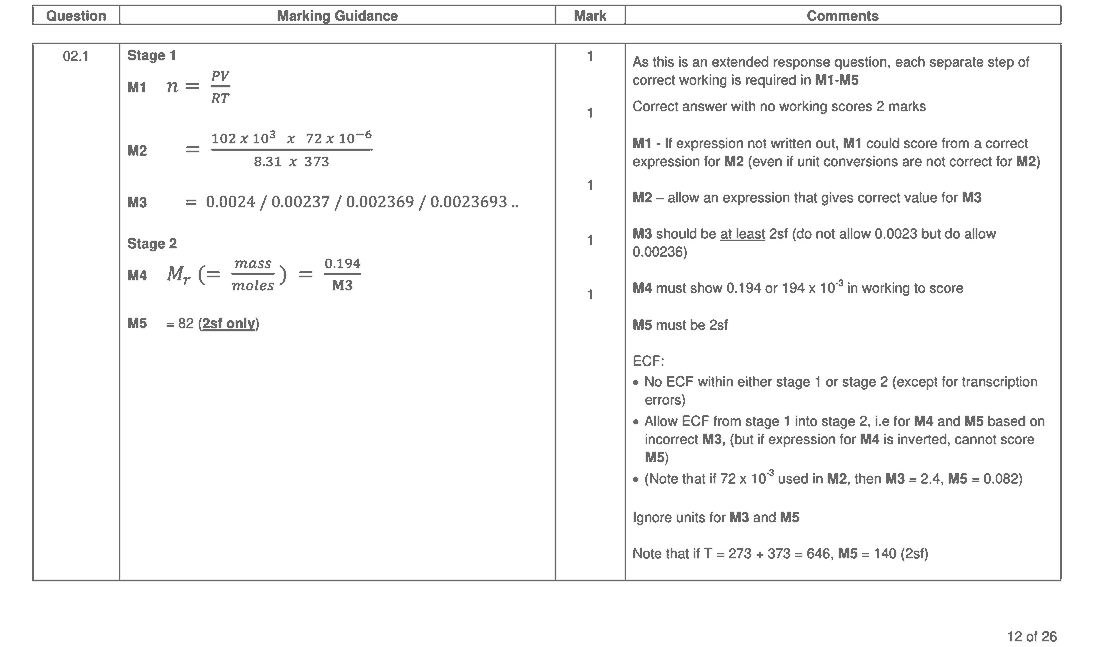
02.1 Amount of substance 5Calculation
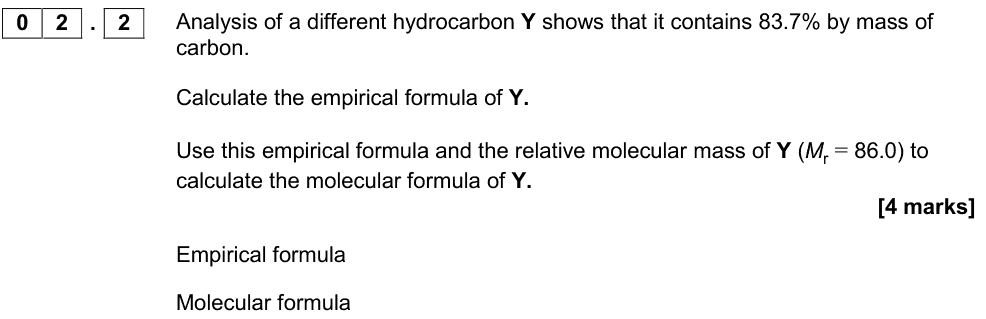
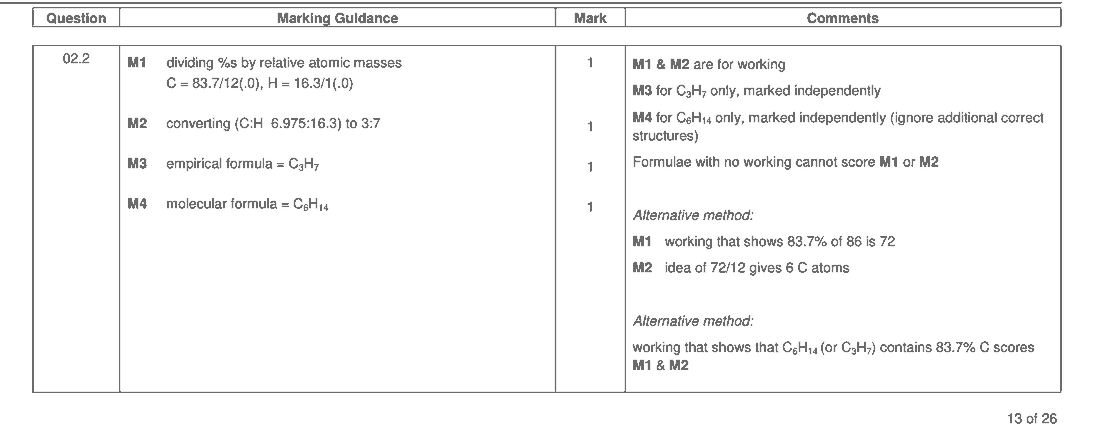
02.2 Amount of substance 4Calculation
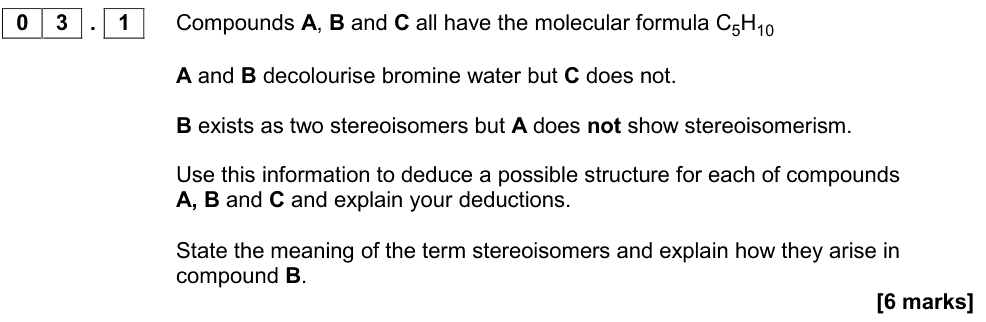
03.1 Introduction to organic chemistry: nomenclature, mechanisms and isomerism, Alkenes 6Level of response
04.1 Alkanes, Amount of substance 1Equation writing
04.2 Introduction to organic chemistry: nomenclature, mechanisms and isomerism 2Calculation
04.3 Energetics 1Short answer
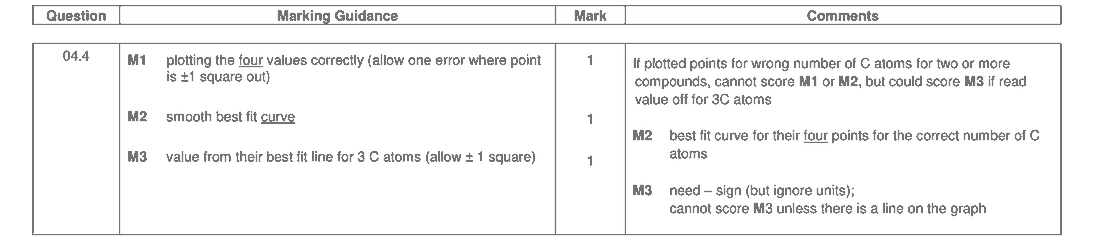
04.4 Energetics 3Practical and data analysis
04.5 Energetics 2Calculation
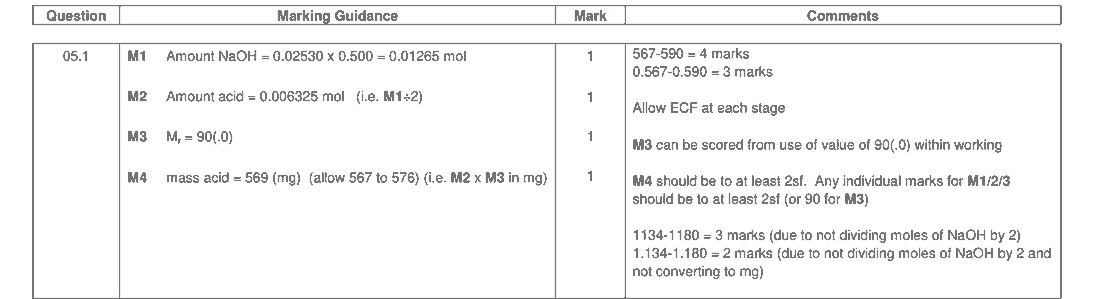
05.1 Amount of substance 4Calculation
05.2 Amount of substance 1Practical and data analysis
05.3 Amount of substance 1Practical and data analysis
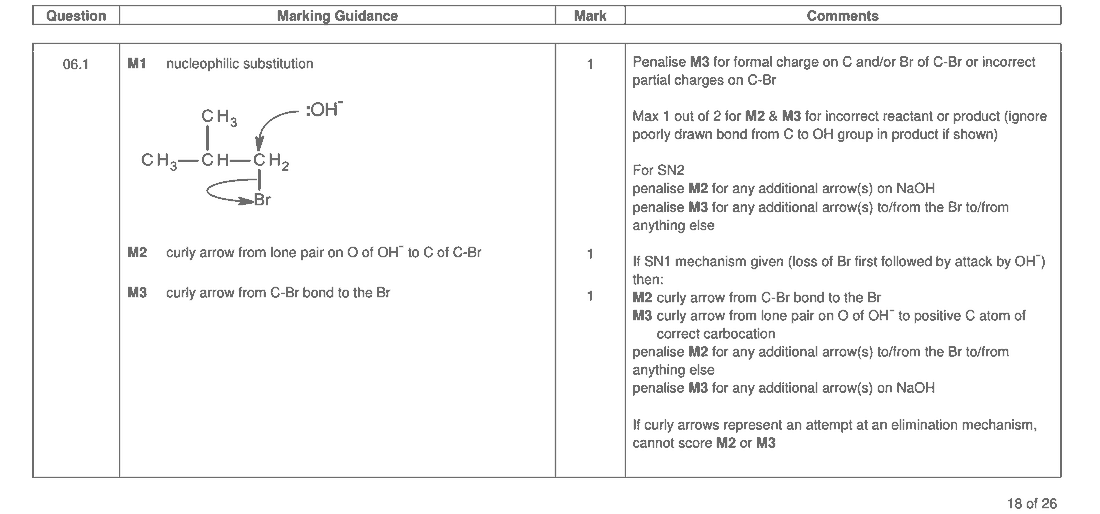
06.1 Halogenoalkanes 3Mechanism
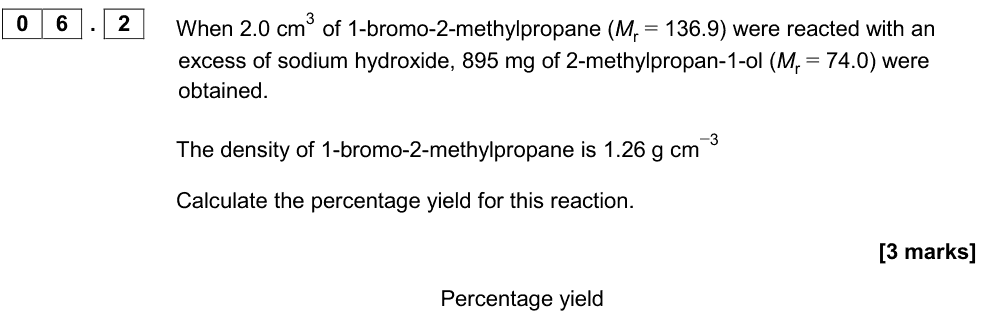
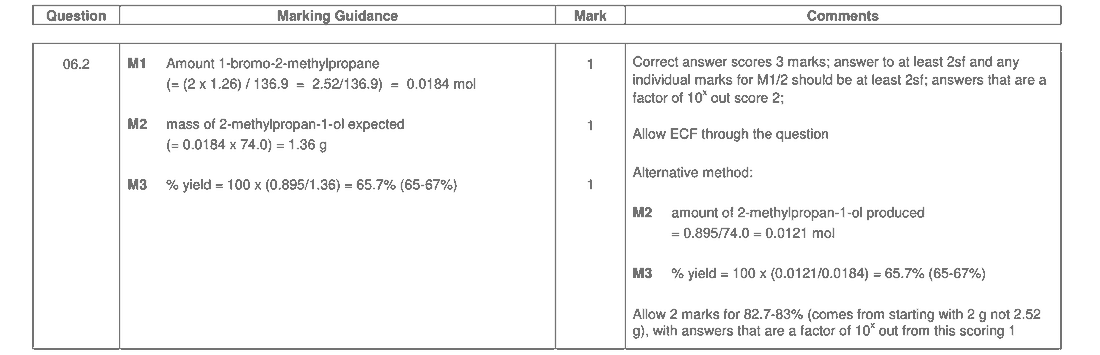
06.2 Amount of substance 3Calculation
06.3 Halogenoalkanes, Introduction to organic chemistry: nomenclature, mechanisms and isomerism 2Short answer
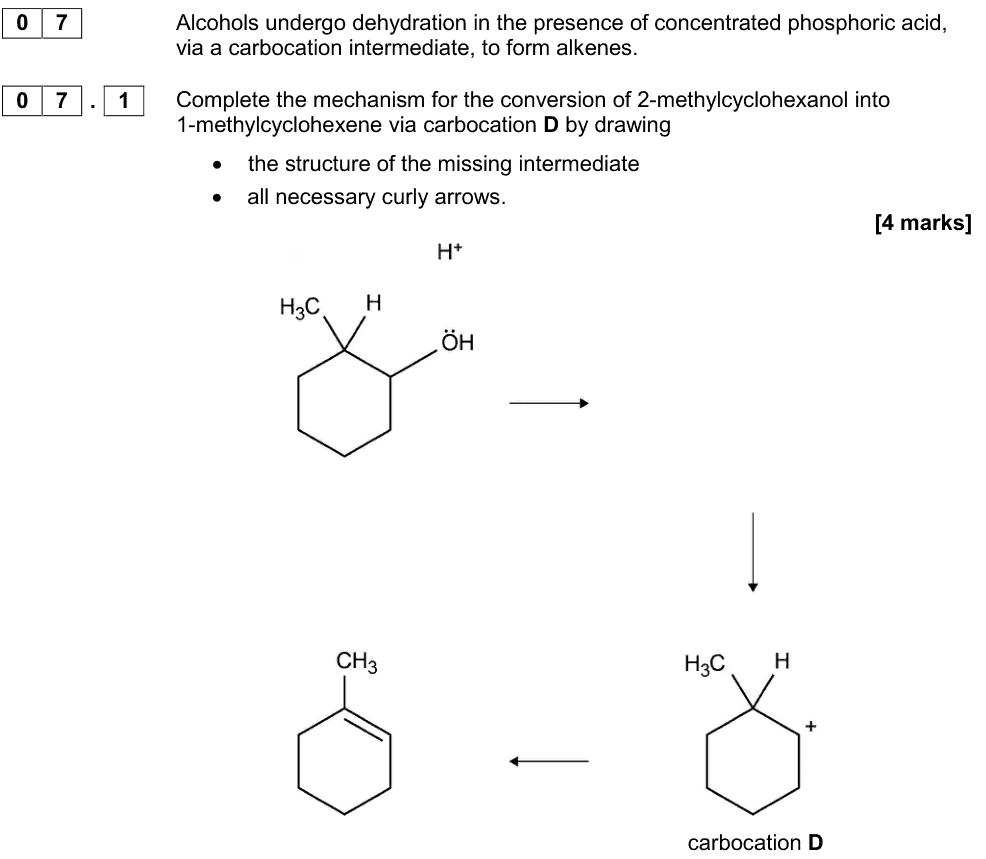
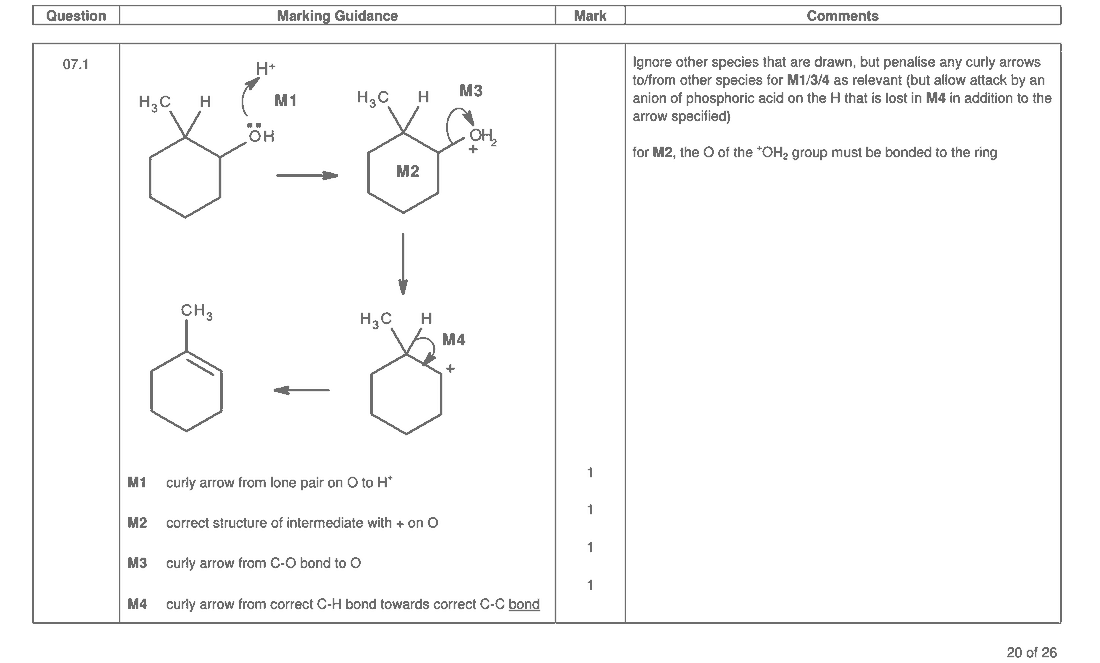
07.1 Alcohols 4Mechanism
07.2 Alcohols 1Diagram or structure
07.3 Alkenes 2Explanation
07.4 Alcohols 1Diagram or structure
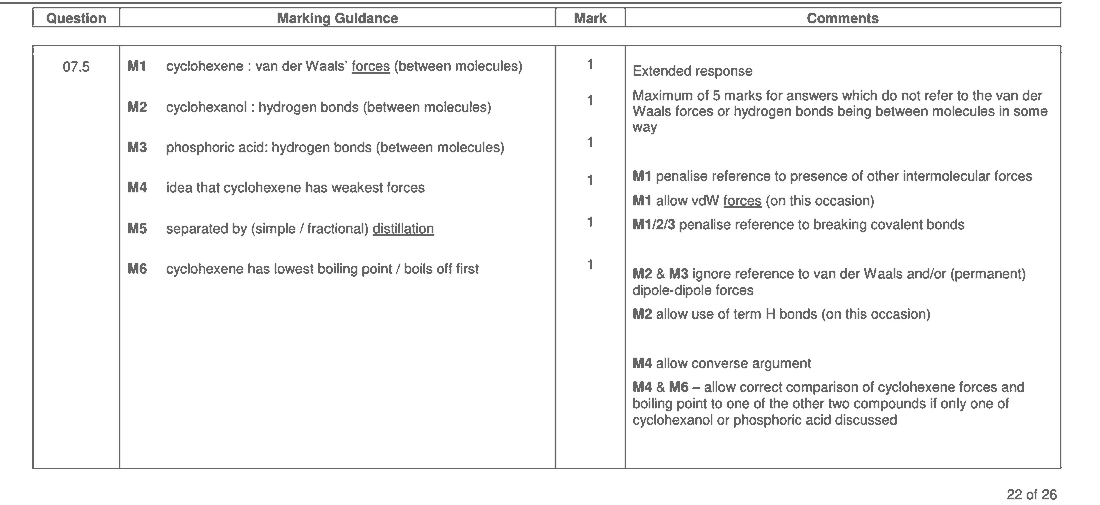
07.5 Bonding 6Explanation
08.1 Introduction to organic chemistry: nomenclature, mechanisms and isomerism 1Diagram or structure
08.2 Alkenes, Introduction to organic chemistry: nomenclature, mechanisms and isomerism 1Diagram or structure
08.3 Alkanes, Alkenes 1Diagram or structure
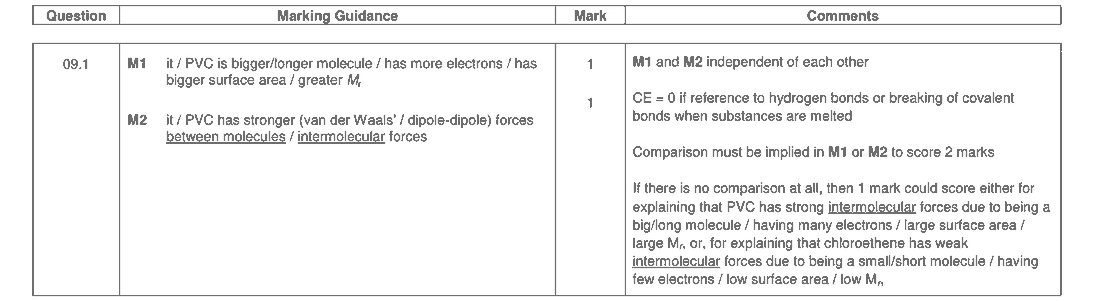
09.1 Alkenes, Bonding 2Explanation
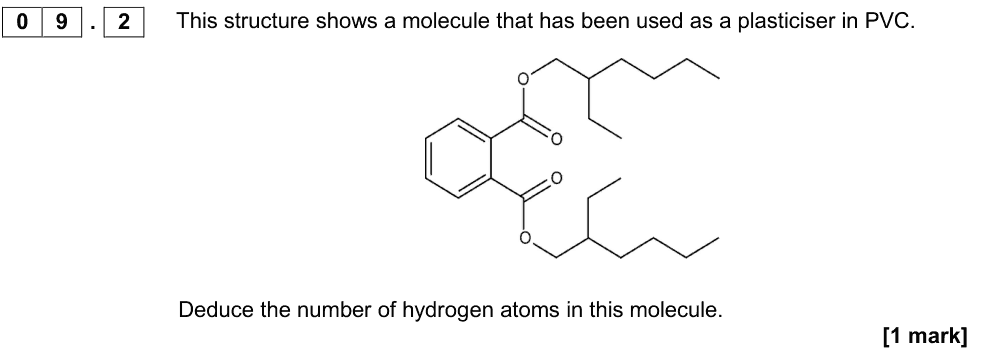
09.2 Introduction to organic chemistry: nomenclature, mechanisms and isomerism 1Short answer
09.3 Alkenes 1Short answer
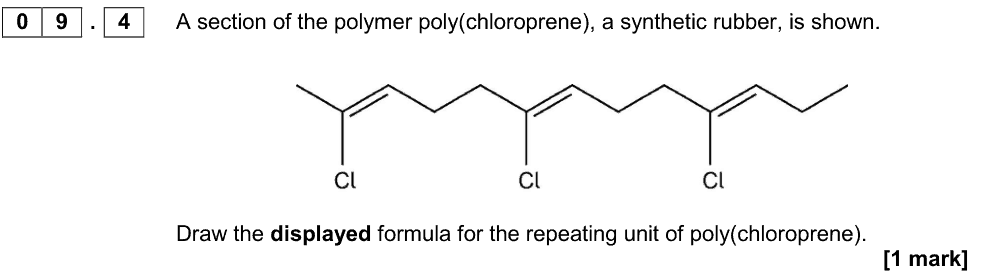
09.4 Alkenes 1Diagram or structure
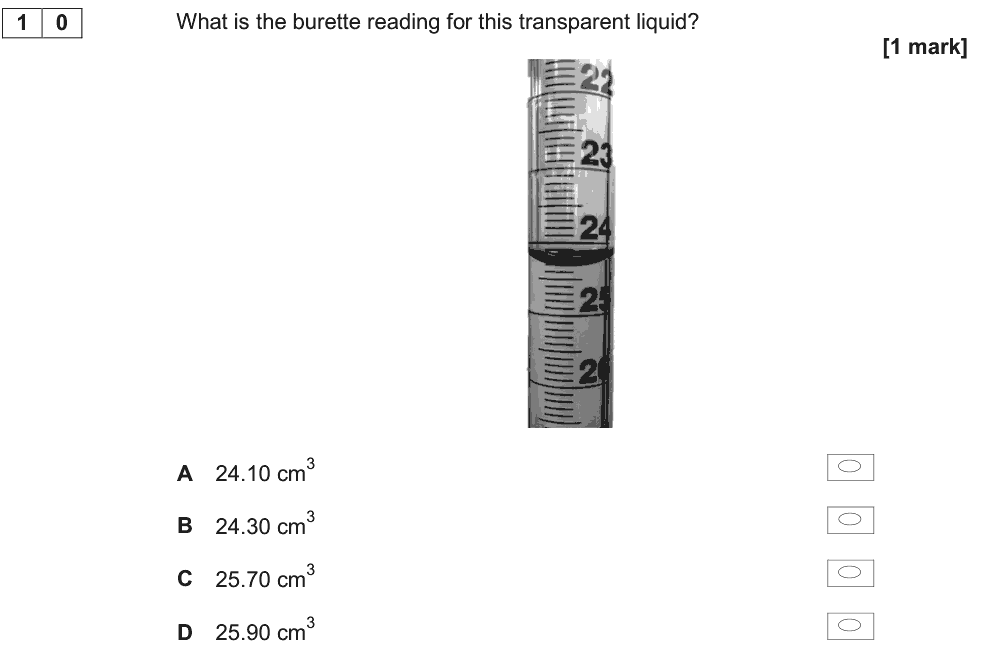
10 Amount of substance 1Multiple choice
11 Amount of substance 1Multiple choice
12 Organic analysis: test-tube reactions, mass spectrometry and infrared 1Multiple choice
13 Bonding 1Multiple choice
14 Introduction to organic chemistry: nomenclature, mechanisms and isomerism 1Multiple choice
15 Alkanes, Introduction to organic chemistry: nomenclature, mechanisms and isomerism 1Multiple choice
16 Halogenoalkanes 1Multiple choice
17 Alcohols 1Multiple choice
18 Introduction to organic chemistry: nomenclature, mechanisms and isomerism 1Multiple choice
19 Amount of substance 1Multiple choice
20 Organic analysis: test-tube reactions, mass spectrometry and infrared, Introduction to organic chemistry: nomenclature, mechanisms and isomerism 1Multiple choice
21 Chemical equilibria, Le Chatelier's principle and Kc 1Multiple choice
22 Amount of substance 1Multiple choice
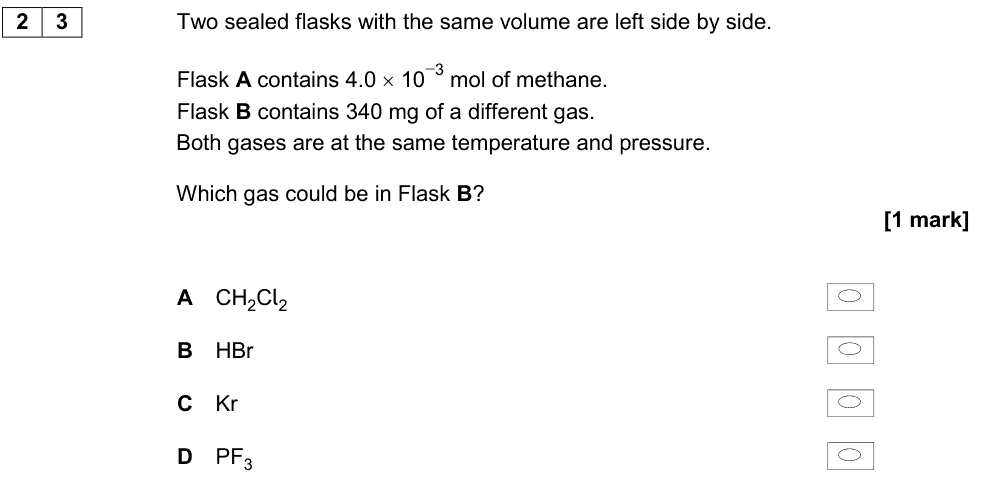
23 Amount of substance 1Multiple choice
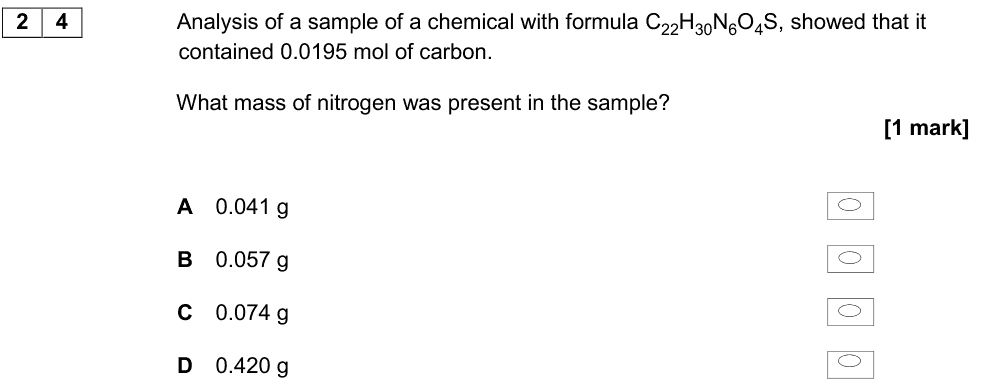
24 Amount of substance 1Multiple choice

The questions

01.101.201.302.102.203.104.104.204.304.404.505.105.205.306.106.206.307.107.207.307.407.508.108.208.309.109.209.309.4101112131415161718192021222324
June 2017 · AS Paper 2 · Q01.1 1 mark Short answer kinetics
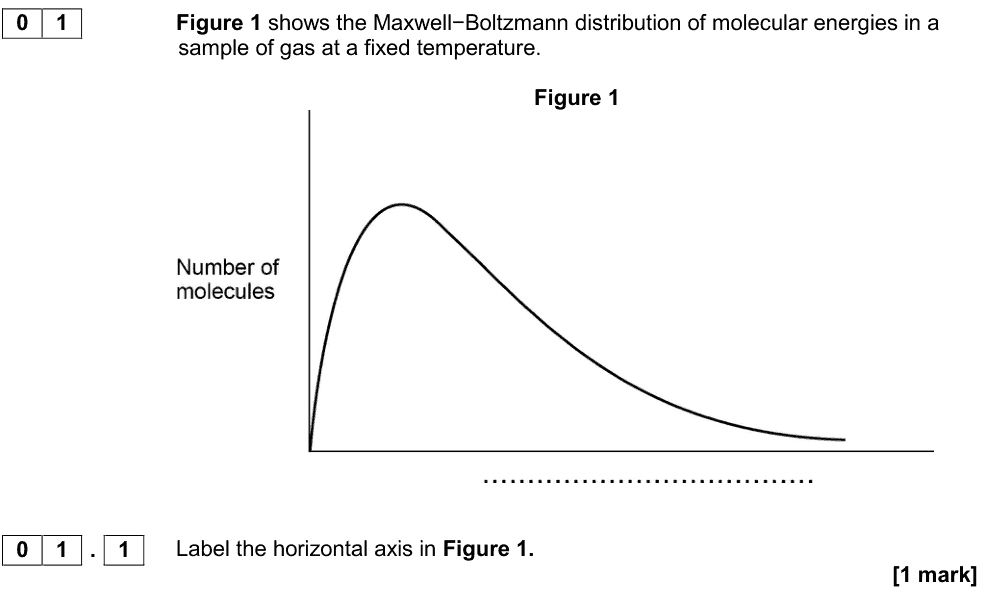
Figure 1 shows the Maxwell−Boltzmann distribution of molecular energies in a
sample of gas at a fixed temperature.
Figure 1
Label the horizontal axis in Figure 1.
[1 mark]
June 2017 · AS Paper 2 · Q01.2 2 marks Diagram or structure kinetics
Earlier part of question 01 that this part usesEarlier part of June 2017 Paper 2 question 01
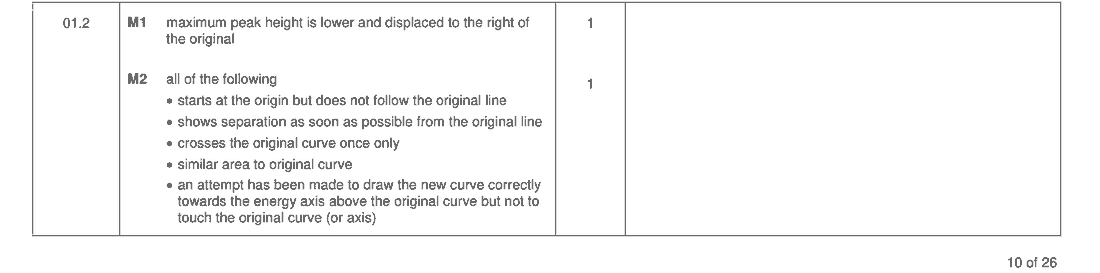
On Figure 1, sketch a distribution of molecular energies for this sample of gas at
a higher temperature.
[2 marks]
June 2017 · AS Paper 2 · Q01.3 2 marks Explanation kinetics
Earlier part of question 01 that this part usesEarlier part of June 2017 Paper 2 question 01
This gas decomposes on heating.
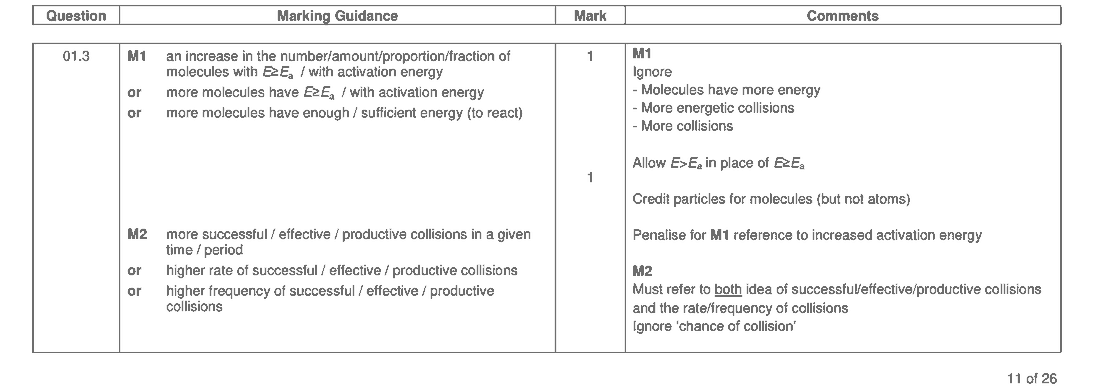
Explain why an increase in temperature increases the rate at which this gas
decomposes.
[2 marks]
June 2017 · AS Paper 2 · Q02.1 5 marks Calculation amount of substance
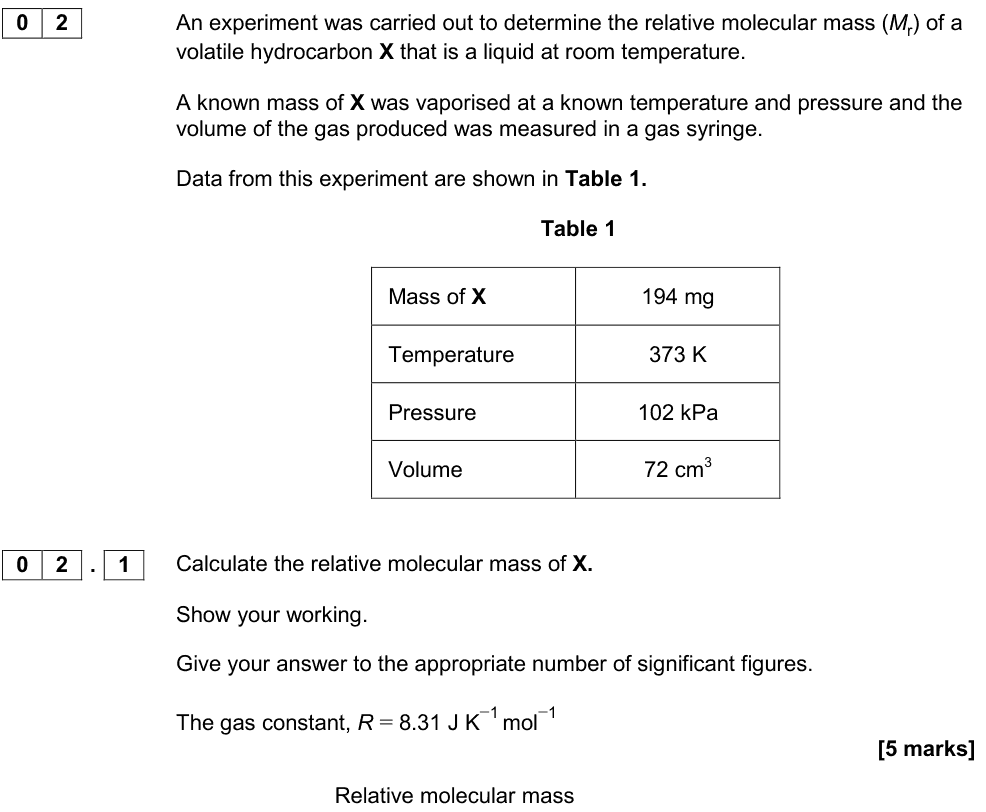
An experiment was carried out to determine the relative molecular mass (Mr) of a
volatile hydrocarbon X that is a liquid at room temperature.
A known mass of X was vaporised at a known temperature and pressure and the
volume of the gas produced was measured in a gas syringe.
Data from this experiment are shown in Table 1.
Table 1
Mass of X
194 mg
Temperature
373 K
Pressure
102 kPa
Volume
72 cm3
Calculate the relative molecular mass of X.
Show your working.
Give your answer to the appropriate number of significant figures.
The gas constant, R = 8.31 J K−1 mol−1
[5 marks]
Relative molecular mass
June 2017 · AS Paper 2 · Q02.2 4 marks Calculation amount of substance
Earlier part of question 02 that this part usesEarlier part of June 2017 Paper 2 question 02
Analysis of a different hydrocarbon Y shows that it contains 83.7% by mass of
carbon.
Calculate the empirical formula of Y.
Use this empirical formula and the relative molecular mass of Y (Mr = 86.0) to
calculate the molecular formula of Y.
[4 marks]
Empirical formula
Molecular formula
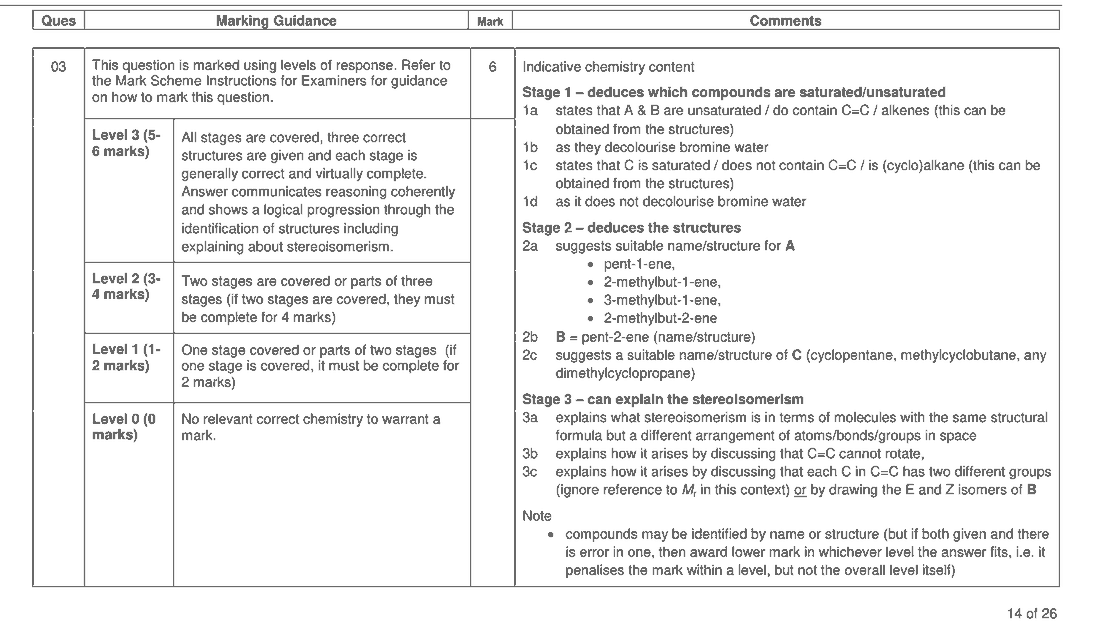
June 2017 · AS Paper 2 · Q03.1 6 marks 6-mark level of response introduction to organic chemistryalkenes
Compounds A, B and C all have the molecular formula C5H10
A and B decolourise bromine water but C does not.
B exists as two stereoisomers but A does not show stereoisomerism.
Use this information to deduce a possible structure for each of compounds
A, B and C and explain your deductions.
State the meaning of the term stereoisomers and explain how they arise in
compound B.
[6 marks]
June 2017 · AS Paper 2 · Q04.1 1 mark Equation writing alkanesamount of substance
When alkanes are burned in an excess of oxygen they produce carbon dioxide
and water.
Write an equation for the complete combustion of propane in oxygen.
[1 mark]
June 2017 · AS Paper 2 · Q04.2 2 marks Calculation introduction to organic chemistry
Earlier part of question 04 that this part usesEarlier part of June 2017 Paper 2 question 04
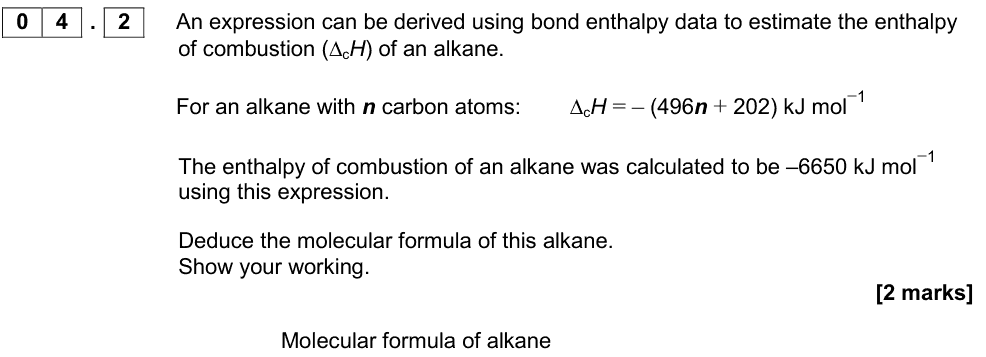
An expression can be derived using bond enthalpy data to estimate the enthalpy
of combustion (∆cH) of an alkane.
For an alkane with n carbon atoms:        ∆cH = – (496n + 202) kJ mol−1
The enthalpy of combustion of an alkane was calculated to be –6650 kJ mol−1
using this expression.
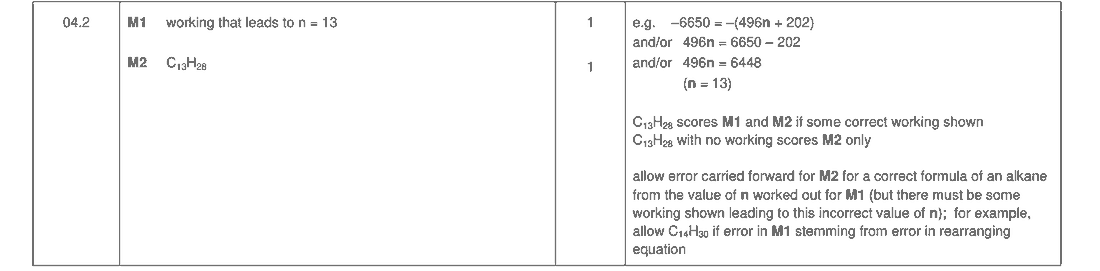
Deduce the molecular formula of this alkane.
Show your working.
[2 marks]
Molecular formula of alkane
June 2017 · AS Paper 2 · Q04.3 1 mark Short answer energetics
Earlier part of question 04 that this part usesEarlier part of June 2017 Paper 2 question 04
Suggest one reason, other than the use of mean bond enthalpies, why a value for
the enthalpy of combustion of a liquid alkane is different from the value obtained
using the expression in Question 4.2
[1 mark]
June 2017 · AS Paper 2 · Q04.4 3 marks Practical and data analysis energetics
Earlier part of question 04 that this part usesEarlier part of June 2017 Paper 2 question 04
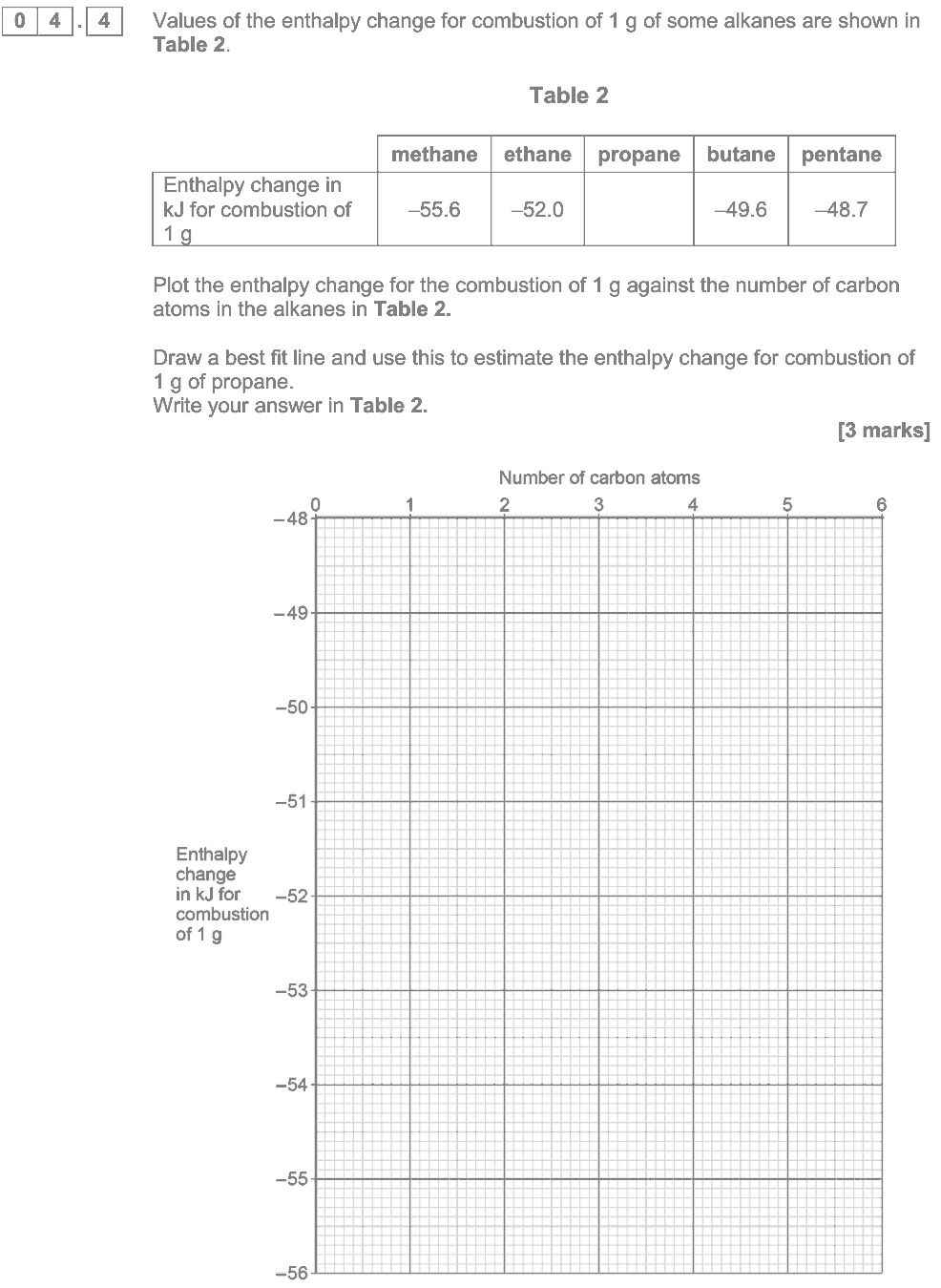
Values of the enthalpy change for combustion of 1 g of some alkanes are shown in
Table 2.
Table 2
methane
ethane
propane
butane
pentane
Enthalpy change in
kJ for combustion of
1 g
–55.6
–52.0
–49.6
–48.7
Plot the enthalpy change for the combustion of 1 g against the number of carbon
atoms in the alkanes in Table 2.
Draw a best fit line and use this to estimate the enthalpy change for combustion of
1 g of propane.
Write your answer in Table 2.
[3 marks]
June 2017 · AS Paper 2 · Q04.5 2 marks Calculation energetics
Earlier part of question 04 that this part usesEarlier part of June 2017 Paper 2 question 04
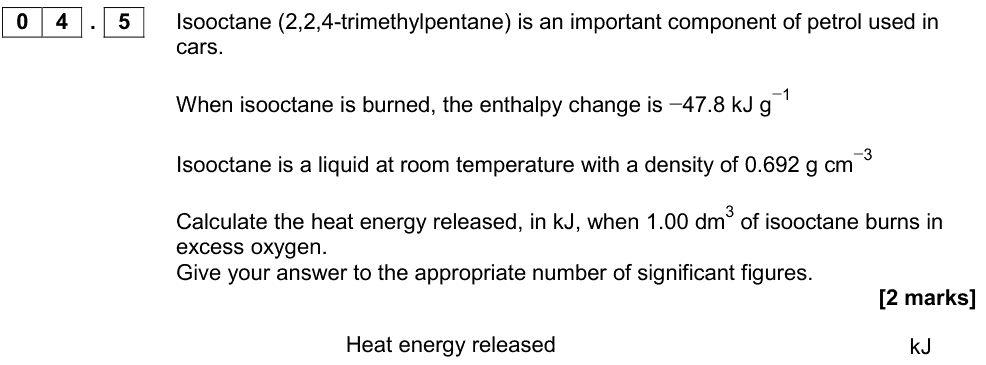
Isooctane (2,2,4-trimethylpentane) is an important component of petrol used in
cars.
When isooctane is burned, the enthalpy change is −47.8 kJ g−1
Isooctane is a liquid at room temperature with a density of 0.692 g cm−3
Calculate the heat energy released, in kJ, when 1.00 dm3 of isooctane burns in
excess oxygen.
Give your answer to the appropriate number of significant figures.
[2 marks]
Heat energy released
kJ
June 2017 · AS Paper 2 · Q05.1 4 marks Calculation amount of substance
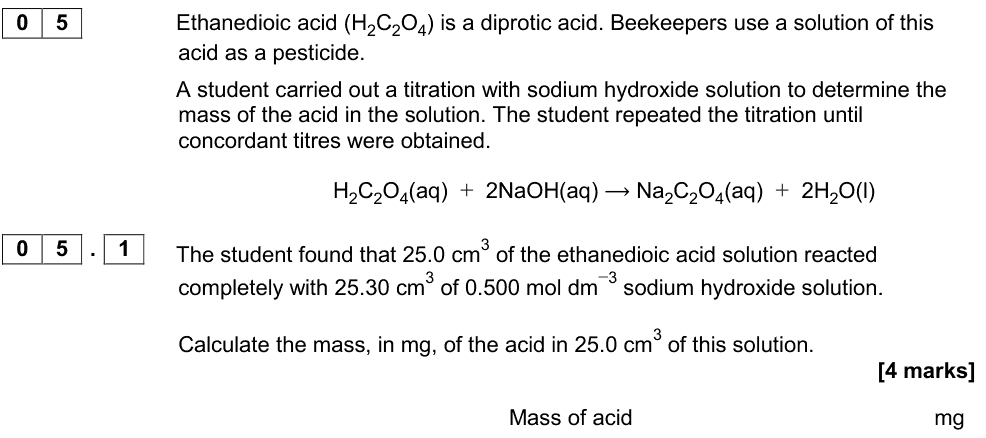
Ethanedioic acid (H2C2O4) is a diprotic acid. Beekeepers use a solution of this
acid as a pesticide.
A student carried out a titration with sodium hydroxide solution to determine the
mass of the acid in the solution. The student repeated the titration until
concordant titres were obtained.
H2C2O4(aq)  +  2NaOH(aq) ⟶ Na2C2O4(aq)  +  2H2O(l)
The student found that 25.0 cm3 of the ethanedioic acid solution reacted
completely with 25.30 cm3 of 0.500 mol dm−3 sodium hydroxide solution.
Calculate the mass, in mg, of the acid in 25.0 cm3 of this solution.
[4 marks]
Mass of acid
mg
June 2017 · AS Paper 2 · Q05.2 1 mark Practical and data analysis amount of substance
Earlier part of question 05 that this part usesEarlier part of June 2017 Paper 2 question 05
The student used a wash bottle containing deionised water when approaching the
end-point to rinse the inside of the conical flask.
Explain why this improved the accuracy of the titration.
[1 mark]
June 2017 · AS Paper 2 · Q05.3 1 mark Practical and data analysis amount of substance
Earlier part of question 05 that this part usesEarlier part of June 2017 Paper 2 question 05
Give the meaning of the term concordant titres.
[1 mark]
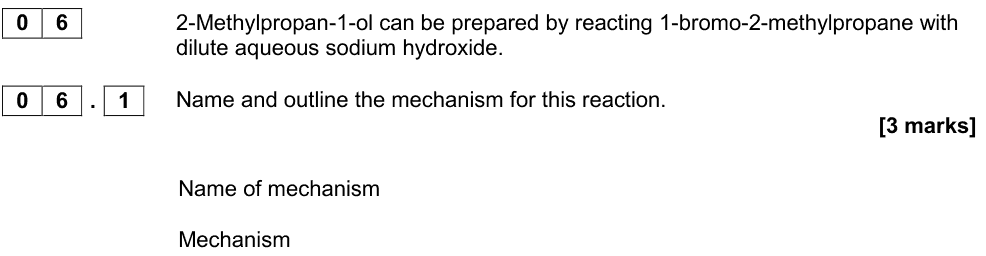
June 2017 · AS Paper 2 · Q06.1 3 marks Mechanism halogenoalkanes
2-Methylpropan-1-ol can be prepared by reacting 1-bromo-2-methylpropane with
dilute aqueous sodium hydroxide.
Name and outline the mechanism for this reaction.
[3 marks]
Name of mechanism
Mechanism
June 2017 · AS Paper 2 · Q06.2 3 marks Calculation amount of substance
Earlier part of question 06 that this part usesEarlier part of June 2017 Paper 2 question 06
When 2.0 cm3  of 1-bromo-2-methylpropane (Mr = 136.9) were reacted with an
excess of sodium hydroxide, 895 mg of 2-methylpropan-1-ol (Mr = 74.0) were
obtained.
The density of 1-bromo-2-methylpropane is 1.26 g cm−3
Calculate the percentage yield for this reaction.
[3 marks]
Percentage yield
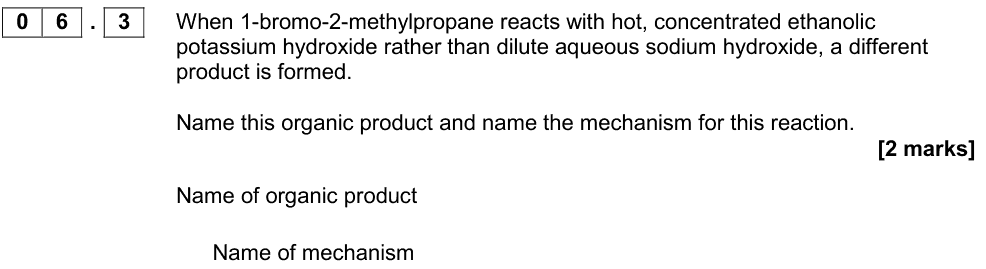
June 2017 · AS Paper 2 · Q06.3 2 marks Short answer halogenoalkanesintroduction to organic chemistry
Earlier part of question 06 that this part usesEarlier part of June 2017 Paper 2 question 06
When 1-bromo-2-methylpropane reacts with hot, concentrated ethanolic
potassium hydroxide rather than dilute aqueous sodium hydroxide, a different
product is formed.
Name this organic product and name the mechanism for this reaction.
[2 marks]
Name of organic product
Name of mechanism
June 2017 · AS Paper 2 · Q07.1 4 marks Mechanism alcohols
Alcohols undergo dehydration in the presence of concentrated phosphoric acid,
via a carbocation intermediate, to form alkenes.
Complete the mechanism for the conversion of 2-methylcyclohexanol into
1-methylcyclohexene via carbocation D by drawing
•
the structure of the missing intermediate
•
all necessary curly arrows.
[4 marks]
carbocation D
carbocation D
June 2017 · AS Paper 2 · Q07.2 1 mark Diagram or structure alcohols
Earlier part of question 07 that this part usesEarlier part of June 2017 Paper 2 question 07
Draw the structure of a different cyclic alkene formed from carbocation D.
[1 mark]
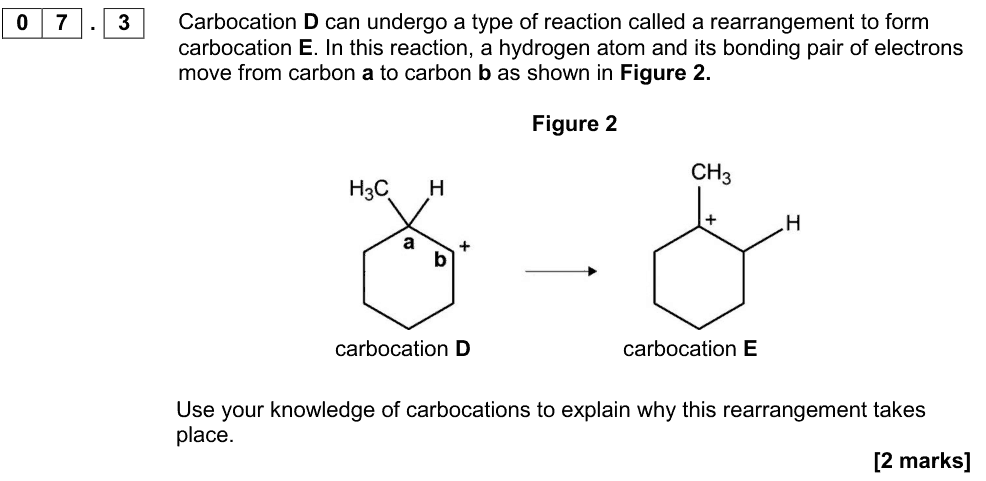
June 2017 · AS Paper 2 · Q07.3 2 marks Explanation alkenes
Earlier part of question 07 that this part usesEarlier part of June 2017 Paper 2 question 07
Carbocation D can undergo a type of reaction called a rearrangement to form
carbocation E. In this reaction, a hydrogen atom and its bonding pair of electrons
move from carbon a to carbon b as shown in Figure 2.
Figure 2
Use your knowledge of carbocations to explain why this rearrangement takes
place.
[2 marks]
carbocation D
carbocation E
June 2017 · AS Paper 2 · Q07.4 1 mark Diagram or structure alcohols
Earlier part of question 07 that this part usesEarlier part of June 2017 Paper 2 question 07
As a result of the rearrangement in Question 7.3, a third alkene is formed in this
reaction.
Draw the structure of this third alkene.
[1 mark]
June 2017 · AS Paper 2 · Q07.5 6 marks Explanation bonding
Earlier part of question 07 that this part usesEarlier part of June 2017 Paper 2 question 07
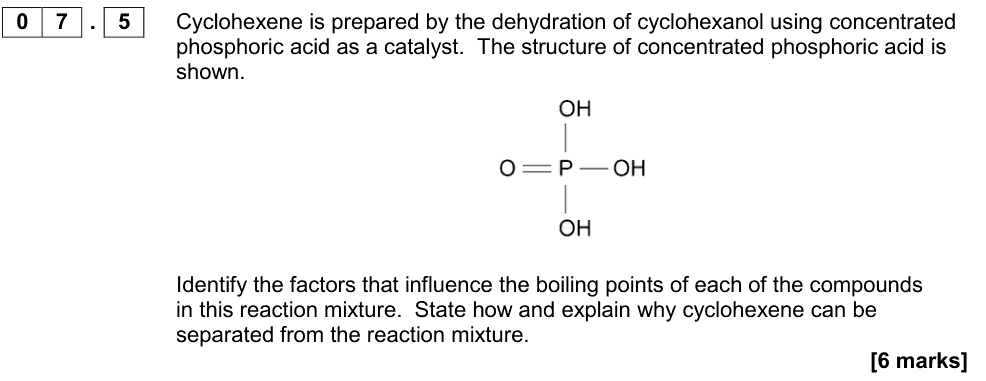
Cyclohexene is prepared by the dehydration of cyclohexanol using concentrated
phosphoric acid as a catalyst.  The structure of concentrated phosphoric acid is
shown.
Identify the factors that influence the boiling points of each of the compounds
in this reaction mixture.  State how and explain why cyclohexene can be
separated from the reaction mixture.
[6 marks]
June 2017 · AS Paper 2 · Q08.1 1 mark Diagram or structure introduction to organic chemistry
This question is about the structures of some organic molecules.
Draw the skeletal formula of 3-methylbutanal.
[1 mark]
June 2017 · AS Paper 2 · Q08.2 1 mark Diagram or structure alkenesintroduction to organic chemistry
Earlier part of question 08 that this part usesEarlier part of June 2017 Paper 2 question 08
Draw the displayed formula of C5H11Br that is the major product of the reaction
of 2-methylbut-2-ene with hydrogen bromide.
[1 mark]
June 2017 · AS Paper 2 · Q08.3 1 mark Diagram or structure alkanesalkenes
Earlier part of question 08 that this part usesEarlier part of June 2017 Paper 2 question 08
Thermal cracking of hydrocarbons produces molecules that are attacked by
electrophiles because they have a region of high electron density.
Draw the structure of one of these molecules that contains four carbon atoms.
[1 mark]
June 2017 · AS Paper 2 · Q09.1 2 marks Explanation alkenesbonding
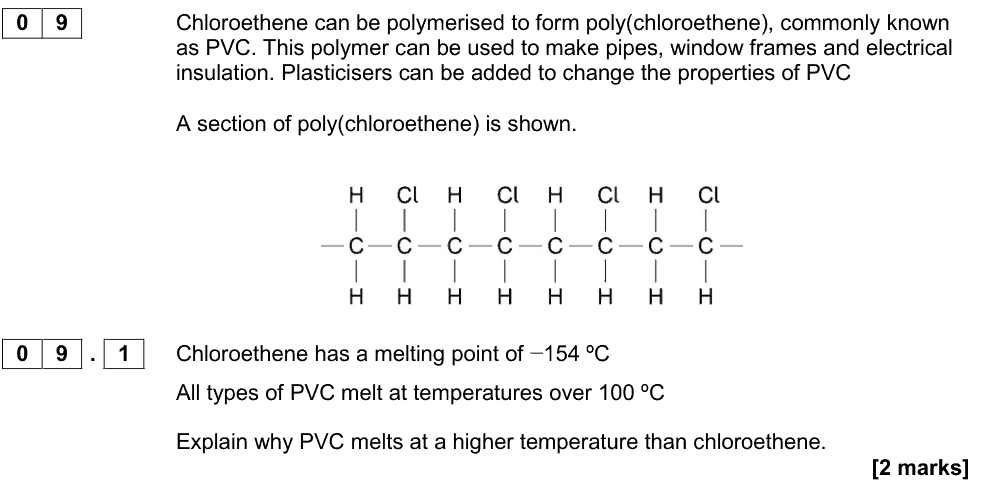
Chloroethene can be polymerised to form poly(chloroethene), commonly known
as PVC. This polymer can be used to make pipes, window frames and electrical
insulation. Plasticisers can be added to change the properties of PVC
A section of poly(chloroethene) is shown.
Chloroethene has a melting point of −154 ºC
All types of PVC melt at temperatures over 100 ºC
Explain why PVC melts at a higher temperature than chloroethene.
[2 marks]
June 2017 · AS Paper 2 · Q09.2 1 mark Short answer introduction to organic chemistry
Earlier part of question 09 that this part usesEarlier part of June 2017 Paper 2 question 09
This structure shows a molecule that has been used as a plasticiser in PVC.
Deduce the number of hydrogen atoms in this molecule.
[1 mark]
June 2017 · AS Paper 2 · Q09.3 1 mark Short answer alkenes
Earlier part of question 09 that this part usesEarlier part of June 2017 Paper 2 question 09
Use your understanding of the properties of PVC to explain whether you would
expect to find a plasticiser in the PVC used to insulate electrical cables.
[1 mark]
June 2017 · AS Paper 2 · Q09.4 1 mark Diagram or structure alkenes
Earlier part of question 09 that this part usesEarlier part of June 2017 Paper 2 question 09
A section of the polymer poly(chloroprene), a synthetic rubber, is shown.
Draw the displayed formula for the repeating unit of poly(chloroprene).
[1 mark]
June 2017 · AS Paper 2 · Q10 1 mark Multiple choice Easy amount of substance
What is the burette reading for this transparent liquid?
[1 mark]
A 24.10 cm3
B 24.30 cm3
C 25.70 cm3
D 25.90 cm3
June 2017 · AS Paper 2 · Q11 1 mark Multiple choice Hard amount of substance
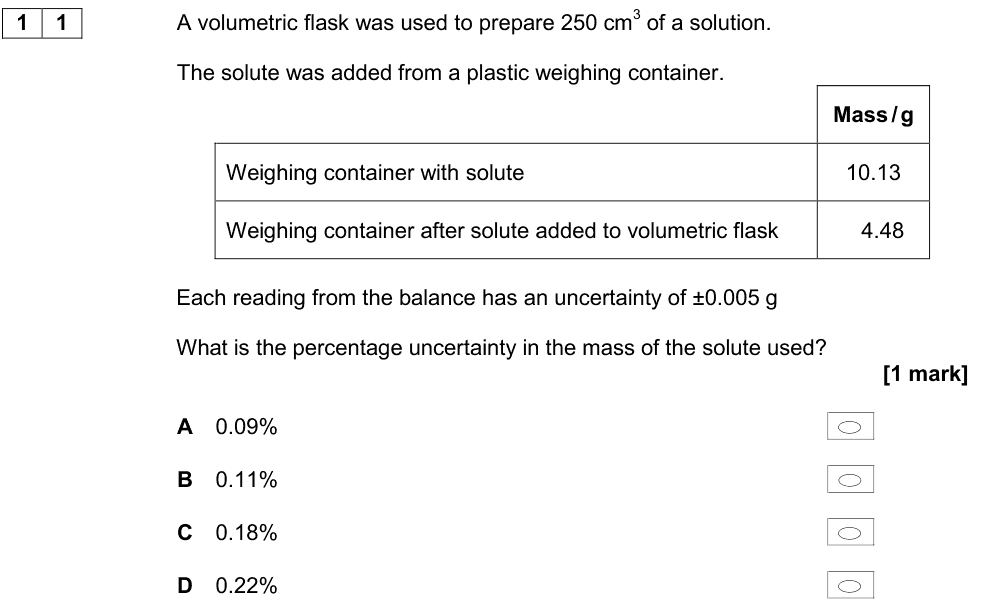
A volumetric flask was used to prepare 250 cm3 of a solution.
The solute was added from a plastic weighing container.
Mass / g
Weighing container with solute
10.13
Weighing container after solute added to volumetric flask
4.48
Each reading from the balance has an uncertainty of ±0.005 g
What is the percentage uncertainty in the mass of the solute used?
[1 mark]
A 0.09%
B 0.11%
C 0.18%
D 0.22%
June 2017 · AS Paper 2 · Q12 1 mark Multiple choice organic analysis
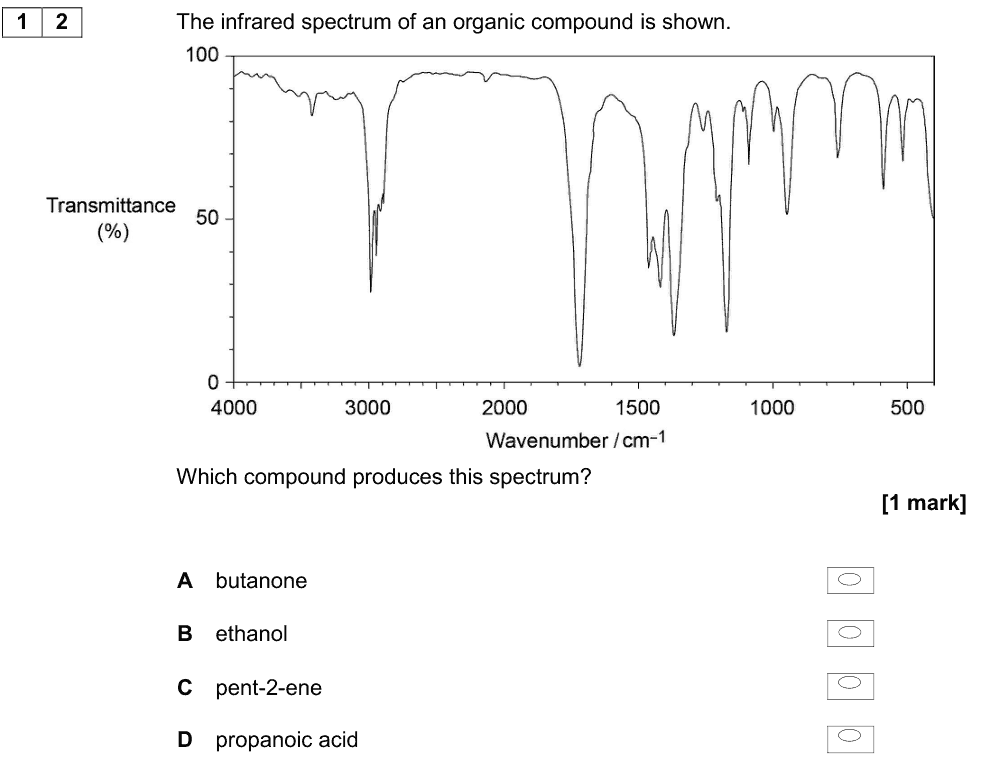
The infrared spectrum of an organic compound is shown.
Which compound produces this spectrum?
[1 mark]
A butanone
B ethanol
C pent-2-ene
D propanoic acid
June 2017 · AS Paper 2 · Q13 1 mark Multiple choice bonding
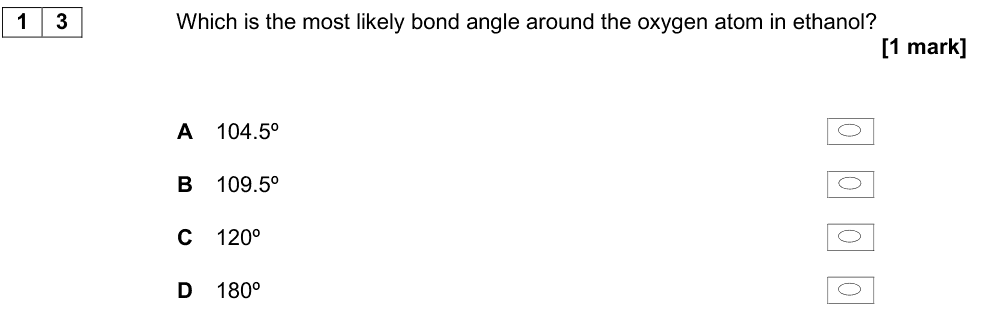
Which is the most likely bond angle around the oxygen atom in ethanol?
[1 mark]
A 104.5º
B 109.5º
C 120º
D 180º
June 2017 · AS Paper 2 · Q14 1 mark Multiple choice introduction to organic chemistry
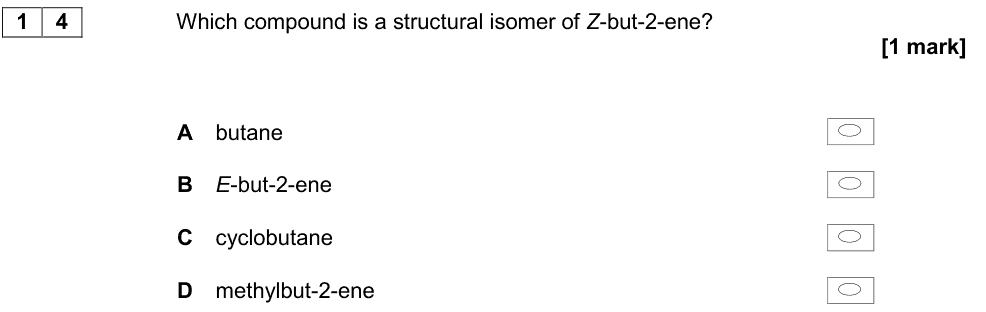
Which compound is a structural isomer of Z-but-2-ene?
[1 mark]
A butane
B E-but-2-ene
C cyclobutane
D methylbut-2-ene
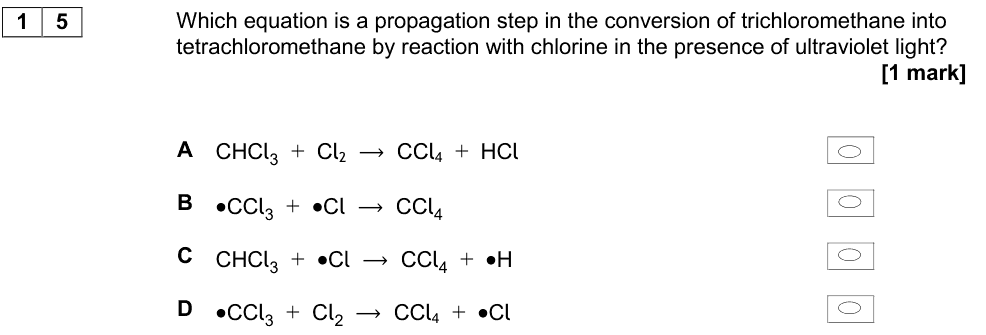
June 2017 · AS Paper 2 · Q15 1 mark Multiple choice Easy alkanesintroduction to organic chemistry
Which equation is a propagation step in the conversion of trichloromethane into
tetrachloromethane by reaction with chlorine in the presence of ultraviolet light?
[1 mark]
A CHCl3  +  Cl2  ⟶  CCl4  +  HCl
B •CCl3  +  •Cl  ⟶  CCl4
C CHCl3  +  •Cl  ⟶  CCl4  +  •H
D •CCl3  +  Cl2  ⟶  CCl4  +  •Cl
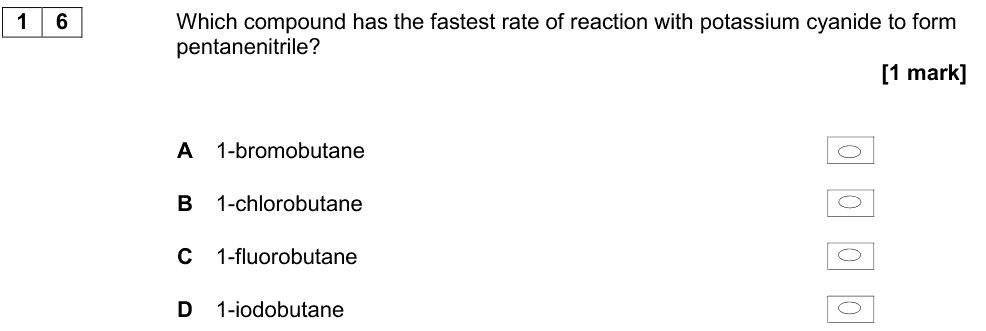
June 2017 · AS Paper 2 · Q16 1 mark Multiple choice halogenoalkanes
Which compound has the fastest rate of reaction with potassium cyanide to form
pentanenitrile?
[1 mark]
A 1-bromobutane
B 1-chlorobutane
C 1-fluorobutane
D 1-iodobutane
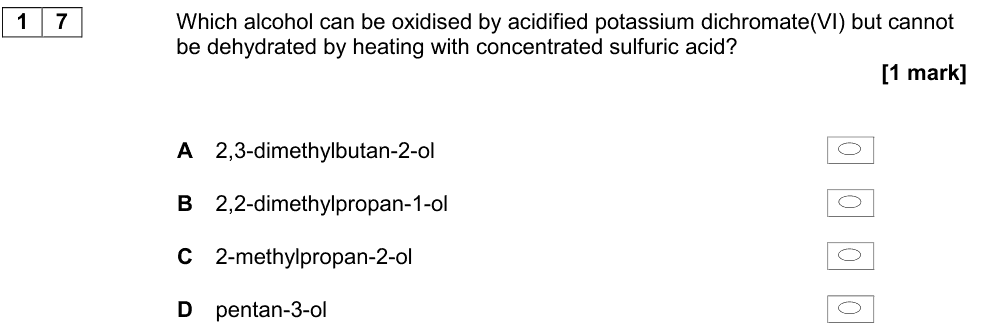
June 2017 · AS Paper 2 · Q17 1 mark Multiple choice alcohols
Which alcohol can be oxidised by acidified potassium dichromate(VI) but cannot
be dehydrated by heating with concentrated sulfuric acid?
[1 mark]
A 2,3-dimethylbutan-2-ol
B 2,2-dimethylpropan-1-ol
C 2-methylpropan-2-ol
D pentan-3-ol
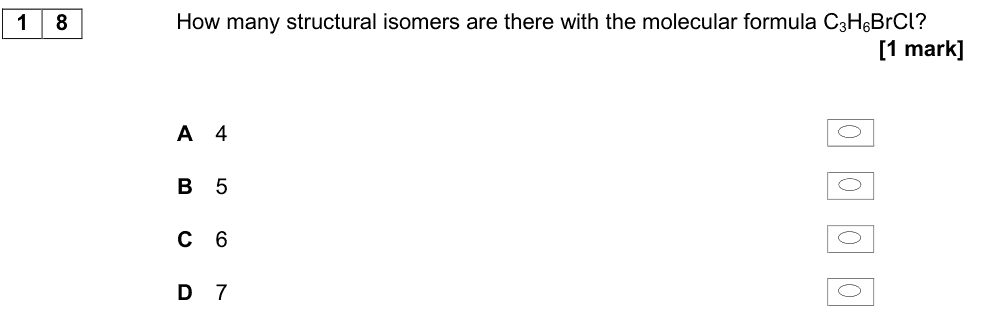
June 2017 · AS Paper 2 · Q18 1 mark Multiple choice Hard introduction to organic chemistry
How many structural isomers are there with the molecular formula C3H6BrCl?
[1 mark]
A 4
B 5
C 6
D 7
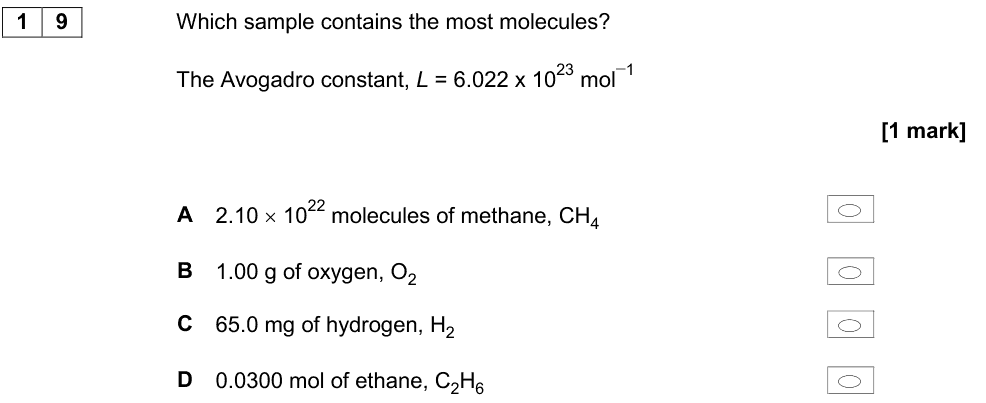
June 2017 · AS Paper 2 · Q19 1 mark Multiple choice amount of substance
Which sample contains the most molecules?
The Avogadro constant, L = 6.022 x 10²³ mol−1
[1 mark]
A 2.10 × 10²² molecules of methane, CH4
B 1.00 g of oxygen, O2
C 65.0 mg of hydrogen, H2
D 0.0300 mol of ethane, C2H6
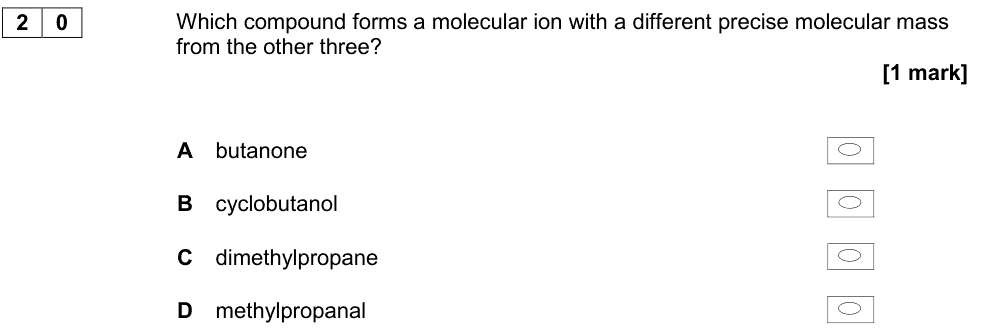
June 2017 · AS Paper 2 · Q20 1 mark Multiple choice organic analysisintroduction to organic chemistry
Which compound forms a molecular ion with a different precise molecular mass
from the other three?
[1 mark]
A butanone
B cyclobutanol
C dimethylpropane
D methylpropanal
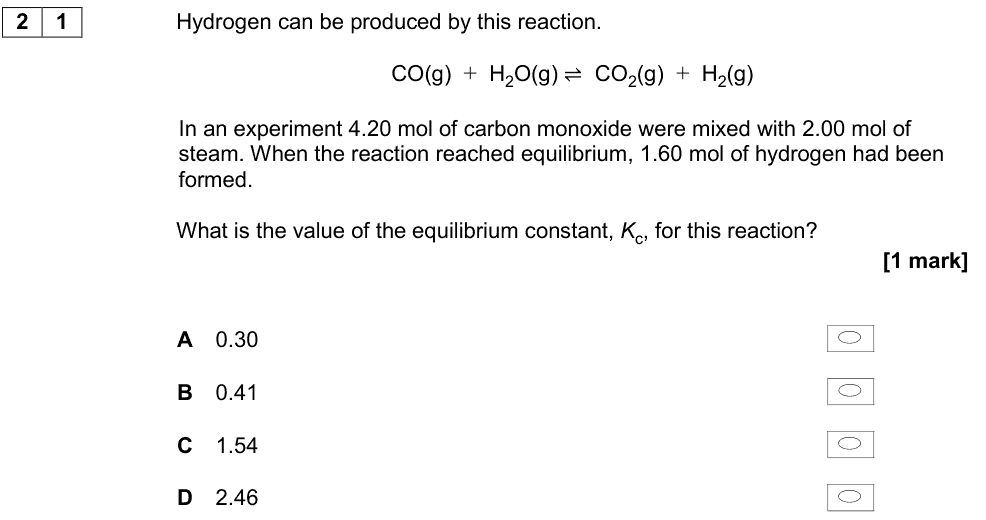
June 2017 · AS Paper 2 · Q21 1 mark Multiple choice chemical equilibria and kc
Hydrogen can be produced by this reaction.
CO(g)  +  H2O(g) ⇌  CO2(g)  +  H2(g)
In an experiment 4.20 mol of carbon monoxide were mixed with 2.00 mol of
steam. When the reaction reached equilibrium, 1.60 mol of hydrogen had been
formed.
What is the value of the equilibrium constant, Kc, for this reaction?
[1 mark]
A 0.30
B 0.41
C 1.54
D 2.46
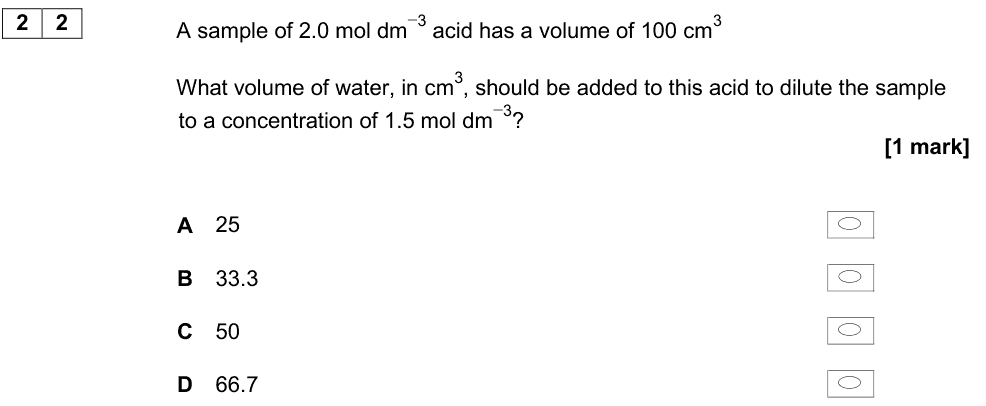
June 2017 · AS Paper 2 · Q22 1 mark Multiple choice amount of substance
A sample of 2.0 mol dm−3 acid has a volume of 100 cm3
What volume of water, in cm3, should be added to this acid to dilute the sample
to a concentration of 1.5 mol dm−3?
[1 mark]
A 25
B 33.3
C 50
D 66.7
June 2017 · AS Paper 2 · Q23 1 mark Multiple choice amount of substance
Two sealed flasks with the same volume are left side by side.
Flask A contains 4.0 × 10⁻³ mol of methane.
Flask B contains 340 mg of a different gas.
Both gases are at the same temperature and pressure.
Which gas could be in Flask B?
[1 mark]
A CH2Cl2
B HBr
C Kr
D PF3
June 2017 · AS Paper 2 · Q24 1 mark Multiple choice amount of substance
Analysis of a sample of a chemical with formula C22H30N6O4S, showed that it
contained 0.0195 mol of carbon.
What mass of nitrogen was present in the sample?
[1 mark]
A 0.041 g
B 0.057 g
C 0.074 g
D 0.420 g

Work with an A-level chemistry tutor

Want a paper marked and gone through with you? Message us.

Prefer email? Send an enquiry

If you are under 18, please include a parent's contact details. Enquiries go to enquiries@chemistryaleveltutor.com and are deleted once handled. All tutoring is online.