
June 2017: AS Paper 1, Inorganic and physical chemistry

80 marks · 43 question parts · Paper, mark scheme and report on AQA's site · Have the Data Booklet beside you

Question by question

QTopicMarksAOType
01.1 Atomic structure 2Short answer
01.2 Atomic structure 1Equation writing
01.3 Atomic structure, Periodicity 3Explanation
01.4 Atomic structure 3Calculation
02.1 Energetics, Amount of substance 1Equation writing
02.2 Energetics 3Calculation
02.3 Energetics 3Calculation
02.4 Energetics 1Short answer
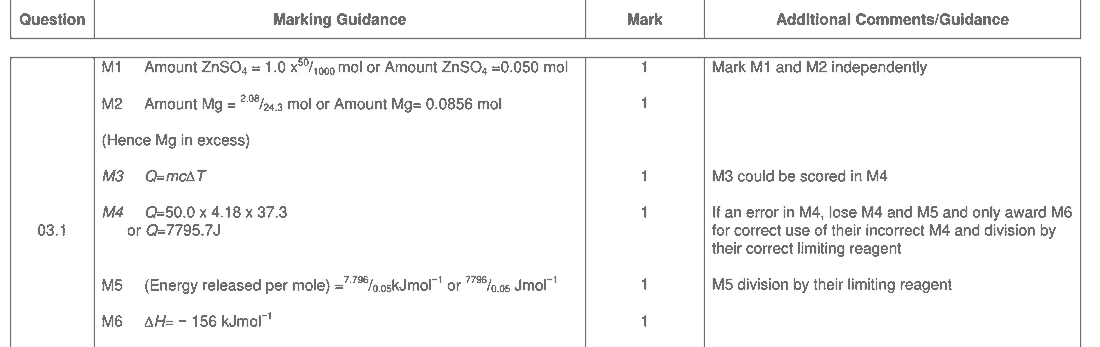
03.1 Energetics, Amount of substance 6Calculation
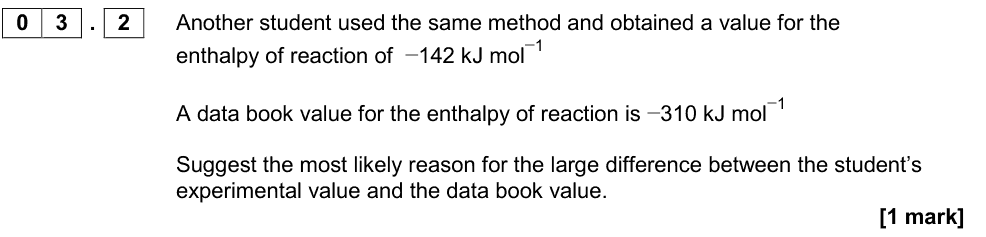
03.2 Energetics 1Practical and data analysis
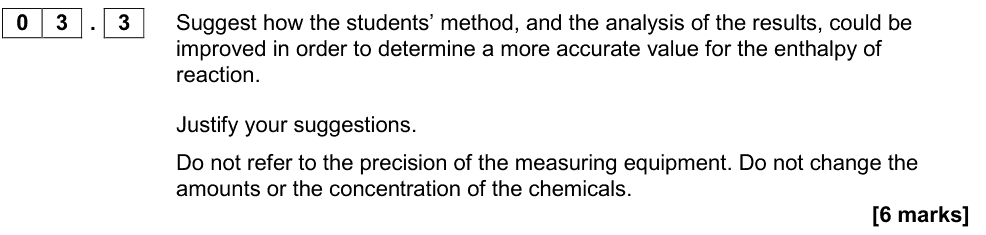
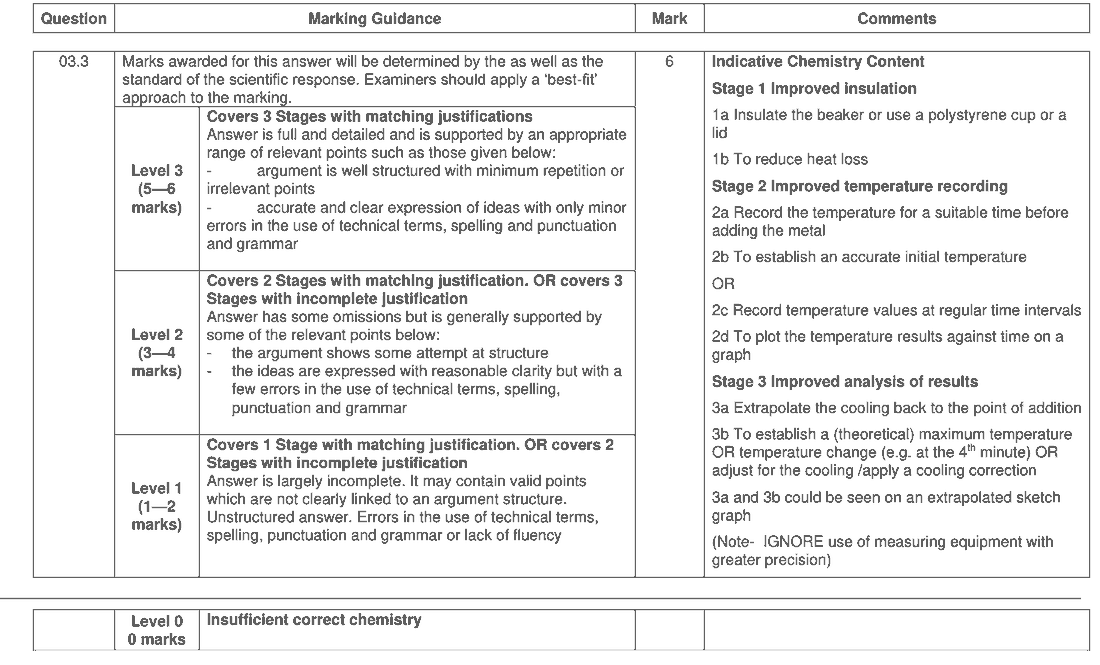
03.3 Energetics 6Level of response
04.1 Chemical equilibria, Le Chatelier's principle and Kc 1Short answer
04.2 Chemical equilibria, Le Chatelier's principle and Kc 3Calculation
05.1 Bonding 1Short answer
05.2 Bonding 2Explanation
05.3 Bonding 4Short answer
06.1 Amount of substance 2Equation writing
06.2 Alkanes, Amount of substance 2Short answer
06.3 Amount of substance 4Calculation
06.4 Amount of substance 2Calculation
07.1 Group 2, the alkaline earth metals, Amount of substance 2Equation writing
07.2 Group 2, the alkaline earth metals, Amount of substance 2Equation writing
08.1 Oxidation, reduction and redox equations 2Short answer
08.2 Oxidation, reduction and redox equations 1Equation writing
08.3 Oxidation, reduction and redox equations 1Equation writing
08.4 Oxidation, reduction and redox equations 1Equation writing
08.5 Oxidation, reduction and redox equations 1Short answer
08.6 Amount of substance 4Calculation
09 Bonding 1Multiple choice
10 Group 7(17), the halogens 1Multiple choice
11 Group 7(17), the halogens 1Multiple choice
12 Atomic structure 1Multiple choice
13 Atomic structure 1Multiple choice
14 Amount of substance, Bonding 1Multiple choice
15 Amount of substance 1Multiple choice
16 Amount of substance 1Multiple choice
17 Amount of substance 1Multiple choice
18 Bonding 1Multiple choice
19 Chemical equilibria, Le Chatelier's principle and Kc 1Multiple choice
20 Oxidation, reduction and redox equations 1Multiple choice
21 Periodicity 1Multiple choice
22 Amount of substance 1Multiple choice
23 Group 7(17), the halogens 1Multiple choice

The questions

01.101.201.301.402.102.202.302.403.103.203.304.104.205.105.205.306.106.206.306.407.107.208.108.208.308.408.508.6091011121314151617181920212223
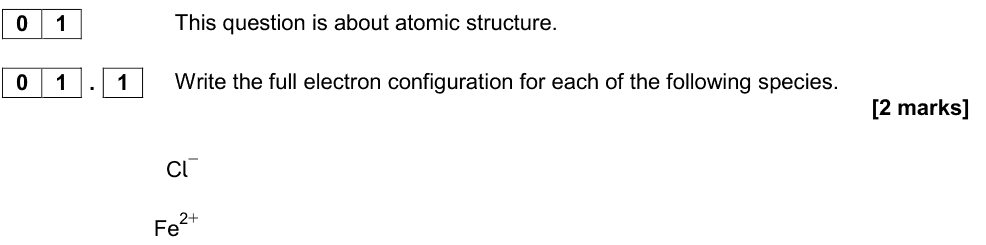
June 2017 · AS Paper 1 · Q01.1 2 marks Short answer atomic structure
This question is about atomic structure.
Write the full electron configuration for each of the following species.
[2 marks]
Cl−
Fe2+
June 2017 · AS Paper 1 · Q01.2 1 mark Equation writing atomic structure
Earlier part of question 01 that this part usesEarlier part of June 2017 Paper 1 question 01
Write an equation, including state symbols, to represent the process that occurs
when the third ionisation energy of manganese is measured.
[1 mark]
June 2017 · AS Paper 1 · Q01.3 3 marks Explanation atomic structureperiodicity
Earlier part of question 01 that this part usesEarlier part of June 2017 Paper 1 question 01
State which of the elements magnesium and aluminium has the lower
first ionisation energy.
Explain your answer.
[3 marks]
June 2017 · AS Paper 1 · Q01.4 3 marks Calculation atomic structure
Earlier part of question 01 that this part usesEarlier part of June 2017 Paper 1 question 01
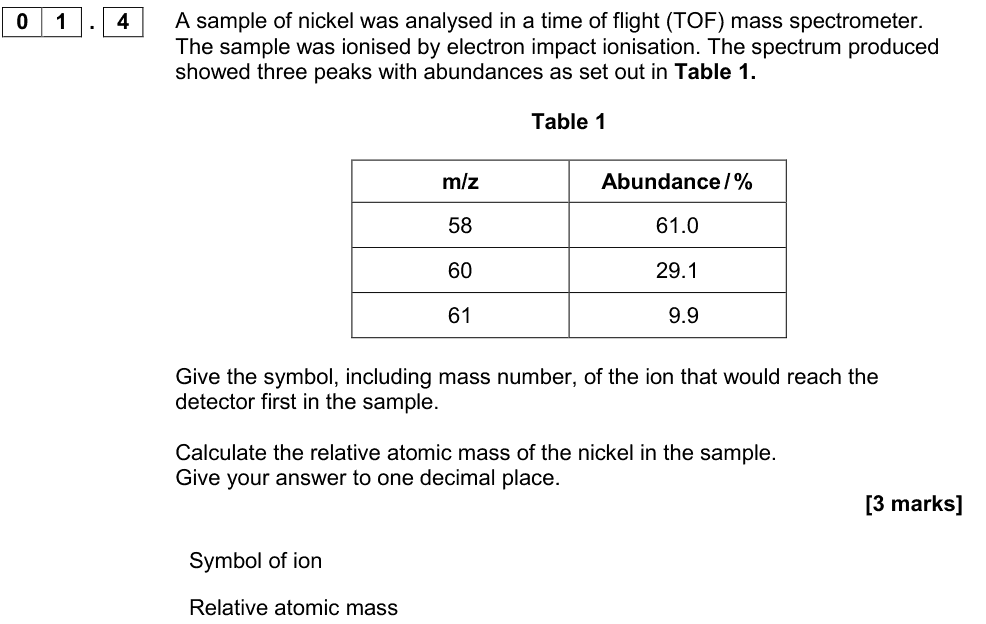
A sample of nickel was analysed in a time of flight (TOF) mass spectrometer.
The sample was ionised by electron impact ionisation. The spectrum produced
showed three peaks with abundances as set out in Table 1.
Table 1
m/z
Abundance / %
58
61.0
60
29.1
61
9.9
Give the symbol, including mass number, of the ion that would reach the
detector first in the sample.
Calculate the relative atomic mass of the nickel in the sample.
Give your answer to one decimal place.
[3 marks]
Symbol of ion
Relative atomic mass
June 2017 · AS Paper 1 · Q02.1 1 mark Equation writing Hard energeticsamount of substance
This question is about energetics.
Write an equation, including state symbols, for the reaction with an enthalpy
change equal to the enthalpy of formation for iron(III) oxide.
[1 mark]
June 2017 · AS Paper 1 · Q02.2 3 marks Calculation energetics
Earlier part of question 02 that this part usesEarlier part of June 2017 Paper 1 question 02
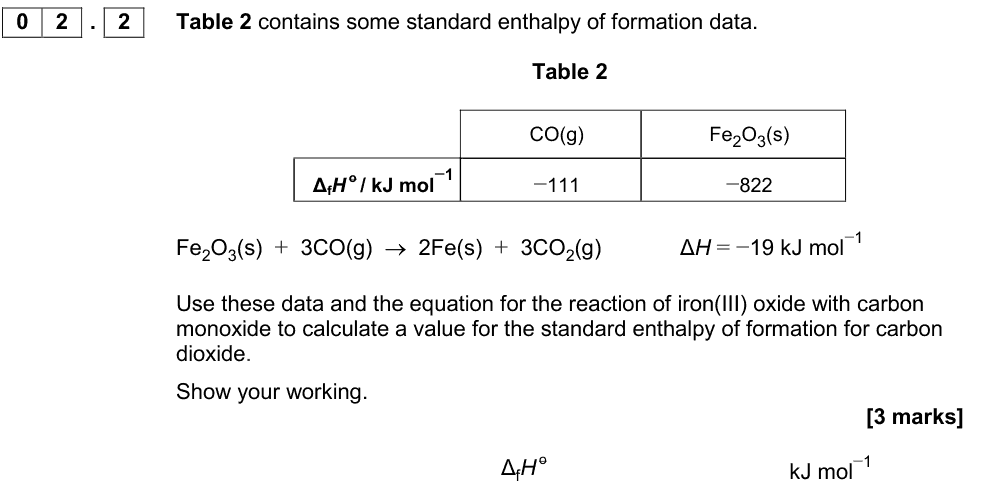
Table 2 contains some standard enthalpy of formation data.
Table 2
CO(g)
Fe2O3(s)
ΔfH o / kJ mol−1
−111
−822
Fe2O3(s)  +  3CO(g)  →  2Fe(s)  +  3CO2(g)
ΔH = −19 kJ mol−1
Use these data and the equation for the reaction of iron(III) oxide with carbon
monoxide to calculate a value for the standard enthalpy of formation for carbon
dioxide.
Show your working.
[3 marks]
ΔfH o
kJ mol−1
June 2017 · AS Paper 1 · Q02.3 3 marks Calculation Hard energetics
Earlier part of question 02 that this part usesEarlier part of June 2017 Paper 1 question 02
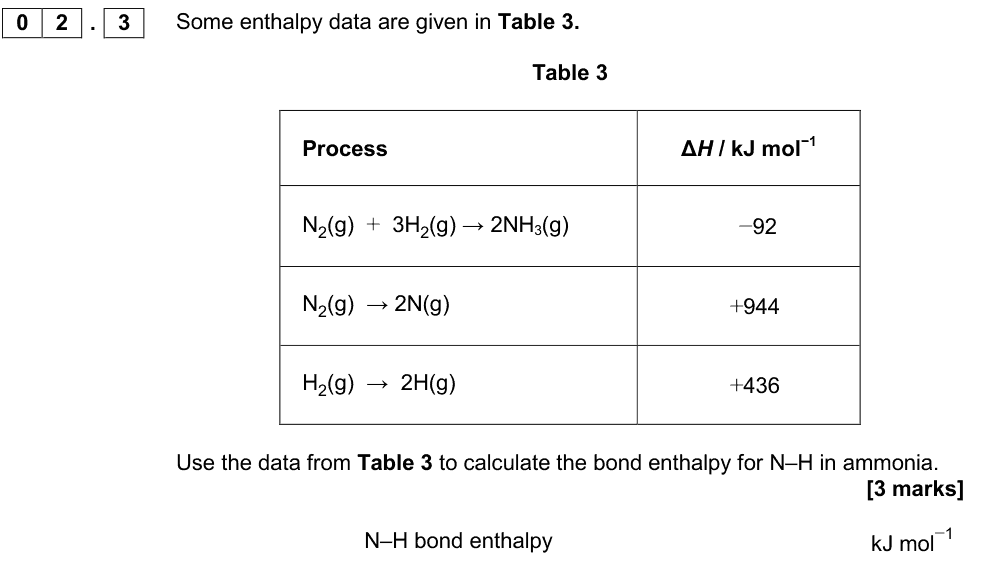
Some enthalpy data are given in Table 3.
Table 3
Process
ΔH / kJ mol−1
N2(g)  +  3H2(g) → 2NH3(g)
−92
N2(g)  → 2N(g)
+944
H2(g)  →  2H(g)
+436
Use the data from Table 3 to calculate the bond enthalpy for N–H in ammonia.
[3 marks]
N–H bond enthalpy
kJ mol−1
June 2017 · AS Paper 1 · Q02.4 1 mark Short answer energetics
Earlier part of question 02 that this part usesEarlier part of June 2017 Paper 1 question 02
Give one reason why the bond enthalpy that you calculated in Question 2.3 is
different from the mean bond enthalpy quoted in a data book (388 kJ mol−1).
[1 mark]
June 2017 · AS Paper 1 · Q03.1 6 marks Calculation energeticsamount of substance
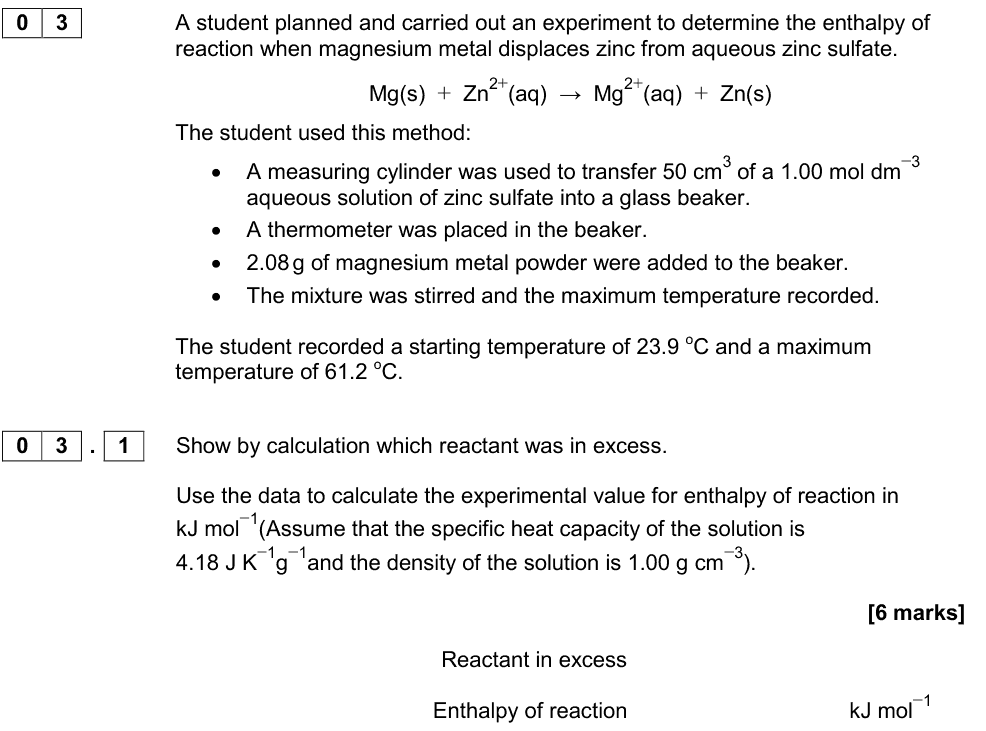
A student planned and carried out an experiment to determine the enthalpy of
reaction when magnesium metal displaces zinc from aqueous zinc sulfate.
Mg(s)  +  Zn2+(aq)  →  Mg2+(aq)  +  Zn(s)
The student used this method:
•
A measuring cylinder was used to transfer 50 cm3 of a 1.00 mol dm−3
aqueous solution of zinc sulfate into a glass beaker.
•
A thermometer was placed in the beaker.
•
2.08 g of magnesium metal powder were added to the beaker.
•
The mixture was stirred and the maximum temperature recorded.
The student recorded a starting temperature of 23.9 oC and a maximum
temperature of 61.2 oC.
Show by calculation which reactant was in excess.
Use the data to calculate the experimental value for enthalpy of reaction in
kJ mol−1(Assume that the specific heat capacity of the solution is
4.18 J K−1g−1and the density of the solution is 1.00 g cm−3).
[6 marks]
Reactant in excess
Enthalpy of reaction
kJ mol−1
June 2017 · AS Paper 1 · Q03.2 1 mark Practical and data analysis energetics
Earlier part of question 03 that this part usesEarlier part of June 2017 Paper 1 question 03
Another student used the same method and obtained a value for the
enthalpy of reaction of  −142 kJ mol−1
A data book value for the enthalpy of reaction is −310 kJ mol−1
Suggest the most likely reason for the large difference between the student’s
experimental value and the data book value.
[1 mark]
June 2017 · AS Paper 1 · Q03.3 6 marks 6-mark level of response energetics
Earlier part of question 03 that this part usesEarlier part of June 2017 Paper 1 question 03
Suggest how the students’ method, and the analysis of the results, could be
improved in order to determine a more accurate value for the enthalpy of
reaction.
Justify your suggestions.
Do not refer to the precision of the measuring equipment. Do not change the
amounts or the concentration of the chemicals.
[6 marks]
June 2017 · AS Paper 1 · Q04.1 1 mark Short answer chemical equilibria and kc
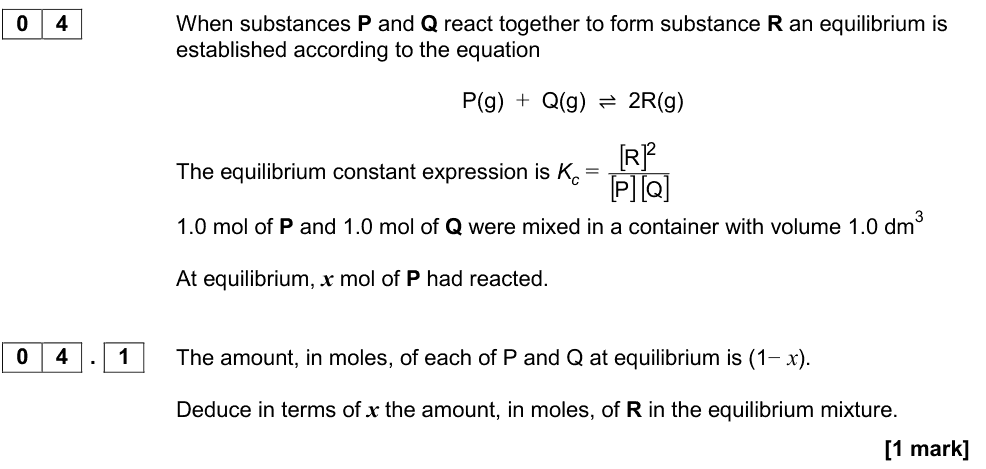
When substances P and Q react together to form substance R an equilibrium is
established according to the equation
P(g)  +  Q(g)  ⇌  2R(g)
The equilibrium constant expression is Kc = [ ]
[ ][ ]
Q
P
R 2
1.0 mol of P and 1.0 mol of Q were mixed in a container with volume 1.0 dm3
At equilibrium, x mol of P had reacted.
The amount, in moles, of each of P and Q at equilibrium is (1− x).
Deduce in terms of x the amount, in moles, of R in the equilibrium mixture.
[1 mark]
June 2017 · AS Paper 1 · Q04.2 3 marks Calculation chemical equilibria and kc
Earlier part of question 04 that this part usesEarlier part of June 2017 Paper 1 question 04
At 298 K the value of the equilibrium constant Kc = 3.6
Calculate a value for the equilibrium concentration, in mol dm−3, of R.
[3 marks]
Equilibrium concentration of R
mol dm−3
June 2017 · AS Paper 1 · Q05.1 1 mark Short answer bonding
This question is about intermolecular forces.
Give the meaning of the term electronegativity.
[1 mark]
June 2017 · AS Paper 1 · Q05.2 2 marks Explanation bonding
Earlier part of question 05 that this part usesEarlier part of June 2017 Paper 1 question 05
Explain how permanent dipole-dipole forces arise between hydrogen chloride
molecules.
[2 marks]
June 2017 · AS Paper 1 · Q05.3 4 marks Short answer bonding
Earlier part of question 05 that this part usesEarlier part of June 2017 Paper 1 question 05
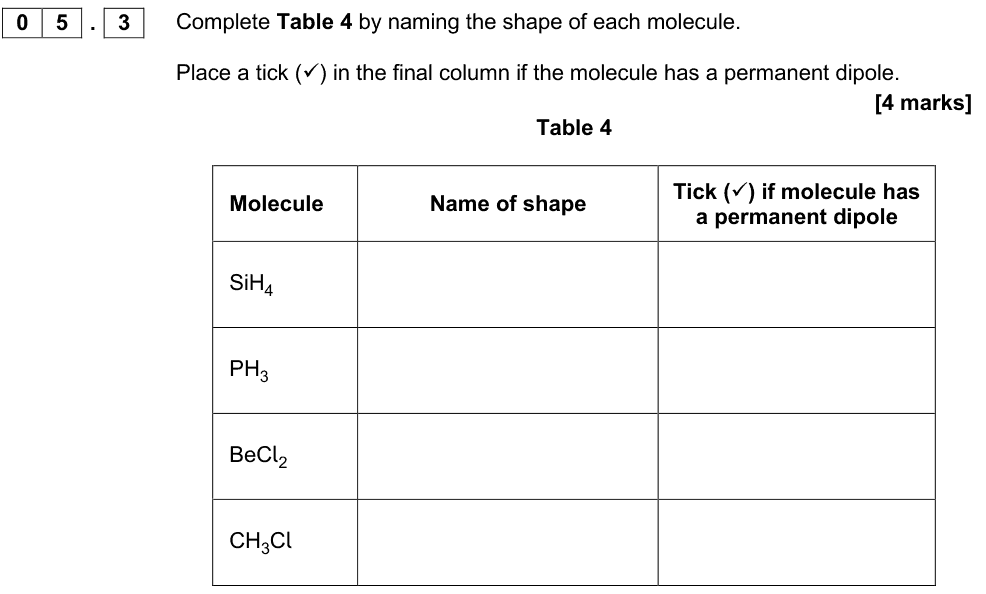
Complete Table 4 by naming the shape of each molecule.
Place a tick () in the final column if the molecule has a permanent dipole.
[4 marks]
Table 4
Molecule
Name of shape
Tick () if molecule has
a permanent dipole
SiH4
PH3
BeCl2
CH3Cl
June 2017 · AS Paper 1 · Q06.1 2 marks Equation writing Hard amount of substance
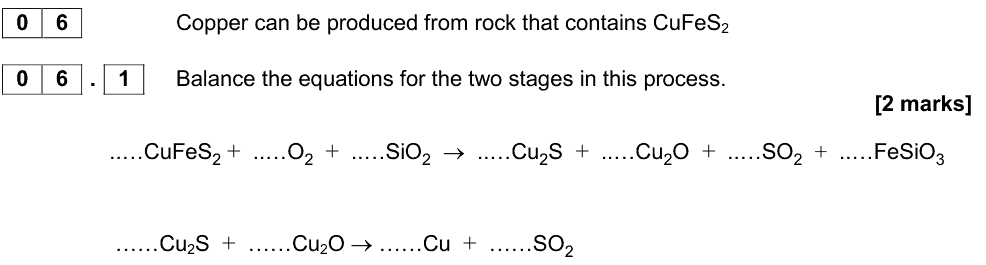
Copper can be produced from rock that contains CuFeS2
Balance the equations for the two stages in this process.
[2 marks]
..…CuFeS2 +  ..…O2  +  ..…SiO2  →  ..…Cu2S  +  ..…Cu2O  +  ..…SO2  +  ..…FeSiO3
……Cu2S  +  ……Cu2O → ……Cu  +  ……SO2
June 2017 · AS Paper 1 · Q06.2 2 marks Short answer alkanesamount of substance
Earlier part of question 06 that this part usesEarlier part of June 2017 Paper 1 question 06
Suggest two reasons why the sulfur dioxide by-product of this process is removed
from the exhaust gases.
[2 marks]
Reason 1
Reason 2
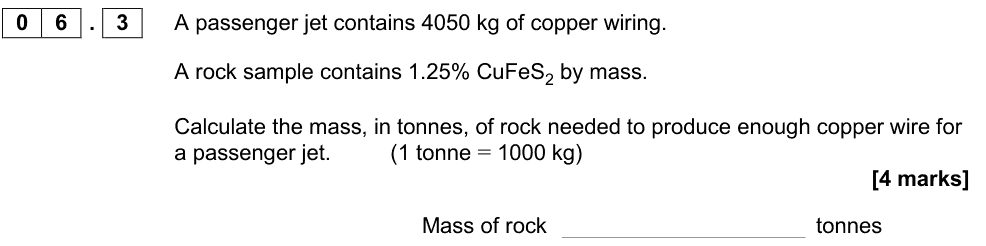
June 2017 · AS Paper 1 · Q06.3 4 marks Calculation amount of substance
Earlier part of question 06 that this part usesEarlier part of June 2017 Paper 1 question 06
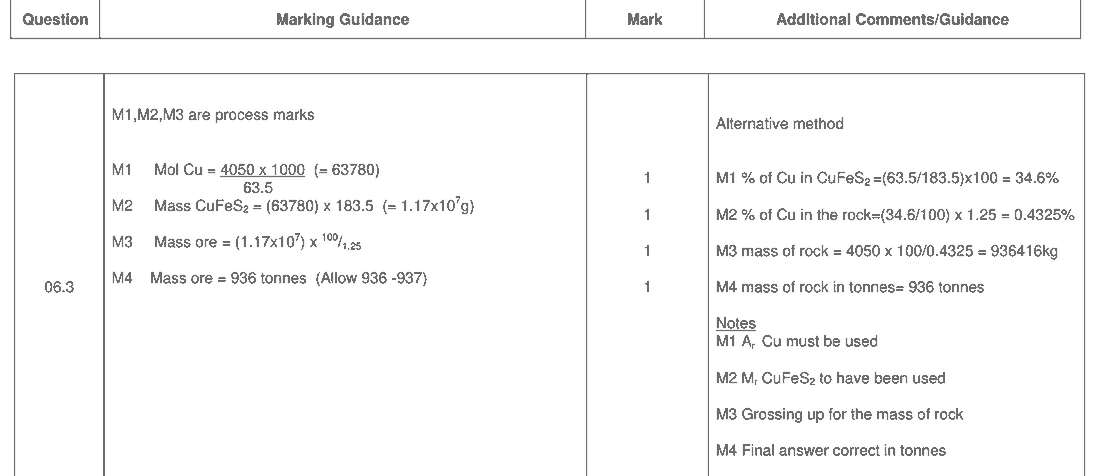
A passenger jet contains 4050 kg of copper wiring.
A rock sample contains 1.25% CuFeS2 by mass.
Calculate the mass, in tonnes, of rock needed to produce enough copper wire for
a passenger jet.
(1 tonne = 1000 kg)
[4 marks]
Mass of rock
tonnes
June 2017 · AS Paper 1 · Q06.4 2 marks Calculation amount of substance
Earlier part of question 06 that this part usesEarlier part of June 2017 Paper 1 question 06
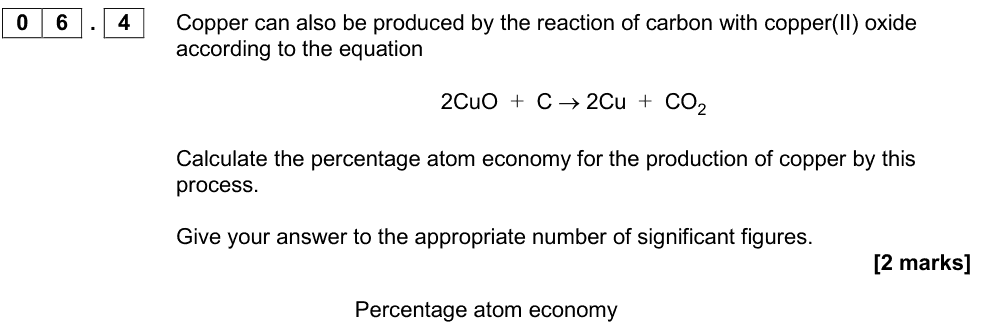
Copper can also be produced by the reaction of carbon with copper(II) oxide
according to the equation
2CuO  +  C → 2Cu  +  CO2
Calculate the percentage atom economy for the production of copper by this
process.
Give your answer to the appropriate number of significant figures.
[2 marks]
Percentage atom economy
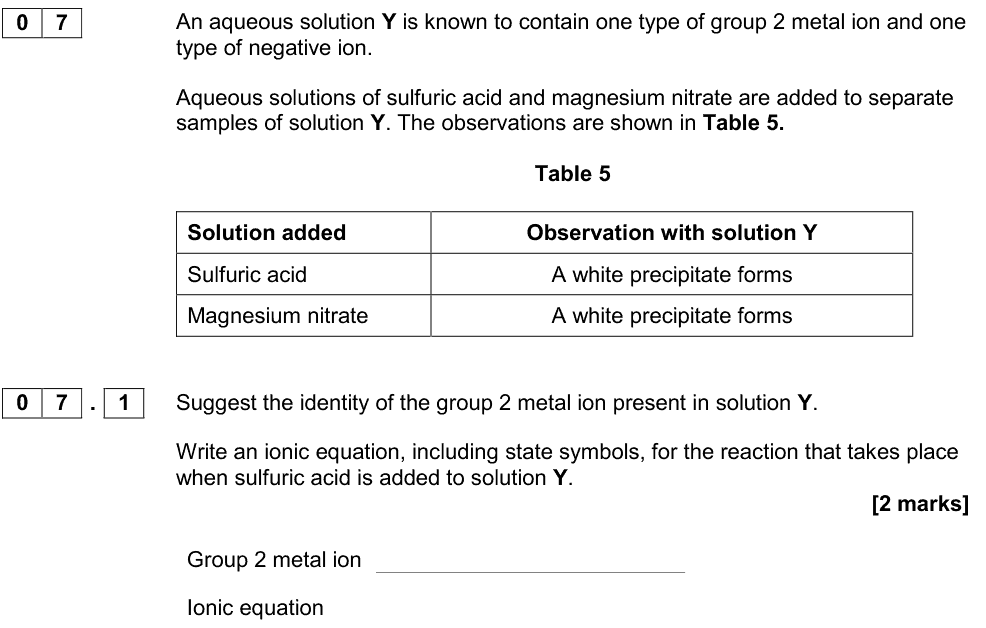
June 2017 · AS Paper 1 · Q07.1 2 marks Equation writing group 2amount of substance
An aqueous solution Y is known to contain one type of group 2 metal ion and one
type of negative ion.
Aqueous solutions of sulfuric acid and magnesium nitrate are added to separate
samples of solution Y. The observations are shown in Table 5.
Table 5
Solution added
Observation with solution Y
Sulfuric acid
A white precipitate forms
Magnesium nitrate
A white precipitate forms
Suggest the identity of the group 2 metal ion present in solution Y.
Write an ionic equation, including state symbols, for the reaction that takes place
when sulfuric acid is added to solution Y.
[2 marks]
Group 2 metal ion
Ionic equation
June 2017 · AS Paper 1 · Q07.2 2 marks Equation writing group 2amount of substance
Earlier part of question 07 that this part usesEarlier part of June 2017 Paper 1 question 07
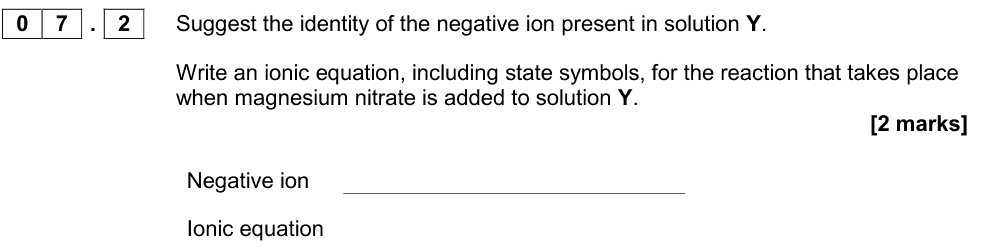
Suggest the identity of the negative ion present in solution Y.
Write an ionic equation, including state symbols, for the reaction that takes place
when magnesium nitrate is added to solution Y.
[2 marks]
Negative ion
Ionic equation
June 2017 · AS Paper 1 · Q08.1 2 marks Short answer Easy redox
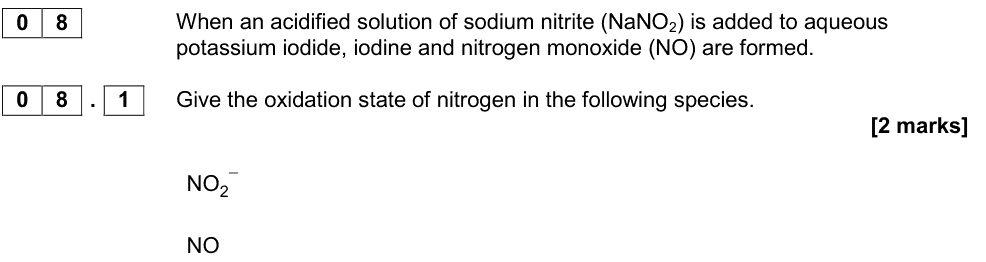
When an acidified solution of sodium nitrite (NaNO2) is added to aqueous
potassium iodide, iodine and nitrogen monoxide (NO) are formed.
Give the oxidation state of nitrogen in the following species.
[2 marks]
NO2
−
NO
June 2017 · AS Paper 1 · Q08.2 1 mark Equation writing redox
Earlier part of question 08 that this part usesEarlier part of June 2017 Paper 1 question 08
Write a half-equation for the conversion of NO2
− in an acidic solution
into NO
[1 mark]
June 2017 · AS Paper 1 · Q08.3 1 mark Equation writing Easy redox
Earlier part of question 08 that this part usesEarlier part of June 2017 Paper 1 question 08
Write a half-equation for the conversion of I− into I2
[1 mark]
June 2017 · AS Paper 1 · Q08.4 1 mark Equation writing redox
Earlier part of question 08 that this part usesEarlier part of June 2017 Paper 1 question 08
Write an overall ionic equation for the reaction of NO2
− in an acidic solution
with I−
[1 mark]
June 2017 · AS Paper 1 · Q08.5 1 mark Short answer redox
Earlier part of question 08 that this part usesEarlier part of June 2017 Paper 1 question 08
State the role of NO2
− in the reaction with I−
[1 mark]
June 2017 · AS Paper 1 · Q08.6 4 marks Calculation amount of substance
Earlier part of question 08 that this part usesEarlier part of June 2017 Paper 1 question 08
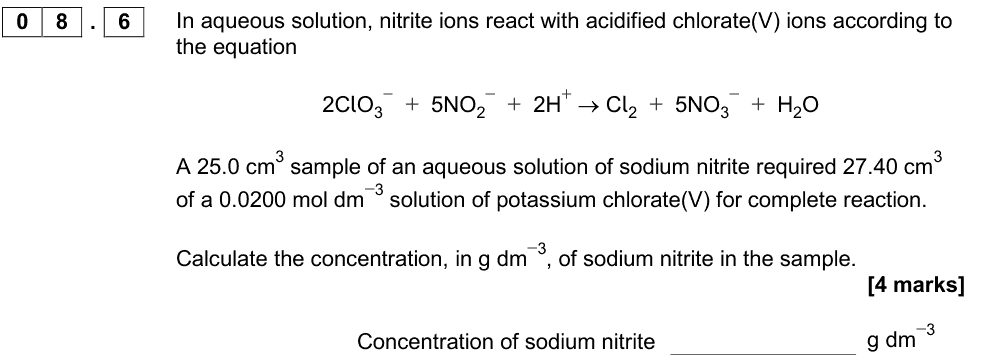
In aqueous solution, nitrite ions react with acidified chlorate(V) ions according to
the equation
2ClO3
−  +  5NO2
−  +  2H+ → Cl2  +  5NO3
−  +  H2O
A 25.0 cm3 sample of an aqueous solution of sodium nitrite required 27.40 cm3
of a 0.0200 mol dm−3 solution of potassium chlorate(V) for complete reaction.
Calculate the concentration, in g dm−3, of sodium nitrite in the sample.
[4 marks]
Concentration of sodium nitrite
g dm−3
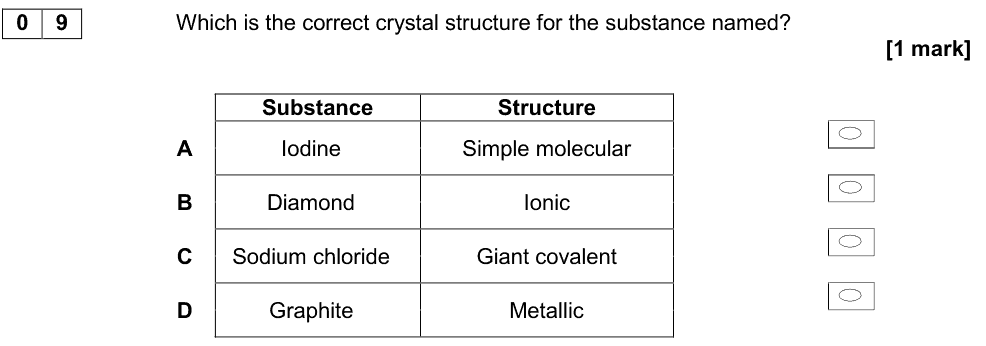
June 2017 · AS Paper 1 · Q09 1 mark Multiple choice Easy bonding
Which is the correct crystal structure for the substance named?
[1 mark]
Substance
Structure
A
Iodine
Simple molecular
B
Diamond
Ionic
C
Sodium chloride
Giant covalent
D
Graphite
Metallic
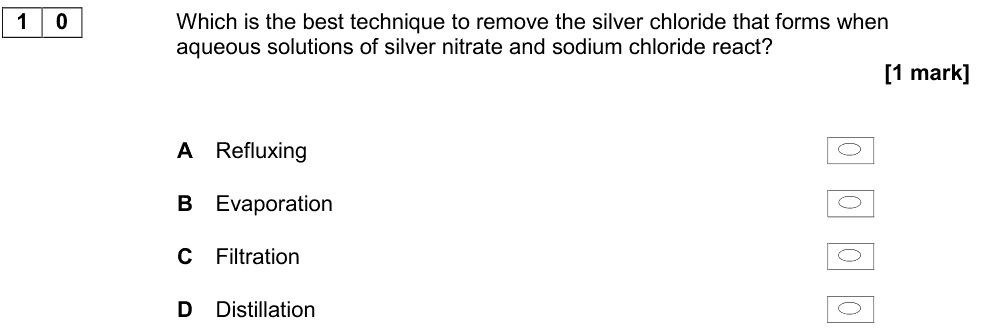
June 2017 · AS Paper 1 · Q10 1 mark Multiple choice Easy group 7 the halogens
Which is the best technique to remove the silver chloride that forms when
aqueous solutions of silver nitrate and sodium chloride react?
[1 mark]
A Refluxing
B Evaporation
C Filtration
D Distillation
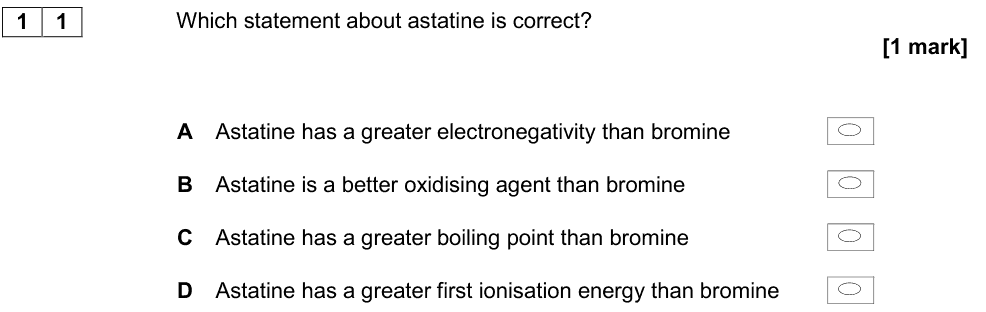
June 2017 · AS Paper 1 · Q11 1 mark Multiple choice Easy group 7 the halogens
Which statement about astatine is correct?
[1 mark]
A Astatine has a greater electronegativity than bromine
B Astatine is a better oxidising agent than bromine
C Astatine has a greater boiling point than bromine
D Astatine has a greater first ionisation energy than bromine
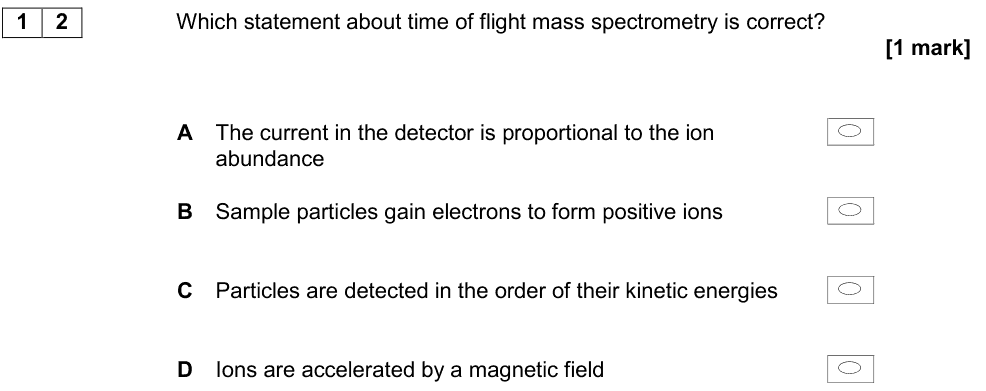
June 2017 · AS Paper 1 · Q12 1 mark Multiple choice atomic structure
Which statement about time of flight mass spectrometry is correct?
[1 mark]
A The current in the detector is proportional to the ion
abundance
B Sample particles gain electrons to form positive ions
C Particles are detected in the order of their kinetic energies
D Ions are accelerated by a magnetic field
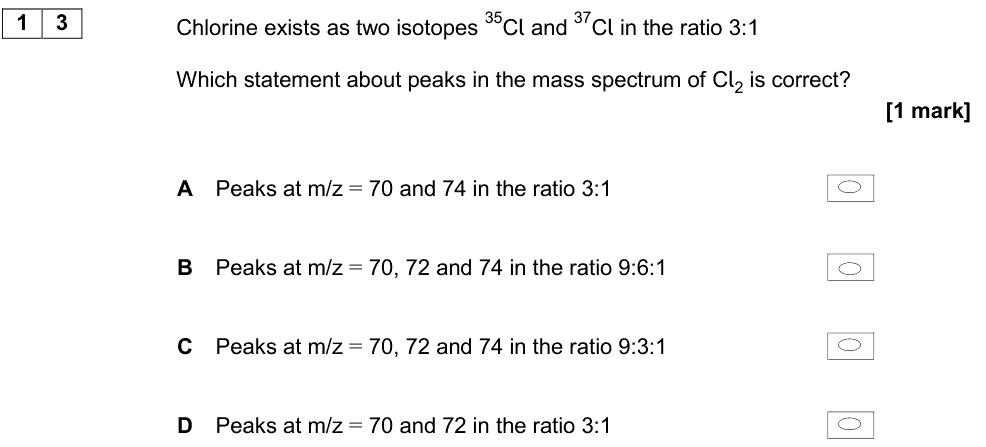
June 2017 · AS Paper 1 · Q13 1 mark Multiple choice Hard atomic structure
Chlorine exists as two isotopes 35Cl and 37Cl in the ratio 3:1
Which statement about peaks in the mass spectrum of Cl2 is correct?
[1 mark]
A Peaks at m/z = 70 and 74 in the ratio 3:1
B Peaks at m/z = 70, 72 and 74 in the ratio 9:6:1
C Peaks at m/z = 70, 72 and 74 in the ratio 9:3:1
D Peaks at m/z = 70 and 72 in the ratio 3:1
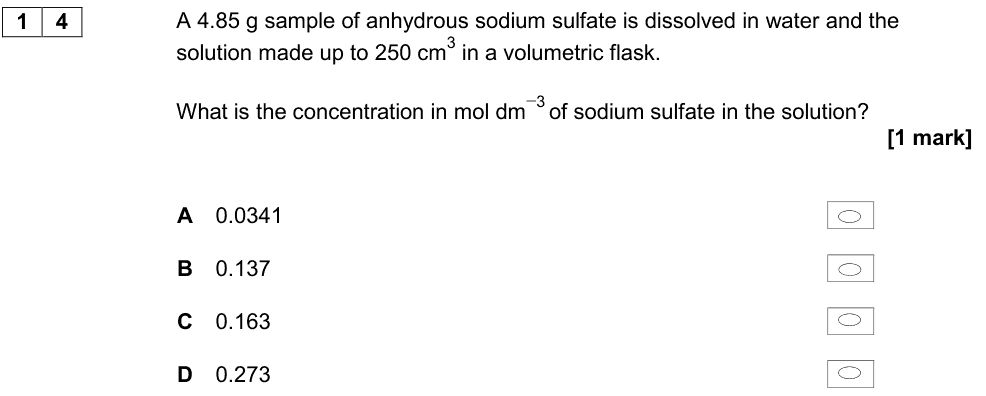
June 2017 · AS Paper 1 · Q14 1 mark Multiple choice amount of substancebonding
A 4.85 g sample of anhydrous sodium sulfate is dissolved in water and the
solution made up to 250 cm3 in a volumetric flask.
What is the concentration in mol dm−3 of sodium sulfate in the solution?
[1 mark]
A 0.0341
B 0.137
C 0.163
D 0.273
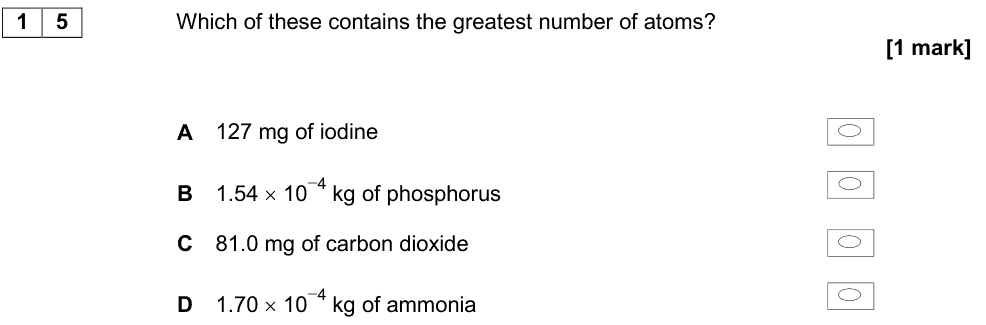
June 2017 · AS Paper 1 · Q15 1 mark Multiple choice amount of substance
Which of these contains the greatest number of atoms?
[1 mark]
A 127 mg of iodine
B 1.54 × 10⁻⁴ kg of phosphorus
C 81.0 mg of carbon dioxide
D 1.70 × 10⁻⁴ kg of ammonia
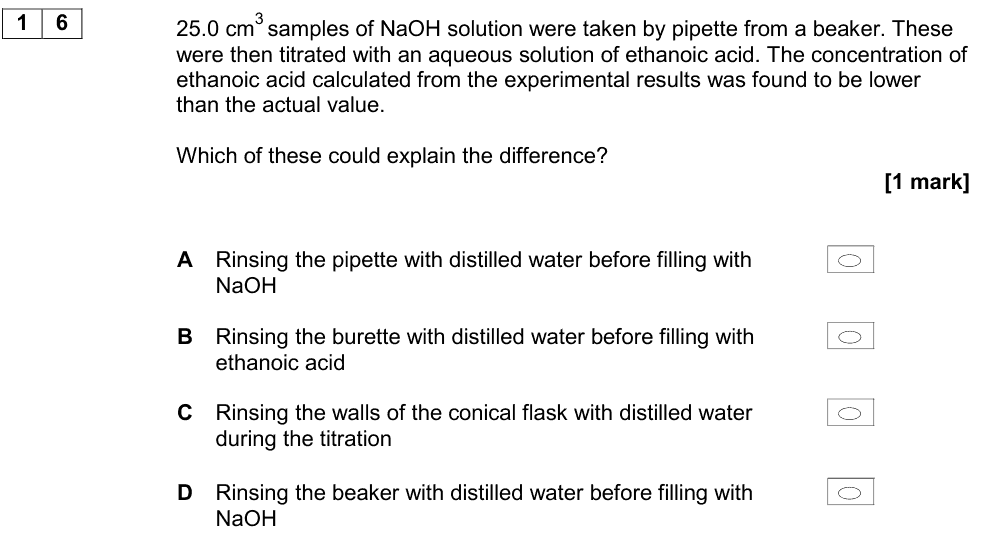
June 2017 · AS Paper 1 · Q16 1 mark Multiple choice amount of substance
25.0 cm3 samples of NaOH solution were taken by pipette from a beaker. These
were then titrated with an aqueous solution of ethanoic acid. The concentration of
ethanoic acid calculated from the experimental results was found to be lower
than the actual value.
Which of these could explain the difference?
[1 mark]
A Rinsing the pipette with distilled water before filling with
NaOH
B Rinsing the burette with distilled water before filling with
ethanoic acid
C Rinsing the walls of the conical flask with distilled water
during the titration
D Rinsing the beaker with distilled water before filling with
NaOH
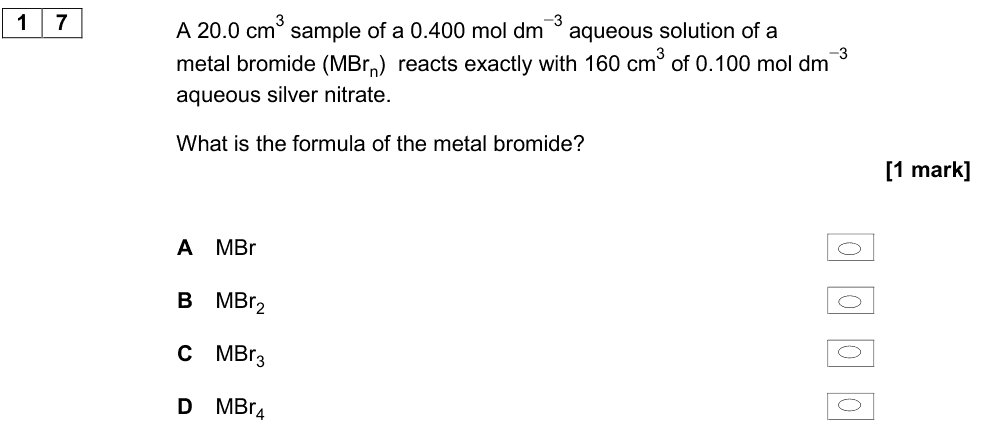
June 2017 · AS Paper 1 · Q17 1 mark Multiple choice Easy amount of substance
A 20.0 cm3 sample of a 0.400 mol dm−3 aqueous solution of a
metal bromide (MBrn)  reacts exactly with 160 cm3 of 0.100 mol dm−3
aqueous silver nitrate.
What is the formula of the metal bromide?
[1 mark]
A MBr
B MBr2
C MBr3
D MBr4
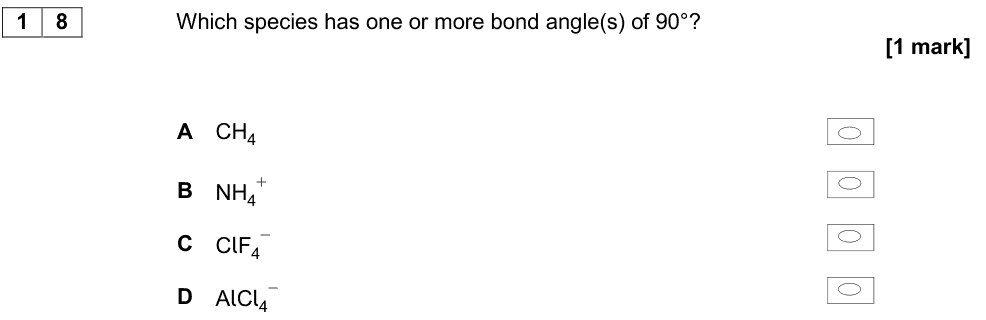
June 2017 · AS Paper 1 · Q18 1 mark Multiple choice bonding
Which species has one or more bond angle(s) of 90°?
[1 mark]
A CH4
B NH4
+
C ClF4
−
D AlCl4
−
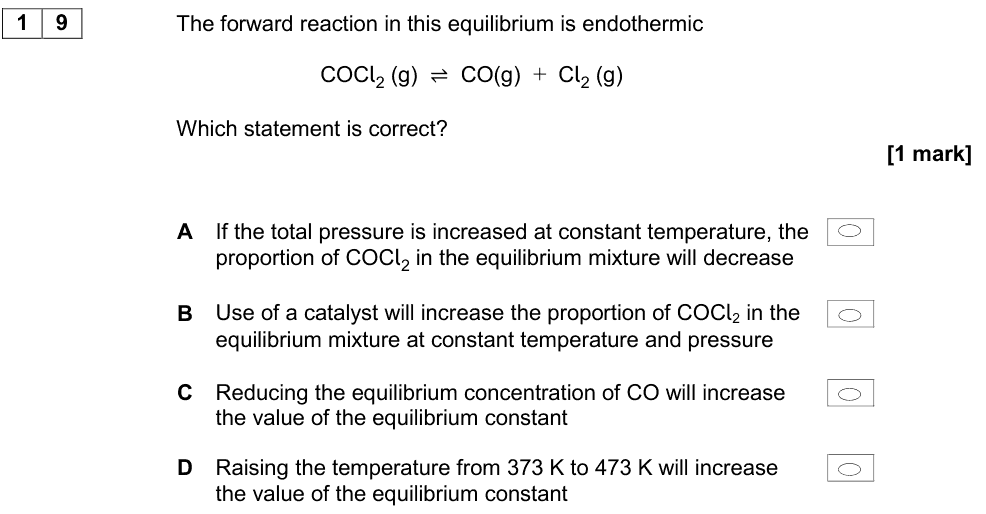
June 2017 · AS Paper 1 · Q19 1 mark Multiple choice Easy chemical equilibria and kc
The forward reaction in this equilibrium is endothermic
COCl2 (g)  ⇌  CO(g)  +  Cl2 (g)
Which statement is correct?
[1 mark]
A If the total pressure is increased at constant temperature, the
proportion of COCl2 in the equilibrium mixture will decrease
B Use of a catalyst will increase the proportion of COCl2 in the
equilibrium mixture at constant temperature and pressure
C Reducing the equilibrium concentration of CO will increase
the value of the equilibrium constant
D Raising the temperature from 373 K to 473 K will increase
the value of the equilibrium constant
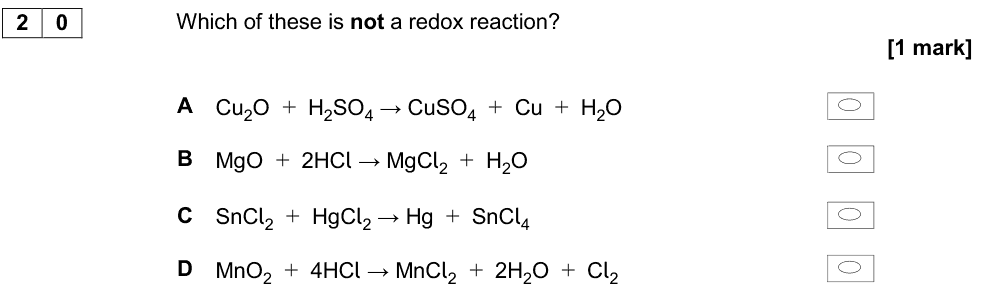
June 2017 · AS Paper 1 · Q20 1 mark Multiple choice redox
Which of these is not a redox reaction?
[1 mark]
A Cu2O  +  H2SO4 → CuSO4  +  Cu  +  H2O
B MgO  +  2HCl → MgCl2  +  H2O
C SnCl2  +  HgCl2 → Hg  +  SnCl4
D MnO2  +  4HCl → MnCl2  +  2H2O  +  Cl2
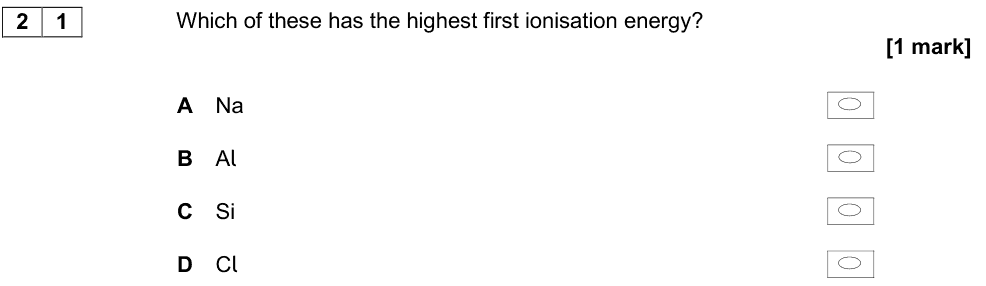
June 2017 · AS Paper 1 · Q21 1 mark Multiple choice Easy periodicity
Which of these has the highest first ionisation energy?
[1 mark]
A Na
B Al
C Si
D Cl
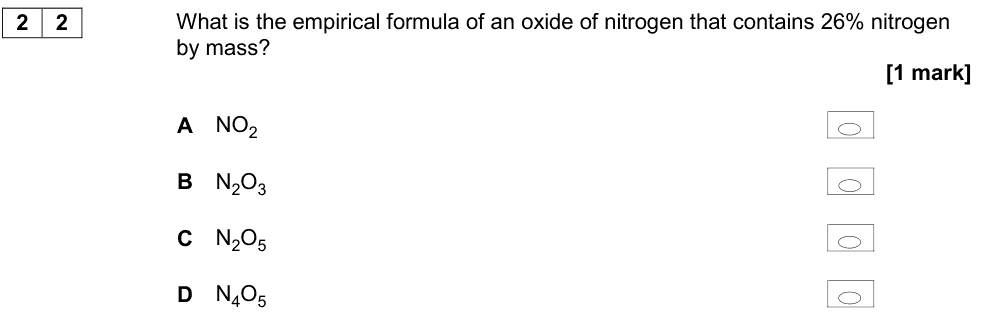
June 2017 · AS Paper 1 · Q22 1 mark Multiple choice Easy amount of substance
What is the empirical formula of an oxide of nitrogen that contains 26% nitrogen
by mass?
[1 mark]
A NO2
B N2O3
C N2O5
D N4O5
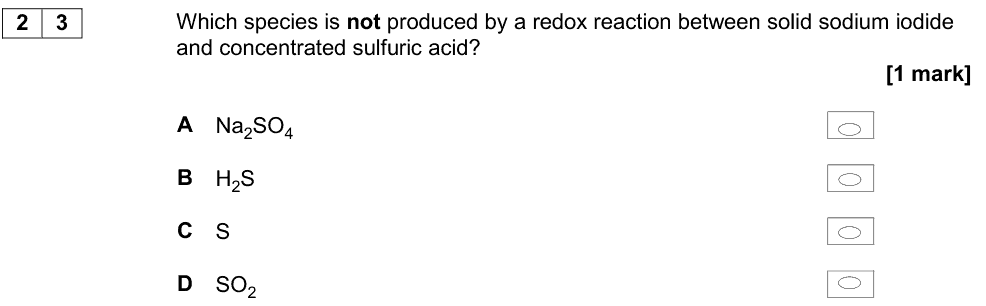
June 2017 · AS Paper 1 · Q23 1 mark Multiple choice group 7 the halogens
Which species is not produced by a redox reaction between solid sodium iodide
and concentrated sulfuric acid?
[1 mark]
A Na2SO4
B H2S
C S
D SO2

Work with an A-level chemistry tutor

Want a paper marked and gone through with you? Message us.

Prefer email? Send an enquiry

If you are under 18, please include a parent's contact details. Enquiries go to enquiries@chemistryaleveltutor.com and are deleted once handled. All tutoring is online.