June 2016: AS Paper 2, Organic and physical chemistry

80 marks · 47 question parts · Paper, mark scheme and report on AQA's site · Have the Data Booklet beside you

Question by question

QTopicMarksAOType
01.1 Chemical equilibria, Le Chatelier's principle and Kc 2Short answer
01.2 Chemical equilibria, Le Chatelier's principle and Kc 2Calculation
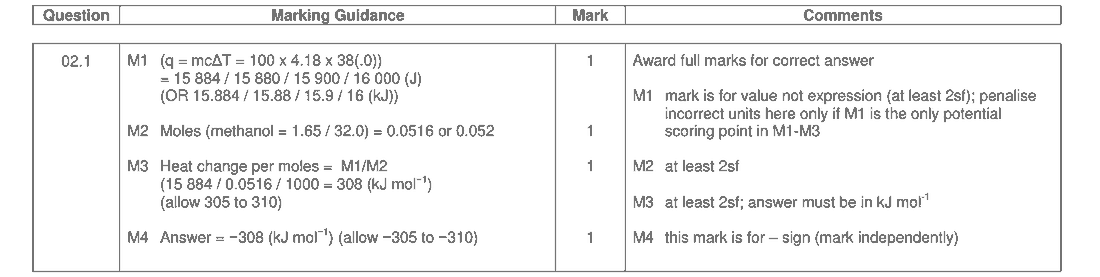
02.1 Energetics, Amount of substance 4Calculation

02.2 Energetics 1Practical and data analysis
02.3 Energetics 1Practical and data analysis
02.4 Energetics 1Practical and data analysis
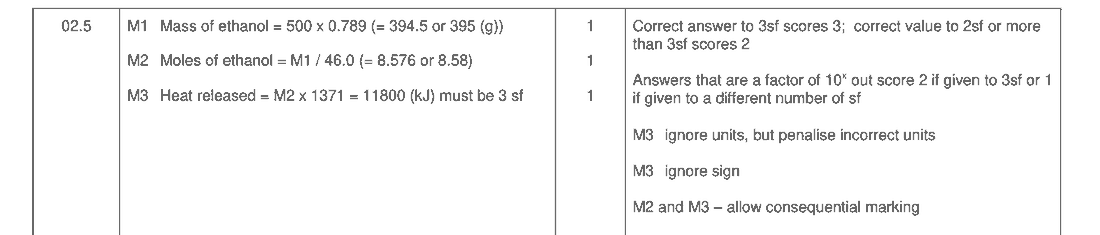
02.5 Amount of substance 3Calculation

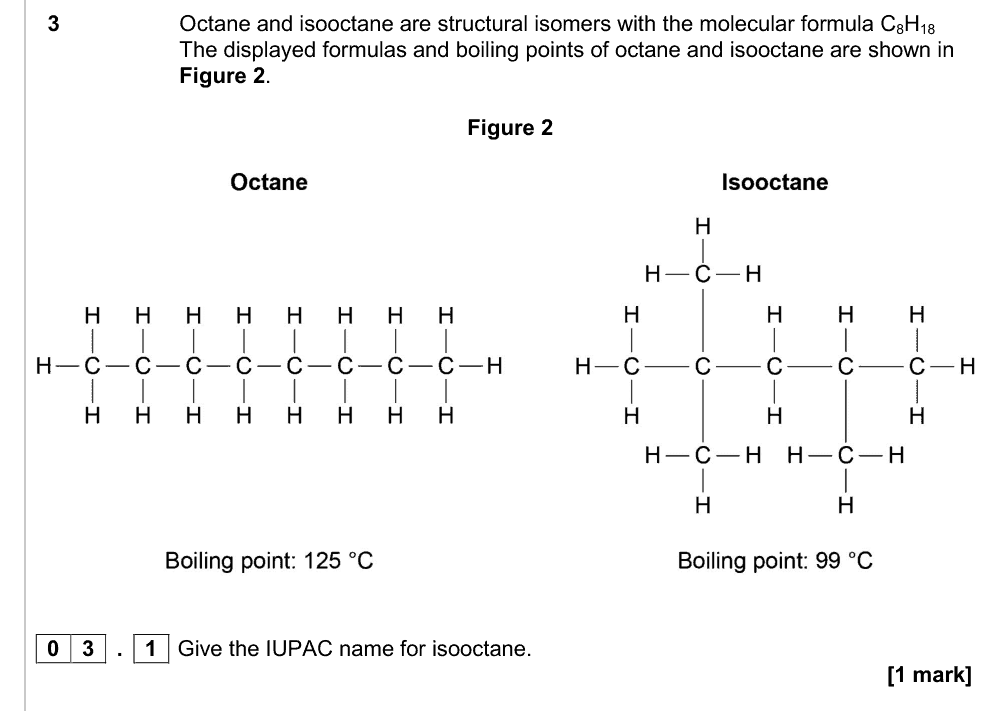
03.1 Introduction to organic chemistry: nomenclature, mechanisms and isomerism 1Short answer

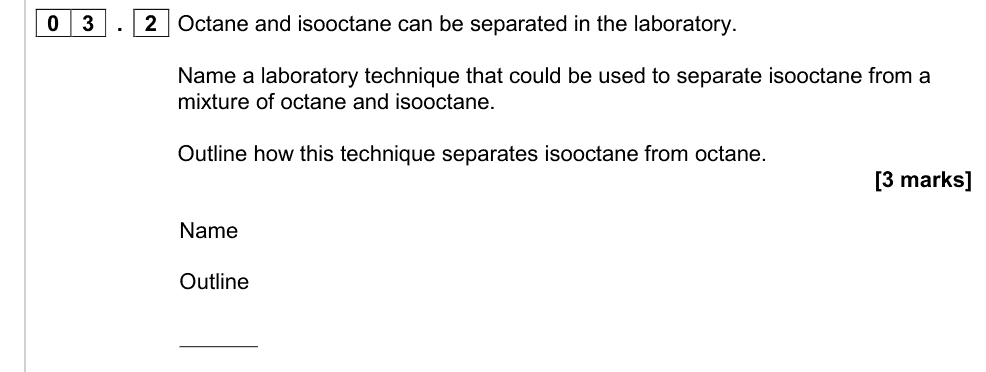
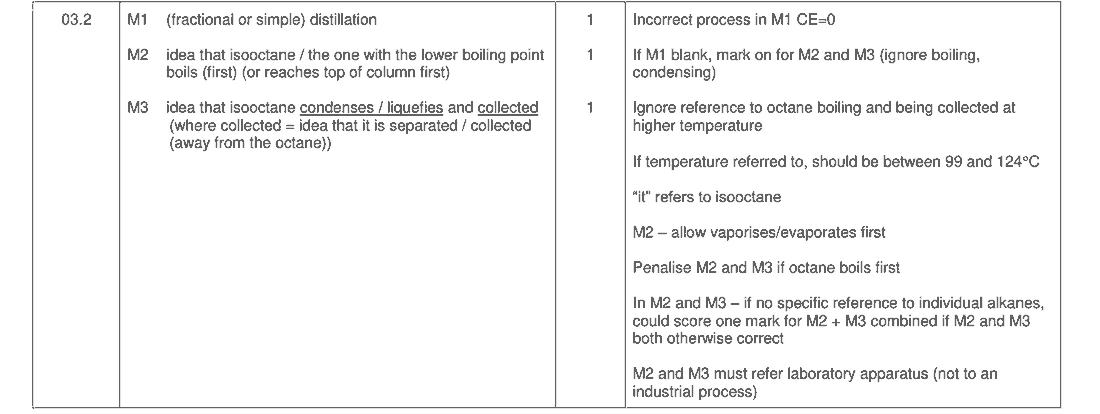
03.2 Alcohols 3Practical and data analysis
03.3 Alkanes, Amount of substance 1Equation writing

03.4 Kinetics 2Explanation
03.5 Alkanes 1Equation writing
03.6 Alkanes 2Explanation
03.7 Alkenes, Organic analysis: test-tube reactions, mass spectrometry and infrared 2Practical and data analysis
04.1 Organic analysis: test-tube reactions, mass spectrometry and infrared 2Explanation
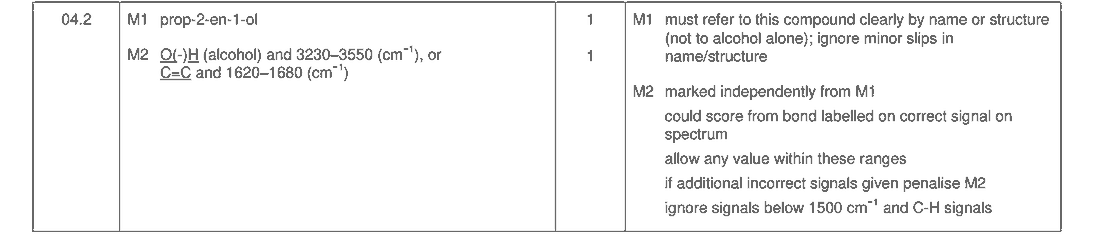
04.2 Organic analysis: test-tube reactions, mass spectrometry and infrared 2Short answer
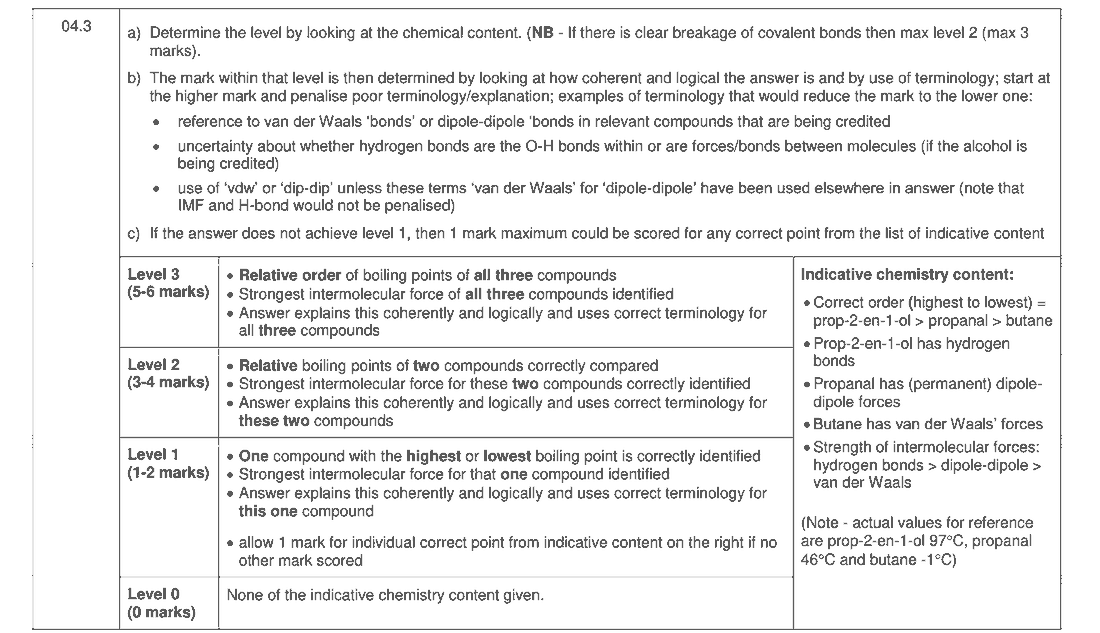
04.3 Bonding 6Level of response
05.1 Halogenoalkanes 2Equation writing
05.2 Introduction to organic chemistry: nomenclature, mechanisms and isomerism 1Diagram or structure
05.3 Halogenoalkanes 1Short answer
05.4 Introduction to organic chemistry: nomenclature, mechanisms and isomerism, Alkanes 2Equation writing
05.5 Amount of substance 2Calculation
05.6 Organic analysis: test-tube reactions, mass spectrometry and infrared 1Short answer
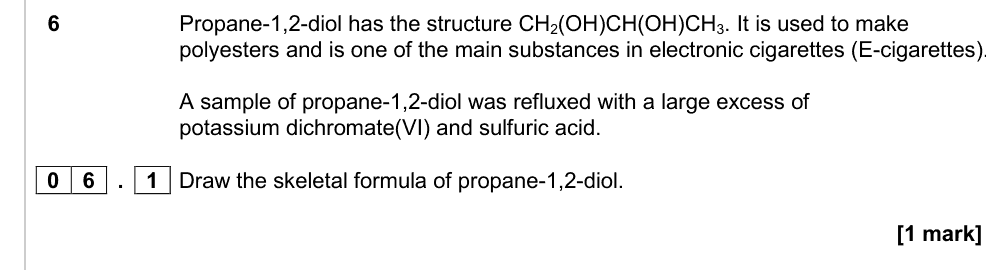
06.1 Introduction to organic chemistry: nomenclature, mechanisms and isomerism 1Diagram or structure
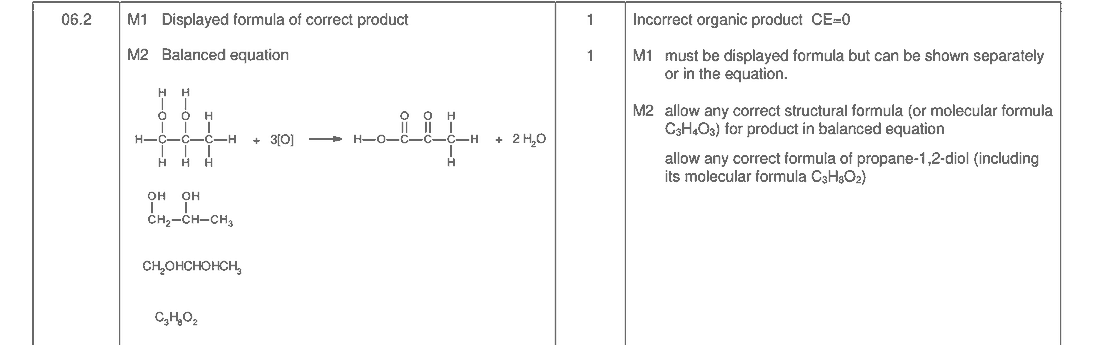
06.2 Alcohols 2Equation writing
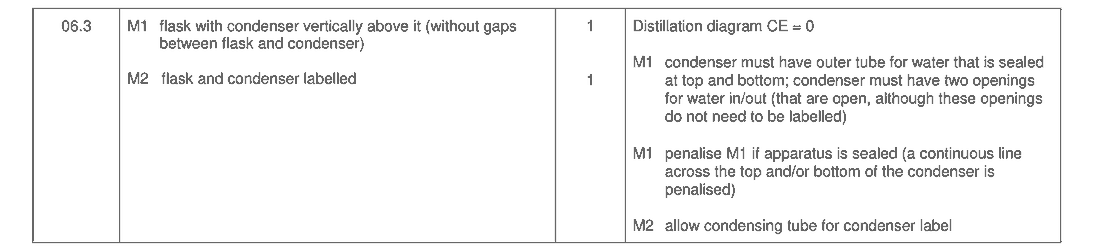
06.3 Alcohols 2Diagram or structure
06.4 Alcohols 1Practical and data analysis
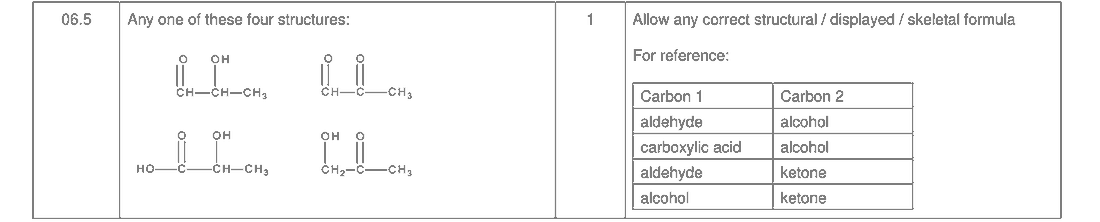
06.5 Alcohols 1Diagram or structure
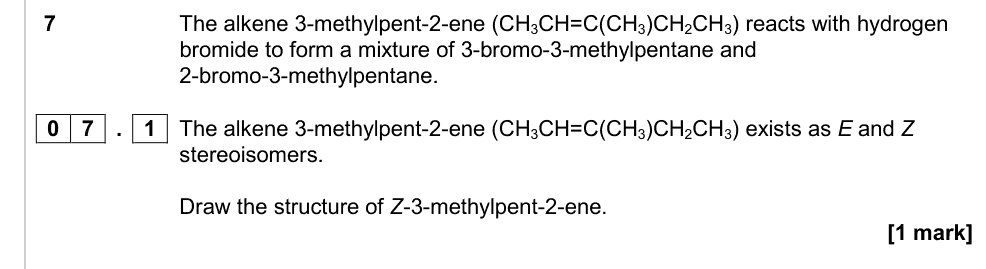
07.1 Introduction to organic chemistry: nomenclature, mechanisms and isomerism 1Diagram or structure
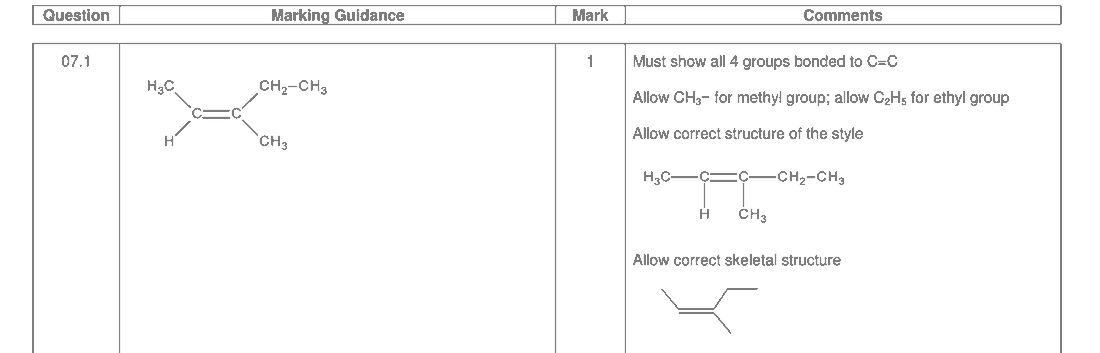
07.2 Alkenes, Introduction to organic chemistry: nomenclature, mechanisms and isomerism 7Mechanism
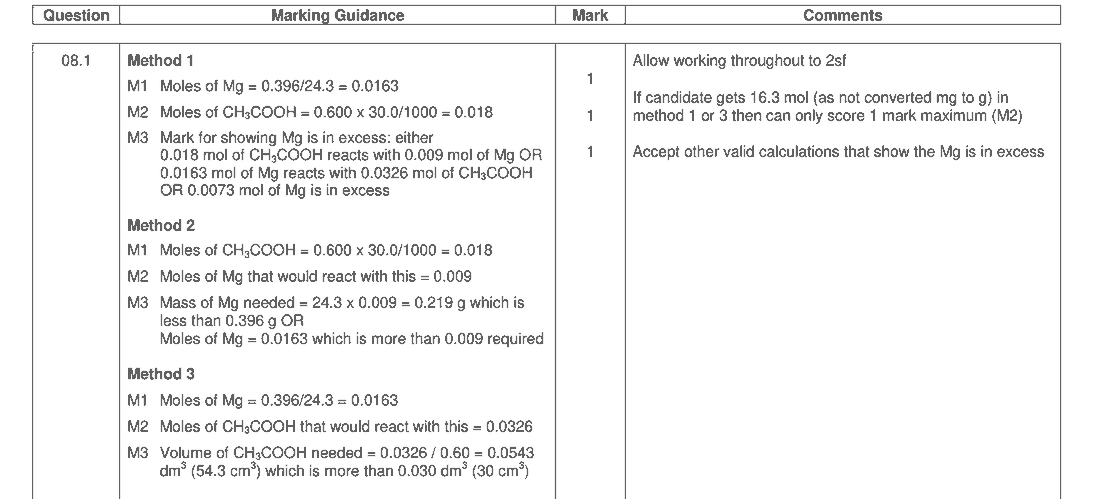
08.1 Amount of substance 3Calculation
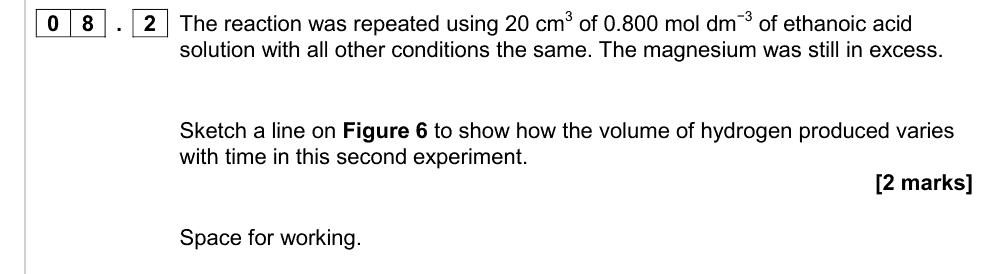
08.2 Kinetics, Amount of substance 2Diagram or structure
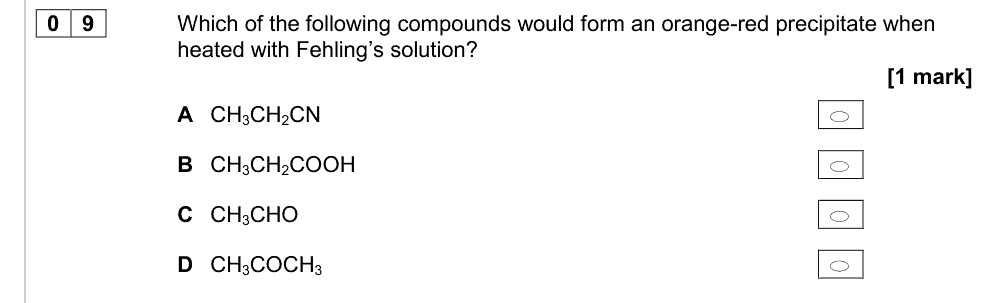
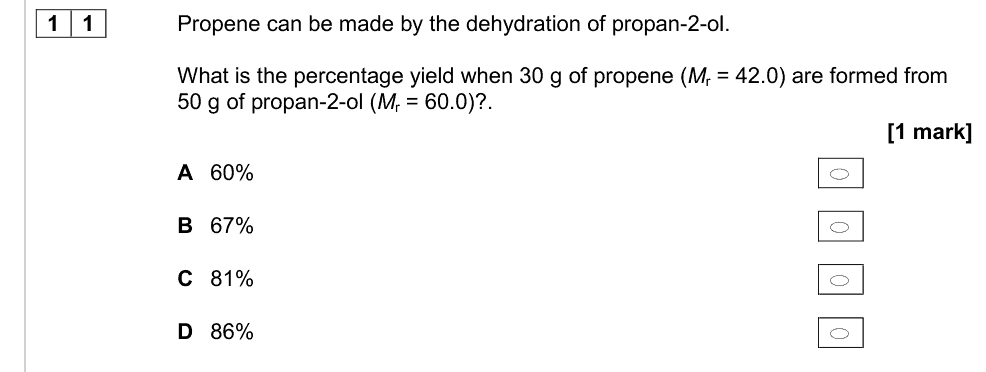
09 Alcohols 1Multiple choice
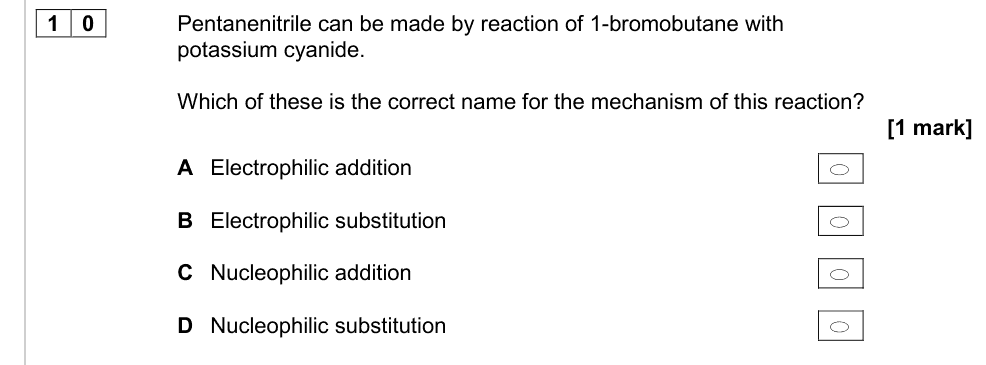
10 Halogenoalkanes 1Multiple choice
11 Amount of substance 1Multiple choice
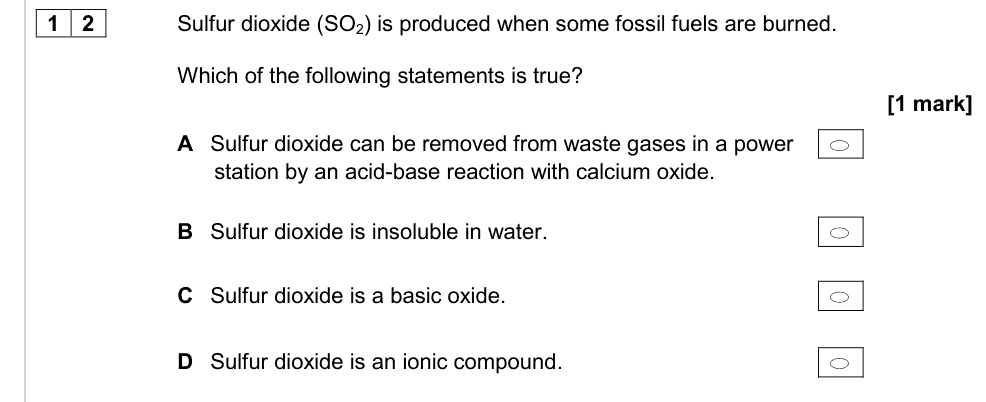
12 Alkanes 1Multiple choice
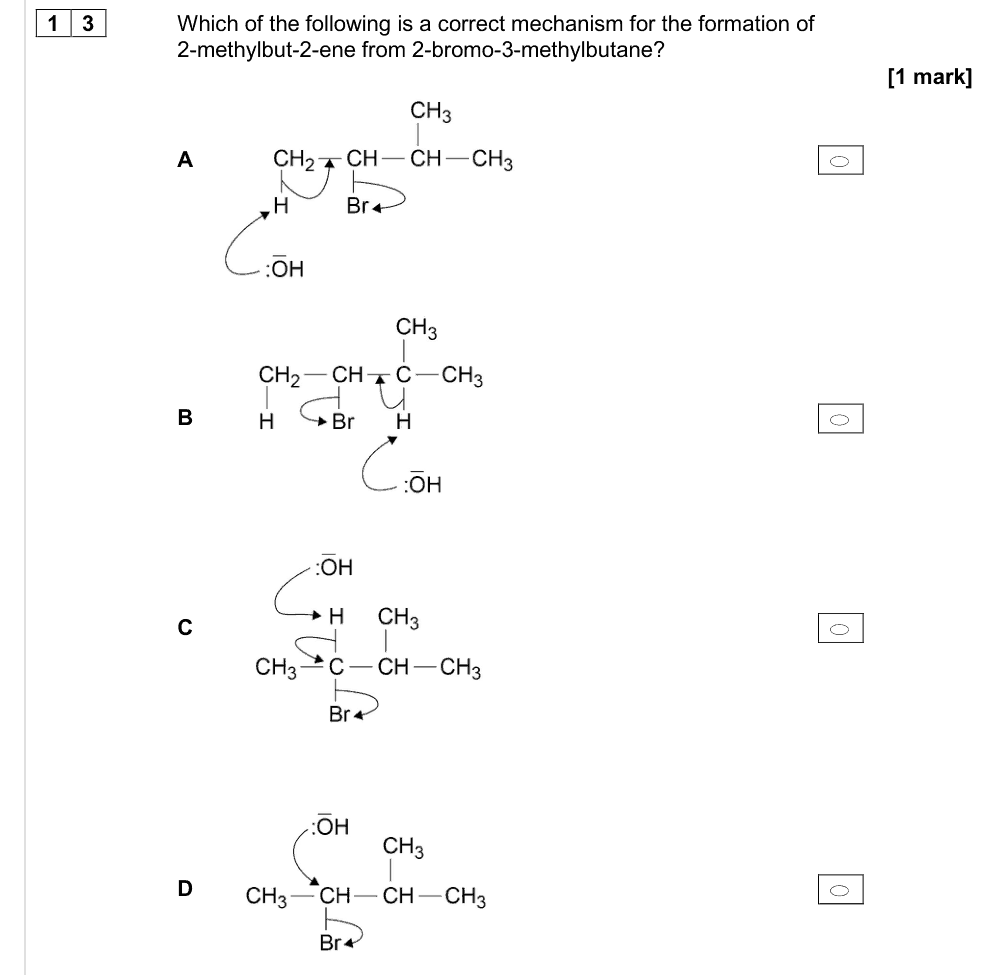
13 Halogenoalkanes, Introduction to organic chemistry: nomenclature, mechanisms and isomerism 1Multiple choice
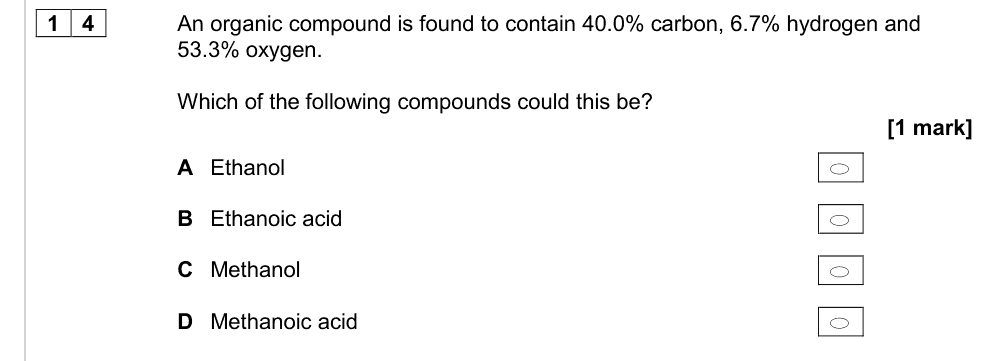
14 Amount of substance 1Multiple choice
15 Alkenes 1Multiple choice
16 Kinetics 1Multiple choice
17 Alkanes, Amount of substance 1Multiple choice
18 Introduction to organic chemistry: nomenclature, mechanisms and isomerism 1Multiple choice
19 Chemical equilibria, Le Chatelier's principle and Kc 1Multiple choice
20 Amount of substance 1Multiple choice
21 Chemical equilibria, Le Chatelier's principle and Kc 1Multiple choice
22 Energetics 1Multiple choice
23 Amount of substance 1Multiple choice

The questions

01.101.202.102.202.302.402.503.103.203.303.403.503.603.704.104.204.305.105.205.305.405.505.606.106.206.306.406.507.107.208.108.2091011121314151617181920212223
June 2016 · AS Paper 2 · Q01.1 2 marks Short answer chemical equilibria and kc
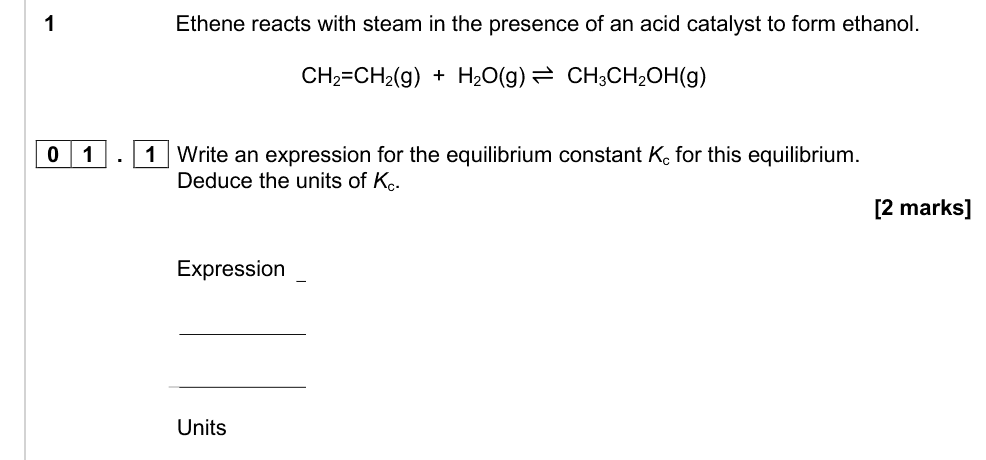
Ethene reacts with steam in the presence of an acid catalyst to form ethanol.
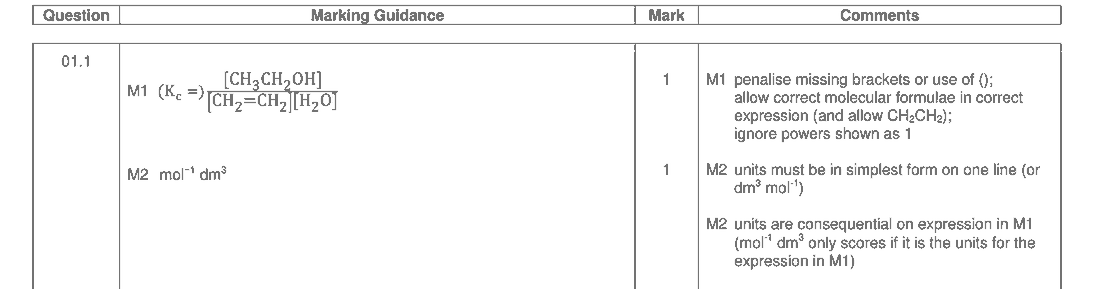
Write an expression for the equilibrium constant Kc for this equilibrium.
Deduce the units of Kc.
[2 marks]
Expression
Units
June 2016 · AS Paper 2 · Q01.2 2 marks Calculation chemical equilibria and kc
Earlier part of question 01 that this part usesEarlier part of June 2016 Paper 2 question 01
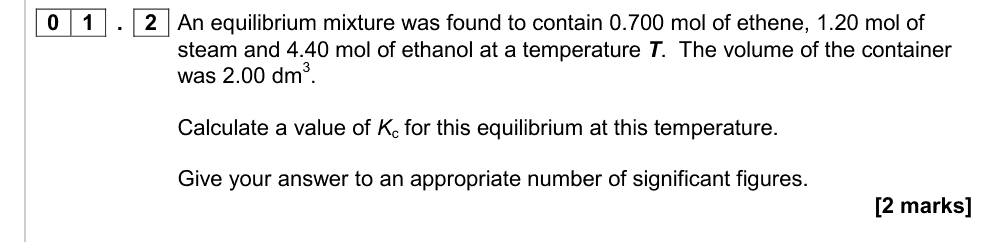
An equilibrium mixture was found to contain 0.700 mol of ethene, 1.20 mol of
steam and 4.40 mol of ethanol at a temperature T.  The volume of the container
was 2.00 dm3.
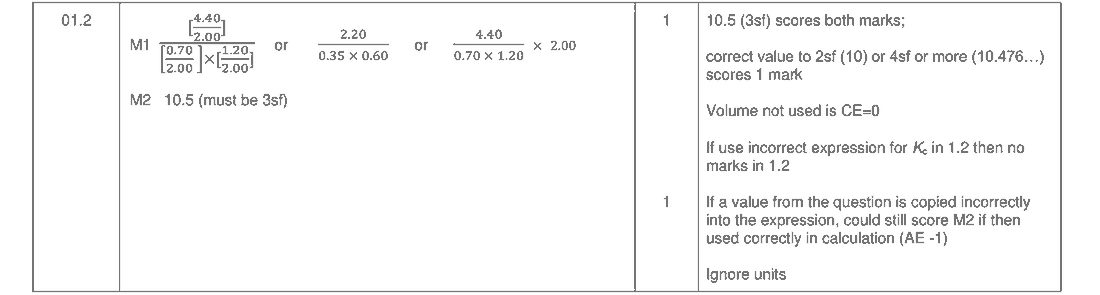
Calculate a value of Kc for this equilibrium at this temperature.
Give your answer to an appropriate number of significant figures.
[2 marks]
June 2016 · AS Paper 2 · Q02.1 4 marks Calculation energeticsamount of substance
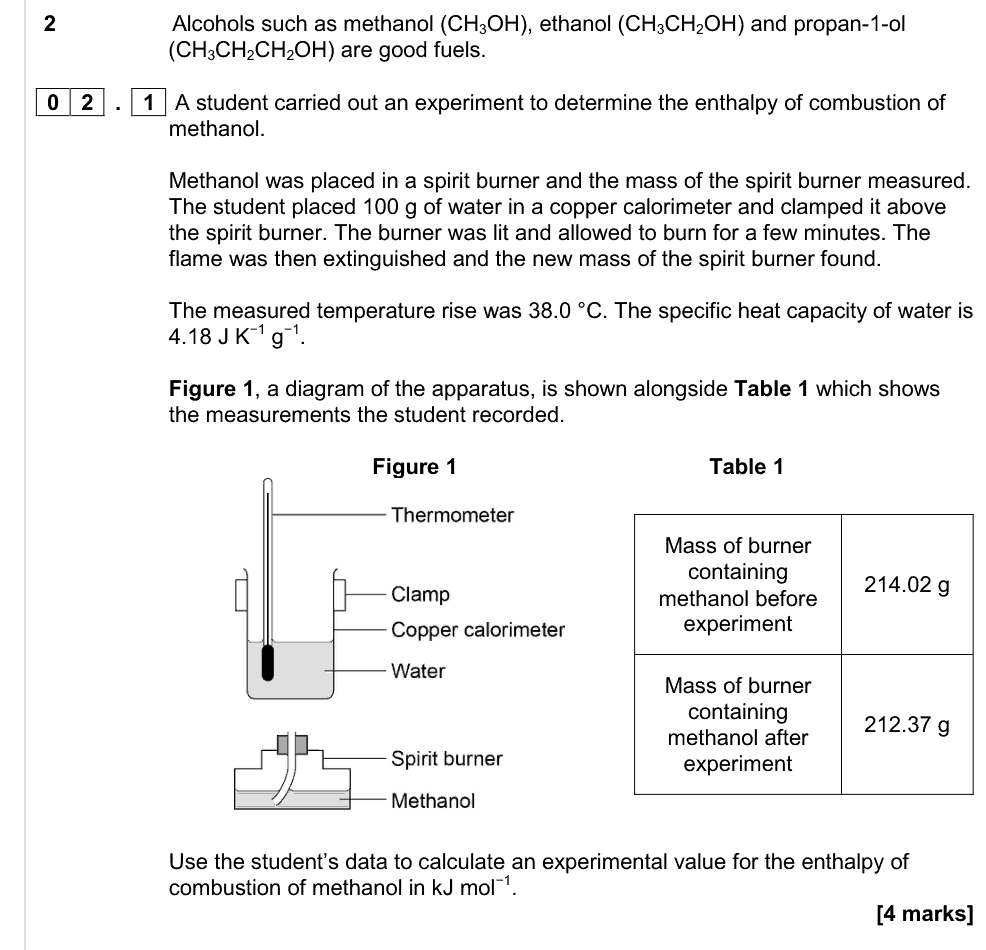
Alcohols such as methanol (CH3OH), ethanol (CH3CH2OH) and propan-1-ol
(CH3CH2CH2OH) are good fuels.
A student carried out an experiment to determine the enthalpy of combustion of
methanol.
Methanol was placed in a spirit burner and the mass of the spirit burner measured.
The student placed 100 g of water in a copper calorimeter and clamped it above
the spirit burner. The burner was lit and allowed to burn for a few minutes. The
flame was then extinguished and the new mass of the spirit burner found.
The measured temperature rise was 38.0 °C. The specific heat capacity of water is
4.18 J K−1 g−1.
Figure 1, a diagram of the apparatus, is shown alongside Table 1 which shows
the measurements the student recorded.
Figure 1                                       Table 1
Mass of burner
containing
methanol before
experiment
214.02 g
Mass of burner
containing
methanol after
experiment
212.37 g
Use the student’s data to calculate an experimental value for the enthalpy of
combustion of methanol in kJ mol−1.
[4 marks]
June 2016 · AS Paper 2 · Q02.2 1 mark Practical and data analysis energetics
Earlier part of question 02 that this part usesEarlier part of June 2016 Paper 2 question 02
Suggest one reason, other than incomplete combustion or heat transfer to the
atmosphere, why the student’s value for the enthalpy of combustion of methanol
is different from that in a Data Book.
[1 mark]
June 2016 · AS Paper 2 · Q02.3 1 mark Practical and data analysis energetics
Earlier part of question 02 that this part usesEarlier part of June 2016 Paper 2 question 02
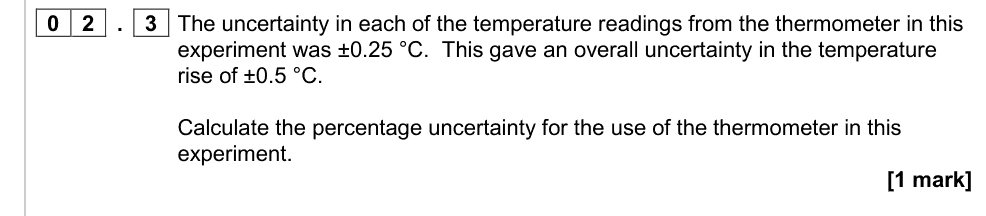
The uncertainty in each of the temperature readings from the thermometer in this
experiment was ±0.25 °C.  This gave an overall uncertainty in the temperature
rise of ±0.5 °C.
Calculate the percentage uncertainty for the use of the thermometer in this
experiment.
[1 mark]
June 2016 · AS Paper 2 · Q02.4 1 mark Practical and data analysis energetics
Earlier part of question 02 that this part usesEarlier part of June 2016 Paper 2 question 02
The student said correctly that using a thermometer with an overall uncertainty for
the rise in temperature of ±0.5 °C was adequate for this experiment.
Explain why this thermometer was adequate for this experiment.
[1 mark]
June 2016 · AS Paper 2 · Q02.5 3 marks Calculation amount of substance
Earlier part of question 02 that this part usesEarlier part of June 2016 Paper 2 question 02
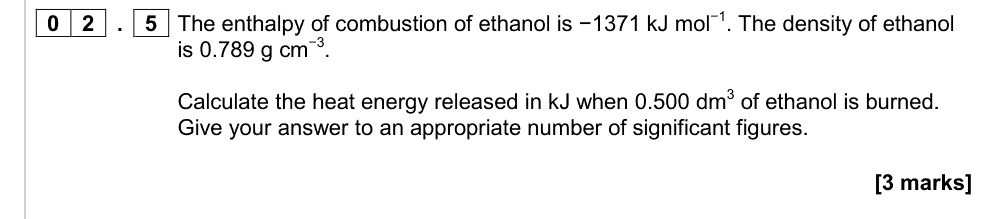
The enthalpy of combustion of ethanol is −1371 kJ mol−1. The density of ethanol
is 0.789 g cm−3.
Calculate the heat energy released in kJ when 0.500 dm3 of ethanol is burned.
Give your answer to an appropriate number of significant figures.
[3 marks]
June 2016 · AS Paper 2 · Q03.1 1 mark Short answer introduction to organic chemistry
Octane and isooctane are structural isomers with the molecular formula C8H18
The displayed formulas and boiling points of octane and isooctane are shown in
Figure 2.
Figure 2
Give the IUPAC name for isooctane.
[1 mark]
June 2016 · AS Paper 2 · Q03.2 3 marks Practical and data analysis alcohols
Earlier part of question 03 that this part usesEarlier part of June 2016 Paper 2 question 03
Octane and isooctane can be separated in the laboratory.
Name a laboratory technique that could be used to separate isooctane from a
mixture of octane and isooctane.
Outline how this technique separates isooctane from octane.
[3 marks]
Name
Outline
June 2016 · AS Paper 2 · Q03.3 1 mark Equation writing alkanesamount of substance
Earlier part of question 03 that this part usesEarlier part of June 2016 Paper 2 question 03
Isooctane is added to petrol to increase its octane rating. Some high-performance
engines require fuel with a higher octane rating.
Write an equation for the complete combustion of isooctane. Use the molecular
formula (C8H18) of isooctane in your equation.
[1 mark]
June 2016 · AS Paper 2 · Q03.4 2 marks Explanation kinetics
Earlier part of question 03 that this part usesEarlier part of June 2016 Paper 2 question 03
Explain, in general terms, how a catalyst works.
[2 marks]
June 2016 · AS Paper 2 · Q03.5 1 mark Equation writing alkanes
Earlier part of question 03 that this part usesEarlier part of June 2016 Paper 2 question 03
Carbon monoxide is produced when incomplete combustion takes place in
engines. Nitrogen monoxide is another pollutant produced in car engines.
Write an equation to show how these pollutants react together in a catalytic
converter.
[1 mark]
June 2016 · AS Paper 2 · Q03.6 2 marks Explanation alkanes
Earlier part of question 03 that this part usesEarlier part of June 2016 Paper 2 question 03
Platinum, palladium and rhodium are metals used inside catalytic converters.
A very thin layer of the metals is used on a honeycomb ceramic support.
Explain why a thin layer is used in this way.
[2 marks]
June 2016 · AS Paper 2 · Q03.7 2 marks Practical and data analysis alkenesorganic analysis
Earlier part of question 03 that this part usesEarlier part of June 2016 Paper 2 question 03
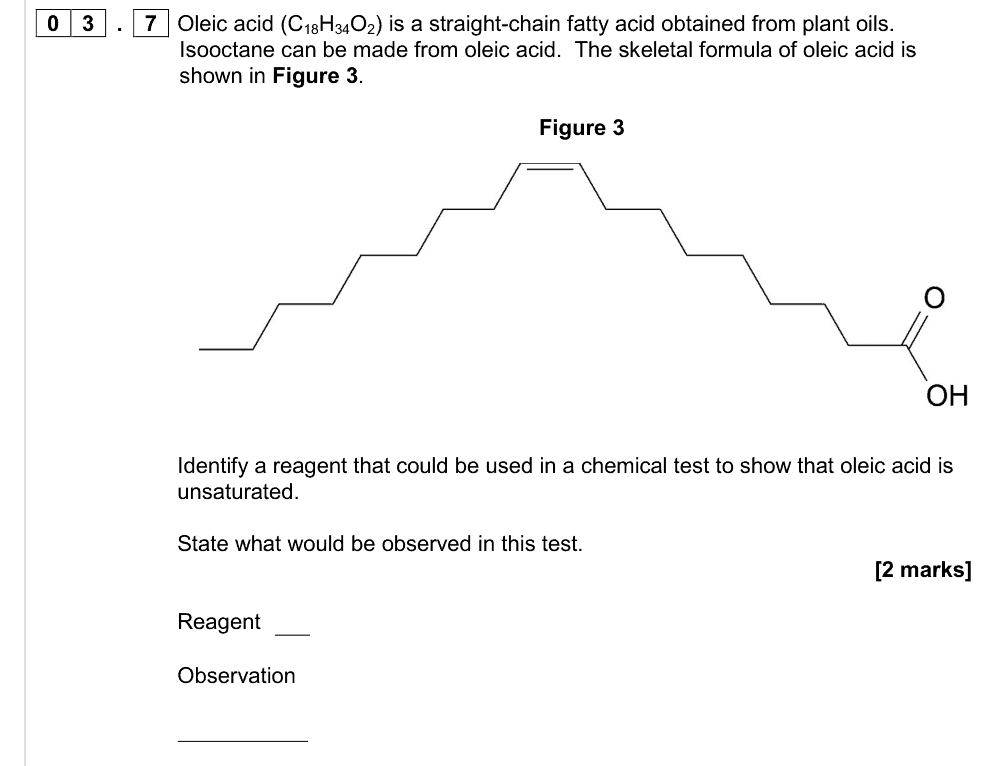
Oleic acid (C18H34O2) is a straight-chain fatty acid obtained from plant oils.
Isooctane can be made from oleic acid.  The skeletal formula of oleic acid is
shown in Figure 3.
Figure 3
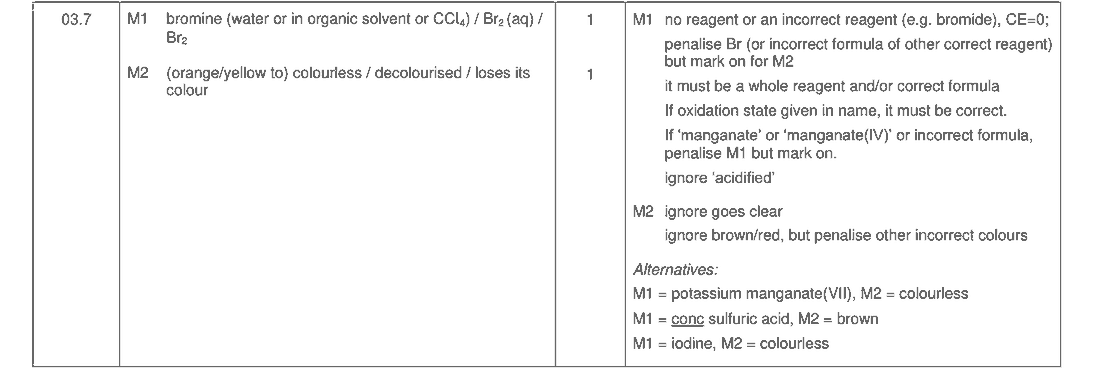
Identify a reagent that could be used in a chemical test to show that oleic acid is
unsaturated.
State what would be observed in this test.
[2 marks]
Reagent
Observation
June 2016 · AS Paper 2 · Q04.1 2 marks Explanation organic analysis
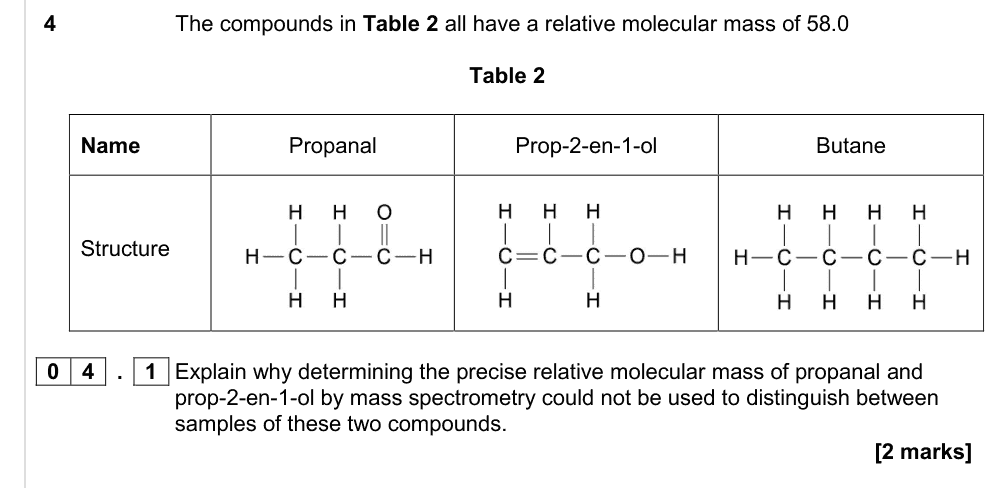
The compounds in Table 2 all have a relative molecular mass of 58.0
Table 2
Name
Propanal
Prop-2-en-1-ol
Butane
Structure
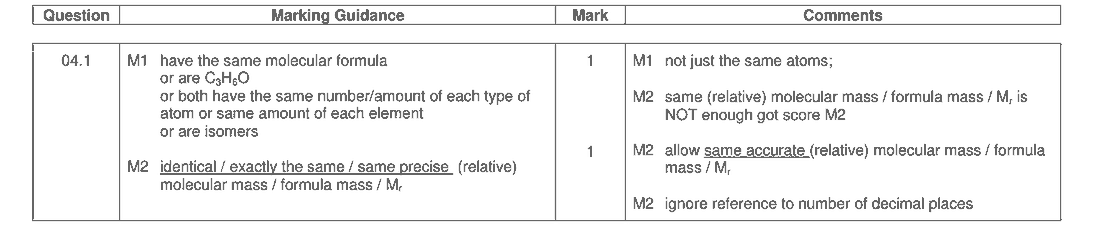
Explain why determining the precise relative molecular mass of propanal and
prop-2-en-1-ol by mass spectrometry could not be used to distinguish between
samples of these two compounds.
[2 marks]
June 2016 · AS Paper 2 · Q04.2 2 marks Short answer organic analysis
Earlier part of question 04 that this part usesEarlier part of June 2016 Paper 2 question 04
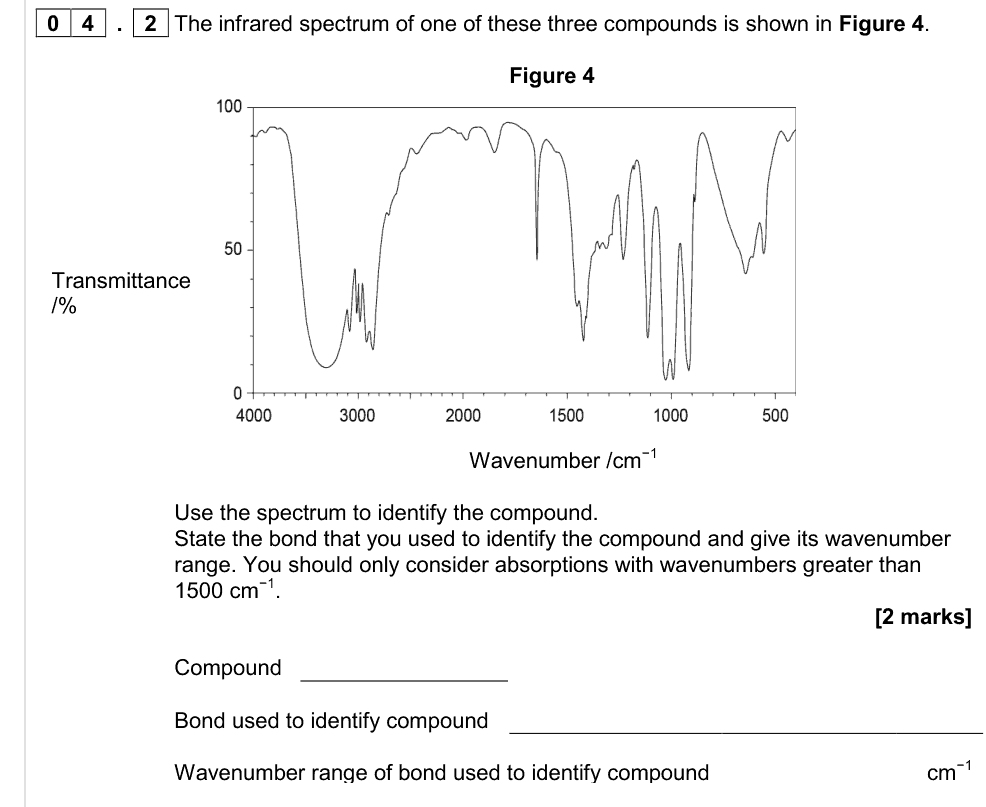
The infrared spectrum of one of these three compounds is shown in Figure 4.
Figure 4
Use the spectrum to identify the compound.
State the bond that you used to identify the compound and give its wavenumber
range. You should only consider absorptions with wavenumbers greater than
1500 cm−1.
[2 marks]
Compound
Bond used to identify compound
Wavenumber /cm−1
Transmittance
/%
June 2016 · AS Paper 2 · Q04.3 6 marks 6-mark level of response bonding
Earlier part of question 04 that this part usesEarlier part of June 2016 Paper 2 question 04
Predict the relative boiling points of these three compounds from the highest to
the lowest boiling points.
Justify this order in terms of intermolecular forces.
[6 marks]
June 2016 · AS Paper 2 · Q05.1 2 marks Equation writing halogenoalkanes
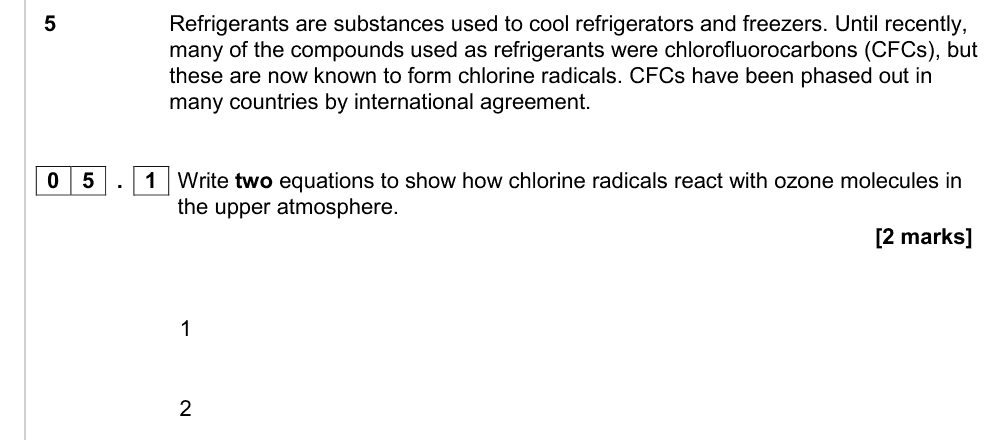
Refrigerants are substances used to cool refrigerators and freezers. Until recently,
many of the compounds used as refrigerants were chlorofluorocarbons (CFCs), but
these are now known to form chlorine radicals. CFCs have been phased out in
many countries by international agreement.
Write two equations to show how chlorine radicals react with ozone molecules in
the upper atmosphere.
[2 marks]
1
2
June 2016 · AS Paper 2 · Q05.2 1 mark Diagram or structure introduction to organic chemistry
Earlier part of question 05 that this part usesEarlier part of June 2016 Paper 2 question 05
Chloropentafluoroethane is a CFC that has been used as a refrigerant.
Draw its displayed formula.
[1 mark]
June 2016 · AS Paper 2 · Q05.3 1 mark Short answer halogenoalkanes
Earlier part of question 05 that this part usesEarlier part of June 2016 Paper 2 question 05
,1,1-trifluoroethane (CF3CH3) is one of the molecules that has been used as a
refrigerant in place of CFCs.
Explain why 1,1,1-trifluoroethane does not lead to the depletion of the ozone in
the upper atmosphere.
[1 mark]
June 2016 · AS Paper 2 · Q05.4 2 marks Equation writing introduction to organic chemistryalkanes
Earlier part of question 05 that this part usesEarlier part of June 2016 Paper 2 question 05
One of the steps in the synthesis of 1,1,1-trifluoroethane (CF3CH3) is the reaction
of 1,1-difluoroethane (CHF2CH3) with fluorine in a free-radical substitution
reaction.
Write two equations to represent the propagation steps in this conversion of
CHF2CH3 into CF3CH3
[2 marks]
Propagation step 1
Propagation step 2
June 2016 · AS Paper 2 · Q05.5 2 marks Calculation amount of substance
Earlier part of question 05 that this part usesEarlier part of June 2016 Paper 2 question 05
A refrigerator contains 1.41 kg of 1,1,1-trifluoroethane (CF3CH3).
Calculate the number of molecules of 1,1,1-trifluoroethane in the refrigerator.
Give your answer to an appropriate number of significant figures.
(The Avogadro constant L = 6.022 x 10²³ mol−1)
[2 marks]
June 2016 · AS Paper 2 · Q05.6 1 mark Short answer organic analysis
Earlier part of question 05 that this part usesEarlier part of June 2016 Paper 2 question 05
There are growing concerns about the use of 1,1,1-trifluoroethane as a refrigerant
as it is a greenhouse gas that absorbs some of Earth’s infrared radiation.
Give one reason why bonds in molecules such as carbon dioxide and
1,1,1-trifluoroethane absorb infrared radiation.
[1 mark]
June 2016 · AS Paper 2 · Q06.1 1 mark Diagram or structure introduction to organic chemistry
Propane-1,2-diol has the structure CH2(OH)CH(OH)CH3. It is used to make
polyesters and is one of the main substances in electronic cigarettes (E-cigarettes).
A sample of propane-1,2-diol was refluxed with a large excess of
potassium dichromate(VI) and sulfuric acid.
Draw the skeletal formula of propane-1,2-diol.
[1 mark]
June 2016 · AS Paper 2 · Q06.2 2 marks Equation writing alcohols
Earlier part of question 06 that this part usesEarlier part of June 2016 Paper 2 question 06
Write an equation for this oxidation reaction of propane-1,2-diol under reflux,
using [O] to represent the oxidizing agent.
Show the displayed formula of the organic product.
[2 marks]
June 2016 · AS Paper 2 · Q06.3 2 marks Diagram or structure alcohols
Earlier part of question 06 that this part usesEarlier part of June 2016 Paper 2 question 06
Draw a labelled diagram to show how you would set up apparatus for refluxing.
[2 marks]
June 2016 · AS Paper 2 · Q06.4 1 mark Practical and data analysis alcohols
Earlier part of question 06 that this part usesEarlier part of June 2016 Paper 2 question 06
Anti-bumping granules are placed in the flask when refluxing.
Suggest why these granules prevent bumping.
[1 mark]
June 2016 · AS Paper 2 · Q06.5 1 mark Diagram or structure alcohols
Earlier part of question 06 that this part usesEarlier part of June 2016 Paper 2 question 06
Draw the structure of a different organic product formed when the acidified
potassium dichromate(VI) is not in excess.
[1 mark]
June 2016 · AS Paper 2 · Q07.1 1 mark Diagram or structure introduction to organic chemistry
The alkene 3-methylpent-2-ene (CH3CH=C(CH3)CH2CH3) reacts with hydrogen
bromide to form a mixture of 3-bromo-3-methylpentane and
2-bromo-3-methylpentane.
The alkene 3-methylpent-2-ene (CH3CH=C(CH3)CH2CH3) exists as E and Z
stereoisomers.
Draw the structure of Z-3-methylpent-2-ene.
[1 mark]
June 2016 · AS Paper 2 · Q07.2 7 marks Mechanism alkenesintroduction to organic chemistry
Earlier part of question 07 that this part usesEarlier part of June 2016 Paper 2 question 07
Name and outline the mechanism for the formation of 3-bromo-3-methylpentane
from this reaction of 3-methylpent-2-ene with hydrogen bromide.
Explain why more 3-bromo-3-methylpentane is formed in this reaction than
2-bromo-3-methylpentane.
[7 marks]
June 2016 · AS Paper 2 · Q08.1 3 marks Calculation amount of substance
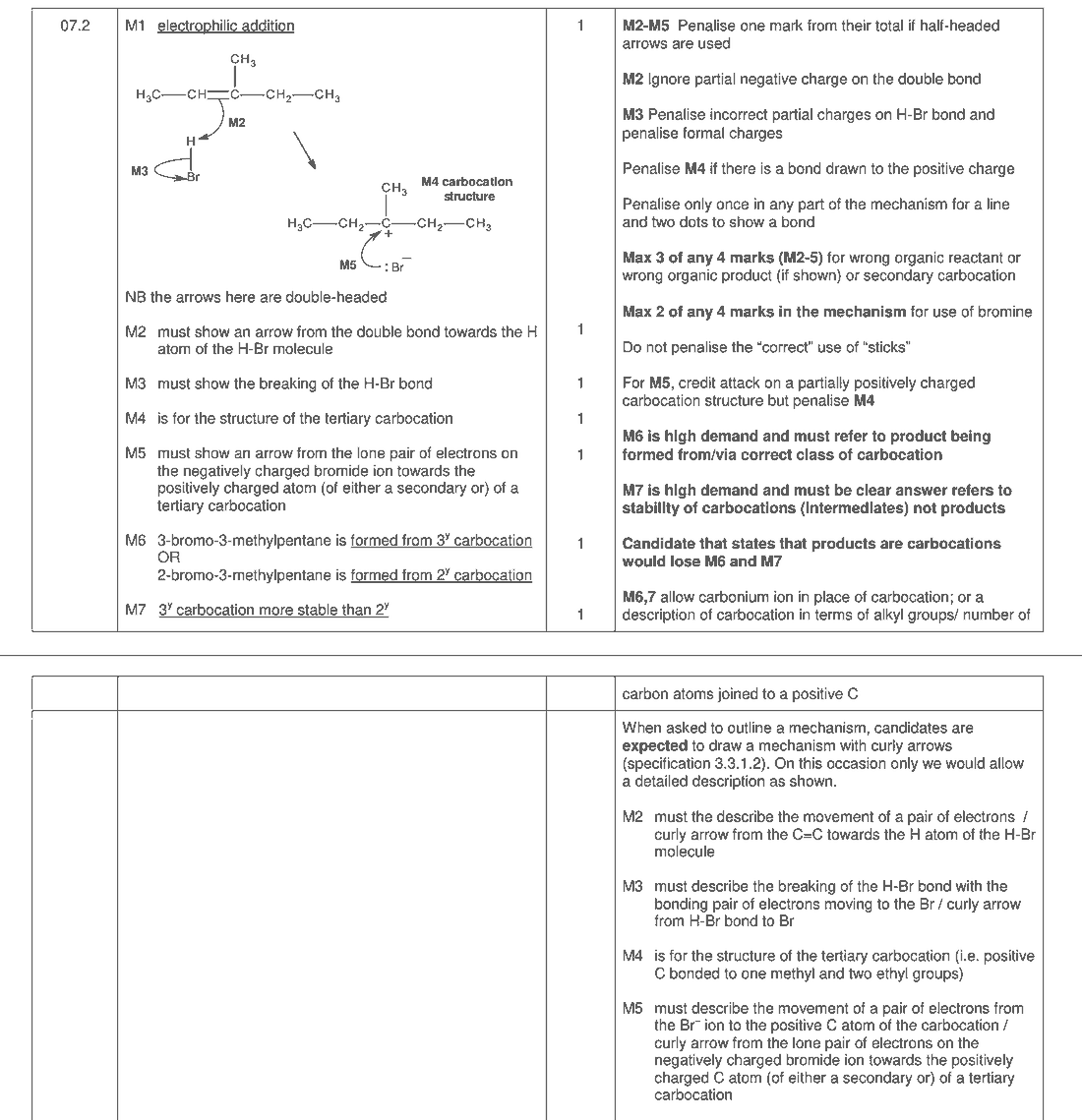
When an aqueous solution of ethanoic acid reacts with magnesium, the progress of
reaction can be followed using the equipment shown in Figure 5 to measure the
volume of hydrogen produced.
Figure 5
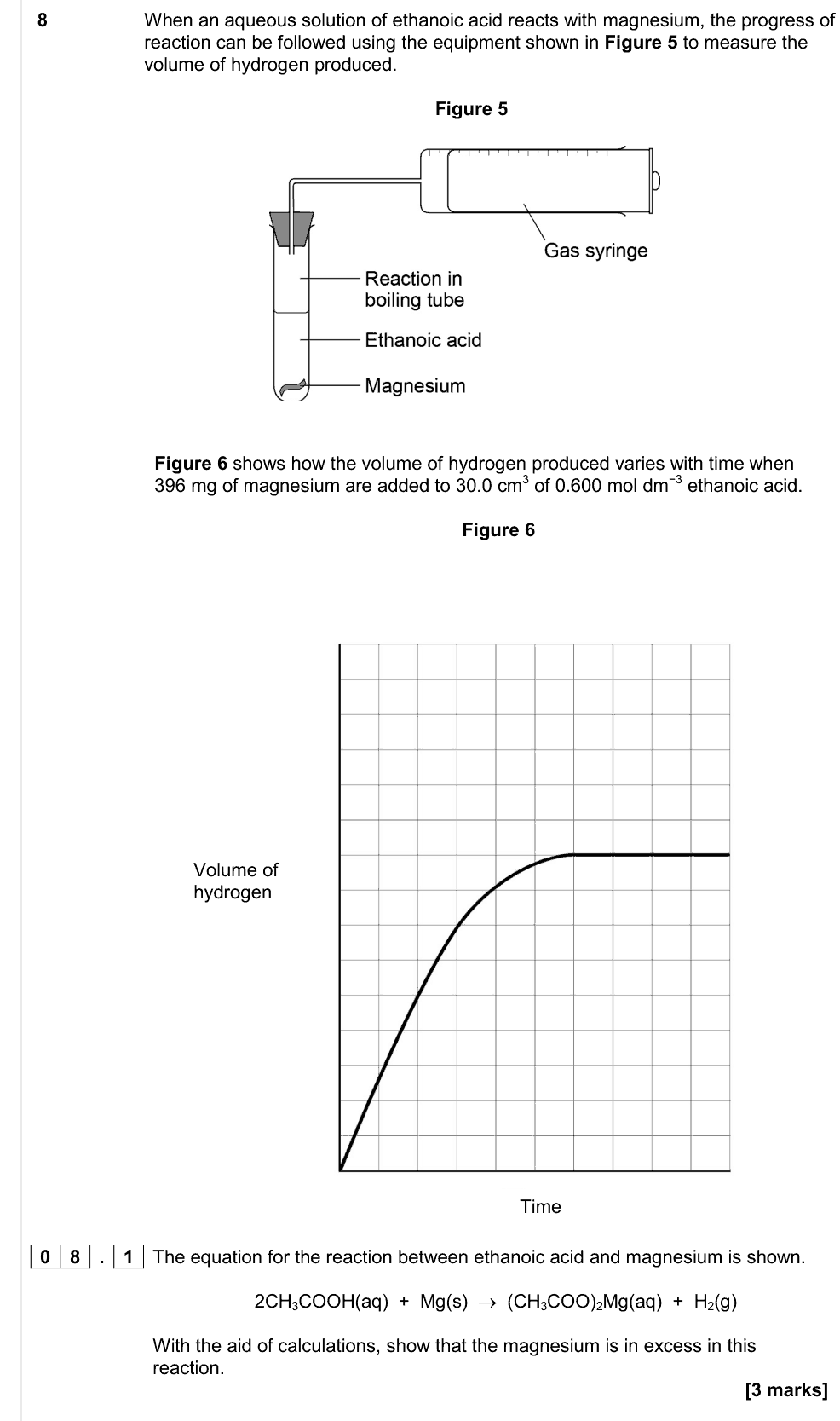
Figure 6 shows how the volume of hydrogen produced varies with time when
396 mg of magnesium are added to 30.0 cm3 of 0.600 mol dm−3 ethanoic acid.
Figure 6
Volume of
hydrogen
Time
The equation for the reaction between ethanoic acid and magnesium is shown.
2CH3COOH(aq)  +  Mg(s)  →  (CH3COO)2Mg(aq)  +  H2(g)
With the aid of calculations, show that the magnesium is in excess in this
reaction.
[3 marks]
June 2016 · AS Paper 2 · Q08.2 2 marks Diagram or structure kineticsamount of substance
Earlier part of question 08 that this part usesEarlier part of June 2016 Paper 2 question 08
The reaction was repeated using 20 cm3 of 0.800 mol dm−3 of ethanoic acid
solution with all other conditions the same. The magnesium was still in excess.
Sketch a line on Figure 6 to show how the volume of hydrogen produced varies
with time in this second experiment.
[2 marks]
Space for working.
June 2016 · AS Paper 2 · Q09 1 mark Multiple choice alcohols
Which of the following compounds would form an orange-red precipitate when
heated with Fehling’s solution?
[1 mark]
A CH3CH2CN
B CH3CH2COOH
C CH3CHO
D CH3COCH3
June 2016 · AS Paper 2 · Q10 1 mark Multiple choice halogenoalkanes
Pentanenitrile can be made by reaction of 1-bromobutane with
potassium cyanide.
Which of these is the correct name for the mechanism of this reaction?
[1 mark]
A Electrophilic addition
B Electrophilic substitution
C Nucleophilic addition
D Nucleophilic substitution
June 2016 · AS Paper 2 · Q11 1 mark Multiple choice amount of substance
Propene can be made by the dehydration of propan-2-ol.
What is the percentage yield when 30 g of propene (Mr = 42.0) are formed from
50 g of propan-2-ol (Mr = 60.0)?.
[1 mark]
A 60%
B 67%
C 81%
D 86%
June 2016 · AS Paper 2 · Q12 1 mark Multiple choice alkanes
Sulfur dioxide (SO2) is produced when some fossil fuels are burned.
Which of the following statements is true?
[1 mark]
A Sulfur dioxide can be removed from waste gases in a power
station by an acid-base reaction with calcium oxide.
B Sulfur dioxide is insoluble in water.
C Sulfur dioxide is a basic oxide.
D Sulfur dioxide is an ionic compound.
June 2016 · AS Paper 2 · Q13 1 mark Multiple choice halogenoalkanesintroduction to organic chemistry
Which of the following is a correct mechanism for the formation of
2-methylbut-2-ene from 2-bromo-3-methylbutane?
[1 mark]
A
B
C
D
June 2016 · AS Paper 2 · Q14 1 mark Multiple choice amount of substance
An organic compound is found to contain 40.0% carbon, 6.7% hydrogen and
53.3% oxygen.
Which of the following compounds could this be?
[1 mark]
A Ethanol
B Ethanoic acid
C Methanol
D Methanoic acid
June 2016 · AS Paper 2 · Q15 1 mark Multiple choice alkenes
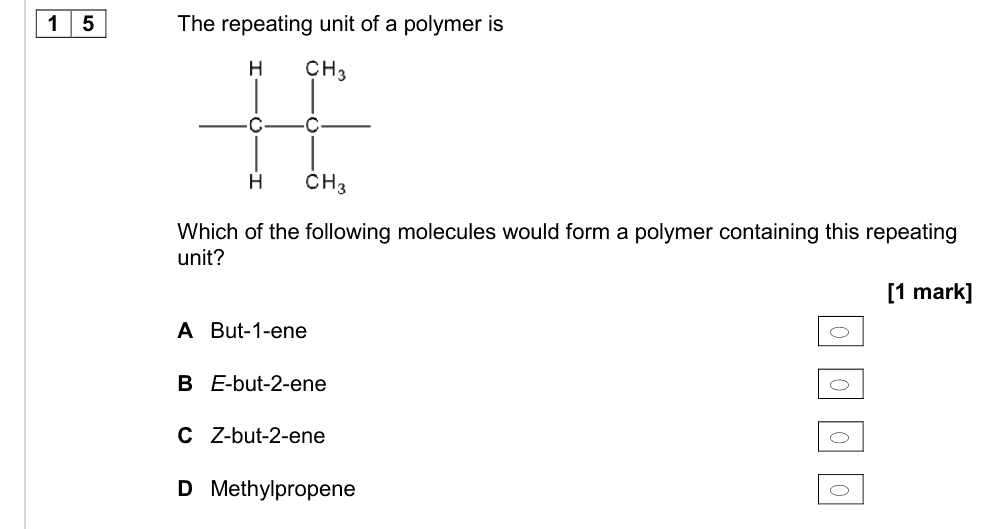
The repeating unit of a polymer is
Which of the following molecules would form a polymer containing this repeating
unit?
[1 mark]
A But-1-ene
B E-but-2-ene
C Z-but-2-ene
D Methylpropene
June 2016 · AS Paper 2 · Q16 1 mark Multiple choice kinetics
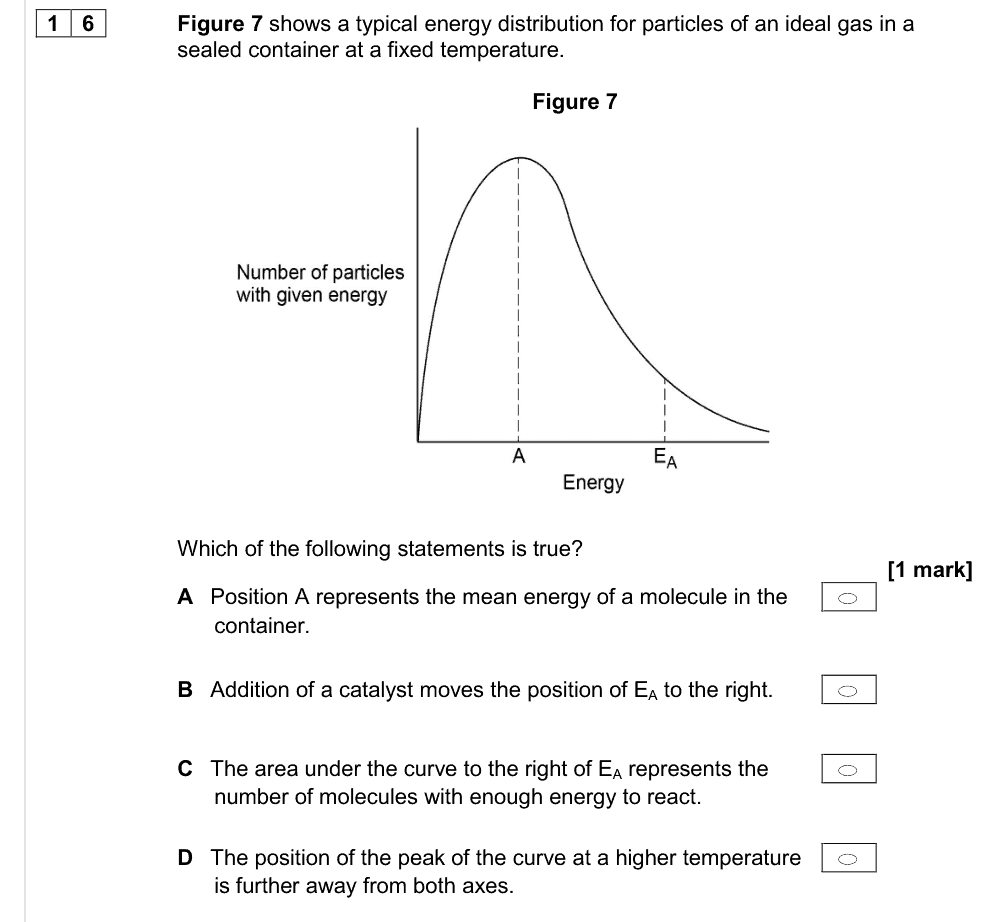
Figure 7 shows a typical energy distribution for particles of an ideal gas in a
sealed container at a fixed temperature.
Figure 7
Which of the following statements is true?
[1 mark]
A Position A represents the mean energy of a molecule in the
container.
B Addition of a catalyst moves the position of EA to the right.
C The area under the curve to the right of EA represents the
number of molecules with enough energy to react.
D The position of the peak of the curve at a higher temperature
is further away from both axes.
June 2016 · AS Paper 2 · Q17 1 mark Multiple choice alkanesamount of substance
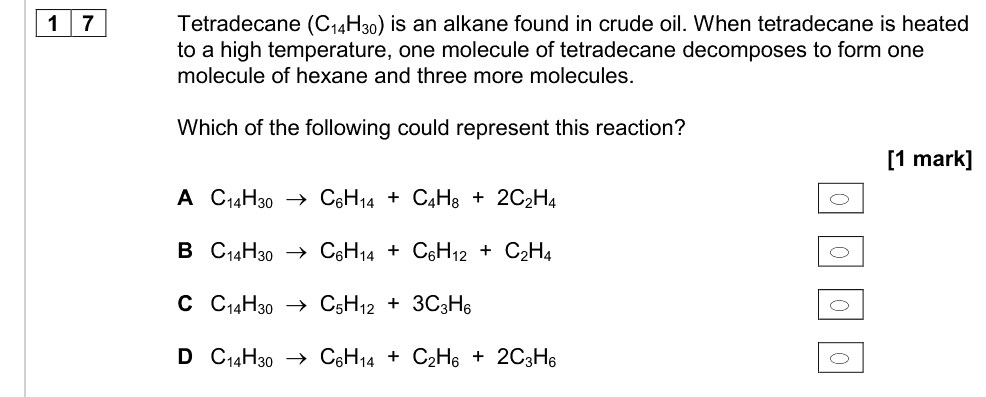
Tetradecane (C14H30) is an alkane found in crude oil. When tetradecane is heated
to a high temperature, one molecule of tetradecane decomposes to form one
molecule of hexane and three more molecules.
Which of the following could represent this reaction?
[1 mark]
A C14H30  →  C6H14  +  C4H8  +  2C2H4
B C14H30  →  C6H14  +  C6H12  +  C2H4
C C14H30  →  C5H12  +  3C3H6
D C14H30  →  C6H14  +  C2H6  +  2C3H6
June 2016 · AS Paper 2 · Q18 1 mark Multiple choice introduction to organic chemistry
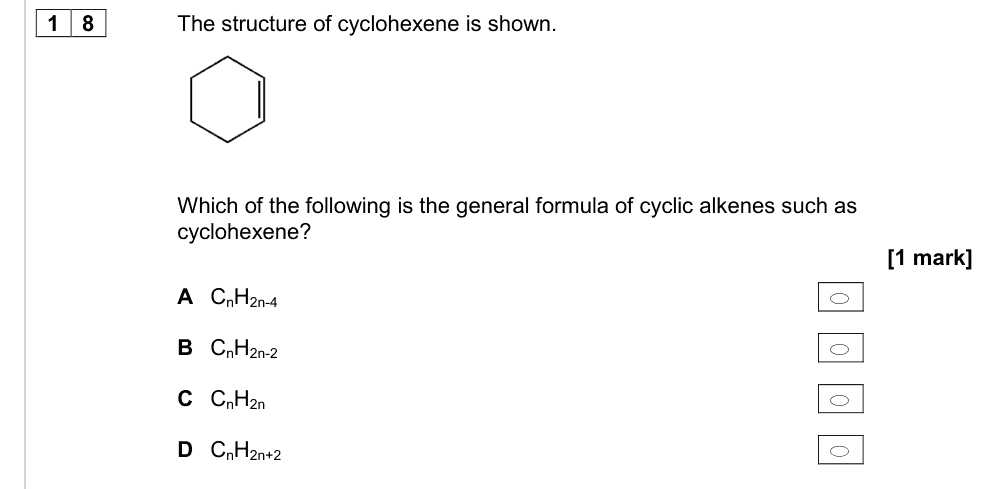
The structure of cyclohexene is shown.
Which of the following is the general formula of cyclic alkenes such as
cyclohexene?
[1 mark]
A CnH2n-4
B CnH2n-2
C CnH2n
D CnH2n+2
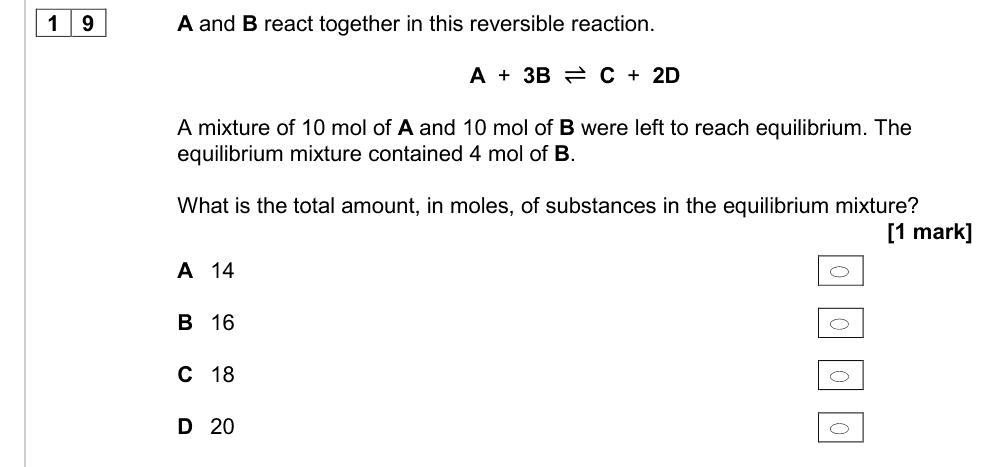
A  +  3B  ⇌  C  +  2D
June 2016 · AS Paper 2 · Q19 1 mark Multiple choice chemical equilibria and kc
A and B react together in this reversible reaction.
A mixture of 10 mol of A and 10 mol of B were left to reach equilibrium. The
equilibrium mixture contained 4 mol of B.
What is the total amount, in moles, of substances in the equilibrium mixture?
[1 mark]
A 14
B 16
C 18
D 20
June 2016 · AS Paper 2 · Q20 1 mark Multiple choice amount of substance
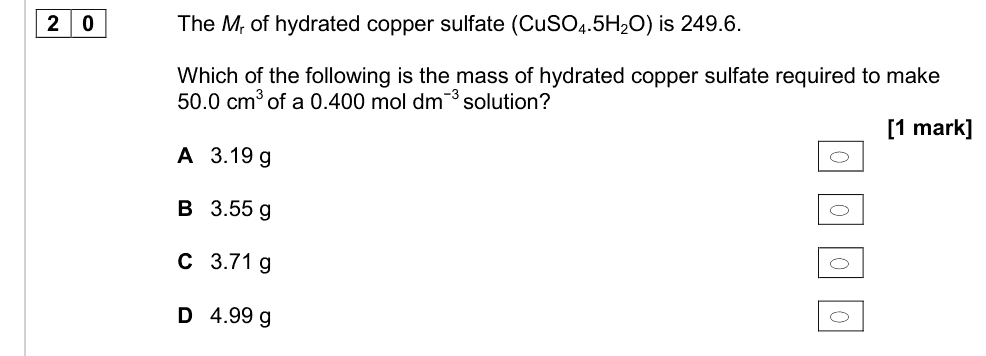
The Mr of hydrated copper sulfate (CuSO4.5H2O) is 249.6.
Which of the following is the mass of hydrated copper sulfate required to make
50.0 cm3 of a 0.400 mol dm−3 solution?
[1 mark]
A 3.19 g
B 3.55 g
C 3.71 g
D 4.99 g
June 2016 · AS Paper 2 · Q21 1 mark Multiple choice chemical equilibria and kc
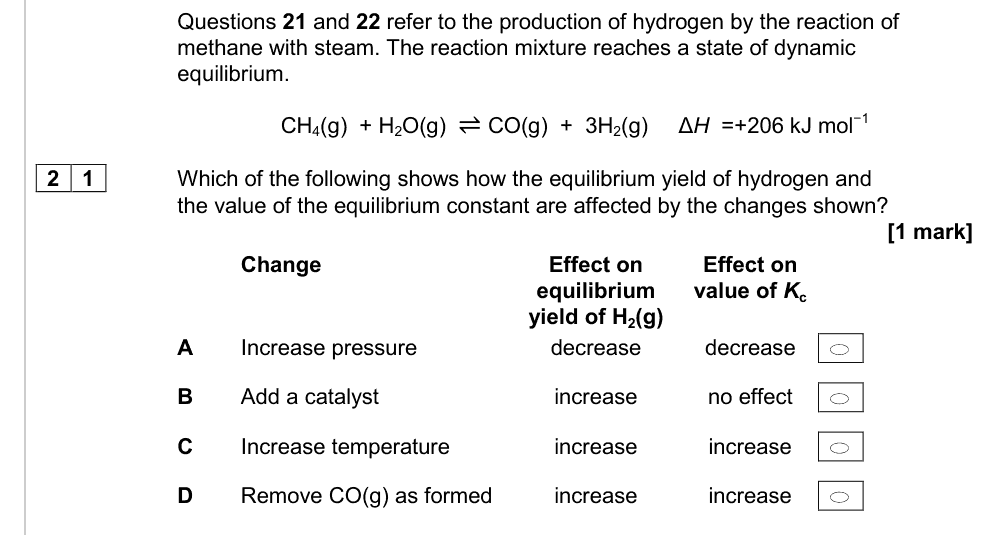
Questions 21 and 22 refer to the production of hydrogen by the reaction of
methane with steam. The reaction mixture reaches a state of dynamic
equilibrium.
CH4(g)  + H2O(g)  ⇌ CO(g)  +  3H2(g)     ΔH  =+206 kJ mol−1
Which of the following shows how the equilibrium yield of hydrogen and
the value of the equilibrium constant are affected by the changes shown?
[1 mark]
Change
Effect on
equilibrium
yield of H2(g)
Effect on
value of Kc
A
Increase pressure
decrease
decrease
B
Add a catalyst
increase
no effect
C
Increase temperature
increase
increase
D
Remove CO(g) as formed
increase
increase
June 2016 · AS Paper 2 · Q22 1 mark Multiple choice energetics
Earlier part of question 22 that this part usesEarlier part of June 2016 Paper 2 question 22
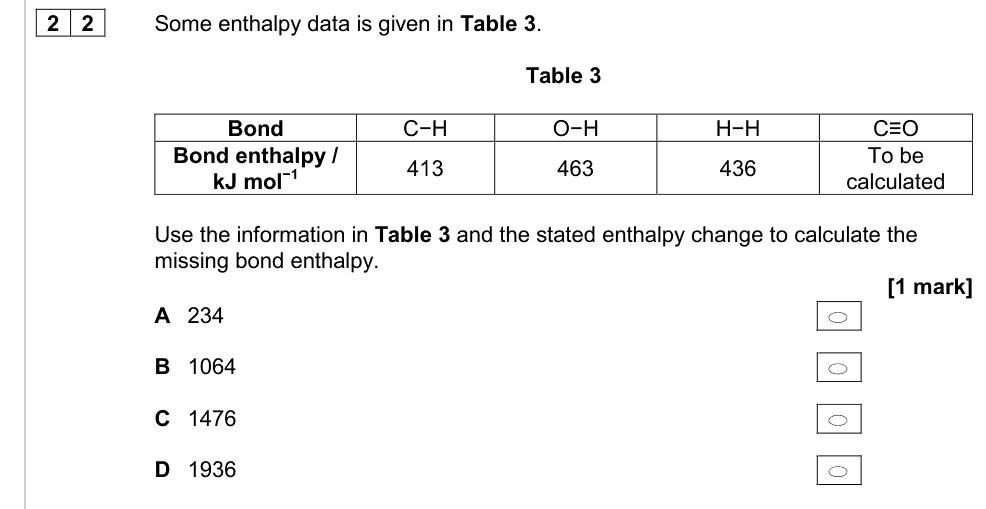
Some enthalpy data is given in Table 3.
Table 3
Bond
C−H
O−H
H−H
C≡O
Bond enthalpy /
kJ mol−1
413
463
436
To be
calculated
Use the information in Table 3 and the stated enthalpy change to calculate the
missing bond enthalpy.
[1 mark]
A 234
B 1064
C 1476
D 1936
June 2016 · AS Paper 2 · Q23 1 mark Multiple choice amount of substance
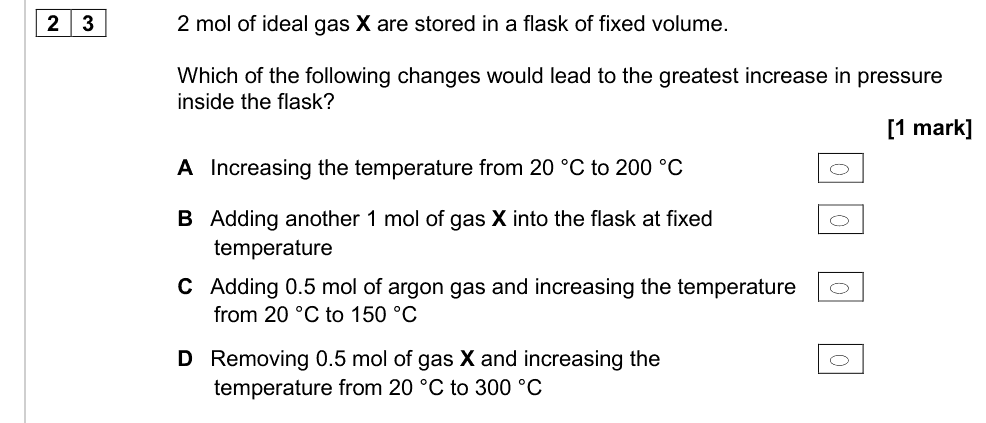
2 mol of ideal gas X are stored in a flask of fixed volume.
Which of the following changes would lead to the greatest increase in pressure
inside the flask?
[1 mark]
A Increasing the temperature from 20 °C to 200 °C
B Adding another 1 mol of gas X into the flask at fixed
temperature
C Adding 0.5 mol of argon gas and increasing the temperature
from 20 °C to 150 °C
D Removing 0.5 mol of gas X and increasing the
temperature from 20 °C to 300 °C

Work with an A-level chemistry tutor

Want a paper marked and gone through with you? Message us.

Prefer email? Send an enquiry

If you are under 18, please include a parent's contact details. Enquiries go to enquiries@chemistryaleveltutor.com and are deleted once handled. All tutoring is online.