Answer
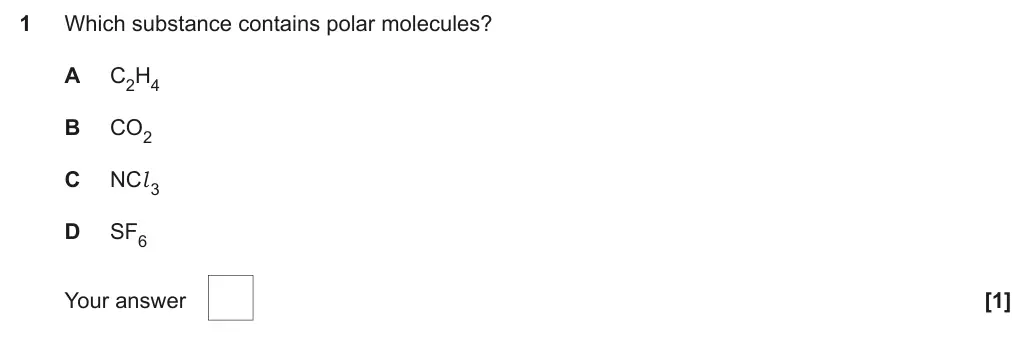
C
Mark scheme

70 marks · 41 question parts · Paper, mark scheme and report on OCR's site · An autumn series, sat in place of the cancelled summer exams · Have OCR's Data Sheet beside you
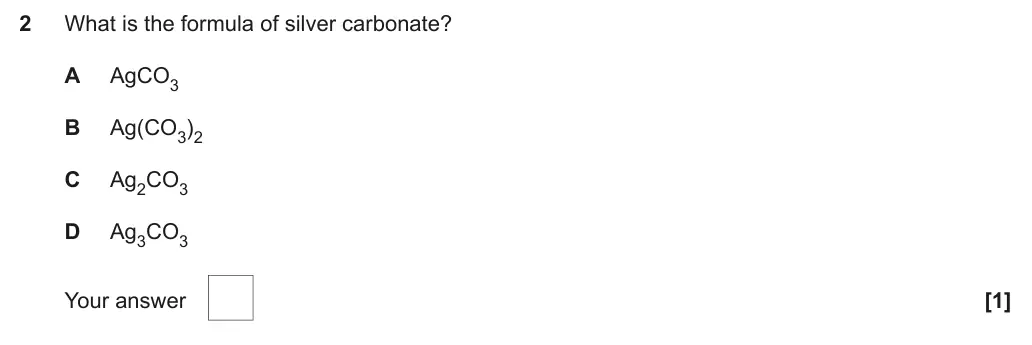
C
C
Candidates are expected to know the charges on silver and carbonate ions. However, a number of candidates responded with A: AgCO3, rather than C: Ag2CO3.
B
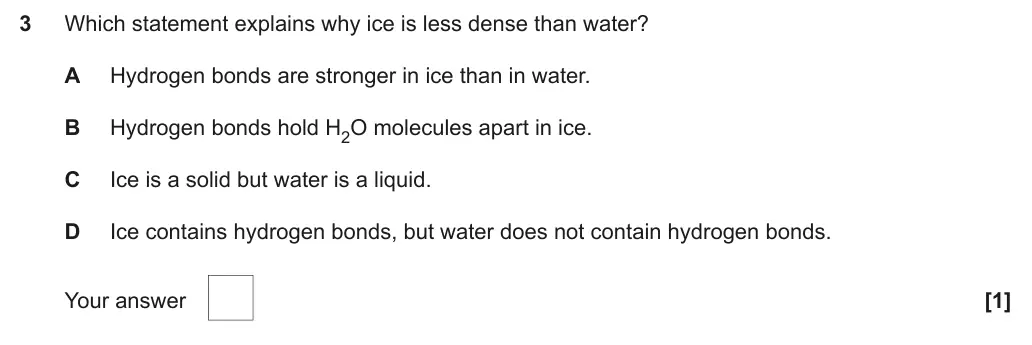
Questions 3, 4, 5, 6 and 13 generally scored well.
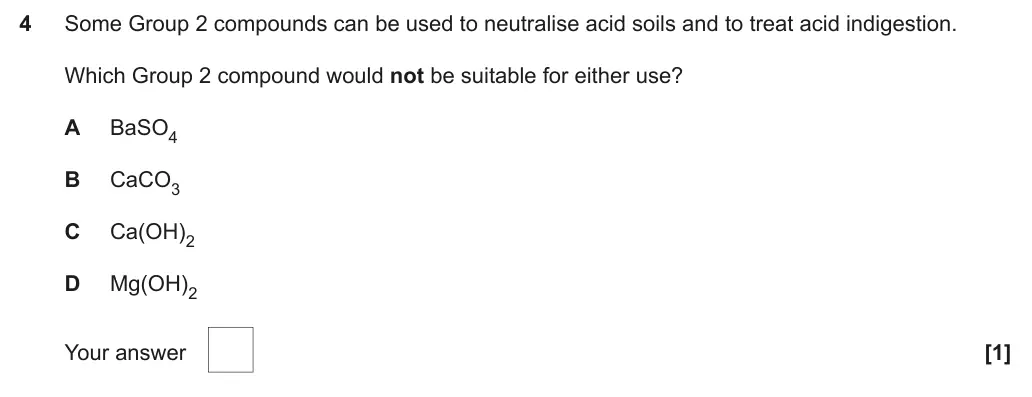
A
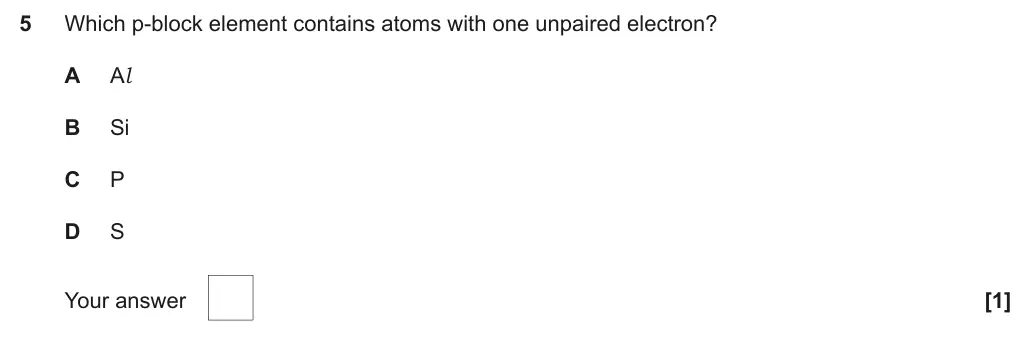
A
Most candidates chose the correct response of A: Al. The best approach seen on many scripts was to write out the electron configuration beside the options and to count off the paired electrons.
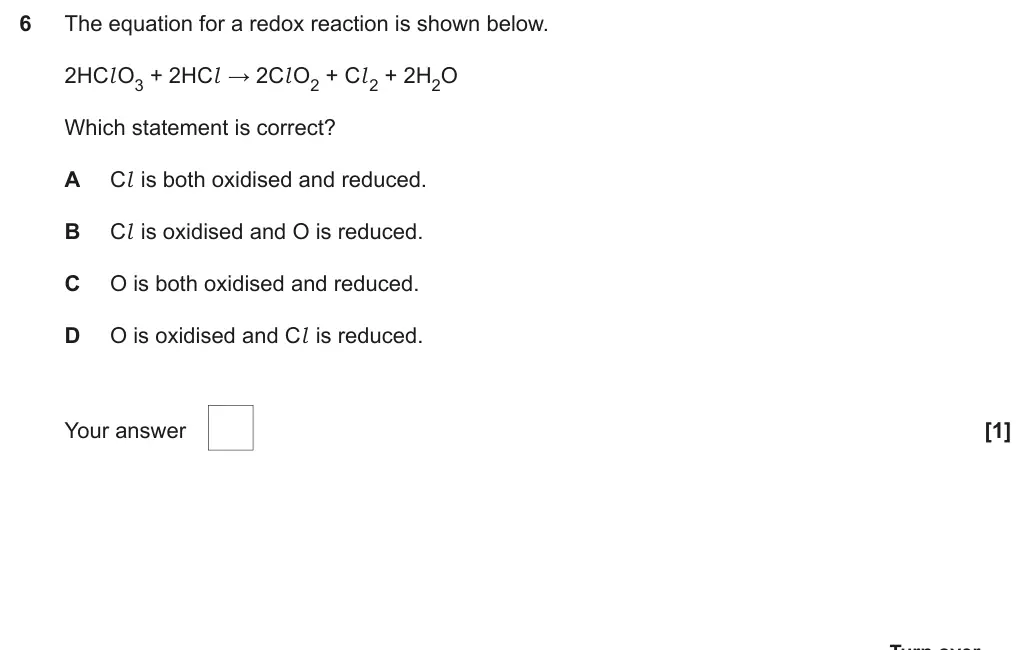
A
Candidates performed well with this question. Most successful candidates wrote the oxidation numbers beneath the equation to work out that Cl is both oxidised and reduced. This is a good strategy.
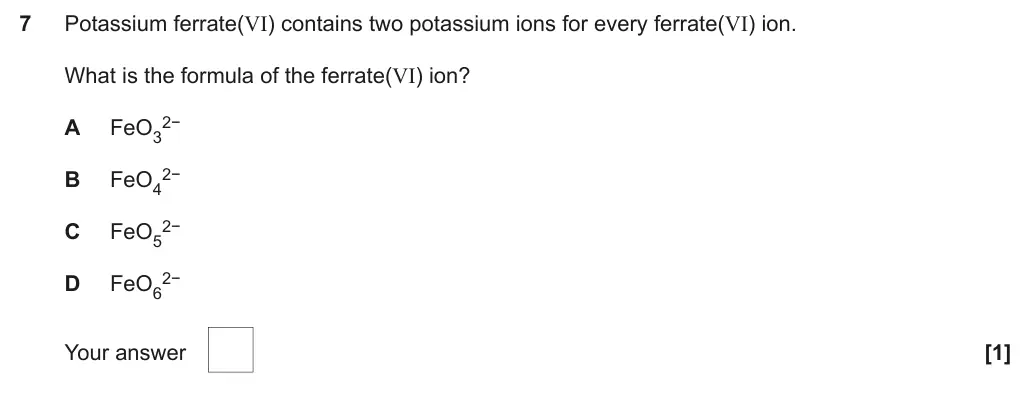
B
Candidates found this question difficult with less than half choosing B, FeO42–, as the correct response. There was no obvious key distractor, with A, C and D all being chosen by candidates.
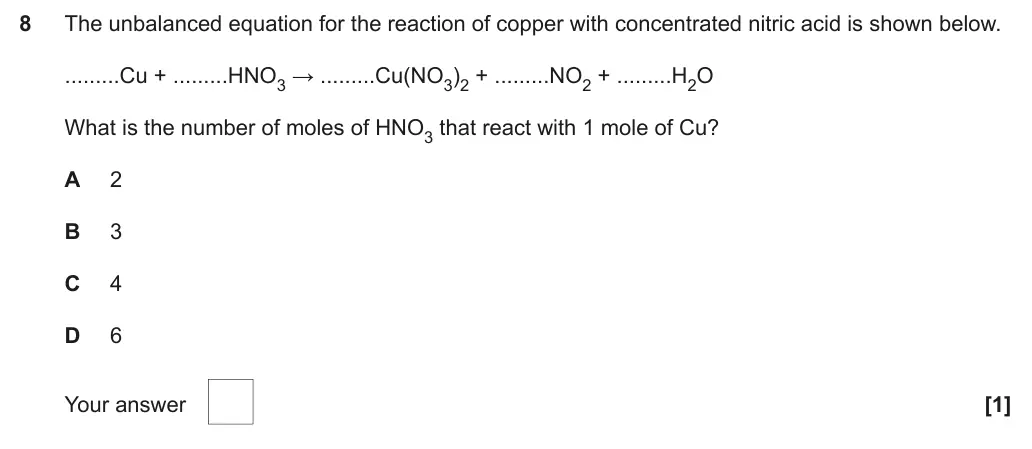
C
Candidates found this question difficult, with the nitric acid N atoms being split between two products, Cu(NO3)2 and NO2. B proved to be the biggest distractor from the correct response of C, probably the result of miscounting the N atoms.
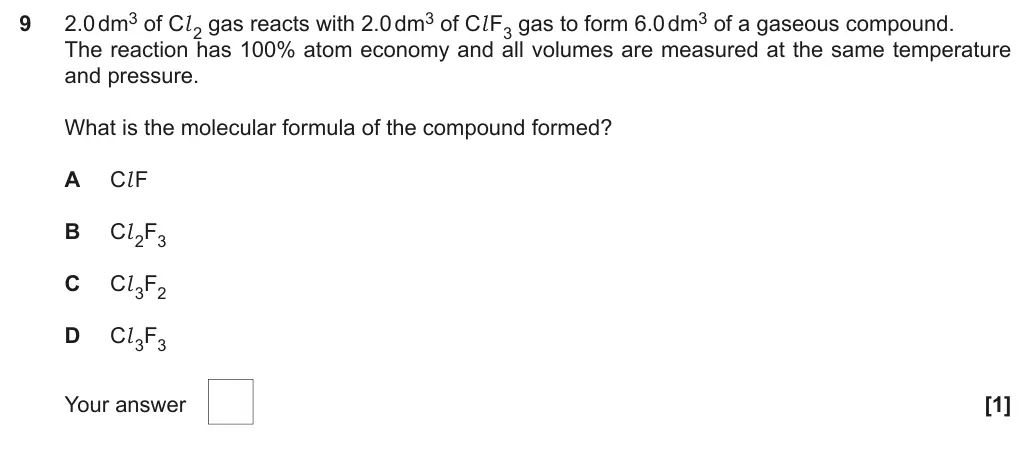
A
Few candidates selected the correct response of A. There was no clear distractor.
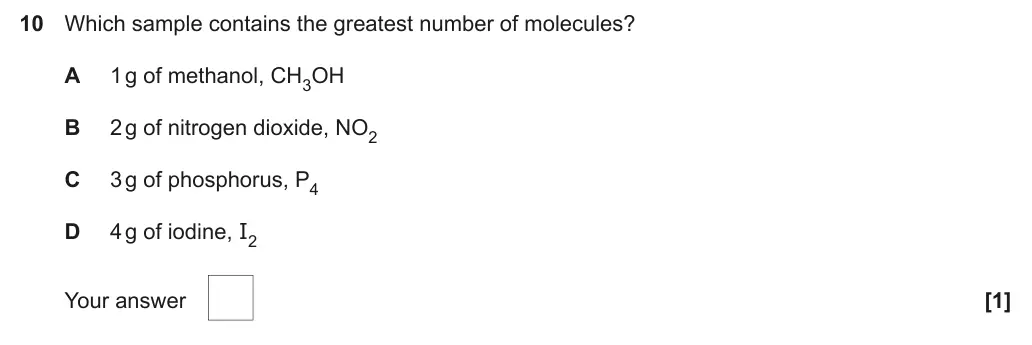
B
The key strategy for success was to calculate the moles of each sample and the working was seen on the scripts of the highest-attaining candidates. D proved to be the main distractor from B, presumably because the 4 g sample of I2 contains both the greatest mass and the highest molecular mass.
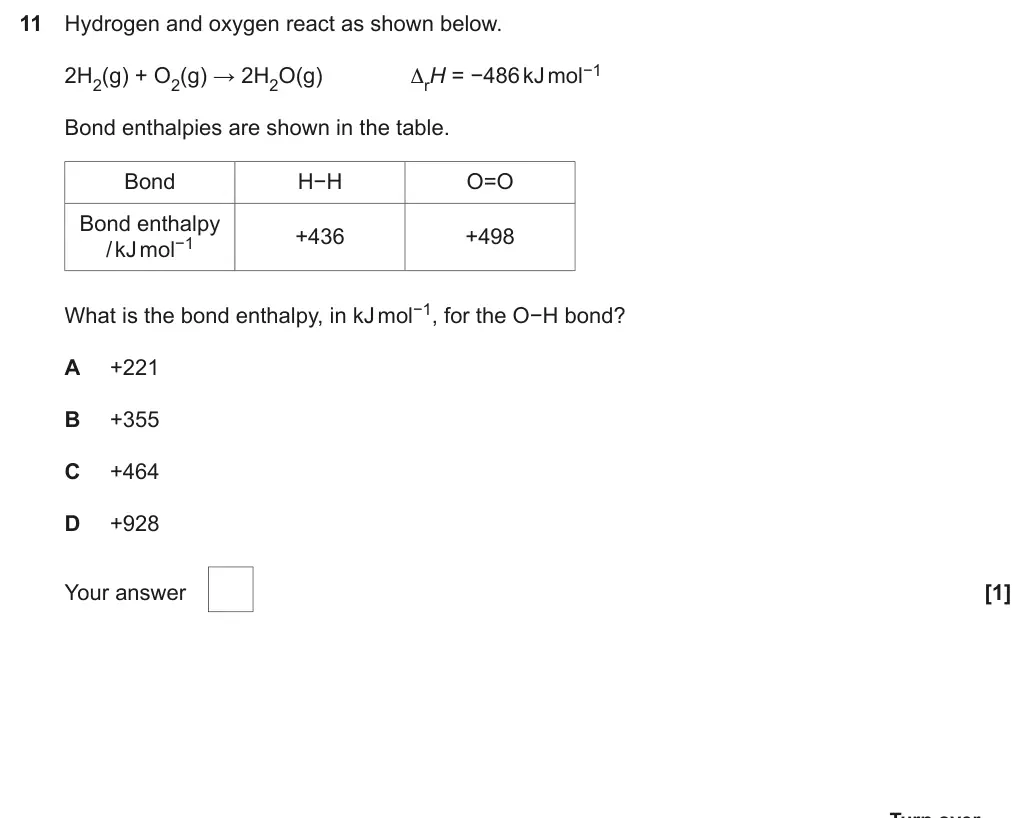
C
The best candidates drew out the bonds on each side of the equation to help them select C, +464. The main distractor proved to be D, obtained from counting 2, rather than 4 O–H bonds. This error could have been prevented by drawing out the bonds.
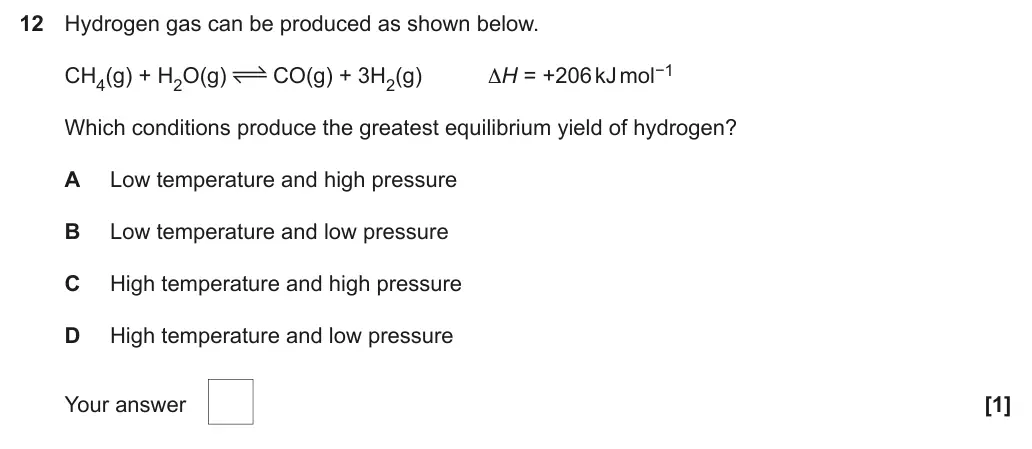
D
D was the correct answer, with C being the main distractor. This straightforward question was answered correctly by only about half the candidates.
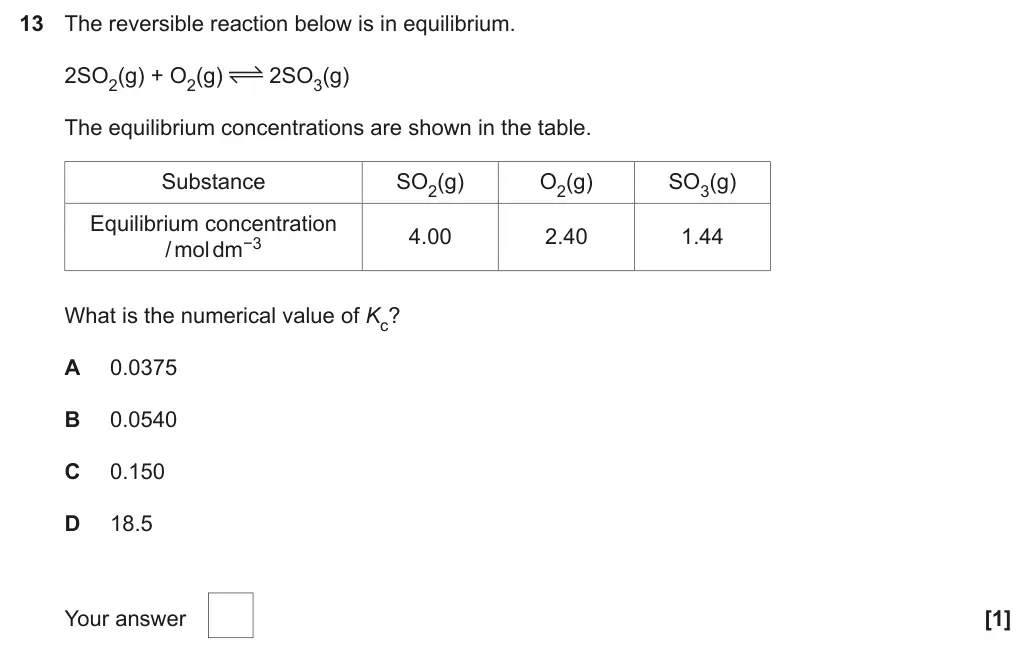
B
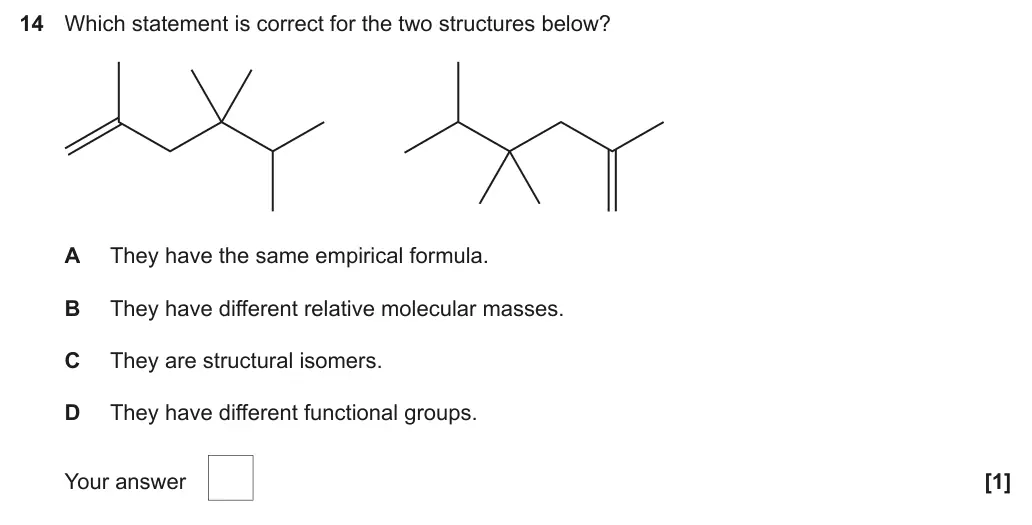
A
Although the two structures were the same molecule drawn in two different configurations, many candidates identified the structures as being structural isomers (C), rather than A.
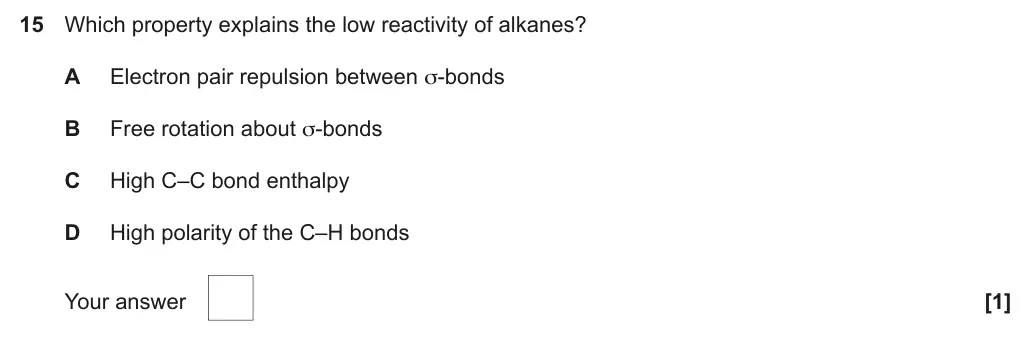
C
Less than half the candidates selected the correct response of C for this direct recall question. There was no key distractor, suggesting that many candidates may have guessed.
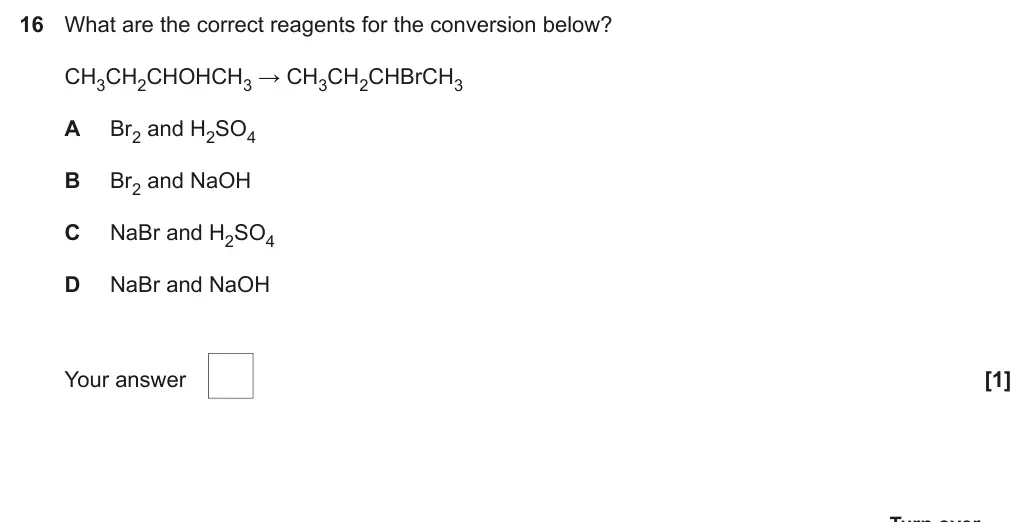
C
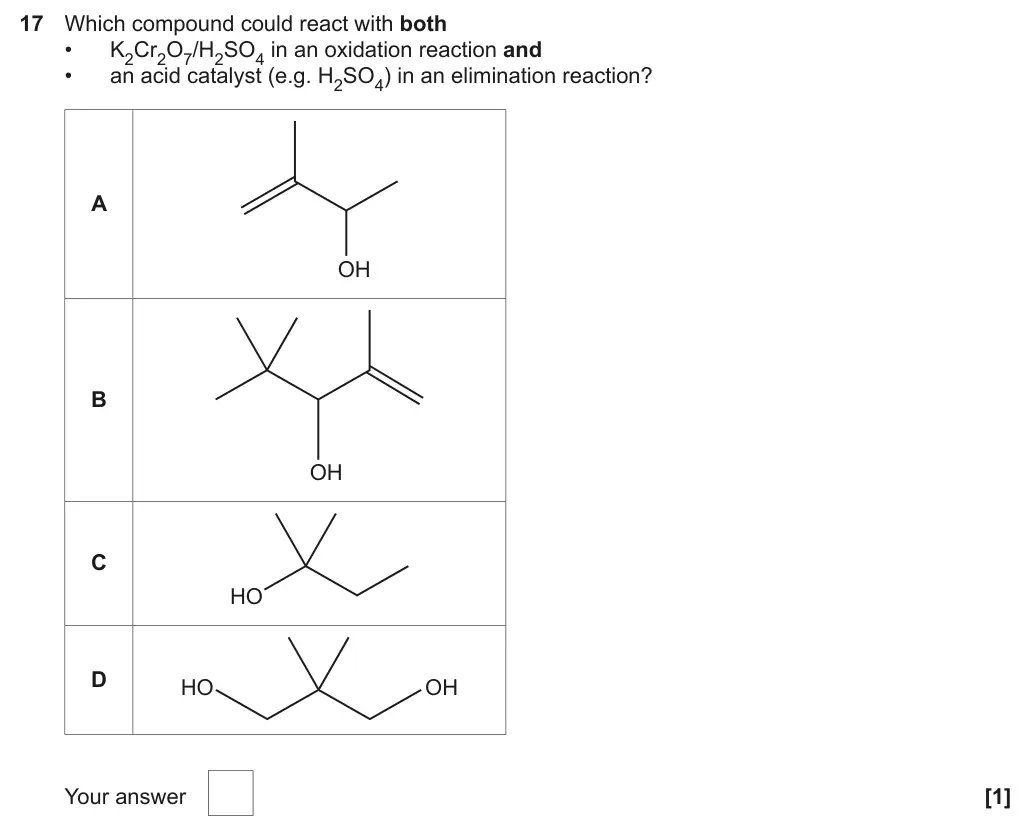
A
Success with this question was dependent on knowledge of key reactions and their reagents. B and C proved to be the main distractors from A.
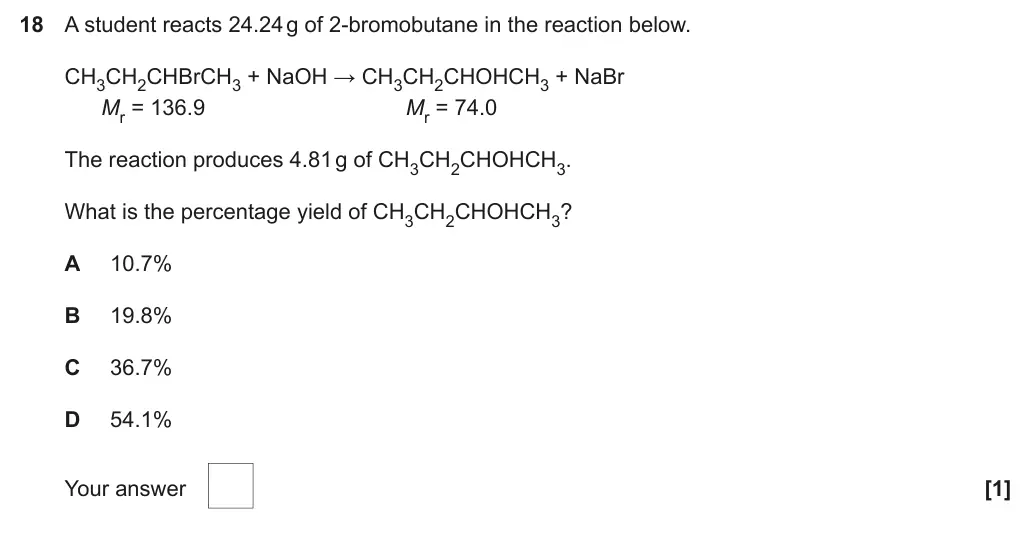
C
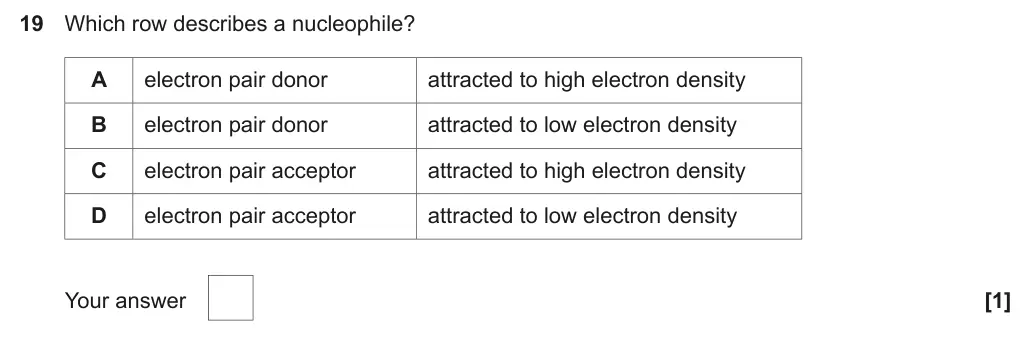
B
Many candidates correctly chose B, with A being seen as the expected main distractor. Fewer than half the candidates scored this mark.
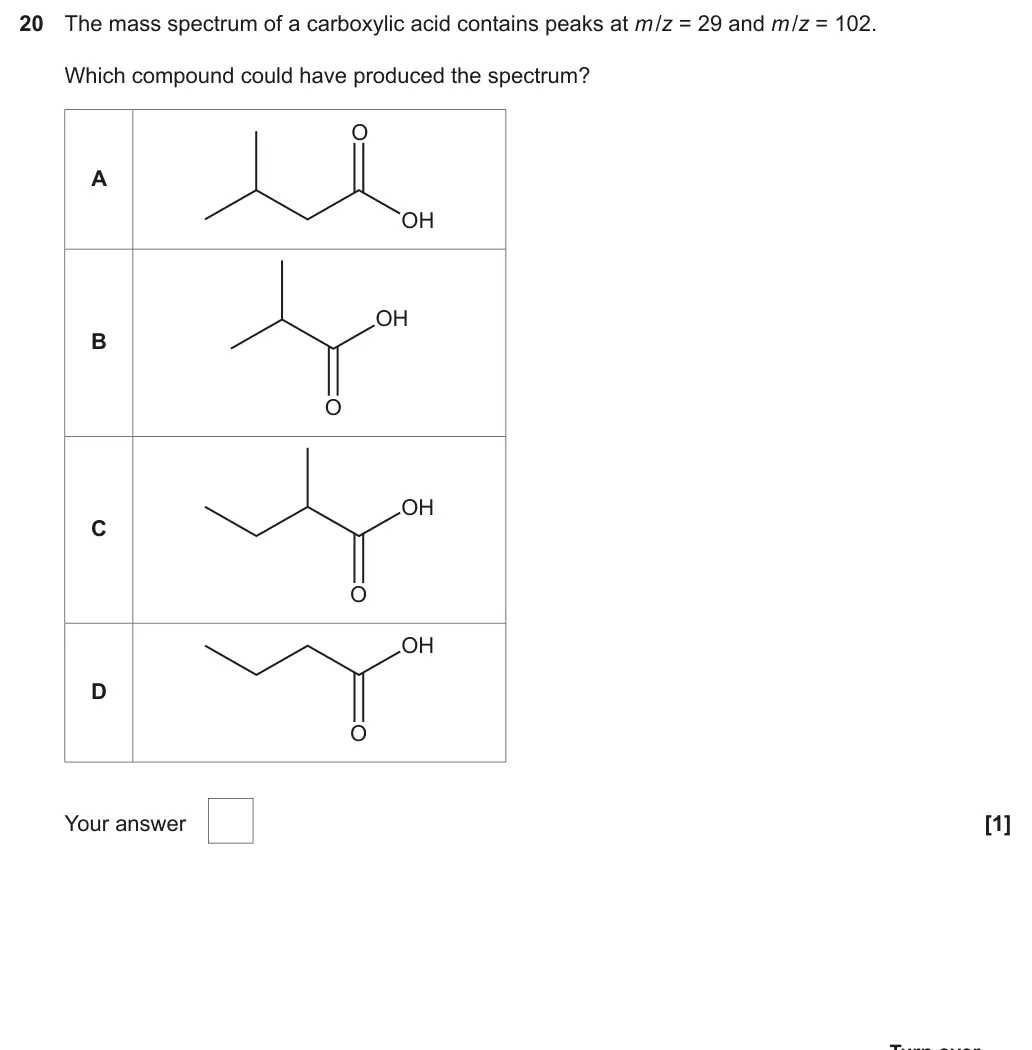
C
From the working on the scripts, the best approach was to reduce the options down to A and C, the two with a molecular mass of 102. The best candidates then identified option C as the one with a CH3CH2 group for 29. Option A was the key distractor. Section B overview Section B includes short answer question styles (structured questions, problem solving, calculations, practical) and extended response questions. This section of the paper is worth 50 marks. Comments on specific questions
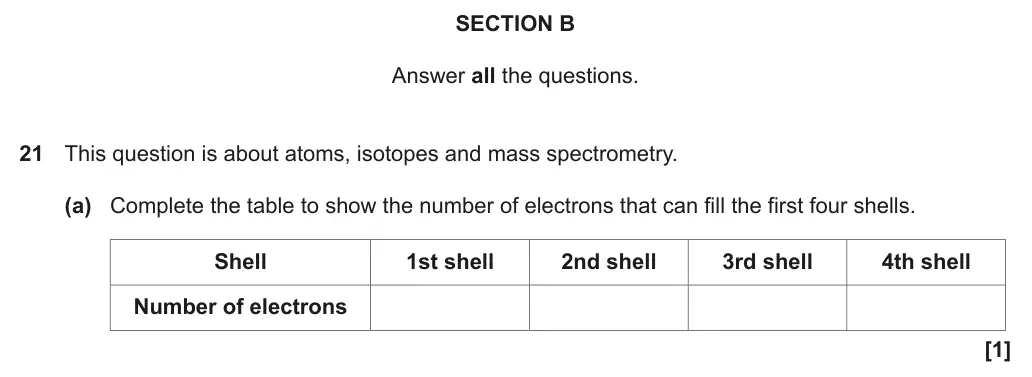
21(a) Most candidates could recall the number of electrons in the first four shells as being 2, 8, 18 and 32. However, many made errors for the third and fourth shell. Common incorrect responses included 2,8,18,18 and 2,8,8,8, perhaps linking back to GCSE coverage. 2,6,10,14 was also seen, confusing shells with subshells. 21(b) Almost all candidates were aware that different isotopes had different numbers of neutrons. For the similarities, ‘the same number of protons’ was usually identified, but the same number electrons was omitted by many candidates. This suggested that candidates were concentrating on the nucleus and did not read the question closely enough which asked for ‘atomic’ structures. 21(c)(ii) This was a high demand question and only the highest scoring answers identified that the peak at 72 was caused by a chlorine molecule containing the chlorine-35 and chlorine-37 isotopes shown in the supplied mass spectrum. Very few candidates went on to predict further peaks with m/z values of 70 (from 35Cl35Cl) and 74 (from 37Cl37Cl). There was little pattern in the incorrect responses, suggestion that many were guesses.
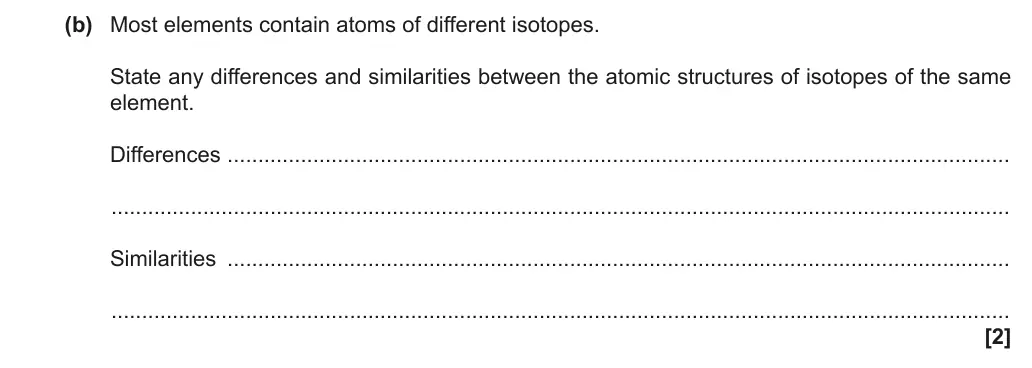
21(a) Most candidates could recall the number of electrons in the first four shells as being 2, 8, 18 and 32. However, many made errors for the third and fourth shell. Common incorrect responses included 2,8,18,18 and 2,8,8,8, perhaps linking back to GCSE coverage. 2,6,10,14 was also seen, confusing shells with subshells. 21(b) Almost all candidates were aware that different isotopes had different numbers of neutrons. For the similarities, ‘the same number of protons’ was usually identified, but the same number electrons was omitted by many candidates. This suggested that candidates were concentrating on the nucleus and did not read the question closely enough which asked for ‘atomic’ structures. 21(c)(ii) This was a high demand question and only the highest scoring answers identified that the peak at 72 was caused by a chlorine molecule containing the chlorine-35 and chlorine-37 isotopes shown in the supplied mass spectrum. Very few candidates went on to predict further peaks with m/z values of 70 (from 35Cl35Cl) and 74 (from 37Cl37Cl). There was little pattern in the incorrect responses, suggestion that many were guesses.
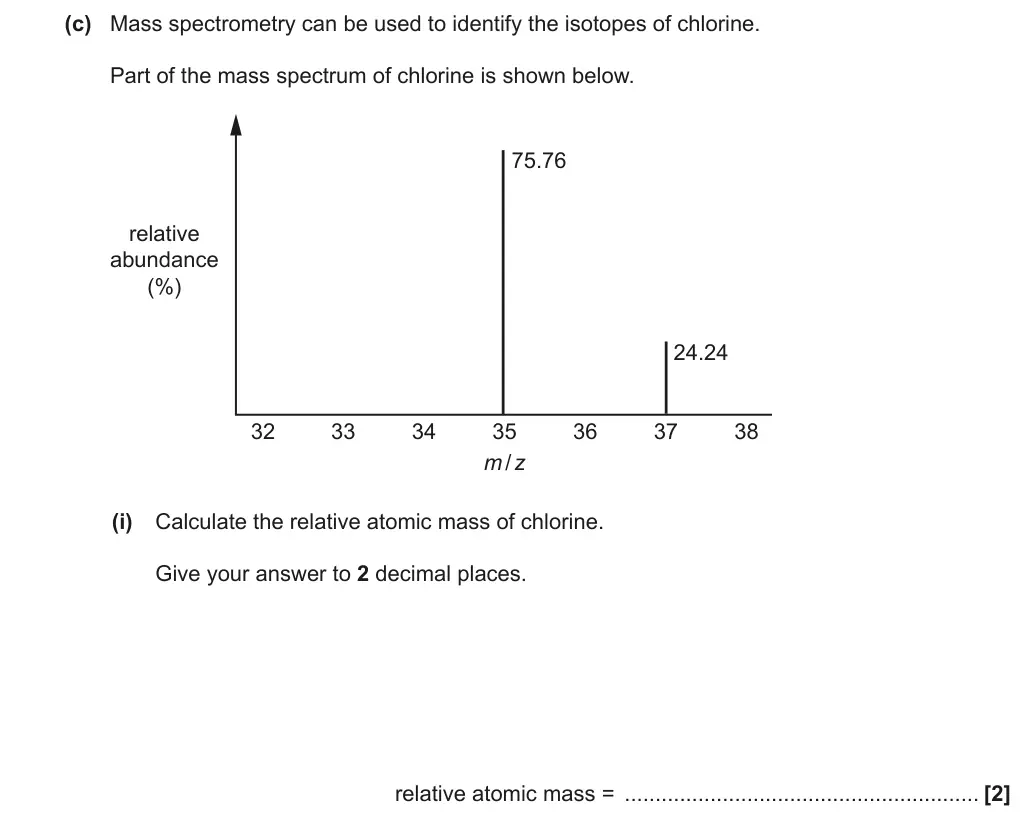
21(a) Most candidates could recall the number of electrons in the first four shells as being 2, 8, 18 and 32. However, many made errors for the third and fourth shell. Common incorrect responses included 2,8,18,18 and 2,8,8,8, perhaps linking back to GCSE coverage. 2,6,10,14 was also seen, confusing shells with subshells. 21(b) Almost all candidates were aware that different isotopes had different numbers of neutrons. For the similarities, ‘the same number of protons’ was usually identified, but the same number electrons was omitted by many candidates. This suggested that candidates were concentrating on the nucleus and did not read the question closely enough which asked for ‘atomic’ structures. 21(c)(ii) This was a high demand question and only the highest scoring answers identified that the peak at 72 was caused by a chlorine molecule containing the chlorine-35 and chlorine-37 isotopes shown in the supplied mass spectrum. Very few candidates went on to predict further peaks with m/z values of 70 (from 35Cl35Cl) and 74 (from 37Cl37Cl). There was little pattern in the incorrect responses, suggestion that many were guesses.
Skills: M0.2 Use ratios, fractions and percentages; M1.2 Find arithmetic means; M3.1 Translate information between graphical, numerical and algebraic forms
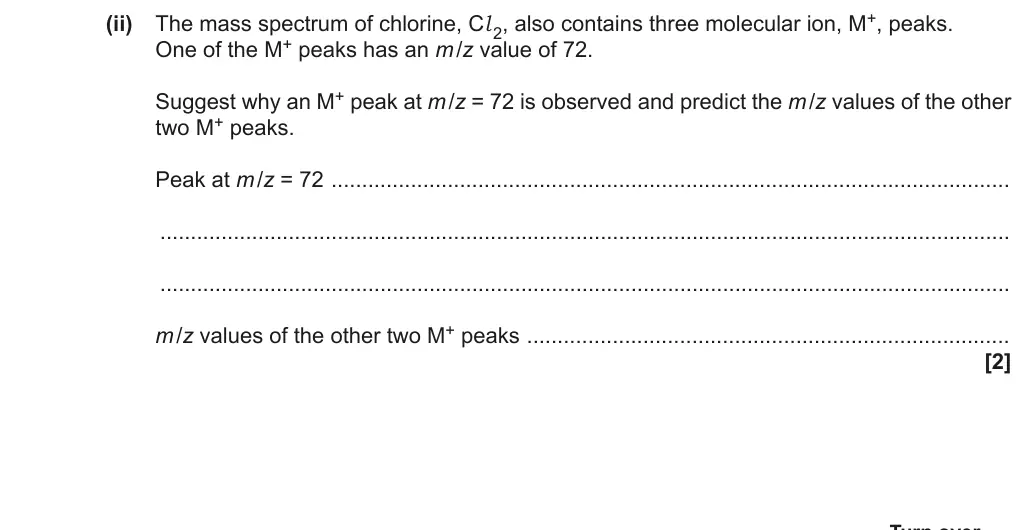
21(a) Most candidates could recall the number of electrons in the first four shells as being 2, 8, 18 and 32. However, many made errors for the third and fourth shell. Common incorrect responses included 2,8,18,18 and 2,8,8,8, perhaps linking back to GCSE coverage. 2,6,10,14 was also seen, confusing shells with subshells. 21(b) Almost all candidates were aware that different isotopes had different numbers of neutrons. For the similarities, ‘the same number of protons’ was usually identified, but the same number electrons was omitted by many candidates. This suggested that candidates were concentrating on the nucleus and did not read the question closely enough which asked for ‘atomic’ structures. 21(c)(ii) This was a high demand question and only the highest scoring answers identified that the peak at 72 was caused by a chlorine molecule containing the chlorine-35 and chlorine-37 isotopes shown in the supplied mass spectrum. Very few candidates went on to predict further peaks with m/z values of 70 (from 35Cl35Cl) and 74 (from 37Cl37Cl). There was little pattern in the incorrect responses, suggestion that many were guesses.
Skills: M3.1 Translate information between graphical, numerical and algebraic forms
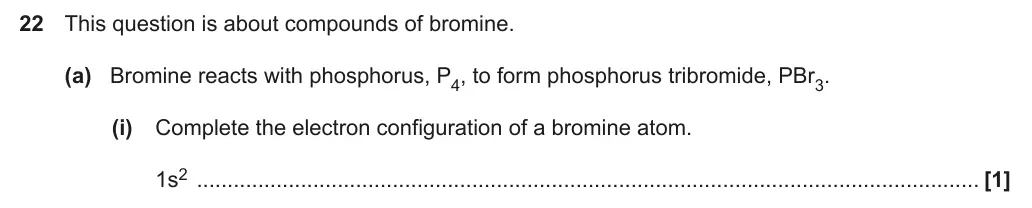
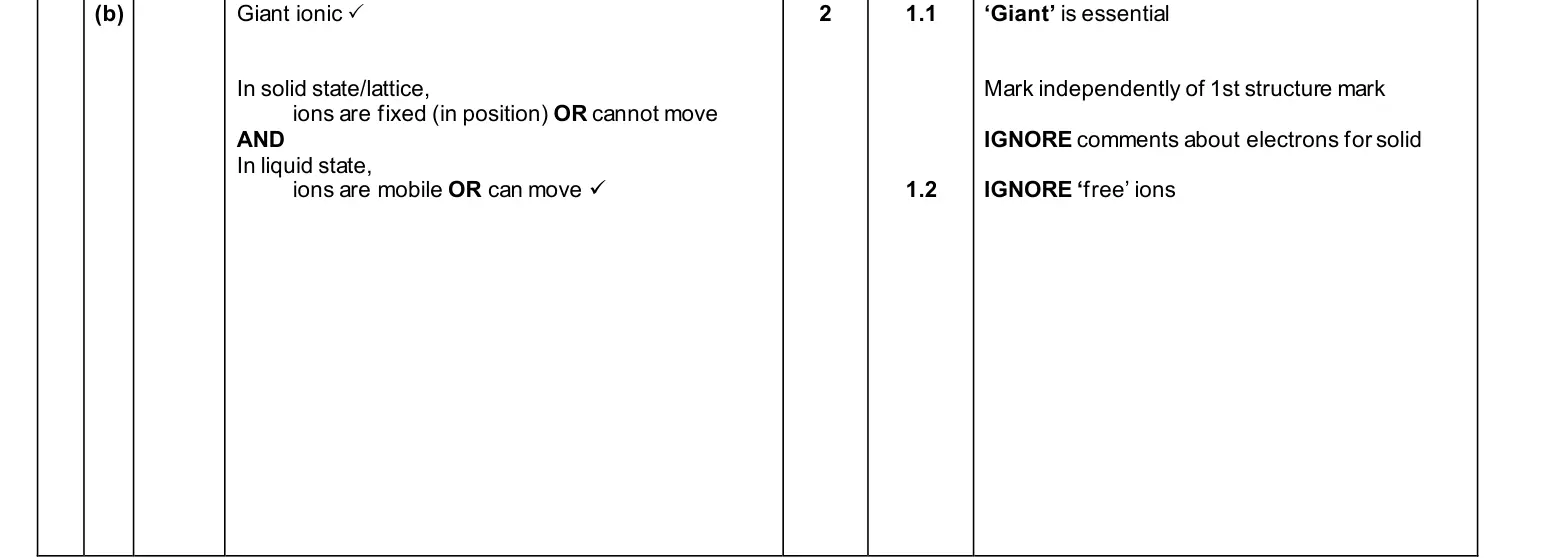
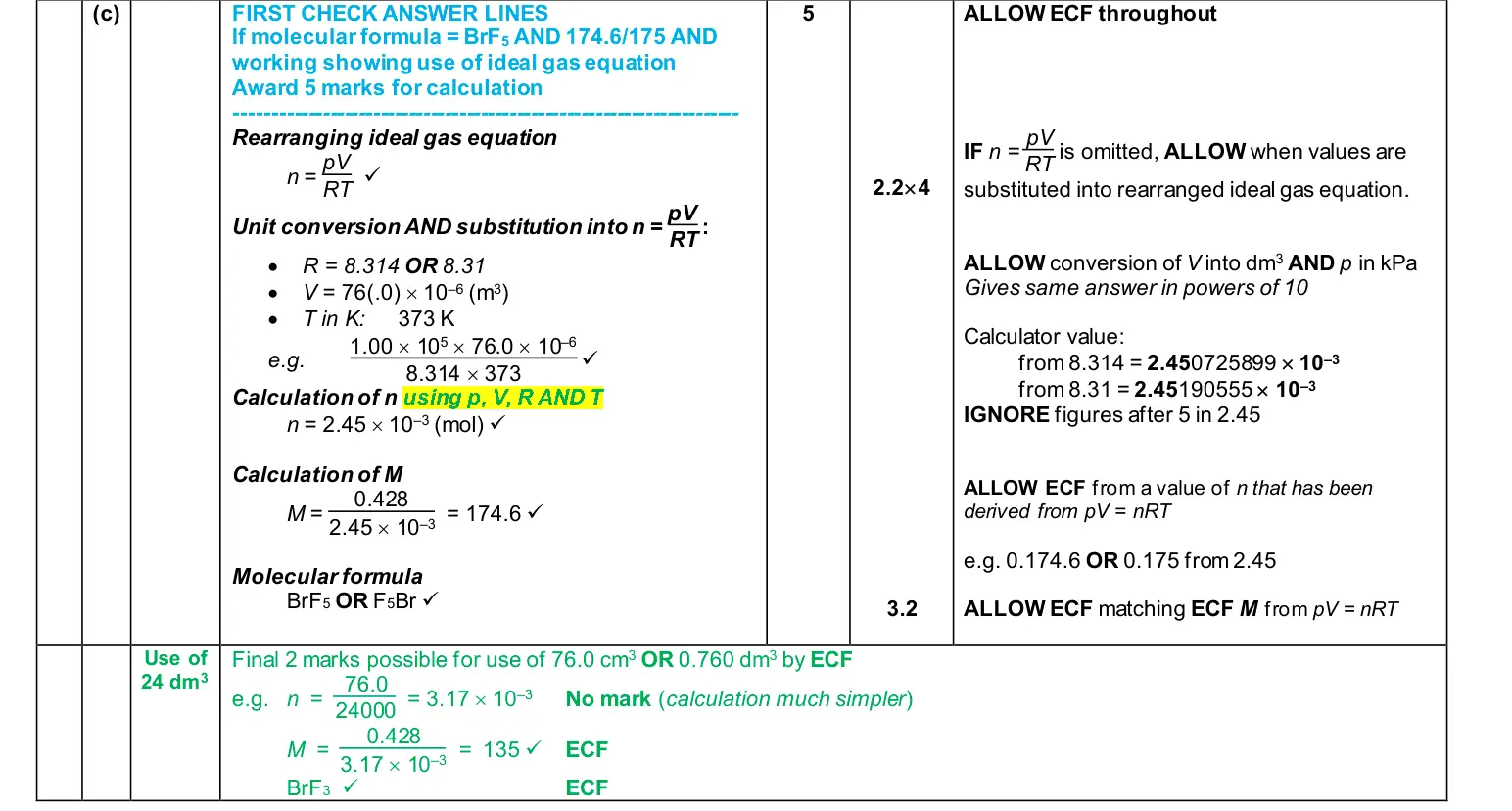
22(a)(i) Candidates answered this part well, showing good knowledge and understanding of electron configuration. When incorrect, it was usually errors with the number of electrons in the 3d and 4p subshells. 22a(ii) Most candidates were able to construct a correct balanced equation for this unfamiliar equation. The commonest error was use of Br instead of Br2 in the equation. 22(b) Structure and bonding continues to be a difficult concept for many candidates. This part did discriminate extremely well, with high-attaining candidates identifying that the compound would have a giant ionic lattice with fixed ions in the solid state which become mobile in the liquid state to conduct electricity. It was common for ‘ionic’ or ‘giant’ to be omitted in the name of the lattice. Most candidates used the ideal gas equation, which was usually rearranged correctly, with substituted values for p, V, R and T being added. A common mistake was for the volume in cm3 to be multiplied by 10–3 rather than 10–6 for the necessary conversion into m3. Low-attaining candidates often did not convert 100 ºC into 373 K. Unfortunately, candidates making an error in unit conversions then obtained an unrealistic molar mass for A and were then unable to derive a possible molecular formula. Well-prepared candidates carried out the calculation well with clear working. It was very encouraging to see the number of candidates able to predict the molecular formula of A as BrF5 from the calculated molar mass of 174.6 g mol–1. There were, however a significant number of incorrect responses, suggesting that some candidates found this type of question challenging. Some candidates used the molar gas volume at room temperature and pressure of 24.0 dm3 mol–1. Two of the five marks were still available for this response.

22(a)(i) Candidates answered this part well, showing good knowledge and understanding of electron configuration. When incorrect, it was usually errors with the number of electrons in the 3d and 4p subshells. 22a(ii) Most candidates were able to construct a correct balanced equation for this unfamiliar equation. The commonest error was use of Br instead of Br2 in the equation. 22(b) Structure and bonding continues to be a difficult concept for many candidates. This part did discriminate extremely well, with high-attaining candidates identifying that the compound would have a giant ionic lattice with fixed ions in the solid state which become mobile in the liquid state to conduct electricity. It was common for ‘ionic’ or ‘giant’ to be omitted in the name of the lattice. Most candidates used the ideal gas equation, which was usually rearranged correctly, with substituted values for p, V, R and T being added. A common mistake was for the volume in cm3 to be multiplied by 10–3 rather than 10–6 for the necessary conversion into m3. Low-attaining candidates often did not convert 100 ºC into 373 K. Unfortunately, candidates making an error in unit conversions then obtained an unrealistic molar mass for A and were then unable to derive a possible molecular formula. Well-prepared candidates carried out the calculation well with clear working. It was very encouraging to see the number of candidates able to predict the molecular formula of A as BrF5 from the calculated molar mass of 174.6 g mol–1. There were, however a significant number of incorrect responses, suggesting that some candidates found this type of question challenging. Some candidates used the molar gas volume at room temperature and pressure of 24.0 dm3 mol–1. Two of the five marks were still available for this response.
Skills: M0.2 Use ratios, fractions and percentages
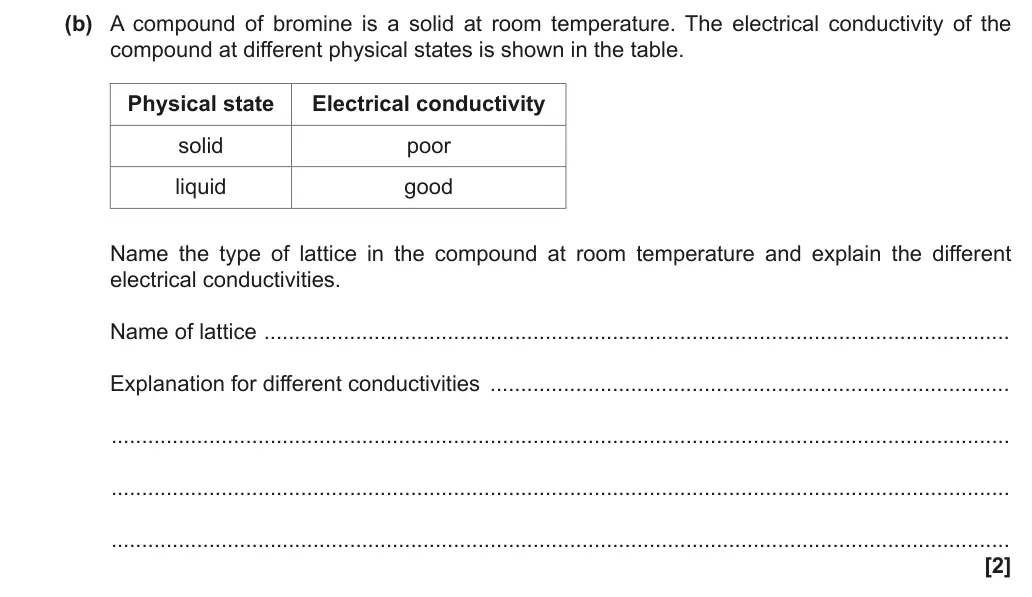
22(a)(i) Candidates answered this part well, showing good knowledge and understanding of electron configuration. When incorrect, it was usually errors with the number of electrons in the 3d and 4p subshells. 22a(ii) Most candidates were able to construct a correct balanced equation for this unfamiliar equation. The commonest error was use of Br instead of Br2 in the equation. 22(b) Structure and bonding continues to be a difficult concept for many candidates. This part did discriminate extremely well, with high-attaining candidates identifying that the compound would have a giant ionic lattice with fixed ions in the solid state which become mobile in the liquid state to conduct electricity. It was common for ‘ionic’ or ‘giant’ to be omitted in the name of the lattice. Most candidates used the ideal gas equation, which was usually rearranged correctly, with substituted values for p, V, R and T being added. A common mistake was for the volume in cm3 to be multiplied by 10–3 rather than 10–6 for the necessary conversion into m3. Low-attaining candidates often did not convert 100 ºC into 373 K. Unfortunately, candidates making an error in unit conversions then obtained an unrealistic molar mass for A and were then unable to derive a possible molecular formula. Well-prepared candidates carried out the calculation well with clear working. It was very encouraging to see the number of candidates able to predict the molecular formula of A as BrF5 from the calculated molar mass of 174.6 g mol–1. There were, however a significant number of incorrect responses, suggesting that some candidates found this type of question challenging. Some candidates used the molar gas volume at room temperature and pressure of 24.0 dm3 mol–1. Two of the five marks were still available for this response.
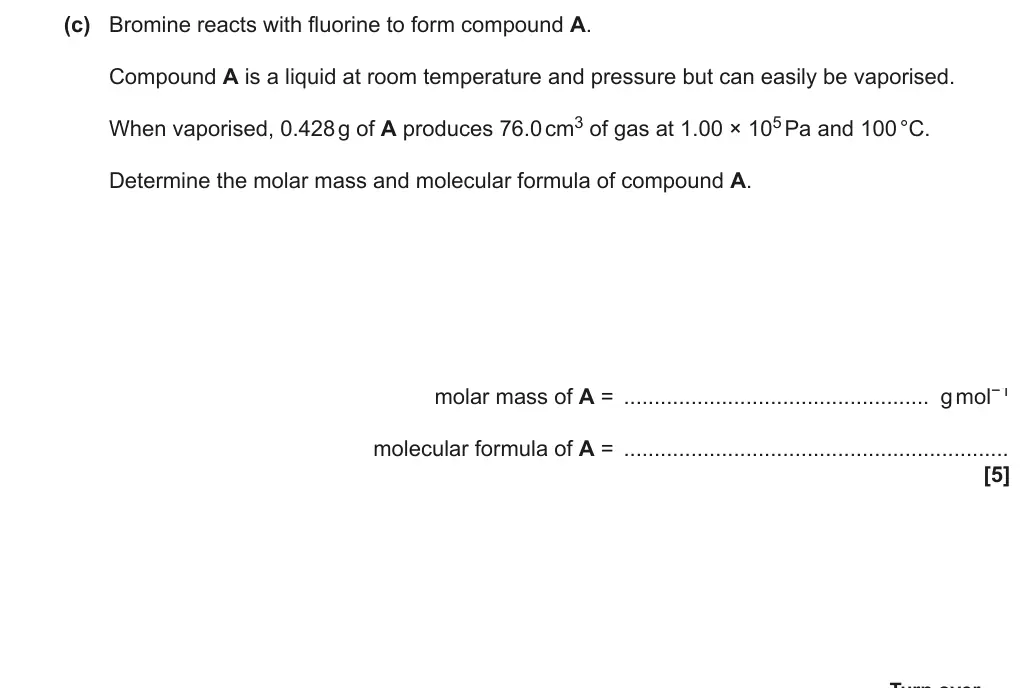
22(a)(i) Candidates answered this part well, showing good knowledge and understanding of electron configuration. When incorrect, it was usually errors with the number of electrons in the 3d and 4p subshells. 22a(ii) Most candidates were able to construct a correct balanced equation for this unfamiliar equation. The commonest error was use of Br instead of Br2 in the equation. 22(b) Structure and bonding continues to be a difficult concept for many candidates. This part did discriminate extremely well, with high-attaining candidates identifying that the compound would have a giant ionic lattice with fixed ions in the solid state which become mobile in the liquid state to conduct electricity. It was common for ‘ionic’ or ‘giant’ to be omitted in the name of the lattice. Most candidates used the ideal gas equation, which was usually rearranged correctly, with substituted values for p, V, R and T being added. A common mistake was for the volume in cm3 to be multiplied by 10–3 rather than 10–6 for the necessary conversion into m3. Low-attaining candidates often did not convert 100 ºC into 373 K. Unfortunately, candidates making an error in unit conversions then obtained an unrealistic molar mass for A and were then unable to derive a possible molecular formula. Well-prepared candidates carried out the calculation well with clear working. It was very encouraging to see the number of candidates able to predict the molecular formula of A as BrF5 from the calculated molar mass of 174.6 g mol–1. There were, however a significant number of incorrect responses, suggesting that some candidates found this type of question challenging. Some candidates used the molar gas volume at room temperature and pressure of 24.0 dm3 mol–1. Two of the five marks were still available for this response.
Skills: M0.0 Recognise and make use of appropriate units in calculations; M0.1 Recognise and use expressions in decimal and ordinary form; M2.2 Change the subject of an equation; M2.3 Substitute numerical values into algebraic equations using appropriate units for physical quantities
Unlike Q23(a), all intermediate calculations gave values to 3 significant figures. As with Q23(a), many candidates produced largely unreferenced numbers. 23(d) Candidates often find questions linked to practical work challenging.
Skills: M0.0 Recognise and make use of appropriate units in calculations; M0.2 Use ratios, fractions and percentages; M1.1 Use an appropriate number of significant figures
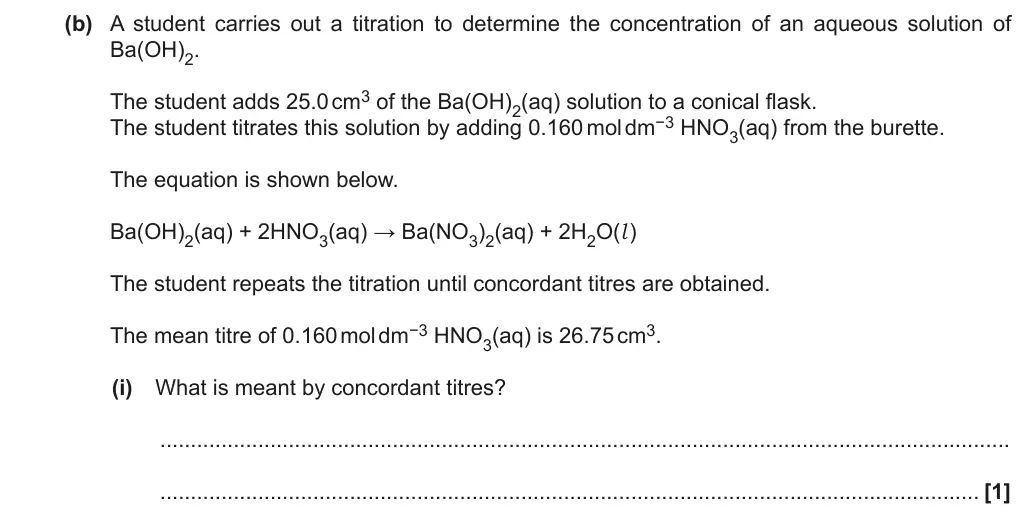
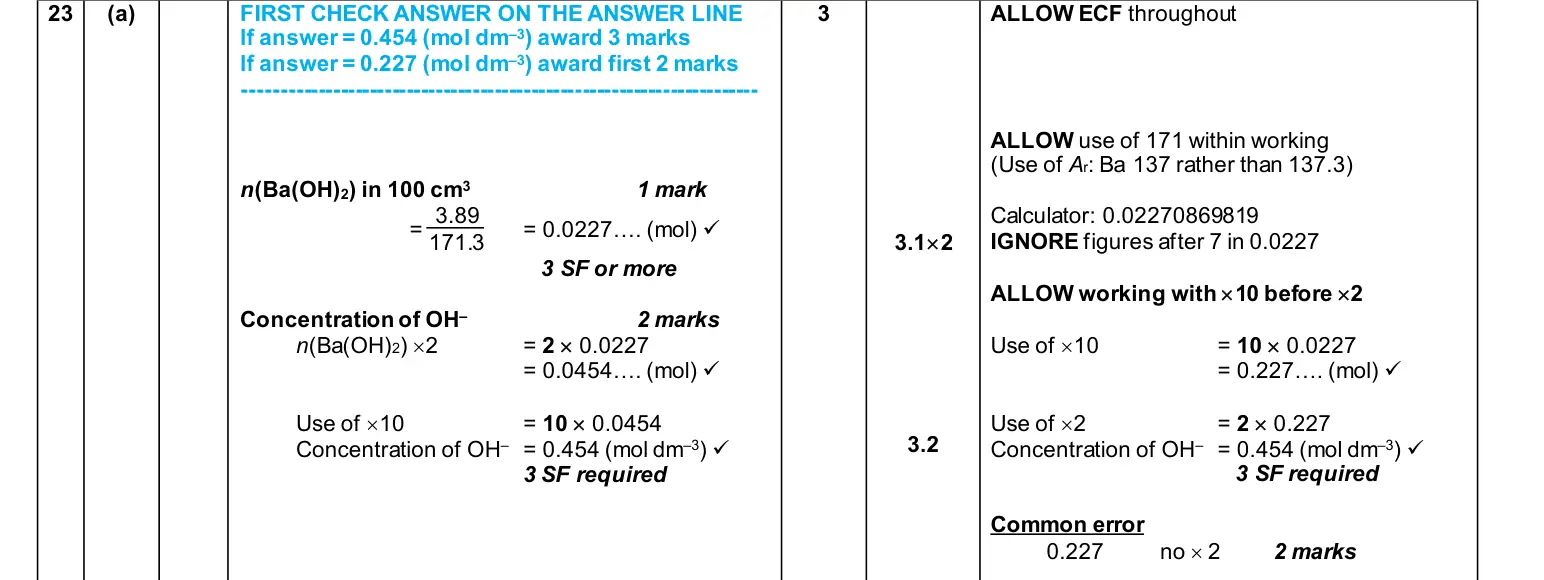
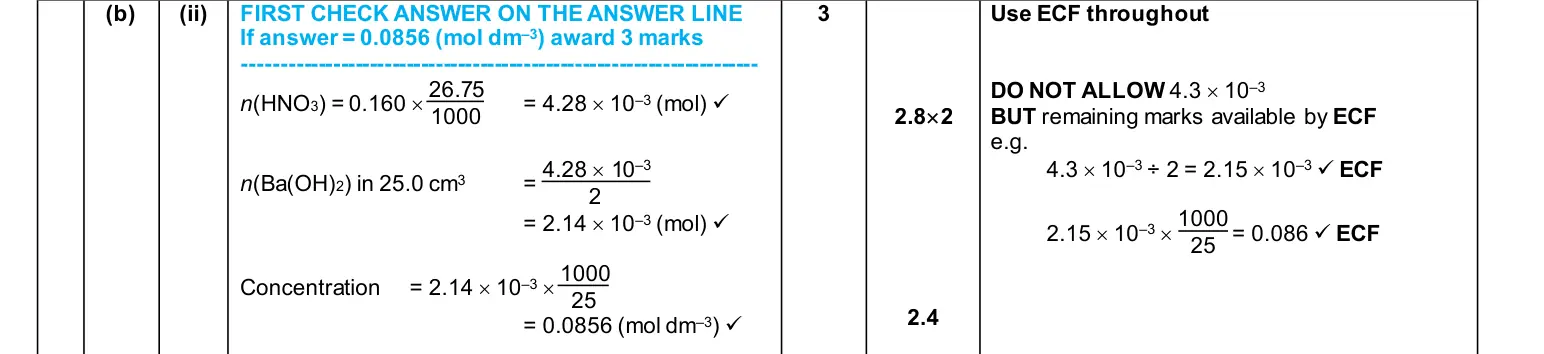
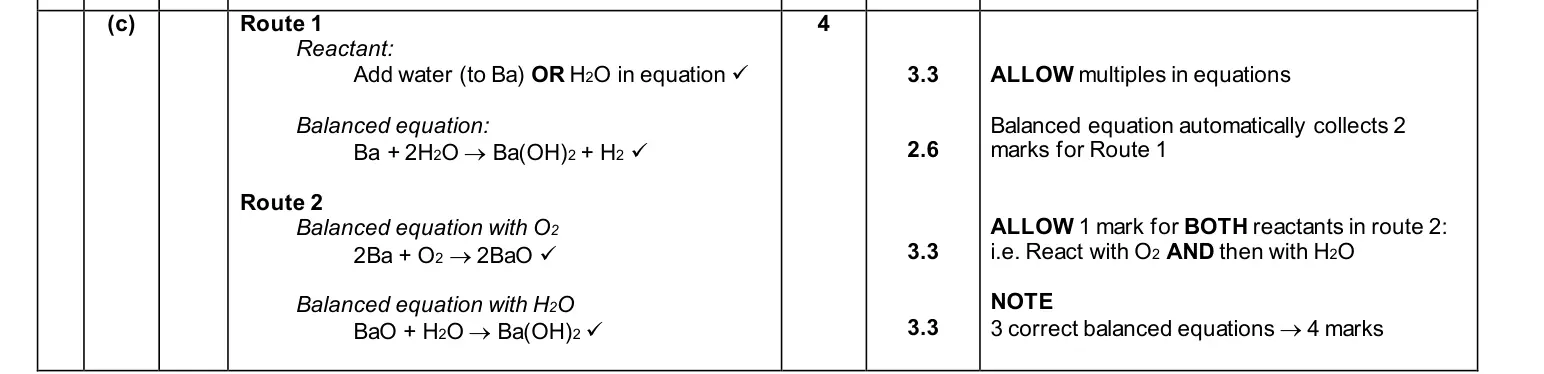
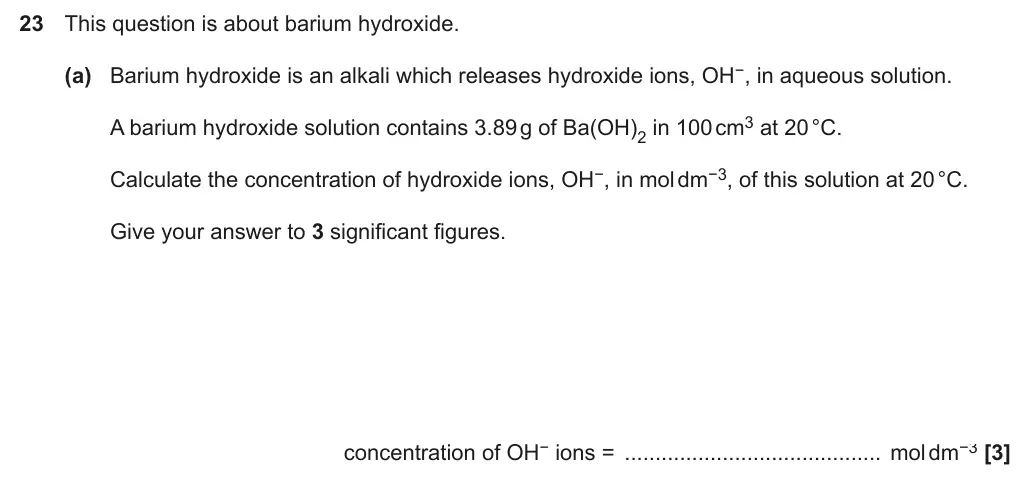
23(a) This question required candidates to calculate the moles of Ba(OH)2 in 100 cm3, to scale this value up to 1 dm3 for the concentration of Ba(OH)2 and finally to multiply this value by 2 to obtain the concentration of OH– ions of 0.454 mol dm–3. This part discriminated extremely well. Lower-attaining candidates would often calculate an incorrect molar mass of Ba(OH)2 and scale up by either 10 or 2. The commonest incorrect answer seen was 0.227, half of the correct answer by omitting the ×2 stage. Most candidates did supply their final answer to the required 3 significant figures. As with all calculations, candidates should round once, at the end of the calculation. Rounding of intermediate values can lead to significant rounding errors. Sometimes, intermediate values were rounded to 2 significant figures when the final value required 3. This use of maths will almost certainly lead to a rounding error in the final answer. Candidates should show clear working so that credit can be given for such responses by applying error carried forward. Many candidates produced largely unreferenced numbers. 23(b) Many candidates seemed to be unfamiliar with the term ‘concordant titres’. Acceptable responses were ‘within 0.1 cm3 and within 0.05 cm3. Common incorrect answers for this important term included ‘the closest titres’, ‘similar titres’, ‘repeated titres’ and ‘within 0.5 cm3’. 23(c) Many candidates were able to calculate the amount of HNO3 in the titration as 4.28 × 10⁻³ mol. Most candidates were credited for the amount of Ba(OH)2 as 2.14 × 10⁻³ mol, half the calculated amount of HNO3. Candidates then need to scale up this value by 1000/25 to obtain the concentration as 0.0856 mol dm–3. Unlike Q23(a), all intermediate calculations gave values to 3 significant figures. Candidates found this stock titration calculation easier than the more unfamiliar 23(a), with many scoring all 3 marks. Discrimination was extremely good, but about a third of candidates did not receive any marks. Candidates should be encouraged to practise stock titration calculations as part of their preparation for the examinations. Candidates should show clear working so that credit can be given for such responses by applying error carried forward. As with Q23(a), many candidates produced largely unreferenced numbers. 23(d) Candidates often find questions linked to practical work challenging. The two reaction routes involving Group 2 reactions are drawn directly from the specification: the reaction of barium with water, and the reaction of barium with oxygen, followed by water. Most candidates found this difficult, and the one-step route using barium and water was seen far more often than the two-step oxygen then water approach. Only the highest-attaining candidates were able to suggest two routes, with scores of 3/4 or 4/4 marks being comparatively rare. As with 21(c)(ii) and 25c(iii), candidates had difficulty in interpreting provided information. OCR support Our new practical question packs, split up by PAG, provide additional opportunities for students to practise questions relating to practical work. They are available on Interchange: https://interchange.ocr.org.uk/Downloads/H432_H433_Chemistry_PAG_ Practice_Question_Sets.zip
Skills: PAG2 Acid–base titration
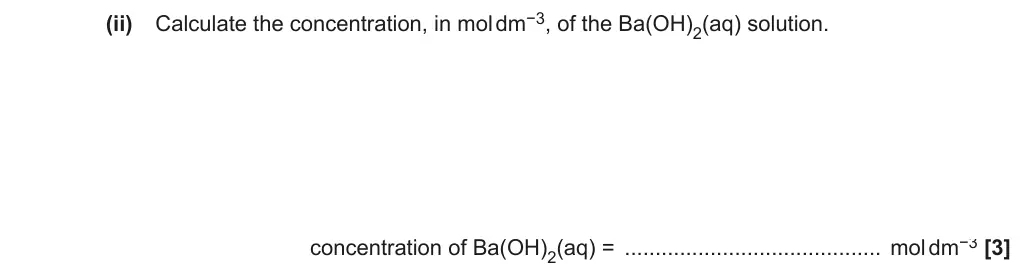
23(a) This question required candidates to calculate the moles of Ba(OH)2 in 100 cm3, to scale this value up to 1 dm3 for the concentration of Ba(OH)2 and finally to multiply this value by 2 to obtain the concentration of OH– ions of 0.454 mol dm–3. This part discriminated extremely well. Lower-attaining candidates would often calculate an incorrect molar mass of Ba(OH)2 and scale up by either 10 or 2. The commonest incorrect answer seen was 0.227, half of the correct answer by omitting the ×2 stage. Most candidates did supply their final answer to the required 3 significant figures. As with all calculations, candidates should round once, at the end of the calculation. Rounding of intermediate values can lead to significant rounding errors. Sometimes, intermediate values were rounded to 2 significant figures when the final value required 3. This use of maths will almost certainly lead to a rounding error in the final answer. Candidates should show clear working so that credit can be given for such responses by applying error carried forward. Many candidates produced largely unreferenced numbers. 23(b) Many candidates seemed to be unfamiliar with the term ‘concordant titres’. Acceptable responses were ‘within 0.1 cm3 and within 0.05 cm3. Common incorrect answers for this important term included ‘the closest titres’, ‘similar titres’, ‘repeated titres’ and ‘within 0.5 cm3’. 23(c) Many candidates were able to calculate the amount of HNO3 in the titration as 4.28 × 10⁻³ mol. Most candidates were credited for the amount of Ba(OH)2 as 2.14 × 10⁻³ mol, half the calculated amount of HNO3. Candidates then need to scale up this value by 1000/25 to obtain the concentration as 0.0856 mol dm–3. Unlike Q23(a), all intermediate calculations gave values to 3 significant figures. Candidates found this stock titration calculation easier than the more unfamiliar 23(a), with many scoring all 3 marks. Discrimination was extremely good, but about a third of candidates did not receive any marks. Candidates should be encouraged to practise stock titration calculations as part of their preparation for the examinations. Candidates should show clear working so that credit can be given for such responses by applying error carried forward. As with Q23(a), many candidates produced largely unreferenced numbers. 23(d) Candidates often find questions linked to practical work challenging. The two reaction routes involving Group 2 reactions are drawn directly from the specification: the reaction of barium with water, and the reaction of barium with oxygen, followed by water. Most candidates found this difficult, and the one-step route using barium and water was seen far more often than the two-step oxygen then water approach. Only the highest-attaining candidates were able to suggest two routes, with scores of 3/4 or 4/4 marks being comparatively rare. As with 21(c)(ii) and 25c(iii), candidates had difficulty in interpreting provided information. OCR support Our new practical question packs, split up by PAG, provide additional opportunities for students to practise questions relating to practical work. They are available on Interchange: https://interchange.ocr.org.uk/Downloads/H432_H433_Chemistry_PAG_ Practice_Question_Sets.zip
Skills: M0.2 Use ratios, fractions and percentages; M1.1 Use an appropriate number of significant figures; M2.3 Substitute numerical values into algebraic equations using appropriate units for physical quantities; PAG2 Acid–base titration
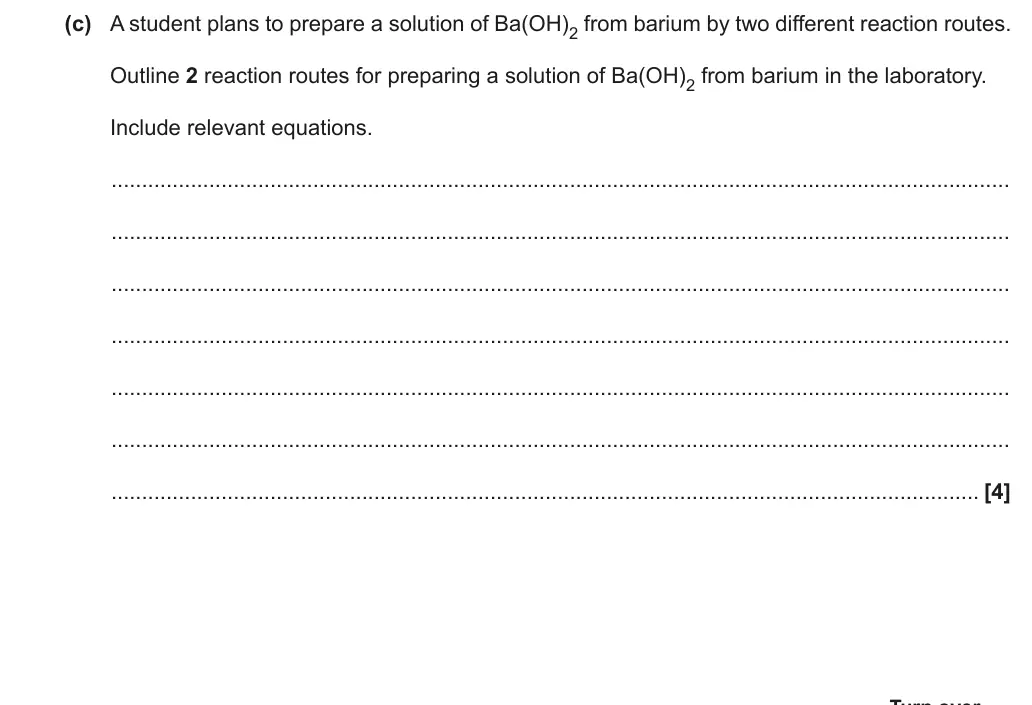
23(a) This question required candidates to calculate the moles of Ba(OH)2 in 100 cm3, to scale this value up to 1 dm3 for the concentration of Ba(OH)2 and finally to multiply this value by 2 to obtain the concentration of OH– ions of 0.454 mol dm–3. This part discriminated extremely well. Lower-attaining candidates would often calculate an incorrect molar mass of Ba(OH)2 and scale up by either 10 or 2. The commonest incorrect answer seen was 0.227, half of the correct answer by omitting the ×2 stage. Most candidates did supply their final answer to the required 3 significant figures. As with all calculations, candidates should round once, at the end of the calculation. Rounding of intermediate values can lead to significant rounding errors. Sometimes, intermediate values were rounded to 2 significant figures when the final value required 3. This use of maths will almost certainly lead to a rounding error in the final answer. Candidates should show clear working so that credit can be given for such responses by applying error carried forward. Many candidates produced largely unreferenced numbers. 23(b) Many candidates seemed to be unfamiliar with the term ‘concordant titres’. Acceptable responses were ‘within 0.1 cm3 and within 0.05 cm3. Common incorrect answers for this important term included ‘the closest titres’, ‘similar titres’, ‘repeated titres’ and ‘within 0.5 cm3’. 23(c) Many candidates were able to calculate the amount of HNO3 in the titration as 4.28 × 10⁻³ mol. Most candidates were credited for the amount of Ba(OH)2 as 2.14 × 10⁻³ mol, half the calculated amount of HNO3. Candidates then need to scale up this value by 1000/25 to obtain the concentration as 0.0856 mol dm–3. Unlike Q23(a), all intermediate calculations gave values to 3 significant figures. Candidates found this stock titration calculation easier than the more unfamiliar 23(a), with many scoring all 3 marks. Discrimination was extremely good, but about a third of candidates did not receive any marks. Candidates should be encouraged to practise stock titration calculations as part of their preparation for the examinations. Candidates should show clear working so that credit can be given for such responses by applying error carried forward. As with Q23(a), many candidates produced largely unreferenced numbers. 23(d) Candidates often find questions linked to practical work challenging. The two reaction routes involving Group 2 reactions are drawn directly from the specification: the reaction of barium with water, and the reaction of barium with oxygen, followed by water. Most candidates found this difficult, and the one-step route using barium and water was seen far more often than the two-step oxygen then water approach. Only the highest-attaining candidates were able to suggest two routes, with scores of 3/4 or 4/4 marks being comparatively rare. As with 21(c)(ii) and 25c(iii), candidates had difficulty in interpreting provided information. OCR support Our new practical question packs, split up by PAG, provide additional opportunities for students to practise questions relating to practical work. They are available on Interchange: https://interchange.ocr.org.uk/Downloads/H432_H433_Chemistry_PAG_ Practice_Question_Sets.zip
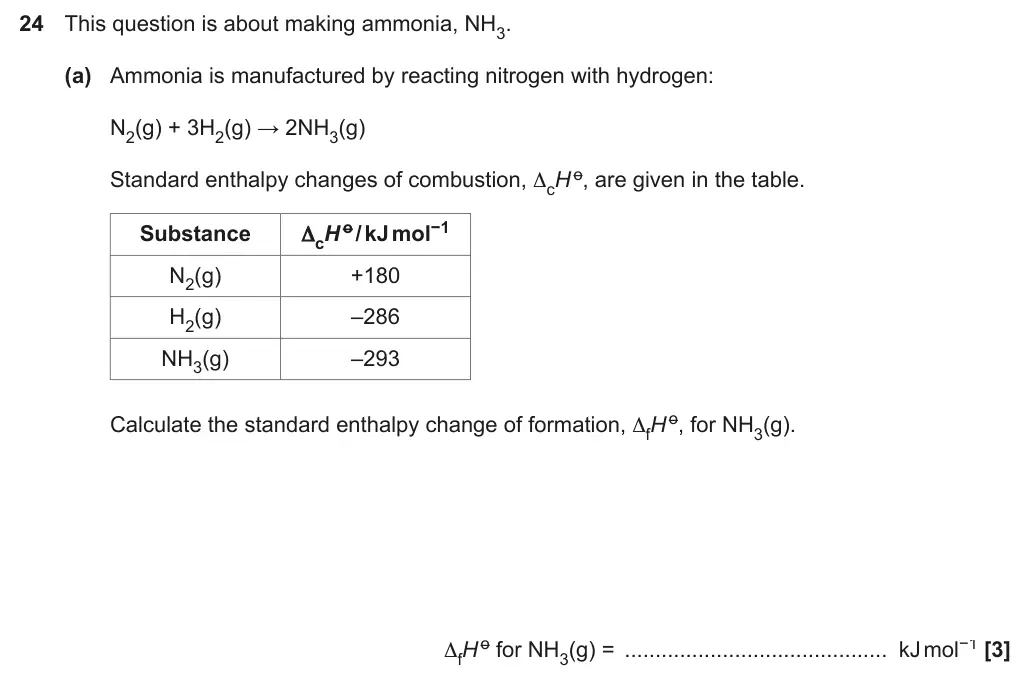
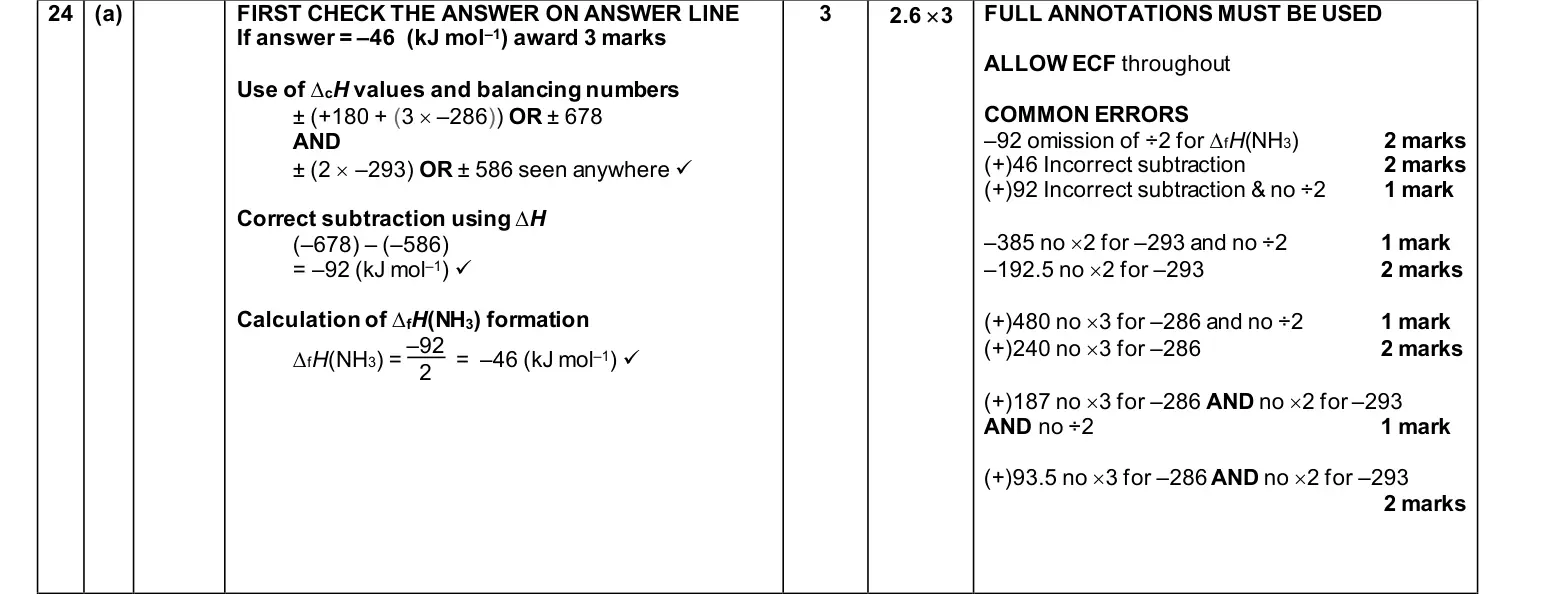
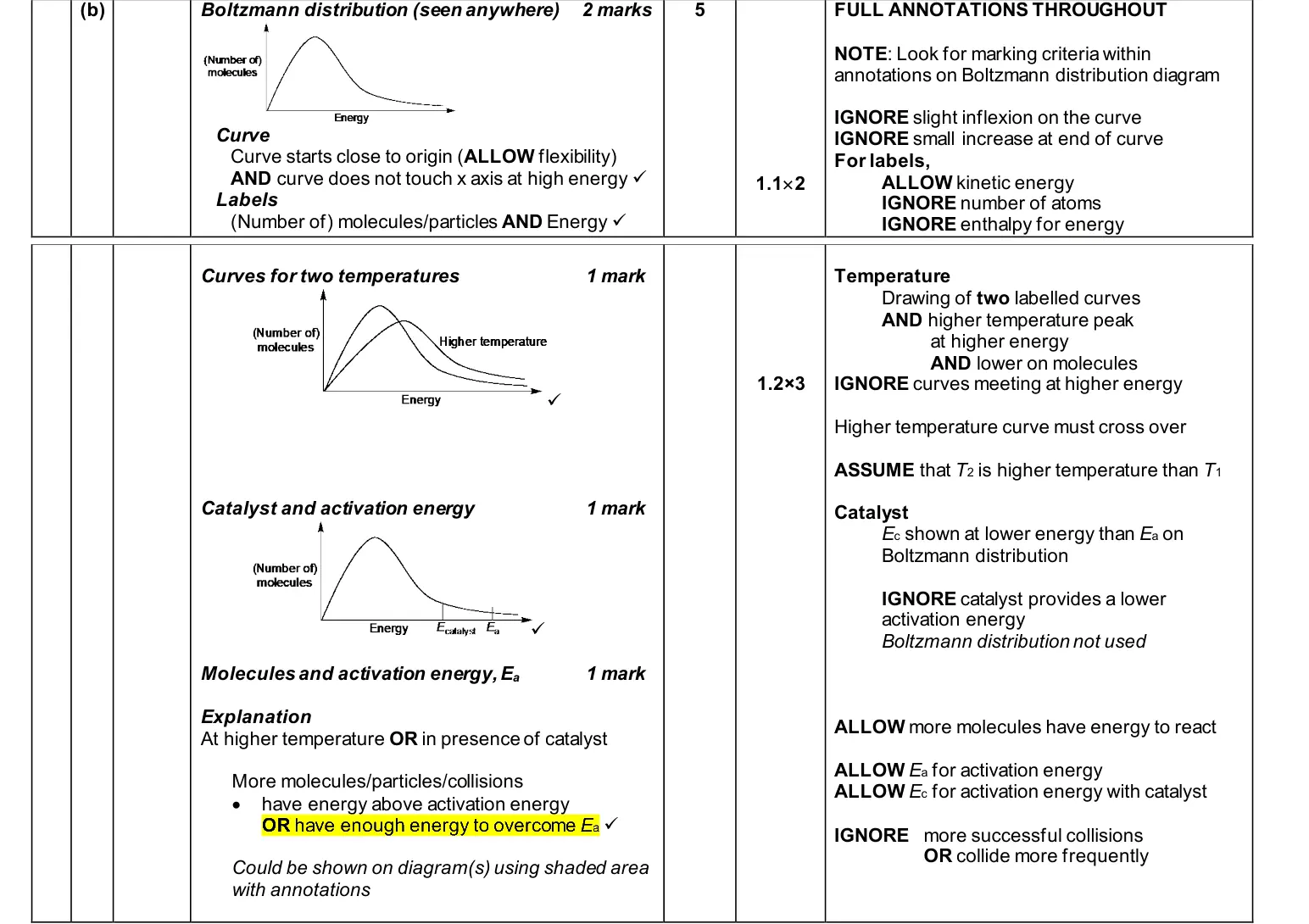
24(a) Most candidates were able to make some progress with the enthalpy calculation. Most recognised that the provided ∆cH values had to be multiplied by the balancing numbers in the equation. Most candidates processed the data on either side of the equation correctly and subtracted the combined enthalpy change from one side of the equation from the other, although the subtraction was sometimes the wrong way round. This resulted in answers of +92, or –92 kJ mol–1, with the exothermic value being correct. An enthalpy change of –92 kJ mol–1 was the commonest final answer, with comparatively few candidates recognising that the enthalpy change of formation of NH3 is for the formation of 1 mol of NH3 and not 2 mol as in the equation. 24(b) This question was well-answered showing that most candidates were well-acquainted with the Boltzmann distribution. Some candidates used one diagram to show the effect of increasing the temperature and of using a catalyst. Other candidates showed two curves, one for temperature, the other for the presence of a catalyst. Either approach could produce a clear response. Most candidates knew that the activation energy was lower with a catalyst that without. A significant number of candidates limited their explanations to ‘successful collisions’ without referring to more molecules exceeding the lower activation energy in the presence of catalyst or at a higher temperature. The best responses secured all five marks from a well-drawn and annotated graph supported by a brief explanation. Candidate should make full use of annotated diagrams to communicate their answers.
Skills: M0.2 Use ratios, fractions and percentages; M2.3 Substitute numerical values into algebraic equations using appropriate units for physical quantities; M2.4 Solve algebraic equations
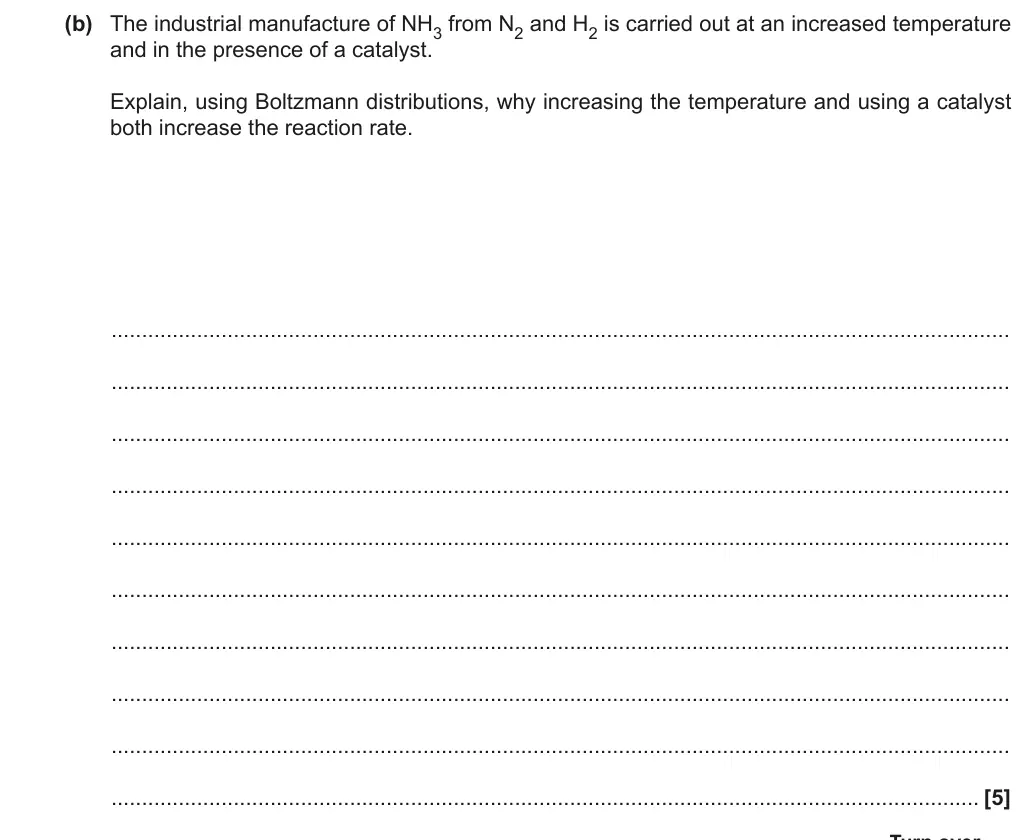
24(a) Most candidates were able to make some progress with the enthalpy calculation. Most recognised that the provided ∆cH values had to be multiplied by the balancing numbers in the equation. Most candidates processed the data on either side of the equation correctly and subtracted the combined enthalpy change from one side of the equation from the other, although the subtraction was sometimes the wrong way round. This resulted in answers of +92, or –92 kJ mol–1, with the exothermic value being correct. An enthalpy change of –92 kJ mol–1 was the commonest final answer, with comparatively few candidates recognising that the enthalpy change of formation of NH3 is for the formation of 1 mol of NH3 and not 2 mol as in the equation. 24(b) This question was well-answered showing that most candidates were well-acquainted with the Boltzmann distribution. Some candidates used one diagram to show the effect of increasing the temperature and of using a catalyst. Other candidates showed two curves, one for temperature, the other for the presence of a catalyst. Either approach could produce a clear response. Most candidates knew that the activation energy was lower with a catalyst that without. A significant number of candidates limited their explanations to ‘successful collisions’ without referring to more molecules exceeding the lower activation energy in the presence of catalyst or at a higher temperature. The best responses secured all five marks from a well-drawn and annotated graph supported by a brief explanation. Candidate should make full use of annotated diagrams to communicate their answers.
Skills: M3.1 Translate information between graphical, numerical and algebraic forms
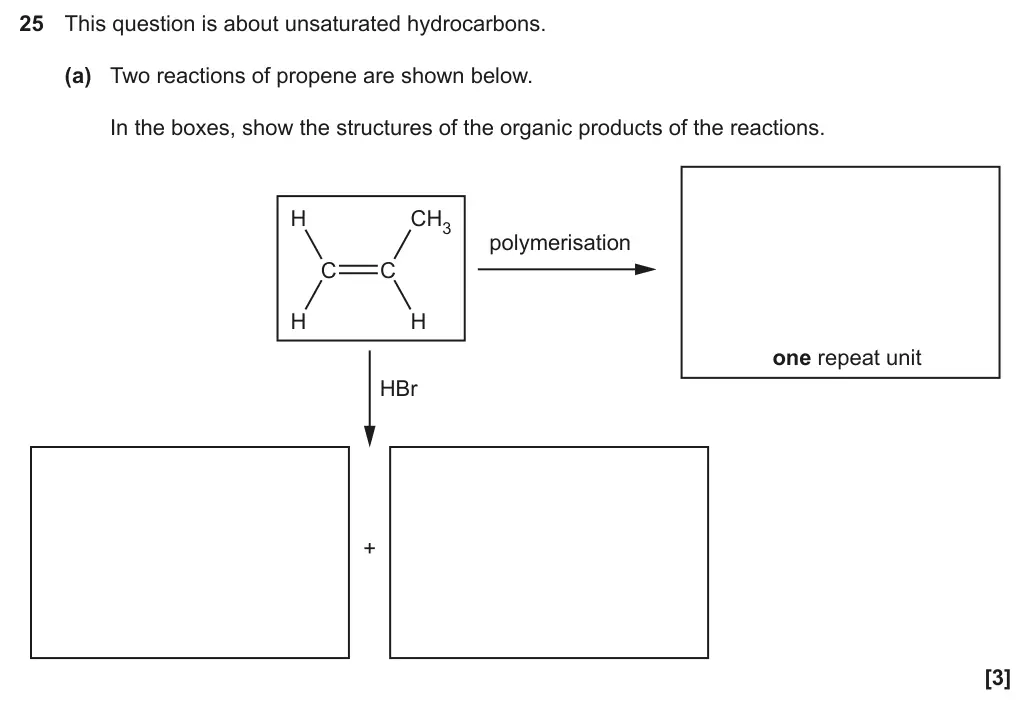
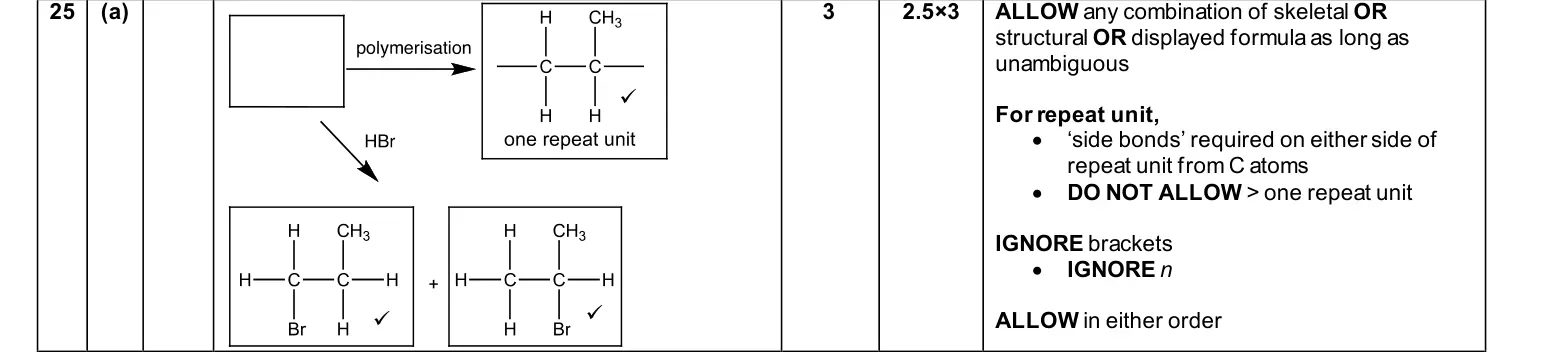
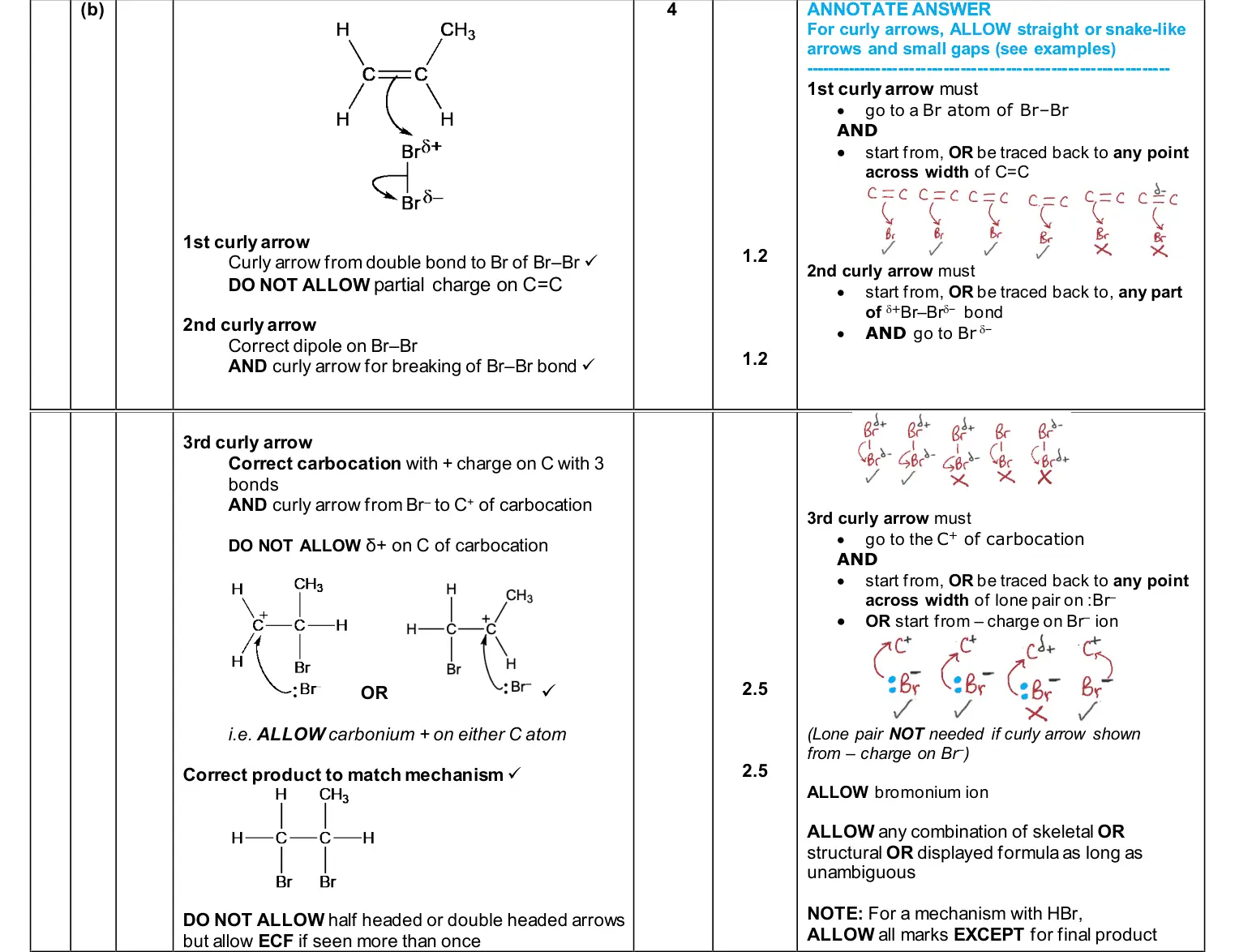
25(a) This part was generally well-answered with well-prepared candidates scoring all three marks. The most common errors resulted from the products of reaction with HBr. The same structure was often drawn, reversed in one of the boxes. Candidates should take care to check that the atoms in a structure have the correct number of bonds. Some candidates added HBr across the C=C double bond but left the C=C bond intact in their final structures, showing carbon atoms with 5 bonds instead of 4. 25(b) As with 25(a), this question rewarded the well-prepared candidate and discriminated well. Conversely, many mechanisms showed little resemblance to the accepted mechanism for electrophilic addition. Mechanisms were often seen showing curly arrows going in the wrong direction and between the wrong bonds and atoms, with incorrect charges and dipoles, and partial charges used where full charges were required. Many candidates were aware that members of a homologous series have the same functional group and react in similar ways. A second mark was available for stating that the formula of successive members increases by CH2. It is important to stress ‘successive’ in communicating this information. 25(c)(ii) This part required candidates to apply their understanding of a ‘general formula’ in a novel context. Many candidates analysed the provided formulae for the alkynes homologous series to derive the correct general formula of CnH2n–2. There was no real pattern in the incorrect responses which usually contained a mixture of numbers for the H atom, e.g. CnH2n, CnHn+1. 25(c)(iii) Although attempted by most candidates, comparatively few responses could be credited. The key to success was again to use the information provided: the formation of a saturated compound. The commonest response seen showed addition of 1 Br2 molecule to form the unsaturated CH3CBr=CHBr instead of the saturated CH3CBr2–CBr2 by addition of 2 Br2. This question was one of the most difficult on the exam paper. 25(c)(iv) Most candidates achieved 1 of the available 2 marks for drawing the structure of but-2-yne, CH3C≡CCH3. The structure of but-1-yne was then usually drawn in the other box despite it being provided already in the table at the start of part (c). A variety of creditworthy structures were seen, including H2C=CH– CH=CH2, cyclobutene and isomers of methylcyclopropane. 25(c)(v) It was encouraging to see the many correct structures drawn from the unfamiliar 2,5-dimethylhept-3-yne. Most candidates positioned the C≡C group and the two substituted CH3 groups correctly. The commonest error was showing a main stem with 6, rather than 7 C atoms. If any of your students’ results are not as expected, you may wish to consider one of our review of results services. For full information about the options available visit the OCR website. If university places are at stake you may wish to consider priority service 2 reviews of marking which have an earlier deadline to ensure your reviews are processed in time for university applications. Our priority is supporting you and your students this autumn and to support you as you prepare for summer 2021 exams. We’ll update our website information regularly with resources, guidance and key information. • Teachers • Students • Exams officers • Assessment specialists We are sending a weekly roundup to tell you about important updates. You can also sign up for your subject specific updates. If you haven’t already, sign up here. Attend one of our popular CPD courses to hear directly from a senior assessor or drop in to a Q&A session. All our courses for the academic year 2020-2021 are being delivered live via an online platform, so you can attend from any location. Please find details for all our courses on the relevant subject page on our website or visit OCR professional development. ExamBuilder is the question builder platform for a range of our GCSE, A Level, Cambridge Nationals, Cambridge Technicals and Functional Skills qualifications. See the full list of available qualifications in the sign up form. ExamBuilder is free for all OCR centres with an Interchange account and gives you unlimited users per centre. We need an Interchange username to validate the identity of your centre's first user account for ExamBuilder. If you do not have an Interchange account please contact your centre administrator (usually the Exams Officer) to request a username, or nominate an existing Interchange user in your department. Review of results
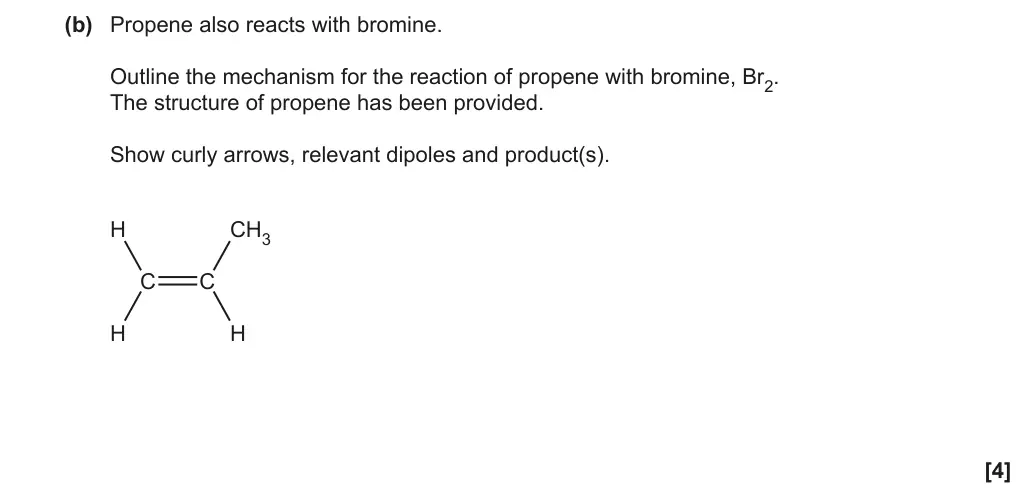
25(a) This part was generally well-answered with well-prepared candidates scoring all three marks. The most common errors resulted from the products of reaction with HBr. The same structure was often drawn, reversed in one of the boxes. Candidates should take care to check that the atoms in a structure have the correct number of bonds. Some candidates added HBr across the C=C double bond but left the C=C bond intact in their final structures, showing carbon atoms with 5 bonds instead of 4. 25(b) As with 25(a), this question rewarded the well-prepared candidate and discriminated well. Conversely, many mechanisms showed little resemblance to the accepted mechanism for electrophilic addition. Mechanisms were often seen showing curly arrows going in the wrong direction and between the wrong bonds and atoms, with incorrect charges and dipoles, and partial charges used where full charges were required. Many candidates were aware that members of a homologous series have the same functional group and react in similar ways. A second mark was available for stating that the formula of successive members increases by CH2. It is important to stress ‘successive’ in communicating this information. 25(c)(ii) This part required candidates to apply their understanding of a ‘general formula’ in a novel context. Many candidates analysed the provided formulae for the alkynes homologous series to derive the correct general formula of CnH2n–2. There was no real pattern in the incorrect responses which usually contained a mixture of numbers for the H atom, e.g. CnH2n, CnHn+1. 25(c)(iii) Although attempted by most candidates, comparatively few responses could be credited. The key to success was again to use the information provided: the formation of a saturated compound. The commonest response seen showed addition of 1 Br2 molecule to form the unsaturated CH3CBr=CHBr instead of the saturated CH3CBr2–CBr2 by addition of 2 Br2. This question was one of the most difficult on the exam paper. 25(c)(iv) Most candidates achieved 1 of the available 2 marks for drawing the structure of but-2-yne, CH3C≡CCH3. The structure of but-1-yne was then usually drawn in the other box despite it being provided already in the table at the start of part (c). A variety of creditworthy structures were seen, including H2C=CH– CH=CH2, cyclobutene and isomers of methylcyclopropane. 25(c)(v) It was encouraging to see the many correct structures drawn from the unfamiliar 2,5-dimethylhept-3-yne. Most candidates positioned the C≡C group and the two substituted CH3 groups correctly. The commonest error was showing a main stem with 6, rather than 7 C atoms. If any of your students’ results are not as expected, you may wish to consider one of our review of results services. For full information about the options available visit the OCR website. If university places are at stake you may wish to consider priority service 2 reviews of marking which have an earlier deadline to ensure your reviews are processed in time for university applications. Our priority is supporting you and your students this autumn and to support you as you prepare for summer 2021 exams. We’ll update our website information regularly with resources, guidance and key information. • Teachers • Students • Exams officers • Assessment specialists We are sending a weekly roundup to tell you about important updates. You can also sign up for your subject specific updates. If you haven’t already, sign up here. Attend one of our popular CPD courses to hear directly from a senior assessor or drop in to a Q&A session. All our courses for the academic year 2020-2021 are being delivered live via an online platform, so you can attend from any location. Please find details for all our courses on the relevant subject page on our website or visit OCR professional development. ExamBuilder is the question builder platform for a range of our GCSE, A Level, Cambridge Nationals, Cambridge Technicals and Functional Skills qualifications. See the full list of available qualifications in the sign up form. ExamBuilder is free for all OCR centres with an Interchange account and gives you unlimited users per centre. We need an Interchange username to validate the identity of your centre's first user account for ExamBuilder. If you do not have an Interchange account please contact your centre administrator (usually the Exams Officer) to request a username, or nominate an existing Interchange user in your department. Review of results
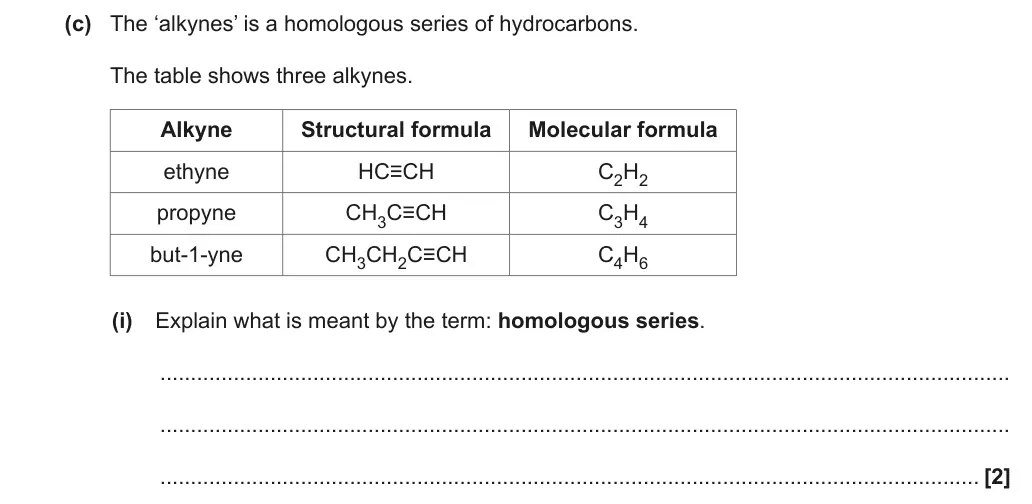
25(a) This part was generally well-answered with well-prepared candidates scoring all three marks. The most common errors resulted from the products of reaction with HBr. The same structure was often drawn, reversed in one of the boxes. Candidates should take care to check that the atoms in a structure have the correct number of bonds. Some candidates added HBr across the C=C double bond but left the C=C bond intact in their final structures, showing carbon atoms with 5 bonds instead of 4. 25(b) As with 25(a), this question rewarded the well-prepared candidate and discriminated well. Conversely, many mechanisms showed little resemblance to the accepted mechanism for electrophilic addition. Mechanisms were often seen showing curly arrows going in the wrong direction and between the wrong bonds and atoms, with incorrect charges and dipoles, and partial charges used where full charges were required. Many candidates were aware that members of a homologous series have the same functional group and react in similar ways. A second mark was available for stating that the formula of successive members increases by CH2. It is important to stress ‘successive’ in communicating this information. 25(c)(ii) This part required candidates to apply their understanding of a ‘general formula’ in a novel context. Many candidates analysed the provided formulae for the alkynes homologous series to derive the correct general formula of CnH2n–2. There was no real pattern in the incorrect responses which usually contained a mixture of numbers for the H atom, e.g. CnH2n, CnHn+1. 25(c)(iii) Although attempted by most candidates, comparatively few responses could be credited. The key to success was again to use the information provided: the formation of a saturated compound. The commonest response seen showed addition of 1 Br2 molecule to form the unsaturated CH3CBr=CHBr instead of the saturated CH3CBr2–CBr2 by addition of 2 Br2. This question was one of the most difficult on the exam paper. 25(c)(iv) Most candidates achieved 1 of the available 2 marks for drawing the structure of but-2-yne, CH3C≡CCH3. The structure of but-1-yne was then usually drawn in the other box despite it being provided already in the table at the start of part (c). A variety of creditworthy structures were seen, including H2C=CH– CH=CH2, cyclobutene and isomers of methylcyclopropane. 25(c)(v) It was encouraging to see the many correct structures drawn from the unfamiliar 2,5-dimethylhept-3-yne. Most candidates positioned the C≡C group and the two substituted CH3 groups correctly. The commonest error was showing a main stem with 6, rather than 7 C atoms. If any of your students’ results are not as expected, you may wish to consider one of our review of results services. For full information about the options available visit the OCR website. If university places are at stake you may wish to consider priority service 2 reviews of marking which have an earlier deadline to ensure your reviews are processed in time for university applications. Our priority is supporting you and your students this autumn and to support you as you prepare for summer 2021 exams. We’ll update our website information regularly with resources, guidance and key information. • Teachers • Students • Exams officers • Assessment specialists We are sending a weekly roundup to tell you about important updates. You can also sign up for your subject specific updates. If you haven’t already, sign up here. Attend one of our popular CPD courses to hear directly from a senior assessor or drop in to a Q&A session. All our courses for the academic year 2020-2021 are being delivered live via an online platform, so you can attend from any location. Please find details for all our courses on the relevant subject page on our website or visit OCR professional development. ExamBuilder is the question builder platform for a range of our GCSE, A Level, Cambridge Nationals, Cambridge Technicals and Functional Skills qualifications. See the full list of available qualifications in the sign up form. ExamBuilder is free for all OCR centres with an Interchange account and gives you unlimited users per centre. We need an Interchange username to validate the identity of your centre's first user account for ExamBuilder. If you do not have an Interchange account please contact your centre administrator (usually the Exams Officer) to request a username, or nominate an existing Interchange user in your department. Review of results

25(a) This part was generally well-answered with well-prepared candidates scoring all three marks. The most common errors resulted from the products of reaction with HBr. The same structure was often drawn, reversed in one of the boxes. Candidates should take care to check that the atoms in a structure have the correct number of bonds. Some candidates added HBr across the C=C double bond but left the C=C bond intact in their final structures, showing carbon atoms with 5 bonds instead of 4. 25(b) As with 25(a), this question rewarded the well-prepared candidate and discriminated well. Conversely, many mechanisms showed little resemblance to the accepted mechanism for electrophilic addition. Mechanisms were often seen showing curly arrows going in the wrong direction and between the wrong bonds and atoms, with incorrect charges and dipoles, and partial charges used where full charges were required. Many candidates were aware that members of a homologous series have the same functional group and react in similar ways. A second mark was available for stating that the formula of successive members increases by CH2. It is important to stress ‘successive’ in communicating this information. 25(c)(ii) This part required candidates to apply their understanding of a ‘general formula’ in a novel context. Many candidates analysed the provided formulae for the alkynes homologous series to derive the correct general formula of CnH2n–2. There was no real pattern in the incorrect responses which usually contained a mixture of numbers for the H atom, e.g. CnH2n, CnHn+1. 25(c)(iii) Although attempted by most candidates, comparatively few responses could be credited. The key to success was again to use the information provided: the formation of a saturated compound. The commonest response seen showed addition of 1 Br2 molecule to form the unsaturated CH3CBr=CHBr instead of the saturated CH3CBr2–CBr2 by addition of 2 Br2. This question was one of the most difficult on the exam paper. 25(c)(iv) Most candidates achieved 1 of the available 2 marks for drawing the structure of but-2-yne, CH3C≡CCH3. The structure of but-1-yne was then usually drawn in the other box despite it being provided already in the table at the start of part (c). A variety of creditworthy structures were seen, including H2C=CH– CH=CH2, cyclobutene and isomers of methylcyclopropane. 25(c)(v) It was encouraging to see the many correct structures drawn from the unfamiliar 2,5-dimethylhept-3-yne. Most candidates positioned the C≡C group and the two substituted CH3 groups correctly. The commonest error was showing a main stem with 6, rather than 7 C atoms. If any of your students’ results are not as expected, you may wish to consider one of our review of results services. For full information about the options available visit the OCR website. If university places are at stake you may wish to consider priority service 2 reviews of marking which have an earlier deadline to ensure your reviews are processed in time for university applications. Our priority is supporting you and your students this autumn and to support you as you prepare for summer 2021 exams. We’ll update our website information regularly with resources, guidance and key information. • Teachers • Students • Exams officers • Assessment specialists We are sending a weekly roundup to tell you about important updates. You can also sign up for your subject specific updates. If you haven’t already, sign up here. Attend one of our popular CPD courses to hear directly from a senior assessor or drop in to a Q&A session. All our courses for the academic year 2020-2021 are being delivered live via an online platform, so you can attend from any location. Please find details for all our courses on the relevant subject page on our website or visit OCR professional development. ExamBuilder is the question builder platform for a range of our GCSE, A Level, Cambridge Nationals, Cambridge Technicals and Functional Skills qualifications. See the full list of available qualifications in the sign up form. ExamBuilder is free for all OCR centres with an Interchange account and gives you unlimited users per centre. We need an Interchange username to validate the identity of your centre's first user account for ExamBuilder. If you do not have an Interchange account please contact your centre administrator (usually the Exams Officer) to request a username, or nominate an existing Interchange user in your department. Review of results
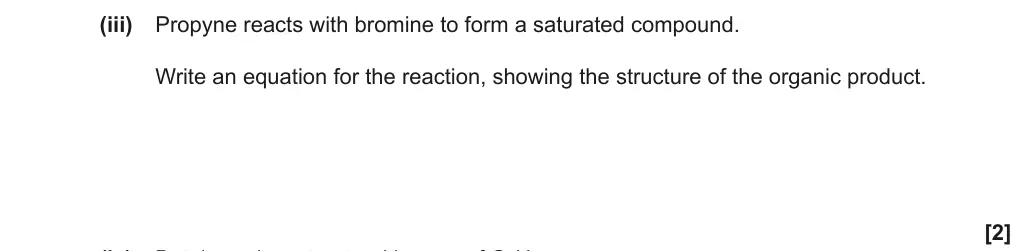
25(a) This part was generally well-answered with well-prepared candidates scoring all three marks. The most common errors resulted from the products of reaction with HBr. The same structure was often drawn, reversed in one of the boxes. Candidates should take care to check that the atoms in a structure have the correct number of bonds. Some candidates added HBr across the C=C double bond but left the C=C bond intact in their final structures, showing carbon atoms with 5 bonds instead of 4. 25(b) As with 25(a), this question rewarded the well-prepared candidate and discriminated well. Conversely, many mechanisms showed little resemblance to the accepted mechanism for electrophilic addition. Mechanisms were often seen showing curly arrows going in the wrong direction and between the wrong bonds and atoms, with incorrect charges and dipoles, and partial charges used where full charges were required. Many candidates were aware that members of a homologous series have the same functional group and react in similar ways. A second mark was available for stating that the formula of successive members increases by CH2. It is important to stress ‘successive’ in communicating this information. 25(c)(ii) This part required candidates to apply their understanding of a ‘general formula’ in a novel context. Many candidates analysed the provided formulae for the alkynes homologous series to derive the correct general formula of CnH2n–2. There was no real pattern in the incorrect responses which usually contained a mixture of numbers for the H atom, e.g. CnH2n, CnHn+1. 25(c)(iii) Although attempted by most candidates, comparatively few responses could be credited. The key to success was again to use the information provided: the formation of a saturated compound. The commonest response seen showed addition of 1 Br2 molecule to form the unsaturated CH3CBr=CHBr instead of the saturated CH3CBr2–CBr2 by addition of 2 Br2. This question was one of the most difficult on the exam paper. 25(c)(iv) Most candidates achieved 1 of the available 2 marks for drawing the structure of but-2-yne, CH3C≡CCH3. The structure of but-1-yne was then usually drawn in the other box despite it being provided already in the table at the start of part (c). A variety of creditworthy structures were seen, including H2C=CH– CH=CH2, cyclobutene and isomers of methylcyclopropane. 25(c)(v) It was encouraging to see the many correct structures drawn from the unfamiliar 2,5-dimethylhept-3-yne. Most candidates positioned the C≡C group and the two substituted CH3 groups correctly. The commonest error was showing a main stem with 6, rather than 7 C atoms. If any of your students’ results are not as expected, you may wish to consider one of our review of results services. For full information about the options available visit the OCR website. If university places are at stake you may wish to consider priority service 2 reviews of marking which have an earlier deadline to ensure your reviews are processed in time for university applications. Our priority is supporting you and your students this autumn and to support you as you prepare for summer 2021 exams. We’ll update our website information regularly with resources, guidance and key information. • Teachers • Students • Exams officers • Assessment specialists We are sending a weekly roundup to tell you about important updates. You can also sign up for your subject specific updates. If you haven’t already, sign up here. Attend one of our popular CPD courses to hear directly from a senior assessor or drop in to a Q&A session. All our courses for the academic year 2020-2021 are being delivered live via an online platform, so you can attend from any location. Please find details for all our courses on the relevant subject page on our website or visit OCR professional development. ExamBuilder is the question builder platform for a range of our GCSE, A Level, Cambridge Nationals, Cambridge Technicals and Functional Skills qualifications. See the full list of available qualifications in the sign up form. ExamBuilder is free for all OCR centres with an Interchange account and gives you unlimited users per centre. We need an Interchange username to validate the identity of your centre's first user account for ExamBuilder. If you do not have an Interchange account please contact your centre administrator (usually the Exams Officer) to request a username, or nominate an existing Interchange user in your department. Review of results
Skills: M0.2 Use ratios, fractions and percentages
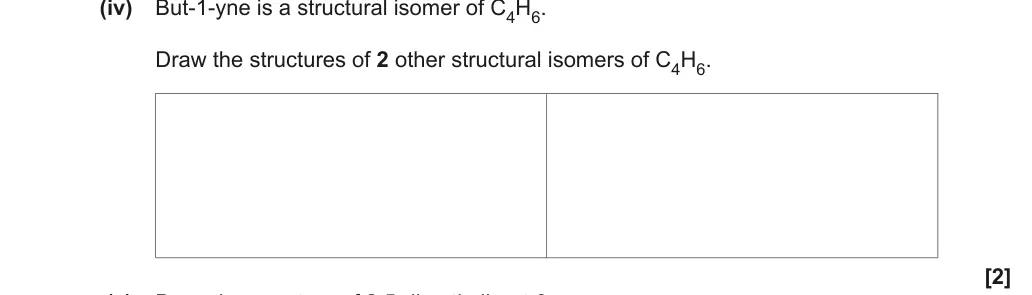
25(a) This part was generally well-answered with well-prepared candidates scoring all three marks. The most common errors resulted from the products of reaction with HBr. The same structure was often drawn, reversed in one of the boxes. Candidates should take care to check that the atoms in a structure have the correct number of bonds. Some candidates added HBr across the C=C double bond but left the C=C bond intact in their final structures, showing carbon atoms with 5 bonds instead of 4. 25(b) As with 25(a), this question rewarded the well-prepared candidate and discriminated well. Conversely, many mechanisms showed little resemblance to the accepted mechanism for electrophilic addition. Mechanisms were often seen showing curly arrows going in the wrong direction and between the wrong bonds and atoms, with incorrect charges and dipoles, and partial charges used where full charges were required. Many candidates were aware that members of a homologous series have the same functional group and react in similar ways. A second mark was available for stating that the formula of successive members increases by CH2. It is important to stress ‘successive’ in communicating this information. 25(c)(ii) This part required candidates to apply their understanding of a ‘general formula’ in a novel context. Many candidates analysed the provided formulae for the alkynes homologous series to derive the correct general formula of CnH2n–2. There was no real pattern in the incorrect responses which usually contained a mixture of numbers for the H atom, e.g. CnH2n, CnHn+1. 25(c)(iii) Although attempted by most candidates, comparatively few responses could be credited. The key to success was again to use the information provided: the formation of a saturated compound. The commonest response seen showed addition of 1 Br2 molecule to form the unsaturated CH3CBr=CHBr instead of the saturated CH3CBr2–CBr2 by addition of 2 Br2. This question was one of the most difficult on the exam paper. 25(c)(iv) Most candidates achieved 1 of the available 2 marks for drawing the structure of but-2-yne, CH3C≡CCH3. The structure of but-1-yne was then usually drawn in the other box despite it being provided already in the table at the start of part (c). A variety of creditworthy structures were seen, including H2C=CH– CH=CH2, cyclobutene and isomers of methylcyclopropane. 25(c)(v) It was encouraging to see the many correct structures drawn from the unfamiliar 2,5-dimethylhept-3-yne. Most candidates positioned the C≡C group and the two substituted CH3 groups correctly. The commonest error was showing a main stem with 6, rather than 7 C atoms. If any of your students’ results are not as expected, you may wish to consider one of our review of results services. For full information about the options available visit the OCR website. If university places are at stake you may wish to consider priority service 2 reviews of marking which have an earlier deadline to ensure your reviews are processed in time for university applications. Our priority is supporting you and your students this autumn and to support you as you prepare for summer 2021 exams. We’ll update our website information regularly with resources, guidance and key information. • Teachers • Students • Exams officers • Assessment specialists We are sending a weekly roundup to tell you about important updates. You can also sign up for your subject specific updates. If you haven’t already, sign up here. Attend one of our popular CPD courses to hear directly from a senior assessor or drop in to a Q&A session. All our courses for the academic year 2020-2021 are being delivered live via an online platform, so you can attend from any location. Please find details for all our courses on the relevant subject page on our website or visit OCR professional development. ExamBuilder is the question builder platform for a range of our GCSE, A Level, Cambridge Nationals, Cambridge Technicals and Functional Skills qualifications. See the full list of available qualifications in the sign up form. ExamBuilder is free for all OCR centres with an Interchange account and gives you unlimited users per centre. We need an Interchange username to validate the identity of your centre's first user account for ExamBuilder. If you do not have an Interchange account please contact your centre administrator (usually the Exams Officer) to request a username, or nominate an existing Interchange user in your department. Review of results
Skills: M4.2 Visualise and represent 2-D and 3-D forms including 2-D representations of 3-D objects
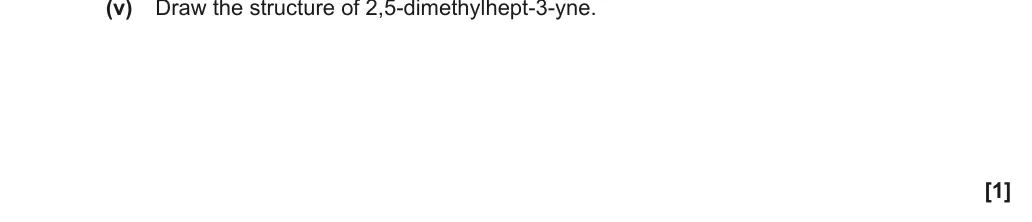
25(a) This part was generally well-answered with well-prepared candidates scoring all three marks. The most common errors resulted from the products of reaction with HBr. The same structure was often drawn, reversed in one of the boxes. Candidates should take care to check that the atoms in a structure have the correct number of bonds. Some candidates added HBr across the C=C double bond but left the C=C bond intact in their final structures, showing carbon atoms with 5 bonds instead of 4. 25(b) As with 25(a), this question rewarded the well-prepared candidate and discriminated well. Conversely, many mechanisms showed little resemblance to the accepted mechanism for electrophilic addition. Mechanisms were often seen showing curly arrows going in the wrong direction and between the wrong bonds and atoms, with incorrect charges and dipoles, and partial charges used where full charges were required. Many candidates were aware that members of a homologous series have the same functional group and react in similar ways. A second mark was available for stating that the formula of successive members increases by CH2. It is important to stress ‘successive’ in communicating this information. 25(c)(ii) This part required candidates to apply their understanding of a ‘general formula’ in a novel context. Many candidates analysed the provided formulae for the alkynes homologous series to derive the correct general formula of CnH2n–2. There was no real pattern in the incorrect responses which usually contained a mixture of numbers for the H atom, e.g. CnH2n, CnHn+1. 25(c)(iii) Although attempted by most candidates, comparatively few responses could be credited. The key to success was again to use the information provided: the formation of a saturated compound. The commonest response seen showed addition of 1 Br2 molecule to form the unsaturated CH3CBr=CHBr instead of the saturated CH3CBr2–CBr2 by addition of 2 Br2. This question was one of the most difficult on the exam paper. 25(c)(iv) Most candidates achieved 1 of the available 2 marks for drawing the structure of but-2-yne, CH3C≡CCH3. The structure of but-1-yne was then usually drawn in the other box despite it being provided already in the table at the start of part (c). A variety of creditworthy structures were seen, including H2C=CH– CH=CH2, cyclobutene and isomers of methylcyclopropane. 25(c)(v) It was encouraging to see the many correct structures drawn from the unfamiliar 2,5-dimethylhept-3-yne. Most candidates positioned the C≡C group and the two substituted CH3 groups correctly. The commonest error was showing a main stem with 6, rather than 7 C atoms. If any of your students’ results are not as expected, you may wish to consider one of our review of results services. For full information about the options available visit the OCR website. If university places are at stake you may wish to consider priority service 2 reviews of marking which have an earlier deadline to ensure your reviews are processed in time for university applications. Our priority is supporting you and your students this autumn and to support you as you prepare for summer 2021 exams. We’ll update our website information regularly with resources, guidance and key information. • Teachers • Students • Exams officers • Assessment specialists We are sending a weekly roundup to tell you about important updates. You can also sign up for your subject specific updates. If you haven’t already, sign up here. Attend one of our popular CPD courses to hear directly from a senior assessor or drop in to a Q&A session. All our courses for the academic year 2020-2021 are being delivered live via an online platform, so you can attend from any location. Please find details for all our courses on the relevant subject page on our website or visit OCR professional development. ExamBuilder is the question builder platform for a range of our GCSE, A Level, Cambridge Nationals, Cambridge Technicals and Functional Skills qualifications. See the full list of available qualifications in the sign up form. ExamBuilder is free for all OCR centres with an Interchange account and gives you unlimited users per centre. We need an Interchange username to validate the identity of your centre's first user account for ExamBuilder. If you do not have an Interchange account please contact your centre administrator (usually the Exams Officer) to request a username, or nominate an existing Interchange user in your department. Review of results
Skills: M4.2 Visualise and represent 2-D and 3-D forms including 2-D representations of 3-D objects
Want a paper marked and gone through with you? Message us.