Answer
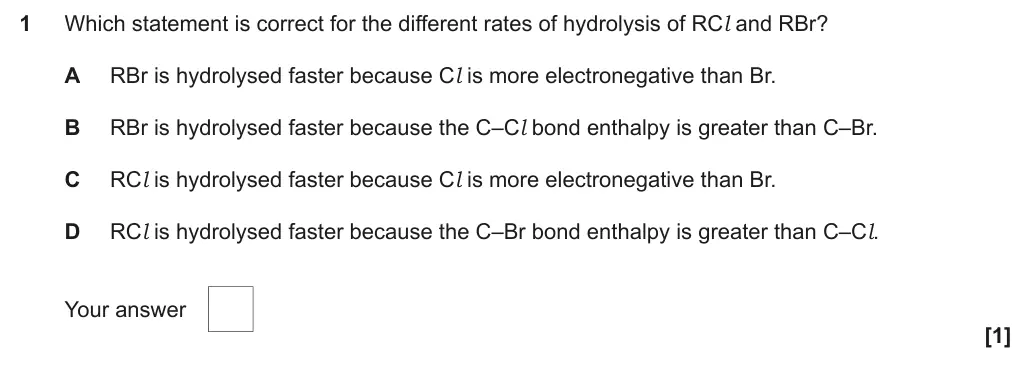
B
Mark scheme

Examiner's comment
The majority of candidates identified B as the correct answer.
100 marks · 47 question parts · Paper, mark scheme and report on OCR's site · Have OCR's Data Sheet beside you
B
The majority of candidates identified B as the correct answer.
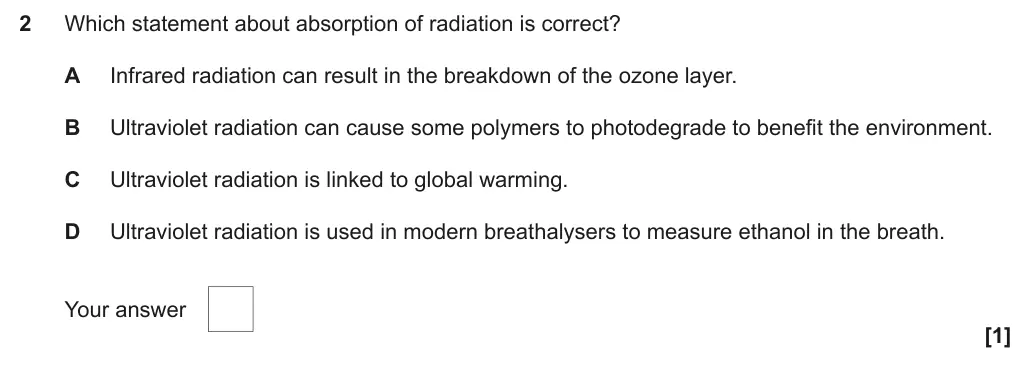
B
Candidates found this multiple choice question challenging. While some identified B as the correct answer, many candidates selected C.
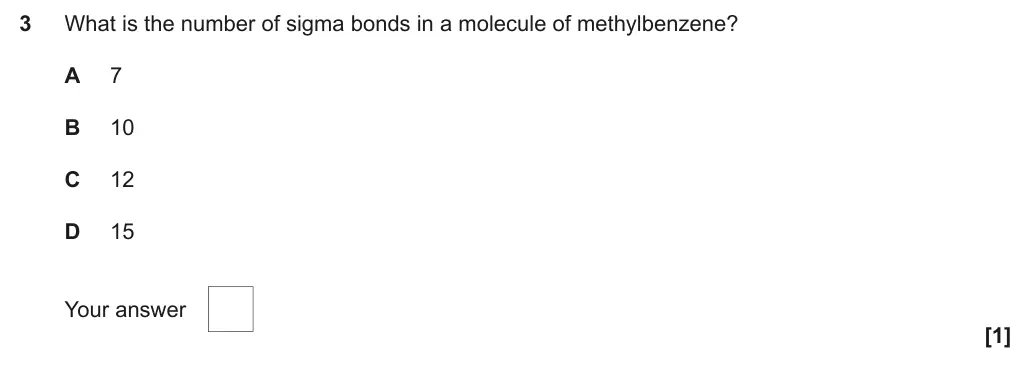
D
This question discriminated well, with higher ability candidates correctly identifying D. Often students overlooked the sigma bonds in the aromatic ring and selected B.
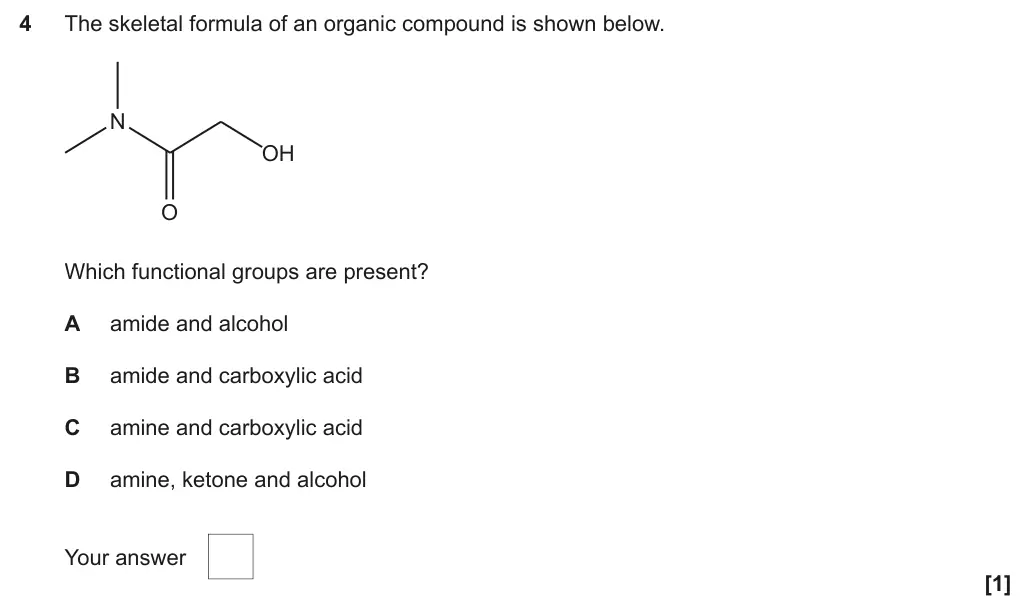
A
Most candidates correctly selected A. The most common incorrect response was option D as candidates had misinterpreted the amide group as a ketone and an amine.
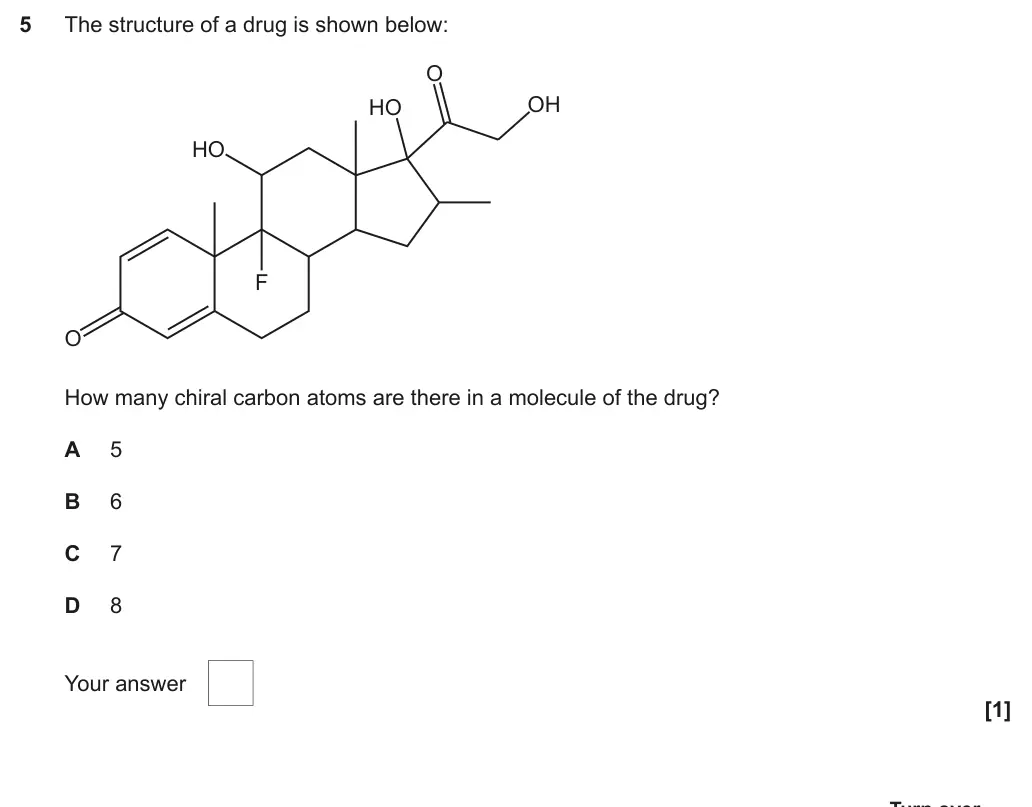
D
Many candidates correctly answered D, with those selecting the correct response showing annotations on the given structure to identify the chiral carbons. C proved a good distractor.
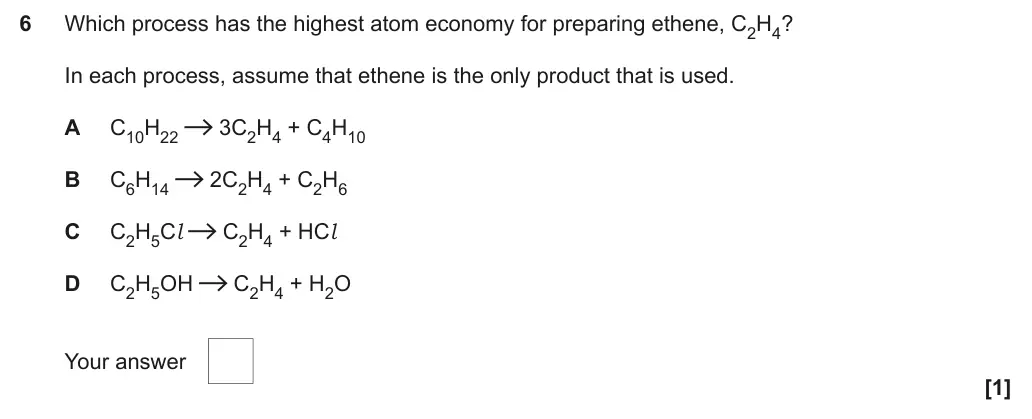
B
The majority of candidates identified B as the correct answer, with candidates frequently showing their calculations alongside each option to aid their choice.
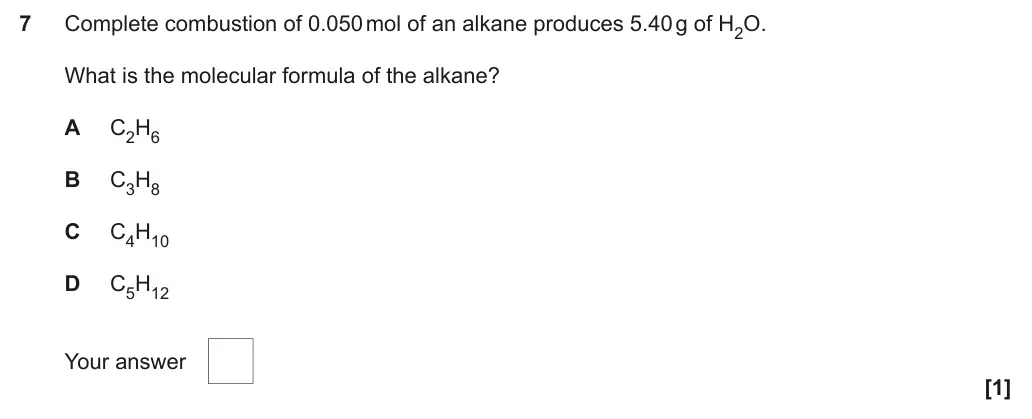
D
Most candidates correctly identified D as the correct response.
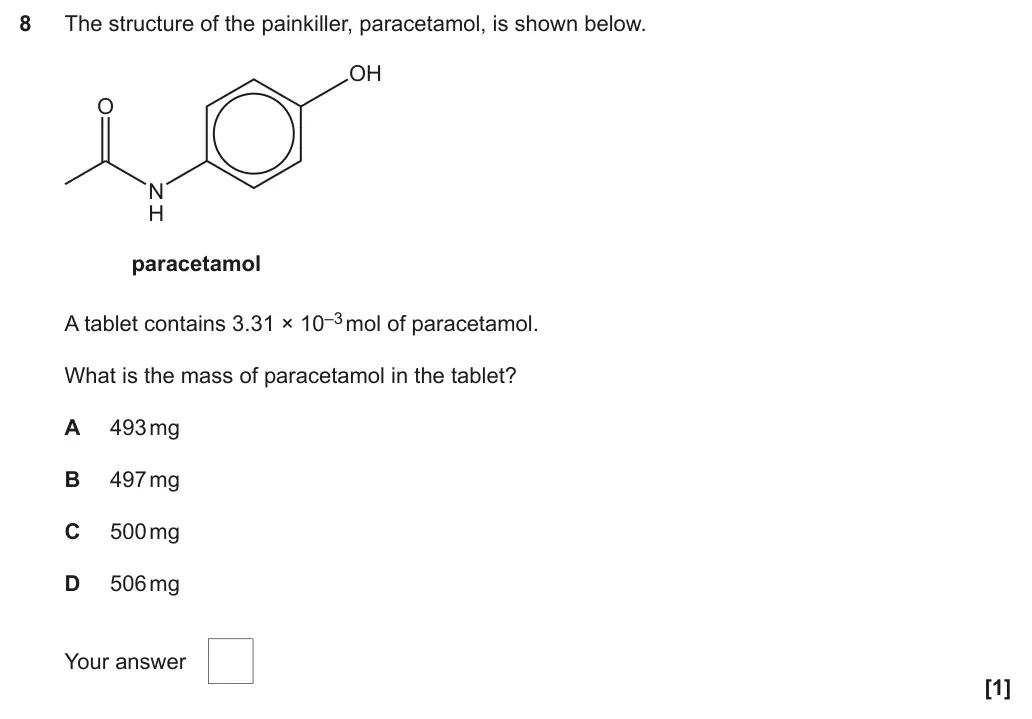
C
The majority of candidates correctly calculated C as the mass of paracetamol in the tablet.
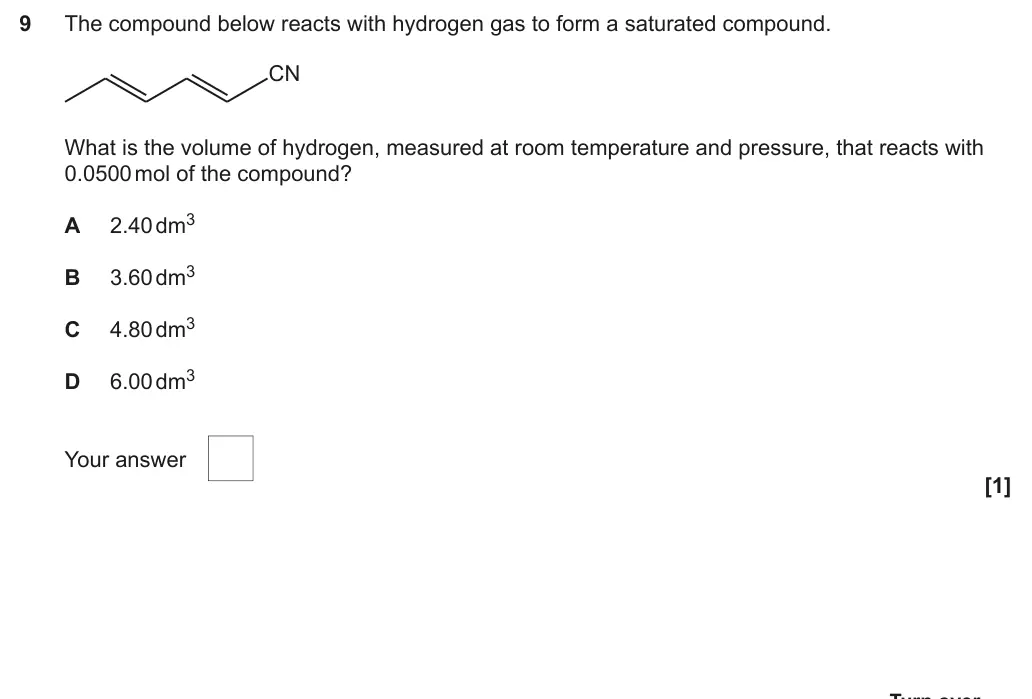
C
This question discriminated well, with higher ability candidates correctly identifying C as the volume of hydrogen produced. Many candidates overlooked the hydrogenation of the CN group and incorrectly selected option A.
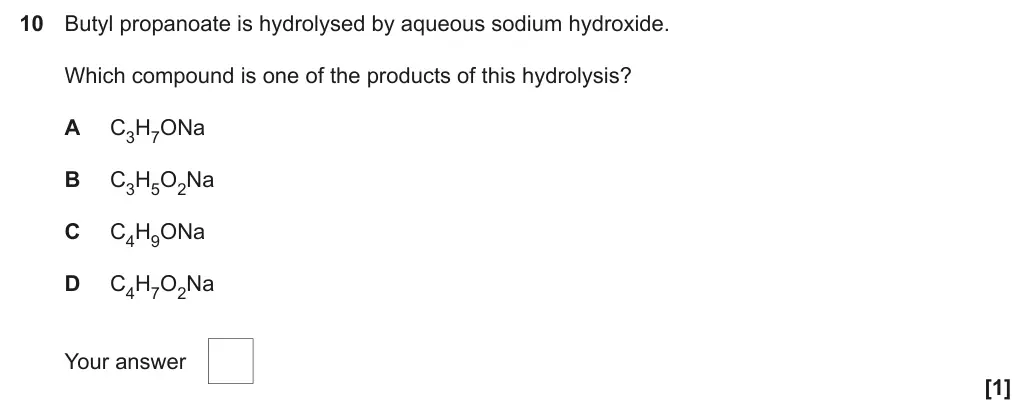
B
Most candidates correctly identified B as one of the products. These candidates often drew out the structures of butyl propanoate and the product options to aid in their selection.
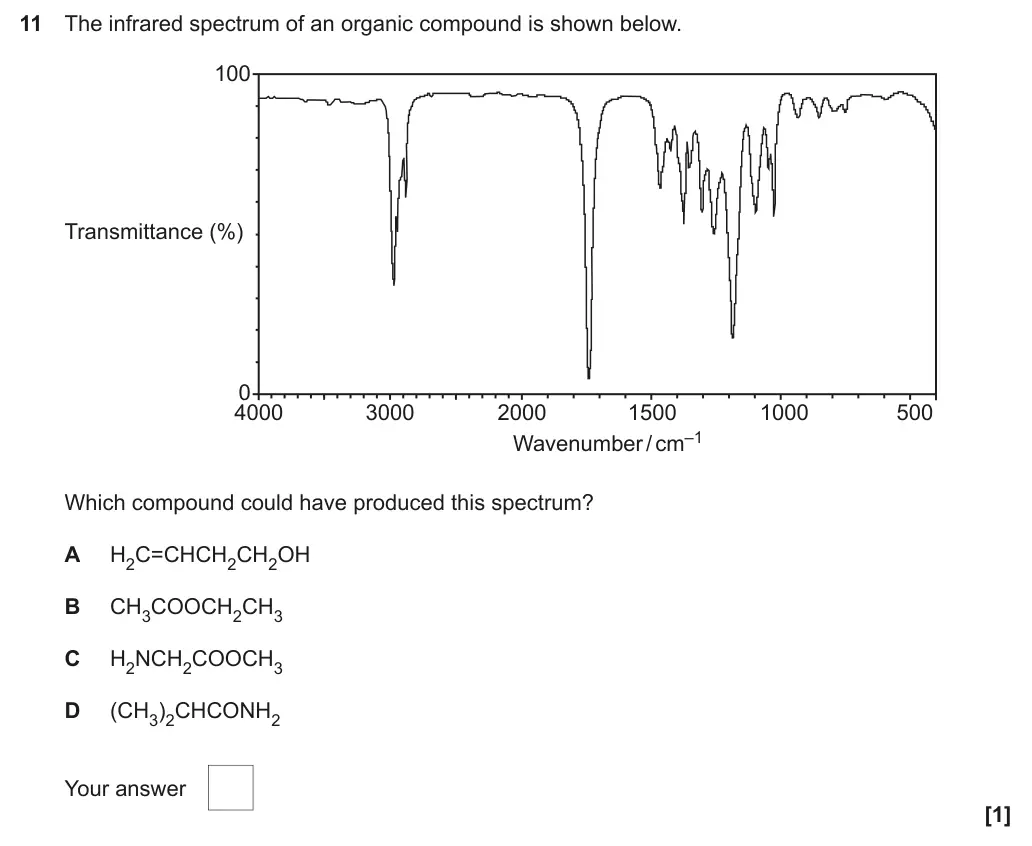
B
Most candidates correctly identified C as the compound after labelling the peaks in the spectrum.
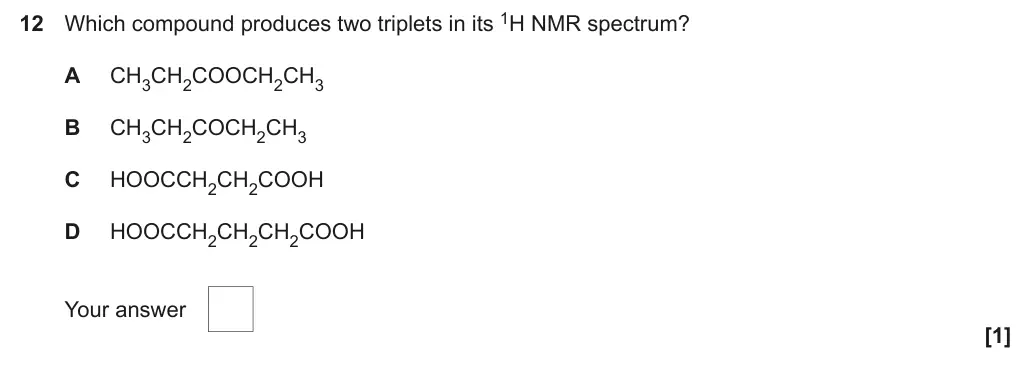
A
This question proved challenging. Candidates who drew out the different compounds were able to identify A as the correct response.
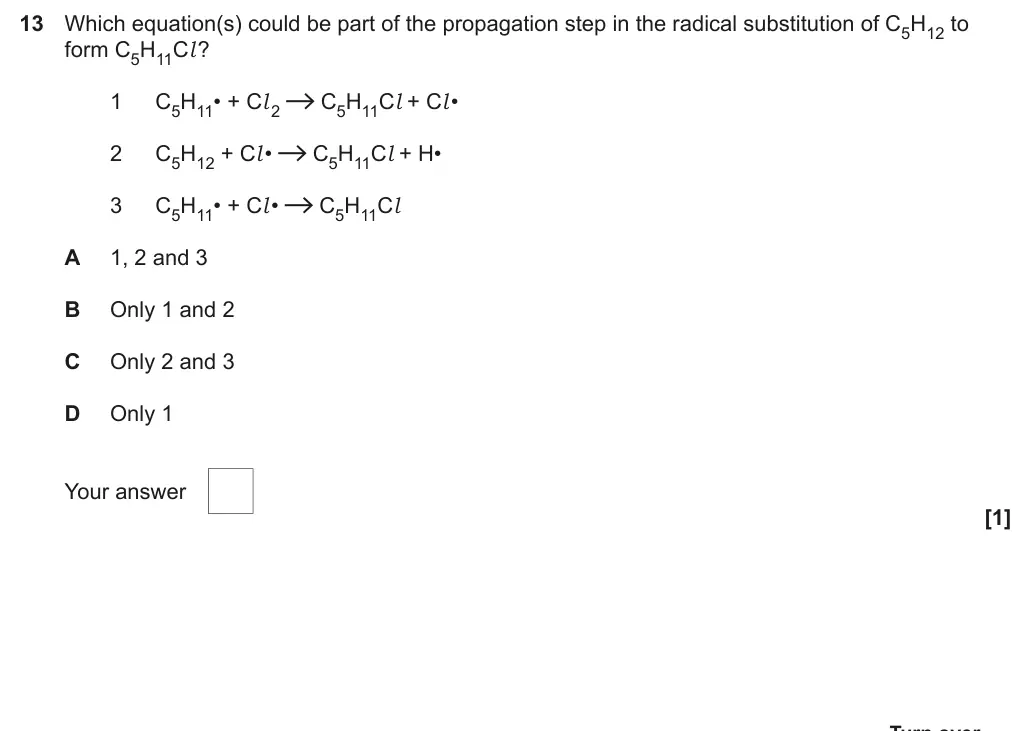
D
Most candidates identified D (only 1) for an equation that could be part of a propagation step.
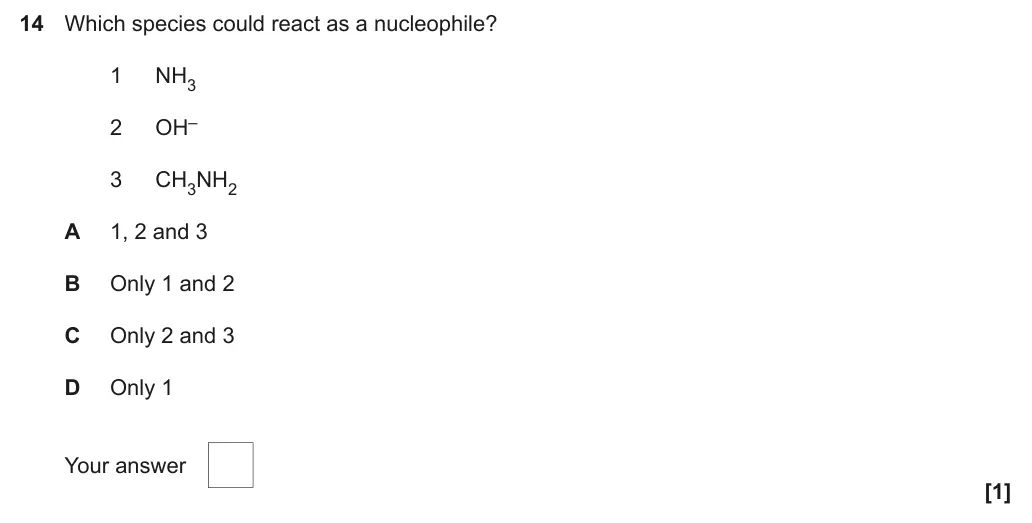
A
Many candidates did not identify CH3NH2 as a nucleophile and selected option B.
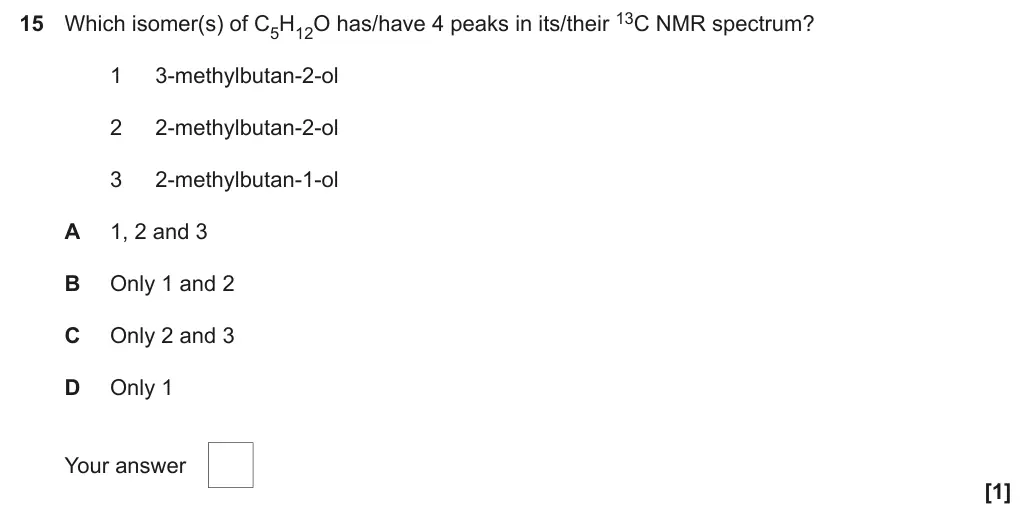
B
Candidates found this question difficult. Those who drew out the different compounds were able to identify B as the correct response. Section B overview Section B includes a mixture of short answer and extended response questions, including two questions marked using a level of response mark scheme (19e and 21). This section of the paper is worth 85 marks.
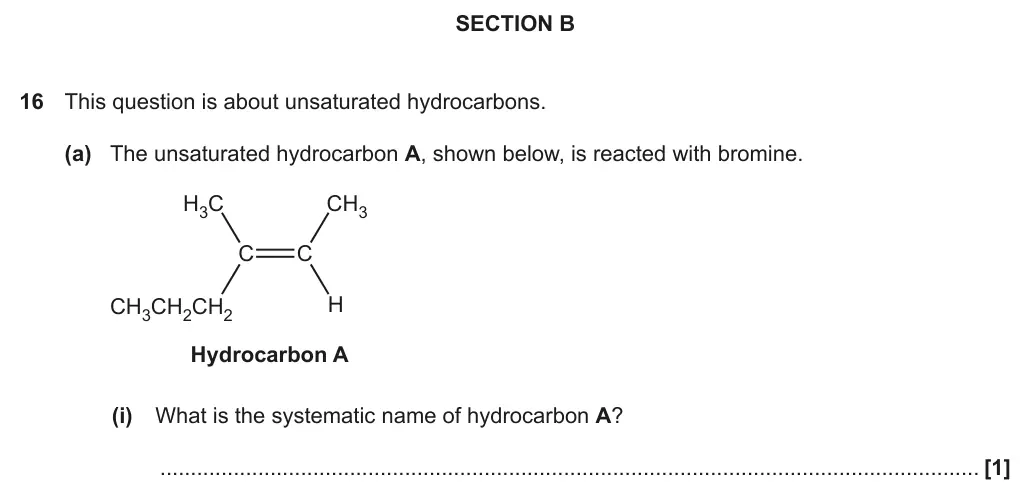
The majority of candidates were able to correct name hydrocarbon A as 3-methylhex-2-ene. A number of responses used incorrect numbering or suggested 3-methylhexan-2-ene as the name.
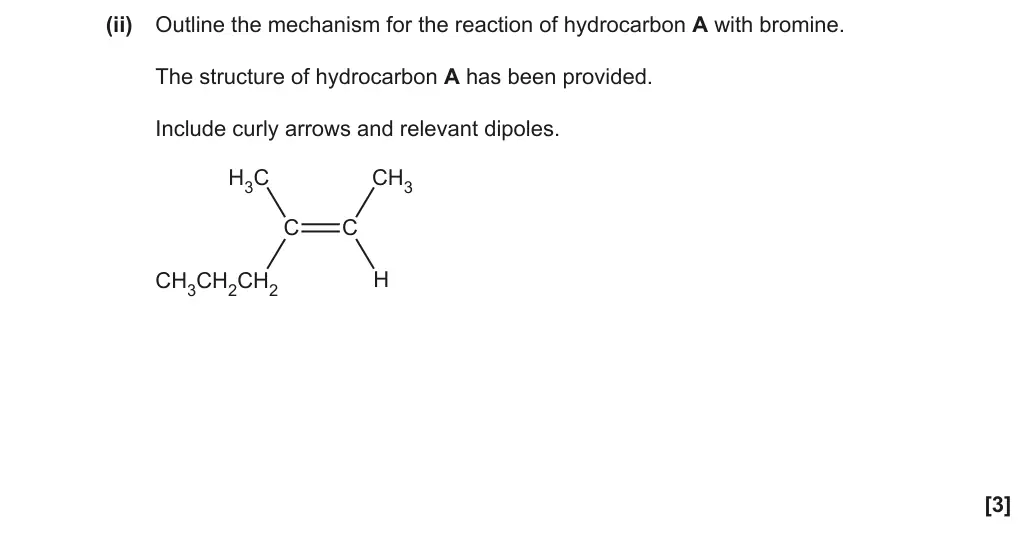
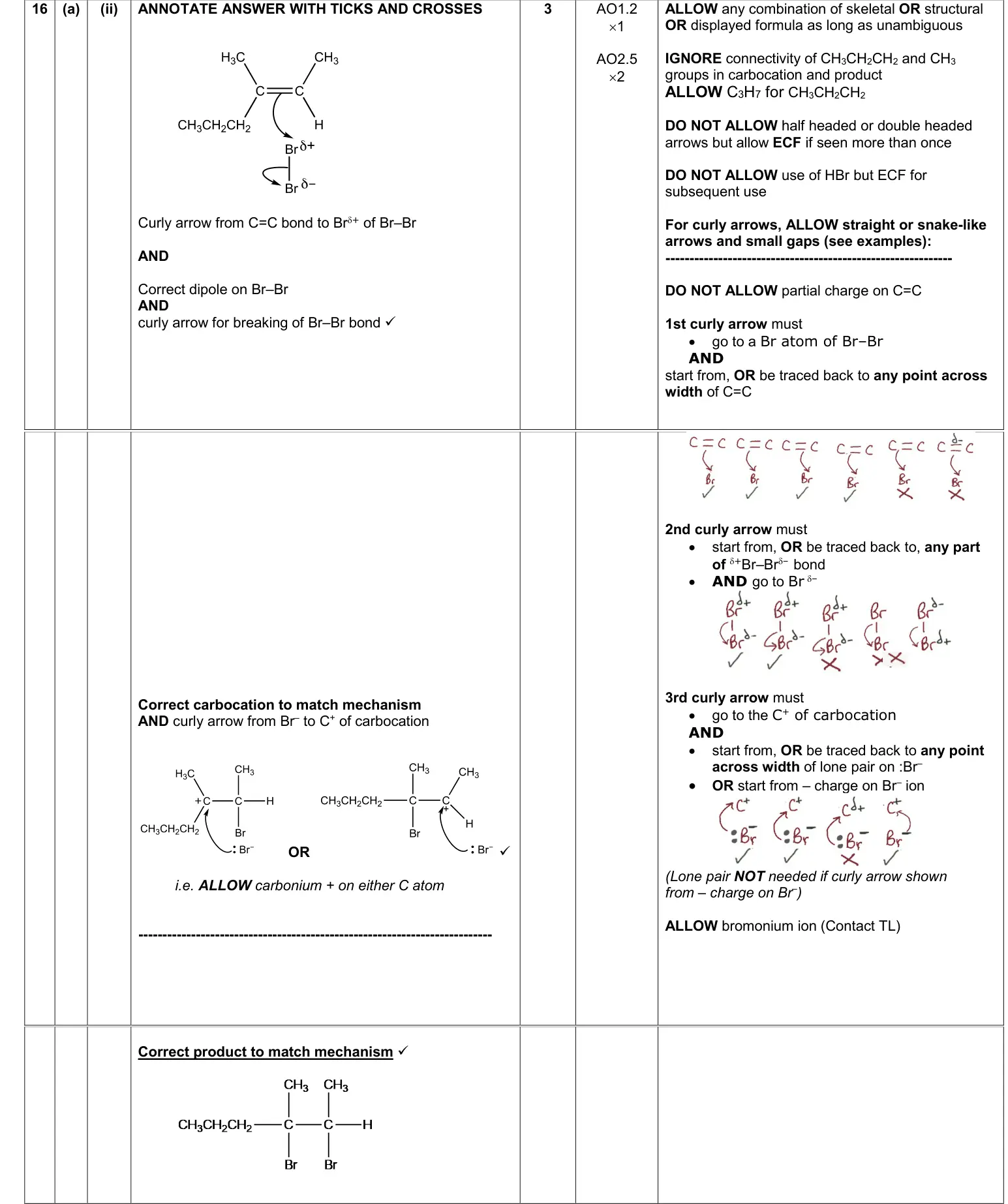
Candidates are familiar with the mechanism for the bromination of hydrocarbons. So, the majority of candidates scored 3 marks. Common errors included the use of HBr rather than Br2 or putting a dipole on the carbon-carbon double bond.
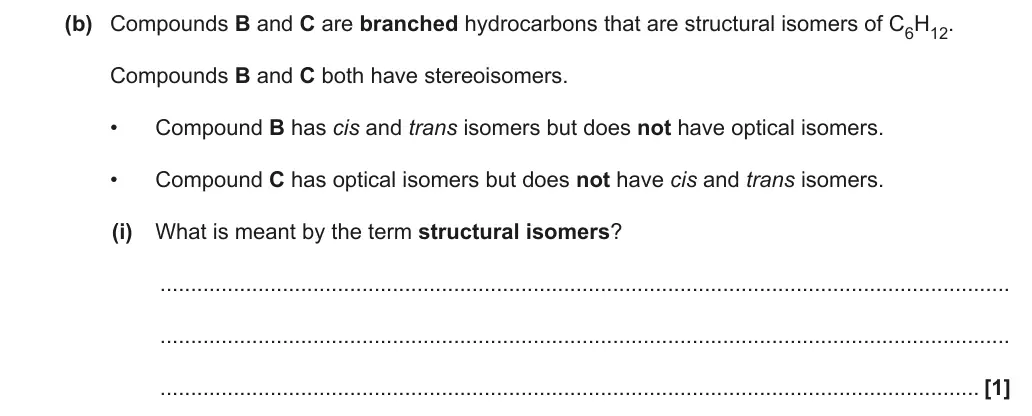
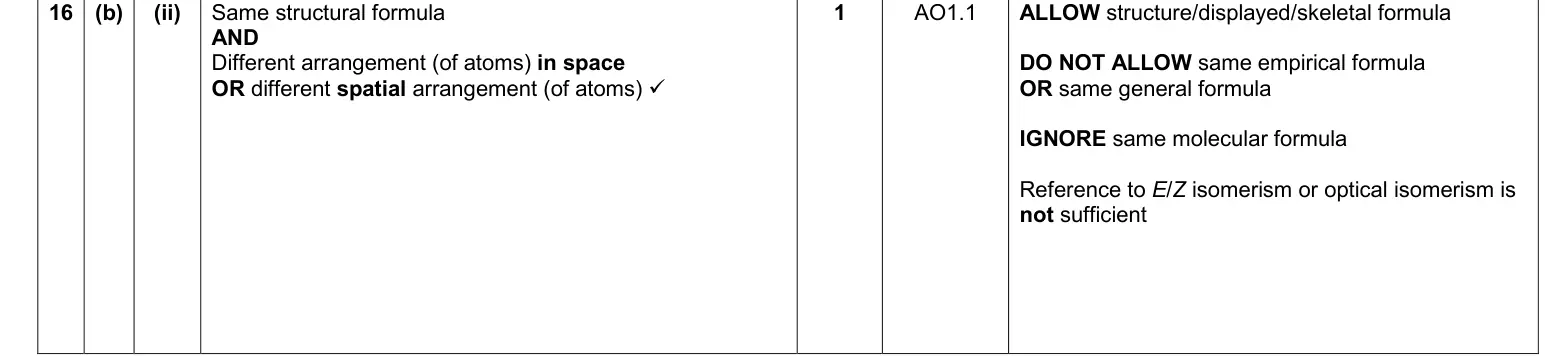
The majority of candidates were able to correctly define a structural isomer.
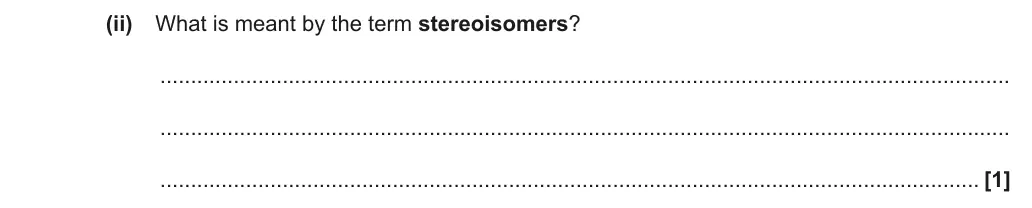
This definition was well known by candidates with the majority of responses given the mark. Some candidates omitted the reference to structural formula.
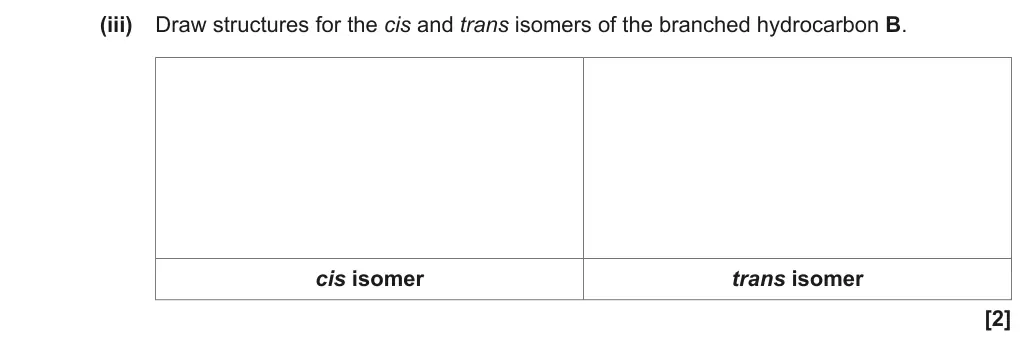
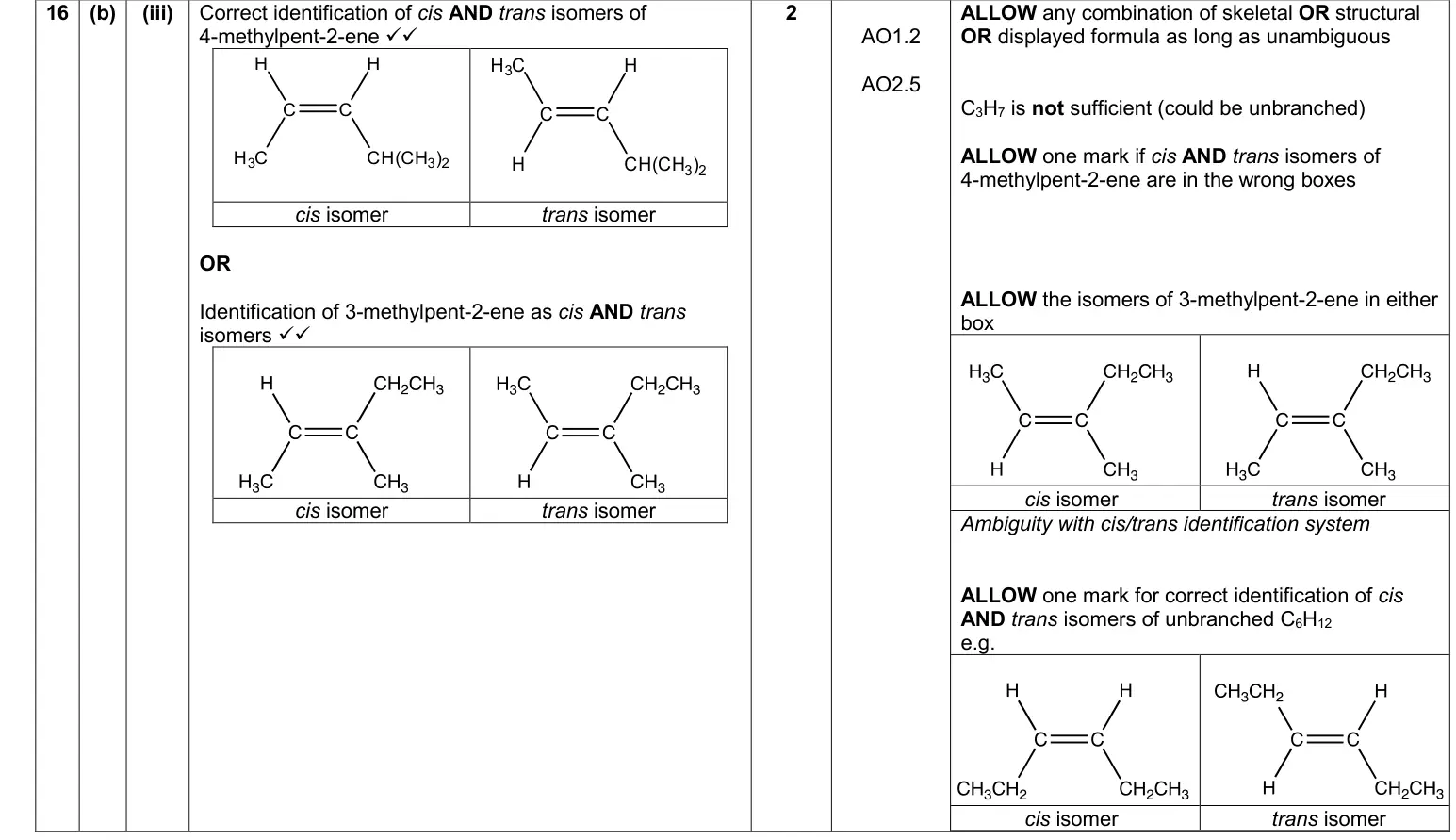
This question required candidates to link their knowledge of cis and trans isomers with branched hydrocarbons. Higher ability candidates were able to do this. The majority of candidates scored 1 mark for correctly drawing cis and trans isomers of an unbranched hydrocarbon.
Skills: M4.2 Visualise and represent 2-D and 3-D forms including 2-D representations of 3-D objects; M4.3 Understand the symmetry of 2-D and 3-D shapes
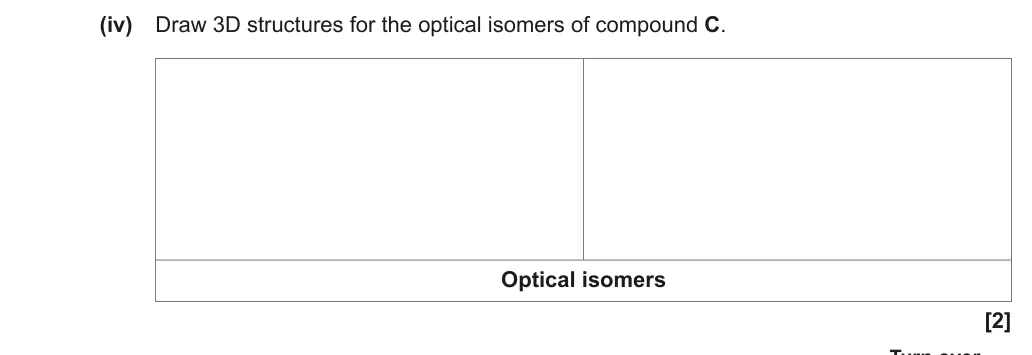
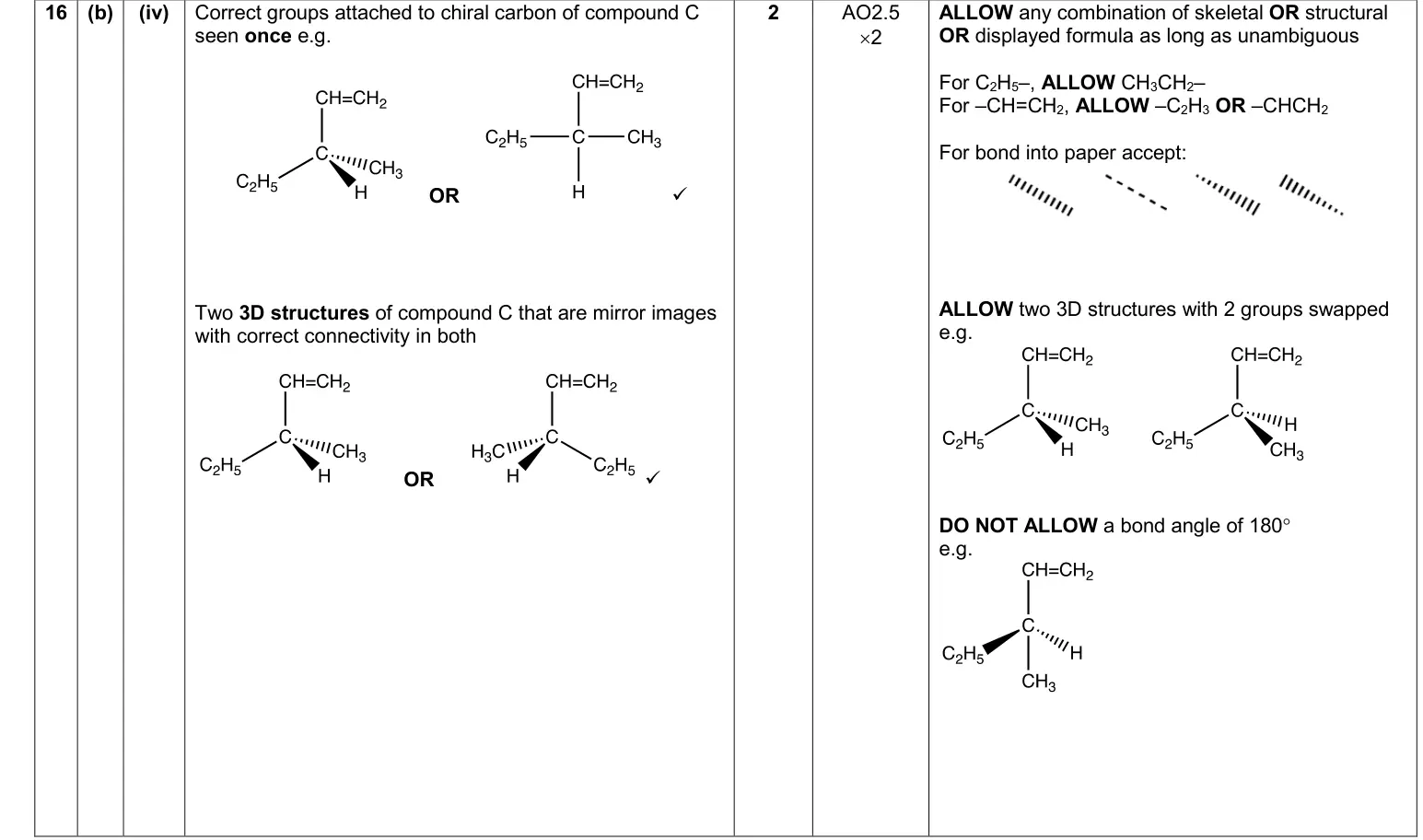
This question discriminated well. Candidates were required to identify the groups around a chiral carbon and then draw the two corresponding optical isomers. Incorrect responses frequently had incorrect connectivity around the chiral carbon, bond angles of 180 or 2D structures.
Skills: M4.2 Visualise and represent 2-D and 3-D forms including 2-D representations of 3-D objects; M4.3 Understand the symmetry of 2-D and 3-D shapes
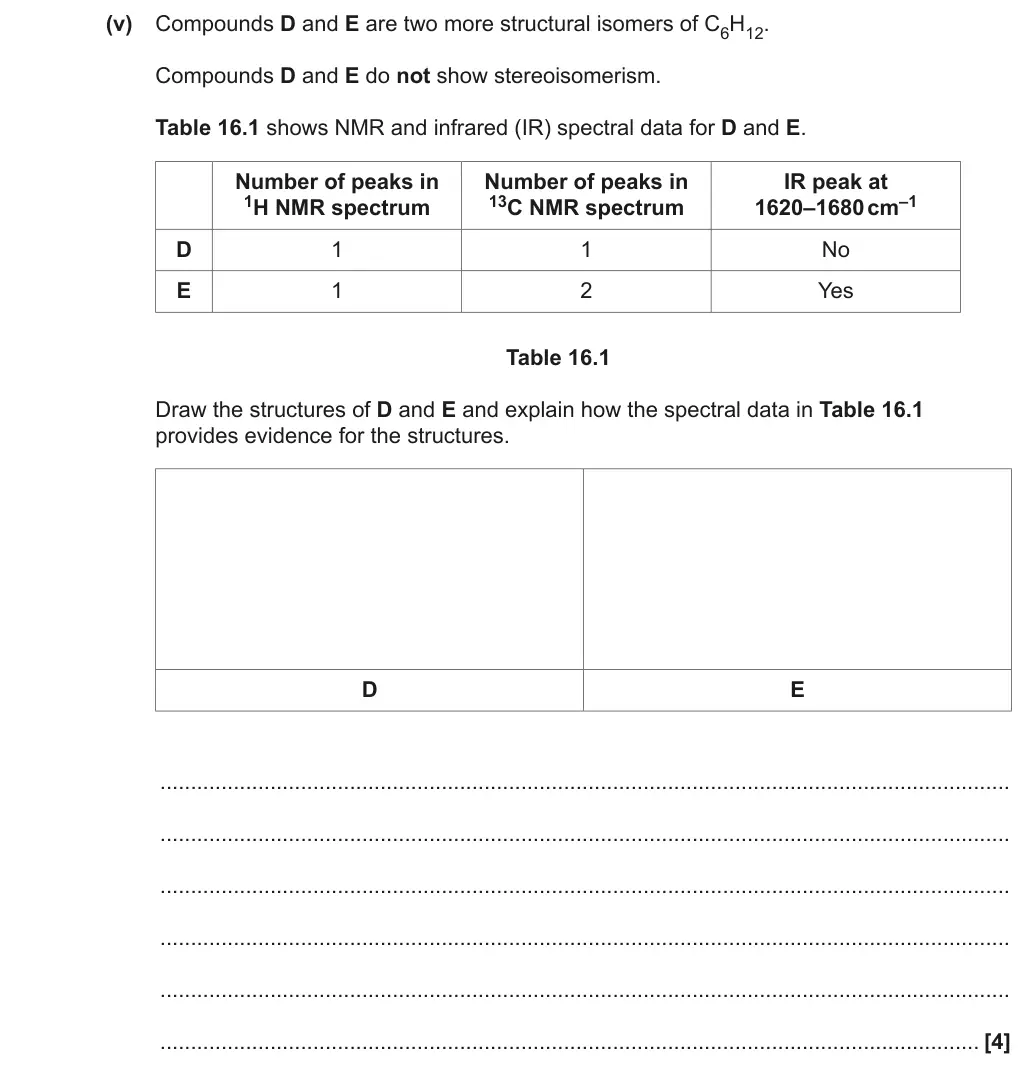
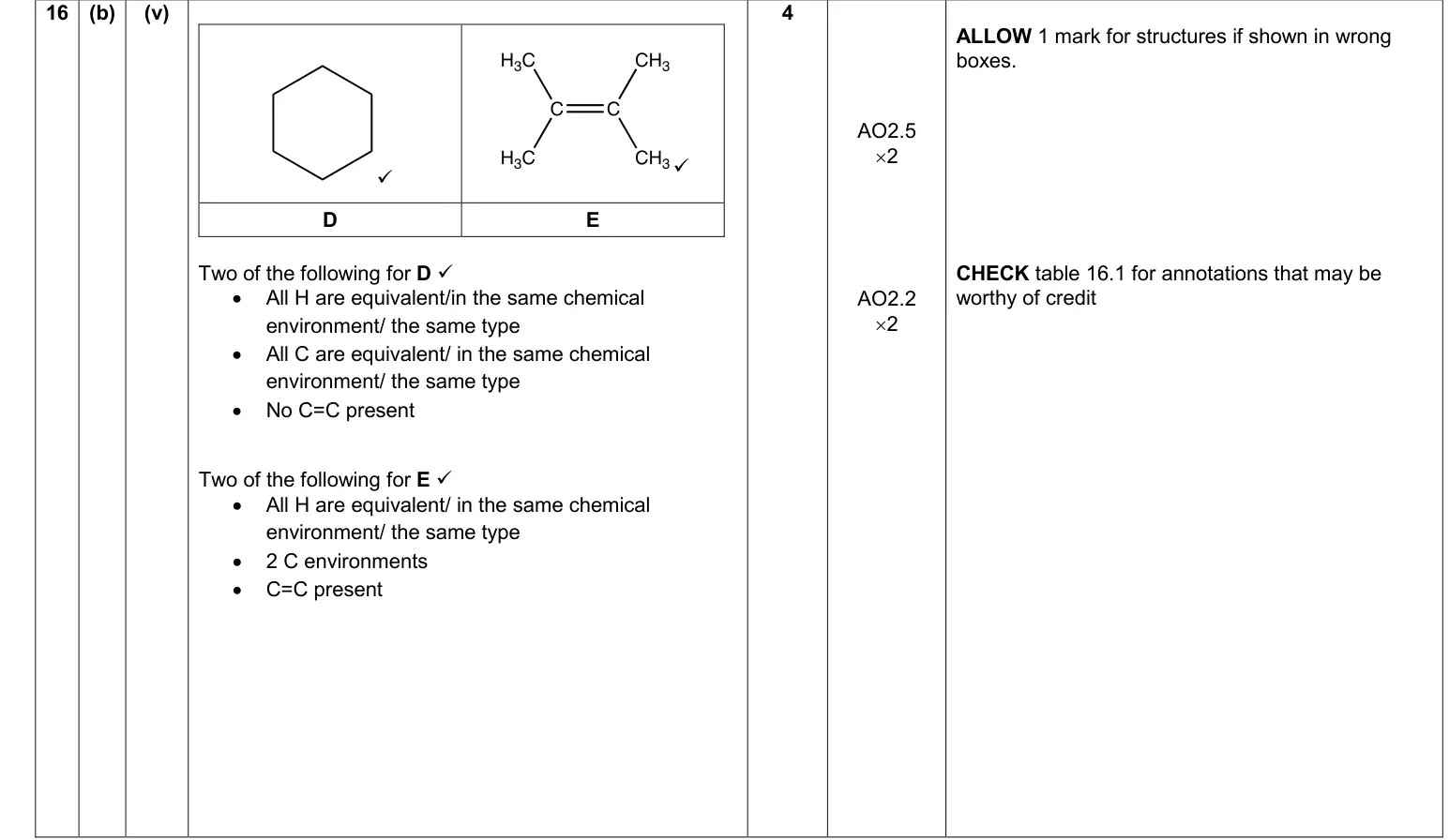
Most candidates were able to correctly draw the structure of D and E. Many candidates did not explain their answers in terms of the number of different hydrogen and carbon environments or the presence/ absence of a carbon-carbon double bond.
Skills: M4.3 Understand the symmetry of 2-D and 3-D shapes
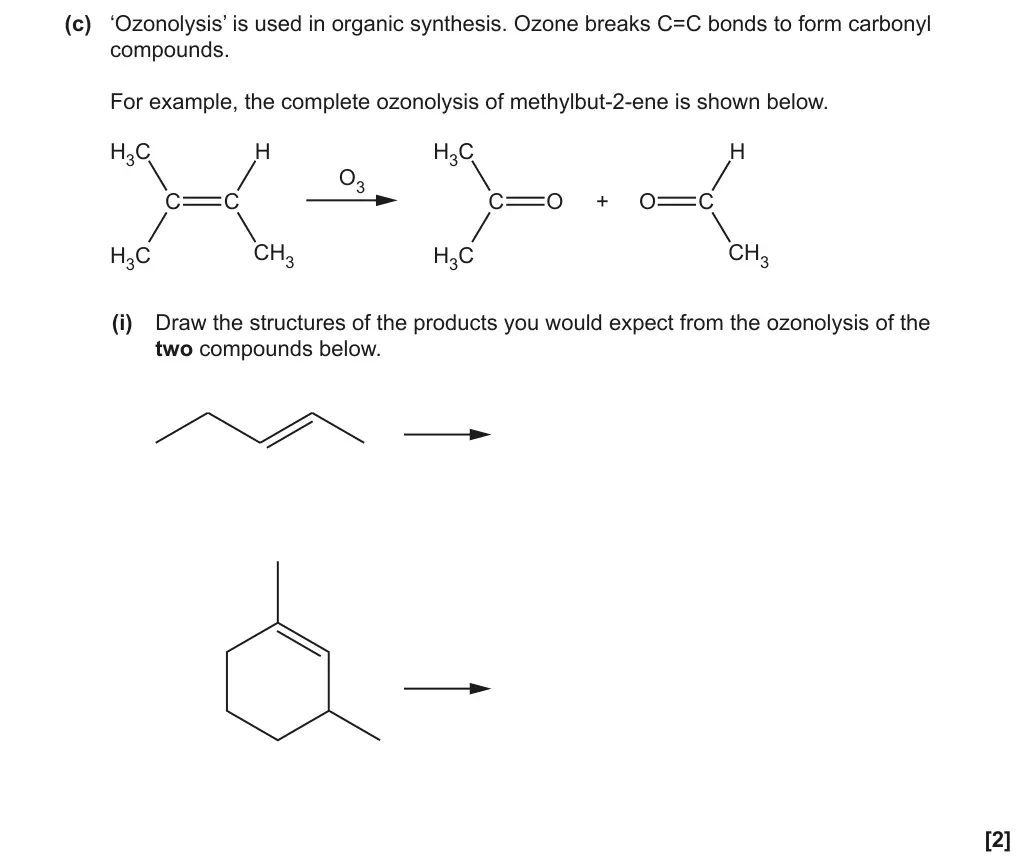
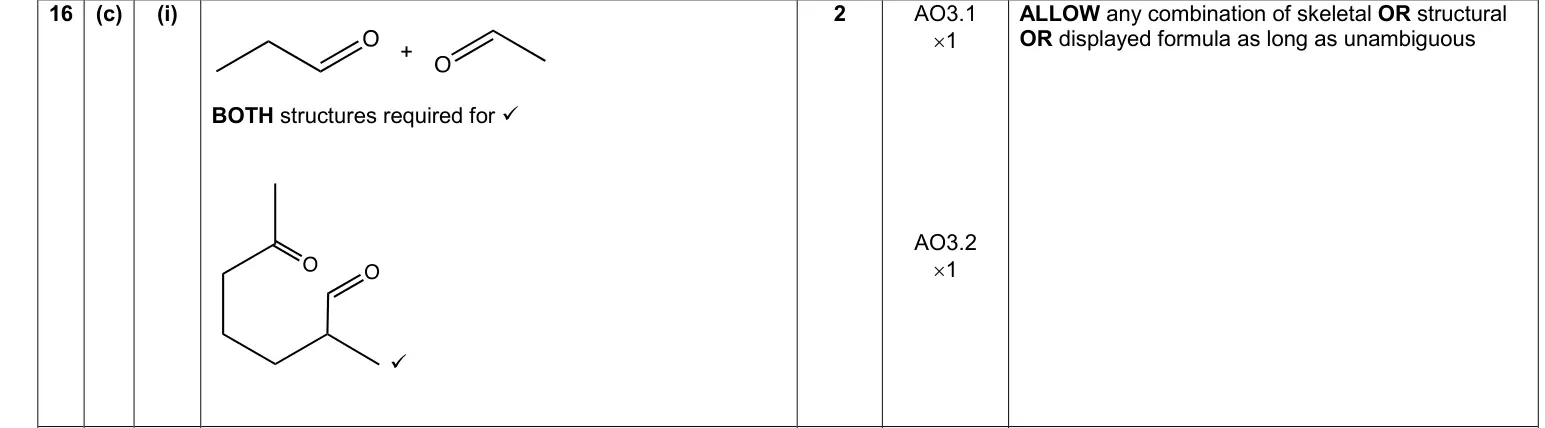
Most candidates were able to score 1 mark for correctly drawing the structures of the two aldehyde products of the first reaction. The second reaction proved more challenging, with most candidates incorrectly drawing two products.
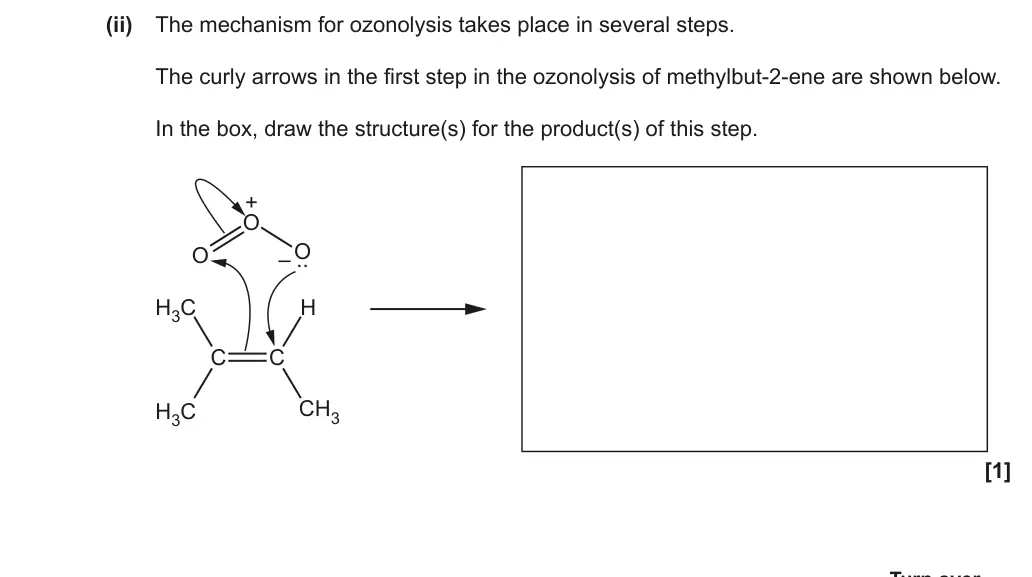
Few candidates were given this mark. A common error was to produce multiple products (rather than a ring structure) or to put positive/negative charges on the oxygen atoms within the ring structure.
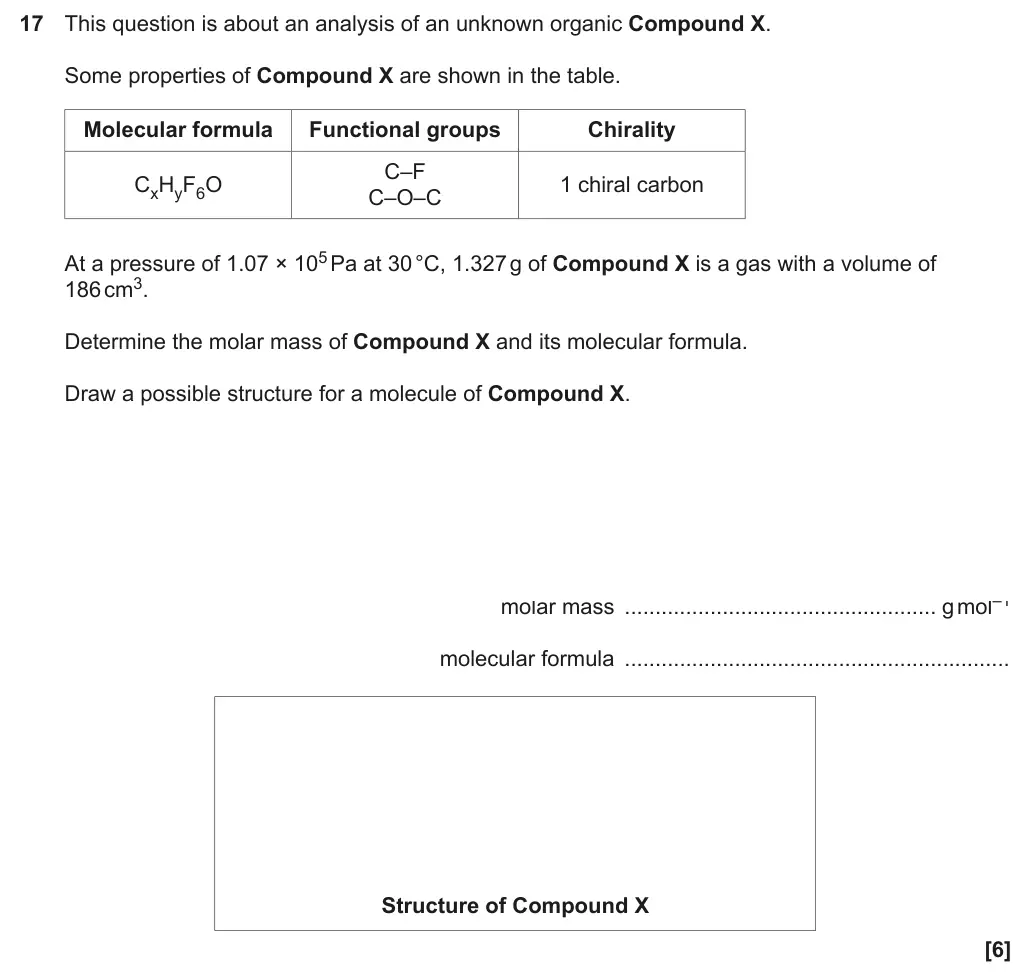
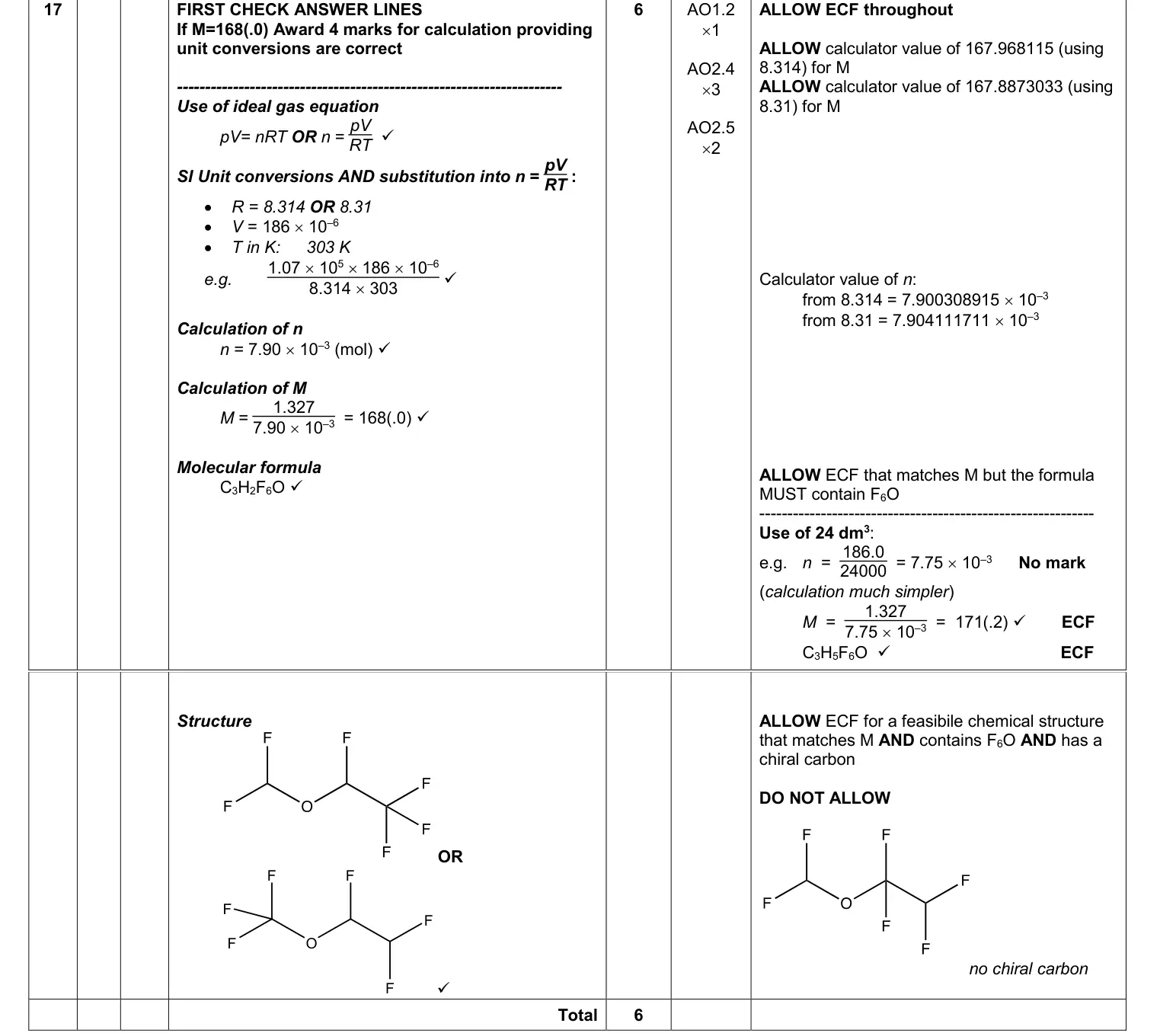
This question proved difficult and discriminated well. Higher ability candidates correctly used SI units and showed each step of their calculation and then using this to correctly identify a structure of compound X. Candidates frequently used the wrong interconversions and gave structures that lacked a chiral centre. A small number of candidates used molar gas volume rather than PV=nRT for their calculation.
Skills: M0.0 Recognise and make use of appropriate units in calculations; M2.2 Change the subject of an equation; M2.3 Substitute numerical values into algebraic equations using appropriate units for physical quantities
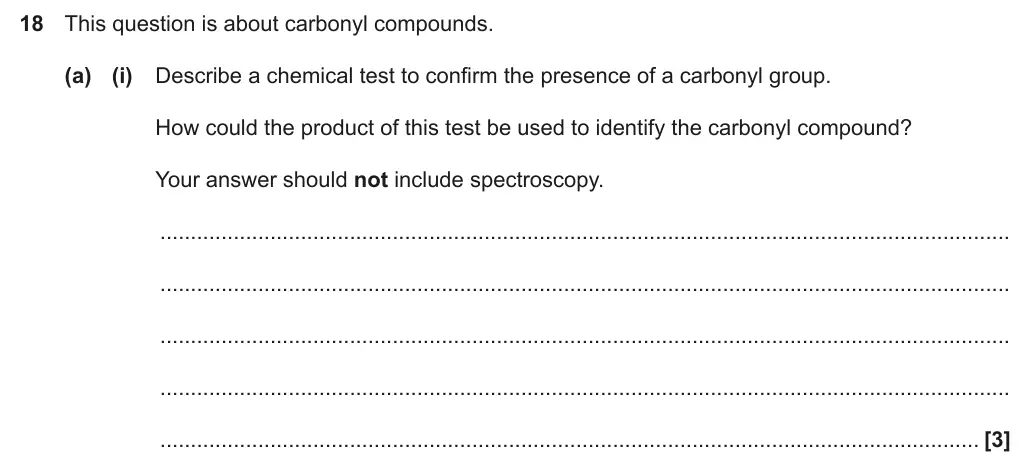
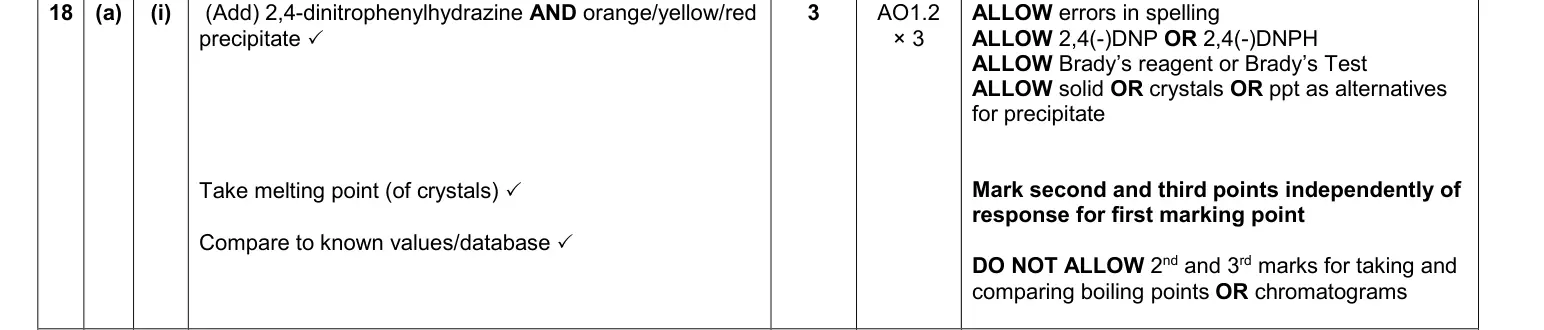
The use of 2,4-dinitrophenylhydrazine as a test for the carbonyl group is well known by candidates at this level. The majority of the cohort correctly identified this test and the subsequent analysis of the melting point of the products as a method of identifying each compound. Lower ability candidate responses made reference to analysis of the boiling points or omitted the reference to analysis of the melting points.
Skills: PAG6 Synthesis of an organic solid; PAG7 Qualitative analysis of organic functional groups
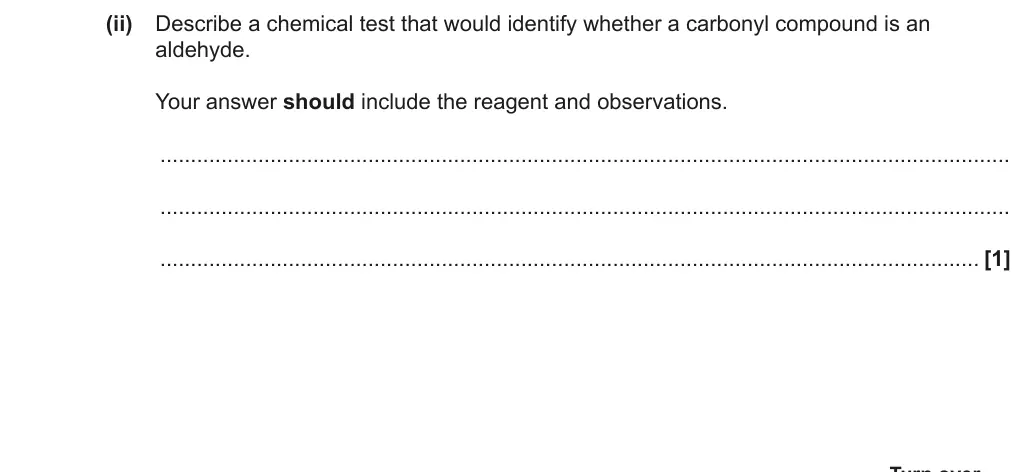
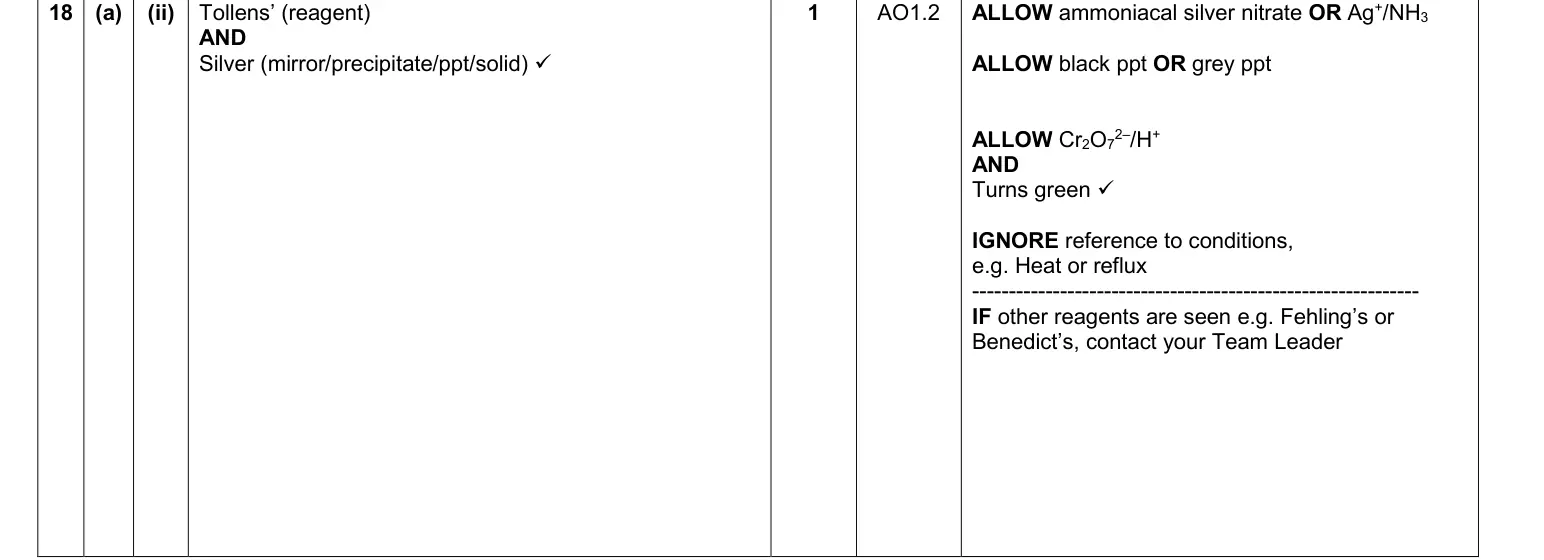
Almost all candidates were able to correctly describe the use of Tollens’ reagent as a test for an aldehyde fictional group
Skills: PAG7 Qualitative analysis of organic functional groups
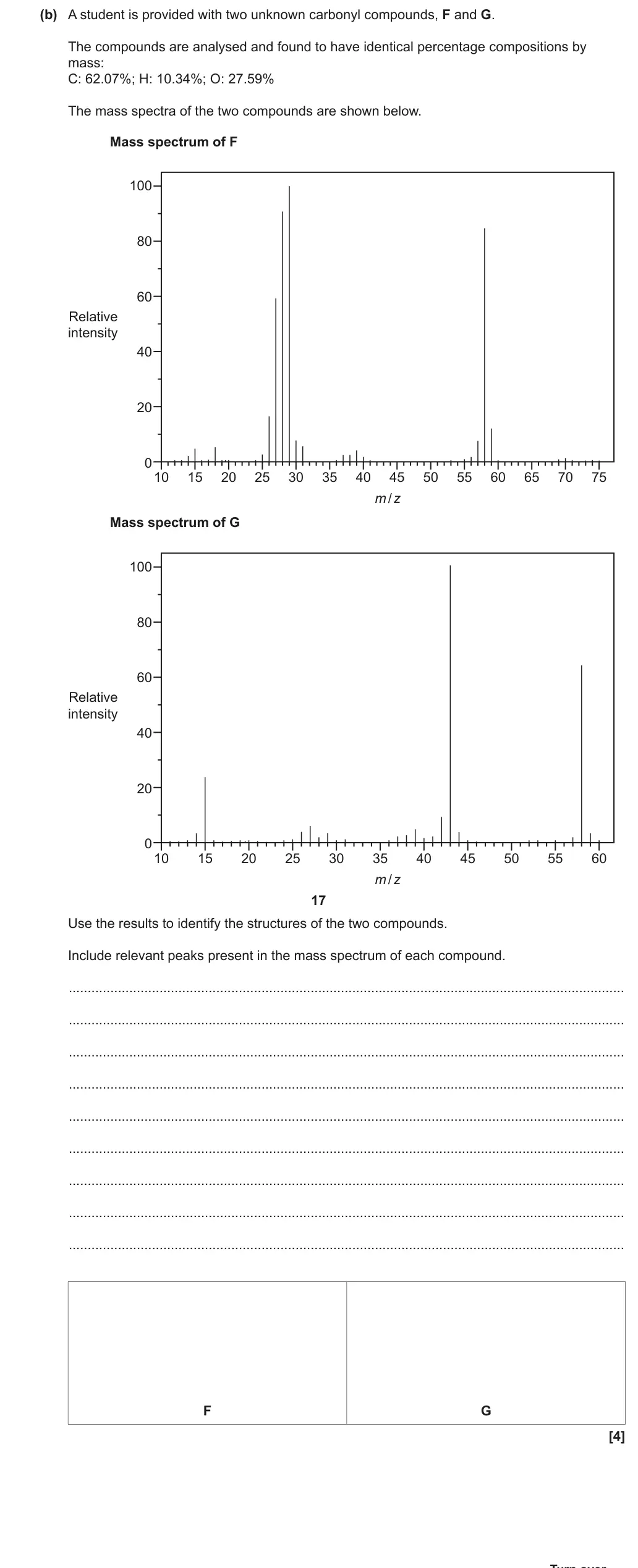
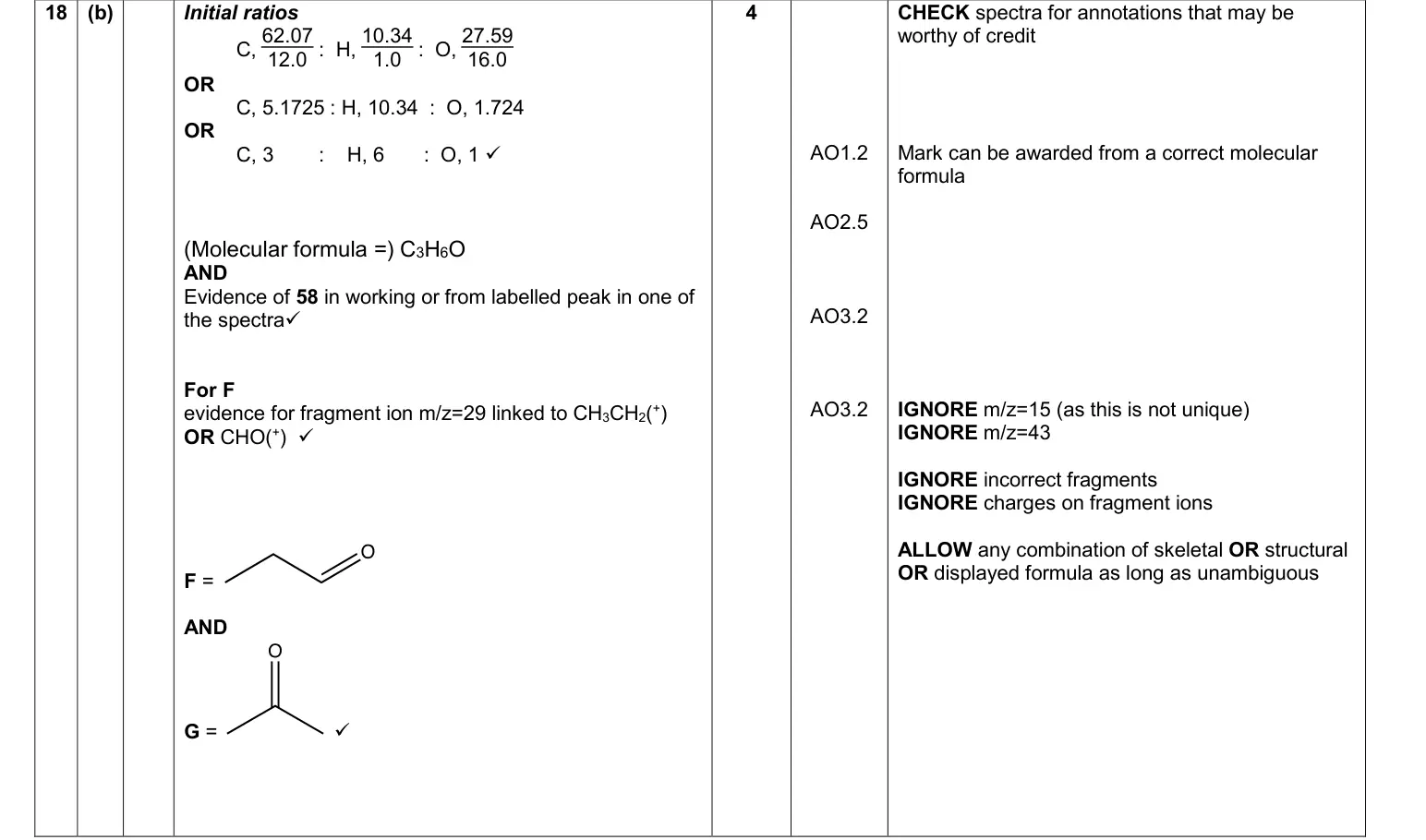
Most candidates were able to calculate the initial ratios and then use this to calculate the molecular formula, linking to the m/z peak at 58. The most common error seen was for the structures of F and G to the in the incorrect boxes, suggesting that candidates have not interpreted the fragment ions to work out F was the aldehyde.
Skills: M0.2 Use ratios, fractions and percentages; M3.1 Translate information between graphical, numerical and algebraic forms
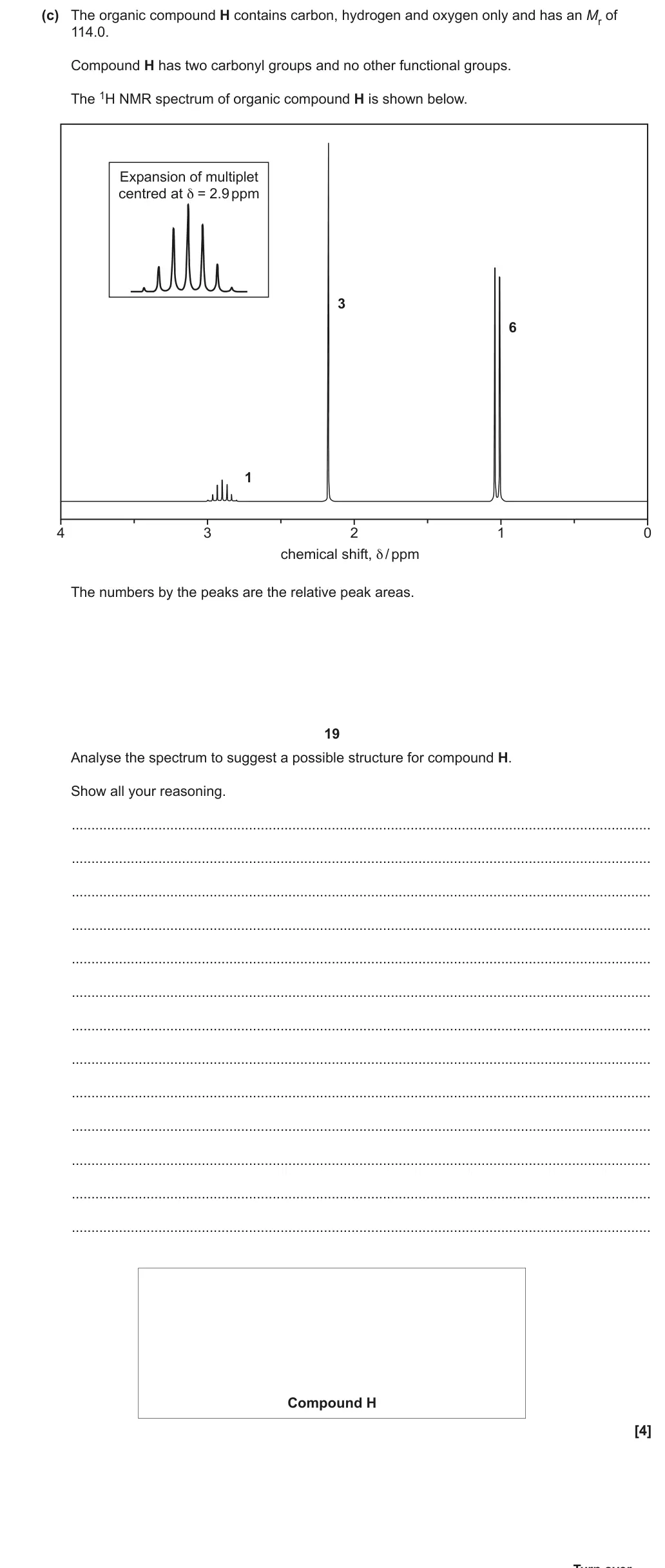
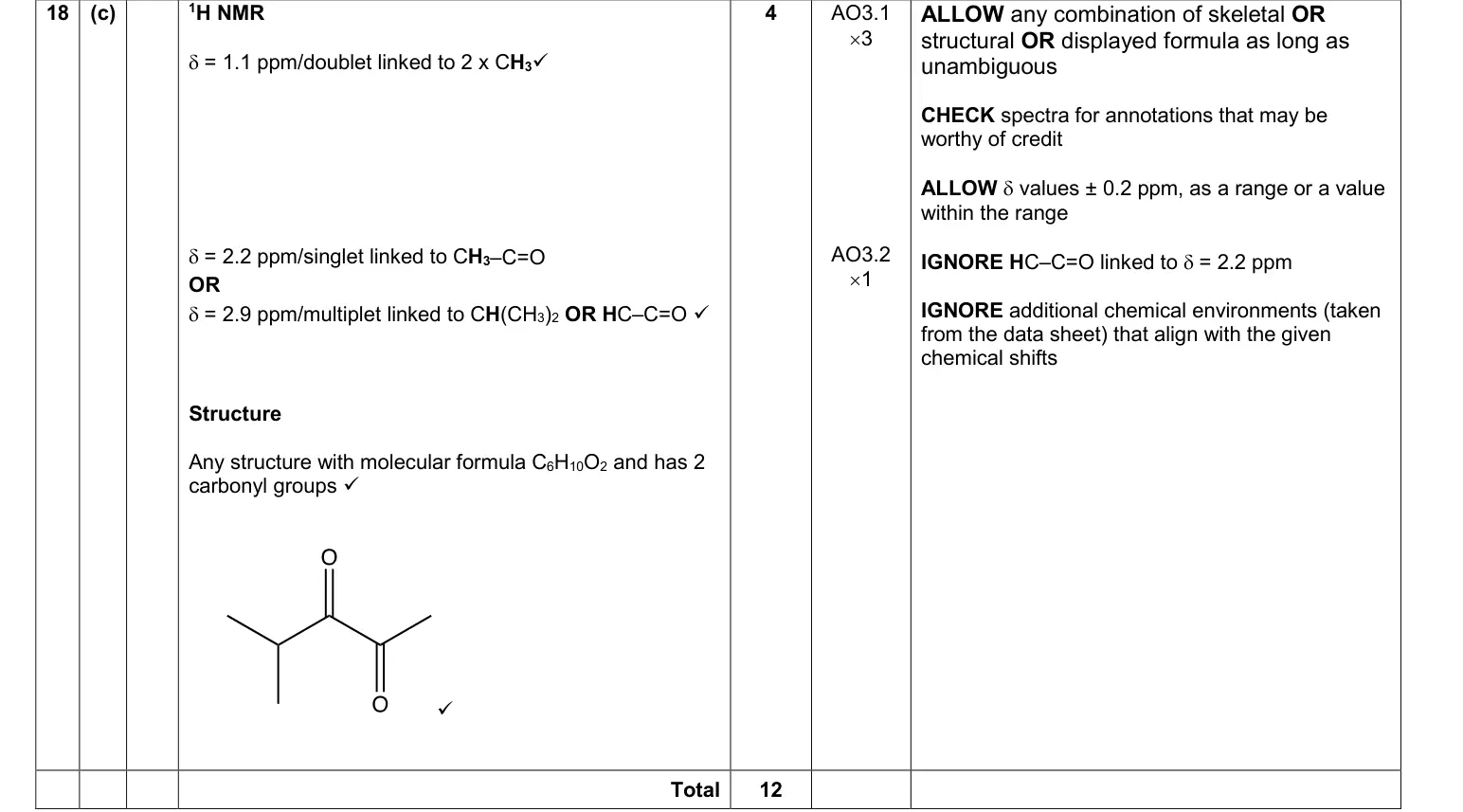
This question proved difficult and although most candidates score some marks, only the very best responses secured all 4 marks. Candidates often did not link the doublet to two CH3 groups and many only scored 1 mark for their suggested structure as the carbonyl groups were not side by side within the molecule.
Skills: M3.1 Translate information between graphical, numerical and algebraic forms
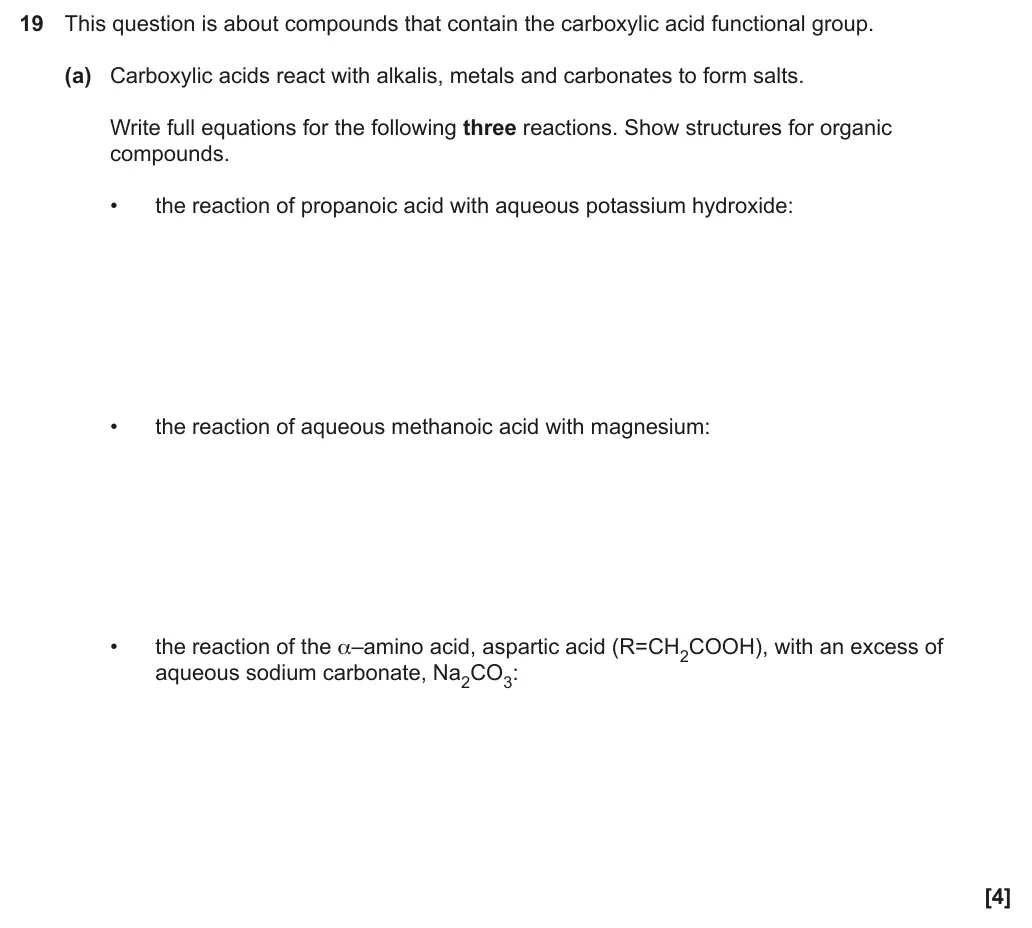
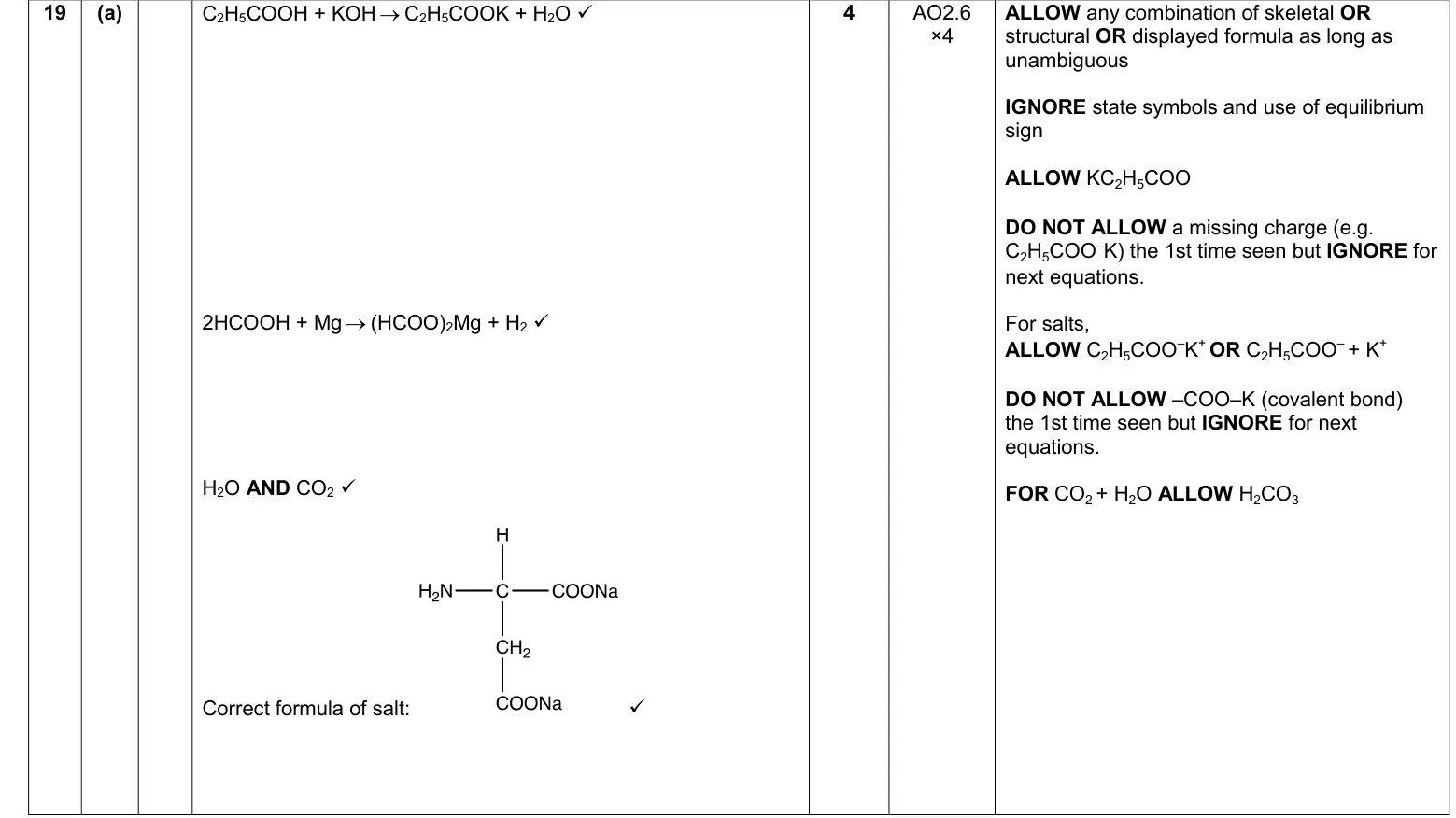
This question proved challenging for candidates. The first equation was often answered correctly, although some candidates used sodium hydroxide rather than potassium hydroxide in their response. The second equation was frequently incorrect. Candidates frequently missed a hydrogen from the structure for methanolic acid or did not recognise that hydrogen was a product. Many candidates did not account for magnesium having a 2+ charge when working out the product. For the third equation, the majority of candidates identified that carbon dioxide and water would be produced but were unable to give the correct formula of the salt as they did not interpret the information given regarding the R group.
Skills: M0.2 Use ratios, fractions and percentages
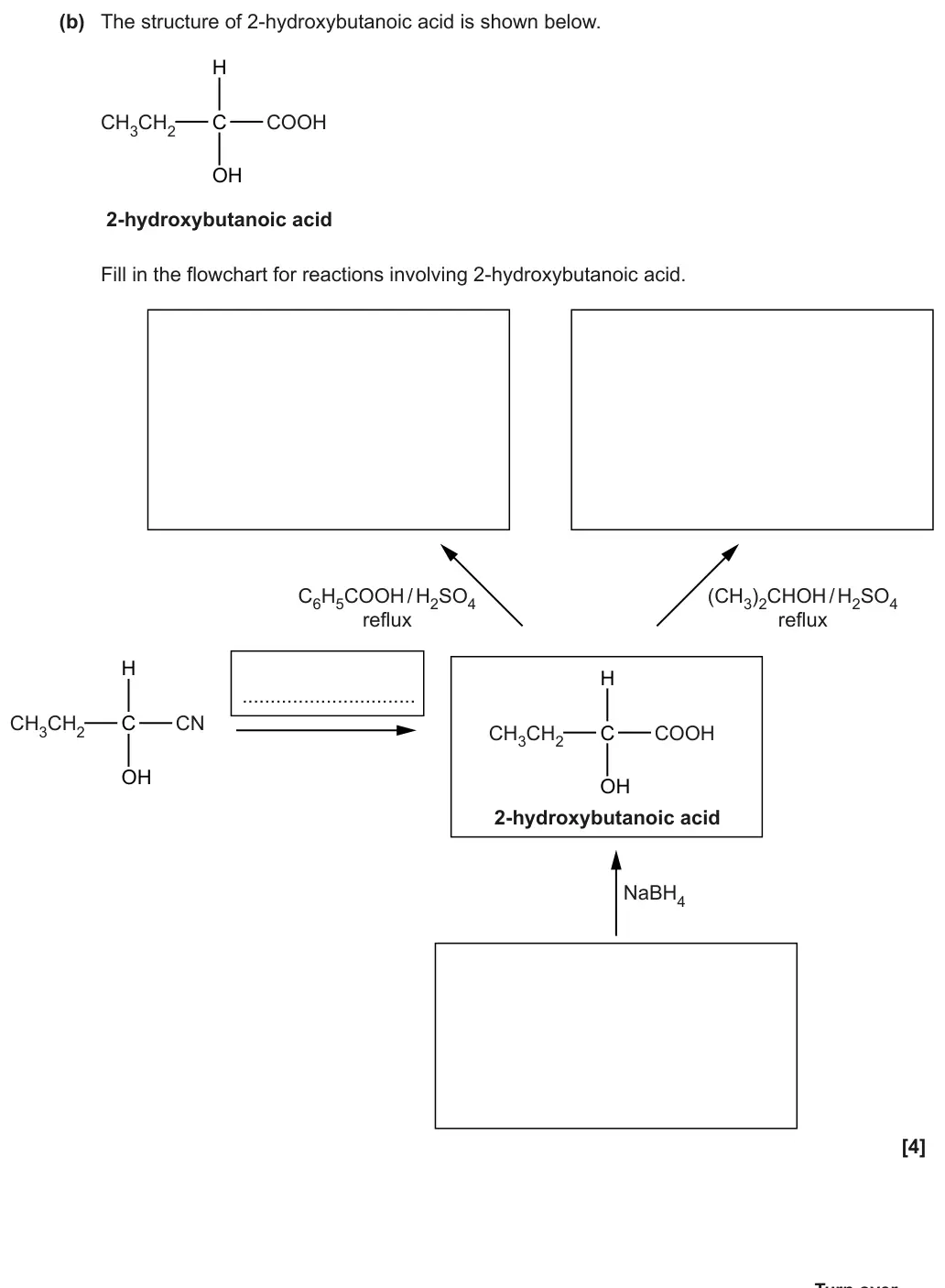
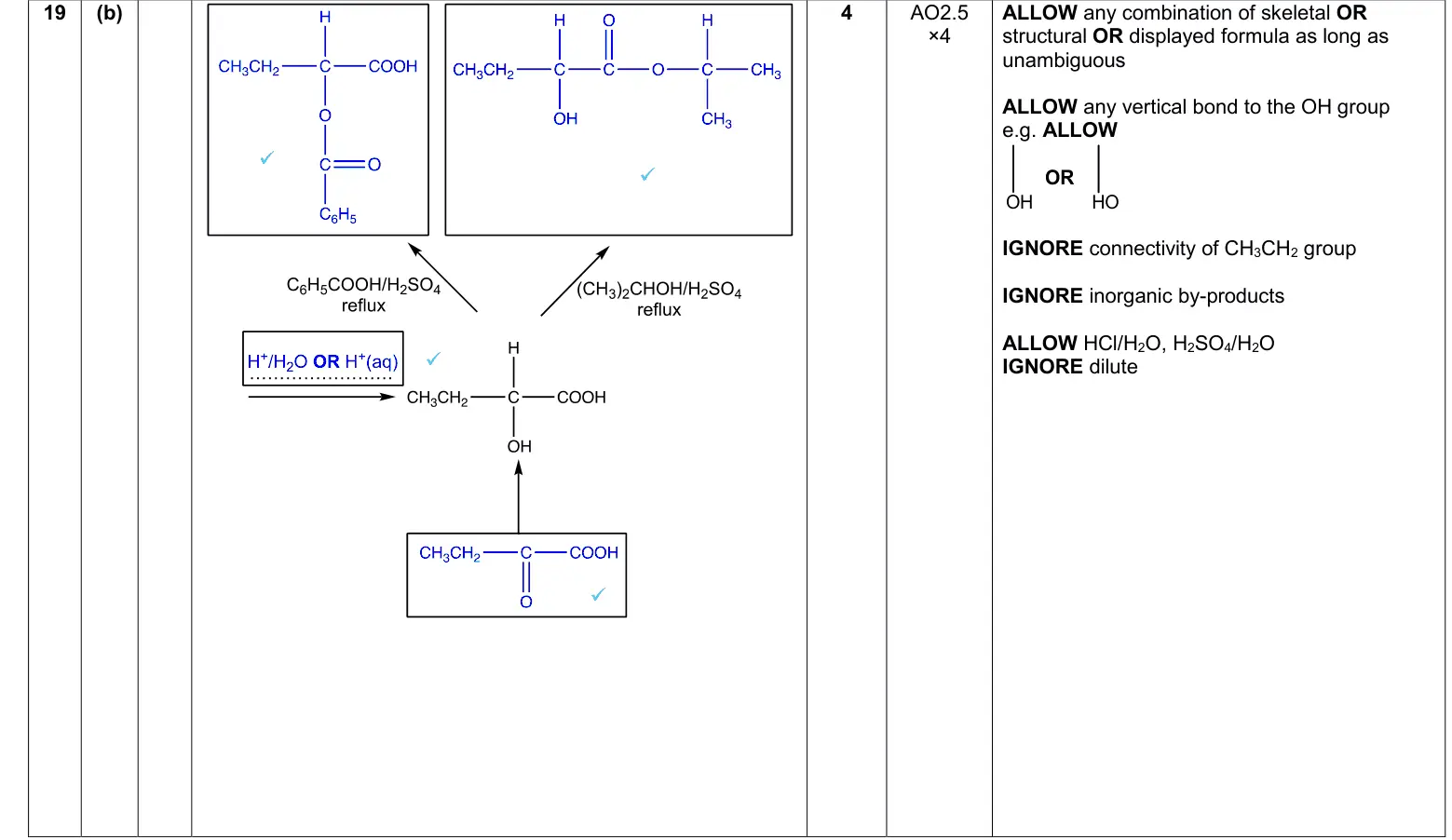
The majority of candidates were able to identify at least one of the structures. A significant number of candidates did not check the number of bonds of each atom in their structures and frequently had too many or too few hydrogen atoms attached. Most candidates identified that acidic conditions were required but some missed the aqueous condition that was also required for the mark.
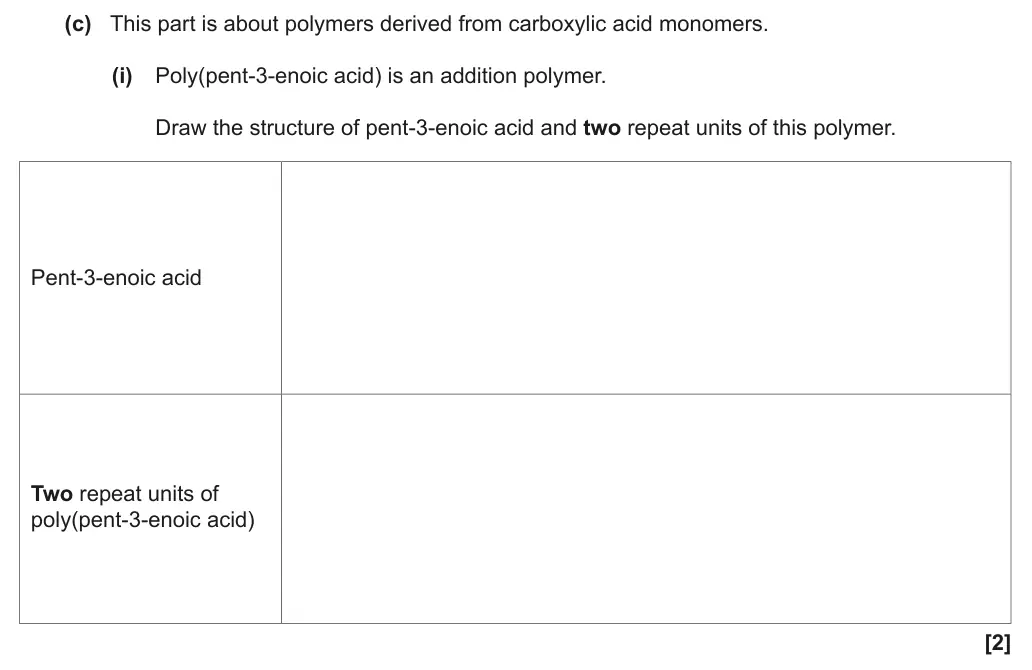
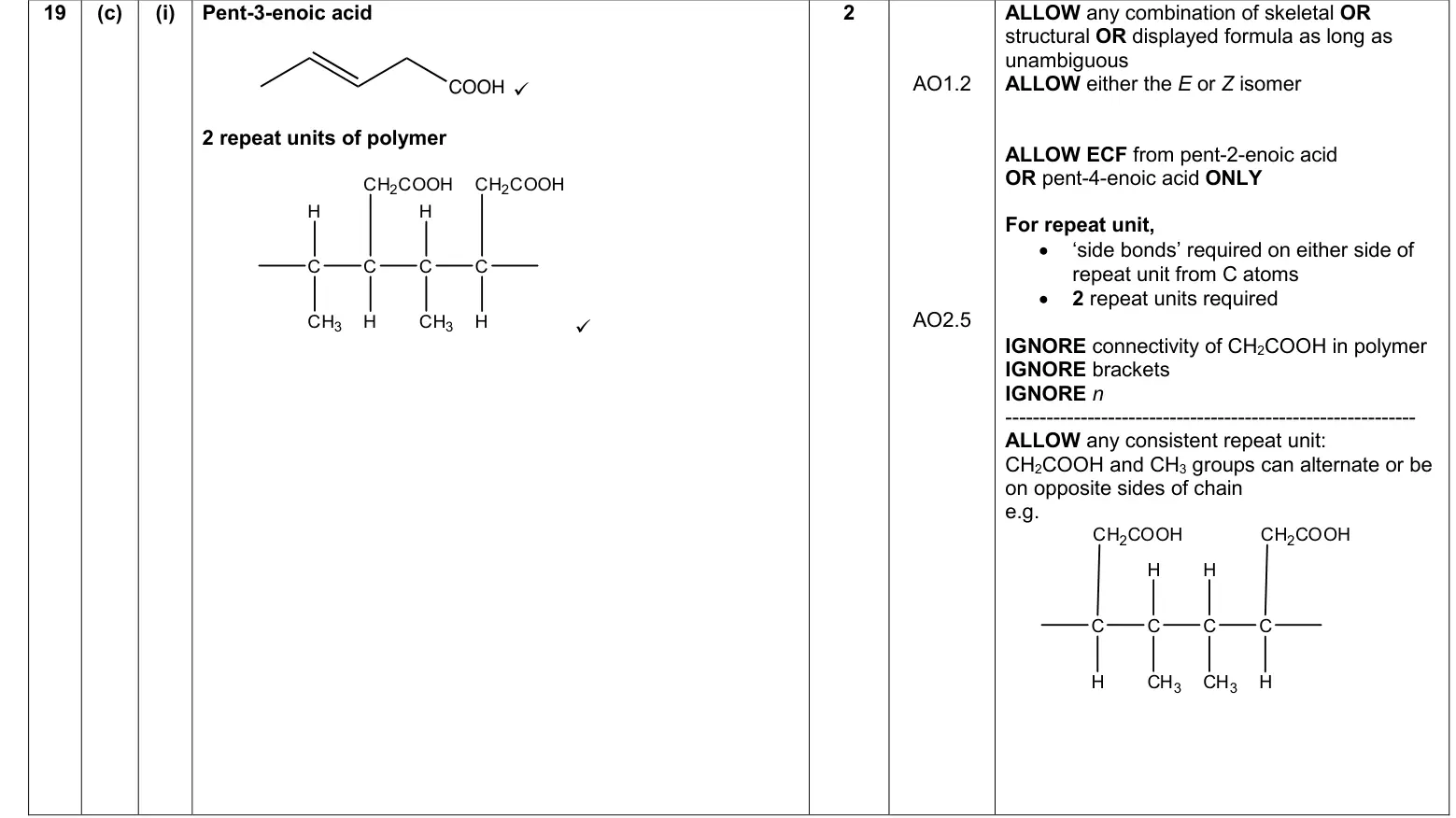
Most candidates were given at least 1 mark with many correctly drawing the structure of pent-3-enoic acid. Common errors included drawing pent-2-enoic acid or propenoic acid, suggesting a lack of knowledge of prefixes. The second mark required candidates to draw two repeat units, frequently candidates tried to draw repeat units linking the carboxylic acid groups rather than identifying that it is the carbon-carbon double bond that breaks.
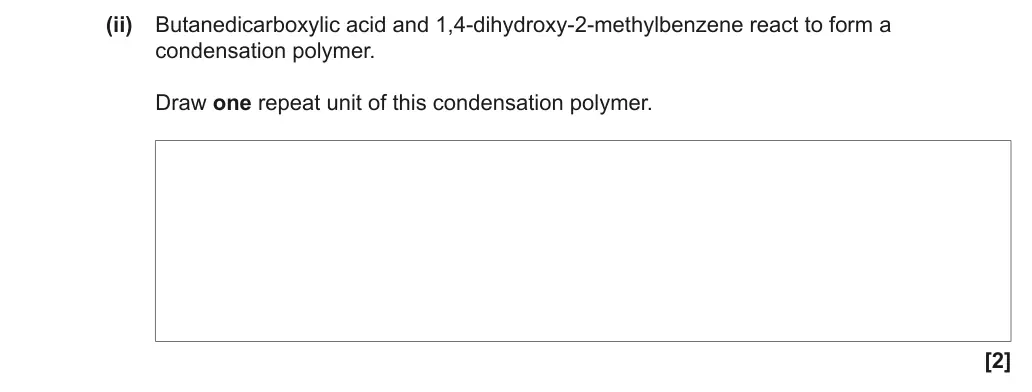
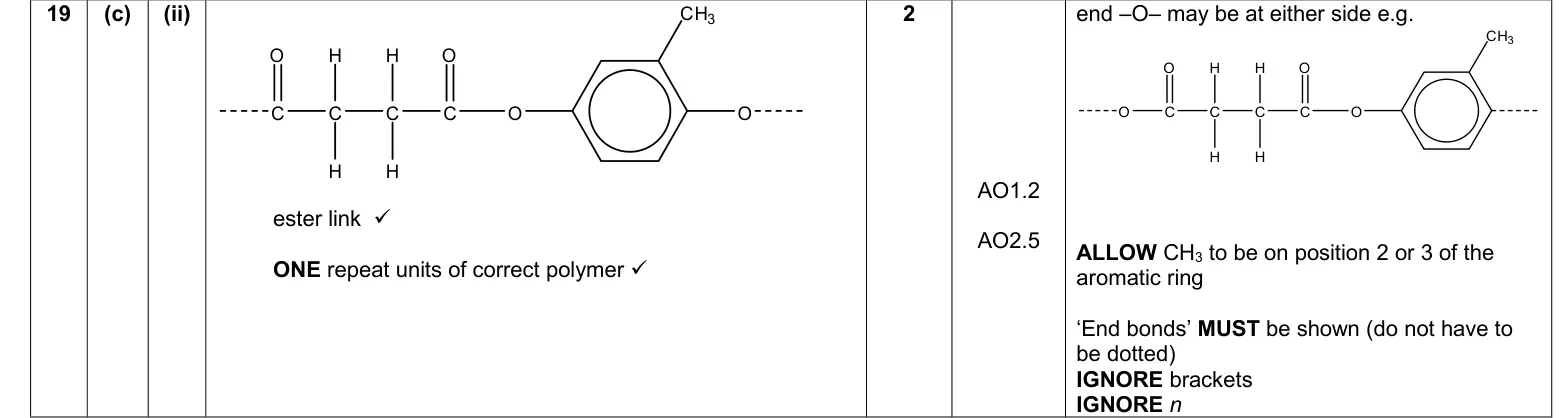
This question differentiated well. Candidates who scored 1 mark had often shown an ester link but their structure was missing hydrogen atoms from the carbon chain (as shown in exemplar 1) or the methyl group was missing from the ring. This type of response was seen frequently by examiners. The candidate has correctly drawn the ester link but has omitted the hydrogen atoms from the carbon chain.
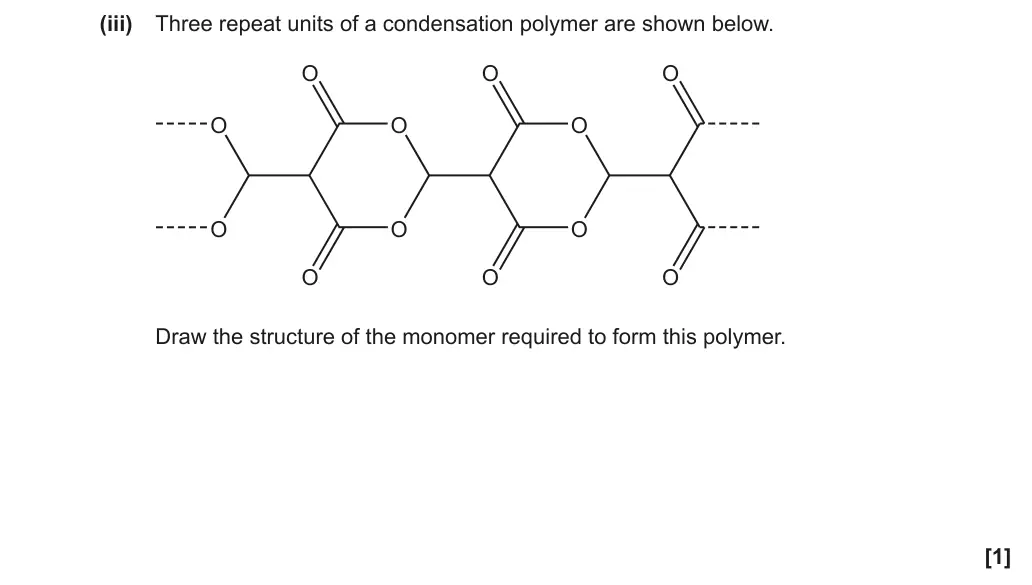
This question proved difficult for candidates with the majority of candidates not scoring the mark. A significant proportion of candidate had identified the monomer but drew structures that combined skeletal and displayed formulae. This resulted in ambiguous structures being given that had missing hydrogen atoms on the carbons. Drawing of organic structures Candidates need practice at drawing structures that are not ambiguous. They should check the number of bonds on each atom and make sure the appropriate number of hydrogen atoms are drawn.
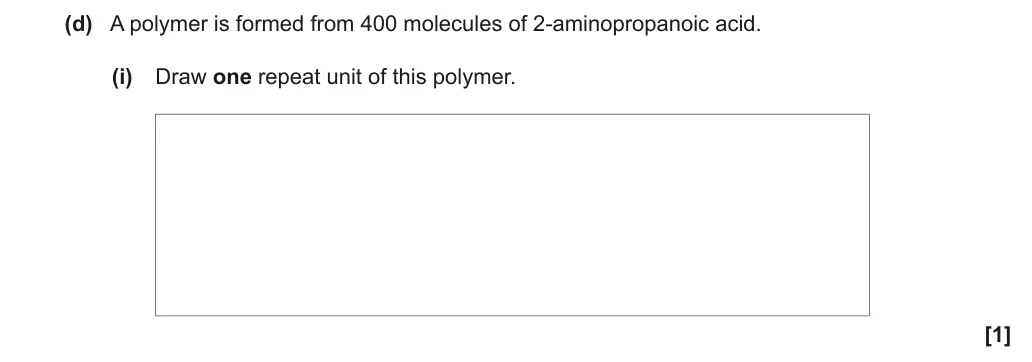
Few candidates were given the mark for this question. Frequently candidates drew structures with two repeat units or the did not remove the oxygen atom from the OH group.
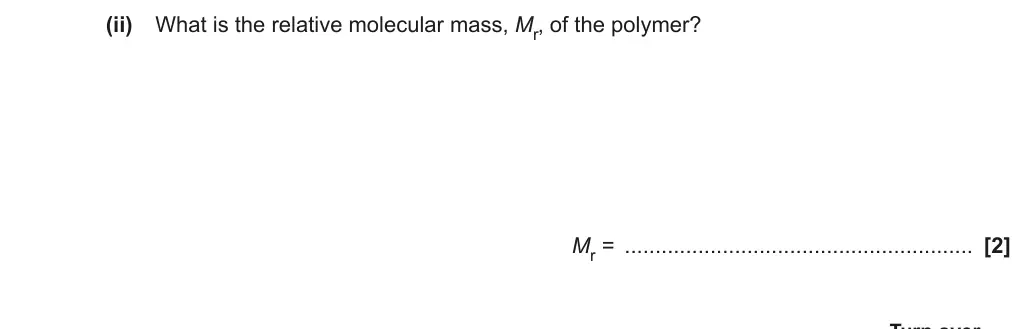
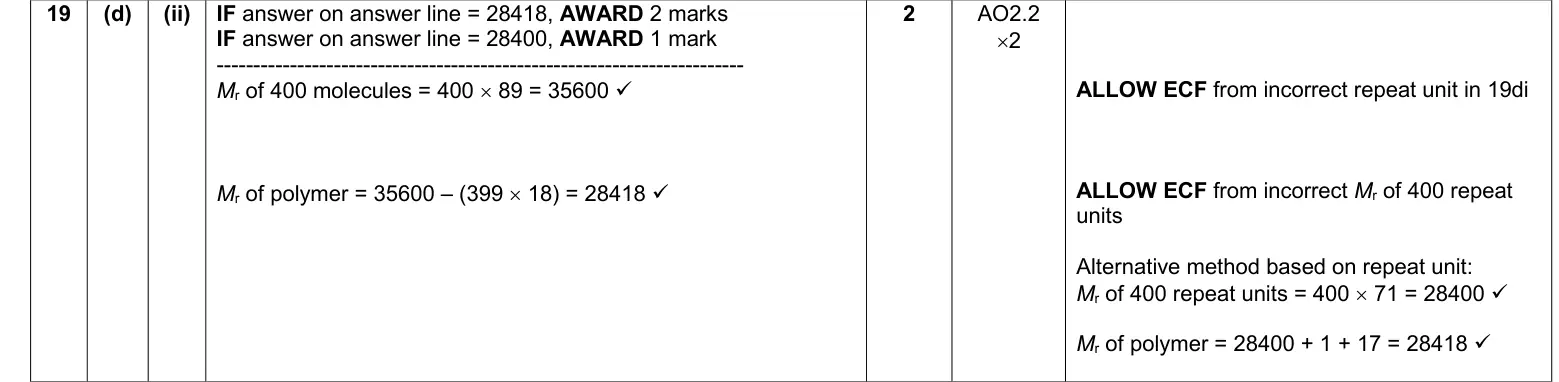
A variety of responses were seen in this demanding question. In general candidates adopted one of two approaches. The most common was to multiply the Mr of the repeat unit by 200 and then add the mass of H and OH at each end of the polymer. The other approach used the Mr of the monomer by 200 and then subtract the mass of the 199 water molecules removed in the polymerisation. Many candidates were successful with the first step of their approach, but the best responses included the second step taking into account the Mr of water. A significant number of candidates used an incorrect value for the Mr.
Skills: M0.2 Use ratios, fractions and percentages
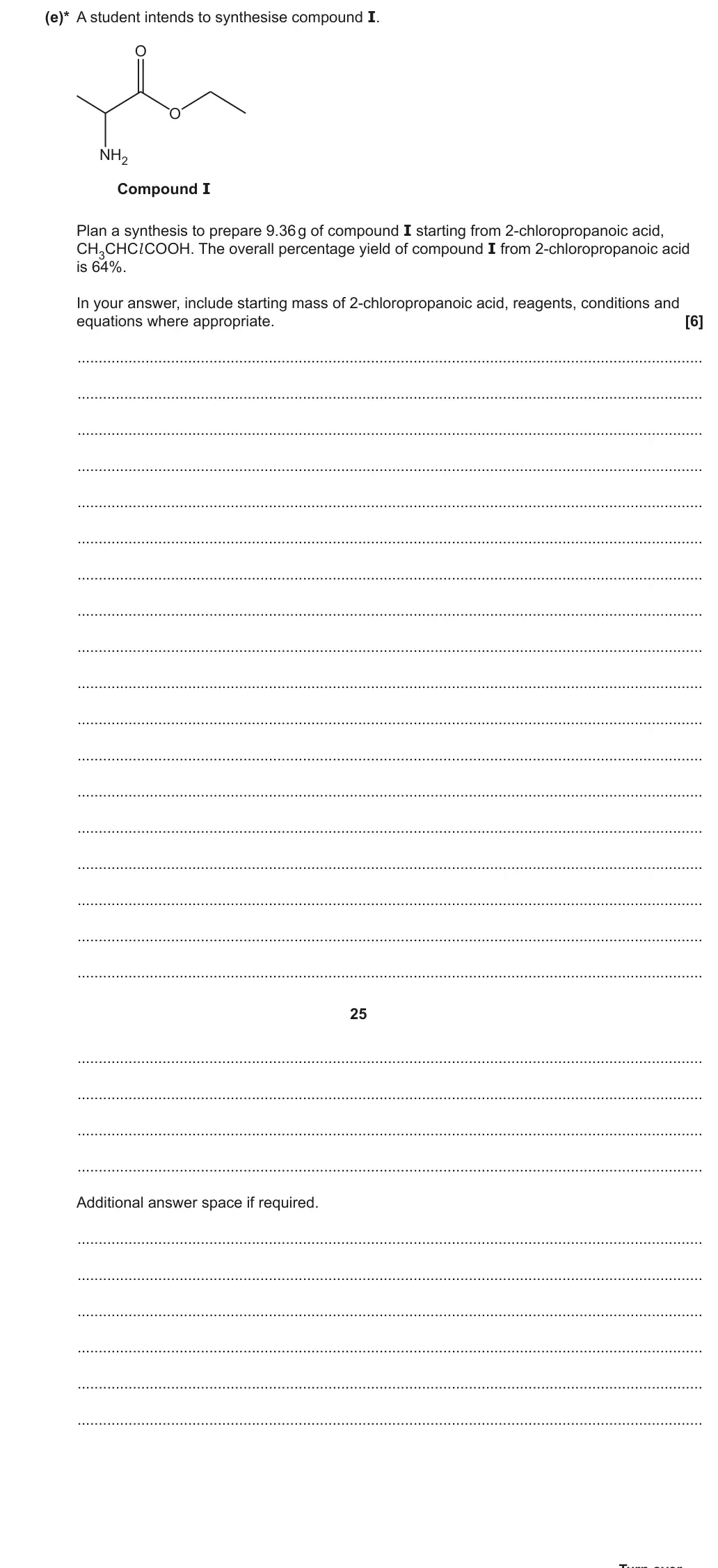
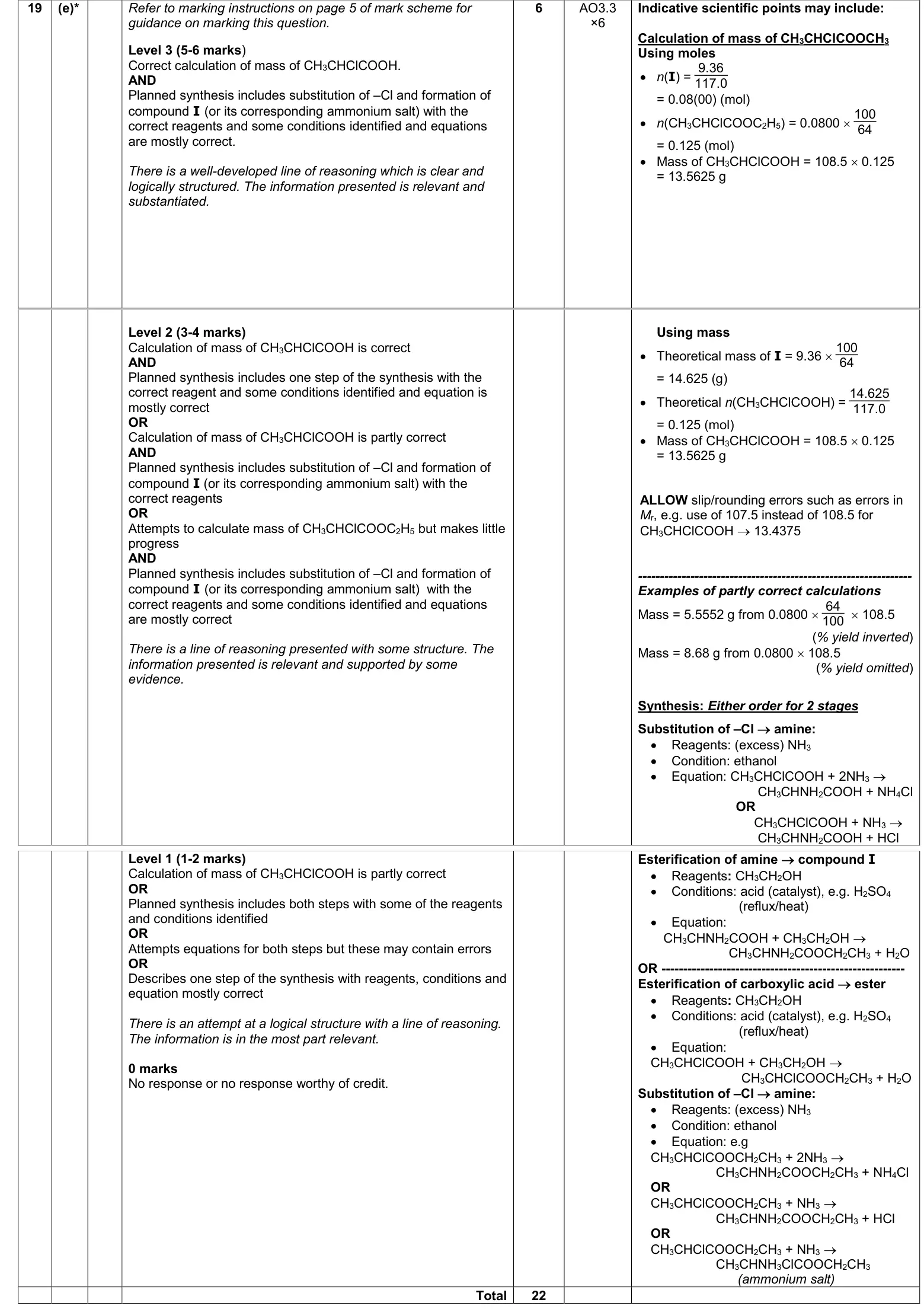
This question was marked using a level of response mark scheme. Most candidates gave an answer worth of at least Level 2 (3-4 marks) by providing the synthetic steps with reagents and equations for the synthesis of compound I. Exemplar 2, below, shows a frequent Level 2 response. The best performing candidates correctly determined the mass attempting to calculate the mass and showed the synthesis efficiently, using equations to communicate the preparation of compound I, with these responses being given Level 3 (5-6 marks). A number of responses omitted the mass calculation, such responses received Level 2 (1-2 marks). In this response the candidate has attempted to calculate the starting mass but has made little progress. Two stages of the synthesis have been covered with the reagents and most of the conditions identified. Both equations are complete. This is a Level 2 response and 4 marks have been given as the repones is logical and well communicated
Skills: M0.2 Use ratios, fractions and percentages; M2.2 Change the subject of an equation
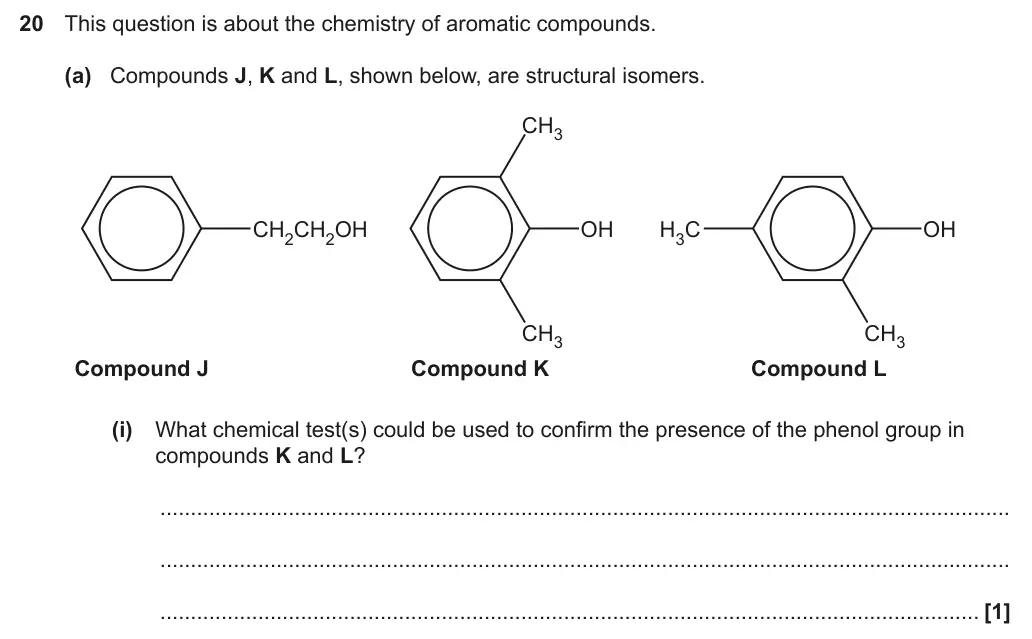
Few candidates knew the test for a phenol group. Frequent incorrect responses involved the production of a gas with a carbonate or stating that bromine water is decolourised but failing to state that a white precipitate is also formed. A significant number of candidates also stated that the reaction with sodium hydroxide confirms the presence of the phenol group.
Skills: PAG7 Qualitative analysis of organic functional groups
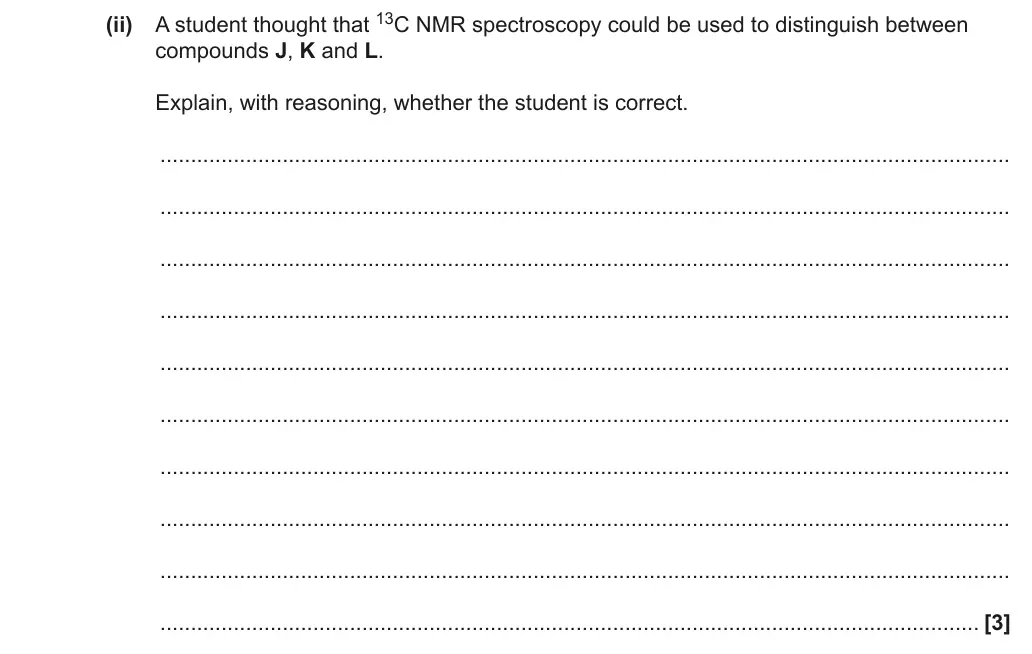
This question proved challenging to candidates with few scoring all 3 marks. Where no marks were given, this was frequently because candidates did not state the number of carbon environments in compounds J, K and L. Candidates who were given 1 or two marks frequently stated the incorrect number of peaks that would be observed.
Skills: M4.3 Understand the symmetry of 2-D and 3-D shapes
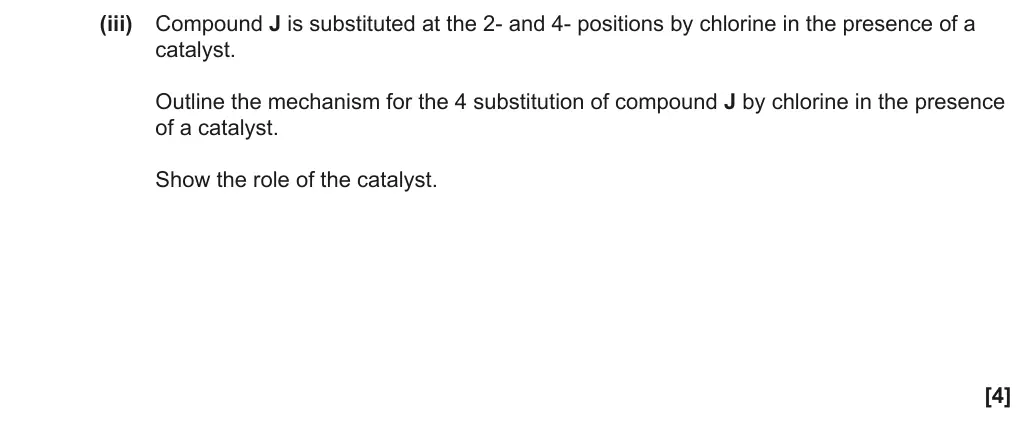
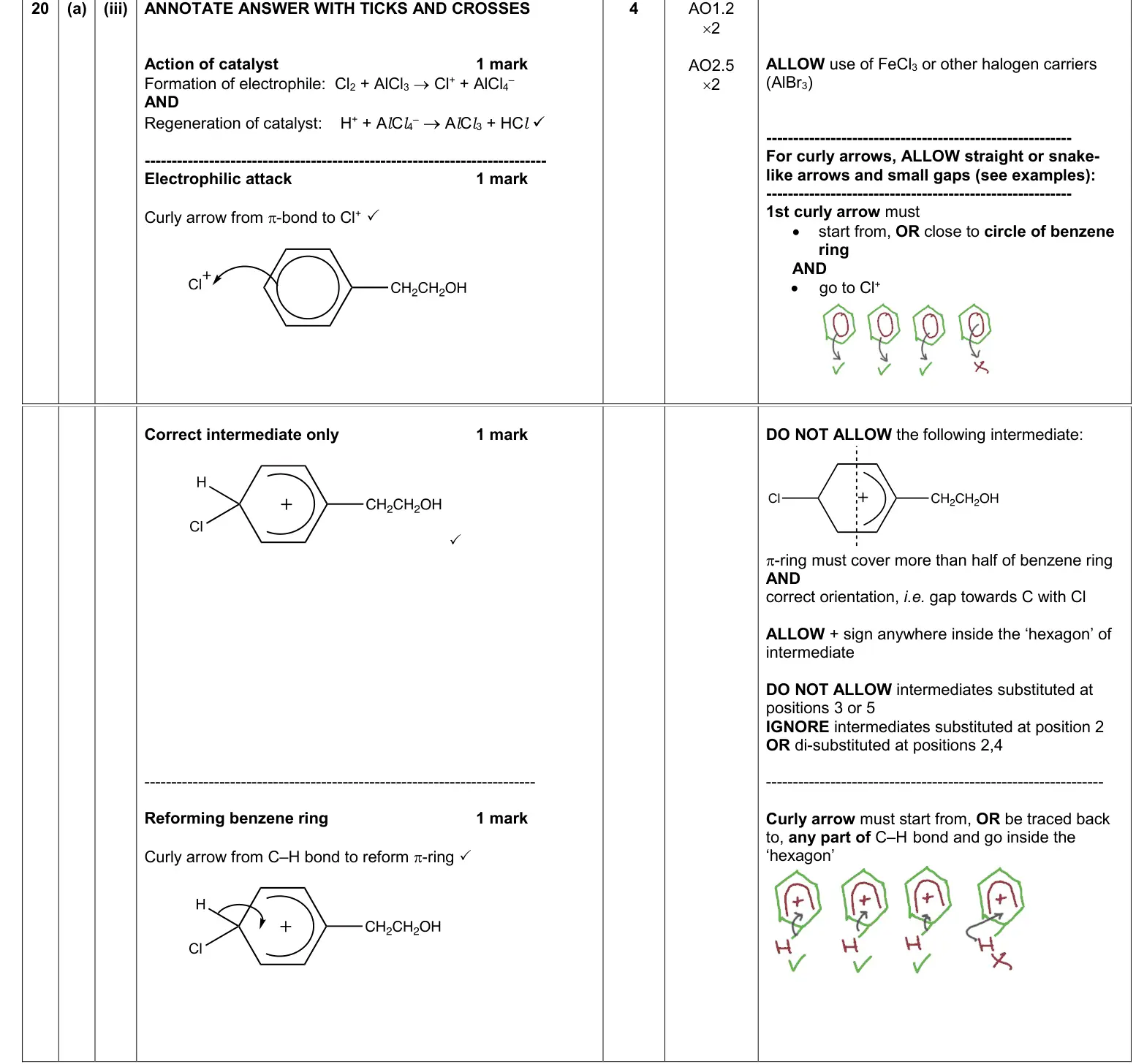
This question required candidates to apply their knowledge of the mechanism of electrophilic substitution. Examiners were encouraged by the number of excellent responses to this question, with the majority of candidates securing 3 out of 4 marks. Common errors included the omission of HCl as product from the regeneration of the catalyst or candidates attempting to substitute at the 2 position.
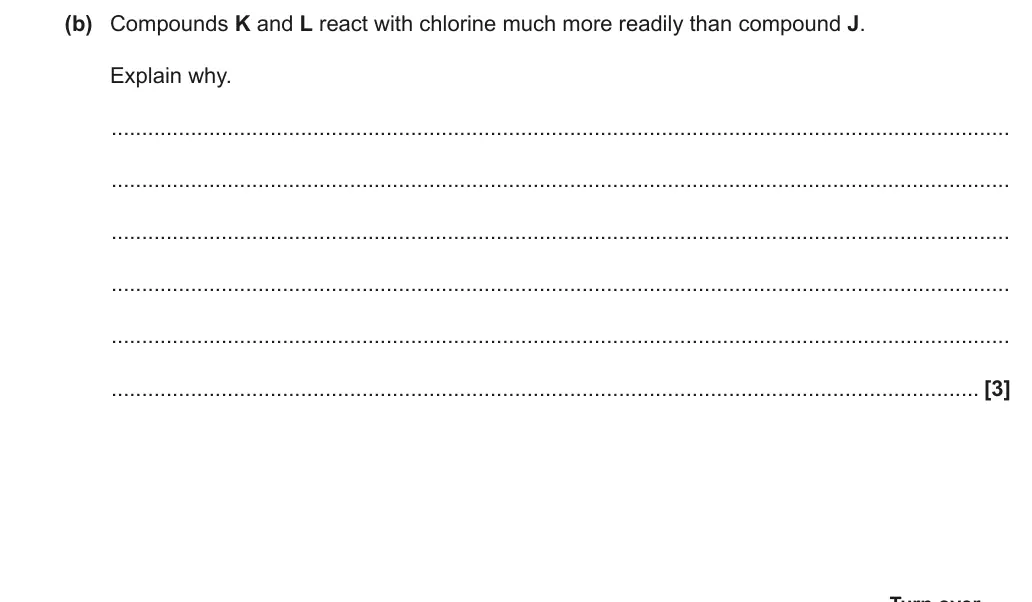
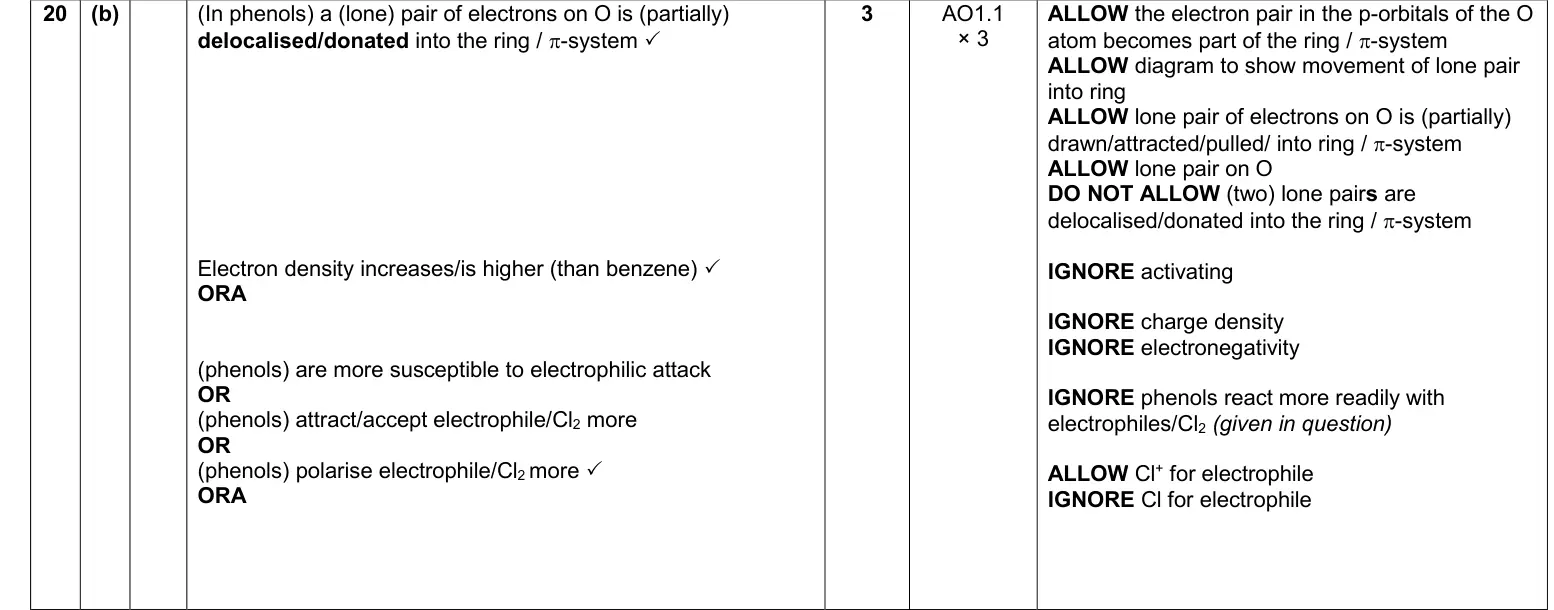
The most able candidates scored well on what proved a difficult question for many. Although the vast majority of candidates knew about the reasons behind compounds K and L’s increased reactivity many were unable to express themselves clearly to gain credit. Often answers lacked the specific detail about the lone pair on the oxygen atom in the –OH group being delocalised into the ring. Less successful answers discussed electrons being supplied to the ring, the -OH group providing the electrons to the ring or just that –OH is an activator. More successful answers expressed the increase in electron density and the subsequent increase in compound K and L’s susceptibility to electrophilic attack. This response correctly states that the electron density is higher which result in K and L being more susceptible to electrophilic attack and receives 2 marks. To score the third mark, the candidate needed to identify that that the lone pair is on the oxygen of the OH group.
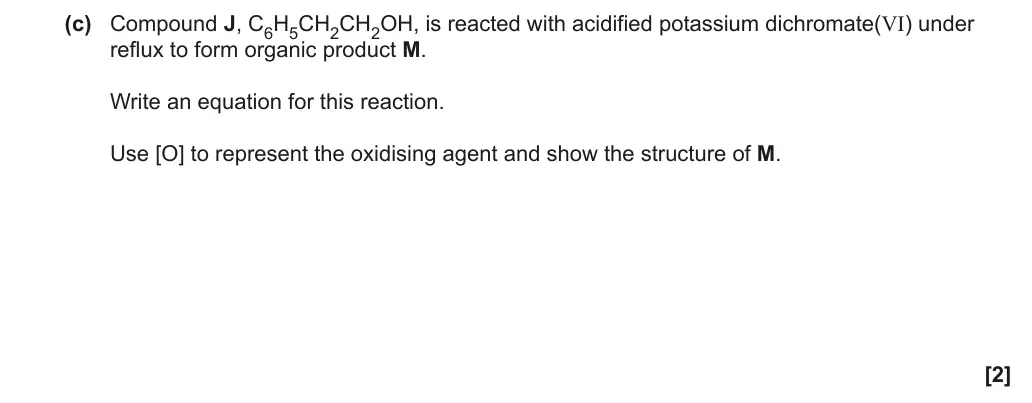
Most candidates were able to score at least 1 mark for this question. Common errors included candidates producing two water molecules or failing to balance [O]. A significant proportion of candidates did not score any marks, frequently due to the organic product having too many carbon atoms in it.
Skills: M0.2 Use ratios, fractions and percentages
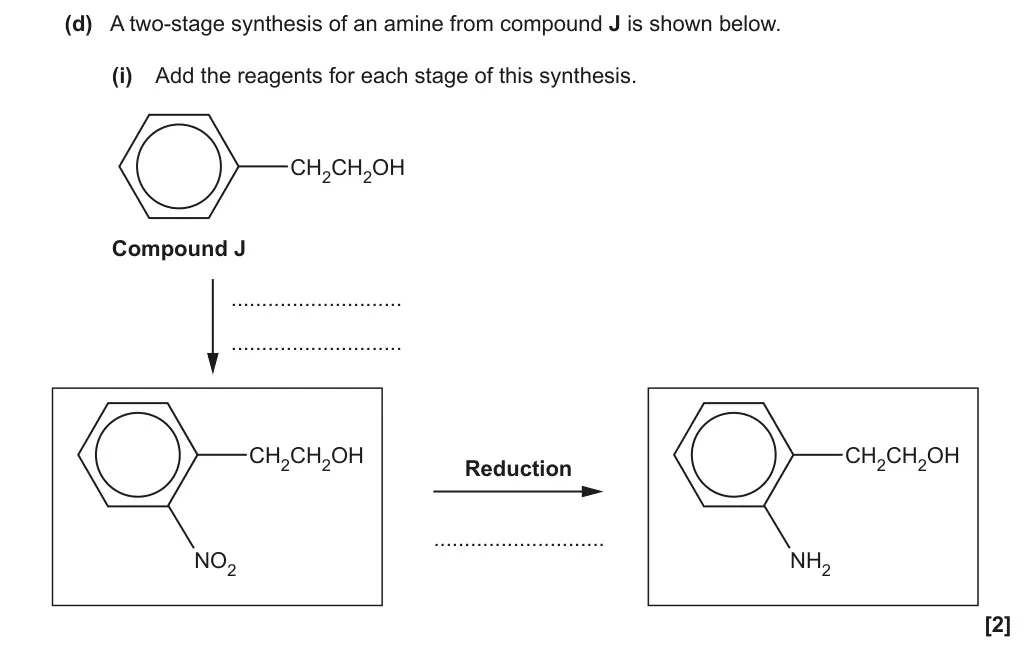
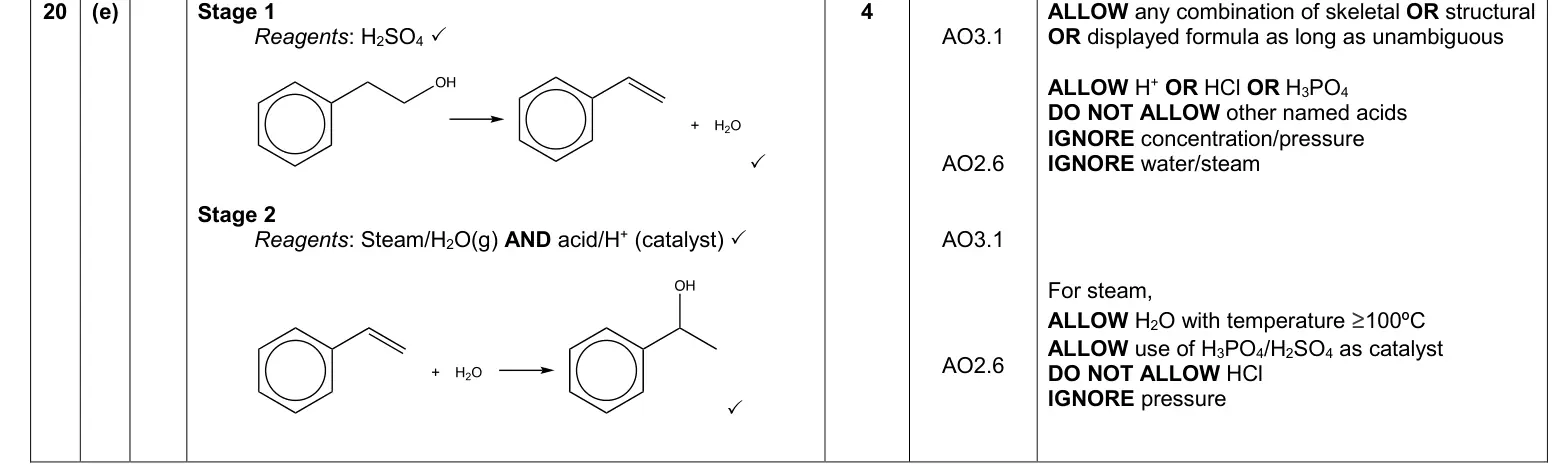
Candidates were familiar with the reagents required in these two reactions.
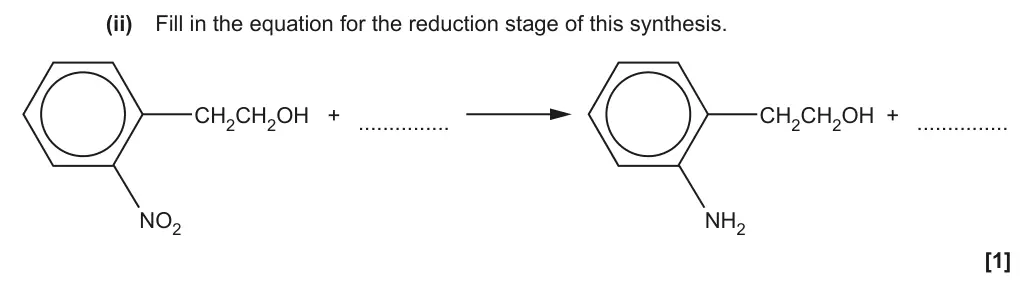
The most able candidates were able to identify the use of 6[H] as the reducing agent and the production of 2 water molecules. Incorrect responses commonly included the use of HCl and NaBH4 as a reactant.
Skills: M0.2 Use ratios, fractions and percentages
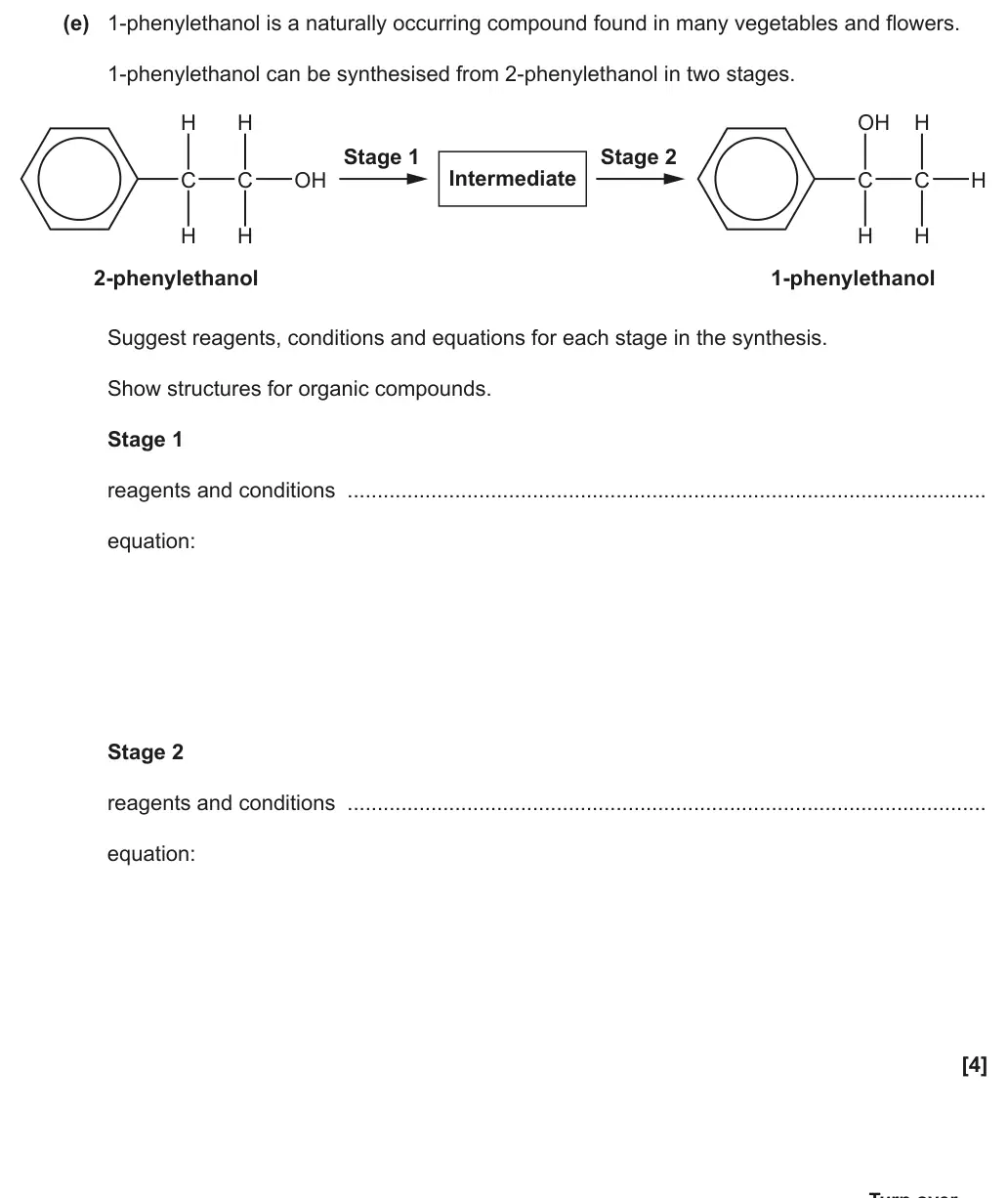
This question proved challenging with only the most able being given full marks. The reagents and conditions were not well known and candidates did not include water in their equations to make sure they were balanced.
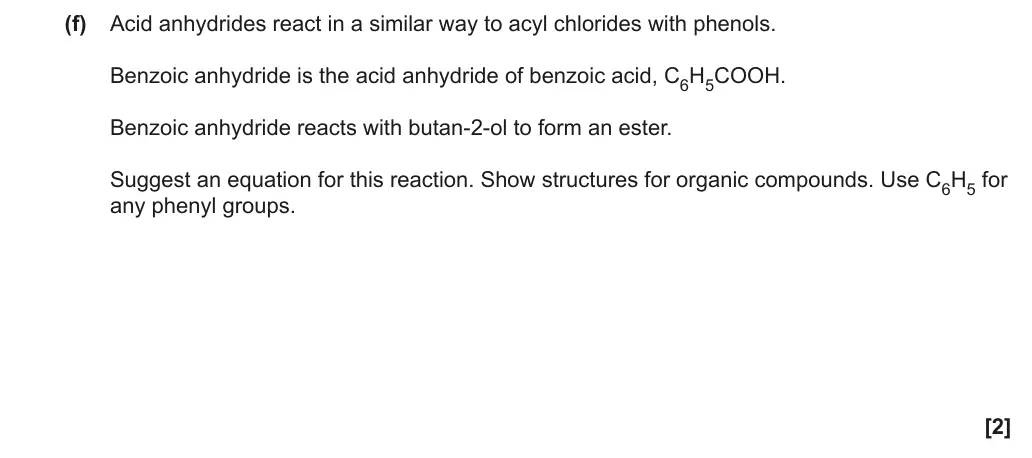
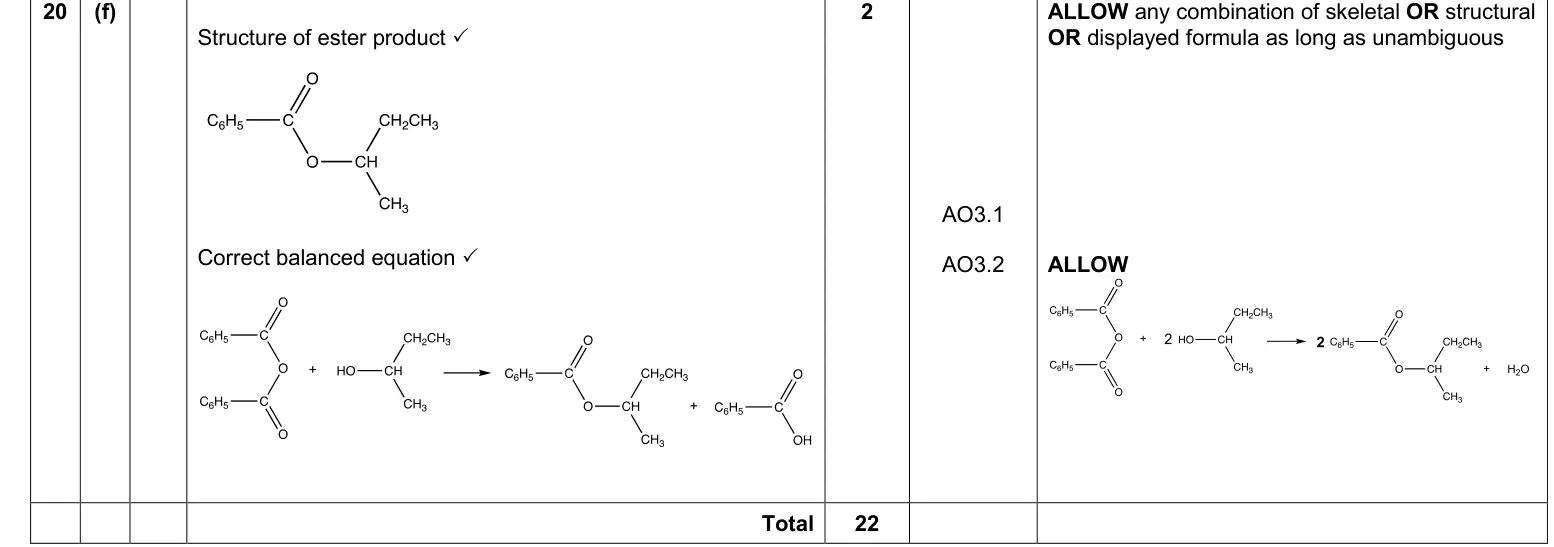
Most candidates did not secure a mark in this question. Many candidates used butan-1-ol in their equations or used benzoic acid rather than benzoic anhydride as the reactant. The most able candidates suggested that the benzoic acid product would then further react with butan-2-ol to produce a second ester molecule and water. This was an acceptable alternative response.
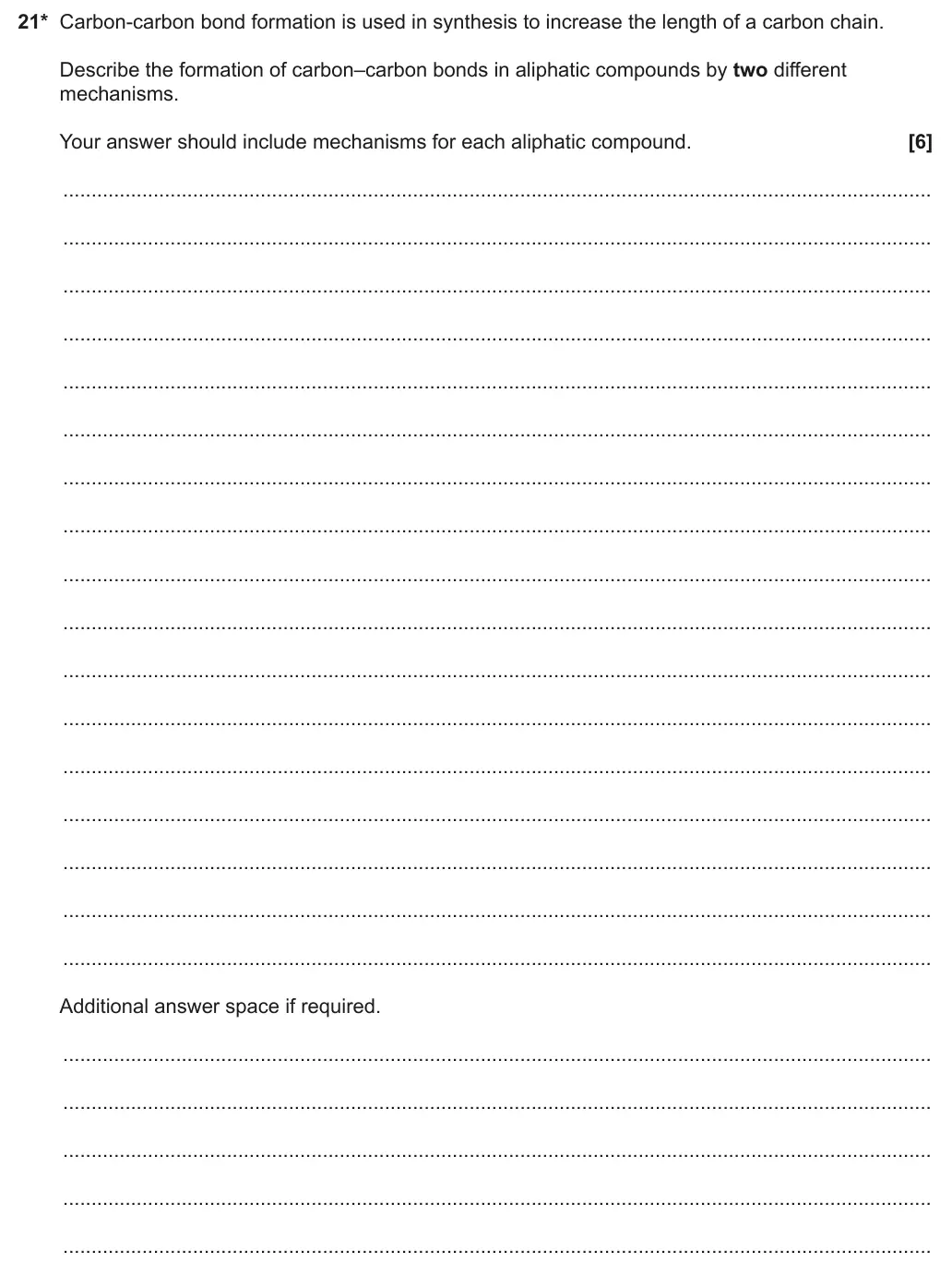
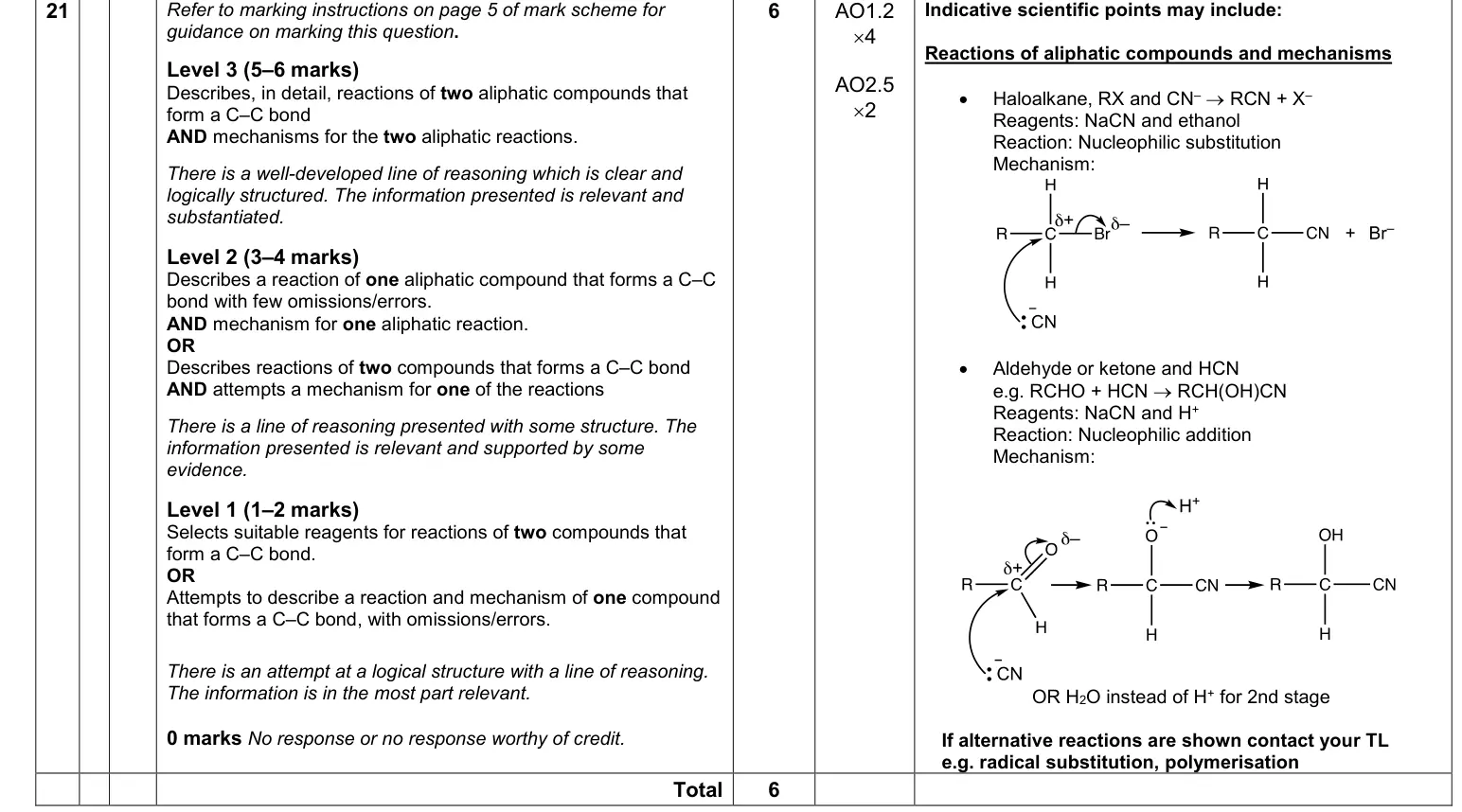
This question differentiated well. Candidates who were given Level 3 (5-6 marks) understood the term aliphatic and were able to provide two different mechanisms that produced a C-C bond. The most common responses seen involved the nucleophilic substitution of a halogenoalkane and a cyanide ion and the nucleophilic addition of a carbonyl with a cyanide ion. Some candidates offered radical substitution mechanisms, detailing initiation, propagation and termination steps, with the termination step producing a C-C bond. Candidates who scored Level 2 (3-4 marks) frequently detailed a reaction involving aromatic compounds or polymerisation of alkenes for which they were unable to give a mechanism. If any of your students’ results are not as expected, you may wish to consider one of our post-results services. For full information about the options available visit the OCR website. We send a weekly roundup to tell you about important updates. You can also sign up for your subject specific updates. If you haven’t already, sign up here. Attend one of our popular CPD courses to hear directly from a senior assessor or drop in to a Q&A session. Most of our courses are delivered live via an online platform, so you can attend from any location. Please find details for all our courses on the relevant subject page on our website or visit OCR professional development. ExamBuilder is the question builder platform for a range of our GCSE, A Level, Cambridge Nationals and Cambridge Technicals qualifications. Find out more. ExamBuilder is free for all OCR centres with an Interchange account and gives you unlimited users per centre. We need an Interchange username to validate the identity of your centre's first user account for ExamBuilder. If you do not have an Interchange account please contact your centre administrator (usually the Exams Officer) to request a username, or nominate an existing Interchange user in your department. Review students' exam performance with our free online results analysis tool. It is available for all GCSEs, AS and A Levels and Cambridge Nationals. It allows you to: • review and run analysis reports on exam performance • analyse results at question and/or topic level • compare your centre with OCR national averages • identify trends across the centre • facilitate effective planning and delivery of courses • identify areas of the curriculum where students excel or struggle • help pinpoint strengths and weaknesses of students and teaching departments. Find out more. Post-results services Keep up-to-date OCR Professional Development Signed up for ExamBuilder?
Want a paper marked and gone through with you? Message us.