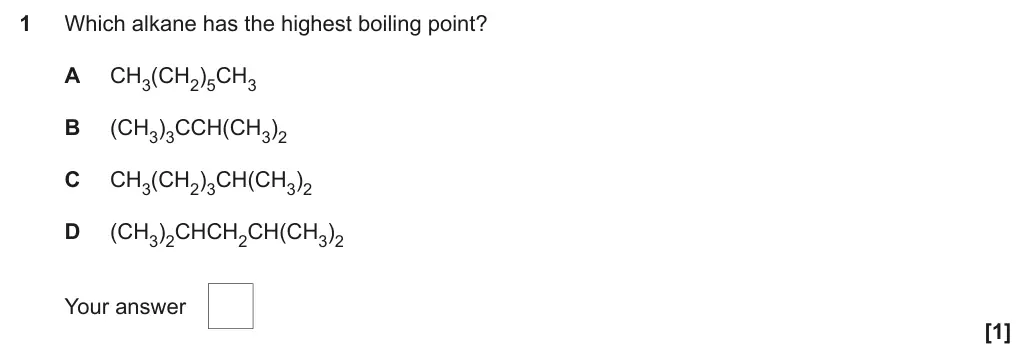
Answer
A
Mark scheme

100 marks · 46 question parts · Paper, mark scheme and report on OCR's site · Have OCR's Data Sheet beside you
A
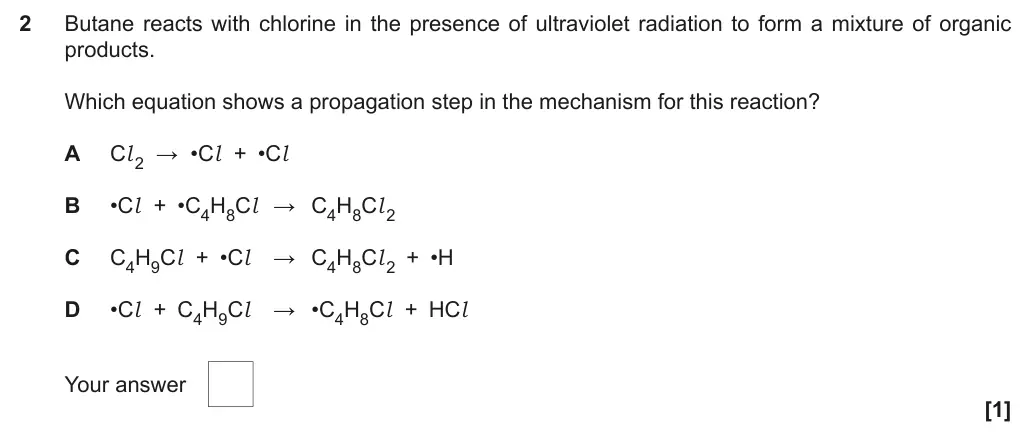
D
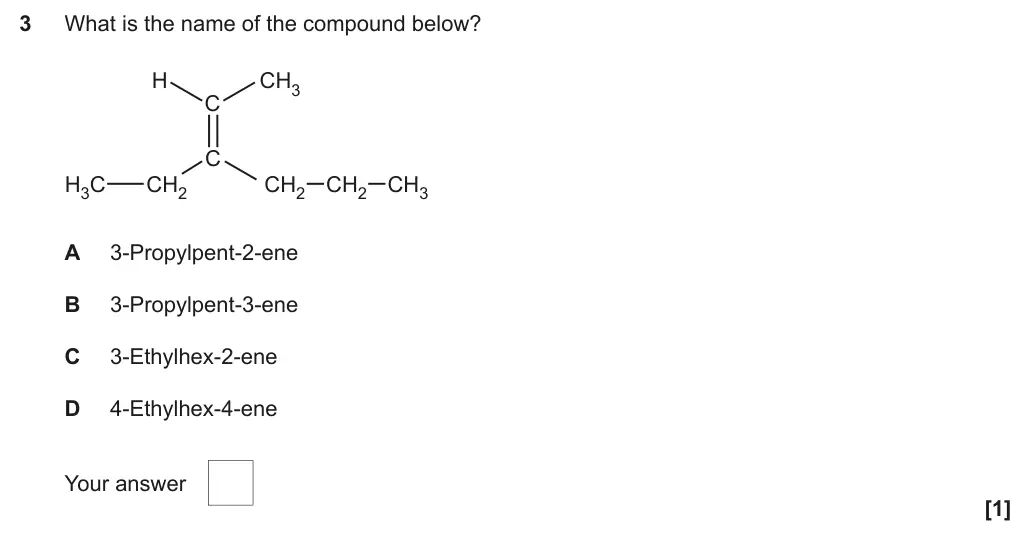
C
The majority of candidates were able to select 3-ethylhex-2-ene (C) as the correct name of the compound. A common incorrect response was D.
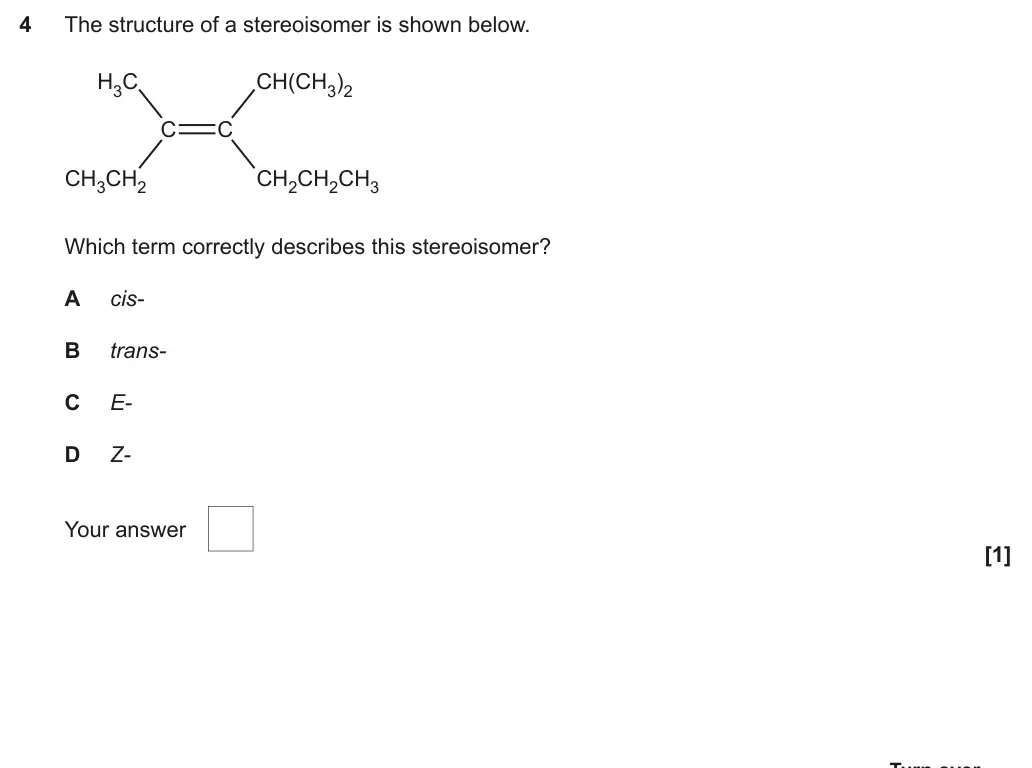
C
This question proved difficult. Many candidates identified that this structure is an E stereoisomer (C) but a significant number of responses selected D. Candidates are encouraged to draw out the groups to determine the first point of difference when applying the Cahn Ingold Prelog (CIP) priority rules.
Skills: M4.2 Visualise and represent 2-D and 3-D forms including 2-D representations of 3-D objects
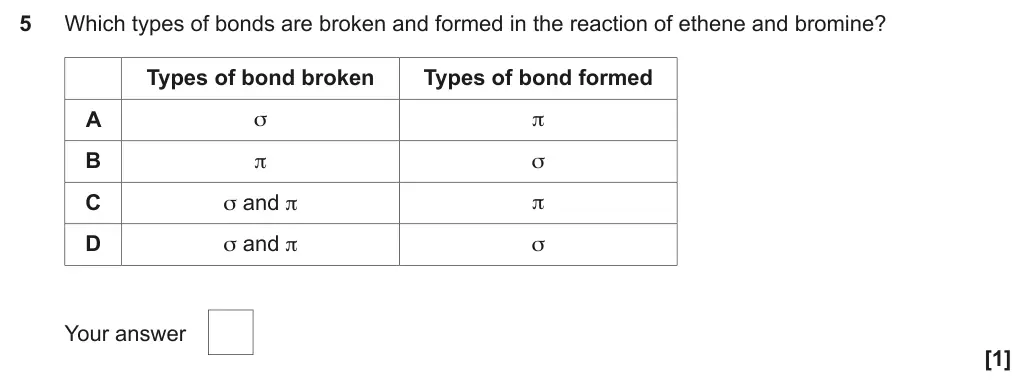
D
This is a demanding question. The best responses drew the first step of the mechanism near the table. This showed both the π bond in ethene and the σ bond in bromine breaking in addition to a σ bond forming between carbon and bromine atoms. Although many candidates correctly selected D, option B was a good distractor and was the most commonly seen incorrect response.
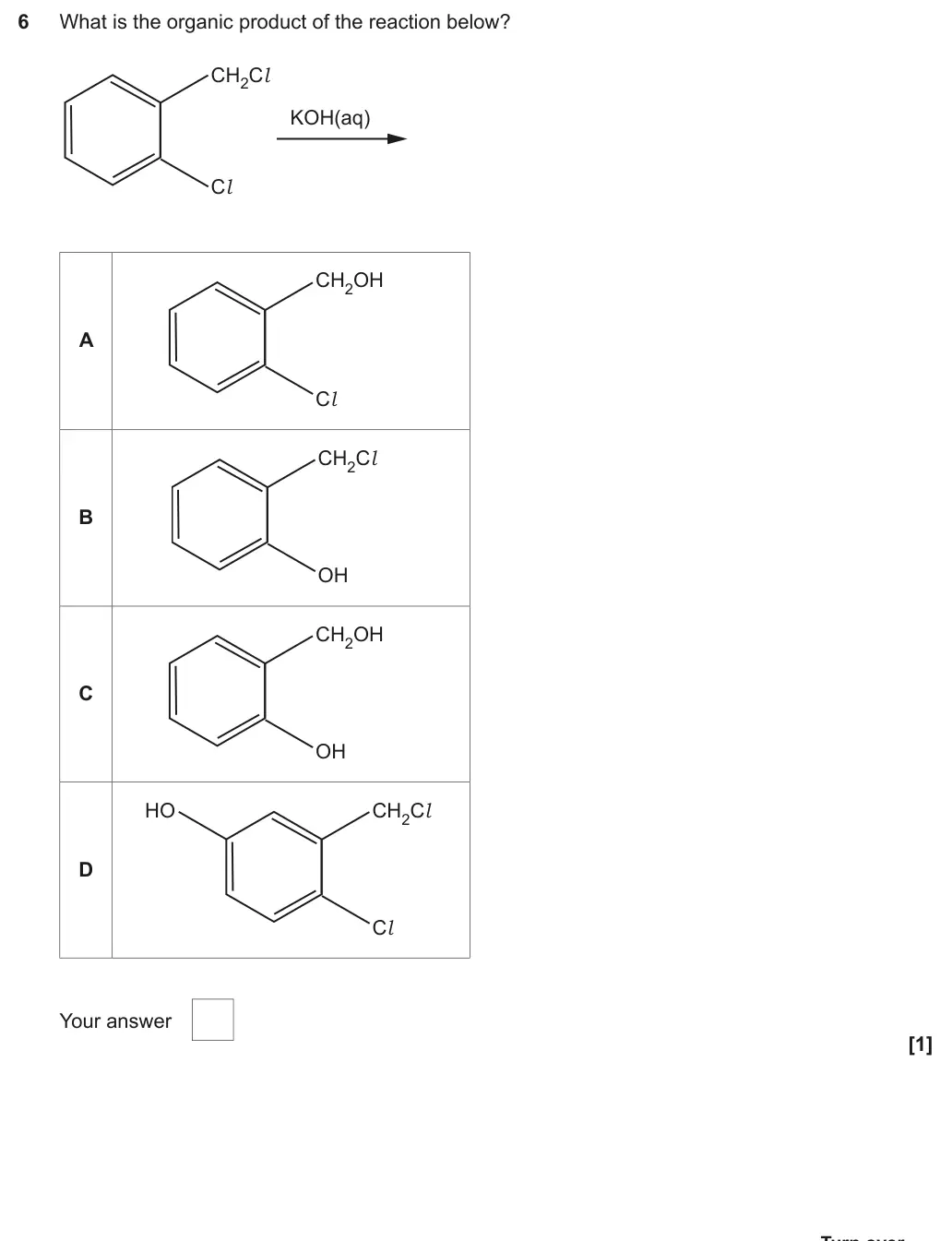
A
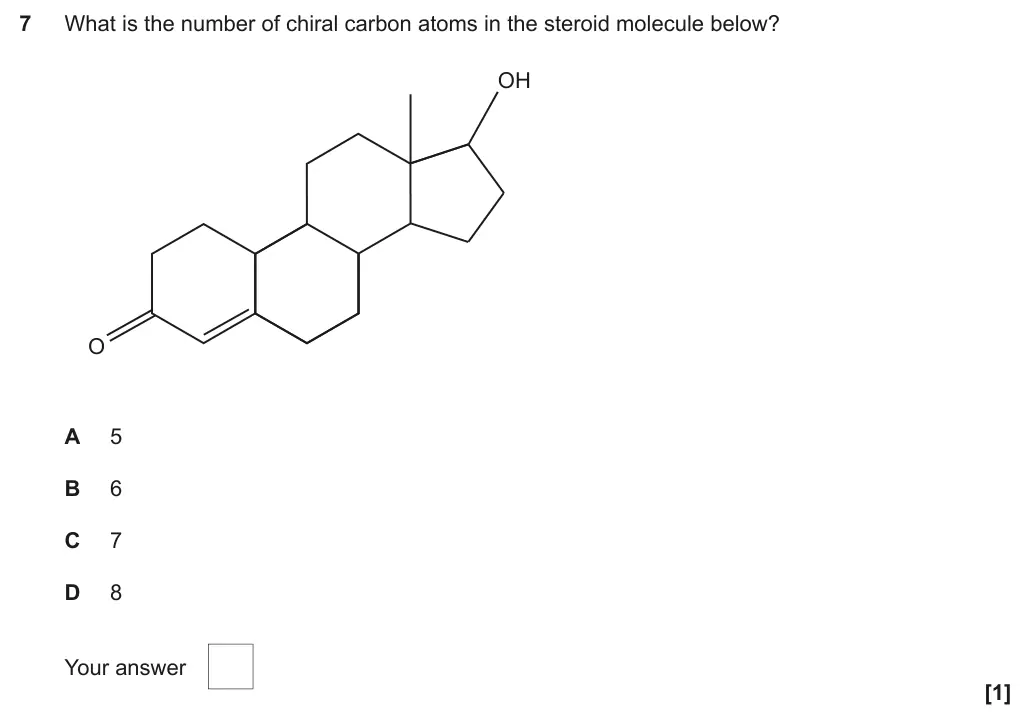
B
Skills: M4.2 Visualise and represent 2-D and 3-D forms including 2-D representations of 3-D objects
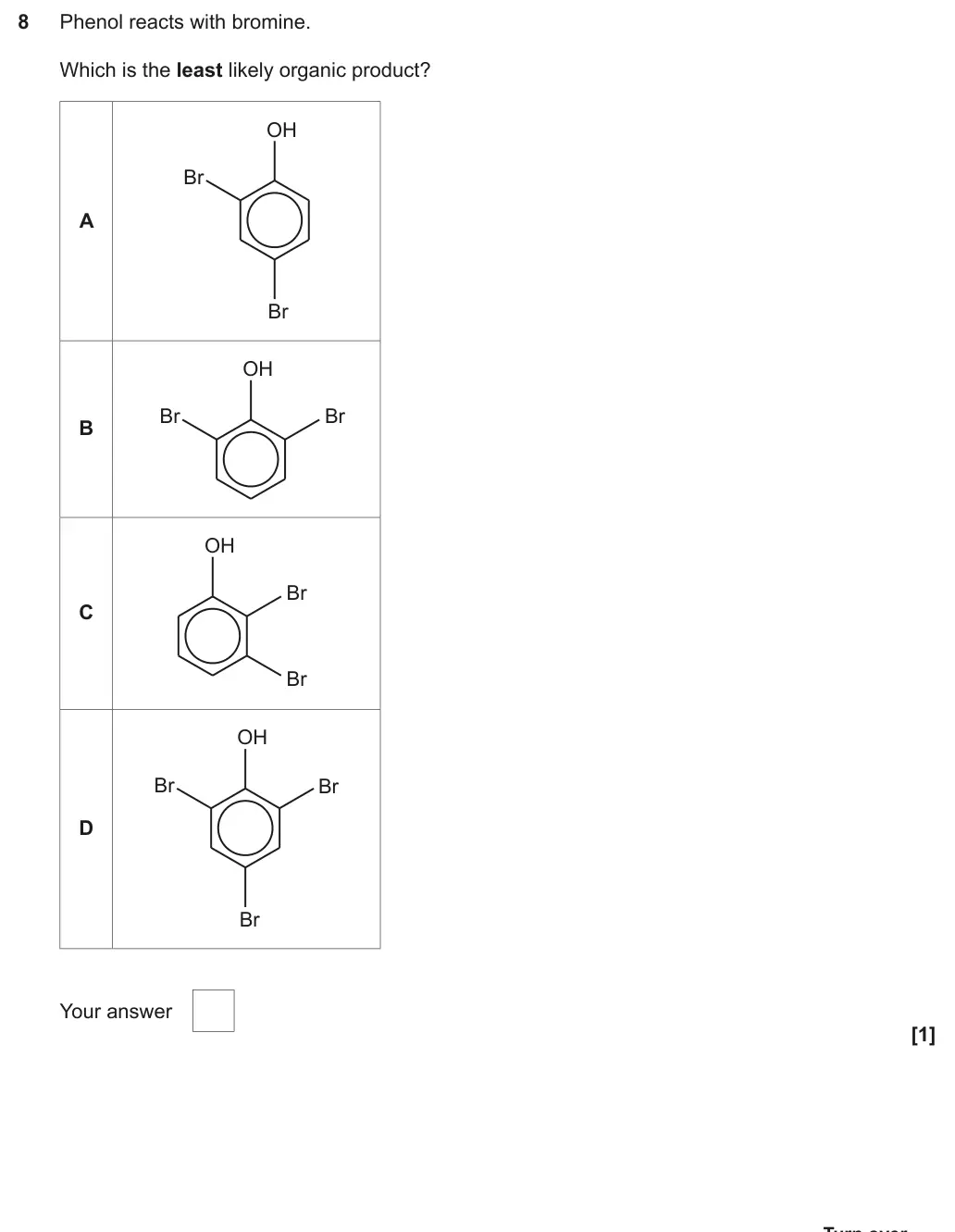
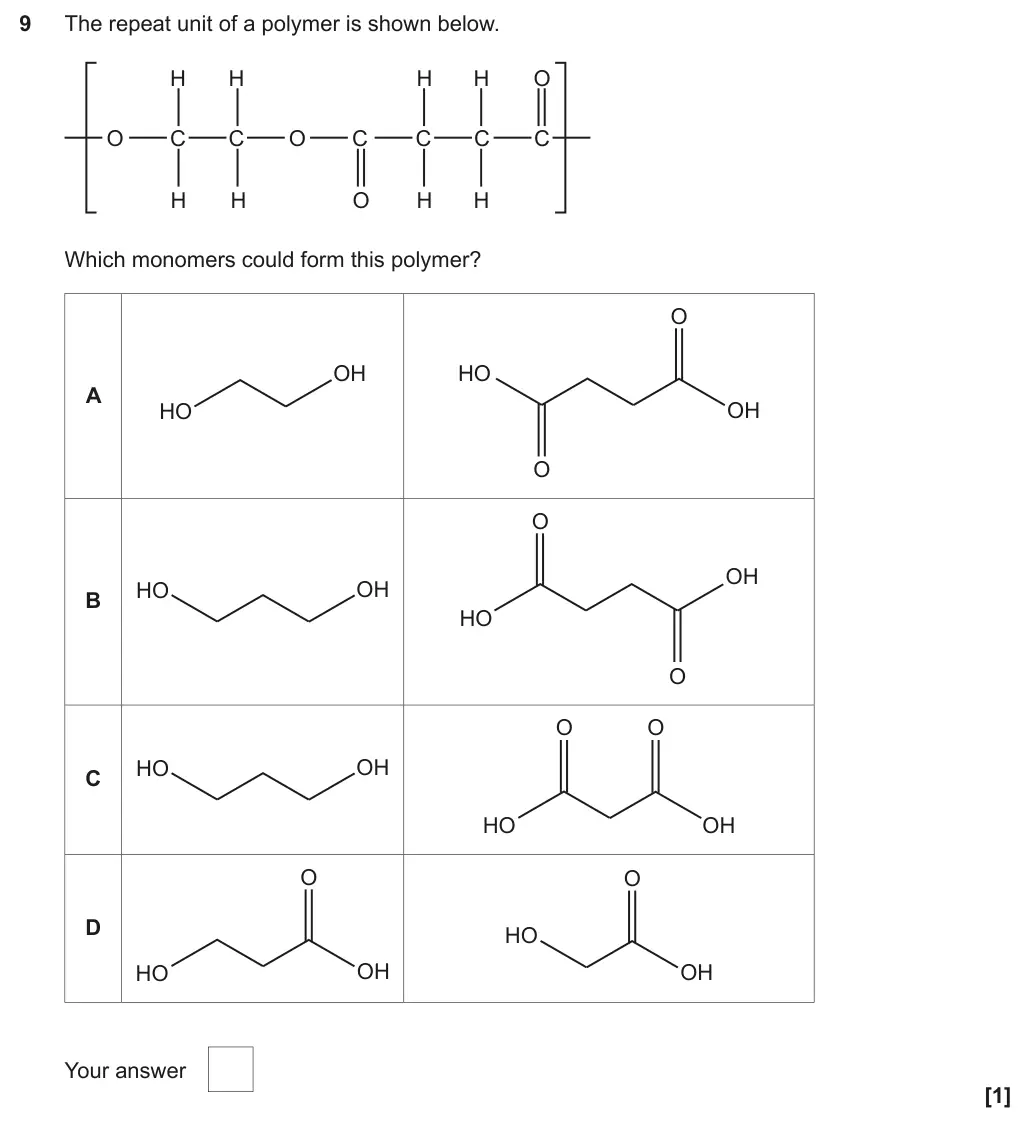
C
A
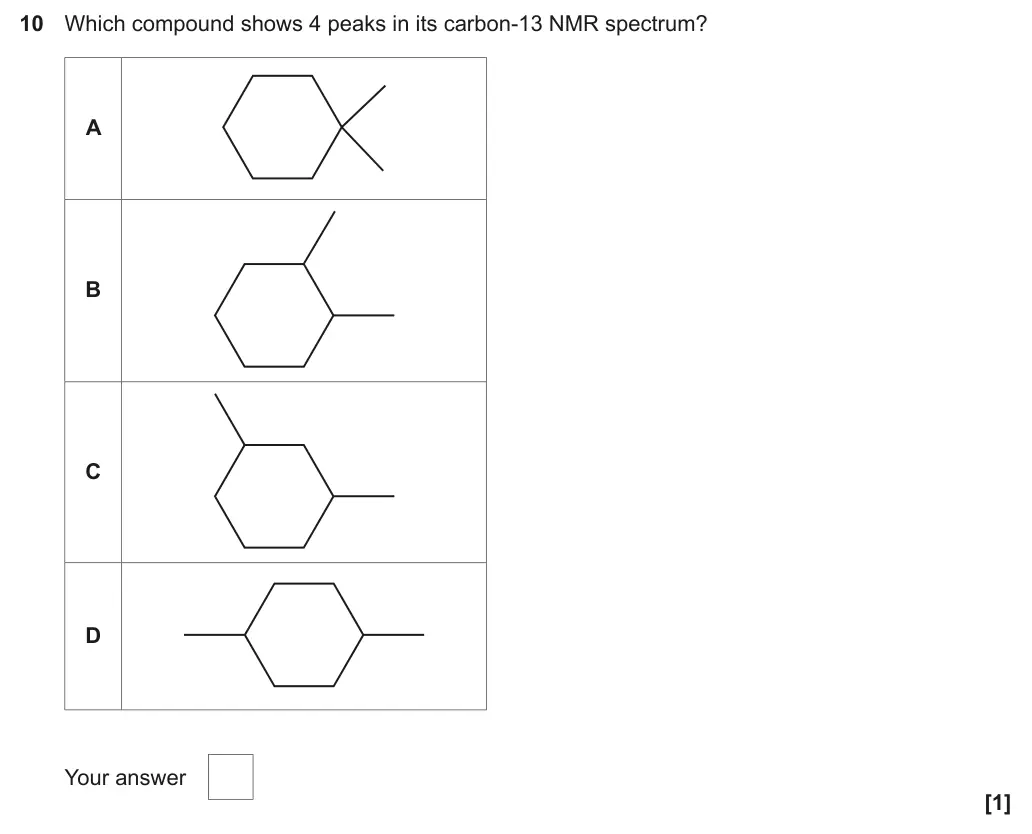
B
Most candidates correctly selected B as the compound that would show four peaks in the 13C NMR spectrum. Many candidates annotated the structures, indicating the different carbon environments with a circle. This proved a good strategy. Common incorrect responses included C and D which were seen in roughly equal proportions.
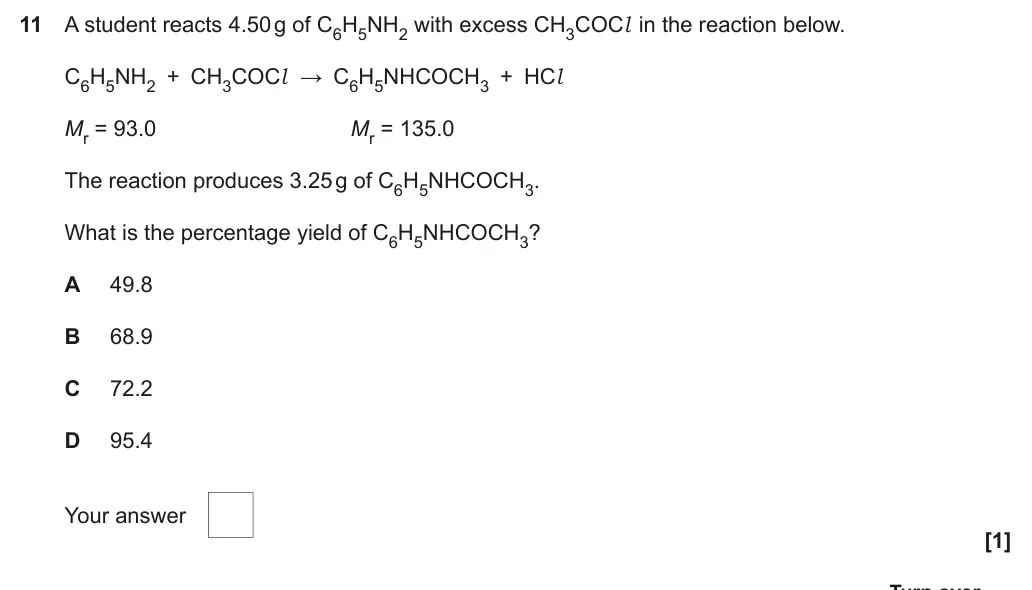
A
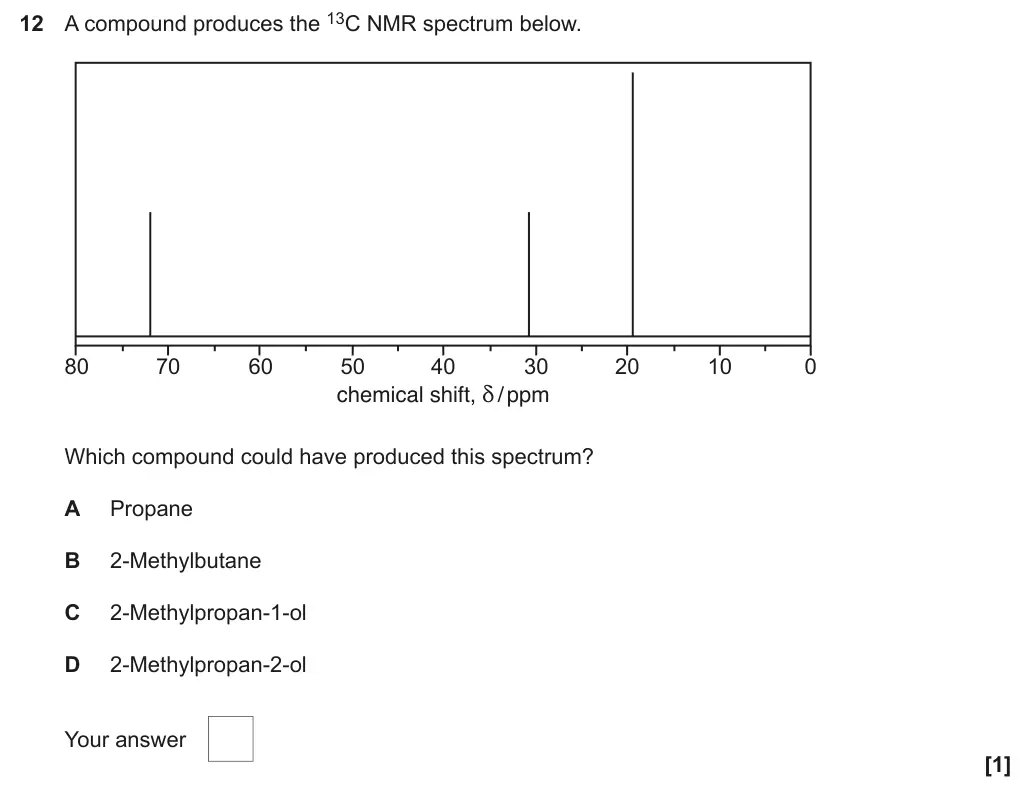
C
Many candidates identified that 2-methylpropan-1-ol (C) produced the 13C NMR spectrum show. The majority of successful responses included diagrams showing the structures of the compounds to choose from. The most frequently seen incorrect response was D.
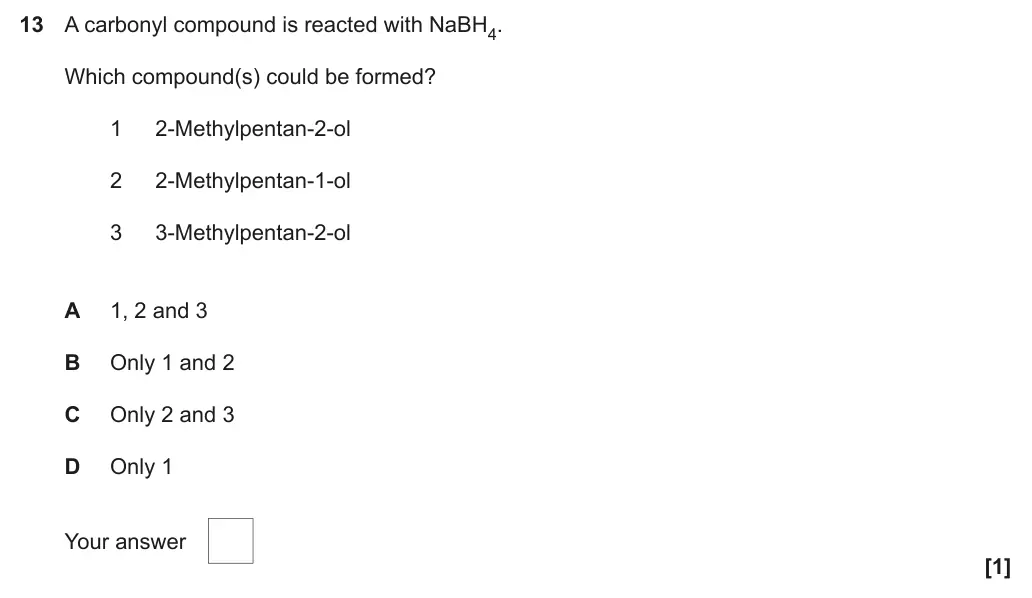
C
This question discriminated well, with the higher ability candidates correctly selecting C. The most common incorrect response was A.
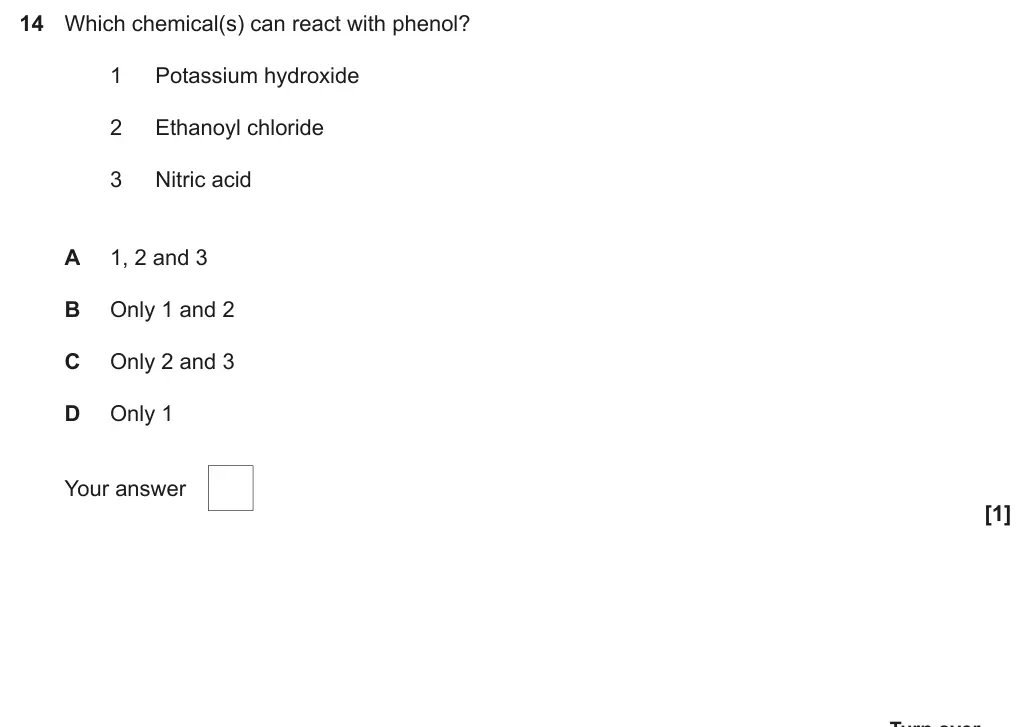
A
This question proved difficult. Many candidates correctly deduced that all three chemicals would react with phenol and selected A. Some candidates did not recognise that phenol would react with HNO3 without the need for a catalyst and selected B. Other candidates did not consider the weak acidity of phenol and selected C.
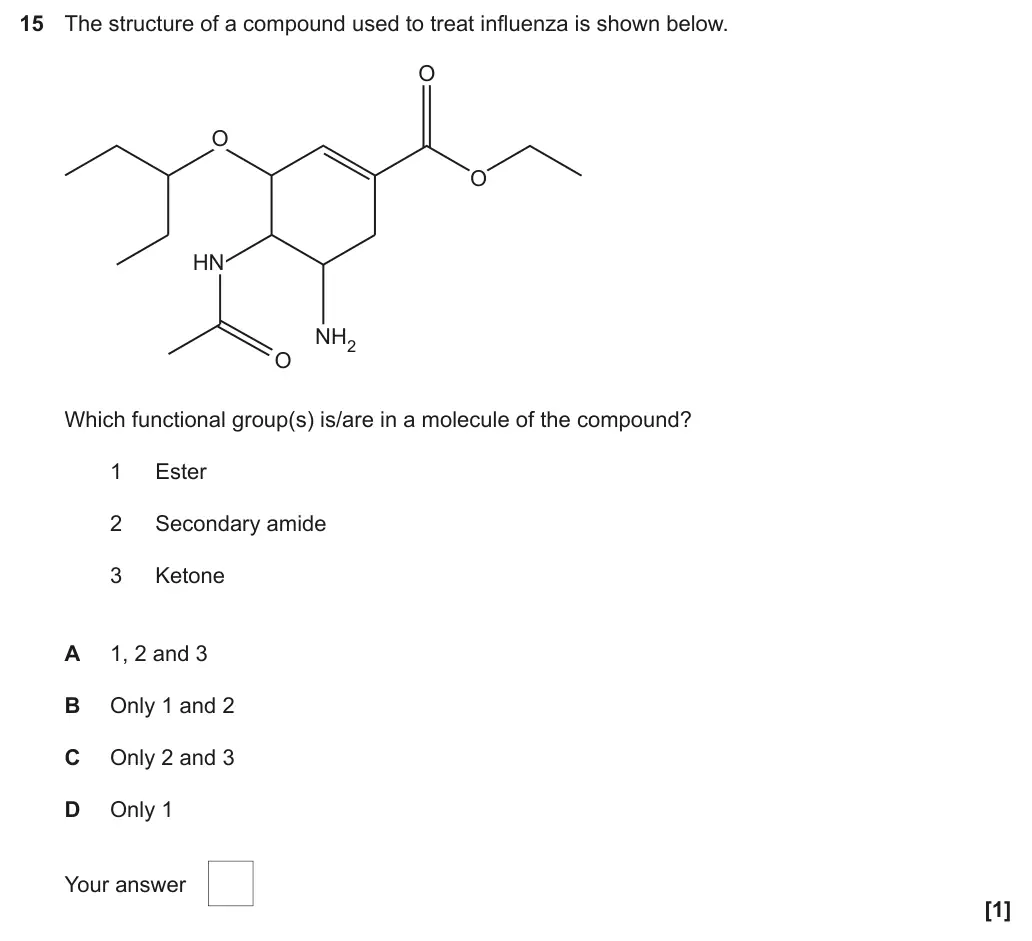
B
Most candidates were able to identify the functional groups correctly and selected B. Some candidates opted for A, presumably assuming the C=O at the top of the structure was a ketone. A small, but significant number of candidates chose option C. Section B overview Section B includes a mixture of short answer and extended response questions, including two questions marked using a level of response mark scheme (18(e)(i) and 21). This section of the paper is worth 85 marks.
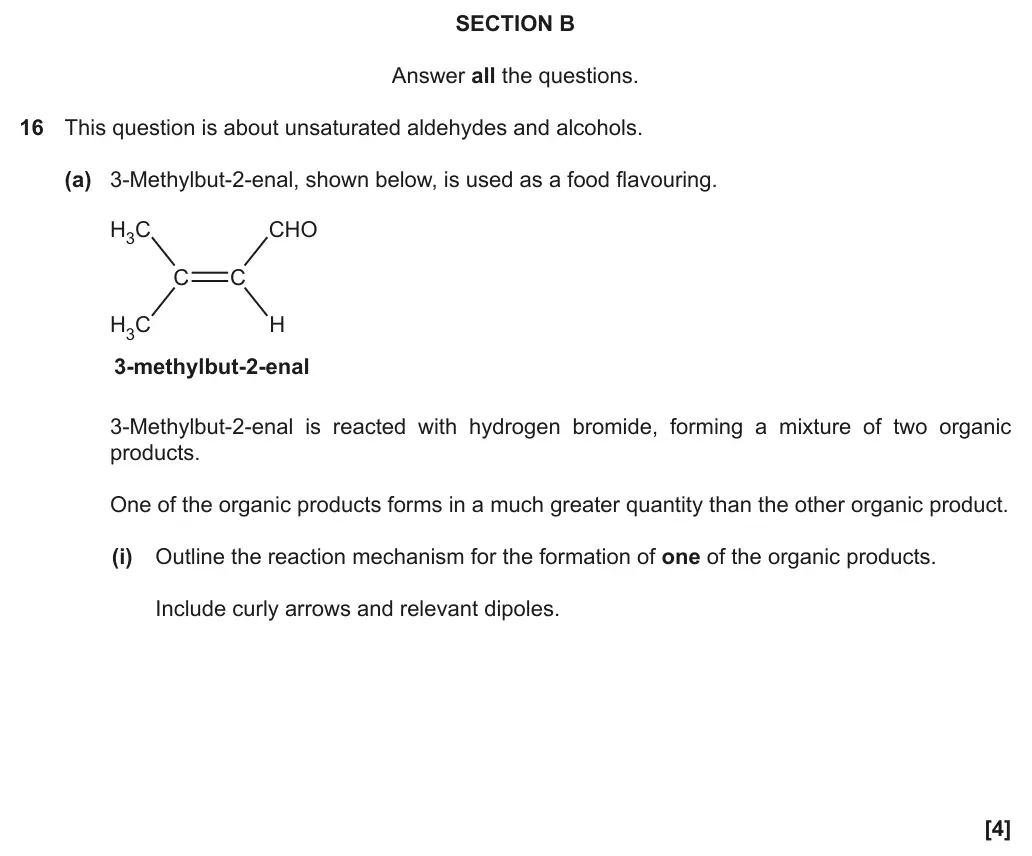
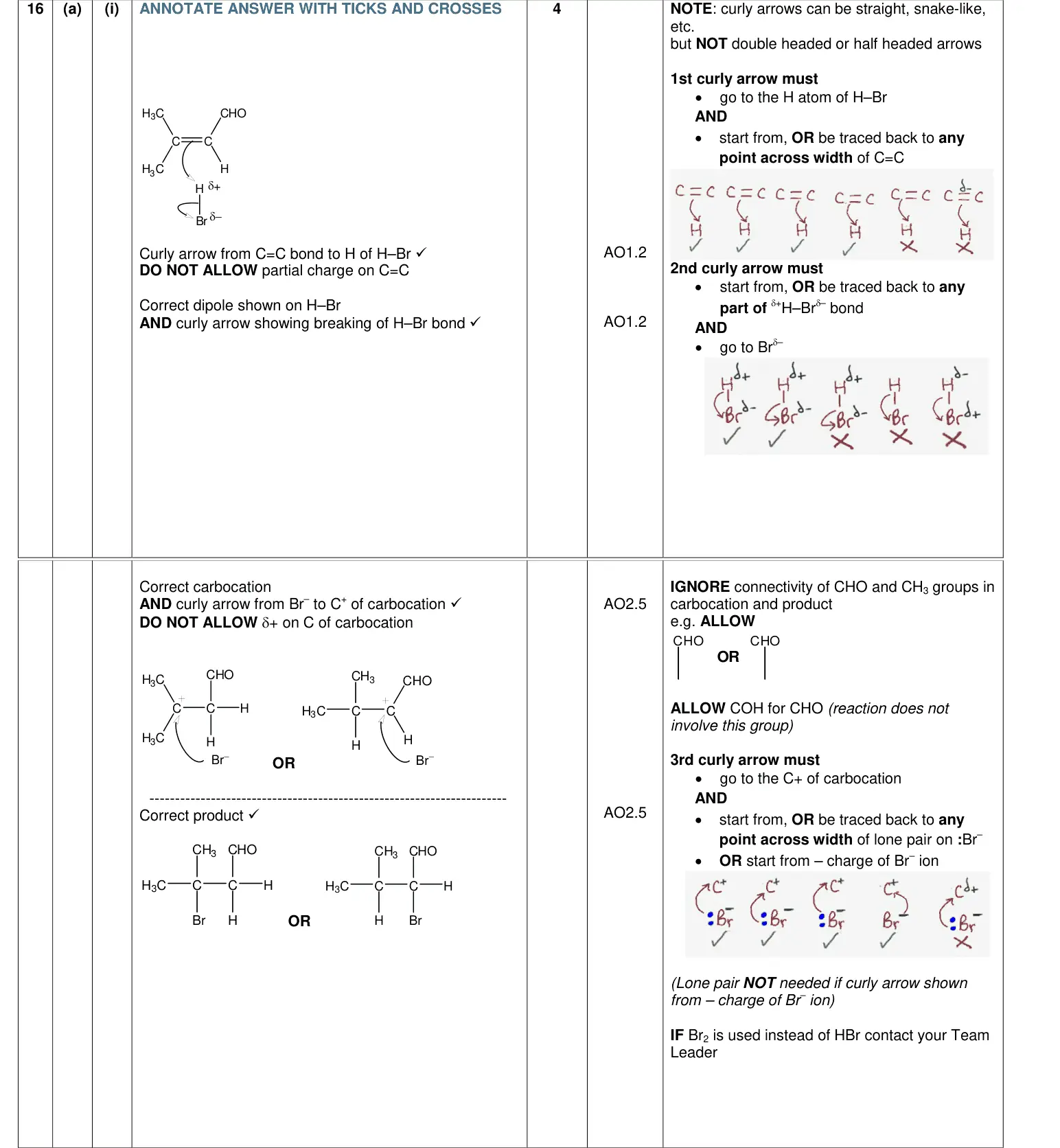
Candidates were very familiar with this electrophilic addition mechanism, so the majority of candidates scored three or four marks. Common errors included inaccurate curly arrows from either the carbon- carbon double bond or the bromide ion or the omission of key detail such as the partial charges on HBr or the charge on the bromide ion.
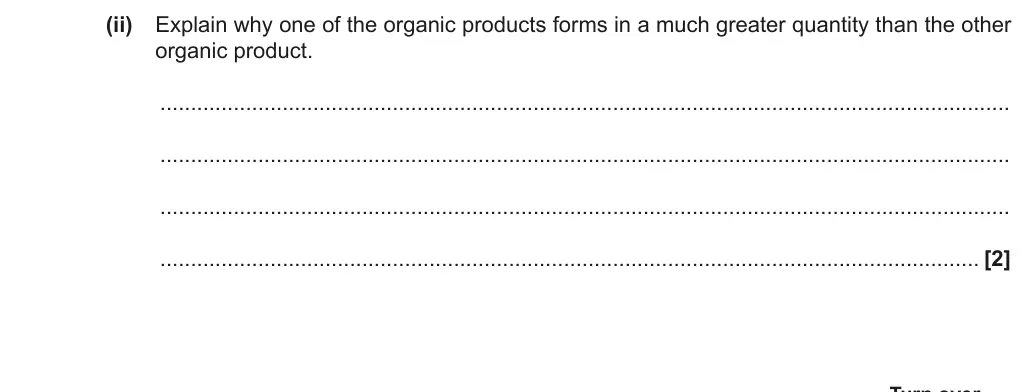
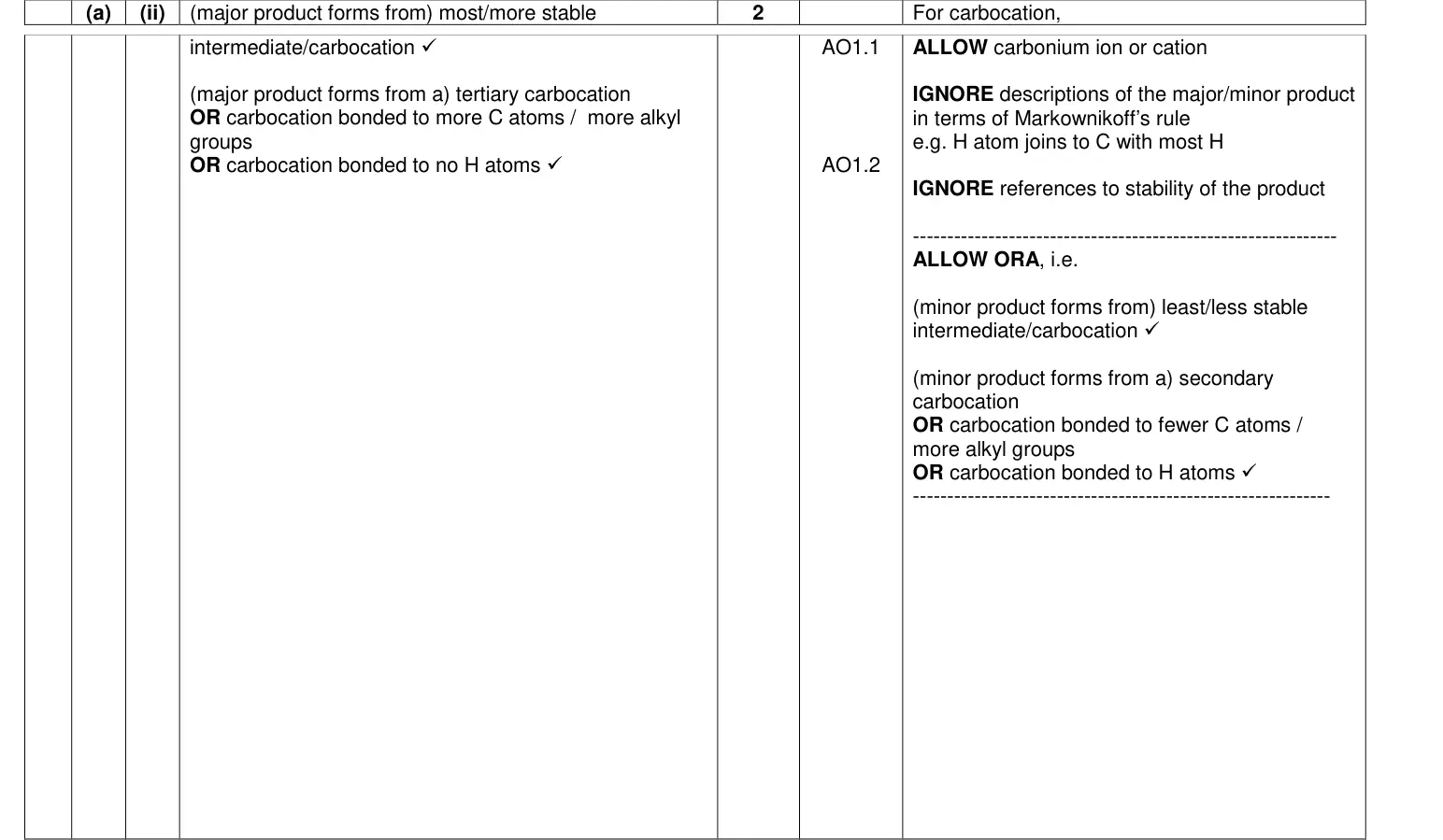
This question required candidates to apply their knowledge of Markownikoff’s rule to explain the formation of a major product in the reaction in part (a)(i). The majority of candidates recognised that the stability of the intermediate was responsible for one of the products being formed in a greater quantity, and most scored at least one mark. The best responses recognised that, in the context of the reaction in (a)(i), a tertiary carbocation would form the major product. Other response talked more generally about the major product (without identifying that the tertiary carbocation in the mechanism is responsible)). Lower ability candidates focused their response on the stability of the product and did not discuss the intermediate at all.
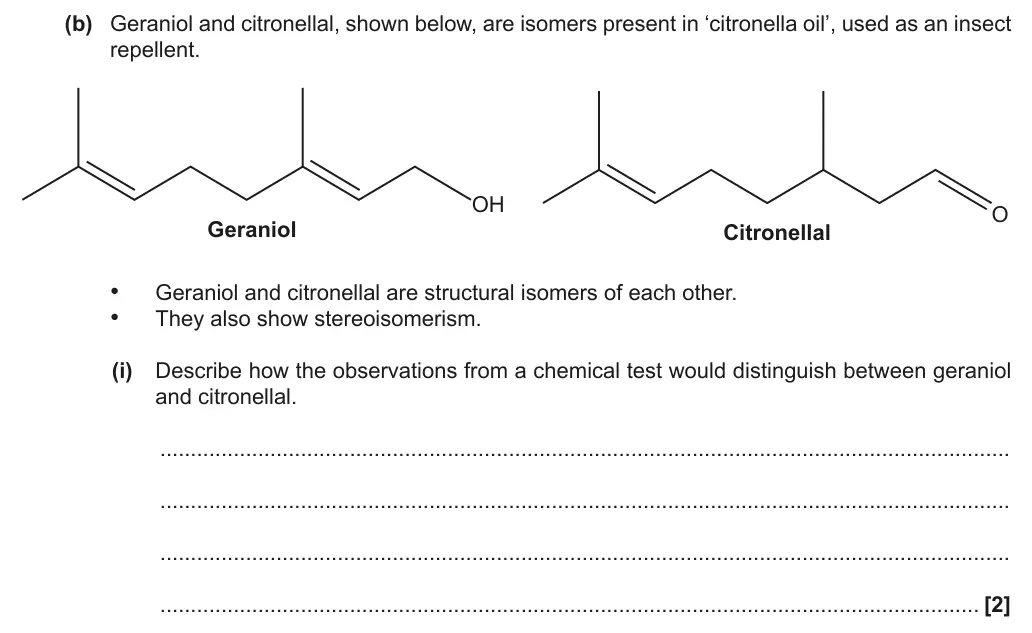
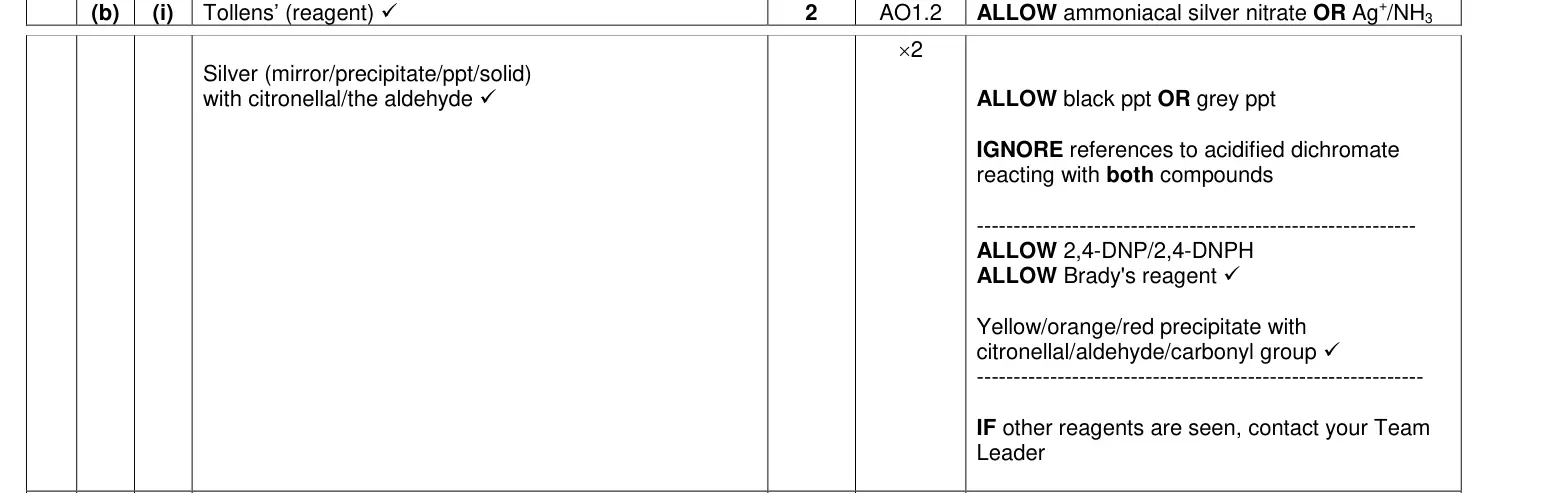
Almost all candidates were able to describe a suitable test to distinguish between geraniol and citronellal and most scored both marks. The most common choice was to use Tollens’ reagent to identify the aldehyde group in citronellal by the formation of a silver mirror. Other candidates opted for 2,4- dinitrophenylhdrazine to differentiate the carbonyl compound from the alcohol.
Skills: PAG7 Qualitative analysis of organic functional groups

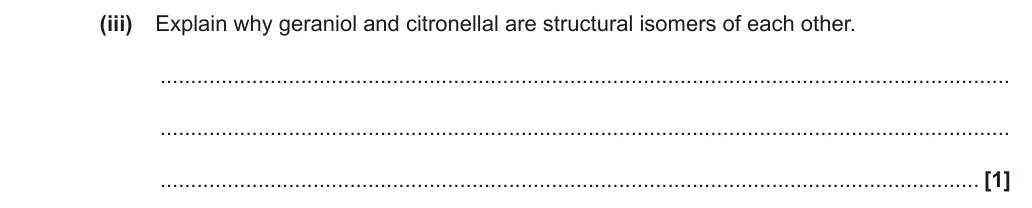
Many candidates were able to determine the correct molecular formula of geraniol as C10H18O. A small but significant proportion of the candidates gave a structural formula, showing each C atom in turn, rather than grouping atoms of the same element together. Candidates are encouraged to practice giving different types of formulae for a range of organic compounds to make sure that each type is understood, and to check to ensure they are providing the type of formula that the question is asking for.
A LEVEL CHEMISTRY A Examiners’ report H432/02 Summer 2019 series Version 1 H432 For first teaching in 2015 www.ocr.org.uk/science Contents Introduction .............................................................................................................................................. 4 Paper 2 series overview ........................................................................................................................... 5 Section A overview ................................................................................................................................... 6 Question 3 ............................................................................................................................................ 6 Question 4 ............................................................................................................................................ 6 Question 5 ............................................................................................................................................ 7 Question 10 .......................................................................................................................................... 8 Question 12 .......................................................................................................................................... 9 Question 13 ........................................................................................................................................ 10 Question 14 ........................................................................................................................................ 10 Question 15 ........................................................................................................................................ 11 Section B overview ................................................................................................................................. 12 Question 16 (a) (i) ............................................................................................................................... 12 Question 16 (a) (ii) .............................................................................................................................. 12 Question 16 (b) (i) ............................................................................................................................... 13 Question 16 (b) (ii) .............................................................................................................................. 14 Question 16 (b) (iv) ............................................................................................................................. 14 Question 16 (b) (v) .............................................................................................................................. 15 Question 17 (a) (i) ............................................................................................................................... 17 Question 17 (a) (ii) .............................................................................................................................. 19 Question 17 (b) (i) ............................................................................................................................... 20 Question 18 (a) (i) ............................................................................................................................... 21 Question 18 (a) (ii) .............................................................................................................................. 22 Question 18 (b) ................................................................................................................................... 23 Question 18 (c) ................................................................................................................................... 23 Question 18 (d) ................................................................................................................................... 24 Question 18 (e) (i) ............................................................................................................................... 24 Question 18 (e) (ii) .............................................................................................................................. 26 Question 19 (a) (i) ............................................................................................................................... 27 Question 19 (a) (ii) .............................................................................................................................. 29 Question 19 (b) (i) ............................................................................................................................... 30 Question 19 (b) (iii) ............................................................................................................................. 32 Question 19 (b) (iv) ............................................................................................................................. 34 Question 20 (a) (i) ............................................................................................................................... 36 Question 20 (a) (ii) .............................................................................................................................. 37 Question 20 (a) (iii) ............................................................................................................................. 37 Question 20 (b) (i) ............................................................................................................................... 38 Question 21 ........................................................................................................................................ 39 Introduction Our examiners’ reports are produced to offer constructive feedback on candidates’ performance in the examinations. OCR support A topic exploration pack on electrophilic addition and Markownikoff’s rule, including activities to assess student understanding, is available here: http://www.ocr.org.uk/Images/336551-electrophilic-addition-and- markownikoff-s-rule.doc Question 16 (b) (i) Almost all candidates were able to describe a suitable test to distinguish between geraniol and citronellal and most scored both marks. Question 16 (b) (ii) Many candidates were able to determine the correct molecular formula of geraniol as C10H18O. Question 16 (b) (iv) Most candidates were able to explain the term stereoisomerism succinctly. Question 16 (b) (v) This question, which discriminated well, required candidates to apply their knowledge of stereoisomerism to geraniol and citronellal.
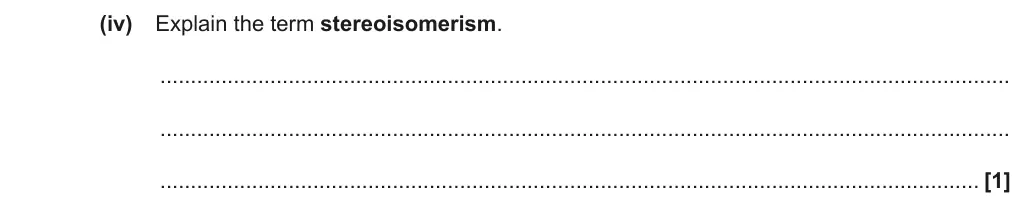
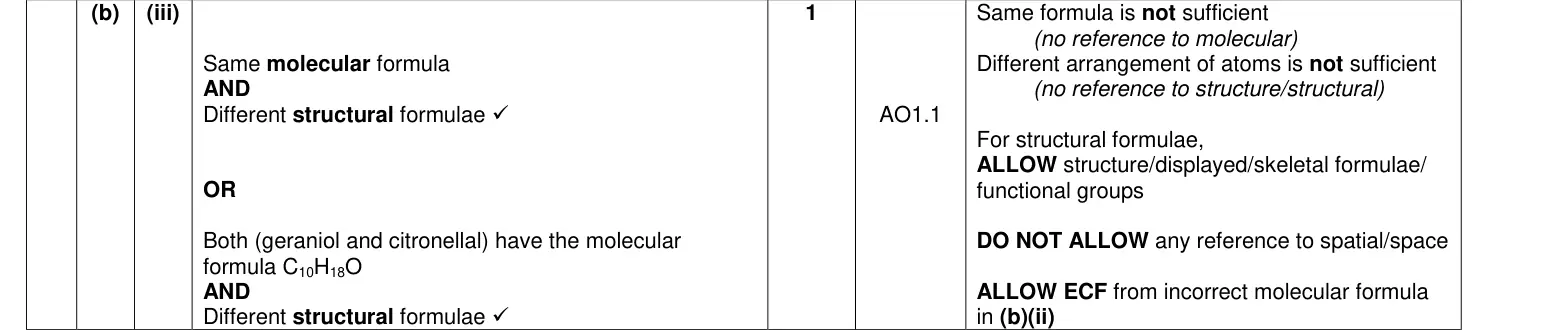
Most candidates were able to explain the term stereoisomerism succinctly. However, a significant number of candidates referred to stereoisomers as having the same molecular formula, rather than being more precise and stating that they are compounds with the same structural formula.
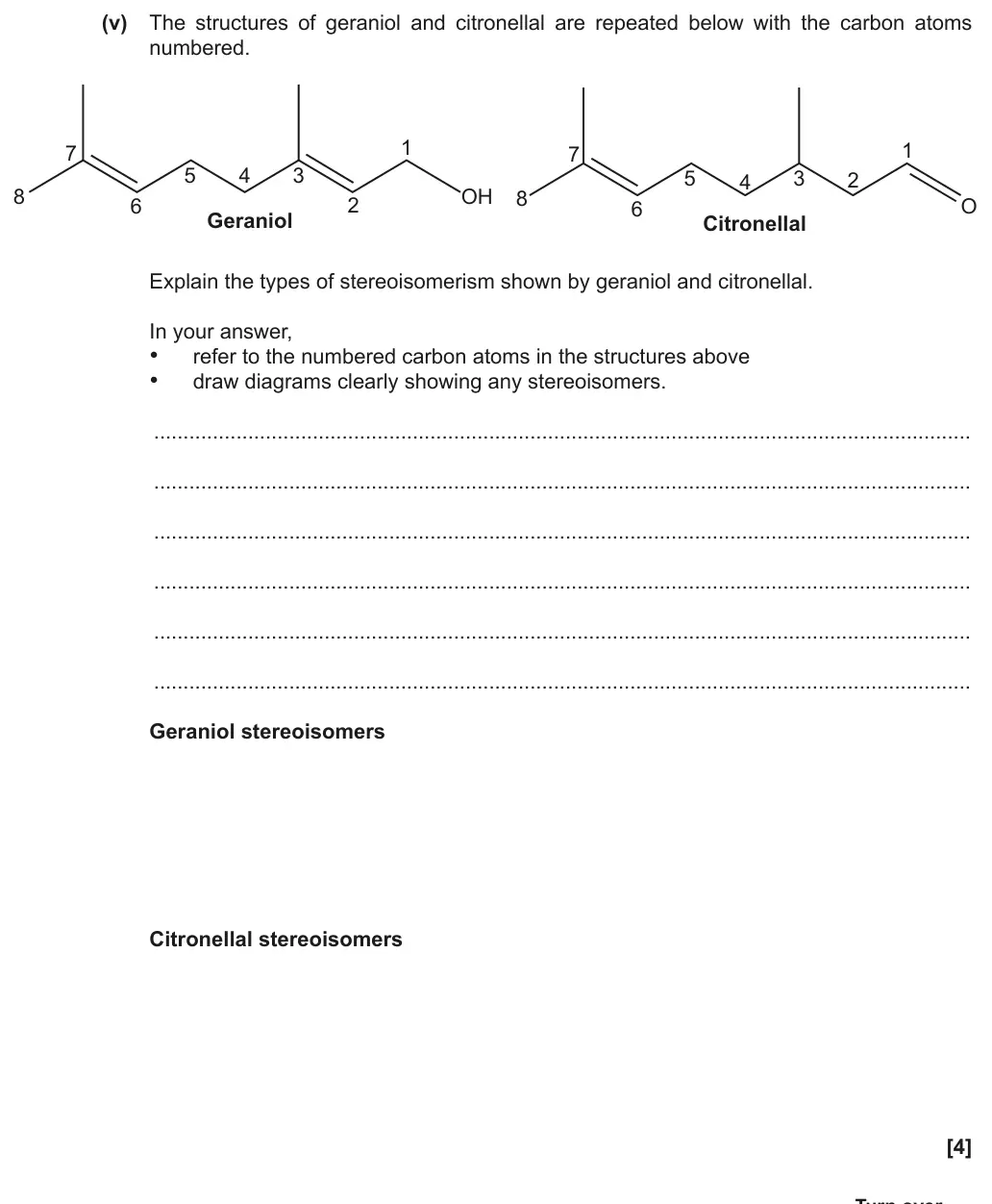
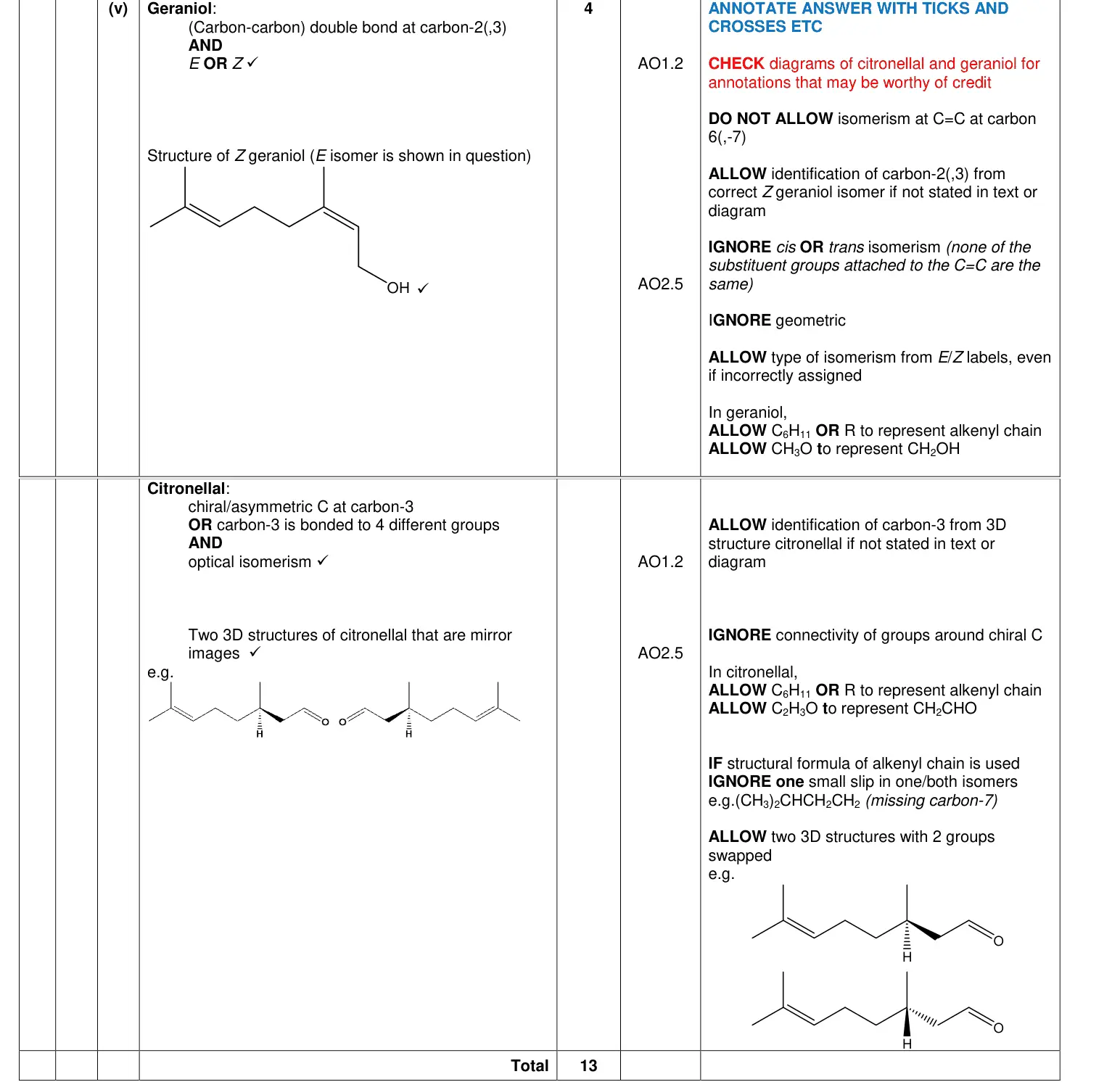
This question, which discriminated well, required candidates to apply their knowledge of stereoisomerism to geraniol and citronellal. The majority of responses focused on E/Z isomerism, as shown in Exemplar 2. Many candidates were able to show the structure of the Z isomer of geraniol and scored at least one mark. Stronger responses were able to explain this type of isomerism as the result of the carbon-carbon double bond between carbon atoms 2 and 3. Common errors included attributing E/Z isomerism to the double bond between carbon atoms 6 and7 or use of cis/trans to describe the isomers (the latter of which was ignored by the mark scheme as it does not apply to geraniol). The best responses also identified the chiral carbon atom in citronellal and were able to show the optical isomers appropriately. This response identifies that geraniol has E/Z isomers and provides a correct explanation with reference to the carbon-carbon double bond between carbon atoms 2 and 3. So marking points one and two were given. The candidate recognises that the double bond between carbon atoms 6 and 7 would not cause isomerism in both compounds. Unfortunately this response overlooks the chiral carbon in citronellal and incorrectly states that it has are no stereoisomers. This question highlights the challenge of a linear specification, where content from different modules may be assessed within the same question. Candidates are likely to encounter these two types of stereoisomerism in different years of their course. They should therefore be encouraged to make links between the different modules to help develop their understanding.
Skills: M4.2 Visualise and represent 2-D and 3-D forms including 2-D representations of 3-D objects; M4.3 Understand the symmetry of 2-D and 3-D shapes
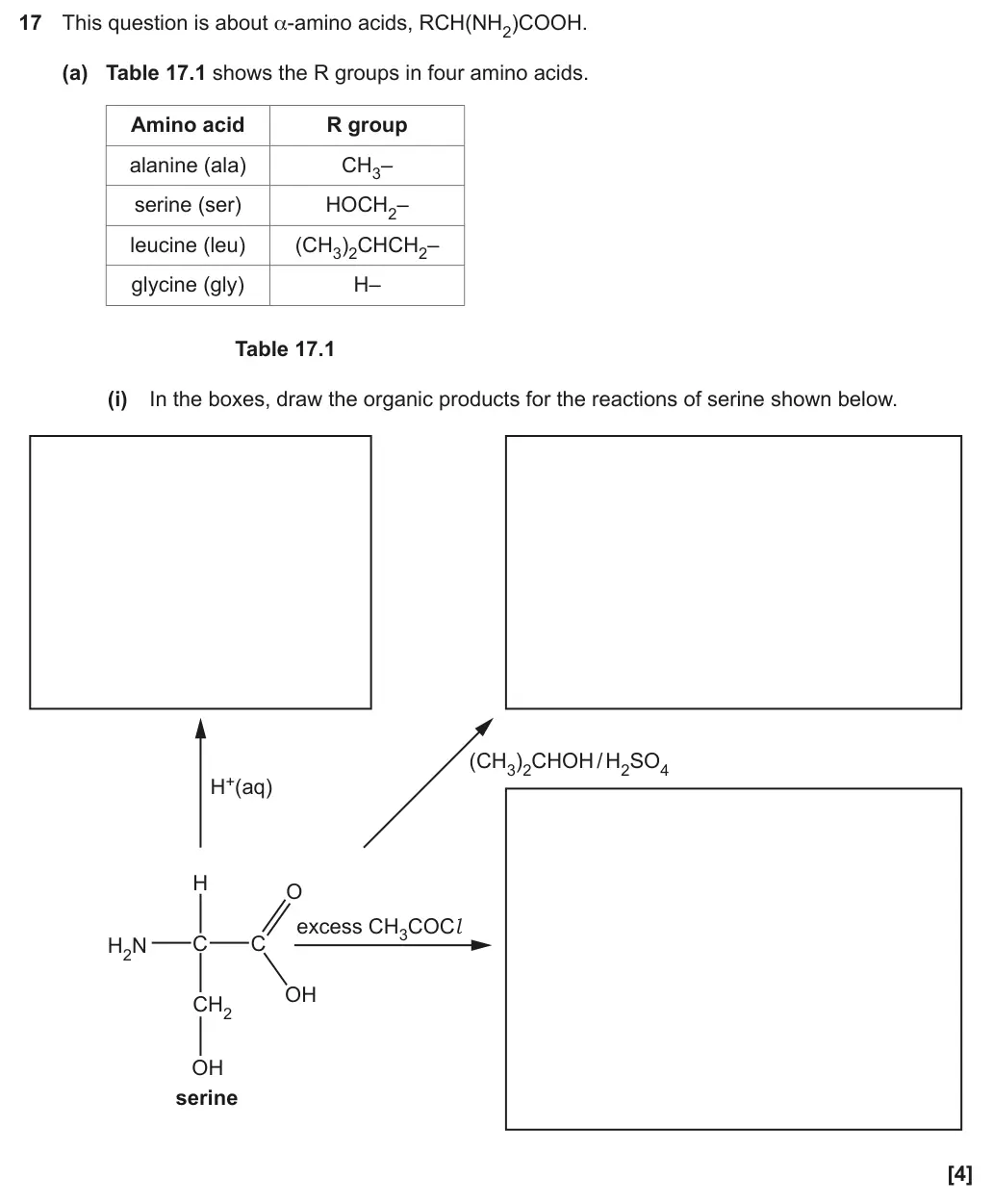
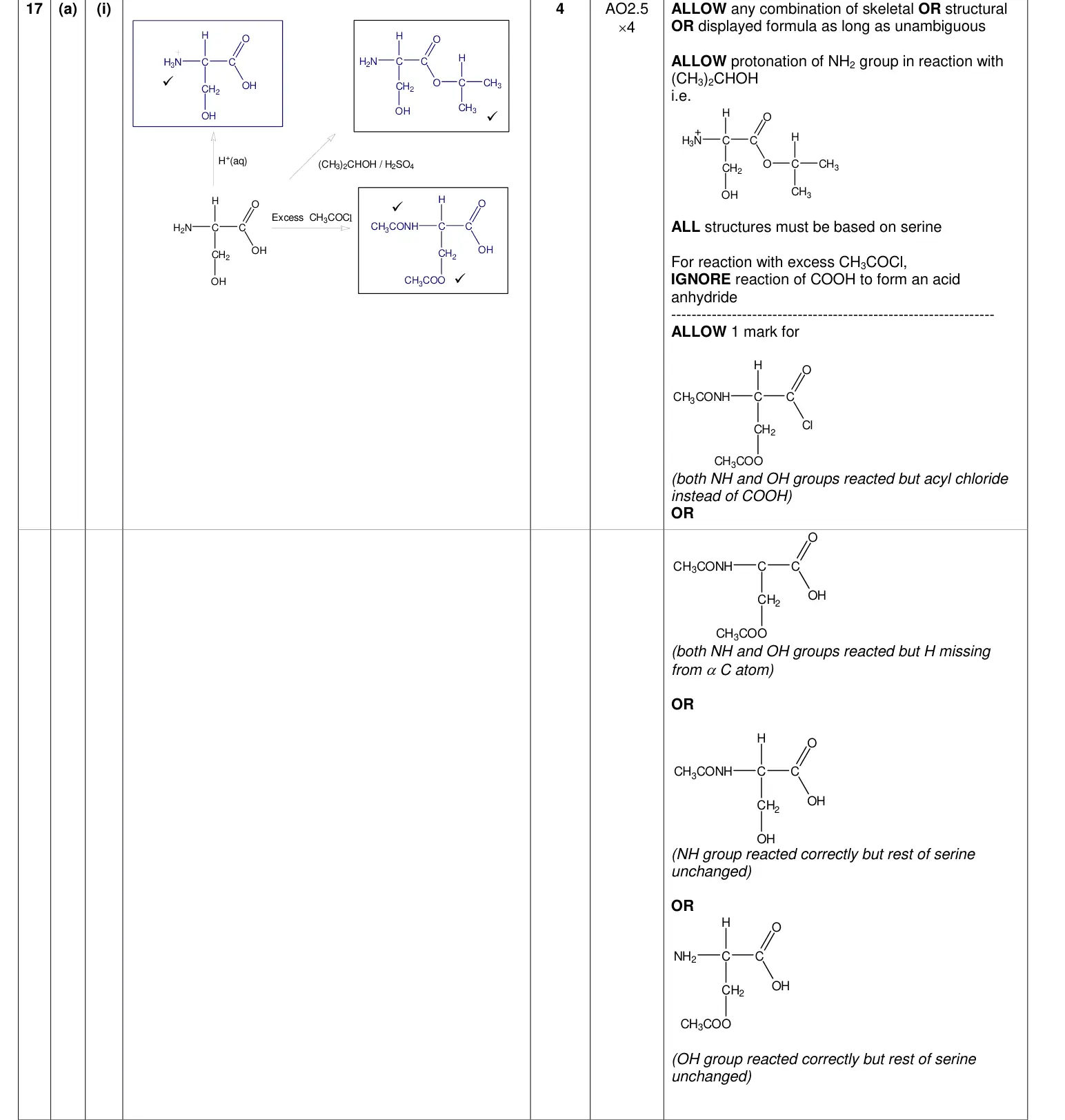
This question focused on the reactions of the different functional groups in serine. Candidates are familiar with these reactions and most candidates scored at least two marks. These were achieved by the formation of the ammonium ion by reaction with H+ and the formation of the ester from (CH3)2CHOH. Determining the organic product from the reaction of serine with excess CH3COCl proved more difficult. Some candidates realised that the OH of serine’s R group would react and others drew the amide formed from the reaction of the NH2 group. The best responses showed both conversions and scored full marks. Lower ability responses often showed organic products containing the Cl atom from the ethanoyl chloride rather than the CH3CO group. This response scored three marks. The candidate has drawn correct organic products for the reaction of serine with H+ and (CH3)2CHOH. The product from the reaction of excess CH3COCl shows the formation of an ester but not the formation of the amide. This product was seen often by examiners and scored one mark. If an amide group had been shown this response would have received full marks. Notice the candidate has presented their organic products clearly with the structures drawn in a similar manner to serine shown in the question. This is a good strategy to avoid errors and omissions when drawing organic structures.
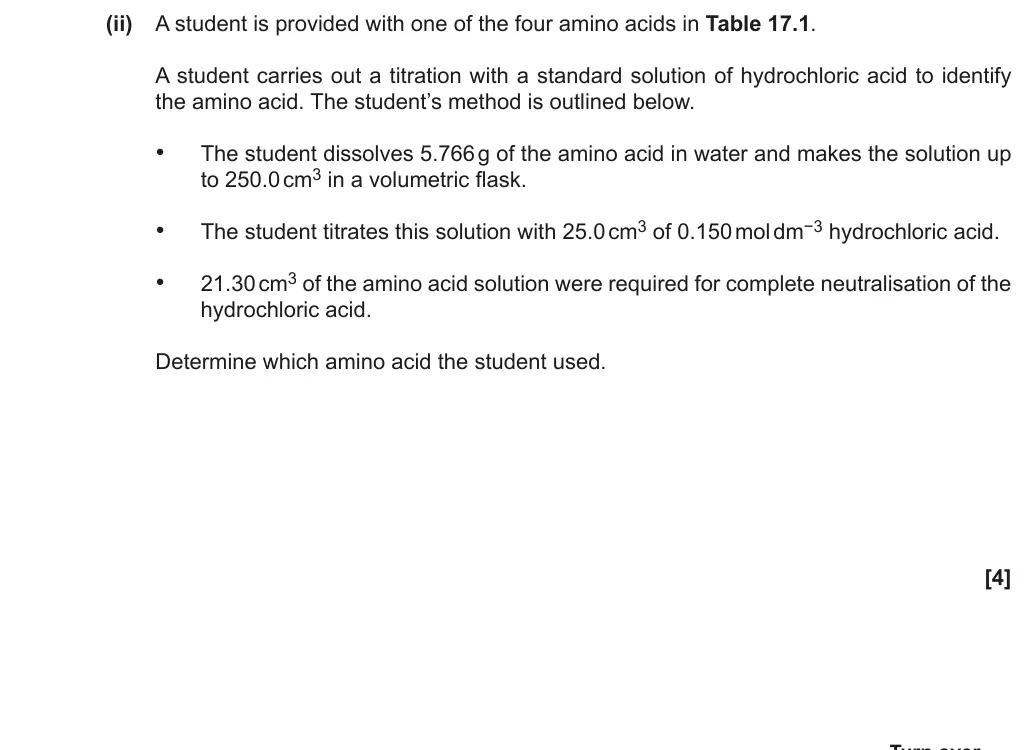
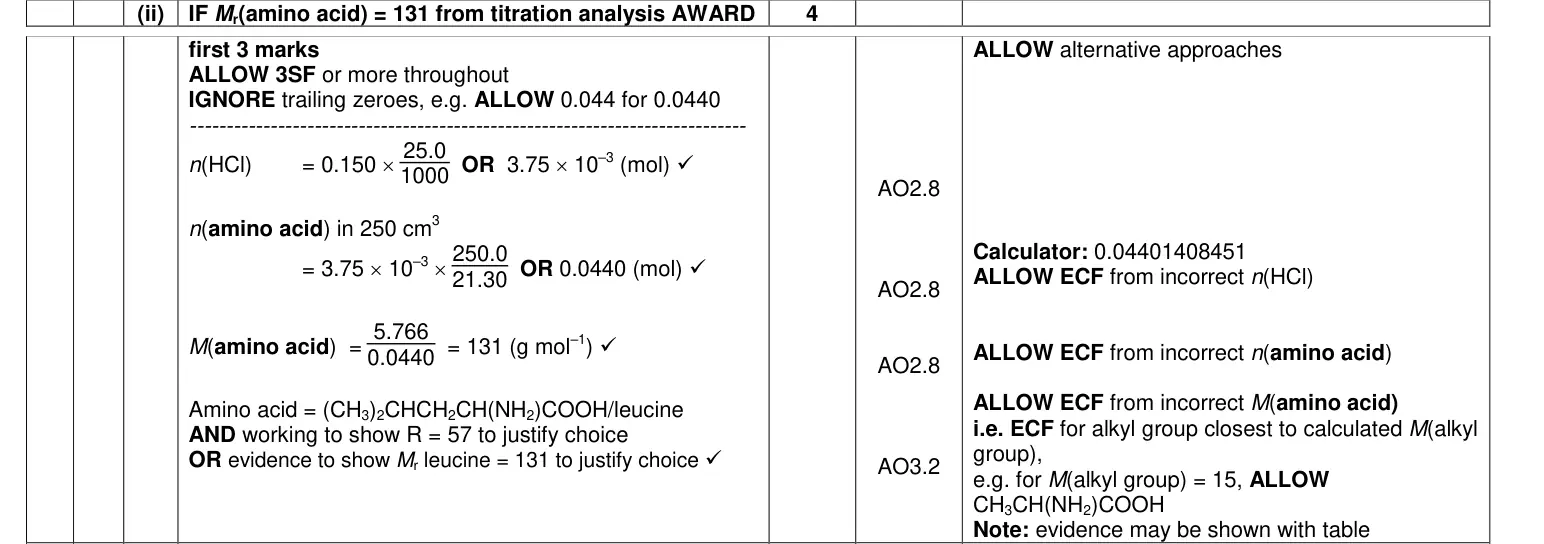
Candidates are confident in tackling titration analysis and the majority of responses were well structured. Most candidates used the results to determine the Mr of the unknown amino acid and hence identify it as leucine. However, other approaches were also seen and these were given full credit if correct. A common error was incorrect scaling to determine the amount of amino acid used to make the 250 cm3 solution. A significant number of responses simply multiplied the number of moles of acid by ten rather than using a factor of 250/21.30. Error carried forward marks were available and so the majority of candidates scored 3 or 4 marks.
Skills: M0.2 Use ratios, fractions and percentages; M1.1 Use an appropriate number of significant figures; M2.3 Substitute numerical values into algebraic equations using appropriate units for physical quantities; PAG2 Acid–base titration
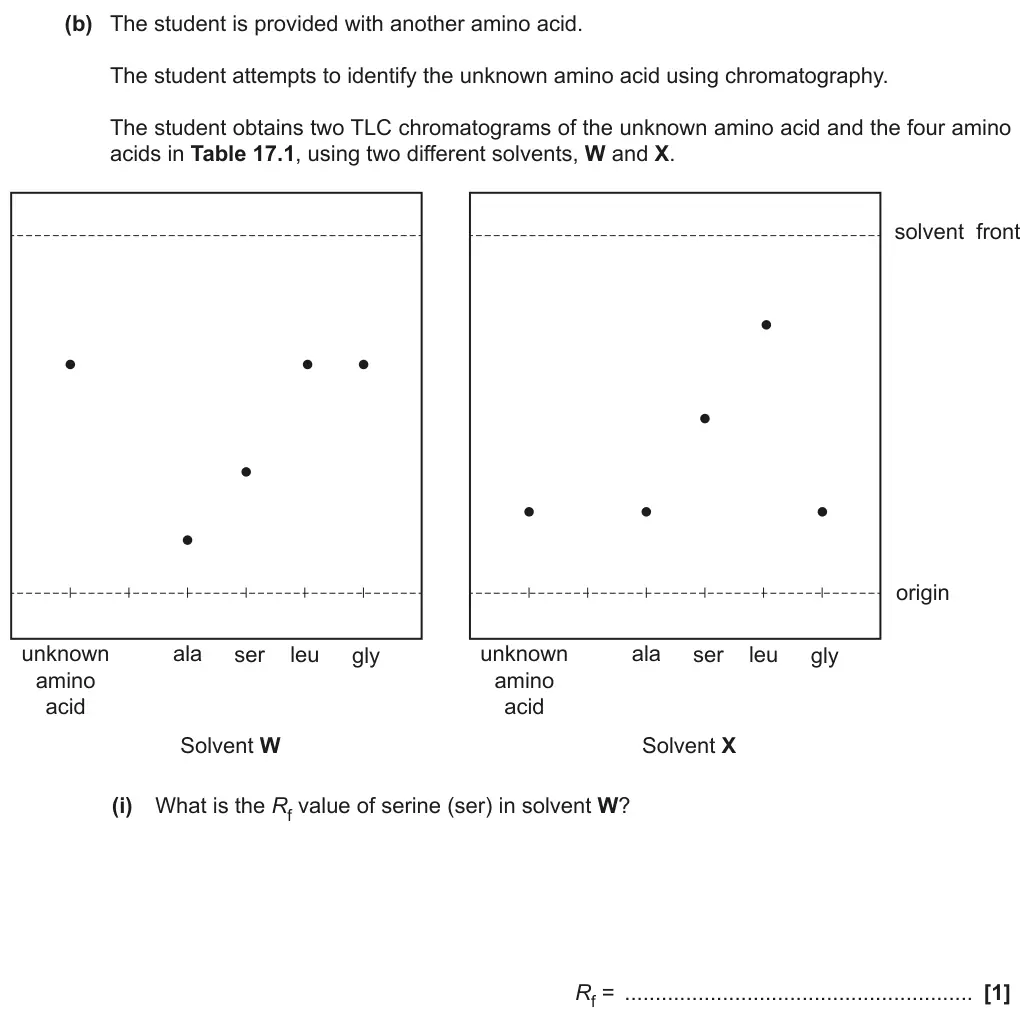
Candidates are familiar with the calculation of Rf values and this question was answered very well. Although almost all candidates showed appropriate working as part of their response some candidates gave the final answer to only one significant figure and did not receive credit. Candidates were expected to give their answer to a number of significant figures appropriate to the measurements they had made, so a minimum of two significant figures was expected. The mark scheme allowed a response within a range, rather than a specific value, and most candidates scored in this part.
Skills: M3.1 Translate information between graphical, numerical and algebraic forms; PAG6 Synthesis of an organic solid
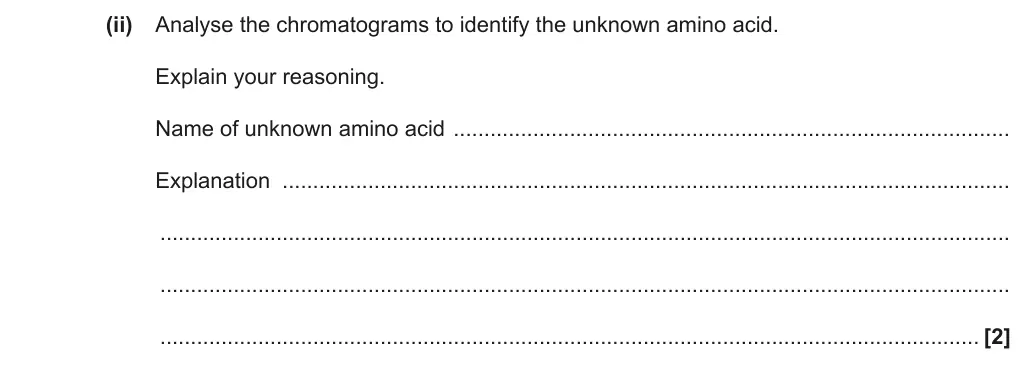
A LEVEL CHEMISTRY A Examiners’ report H432/02 Summer 2019 series Version 1 H432 For first teaching in 2015 www.ocr.org.uk/science Contents Introduction .............................................................................................................................................. 4 Paper 2 series overview ........................................................................................................................... 5 Section A overview ................................................................................................................................... 6 Question 3 ............................................................................................................................................ 6 Question 4 ............................................................................................................................................ 6 Question 5 ............................................................................................................................................ 7 Question 10 .......................................................................................................................................... 8 Question 12 .......................................................................................................................................... 9 Question 13 ........................................................................................................................................ 10 Question 14 ........................................................................................................................................ 10 Question 15 ........................................................................................................................................ 11 Section B overview ................................................................................................................................. 12 Question 16 (a) (i) ............................................................................................................................... 12 Question 16 (a) (ii) .............................................................................................................................. 12 Question 16 (b) (i) ............................................................................................................................... 13 Question 16 (b) (ii) .............................................................................................................................. 14 Question 16 (b) (iv) ............................................................................................................................. 14 Question 16 (b) (v) .............................................................................................................................. 15 Question 17 (a) (i) ............................................................................................................................... 17 Question 17 (a) (ii) .............................................................................................................................. 19 Question 17 (b) (i) ............................................................................................................................... 20 Question 18 (a) (i) ............................................................................................................................... 21 Question 18 (a) (ii) .............................................................................................................................. 22 Question 18 (b) ................................................................................................................................... 23 Question 18 (c) ................................................................................................................................... 23 Question 18 (d) ................................................................................................................................... 24 Question 18 (e) (i) ............................................................................................................................... 24 Question 18 (e) (ii) .............................................................................................................................. 26 Question 19 (a) (i) ............................................................................................................................... 27 Question 19 (a) (ii) .............................................................................................................................. 29 Question 19 (b) (i) ............................................................................................................................... 30 Question 19 (b) (iii) ............................................................................................................................. 32 Question 19 (b) (iv) ............................................................................................................................. 34 Question 20 (a) (i) ............................................................................................................................... 36 Question 20 (a) (ii) .............................................................................................................................. 37 Question 20 (a) (iii) ............................................................................................................................. 37 Question 20 (b) (i) ............................................................................................................................... 38 Question 21 ........................................................................................................................................ 39 Introduction Our examiners’ reports are produced to offer constructive feedback on candidates’ performance in the examinations. Question 17 (b) (i) Candidates are familiar with the calculation of Rf values and this question was answered very well.
Skills: M3.1 Translate information between graphical, numerical and algebraic forms; PAG6 Synthesis of an organic solid
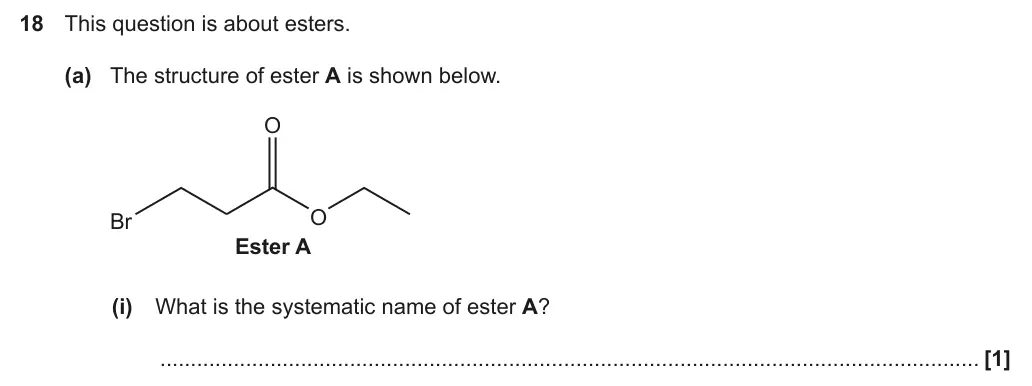
This demanding question discriminated well. The most able candidates were able to apply the nomenclature rules to name ester A correctly as ethyl 3-bromopropanoate. Common incorrect responses included ethyl 1-bromopropanote and ethyl 4-bromopropanoate.
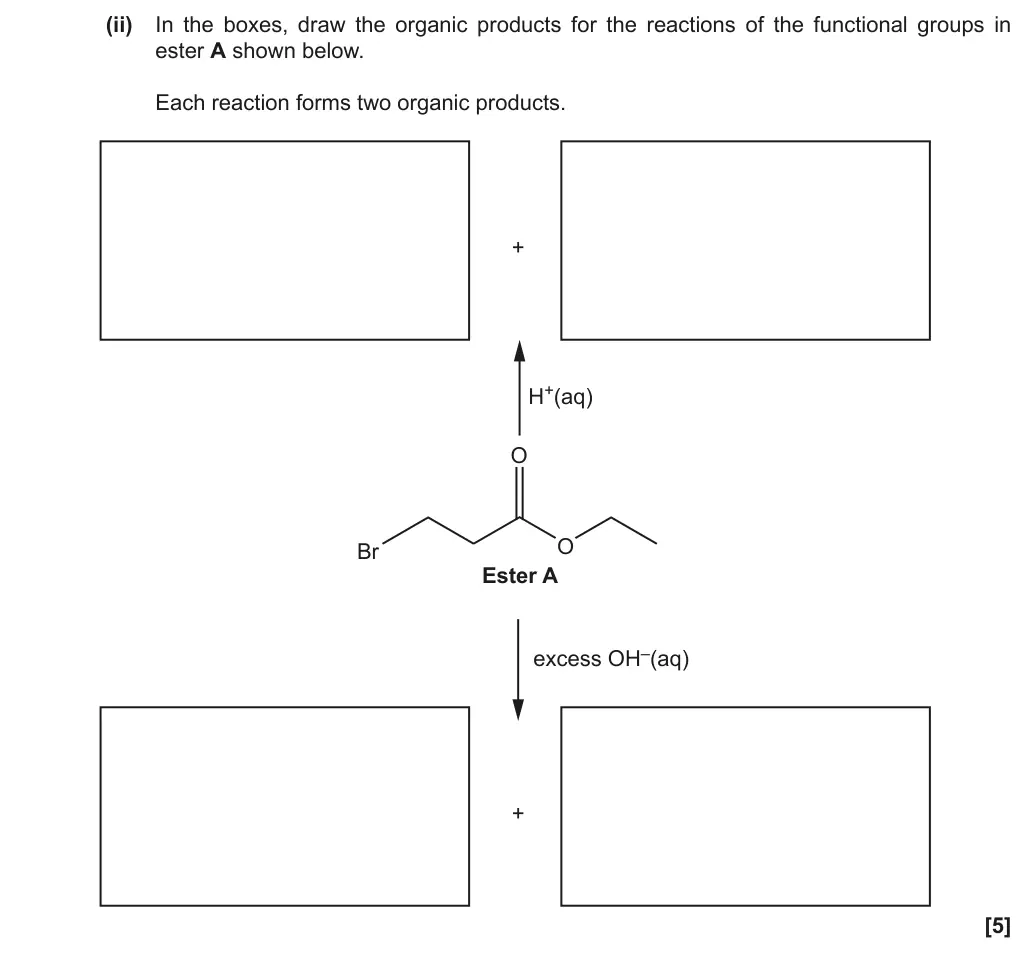
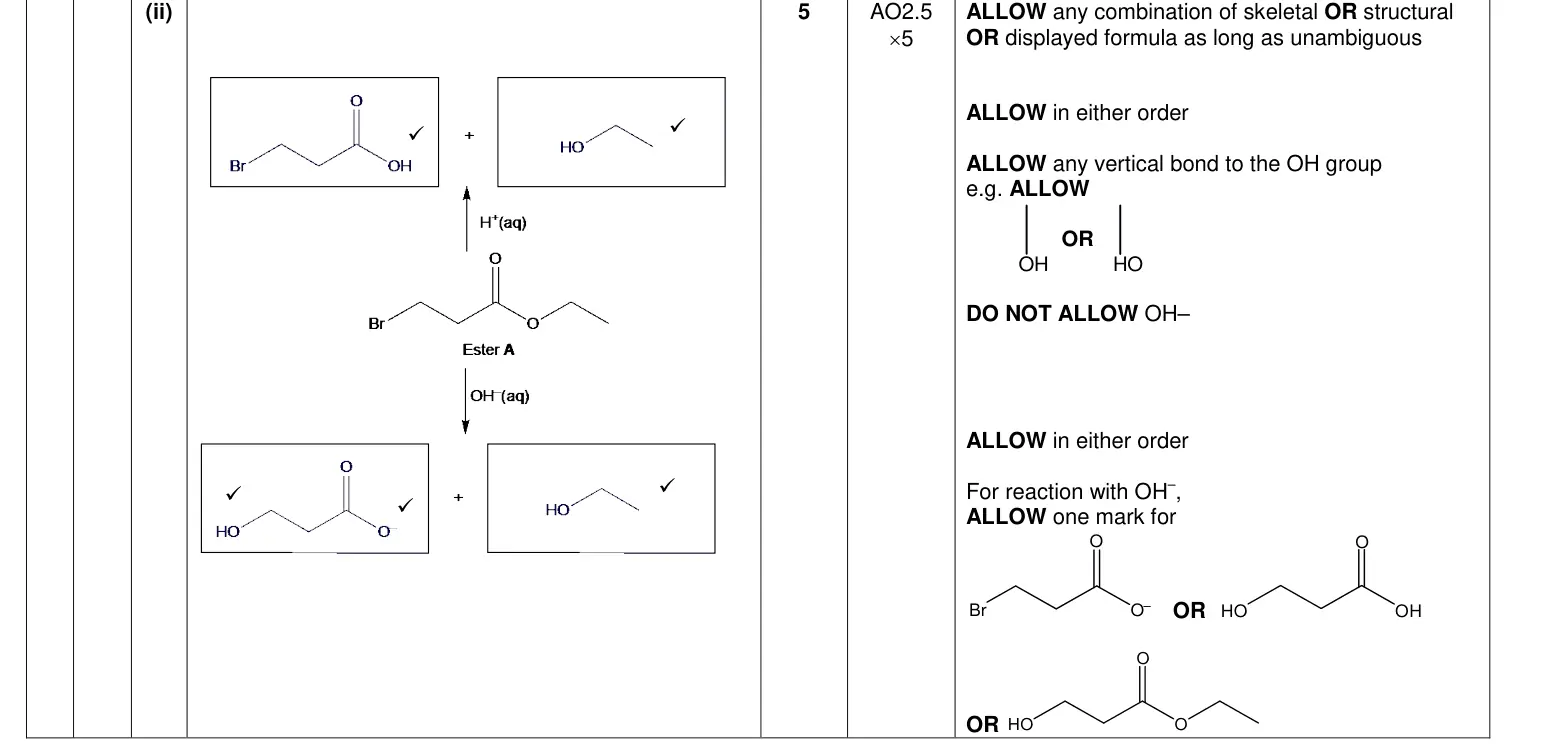
This question required candidates to apply their knowledge of hydrolysis reactions to ester A. The majority of candidates were able to show 3-bromopropanoic acid and ethanol in the top two boxes to secure two marks. The organic products from the alkaline hydrolysis proved more difficult. Many candidates identified ethanol as a product in one of the lower boxes but lower ability responses showed the ethoxide ion. Some candidates drew the 3-bromopropanoate ion as the other product. Higher ability candidates realised that the Br atom would be replaced by an OH group and the best responses showed the correct carboxylate ion. Examiners were encouraged by the number of excellent responses seen and the majority of candidates scored 4 or 5 marks.

A LEVEL CHEMISTRY A Examiners’ report H432/02 Summer 2019 series Version 1 H432 For first teaching in 2015 www.ocr.org.uk/science Contents Introduction .............................................................................................................................................. 4 Paper 2 series overview ........................................................................................................................... 5 Section A overview ................................................................................................................................... 6 Question 3 ............................................................................................................................................ 6 Question 4 ............................................................................................................................................ 6 Question 5 ............................................................................................................................................ 7 Question 10 .......................................................................................................................................... 8 Question 12 .......................................................................................................................................... 9 Question 13 ........................................................................................................................................ 10 Question 14 ........................................................................................................................................ 10 Question 15 ........................................................................................................................................ 11 Section B overview ................................................................................................................................. 12 Question 16 (a) (i) ............................................................................................................................... 12 Question 16 (a) (ii) .............................................................................................................................. 12 Question 16 (b) (i) ............................................................................................................................... 13 Question 16 (b) (ii) .............................................................................................................................. 14 Question 16 (b) (iv) ............................................................................................................................. 14 Question 16 (b) (v) .............................................................................................................................. 15 Question 17 (a) (i) ............................................................................................................................... 17 Question 17 (a) (ii) .............................................................................................................................. 19 Question 17 (b) (i) ............................................................................................................................... 20 Question 18 (a) (i) ............................................................................................................................... 21 Question 18 (a) (ii) .............................................................................................................................. 22 Question 18 (b) ................................................................................................................................... 23 Question 18 (c) ................................................................................................................................... 23 Question 18 (d) ................................................................................................................................... 24 Question 18 (e) (i) ............................................................................................................................... 24 Question 18 (e) (ii) .............................................................................................................................. 26 Question 19 (a) (i) ............................................................................................................................... 27 Question 19 (a) (ii) .............................................................................................................................. 29 Question 19 (b) (i) ............................................................................................................................... 30 Question 19 (b) (iii) ............................................................................................................................. 32 Question 19 (b) (iv) ............................................................................................................................. 34 Question 20 (a) (i) ............................................................................................................................... 36 Question 20 (a) (ii) .............................................................................................................................. 37 Question 20 (a) (iii) ............................................................................................................................. 37 Question 20 (b) (i) ............................................................................................................................... 38 Question 21 ........................................................................................................................................ 39 Introduction Our examiners’ reports are produced to offer constructive feedback on candidates’ performance in the examinations. Question 18 (a) (i) This demanding question discriminated well. Question 18 (a) (ii) This question required candidates to apply their knowledge of hydrolysis reactions to ester A.
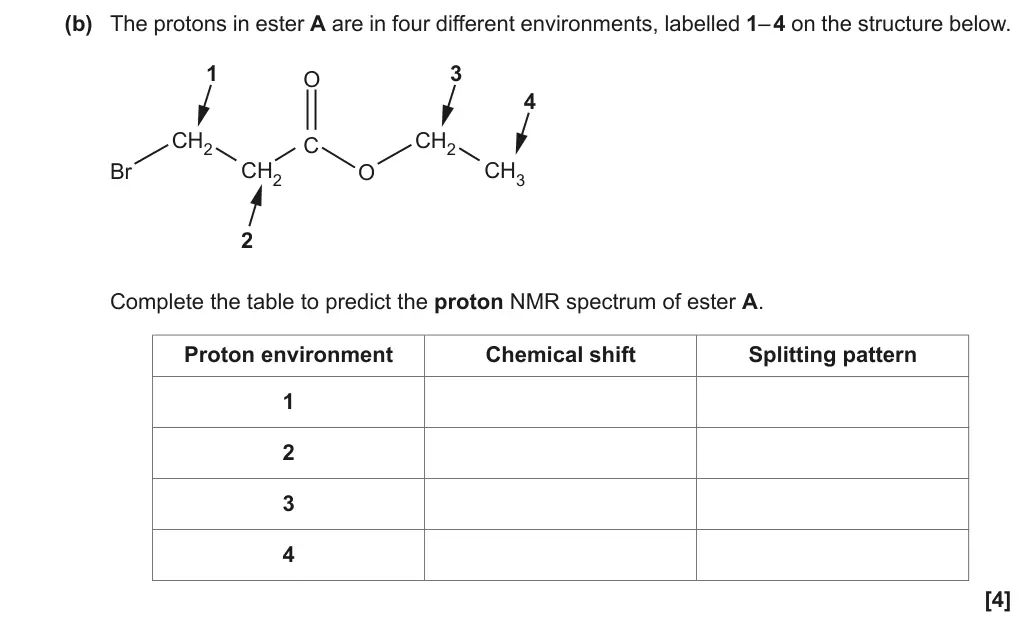
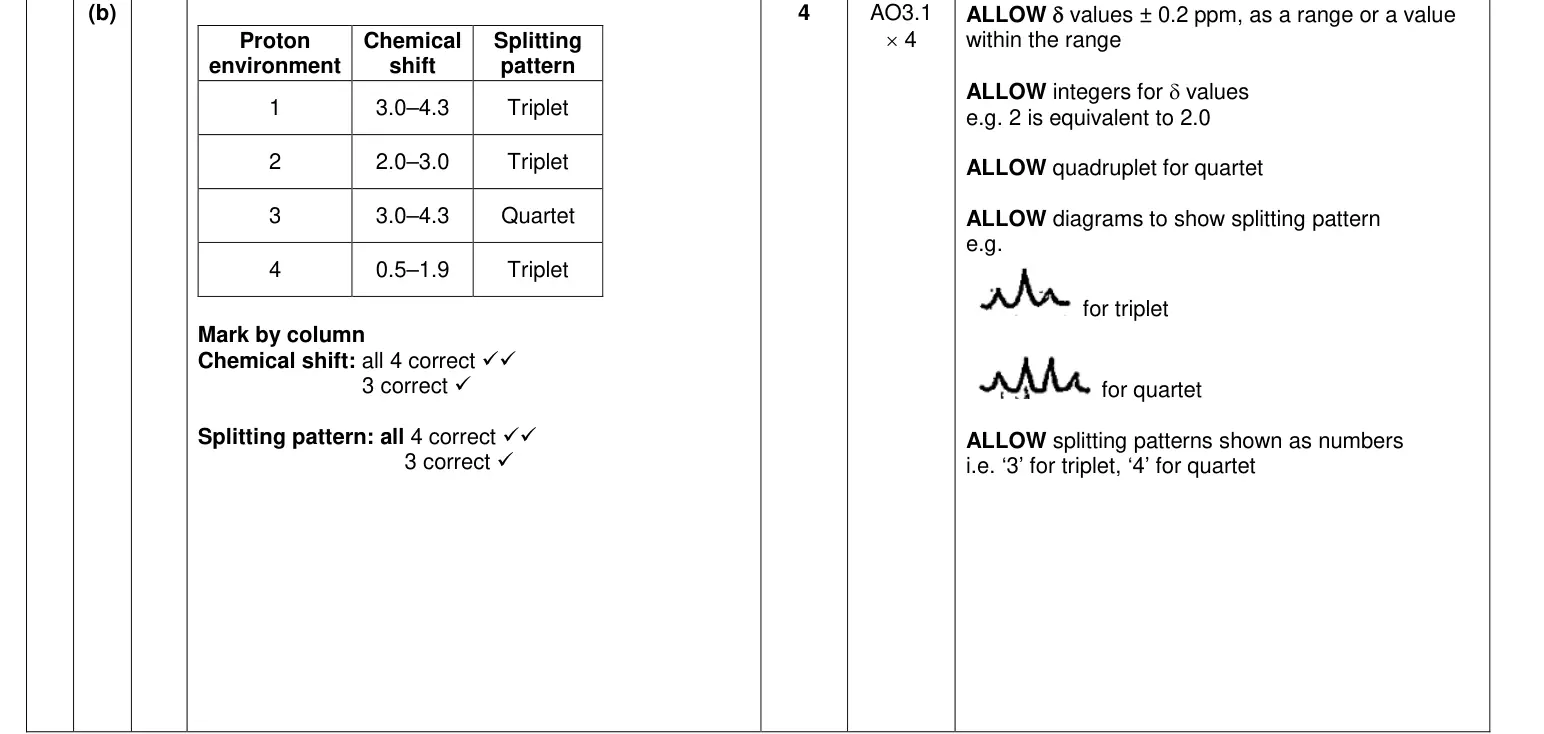
This question was answered well and most candidates scored full marks. A common error was the chemical shift of environment 2, which was sometimes shown as 9.0-10.0. Some candidates gave incorrect splitting patterns for environment 2, stating it would give a singlet, rather than a triplet. This is presumably the result of focusing on the carbon atom to the right of the environment with no H atoms. Candidates should be reminded to consider adjacent carbon atoms on both sides of a particular environment, rather the just looking in one direction.
Skills: M3.1 Translate information between graphical, numerical and algebraic forms
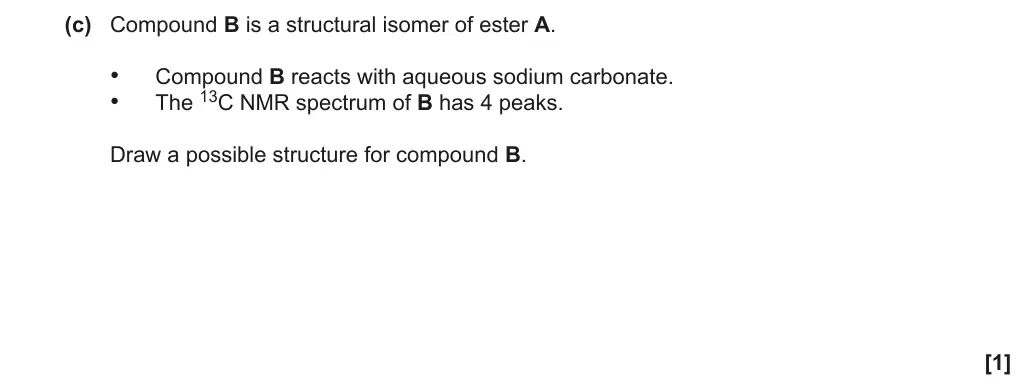
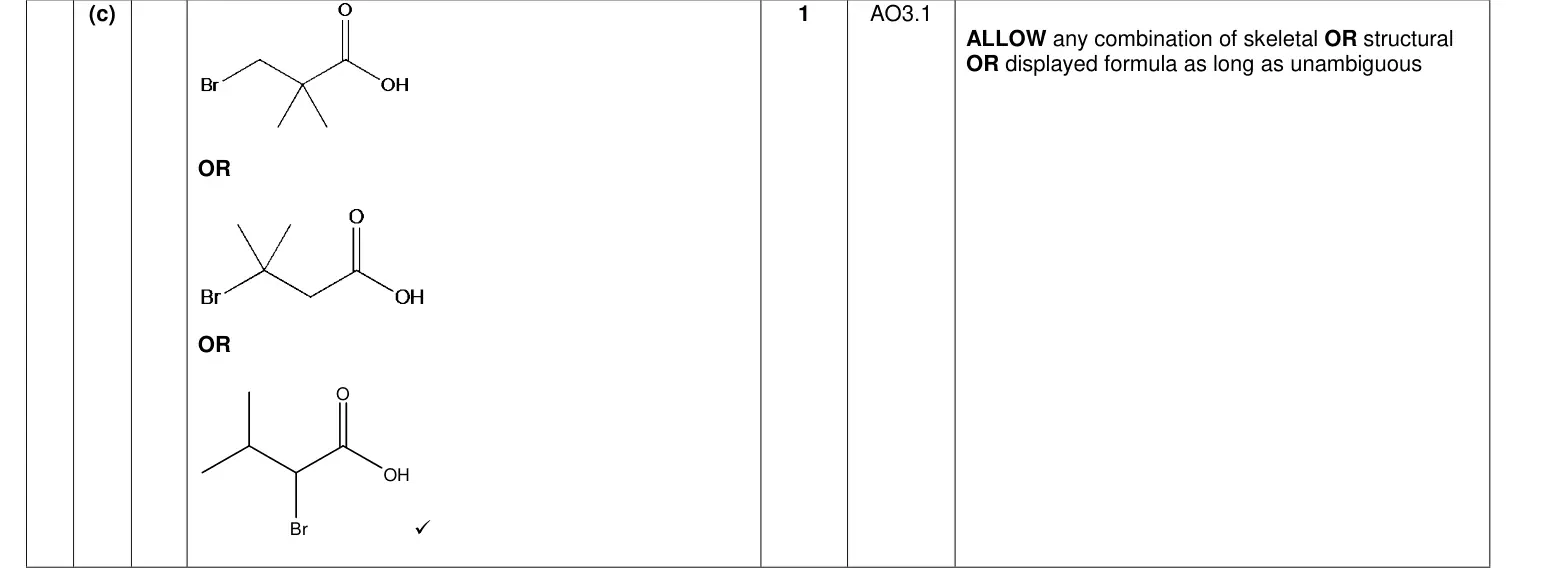
This question required candidates to use both pieces of information to deduce that B was a carboxylic acid with two equivalent carbon atoms. Many candidates were able to suggest a suitable structure. However some candidates did not use all the information and it was common to see responses that showed an ester or a straight chain carboxylic acid.
A LEVEL CHEMISTRY A Examiners’ report H432/02 Summer 2019 series Version 1 H432 For first teaching in 2015 www.ocr.org.uk/science Contents Introduction .............................................................................................................................................. 4 Paper 2 series overview ........................................................................................................................... 5 Section A overview ................................................................................................................................... 6 Question 3 ............................................................................................................................................ 6 Question 4 ............................................................................................................................................ 6 Question 5 ............................................................................................................................................ 7 Question 10 .......................................................................................................................................... 8 Question 12 .......................................................................................................................................... 9 Question 13 ........................................................................................................................................ 10 Question 14 ........................................................................................................................................ 10 Question 15 ........................................................................................................................................ 11 Section B overview ................................................................................................................................. 12 Question 16 (a) (i) ............................................................................................................................... 12 Question 16 (a) (ii) .............................................................................................................................. 12 Question 16 (b) (i) ............................................................................................................................... 13 Question 16 (b) (ii) .............................................................................................................................. 14 Question 16 (b) (iv) ............................................................................................................................. 14 Question 16 (b) (v) .............................................................................................................................. 15 Question 17 (a) (i) ............................................................................................................................... 17 Question 17 (a) (ii) .............................................................................................................................. 19 Question 17 (b) (i) ............................................................................................................................... 20 Question 18 (a) (i) ............................................................................................................................... 21 Question 18 (a) (ii) .............................................................................................................................. 22 Question 18 (b) ................................................................................................................................... 23 Question 18 (c) ................................................................................................................................... 23 Question 18 (d) ................................................................................................................................... 24 Question 18 (e) (i) ............................................................................................................................... 24 Question 18 (e) (ii) .............................................................................................................................. 26 Question 19 (a) (i) ............................................................................................................................... 27 Question 19 (a) (ii) .............................................................................................................................. 29 Question 19 (b) (i) ............................................................................................................................... 30 Question 19 (b) (iii) ............................................................................................................................. 32 Question 19 (b) (iv) ............................................................................................................................. 34 Question 20 (a) (i) ............................................................................................................................... 36 Question 20 (a) (ii) .............................................................................................................................. 37 Question 20 (a) (iii) ............................................................................................................................. 37 Question 20 (b) (i) ............................................................................................................................... 38 Question 21 ........................................................................................................................................ 39 Introduction Our examiners’ reports are produced to offer constructive feedback on candidates’ performance in the examinations. Question 18 (d) Question 18 (e) (i) This question was marked using a level of response mark scheme.
Skills: M0.2 Use ratios, fractions and percentages
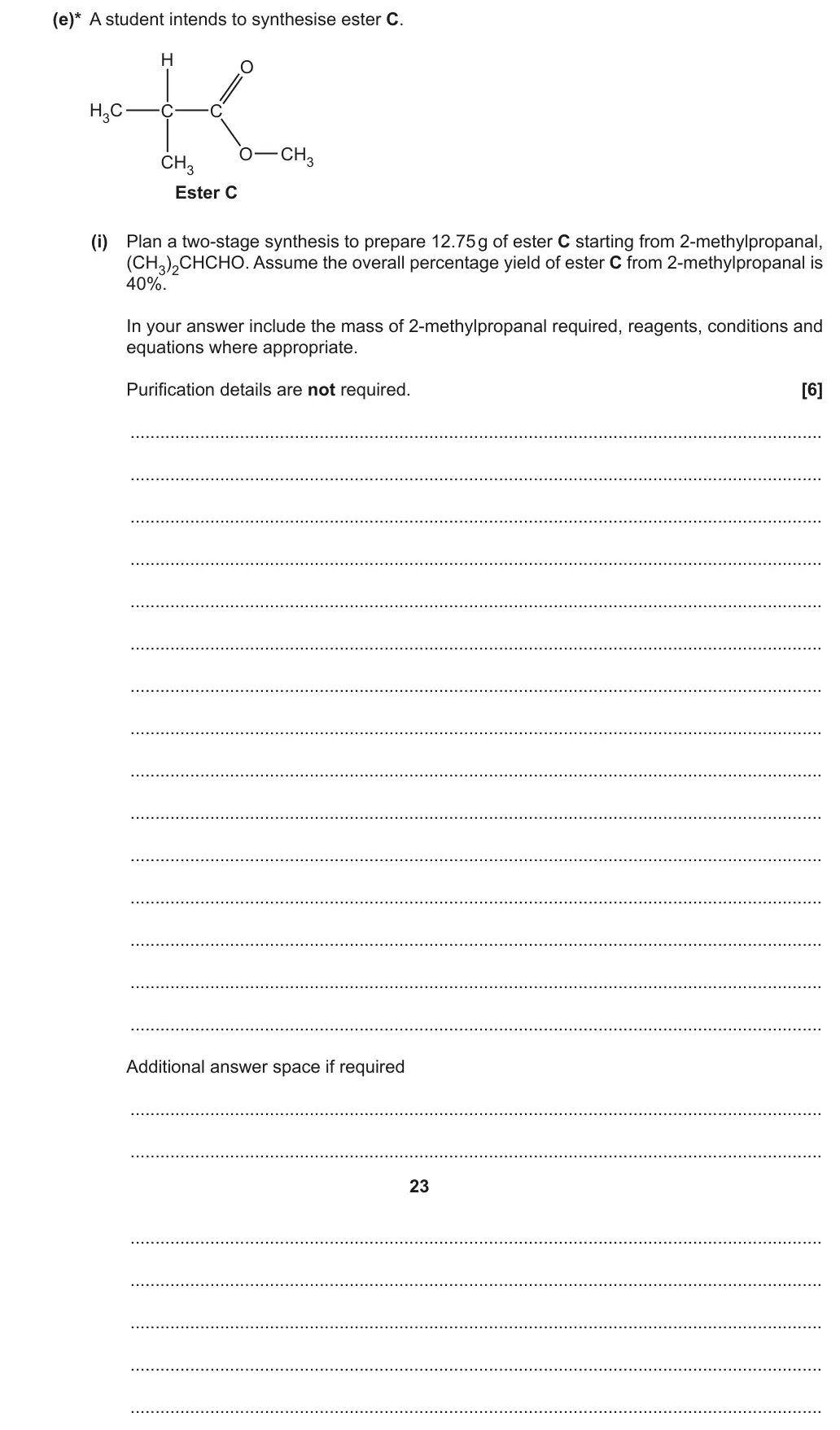
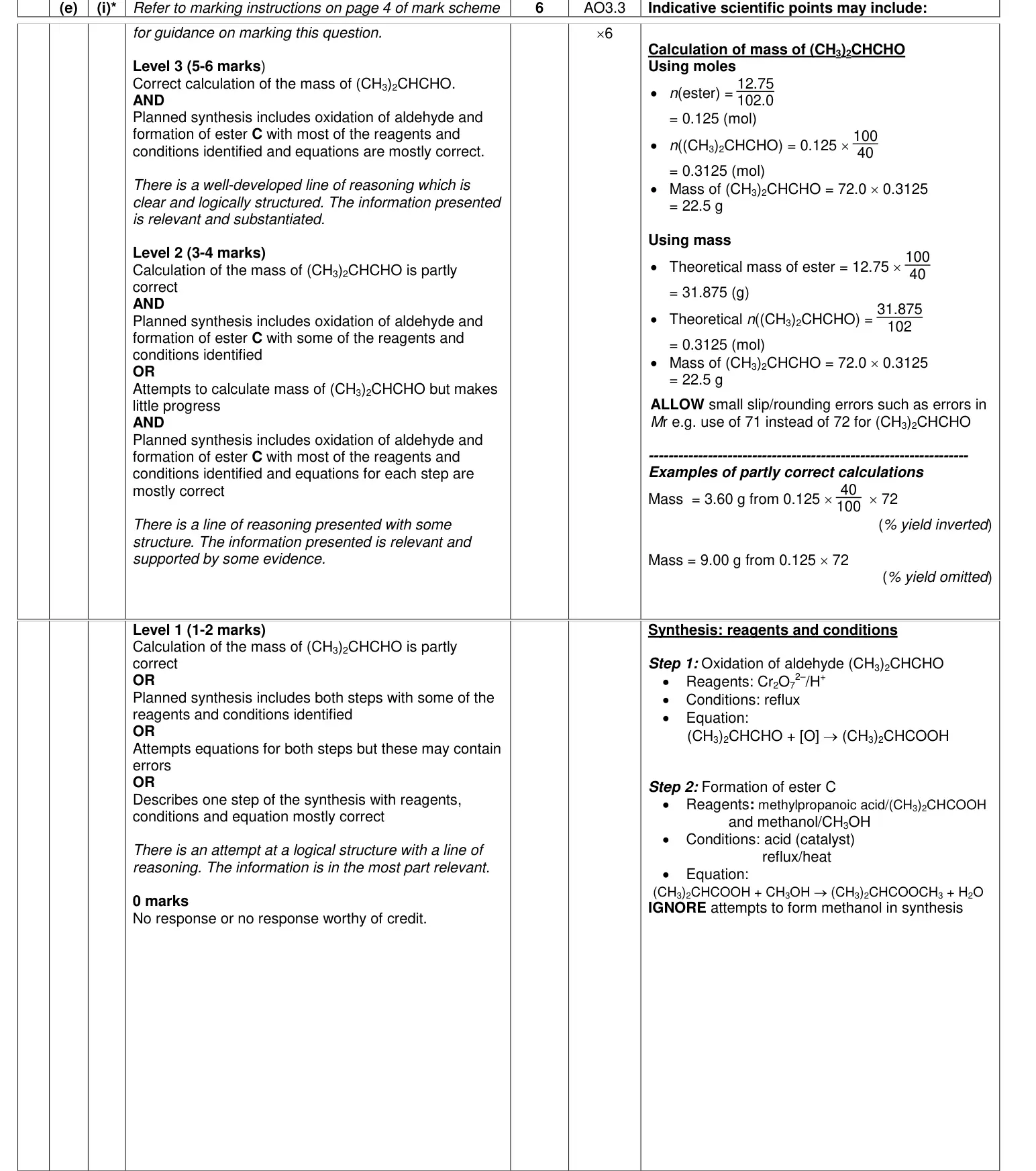
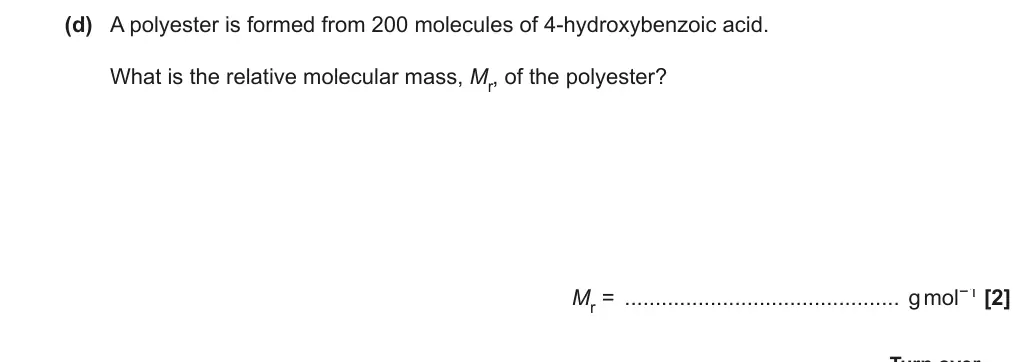
This question was marked using a level of response mark scheme. Most candidates gave a response worthy of at least Level 2 (3-4 marks) by either providing the synthetic steps with reagents and/or equations for the synthesis of ester C as well as calculating the mass of 2-methylpropanal required. determined the mass correctly and showed the synthesis efficiently, using equations to communicate the preparation of ester C and received Level 3 (5-6 marks). Some responses focused solely on the 2- methylpropanal and suggested it would be both oxidised and reduced with each of the products being used to form an ester. Others omitted the mass calculation or gave only a partial synthesis. Such responses received Level 1 (1-2 marks). A variety of responses was seen in this demanding question. In general candidates adopted one of two approaches. The most common was to multiply the Mr of 2-hydroxybenzoic acid by 200 and then subtract the mass of the 199 water molecules removed during polymerisation. The other approach used the Mr of the repeat unit. This was multiplied by 200 and the mass of H and OH at each end of the polymer was added to give the final answer. Many candidates were successful with the first step of their approach, but the best responses included the second step taking into account the Mr of water. A significant number of candidates used an incorrect value for the Mr in their first step. Candidates are advised to draw out the structure of a compound before determining the Mr. This is particularly important when only a name is given in the question. This response includes an excellent description of the synthesis of ester C. Each step is labelled clearly with the most of the reagents and conditions stated and correct equations. The candidate makes little progress with the calculation of the mass of 2-methylpropanal required, completing only the first step. This response satisfies the Level 2 criteria. The information is provided is relevant and presented with a clear logical structure and was therefore given the upper mark within the level and achieved four marks. The presentation of the synthesis by equations rather than words is an excellent strategy. Candidates are advised to adopt such an approach in questions like this as it allows them develop and clear line of reasoning without the need to write lots of unnecessary text.
Skills: M0.2 Use ratios, fractions and percentages; M2.3 Substitute numerical values into algebraic equations using appropriate units for physical quantities
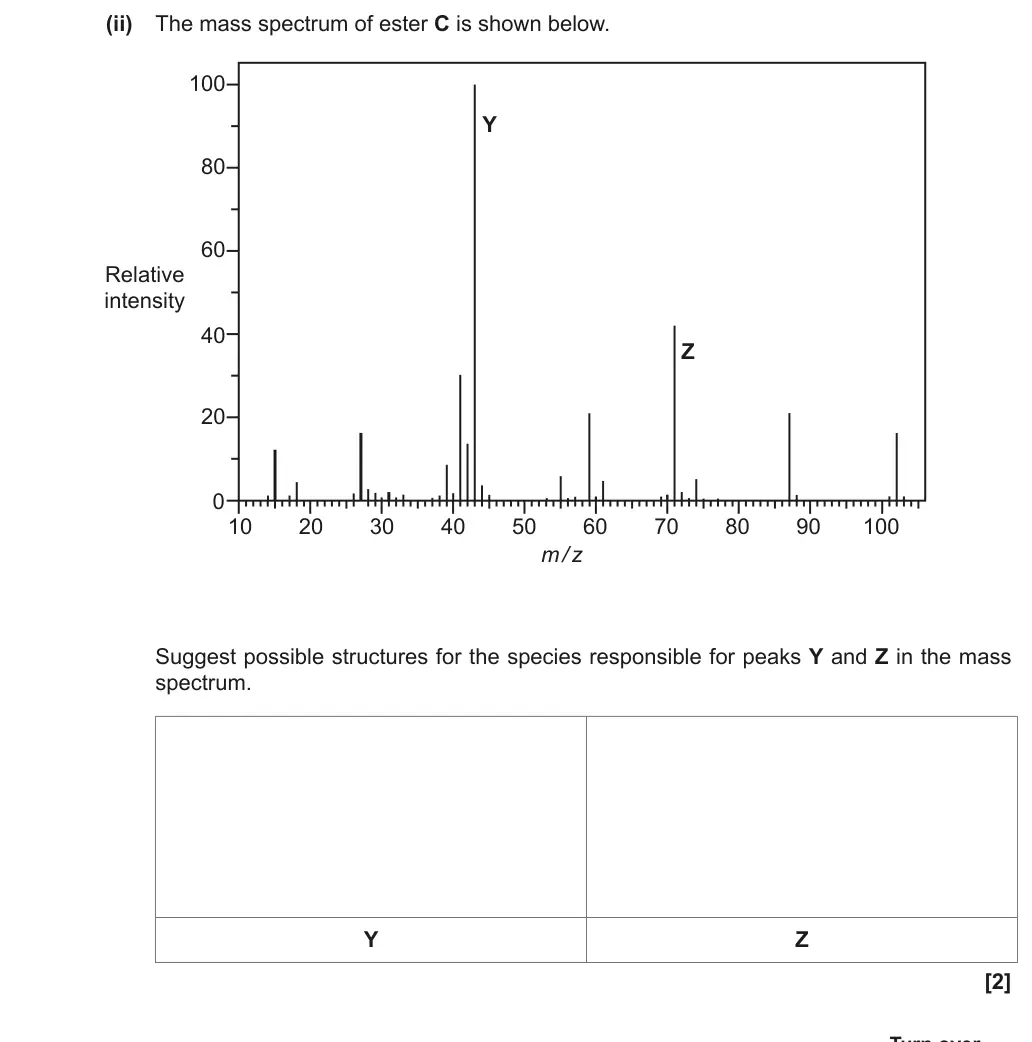
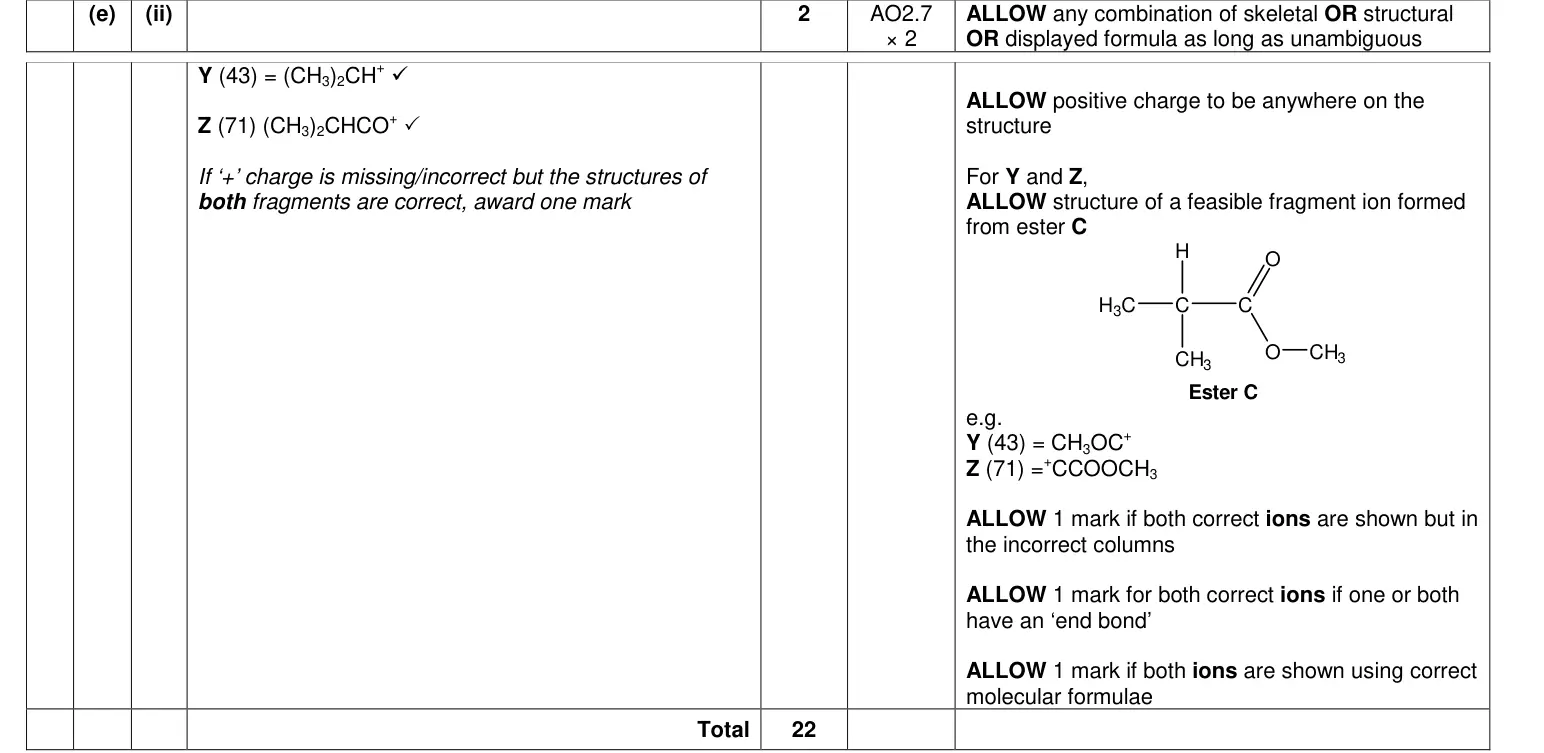
Most candidates were able to provide a correct structure for each of the ions responsible for the peaks labelled Y and Z. Some candidates omitted the charge, or included ‘end bonds’. These responses were able to achieve one mark if both fragments were correct. So the majority of candidates scored one or two marks in this part.
Skills: M3.1 Translate information between graphical, numerical and algebraic forms
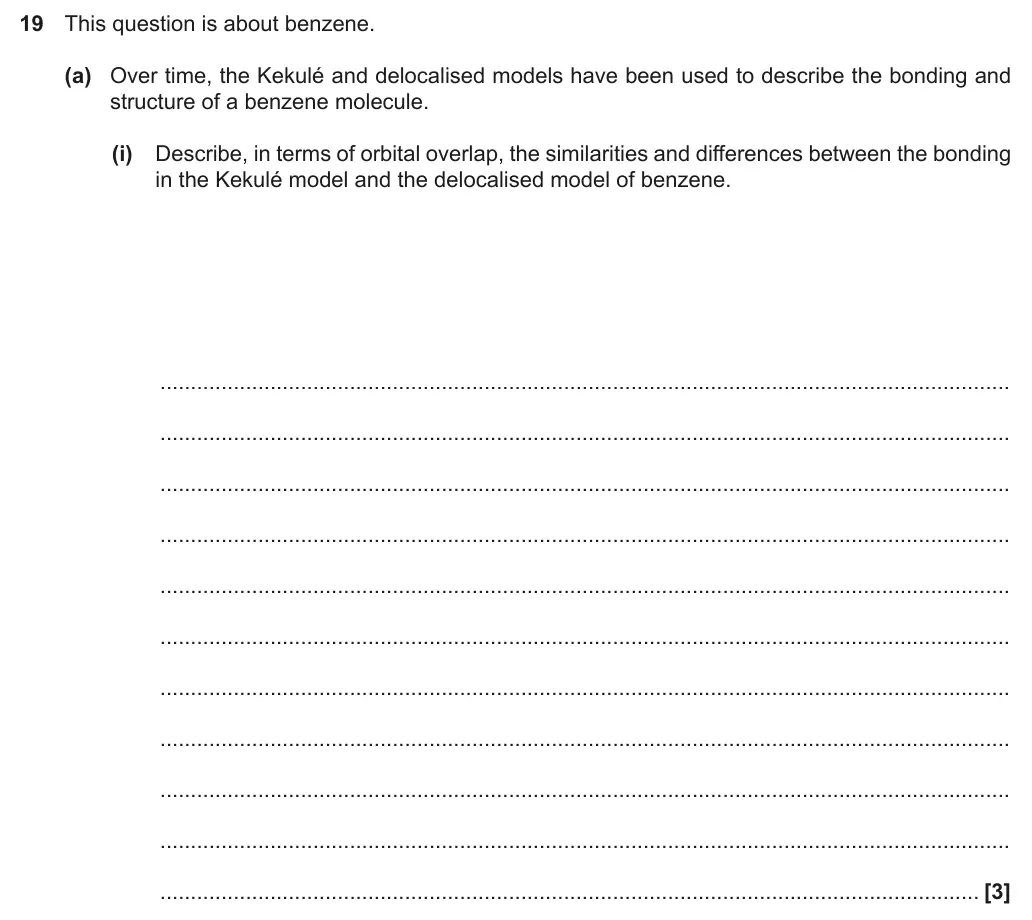
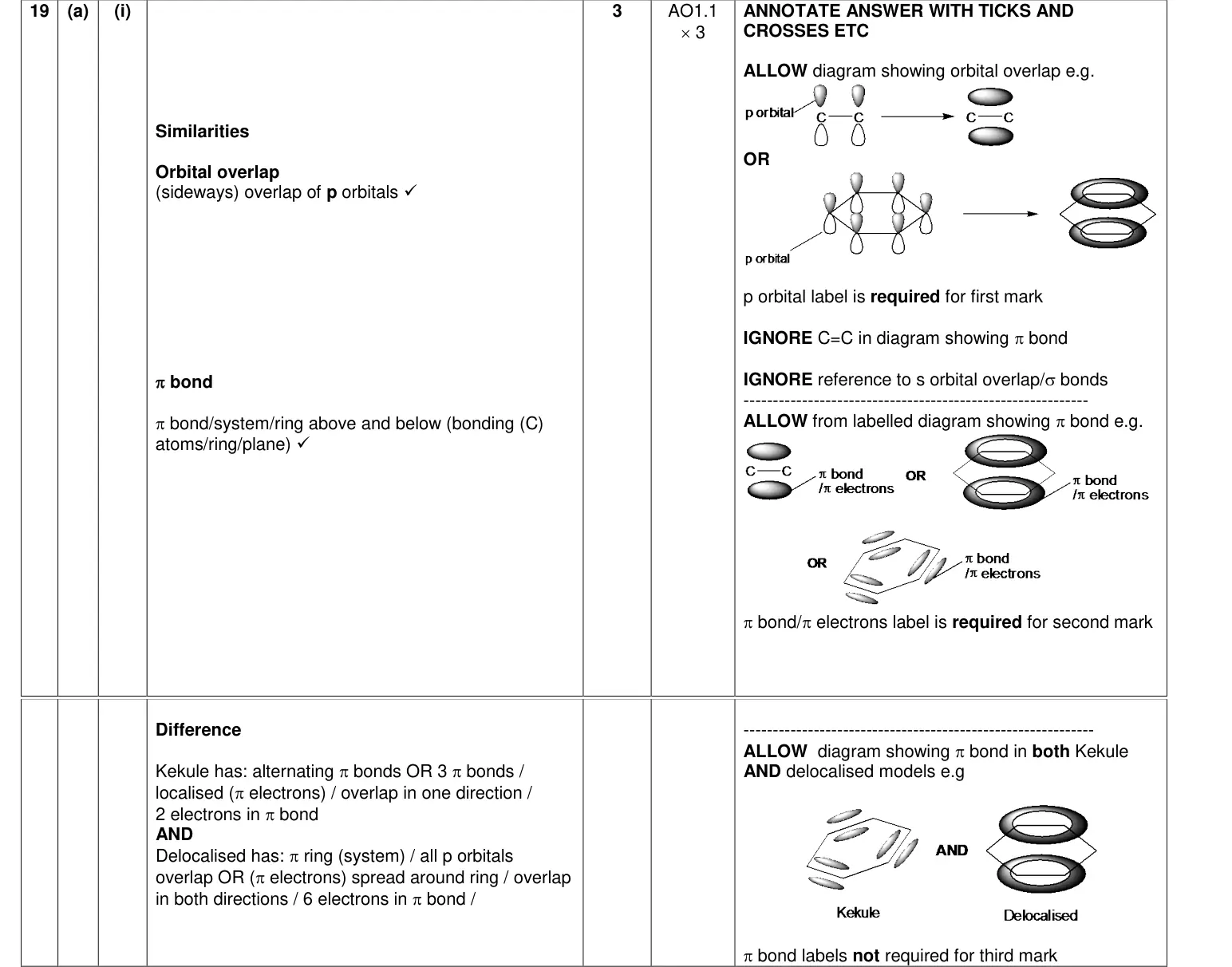
Candidates found this question difficult. The majority of the cohort referred to the overlap of p orbitals in either the Kekulé or delocalised model. The best responses developed this idea further and made reference to π bonds above and below the bonding carbon atoms. Although some candidates were able describe the difference between the two models, the responses of others lacked detail. Describing conceptual ideas, such as orbital overlap and π bonds, is understandably tricky. Candidates are advised to draw diagrams. These serve as a good basis from which to construct a written response. Exemplar 5 shows how effective the use of diagrams can be. This response starts with a diagram for both the Kekulé and delocalised models of benzene. Each diagram is clear and shows the p orbitals and π bonds separately. This is an excellent response for future candidates to follow. The candidate’s written response is effectively a description of the diagrams they have drawn and describes the similarities and differences between these two models clearly. This response scored full marks and demonstrates the best style of response seen in this part.
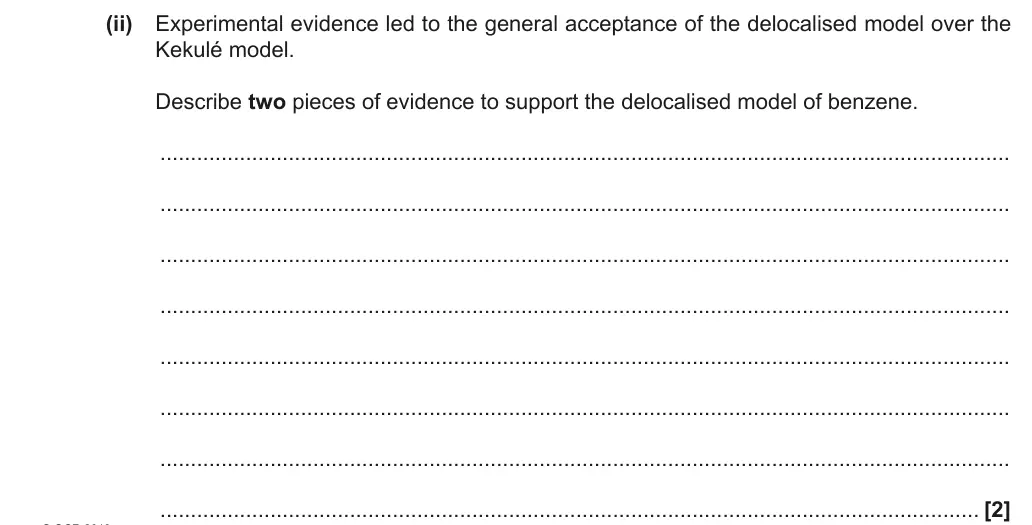
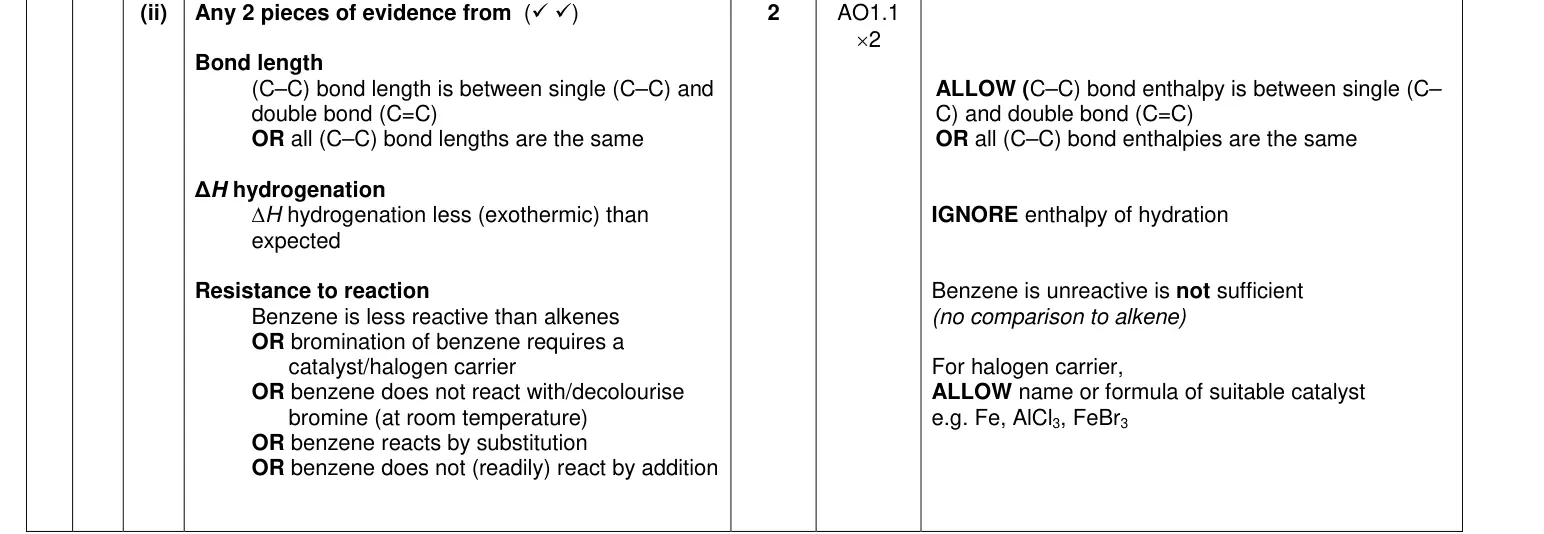
Candidates were well prepared for this question and the majority of the cohort scored two marks. The most common piece of evidence given was the lack of reactivity of benzene with bromine, with candidates citing the need for a catalyst for the reaction to occur. Responses also included reference to carbon-carbon bond lengths as well as the enthalpy of hydrogenation. A small but significant proportion of the cohort referred to hydration rather than hydrogenation.
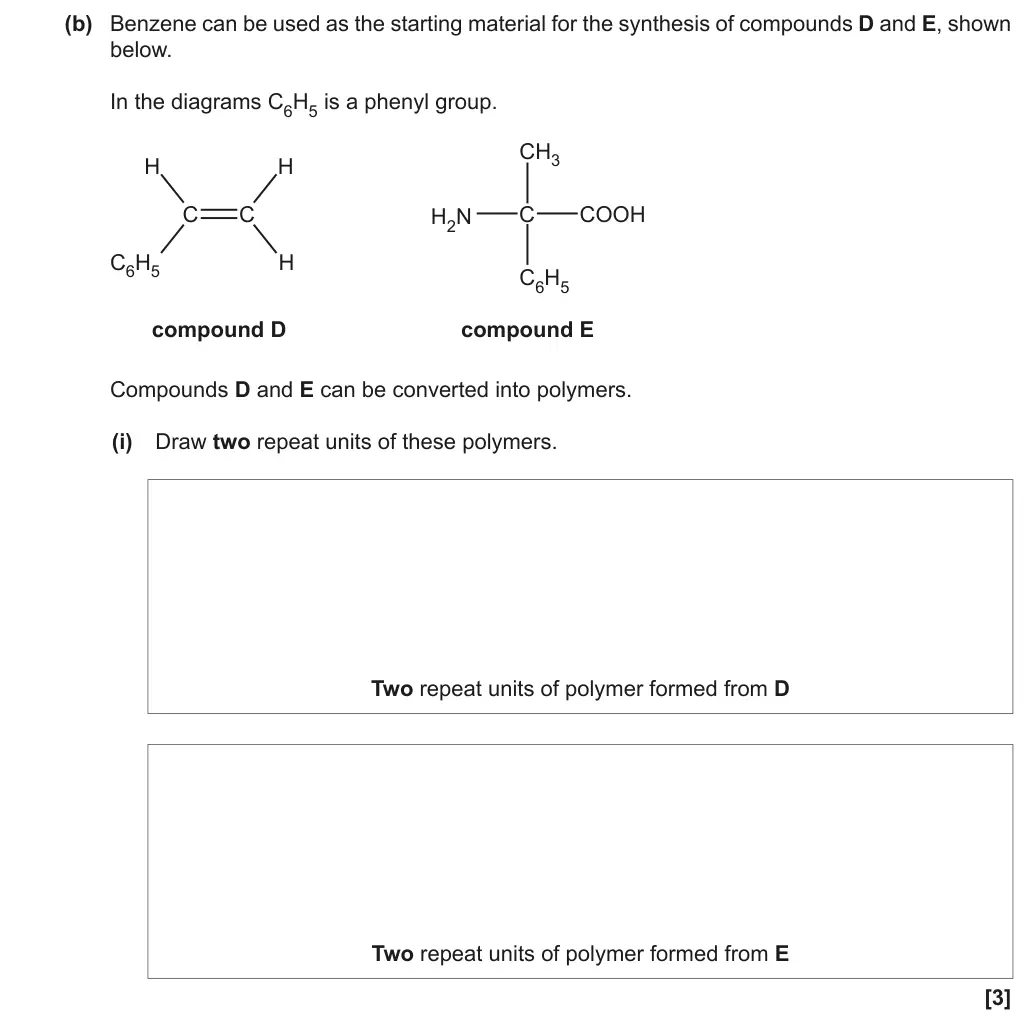
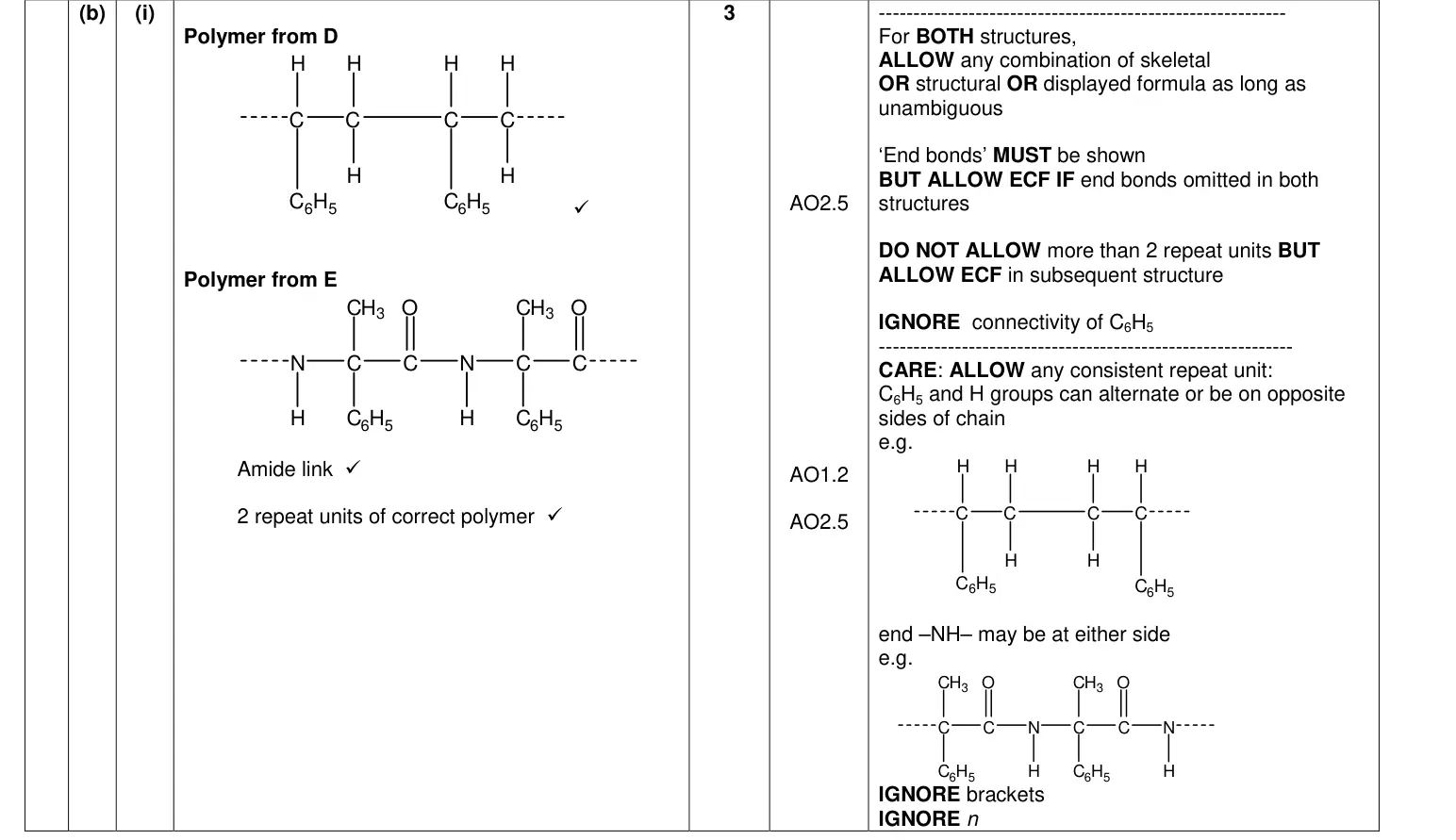
The majority of candidates were able to draw two repeats units of the polymer formed from D and scored at least one mark. While most candidates drew the polymer from E correctly, securing full marks, some candidates were unable to show the amide link correctly. This common error is demonstrated in This response demonstrates a common error seen by examiners. The candidate has included an O atom as part of the amide link. So they have also included an O atom before the ‘end bond’. This is a costly error as the candidate is unable to be given either of the marks available for this polymer.
A LEVEL CHEMISTRY A Examiners’ report H432/02 Summer 2019 series Version 1 H432 For first teaching in 2015 www.ocr.org.uk/science Contents Introduction .............................................................................................................................................. 4 Paper 2 series overview ........................................................................................................................... 5 Section A overview ................................................................................................................................... 6 Question 3 ............................................................................................................................................ 6 Question 4 ............................................................................................................................................ 6 Question 5 ............................................................................................................................................ 7 Question 10 .......................................................................................................................................... 8 Question 12 .......................................................................................................................................... 9 Question 13 ........................................................................................................................................ 10 Question 14 ........................................................................................................................................ 10 Question 15 ........................................................................................................................................ 11 Section B overview ................................................................................................................................. 12 Question 16 (a) (i) ............................................................................................................................... 12 Question 16 (a) (ii) .............................................................................................................................. 12 Question 16 (b) (i) ............................................................................................................................... 13 Question 16 (b) (ii) .............................................................................................................................. 14 Question 16 (b) (iv) ............................................................................................................................. 14 Question 16 (b) (v) .............................................................................................................................. 15 Question 17 (a) (i) ............................................................................................................................... 17 Question 17 (a) (ii) .............................................................................................................................. 19 Question 17 (b) (i) ............................................................................................................................... 20 Question 18 (a) (i) ............................................................................................................................... 21 Question 18 (a) (ii) .............................................................................................................................. 22 Question 18 (b) ................................................................................................................................... 23 Question 18 (c) ................................................................................................................................... 23 Question 18 (d) ................................................................................................................................... 24 Question 18 (e) (i) ............................................................................................................................... 24 Question 18 (e) (ii) .............................................................................................................................. 26 Question 19 (a) (i) ............................................................................................................................... 27 Question 19 (a) (ii) .............................................................................................................................. 29 Question 19 (b) (i) ............................................................................................................................... 30 Question 19 (b) (iii) ............................................................................................................................. 32 Question 19 (b) (iv) ............................................................................................................................. 34 Question 20 (a) (i) ............................................................................................................................... 36 Question 20 (a) (ii) .............................................................................................................................. 37 Question 20 (a) (iii) ............................................................................................................................. 37 Question 20 (b) (i) ............................................................................................................................... 38 Question 21 ........................................................................................................................................ 39 Introduction Our examiners’ reports are produced to offer constructive feedback on candidates’ performance in the examinations. Question 19 (b) (i) The majority of candidates were able to draw two repeats units of the polymer formed from D and scored at least one mark. Question 19 (b) (iii) This question required candidates to apply their knowledge of the mechanism of electrophilic substitution to the formation of phenylethanone from benzene. Question 19 (b) (iv) This question required candidates to apply knowledge of organic reactions from across the specification and discriminated well.
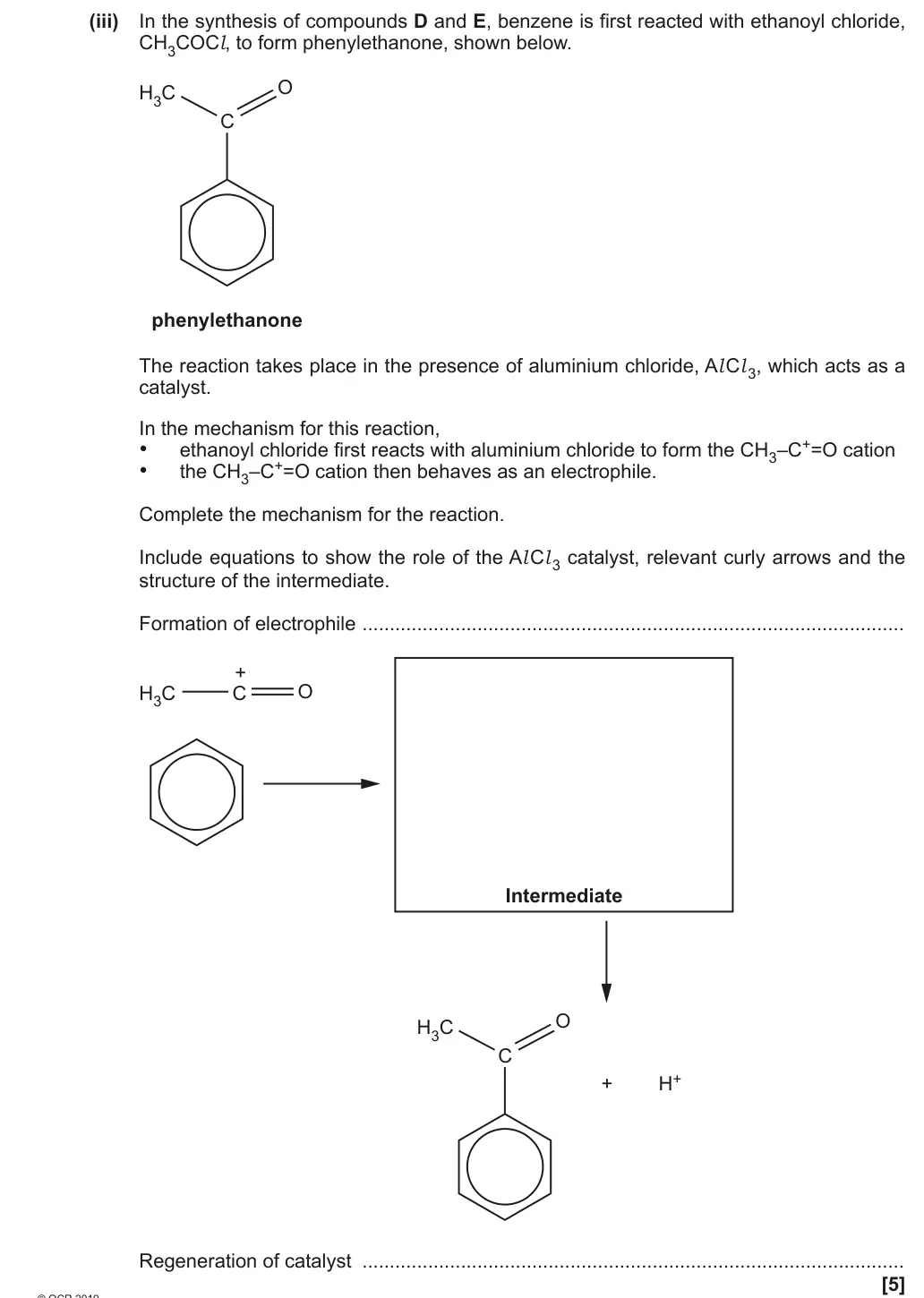
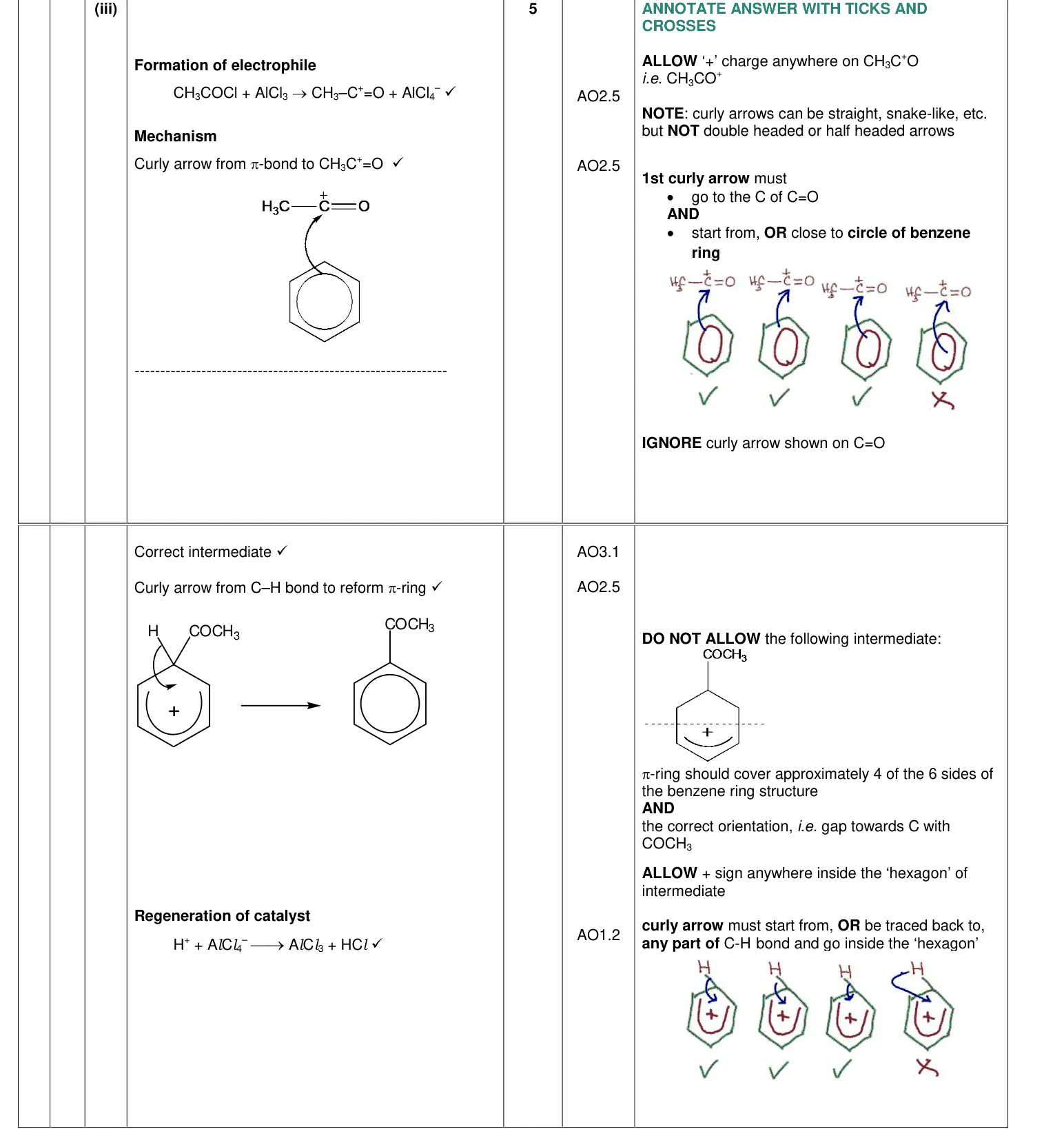
This question required candidates to apply their knowledge of the mechanism of electrophilic substitution to the formation of phenylethanone from benzene. Examiners were encouraged by the number of excellent responses to this question, with the majority of candidates securing four out of five marks. Common errors included accuracy of curly arrows (Exemplar 7 below) and omission of HCl as product from the regeneration of the catalyst. The responses of lower ability candidates also contained errors in the equation for the formation of the electrophile. Such responses used chlorine rather than ethanoyl chloride. This response demonstrates a near perfect attempt at this question. The equations for the formation of the electrophile and regeneration of the catalyst are correct. The first curly arrow is drawn accurately from the circle of the benzene ring to the correct carbon atom of the electrophile. The intermediate is correct, with the π ring over the five carbon atoms and in the correct orientation. Unfortunately the curly arrow drawn to reform the π bond starts at the H atom rather than from the bond. This small error has prevented this candidate from being given full marks.
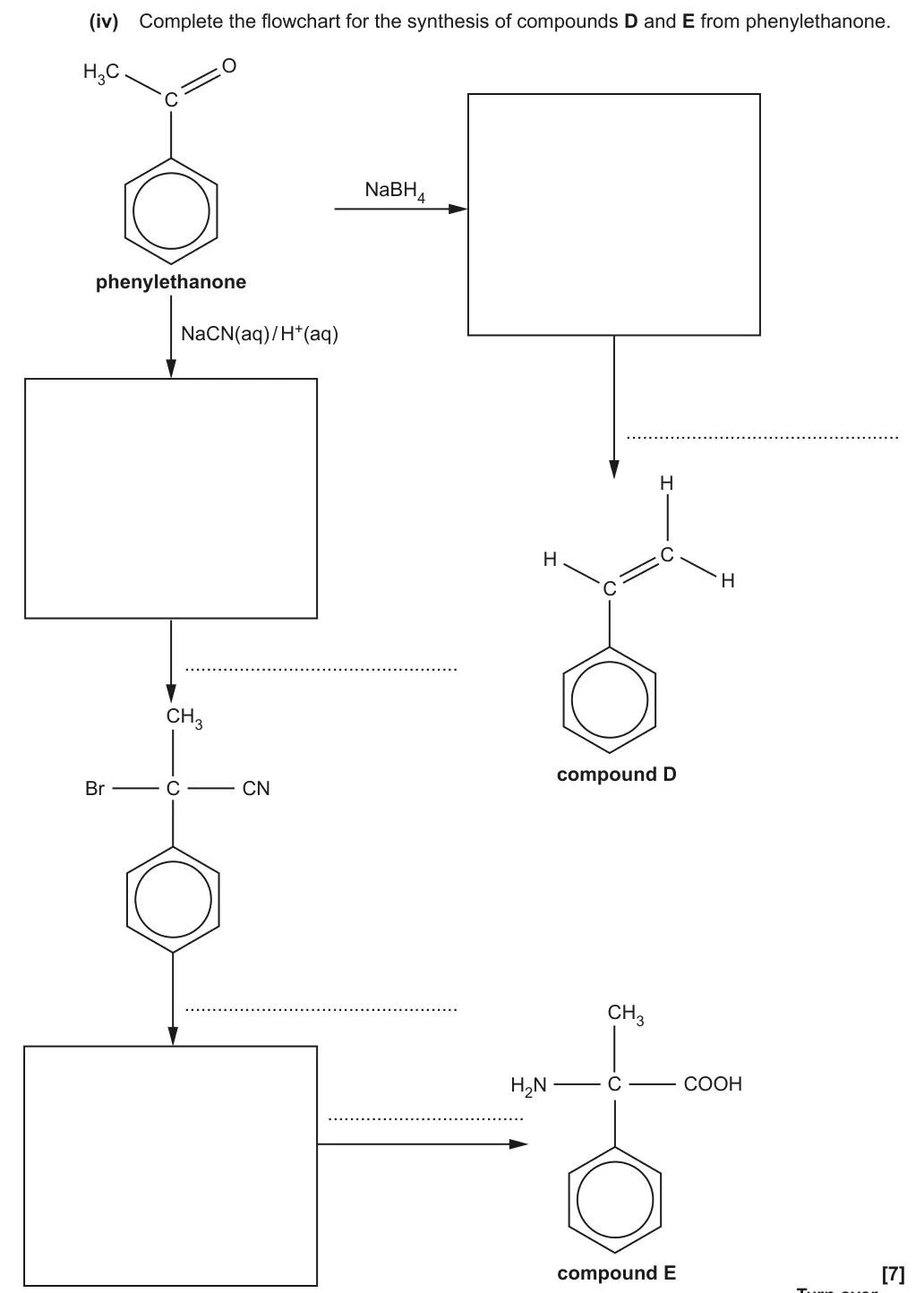
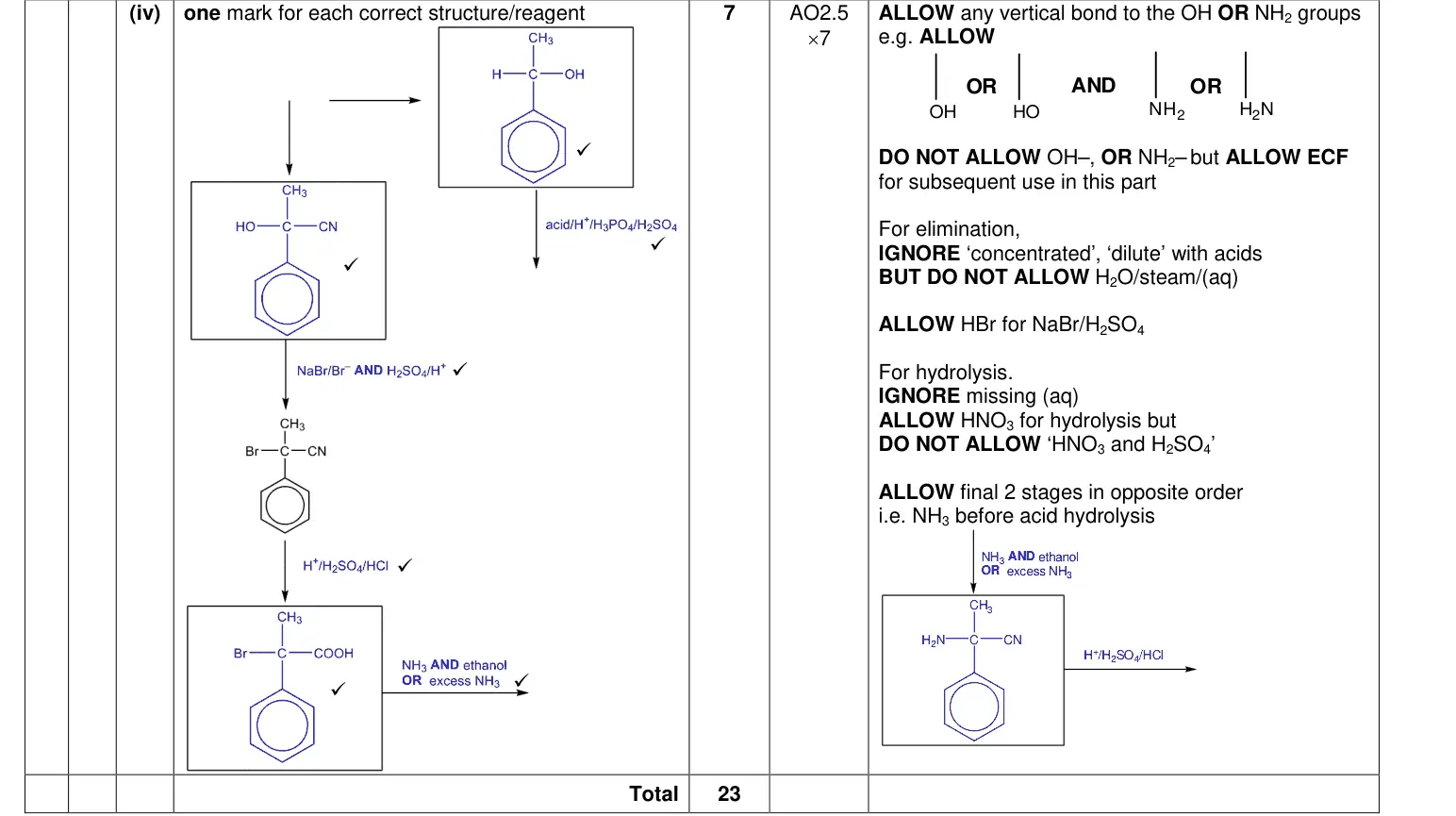
This question required candidates to apply knowledge of organic reactions from across the specification and discriminated well. Candidates with a good knowledge of reagents and conditions frequently scored over five marks. More detailed feedback is discussed with Exemplar 7, below. Phenylethanone is the starting point of this flowchart which shows the synthesis of compounds D and E. Synthesis of D The first step in the synthesis of D is the reduction of the ketone group. This response demonstrates a common error seen by examiners. The candidate has correctly deduced that than alcohol is formed but has omitted a hydrogen atom. Candidates are advised to take care when drawing structures. If a carbon atom is displayed it should be shown to be making four bonds. The final step of the synthesis is the dehydration of the alcohol with an acid. This candidate has used H3PO4. H2SO4 was also frequently seen. Lower ability responses included reference to water or steam and this was not credited. Synthesis of E The first step of the synthesis of E from phenylethanone is the reaction with NaCN(aq)/H+(aq). This candidate identifies that the product of the reaction is a hydroxynitrile but unfortunately this cannot be credited due to the incorrect linking of the OH group via the H atom. Candidates should be aware that, when drawing structures, groups must be bonded via the correct atoms. The next step of the synthesis is the substitution of the OH group. The candidate correctly recognises that NaBr is a suitable reagent but omits an acid, e.g. H2SO4, which is also required for this reaction. This error was seen frequently by examiners. The final two steps involve the substitution of the Br atom and acid hydrolysis of the nitrile group. In this case the candidate chooses the reaction with excess NH3. The structure of the correct product of this reaction is shown and the synthesis is completed by identifying a suitable reagent for the final step. Other candidates opted to perform these steps in the reverse order and the mark scheme allowed full credit for either approach. Common errors in the final steps were omissions. Some candidates simply stated NH3 without mentioning ethanol. Others identified water as important for the hydrolysis but did not include reference to an acid.
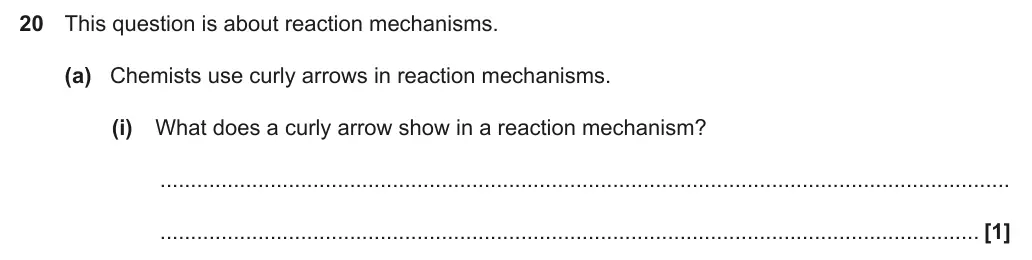
Most candidates were able to state that a curly arrow shows the movement of a pair of electrons. However, many candidates gave responses that lacked precision, such as ‘movement of electrons’. Such responses did not receive credit as the number of electrons was not specified.
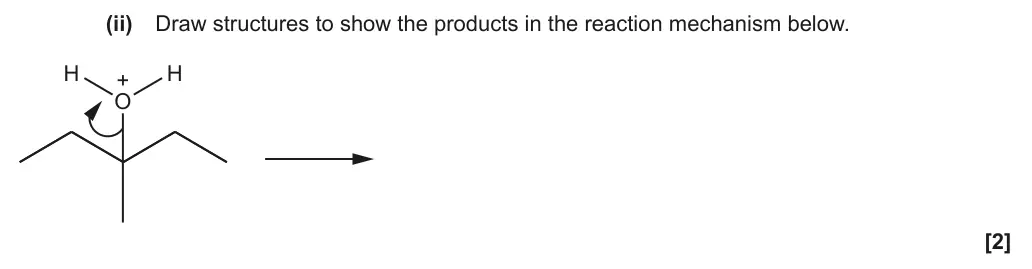
This demanding question required candidates to apply their knowledge of curly arrows to an unfamiliar intermediate. Examiners were impressed by the number of good responses and many candidates were able to draw an organic product with the correct carbon skeleton. The best responses demonstrated candidates’ flair for the subject and these recognised that a carbocation would be formed rather than an alkane.
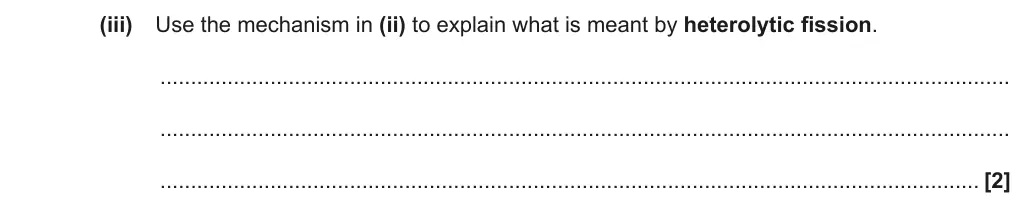
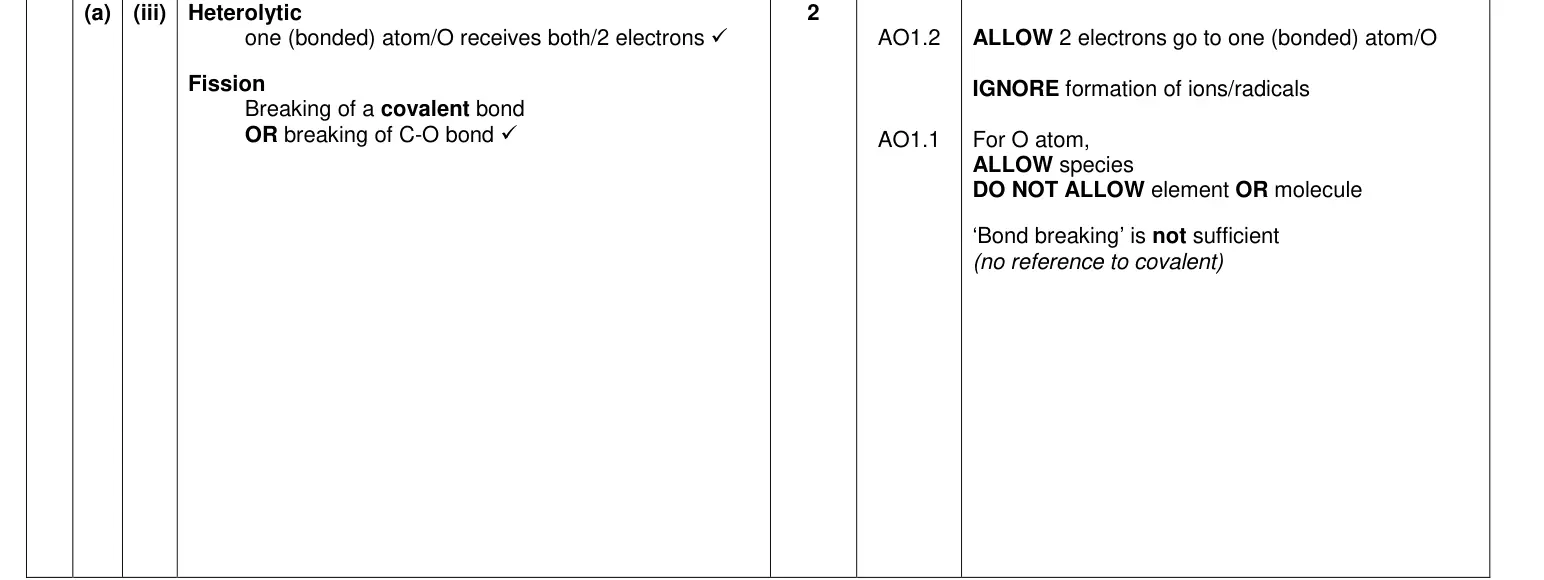
Many candidates were able to describe the meaning of ‘heterolytic’, referring to both electrons going to the O atom. However, only some candidates described ‘fission’ and a significant proportion of these referred only to ‘bond breaking’. The best responses correctly stated that fission is the breaking of a covalent bond. Candidate are encouraged to read questions carefully and take notice of words that appear in bold type as these often communicate what is expected in a question.
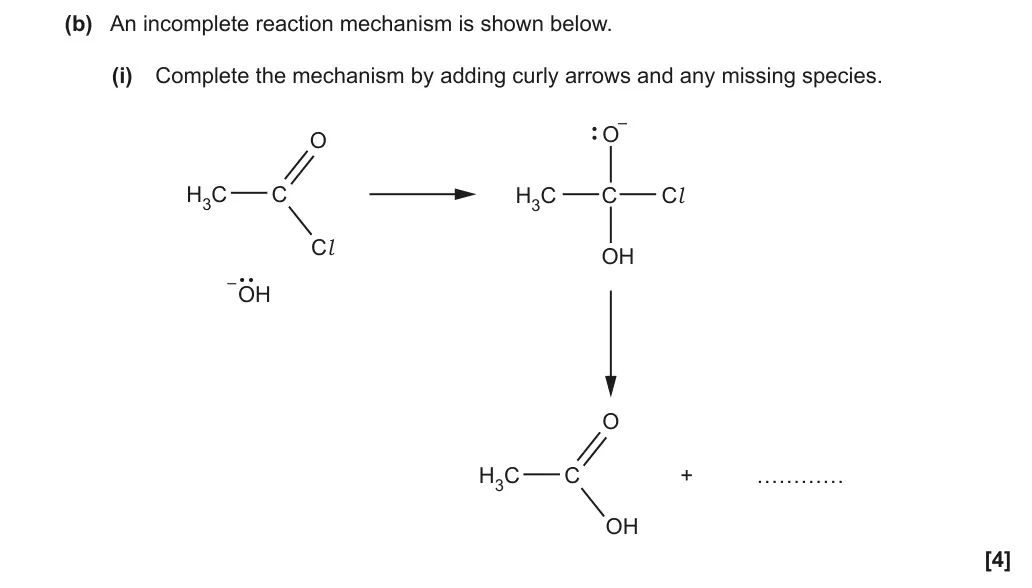
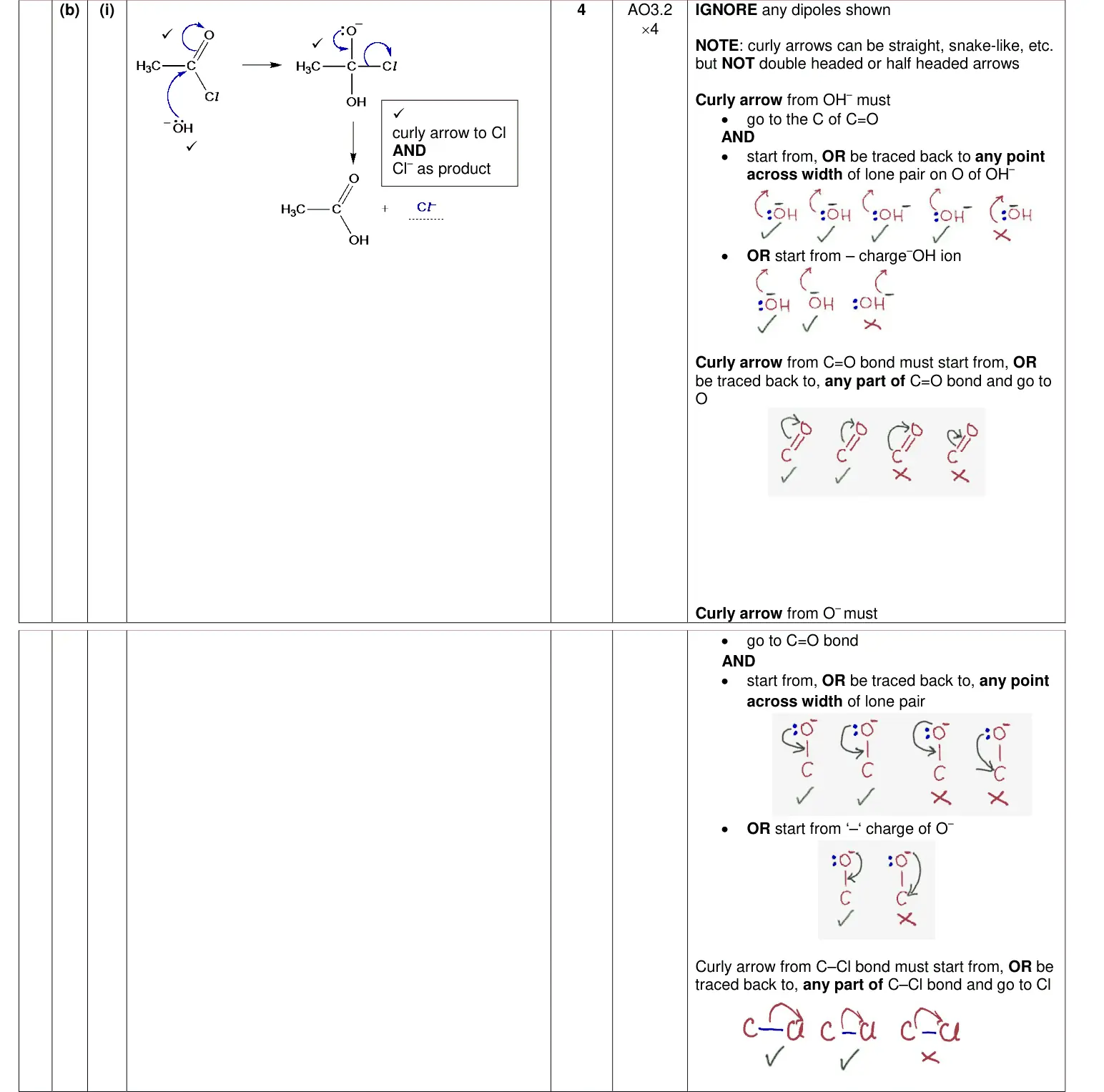
Examiners were encouraged by the number of excellent responses to this question. Candidates were able to confidently apply their knowledge of mechanisms to this unfamiliar example and the majority of the cohort scored at least two marks. In the first step candidates used their understanding of nucleophilic addition to show a correct curly arrow from the hydroxide ion to the C of the C=O bond as well as an arrow from this bond to the O. Many candidates were able to show the breaking of the C–Cl bond and the formation of a chloride ion, drawing on their experience of the reactions of haloalkanes. Some candidates recognised the need to include an arrow to reform the carbon-oxygen double bond, with the best responses showing this accurately. A common error was to draw the bond from the lone pair on O to the C atom, rather than the bond.
A LEVEL CHEMISTRY A Examiners’ report H432/02 Summer 2019 series Version 1 H432 For first teaching in 2015 www.ocr.org.uk/science Contents Introduction .............................................................................................................................................. 4 Paper 2 series overview ........................................................................................................................... 5 Section A overview ................................................................................................................................... 6 Question 3 ............................................................................................................................................ 6 Question 4 ............................................................................................................................................ 6 Question 5 ............................................................................................................................................ 7 Question 10 .......................................................................................................................................... 8 Question 12 .......................................................................................................................................... 9 Question 13 ........................................................................................................................................ 10 Question 14 ........................................................................................................................................ 10 Question 15 ........................................................................................................................................ 11 Section B overview ................................................................................................................................. 12 Question 16 (a) (i) ............................................................................................................................... 12 Question 16 (a) (ii) .............................................................................................................................. 12 Question 16 (b) (i) ............................................................................................................................... 13 Question 16 (b) (ii) .............................................................................................................................. 14 Question 16 (b) (iv) ............................................................................................................................. 14 Question 16 (b) (v) .............................................................................................................................. 15 Question 17 (a) (i) ............................................................................................................................... 17 Question 17 (a) (ii) .............................................................................................................................. 19 Question 17 (b) (i) ............................................................................................................................... 20 Question 18 (a) (i) ............................................................................................................................... 21 Question 18 (a) (ii) .............................................................................................................................. 22 Question 18 (b) ................................................................................................................................... 23 Question 18 (c) ................................................................................................................................... 23 Question 18 (d) ................................................................................................................................... 24 Question 18 (e) (i) ............................................................................................................................... 24 Question 18 (e) (ii) .............................................................................................................................. 26 Question 19 (a) (i) ............................................................................................................................... 27 Question 19 (a) (ii) .............................................................................................................................. 29 Question 19 (b) (i) ............................................................................................................................... 30 Question 19 (b) (iii) ............................................................................................................................. 32 Question 19 (b) (iv) ............................................................................................................................. 34 Question 20 (a) (i) ............................................................................................................................... 36 Question 20 (a) (ii) .............................................................................................................................. 37 Question 20 (a) (iii) ............................................................................................................................. 37 Question 20 (b) (i) ............................................................................................................................... 38 Question 21 ........................................................................................................................................ 39 Introduction Our examiners’ reports are produced to offer constructive feedback on candidates’ performance in the examinations. Question 20 (b) (i) Examiners were encouraged by the number of excellent responses to this question.
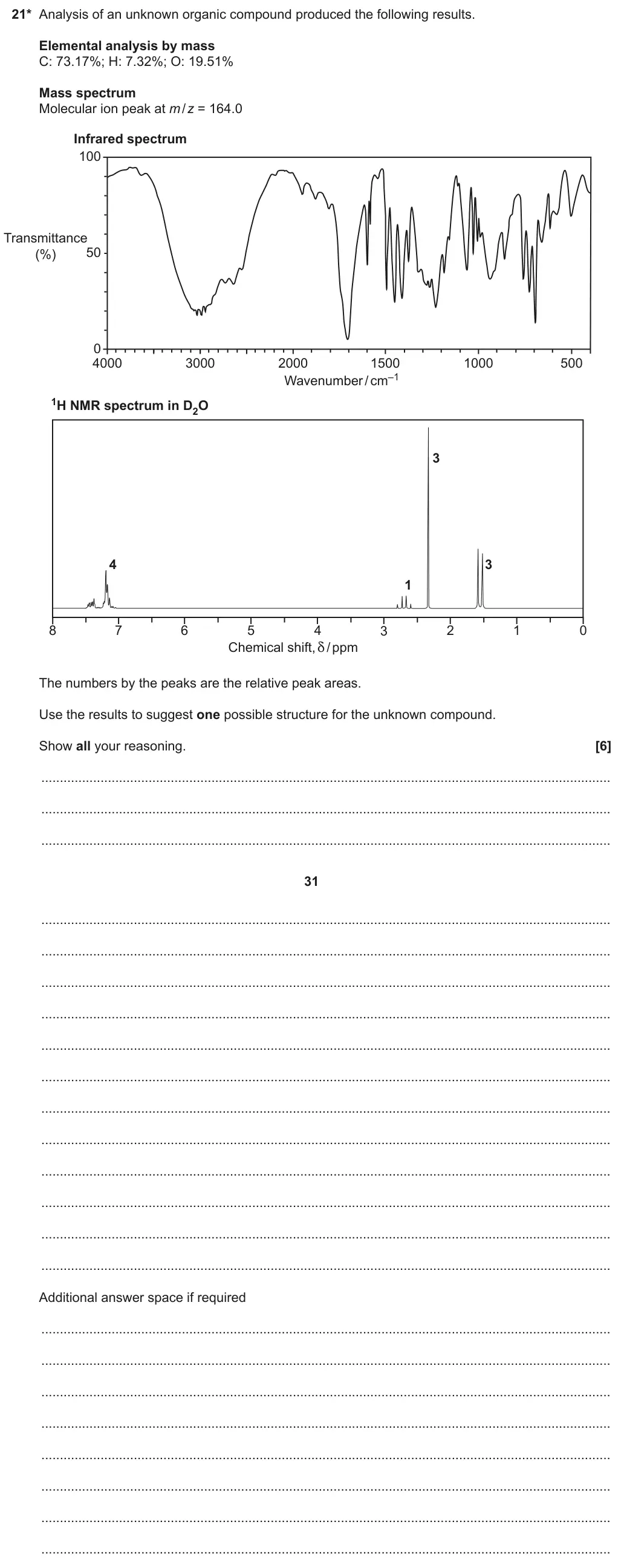
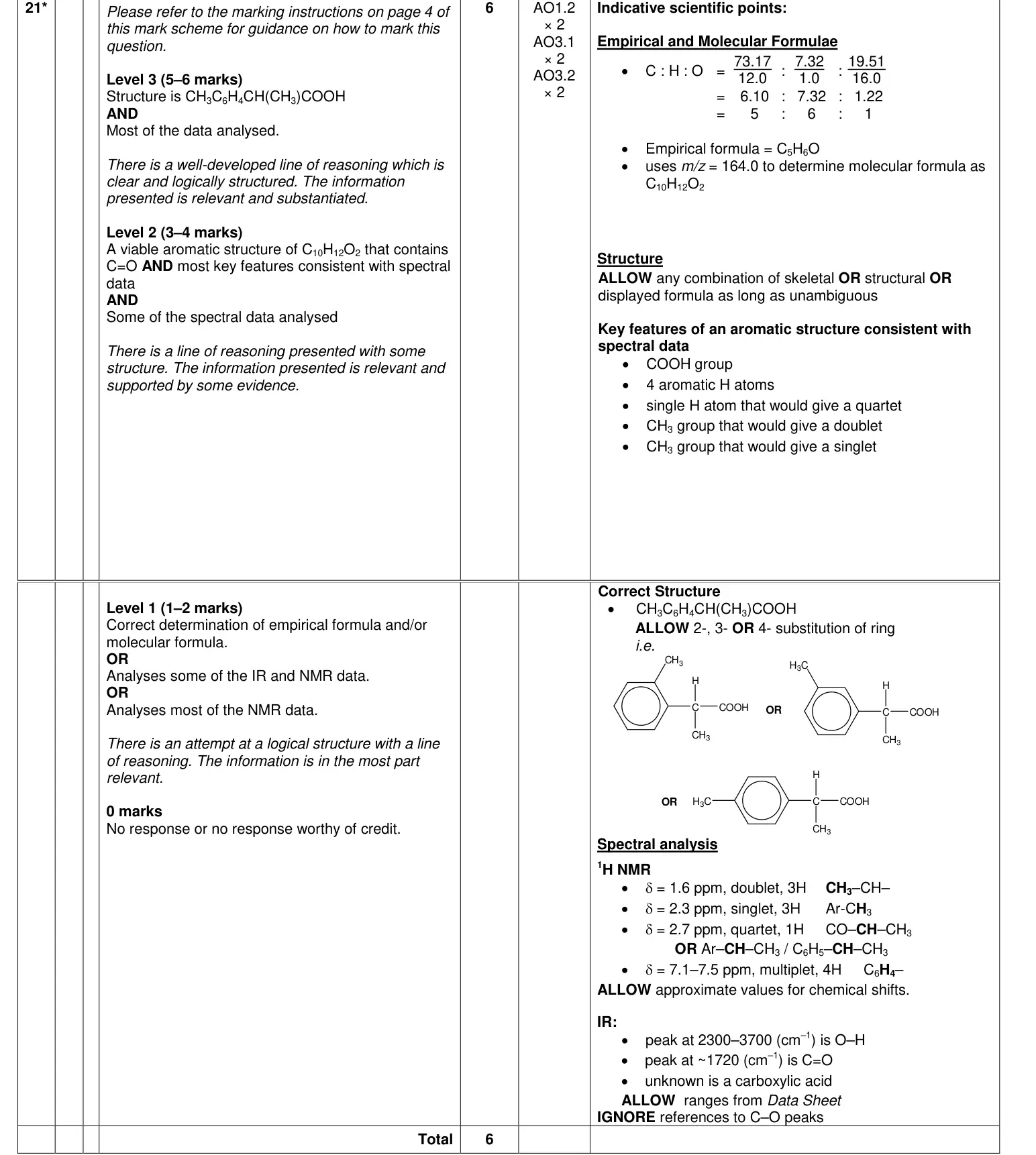
Candidates are confident in tackling questions requiring spectral analysis. Most candidates were able to determine the empirical and molecular formula of the unknown compound and analyse the IR and NMR data. A number of excellent responses were seen which included interpretation of the peak splitting in the NMR spectrum. However, many candidates were unable to suggest a structure that matched their spectral analysis. The majority of structures seen were aromatic but not all contained the carboxylic acid group. Some candidates focused on the NMR data and suggested a structure that was consistent with some of these peaks and included a two substituents of the ring or a degree of chain branching. Lower ability responses often showed a simpler structure of a monosubstituted ring with a straight chain. Stronger responses were able to use all the data to suggest a correct structure as demonstrated in significant proportion of responses were given six marks. This candidate starts their analysis by determining the empirical and molecular formula of the unknown compound. Next the IR and NMR data is analysed in a clear, logical fashion. Although not shown in this report, the candidate had annotated the spectra, a good strategy. At the end of the response the candidate has determined a possible structure. Notice how the candidate has crossed out the first attempt at a structure. This is much better than rubbing out a pencil diagram and re-drawing over the space as this often leads to unclear images that are difficult for examiners to read. This candidate received full marks in this question.
Skills: M0.2 Use ratios, fractions and percentages; M3.1 Translate information between graphical, numerical and algebraic forms
Want a paper marked and gone through with you? Message us.