Answer
C
Mark scheme

Examiner's comment
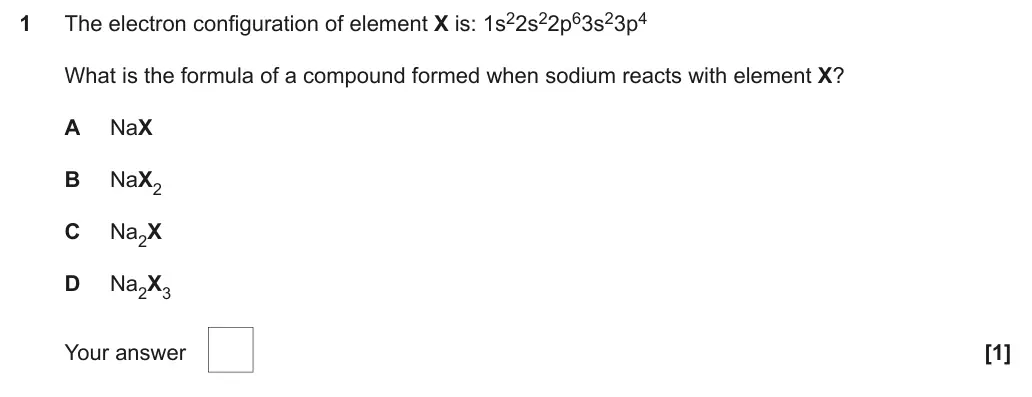
Nearly all candidates responded with the correct response of C.
70 marks · 42 question parts · Paper, mark scheme and report on OCR's site · Have OCR's Data Sheet beside you
C
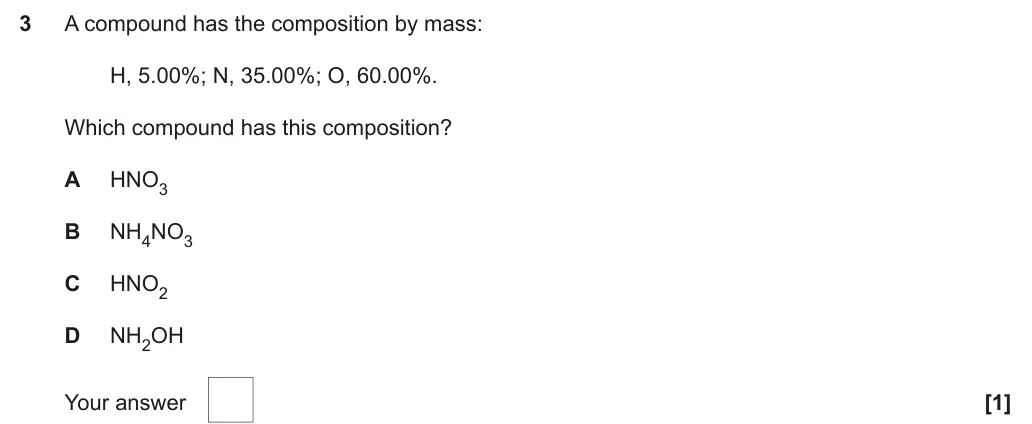
Nearly all candidates responded with the correct response of C.
C
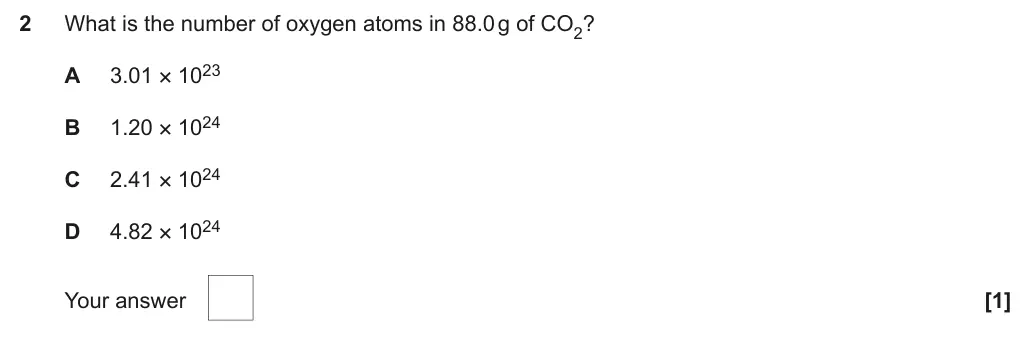
Candidates found this question difficult with comparatively few obtaining the correct response of C. Many candidates selected B instead, the number of CO2 or O2 molecules, and not the number of O atoms. Good advice is to read the question carefully and to underline any key features.
B
Nearly all candidates responded with the correct response of B.
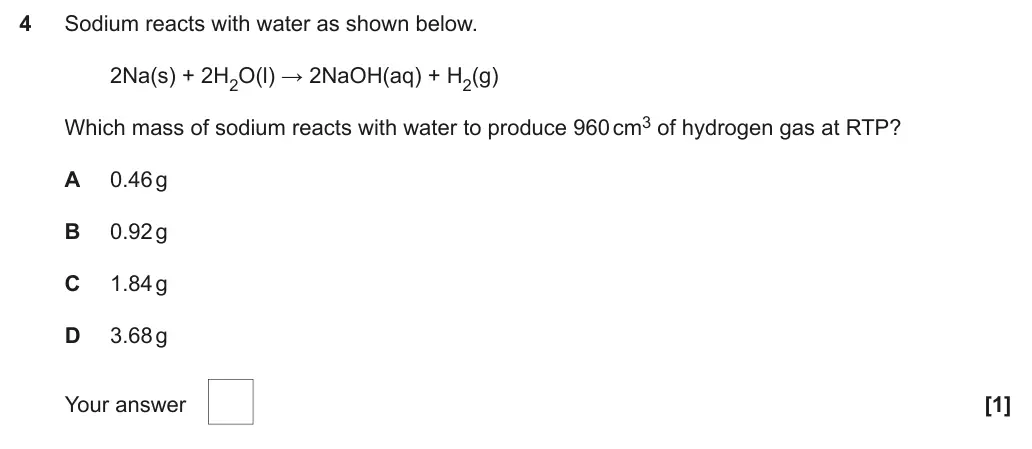
C
This part discriminated well, with most able candidates selecting the correct answer of C. A sizeable number selected B, presumably by not considering the 2:1 stoichiometric ratio in the equation.
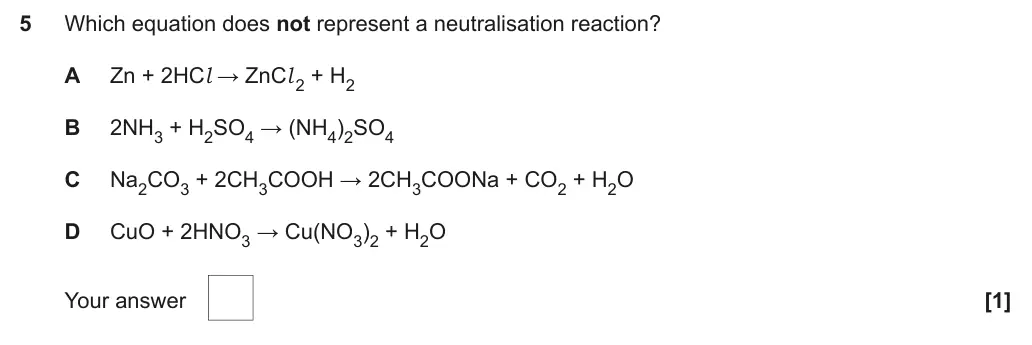
A
Candidates found this part difficult with many selecting B, the equation that looked a little different, rather than the correct answer of A (a redox equation). This suggests that many candidates are unaware of the role of ammonia as a base.
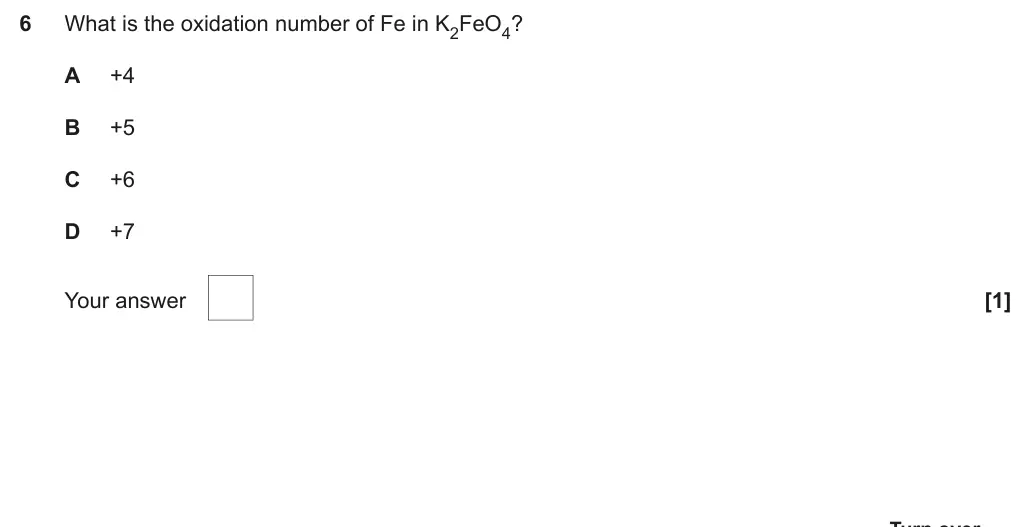
C
Nearly all candidates responded with the correct response of C. Candidates seem to have a very good understanding of applying oxidation number rules.
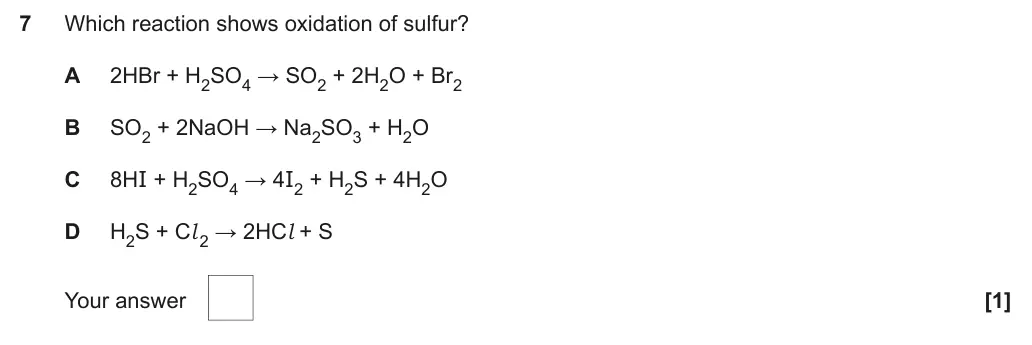
D
Candidates needed to do a lot of work to solve this problem and most wrote oxidation numbers around the equations. This systematic process allowed most candidates to find that D is the only option in which sulfur is oxidised.
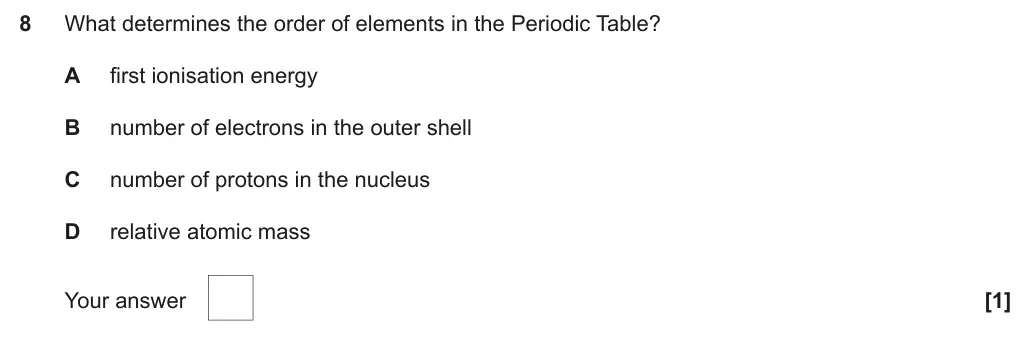
C
Most candidates correctly selected C (number of protons) but a sizeable number selected D (relative atomic mass) or B (number of electrons) instead.
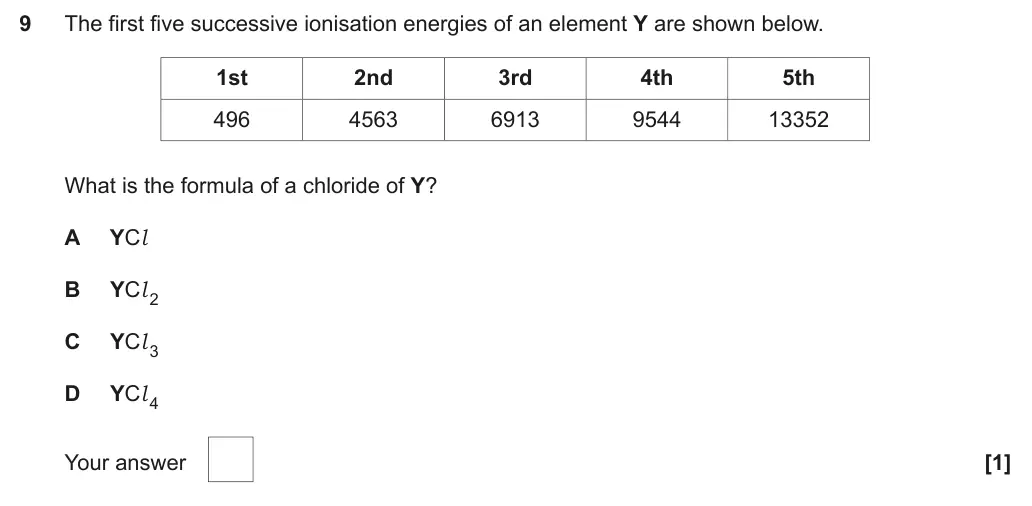
A
Success depended on identifying the group of Y and working out the formula of the chloride. Most candidates recognised the large increase between 1st and 2nd ionisation energies, leading to the conclusion that Y is in Group 1 and the correct formula is YCl (A).
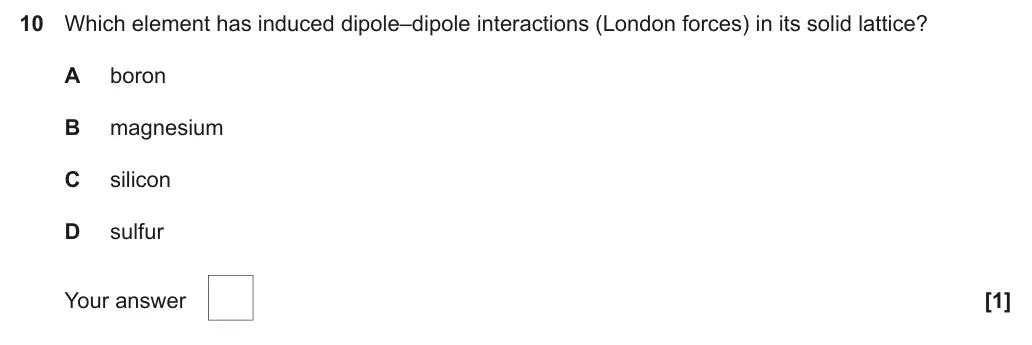
D
As is often the case, candidates find structure and bonding difficult. Many candidates selected silicon (C) instead of the correct response of sulfur (D).
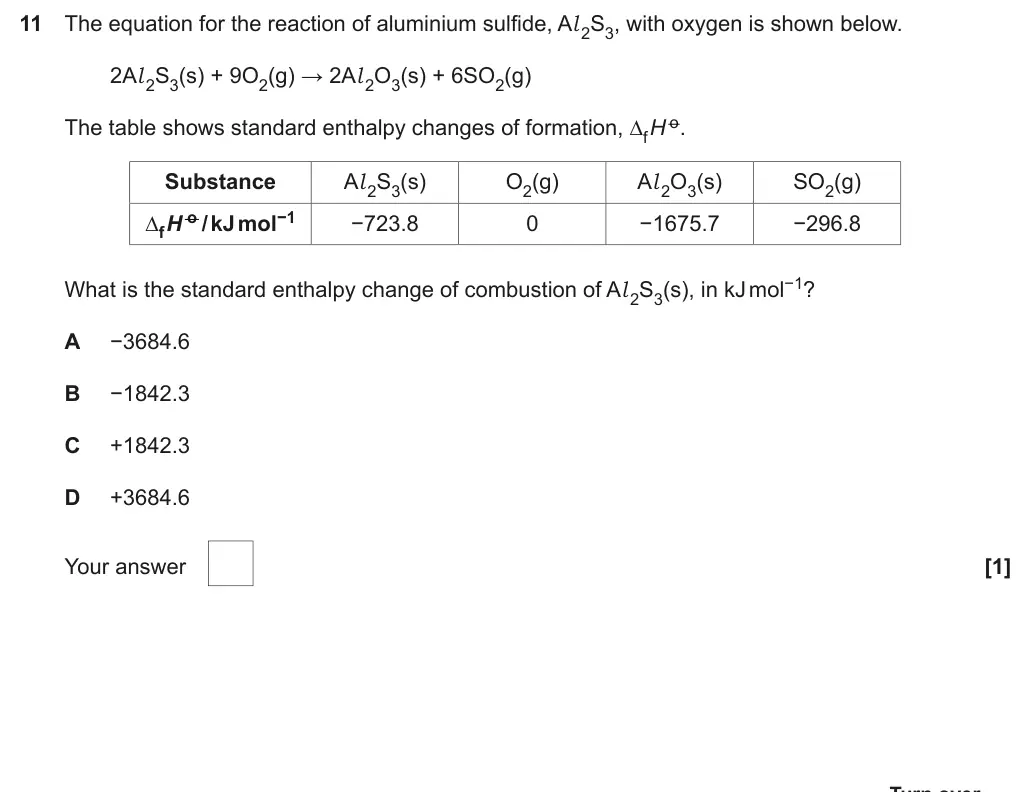
B
This question proved to be the most difficult of the multiple-choice questions. Most candidates constructed a correct energy cycle using the provided equation. This gave an energy change of –3684.6 kJ mol–1 (A). The question asks for the enthalpy change of combustion for Al2S3, which is half this value (option B). As with question 2, candidates are advised to read the question carefully.
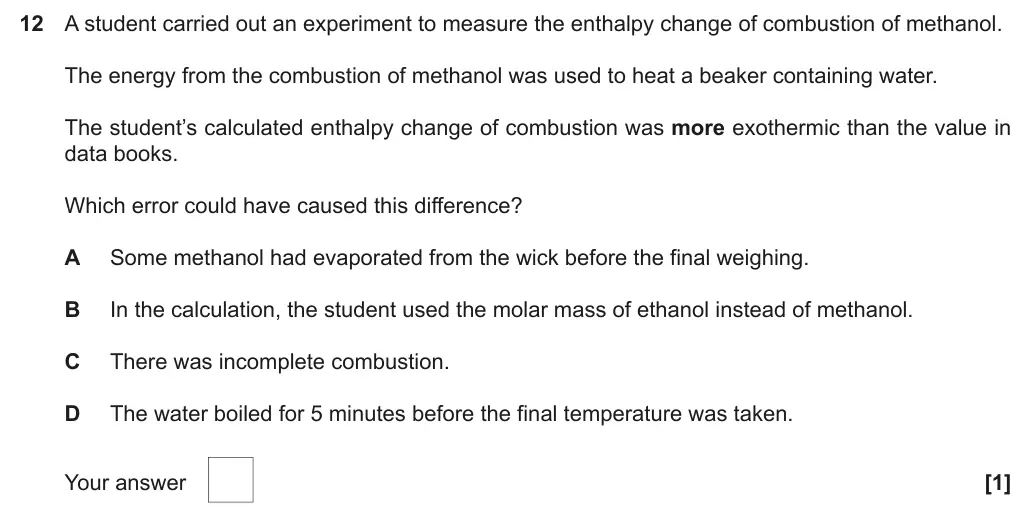
B
Candidates find questions based on practical procedures difficult and this question proved to be no exception. A similar number of candidates selected each option, suggesting that most guessed. The correct option is B.
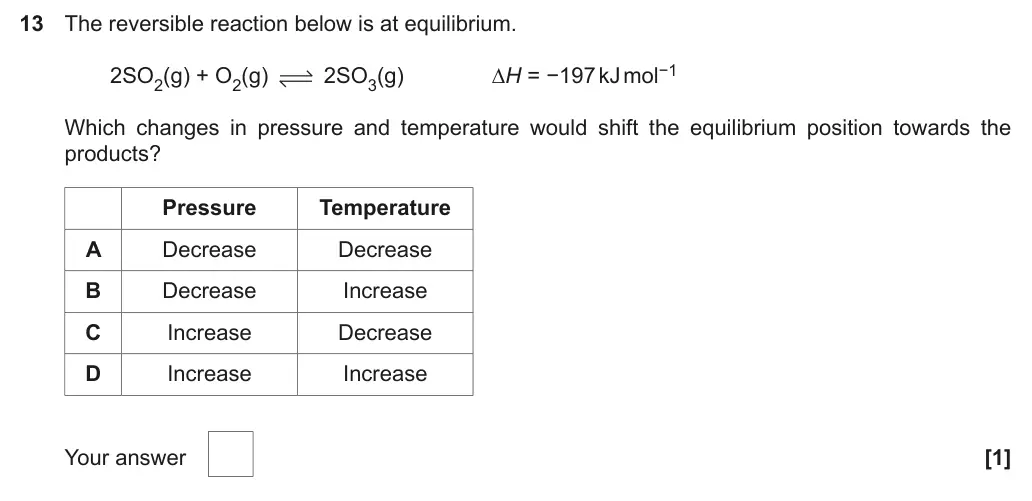
C
This question was a good discriminator with well-prepared candidates usually selecting the correct option of C. Incorrect responses were reasonably evenly split across the other options, suggesting guesses and poor preparation.
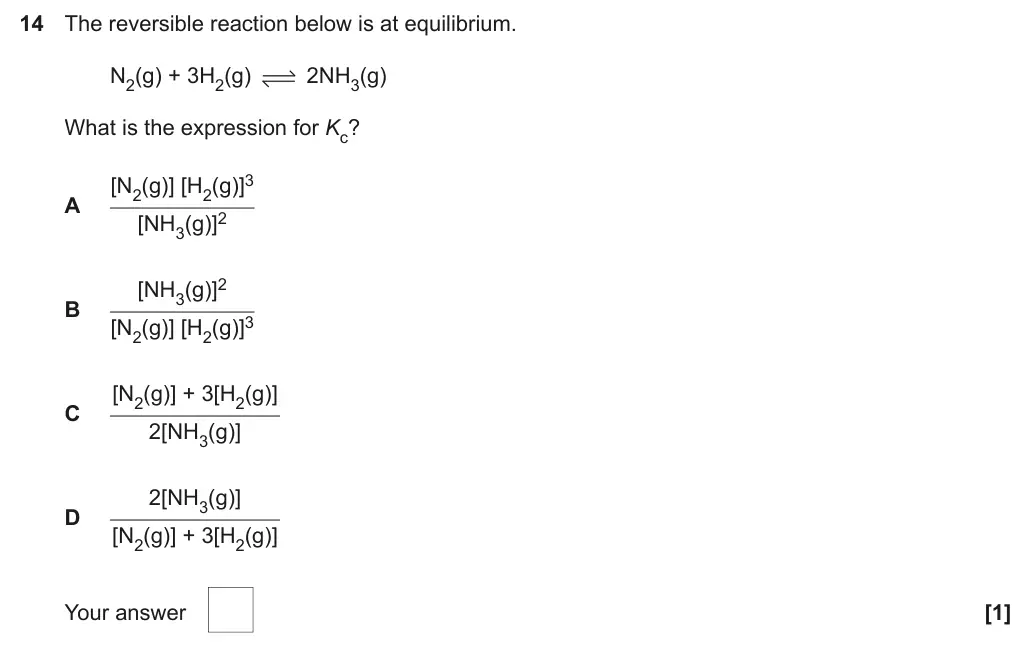
B
Most candidates responded with the correct response of B. The most common incorrect response was the inverse expression shown in A.
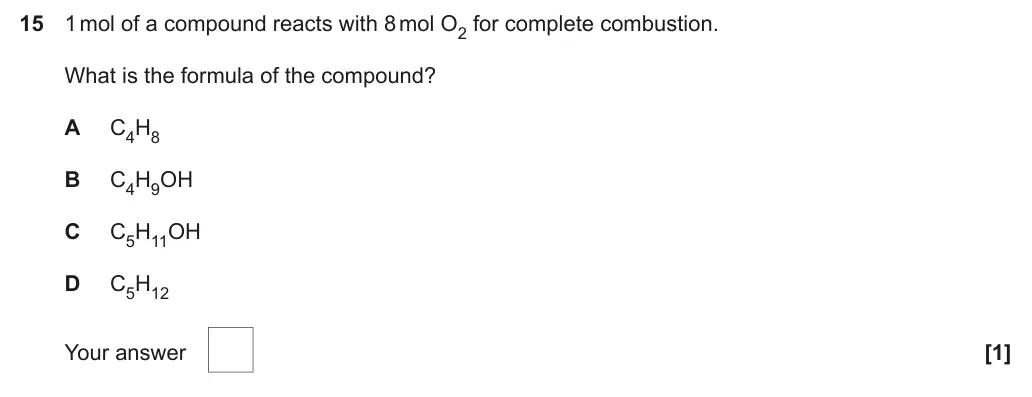
D
Most candidates selected A or D, with D being the correct option. Presumably, A was chosen by halving the ‘8’ in C4H8 without considering that each H2O molecule contains two H atoms. The successful answer of D usually resulted from the candidate constructing equations.
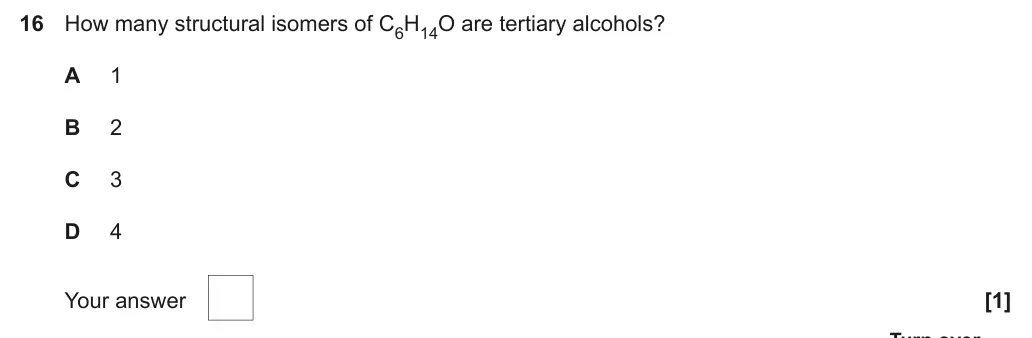
C
The responses showed a reasonably even split across all options with relatively few correct responses of C. A good route to success here is to draw out the possibilities.
Skills: M4.2 Visualise and represent 2-D and 3-D forms including 2-D representations of 3-D objects
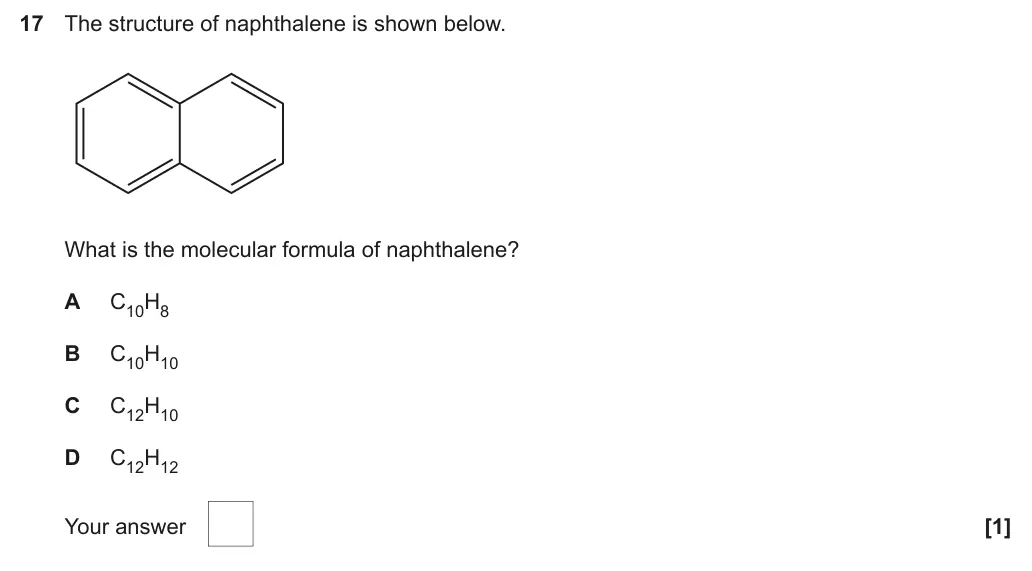
A
Many candidates added H atoms to the structure to aid their choice. Most candidates selected the correct response of A, with a sizeable number selecting B (by adding two H atoms where the two rings join).
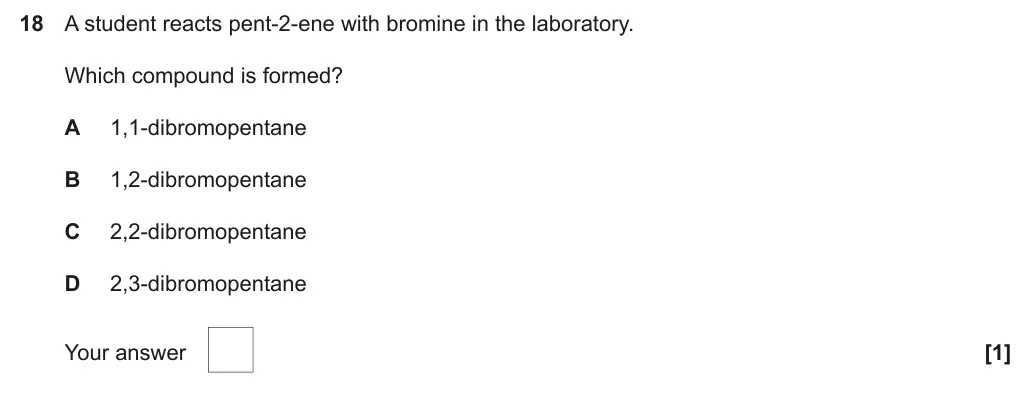
D
Most candidates chose the correct option of D but a sizeable number chose B and C, the other options containing a ‘2’ in their names. The best strategy here is to draw out the carbon skeleton of pent-2-ene from which it is clear that bromine atoms must be added at carbon positions 2 and 3.
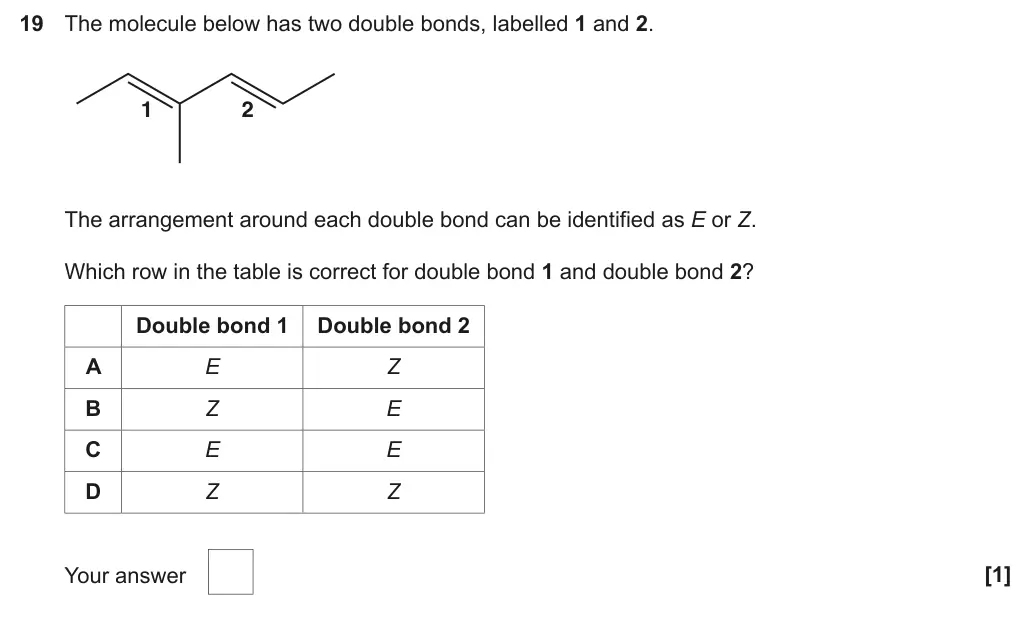
C
This was a difficult question but higher ability candidates selected the correct option of C. The main discriminator was B, which identifies the 1 double bond as Z. CIP analysis is required to show that the double bond is E. This is a good ‘hard’ example for illustrating E/Z isomerism.
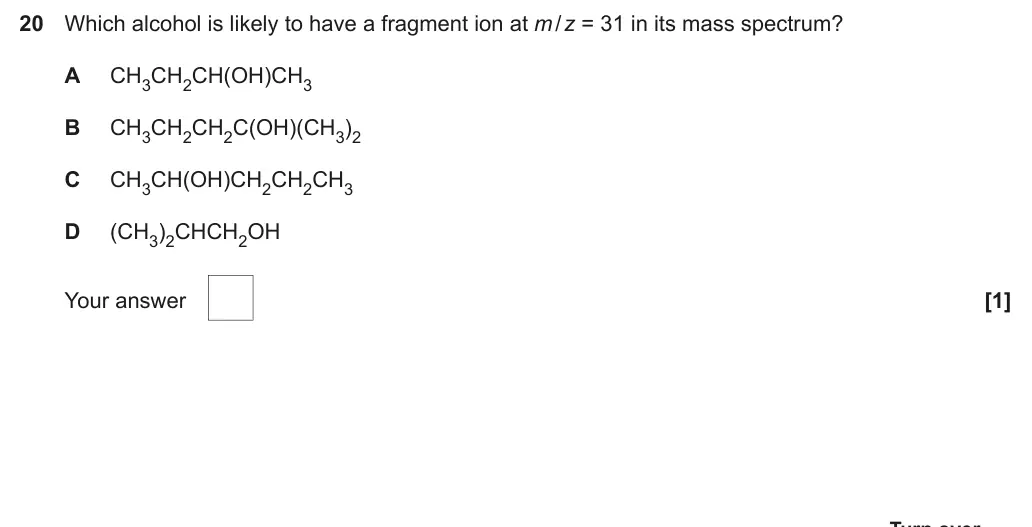
D
Overall, candidates answered this question well with many selecting the correct response of D. From scripts, successful candidates drew vertical lines to isolate likely fragments. Section B Overview
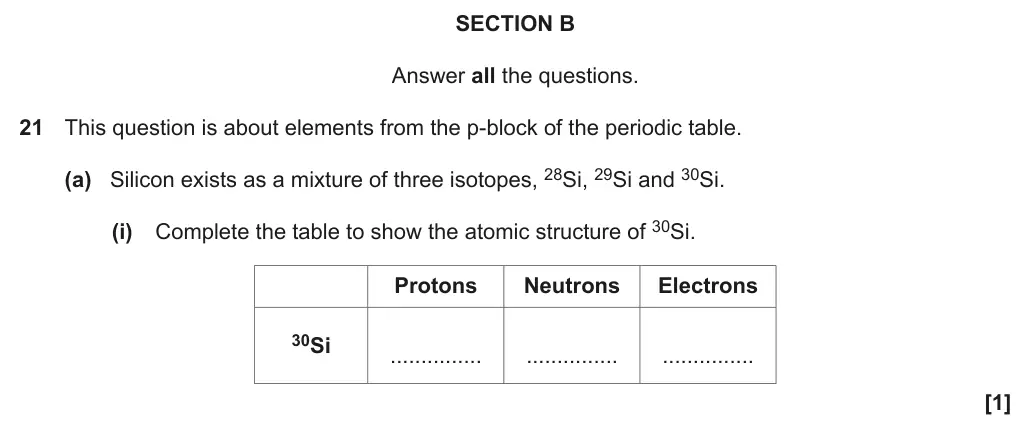
This question was an easy starter to the paper with most candidates producing the correct answer.
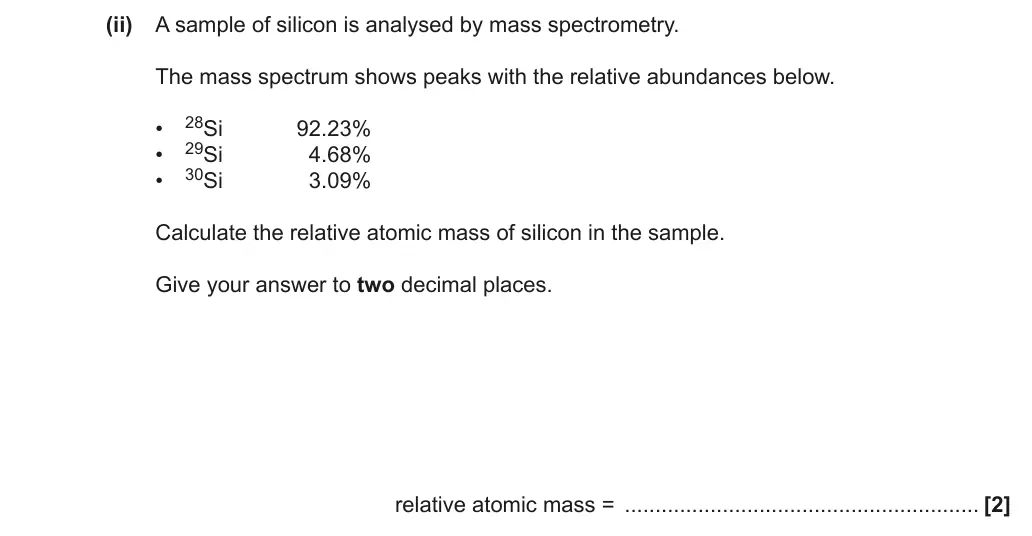
Almost all candidates followed a well-learnt procedure to complete the calculation. Despite being in the rubric to the question, some candidates did not give an answer to two decimal places. Others made a rounding error in reducing 28.1086 to two decimal places, with 28.10 and 28.12 being common errors.
Skills: M0.2 Use ratios, fractions and percentages; M1.1 Use an appropriate number of significant figures
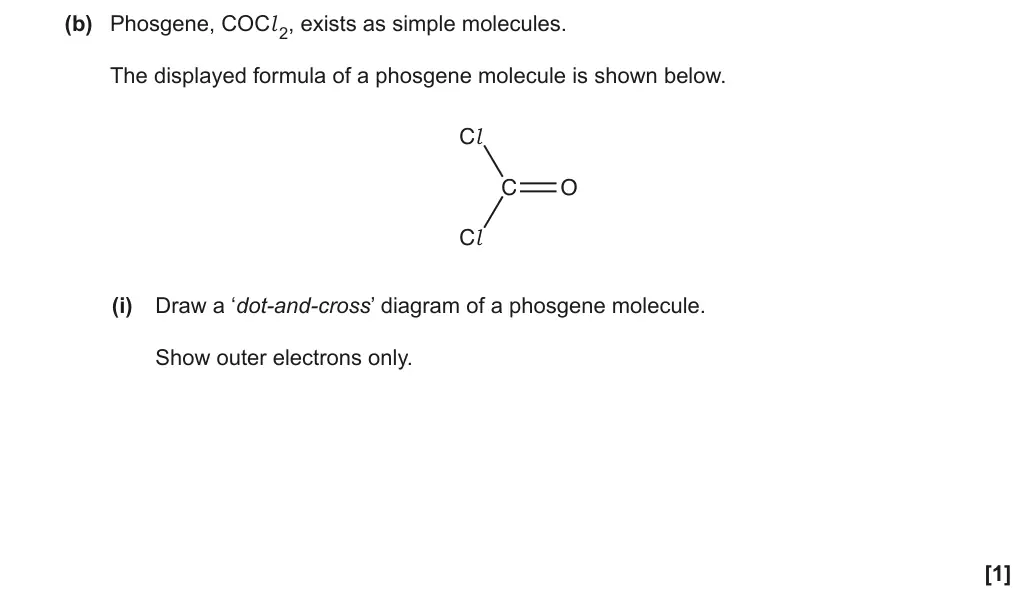
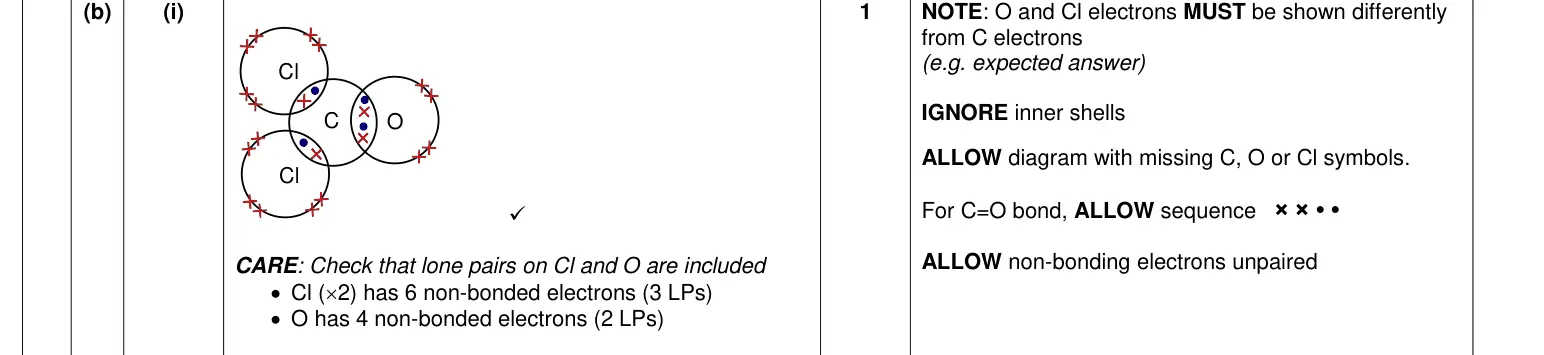
Most candidates attempted a dot-and-cross diagram of a COCl2 molecule, with ionic representations being rare. Candidates should take care to include any lone pairs in their diagrams. Omission of the O and Cl lone pairs was the most common error.
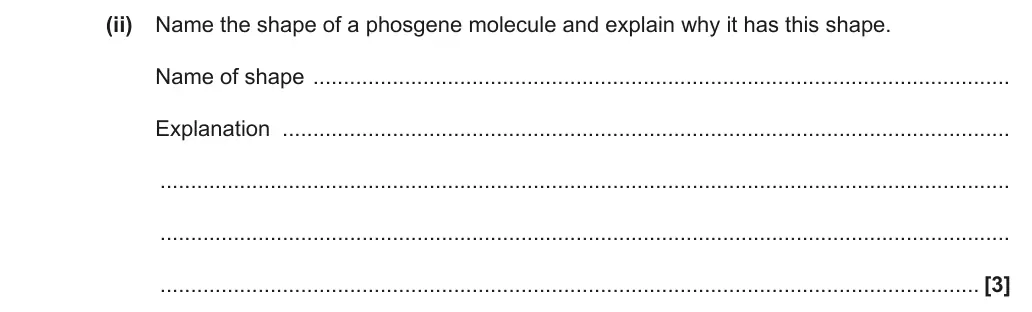
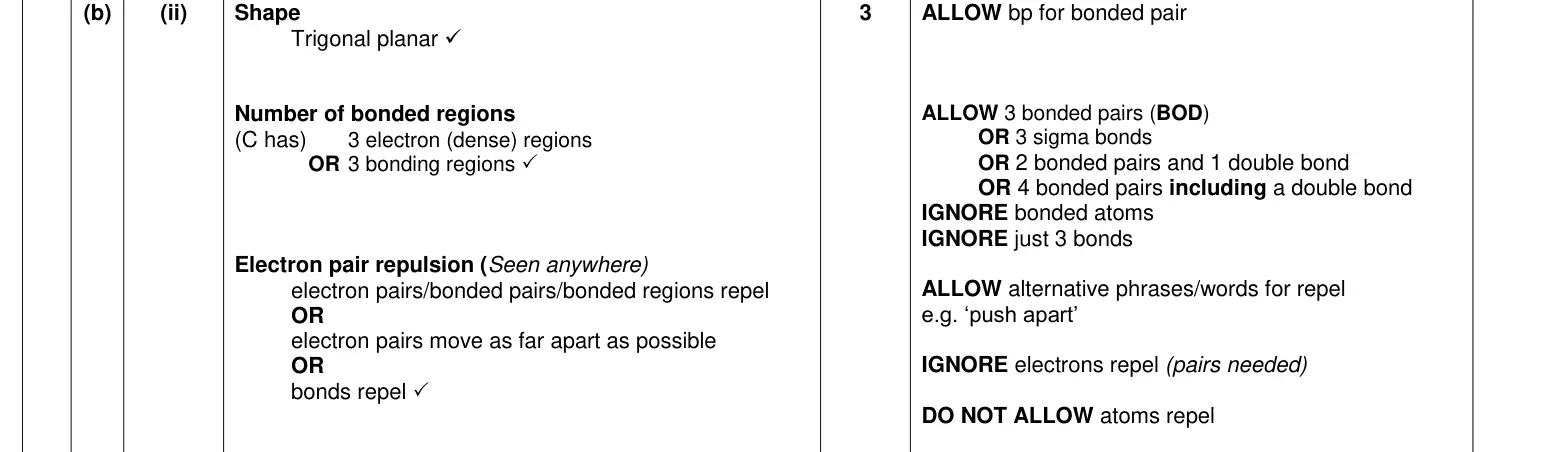
This question discriminated well. Most candidates recognised that a COCl2 molecule has a trigonal planar shape. The best answers explained this shape in terms of the three electron regions around the central C atom and their repulsion.
Skills: M4.1 Use angles and shapes in regular 2-D and 3-D structures
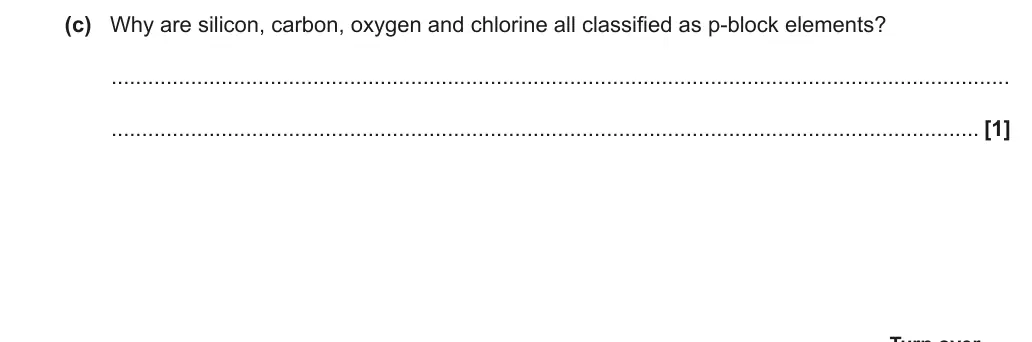
Candidates were expected to identify that a p-block element has its highest energy electron(s), or outer electrons, in a p orbital or sub-shell. Lower ability candidates often omitted ‘electrons’ in their responses and just repeated the information in the question.
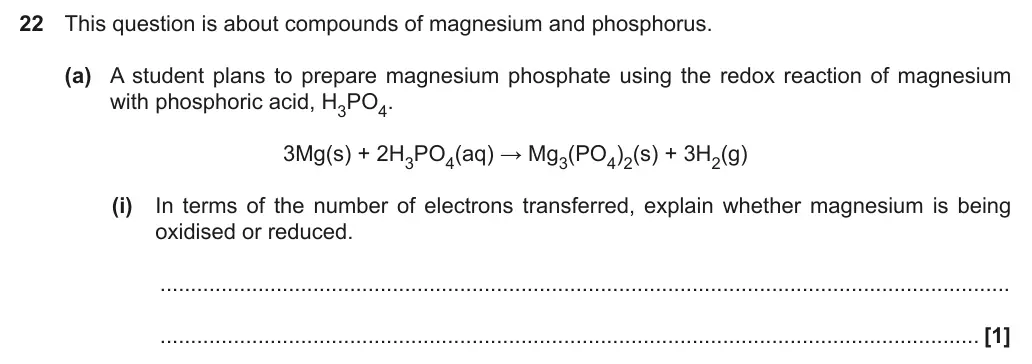
Despite the question clearly asking for a response in terms of the number of electrons transferred, most candidates answered in terms of oxidation number changes. Candidates are recommended to read the question and to answer in terms of its requirements. Underlining ‘number of electrons’ may have helped candidates to answer the question that had been set.
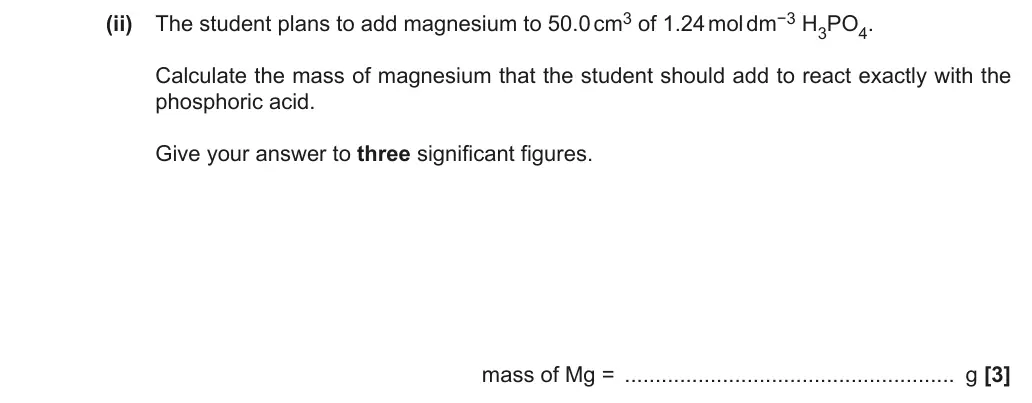
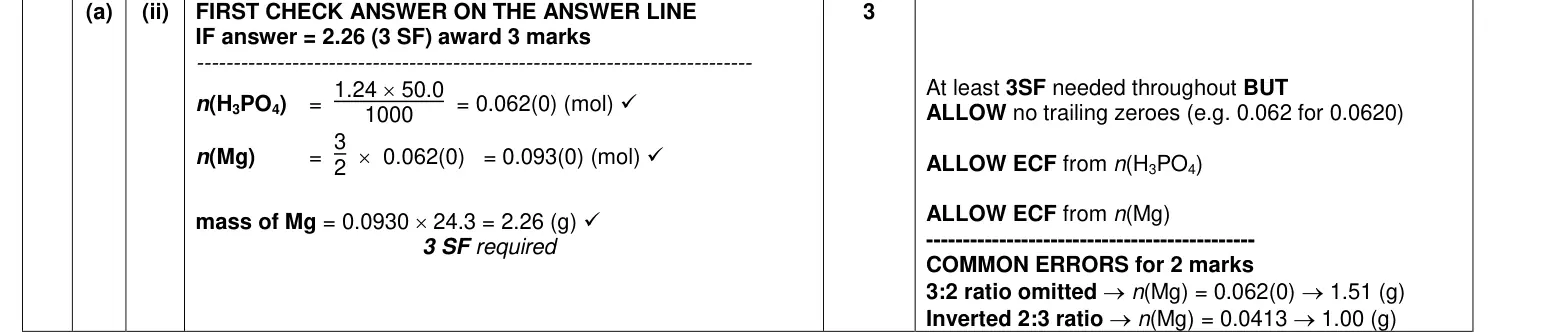
Most candidates are competent at answering questions based on the mole. Almost all candidates were able to calculate the amount of H3PO4 as 0.062 mol. Candidates then needed to use the 2:3 mole stoichiometric ratio to show that 0.093 mol of Mg reacts, which has a mass of 2.26 g to the required 3 significant figures. The commonest errors were use of the inverse 3:2 ratio to obtain 1.00 g Mg, or to omit the ratio to obtain 1.51 g Mg, as shown in the exemplar. Candidates are advised to show clear working so that credit can be awarded for such responses by applying error carried forward.
Skills: M0.0 Recognise and make use of appropriate units in calculations; M0.2 Use ratios, fractions and percentages; M1.1 Use an appropriate number of significant figures
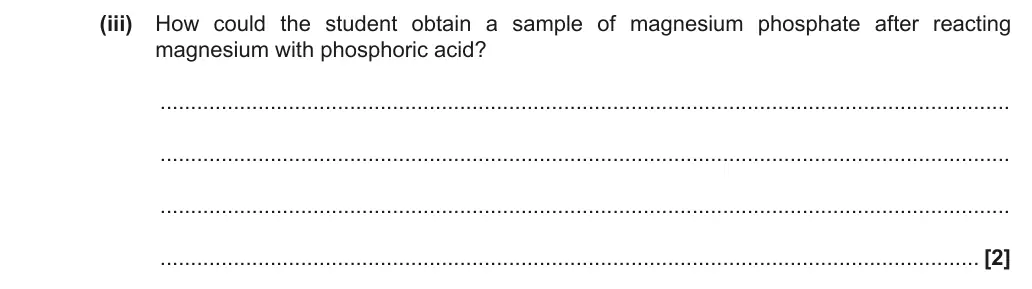
Candidates often struggle with questions based on practical work. There were many random responses to this question, with relatively few candidates identifying that solid magnesium phosphate could be obtained by filtration, followed by drying.
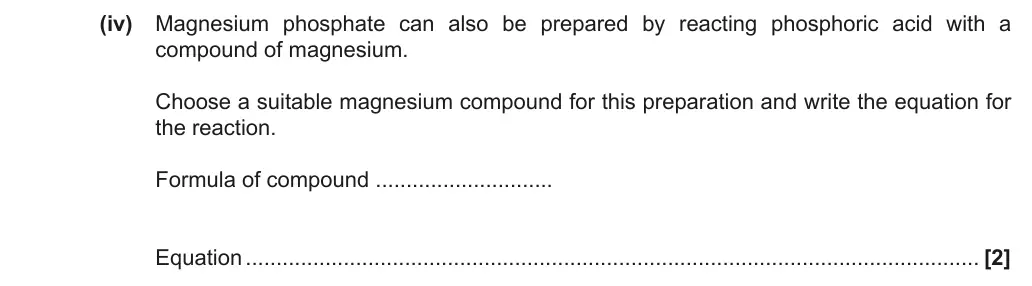
Candidates were expected to identify a suitable reagent for this reaction, with most choosing magnesium oxide, hydroxide or carbonate. Credit was also given for using a soluble magnesium salt such as its sulfate, chloride or nitrate. The correct equation often followed, but errors sometimes appeared in the form of incorrect formulae, such as MgOH for magnesium hydroxide. The exemplar shows a good clear response, using MgO as the reagent.
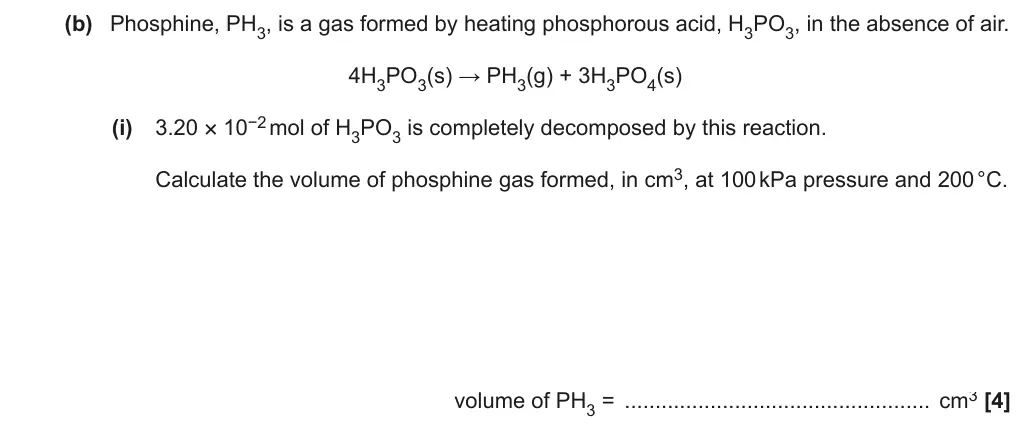
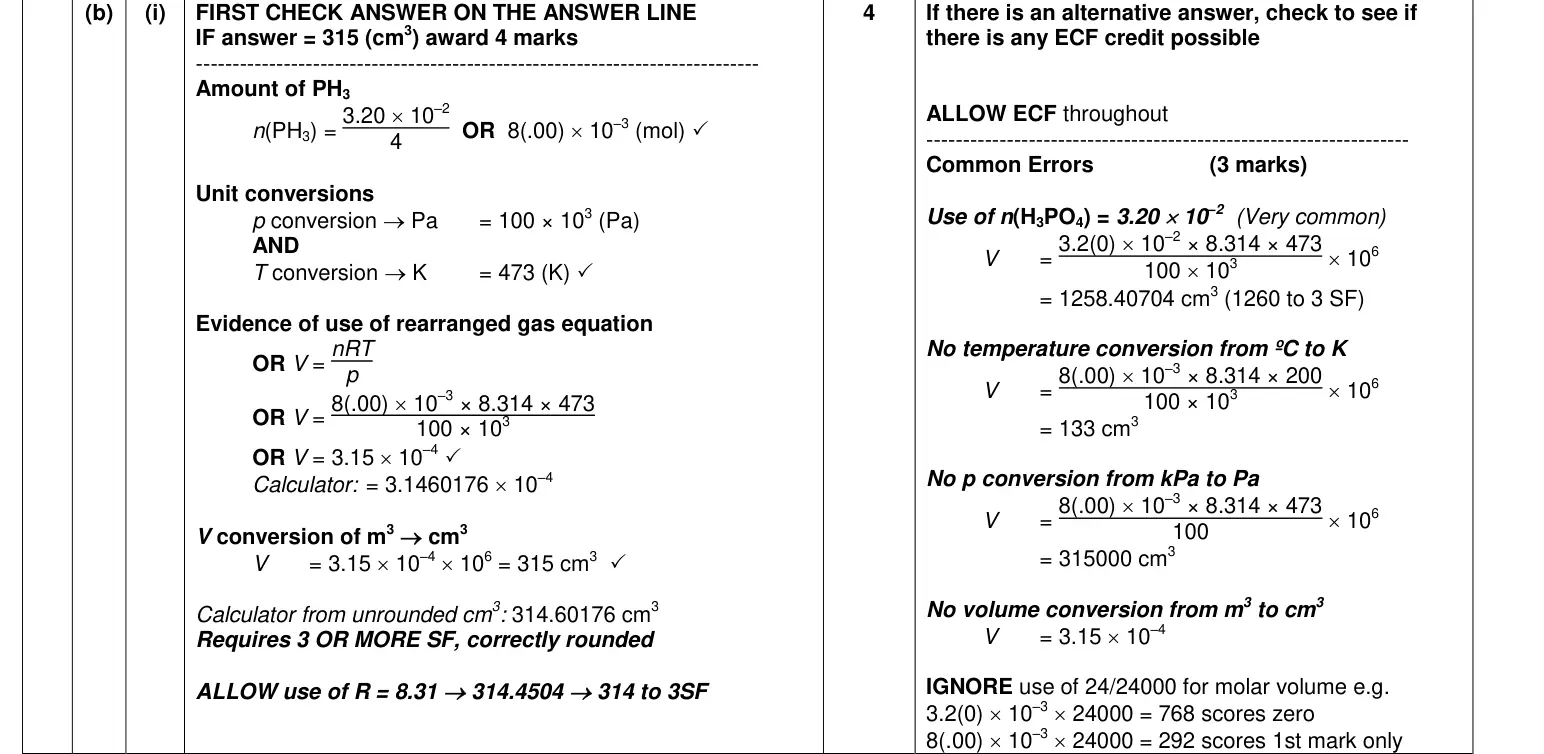
Almost all candidates realised that the calculation required the ideal gas equation. Most candidates correctly rearranged the equation and used the data from the question to obtain a value for the volume of phosphine. The most common errors were with conversion of units into Pa and m3. It is recommended that candidates learn how to carry out these conversions. In their calculations, many candidates used the amount of phosphoric acid, 3.20 × 10⁻³ mol, rather than 8.00 × 10⁻³ mol of phosphine, obtaining a volume of 1258 cm3. Error carried forward ensured that 3 of the available 4 marks could be credited, provided that the working was clear. The exemplar shows such a response. Answer = 315 cm3
Skills: M0.0 Recognise and make use of appropriate units in calculations; M1.1 Use an appropriate number of significant figures; M2.2 Change the subject of an equation; M2.3 Substitute numerical values into algebraic equations using appropriate units for physical quantities
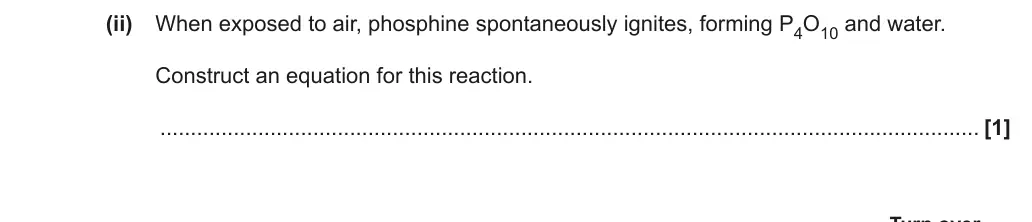
Most candidates were able to write a correctly balanced equation for this reaction.
Skills: M0.2 Use ratios, fractions and percentages
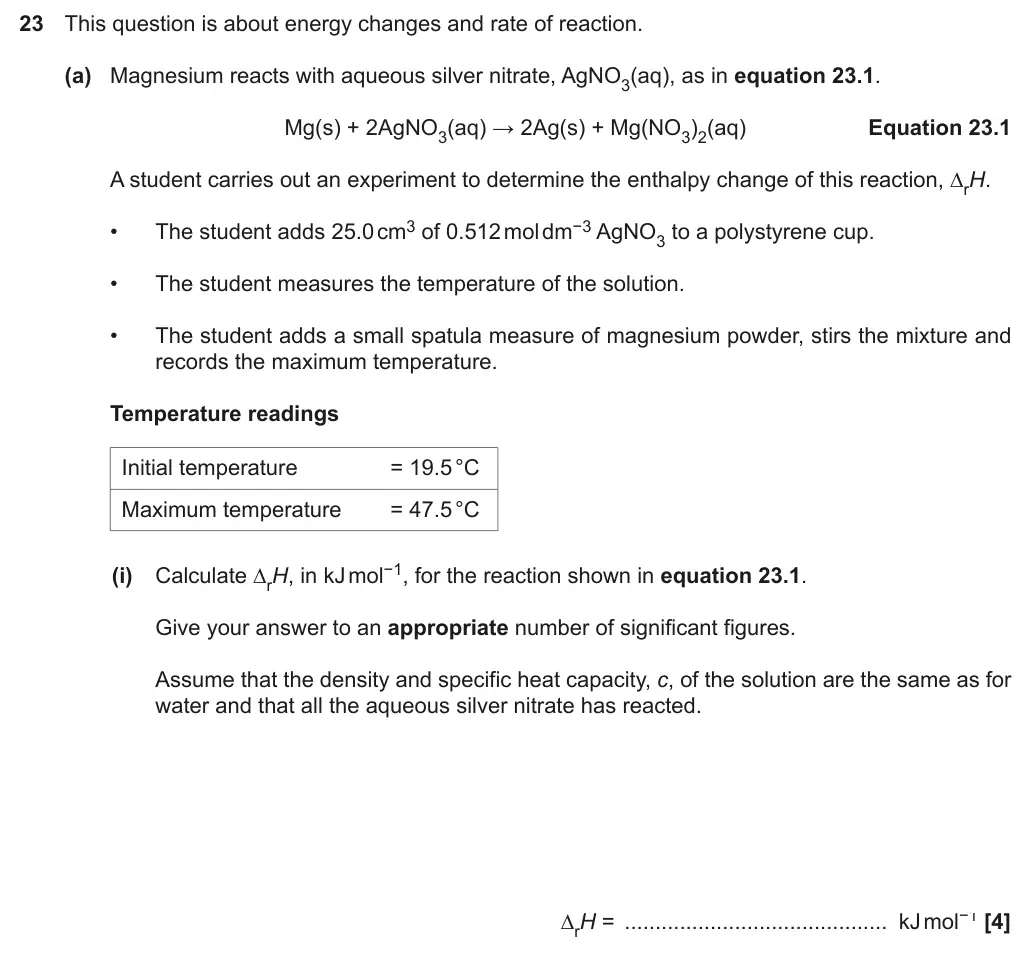
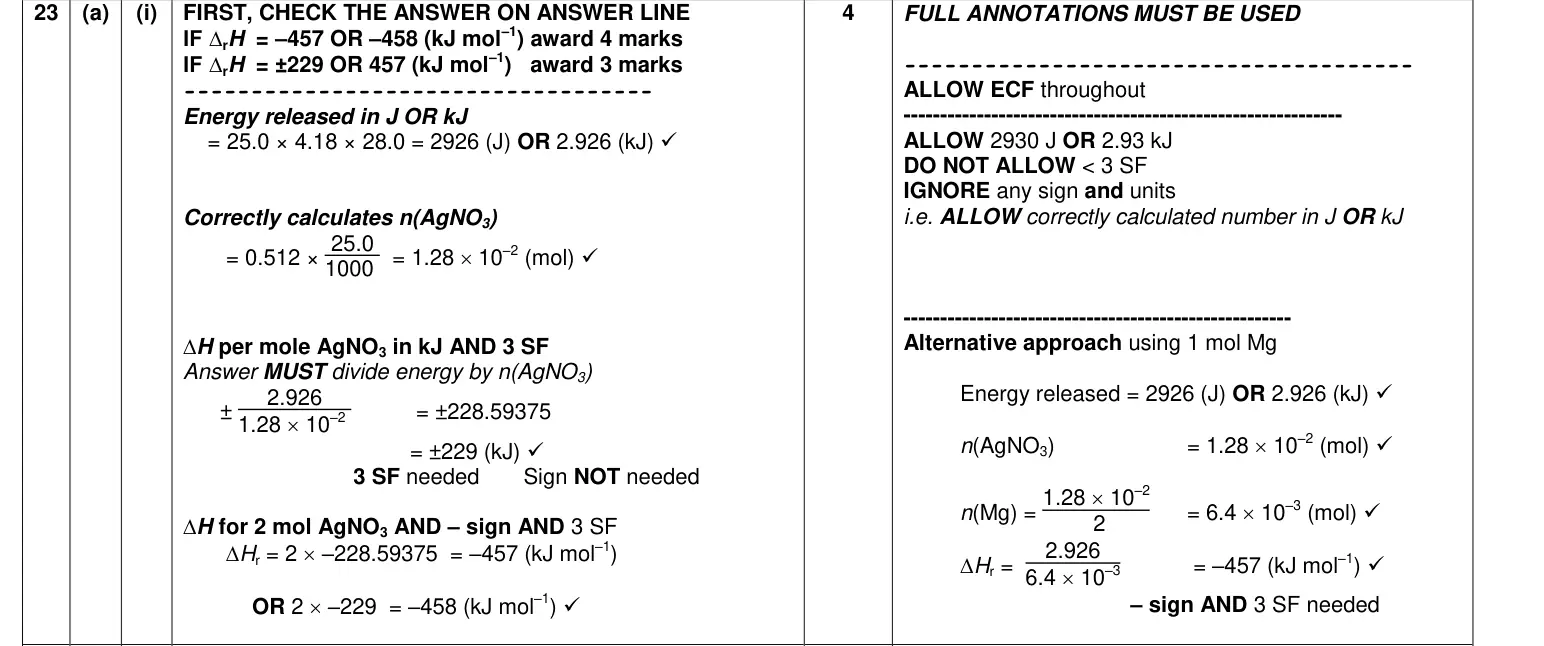
Candidates are well-versed with the relationship q = mc∆T and most were able to calculate that 2.926 kJ of energy was released in this reaction. It was also common to see the amount of AgNO3 correctly calculated as 1.28 × 10⁻³ mol. Candidates were expected to determine the amount of energy released from 1 mol AgNO3 as 229 kJ and finally to multiply this value by 2 for the molar quantities in the equation to match the ‘enthalpy change of reaction’. It was common to see –229 given as the final answer but this was rarely multiplied by 2. The question also required the final answer to be given to an appropriate number of significant figures. Many candidates seemed to be unaware that this reflects the least significant figure provided in the data, in this case 3 significant figures. The exemplar shows a typical response for 3 of the available 4 marks. Many omitted the negative sign in their ∆H value to consider the exothermicity of the reaction. Candidates are also advised to only round at the end of a multi-step calculation. Rounding of intermediate values introduces rounding errors in the final answer. Answer = –457 kJ mol–1
Skills: M0.0 Recognise and make use of appropriate units in calculations; M0.2 Use ratios, fractions and percentages; M1.1 Use an appropriate number of significant figures; M2.3 Substitute numerical values into algebraic equations using appropriate units for physical quantities; PAG3 Enthalpy determination
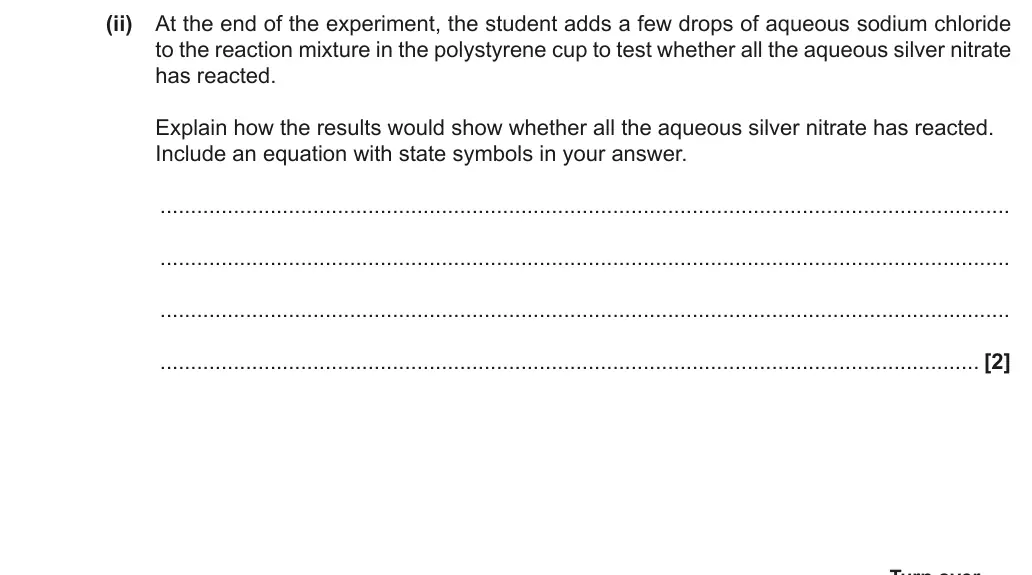
Most candidates recognised that silver nitrate and chloride ions react together to form a white precipitate, but many did not make the link between this observation and whether any silver nitrate was left unreacted. Many candidates did not give a correct equation, with missing or incorrect state symbols being common. This question discriminated extremely well.
Skills: PAG4 Qualitative analysis of ions
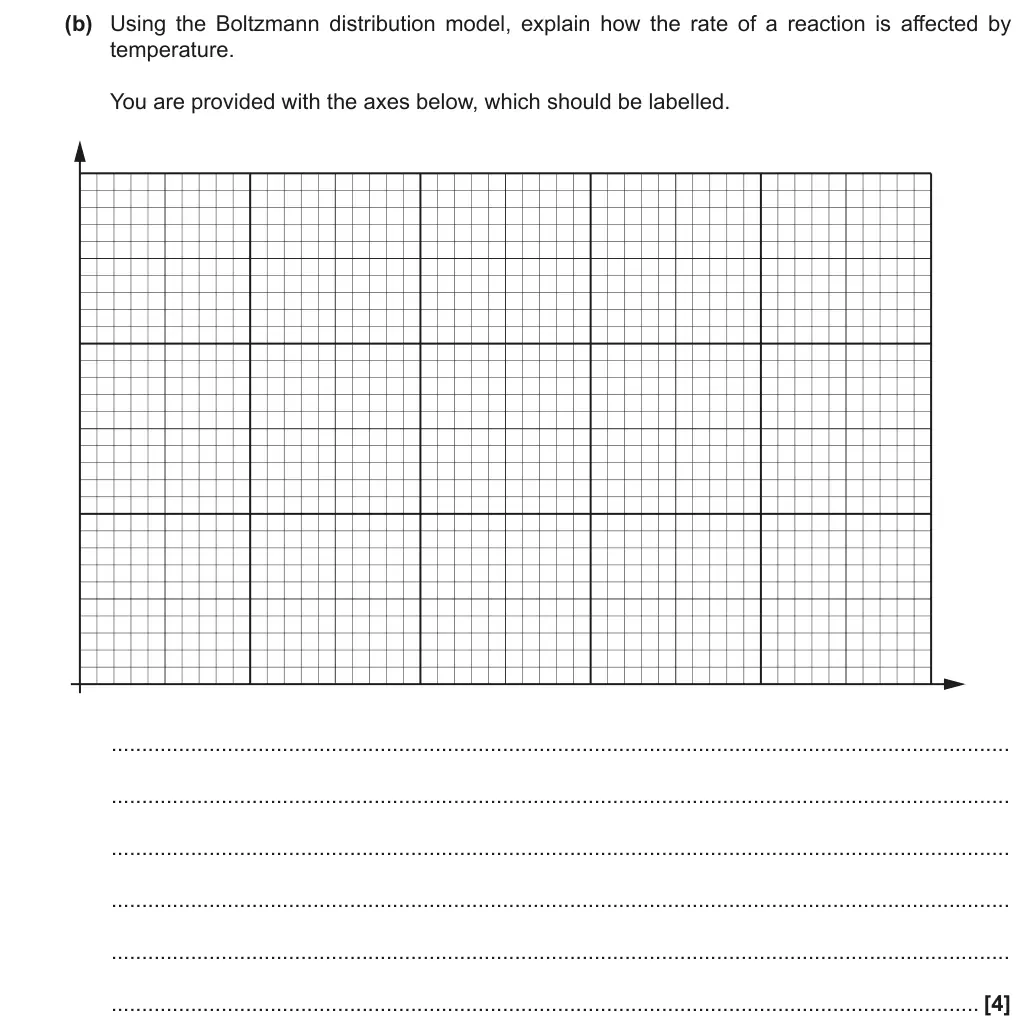
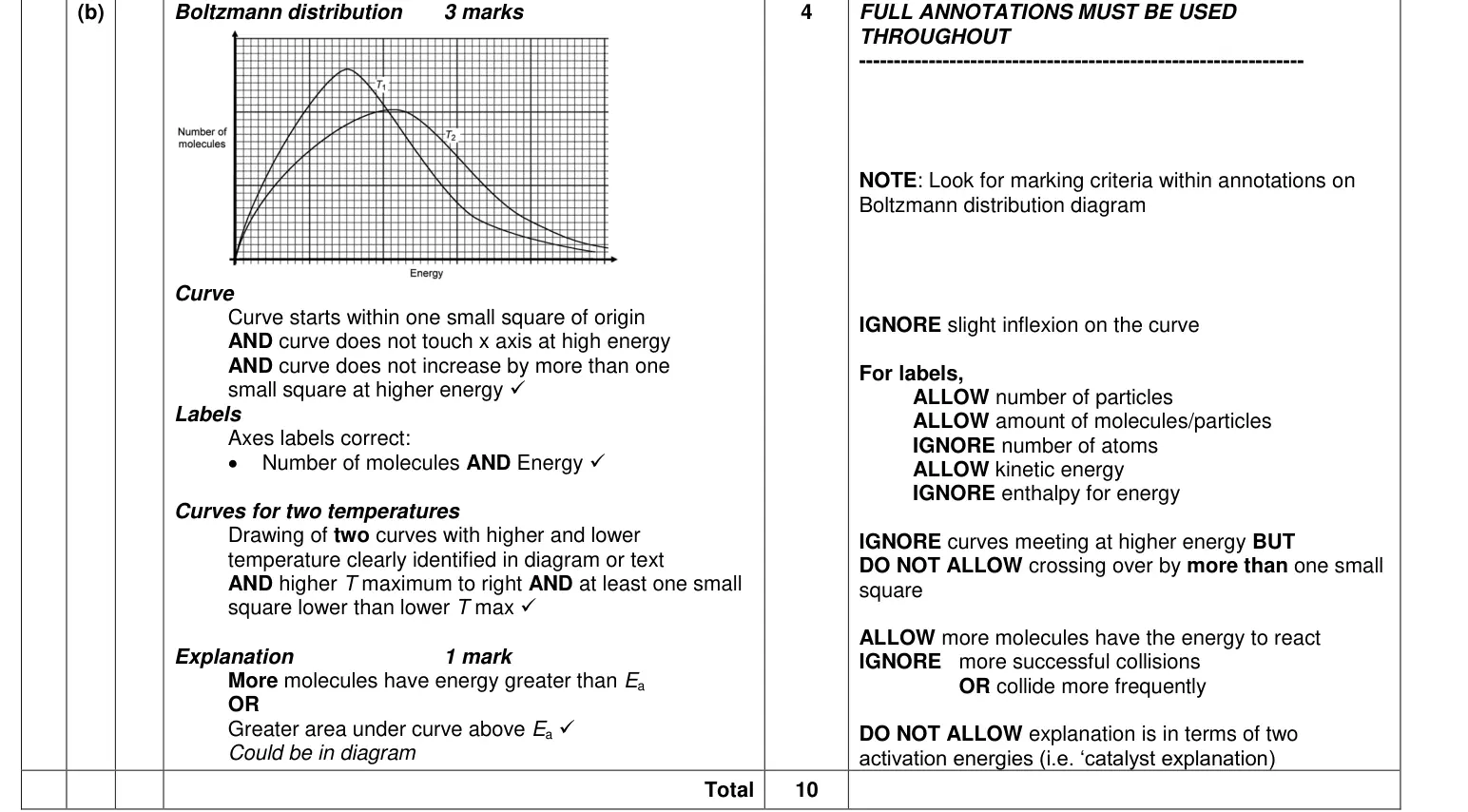
Overall, this question was answered well. Most candidates showed two Boltzmann distribution curves at different temperatures. Labelling of the axes was usually correct, although the labels were sometimes seen the wrong way around. Most candidates were aware that more molecules possessed the required activation energy at a higher temperature, although lower ability candidates discussed frequency of collisions instead. Strangely, many good responses were spoilt by not labelling which of the two curves was at higher temperature. This is shown in the otherwise excellent response in the exemplar.
Skills: M3.1 Translate information between graphical, numerical and algebraic forms
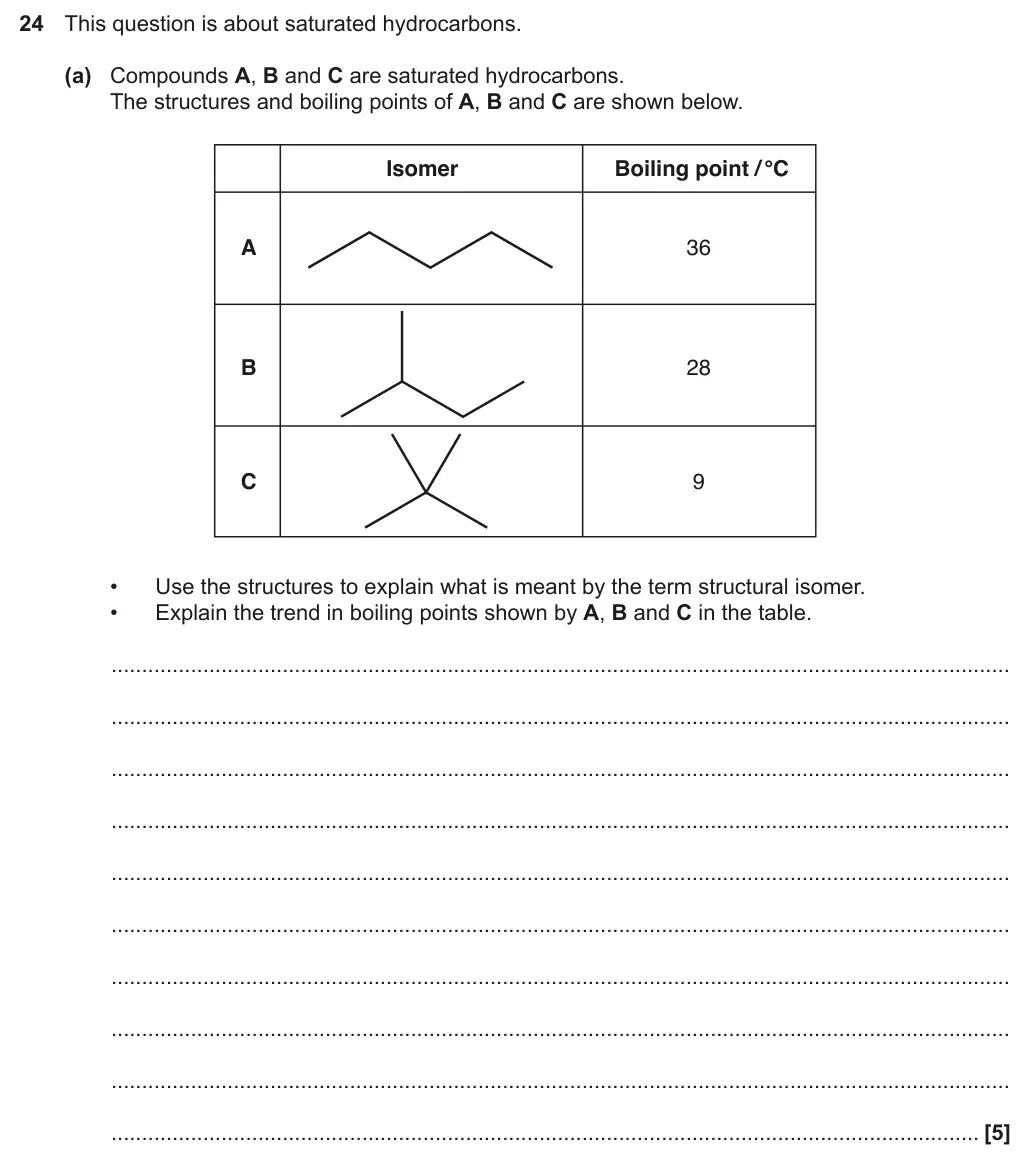
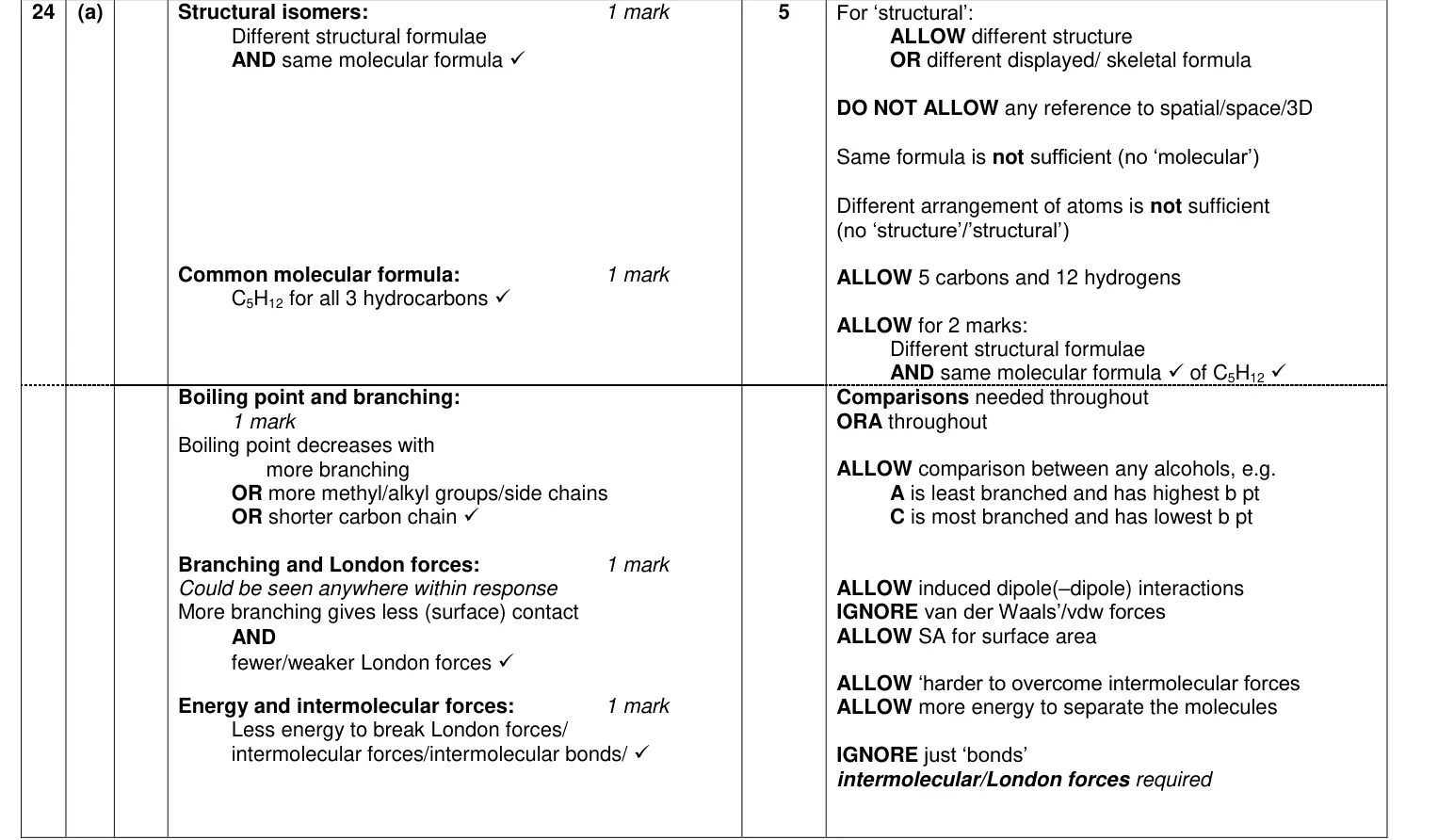
This question discriminated well and resulted in a full range of marks. Most candidates were aware that structural isomers have different structural formulae but the same molecular formulae. It was common though for candidates to refer to different arrangements of atoms in space, clearly confusing with stereoisomerism. The best candidates used the structures (as in the question) to show that the common molecular formula was C5H12. Candidates were expected to link the amount of surface contact between molecules with induced dipole–dipole forces or London forces. ‘Contact’ or the name of the intermolecular forces was often omitted. Finally, candidates were expected to link the amount of branching to the strength of the intermolecular forces and the energy needed to change state. Lower ability candidates often let themselves down by being unable to construct a well-reasoned response. There was often a gulf between the clear responses of able candidates and those of lower ability candidates.

Most candidates identified this reaction as radical substitution.
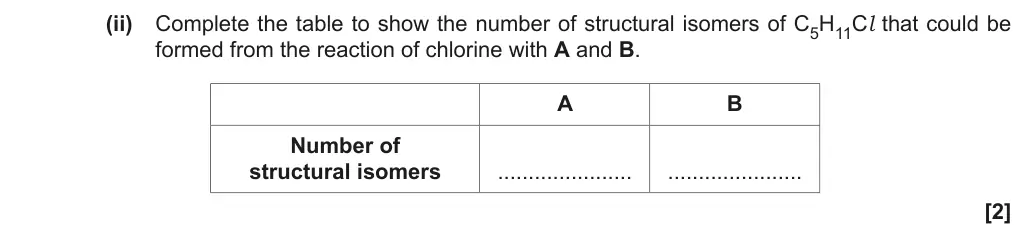
Most candidates achieved at least one mark, particularly for isomer A. Successful candidates often drew structures of the isomers alongside the table to help with their response.
Skills: M4.2 Visualise and represent 2-D and 3-D forms including 2-D representations of 3-D objects
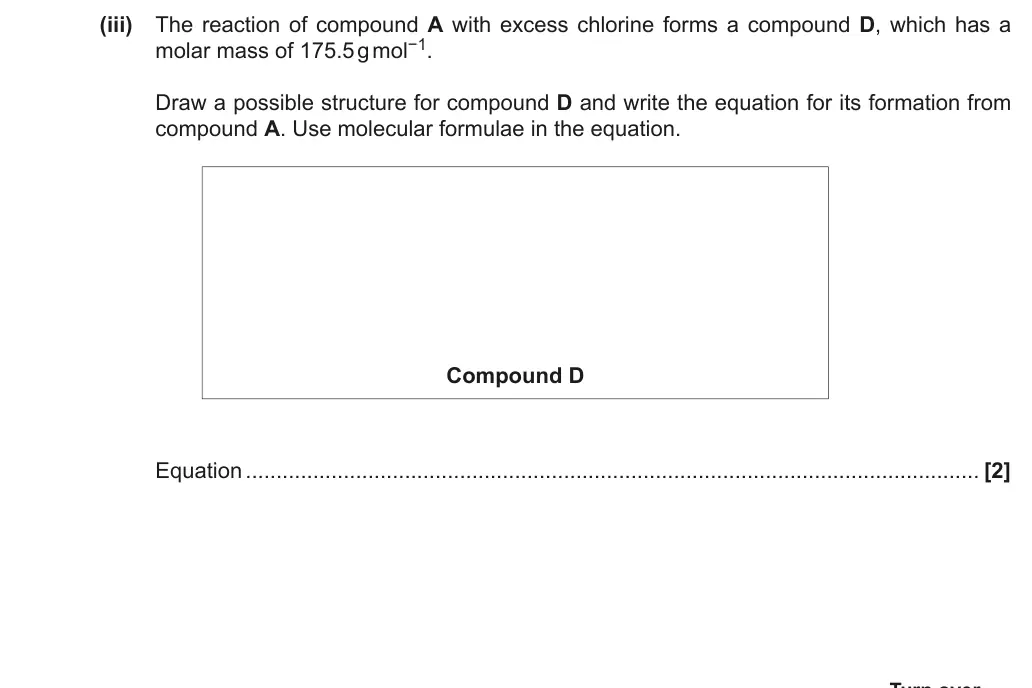
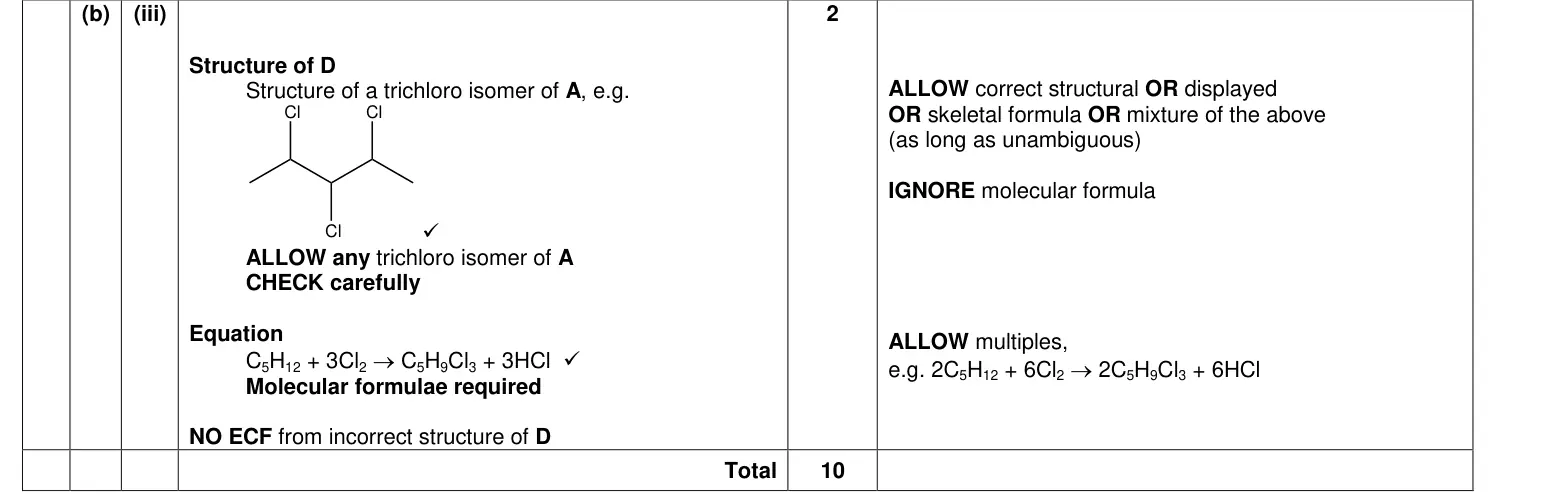
Many candidates correctly drew the structure of compound D but comparatively few were able to construct a correct equation. For this equation, candidates needed to apply their knowledge and understanding of monosubstitution of alkanes to substitution of three H atoms by three Cl atoms. This task proved to be one of the most difficult questions on this paper. The exemplar shows an excellent response. The candidate has drawn a trisubstituted structure that fits the molar mass of 175.5 g mol–1 and a correct equation for its formation. Many attempts at this equation showed H2 as the second product rather than HCl.
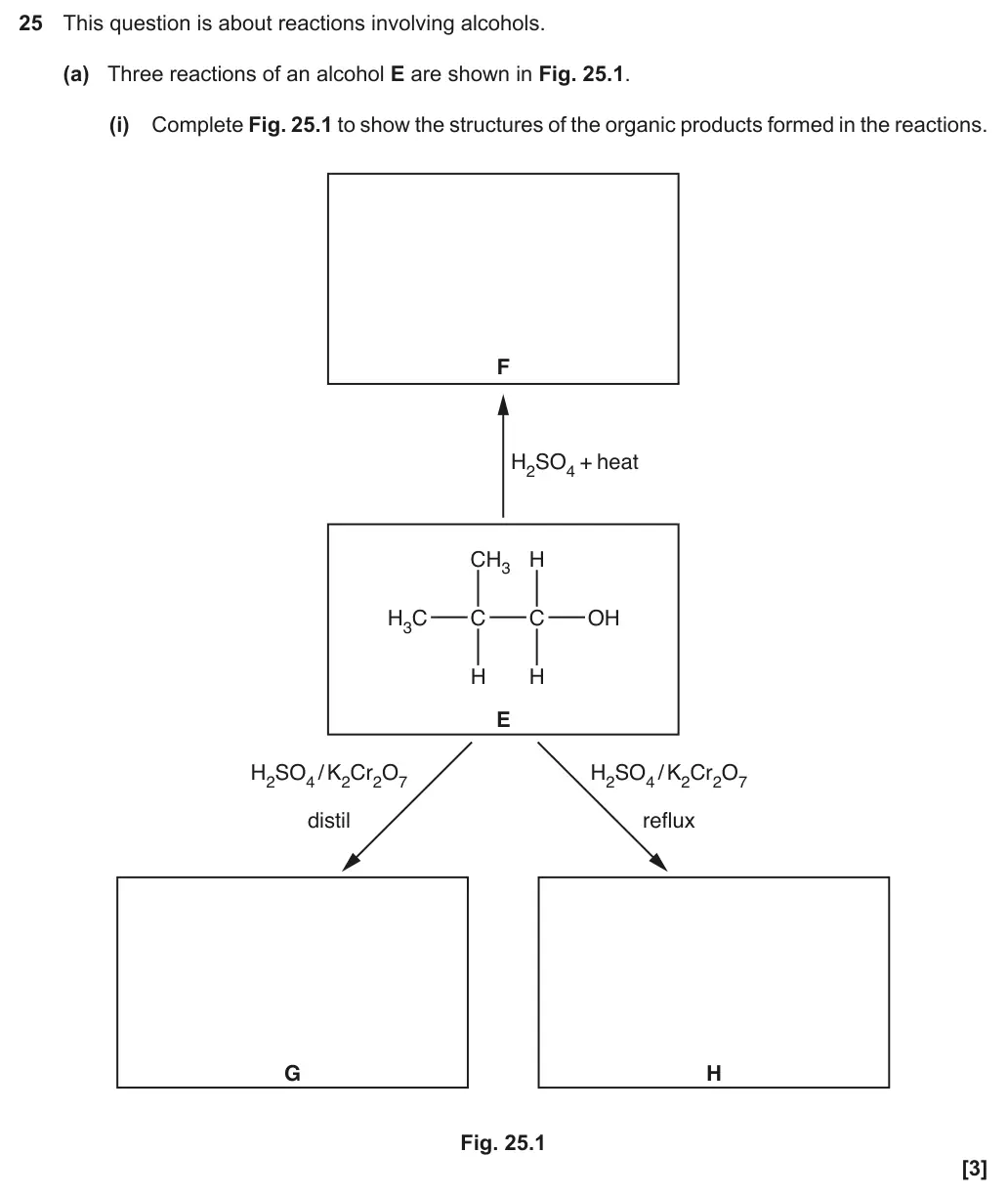
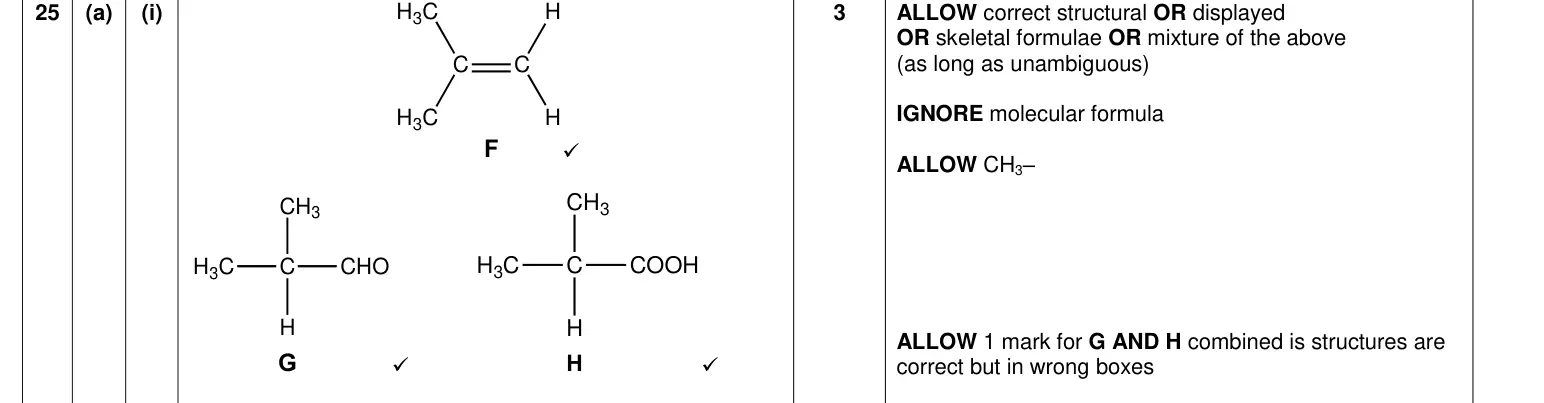
Part (i) discriminated extremely well and rewarded the well-prepared candidate. Compound F proved to be the most difficult option, with a large variety of responses, many appearing to be guesses. Candidates were much more successful with compounds G and H, although these were sometimes shown in reverse order. A significant number of candidates drew structures containing C=C or C=O bonds in which the carbon atom had five bonds. Candidates should check drawing of organic structures carefully to ensure that all carbon atoms have four bonds. There were some good responses for part (ii), with many clearly shown and correct systematic names.

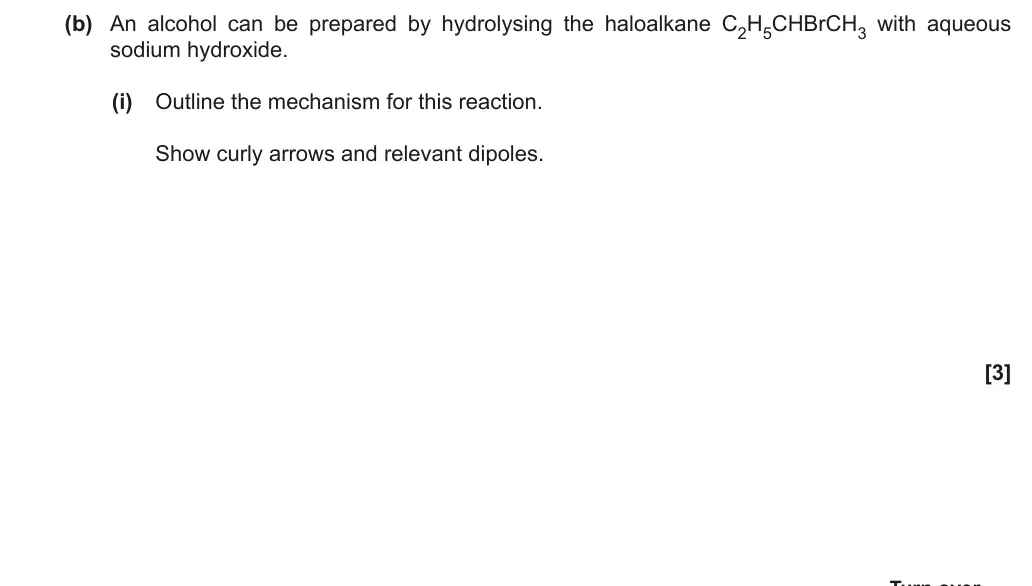
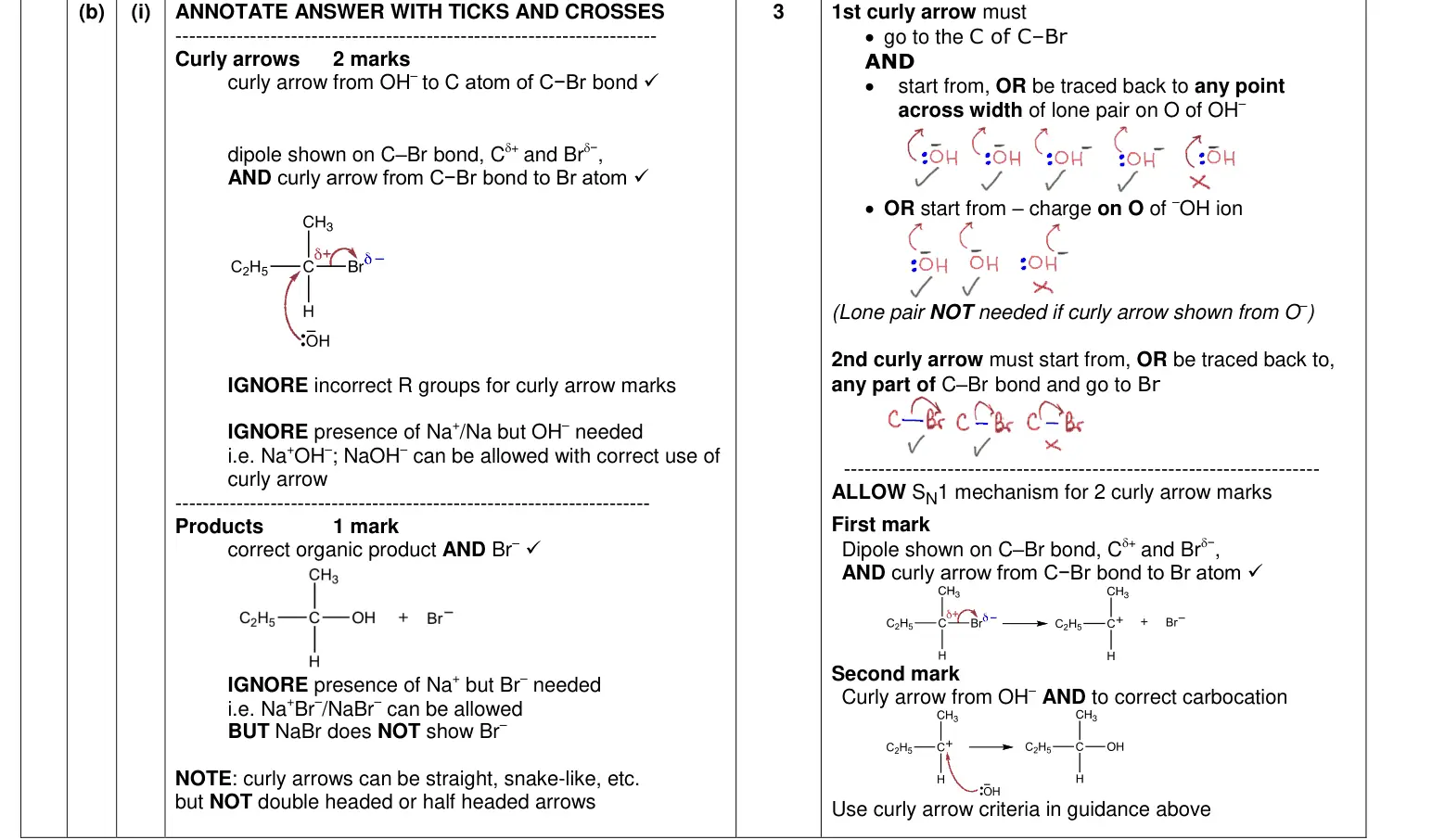
As with 25(a)(i), this question rewarded the well-prepared candidate. The large number of proposed mechanisms showed little resemblance to the accepted mechanism for nucleophilic substitution. Mechanisms were often seen showing curly arrows going in the wrong direction and between the wrong bonds and atoms, charges and dipoles were often incorrect, and partial changes used where full charges were required. Two exemplars are shown. The first exemplar shows clear curly arrows, the role of the lone pair and all charges correct. The second exemplar shows a typical muddled response. Although the curly arrow from the hydroxide ion has been accurately drawn, the hydroxide ion has a partial charge rather than a – charge. There is also no curly arrow showing breaking of the C–Br bond. The only mark available is for the correct organic product and a Br– ion. Some mechanisms were so poor that it was impossible to credit many candidates with any marks. Writing mechanisms is an important skill in organic chemistry and it is recommended that candidates learn and practice their writing.
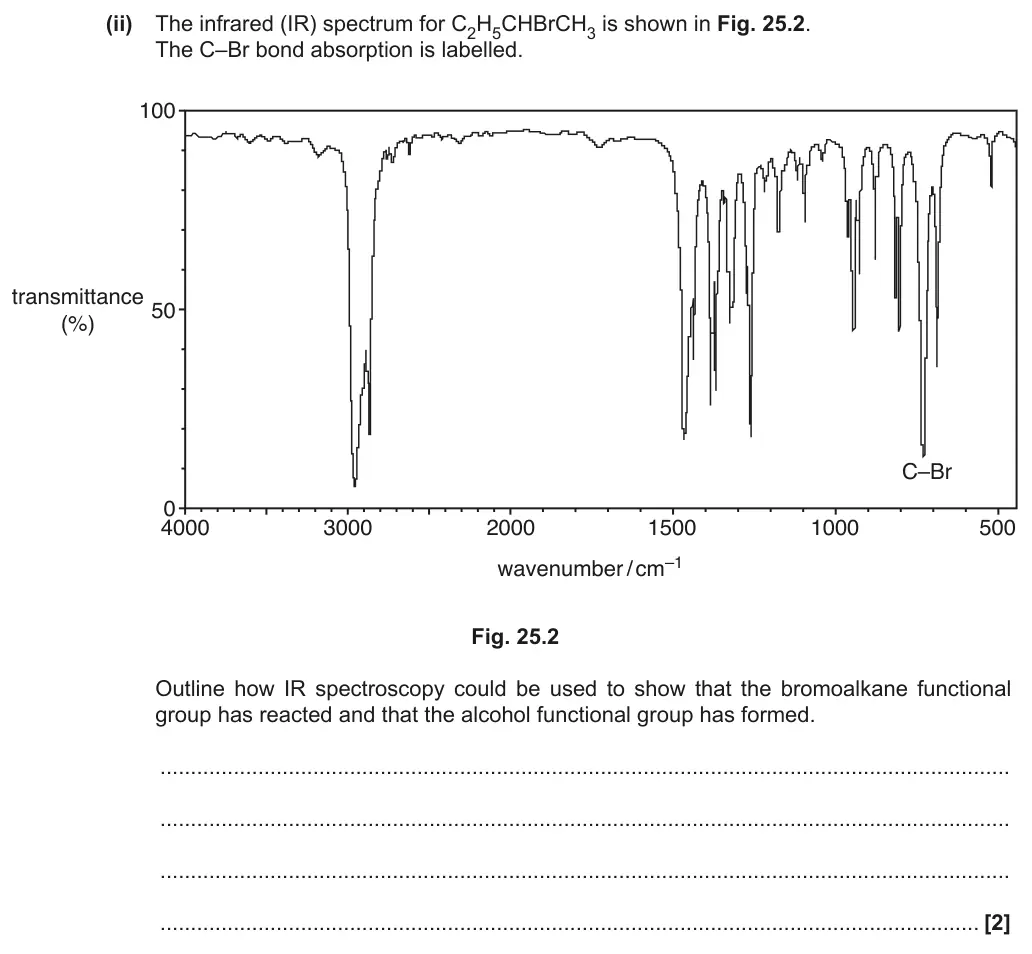
This part discriminated very well with able candidates identifying that the absorption for the C–Br bond would disappear, with a new peak appearing for the alcohol O–H bond. A significant number of candidates did not seem to understand what was required, with many interpreting the spectrum as that of the alcohol, rather than predicting how the spectrum would change during the reaction. A common error was to interpret the absorption for a C–H bond at ~3000 cm–1 as that of an O–H bond. Copyright acknowledgements Q25(b)(ii) spectrum © SDBSWeb : https://sdbs.db.aist.go.jp/sdbs/cgi-bin/cre_index.cgi (National Institute of Advanced Industrial Science and Technology, accessed 31 January 2017).
Skills: M3.1 Translate information between graphical, numerical and algebraic forms
Want a paper marked and gone through with you? Message us.