June 2017: AS Paper 2, Core Organic and Physical Chemistry

80 marks · 41 question parts · Paper, mark scheme and report on Edexcel's site · Have the Data Booklet beside you

Question by question

QTopicMarksAOType
1 Bonding 1Multiple choice
2 Bonding 1Multiple choice
3(a) Formulae, equations and amounts of substance 4Calculation
3(b)(i) Energetics I 3Calculation
3(b)(ii) Energetics I 1Practical and data analysis
4(a) Introduction to organic chemistry, Formulae, equations and amounts of substance 2Short answer
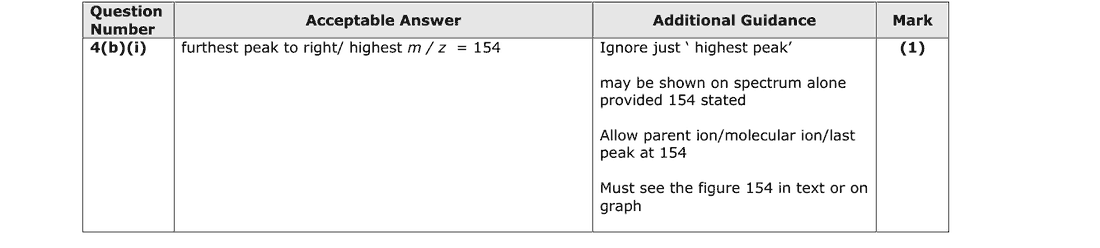
4(b)(i) Modern analytical techniques I: mass spectrometry and infrared 1Short answer
4(b)(ii) Modern analytical techniques I: mass spectrometry and infrared 1Short answer
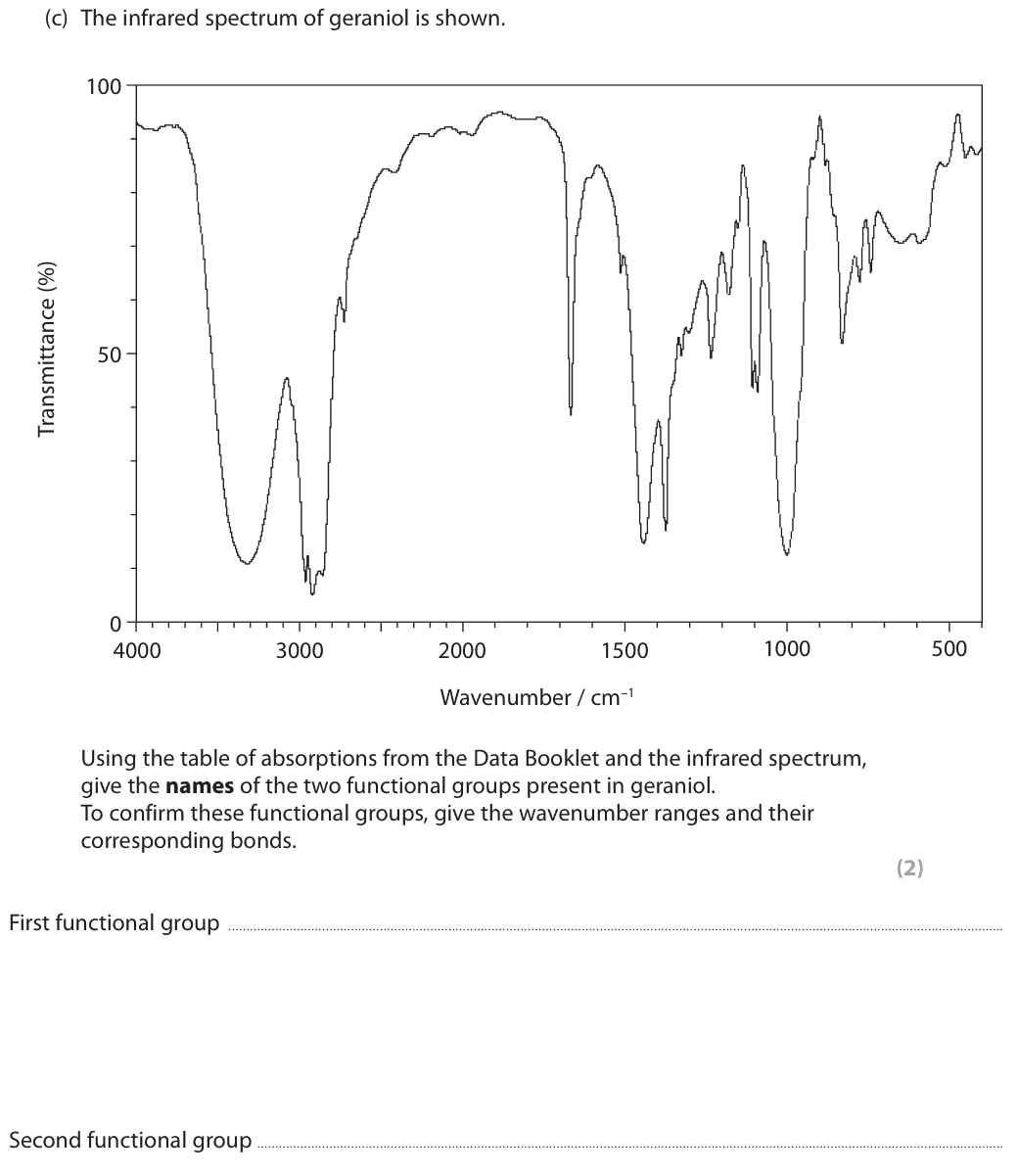
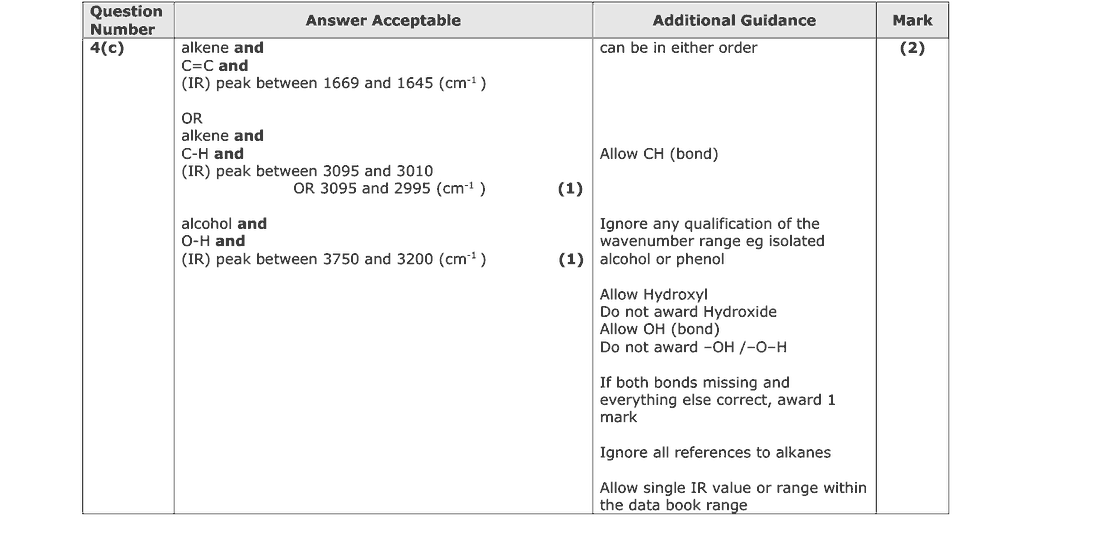
4(c) Modern analytical techniques I: mass spectrometry and infrared 2Short answer
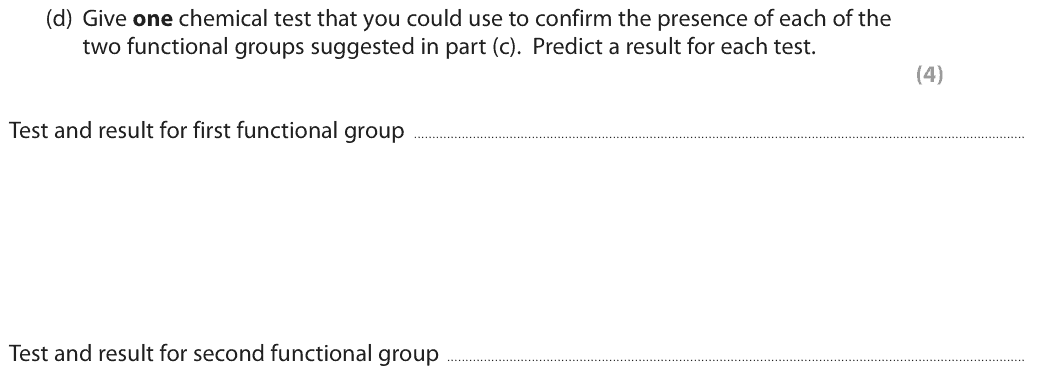
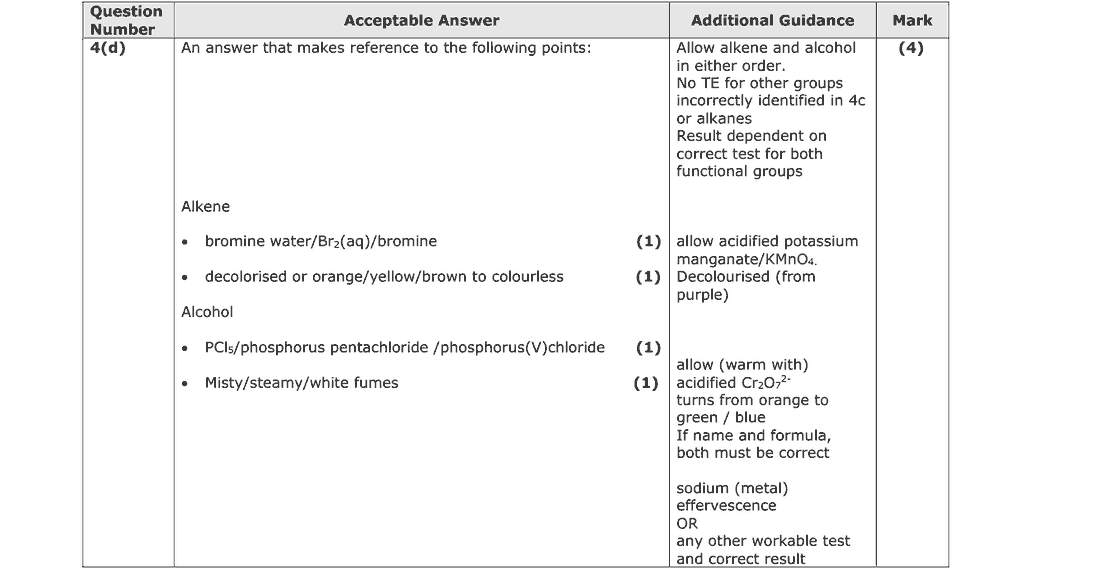
4(d) Alkenes, Alcohols 4Practical and data analysis
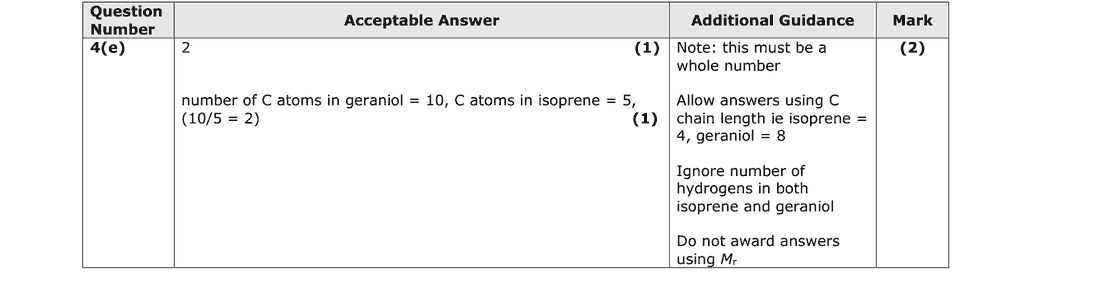
4(e) Introduction to organic chemistry 2Short answer
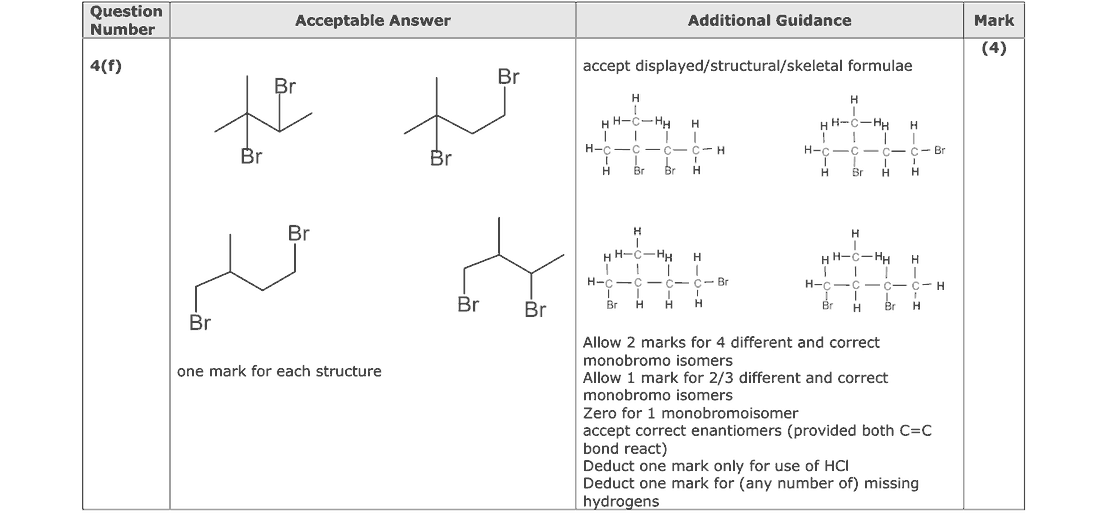
4(f) Alkenes, Introduction to organic chemistry 4Diagram or structure
5(a) Formulae, equations and amounts of substance 1Short answer
5(b)(i) Formulae, equations and amounts of substance 2Calculation
5(b)(ii) Formulae, equations and amounts of substance 2Short answer
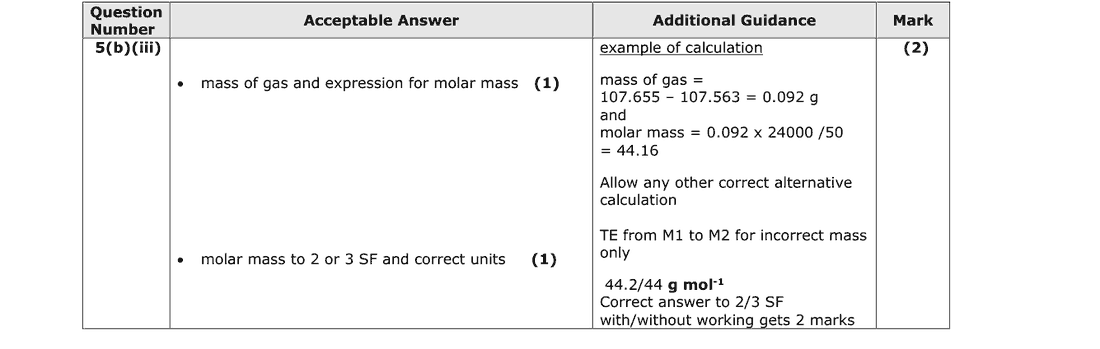
5(b)(iii) Formulae, equations and amounts of substance 2Calculation
5(b)(iv) Formulae, equations and amounts of substance 2Practical and data analysis
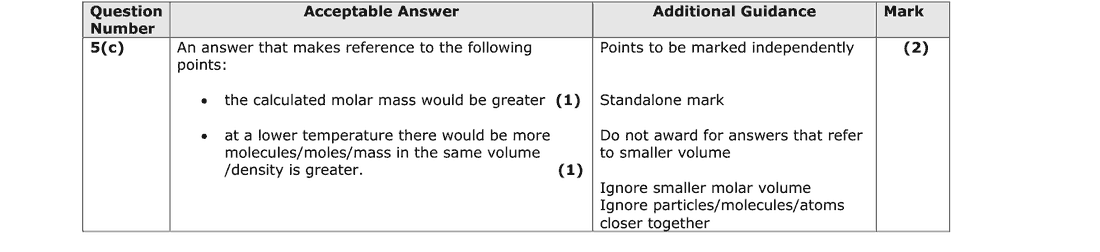
5(c) Formulae, equations and amounts of substance 2Practical and data analysis
5(d) Formulae, equations and amounts of substance 1Practical and data analysis
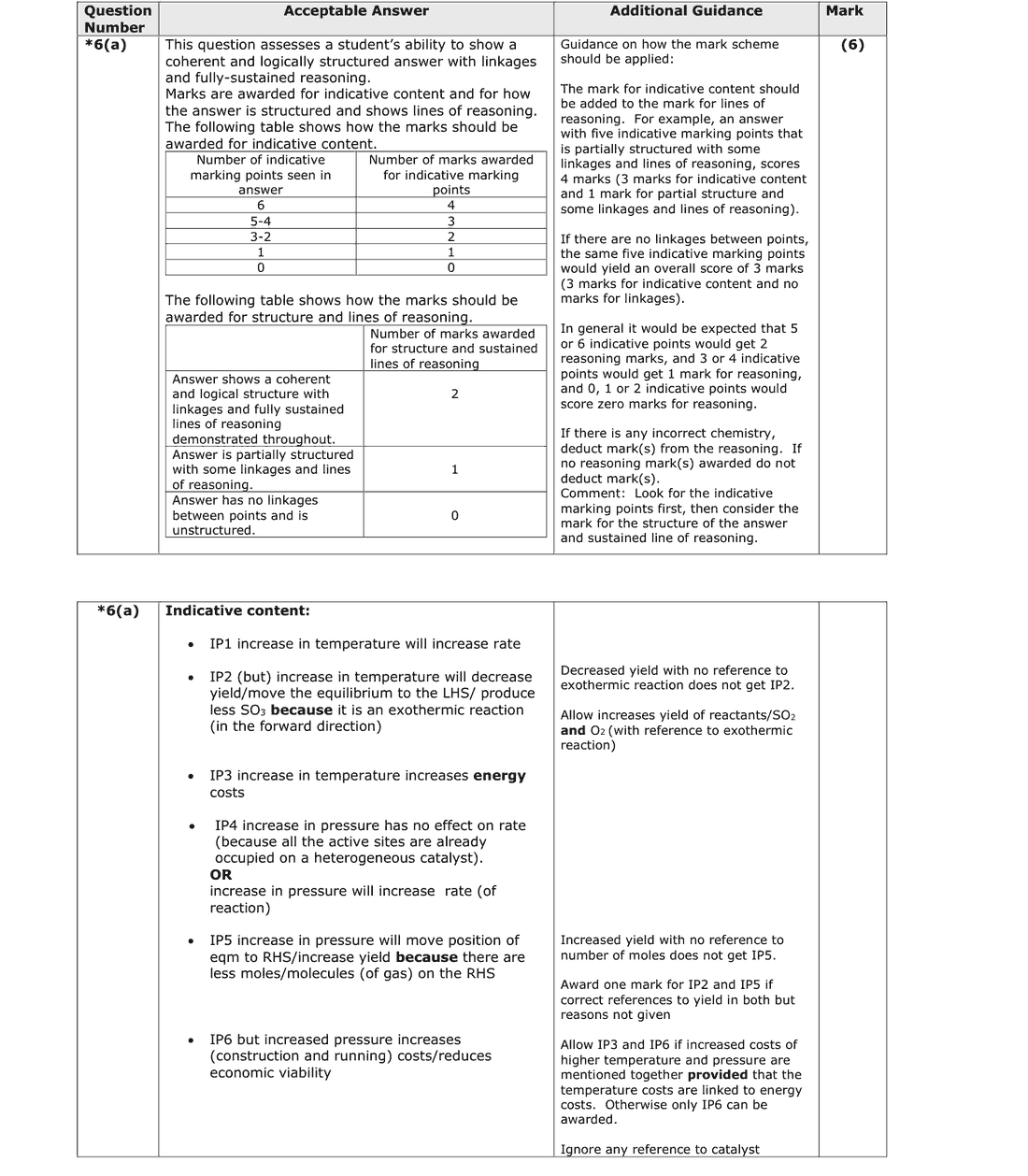
6(a) Equilibrium I, Kinetics I 6Extended response
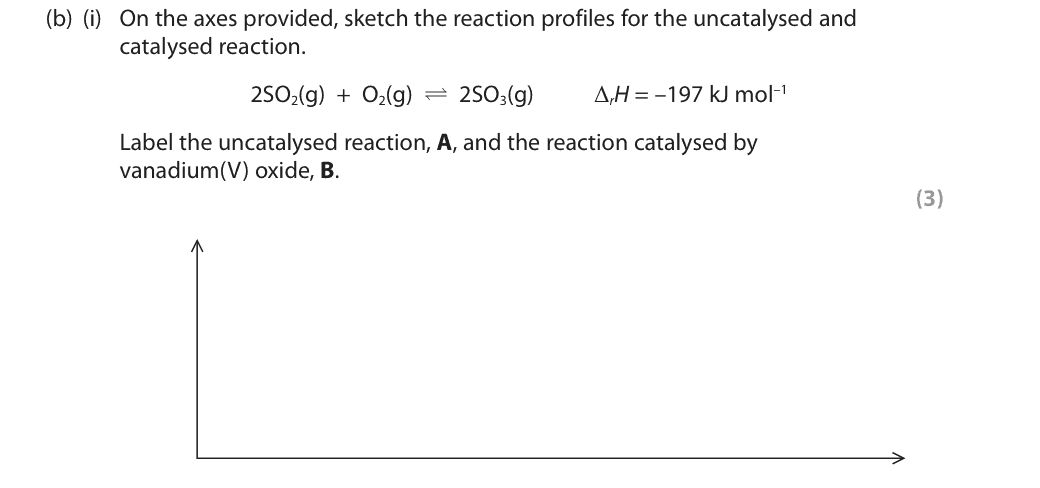
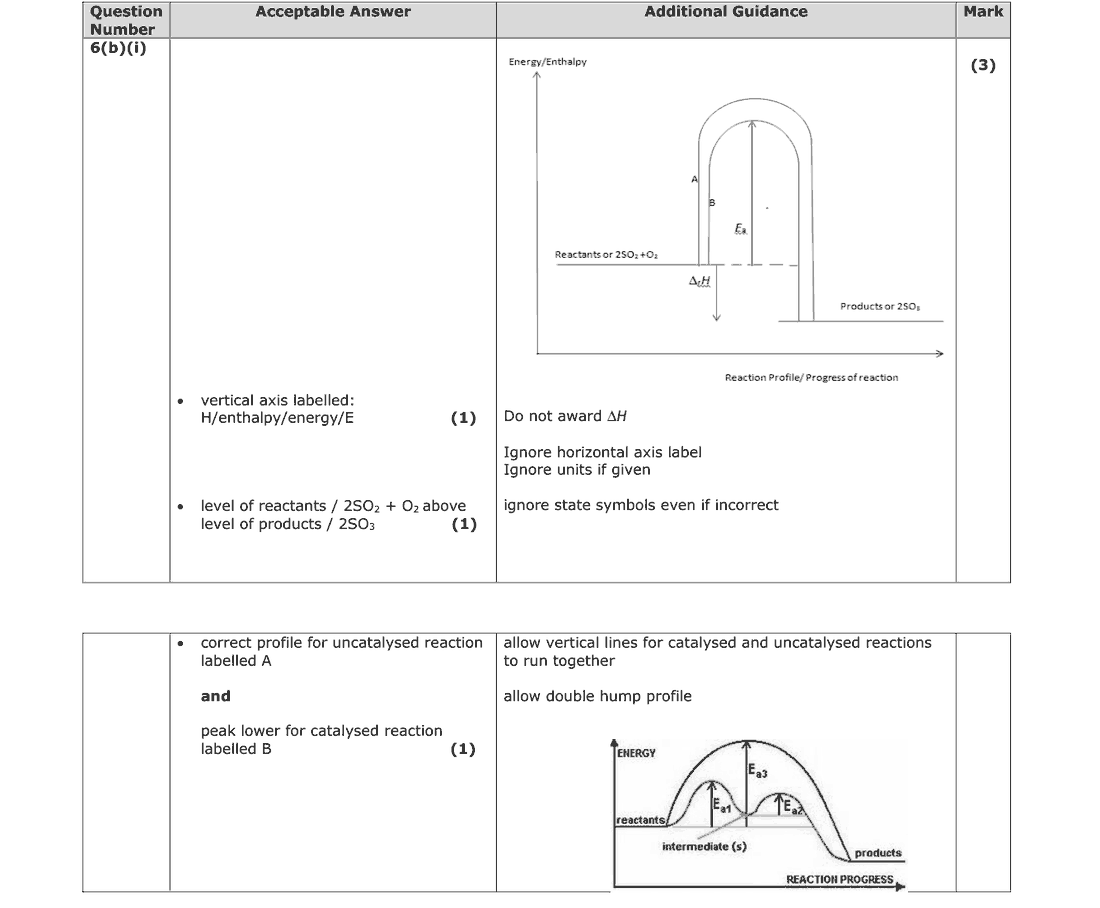
6(b)(i) Kinetics I 3Diagram or structure
6(b)(ii) Kinetics I 2Diagram or structure
6(c)(i) Equilibrium I 1Short answer
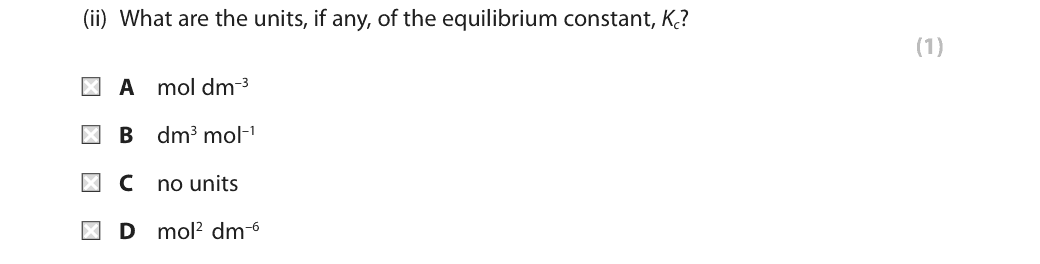
6(c)(ii) Equilibrium I 1Multiple choice
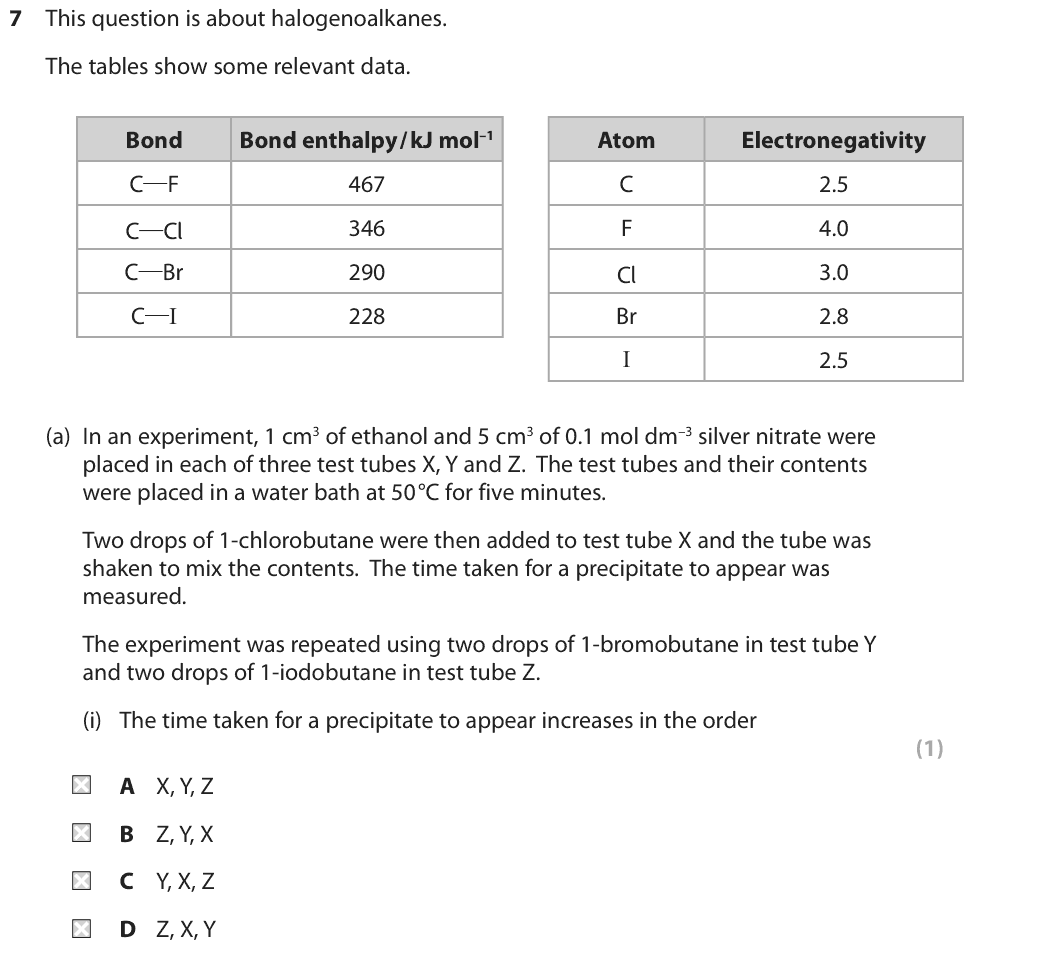
7(a)(i) Halogenoalkanes 1Multiple choice
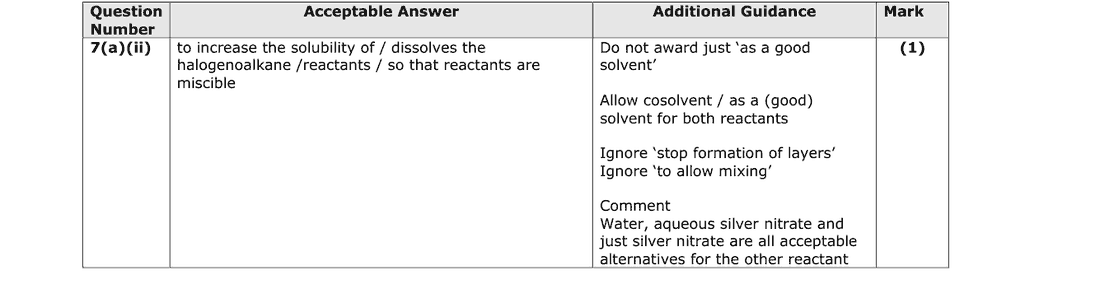
7(a)(ii) Halogenoalkanes, Bonding 1Practical and data analysis
7(a)(iii) Halogenoalkanes 1Practical and data analysis
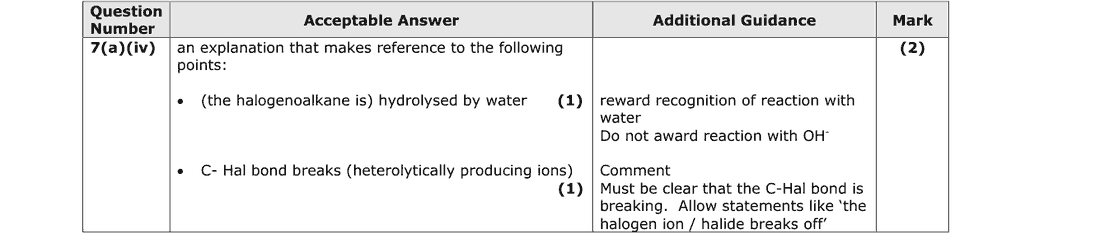
7(a)(iv) Halogenoalkanes, Alkenes 2Explanation
7(a)(v) Formulae, equations and amounts of substance 1Equation writing
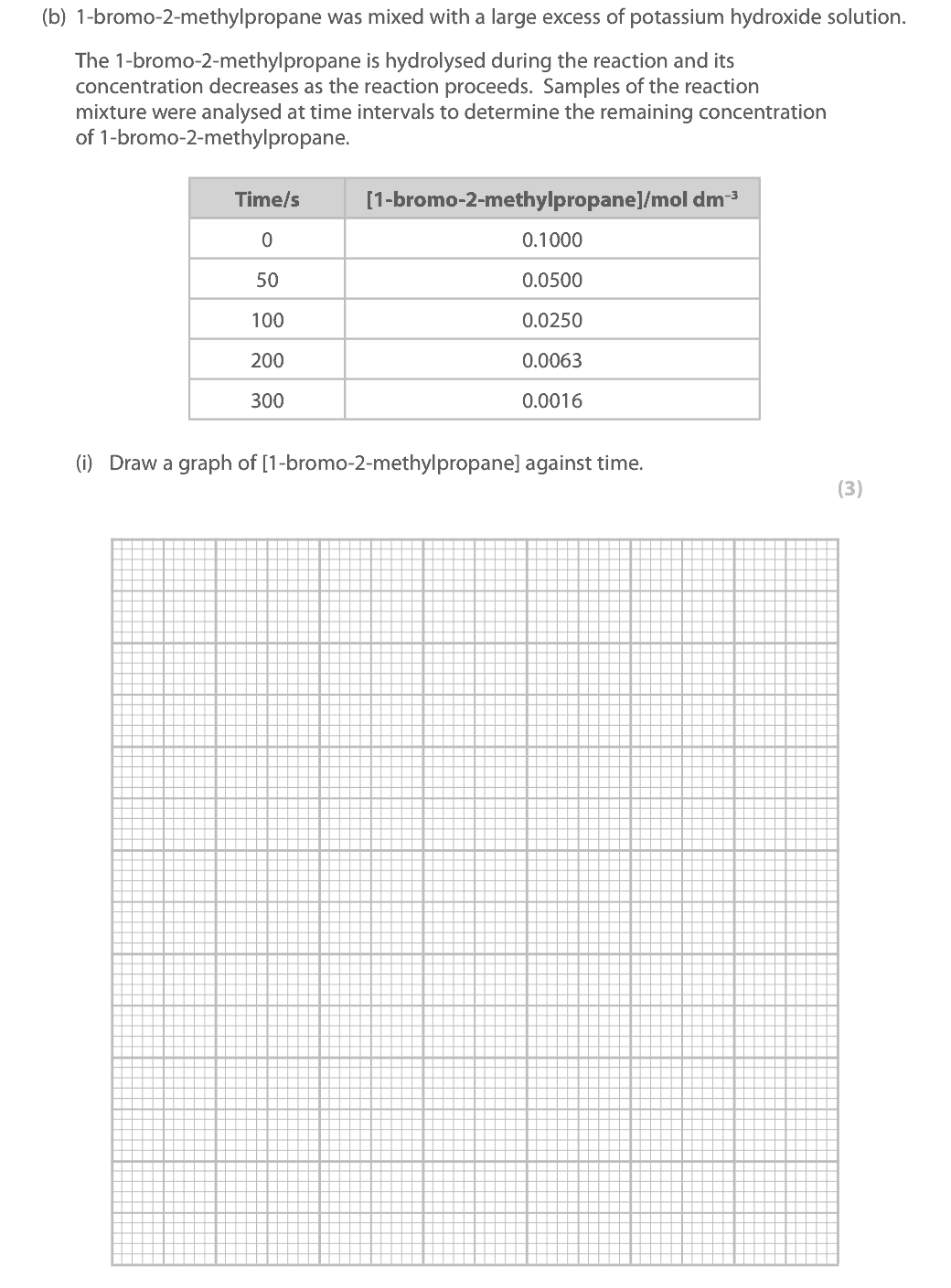
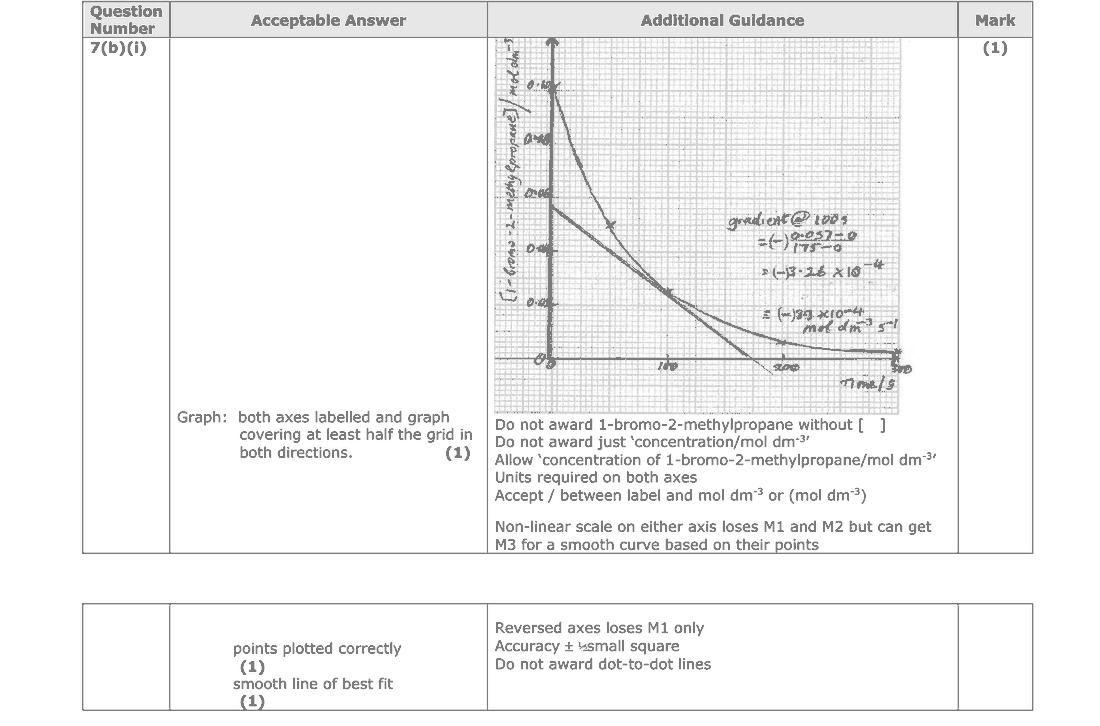
7(b)(i) Kinetics I 3Diagram or structure
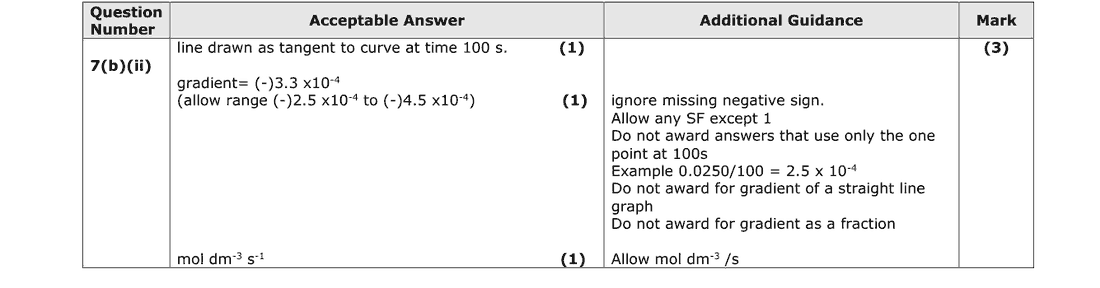
7(b)(ii) Kinetics I 3Calculation
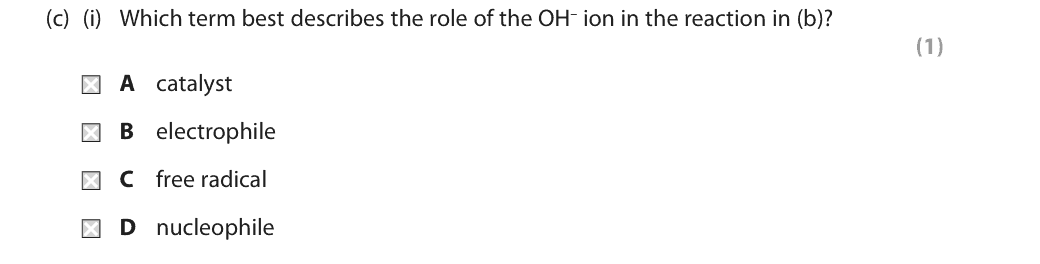
7(c)(i) Halogenoalkanes 1Multiple choice
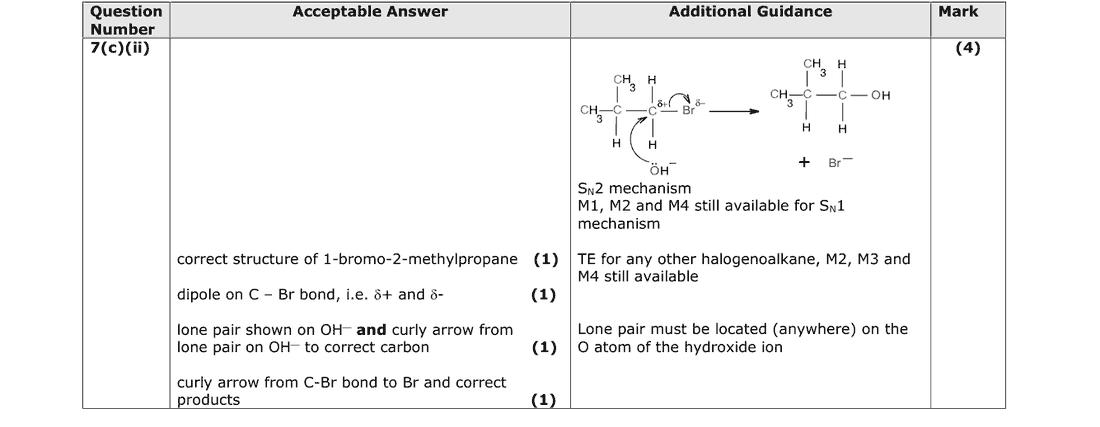
7(c)(ii) Halogenoalkanes 4Mechanism
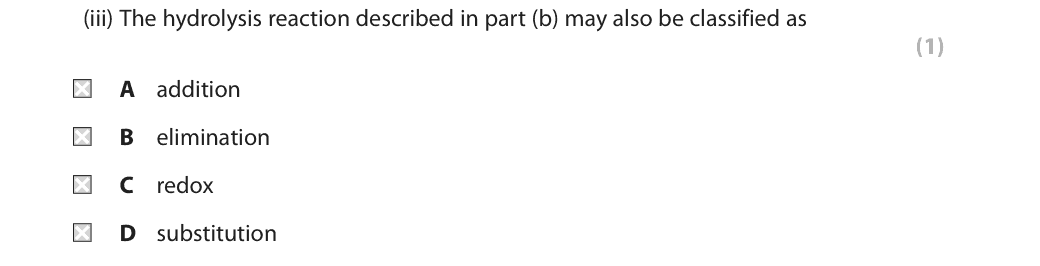
7(c)(iii) Introduction to organic chemistry 1Multiple choice
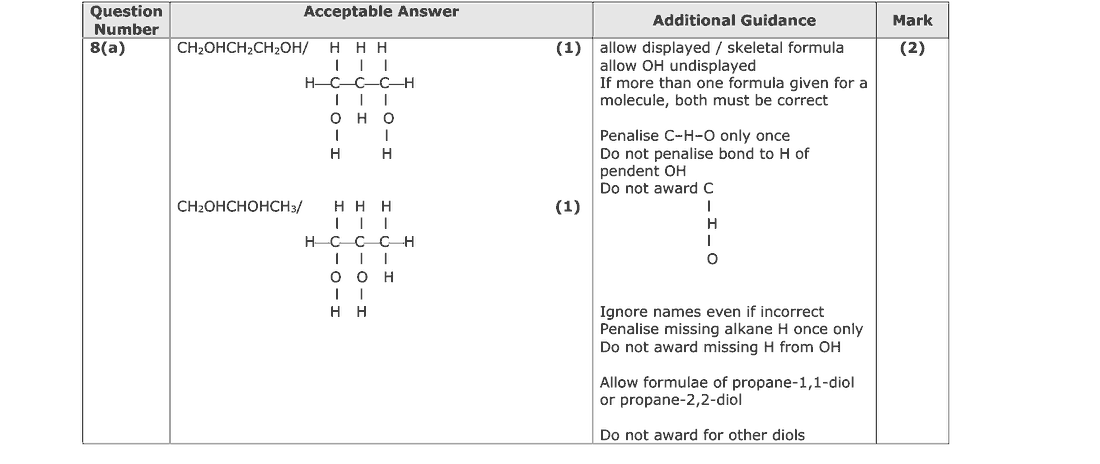
8(a) Introduction to organic chemistry 2Diagram or structure
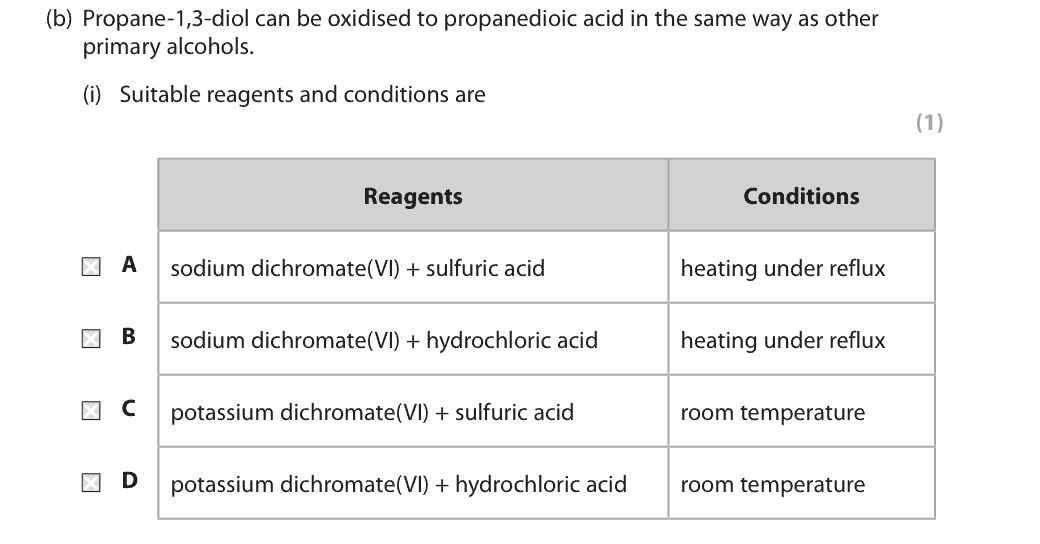
8(b)(i) Alcohols 1Multiple choice
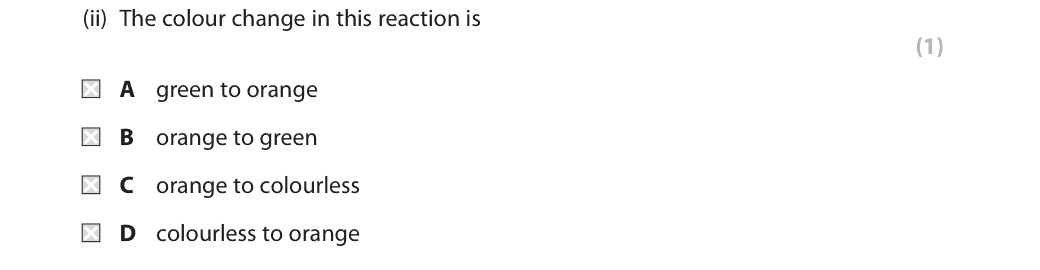
8(b)(ii) Alcohols 1Multiple choice
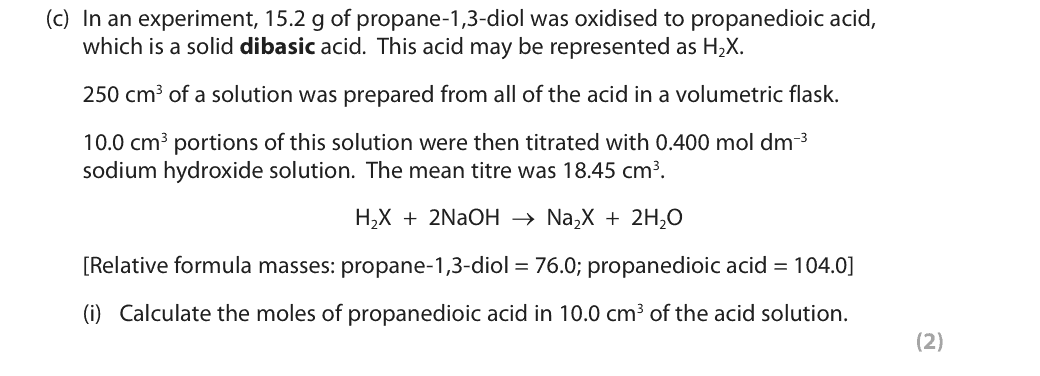
8(c)(i) Formulae, equations and amounts of substance 2Calculation
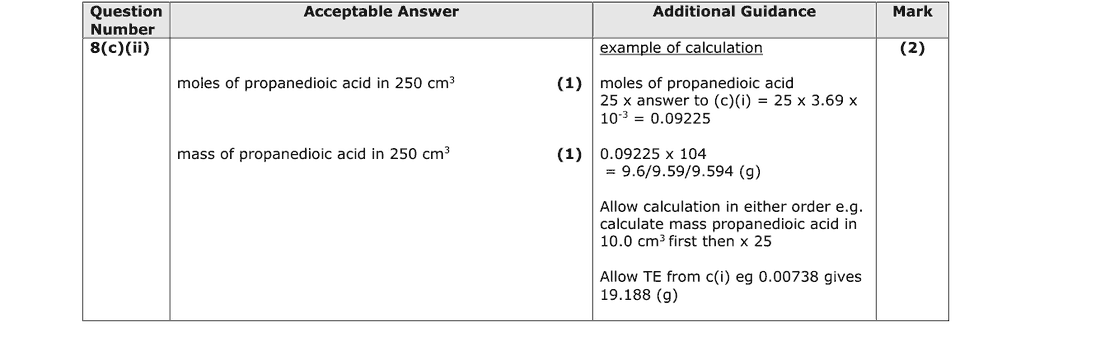
8(c)(ii) Formulae, equations and amounts of substance 2Calculation
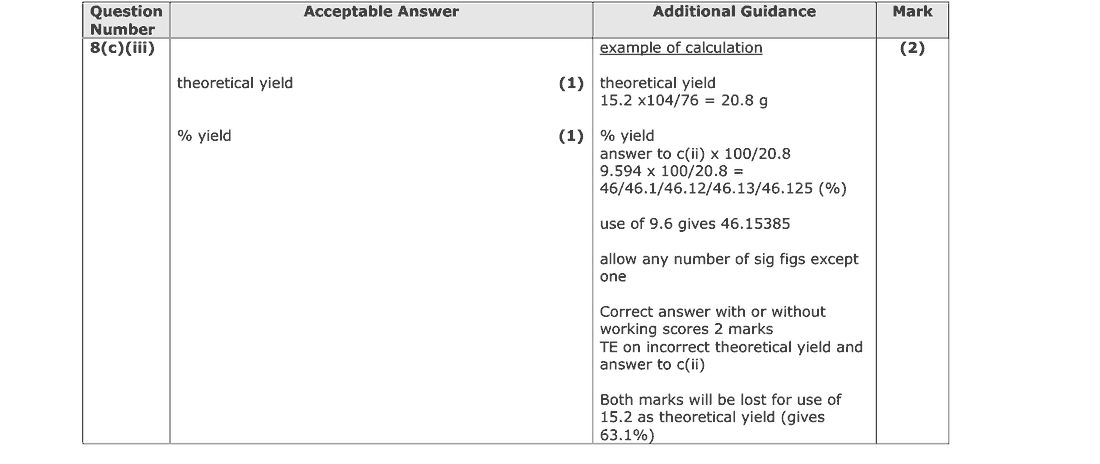
8(c)(iii) Formulae, equations and amounts of substance 2Calculation
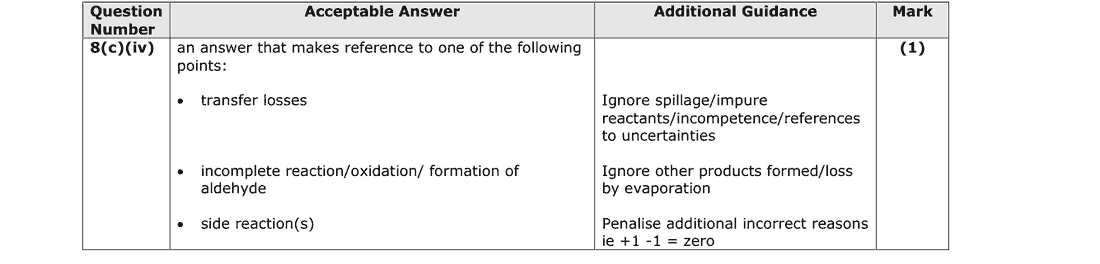
8(c)(iv) Formulae, equations and amounts of substance 1Short answer

The questions

123(a)3(b)(i)3(b)(ii)4(a)4(b)(i)4(b)(ii)4(c)4(d)4(e)4(f)5(a)5(b)(i)5(b)(ii)5(b)(iii)5(b)(iv)5(c)5(d)6(a)6(b)(i)6(b)(ii)6(c)(i)6(c)(ii)7(a)(i)7(a)(ii)7(a)(iii)7(a)(iv)7(a)(v)7(b)(i)7(b)(ii)7(c)(i)7(c)(ii)7(c)(iii)8(a)8(b)(i)8(b)(ii)8(c)(i)8(c)(ii)8(c)(iii)8(c)(iv)
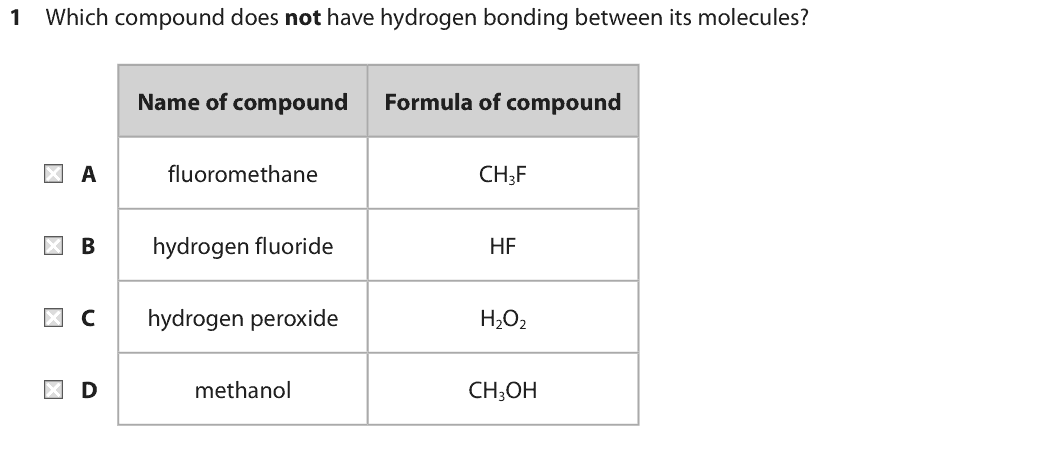
June 2017 · AS Paper 2 · Q1 1 mark Multiple choice bonding
Which compound does not have hydrogen bonding between its molecules?
Name of compound
Formula of compound
A
fluoromethane
CH3F
B
hydrogen fluoride
HF
C
hydrogen peroxide
H2O2
D
methanol
CH3OH
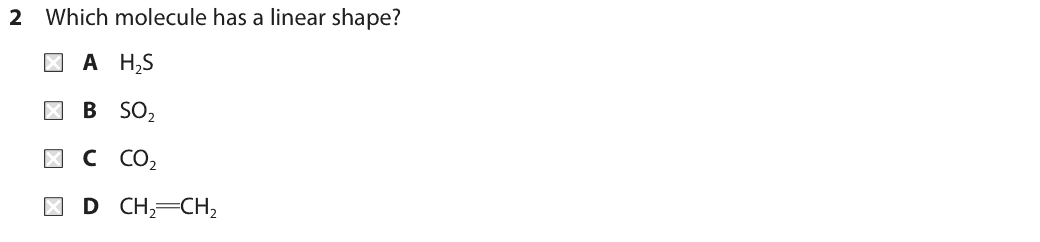
June 2017 · AS Paper 2 · Q2 1 mark Multiple choice bonding
Which molecule has a linear shape?
A H2S
B SO2
C CO2
D CH2
CH2
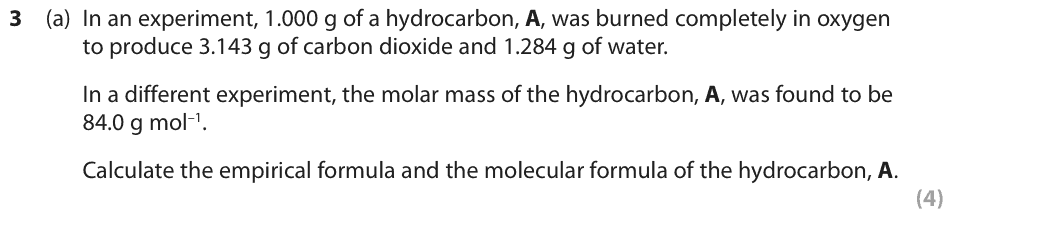
June 2017 · AS Paper 2 · Q3(a) 4 marks Calculation formulae equations and amounts of substance
In an experiment, 1.000 g of a hydrocarbon, A, was burned completely in oxygen
to produce 3.143 g of carbon dioxide and 1.284 g of water.
In a different experiment, the molar mass of the hydrocarbon, A, was found to be
84.0 g mol–1.
Calculate the empirical formula and the molecular formula of the hydrocarbon, A.
June 2017 · AS Paper 2 · Q3(b)(i) 3 marks Calculation energetics i
Earlier part of question 3 that this part usesEarlier part of June 2017 Paper 2 question 3
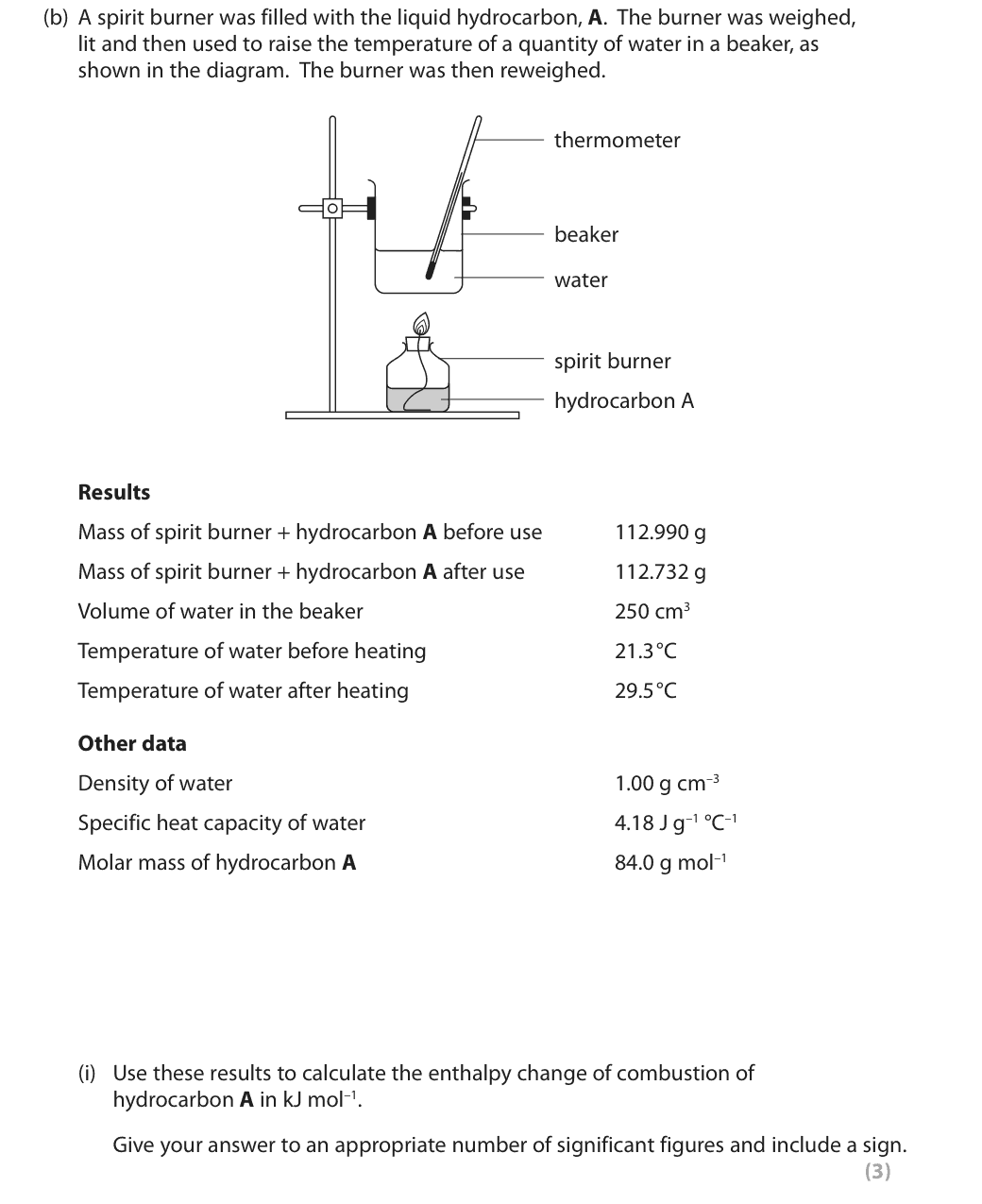
A spirit burner was filled with the liquid hydrocarbon, A.  The burner was weighed,
lit and then used to raise the temperature of a quantity of water in a beaker, as
shown in the diagram.  The burner was then reweighed.
thermometer
beaker
water
spirit burner
hydrocarbon A
Results
Mass of spirit burner + hydrocarbon A before use
112.990 g
Mass of spirit burner + hydrocarbon A after use
112.732 g
Volume of water in the beaker
250 cm3
Temperature of water before heating
21.3°C
Temperature of water after heating
29.5°C
Other data
Density of water
1.00 g cm–3
Specific heat capacity of water
4.18 J g–1 °C–1
Molar mass of hydrocarbon A
84.0 g mol–1
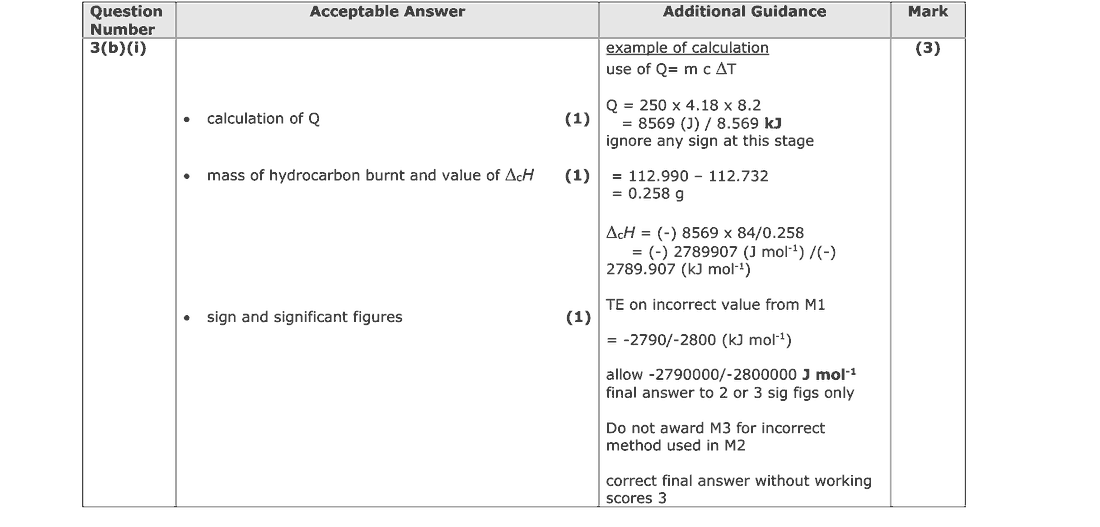
Use these results to calculate the enthalpy change of combustion of
hydrocarbon A in kJ mol–1.
Give your answer to an appropriate number of significant figures and include a sign.
June 2017 · AS Paper 2 · Q3(b)(ii) 1 mark Practical and data analysis energetics i
Earlier parts of question 3 that this part usesEarlier part of June 2017 Paper 2 question 3Earlier part of June 2017 Paper 2 question 3
The beaker used in this experiment was made of copper rather than glass.
Give a reason for this.
June 2017 · AS Paper 2 · Q4(a) 2 marks Short answer introduction to organic chemistryformulae equations and amounts of substance
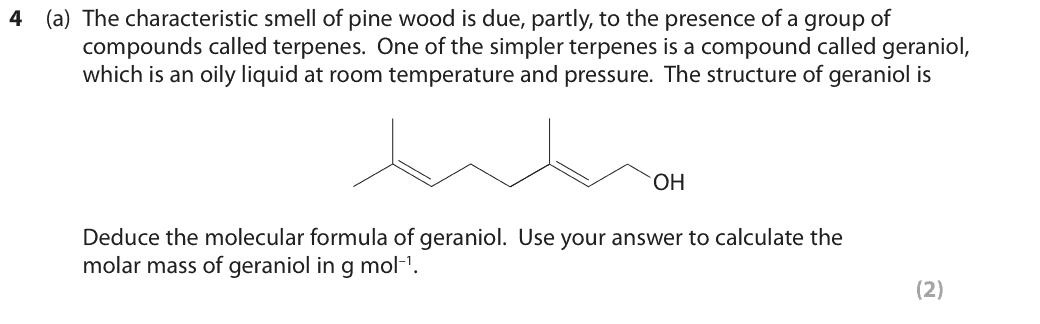
The characteristic smell of pine wood is due, partly, to the presence of a group of
compounds called terpenes.  One of the simpler terpenes is a compound called geraniol,
which is an oily liquid at room temperature and pressure.  The structure of geraniol is
OH
Deduce the molecular formula of geraniol.  Use your answer to calculate the
molar mass of geraniol in g mol–1.
June 2017 · AS Paper 2 · Q4(b)(i) 1 mark Short answer mass spectrometry and infrared spectroscopy
Earlier part of question 4 that this part usesEarlier part of June 2017 Paper 2 question 4
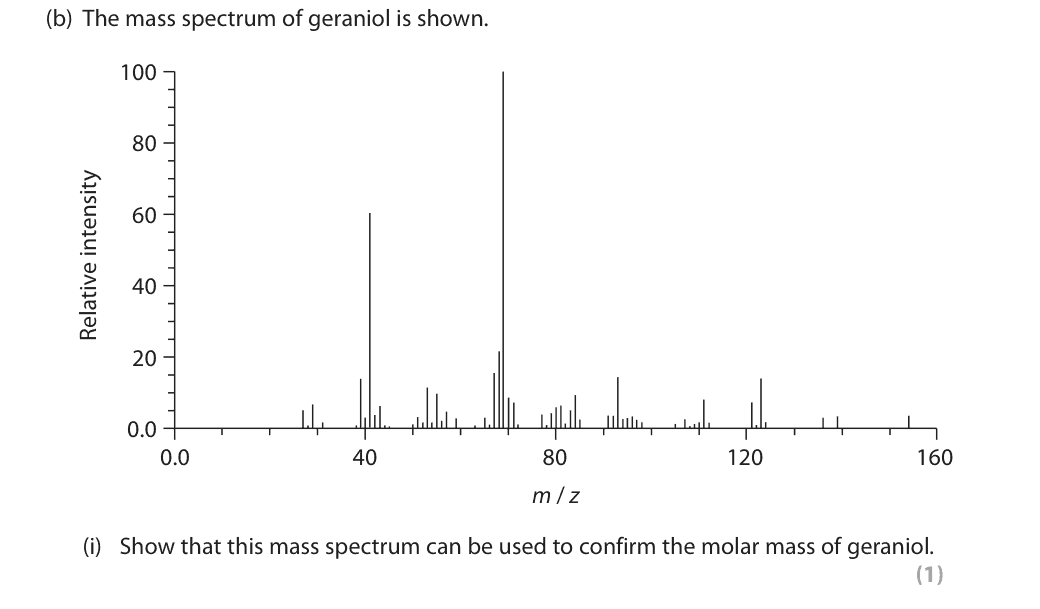
The mass spectrum of geraniol is shown.
100
80
60
40
20
0.0
0.0
40
80
120
160
m / z
Show that this mass spectrum can be used to confirm the molar mass of geraniol.
June 2017 · AS Paper 2 · Q4(b)(ii) 1 mark Short answer mass spectrometry and infrared spectroscopy
Earlier parts of question 4 that this part usesEarlier part of June 2017 Paper 2 question 4Earlier part of June 2017 Paper 2 question 4
Identify an ion that could be responsible for the peak at m / z = 69.
June 2017 · AS Paper 2 · Q4(c) 2 marks Short answer mass spectrometry and infrared spectroscopy
Earlier part of question 4 that this part usesEarlier part of June 2017 Paper 2 question 4
The infrared spectrum of geraniol is shown.
100
50
0
4000
3000
2000
1500
1000
500
Wavenumber / cm–1
Using the table of absorptions from the Data Booklet and the infrared spectrum,
give the names of the two functional groups present in geraniol.
To confirm these functional groups, give the wavenumber ranges and their
corresponding bonds.
First functional group  
Second functional group
June 2017 · AS Paper 2 · Q4(d) 4 marks Practical and data analysis alkenesalcohols
Earlier parts of question 4 that this part usesEarlier part of June 2017 Paper 2 question 4Earlier part of June 2017 Paper 2 question 4
Give one chemical test that you could use to confirm the presence of each of the
two functional groups suggested in part (c).  Predict a result for each test.
Test and result for first functional group  
Test and result for second functional group
June 2017 · AS Paper 2 · Q4(e) 2 marks Short answer introduction to organic chemistry
Earlier part of question 4 that this part usesEarlier part of June 2017 Paper 2 question 4
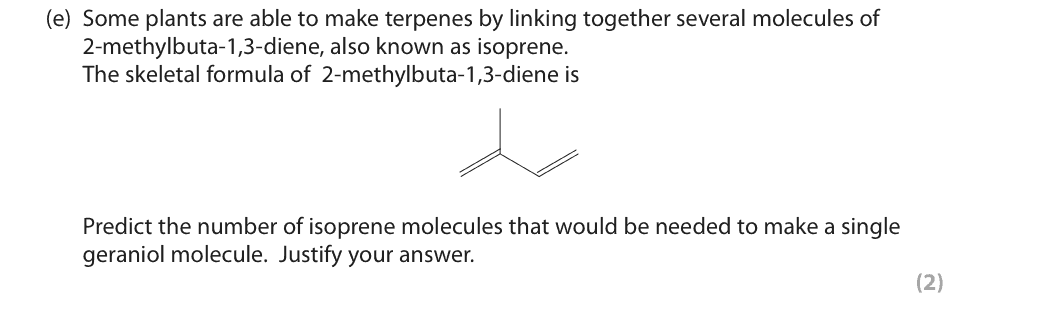
Some plants are able to make terpenes by linking together several molecules of
2-methylbuta-1,3-diene, also known as isoprene.
The skeletal formula of  2-methylbuta-1,3-diene is
Predict the number of isoprene molecules that would be needed to make a single
geraniol molecule.  Justify your answer.
June 2017 · AS Paper 2 · Q4(f) 4 marks Diagram or structure alkenesintroduction to organic chemistry
2-methylbuta-1,3-diene can react with hydrogen bromide.
When 2-methylbuta-1,3-diene reacts with excess hydrogen bromide, several
isomeric products are possible.  Give the structures of four isomeric products.
June 2017 · AS Paper 2 · Q5(a) 1 mark Short answer formulae equations and amounts of substance
State what is meant by the term molar volume of a gas.
June 2017 · AS Paper 2 · Q5(b)(i) 2 marks Calculation formulae equations and amounts of substance
Earlier part of question 5 that this part usesEarlier part of June 2017 Paper 2 question 5
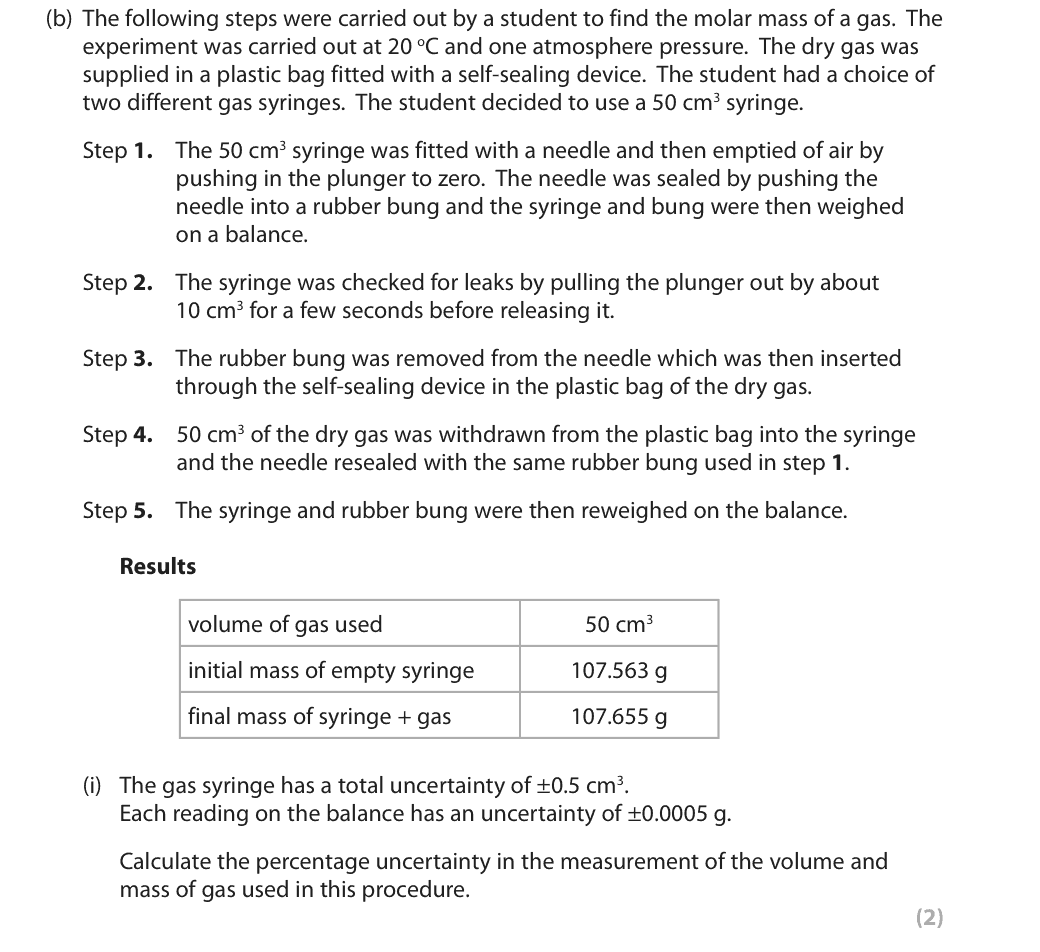
The following steps were carried out by a student to find the molar mass of a gas.  The
experiment was carried out at 20 oC and one atmosphere pressure.  The dry gas was
supplied in a plastic bag fitted with a self-sealing device.  The student had a choice of
two different gas syringes.  The student decided to use a 50 cm3 syringe.
Step 1.   The 50 cm3 syringe was fitted with a needle and then emptied of air by
pushing in the plunger to zero.  The needle was sealed by pushing the
needle into a rubber bung and the syringe and bung were then weighed
on a balance.
Step 2.   The syringe was checked for leaks by pulling the plunger out by about
10 cm3 for a few seconds before releasing it.
Step 3.   The rubber bung was removed from the needle which was then inserted
through the self-sealing device in the plastic bag of the dry gas.
Step 4.   50 cm3 of the dry gas was withdrawn from the plastic bag into the syringe
and the needle resealed with the same rubber bung used in step 1.
Step 5.   The syringe and rubber bung were then reweighed on the balance.
Results
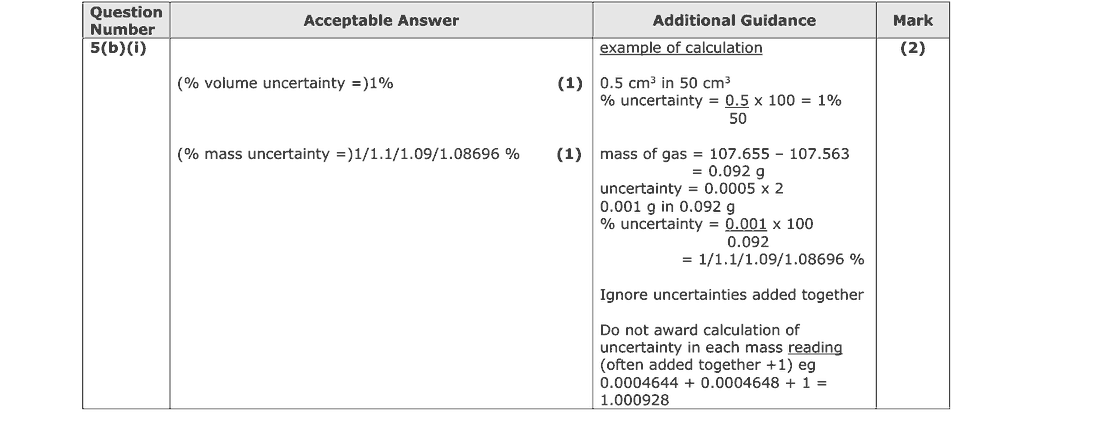
volume of gas used
50 cm3
initial mass of empty syringe
107.563 g
final mass of syringe + gas
107.655 g
The gas syringe has a total uncertainty of ±0.5 cm3.
Each reading on the balance has an uncertainty of ±0.0005 g.
Calculate the percentage uncertainty in the measurement of the volume and
mass of gas used in this procedure.
June 2017 · AS Paper 2 · Q5(b)(ii) 2 marks Short answer formulae equations and amounts of substance
Earlier parts of question 5 that this part usesEarlier part of June 2017 Paper 2 question 5Earlier part of June 2017 Paper 2 question 5
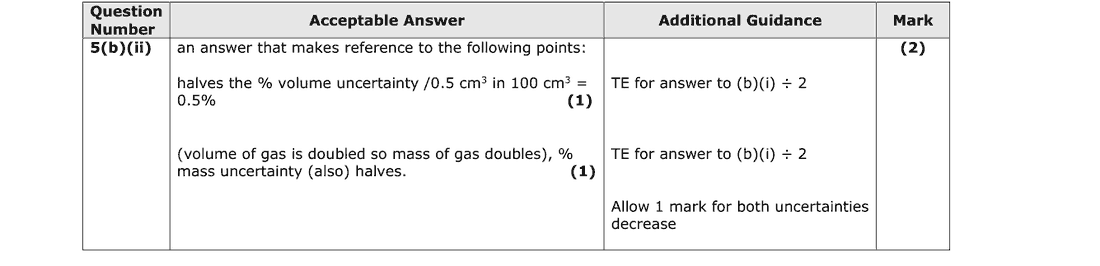
The student repeated the experiment with 100 cm3 of the gas using a
100 cm3 syringe.
The total uncertainty for this larger syringe was also ±0.5 cm3.
Determine the effect, if any, on the volume and mass uncertainties.
June 2017 · AS Paper 2 · Q5(b)(iii) 2 marks Calculation formulae equations and amounts of substance
Earlier parts of question 5 that this part usesEarlier part of June 2017 Paper 2 question 5Earlier part of June 2017 Paper 2 question 5Earlier part of June 2017 Paper 2 question 5
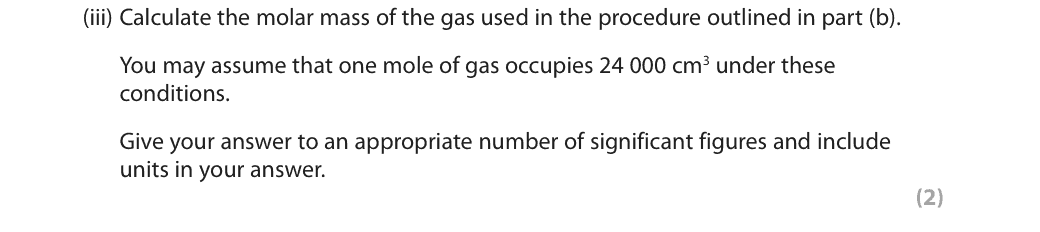
Calculate the molar mass of the gas used in the procedure outlined in part (b).
You may assume that one mole of gas occupies 24 000 cm3 under these
conditions.
Give your answer to an appropriate number of significant figures and include
units in your answer.
June 2017 · AS Paper 2 · Q5(b)(iv) 2 marks Practical and data analysis Hard formulae equations and amounts of substance
Earlier parts of question 5 that this part usesEarlier part of June 2017 Paper 2 question 5Earlier part of June 2017 Paper 2 question 5Earlier part of June 2017 Paper 2 question 5
Explain how the student would know if the syringe had a leak in step 2 and
what effect this leak would have on the molar mass determined in part (b)(iii).
June 2017 · AS Paper 2 · Q5(c) 2 marks Practical and data analysis formulae equations and amounts of substance
Earlier parts of question 5 that this part usesEarlier part of June 2017 Paper 2 question 5Earlier part of June 2017 Paper 2 question 5
If the temperature had been less than 20 °C and the pressure remained at one
atmosphere, deduce the effect, if any, on the molar mass calculated in part (b)(iii).
June 2017 · AS Paper 2 · Q5(d) 1 mark Practical and data analysis formulae equations and amounts of substance
Earlier part of question 5 that this part usesEarlier part of June 2017 Paper 2 question 5
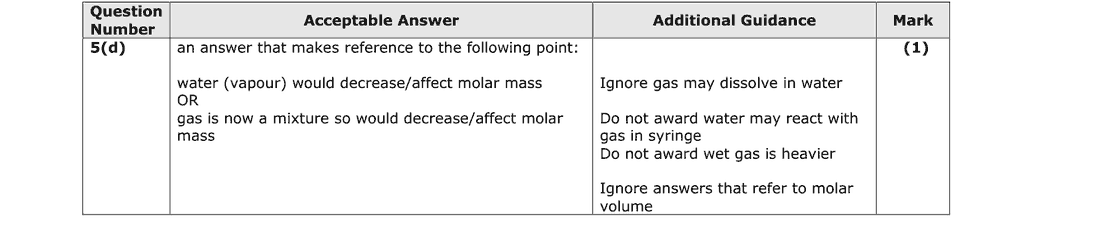
Give a reason why the gas should be dry.
June 2017 · AS Paper 2 · Q6(a) 6 marks 6-mark extended response equilibrium ikinetics i
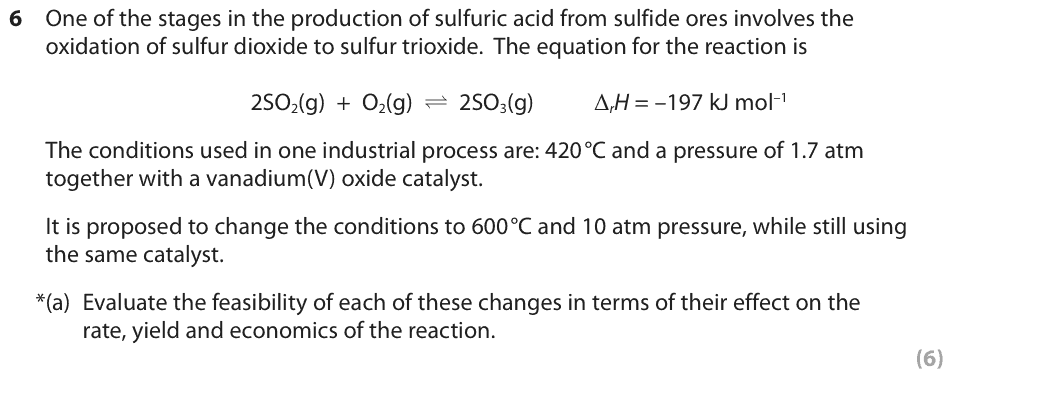
One of the stages in the production of sulfuric acid from sulfide ores involves the
oxidation of sulfur dioxide to sulfur trioxide.  The equation for the reaction is
2SO2(g)  +  O2(g)  `
_  2SO3(g)     ǻrH = –197 kJ mol–1
The conditions used in one industrial process are: 420°C and a pressure of 1.7 atm
together with a vanadium(V) oxide catalyst.
It is proposed to change the conditions to 600°C and 10 atm pressure, while still using
the same catalyst.
Evaluate the feasibility of each of these changes in terms of their effect on the
rate, yield and economics of the reaction.
June 2017 · AS Paper 2 · Q6(b)(i) 3 marks Diagram or structure kinetics i
Earlier part of question 6 that this part usesEarlier part of June 2017 Paper 2 question 6
On the axes provided, sketch the reaction profiles for the uncatalysed and
catalysed reaction.
2SO2(g)  +  O2(g)  `
_  2SO3(g)     ǻrH = –197 kJ mol–1
Label the uncatalysed reaction, A, and the reaction catalysed by
vanadium(V) oxide, B.
June 2017 · AS Paper 2 · Q6(b)(ii) 2 marks Diagram or structure kinetics i
Earlier parts of question 6 that this part usesEarlier part of June 2017 Paper 2 question 6Earlier part of June 2017 Paper 2 question 6
On your reaction profile, identify and label both the enthalpy change and the
activation energy for the catalysed reaction.
June 2017 · AS Paper 2 · Q6(c)(i) 1 mark Short answer equilibrium i
Earlier part of question 6 that this part usesEarlier part of June 2017 Paper 2 question 6
Write the expression for the equilibrium constant Kc for this reaction.
2SO2(g)  +  O2(g)  `
_  2SO3(g)
June 2017 · AS Paper 2 · Q6(c)(ii) 1 mark Multiple choice equilibrium i
Earlier parts of question 6 that this part usesEarlier part of June 2017 Paper 2 question 6Earlier part of June 2017 Paper 2 question 6
What are the units, if any, of the equilibrium constant, Kc?
A
mol dm–3
B
dm3 mol–1
C
no units
D
mol2  dm–6
June 2017 · AS Paper 2 · Q7(a)(i) 1 mark Multiple choice halogenoalkanes
This question is about halogenoalkanes.
The tables show some relevant data.
Bond
Bond enthalpy/kJ mol–1
Atom
Electronegativity
C
F
467
C
2.5
Cl
C
346
F
4.0
C
Br
290
Cl
3.0
C
I
228
Br
2.8
I
2.5
In an experiment, 1 cm3 of ethanol and 5 cm3 of 0.1 mol dm–3 silver nitrate were
placed in each of three test tubes X, Y and Z.  The test tubes and their contents
were placed in a water bath at 50°C for five minutes.
Two drops of 1-chlorobutane were then added to test tube X and the tube was
shaken to mix the contents.  The time taken for a precipitate to appear was
measured.
The experiment was repeated using two drops of 1-bromobutane in test tube Y
and two drops of 1-iodobutane in test tube Z.
The time taken for a precipitate to appear increases in the order
   A X, Y, Z
   B Z, Y, X
   C Y, X, Z
   D Z, X, Y
June 2017 · AS Paper 2 · Q7(a)(ii) 1 mark Practical and data analysis halogenoalkanesbonding
Earlier part of question 7 that this part usesEarlier part of June 2017 Paper 2 question 7
Give a reason for the addition of ethanol to each test tube.
June 2017 · AS Paper 2 · Q7(a)(iii) 1 mark Practical and data analysis halogenoalkanes
Earlier part of question 7 that this part usesEarlier part of June 2017 Paper 2 question 7
Give a reason why the test tubes were left in the water bath for five minutes
before adding the halogenoalkanes.
June 2017 · AS Paper 2 · Q7(a)(iv) 2 marks Explanation halogenoalkanesalkenes
Earlier part of question 7 that this part usesEarlier part of June 2017 Paper 2 question 7
The precipitates form as a result of reactions between aqueous silver ions and
aqueous halide ions.
Explain why halide ions are present in the mixture containing a
halogenoalkane which has only covalent bonds.
June 2017 · AS Paper 2 · Q7(a)(v) 1 mark Equation writing formulae equations and amounts of substance
Earlier part of question 7 that this part usesEarlier part of June 2017 Paper 2 question 7
Write the ionic equation, including state symbols, for the reaction involving
the silver nitrate in test tube X.
June 2017 · AS Paper 2 · Q7(b)(i) 3 marks Diagram or structure kinetics i
Earlier part of question 7 that this part usesEarlier part of June 2017 Paper 2 question 7
1-bromo-2-methylpropane was mixed with a large excess of potassium hydroxide solution.
The 1-bromo-2-methylpropane is hydrolysed during the reaction and its
concentration decreases as the reaction proceeds.  Samples of the reaction
mixture were analysed at time intervals to determine the remaining concentration
of 1-bromo-2-methylpropane.
Time/s
[1-bromo-2-methylpropane]/mol dm–3
0
0.1000
50
0.0500
100
0.0250
200
0.0063
300
0.0016
Draw a graph of [1-bromo-2-methylpropane] against time.
June 2017 · AS Paper 2 · Q7(b)(ii) 3 marks Calculation kinetics i
Earlier parts of question 7 that this part usesEarlier part of June 2017 Paper 2 question 7Earlier part of June 2017 Paper 2 question 7
Use your graph to calculate a value for the rate of reaction at 100 s.
Include units in your answer.
June 2017 · AS Paper 2 · Q7(c)(i) 1 mark Multiple choice halogenoalkanes
Earlier parts of question 7 that this part usesEarlier part of June 2017 Paper 2 question 7Earlier part of June 2017 Paper 2 question 7Earlier part of June 2017 Paper 2 question 7
Which term best describes the role of the OH– ion in the reaction in (b)?
A catalyst
B electrophile
C free radical
D nucleophile
June 2017 · AS Paper 2 · Q7(c)(ii) 4 marks Mechanism halogenoalkanes
Earlier parts of question 7 that this part usesEarlier part of June 2017 Paper 2 question 7Earlier part of June 2017 Paper 2 question 7
Draw a diagram to show the mechanism for the hydrolysis of
1-bromo-2-methylpropane by the hydroxide ion.
Include any appropriate lone pairs and dipoles.
June 2017 · AS Paper 2 · Q7(c)(iii) 1 mark Multiple choice introduction to organic chemistry
Earlier parts of question 7 that this part usesEarlier part of June 2017 Paper 2 question 7Earlier part of June 2017 Paper 2 question 7Earlier part of June 2017 Paper 2 question 7Earlier part of June 2017 Paper 2 question 7
The hydrolysis reaction described in part (b) may also be classified as
A addition
   B elimination
   C redox
   D substitution
June 2017 · AS Paper 2 · Q8(a) 2 marks Diagram or structure introduction to organic chemistry
This question is about the chemistry of propane-1,3-diol and propanedioic acid.
Give the structures of propane-1,3-diol and another diol which is an
isomer of propane-1,3-diol.
June 2017 · AS Paper 2 · Q8(b)(i) 1 mark Multiple choice alcohols
Propane-1,3-diol can be oxidised to propanedioic acid in the same way as other
primary alcohols.
Suitable reagents and conditions are
Reagents
Conditions
A
sodium dichromate(VI) + sulfuric acid
heating under reflux
B
sodium dichromate(VI) + hydrochloric acid
heating under reflux
C
potassium dichromate(VI) + sulfuric acid
room temperature
D
potassium dichromate(VI) + hydrochloric acid
room temperature
June 2017 · AS Paper 2 · Q8(b)(ii) 1 mark Multiple choice alcohols
Earlier part of question 8 that this part usesEarlier part of June 2017 Paper 2 question 8
The colour change in this reaction is
A green to orange
   B orange to green
   C orange to colourless
   D colourless to orange
June 2017 · AS Paper 2 · Q8(c)(i) 2 marks Calculation formulae equations and amounts of substance
Earlier part of question 8 that this part usesEarlier part of June 2017 Paper 2 question 8
In an experiment, 15.2 g of propane-1,3-diol was oxidised to propanedioic acid,
which is a solid dibasic acid.  This acid may be represented as H2X.
250 cm3 of a solution was prepared from all of the acid in a volumetric flask.
10.0 cm3 portions of this solution were then titrated with 0.400 mol dm–3
sodium hydroxide solution.  The mean titre was 18.45 cm3.
H2X  +  2NaOH  o  Na2X  +  2H2O
[Relative formula masses: propane-1,3-diol = 76.0; propanedioic acid = 104.0]
Calculate the moles of propanedioic acid in 10.0 cm3 of the acid solution.
June 2017 · AS Paper 2 · Q8(c)(ii) 2 marks Calculation formulae equations and amounts of substance
Earlier parts of question 8 that this part usesEarlier part of June 2017 Paper 2 question 8Earlier part of June 2017 Paper 2 question 8
Calculate the mass of propanedioic acid in the 250 cm3 solution.
June 2017 · AS Paper 2 · Q8(c)(iii) 2 marks Calculation formulae equations and amounts of substance
Earlier parts of question 8 that this part usesEarlier part of June 2017 Paper 2 question 8Earlier part of June 2017 Paper 2 question 8
Calculate the percentage yield for the oxidation of propane-1,3-diol to
propanedioic acid.
June 2017 · AS Paper 2 · Q8(c)(iv) 1 mark Short answer formulae equations and amounts of substance
Earlier part of question 8 that this part usesEarlier part of June 2017 Paper 2 question 8
Give one reason why the yield calculated in (iii) is less than 100%.

Work with an A-level chemistry tutor

Want a paper marked and gone through with you? Message us.

Prefer email? Send an enquiry

If you are under 18, please include a parent's contact details. Enquiries go to enquiries@chemistryaleveltutor.com and are deleted once handled. All tutoring is online.