June 2016: AS Paper 2, Core Organic and Physical Chemistry

80 marks · 41 question parts · Paper, mark scheme and report on Edexcel's site · Have the Data Booklet beside you

Question by question

QTopicMarksAOType
1(a) Introduction to organic chemistry 1Multiple choice
1(b) Introduction to organic chemistry 1Multiple choice
1(c) Alkanes, Introduction to organic chemistry 2Equation writing
1(d)(i) Alkanes 1Multiple choice
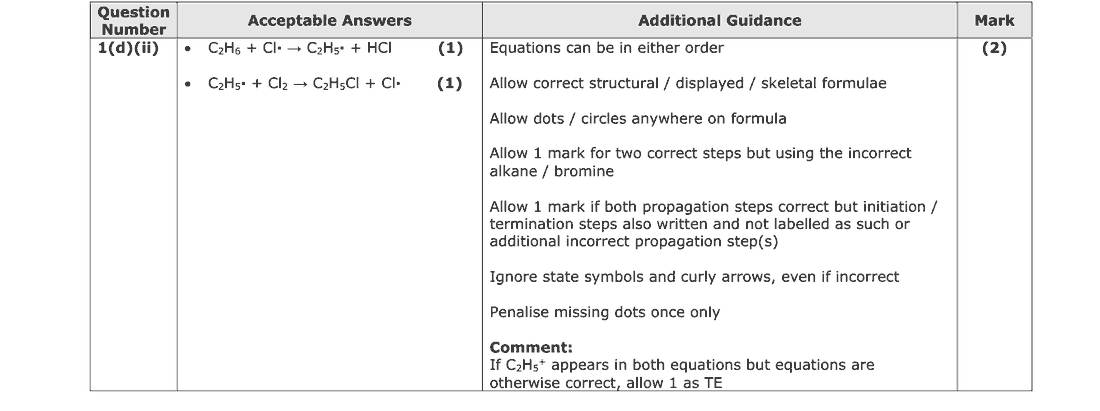
1(d)(ii) Alkanes 2Equation writing
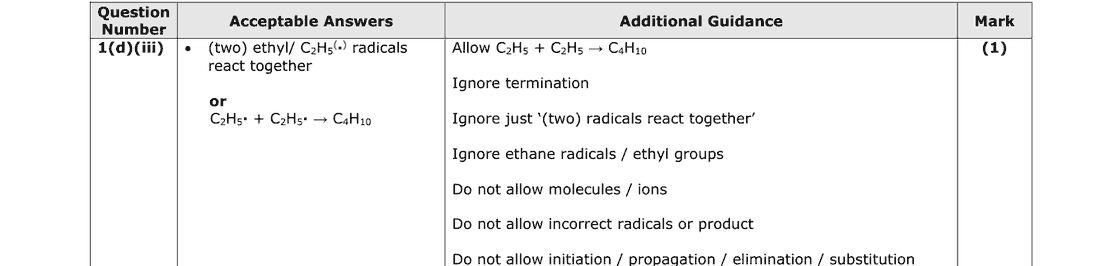
1(d)(iii) Alkanes 1Short answer
2(a) Introduction to organic chemistry 1Multiple choice
2(b)(i) Alkenes 1Multiple choice
2(b)(ii) Alkenes 1Multiple choice
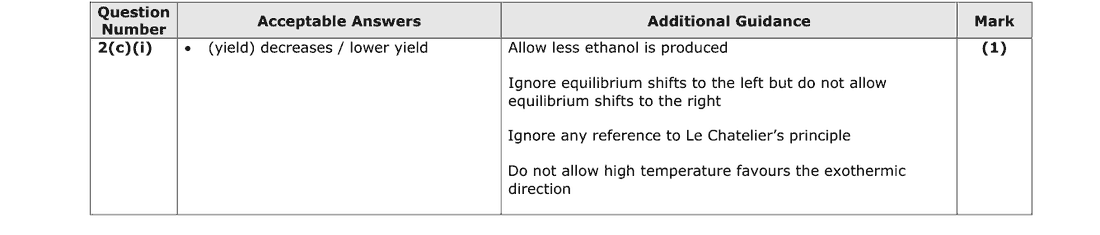
2(c)(i) Equilibrium I 1Short answer
2(c)(ii) Equilibrium I 1Short answer
2(c)(iii) Equilibrium I 1Multiple choice
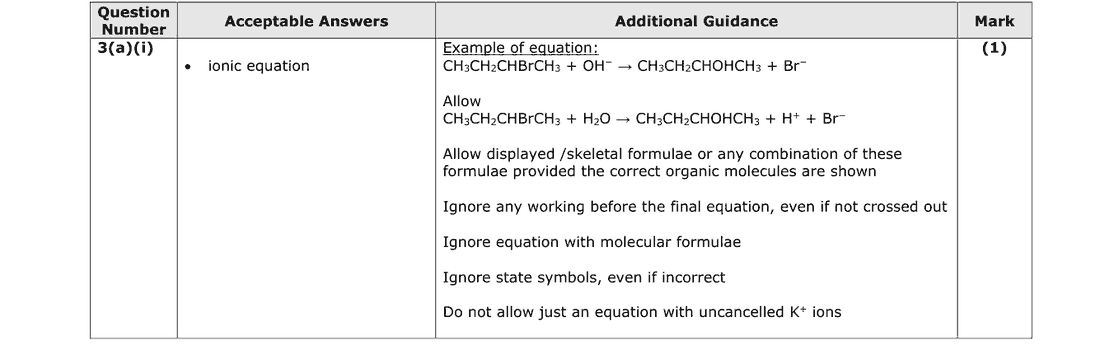
3(a)(i) Halogenoalkanes, Formulae, equations and amounts of substance 1Equation writing
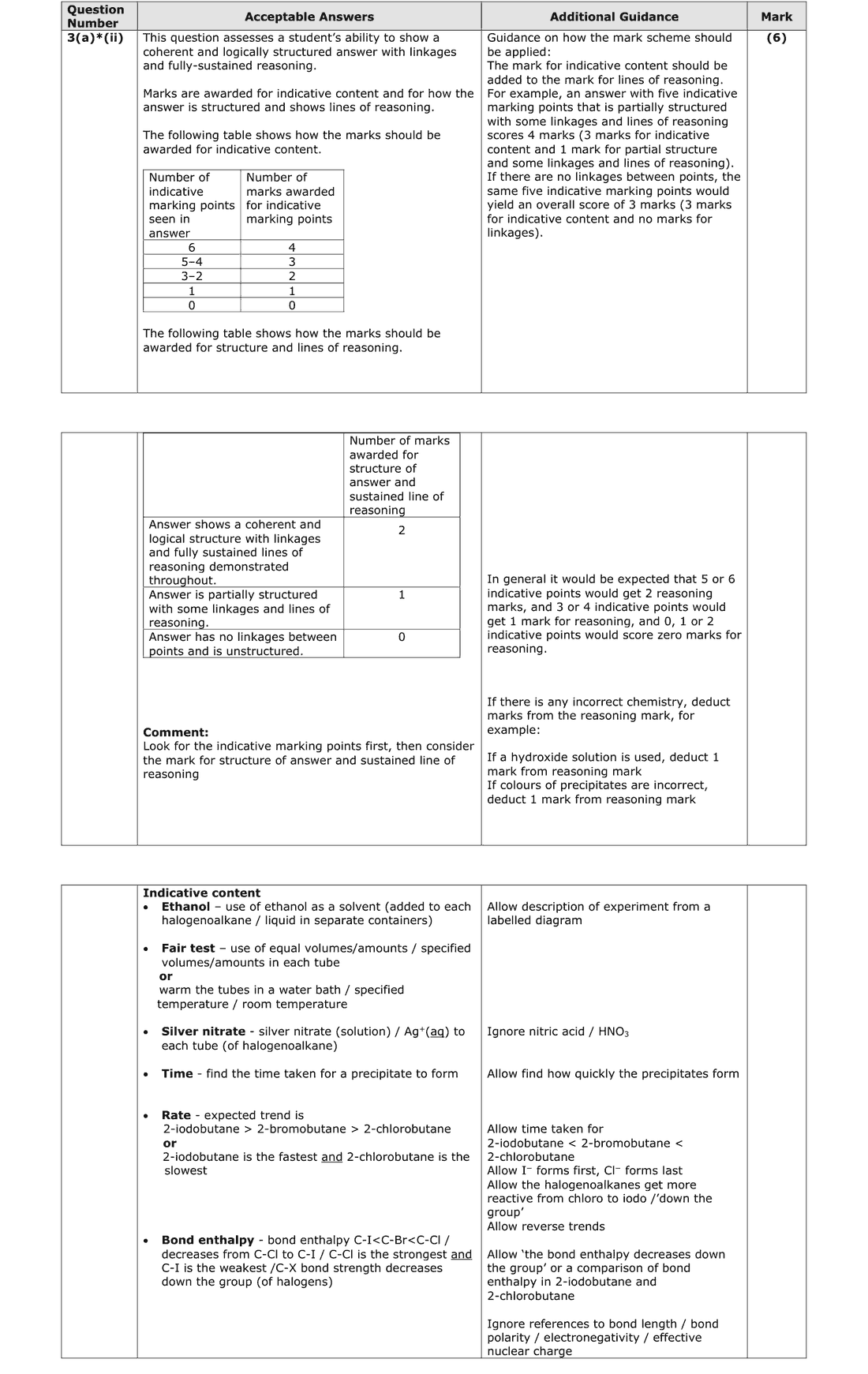
3(a)(ii) Halogenoalkanes 6Extended response
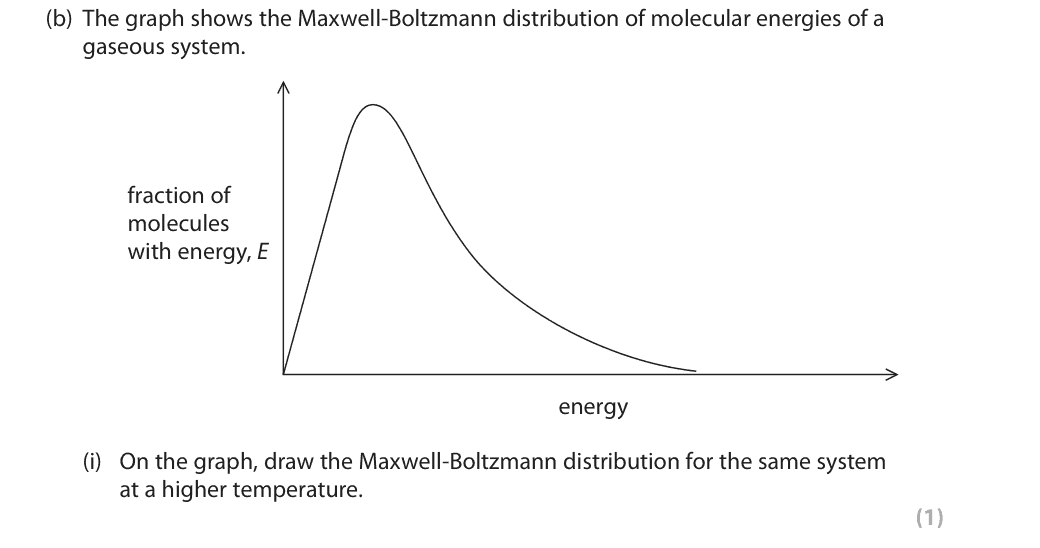
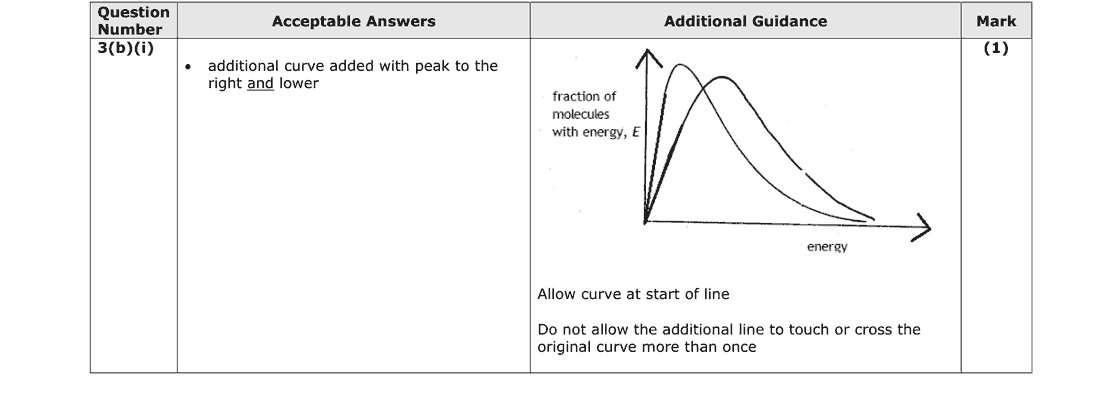
3(b)(i) Kinetics I 1Diagram or structure
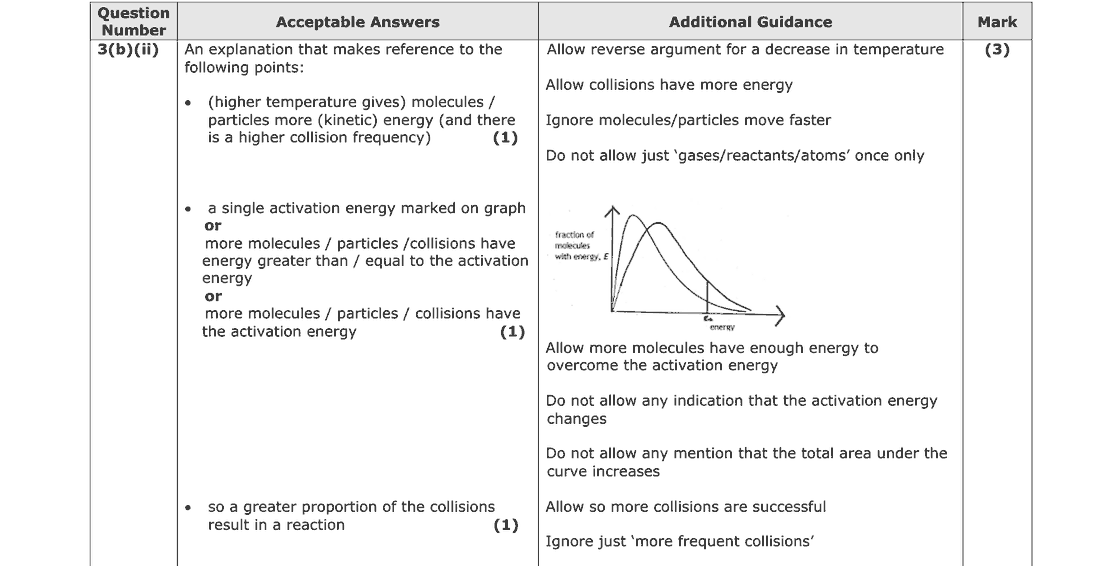
3(b)(ii) Kinetics I 3Explanation
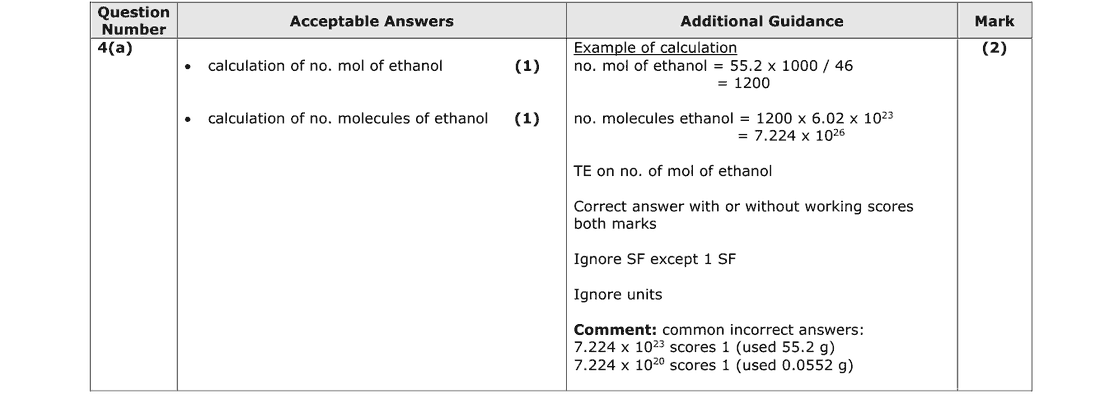
4(a) Formulae, equations and amounts of substance 2Calculation
4(b) Energetics I, Formulae, equations and amounts of substance 2Equation writing
4(c)(i) Energetics I 3Calculation
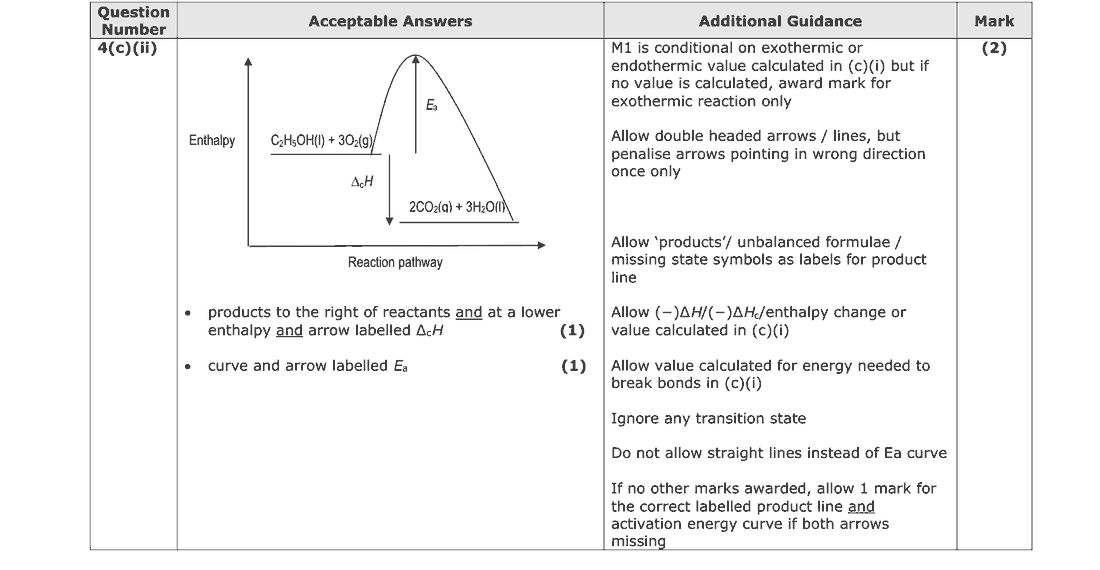
4(c)(ii) Kinetics I 2Diagram or structure
4(c)(iii) Energetics I 1Short answer
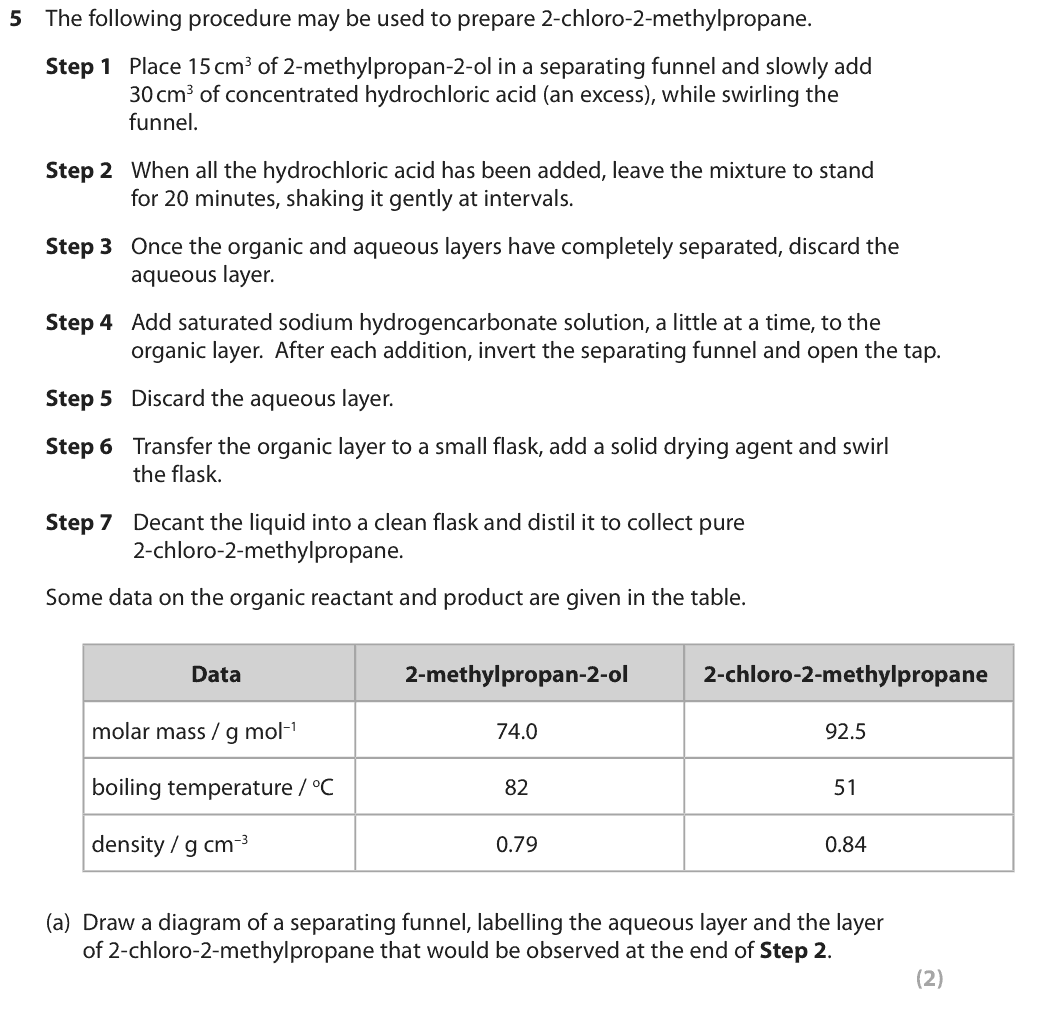
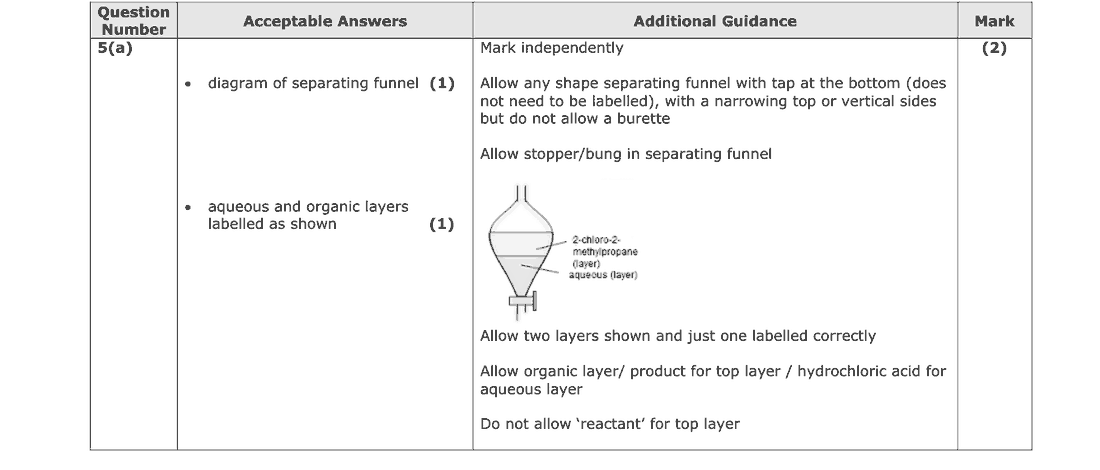
5(a) Alcohols 2Diagram or structure
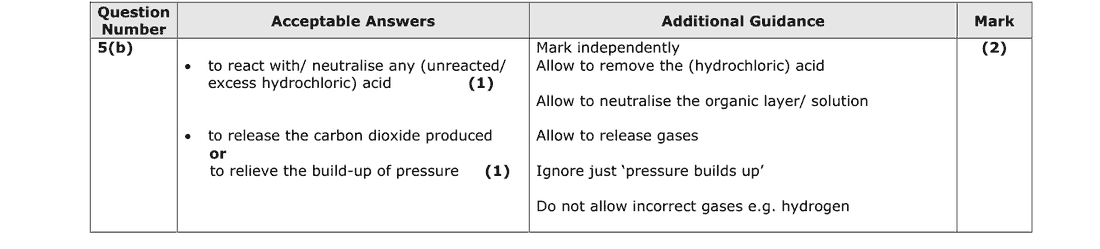
5(b) Alcohols 2Practical and data analysis
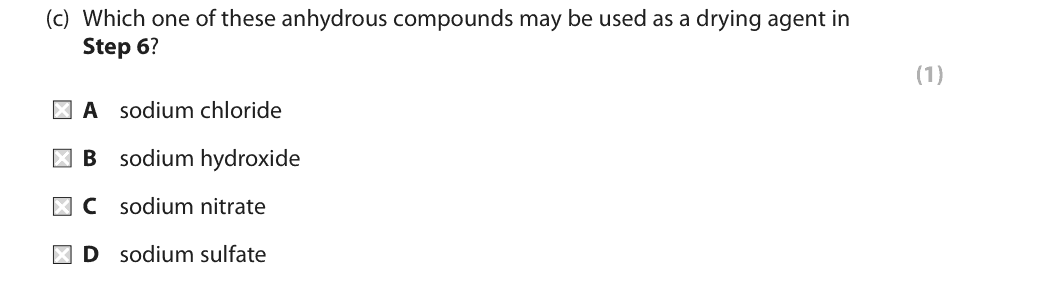
5(c) Alcohols 1Multiple choice
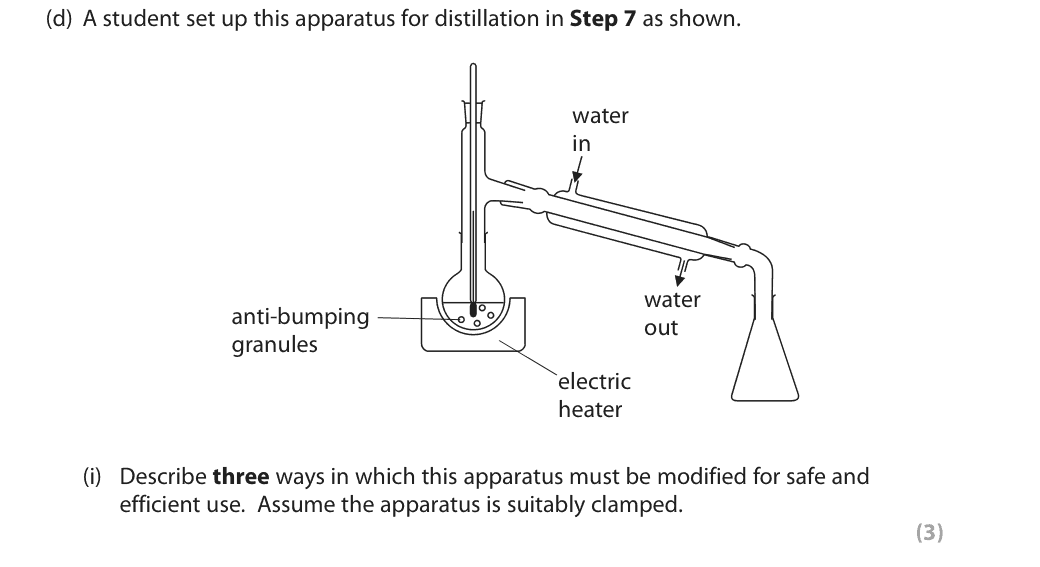
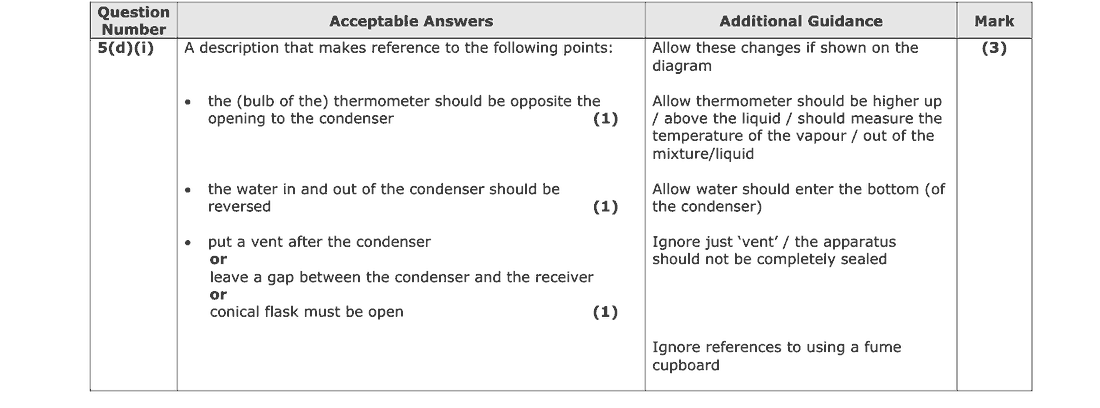
5(d)(i) Alcohols 3Practical and data analysis
5(d)(ii) Alcohols 1Practical and data analysis
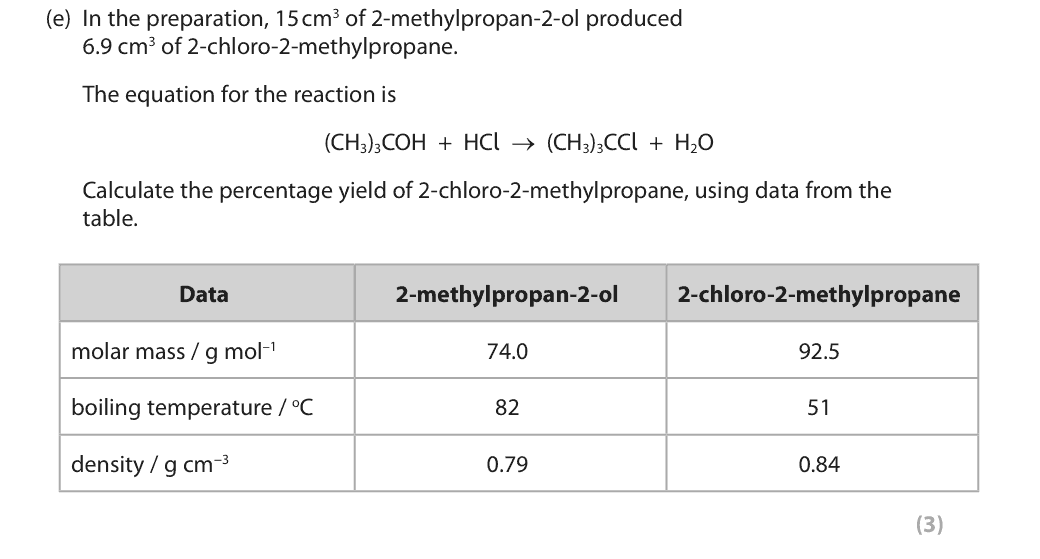
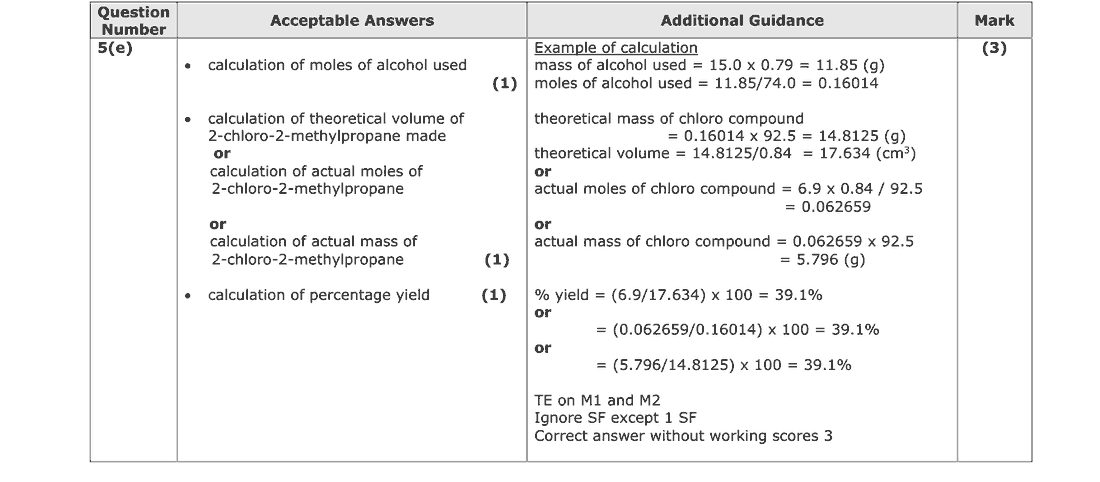
5(e) Formulae, equations and amounts of substance 3Calculation
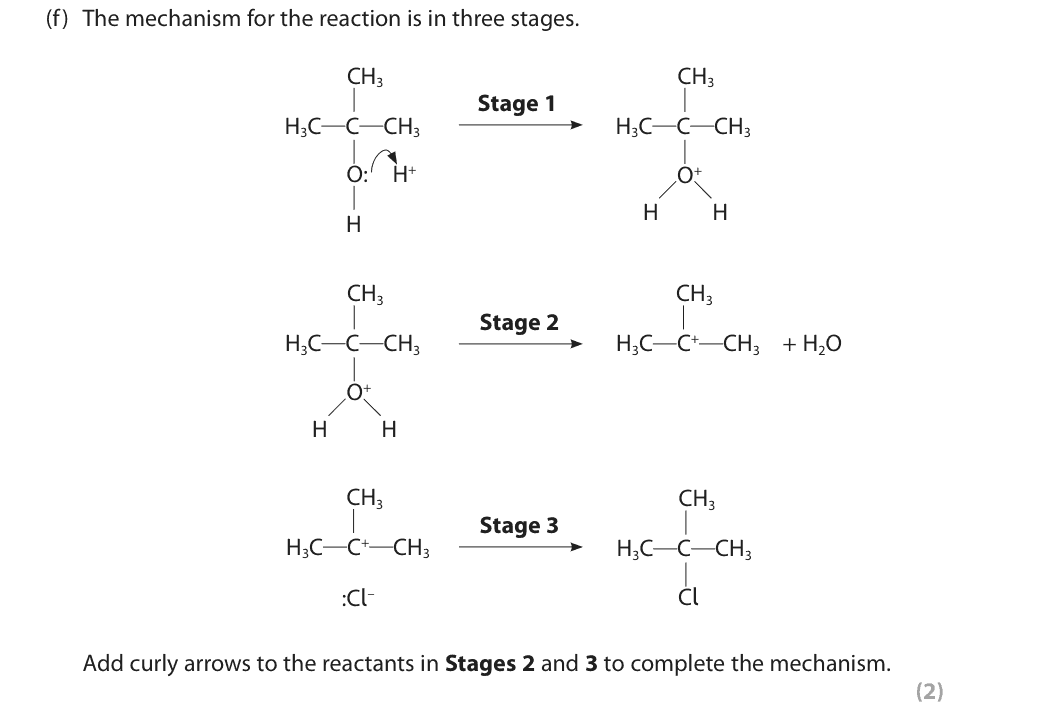
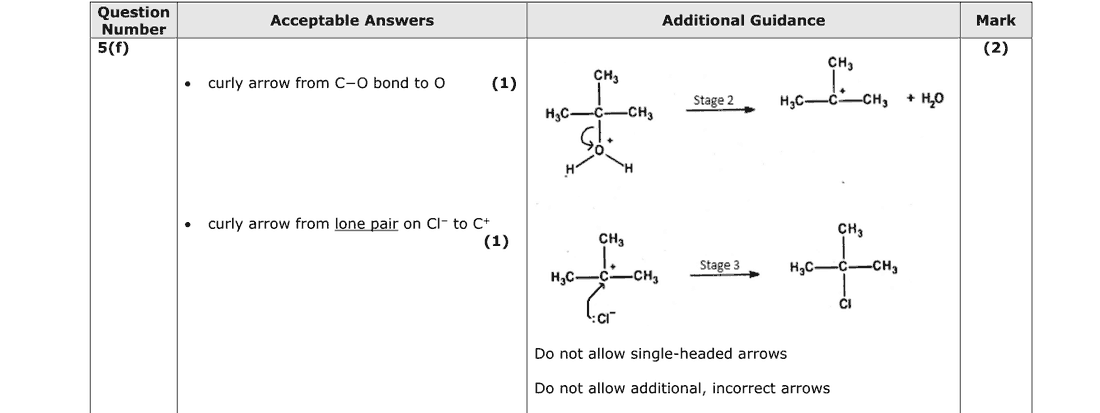
5(f) Alkenes, Halogenoalkanes 2Mechanism
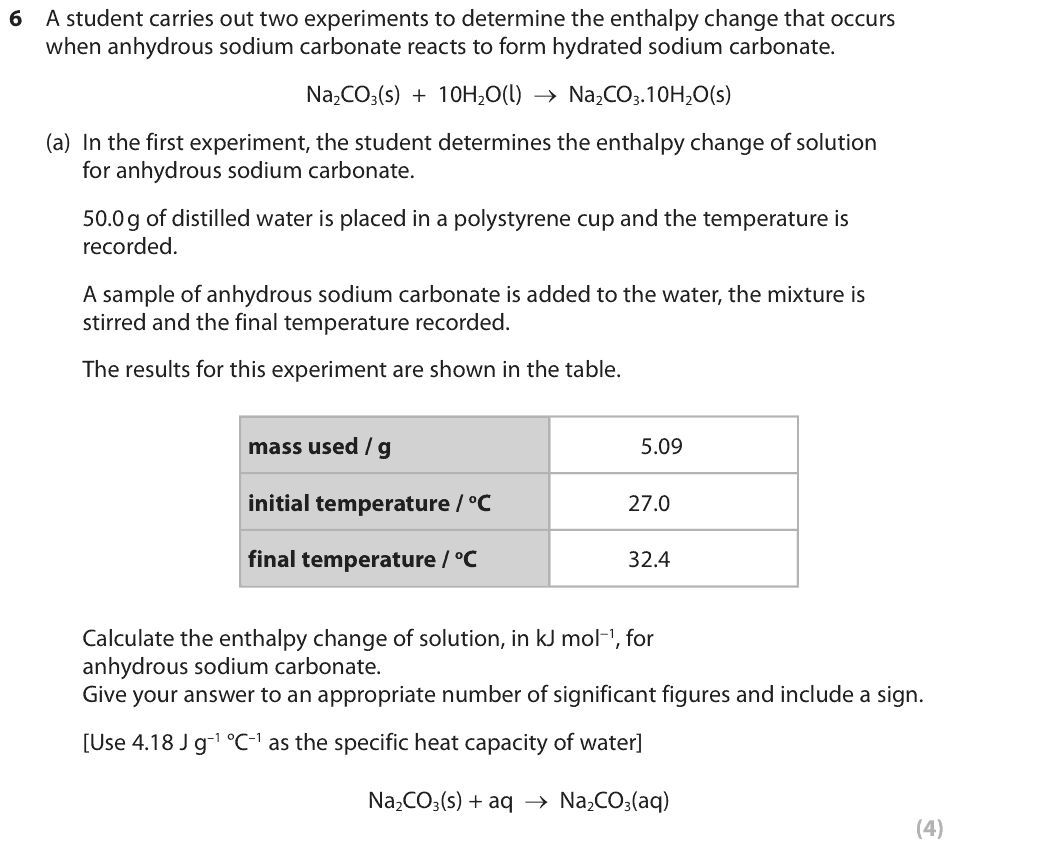
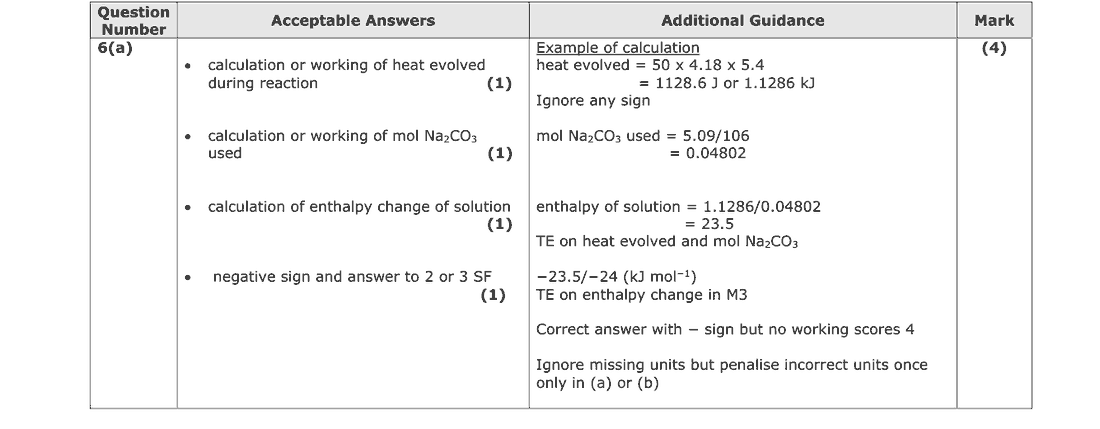
6(a) Energetics I 4Calculation
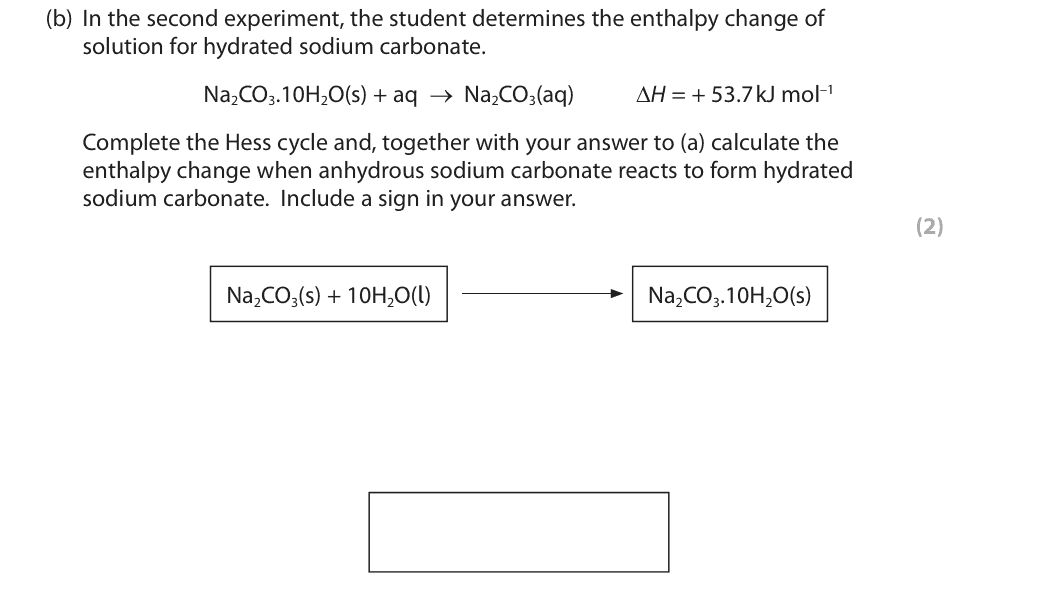
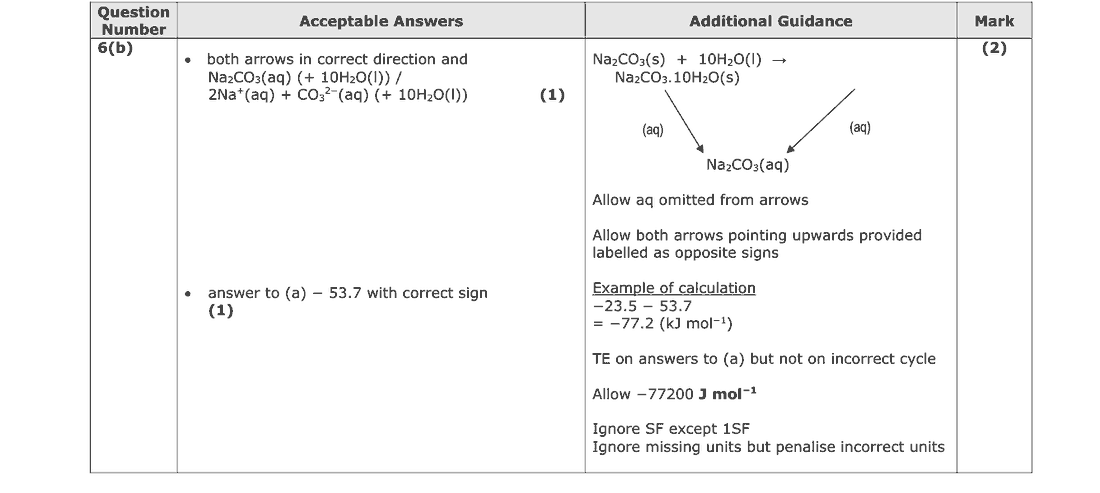
6(b) Energetics I 2Calculation
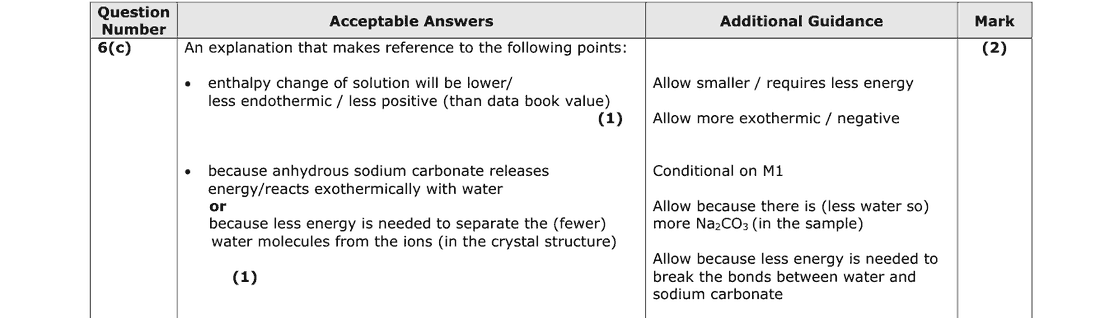
6(c) Energetics I 2Explanation
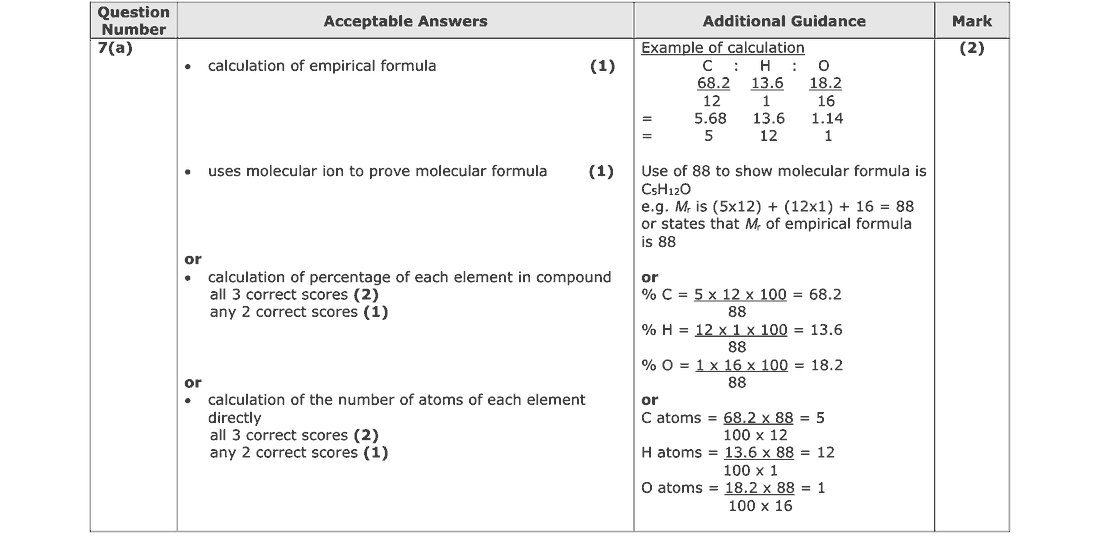
7(a) Formulae, equations and amounts of substance, Modern analytical techniques I: mass spectrometry and infrared 2Calculation
7(b)(i) Alcohols 1Short answer
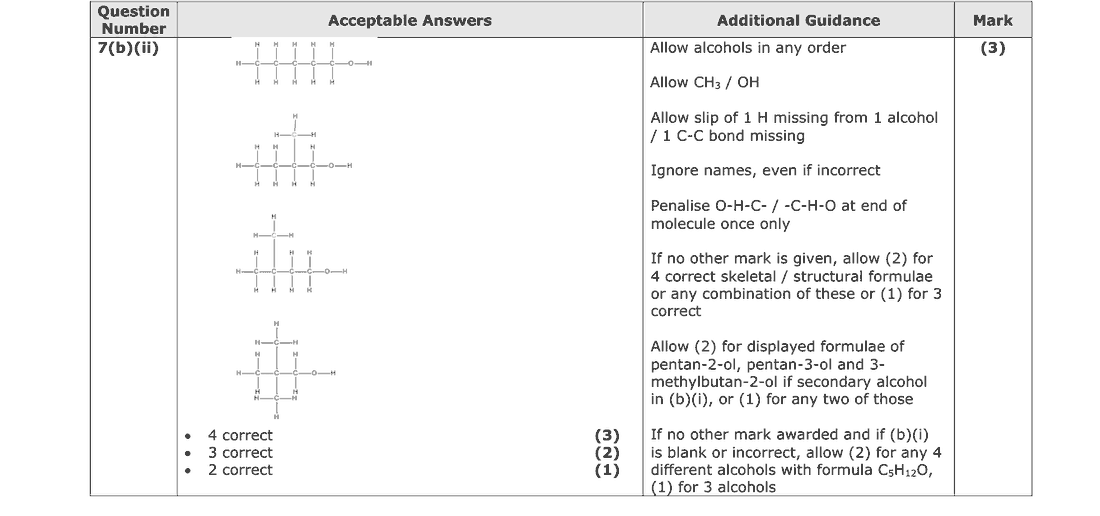
7(b)(ii) Introduction to organic chemistry 3Diagram or structure
7(b)(iii) Modern analytical techniques I: mass spectrometry and infrared 1Diagram or structure
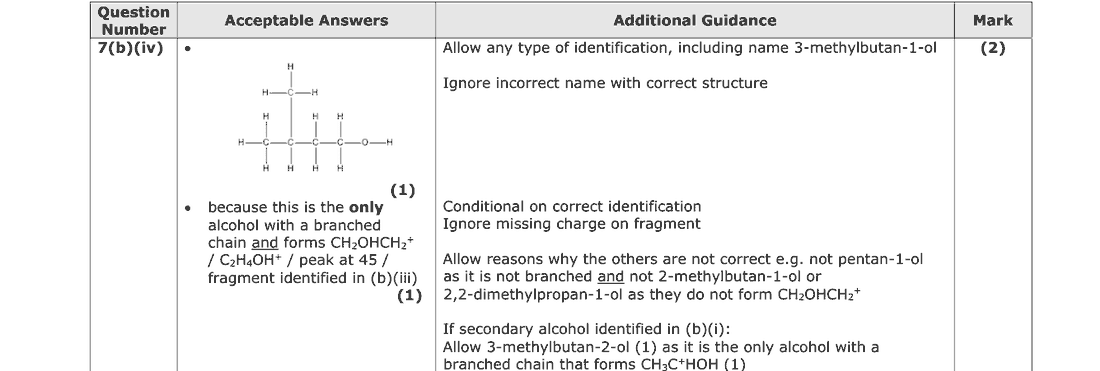
7(b)(iv) Modern analytical techniques I: mass spectrometry and infrared, Introduction to organic chemistry 2Short answer
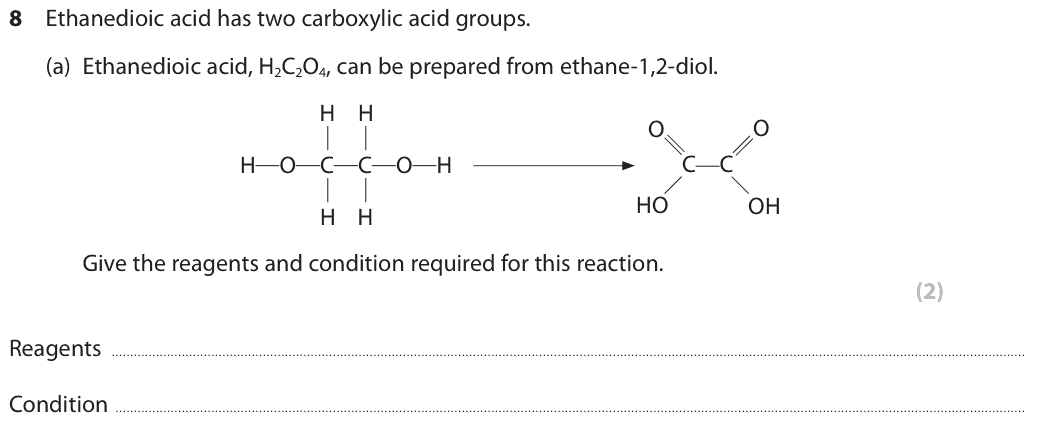
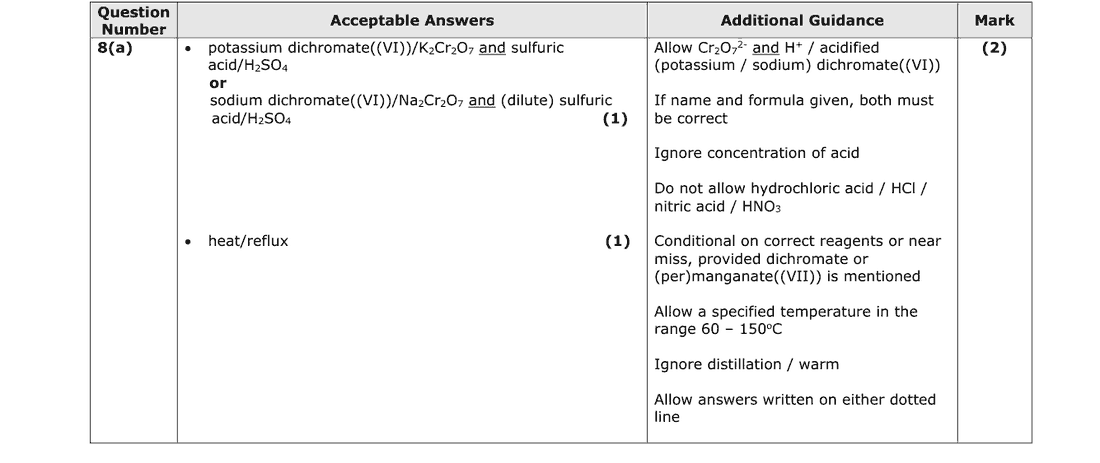
8(a) Alcohols 2Short answer
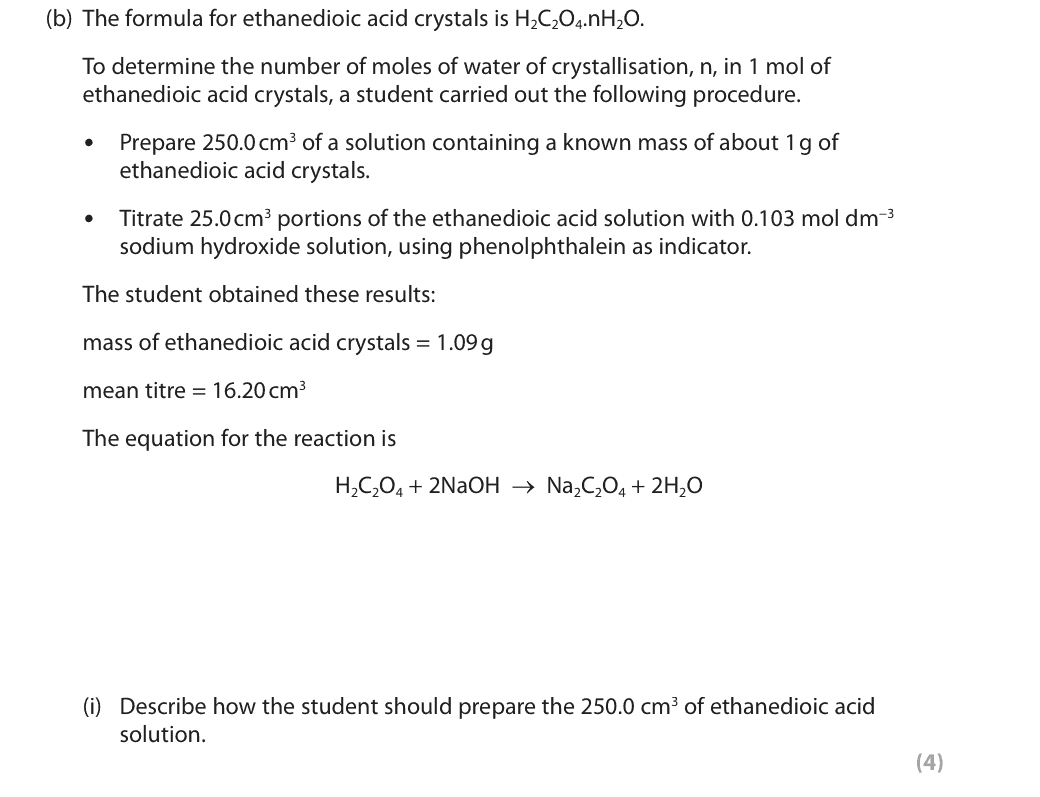
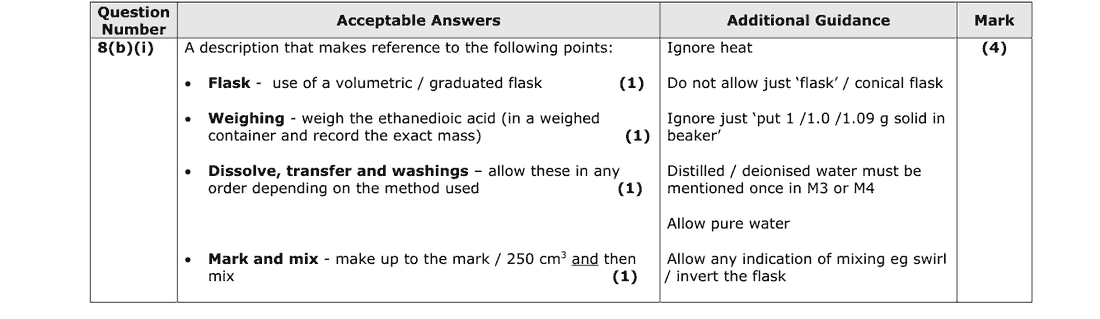
8(b)(i) Formulae, equations and amounts of substance 4Practical and data analysis
8(b)(ii) Formulae, equations and amounts of substance 1Practical and data analysis
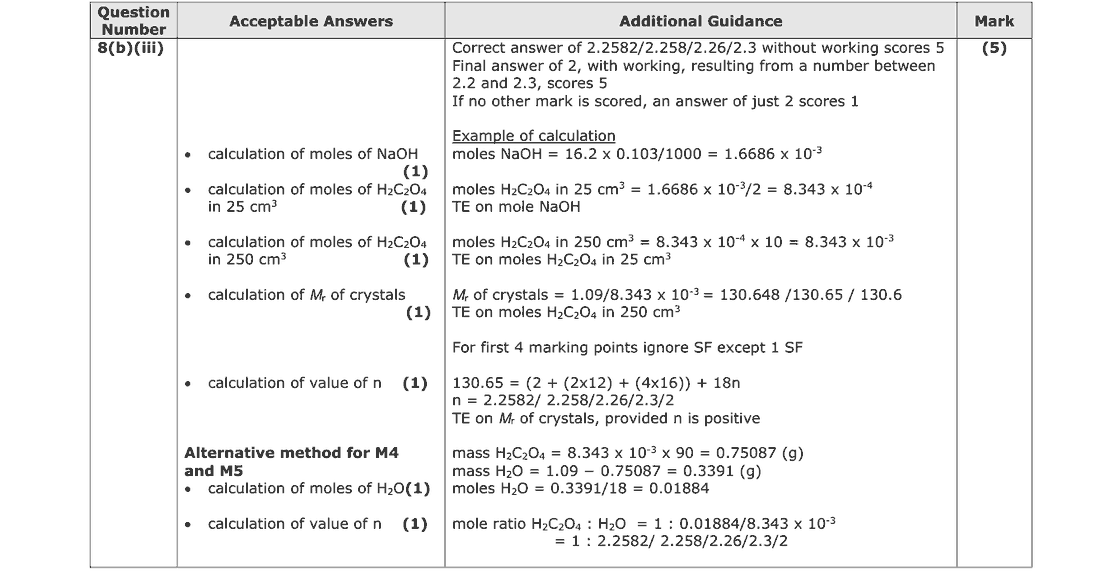
8(b)(iii) Formulae, equations and amounts of substance 5Calculation
8(b)(iv) Formulae, equations and amounts of substance 2Explanation

The questions

1(a)1(b)1(c)1(d)(i)1(d)(ii)1(d)(iii)2(a)2(b)(i)2(b)(ii)2(c)(i)2(c)(ii)2(c)(iii)3(a)(i)3(a)(ii)3(b)(i)3(b)(ii)4(a)4(b)4(c)(i)4(c)(ii)4(c)(iii)5(a)5(b)5(c)5(d)(i)5(d)(ii)5(e)5(f)6(a)6(b)6(c)7(a)7(b)(i)7(b)(ii)7(b)(iii)7(b)(iv)8(a)8(b)(i)8(b)(ii)8(b)(iii)8(b)(iv)
June 2016 · AS Paper 2 · Q1(a) 1 mark Multiple choice introduction to organic chemistry
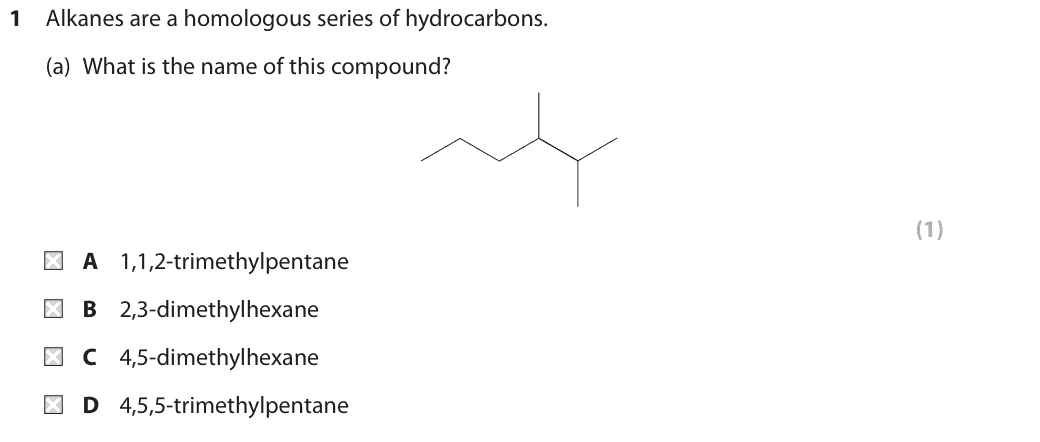
Alkanes are a homologous series of hydrocarbons.
What is the name of this compound?
A 1,1,2-trimethylpentane
B 2,3-dimethylhexane
C 4,5-dimethylhexane
D 4,5,5-trimethylpentane
June 2016 · AS Paper 2 · Q1(b) 1 mark Multiple choice introduction to organic chemistry
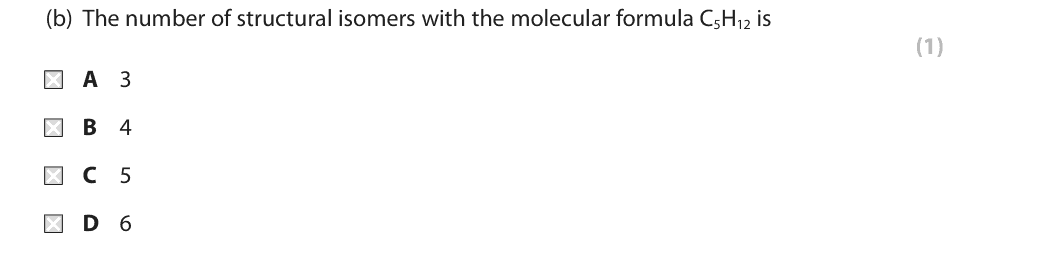
The number of structural isomers with the molecular formula C5H12 is
A 3
B 4
C 5
D 6
June 2016 · AS Paper 2 · Q1(c) 2 marks Equation writing alkanesintroduction to organic chemistry
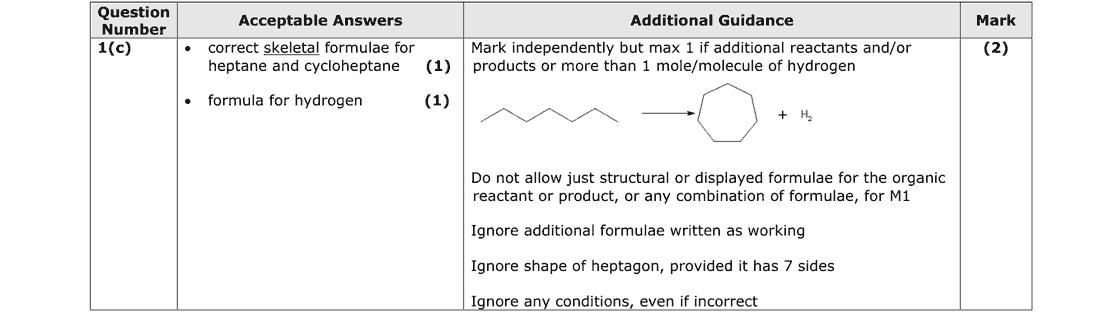
Write the equation for reforming heptane into cycloheptane, showing the skeletal
formulae of the organic molecules.
June 2016 · AS Paper 2 · Q1(d)(i) 1 mark Multiple choice alkanes
Earlier part of question 1 that this part usesEarlier part of June 2016 Paper 2 question 1
Ethane reacts with chlorine in the presence of ultraviolet light to form a mixture
of products.
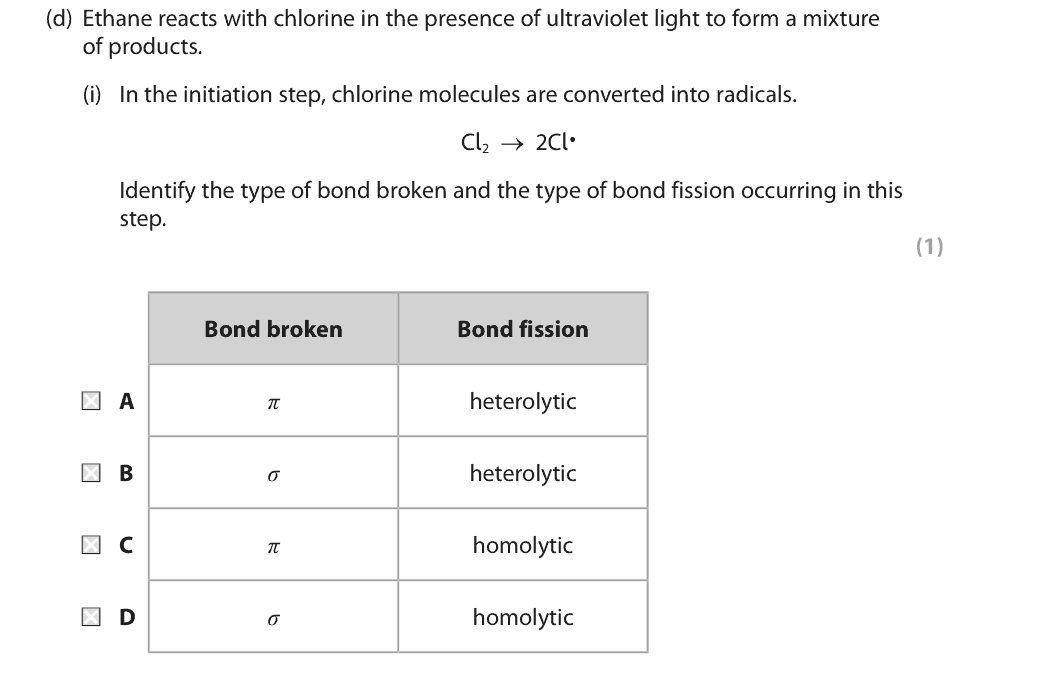
In the initiation step, chlorine molecules are converted into radicals.
Cl2  o  2Cl∙
Identify the type of bond broken and the type of bond fission occurring in this
step.
Bond broken
Bond fission
ʌ
heterolytic
A
ı
heterolytic
B
ʌ
homolytic
C
ı
homolytic
D
June 2016 · AS Paper 2 · Q1(d)(ii) 2 marks Equation writing alkanes
Earlier part of question 1 that this part usesEarlier part of June 2016 Paper 2 question 1
Write the propagation steps to show the formation of C2H5Cl.
June 2016 · AS Paper 2 · Q1(d)(iii) 1 mark Short answer alkanes
Earlier part of question 1 that this part usesEarlier part of June 2016 Paper 2 question 1
State how some butane, C4H10, is formed in the reaction.
June 2016 · AS Paper 2 · Q2(a) 1 mark Multiple choice introduction to organic chemistry
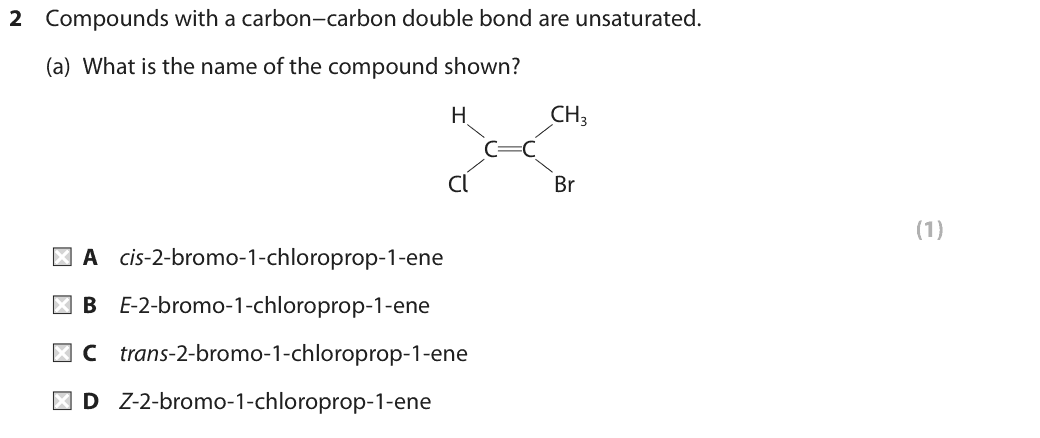
Compounds with a carbon−carbon double bond are unsaturated.
What is the name of the compound shown?
H
CH3
C
C
Cl
Br
A cis-2-bromo-1-chloroprop-1-ene
B E-2-bromo-1-chloroprop-1-ene
C trans-2-bromo-1-chloroprop-1-ene
D Z-2-bromo-1-chloroprop-1-ene
June 2016 · AS Paper 2 · Q2(b)(i) 1 mark Multiple choice alkenes
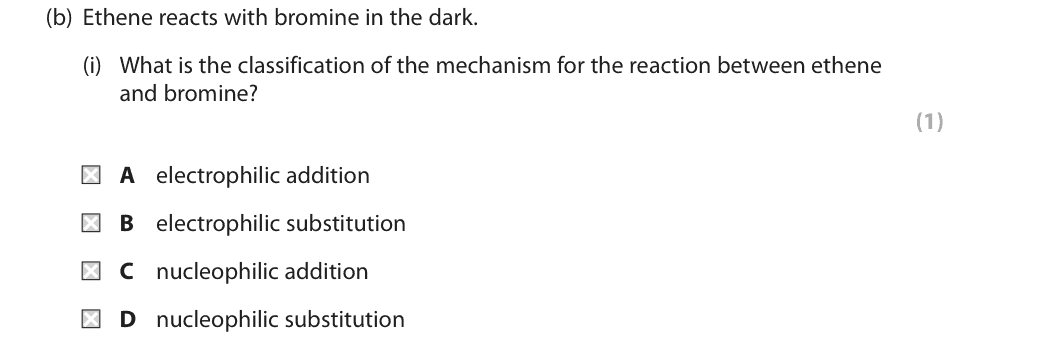
Ethene reacts with bromine in the dark.
What is the classification of the mechanism for the reaction between ethene
and bromine?
A electrophilic addition
B electrophilic substitution
C nucleophilic addition
D nucleophilic substitution
June 2016 · AS Paper 2 · Q2(b)(ii) 1 mark Multiple choice alkenes
Earlier parts of question 2 that this part usesEarlier part of June 2016 Paper 2 question 2Earlier part of June 2016 Paper 2 question 2
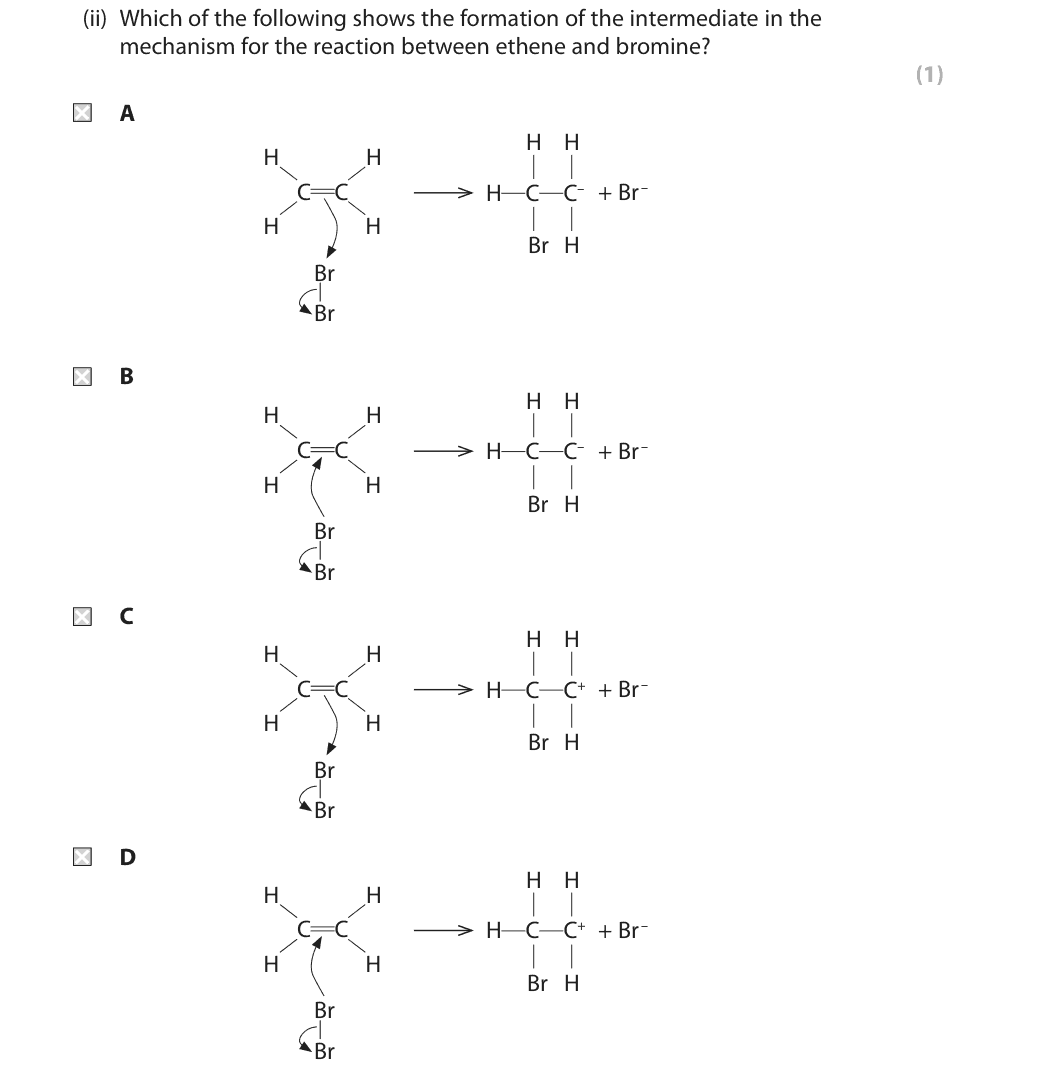
Which of the following shows the formation of the intermediate in the
mechanism for the reaction between ethene and bromine?
A
H
H
H
H
C
C
H
C
C–
+ Br –
H
H
Br
H
Br
Br
B
H
H
H
H
C
C
H
C
C–
+ Br –
H
H
Br
H
Br
Br
C
H
H
H
H
C
C
+ Br –
H
C
C+
H
H
Br
H
Br
Br
D
H
H
H
H
C
C
H
C
C+
+ Br –
H
H
Br
H
Br
Br
June 2016 · AS Paper 2 · Q2(c)(i) 1 mark Short answer equilibrium i
Earlier part of question 2 that this part usesEarlier part of June 2016 Paper 2 question 2
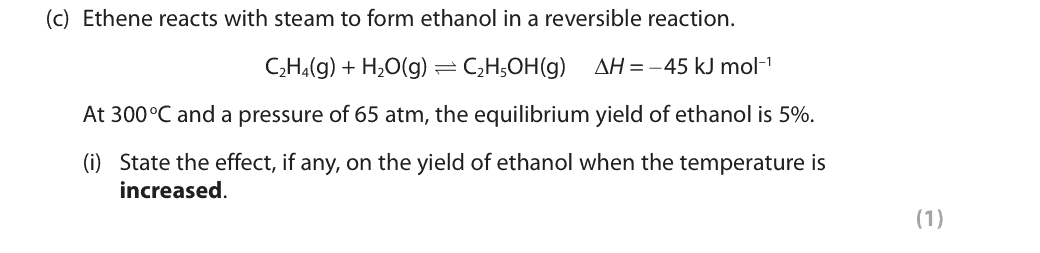
Ethene reacts with steam to form ethanol in a reversible reaction.
C2H4(g) + H2O(g) U C2H5OH(g)     ¨H = –45 kJ mol–1
At 300 oC and a pressure of 65 atm, the equilibrium yield of ethanol is 5%.
State the effect, if any, on the yield of ethanol when the temperature is
increased.
June 2016 · AS Paper 2 · Q2(c)(ii) 1 mark Short answer equilibrium i
Earlier parts of question 2 that this part usesEarlier part of June 2016 Paper 2 question 2Earlier part of June 2016 Paper 2 question 2
State the effect, if any, on the yield of ethanol when the pressure is decreased.
June 2016 · AS Paper 2 · Q2(c)(iii) 1 mark Multiple choice equilibrium i
Earlier parts of question 2 that this part usesEarlier part of June 2016 Paper 2 question 2Earlier part of June 2016 Paper 2 question 2Earlier part of June 2016 Paper 2 question 2
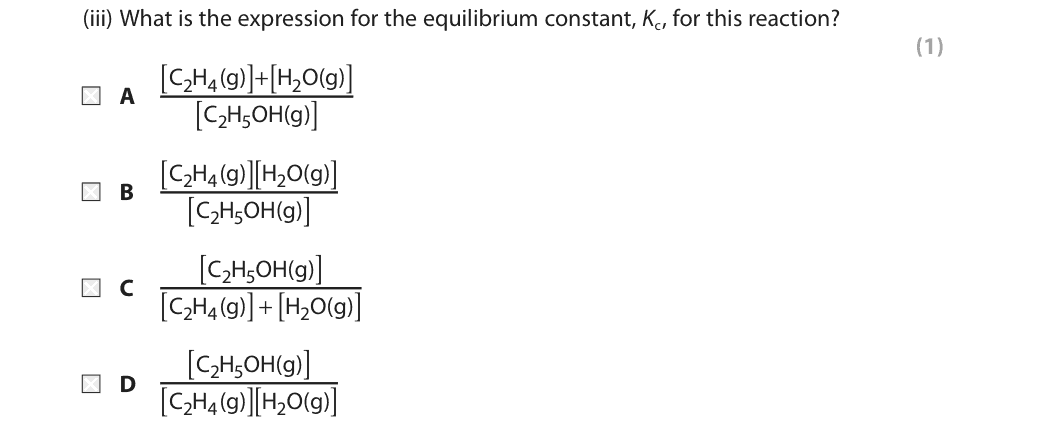
What is the expression for the equilibrium constant, Kc, for this reaction?
[
] [
]
C H (g) + H O(g)
2 4
2
A
[
]
C H OH(g)
2 5
[
][
]
C H (g) H O(g)
2 4
2
B
[
]
C H OH(g)
2 5
[
]
C H OH(g)
2
5
C
[
] + [
]
C H (g)
H O(g)
2
4
2
[
]
C H OH(g)
2
5
D
[
][
]
C H (g) H O(g)
2
4
2
June 2016 · AS Paper 2 · Q3(a)(i) 1 mark Equation writing halogenoalkanesformulae equations and amounts of substance
This question is about halogenoalkanes and kinetics.
Some halogenoalkanes are hydrolysed by aqueous potassium hydroxide.
Write the ionic equation for the hydrolysis of 2-bromobutane showing the
structural formulae for the organic molecules.
June 2016 · AS Paper 2 · Q3(a)(ii) 6 marks 6-mark extended response halogenoalkanes
Earlier part of question 3 that this part usesEarlier part of June 2016 Paper 2 question 3
Devise an experiment to compare the rates of hydrolysis of 2-chlorobutane,
2-bromobutane and 2-iodobutane.
State the trend in the rates of reaction.  Justify your answer.
June 2016 · AS Paper 2 · Q3(b)(i) 1 mark Diagram or structure kinetics i
Earlier part of question 3 that this part usesEarlier part of June 2016 Paper 2 question 3
The graph shows the Maxwell-Boltzmann distribution of molecular energies of a
gaseous system.
fraction of
molecules
with energy, E
energy
On the graph, draw the Maxwell-Boltzmann distribution for the same system
at a higher temperature.
June 2016 · AS Paper 2 · Q3(b)(ii) 3 marks Explanation kinetics i
Earlier parts of question 3 that this part usesEarlier part of June 2016 Paper 2 question 3Earlier part of June 2016 Paper 2 question 3
Use the graph to explain why a small increase in temperature results in a large
increase in the rate of a gaseous reaction.
June 2016 · AS Paper 2 · Q4(a) 2 marks Calculation Easy formulae equations and amounts of substance
Ethanol, C2H5OH, is a member of the homologous series of alcohols.
Calculate the number of molecules in 55.2kg of ethanol.
[Avogadro Constant = 6.02 × 10²³ mol–1]
June 2016 · AS Paper 2 · Q4(b) 2 marks Equation writing Hard energetics iformulae equations and amounts of substance
Write the equation to represent the standard enthalpy change of formation of
ethanol.  Include state symbols.
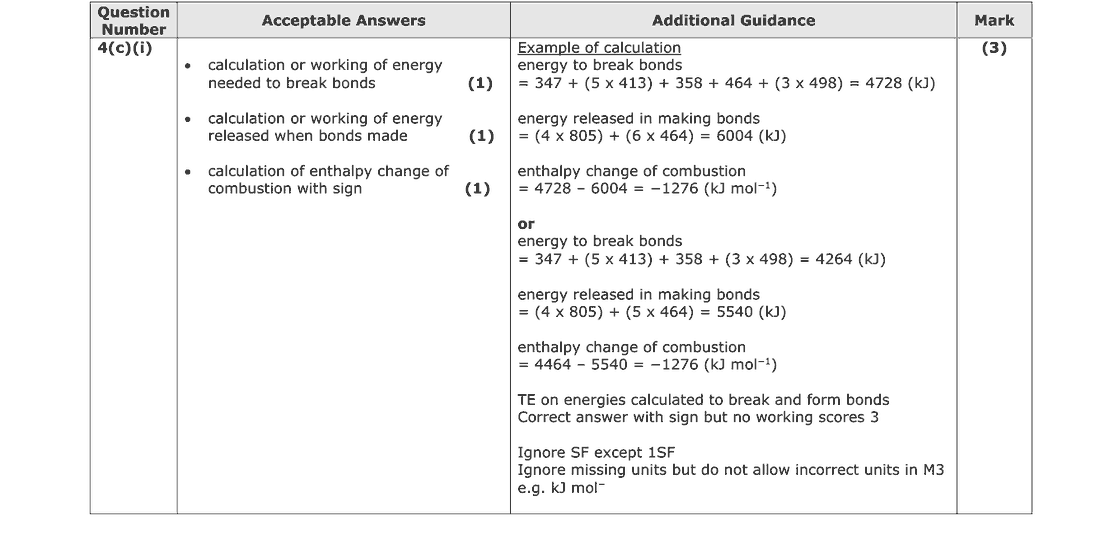
June 2016 · AS Paper 2 · Q4(c)(i) 3 marks Calculation energetics i
Earlier part of question 4 that this part usesEarlier part of June 2016 Paper 2 question 4
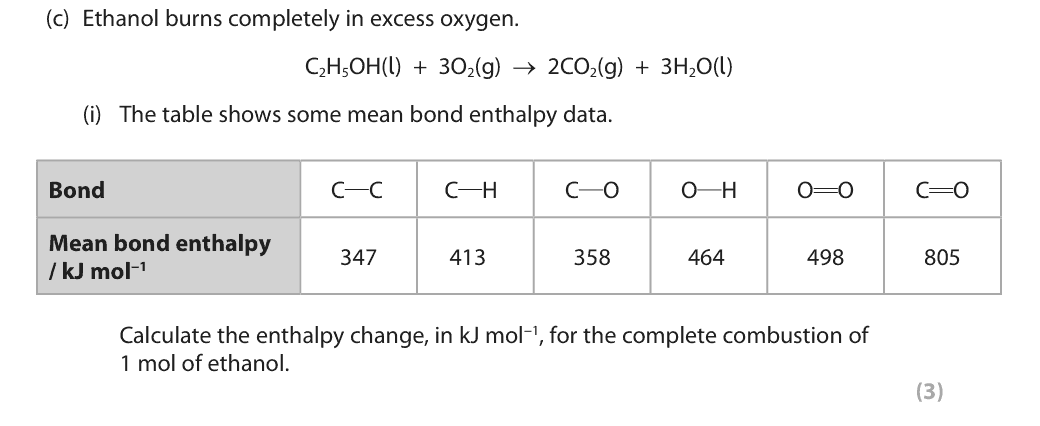
Ethanol burns completely in excess oxygen.
C2H5OH(l)  +  3O2(g)  o  2CO2(g)  +  3H2O(l)
The table shows some mean bond enthalpy data.
Bond
C
C
C
H
C
O
O
H
O
O
C
O
Mean bond enthalpy
347
413
358
464
498
805
/ kJ mol−1
Calculate the enthalpy change, in kJ mol−1, for the complete combustion of
1 mol of ethanol.
June 2016 · AS Paper 2 · Q4(c)(ii) 2 marks Diagram or structure kinetics i
Earlier parts of question 4 that this part usesEarlier part of June 2016 Paper 2 question 4Earlier part of June 2016 Paper 2 question 4
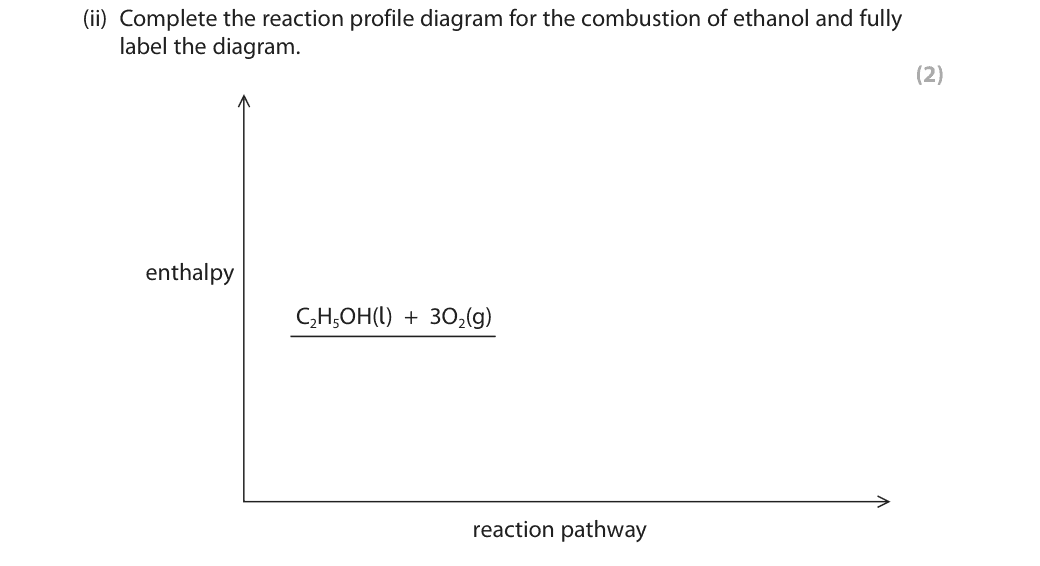
Complete the reaction profile diagram for the combustion of ethanol and fully
label the diagram.
enthalpy
C2H5OH(l)  +  3O2(g)
reaction pathway
June 2016 · AS Paper 2 · Q4(c)(iii) 1 mark Short answer Hard energetics i
Earlier part of question 4 that this part usesEarlier part of June 2016 Paper 2 question 4
A data book value for the standard enthalpy change of combustion of ethanol
is −1367.3 kJ mol−1.
Give the main reason why the value you calculated in (b)(i) is different from
this data book value.
June 2016 · AS Paper 2 · Q5(a) 2 marks Diagram or structure alcohols
The following procedure may be used to prepare 2-chloro-2-methylpropane.
Step 1 Place 15cm3 of 2-methylpropan-2-ol in a separating funnel and slowly add
30cm3 of concentrated hydrochloric acid (an excess), while swirling the

funnel.
Step 2 When all the hydrochloric acid has been added, leave the mixture to stand

for 20 minutes, shaking it gently at intervals.
Step 3 Once the organic and aqueous layers have completely separated, discard the
aqueous layer.
Step 4 Add saturated sodium hydrogencarbonate solution, a little at a time, to the
organic layer.  After each addition, invert the separating funnel and open the tap.
Step 5 Discard the aqueous layer.
Step 6 Transfer the organic layer to a small flask, add a solid drying agent and swirl
the flask.
Step 7 Decant the liquid into a clean flask and distil it to collect pure
2-chloro-2-methylpropane.
Some data on the organic reactant and product are given in the table.
Data
2-methylpropan-2-ol
2-chloro-2-methylpropane
molar mass / g mol–1
74.0
92.5
boiling temperature / oC
82
51
density / g cm–3
0.79
0.84
Draw a diagram of a separating funnel, labelling the aqueous layer and the layer
of 2-chloro-2-methylpropane that would be observed at the end of Step 2.
June 2016 · AS Paper 2 · Q5(b) 2 marks Practical and data analysis alcohols
Earlier part of question 5 that this part usesEarlier part of June 2016 Paper 2 question 5
Give the reason why sodium hydrogencarbonate solution is added to the organic
layer in Step 4 and why it is important to open the tap after adding this solution.
June 2016 · AS Paper 2 · Q5(c) 1 mark Multiple choice alcohols
Earlier part of question 5 that this part usesEarlier part of June 2016 Paper 2 question 5
Which one of these anhydrous compounds may be used as a drying agent in
Step 6?
A sodium chloride
B sodium hydroxide
C sodium nitrate
D sodium sulfate
June 2016 · AS Paper 2 · Q5(d)(i) 3 marks Practical and data analysis alcohols
Earlier part of question 5 that this part usesEarlier part of June 2016 Paper 2 question 5
A student set up this apparatus for distillation in Step 7 as shown.
water
in
water
anti-bumping
out
granules
electric
heater
Describe three ways in which this apparatus must be modified for safe and
efficient use.  Assume the apparatus is suitably clamped.
June 2016 · AS Paper 2 · Q5(d)(ii) 1 mark Practical and data analysis Hard alcohols
Earlier parts of question 5 that this part usesEarlier part of June 2016 Paper 2 question 5Earlier part of June 2016 Paper 2 question 5
Give a suitable temperature range over which to collect the final product
during the distillation.
June 2016 · AS Paper 2 · Q5(e) 3 marks Calculation formulae equations and amounts of substance
Earlier part of question 5 that this part usesEarlier part of June 2016 Paper 2 question 5
In the preparation, 15cm3 of 2-methylpropan-2-ol produced
6.9 cm3 of 2-chloro-2-methylpropane.
The equation for the reaction is
(CH3)3COH  +  HCl  o  (CH3)3CCl  +  H2O
Calculate the percentage yield of 2-chloro-2-methylpropane, using data from the
table.
Data
2-methylpropan-2-ol
2-chloro-2-methylpropane
molar mass / g mol–1
74.0
92.5
boiling temperature / oC
82
51
density / g cm−3
0.79
0.84
June 2016 · AS Paper 2 · Q5(f) 2 marks Mechanism alkeneshalogenoalkanes
Earlier part of question 5 that this part usesEarlier part of June 2016 Paper 2 question 5
The mechanism for the reaction is in three stages.
CH3
CH3
Stage 1
H3C
C
CH3
H3C
C
CH3
O:
H+
O+
H
H
CH3
CH3
Stage 2
H3C
C
CH3
H3C
C+
CH3       + H2O
O+
H
CH3
CH3
Stage 3
H3C
C+
CH3
H3C
C
CH3
:Cl–
Cl
Add curly arrows to the reactants in Stages 2 and 3 to complete the mechanism.
June 2016 · AS Paper 2 · Q6(a) 4 marks Calculation energetics i
A student carries out two experiments to determine the enthalpy change that occurs
when anhydrous sodium carbonate reacts to form hydrated sodium carbonate.
Na2CO3(s)  +  10H2O(l)  o  Na2CO3.10H2O(s)
In the first experiment, the student determines the enthalpy change of solution
for anhydrous sodium carbonate.
50.0g of distilled water is placed in a polystyrene cup and the temperature is
recorded.
A sample of anhydrous sodium carbonate is added to the water, the mixture is
stirred and the final temperature recorded.
The results for this experiment are shown in the table.
mass used / g
5.09
initial temperature / oC
27.0
final temperature / oC
32.4
Calculate the enthalpy change of solution, in kJ mol−1, for
anhydrous sodium carbonate.
Give your answer to an appropriate number of significant figures and include a sign.
[Use 4.18 J g–1 °C–1 as the specific heat capacity of water]
Na2CO3(s) + aq  o  Na2CO3(aq)
June 2016 · AS Paper 2 · Q6(b) 2 marks Calculation energetics i
Earlier part of question 6 that this part usesEarlier part of June 2016 Paper 2 question 6
In the second experiment, the student determines the enthalpy change of
solution for hydrated sodium carbonate.
Na2CO3.10H2O(s) + aq  o  Na2CO3(aq)           ¨H = + 53.7kJ mol–1
Complete the Hess cycle and, together with your answer to (a) calculate the
enthalpy change when anhydrous sodium carbonate reacts to form hydrated
sodium carbonate.  Include a sign in your answer.
Na2CO3(s) + 10H2O(l)
Na2CO3.10H2O(s)
June 2016 · AS Paper 2 · Q6(c) 2 marks Explanation energetics i
Earlier part of question 6 that this part usesEarlier part of June 2016 Paper 2 question 6
Hydrated sodium carbonate slowly loses some water of crystallisation when left in air.
Explain how the enthalpy change in the second experiment would compare with
the data book value if an old sample of hydrated sodium carbonate had been
used.
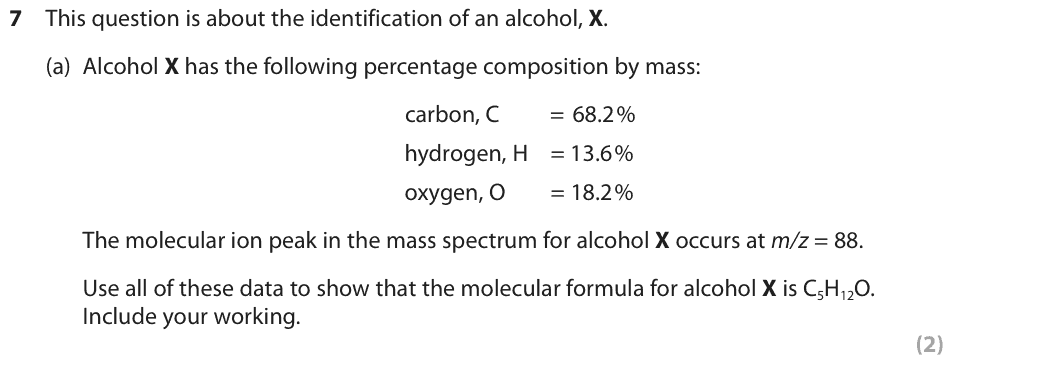
This question is about the identification of an alcohol, X.
Alcohol X has the following percentage composition by mass:
carbon, C         = 68.2%
hydrogen, H    = 13.6%
oxygen, O        = 18.2%
The molecular ion peak in the mass spectrum for alcohol X occurs at m/z = 88.
Use all of these data to show that the molecular formula for alcohol X is C5H12O.
Include your working.
June 2016 · AS Paper 2 · Q7(b)(i) 1 mark Short answer alcohols
When alcohol X is oxidised, a carboxylic acid is formed.

State what information this gives about alcohol X.
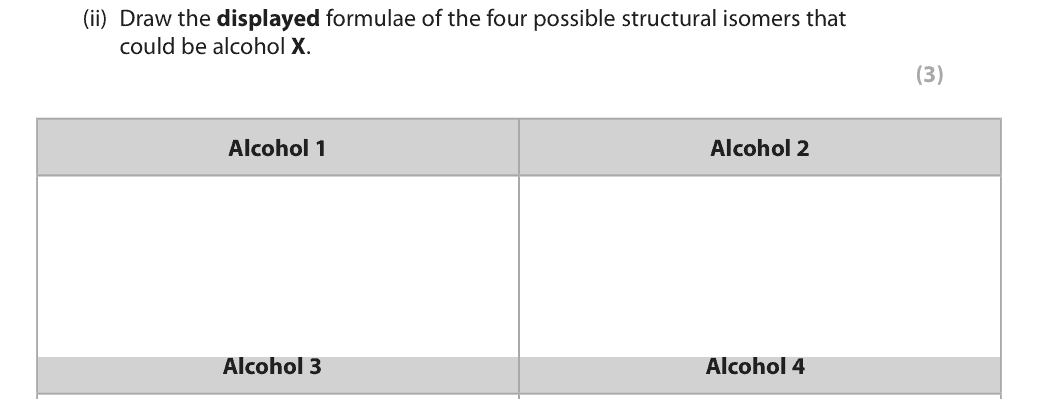
June 2016 · AS Paper 2 · Q7(b)(ii) 3 marks Diagram or structure introduction to organic chemistry
Earlier parts of question 7 that this part usesEarlier part of June 2016 Paper 2 question 7Earlier part of June 2016 Paper 2 question 7
Draw the displayed formulae of the four possible structural isomers that
could be alcohol X.
Alcohol 1
Alcohol 2
Alcohol 3
Alcohol 4
June 2016 · AS Paper 2 · Q7(b)(iii) 1 mark Diagram or structure mass spectrometry and infrared spectroscopy
Earlier parts of question 7 that this part usesEarlier part of June 2016 Paper 2 question 7Earlier part of June 2016 Paper 2 question 7
The mass spectrum of alcohol X has a major peak at m/z = 45.
Draw the structure of the species that could give this peak.
June 2016 · AS Paper 2 · Q7(b)(iv) 2 marks Short answer mass spectrometry and infrared spectroscopyintroduction to organic chemistry
Earlier parts of question 7 that this part usesEarlier part of June 2016 Paper 2 question 7Earlier part of June 2016 Paper 2 question 7
Alcohol X has a branched chain.
Identify alcohol X, explaining your reasoning.
June 2016 · AS Paper 2 · Q8(a) 2 marks Short answer alcohols
Ethanedioic acid has two carboxylic acid groups.

Ethanedioic acid, H2C2O4, can be prepared from ethane-1,2-diol.
H
H
O
O
H
O
C
C
O
H
C
C
HO
OH
H
H
Give the reagents and condition required for this reaction.
Reagents  
Condition
June 2016 · AS Paper 2 · Q8(b)(i) 4 marks Practical and data analysis formulae equations and amounts of substance
Earlier part of question 8 that this part usesEarlier part of June 2016 Paper 2 question 8
The formula for ethanedioic acid crystals is H2C2O4.nH2O.

To determine the number of moles of water of crystallisation, n, in 1 mol of
ethanedioic acid crystals, a student carried out the following procedure.
•
Prepare 250.0cm3 of a solution containing a known mass of about 1g of
ethanedioic acid crystals.
•
Titrate 25.0cm3 portions of the ethanedioic acid solution with 0.103 mol dm−3
sodium hydroxide solution, using phenolphthalein as indicator.
The student obtained these results:
mass of ethanedioic acid crystals = 1.09g
mean titre = 16.20cm3
The equation for the reaction is
H2C2O4 + 2NaOH  o  Na2C2O4 + 2H2O
Describe how the student should prepare the 250.0 cm3 of ethanedioic acid
solution.
June 2016 · AS Paper 2 · Q8(b)(ii) 1 mark Practical and data analysis Hard formulae equations and amounts of substance
Earlier parts of question 8 that this part usesEarlier part of June 2016 Paper 2 question 8Earlier part of June 2016 Paper 2 question 8
Give the colour change at the end-point in this titration.
From   to
June 2016 · AS Paper 2 · Q8(b)(iii) 5 marks Calculation Hard formulae equations and amounts of substance
Earlier parts of question 8 that this part usesEarlier part of June 2016 Paper 2 question 8Earlier part of June 2016 Paper 2 question 8Earlier part of June 2016 Paper 2 question 8
Calculate a value of n in the formula H2C2O4.nH2O from these data.
June 2016 · AS Paper 2 · Q8(b)(iv) 2 marks Explanation formulae equations and amounts of substance
Earlier parts of question 8 that this part usesEarlier part of June 2016 Paper 2 question 8Earlier part of June 2016 Paper 2 question 8
The student thought that the ethanedioic acid crystals used may have been
slightly damp.
Explain the effect of using damp crystals on the titre and on the value of n.

Work with an A-level chemistry tutor

Want a paper marked and gone through with you? Message us.

Prefer email? Send an enquiry

If you are under 18, please include a parent's contact details. Enquiries go to enquiries@chemistryaleveltutor.com and are deleted once handled. All tutoring is online.