
June 2025: AS Paper 2, Organic and physical chemistry

80 marks · 44 question parts · Paper, mark scheme and report on AQA's site · Have the Data Booklet beside you

Question by question

QTopicMarksAOType
01.1 Halogenoalkanes 2AO1=2Explanation
01.2 Halogenoalkanes 3AO1=1,AO2=2Mechanism
01.3 Halogenoalkanes 1AO1=1Short answer
01.4 Halogenoalkanes, Introduction to organic chemistry: nomenclature, mechanisms and isomerism 5AO1=1,AO2=2,AO3=2Mechanism
01.5 Bonding 1AO3=1Short answer
01.6 Bonding 2AO1=1,AO2=1Explanation
02.1 Kinetics 2AO1=2Short answer
02.2 Kinetics 3AO3=3Explanation
02.3 Bonding 3AO2=3Diagram or structure
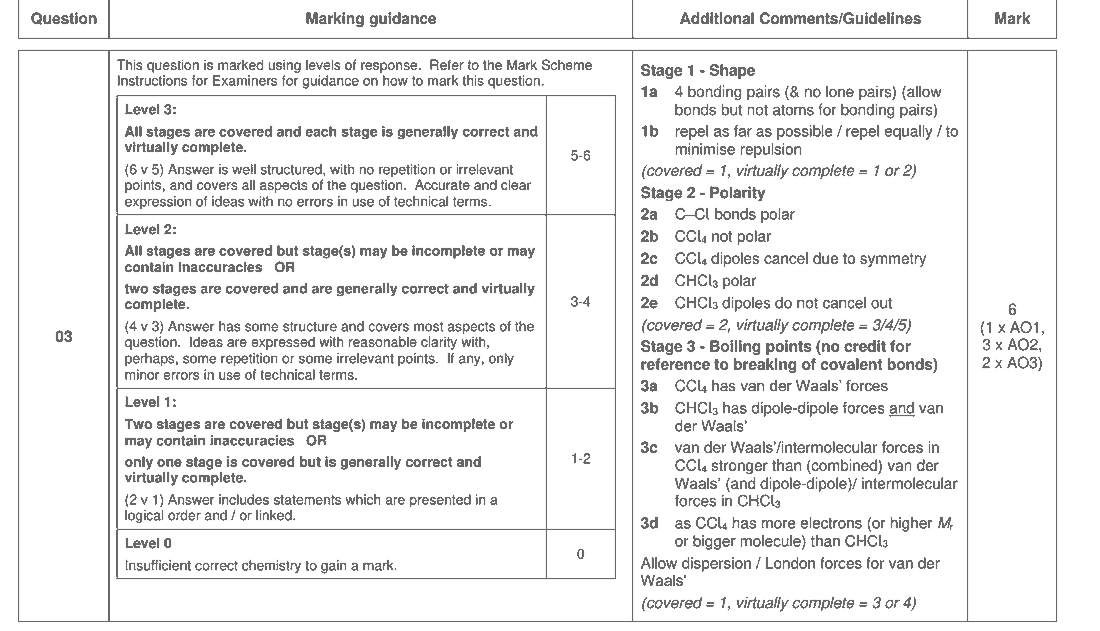
03 Bonding 6AO1=1,AO2=3,AO3=2Level of response
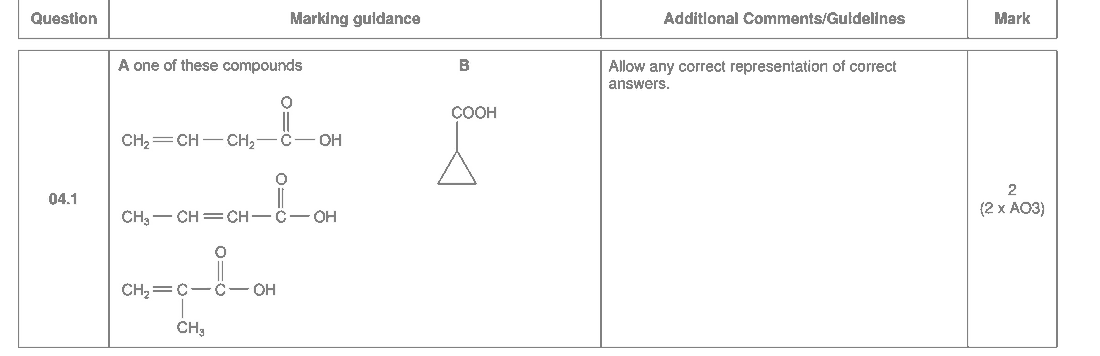
04.1 Introduction to organic chemistry: nomenclature, mechanisms and isomerism, Organic analysis: test-tube reactions, mass spectrometry and infrared 2AO3=2Diagram or structure
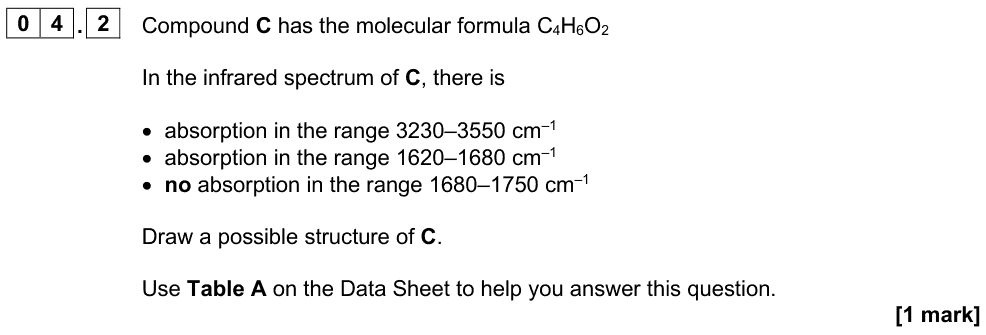
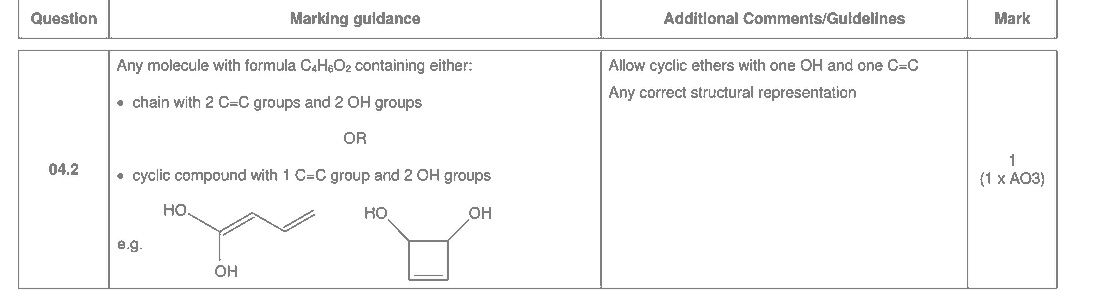
04.2 Organic analysis: test-tube reactions, mass spectrometry and infrared 1AO3=1Diagram or structure
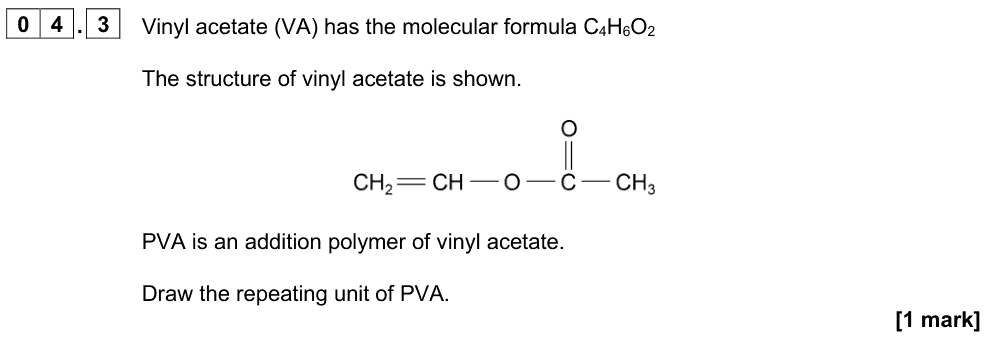
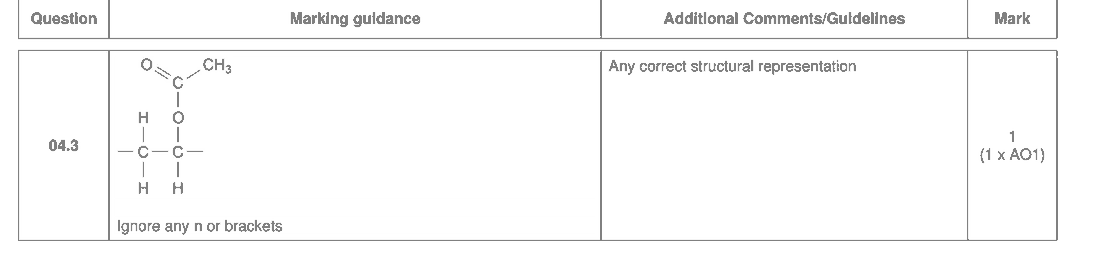
04.3 Alkenes 1AO1=1Diagram or structure
05.1 Organic analysis: test-tube reactions, mass spectrometry and infrared 2AO2=2Explanation
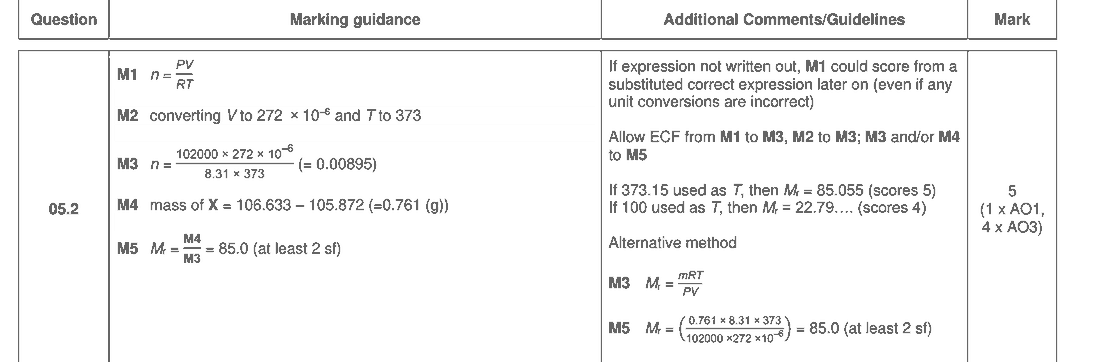
05.2 Amount of substance 5AO1=1,AO3=4Calculation
06.1 Alcohols 1AO2=1Equation writing
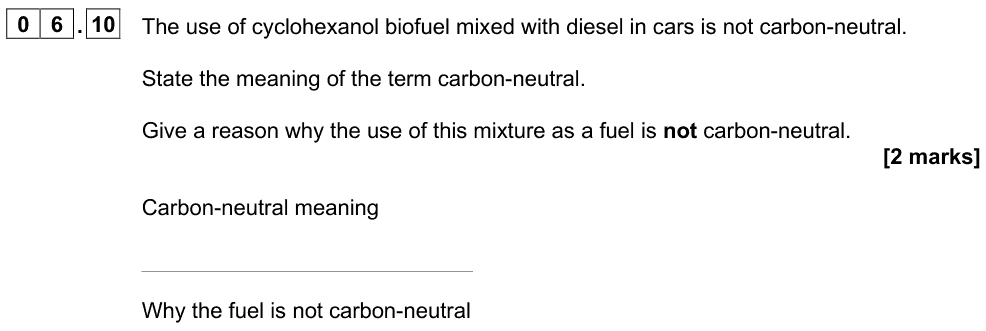
06.10 Alcohols 2AO1=1,AO2=1Short answer
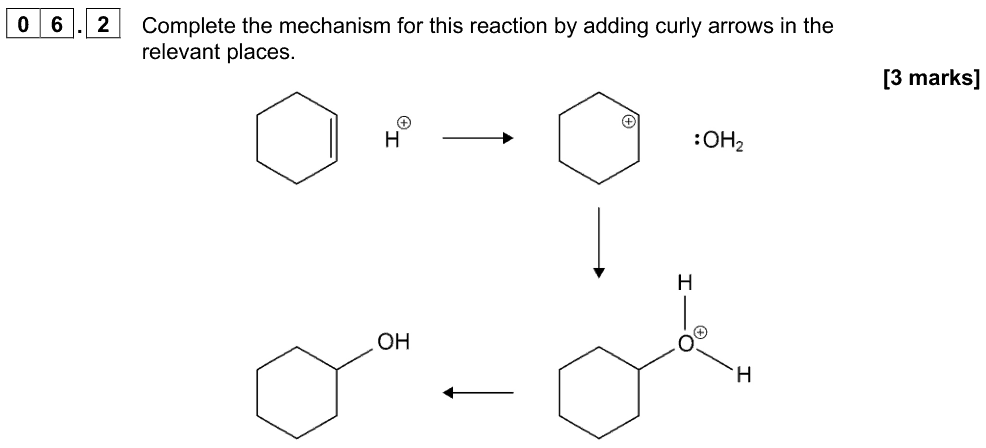
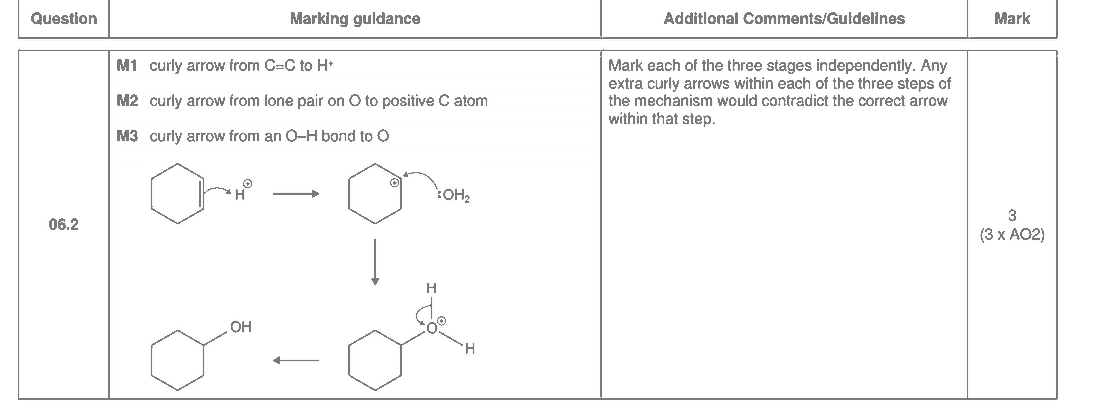
06.2 Alcohols 3AO2=3Mechanism
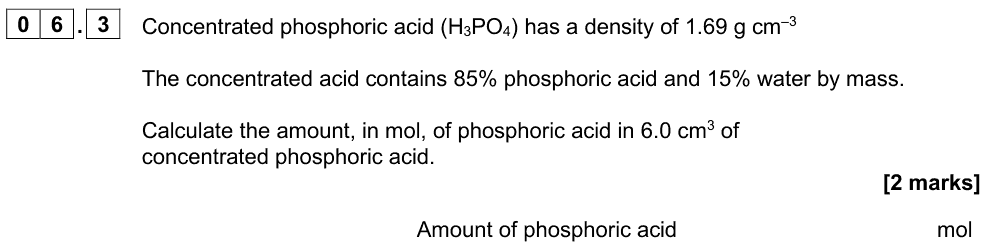
06.3 Amount of substance 2AO2=2Calculation
06.4 Alcohols 2AO1=2Practical and data analysis
06.5 Alcohols 1AO1=1Practical and data analysis
06.6 Alcohols 1AO3=1Practical and data analysis
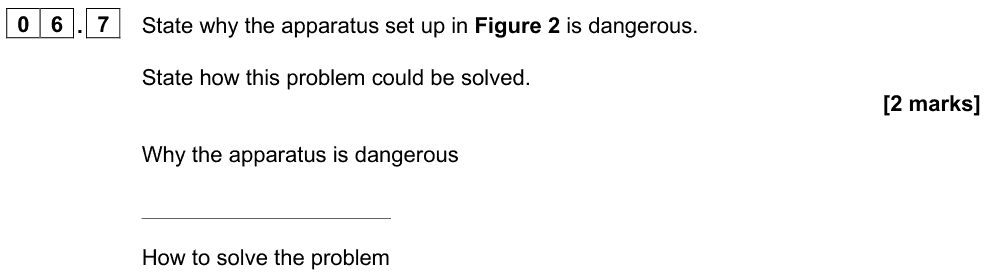
06.7 Alcohols 2AO3=2Practical and data analysis
06.8 Alcohols 1AO1=1Short answer
06.9 Alkanes, Amount of substance 1AO2=1Equation writing
07.1 Energetics 1AO1=1Short answer
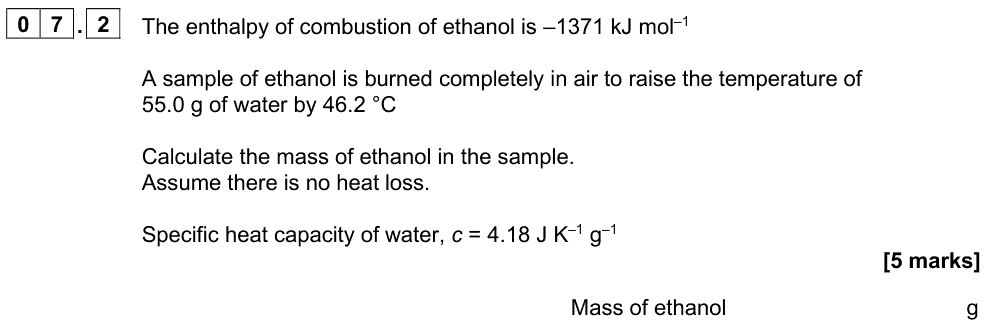
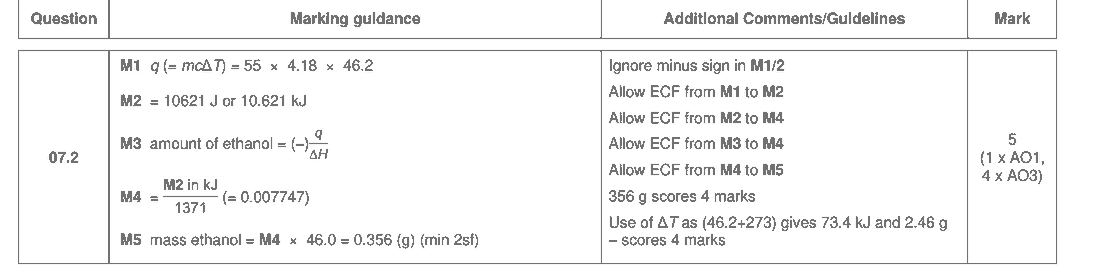
07.2 Energetics 5AO1=1,AO3=4Calculation
07.3 Energetics 1AO2=1Calculation
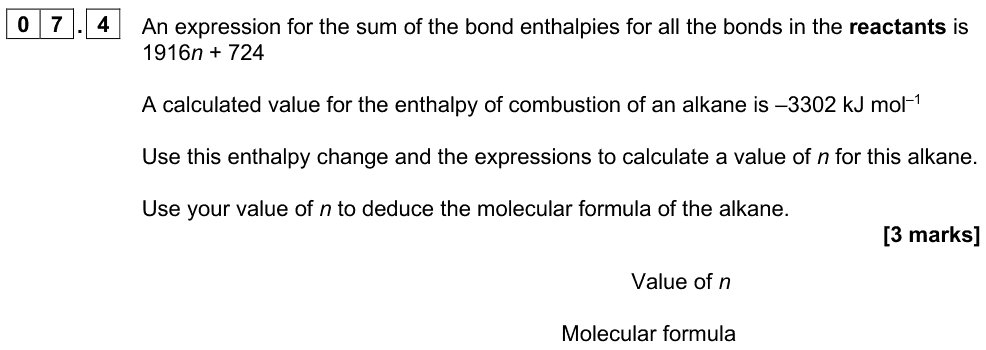
07.4 Energetics, Introduction to organic chemistry: nomenclature, mechanisms and isomerism 3AO3=3Calculation
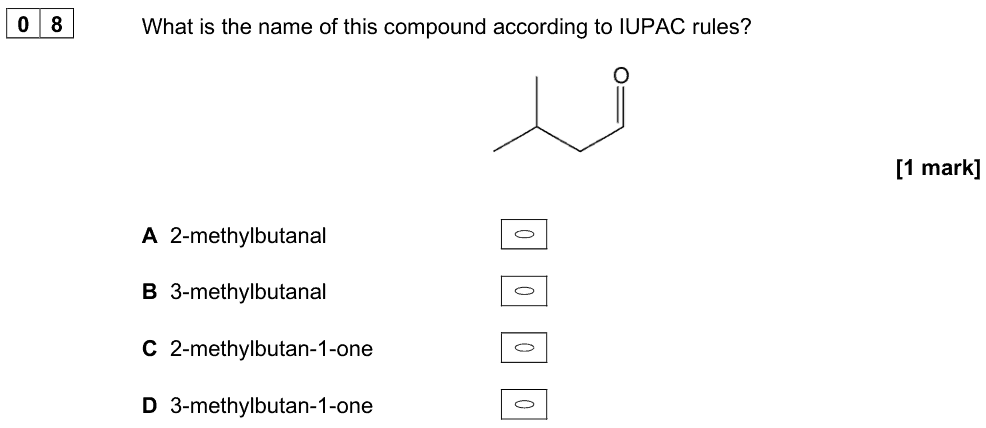
08 Introduction to organic chemistry: nomenclature, mechanisms and isomerism 1AO2=1Multiple choice
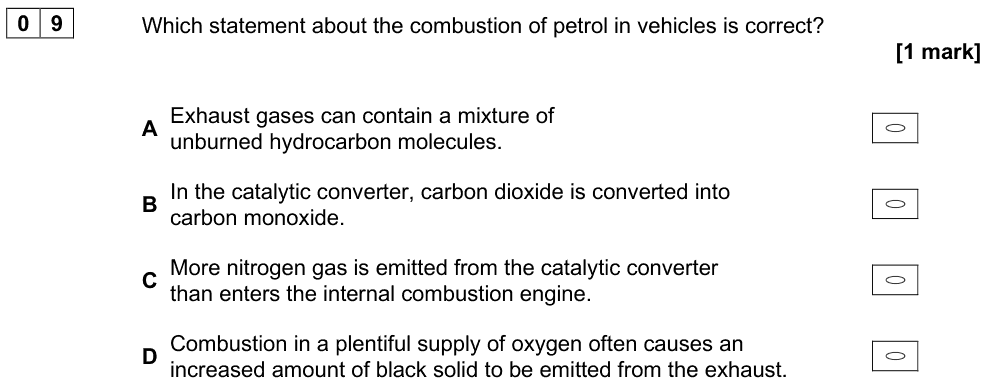
09 Alkanes 1AO1=1Multiple choice
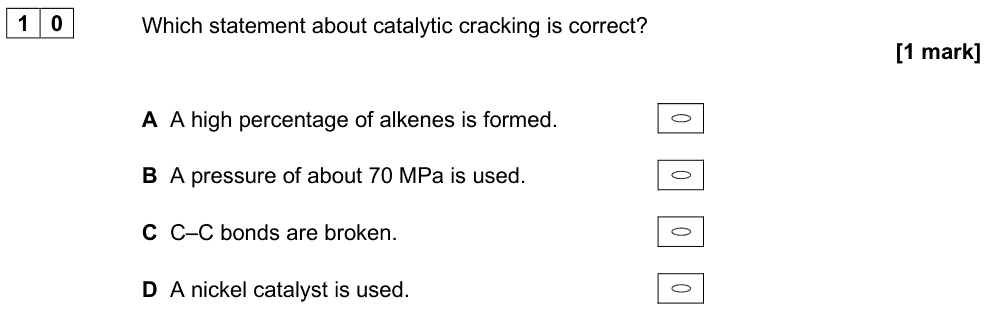
10 Alkanes 1AO1=1Multiple choice
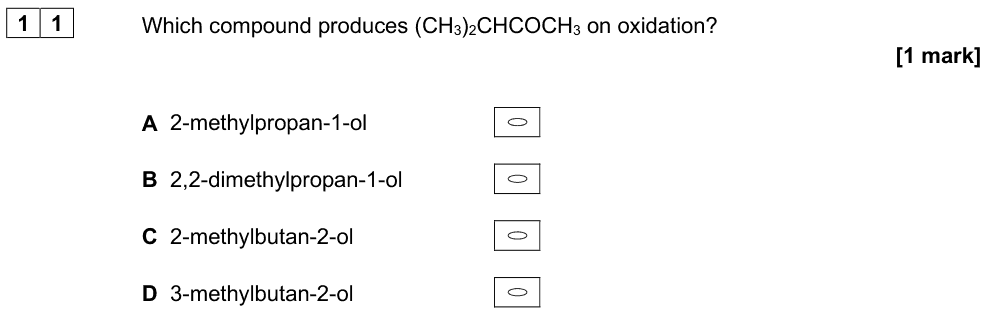
11 Alcohols, Introduction to organic chemistry: nomenclature, mechanisms and isomerism 1AO3=1Multiple choice
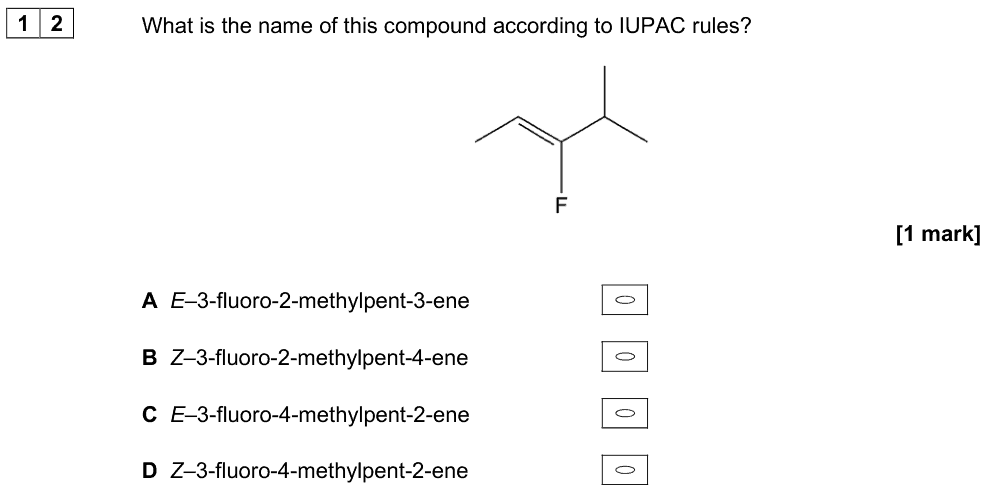
12 Introduction to organic chemistry: nomenclature, mechanisms and isomerism 1AO3=1Multiple choice
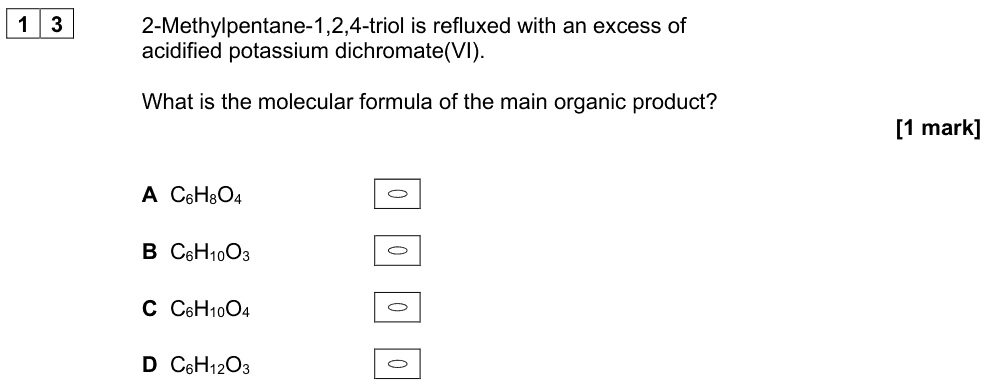
13 Alcohols 1AO3=1Multiple choice
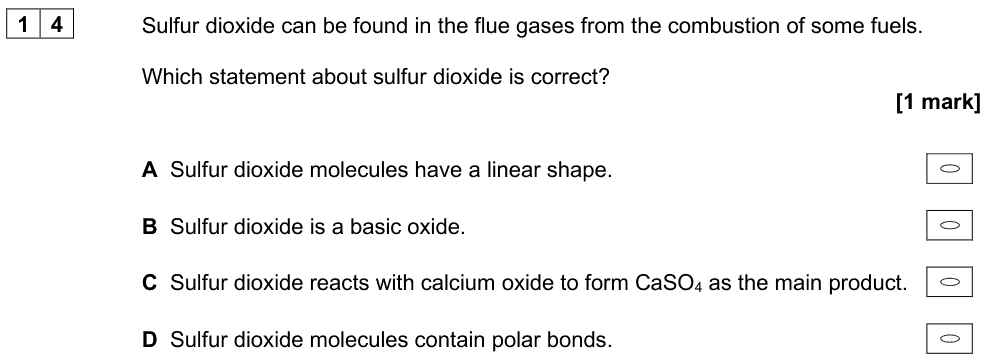
14 Bonding 1AO1=1Multiple choice
15 Halogenoalkanes 1AO1=1Multiple choice
16 Alkanes 1AO1=1Multiple choice
17 Organic analysis: test-tube reactions, mass spectrometry and infrared 1AO1=1Multiple choice
18 Energetics 1AO2=1Multiple choice
19 Kinetics 1AO1=1Multiple choice
20 Kinetics, Amount of substance 1AO3=1Multiple choice
21 Alkanes 1AO2=1Multiple choice
22 Energetics 1AO2=1Multiple choice

The questions

01.101.201.301.401.501.602.102.202.30304.104.204.305.105.206.106.1006.206.306.406.506.606.706.806.907.107.207.307.4080910111213141516171819202122
June 2025 · AS Paper 2 · Q01.1 2 marks AO1=2 Explanation halogenoalkanes
This question is about halogenoalkanes.
Halogenoalkanes undergo substitution reactions with nucleophiles such as
CN–, NH3 and OH–
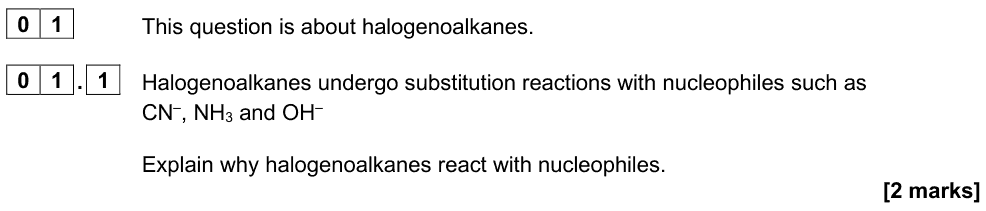
Explain why halogenoalkanes react with nucleophiles.
[2 marks]
June 2025 · AS Paper 2 · Q01.2 3 marks AO1=1, AO2=2 Mechanism halogenoalkanes
Earlier part of question 01 that this part usesEarlier part of June 2025 Paper 2 question 01
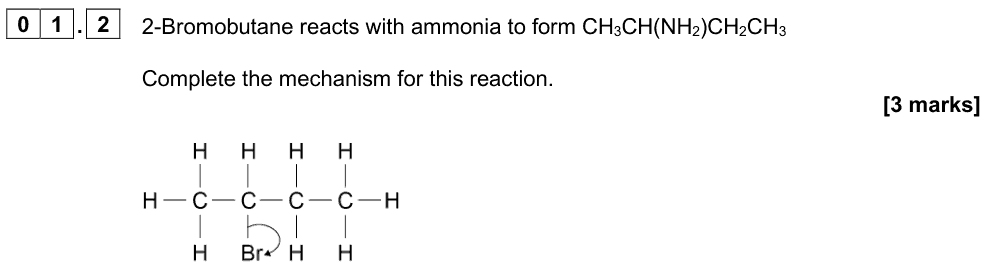
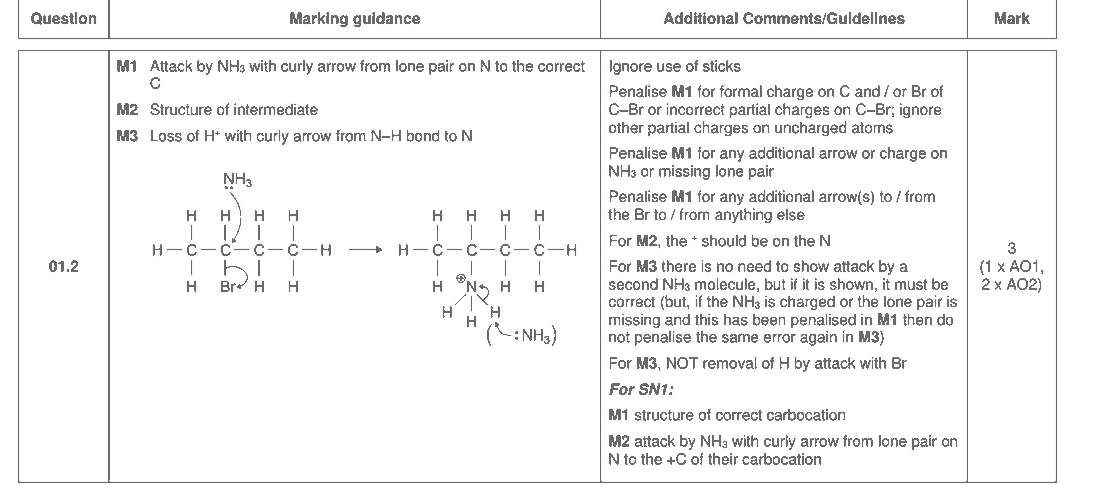
2-Bromobutane reacts with ammonia to form CH3CH(NH2)CH2CH3
Complete the mechanism for this reaction.
[3 marks]
June 2025 · AS Paper 2 · Q01.3 1 mark AO1=1 Short answer halogenoalkanes
Earlier part of question 01 that this part usesEarlier part of June 2025 Paper 2 question 01
2-Bromobutane reacts with KOH to give a mixture of products.
Identify the solvent that should be used to ensure that butan-2-ol is the
main organic product when 2-brombutane reacts with KOH
[1 mark]
June 2025 · AS Paper 2 · Q01.4 5 marks AO1=1, AO2=2, AO3=2 Mechanism halogenoalkanesintroduction to organic chemistry
Earlier parts of question 01 that this part usesEarlier part of June 2025 Paper 2 question 01Earlier part of June 2025 Paper 2 question 01
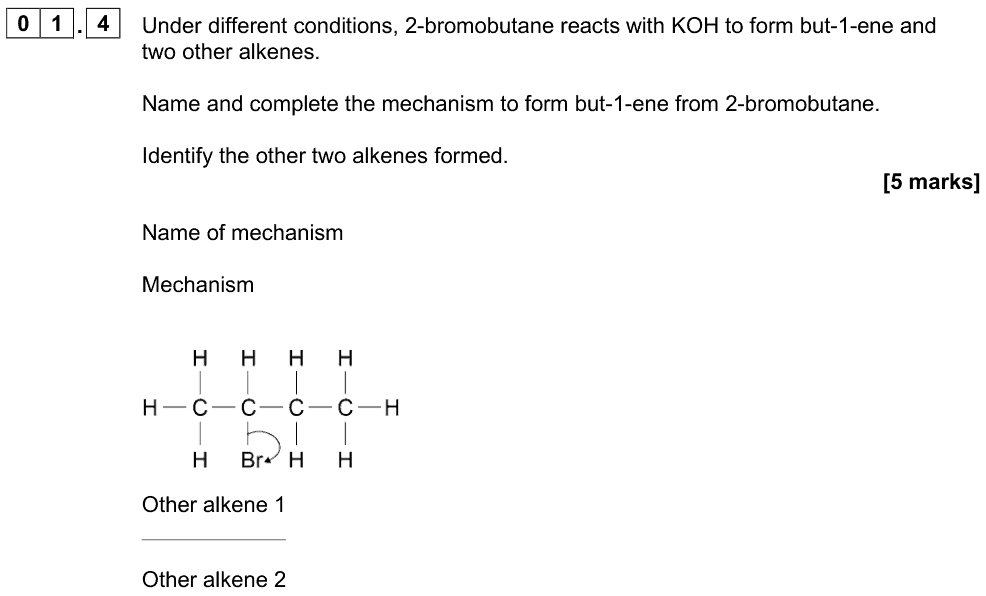
Under different conditions, 2-bromobutane reacts with KOH to form but-1-ene and
two other alkenes.
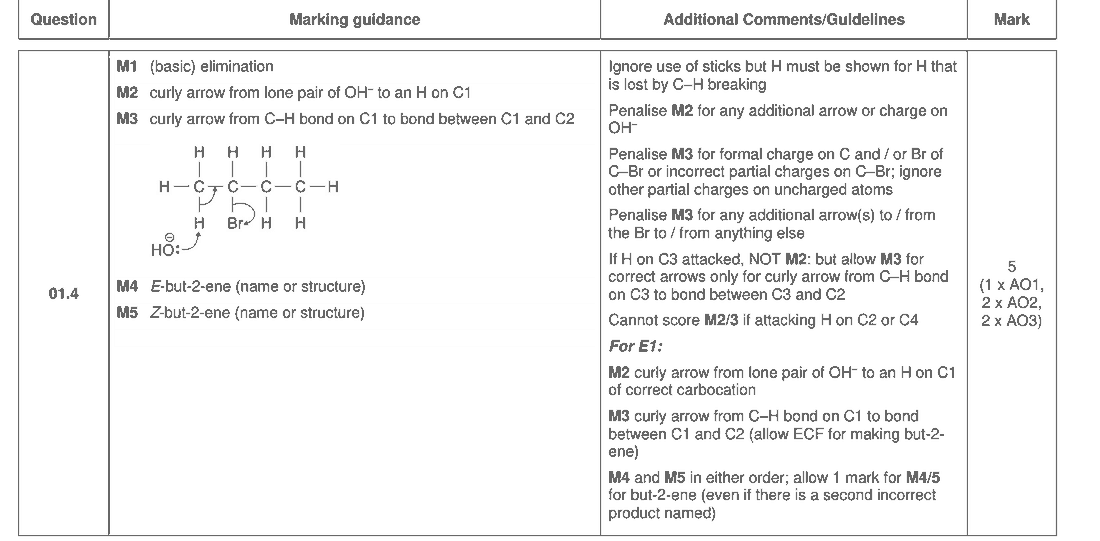
Name and complete the mechanism to form but-1-ene from 2-bromobutane.
Identify the other two alkenes formed.
[5 marks]
Name of mechanism
Mechanism
Other alkene 1
Other alkene 2
June 2025 · AS Paper 2 · Q01.5 1 mark AO3=1 Short answer bonding
Earlier part of question 01 that this part usesEarlier part of June 2025 Paper 2 question 01
The carbocation (CH3)3C+ is formed as an intermediate in the reaction of
2-bromo-2-methylpropane with KCN
Suggest the value of the bond angle around the central C atom in the
(CH3)3C+ carbocation.
[1 mark]
June 2025 · AS Paper 2 · Q01.6 2 marks AO1=1, AO2=1 Explanation bonding
Earlier part of question 01 that this part usesEarlier part of June 2025 Paper 2 question 01
A co-ordinate bond is formed when the (CH3)3C+ carbocation reacts with CN– to
form a nitrile.
Explain how this co-ordinate bond is formed during this reaction.
[2 marks]
June 2025 · AS Paper 2 · Q02.1 2 marks AO1=2 Short answer kinetics
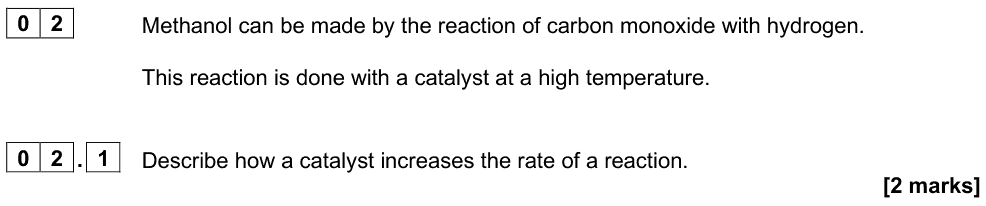
Methanol can be made by the reaction of carbon monoxide with hydrogen.
This reaction is done with a catalyst at a high temperature.
Describe how a catalyst increases the rate of a reaction.
[2 marks]
June 2025 · AS Paper 2 · Q02.2 3 marks AO3=3 Explanation kinetics
Earlier part of question 02 that this part usesEarlier part of June 2025 Paper 2 question 02
Explain why the rate of a reaction increases as the temperature increases.
[3 marks]
June 2025 · AS Paper 2 · Q02.3 3 marks AO2=3 Diagram or structure bonding
Earlier part of question 02 that this part usesEarlier part of June 2025 Paper 2 question 02
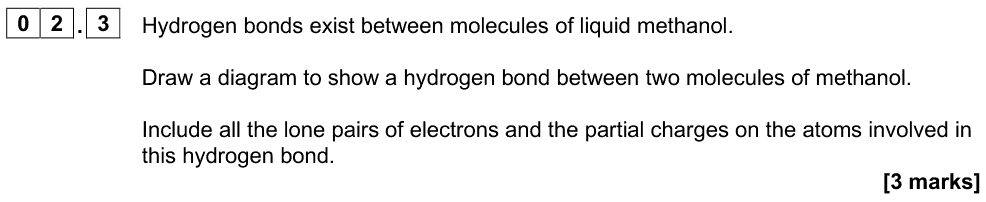
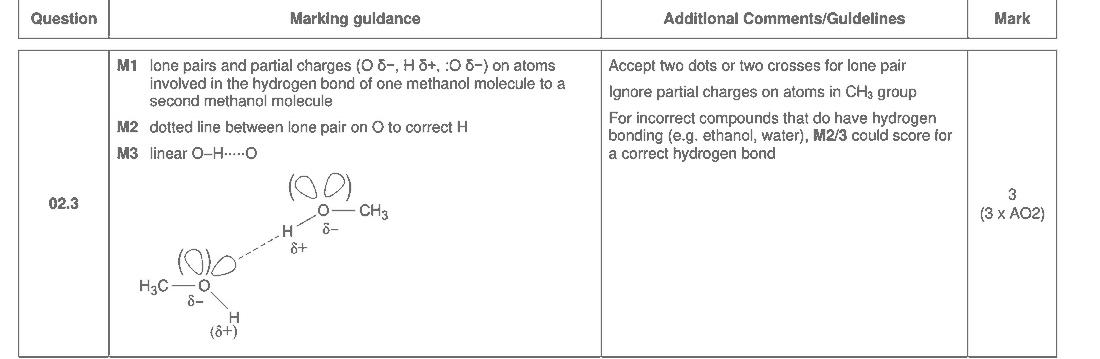
Hydrogen bonds exist between molecules of liquid methanol.
Draw a diagram to show a hydrogen bond between two molecules of methanol.
Include all the lone pairs of electrons and the partial charges on the atoms involved in
this hydrogen bond.
[3 marks]
June 2025 · AS Paper 2 · Q03 6 marks AO1=1, AO2=3, AO3=2 6-mark level of response bonding
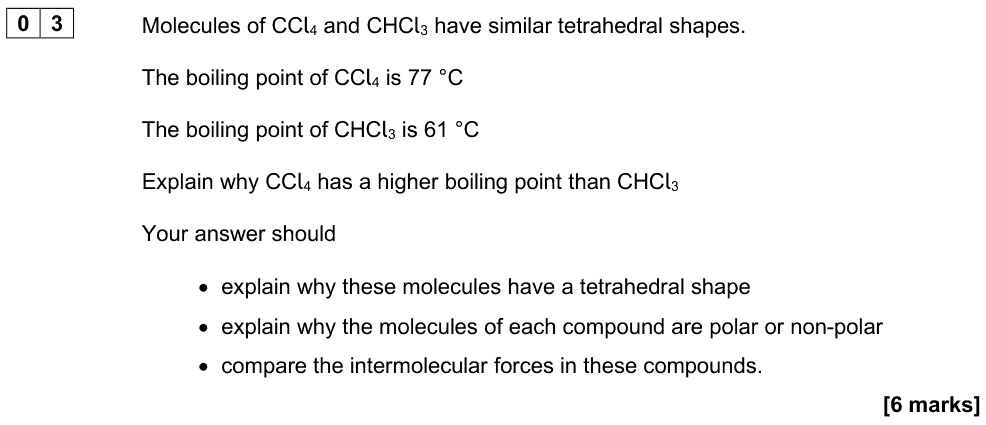
Molecules of CCl4 and CHCl3 have similar tetrahedral shapes.
The boiling point of CCl4 is 77 °C
The boiling point of CHCl3 is 61 °C
Explain why CCl4 has a higher boiling point than CHCl3
Your answer should
• explain why these molecules have a tetrahedral shape
• explain why the molecules of each compound are polar or non-polar
• compare the intermolecular forces in these compounds.
[6 marks]
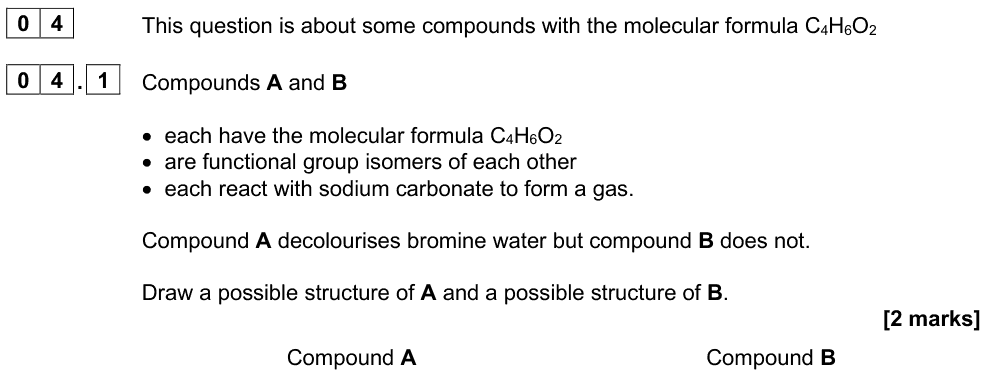
June 2025 · AS Paper 2 · Q04.1 2 marks AO3=2 Diagram or structure introduction to organic chemistryorganic analysis
This question is about some compounds with the molecular formula C4H6O2
Compounds A and B
• each have the molecular formula C4H6O2
• are functional group isomers of each other
• each react with sodium carbonate to form a gas.
Compound A decolourises bromine water but compound B does not.
Draw a possible structure of A and a possible structure of B.
[2 marks]
Compound A
Compound B
June 2025 · AS Paper 2 · Q04.2 1 mark AO3=1 Diagram or structure organic analysis
Earlier part of question 04 that this part usesEarlier part of June 2025 Paper 2 question 04
Compound C has the molecular formula C4H6O2
In the infrared spectrum of C, there is
• absorption in the range 3230–3550 cm–1
• absorption in the range 1620–1680 cm–1
• no absorption in the range 1680–1750 cm–1
Draw a possible structure of C.
Use Table A on the Data Sheet to help you answer this question.
[1 mark]
June 2025 · AS Paper 2 · Q04.3 1 mark AO1=1 Diagram or structure alkenes
Earlier part of question 04 that this part usesEarlier part of June 2025 Paper 2 question 04
Vinyl acetate (VA) has the molecular formula C4H6O2
The structure of vinyl acetate is shown.
PVA is an addition polymer of vinyl acetate.
Draw the repeating unit of PVA.
[1 mark]
June 2025 · AS Paper 2 · Q05.1 2 marks AO2=2 Explanation organic analysis
This question is about determining the relative molecular mass (Mr) of
different compounds.
The Mr of a compound can be determined by mass spectrometry.
Propanone, prop-2-en-1-ol and butane each have Mr = 58.0
Give the reason why high resolution mass spectrometry can distinguish between
propanone and butane, but cannot distinguish between propanone and
prop-2-en-1-ol.
[2 marks]
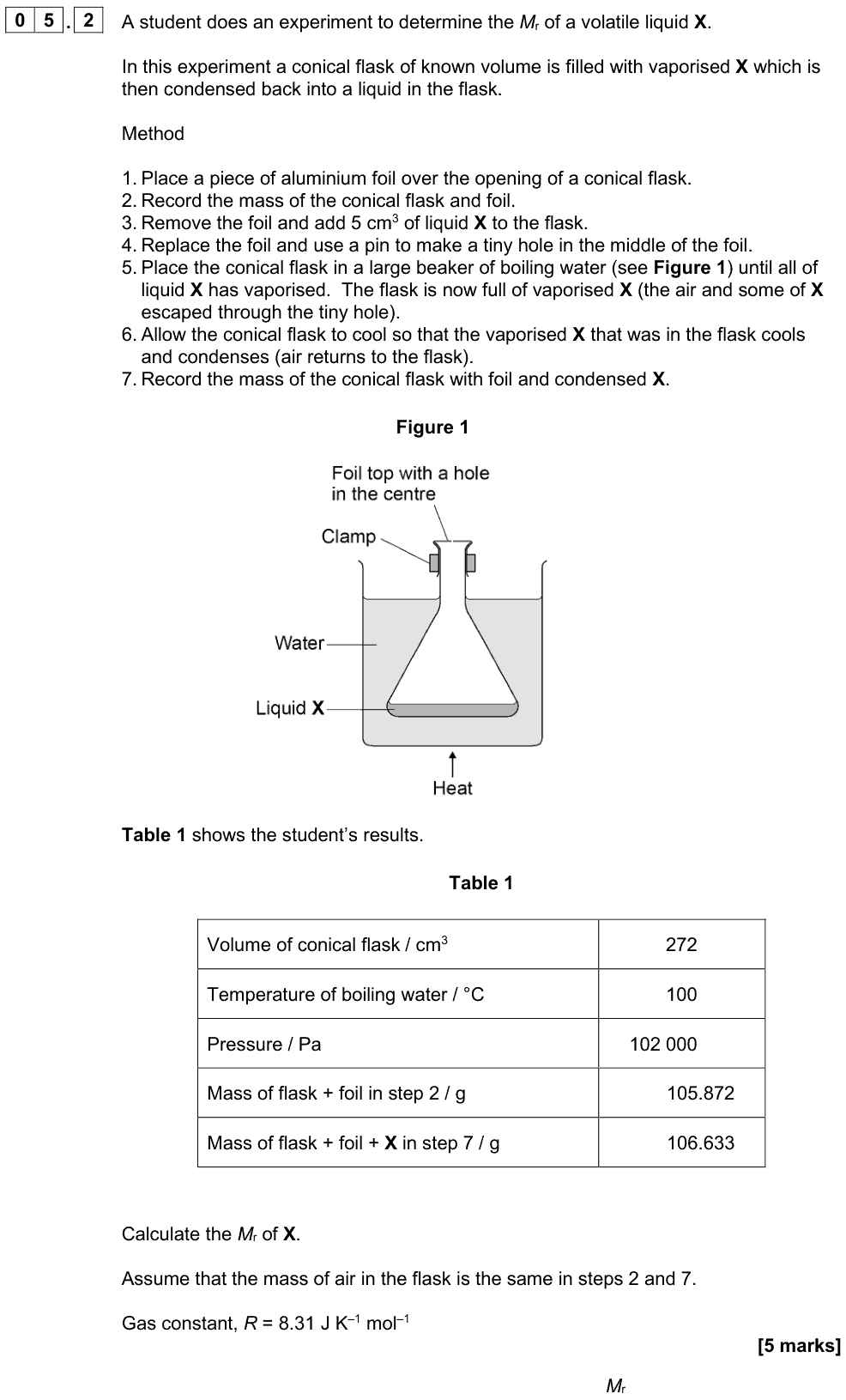
June 2025 · AS Paper 2 · Q05.2 5 marks AO1=1, AO3=4 Calculation amount of substance
Earlier part of question 05 that this part usesEarlier part of June 2025 Paper 2 question 05
A student does an experiment to determine the Mr of a volatile liquid X.
In this experiment a conical flask of known volume is filled with vaporised X which is
then condensed back into a liquid in the flask.
Method
1. Place a piece of aluminium foil over the opening of a conical flask.
2. Record the mass of the conical flask and foil.
3. Remove the foil and add 5 cm3 of liquid X to the flask.
4. Replace the foil and use a pin to make a tiny hole in the middle of the foil.
5. Place the conical flask in a large beaker of boiling water (see Figure 1) until all of
liquid X has vaporised.  The flask is now full of vaporised X (the air and some of X

escaped through the tiny hole).
6. Allow the conical flask to cool so that the vaporised X that was in the flask cools
and condenses (air returns to the flask).
7. Record the mass of the conical flask with foil and condensed X.
Figure 1
Table 1 shows the student’s results.
Table 1
Volume of conical flask / cm3
272
Temperature of boiling water / °C

100
Pressure / Pa
102 000
Mass of flask + foil in step 2 / g
105.872
Mass of flask + foil + X in step 7 / g
106.633
Calculate the Mr of X.
Assume that the mass of air in the flask is the same in steps 2 and 7.
Gas constant, R = 8.31 J K–1 mol–1
[5 marks]
Mr
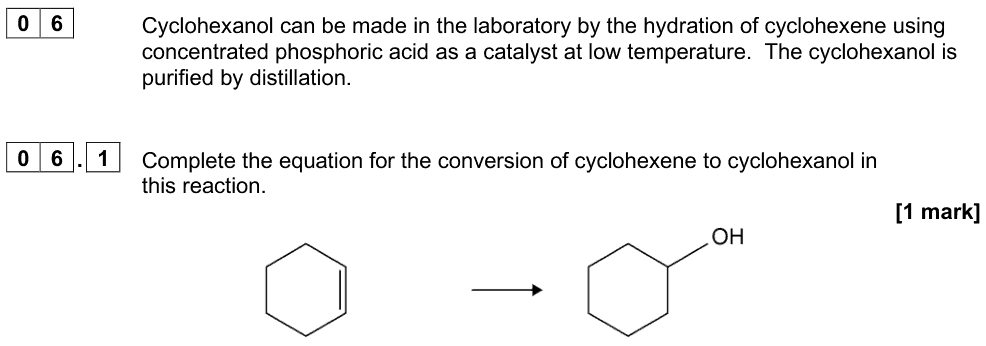
June 2025 · AS Paper 2 · Q06.1 1 mark AO2=1 Equation writing alcohols
Cyclohexanol can be made in the laboratory by the hydration of cyclohexene using
concentrated phosphoric acid as a catalyst at low temperature.  The cyclohexanol is
purified by distillation.
Complete the equation for the conversion of cyclohexene to cyclohexanol in
this reaction.
[1 mark]
June 2025 · AS Paper 2 · Q06.10 2 marks AO1=1, AO2=1 Short answer alcohols
Earlier parts of question 06 that this part usesEarlier part of June 2025 Paper 2 question 06Earlier part of June 2025 Paper 2 question 06
The use of cyclohexanol biofuel mixed with diesel in cars is not carbon-neutral.
State the meaning of the term carbon-neutral.
Give a reason why the use of this mixture as a fuel is not carbon-neutral.
[2 marks]
Carbon-neutral meaning
Why the fuel is not carbon-neutral
June 2025 · AS Paper 2 · Q06.2 3 marks AO2=3 Mechanism alcohols
Earlier part of question 06 that this part usesEarlier part of June 2025 Paper 2 question 06
Complete the mechanism for this reaction by adding curly arrows in the
relevant places.
[3 marks]
June 2025 · AS Paper 2 · Q06.3 2 marks AO2=2 Calculation amount of substance
Earlier part of question 06 that this part usesEarlier part of June 2025 Paper 2 question 06
Concentrated phosphoric acid (H3PO4) has a density of 1.69 g cm–3
The concentrated acid contains 85% phosphoric acid and 15% water by mass.
Calculate the amount, in mol, of phosphoric acid in 6.0 cm3 of
concentrated phosphoric acid.
[2 marks]
Amount of phosphoric acid
mol
June 2025 · AS Paper 2 · Q06.4 2 marks AO1=2 Practical and data analysis alcohols
Earlier part of question 06 that this part usesEarlier part of June 2025 Paper 2 question 06
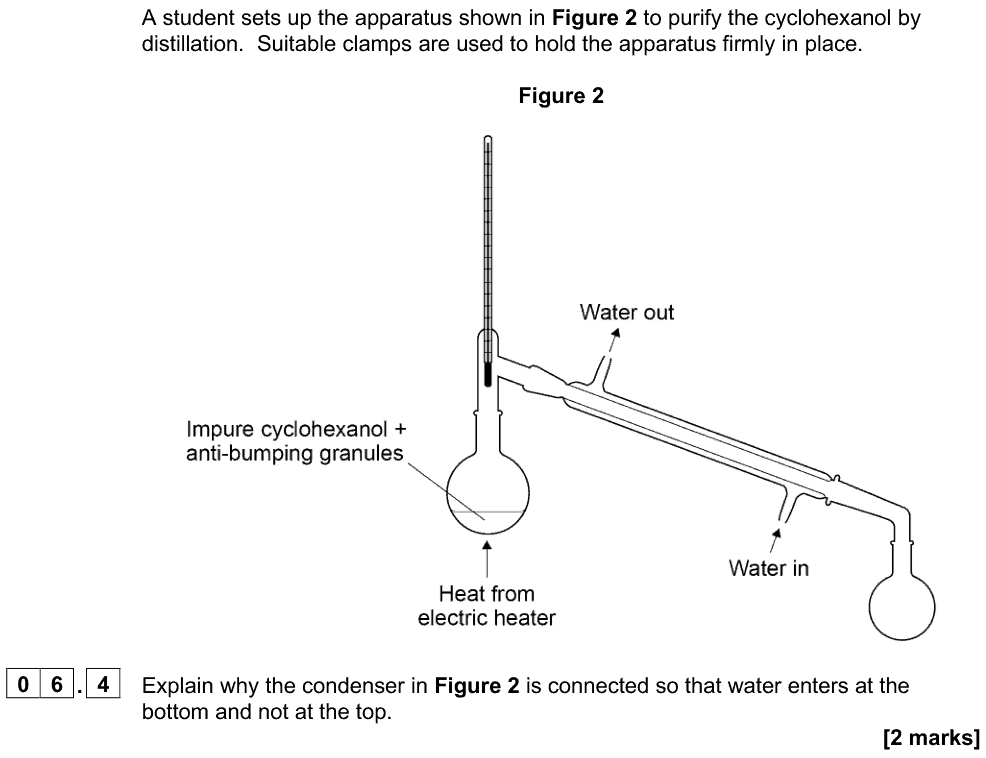
A student sets up the apparatus shown in Figure 2 to purify the cyclohexanol by
distillation.  Suitable clamps are used to hold the apparatus firmly in place.
Figure 2
Explain why the condenser in Figure 2 is connected so that water enters at the
bottom and not at the top.
[2 marks]
June 2025 · AS Paper 2 · Q06.5 1 mark AO1=1 Practical and data analysis alcohols
Earlier parts of question 06 that this part usesEarlier part of June 2025 Paper 2 question 06Earlier part of June 2025 Paper 2 question 06
The flask heated in Figure 2 contains anti-bumping granules.
State why these are used.
[1 mark]
June 2025 · AS Paper 2 · Q06.6 1 mark AO3=1 Practical and data analysis alcohols
Earlier parts of question 06 that this part usesEarlier part of June 2025 Paper 2 question 06Earlier part of June 2025 Paper 2 question 06
Suggest why the flask in Figure 2 is heated with an electric heater, rather than a
Bunsen burner.
[1 mark]
June 2025 · AS Paper 2 · Q06.7 2 marks AO3=2 Practical and data analysis alcohols
Earlier parts of question 06 that this part usesEarlier part of June 2025 Paper 2 question 06Earlier part of June 2025 Paper 2 question 06
State why the apparatus set up in Figure 2 is dangerous.
State how this problem could be solved.
[2 marks]
Why the apparatus is dangerous
How to solve the problem
June 2025 · AS Paper 2 · Q06.8 1 mark AO1=1 Short answer alcohols
Earlier part of question 06 that this part usesEarlier part of June 2025 Paper 2 question 06
The cyclohexanol can be dehydrated to re-form cyclohexene by heating with
concentrated phosphoric acid.
Name the mechanism for this reaction.
[1 mark]
June 2025 · AS Paper 2 · Q06.9 1 mark AO2=1 Equation writing alkanesamount of substance
Earlier part of question 06 that this part usesEarlier part of June 2025 Paper 2 question 06
Cyclohexanol biofuel can be made from waste biomass materials such as
rice and straw.
Cyclohexanol biofuel can be mixed with diesel and used as fuel in cars.
Give an equation for the complete combustion of cyclohexanol (C6H11OH).
[1 mark]
June 2025 · AS Paper 2 · Q07.1 1 mark AO1=1 Short answer energetics
This question is about enthalpies of combustion.
Define enthalpy change.
[1 mark]
June 2025 · AS Paper 2 · Q07.2 5 marks AO1=1, AO3=4 Calculation energetics
Earlier part of question 07 that this part usesEarlier part of June 2025 Paper 2 question 07
The enthalpy of combustion of ethanol is –1371 kJ mol–1
A sample of ethanol is burned completely in air to raise the temperature of
55.0 g of water by 46.2 °C
Calculate the mass of ethanol in the sample.
Assume there is no heat loss.
Specific heat capacity of water, c = 4.18 J K–1 g–1
[5 marks]
Mass of ethanol
g
June 2025 · AS Paper 2 · Q07.3 1 mark AO2=1 Calculation energetics
Earlier part of question 07 that this part usesEarlier part of June 2025 Paper 2 question 07
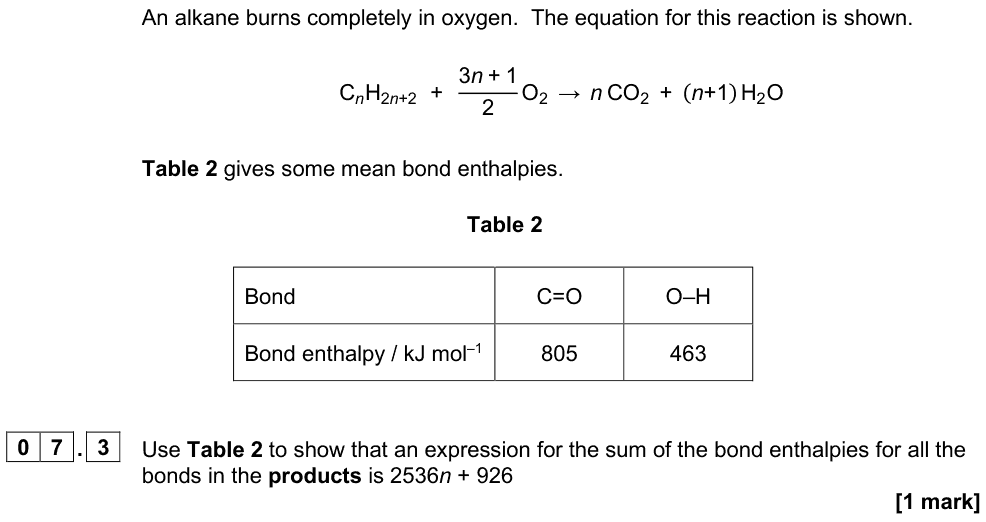
An alkane burns completely in oxygen.  The equation for this reaction is shown.
CnH2n+2  +  3n + 1
2
O2  →  n CO2  +  (n+1) H2O
Table 2 gives some mean bond enthalpies.
Table 2
Bond
C=O
O–H
Bond enthalpy / kJ mol–1
805
463
Use Table 2 to show that an expression for the sum of the bond enthalpies for all the
bonds in the products is 2536n + 926
[1 mark]
June 2025 · AS Paper 2 · Q07.4 3 marks AO3=3 Calculation energeticsintroduction to organic chemistry
Earlier parts of question 07 that this part usesEarlier part of June 2025 Paper 2 question 07Earlier part of June 2025 Paper 2 question 07
An expression for the sum of the bond enthalpies for all the bonds in the reactants is
1916n + 724
A calculated value for the enthalpy of combustion of an alkane is –3302 kJ mol–1
Use this enthalpy change and the expressions to calculate a value of n for this alkane.
Use your value of n to deduce the molecular formula of the alkane.
[3 marks]
Value of n
Molecular formula
June 2025 · AS Paper 2 · Q08 1 mark AO2=1 Multiple choice introduction to organic chemistry
What is the name of this compound according to IUPAC rules?
[1 mark]
A 2-methylbutanal
B 3-methylbutanal
C 2-methylbutan-1-one
D 3-methylbutan-1-one
June 2025 · AS Paper 2 · Q09 1 mark AO1=1 Multiple choice alkanes
Which statement about the combustion of petrol in vehicles is correct?
[1 mark]
A Exhaust gases can contain a mixture of
unburned hydrocarbon molecules.
B In the catalytic converter, carbon dioxide is converted into
carbon monoxide.
C More nitrogen gas is emitted from the catalytic converter
than enters the internal combustion engine.
D Combustion in a plentiful supply of oxygen often causes an
increased amount of black solid to be emitted from the exhaust.
June 2025 · AS Paper 2 · Q10 1 mark AO1=1 Multiple choice alkanes
Which statement about catalytic cracking is correct?
[1 mark]
A A high percentage of alkenes is formed.
B A pressure of about 70 MPa is used.
C C–C bonds are broken.
D A nickel catalyst is used.
June 2025 · AS Paper 2 · Q11 1 mark AO3=1 Multiple choice alcoholsintroduction to organic chemistry
Which compound produces (CH3)2CHCOCH3 on oxidation?
[1 mark]
A 2-methylpropan-1-ol
B 2,2-dimethylpropan-1-ol
C 2-methylbutan-2-ol
D 3-methylbutan-2-ol
June 2025 · AS Paper 2 · Q12 1 mark AO3=1 Multiple choice introduction to organic chemistry
What is the name of this compound according to IUPAC rules?
[1 mark]
A E–3-fluoro-2-methylpent-3-ene
B Z–3-fluoro-2-methylpent-4-ene
C E–3-fluoro-4-methylpent-2-ene
D Z–3-fluoro-4-methylpent-2-ene
June 2025 · AS Paper 2 · Q13 1 mark AO3=1 Multiple choice alcohols
2-Methylpentane-1,2,4-triol is refluxed with an excess of
acidified potassium dichromate(VI).
What is the molecular formula of the main organic product?
[1 mark]
A C6H8O4
B C6H10O3
C C6H10O4
D C6H12O3
June 2025 · AS Paper 2 · Q14 1 mark AO1=1 Multiple choice bonding
Sulfur dioxide can be found in the flue gases from the combustion of some fuels.
Which statement about sulfur dioxide is correct?
[1 mark]
A Sulfur dioxide molecules have a linear shape.
B Sulfur dioxide is a basic oxide.
C Sulfur dioxide reacts with calcium oxide to form CaSO4 as the main product.
D Sulfur dioxide molecules contain polar bonds.
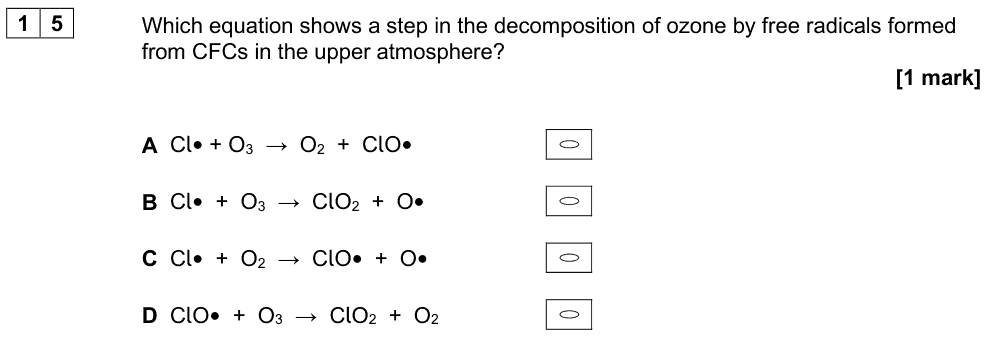
June 2025 · AS Paper 2 · Q15 1 mark AO1=1 Multiple choice halogenoalkanes
Which equation shows a step in the decomposition of ozone by free radicals formed
from CFCs in the upper atmosphere?
[1 mark]
A Cl● + O3  →  O2  +  ClO●
B Cl●  +  O3  →  ClO2  +  O●
C Cl●  +  O2  →  ClO●  +  O●
D ClO●  +  O3  →  ClO2  +  O2
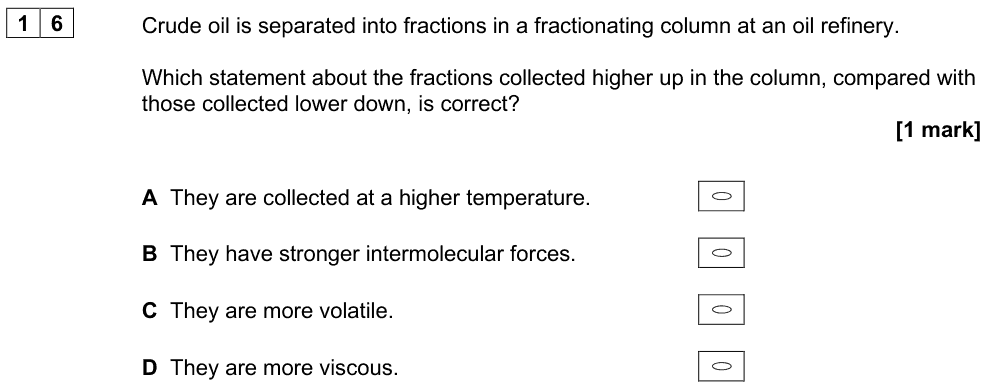
June 2025 · AS Paper 2 · Q16 1 mark AO1=1 Multiple choice alkanes
Crude oil is separated into fractions in a fractionating column at an oil refinery.
Which statement about the fractions collected higher up in the column, compared with
those collected lower down, is correct?
[1 mark]
A They are collected at a higher temperature.
B They have stronger intermolecular forces.
C They are more volatile.
D They are more viscous.
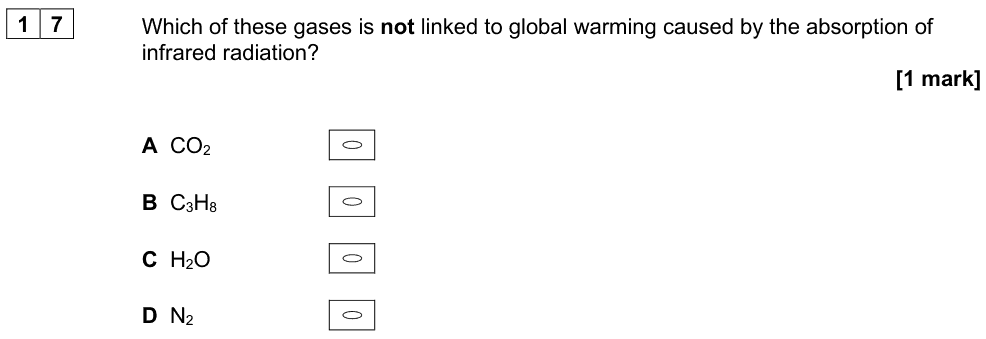
June 2025 · AS Paper 2 · Q17 1 mark AO1=1 Multiple choice organic analysis
Which of these gases is not linked to global warming caused by the absorption of
infrared radiation?
[1 mark]
A CO2
B C3H8
C H2O
D N2
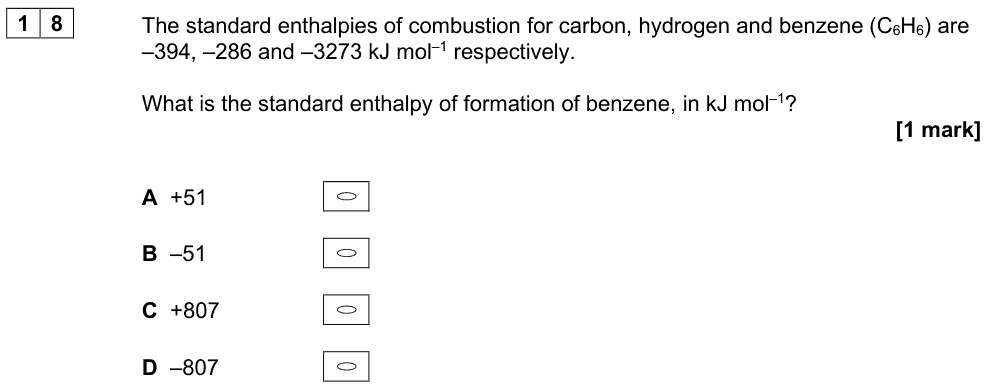
June 2025 · AS Paper 2 · Q18 1 mark AO2=1 Multiple choice energetics
The standard enthalpies of combustion for carbon, hydrogen and benzene (C6H6) are
–394, –286 and –3273 kJ mol–1 respectively.
What is the standard enthalpy of formation of benzene, in kJ mol–1?
[1 mark]
A +51
B –51
C +807
D –807
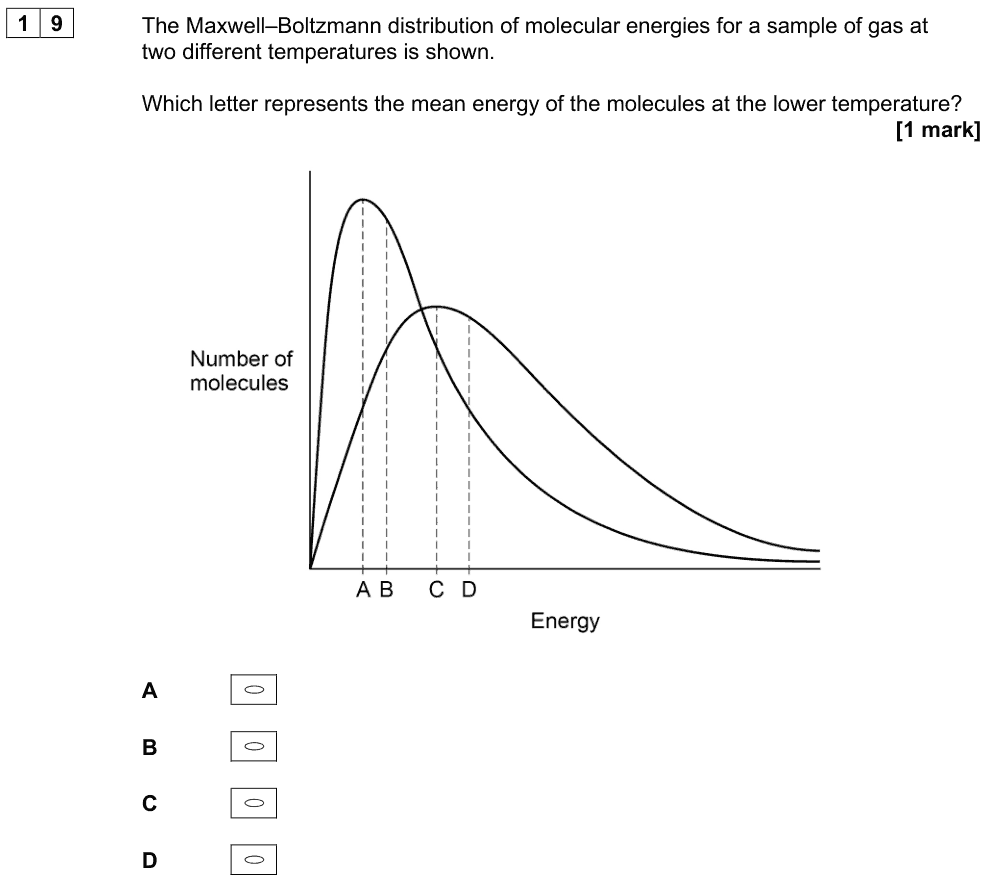
June 2025 · AS Paper 2 · Q19 1 mark AO1=1 Multiple choice kinetics
The Maxwell–Boltzmann distribution of molecular energies for a sample of gas at
two different temperatures is shown.
Which letter represents the mean energy of the molecules at the lower temperature?
[1 mark]
A
B
C
D
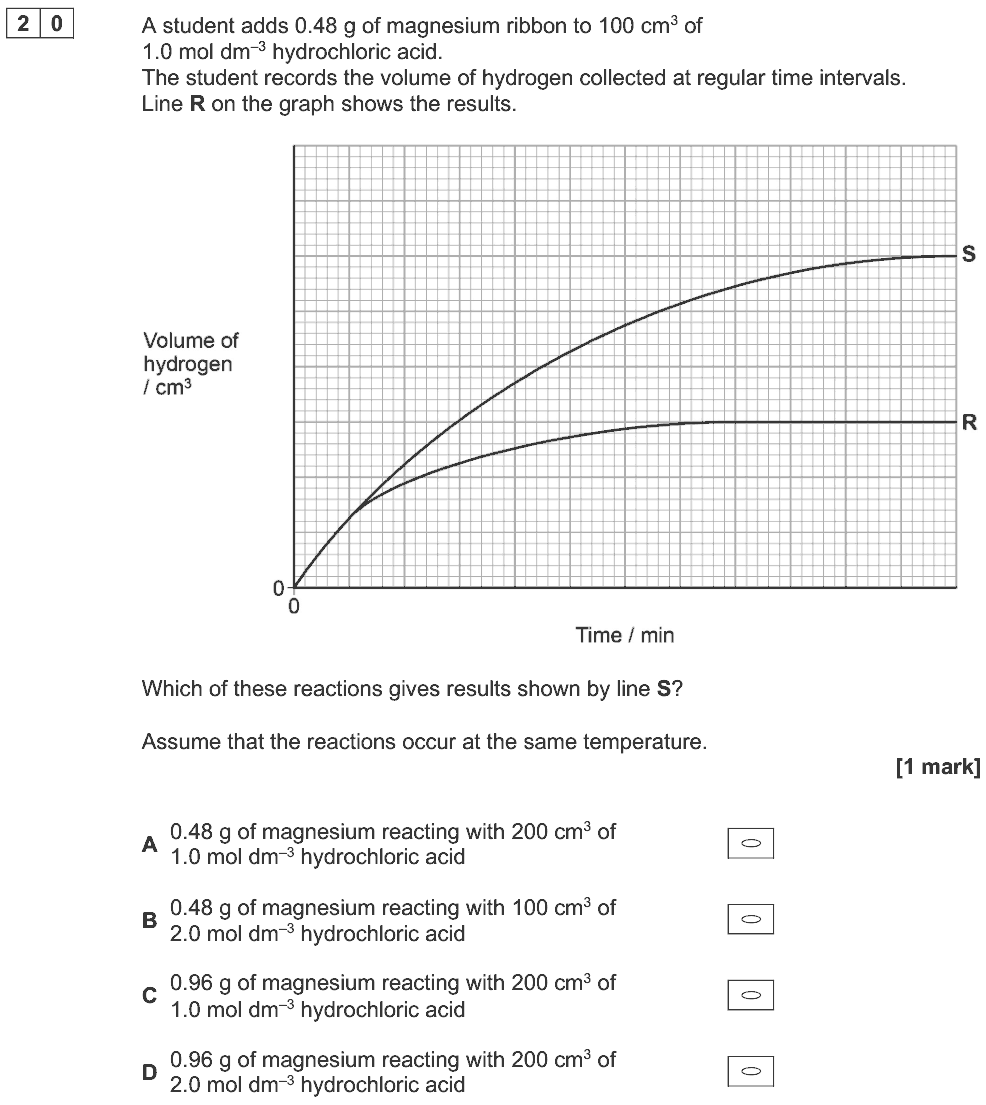
June 2025 · AS Paper 2 · Q20 1 mark AO3=1 Multiple choice kineticsamount of substance
A student adds 0.48 g of magnesium ribbon to 100 cm3 of
1.0 mol dm–3 hydrochloric acid.
The student records the volume of hydrogen collected at regular time intervals.
Line R on the graph shows the results.
Which of these reactions gives results shown by line S?
Assume that the reactions occur at the same temperature.
[1 mark]
A 0.48 g of magnesium reacting with 200 cm3 of
1.0 mol dm–3 hydrochloric acid
B 0.48 g of magnesium reacting with 100 cm3 of
2.0 mol dm–3 hydrochloric acid
C 0.96 g of magnesium reacting with 200 cm3 of
1.0 mol dm–3 hydrochloric acid
D 0.96 g of magnesium reacting with 200 cm3 of
2.0 mol dm–3 hydrochloric acid
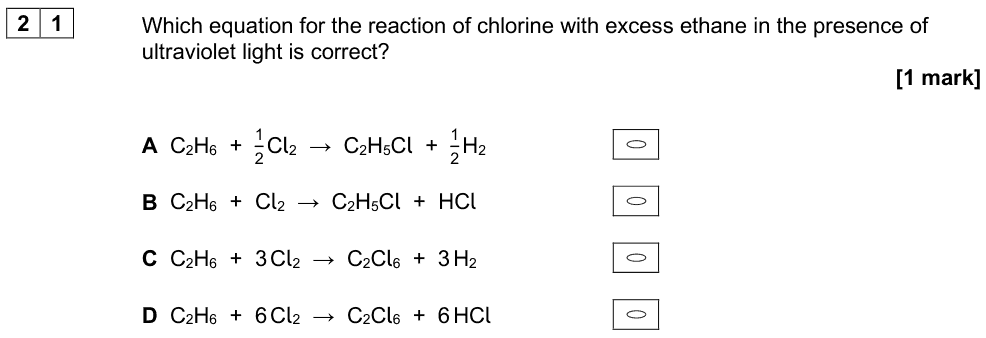
June 2025 · AS Paper 2 · Q21 1 mark AO2=1 Multiple choice alkanes
Which equation for the reaction of chlorine with excess ethane in the presence of
ultraviolet light is correct?
[1 mark]
A C2H6  +
1
2
Cl2  →  C2H5Cl  +
1
2
H2
B C2H6  +  Cl2  →  C2H5Cl  +  HCl
C C2H6  +  3 Cl2  →  C2Cl6  +  3 H2
D C2H6  +  6 Cl2  →  C2Cl6  +  6 HCl
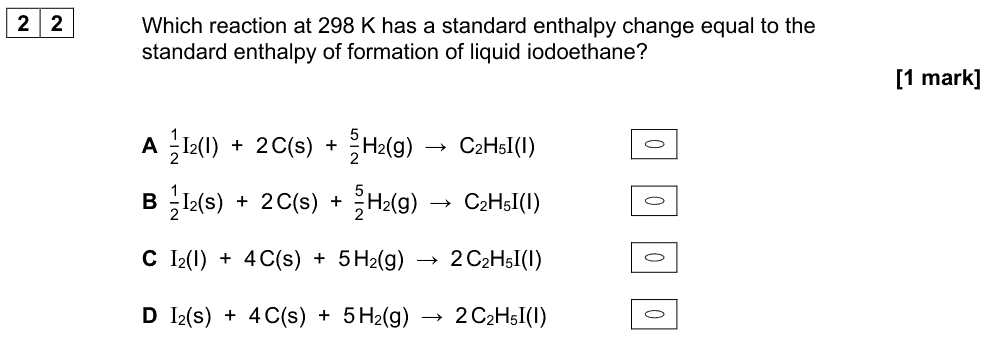
June 2025 · AS Paper 2 · Q22 1 mark AO2=1 Multiple choice energetics
Which reaction at 298 K has a standard enthalpy change equal to the
standard enthalpy of formation of liquid iodoethane?
[1 mark]
A
1
2
I2(I)  +  2 C(s)  +
5
2
H2(g)  →  C2H5I(I)
B
1
2
I2(s)  +  2 C(s)  +
5
2
H2(g)  →  C2H5I(I)
C I2(I)  +  4 C(s)  +  5 H2(g)  →  2 C2H5I(I)
D I2(s)  +  4 C(s)  +  5 H2(g)  →  2 C2H5I(I)

Work with an A-level chemistry tutor

Want a paper marked and gone through with you? Message us.

Prefer email? Send an enquiry

If you are under 18, please include a parent's contact details. Enquiries go to enquiries@chemistryaleveltutor.com and are deleted once handled. All tutoring is online.