
June 2019: AS Paper 1, Inorganic and physical chemistry

80 marks · 43 question parts · Paper, mark scheme and report on AQA's site · Have the Data Booklet beside you

Question by question

QTopicMarksAOType
01.1 Atomic structure, Periodicity 2Explanation
01.2 Bonding 2Explanation
01.3 Bonding 2Short answer
01.4 Bonding 4Diagram or structure
01.5 Energetics 3Calculation
02.1 Atomic structure 3Short answer
02.2 Atomic structure 1Short answer
02.3 Atomic structure 1Equation writing
02.4 Atomic structure, Amount of substance 5Calculation
03.1 Atomic structure 1Short answer
03.2 Atomic structure 1Short answer
03.3 Atomic structure 3Calculation
03.4 Oxidation, reduction and redox equations 1Short answer
03.5 Oxidation, reduction and redox equations 1Equation writing
03.6 Oxidation, reduction and redox equations 1Equation writing
03.7 Oxidation, reduction and redox equations 1Equation writing
04 Atomic structure, Periodicity 6Level of response
05.1 Chemical equilibria, Le Chatelier's principle and Kc 2Calculation
05.2 Chemical equilibria, Le Chatelier's principle and Kc 1Short answer
05.3 Chemical equilibria, Le Chatelier's principle and Kc 4Calculation
06.1 Amount of substance 5Calculation
06.2 Amount of substance 1Practical and data analysis
06.3 Amount of substance 1Practical and data analysis
06.4 Amount of substance 1Practical and data analysis
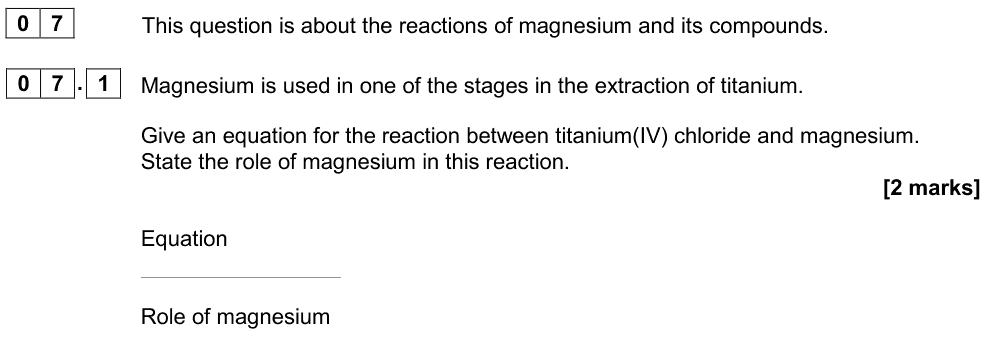
07.1 Group 2, the alkaline earth metals, Oxidation, reduction and redox equations 2Equation writing
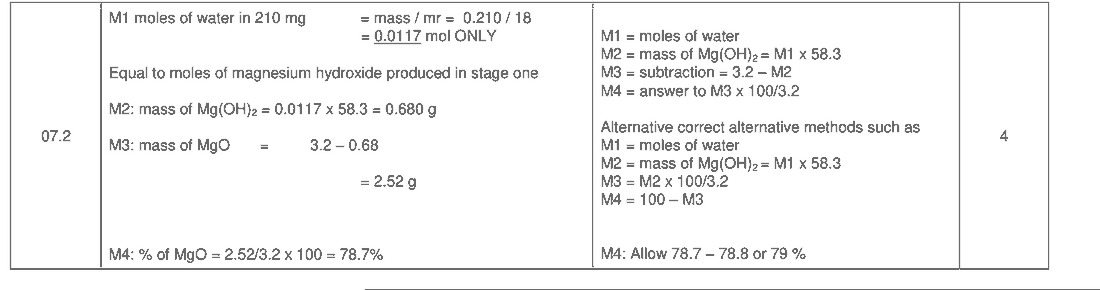
07.2 Amount of substance 4Calculation
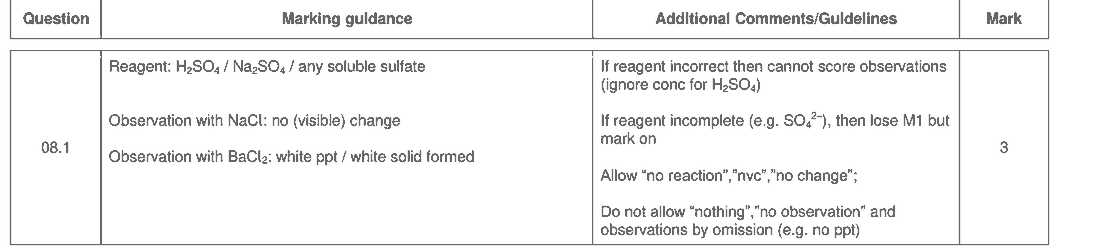
08.1 Group 2, the alkaline earth metals 3Practical and data analysis
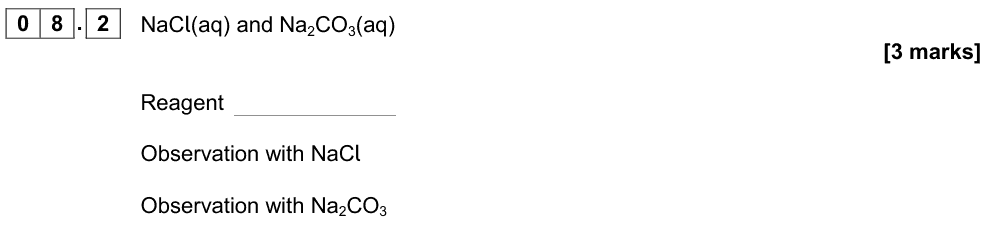
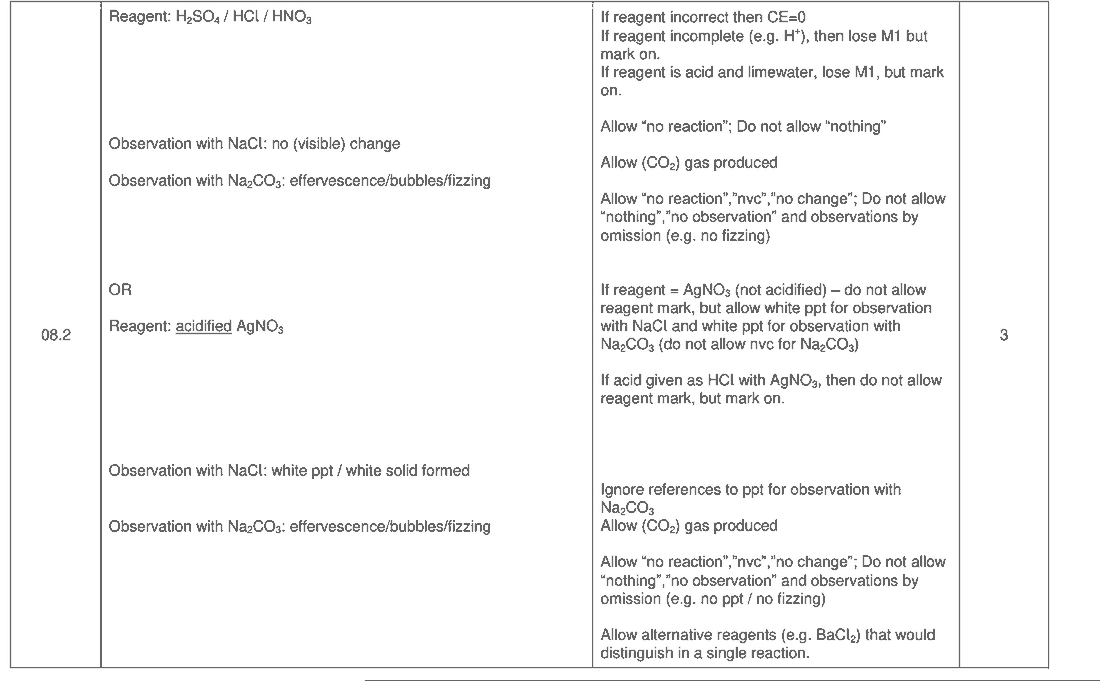
08.2 Group 7(17), the halogens 3Practical and data analysis
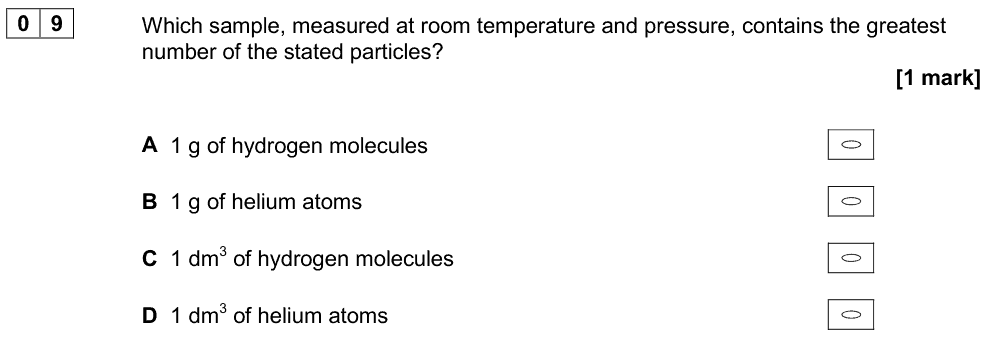
09 Amount of substance 1Multiple choice
10 Amount of substance 1Multiple choice
11 Bonding 1Multiple choice
12 Bonding 1Multiple choice
13 Bonding 1Multiple choice
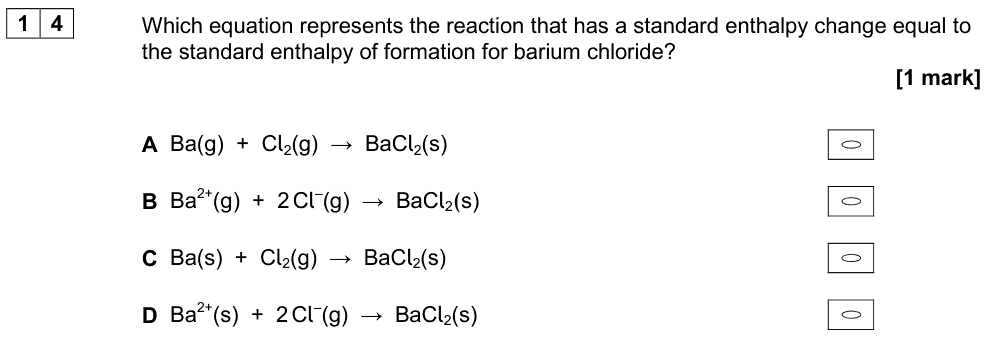
14 Energetics 1Multiple choice
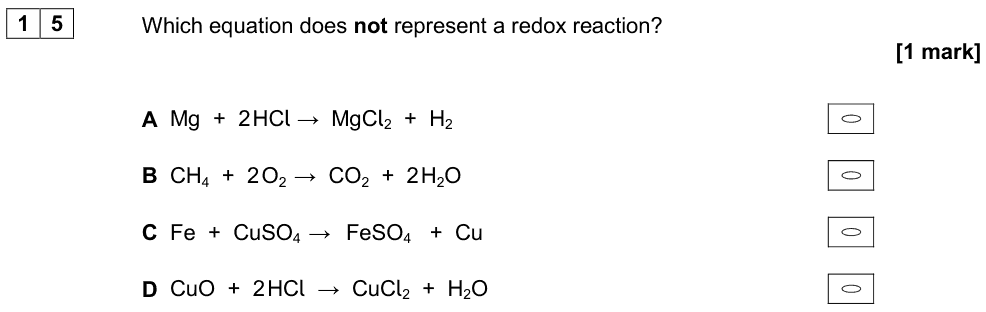
15 Oxidation, reduction and redox equations 1Multiple choice
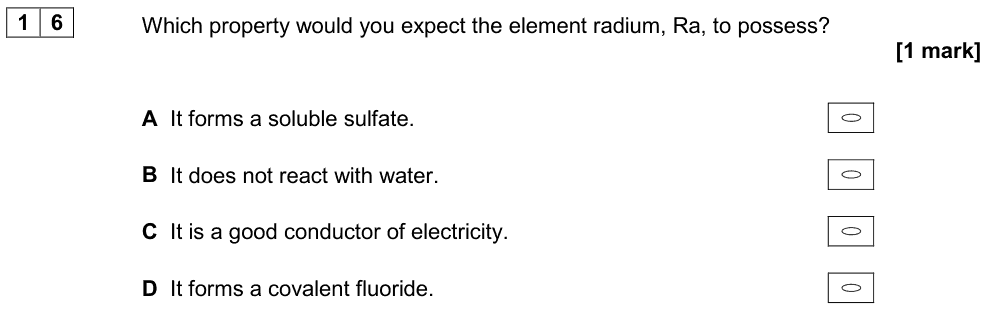
16 Bonding, Group 2, the alkaline earth metals 1Multiple choice
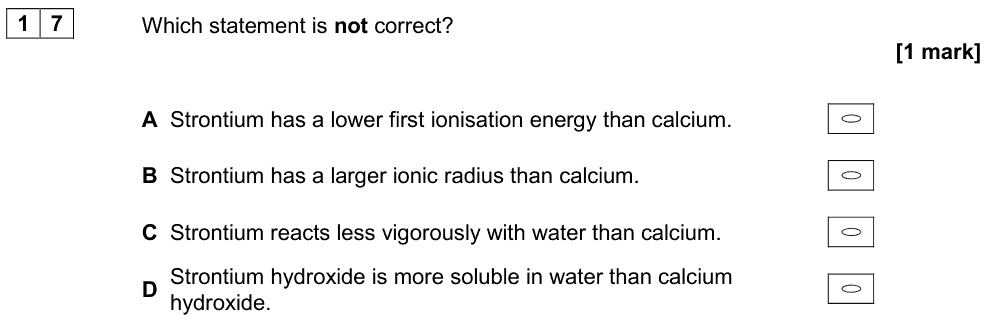
17 Group 2, the alkaline earth metals 1Multiple choice
18 Group 2, the alkaline earth metals 1Multiple choice
19 Group 7(17), the halogens 1Multiple choice
20 Energetics 1Multiple choice
21 Amount of substance 1Multiple choice
22 Group 7(17), the halogens 1Multiple choice
23 Amount of substance 1Multiple choice

The questions

01.101.201.301.401.502.102.202.302.403.103.203.303.403.503.603.70405.105.205.306.106.206.306.407.107.208.108.2091011121314151617181920212223
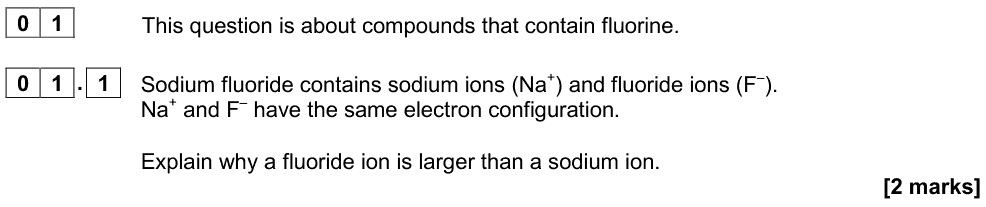
June 2019 · AS Paper 1 · Q01.1 2 marks Explanation atomic structureperiodicity
This question is about compounds that contain fluorine.
Sodium fluoride contains sodium ions (Na+) and fluoride ions (F–).
Na+ and F– have the same electron configuration.
Explain why a fluoride ion is larger than a sodium ion.
[2 marks]
June 2019 · AS Paper 1 · Q01.2 2 marks Explanation bonding
Earlier part of question 01 that this part usesEarlier part of June 2019 Paper 1 question 01
Explain, in terms of structure and bonding, why the melting point of sodium fluoride is
high.
[2 marks]
June 2019 · AS Paper 1 · Q01.3 2 marks Short answer bonding
Earlier part of question 01 that this part usesEarlier part of June 2019 Paper 1 question 01
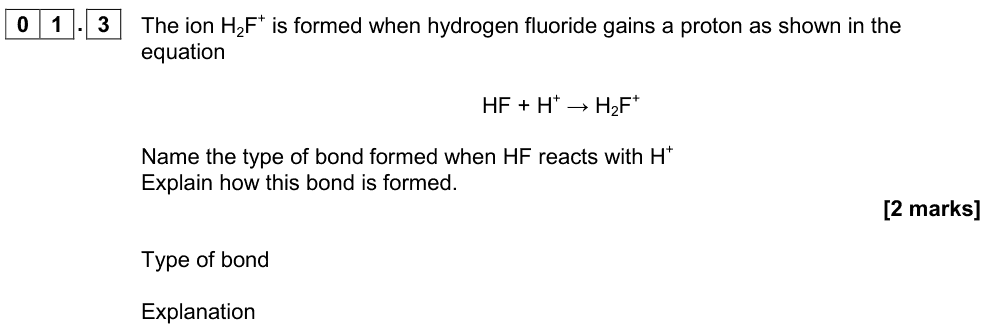
The ion H2F+ is formed when hydrogen fluoride gains a proton as shown in the
equation
HF + H+ → H2F+
Name the type of bond formed when HF reacts with H+
Explain how this bond is formed.
[2 marks]
Type of bond
Explanation
June 2019 · AS Paper 1 · Q01.4 4 marks Diagram or structure bonding
Earlier part of question 01 that this part usesEarlier part of June 2019 Paper 1 question 01
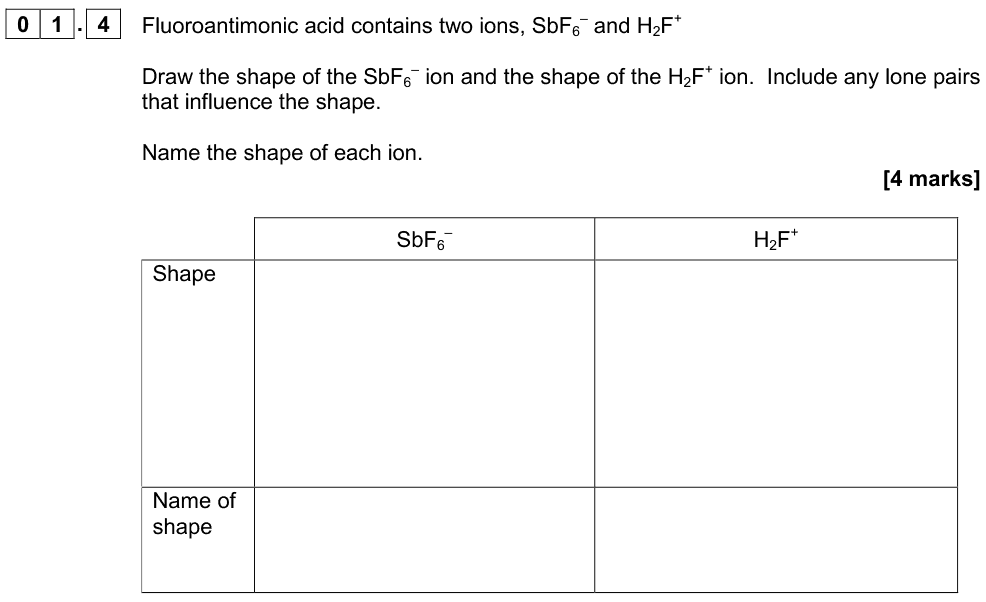
Fluoroantimonic acid contains two ions, SbF6
– and H2F+
Draw the shape of the SbF6
– ion and the shape of the H2F+ ion.  Include any lone pairs
that influence the shape.
Name the shape of each ion.
[4 marks]
SbF6
–
H2F+
Shape
Name of
shape
June 2019 · AS Paper 1 · Q01.5 3 marks Calculation energetics
Earlier part of question 01 that this part usesEarlier part of June 2019 Paper 1 question 01
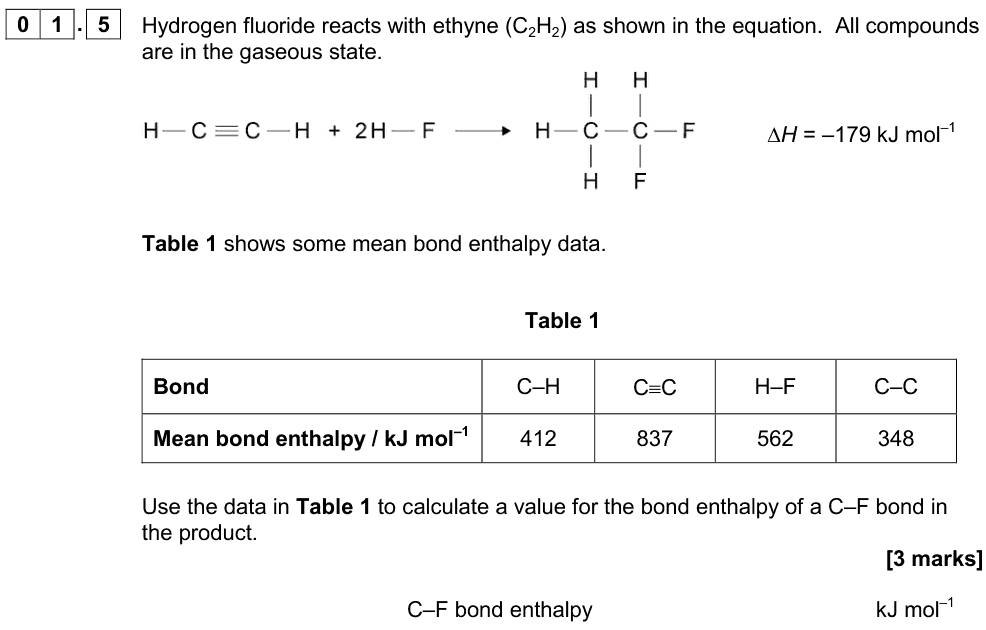
Hydrogen fluoride reacts with ethyne (C2H2) as shown in the equation.  All compounds
are in the gaseous state.
∆H = –179 kJ mol–1
Table 1 shows some mean bond enthalpy data.
Table 1
Bond
C–H
C≡C
H–F
C–C
Mean bond enthalpy / kJ mol–1
412
837
562
348
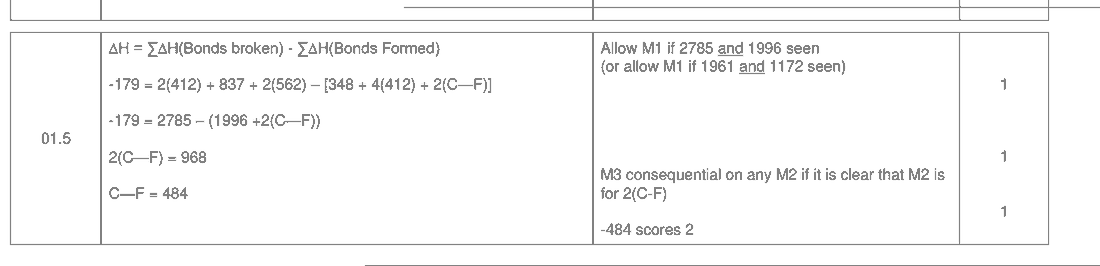
Use the data in Table 1 to calculate a value for the bond enthalpy of a C–F bond in
the product.
[3 marks]
C–F bond enthalpy
kJ mol–1
June 2019 · AS Paper 1 · Q02.1 3 marks Short answer atomic structure
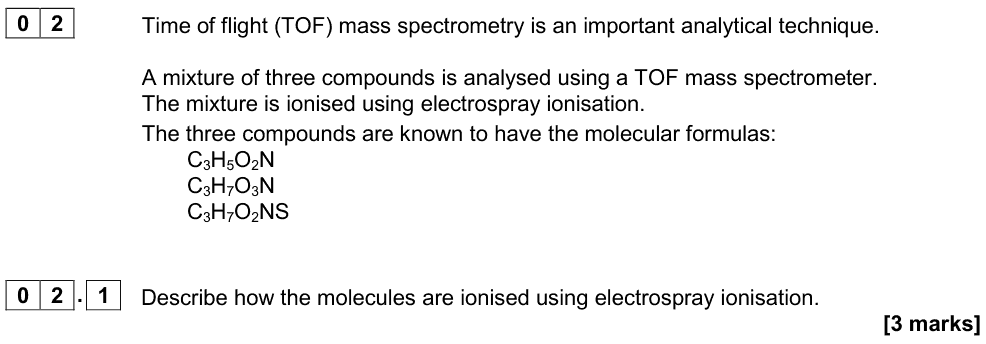
Time of flight (TOF) mass spectrometry is an important analytical technique.
A mixture of three compounds is analysed using a TOF mass spectrometer.
The mixture is ionised using electrospray ionisation.
The three compounds are known to have the molecular formulas:
C3H5O2N
C3H7O3N
C3H7O2NS
Describe how the molecules are ionised using electrospray ionisation.
[3 marks]
June 2019 · AS Paper 1 · Q02.2 1 mark Short answer atomic structure
Earlier part of question 02 that this part usesEarlier part of June 2019 Paper 1 question 02
Give the formula of the ion that reaches the detector first in the TOF mass
spectrometer.
[1 mark]
June 2019 · AS Paper 1 · Q02.3 1 mark Equation writing atomic structure
Earlier part of question 02 that this part usesEarlier part of June 2019 Paper 1 question 02
A sample of germanium is analysed in a TOF mass spectrometer using
electron impact ionisation.
Give an equation, including state symbols, for the process that occurs during the
ionisation of a germanium atom.
[1 mark]
June 2019 · AS Paper 1 · Q02.4 5 marks Calculation atomic structureamount of substance
Earlier part of question 02 that this part usesEarlier part of June 2019 Paper 1 question 02
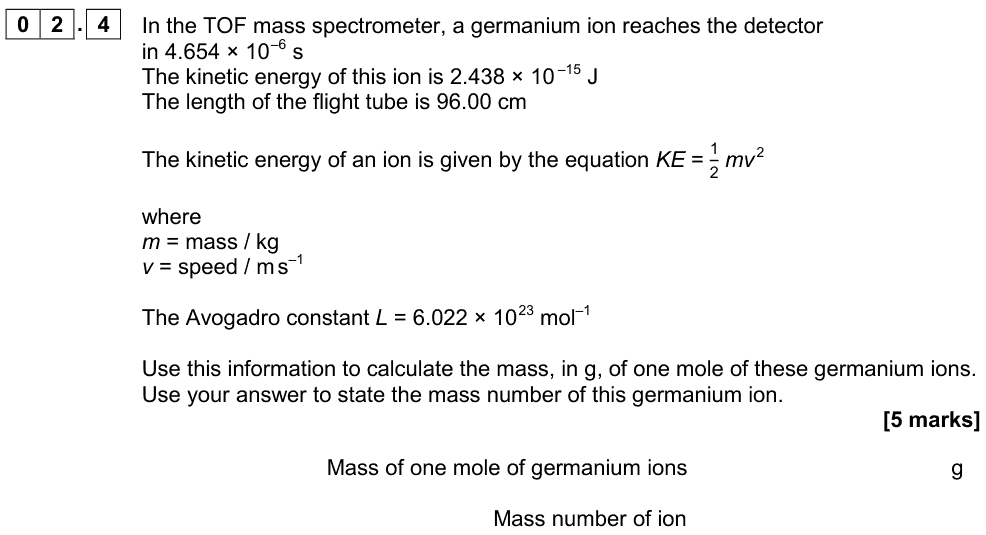
In the TOF mass spectrometer, a germanium ion reaches the detector
in 4.654 × 10 –6 s
The kinetic energy of this ion is 2.438 × 10 –15 J
The length of the flight tube is 96.00 cm
The kinetic energy of an ion is given by the equation KE =
1
2 mv  2
where
m = mass / kg
v = speed / m s–1
The Avogadro constant L = 6.022 × 10 23 mol–1
Use this information to calculate the mass, in g, of one mole of these germanium ions.
Use your answer to state the mass number of this germanium ion.
[5 marks]
Mass of one mole of germanium ions
g
Mass number of ion
June 2019 · AS Paper 1 · Q03.1 1 mark Short answer atomic structure
This question is about chromium and its compounds.
Complete the full electron configuration of a chromium atom.
[1 mark]
1s2
June 2019 · AS Paper 1 · Q03.2 1 mark Short answer atomic structure
Earlier part of question 03 that this part usesEarlier part of June 2019 Paper 1 question 03
An atom has 2 more protons and 3 more neutrons than an atom of 52Cr.
Deduce the symbol, including the mass number and the atomic number, for this atom.
[1 mark]
June 2019 · AS Paper 1 · Q03.3 3 marks Calculation atomic structure
Earlier part of question 03 that this part usesEarlier part of June 2019 Paper 1 question 03
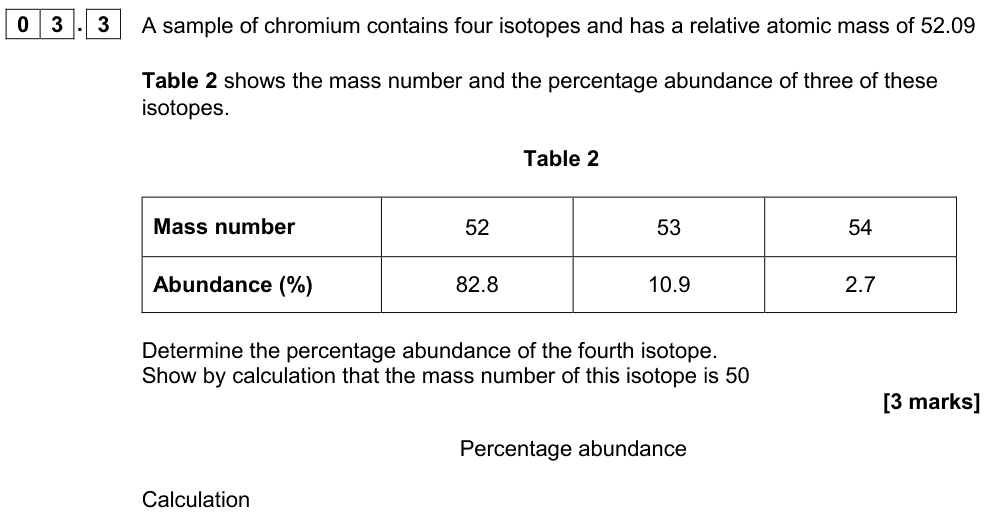
A sample of chromium contains four isotopes and has a relative atomic mass of 52.09
Table 2 shows the mass number and the percentage abundance of three of these
isotopes.
Table 2
Mass number
52
53
54
Abundance (%)
82.8
10.9
2.7
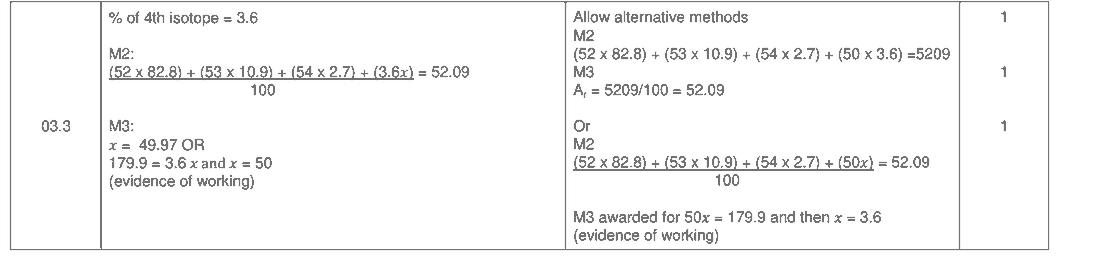
Determine the percentage abundance of the fourth isotope.
Show by calculation that the mass number of this isotope is 50
[3 marks]
Percentage abundance
Calculation
June 2019 · AS Paper 1 · Q03.4 1 mark Short answer redox
Earlier part of question 03 that this part usesEarlier part of June 2019 Paper 1 question 03
Deduce the oxidation state of chromium in the Cr2O7
2– ion.
[1 mark]
June 2019 · AS Paper 1 · Q03.5 1 mark Equation writing redox
Earlier part of question 03 that this part usesEarlier part of June 2019 Paper 1 question 03
Iodide ions can be oxidised to iodine using Cr2O7
2– ions.
Deduce a half-equation to show the oxidation of iodide ions to iodine.
State symbols are not required.
[1 mark]
June 2019 · AS Paper 1 · Q03.6 1 mark Equation writing redox
Earlier part of question 03 that this part usesEarlier part of June 2019 Paper 1 question 03
Deduce a half-equation for the conversion in acidic solution of Cr2O7
2– ions to
Cr3+ ions.
State symbols are not required.
[1 mark]
June 2019 · AS Paper 1 · Q03.7 1 mark Equation writing redox
Earlier part of question 03 that this part usesEarlier part of June 2019 Paper 1 question 03
Use your answers from questions 03.5 and 03.6 to deduce the overall redox equation
for the reaction between iodide ions and acidified Cr2O7
2– ions.
State symbols are not required.
[1 mark]
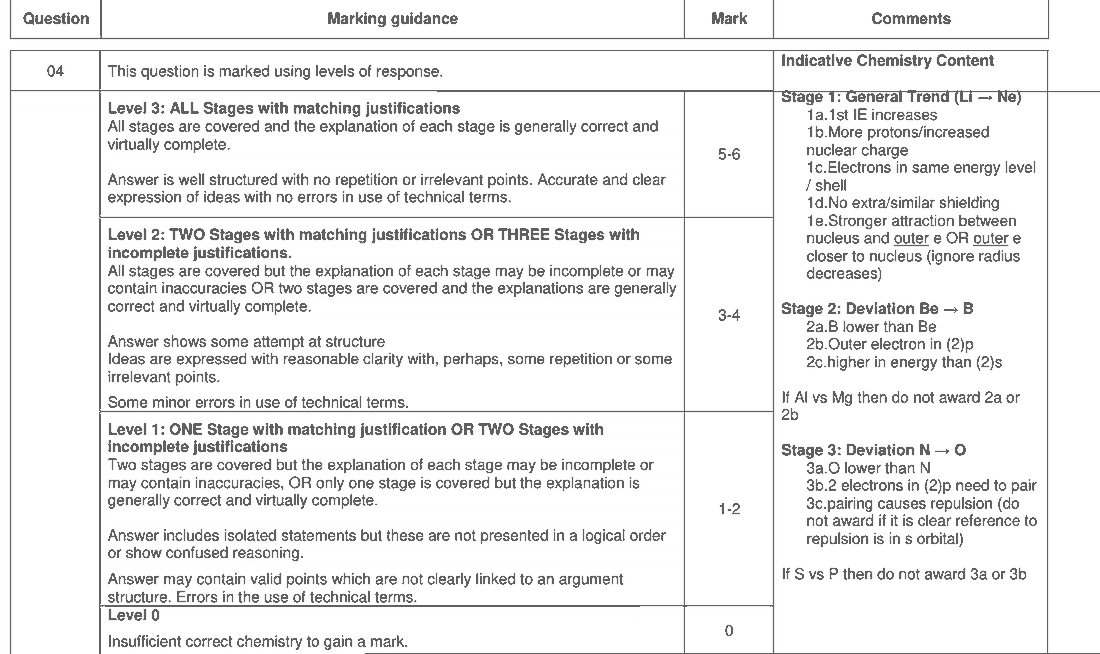
June 2019 · AS Paper 1 · Q04 6 marks 6-mark level of response atomic structureperiodicity
The first ionisation energies of the elements in Period 2 change as the atomic number
increases.
Explain the pattern in the first ionisation energies of the elements from lithium to neon.
[6 marks]
June 2019 · AS Paper 1 · Q05.1 2 marks Calculation chemical equilibria and kc
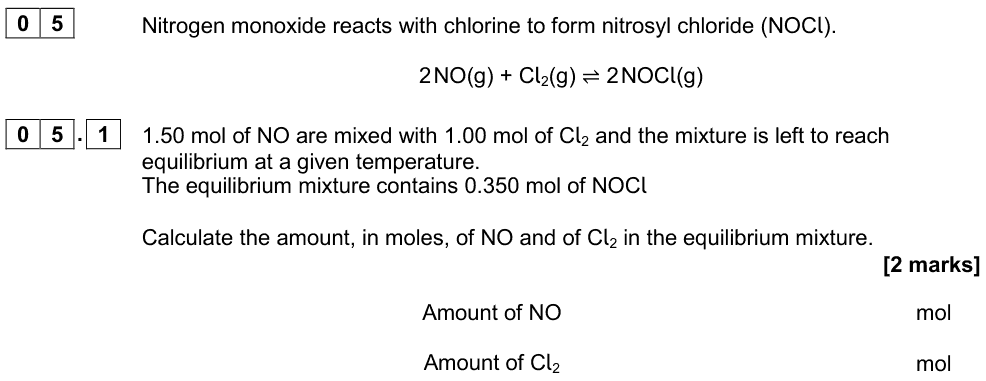
Nitrogen monoxide reacts with chlorine to form nitrosyl chloride (NOCl).
2 NO(g) + Cl2(g) ⇌ 2 NOCl(g)
1.50 mol of NO are mixed with 1.00 mol of Cl2 and the mixture is left to reach
equilibrium at a given temperature.
The equilibrium mixture contains 0.350 mol of NOCl
Calculate the amount, in moles, of NO and of Cl2 in the equilibrium mixture.
[2 marks]
Amount of NO
mol
Amount of Cl2
mol
June 2019 · AS Paper 1 · Q05.2 1 mark Short answer Easy chemical equilibria and kc
Earlier part of question 05 that this part usesEarlier part of June 2019 Paper 1 question 05
Give the expression for the equilibrium constant, Kc, for the reaction between
nitrogen monoxide and chlorine to form nitrosyl chloride.
[1 mark]
Kc =
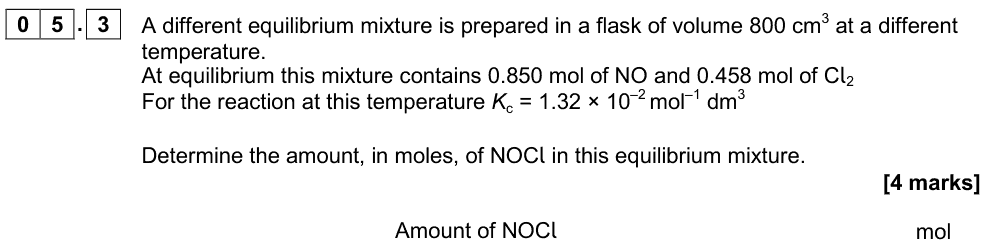
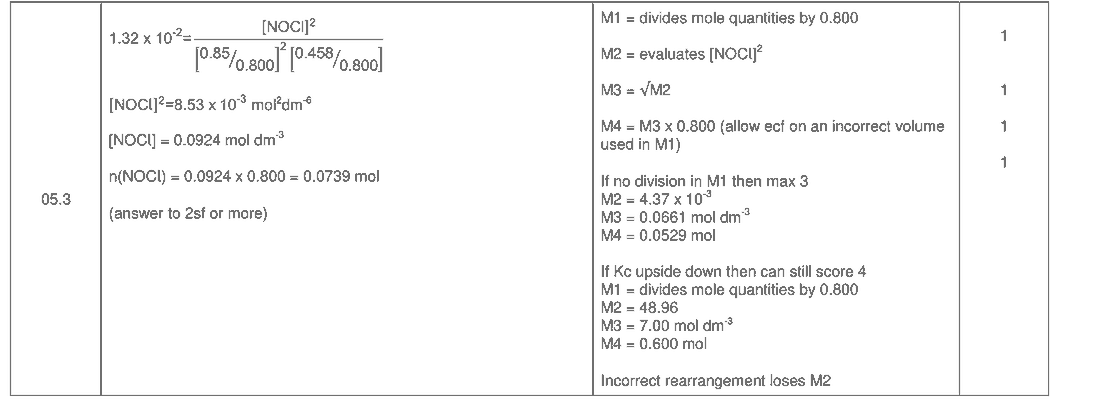
June 2019 · AS Paper 1 · Q05.3 4 marks Calculation chemical equilibria and kc
Earlier part of question 05 that this part usesEarlier part of June 2019 Paper 1 question 05
A different equilibrium mixture is prepared in a flask of volume 800 cm3 at a different
temperature.
At equilibrium this mixture contains 0.850 mol of NO and 0.458 mol of Cl2
For the reaction at this temperature Kc = 1.32 × 10⁻² mol–1 dm3
Determine the amount, in moles, of NOCl in this equilibrium mixture.
[4 marks]
Amount of NOCl
mol
June 2019 · AS Paper 1 · Q06.1 5 marks Calculation amount of substance
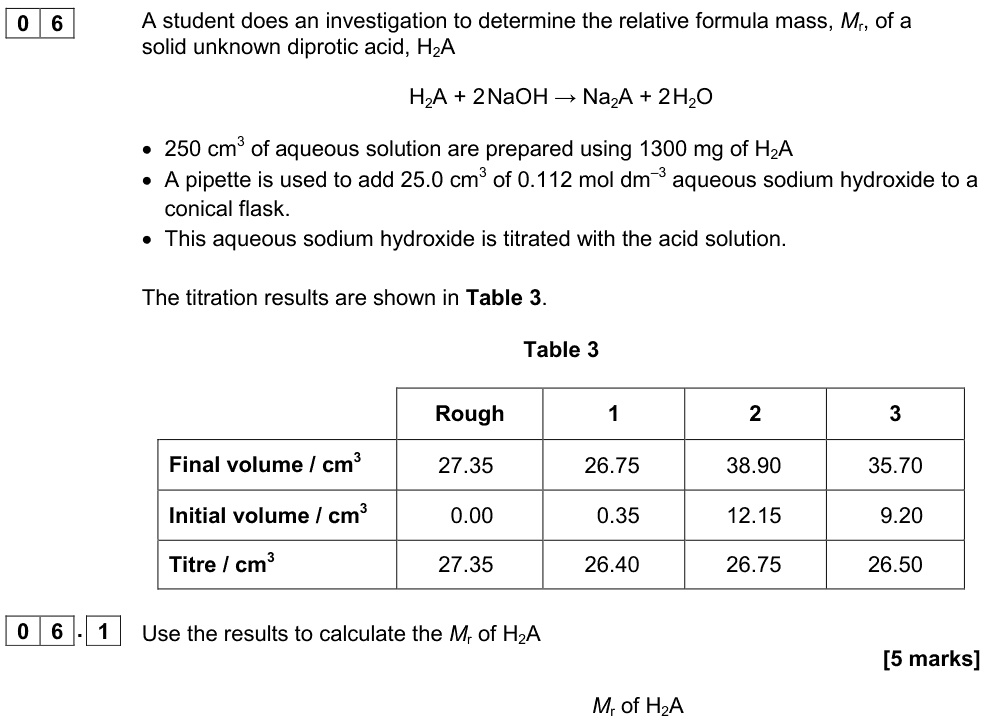
A student does an investigation to determine the relative formula mass, Mr, of a
solid unknown diprotic acid, H2A
H2A + 2 NaOH → Na2A + 2 H2O
• 250 cm3 of aqueous solution are prepared using 1300 mg of H2A
• A pipette is used to add 25.0 cm3 of 0.112 mol dm–3 aqueous sodium hydroxide to a
conical flask.
• This aqueous sodium hydroxide is titrated with the acid solution.
The titration results are shown in Table 3.
Table 3
Rough
1
2
3
Final volume / cm3
27.35
26.75
38.90
35.70
Initial volume / cm3
0.00
0.35
12.15
9.20
Titre / cm3
27.35
26.40
26.75
26.50
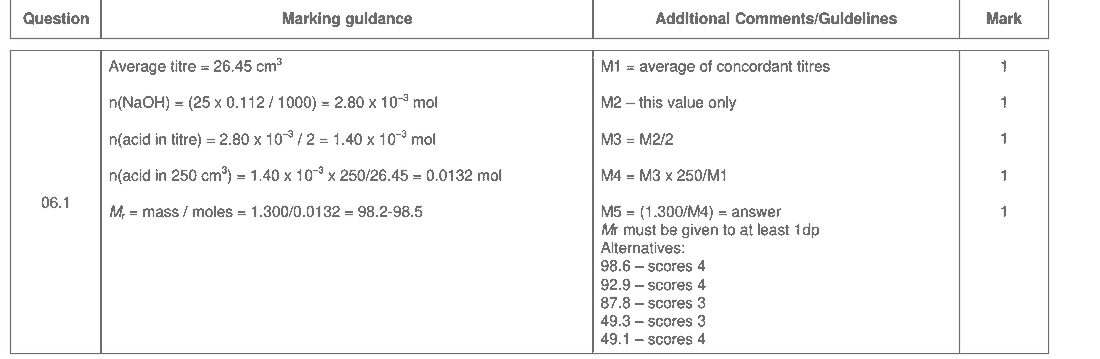
Use the results to calculate the Mr of H2A
[5 marks]
Mr of H2A
June 2019 · AS Paper 1 · Q06.2 1 mark Practical and data analysis amount of substance
Earlier part of question 06 that this part usesEarlier part of June 2019 Paper 1 question 06
The uncertainty in using the pipette in this experiment is ±0.06 cm3
Calculate the percentage uncertainty in using the pipette.
[1 mark]
% uncertainty
June 2019 · AS Paper 1 · Q06.3 1 mark Practical and data analysis amount of substance
Earlier part of question 06 that this part usesEarlier part of June 2019 Paper 1 question 06
Before adding the solution from the burette in the rough titration, there was an
air bubble below the tap.
At the end of this titration the air bubble was not there.
Explain why this air bubble increases the final burette reading of the rough titration.
[1 mark]
June 2019 · AS Paper 1 · Q06.4 1 mark Practical and data analysis amount of substance
Earlier part of question 06 that this part usesEarlier part of June 2019 Paper 1 question 06
During the titration the student washed the inside of the conical flask with some
distilled water.
Suggest why this washing does not give an incorrect result.
[1 mark]
June 2019 · AS Paper 1 · Q07.1 2 marks Equation writing group 2redox
This question is about the reactions of magnesium and its compounds.
Magnesium is used in one of the stages in the extraction of titanium.
Give an equation for the reaction between titanium(IV) chloride and magnesium.

State the role of magnesium in this reaction.
[2 marks]
Equation
Role of magnesium
June 2019 · AS Paper 1 · Q07.2 4 marks Calculation amount of substance
Earlier part of question 07 that this part usesEarlier part of June 2019 Paper 1 question 07
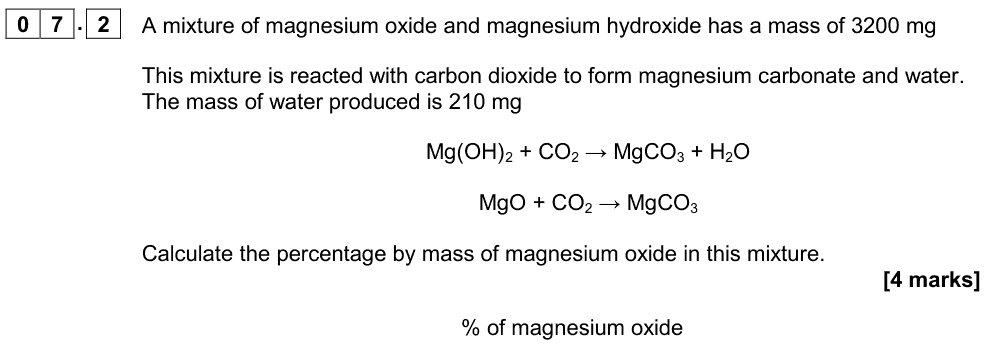
A mixture of magnesium oxide and magnesium hydroxide has a mass of 3200 mg
This mixture is reacted with carbon dioxide to form magnesium carbonate and water.
The mass of water produced is 210 mg
Mg(OH) 2 + CO2 → MgCO3 + H2O
MgO + CO2 → MgCO3
Calculate the percentage by mass of magnesium oxide in this mixture.
[4 marks]
% of magnesium oxide
June 2019 · AS Paper 1 · Q08.1 3 marks Practical and data analysis group 2
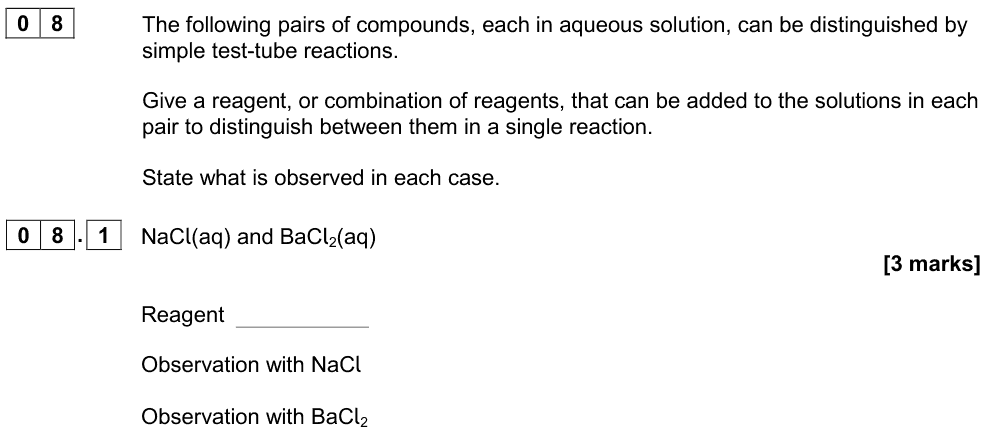
The following pairs of compounds, each in aqueous solution, can be distinguished by
simple test-tube reactions.
Give a reagent, or combination of reagents, that can be added to the solutions in each
pair to distinguish between them in a single reaction.
State what is observed in each case.
NaCl(aq) and BaCl2(aq)
[3 marks]
Reagent
Observation with NaCl
Observation with BaCl2
June 2019 · AS Paper 1 · Q08.2 3 marks Practical and data analysis group 7 the halogens
Earlier part of question 08 that this part usesEarlier part of June 2019 Paper 1 question 08
NaCl(aq) and Na2CO3(aq)
[3 marks]
Reagent
Observation with NaCl
Observation with Na2CO3
June 2019 · AS Paper 1 · Q09 1 mark Multiple choice amount of substance
Which sample, measured at room temperature and pressure, contains the greatest
number of the stated particles?
[1 mark]
A 1 g of hydrogen molecules
B 1 g of helium atoms
C 1 dm3 of hydrogen molecules
D 1 dm3 of helium atoms
June 2019 · AS Paper 1 · Q10 1 mark Multiple choice amount of substance
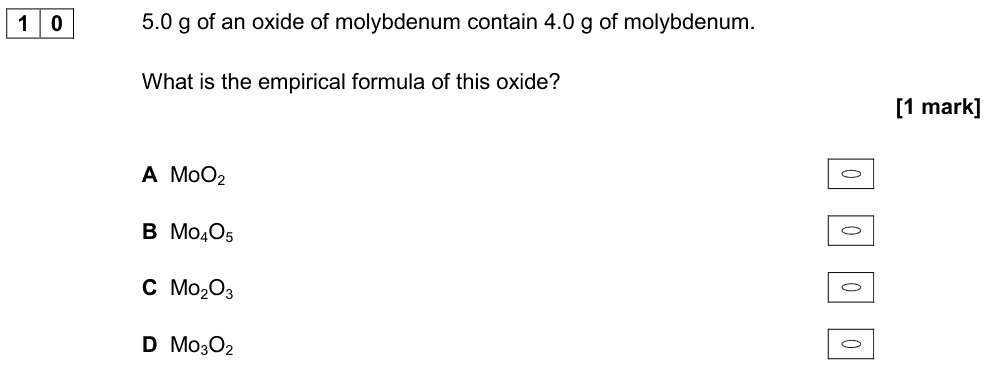
5.0 g of an oxide of molybdenum contain 4.0 g of molybdenum.
What is the empirical formula of this oxide?
[1 mark]
A MoO2
B Mo4O5
C Mo2O3
D Mo3O2
June 2019 · AS Paper 1 · Q11 1 mark Multiple choice bonding
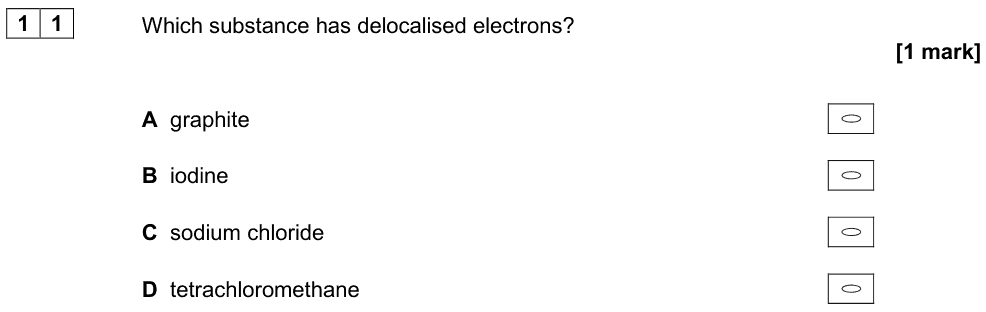
Which substance has delocalised electrons?
[1 mark]
A graphite
B iodine
C sodium chloride
D tetrachloromethane
June 2019 · AS Paper 1 · Q12 1 mark Multiple choice bonding
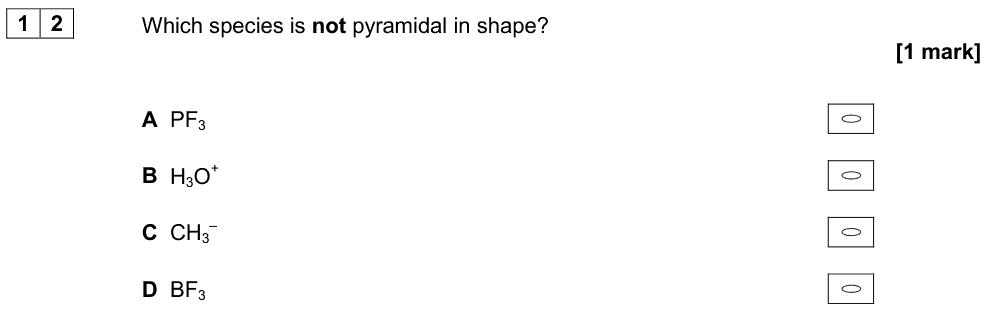
Which species is not pyramidal in shape?
[1 mark]
A PF3
B H3O+
C CH3
–
D BF3
June 2019 · AS Paper 1 · Q13 1 mark Multiple choice Easy bonding
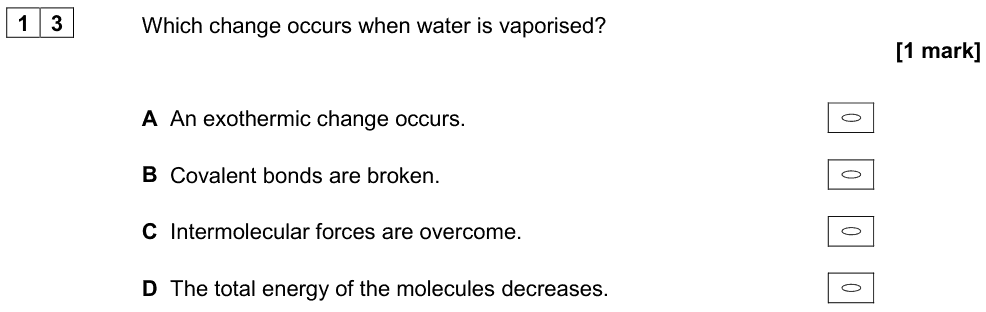
Which change occurs when water is vaporised?
[1 mark]
A An exothermic change occurs.
B Covalent bonds are broken.
C Intermolecular forces are overcome.
D The total energy of the molecules decreases.
June 2019 · AS Paper 1 · Q14 1 mark Multiple choice energetics
Which equation represents the reaction that has a standard enthalpy change equal to

the standard enthalpy of formation for barium chloride?

[1 mark]
A Ba(g)  +  Cl2(g)  →  BaCl2(s)
B Ba2+(g)  +  2 Cl–(g)  →  BaCl2(s)
C Ba(s)  +  Cl2(g)  →  BaCl2(s)
D Ba2+(s)  +  2 Cl–(g)  →  BaCl2(s)
June 2019 · AS Paper 1 · Q15 1 mark Multiple choice redox
Which equation does not represent a redox reaction?
[1 mark]
A Mg  +  2 HCl →  MgCl2  +  H2
B CH4  +  2 O2  →  CO2  +  2 H2O
C Fe  +  CuSO4  →    FeSO4   +  Cu
D CuO  +  2 HCl  →  CuCl2  +  H2O
June 2019 · AS Paper 1 · Q16 1 mark Multiple choice bondinggroup 2
Which property would you expect the element radium, Ra, to possess?
[1 mark]
A It forms a soluble sulfate.
B It does not react with water.
C It is a good conductor of electricity.
D It forms a covalent fluoride.
June 2019 · AS Paper 1 · Q17 1 mark Multiple choice group 2
Which statement is not correct?
[1 mark]
A Strontium has a lower first ionisation energy than calcium.
B Strontium has a larger ionic radius than calcium.
C Strontium reacts less vigorously with water than calcium.
D Strontium hydroxide is more soluble in water than calcium
hydroxide.
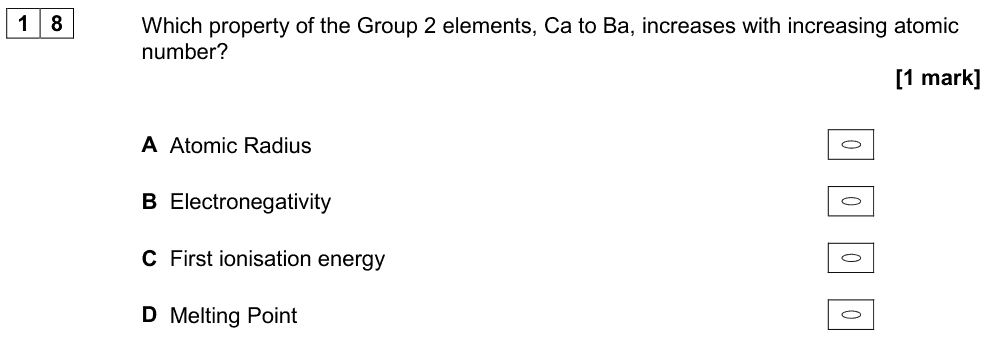
June 2019 · AS Paper 1 · Q18 1 mark Multiple choice Easy group 2
Which property of the Group 2 elements, Ca to Ba, increases with increasing atomic
number?
[1 mark]
A Atomic Radius
B Electronegativity
C First ionisation energy
D Melting Point
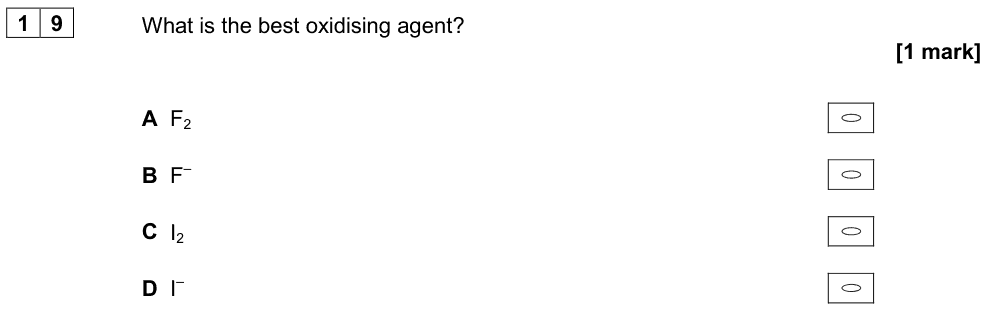
June 2019 · AS Paper 1 · Q19 1 mark Multiple choice group 7 the halogens
What is the best oxidising agent?
[1 mark]
A F2
B F–
C I2
D I–
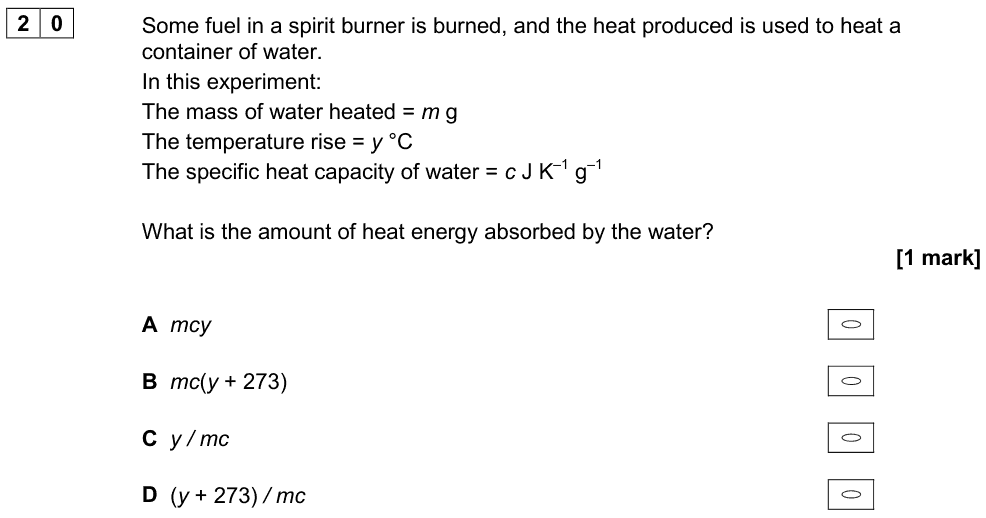
June 2019 · AS Paper 1 · Q20 1 mark Multiple choice energetics
Some fuel in a spirit burner is burned, and the heat produced is used to heat a
container of water.
In this experiment:
The mass of water heated = m g
The temperature rise = y °C
The specific heat capacity of water = c J K–1 g–1
What is the amount of heat energy absorbed by the water?
[1 mark]
A mcy
B mc(y + 273)
C y / mc
D (y + 273) / mc
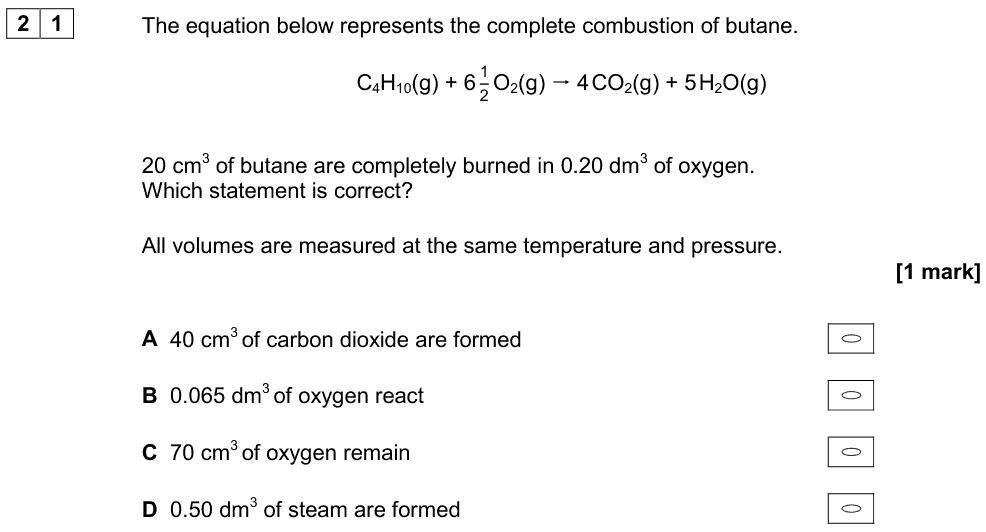
June 2019 · AS Paper 1 · Q21 1 mark Multiple choice Hard amount of substance
The equation below represents the complete combustion of butane.
C4H10(g) + 6
1
2
O2(g)  4 CO2(g) + 5 H2O(g)
20 cm3 of butane are completely burned in 0.20 dm3 of oxygen.
Which statement is correct?
All volumes are measured at the same temperature and pressure.
[1 mark]
A 40 cm3 of carbon dioxide are formed
B 0.065 dm3 of oxygen react
C 70 cm3 of oxygen remain
D 0.50 dm3 of steam are formed
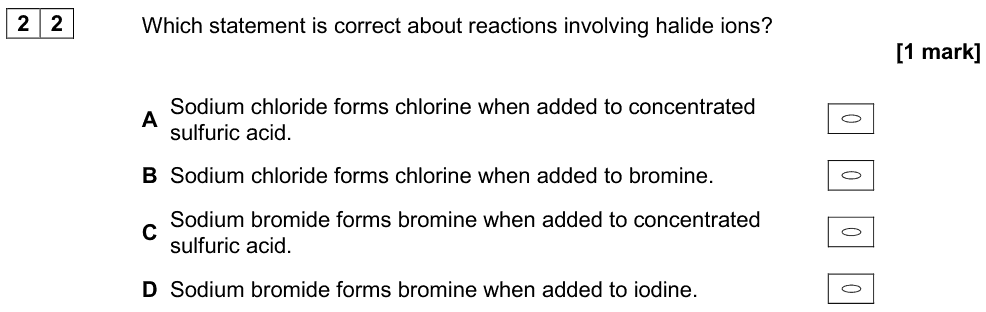
June 2019 · AS Paper 1 · Q22 1 mark Multiple choice group 7 the halogens
Which statement is correct about reactions involving halide ions?
[1 mark]
A Sodium chloride forms chlorine when added to concentrated
sulfuric acid.
B Sodium chloride forms chlorine when added to bromine.
C Sodium bromide forms bromine when added to concentrated
sulfuric acid.
D Sodium bromide forms bromine when added to iodine.
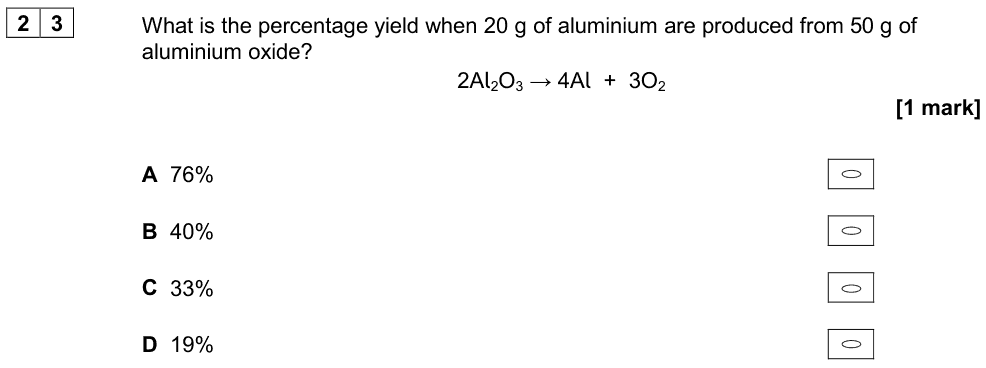
June 2019 · AS Paper 1 · Q23 1 mark Multiple choice amount of substance
What is the percentage yield when 20 g of aluminium are produced from 50 g of
aluminium oxide?
2Al2O3 → 4Al  +  3O2
[1 mark]
A 76%
B 40%
C 33%
D 19%

Work with an A-level chemistry tutor

Want a paper marked and gone through with you? Message us.

Prefer email? Send an enquiry

If you are under 18, please include a parent's contact details. Enquiries go to enquiries@chemistryaleveltutor.com and are deleted once handled. All tutoring is online.