June 2018: AS Paper 1, Inorganic and physical chemistry

80 marks · 41 question parts · Paper, mark scheme and report on AQA's site · Have the Data Booklet beside you

Question by question

QTopicMarksAOType
01.1 Atomic structure 2Short answer
01.2 Atomic structure 1Short answer
01.3 Bonding 1Short answer
02.1 Amount of substance 4Calculation
02.2 Amount of substance 1Calculation
02.3 Amount of substance 1Calculation
02.4 Atomic structure 3Explanation
03.1 Amount of substance 5Calculation
03.2 Amount of substance 1Practical and data analysis
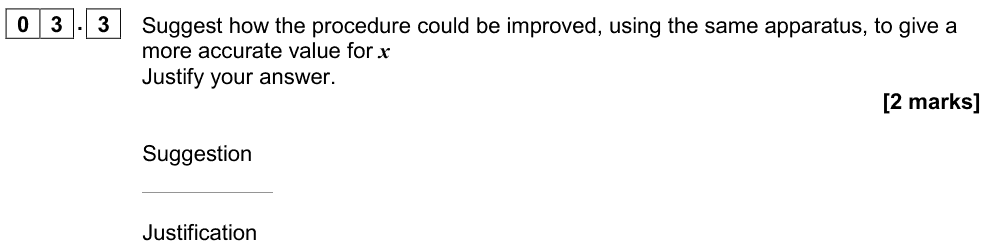
03.3 Amount of substance 2Practical and data analysis
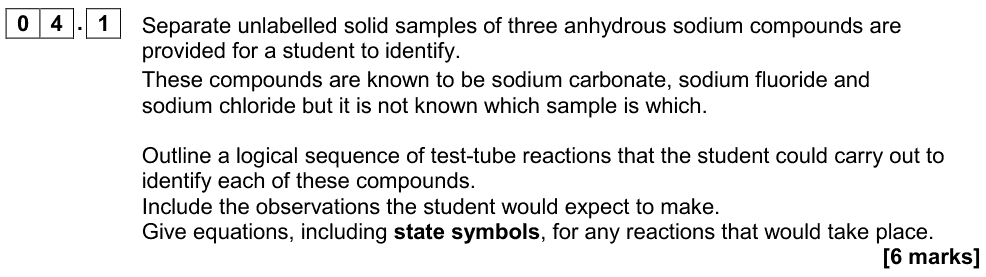
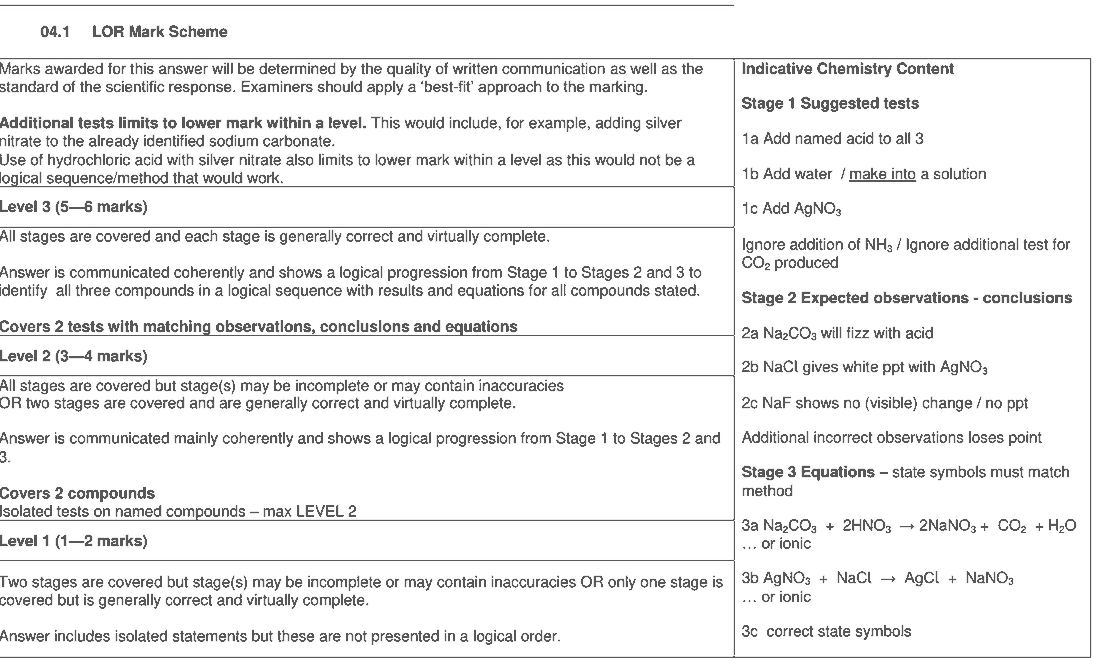
04.1 Group 7(17), the halogens, Amount of substance 6Level of response
05.1 Chemical equilibria, Le Chatelier's principle and Kc 2Short answer
05.2 Chemical equilibria, Le Chatelier's principle and Kc, Amount of substance 2Diagram or structure
05.3 Chemical equilibria, Le Chatelier's principle and Kc 2Explanation
06.1 Amount of substance 5Calculation
06.2 Amount of substance 2Practical and data analysis
07.1 Oxidation, reduction and redox equations 1Short answer
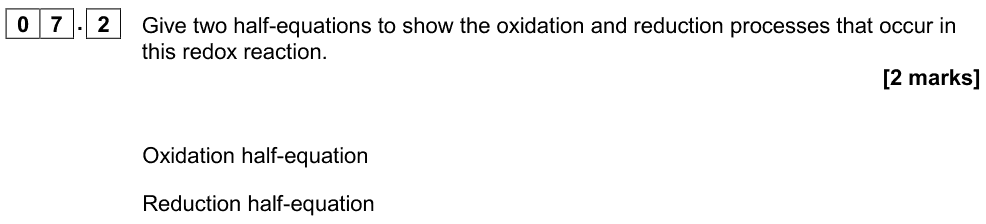
07.2 Oxidation, reduction and redox equations 2Equation writing
07.3 Group 7(17), the halogens 1Equation writing
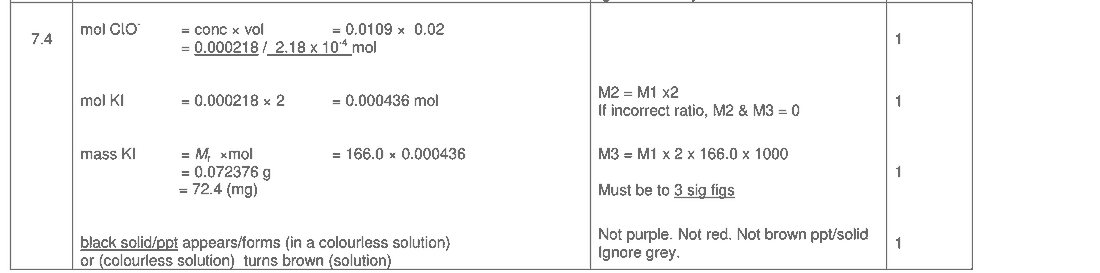
07.4 Amount of substance, Group 7(17), the halogens 4Calculation
07.5 Energetics, Amount of substance 2Calculation
08.1 Atomic structure, Amount of substance 5Calculation
08.2 Atomic structure 2Explanation
09.1 Bonding 3Diagram or structure
09.2 Bonding 2Explanation
09.3 Bonding 3Explanation
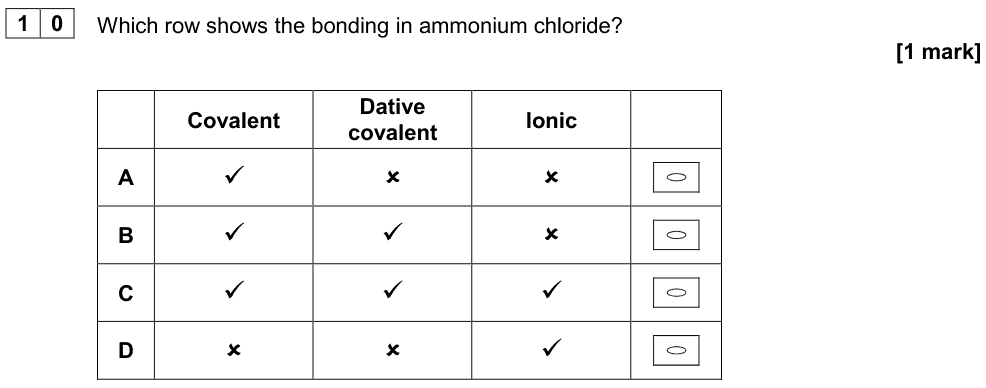
10 Bonding 1Multiple choice
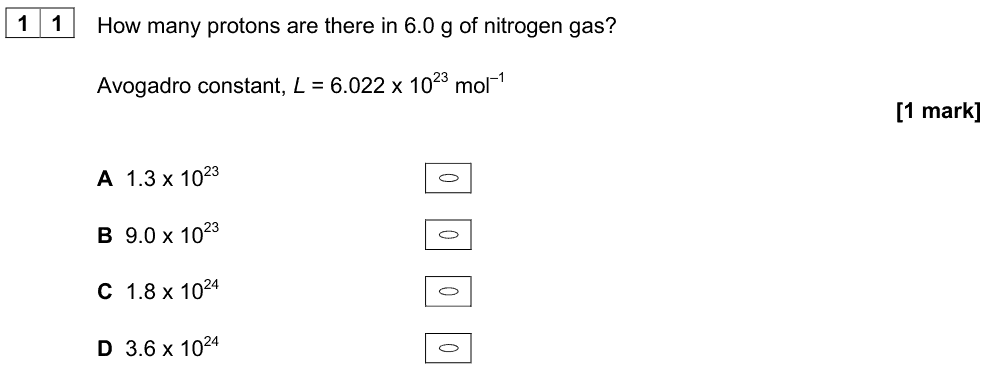
11 Amount of substance, Atomic structure 1Multiple choice
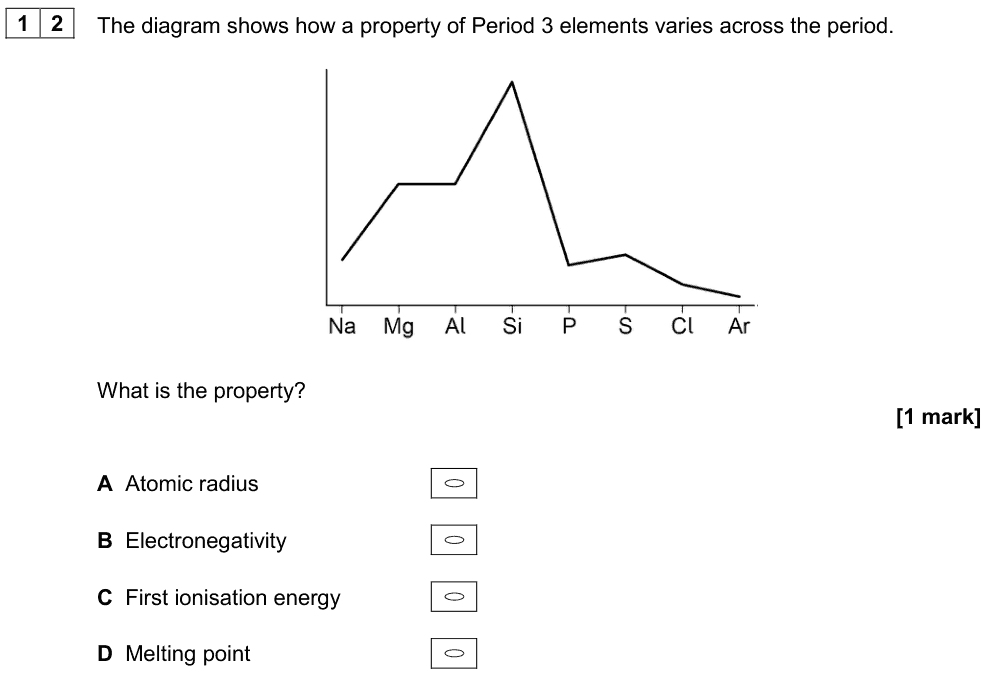
12 Periodicity 1Multiple choice
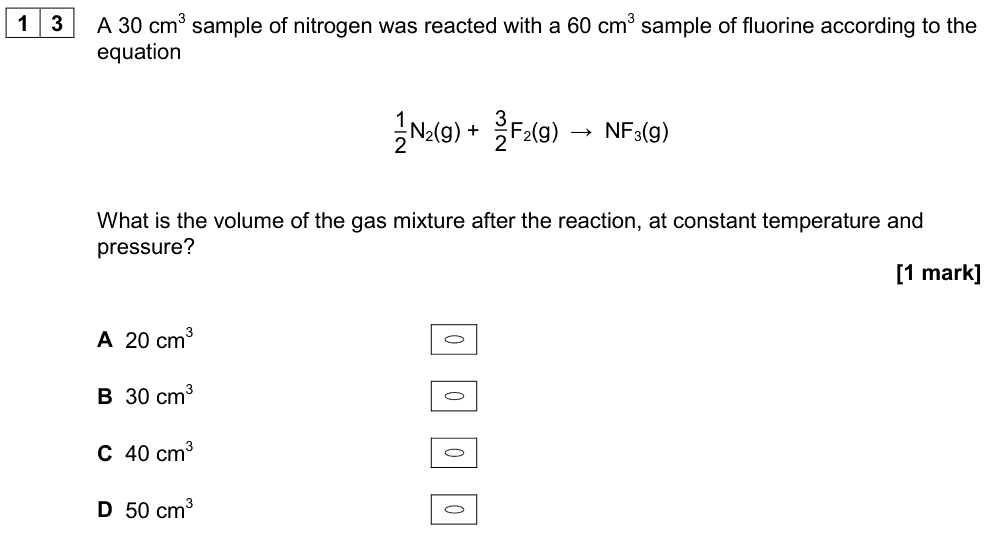
13 Amount of substance 1Multiple choice
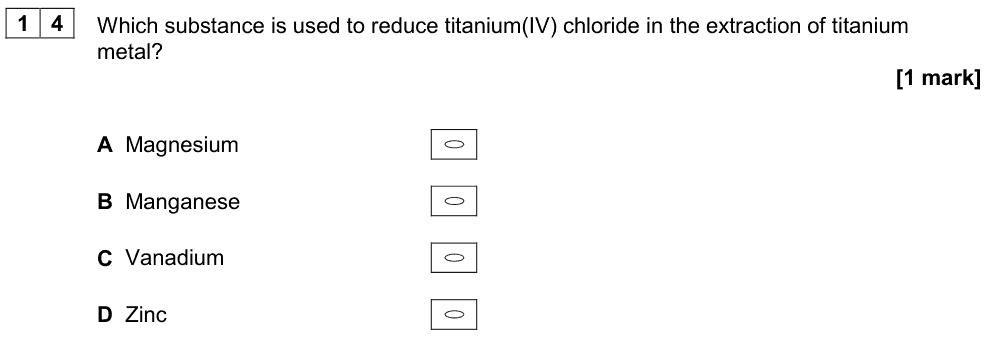
14 Group 2, the alkaline earth metals 1Multiple choice
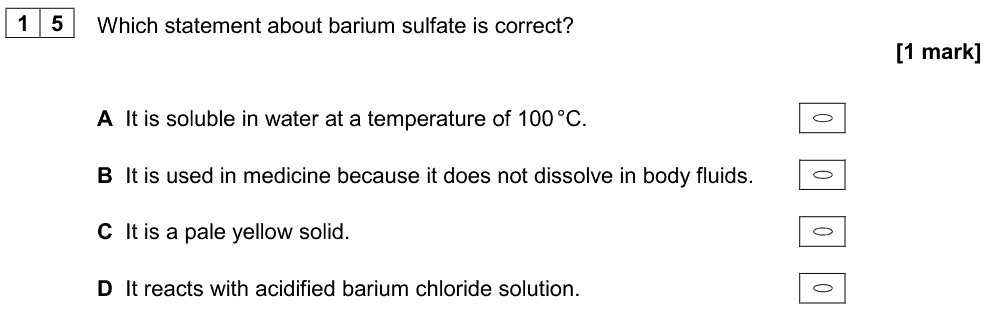
15 Group 2, the alkaline earth metals 1Multiple choice
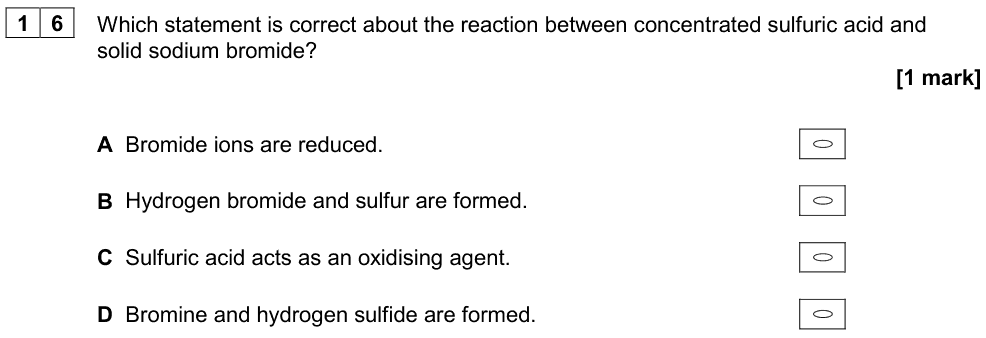
16 Group 7(17), the halogens 1Multiple choice
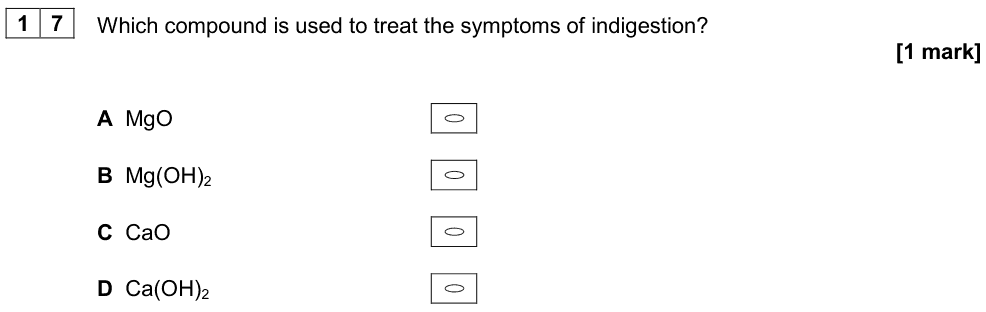
17 Group 2, the alkaline earth metals 1Multiple choice
18 Periodicity, Atomic structure 1Multiple choice
19 Amount of substance 1Multiple choice
20 Amount of substance 1Multiple choice
21 Amount of substance 1Multiple choice
22 Amount of substance 1Multiple choice
23 Amount of substance 1Multiple choice
24 Amount of substance 1Multiple choice

The questions

01.101.201.302.102.202.302.403.103.203.304.105.105.205.306.106.207.107.207.307.407.508.108.209.109.209.3101112131415161718192021222324
June 2018 · AS Paper 1 · Q01.1 2 marks Short answer atomic structure
This question is about atomic structure.
In the nineteenth century JJ Thomson discovered the electron.  He suggested that
negative electrons were found throughout an atom like ‘plums in a pudding of positive
charge’.
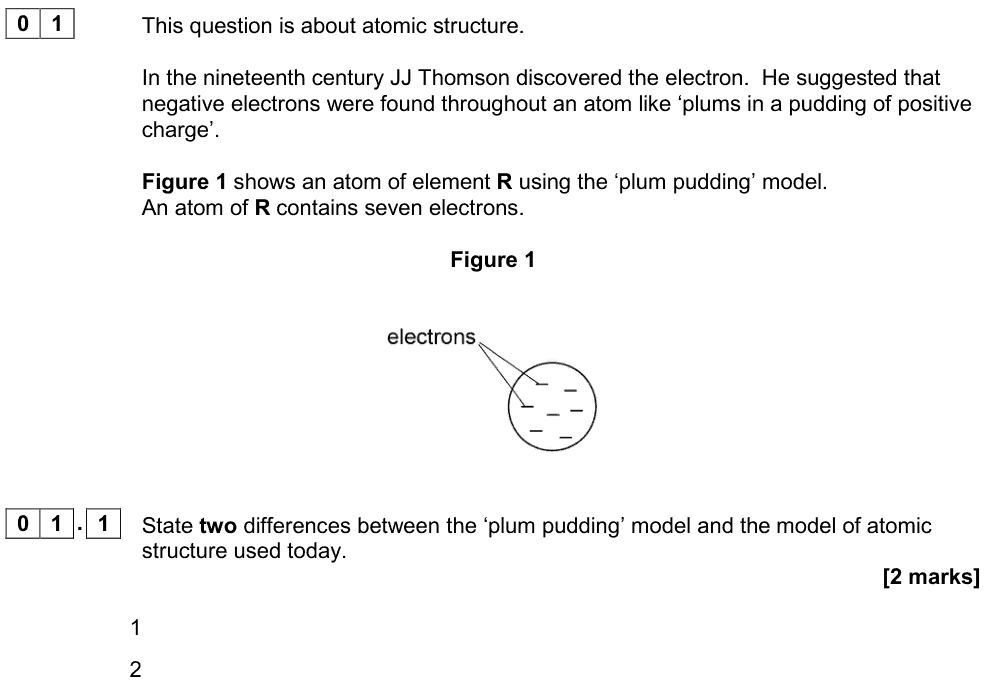
Figure 1 shows an atom of element R using the ‘plum pudding’ model.
An atom of R contains seven electrons.
Figure 1
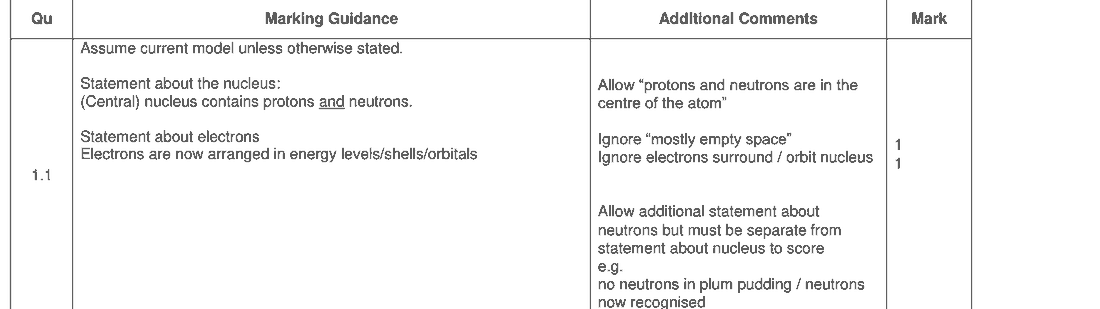
State two differences between the ‘plum pudding’ model and the model of atomic
structure used today.
[2 marks]
1
2
June 2018 · AS Paper 1 · Q01.2 1 mark Short answer Easy atomic structure
Earlier part of question 01 that this part usesEarlier part of June 2018 Paper 1 question 01
Deduce the full electron configuration of an atom of element R.
[1 mark]
June 2018 · AS Paper 1 · Q01.3 1 mark Short answer bonding
Earlier part of question 01 that this part usesEarlier part of June 2018 Paper 1 question 01
Identify R and deduce the formula of the compound formed when R reacts with the
Group 2 metal in the same period as R.
[1 mark]
June 2018 · AS Paper 1 · Q02.1 4 marks Calculation amount of substance
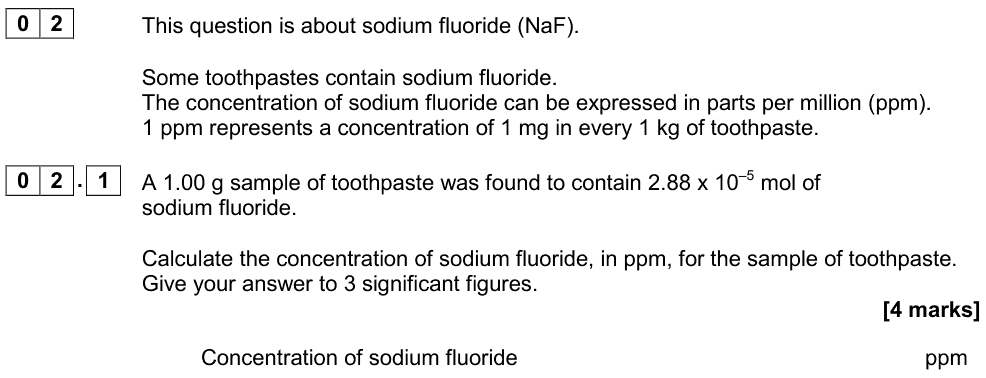
This question is about sodium fluoride (NaF).
Some toothpastes contain sodium fluoride.
The concentration of sodium fluoride can be expressed in parts per million (ppm).
1 ppm represents a concentration of 1 mg in every 1 kg of toothpaste.
A 1.00 g sample of toothpaste was found to contain 2.88 x 10⁻⁵ mol of
sodium fluoride.
Calculate the concentration of sodium fluoride, in ppm, for the sample of toothpaste.
Give your answer to 3 significant figures.
[4 marks]
Concentration of sodium fluoridee
pppm
June 2018 · AS Paper 1 · Q02.2 1 mark Calculation amount of substance
Earlier part of question 02 that this part usesEarlier part of June 2018 Paper 1 question 02
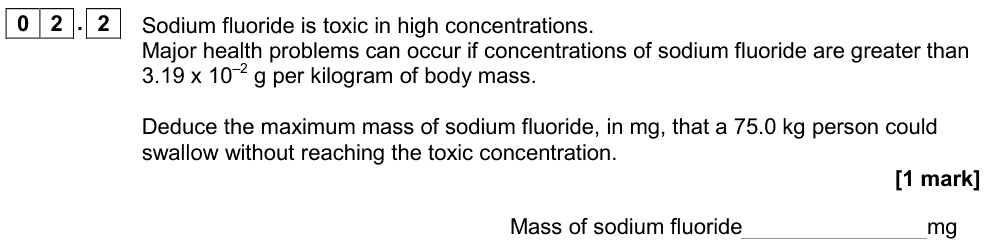
Sodium fluoride is toxic in high concentrations.
Major health problems can occur if concentrations of sodium fluoride are greater than
3.19 x 10⁻² g per kilogram of body mass.
Deduce the maximum mass of sodium fluoride, in mg, that a 75.0 kg person could
swallow without reaching the toxic concentration.
[1 mark]
Mass of sodium fluoride
mg
June 2018 · AS Paper 1 · Q02.3 1 mark Calculation amount of substance
Earlier part of question 02 that this part usesEarlier part of June 2018 Paper 1 question 02
The concentration of sodium fluoride in a prescription toothpaste is 2800 ppm.
Use your answer to Question 02.2 to deduce the mass of toothpaste, in kg, that a
75.0 kg person could swallow without reaching the toxic concentration.
[1 mark]
Mass of toothpaste
kg
June 2018 · AS Paper 1 · Q02.4 3 marks Explanation atomic structure
Earlier part of question 02 that this part usesEarlier part of June 2018 Paper 1 question 02
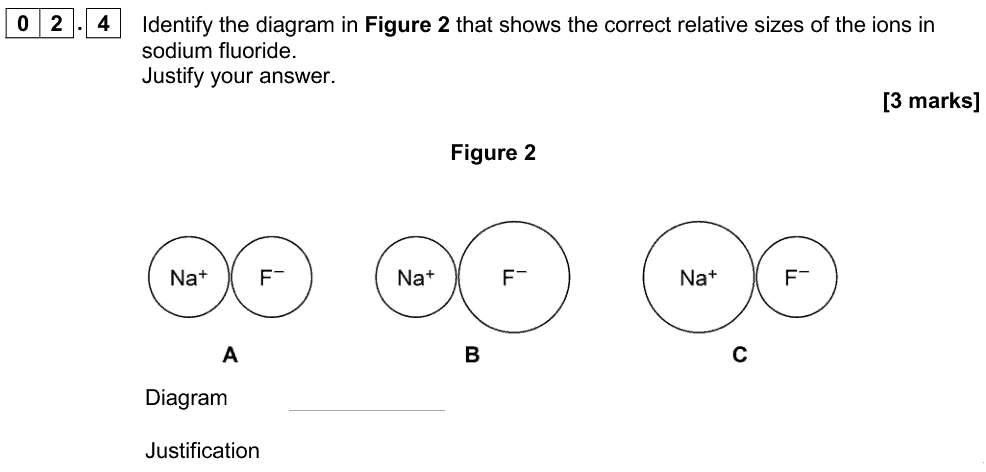
Identify the diagram in Figure 2 that shows the correct relative sizes of the ions in
sodium fluoride.
Justify your answer.
[3 marks]
Figure 2
Diagram
Justification
June 2018 · AS Paper 1 · Q03.1 5 marks Calculation amount of substance
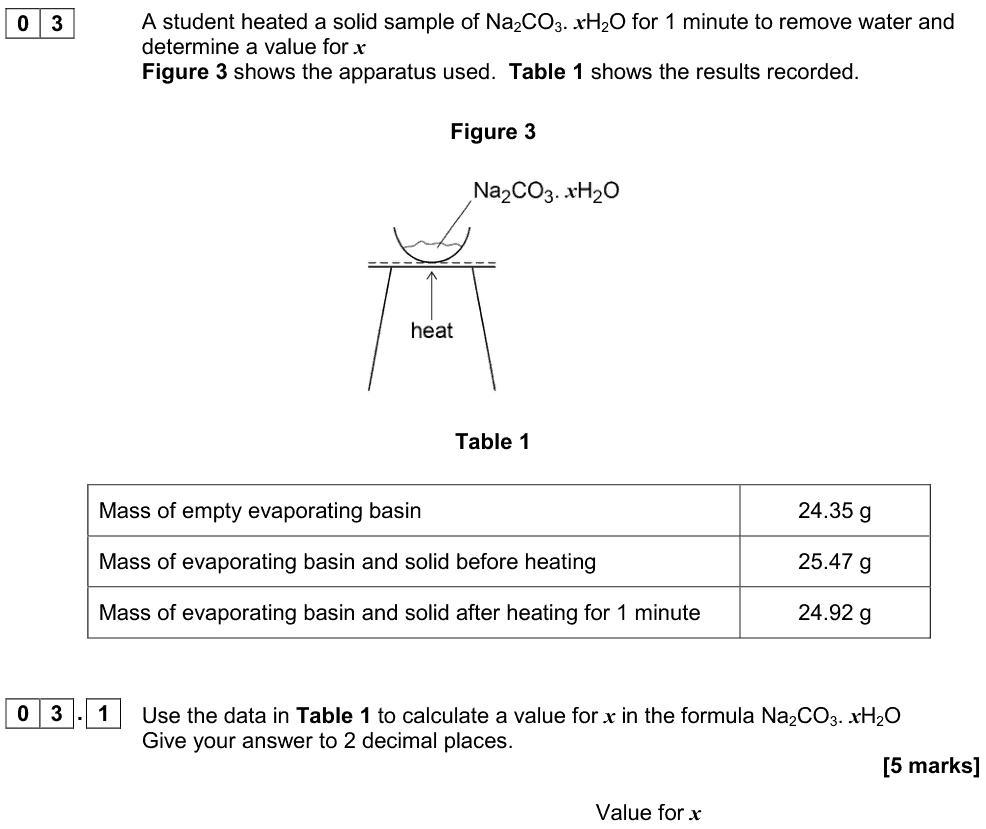
A student heated a solid sample of Na2CO3. xH2O for 1 minute to remove water and
determine a value for x
Figure 3 shows the apparatus used.  Table 1 shows the results recorded.
Figure 3
Table 1
Mass of empty evaporating basin
24.35 g
Mass of evaporating basin and solid before heating
25.47 g
Mass of evaporating basin and solid after heating for 1 minute
24.92 g
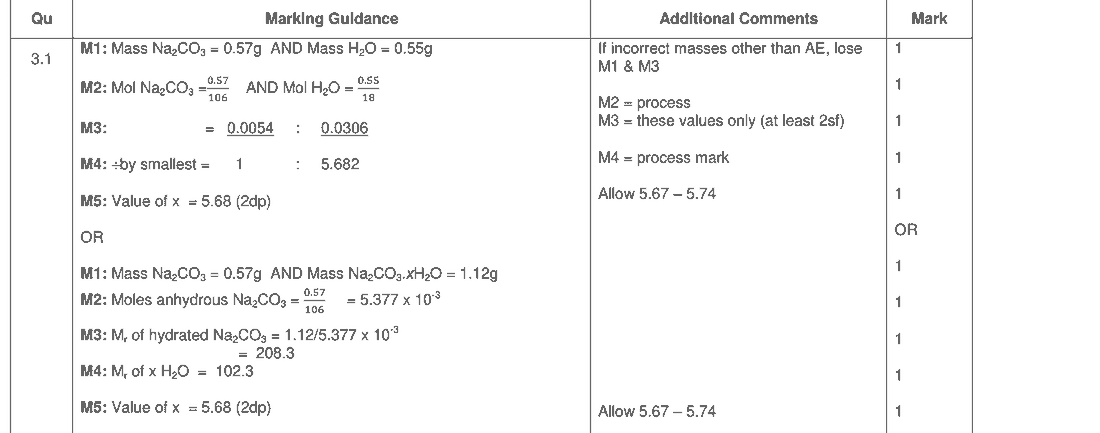
Use the data in Table 1 to calculate a value for x in the formula Na2CO3. xH2O
Give your answer to 2 decimal places.
[5 marks]
Value for x
June 2018 · AS Paper 1 · Q03.2 1 mark Practical and data analysis amount of substance
Earlier part of question 03 that this part usesEarlier part of June 2018 Paper 1 question 03
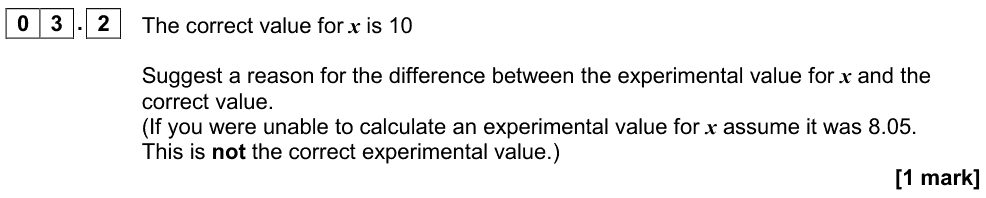
The correct value for x is 10
Suggest a reason for the difference between the experimental value for x and the
correct value.
(If you were unable to calculate an experimental value for x assume it was 8.05.
This is not the correct experimental value.)
[1 mark]
June 2018 · AS Paper 1 · Q03.3 2 marks Practical and data analysis amount of substance
Earlier part of question 03 that this part usesEarlier part of June 2018 Paper 1 question 03
Suggest how the procedure could be improved, using the same apparatus, to give a
more accurate value for x
Justify your answer.
[2 marks]
Suggestion
Justification
June 2018 · AS Paper 1 · Q04.1 6 marks 6-mark level of response group 7 the halogensamount of substance
Separate unlabelled solid samples of three anhydrous sodium compounds are
provided for a student to identify.
These compounds are known to be sodium carbonate, sodium fluoride and
sodium chloride but it is not known which sample is which.
Outline a logical sequence of test-tube reactions that the student could carry out to
identify each of these compounds.
Include the observations the student would expect to make.
Give equations, including state symbols, for any reactions that would take place.
[6 marks]
June 2018 · AS Paper 1 · Q05.1 2 marks Short answer chemical equilibria and kc
This question is about equilibrium.
Sulfur trioxide decomposes to form sulfur dioxide and oxygen at temperature T1
according to the equilibrium shown.
2SO3(g)  ⇌  2SO2(g)  +  O2(g)               ∆H = +196 kJ mol–1
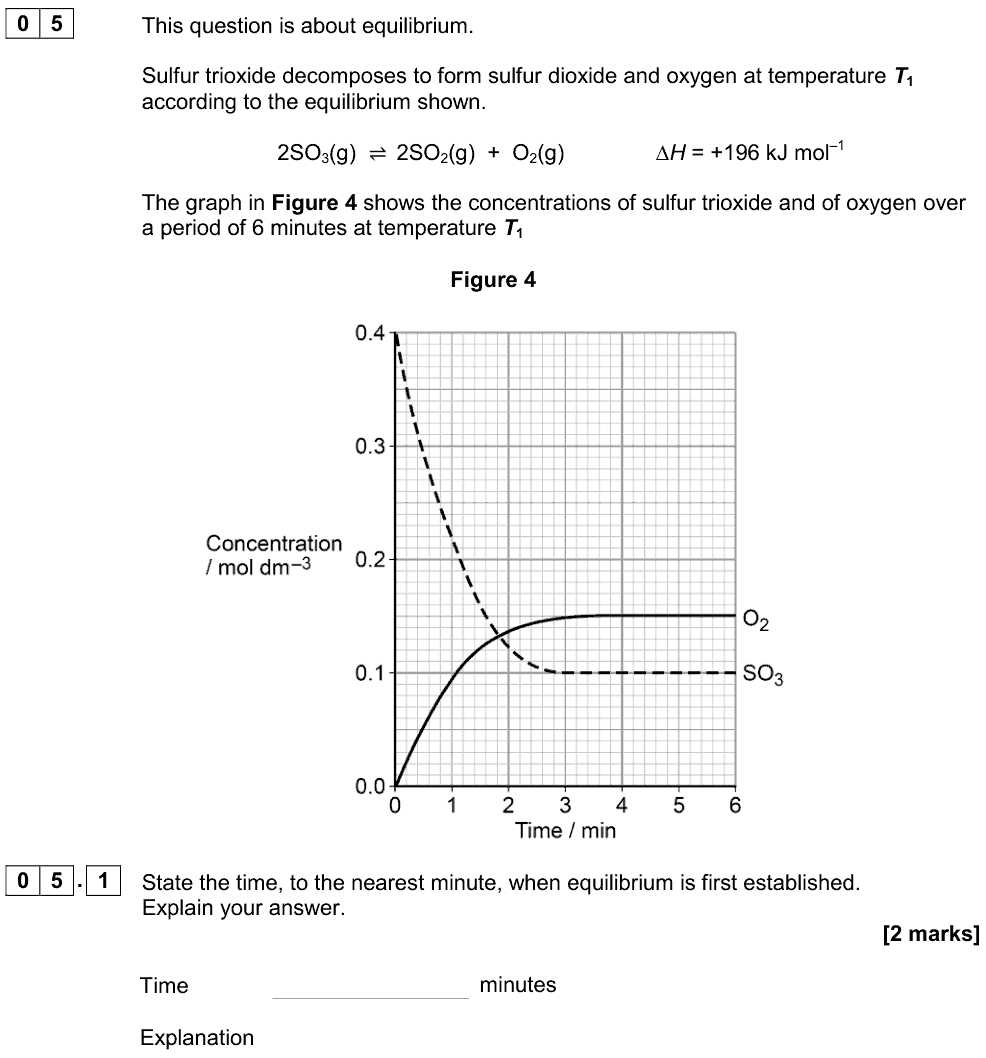
The graph in Figure 4 shows the concentrations of sulfur trioxide and of oxygen over
a period of 6 minutes at temperature T1
Figure 4
State the time, to the nearest minute, when equilibrium is first established.
Explain your answer.
[2 marks]
Time
minutes
Explanation
June 2018 · AS Paper 1 · Q05.2 2 marks Diagram or structure chemical equilibria and kcamount of substance
Earlier part of question 05 that this part usesEarlier part of June 2018 Paper 1 question 05
Sketch on the graph in Figure 4 how the concentration of sulfur dioxide changes over
these 6 minutes at temperature T1
[2 marks]
June 2018 · AS Paper 1 · Q05.3 2 marks Explanation chemical equilibria and kc
Earlier part of question 05 that this part usesEarlier part of June 2018 Paper 1 question 05
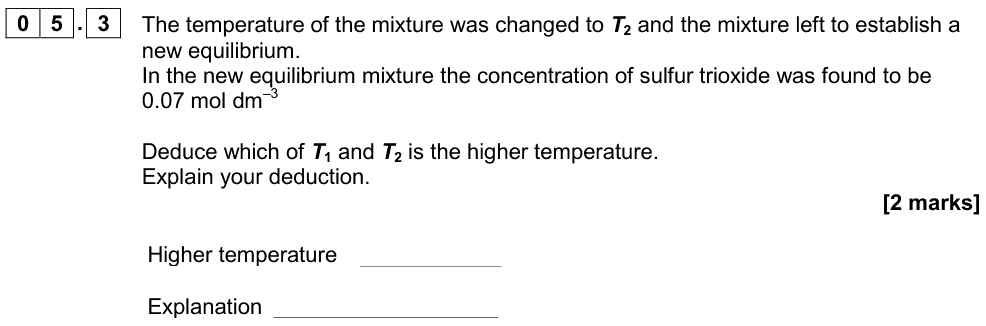
The temperature of the mixture was changed to T2 and the mixture left to establish a
new equilibrium.
In the new equilibrium mixture the concentration of sulfur trioxide was found to be
0.07 mol dm–3
Deduce which of T1 and T2 is the higher temperature.
Explain your deduction.
[2 marks]
Higher temperature
Explanation
June 2018 · AS Paper 1 · Q06.1 5 marks Calculation amount of substance
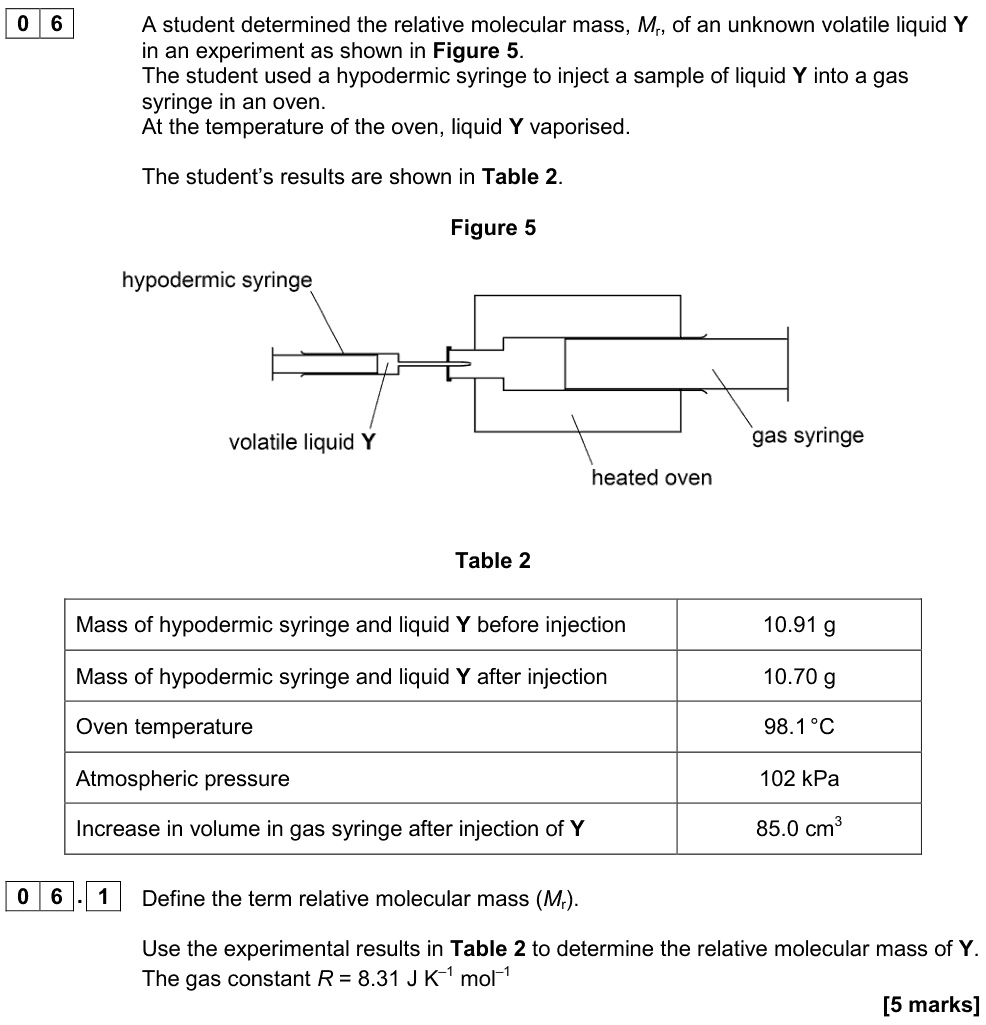
A student determined the relative molecular mass, Mr, of an unknown volatile liquid Y
in an experiment as shown in Figure 5.
The student used a hypodermic syringe to inject a sample of liquid Y into a gas
syringe in an oven.
At the temperature of the oven, liquid Y vaporised.
The student’s results are shown in Table 2.
Figure 5
Table 2
Mass of hypodermic syringe and liquid Y before injection
10.91 g
Mass of hypodermic syringe and liquid Y after injection
10.70 g
Oven temperature
98.1 °C
Atmospheric pressure
102 kPa
Increase in volume in gas syringe after injection of Y
85.0 cm3
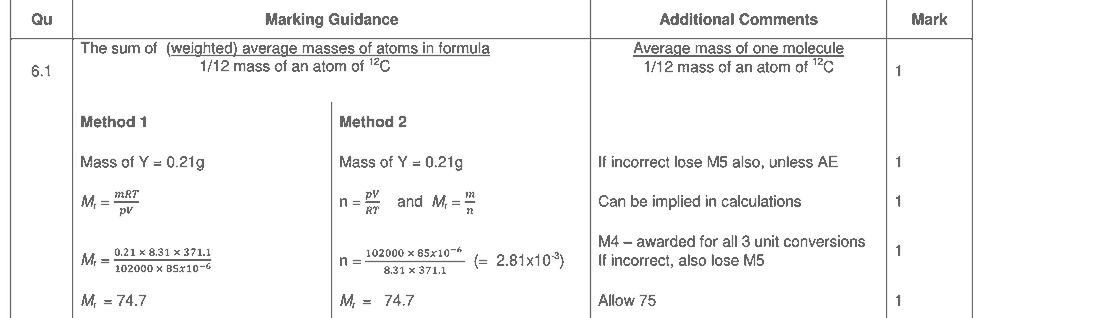
Define the term relative molecular mass (Mr).
Use the experimental results in Table 2 to determine the relative molecular mass of Y.
The gas constant R = 8.31 J K–1 mol–1
[5 marks]
June 2018 · AS Paper 1 · Q06.2 2 marks Practical and data analysis amount of substance
Earlier part of question 06 that this part usesEarlier part of June 2018 Paper 1 question 06
Some of the liquid injected did not evaporate because it dripped into the
gas syringe nozzle outside the oven.
Explain how this would affect the value of the Mr of Y calculated from the experimental
results.
[2 marks]
June 2018 · AS Paper 1 · Q07.1 1 mark Short answer Easy redox
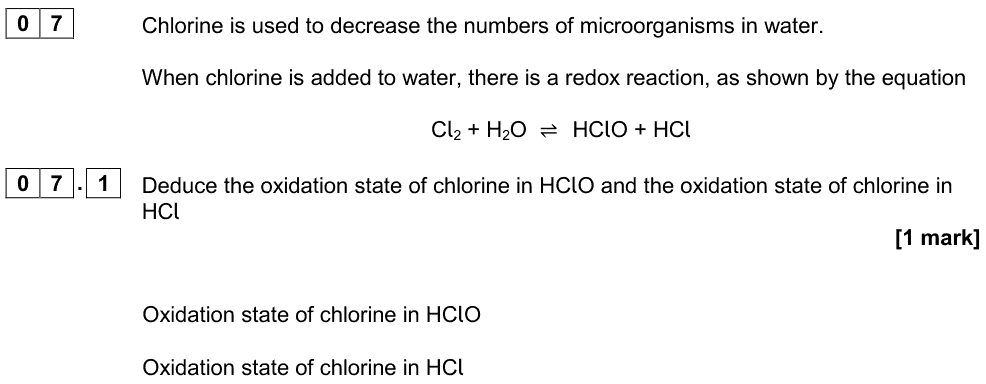
Chlorine is used to decrease the numbers of microorganisms in water.
When chlorine is added to water, there is a redox reaction, as shown by the equation
Cl2 + H2O  ⇌   HClO + HCl
Deduce the oxidation state of chlorine in HClO and the oxidation state of chlorine in
HCl
[1 mark]
Oxidation state of chlorine in HClO
Oxidation state of chlorine in HCl
June 2018 · AS Paper 1 · Q07.2 2 marks Equation writing redox
Earlier part of question 07 that this part usesEarlier part of June 2018 Paper 1 question 07
Give two half-equations to show the oxidation and reduction processes that occur in
this redox reaction.
[2 marks]
Oxidation half-equation
Reduction half-equation
June 2018 · AS Paper 1 · Q07.3 1 mark Equation writing Hard group 7 the halogens
Earlier part of question 07 that this part usesEarlier part of June 2018 Paper 1 question 07
Chlorine is reacted with cold, aqueous sodium hydroxide in the manufacture of
bleach.
Give an equation for this reaction between chlorine and sodium hydroxide.
[1 mark]
June 2018 · AS Paper 1 · Q07.4 4 marks Calculation amount of substancegroup 7 the halogens
Earlier part of question 07 that this part usesEarlier part of June 2018 Paper 1 question 07
The concentration of ClO– ions in bleach solution can be found by reaction with
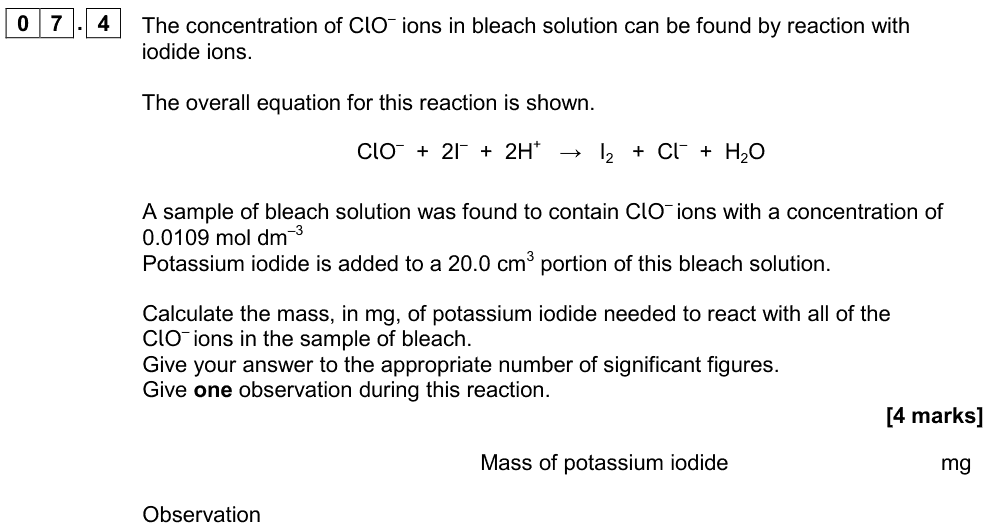
iodide ions.
The overall equation for this reaction is shown.
ClO–  +  2I–  +  2H+   →   I2   +  Cl–  +  H2O
A sample of bleach solution was found to contain ClO– ions with a concentration of
0.0109 mol dm–3
Potassium iodide is added to a 20.0 cm3 portion of this bleach solution.
Calculate the mass, in mg, of potassium iodide needed to react with all of the
ClO– ions in the sample of bleach.
Give your answer to the appropriate number of significant figures.
Give one observation during this reaction.
[4 marks]
Mass of potassium iodide
mg
Observation
June 2018 · AS Paper 1 · Q07.5 2 marks Calculation energeticsamount of substance
Earlier part of question 07 that this part usesEarlier part of June 2018 Paper 1 question 07
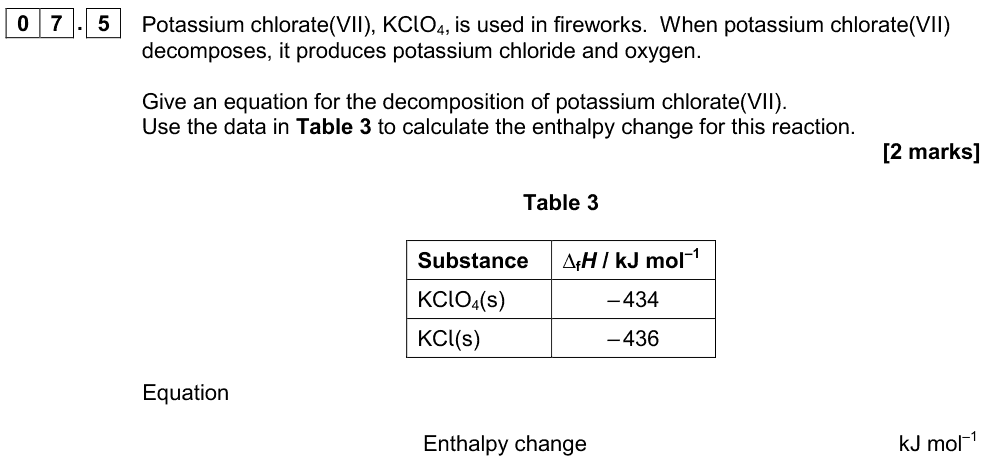
Potassium chlorate(VII), KClO4, is used in fireworks.  When potassium chlorate(VII)
decomposes, it produces potassium chloride and oxygen.
Give an equation for the decomposition of potassium chlorate(VII).
Use the data in Table 3 to calculate the enthalpy change for this reaction.
[2 marks]
Table 3
Substance
∆fH / kJ mol–1
KClO4(s)
– 434
KCl(s)
– 436
Equation
Enthalpy change
kJ mol–1
June 2018 · AS Paper 1 · Q08.1 5 marks Calculation atomic structureamount of substance
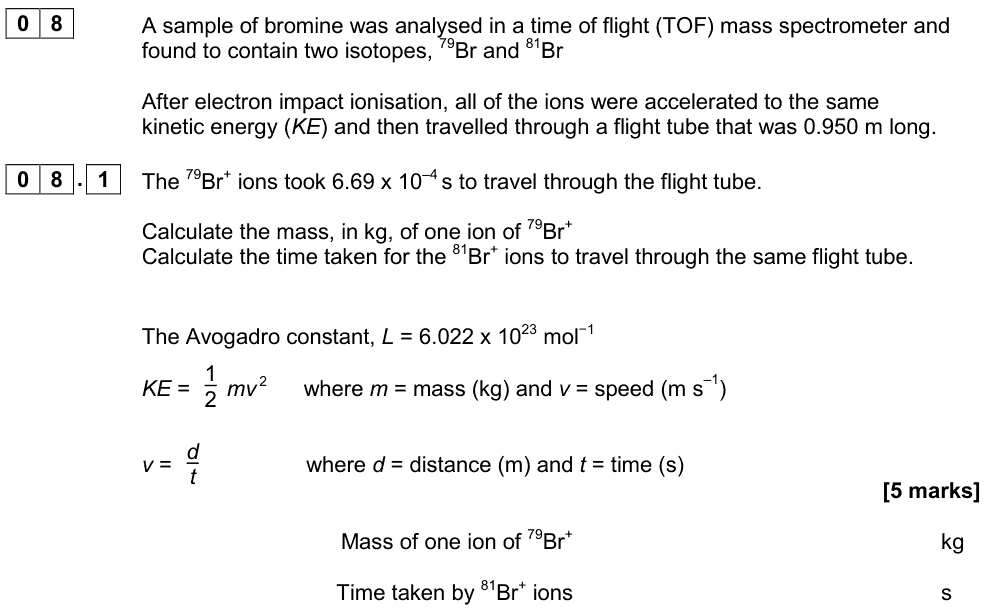
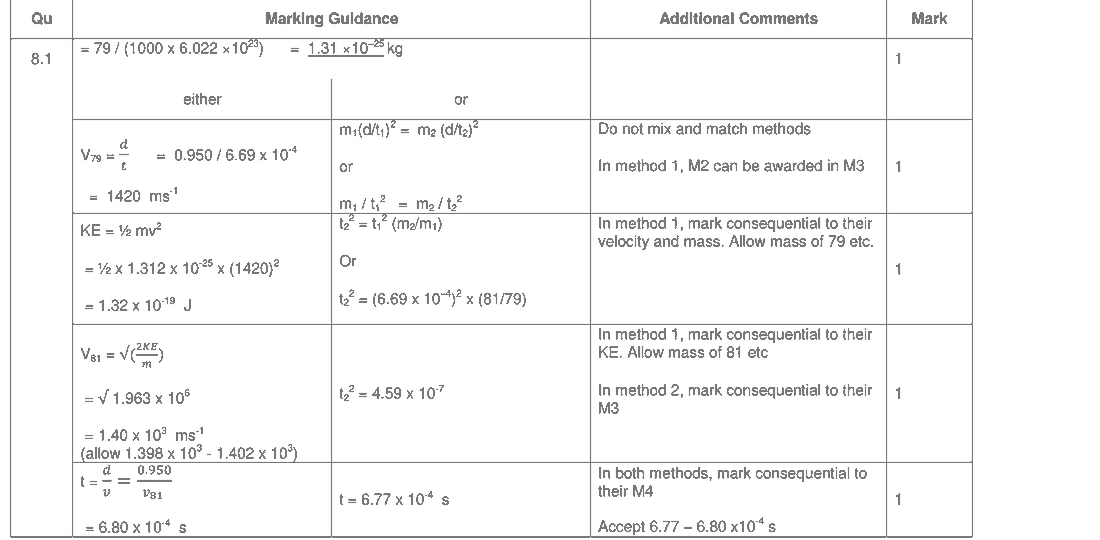
A sample of bromine was analysed in a time of flight (TOF) mass spectrometer and
found to contain two isotopes, 79Br and 81Br
After electron impact ionisation, all of the ions were accelerated to the same
kinetic energy (KE) and then travelled through a flight tube that was 0.950 m long.
The 79Br+ ions took 6.69 x 10⁻⁴ s to travel through the flight tube.
Calculate the mass, in kg, of one ion of 79Br+
Calculate the time taken for the 81Br+ ions to travel through the same flight tube.
The Avogadro constant, L = 6.022 x 10²³ mol−1
KE =      mv 2      where m = mass (kg) and v = speed (m s
–1)
v =                      where d = distance (m) and t = time (s)
[5 marks]
Mass of one ion of 79Br+
kg
Time taken by 81Br+ ions
s
1
2
d
t
June 2018 · AS Paper 1 · Q08.2 2 marks Explanation atomic structure
Earlier part of question 08 that this part usesEarlier part of June 2018 Paper 1 question 08
Explain how ions are detected and relative abundance is measured in a TOF mass
spectrometer.
[2 marks]
June 2018 · AS Paper 1 · Q09.1 3 marks Diagram or structure bonding
This question is about compounds containing fluorine.
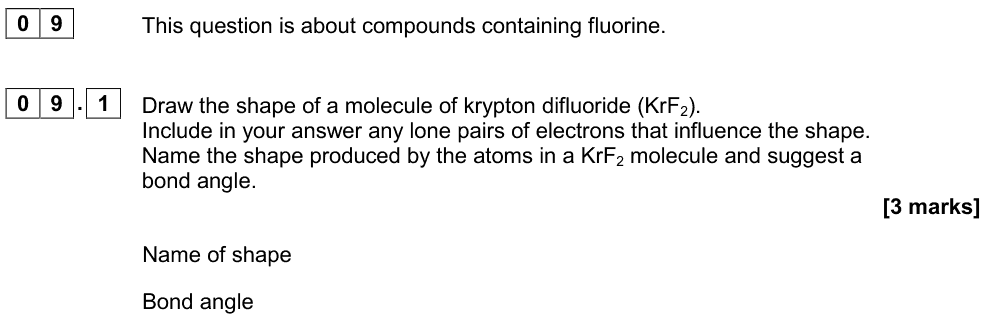
Draw the shape of a molecule of krypton difluoride (KrF2).
Include in your answer any lone pairs of electrons that influence the shape.
Name the shape produced by the atoms in a KrF2 molecule and suggest a
bond angle.
[3 marks]
Name of shape
Bond angle
June 2018 · AS Paper 1 · Q09.2 2 marks Explanation bonding
Earlier part of question 09 that this part usesEarlier part of June 2018 Paper 1 question 09
There are two lone pairs of electrons on the oxygen atom in a molecule of
oxygen difluoride (OF2).
Explain how the lone pairs of electrons on the oxygen atom influence the bond angle
in oxygen difluoride.
[2 marks]
June 2018 · AS Paper 1 · Q09.3 3 marks Explanation Hard bonding
Earlier part of question 09 that this part usesEarlier part of June 2018 Paper 1 question 09
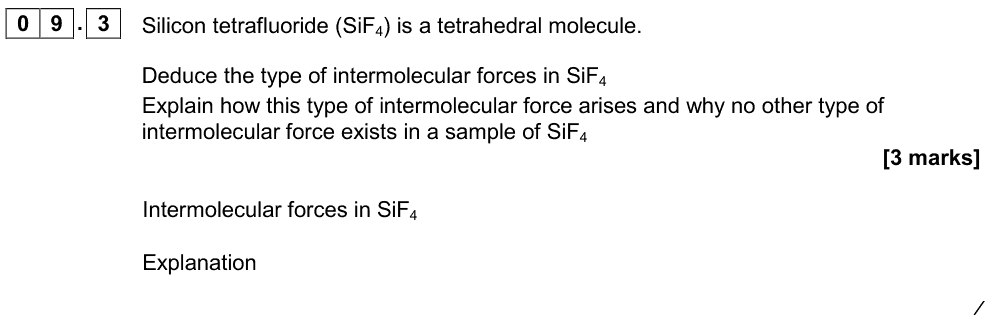
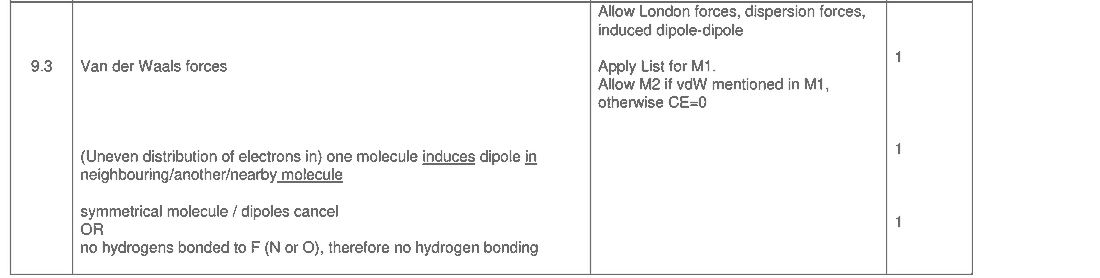
Silicon tetrafluoride (SiF4) is a tetrahedral molecule.
Deduce the type of intermolecular forces in SiF4
Explain how this type of intermolecular force arises and why no other type of
intermolecular force exists in a sample of SiF4
[3 marks]
Intermolecular forces in SiF4
Explanation
June 2018 · AS Paper 1 · Q10 1 mark Multiple choice Hard bonding
Which row shows the bonding in ammonium chloride?
[1 mark]
Covalent
Dative
covalent
Ionic
A



B



C



D



June 2018 · AS Paper 1 · Q11 1 mark Multiple choice amount of substanceatomic structure
How many protons are there in 6.0 g of nitrogen gas?
Avogadro constant, L = 6.022 x 10²³ mol–1
[1 mark]
A 1.3 x 10²³
B 9.0 x 10²³
C 1.8 x 1024
D 3.6 x 1024
June 2018 · AS Paper 1 · Q12 1 mark Multiple choice Easy periodicity
The diagram shows how a property of Period 3 elements varies across the period.
What is the property?
[1 mark]
A Atomic radius
B Electronegativity
C First ionisation energy
D Melting point
June 2018 · AS Paper 1 · Q13 1 mark Multiple choice Hard amount of substance
A 30 cm3 sample of nitrogen was reacted with a 60 cm3 sample of fluorine according to the
equation
N2(g) +     F2(g)  →  NF3(g)
What is the volume of the gas mixture after the reaction, at constant temperature and
pressure?
[1 mark]
A 20 cm3
B 30 cm3
C 40 cm3
D 50 cm3
1
2
3
2
June 2018 · AS Paper 1 · Q14 1 mark Multiple choice Easy group 2
Which substance is used to reduce titanium(IV) chloride in the extraction of titanium
metal?
[1 mark]
A Magnesium
B Manganese
C Vanadium
D Zinc
June 2018 · AS Paper 1 · Q15 1 mark Multiple choice Easy group 2
Which statement about barium sulfate is correct?
[1 mark]
A It is soluble in water at a temperature of 100 °C.
B It is used in medicine because it does not dissolve in body fluids.
C It is a pale yellow solid.
D It reacts with acidified barium chloride solution.
June 2018 · AS Paper 1 · Q16 1 mark Multiple choice group 7 the halogens
Which statement is correct about the reaction between concentrated sulfuric acid and
solid sodium bromide?
[1 mark]
A Bromide ions are reduced.
B Hydrogen bromide and sulfur are formed.
C Sulfuric acid acts as an oxidising agent.
D Bromine and hydrogen sulfide are formed.
June 2018 · AS Paper 1 · Q17 1 mark Multiple choice Easy group 2
Which compound is used to treat the symptoms of indigestion?
[1 mark]
A MgO
B Mg(OH)2
C CaO
D Ca(OH)2
June 2018 · AS Paper 1 · Q18 1 mark Multiple choice periodicityatomic structure
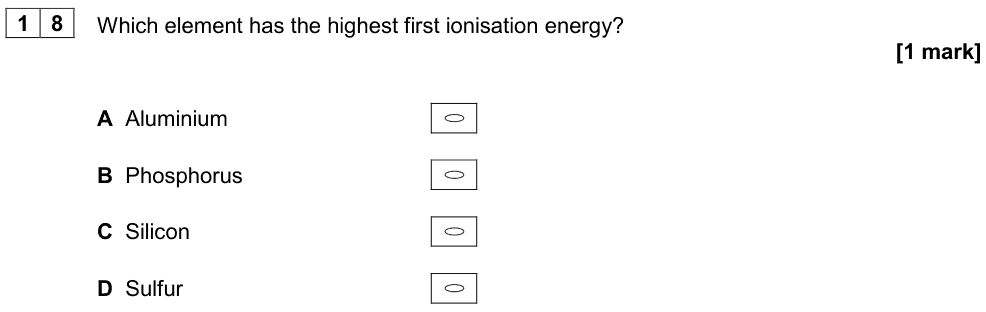
Which element has the highest first ionisation energy?
[1 mark]
A Aluminium
B Phosphorus
C Silicon
D Sulfur
June 2018 · AS Paper 1 · Q19 1 mark Multiple choice Easy amount of substance
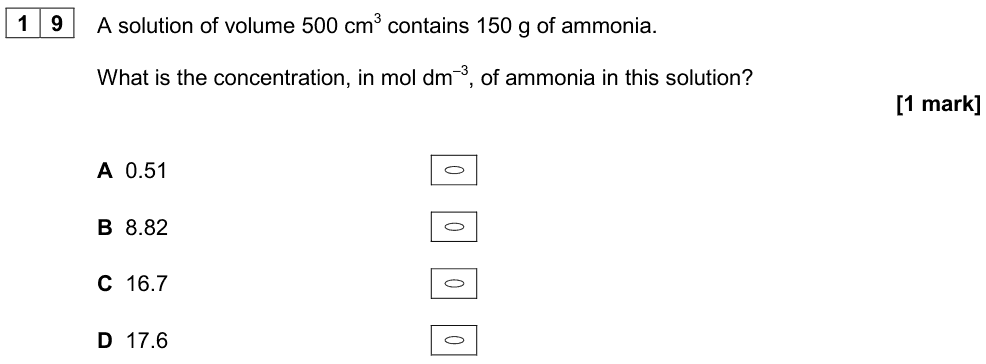
A solution of volume 500 cm3 contains 150 g of ammonia.
What is the concentration, in mol dm–3, of ammonia in this solution?
[1 mark]
A 0.51
B 8.82
C 16.7
D 17.6
June 2018 · AS Paper 1 · Q20 1 mark Multiple choice amount of substance
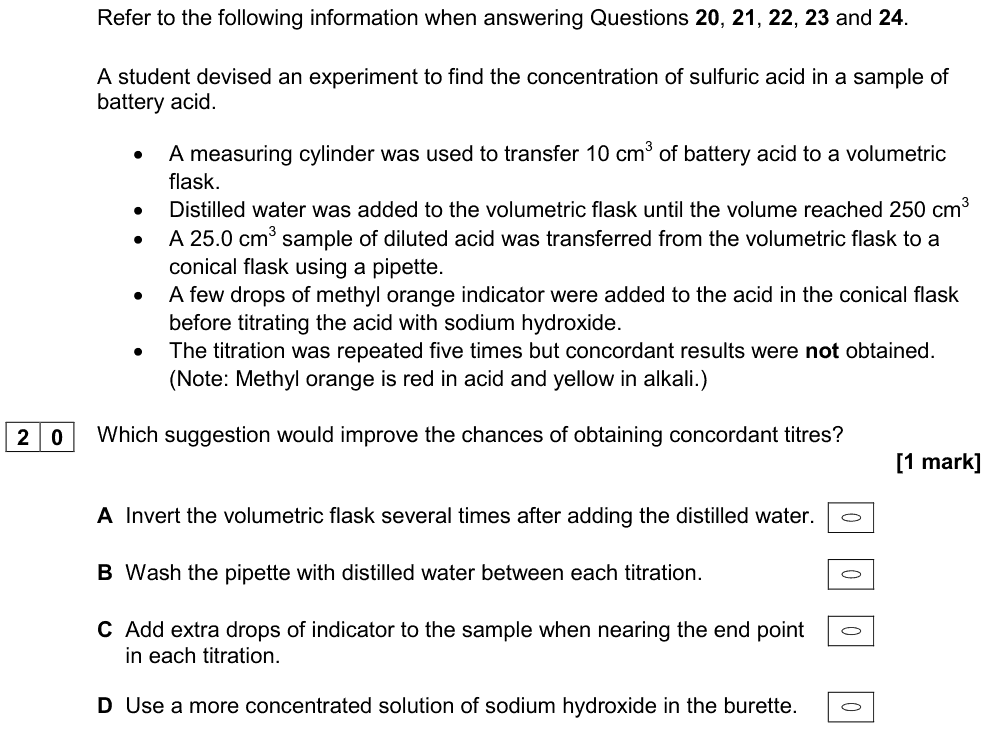
Refer to the following information when answering Questions 20, 21, 22, 23 and 24.
A student devised an experiment to find the concentration of sulfuric acid in a sample of
battery acid.
•
A measuring cylinder was used to transfer 10 cm3 of battery acid to a volumetric
flask.
•
Distilled water was added to the volumetric flask until the volume reached 250 cm3
•
A 25.0 cm3 sample of diluted acid was transferred from the volumetric flask to a
conical flask using a pipette.
•
A few drops of methyl orange indicator were added to the acid in the conical flask
before titrating the acid with sodium hydroxide.
•
The titration was repeated five times but concordant results were not obtained.
(Note: Methyl orange is red in acid and yellow in alkali.)
Which suggestion would improve the chances of obtaining concordant titres?
[1 mark]
A Invert the volumetric flask several times after adding the distilled water.
B Wash the pipette with distilled water between each titration.
C Add extra drops of indicator to the sample when nearing the end point
in each titration.
D Use a more concentrated solution of sodium hydroxide in the burette.
June 2018 · AS Paper 1 · Q21 1 mark Multiple choice Easy amount of substance
Earlier part of question 21 that this part usesEarlier part of June 2018 Paper 1 question 21
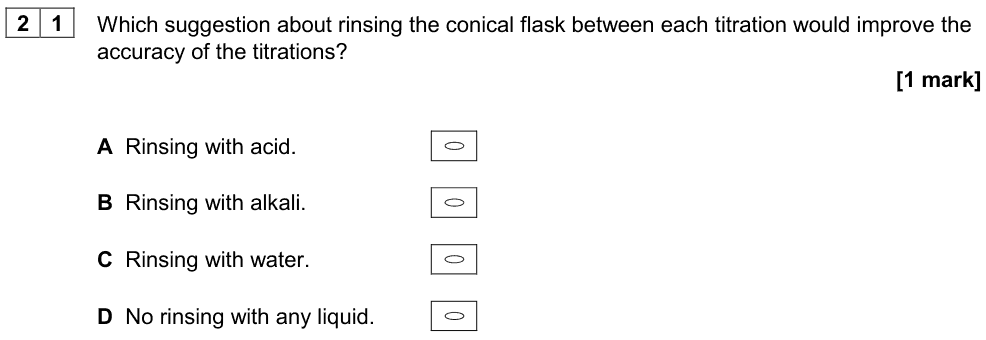
Which suggestion about rinsing the conical flask between each titration would improve the
accuracy of the titrations?
[1 mark]
A Rinsing with acid.
B Rinsing with alkali.
C Rinsing with water.
D No rinsing with any liquid.
June 2018 · AS Paper 1 · Q22 1 mark Multiple choice Hard amount of substance
Earlier part of question 22 that this part usesEarlier part of June 2018 Paper 1 question 22
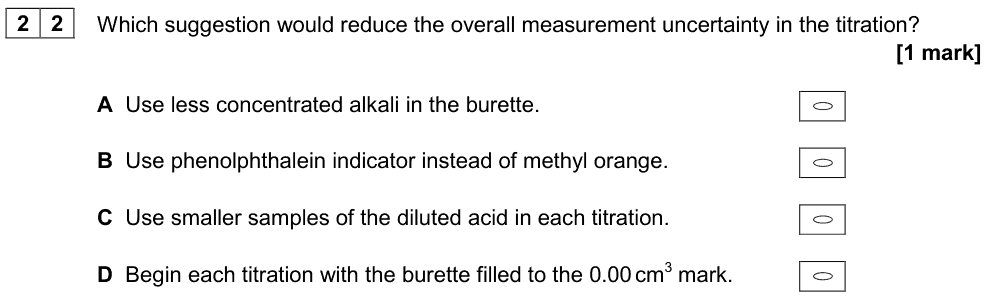
Which suggestion would reduce the overall measurement uncertainty in the titration?
[1 mark]
A Use less concentrated alkali in the burette.
B Use phenolphthalein indicator instead of methyl orange.
C Use smaller samples of the diluted acid in each titration.
D Begin each titration with the burette filled to the 0.00 cm3 mark.
June 2018 · AS Paper 1 · Q23 1 mark Multiple choice Easy amount of substance
Earlier part of question 23 that this part usesEarlier part of June 2018 Paper 1 question 23
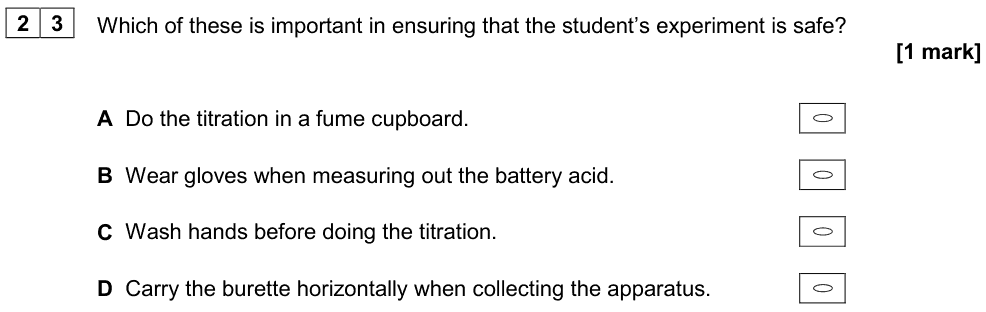
Which of these is important in ensuring that the student’s experiment is safe?
[1 mark]
A Do the titration in a fume cupboard.
B Wear gloves when measuring out the battery acid.
C Wash hands before doing the titration.
D Carry the burette horizontally when collecting the apparatus.
June 2018 · AS Paper 1 · Q24 1 mark Multiple choice Hard amount of substance
Earlier part of question 24 that this part usesEarlier part of June 2018 Paper 1 question 24
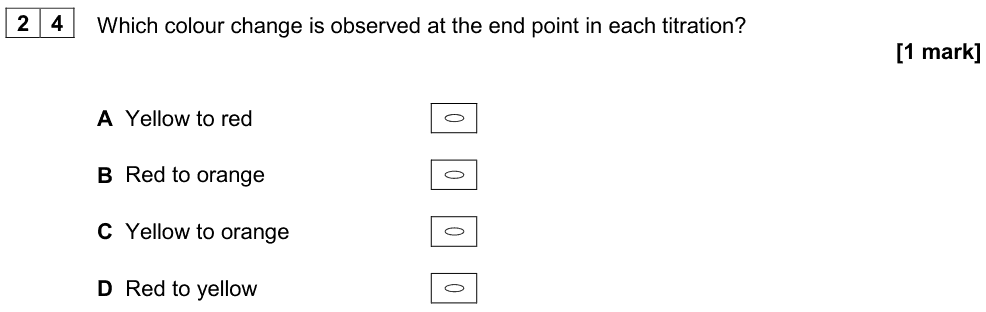
Which colour change is observed at the end point in each titration?
[1 mark]
A Yellow to red
B Red to orange
C Yellow to orange
D Red to yellow

Work with an A-level chemistry tutor

Want a paper marked and gone through with you? Message us.

Prefer email? Send an enquiry

If you are under 18, please include a parent's contact details. Enquiries go to enquiries@chemistryaleveltutor.com and are deleted once handled. All tutoring is online.