November 2021: Paper 3, Unified chemistry

70 marks · 22 question parts · Paper, mark scheme and report on OCR's site · An autumn series, sat in place of the cancelled summer exams · Have OCR's Data Sheet beside you

Question by question

QTopicMarksAOType
1(a) Equilibrium constants Kc and Kp, Amount of substance (moles) 2AO1Calculation
1(b) Chemical equilibrium and Kc, Equilibrium constants Kc and Kp 2AO1, 2Calculation
1(c) Bonding, structure and shapes of molecules 3AO1, 2Short answer
1(d) Amount of substance (moles), Formulae and equations, Acids, bases and titrations 4AO1, 2Equation writing
1(e) Carboxylic acids, esters and acyl chlorides, Formulae and equations, Acids, bases and titrations, Redox and oxidation numbers 4AO2Equation writing
1(f) Haloalkanes, Organic basics: naming, formulae and isomerism 3AO1, 2Mechanism
2(a) Amount of substance (moles), Practical skills: planning, analysis and evaluation, Practical techniques and apparatus (PAGs) 2AO3Drawing / labelling
2(b) Amount of substance (moles), Practical skills: planning, analysis and evaluation 3AO2, 3Calculation
2(c) Practical skills: planning, analysis and evaluation 2AO3Short answer
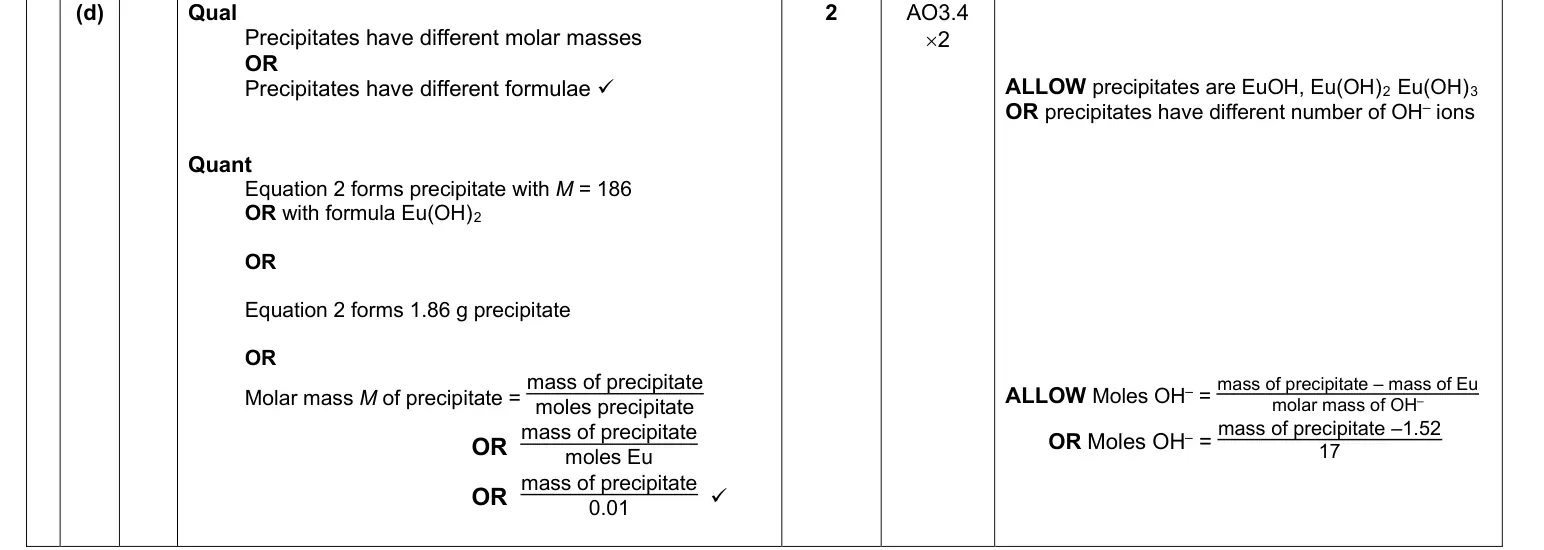
2(d) Practical skills: planning, analysis and evaluation, Amount of substance (moles) 2AO3Short answer
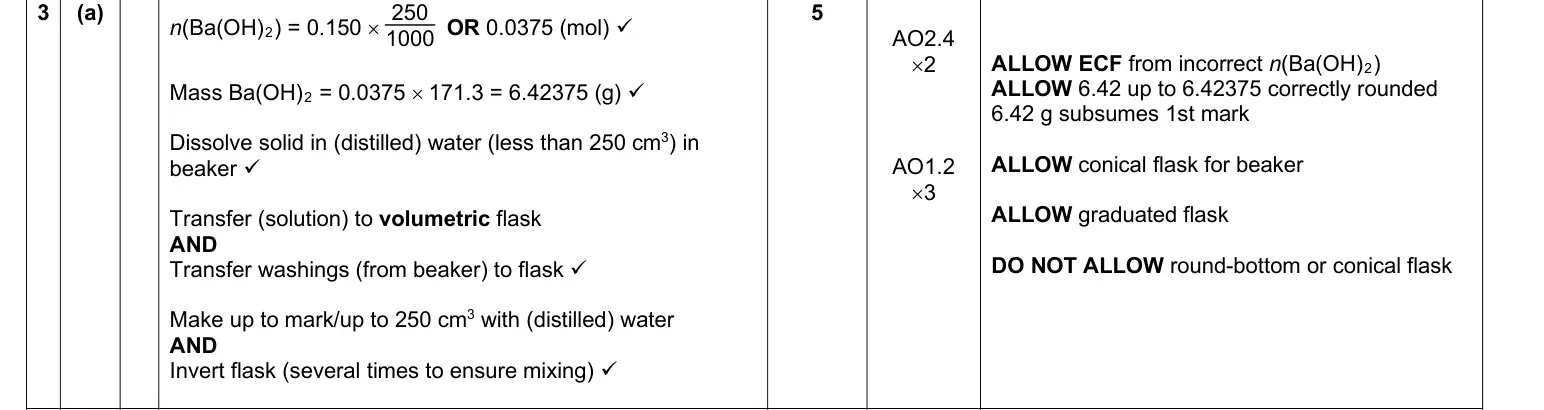
3(a) Acids, bases and titrations, Practical techniques and apparatus (PAGs), Amount of substance (moles) 5AO1, 2Extended response
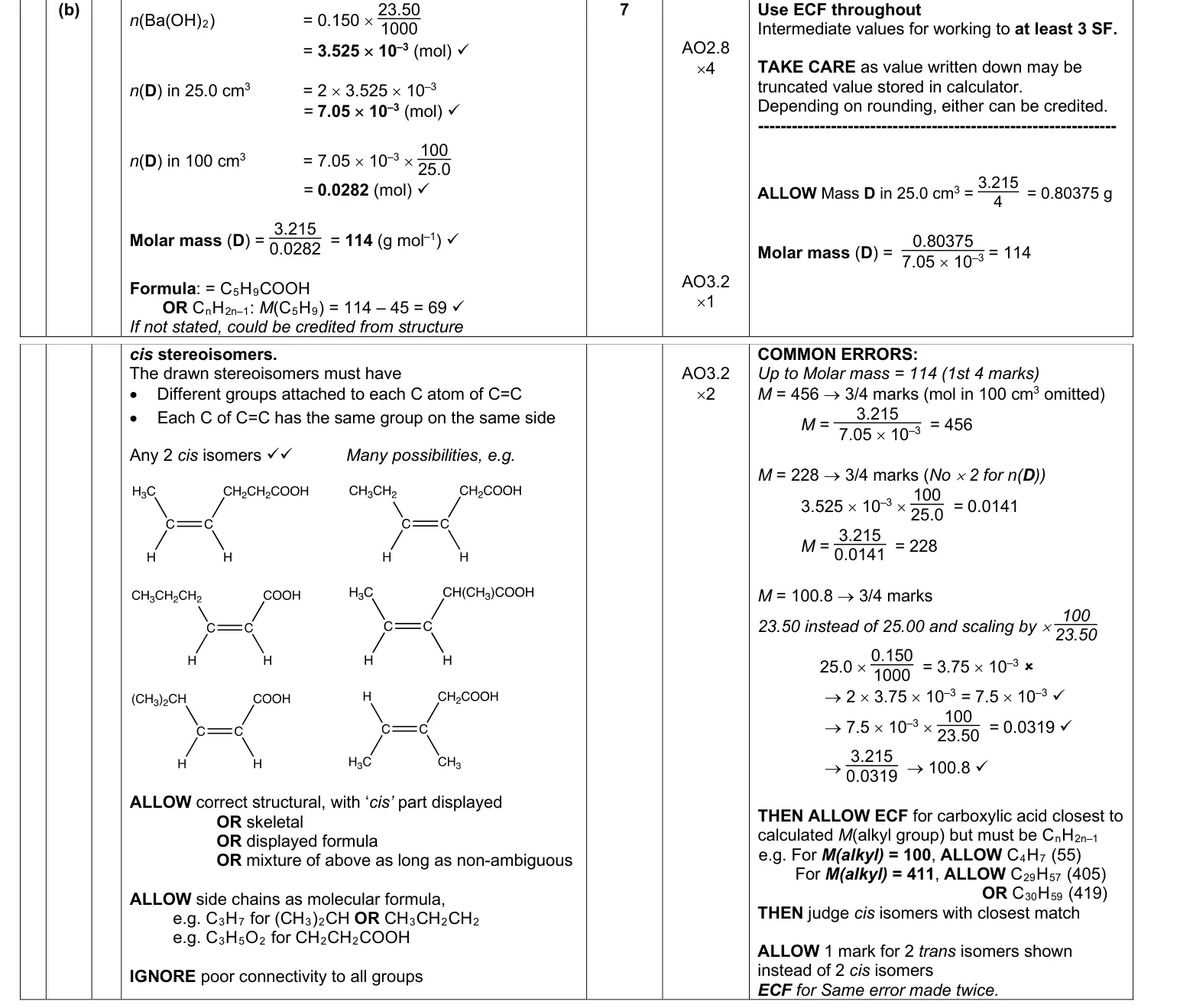
3(b) Acids, bases and titrations, Amount of substance (moles), Organic basics: naming, formulae and isomerism, Alkenes 7AO2, 3Data interpretation
4(a) Rates: orders, rate equations and the Arrhenius equation 1AO3Short answer
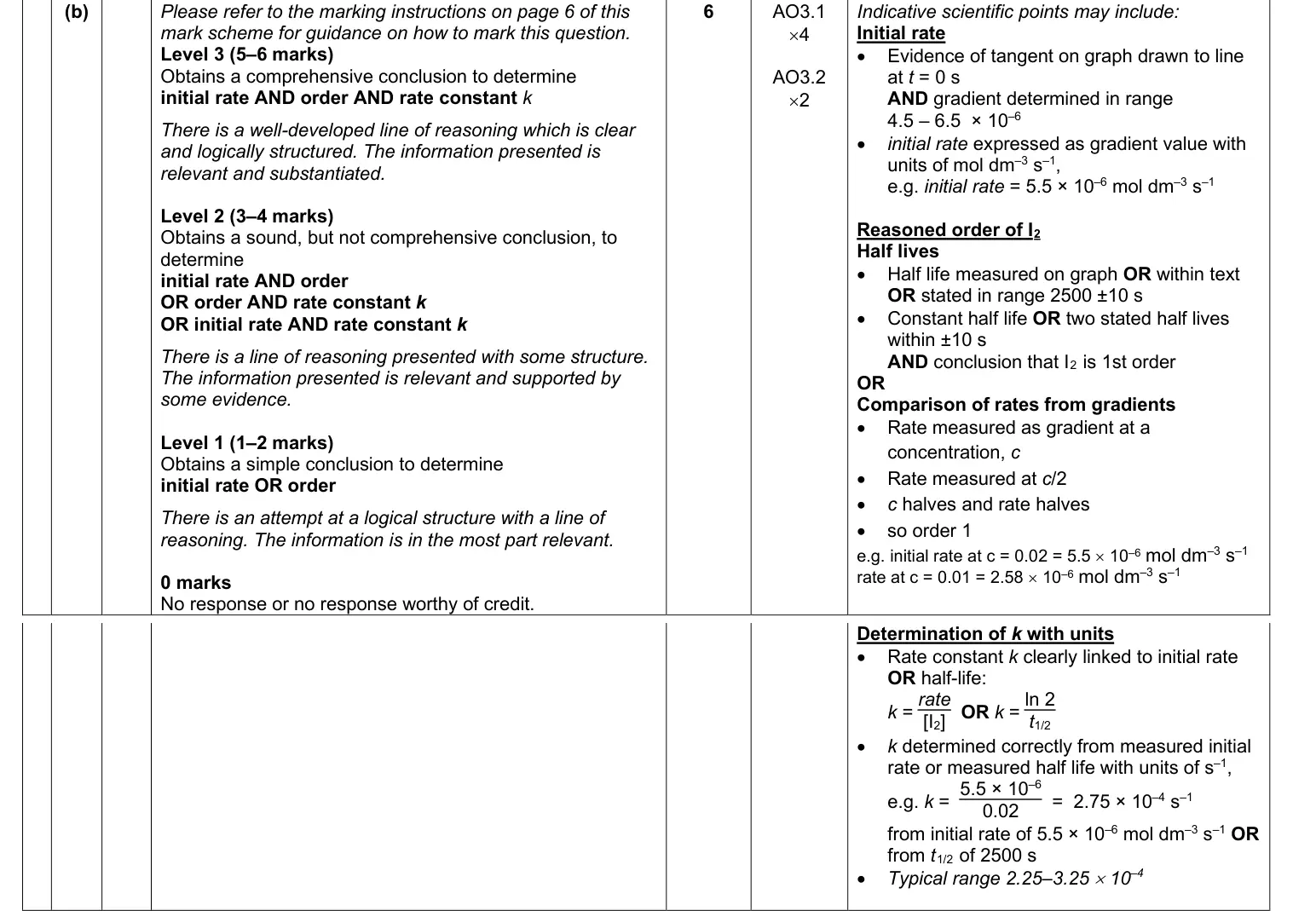
4(b) Rates: orders, rate equations and the Arrhenius equation 6AO3Level of response
4(c)(i) Rates: orders, rate equations and the Arrhenius equation 2AO2Equation writing
4(c)(ii) Rates: orders, rate equations and the Arrhenius equation, Practical skills: planning, analysis and evaluation 2AO3Short answer
5(a)(i) Redox titrations and electrode potentials, Redox and oxidation numbers 2AO1Equation writing
5(a)(ii) Amount of substance (moles) 5AO2Calculation
5(b)(i) Acids, bases, pH and buffers 2AO2Calculation
5(b)(ii) Acids, bases, pH and buffers 2AO1Complete table/diagram
5(b)(iii) Organic synthesis (Module 6), Formulae and equations, Organic basics: naming, formulae and isomerism 3AO2, 3Equation writing
5(c) Amount of substance (moles), Formulae and equations, Infrared spectroscopy and mass spectrometry, Carboxylic acids, esters and acyl chlorides 6AO3Level of response

The questions

1(a)1(b)1(c)1(d)1(e)1(f)2(a)2(b)2(c)2(d)3(a)3(b)4(a)4(b)4(c)(i)4(c)(ii)5(a)(i)5(a)(ii)5(b)(i)5(b)(ii)5(b)(iii)5(c)
November 2021 · Paper 3 · Q1(a) 2 marks AO1 Calculation Hard equilibrium constantsamount of substance
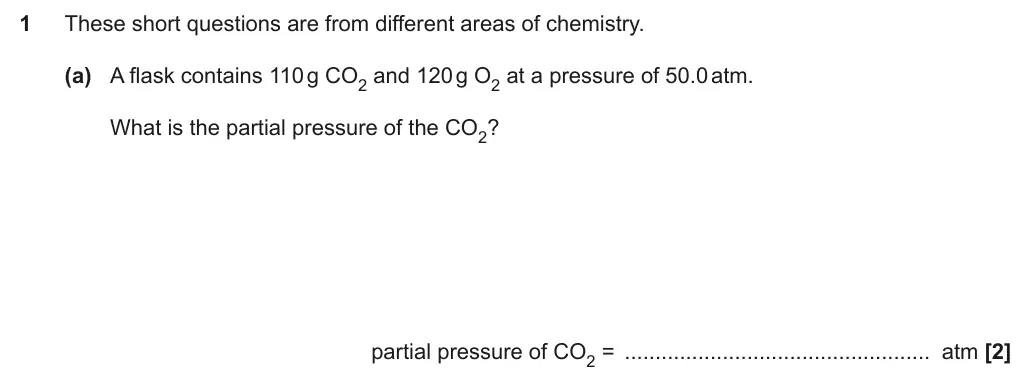
1 These short questions are from different areas of chemistry.
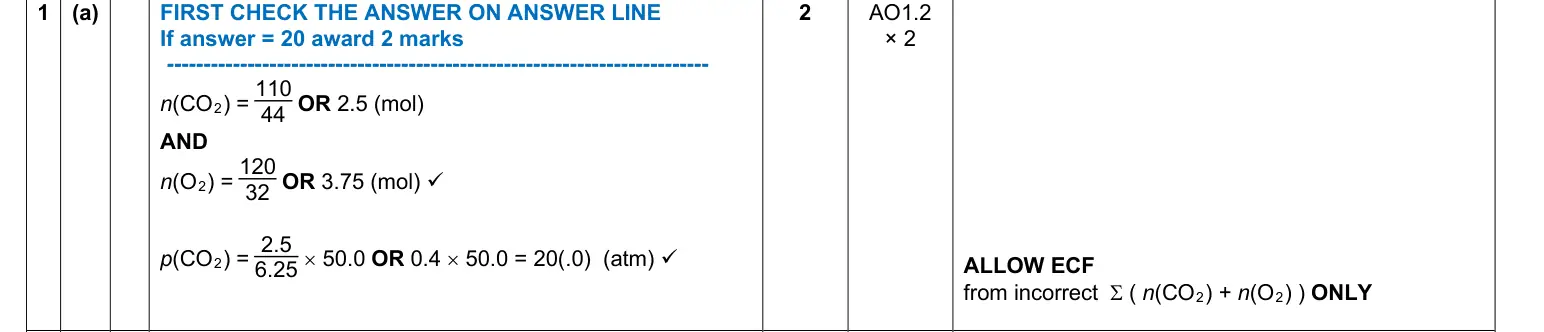
(a) A flask contains 110 g CO2 and 120 g O2 at a pressure of 50.0 atm.
What is the partial pressure of the CO2?
partial pressure of CO2 =  .................................................. atm [2]
November 2021 · Paper 3 · Q1(b) 2 marks AO1, 2 Calculation Medium chemical equilibriumequilibrium constants
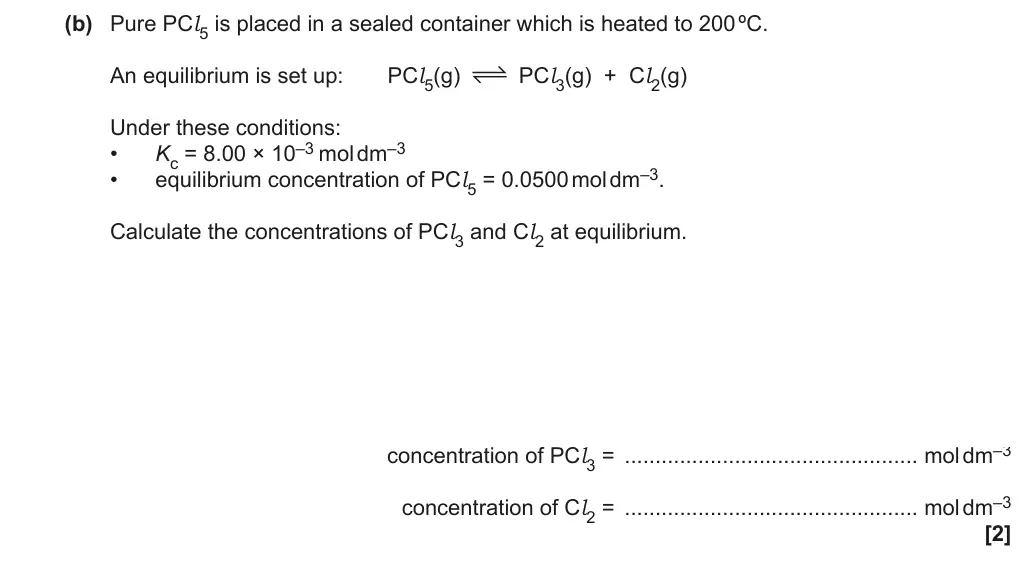
(b) Pure PCl5 is placed in a sealed container which is heated to 200 ºC.
An equilibrium is set up:  PCl5(g) PCl3(g)  +  Cl2(g)
Under these conditions:
• Kc = 8.00 × 10⁻³ mol dm–3
• equilibrium concentration of PCl5 = 0.0500 mol dm–3.
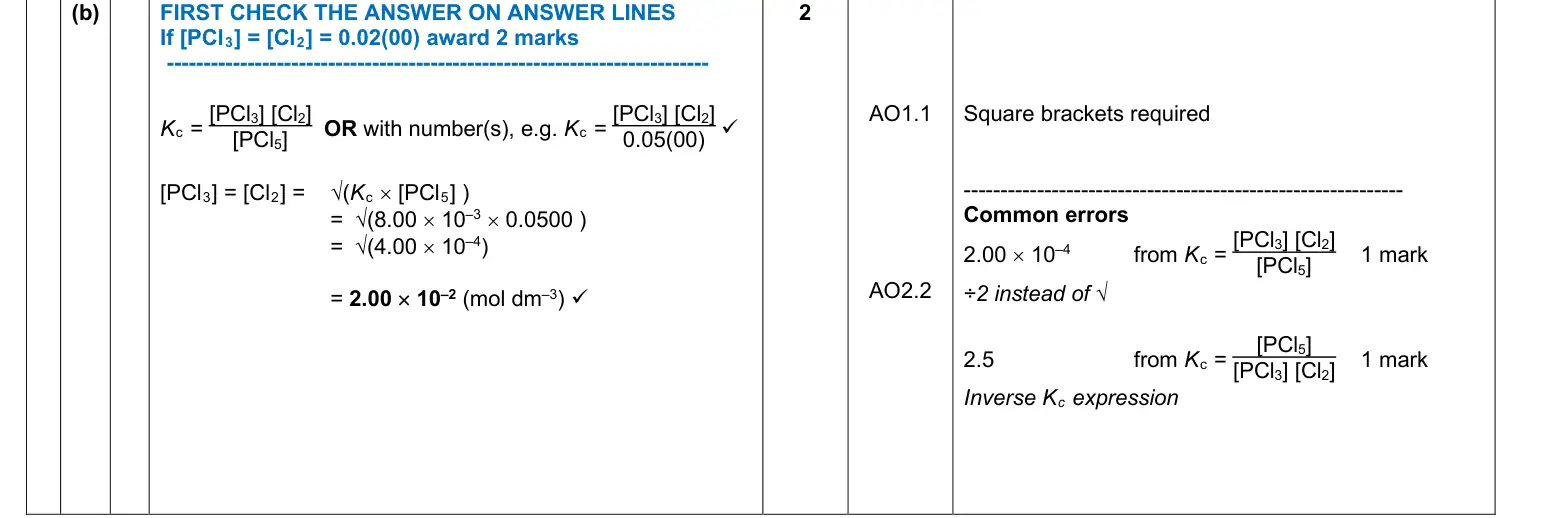
Calculate the concentrations of PCl3 and Cl2 at equilibrium.
concentration of PCl3 =  ................................................ mol dm–3
concentration of Cl2 =  ................................................ mol dm–3
[2]
November 2021 · Paper 3 · Q1(c) 3 marks AO1, 2 Short answer Medium bonding and structure
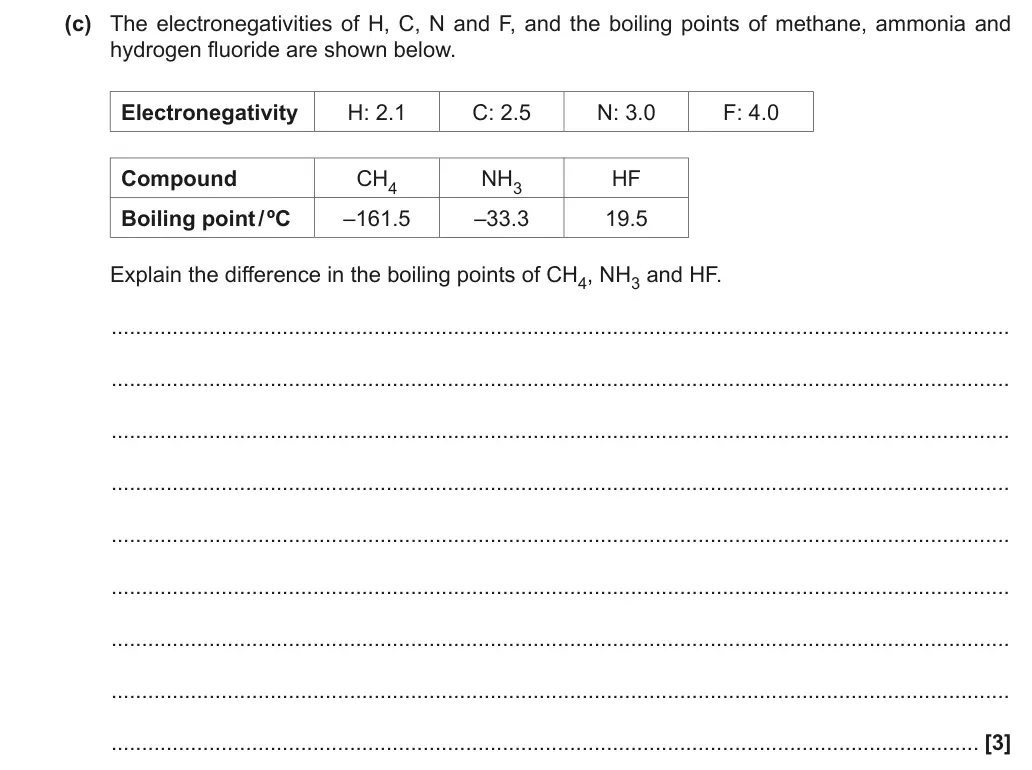
(c) The electronegativities of H, C, N and F, and the boiling points of methane, ammonia and
hydrogen fluoride are shown below.
Electronegativity H: 2.1 C: 2.5 N: 3.0 F: 4.0
Compound CH4 NH3 HF
Boiling point / ºC –161.5 –33.3 19.5
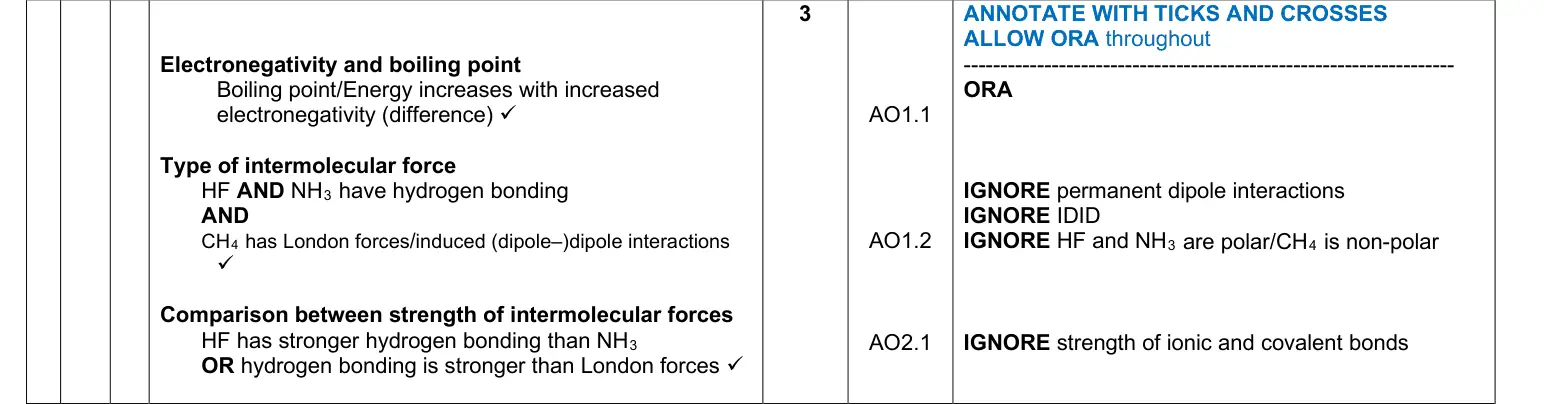
Explain the difference in the boiling points of CH4, NH3 and HF.
...................................................................................................................................................
...................................................................................................................................................
...................................................................................................................................................
...................................................................................................................................................
...................................................................................................................................................
...................................................................................................................................................
...................................................................................................................................................
...................................................................................................................................................
.............................................................................................................................................. [3]
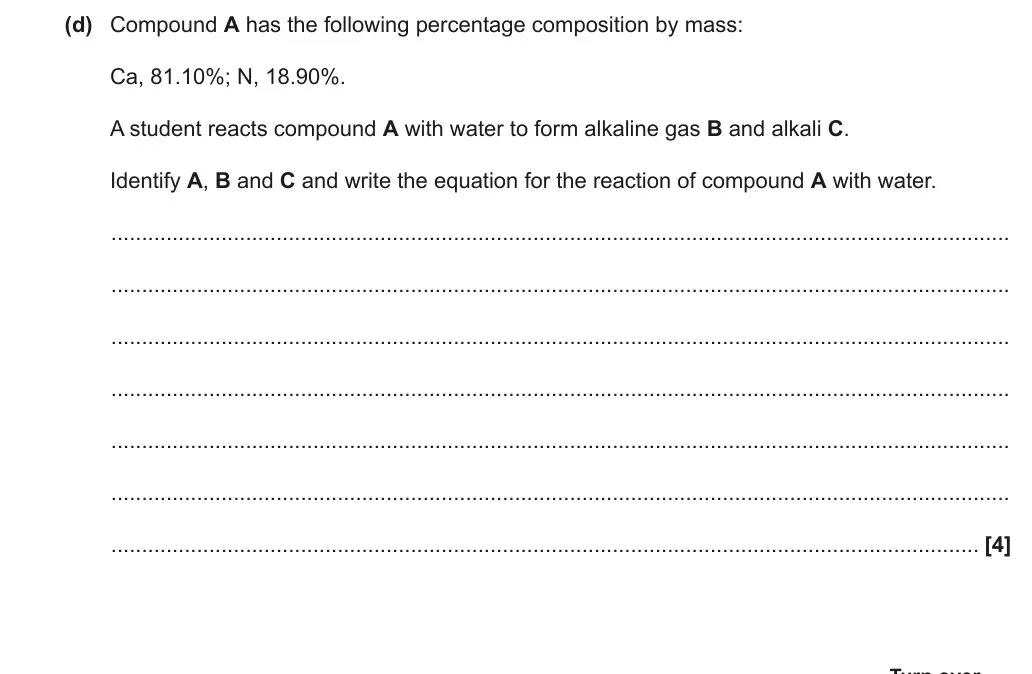
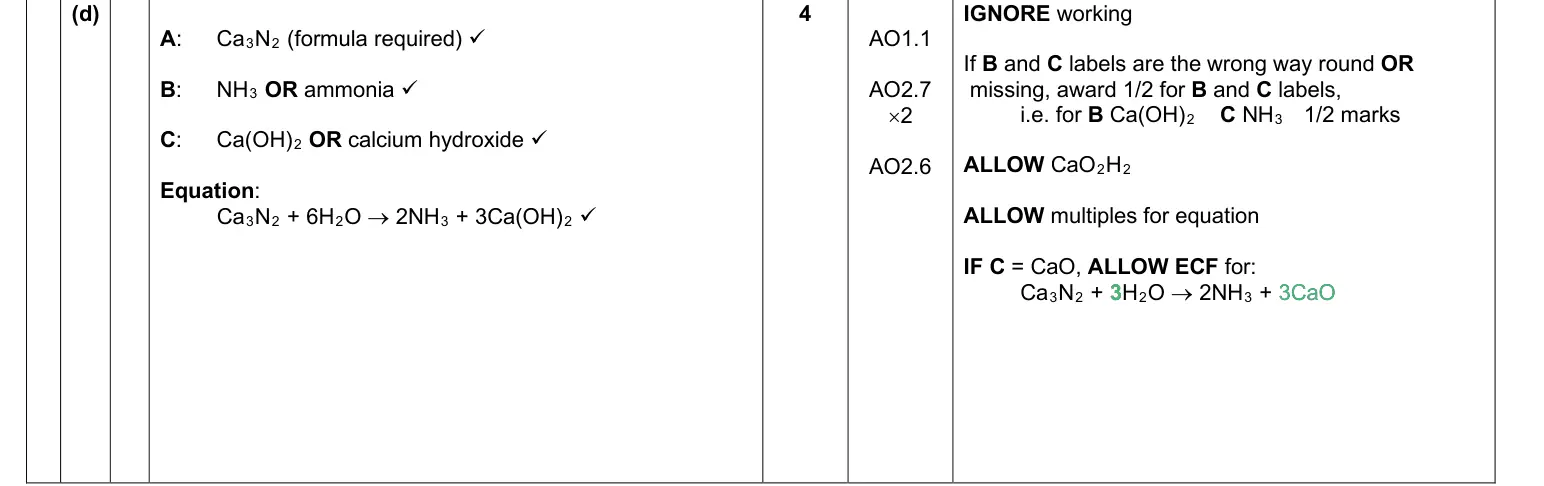
November 2021 · Paper 3 · Q1(d) 4 marks AO1, 2 Equation writing Hard amount of substanceformulae and equationsacids and titrations
(d) Compound A has the following percentage composition by mass:
Ca, 81.10%; N, 18.90%.
A student reacts compound A with water to form alkaline gas B and alkali C.
Identify A, B and C and write the equation for the reaction of compound A with water.
...................................................................................................................................................
...................................................................................................................................................
...................................................................................................................................................
...................................................................................................................................................
...................................................................................................................................................
...................................................................................................................................................
.............................................................................................................................................. [4]
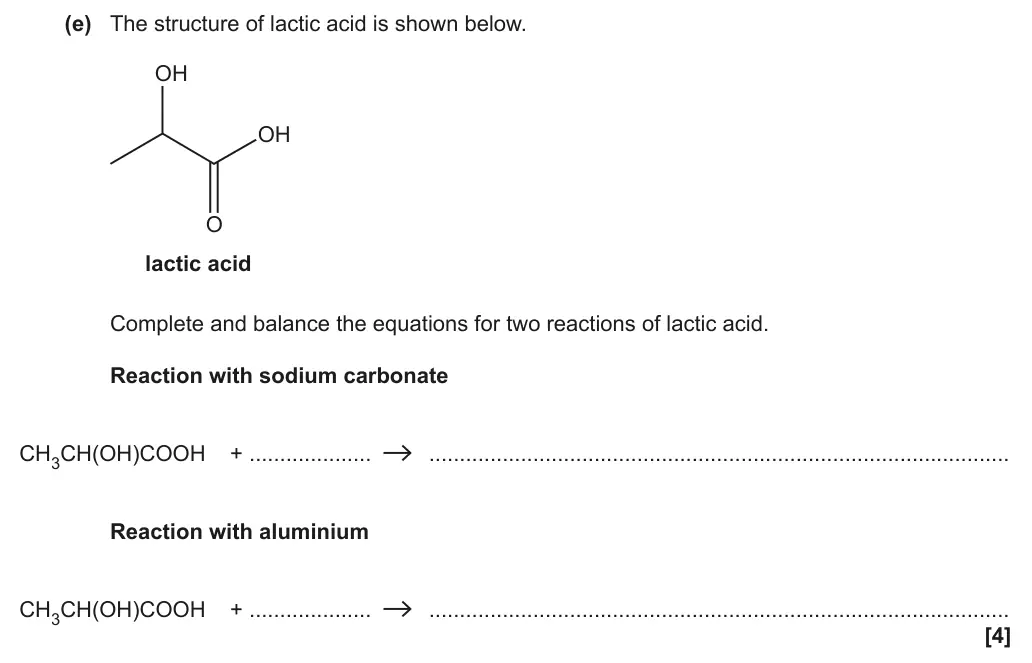
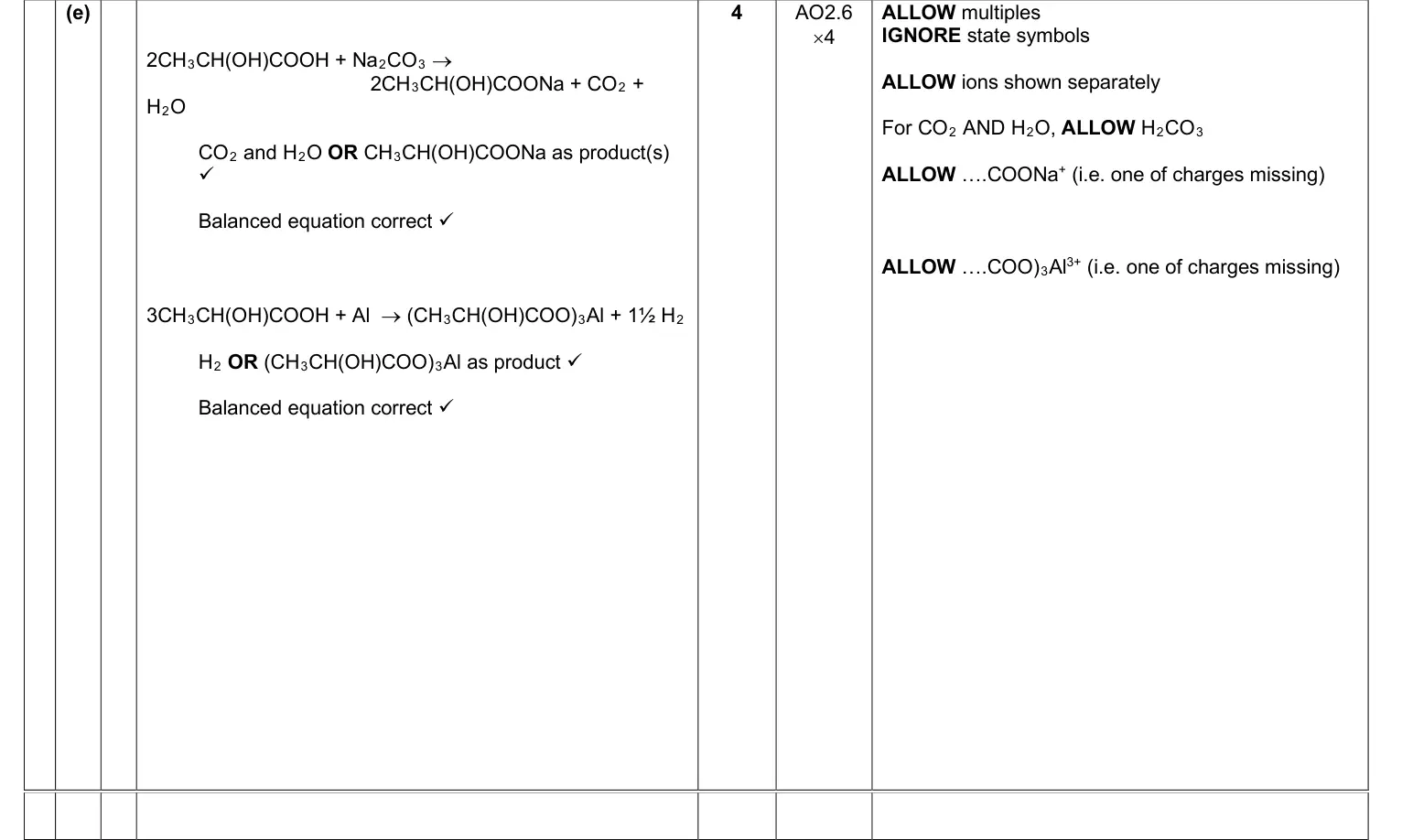
November 2021 · Paper 3 · Q1(e) 4 marks AO2 Equation writing Hard carboxylic acids and estersformulae and equationsacids and titrationsredox
(e) The structure of lactic acid is shown below.
OH
OH
O
lactic acid
Complete and balance the equations for two reactions of lactic acid.
Reaction with sodium carbonate
CH3CH(OH)COOH    + .................... ...............................................................................................
Reaction with aluminium
CH3CH(OH)COOH    + .................... ...............................................................................................
[4]
November 2021 · Paper 3 · Q1(f) 3 marks AO1, 2 Mechanism Medium haloalkanesorganic basics
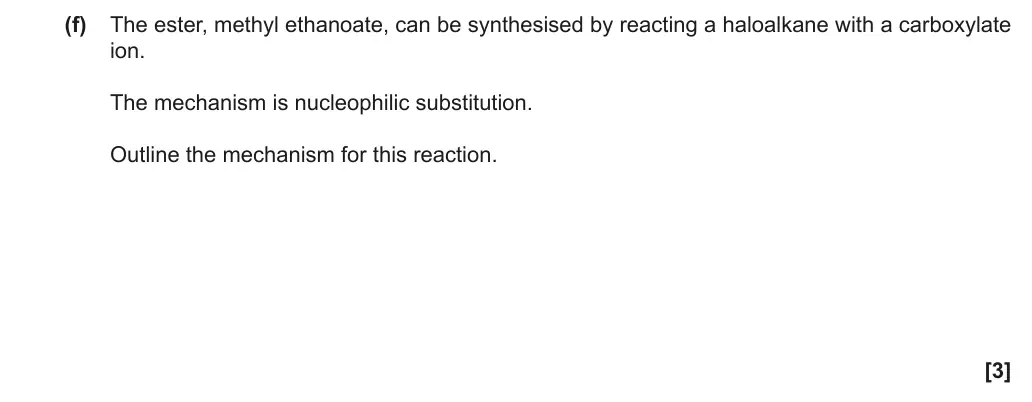
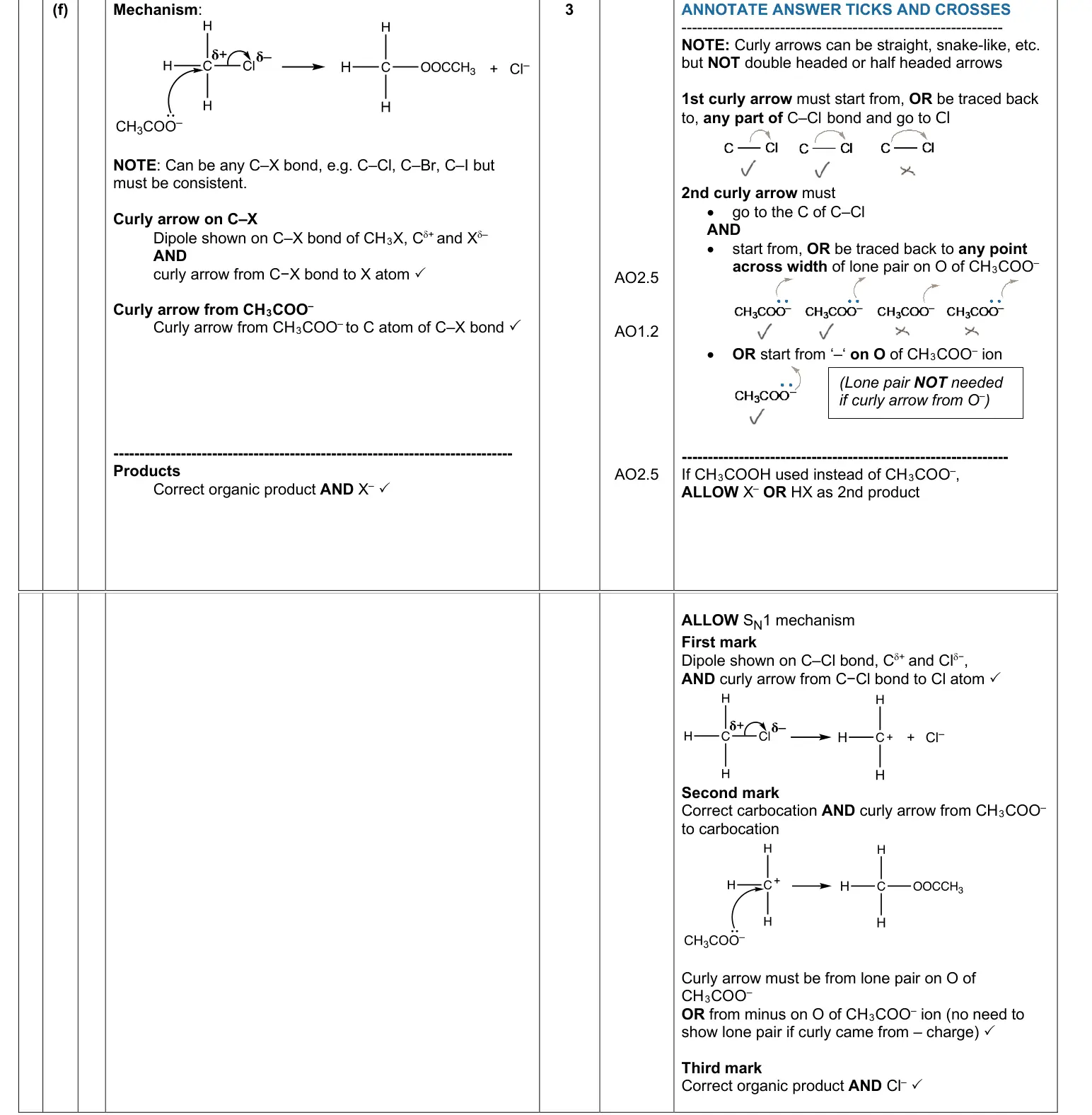
(f) The ester, methyl ethanoate, can be synthesised by reacting a haloalkane with a carboxylate
ion.
The mechanism is nucleophilic substitution.
Outline the mechanism for this reaction.
[3]
November 2021 · Paper 3 · Q2(a) 2 marks AO3 Drawing / labelling Hard amount of substancepractical skillspractical techniques
2 Europium (Ar = 152.0) reacts with dilute aqueous acid in a redox reaction, forming a solution and
hydrogen gas.
A student proposed three possible ionic equations for this reaction, forming europium ions with
different charges:
Equation 1 2Eu(s) + 2H+(aq) 2Eu+(aq) + H2(g)
Equation 2 Eu(s) + 2H+(aq) Eu2+(aq) + H2(g)
Equation 3 2Eu(s) + 6H+(aq) 2Eu3+(aq) + 3H2(g)
The student plans to carry out an investigation to determine which equation is correct.
Hydrochloric acid is used as the source of H+(aq) ions.
The student’s method is outlined below.
Step 1 Using a 3 decimal place balance, weigh a suitable container for the reaction.
Add about 1 g of europium to the container and reweigh.
Step 2 Set up apparatus for gas collection.
Add an excess of dilute hydrochloric acid to the europium.
Step 3 Measure the volume of gas produced.
Results
Mass of container = 32.795 g
Mass of container + europium = 33.783 g
Volume of gas collected = 152 cm3
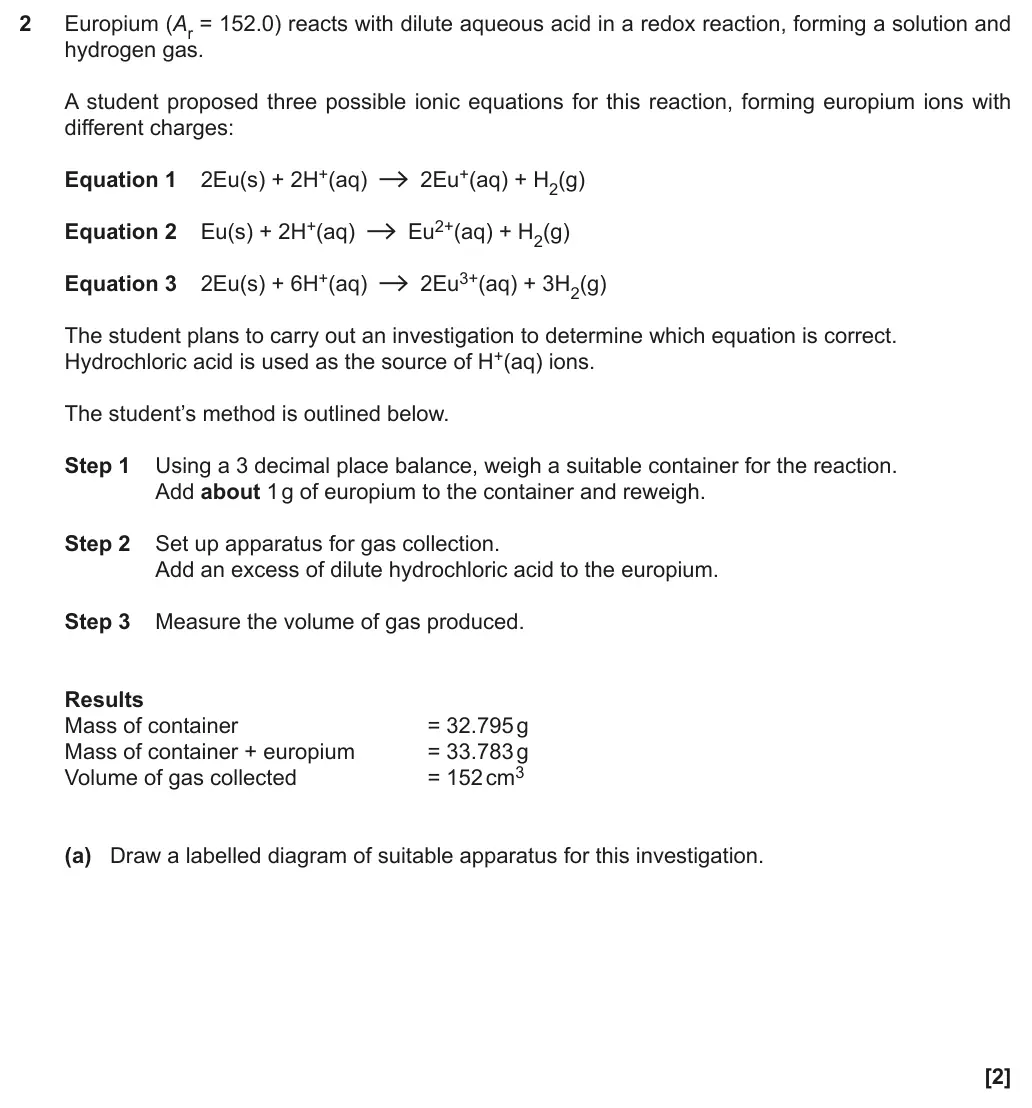
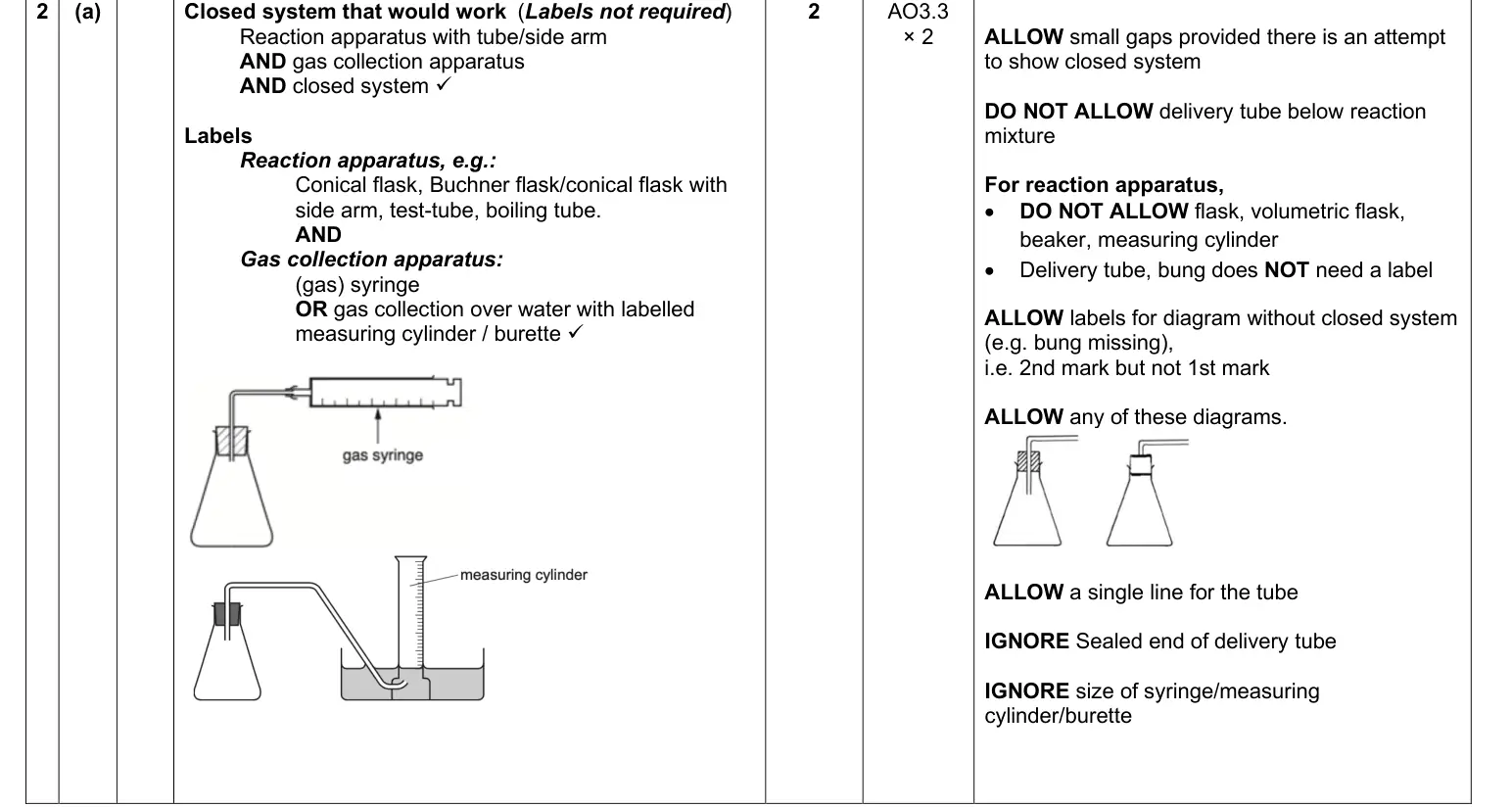
(a) Draw a labelled diagram of suitable apparatus for this investigation.
[2]
November 2021 · Paper 3 · Q2(b) 3 marks AO2, 3 Calculation Hard amount of substancepractical skills
Earlier part of question 2 that this part usesEarlier part of November 2021 Paper 3 question 2
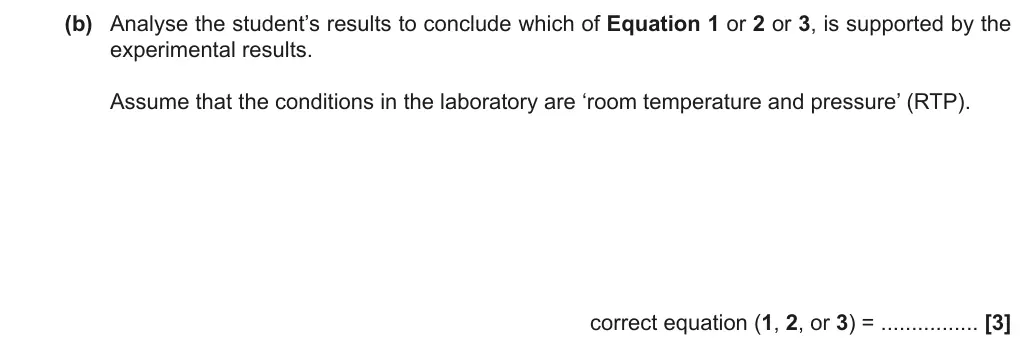
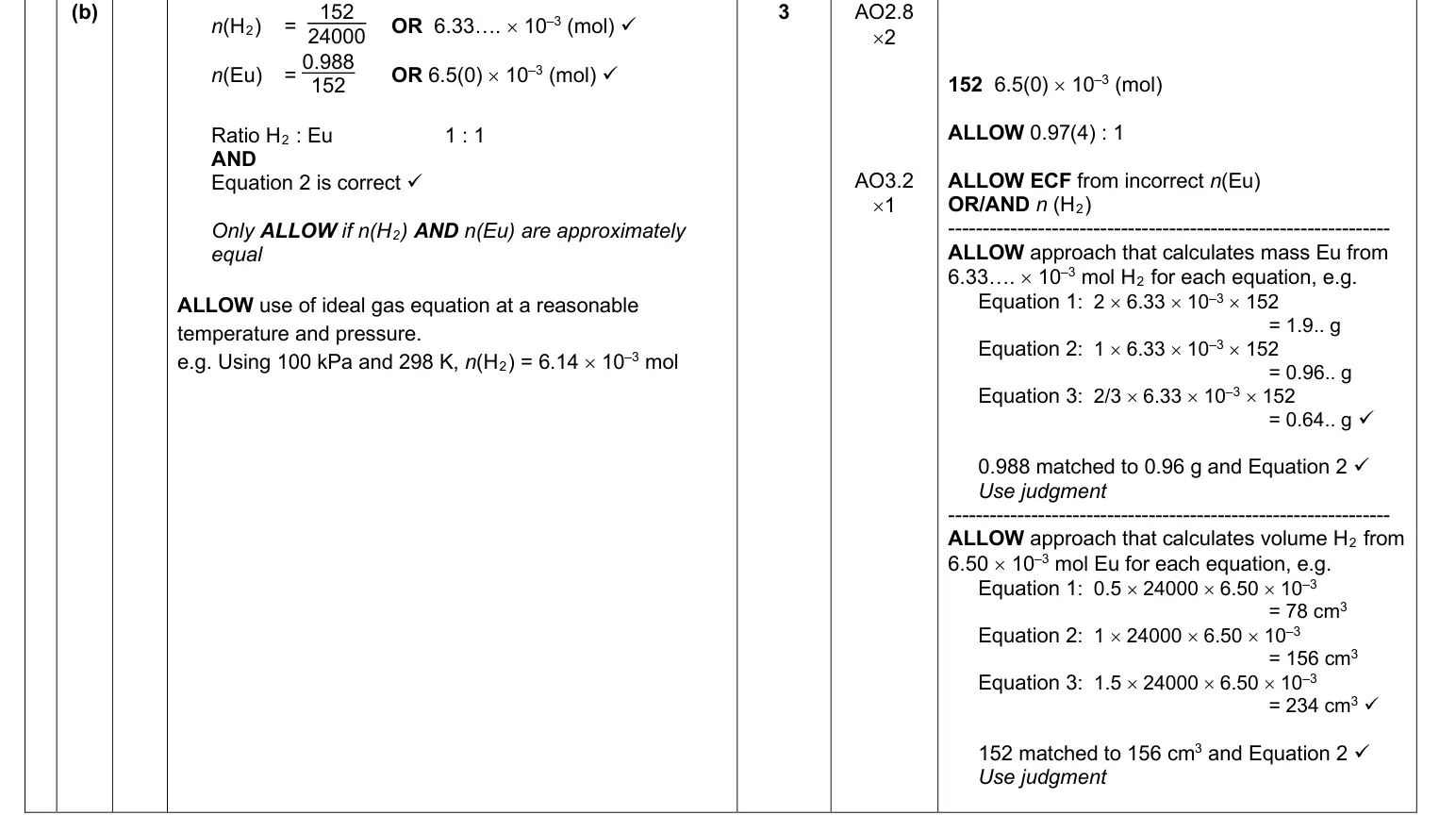
(b) Analyse the student’s results to conclude which of Equation 1 or 2 or 3, is supported by the
experimental results.
Assume that the conditions in the laboratory are ‘room temperature and pressure’ (RTP).
correct equation (1, 2, or 3) = ................ [3]
November 2021 · Paper 3 · Q2(c) 2 marks AO3 Short answer Hard practical skills
Earlier parts of question 2 that this part usesEarlier part of November 2021 Paper 3 question 2Earlier part of November 2021 Paper 3 question 2
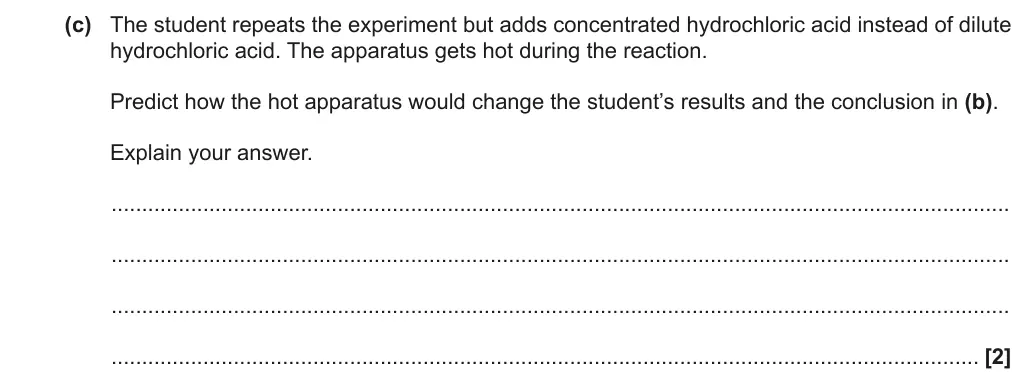
(c) The student repeats the experiment but adds concentrated hydrochloric acid instead of dilute
hydrochloric acid. The apparatus gets hot during the reaction.
Predict how the hot apparatus would change the student’s results and the conclusion in (b).
Explain your answer.
...................................................................................................................................................
...................................................................................................................................................
...................................................................................................................................................
.............................................................................................................................................. [2]
November 2021 · Paper 3 · Q2(d) 2 marks AO3 Short answer Hard practical skillsamount of substance
Earlier part of question 2 that this part usesEarlier part of November 2021 Paper 3 question 2
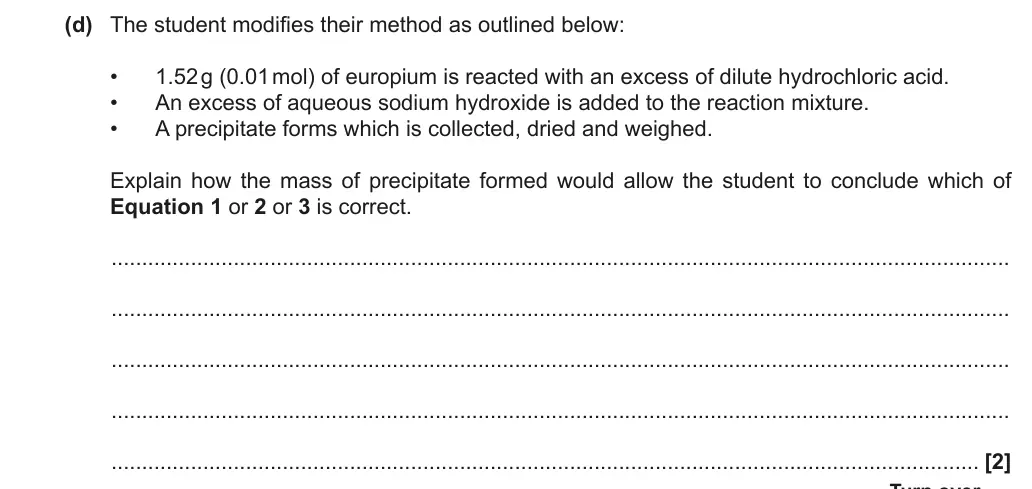
(d) The student modifies their method as outlined below:
• 1.52 g (0.01 mol) of europium is reacted with an excess of dilute hydrochloric acid.
• An excess of aqueous sodium hydroxide is added to the reaction mixture.
• A precipitate forms which is collected, dried and weighed.
Explain how the mass of precipitate formed would allow the student to conclude which of
Equation 1 or 2 or 3 is correct.
...................................................................................................................................................
...................................................................................................................................................
...................................................................................................................................................
...................................................................................................................................................
.............................................................................................................................................. [2]
November 2021 · Paper 3 · Q3(a) 5 marks AO1, 2 Extended response Medium acids and titrationspractical techniquesamount of substance
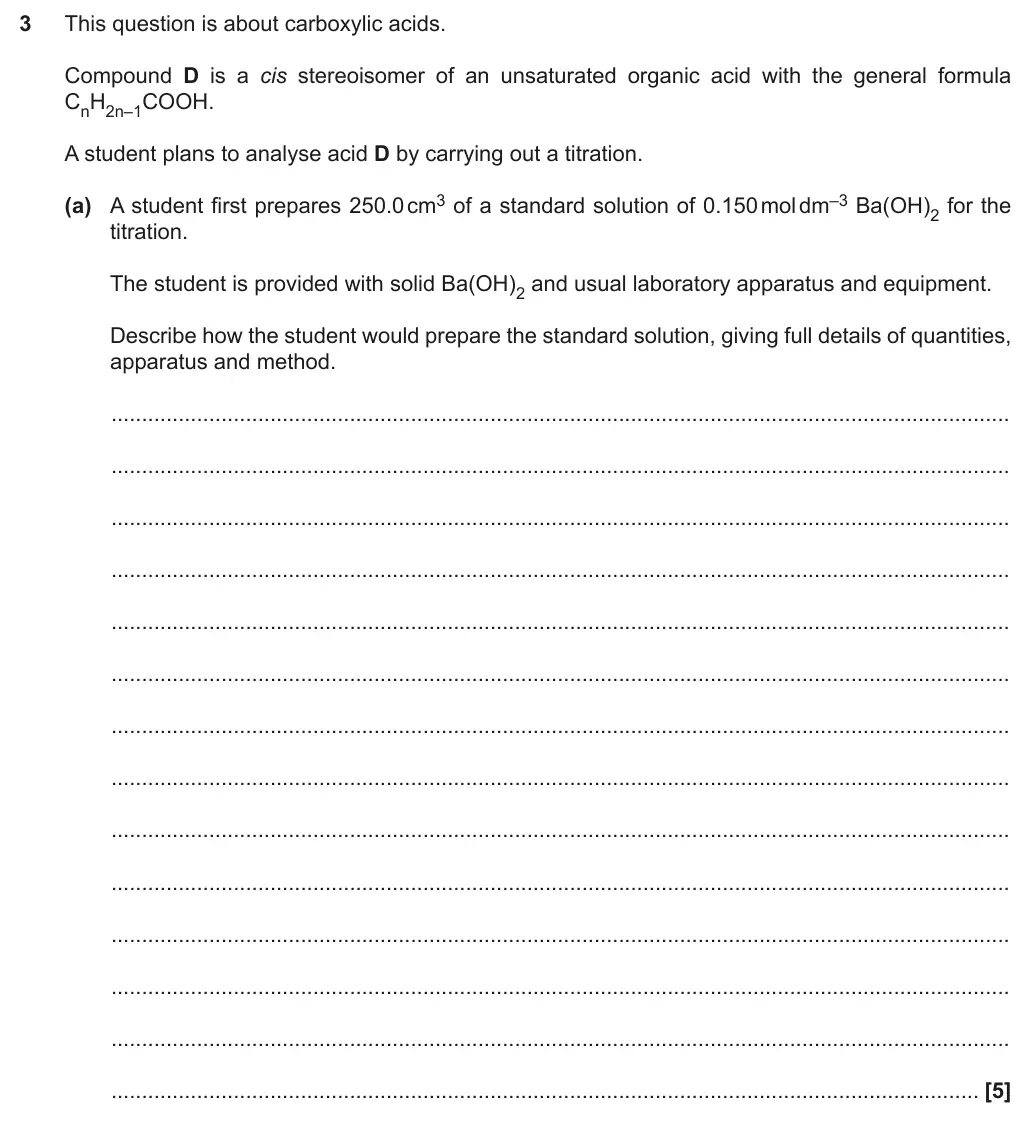
3 This question is about carboxylic acids.
Compound D is a cis stereoisomer of an unsaturated organic acid with the general formula
CnH2n–1COOH.
A student plans to analyse acid D by carrying out a titration.
(a) A student first prepares 250.0 cm3 of a standard solution of 0.150 mol dm–3 Ba(OH)2 for the

titration.
The student is provided with solid Ba(OH)2 and usual laboratory apparatus and equipment.
Describe how the student would prepare the standard solution, giving full details of quantities,
apparatus and method.
...................................................................................................................................................
...................................................................................................................................................
...................................................................................................................................................
...................................................................................................................................................
...................................................................................................................................................
...................................................................................................................................................
...................................................................................................................................................
...................................................................................................................................................
...................................................................................................................................................
...................................................................................................................................................
...................................................................................................................................................
...................................................................................................................................................
...................................................................................................................................................
.............................................................................................................................................. [5]
November 2021 · Paper 3 · Q3(b) 7 marks AO2, 3 Data interpretation Hard acids and titrationsamount of substanceorganic basicsalkenes
Earlier part of question 3 that this part usesEarlier part of November 2021 Paper 3 question 3
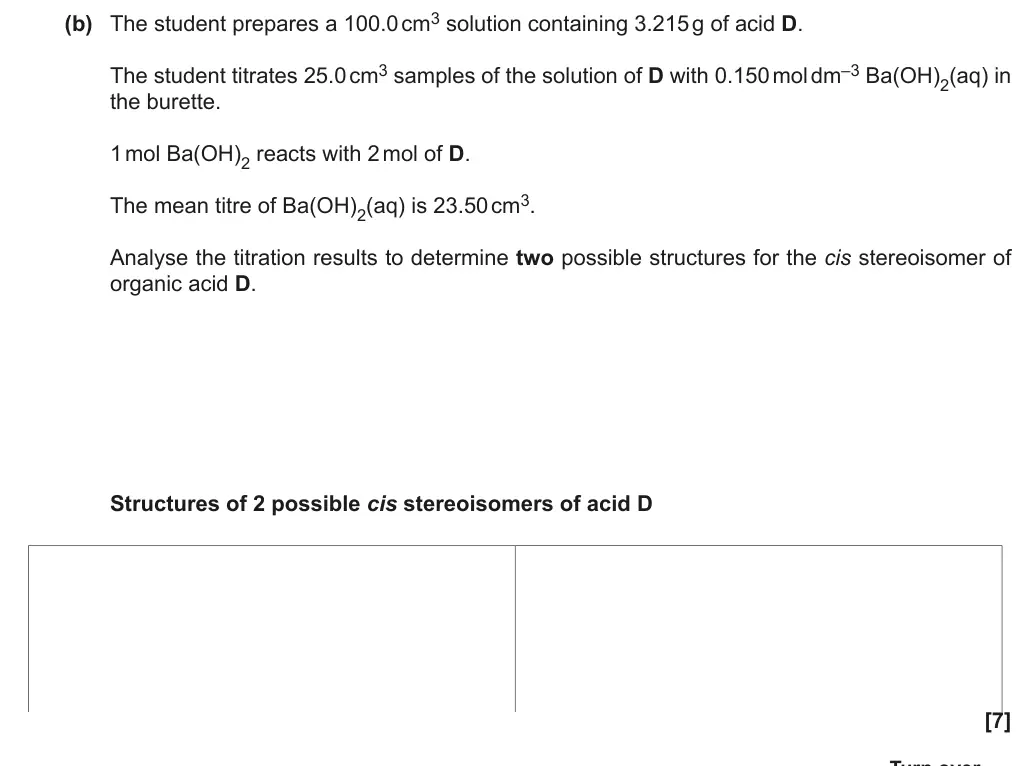
(b) The student prepares a 100.0 cm3 solution containing 3.215 g of acid D.
The student titrates 25.0 cm3 samples of the solution of D with 0.150 mol dm–3 Ba(OH)2(aq) in
the burette.
1 mol Ba(OH)2 reacts with 2 mol of D.
The mean titre of Ba(OH)2(aq) is 23.50 cm3.
Analyse the titration results to determine two possible structures for the cis stereoisomer of
organic acid D.
Structures of 2 possible cis stereoisomers of acid D
[7]
November 2021 · Paper 3 · Q4(a) 1 mark AO3 Short answer Medium rate equations
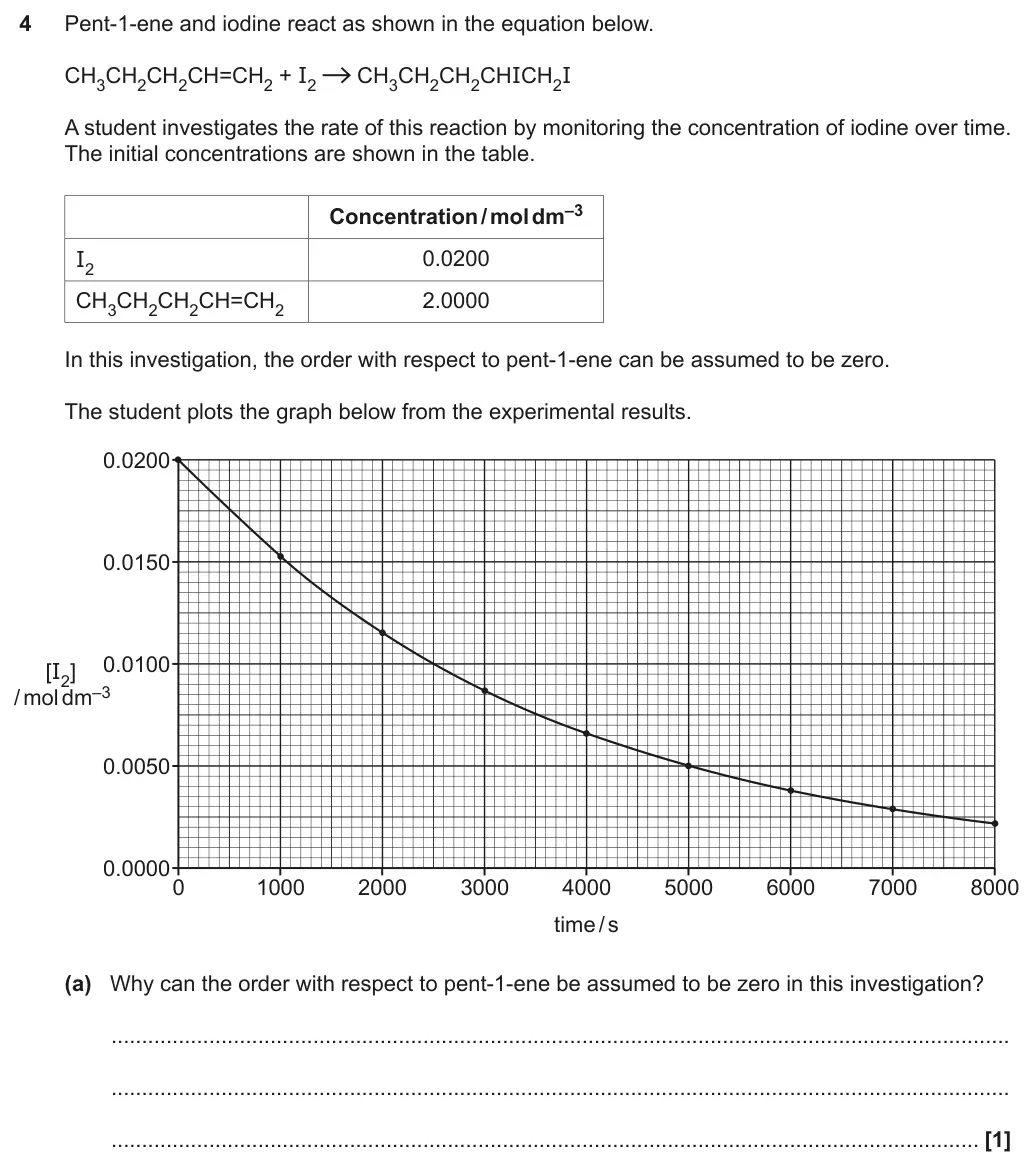
4 Pent-1-ene and iodine react as shown in the equation below.
CH3CH2CH2CH=CH2 + I2 CH3CH2CH2CHICH2I
A student investigates the rate of this reaction by monitoring the concentration of iodine over time.
The initial concentrations are shown in the table.
Concentration / mol dm–3
I2 0.0200
CH3CH2CH2CH=CH2 2.0000
In this investigation, the order with respect to pent-1-ene can be assumed to be zero.
The student plots the graph below from the experimental results.
0.0200
0.0150
[I2] 0.0100
/ mol dm–3
0.0050
0.0000
0 1000 2000 3000 4000 5000 6000 7000 8000
time / s
(a) Why can the order with respect to pent-1-ene be assumed to be zero in this investigation?
...................................................................................................................................................
...................................................................................................................................................
.............................................................................................................................................. [1]
November 2021 · Paper 3 · Q4(b) 6 marks AO3 6-mark level of response Hard rate equations
Earlier part of question 4 that this part usesEarlier part of November 2021 Paper 3 question 4
(b)* The student’s experimental procedure shows that the reaction is first order with respect to
iodine.
Show that this statement is true and determine the initial rate of reaction and rate constant.
Assume that the reaction is zero order with respect to pent-1-ene. Show your working on the
graph on page 10 and the lines below as appropriate. [6]
...................................................................................................................................................
...................................................................................................................................................
...................................................................................................................................................
...................................................................................................................................................
...................................................................................................................................................
...................................................................................................................................................
...................................................................................................................................................
...................................................................................................................................................
...................................................................................................................................................
...................................................................................................................................................
...................................................................................................................................................
...................................................................................................................................................
...................................................................................................................................................
...................................................................................................................................................
...................................................................................................................................................
...................................................................................................................................................
Additional answer space if required.
...................................................................................................................................................
...................................................................................................................................................
...................................................................................................................................................
...................................................................................................................................................
...................................................................................................................................................
November 2021 · Paper 3 · Q4(c)(i) 2 marks AO2 Equation writing Medium rate equations
Earlier part of question 4 that this part usesEarlier part of November 2021 Paper 3 question 4
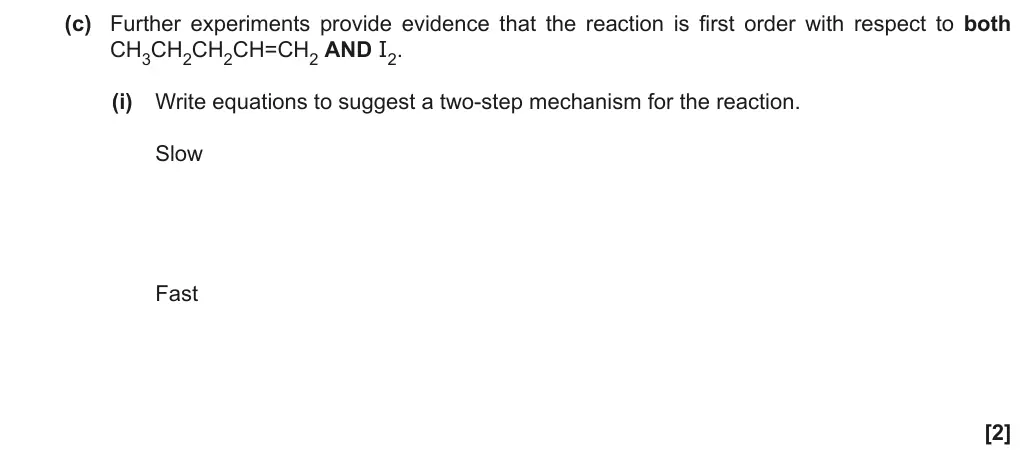
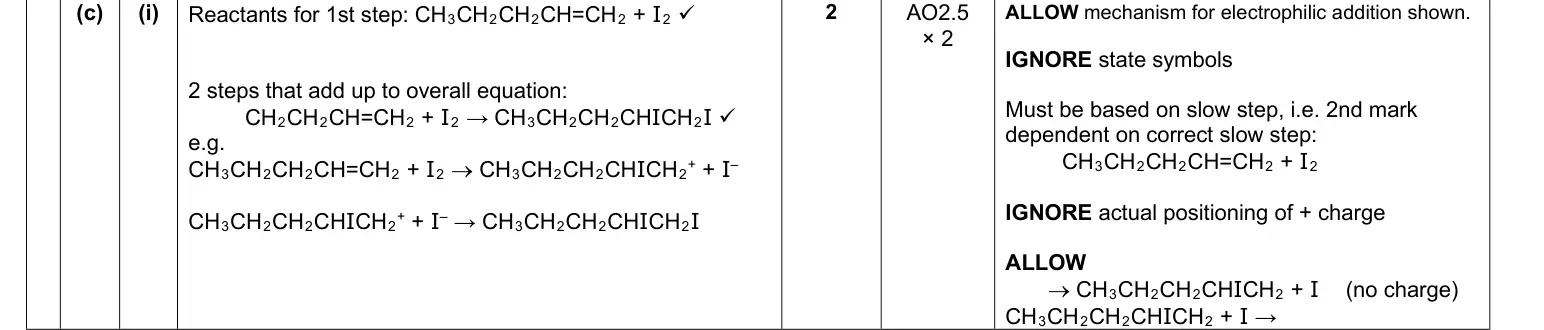
(c) Further experiments provide evidence that the reaction is first order with respect to both
CH3CH2CH2CH=CH2 AND I2.
(i) Write equations to suggest a two-step mechanism for the reaction.
Slow
Fast
[2]
November 2021 · Paper 3 · Q4(c)(ii) 2 marks AO3 Short answer Medium rate equationspractical skills
Earlier part of question 4 that this part usesEarlier part of November 2021 Paper 3 question 4
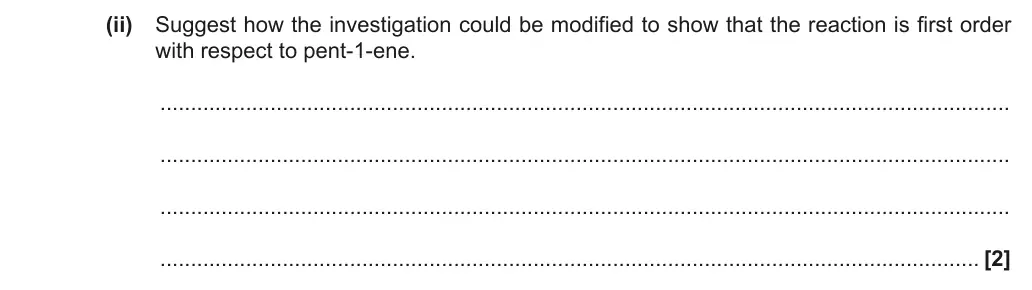
(ii) Suggest how the investigation could be modified to show that the reaction is first order
with respect to pent-1-ene.
...........................................................................................................................................
...........................................................................................................................................
...........................................................................................................................................
...................................................................................................................................... [2]
November 2021 · Paper 3 · Q5(a)(i) 2 marks AO1 Equation writing Hard redox and electrode potentialsredox
5 This question is about nitrogen and its compounds.
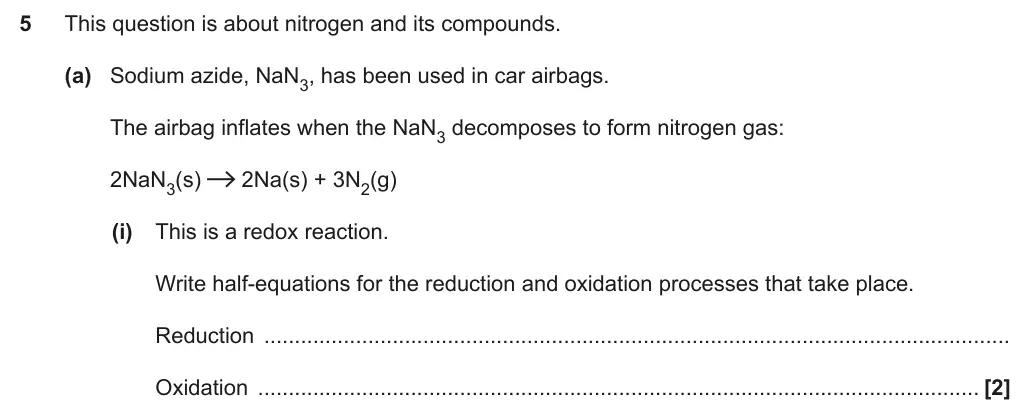
(a) Sodium azide, NaN3, has been used in car airbags.
The airbag inflates when the NaN3 decomposes to form nitrogen gas:
2NaN3(s) 2Na(s) + 3N2(g)
(i) This is a redox reaction.
Write half-equations for the reduction and oxidation processes that take place.
Reduction  ..........................................................................................................................
Oxidation  ...................................................................................................................... [2]
November 2021 · Paper 3 · Q5(a)(ii) 5 marks AO2 Calculation Hard amount of substance
Earlier part of question 5 that this part usesEarlier part of November 2021 Paper 3 question 5
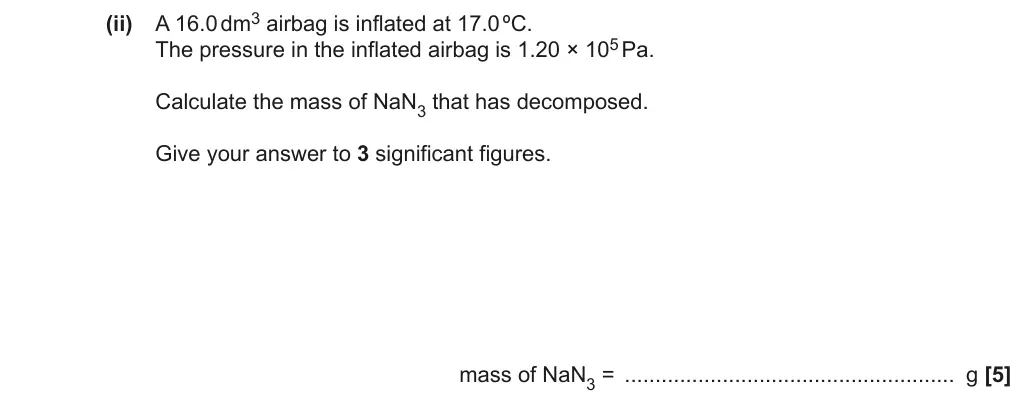
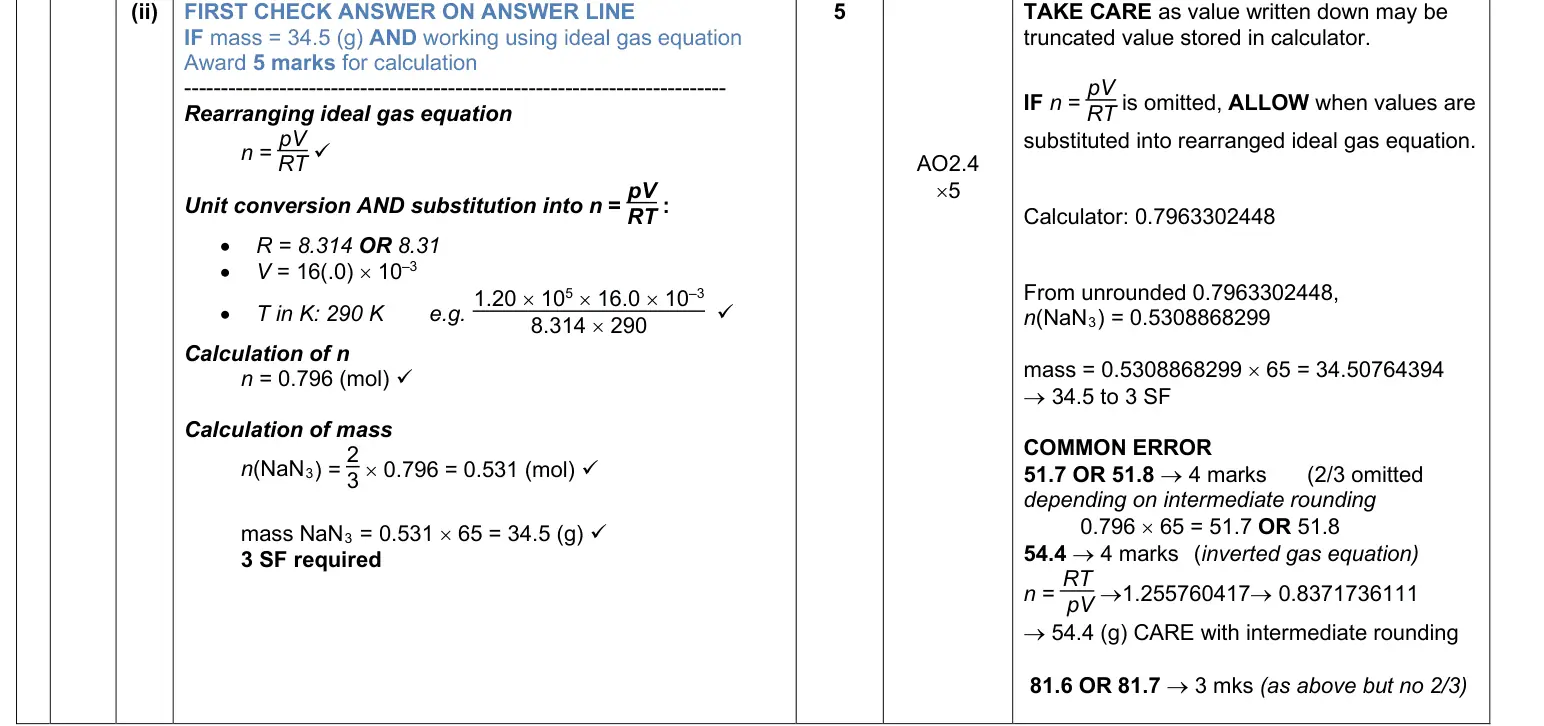
(ii) A 16.0 dm3 airbag is inflated at 17.0 ºC.
The pressure in the inflated airbag is 1.20 × 10⁵ Pa.
Calculate the mass of NaN3 that has decomposed.
Give your answer to 3 significant figures.
mass of NaN3 =  ...................................................... g [5]
November 2021 · Paper 3 · Q5(b)(i) 2 marks AO2 Calculation Hard acids bases and buffers
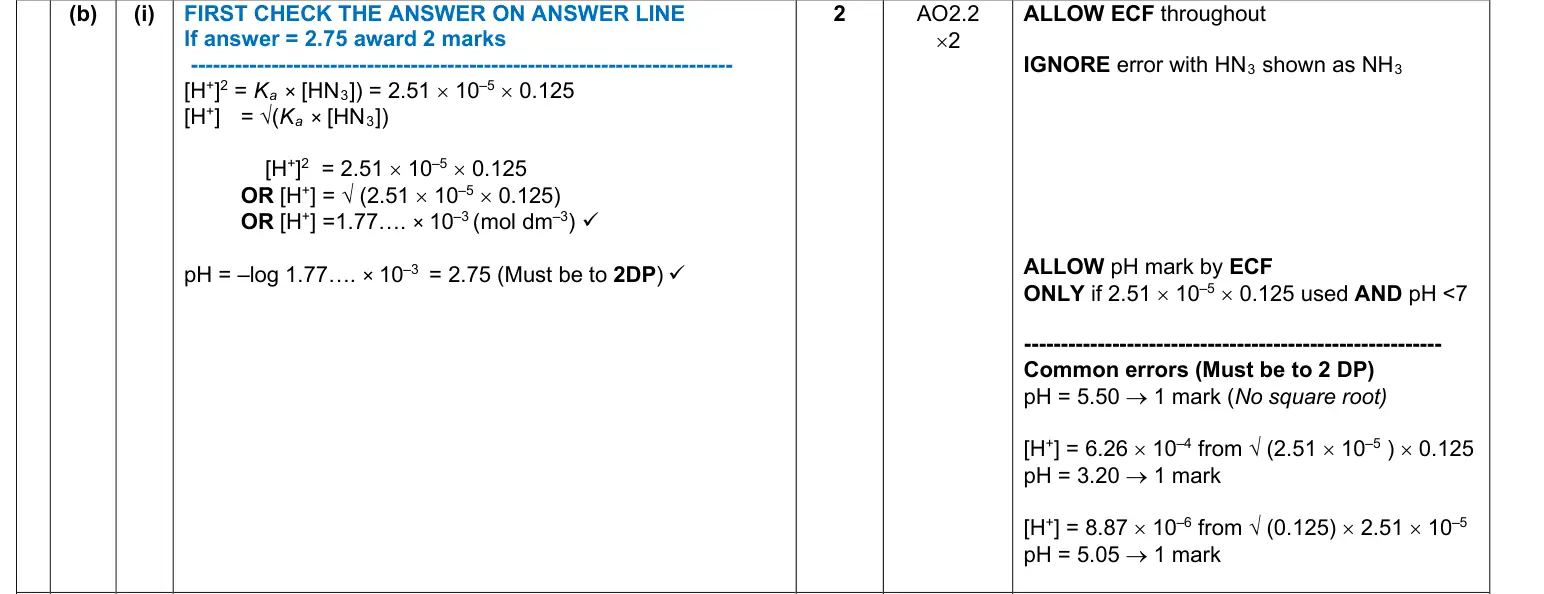
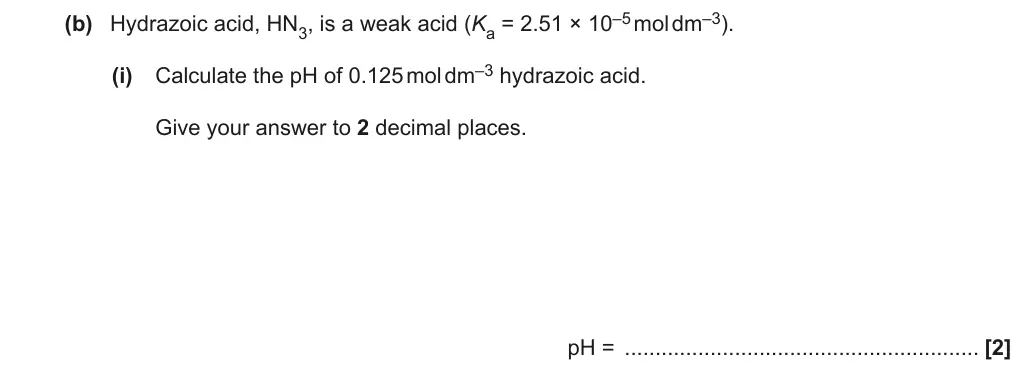
(b) Hydrazoic acid, HN3, is a weak acid (Ka = 2.51 × 10⁻⁵ mol dm–3).
(i) Calculate the pH of 0.125 mol dm–3 hydrazoic acid.
Give your answer to 2 decimal places.
pH =  .......................................................... [2]
November 2021 · Paper 3 · Q5(b)(ii) 2 marks AO1 Complete table/diagram Medium acids bases and buffers
Earlier part of question 5 that this part usesEarlier part of November 2021 Paper 3 question 5
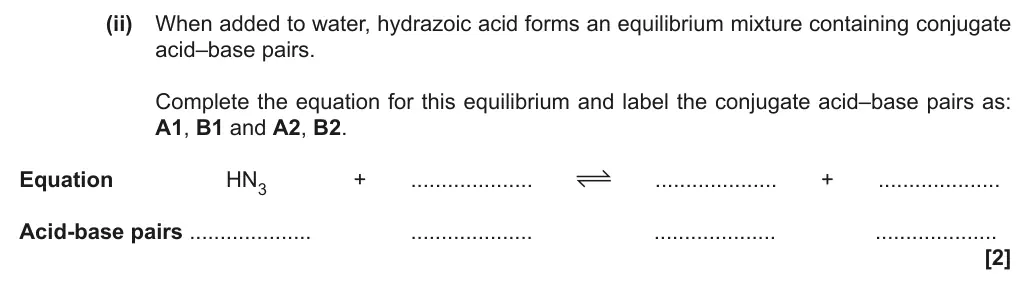
(ii) When added to water, hydrazoic acid forms an equilibrium mixture containing conjugate
acid–base pairs.
Complete the equation for this equilibrium and label the conjugate acid–base pairs as:
A1, B1 and A2, B2.
Equation HN3         +  .................... ....................  +  ....................
Acid-base pairs  ....................     ....................      ....................     ....................
[2]
November 2021 · Paper 3 · Q5(b)(iii) 3 marks AO2, 3 Equation writing Medium organic synthesisformulae and equationsorganic basics
Earlier part of question 5 that this part usesEarlier part of November 2021 Paper 3 question 5
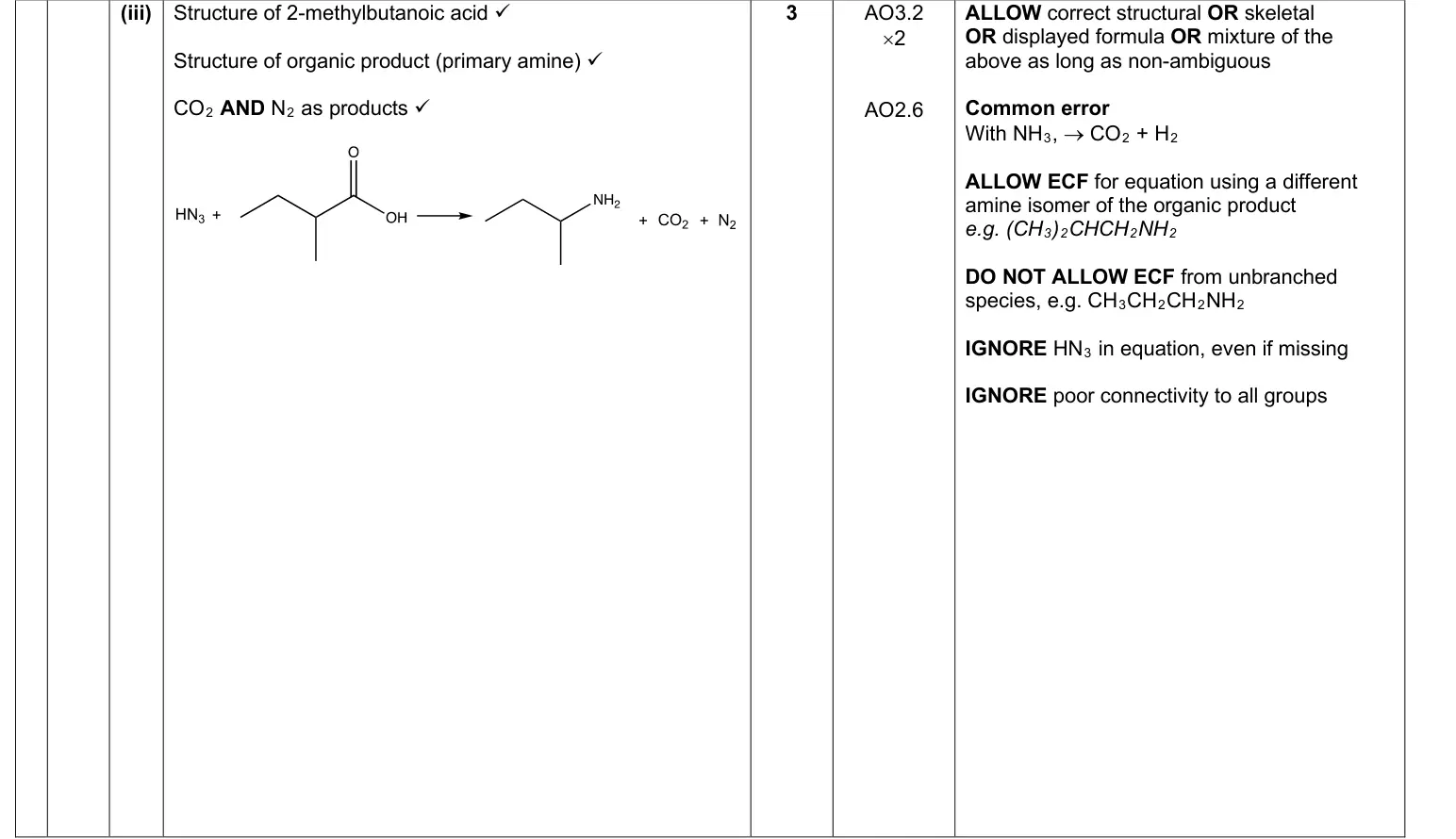
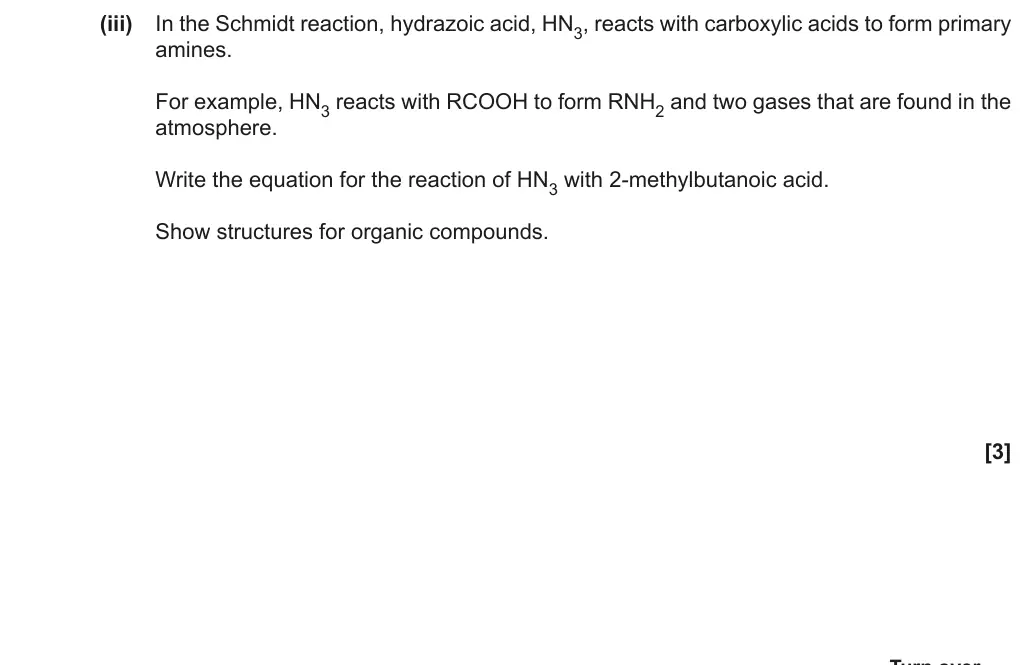
(iii) In the Schmidt reaction, hydrazoic acid, HN3, reacts with carboxylic acids to form primary
amines.
For example, HN3 reacts with RCOOH to form RNH2 and two gases that are found in the
atmosphere.
Write the equation for the reaction of HN3 with 2-methylbutanoic acid.
Show structures for organic compounds.
[3]
November 2021 · Paper 3 · Q5(c) 6 marks AO3 6-mark level of response Hard amount of substanceformulae and equationsinfrared and mass spectrometrycarboxylic acids and esters
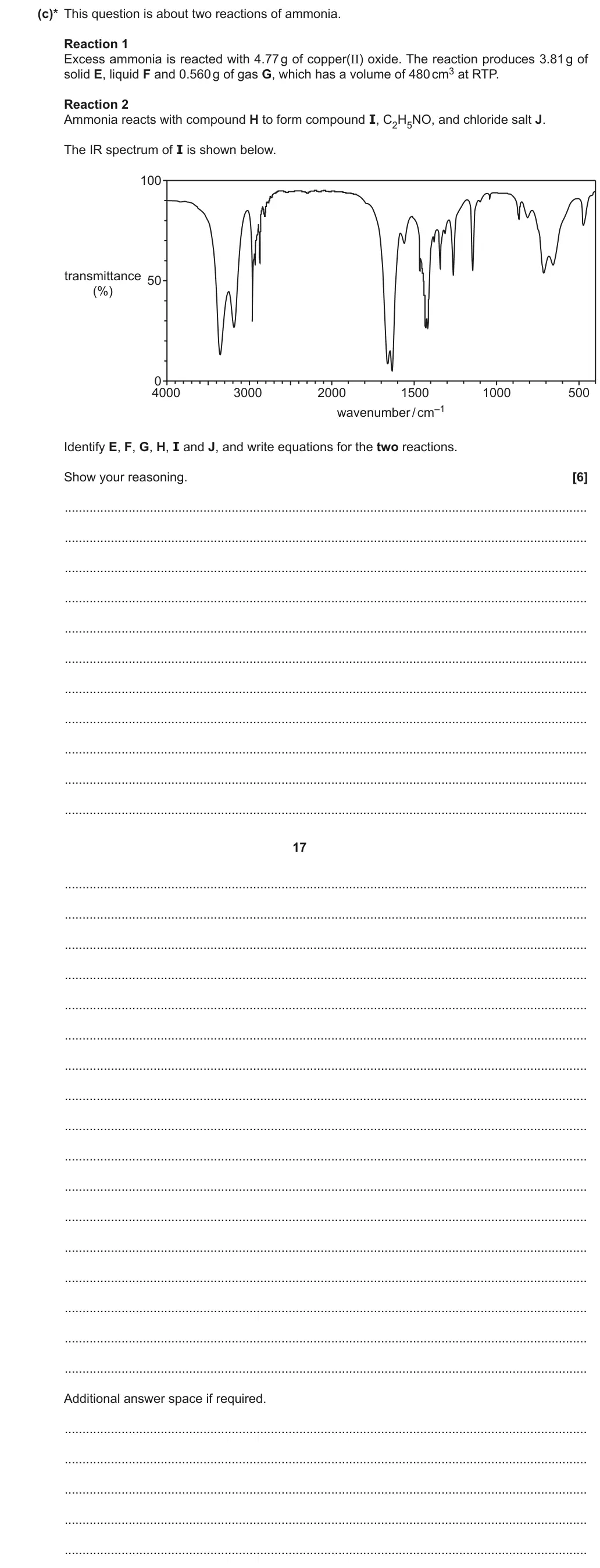
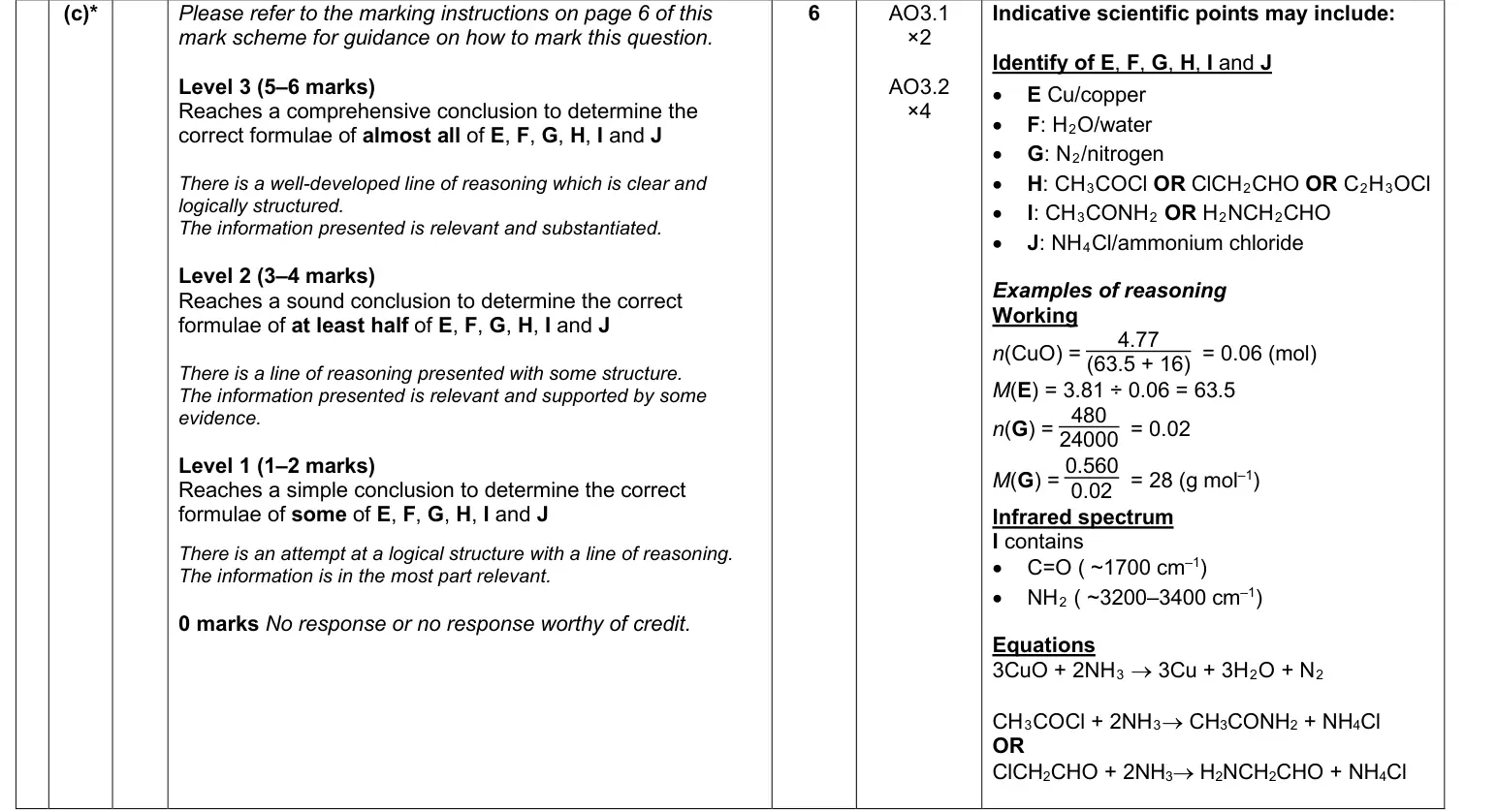
(c)* This question is about two reactions of ammonia.
Reaction 1
Excess ammonia is reacted with 4.77 g of copper(II) oxide. The reaction produces 3.81 g of
solid E, liquid F and 0.560 g of gas G, which has a volume of 480 cm3 at RTP.
Reaction 2
Ammonia reacts with compound H to form compound I, C2H5NO, and chloride salt J.
The IR spectrum of I is shown below.
100
transmittance
50
(%)
0
4000 3000 2000 1500 1000 500
wavenumber / cm–1
Identify E, F, G, H, I and J, and write equations for the two reactions.
Show your reasoning. [6]
...................................................................................................................................................
...................................................................................................................................................
...................................................................................................................................................
...................................................................................................................................................
...................................................................................................................................................
...................................................................................................................................................
...................................................................................................................................................
...................................................................................................................................................
...................................................................................................................................................
...................................................................................................................................................
...................................................................................................................................................
...................................................................................................................................................
...................................................................................................................................................
...................................................................................................................................................
...................................................................................................................................................
...................................................................................................................................................
...................................................................................................................................................
...................................................................................................................................................
...................................................................................................................................................
...................................................................................................................................................
...................................................................................................................................................
...................................................................................................................................................
...................................................................................................................................................
...................................................................................................................................................
...................................................................................................................................................
...................................................................................................................................................
...................................................................................................................................................
...................................................................................................................................................
Additional answer space if required.
...................................................................................................................................................
...................................................................................................................................................
...................................................................................................................................................
...................................................................................................................................................
...................................................................................................................................................

Work with an OCR chemistry tutor

Want a paper marked and gone through with you? Message us.

Prefer email? Send an enquiry

If you are under 18, please include a parent's contact details. Enquiries go to enquiries@chemistryaleveltutor.com and are deleted once handled. All tutoring is online.