June 2025: AS Paper 2, Depth in chemistry

70 marks · 34 question parts · Paper, mark scheme and report on OCR's site · Have OCR's Data Sheet beside you

Question by question

QTopicMarksAOType
1(a) Acids, bases and titrations 1Short answer
1(b) Acids, bases and titrations 1Equation writing
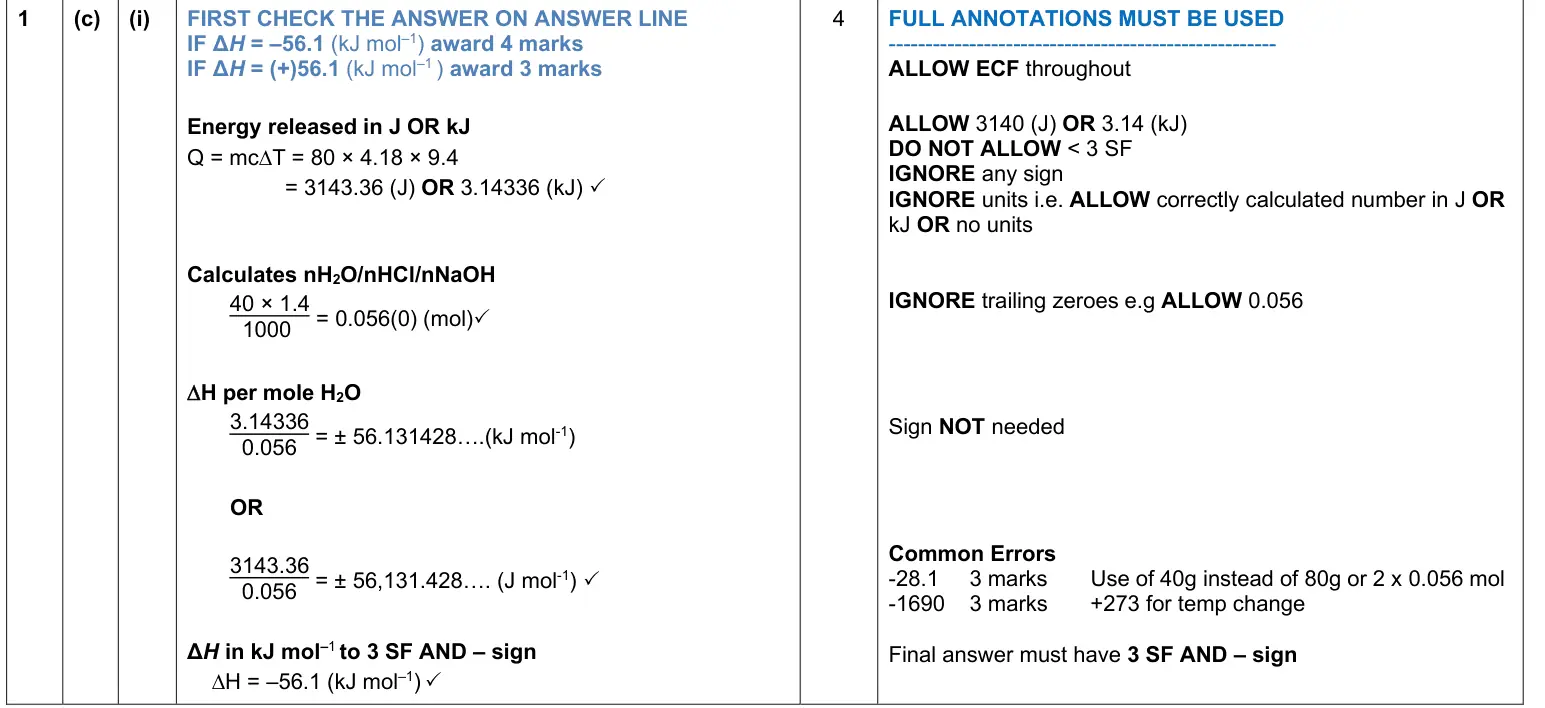
1(c)(i) Enthalpy changes and Hess’ law, Amount of substance (moles) 4Calculation
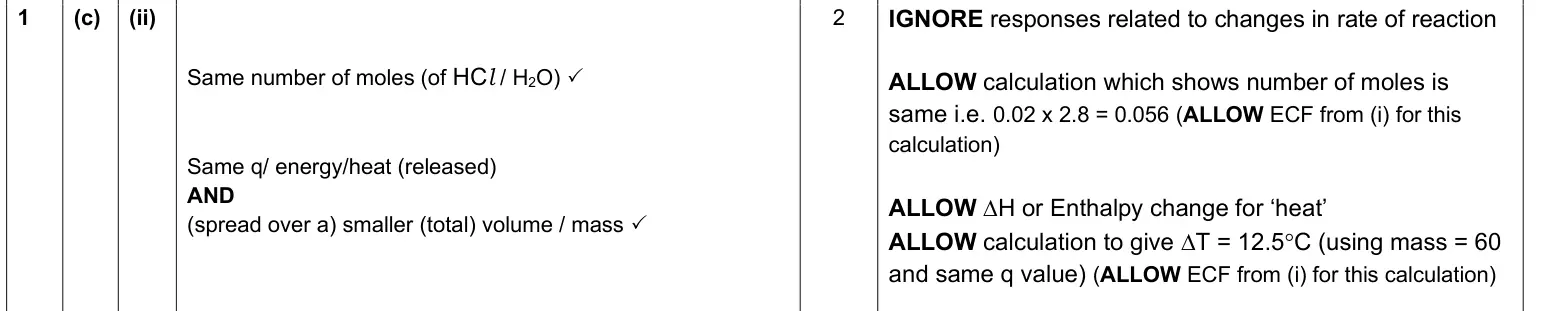
1(c)(ii) Enthalpy changes and Hess’ law 2Short answer
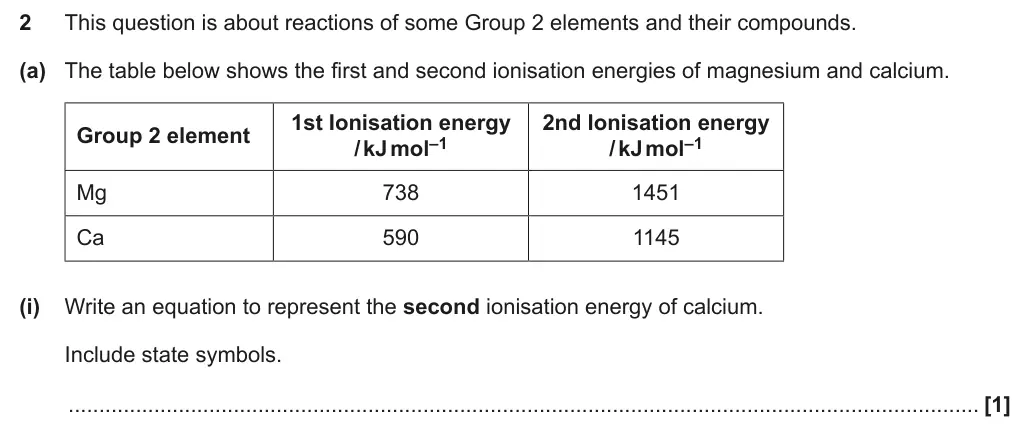
2(a)(i) Group 2, Periodicity and ionisation energy 1Equation writing
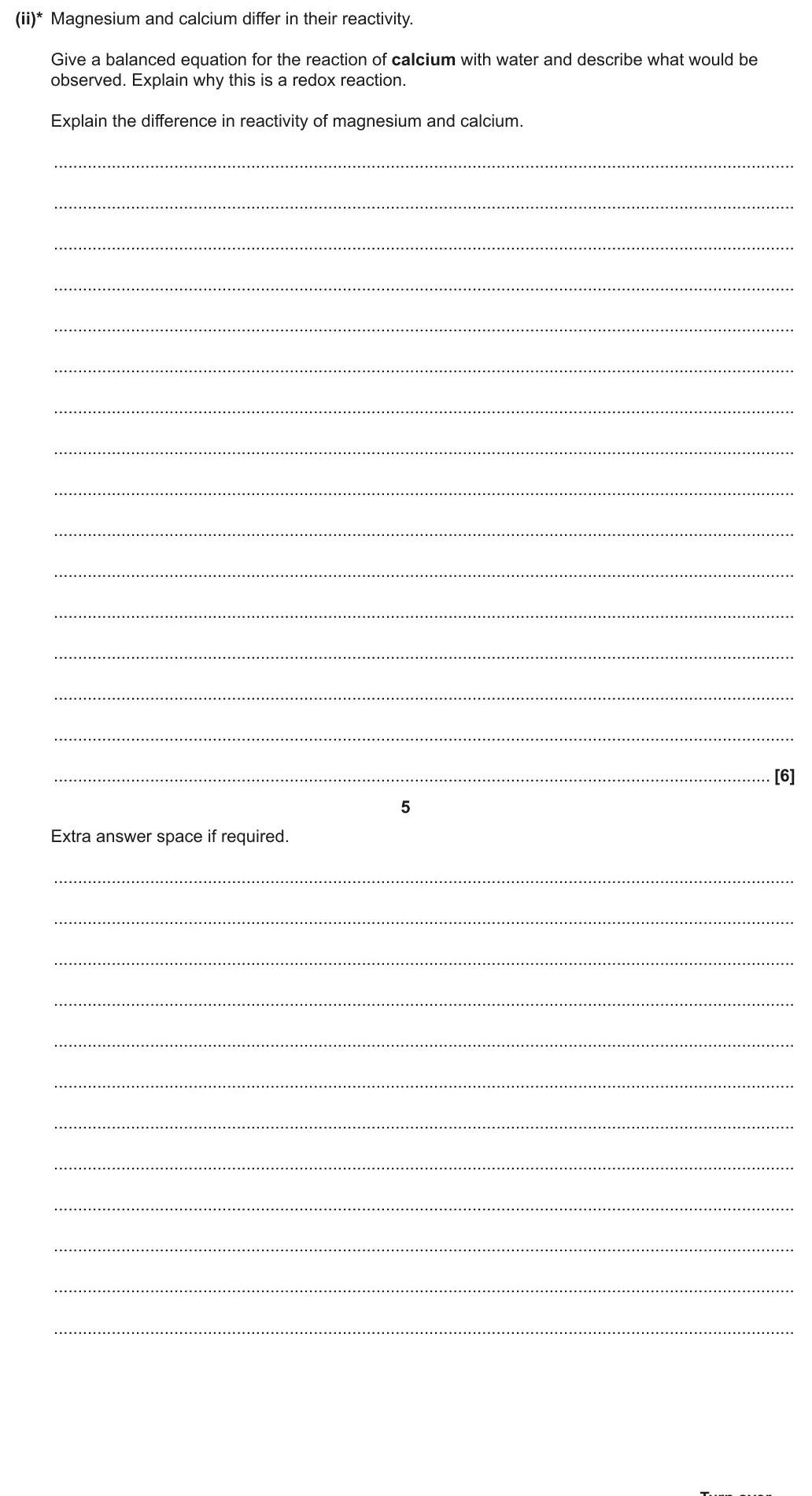
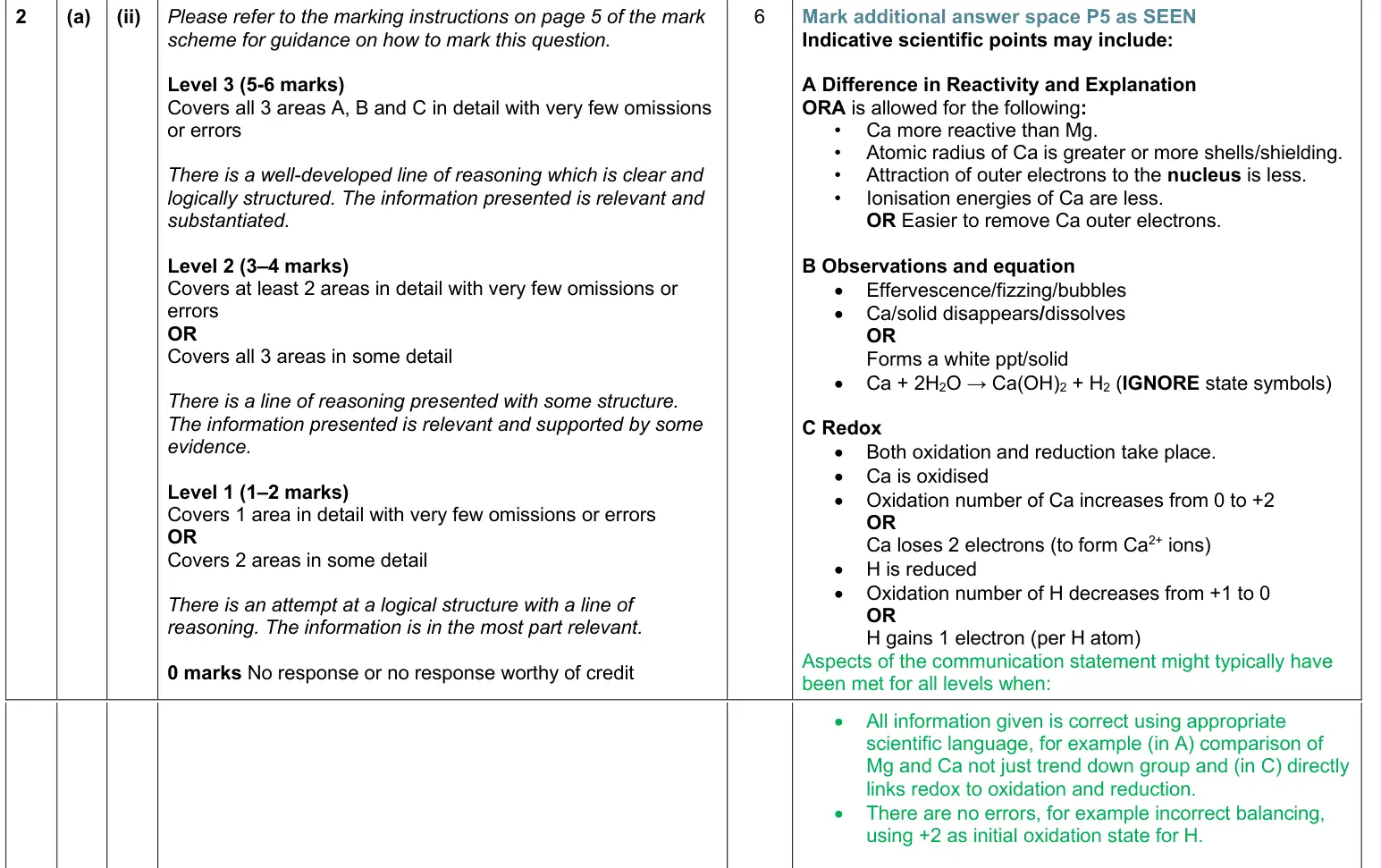
2(a)(ii) Group 2, Redox and oxidation numbers, Periodicity and ionisation energy 6Level of response
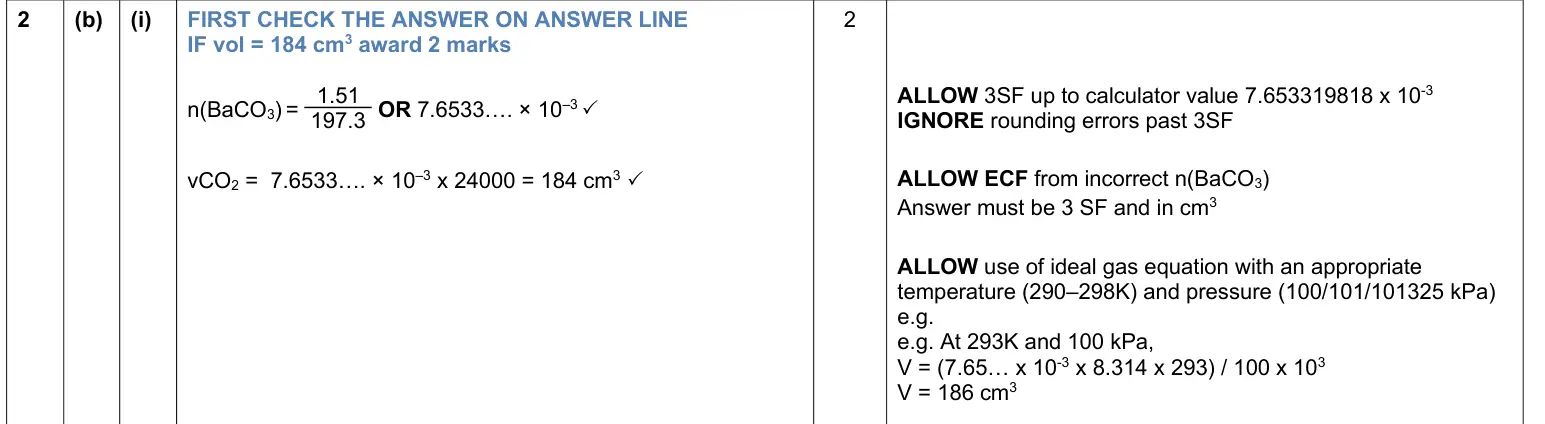
2(b)(i) Amount of substance (moles) 2Calculation
2(b)(ii) Practical skills: planning, analysis and evaluation, Amount of substance (moles) 2Short answer
2(b)(iii) Practical skills: planning, analysis and evaluation, Amount of substance (moles) 1Short answer
3(a)(i) Acids, bases and titrations, Practical techniques and apparatus (PAGs) 1Complete table/diagram
3(a)(ii) Acids, bases and titrations 1Calculation
3(a)(iii) Acids, bases and titrations, Amount of substance (moles) 5Calculation
3(b) Acids, bases and titrations, Practical skills: planning, analysis and evaluation 2Short answer
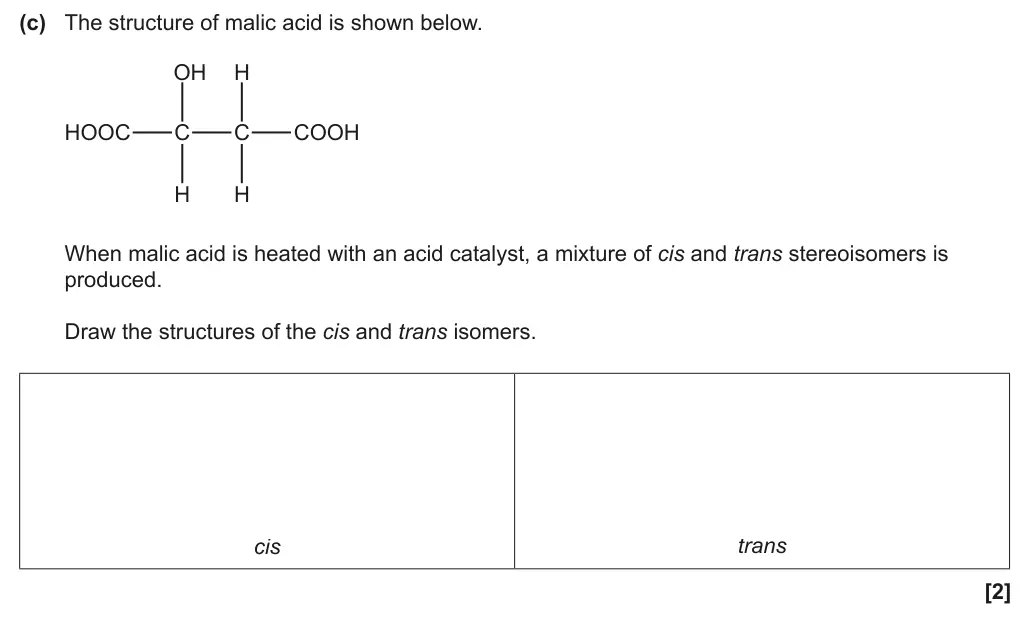
3(c) Alcohols, Alkenes, Organic synthesis and practical techniques (Module 4) 2Structure / isomer
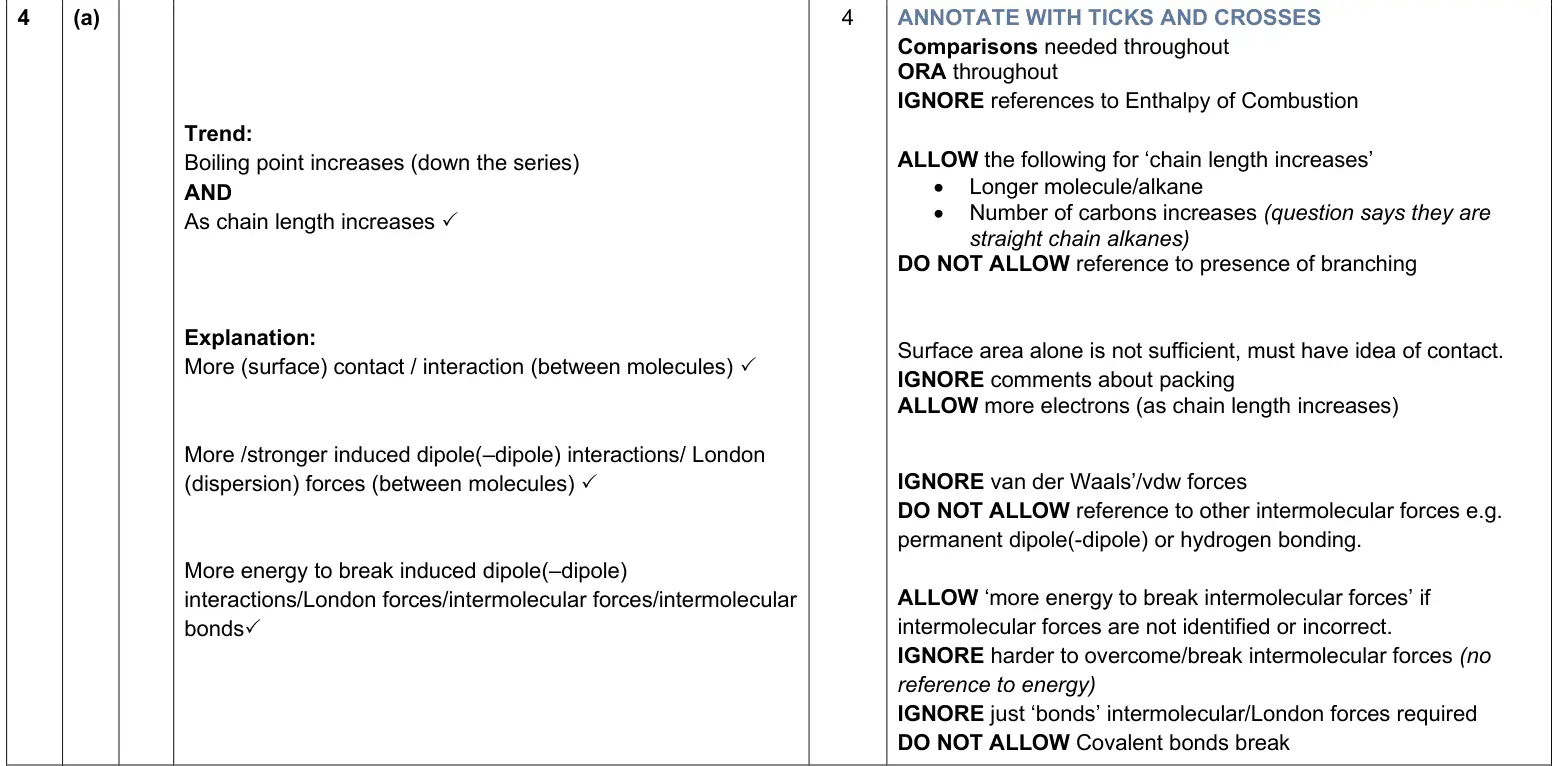
4(a) Alkanes 4Data interpretation
4(b)(i) Alkanes 1Equation writing
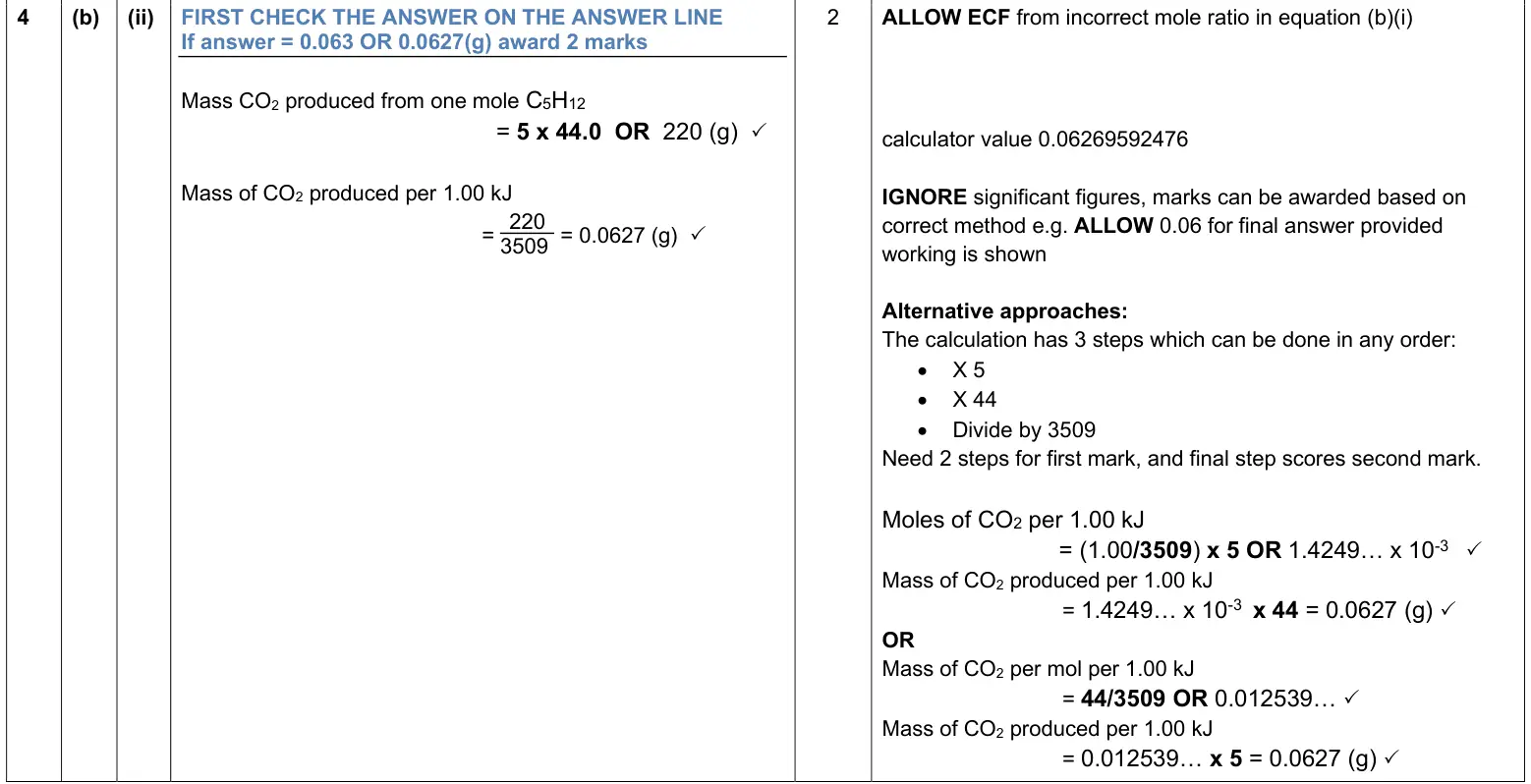
4(b)(ii) Enthalpy changes and Hess’ law, Amount of substance (moles) 2Calculation
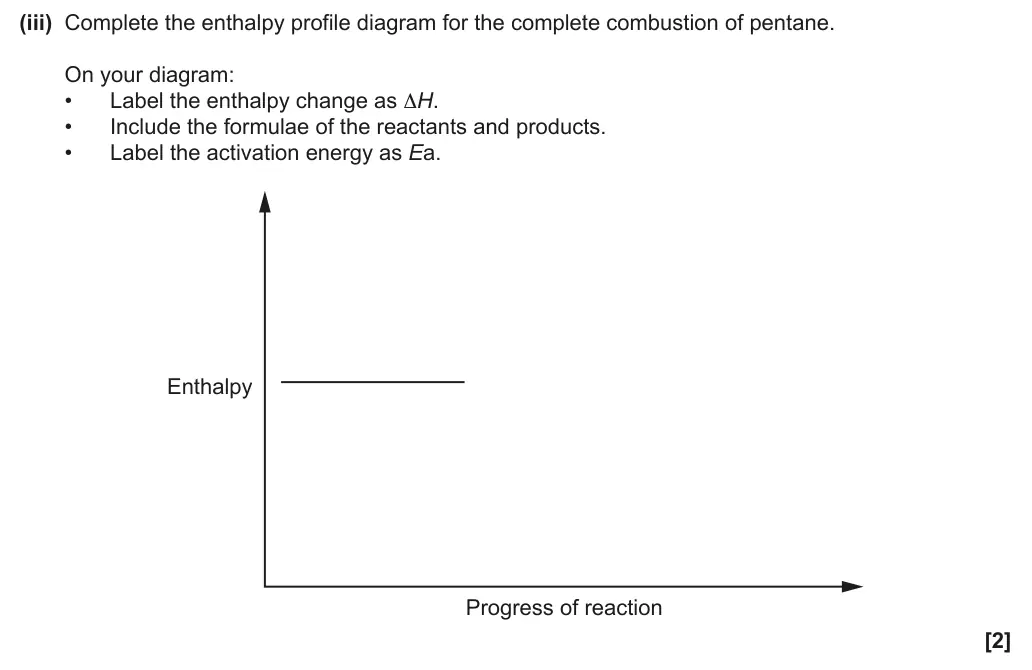
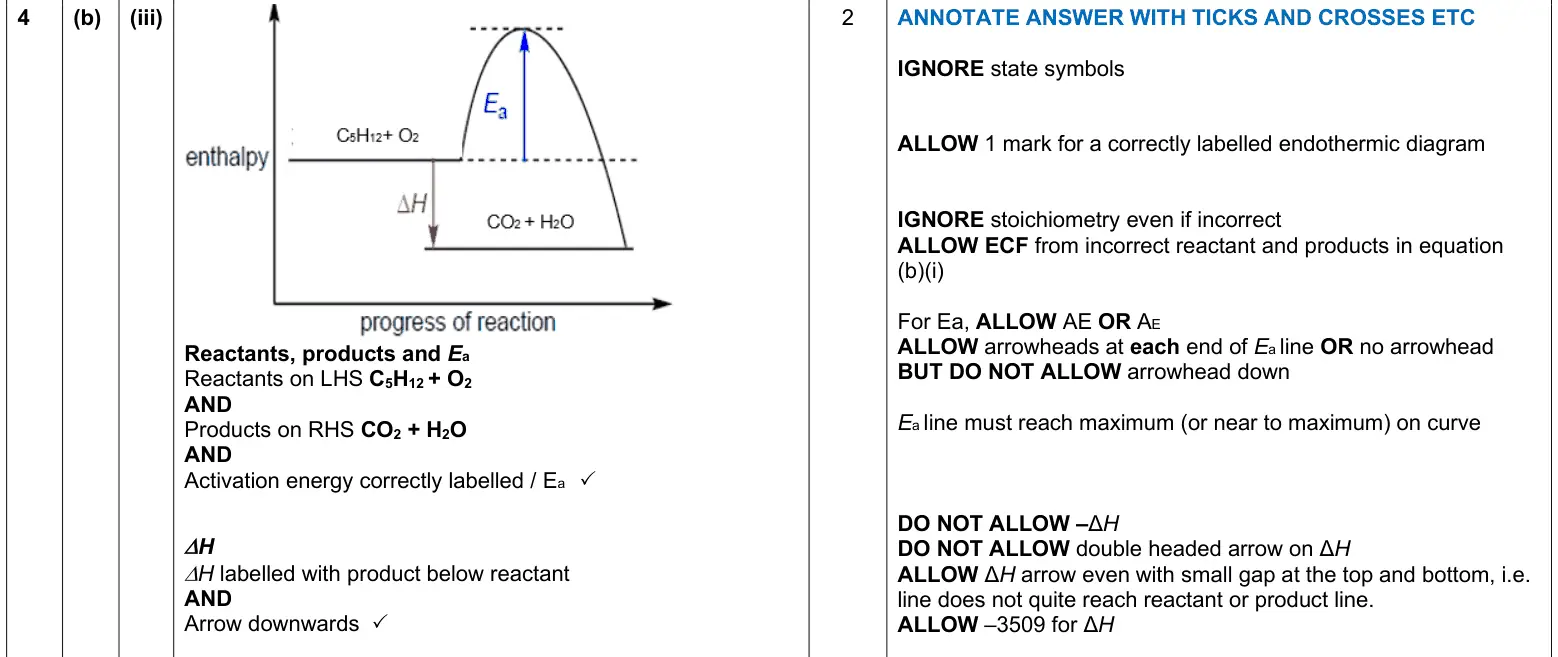
4(b)(iii) Enthalpy changes and Hess’ law 2Complete table/diagram
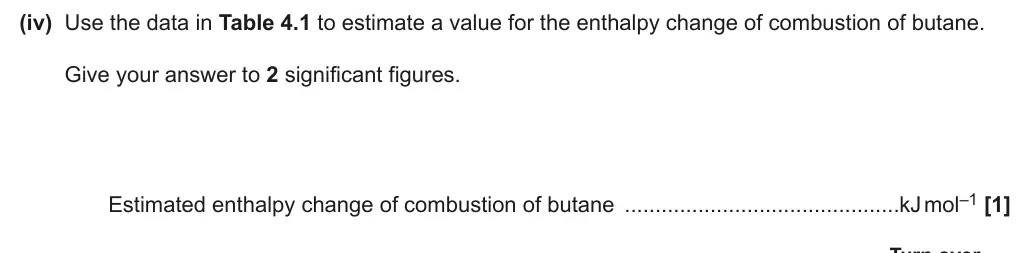
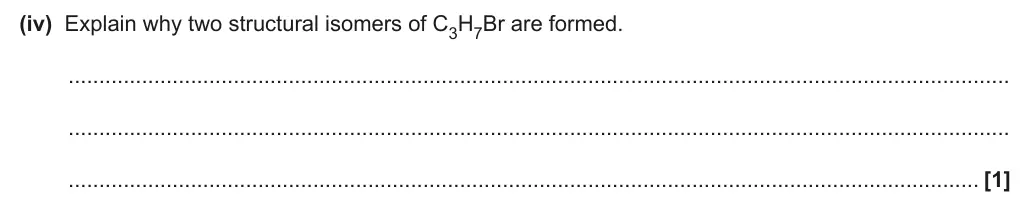
4(b)(iv) Enthalpy changes and Hess’ law, Organic basics: naming, formulae and isomerism 1Data interpretation
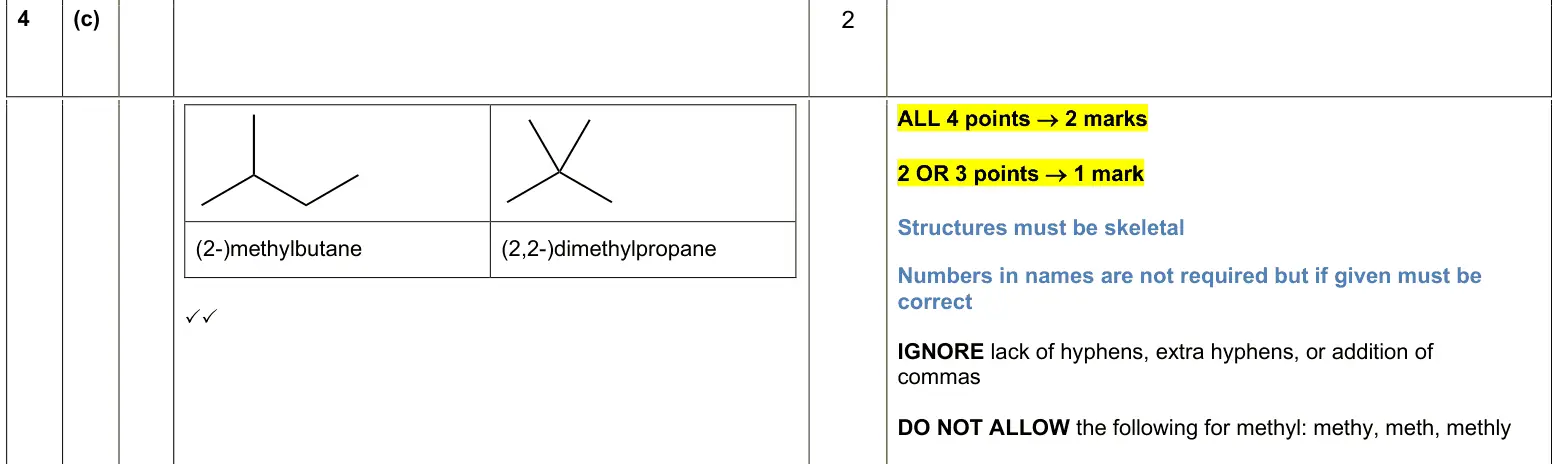
4(c) Organic basics: naming, formulae and isomerism 2Structure / isomer
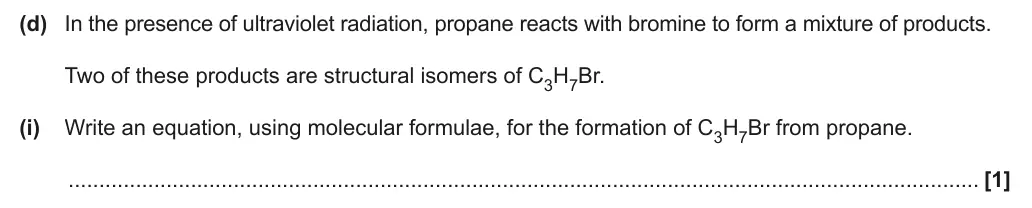
4(d)(i) Alkanes 1Equation writing
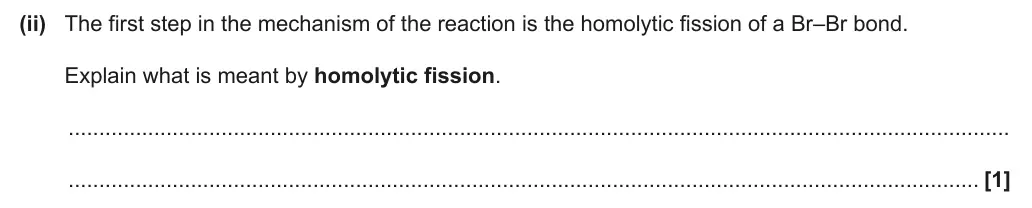
4(d)(ii) Organic basics: naming, formulae and isomerism 1Short answer
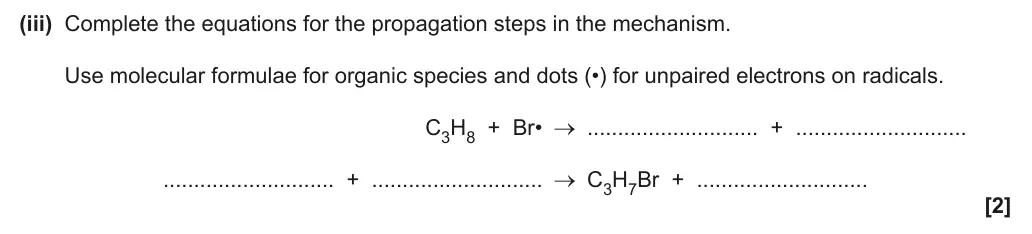
4(d)(iii) Alkanes, Organic basics: naming, formulae and isomerism 2Mechanism
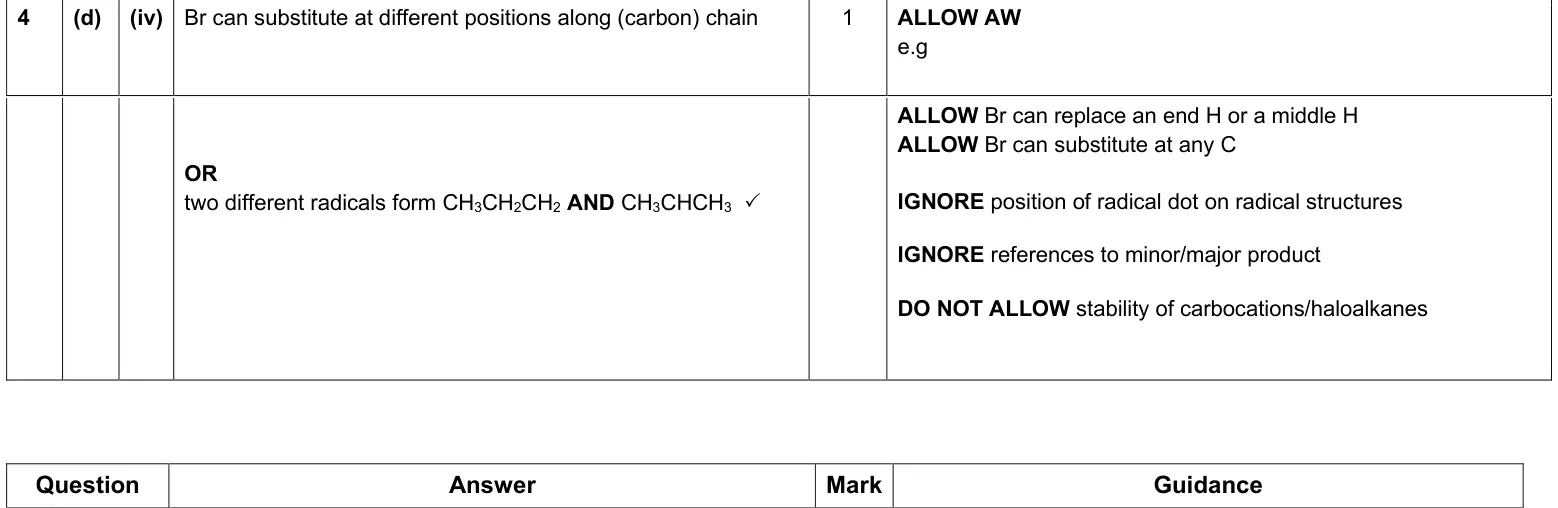
4(d)(iv) Alkanes 1Short answer
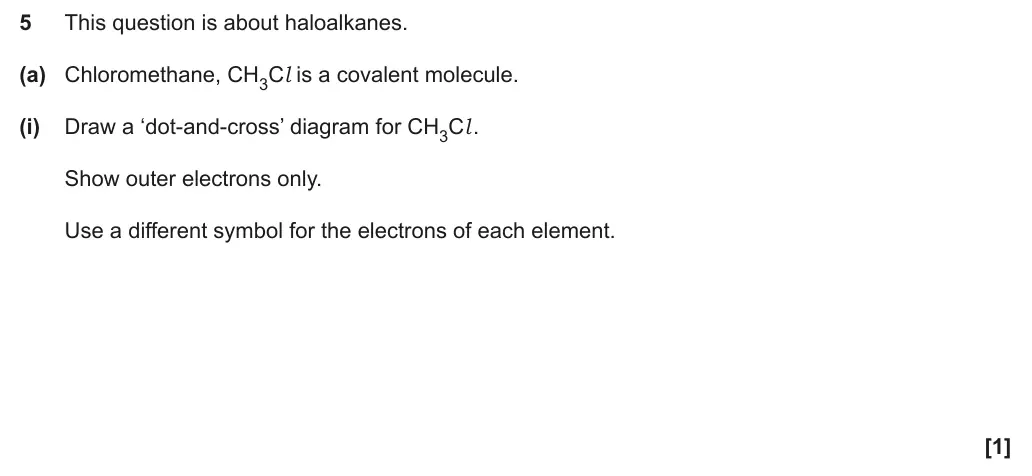
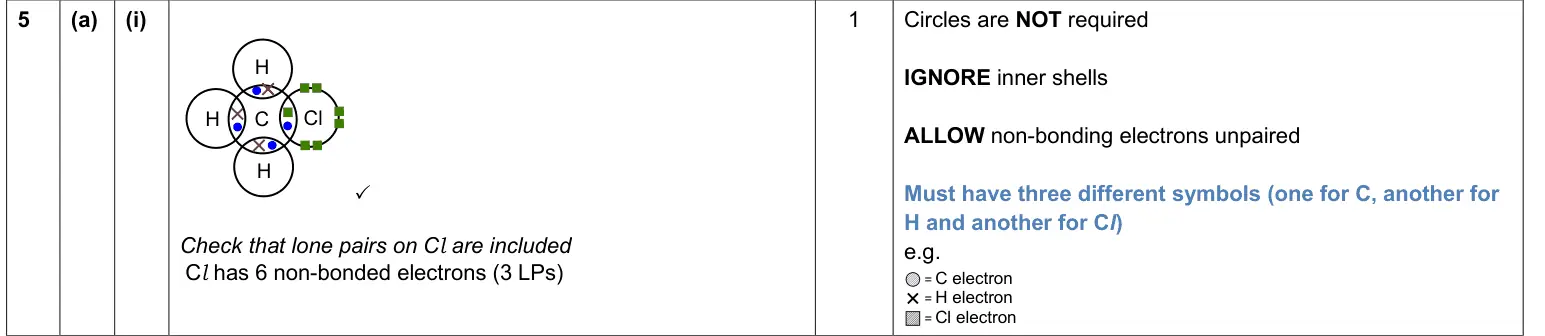
5(a)(i) Bonding, structure and shapes of molecules 1Drawing / labelling
5(a)(ii) Bonding, structure and shapes of molecules, Alkanes 2Short answer
5(b) Alkenes, Bonding, structure and shapes of molecules 3Short answer
5(c) Organic synthesis and practical techniques (Module 4), Practical techniques and apparatus (PAGs), Amount of substance (moles) 6Level of response
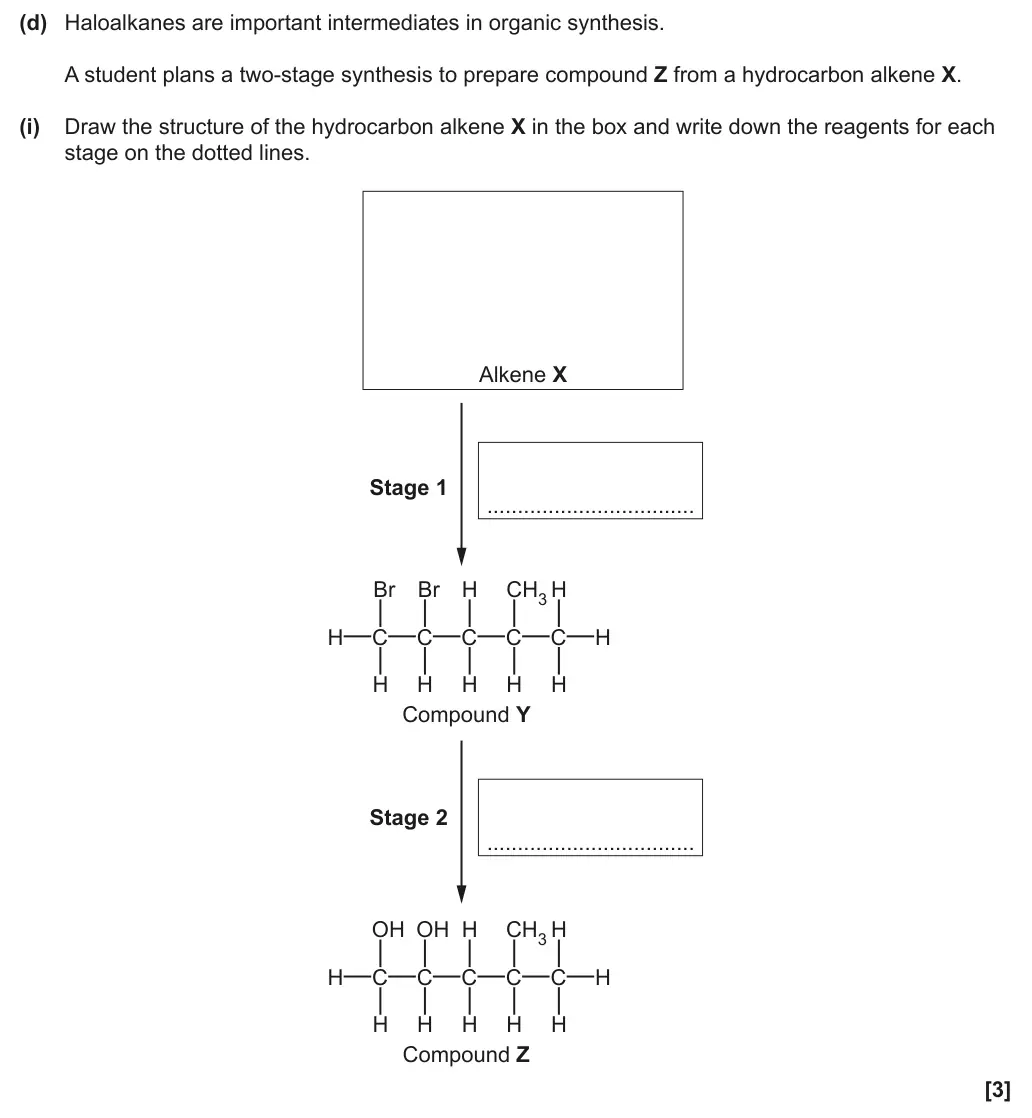
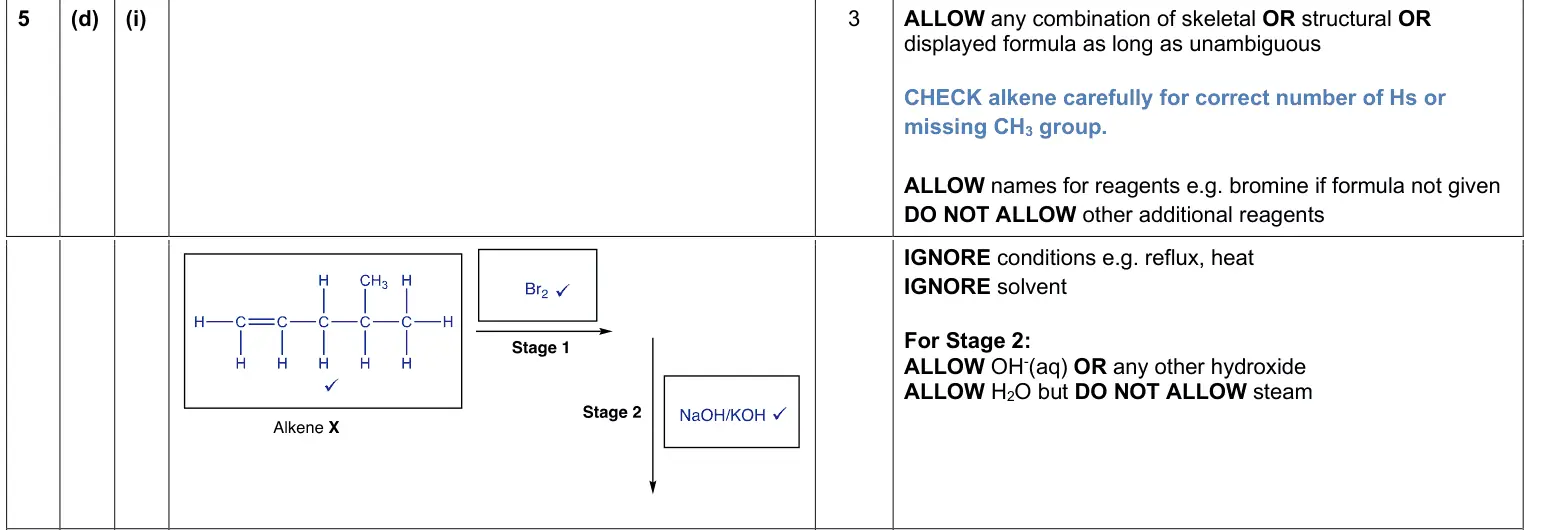
5(d)(i) Organic synthesis and practical techniques (Module 4), Alkenes, Haloalkanes 3Structure / isomer
5(d)(ii) Haloalkanes 1Short answer
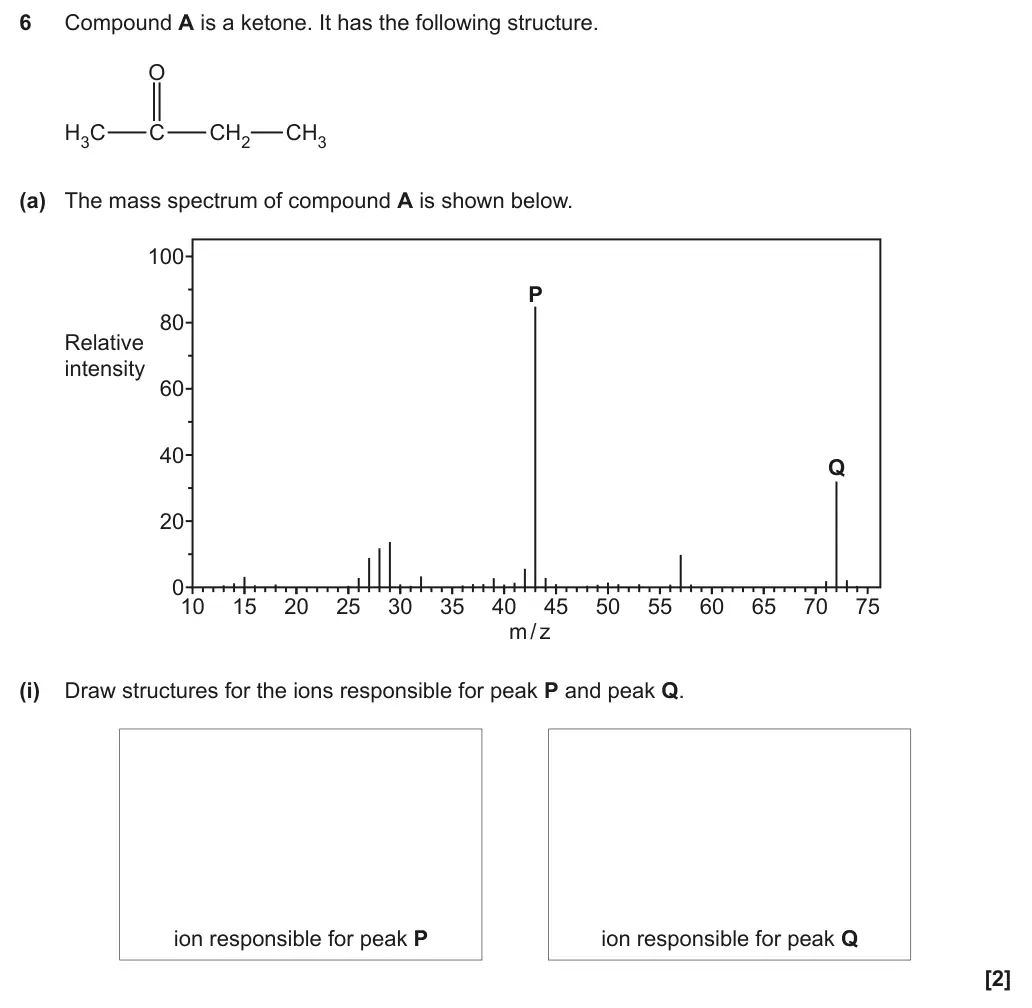
6(a)(i) Infrared spectroscopy and mass spectrometry 2Drawing / labelling
6(a)(ii) Infrared spectroscopy and mass spectrometry 1Short answer
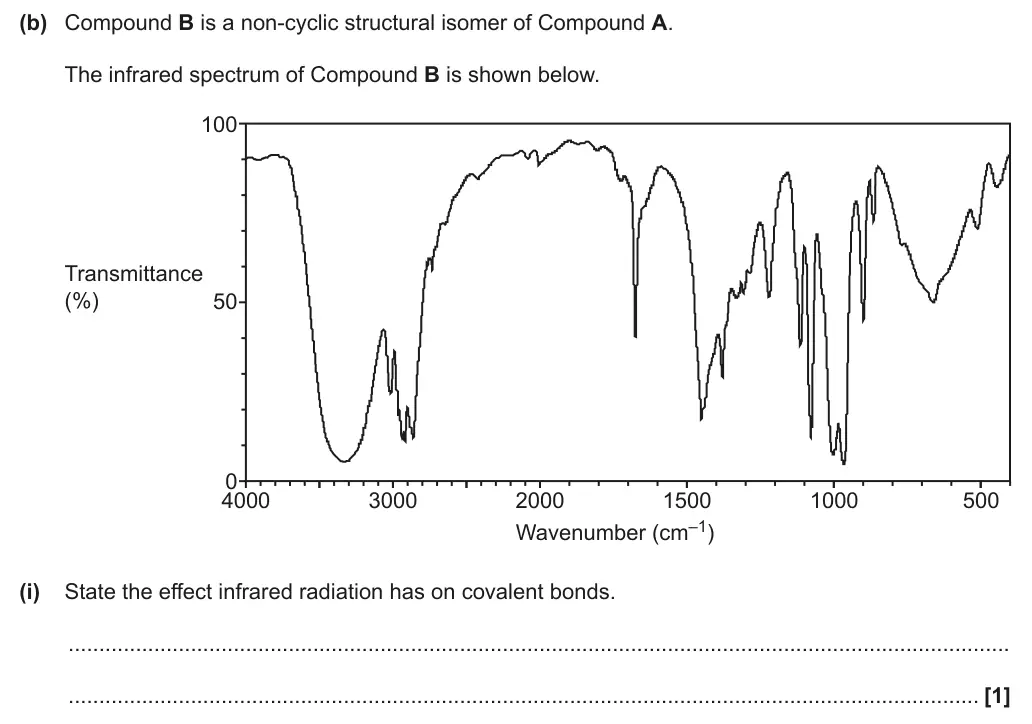
6(b)(i) Infrared spectroscopy and mass spectrometry 1Short answer
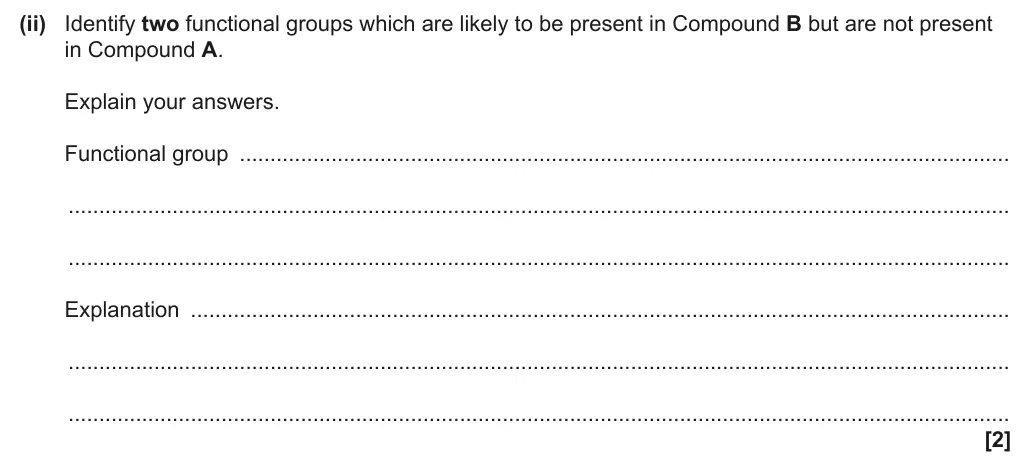
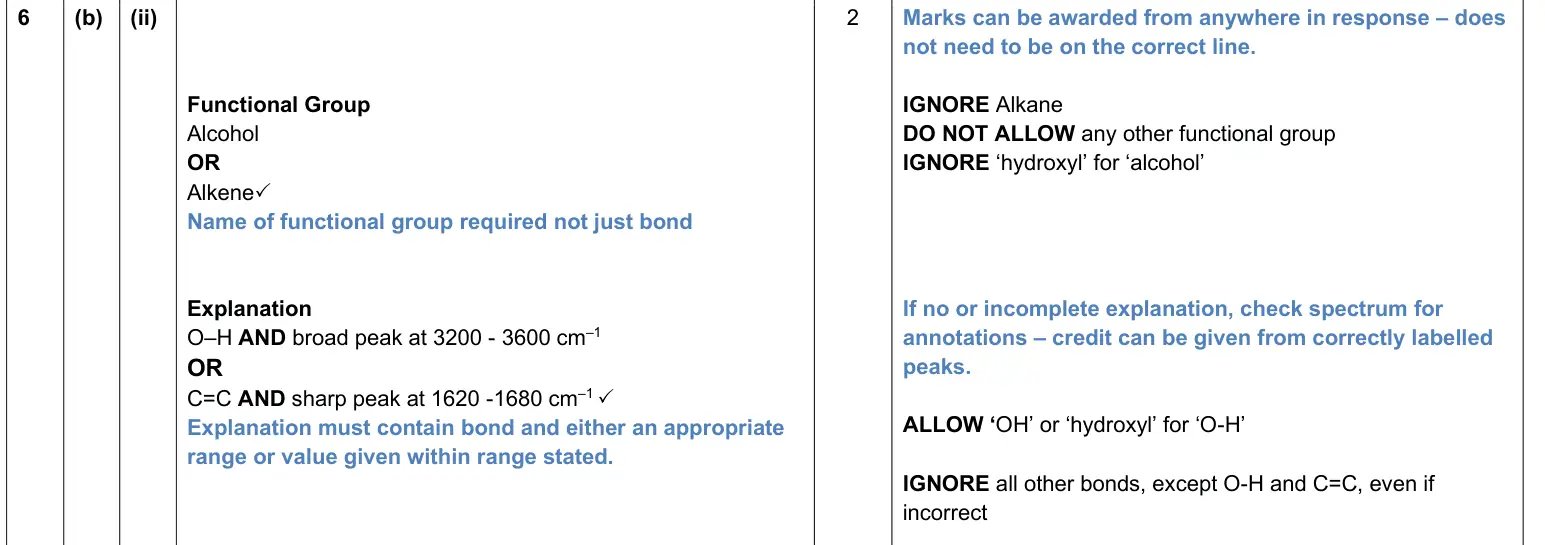
6(b)(ii) Infrared spectroscopy and mass spectrometry, Organic synthesis and practical techniques (Module 4) 2Short answer

The questions

1(a)1(b)1(c)(i)1(c)(ii)2(a)(i)2(a)(ii)2(b)(i)2(b)(ii)2(b)(iii)3(a)(i)3(a)(ii)3(a)(iii)3(b)3(c)4(a)4(b)(i)4(b)(ii)4(b)(iii)4(b)(iv)4(c)4(d)(i)4(d)(ii)4(d)(iii)4(d)(iv)5(a)(i)5(a)(ii)5(b)5(c)5(d)(i)5(d)(ii)6(a)(i)6(a)(ii)6(b)(i)6(b)(ii)
June 2025 · AS Paper 2 · Q1(a) 1 mark Short answer Medium acids and titrations
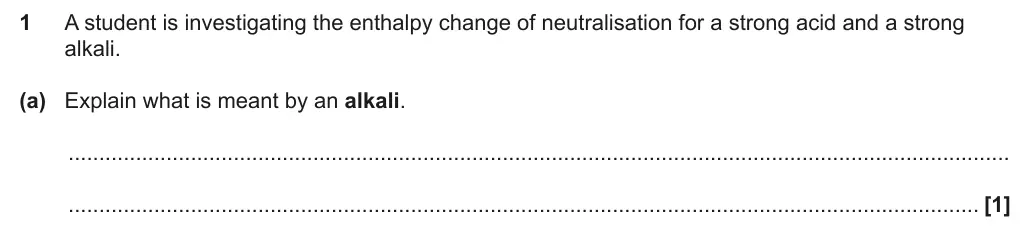
1 A student is investigating the enthalpy change of neutralisation for a strong acid and a strong
alkali.
(a) Explain what is meant by an alkali.
..........................................................................................................................................................
..................................................................................................................................................... [1]
June 2025 · AS Paper 2 · Q1(b) 1 mark Equation writing Easy acids and titrations
Earlier part of question 1 that this part usesEarlier part of June 2025 Paper 2 question 1
(b) Write the ionic equation for the neutralisation reaction between an acid and an alkali.
..................................................................................................................................................... [1]
June 2025 · AS Paper 2 · Q1(c)(i) 4 marks Calculation Easy enthalpy changesamount of substance
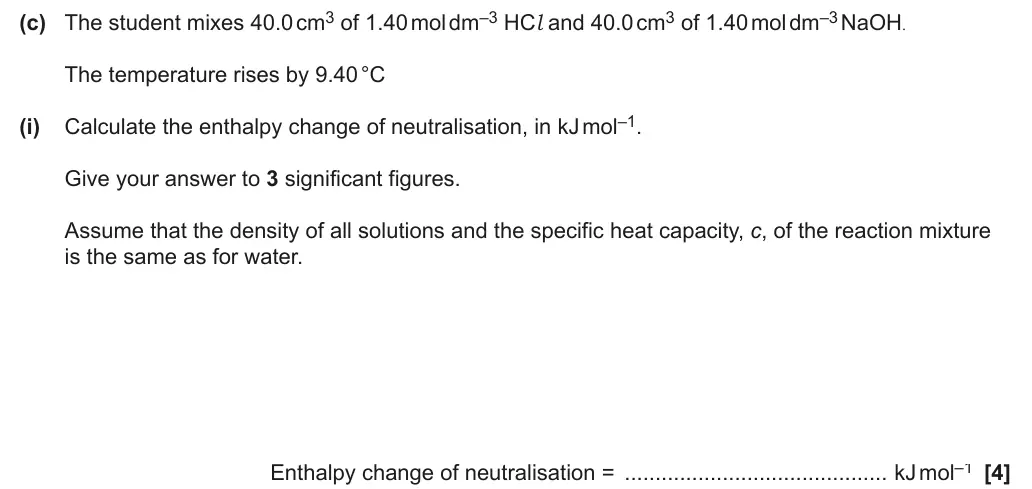
(c) The student mixes 40.0 cm3 of 1.40 mol dm–3 HCl and 40.0 cm3 of 1.40 mol dm–3 NaOH.
The temperature rises by 9.40 °C
(i) Calculate the enthalpy change of neutralisation, in kJ mol–1.
Give your answer to 3 significant figures.

Assume that the density of all solutions and the specific heat capacity, c, of the reaction mixture
is the same as for water.
Enthalpy change of neutralisation =  ........................................... kJ mol–1 [4]
June 2025 · AS Paper 2 · Q1(c)(ii) 2 marks Short answer Hard enthalpy changes
Earlier part of question 1 that this part usesEarlier part of June 2025 Paper 2 question 1
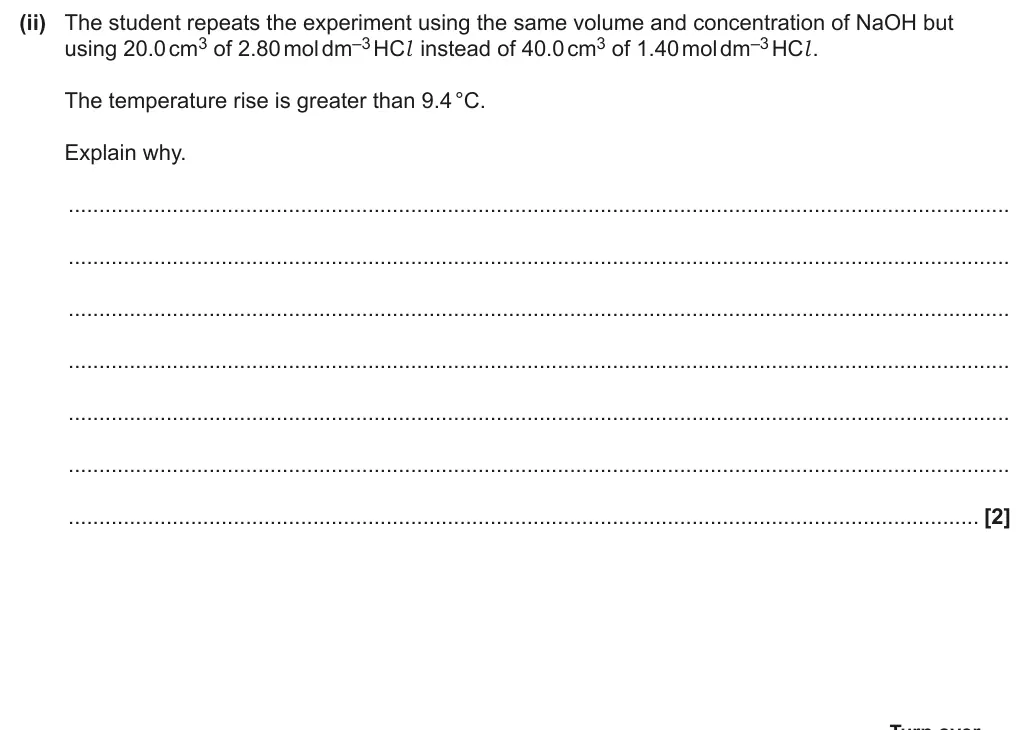
(ii) The student repeats the experiment using the same volume and concentration of NaOH but
using 20.0 cm3 of 2.80 mol dm–3 HCl  instead of 40.0 cm3 of 1.40 mol dm–3 HCl .
The temperature rise is greater than 9.4 °C.
Explain why.
..........................................................................................................................................................
..........................................................................................................................................................
..........................................................................................................................................................
..........................................................................................................................................................
..........................................................................................................................................................
..........................................................................................................................................................
..................................................................................................................................................... [2]
June 2025 · AS Paper 2 · Q2(a)(i) 1 mark Equation writing Medium group 2periodicity
2 This question is about reactions of some Group 2 elements and their compounds.
(a) The table below shows the first and second ionisation energies of magnesium and calcium.
1st Ionisation energy 2nd Ionisation energy
Group 2 element
/ kJ mol–1 / kJ mol–1
Mg 738 1451
Ca 590 1145
(i) Write an equation to represent the second ionisation energy of calcium.
Include state symbols.
..................................................................................................................................................... [1]
June 2025 · AS Paper 2 · Q2(a)(ii) 6 marks 6-mark level of response Medium group 2redoxperiodicity
Earlier part of question 2 that this part usesEarlier part of June 2025 Paper 2 question 2
(ii)* Magnesium and calcium differ in their reactivity.
Give a balanced equation for the reaction of calcium with water and describe what would be
observed. Explain why this is a redox reaction.
Explain the difference in reactivity of magnesium and calcium.
..........................................................................................................................................................
..........................................................................................................................................................
..........................................................................................................................................................
..........................................................................................................................................................
..........................................................................................................................................................
..........................................................................................................................................................
..........................................................................................................................................................
..........................................................................................................................................................
..........................................................................................................................................................
..........................................................................................................................................................
..........................................................................................................................................................
..........................................................................................................................................................
..........................................................................................................................................................
..........................................................................................................................................................
..........................................................................................................................................................
..................................................................................................................................................... [6]
Extra answer space if required.
..........................................................................................................................................................
..........................................................................................................................................................
..........................................................................................................................................................
..........................................................................................................................................................
..........................................................................................................................................................
..........................................................................................................................................................
..........................................................................................................................................................
..........................................................................................................................................................
..........................................................................................................................................................
..........................................................................................................................................................
..........................................................................................................................................................
..........................................................................................................................................................
June 2025 · AS Paper 2 · Q2(b)(i) 2 marks Calculation Hard amount of substance
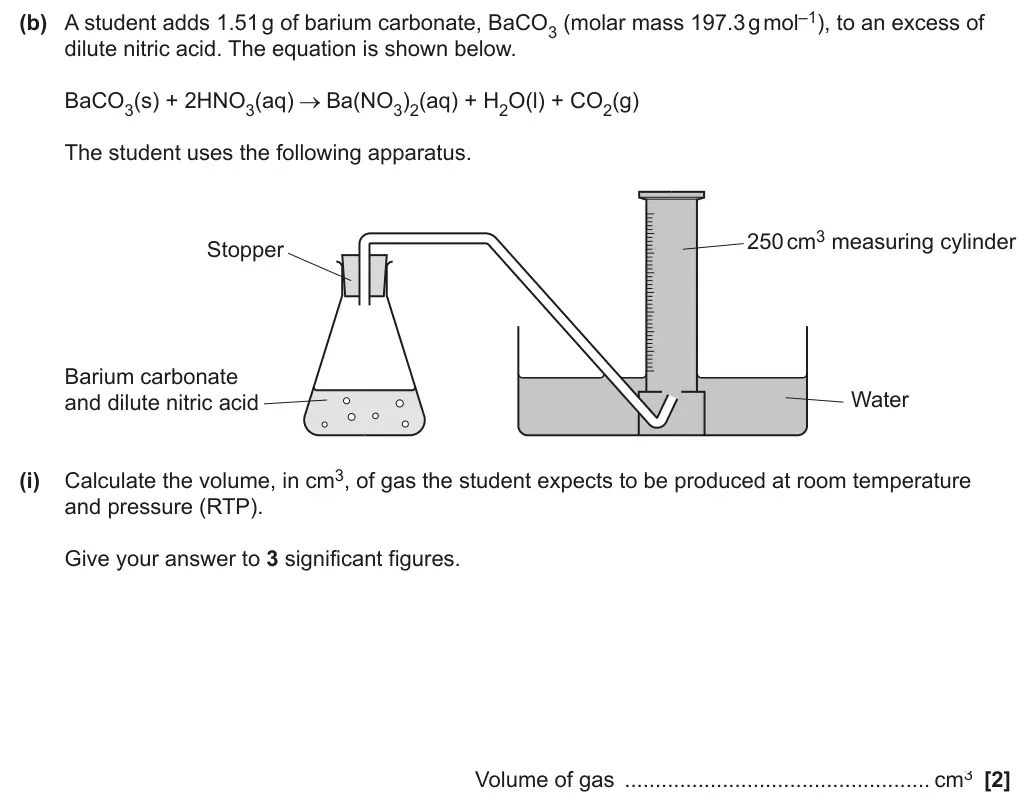
(b) A student adds 1.51 g of barium carbonate, BaCO3 (molar mass 197.3 g mol–1), to an excess of
dilute nitric acid. The equation is shown below.
BaCO3(s) + 2HNO3(aq) Ba(NO3)2(aq) + H2O(l) + CO2(g)
The student uses the following apparatus.
250 cm3 measuring cylinder
Stopper
Barium carbonate
and dilute nitric acid Water
(i) Calculate the volume, in cm3, of gas the student expects to be produced at room temperature
and pressure (RTP).
Give your answer to 3 significant figures.
Volume of gas  .................................................. cm3 [2]
June 2025 · AS Paper 2 · Q2(b)(ii) 2 marks Short answer Hard practical skillsamount of substance
Earlier part of question 2 that this part usesEarlier part of June 2025 Paper 2 question 2
(ii) The volume of gas collected is less than the calculated volume.
Suggest two reasons for this difference.
1  .......................................................................................................................................................
..........................................................................................................................................................
2  .......................................................................................................................................................
..........................................................................................................................................................
[2]
June 2025 · AS Paper 2 · Q2(b)(iii) 1 mark Short answer Medium practical skillsamount of substance
Earlier parts of question 2 that this part usesEarlier part of June 2025 Paper 2 question 2Earlier part of June 2025 Paper 2 question 2
(iii) Suggest one way in which the student could modify the apparatus to produce a volume closer to
the calculated volume.
..........................................................................................................................................................
..................................................................................................................................................... [1]
June 2025 · AS Paper 2 · Q3(a)(i) 1 mark Complete table/diagram Hard acids and titrationspractical techniques
3 Malic acid tablets are sold as a health supplement.
A student carries out a titration to determine the mass of malic acid, C4H6O5, in one tablet.
The student follows the method below:
Step 1 Crush three tablets, transfer the powder into a beaker and dissolve in distilled water.
Step 2 Transfer the solution into a 250.0 cm3 volumetric flask and make up to the mark with
distilled water.
Step 3 Pipette 25.0 cm3 of the solution from Step 2 into a conical flask and add a few drops of
indicator.
Step 4 Titrate this solution with 0.0800 mol dm–3 sodium hydroxide, NaOH, in the burette.
The equation for the neutralisation reaction is:
C4H6O5 + 2NaOH C4H4O5Na2 + 2H2O
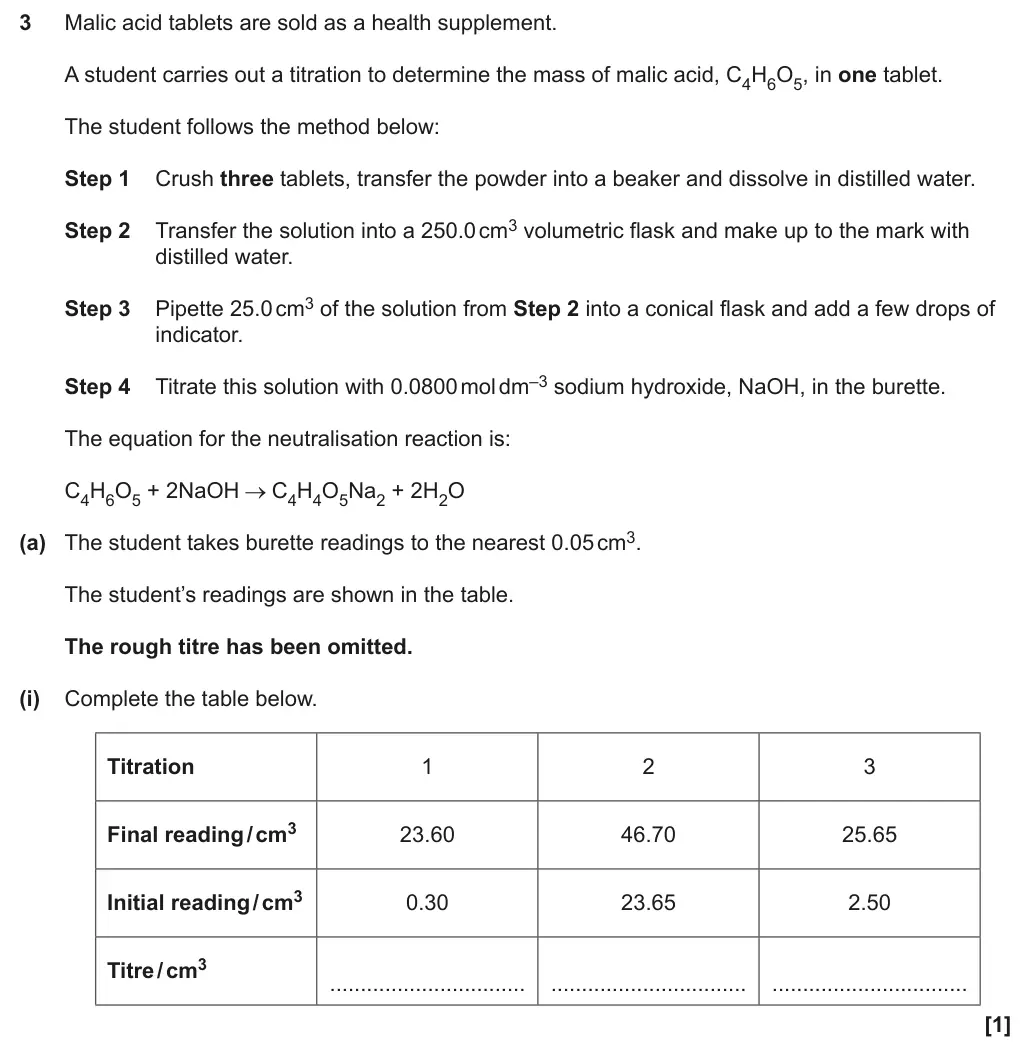
(a) The student takes burette readings to the nearest 0.05 cm3.
The student’s readings are shown in the table.
The rough titre has been omitted.
(i) Complete the table below.
Titration 1 2 3
Final reading / cm3 23.60 46.70 25.65
Initial reading / cm3 0.30 23.65 2.50
Titre / cm3
................................ ................................ ................................
[1]
June 2025 · AS Paper 2 · Q3(a)(ii) 1 mark Calculation Medium acids and titrations
Earlier part of question 3 that this part usesEarlier part of June 2025 Paper 2 question 3
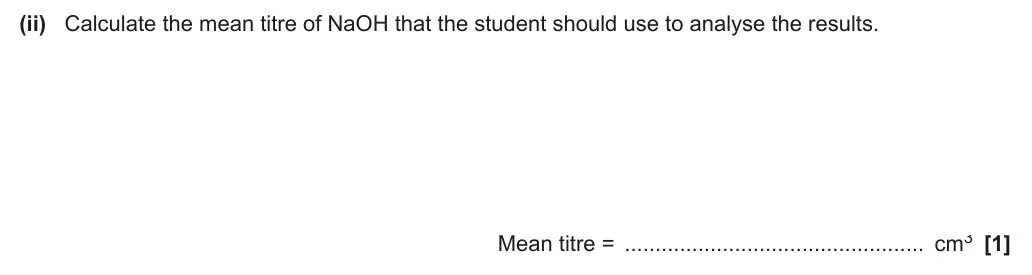
(ii) Calculate the mean titre of NaOH that the student should use to analyse the results.
Mean titre =  ................................................. cm3 [1]
June 2025 · AS Paper 2 · Q3(a)(iii) 5 marks Calculation Easy acids and titrationsamount of substance
Earlier parts of question 3 that this part usesEarlier part of June 2025 Paper 2 question 3Earlier part of June 2025 Paper 2 question 3
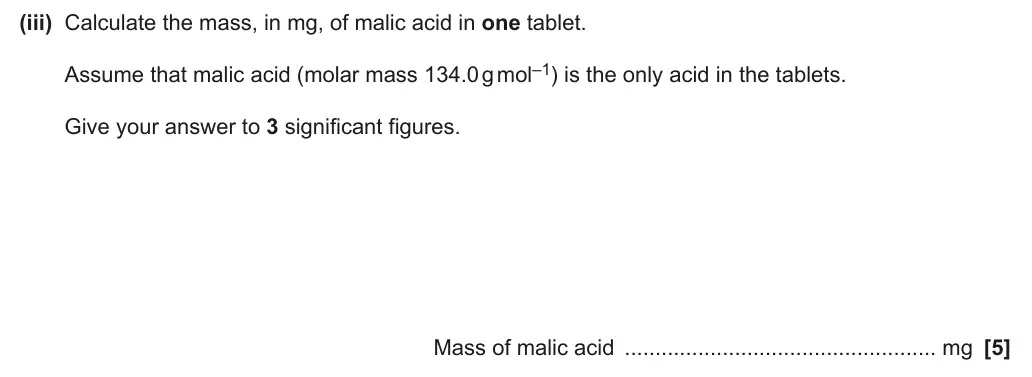
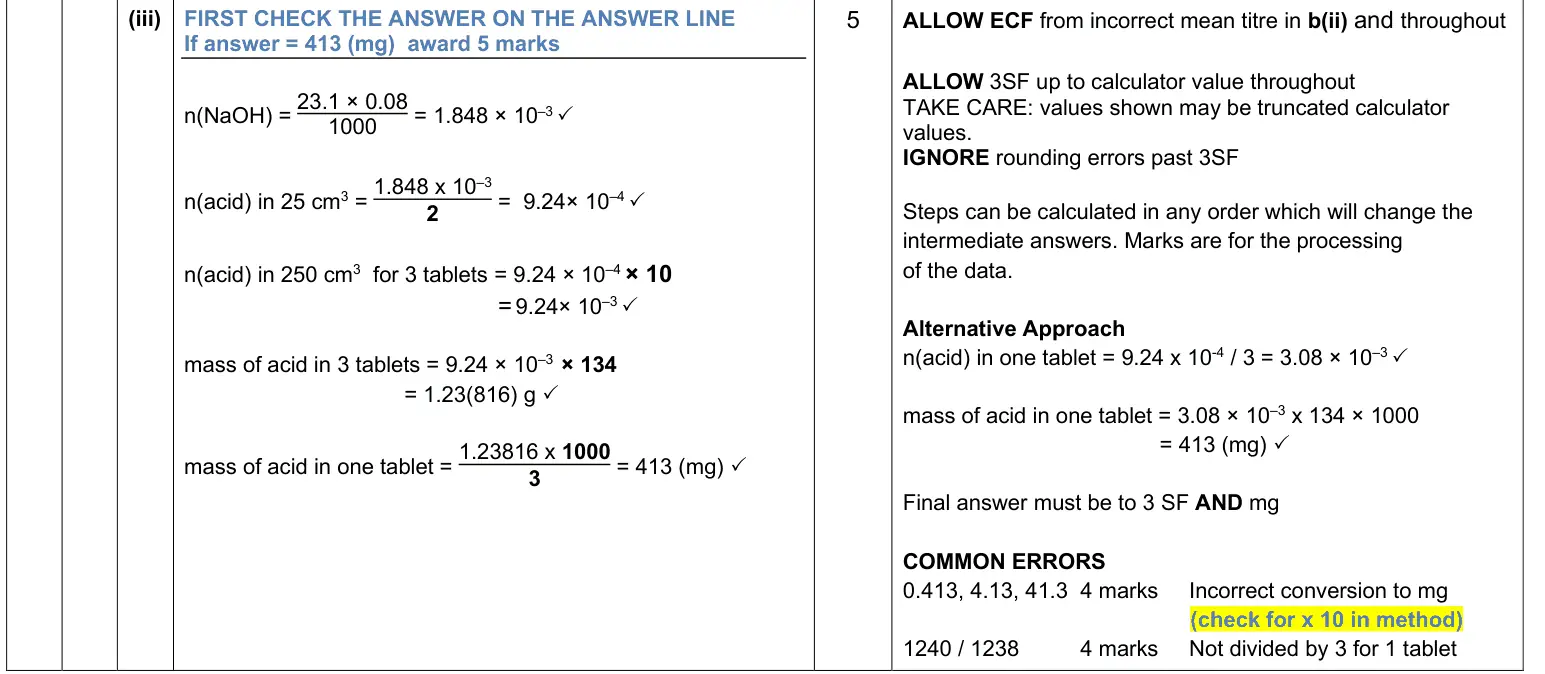
(iii) Calculate the mass, in mg, of malic acid in one tablet.
Assume that malic acid (molar mass 134.0 g mol–1) is the only acid in the tablets.
Give your answer to 3 significant figures.
Mass of malic acid  ................................................... mg [5]
June 2025 · AS Paper 2 · Q3(b) 2 marks Short answer Medium acids and titrationspractical skills
Earlier part of question 3 that this part usesEarlier part of June 2025 Paper 2 question 3
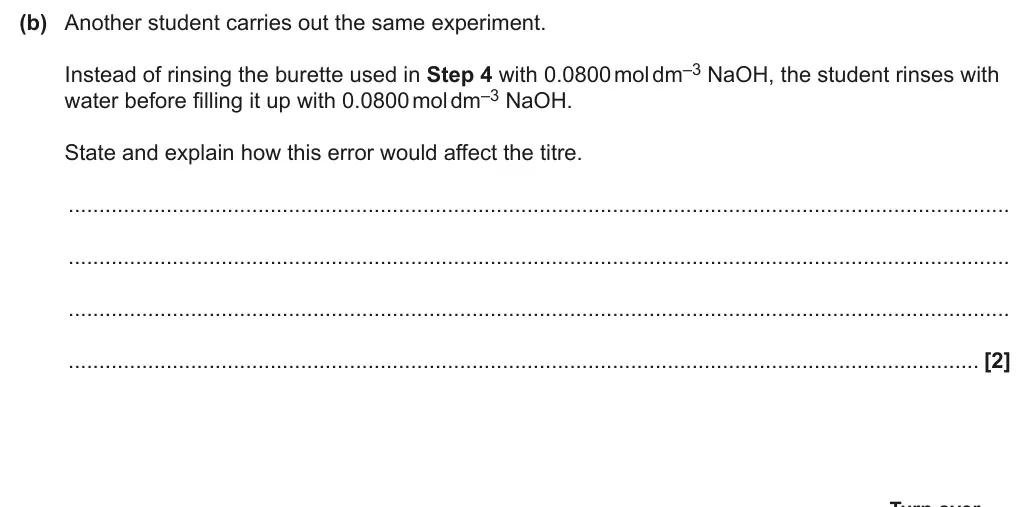
(b) Another student carries out the same experiment.
Instead of rinsing the burette used in Step 4 with 0.0800 mol dm–3 NaOH, the student rinses with
water before filling it up with 0.0800 mol dm–3 NaOH.
State and explain how this error would affect the titre.
..........................................................................................................................................................
..........................................................................................................................................................
..........................................................................................................................................................
..................................................................................................................................................... [2]
June 2025 · AS Paper 2 · Q3(c) 2 marks Structure / isomer Medium alcoholsalkenesorganic synthesis as
Earlier part of question 3 that this part usesEarlier part of June 2025 Paper 2 question 3
(c) The structure of malic acid is shown below.
OH H
HOOC C C COOH
H H
When malic acid is heated with an acid catalyst, a mixture of cis and trans stereoisomers is
produced.
Draw the structures of the cis and trans isomers.
cis trans
[2]
June 2025 · AS Paper 2 · Q4(a) 4 marks Data interpretation Medium alkanes
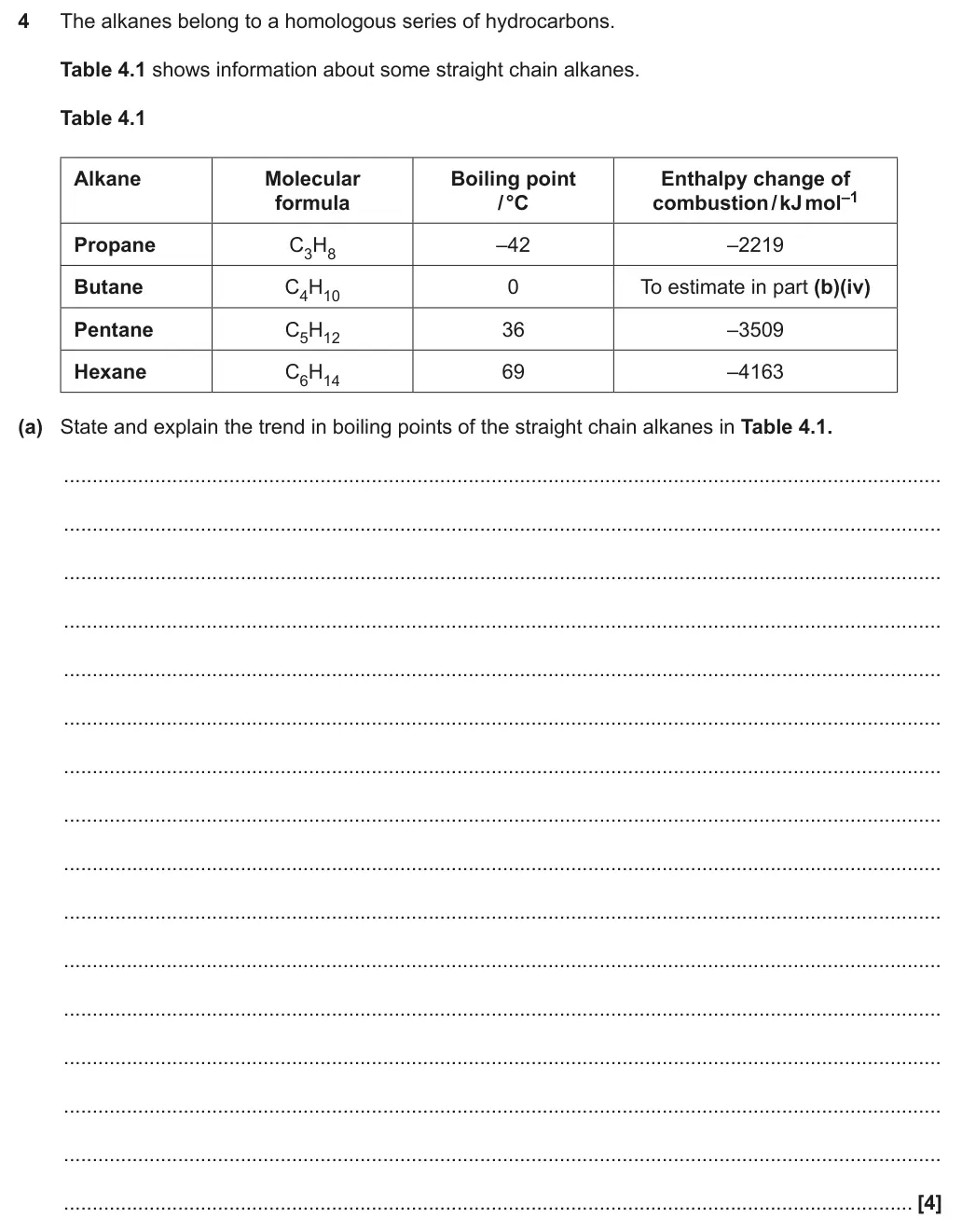
4 The alkanes belong to a homologous series of hydrocarbons.
Table 4.1 shows information about some straight chain alkanes.
Table 4.1
Alkane Molecular Boiling point Enthalpy change of
formula / °C combustion / kJ mol–1
Propane C3H8 –42 –2219
Butane C4H10 0 To estimate in part (b)(iv)
Pentane C5H12 36 –3509
Hexane C6H14 69 –4163
(a) State and explain the trend in boiling points of the straight chain alkanes in Table 4.1.
..........................................................................................................................................................
..........................................................................................................................................................
..........................................................................................................................................................
..........................................................................................................................................................
..........................................................................................................................................................
..........................................................................................................................................................
..........................................................................................................................................................
..........................................................................................................................................................
..........................................................................................................................................................
..........................................................................................................................................................
..........................................................................................................................................................
..........................................................................................................................................................
..........................................................................................................................................................
..........................................................................................................................................................
..........................................................................................................................................................
..................................................................................................................................................... [4]
June 2025 · AS Paper 2 · Q4(b)(i) 1 mark Equation writing Hard alkanes
Earlier part of question 4 that this part usesEarlier part of June 2025 Paper 2 question 4
(b) When alkanes undergo complete combustion carbon dioxide and water are produced.
(i) Write the balanced equation for the complete combustion of one mole of pentane.
..................................................................................................................................................... [1]
June 2025 · AS Paper 2 · Q4(b)(ii) 2 marks Calculation Medium enthalpy changesamount of substance
Earlier parts of question 4 that this part usesEarlier part of June 2025 Paper 2 question 4Earlier part of June 2025 Paper 2 question 4
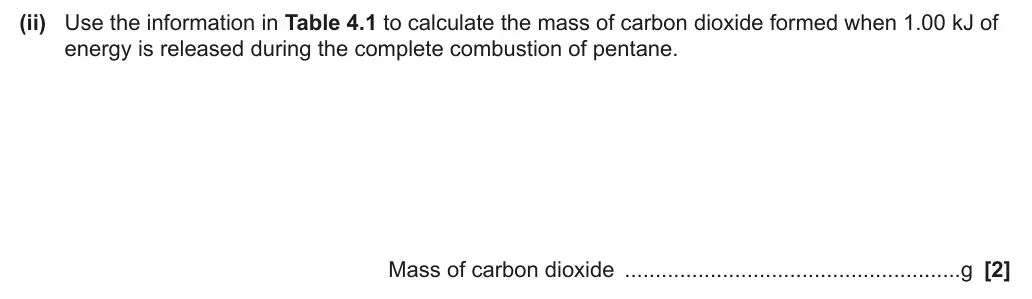
(ii) Use the information in Table 4.1 to calculate the mass of carbon dioxide formed when 1.00 kJ of
energy is released during the complete combustion of pentane.
Mass of carbon dioxide  .......................................................g [2]
June 2025 · AS Paper 2 · Q4(b)(iii) 2 marks Complete table/diagram Easy enthalpy changes
Earlier parts of question 4 that this part usesEarlier part of June 2025 Paper 2 question 4Earlier part of June 2025 Paper 2 question 4
(iii) Complete the enthalpy profile diagram for the complete combustion of pentane.
On your diagram:
• Label the enthalpy change as ΔH.
• Include the formulae of the reactants and products.
• Label the activation energy as Ea.
Enthalpy
Progress of reaction
[2]
June 2025 · AS Paper 2 · Q4(b)(iv) 1 mark Data interpretation Hard enthalpy changesorganic basics
Earlier part of question 4 that this part usesEarlier part of June 2025 Paper 2 question 4
(iv) Use the data in Table 4.1 to estimate a value for the enthalpy change of combustion of butane.
Give your answer to 2 significant figures.
Estimated enthalpy change of combustion of butane  .............................................kJ mol–1 [1]
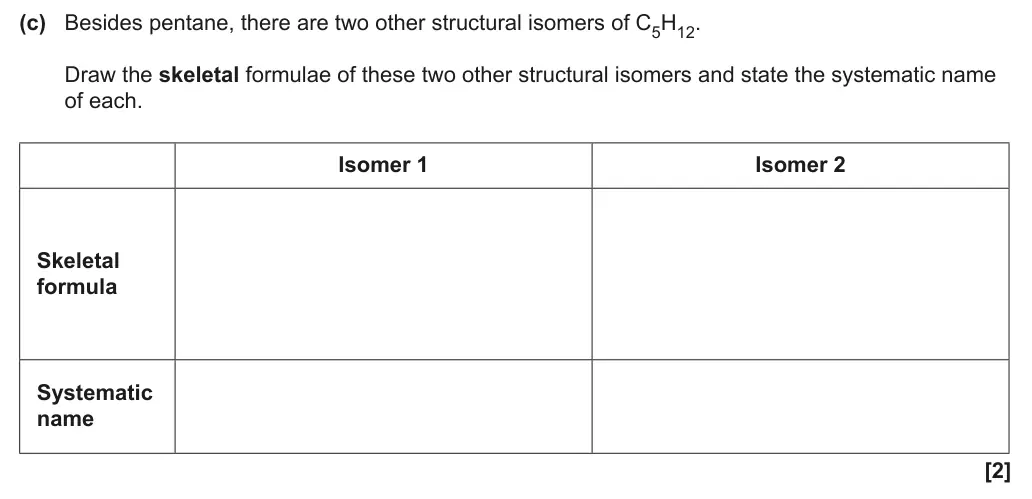
June 2025 · AS Paper 2 · Q4(c) 2 marks Structure / isomer Easy organic basics
(c) Besides pentane, there are two other structural isomers of C5H12.
Draw the skeletal formulae of these two other structural isomers and state the systematic name
of each.
Isomer 1 Isomer 2
Skeletal
formula
Systematic
name
[2]
June 2025 · AS Paper 2 · Q4(d)(i) 1 mark Equation writing Medium alkanes
(d) In the presence of ultraviolet radiation, propane reacts with bromine to form a mixture of products.
Two of these products are structural isomers of C3H7Br.
(i) Write an equation, using molecular formulae, for the formation of C3H7Br from propane.
..................................................................................................................................................... [1]
June 2025 · AS Paper 2 · Q4(d)(ii) 1 mark Short answer Hard organic basics
Earlier part of question 4 that this part usesEarlier part of June 2025 Paper 2 question 4
(ii) The first step in the mechanism of the reaction is the homolytic fission of a Br–Br bond.
Explain what is meant by homolytic fission.
..........................................................................................................................................................
..................................................................................................................................................... [1]
June 2025 · AS Paper 2 · Q4(d)(iii) 2 marks Mechanism Hard alkanesorganic basics
Earlier part of question 4 that this part usesEarlier part of June 2025 Paper 2 question 4
(iii) Complete the equations for the propagation steps in the mechanism.
Use molecular formulae for organic species and dots (•) for unpaired electrons on radicals.
C3H8  +  Br• ............................  +  ............................
............................  +  ............................ C3H7Br  +  ............................
[2]
June 2025 · AS Paper 2 · Q4(d)(iv) 1 mark Short answer Medium alkanes
Earlier part of question 4 that this part usesEarlier part of June 2025 Paper 2 question 4
(iv) Explain why two structural isomers of C3H7Br are formed.
..........................................................................................................................................................
..........................................................................................................................................................
..................................................................................................................................................... [1]
June 2025 · AS Paper 2 · Q5(a)(i) 1 mark Drawing / labelling Medium bonding and structure
5 This question is about haloalkanes.
(a) Chloromethane, CH3Cl is a covalent molecule.
(i) Draw a ‘dot-and-cross’ diagram for CH3Cl .
Show outer electrons only.
Use a different symbol for the electrons of each element.
[1]
June 2025 · AS Paper 2 · Q5(a)(ii) 2 marks Short answer Hard bonding and structurealkanes
Earlier part of question 5 that this part usesEarlier part of June 2025 Paper 2 question 5
(ii) Name the shape of the chloromethane molecule and predict the value of the H–C–Cl bond angle.
Name of shape ..................................................................................................................................
Bond angle ........................................................................................................................................
[2]
June 2025 · AS Paper 2 · Q5(b) 3 marks Short answer Hard alkenesbonding and structure
Earlier parts of question 5 that this part usesEarlier part of June 2025 Paper 2 question 5Earlier part of June 2025 Paper 2 question 5
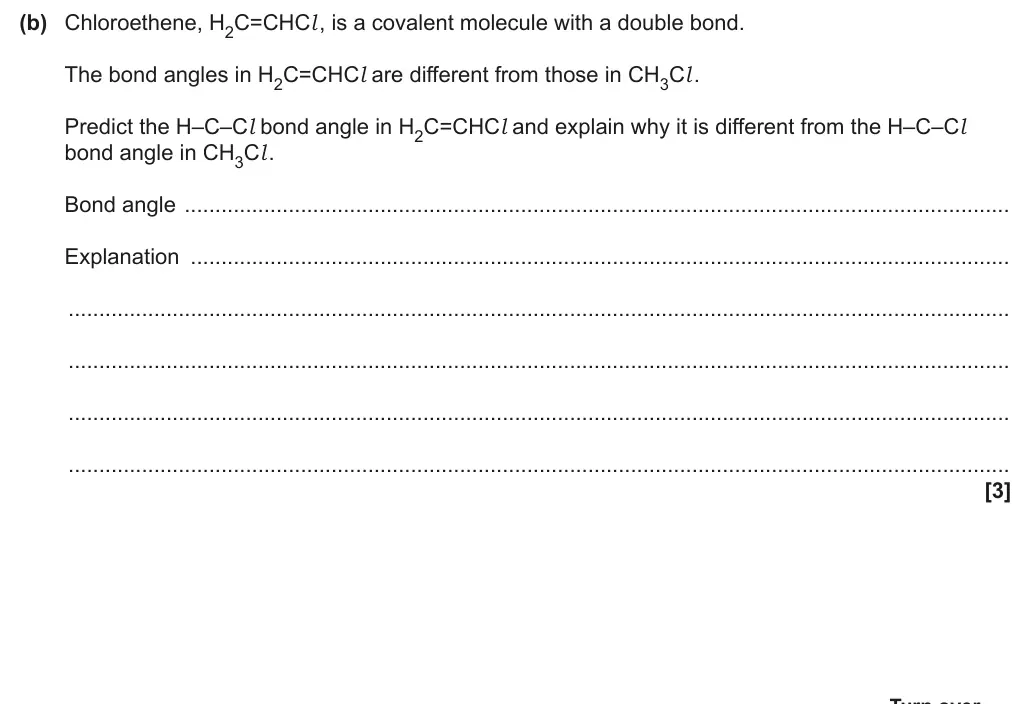
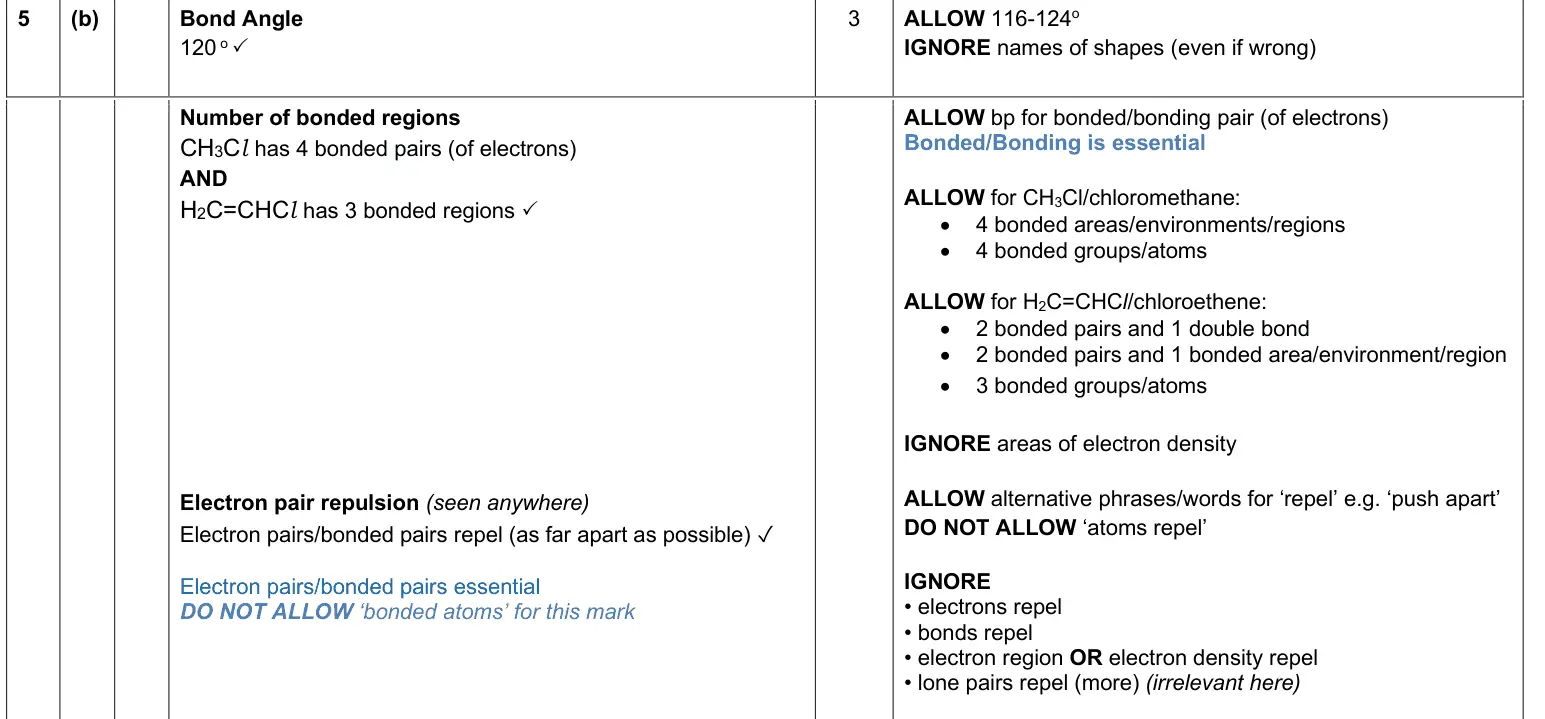
(b) Chloroethene, H2C=CHCl , is a covalent molecule with a double bond.
The bond angles in H2C=CHCl are different from those in CH3Cl .
Predict the H–C–Cl bond angle in H2C=CHCl and explain why it is different from the H–C–Cl
bond angle in CH3Cl .
Bond angle  .......................................................................................................................................
Explanation  ......................................................................................................................................
..........................................................................................................................................................
..........................................................................................................................................................
..........................................................................................................................................................
..........................................................................................................................................................
[3]
June 2025 · AS Paper 2 · Q5(c) 6 marks 6-mark level of response Medium organic synthesis aspractical techniquesamount of substance
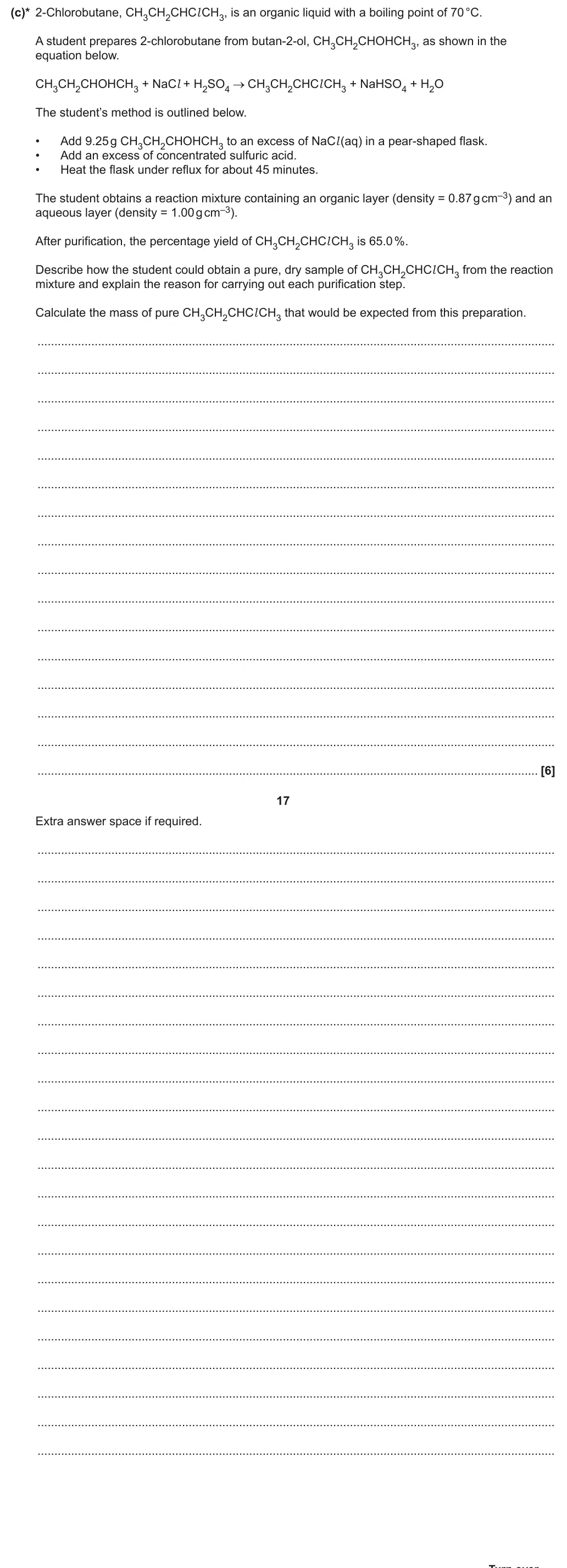
(c)* 2-Chlorobutane, CH3CH2CHCl CH3, is an organic liquid with a boiling point of 70 °C.
A student prepares 2-chlorobutane from butan-2-ol, CH3CH2CHOHCH3, as shown in the
equation below.
CH3CH2CHOHCH3 + NaCl + H2SO4 CH3CH2CHCl CH3 + NaHSO4 + H2O
The student’s method is outlined below.
• Add 9.25 g CH3CH2CHOHCH3 to an excess of NaCl (aq) in a pear-shaped flask.
• Add an excess of concentrated sulfuric acid.
• Heat the flask under reflux for about 45 minutes.
The student obtains a reaction mixture containing an organic layer (density = 0.87 g cm–3) and an
aqueous layer (density = 1.00 g cm–3).
After purification, the percentage yield of CH3CH2CHCl CH3 is 65.0 %.
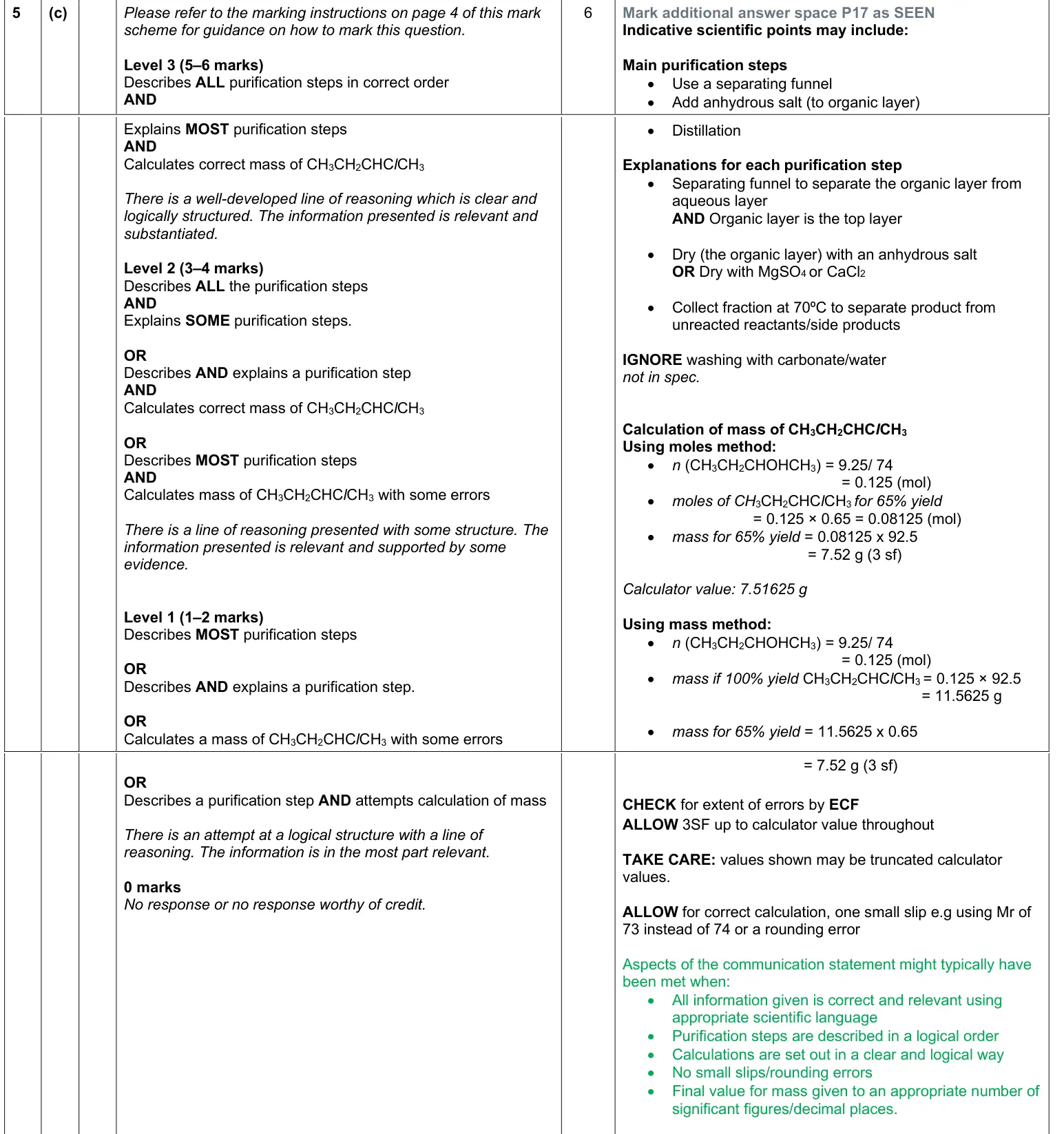
Describe how the student could obtain a pure, dry sample of CH3CH2CHCl CH3 from the reaction
mixture and explain the reason for carrying out each purification step.
Calculate the mass of pure CH3CH2CHCl CH3 that would be expected from this preparation.
..........................................................................................................................................................
..........................................................................................................................................................
..........................................................................................................................................................
..........................................................................................................................................................
..........................................................................................................................................................
..........................................................................................................................................................
..........................................................................................................................................................
..........................................................................................................................................................
..........................................................................................................................................................
..........................................................................................................................................................
..........................................................................................................................................................
..........................................................................................................................................................
..........................................................................................................................................................
..........................................................................................................................................................
..........................................................................................................................................................
..................................................................................................................................................... [6]
Extra answer space if required.
..........................................................................................................................................................
..........................................................................................................................................................
..........................................................................................................................................................
..........................................................................................................................................................
..........................................................................................................................................................
..........................................................................................................................................................
..........................................................................................................................................................
..........................................................................................................................................................
..........................................................................................................................................................
..........................................................................................................................................................
..........................................................................................................................................................
..........................................................................................................................................................
..........................................................................................................................................................
..........................................................................................................................................................
..........................................................................................................................................................
..........................................................................................................................................................
..........................................................................................................................................................
..........................................................................................................................................................
..........................................................................................................................................................
..........................................................................................................................................................
..........................................................................................................................................................
..........................................................................................................................................................
June 2025 · AS Paper 2 · Q5(d)(i) 3 marks Structure / isomer Medium organic synthesis asalkeneshaloalkanes
(d) Haloalkanes are important intermediates in organic synthesis.
A student plans a two-stage synthesis to prepare compound Z from a hydrocarbon alkene X.
(i) Draw the structure of the hydrocarbon alkene X in the box and write down the reagents for each
stage on the dotted lines.
Alkene X
Stage 1
..................................
Br Br H CH3 H
H C C C C C H
H H H H H
Compound Y
Stage 2
..................................
OH OH H CH3 H
H C C C C C H
H H H H H
Compound Z
[3]
June 2025 · AS Paper 2 · Q5(d)(ii) 1 mark Short answer Easy haloalkanes
Earlier part of question 5 that this part usesEarlier part of June 2025 Paper 2 question 5
(ii) State the name of the mechanism of the reaction in Stage 2.
..................................................................................................................................................... [1]
June 2025 · AS Paper 2 · Q6(a)(i) 2 marks Drawing / labelling Medium infrared and mass spectrometry
6 Compound A is a ketone. It has the following structure.
O
H3C C CH2 CH3
(a) The mass spectrum of compound A is shown below.
100
P
80
Relative
intensity
60
40
Q
20
0
10 15 20 25 30 35 40 45 50 55 60 65 70 75
m / z
(i) Draw structures for the ions responsible for peak P and peak Q.
ion responsible for peak P ion responsible for peak Q
[2]
June 2025 · AS Paper 2 · Q6(a)(ii) 1 mark Short answer Hard infrared and mass spectrometry
Earlier part of question 6 that this part usesEarlier part of June 2025 Paper 2 question 6
(ii) Explain why there is a small peak at m / z = 73
..........................................................................................................................................................
..................................................................................................................................................... [1]
June 2025 · AS Paper 2 · Q6(b)(i) 1 mark Short answer Medium infrared and mass spectrometry
(b) Compound B is a non-cyclic structural isomer of Compound A.
The infrared spectrum of Compound B is shown below.
100
Transmittance
(%) 50
0
4000 3000 2000 1500 1000 500
Wavenumber (cm–1)
(i) State the effect infrared radiation has on covalent bonds.
..........................................................................................................................................................
..................................................................................................................................................... [1]
June 2025 · AS Paper 2 · Q6(b)(ii) 2 marks Short answer Medium infrared and mass spectrometryorganic synthesis as
Earlier parts of question 6 that this part usesEarlier part of June 2025 Paper 2 question 6Earlier part of June 2025 Paper 2 question 6
(ii) Identify two functional groups which are likely to be present in Compound B but are not present
in Compound A.
Explain your answers.
Functional group  ..............................................................................................................................
..........................................................................................................................................................
..........................................................................................................................................................
Explanation  ......................................................................................................................................
..........................................................................................................................................................
..........................................................................................................................................................
[2]

Work with an OCR chemistry tutor

Want a paper marked and gone through with you? Message us.

Prefer email? Send an enquiry

If you are under 18, please include a parent's contact details. Enquiries go to enquiries@chemistryaleveltutor.com and are deleted once handled. All tutoring is online.