June 2024: Paper 3, Unified chemistry

70 marks · 32 question parts · Paper, mark scheme and report on OCR's site · Have OCR's Data Sheet beside you

Question by question

QTopicMarksAOType
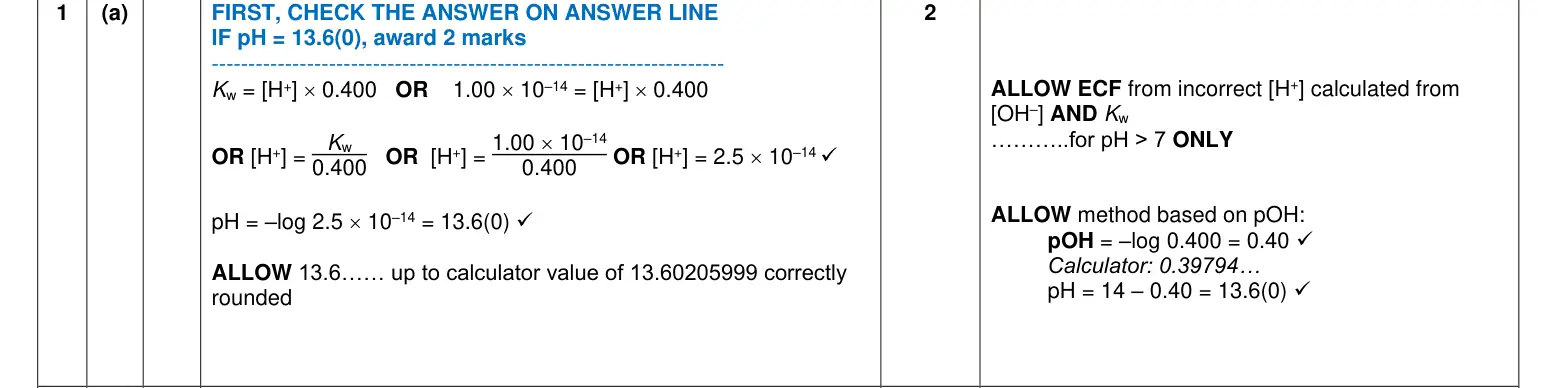
1(a) Acids, bases, pH and buffers 2Calculation
1(b) Acids, bases, pH and buffers, Amount of substance (moles) 1Calculation
1(c) Acids, bases, pH and buffers 2Calculation
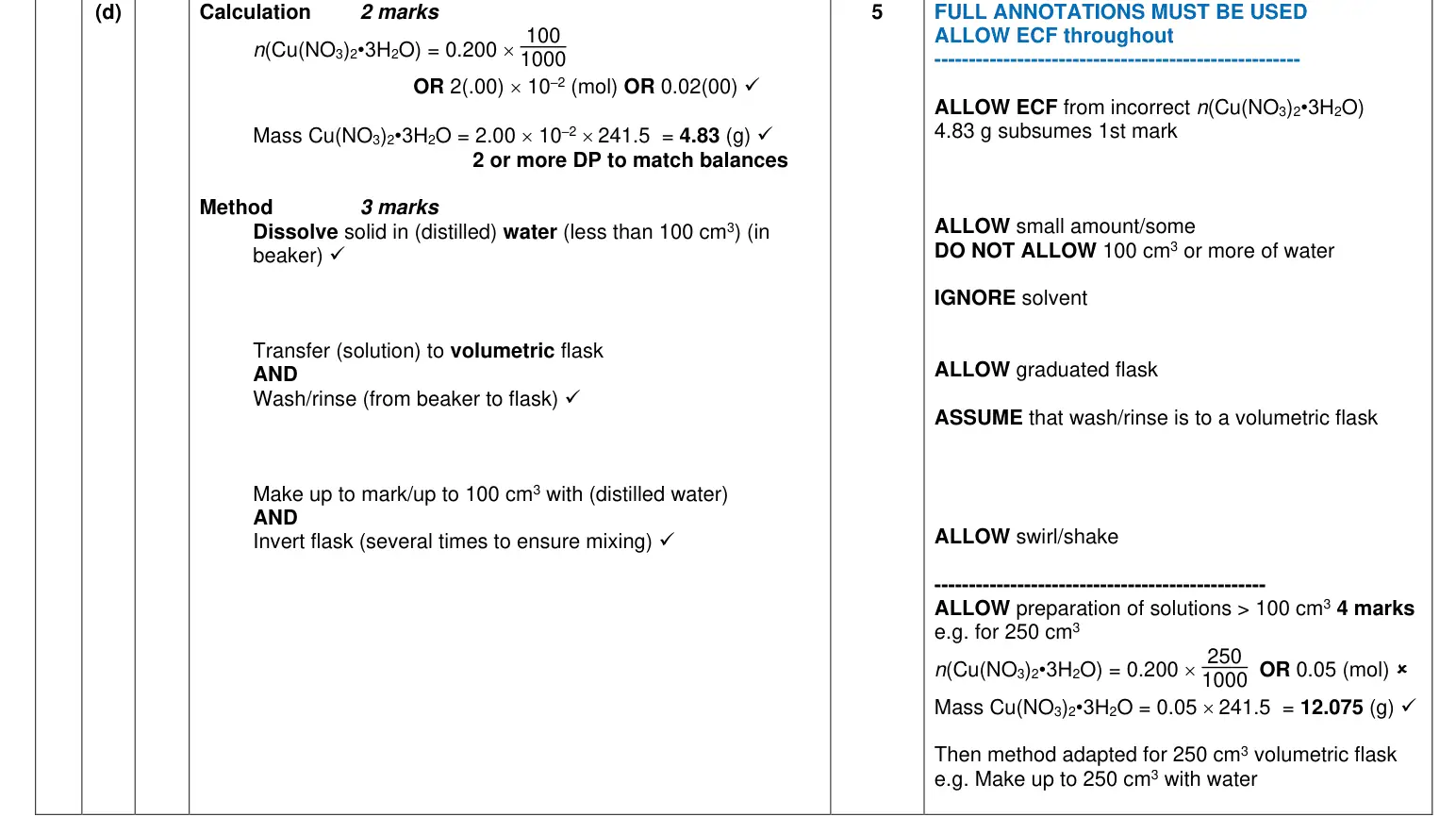
1(d) Acids, bases and titrations, Practical techniques and apparatus (PAGs), Amount of substance (moles) 5Extended response
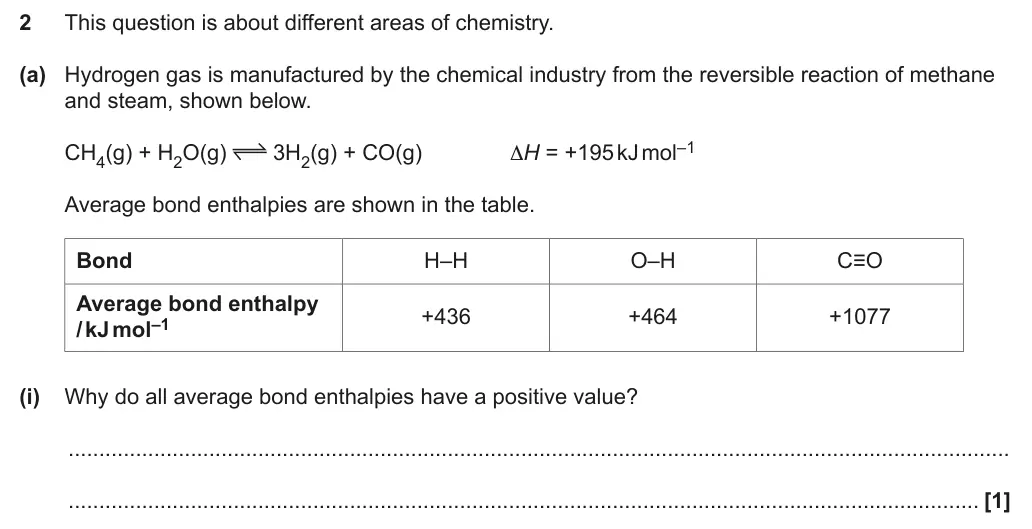
2(a)(i) Enthalpy changes and Hess’ law 1Short answer
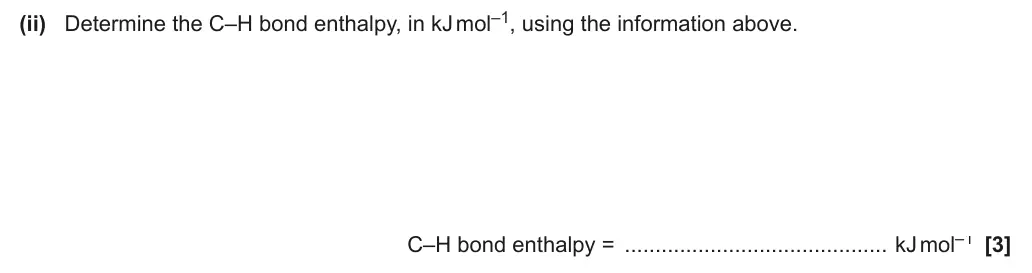
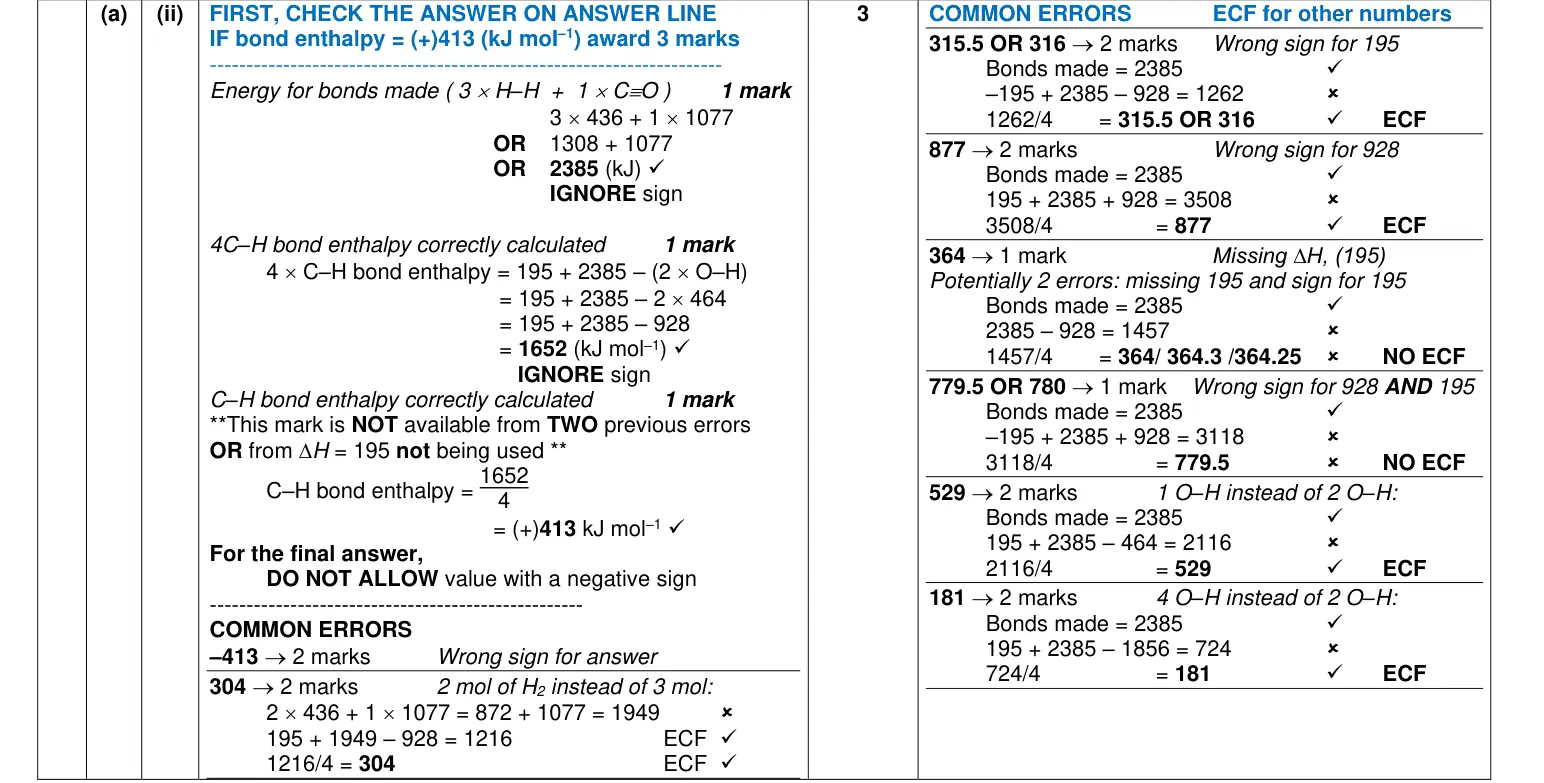
2(a)(ii) Enthalpy changes and Hess’ law 3Calculation
2(a)(iii) Amount of substance (moles), Enthalpy changes and Hess’ law 2Calculation
2(b)(i) The halogens 1Equation writing
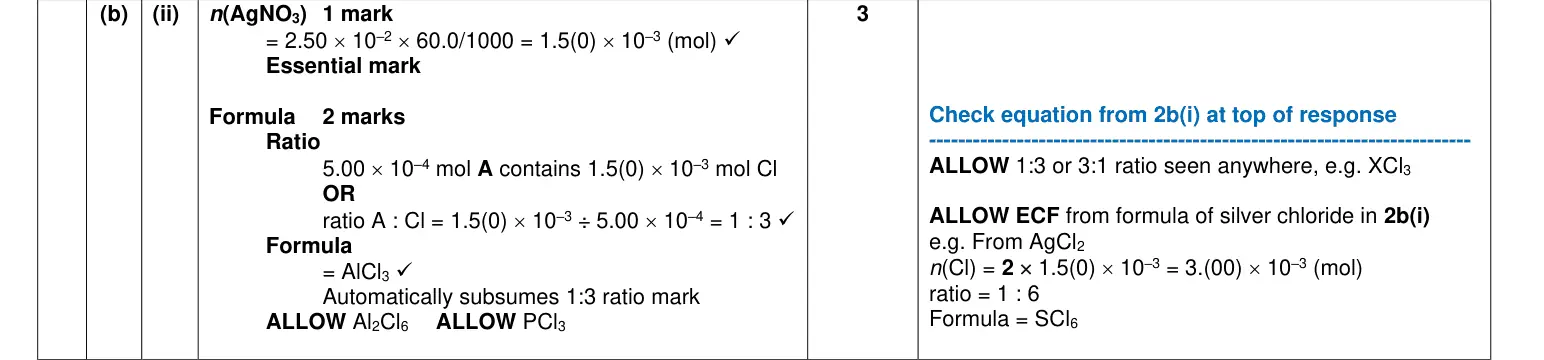
2(b)(ii) Amount of substance (moles), Formulae and equations 3Calculation
2(c)(i) Organic basics: naming, formulae and isomerism, Amount of substance (moles) 1Short answer
2(c)(ii) Amino acids, amides and chirality 1Short answer
2(c)(iii) Atomic structure and isotopes 2Calculation
3(a)(i) Transition elements 2Short answer
3(a)(ii) Transition elements 3Structure / isomer
3(b)(i) Redox titrations and electrode potentials 2Equation writing
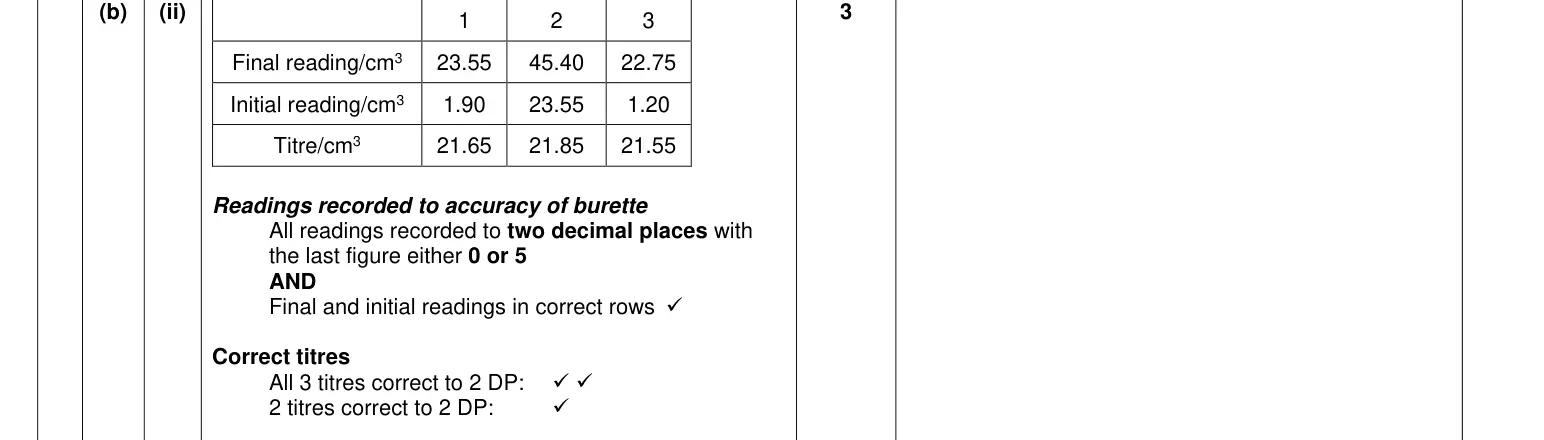
3(b)(ii) Redox titrations and electrode potentials, Practical skills: planning, analysis and evaluation, Practical techniques and apparatus (PAGs) 3Complete table/diagram
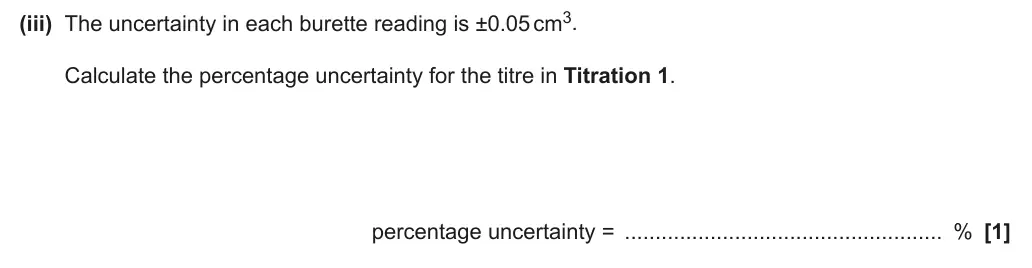
3(b)(iii) Practical skills: planning, analysis and evaluation 1Calculation
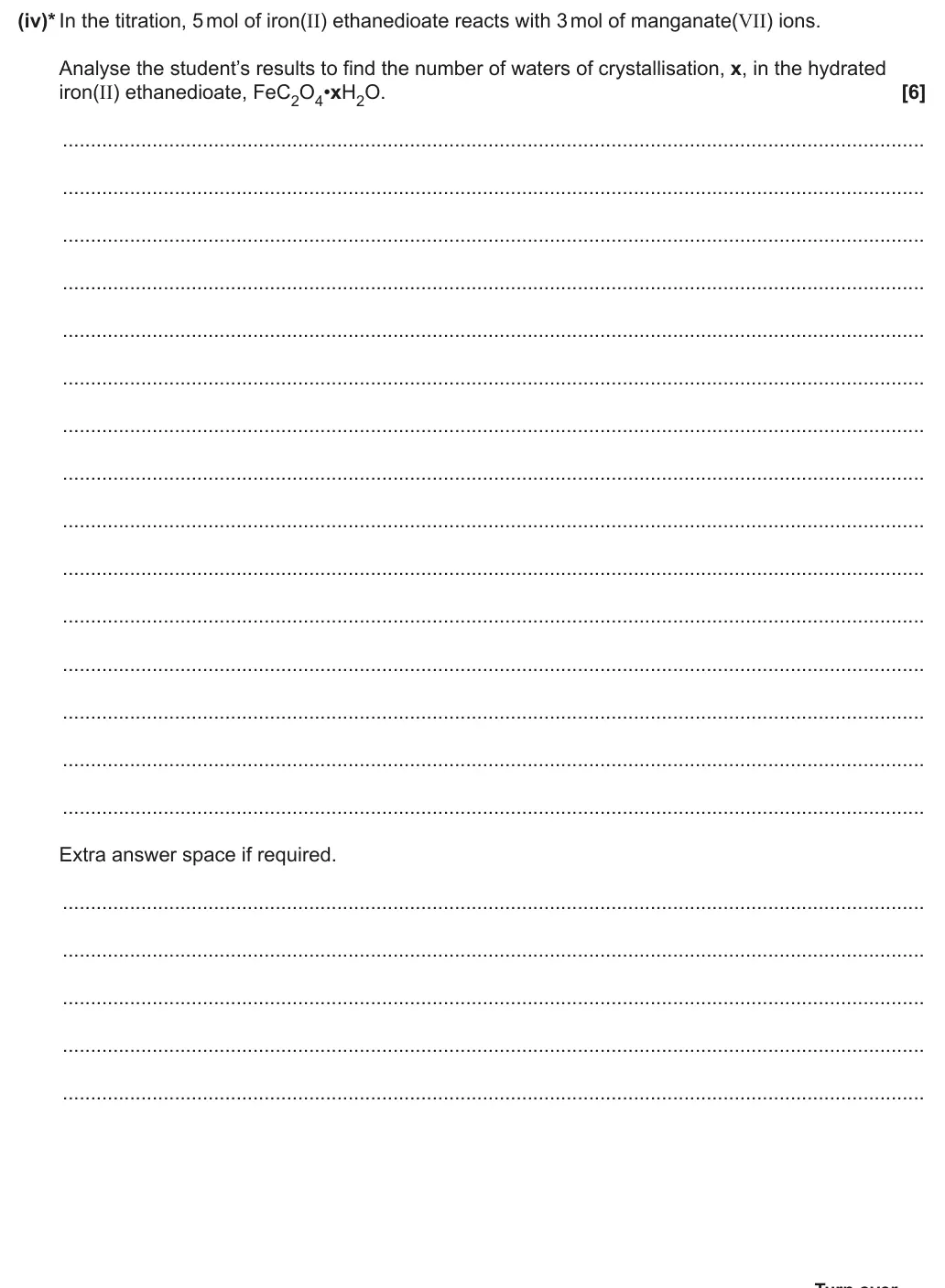
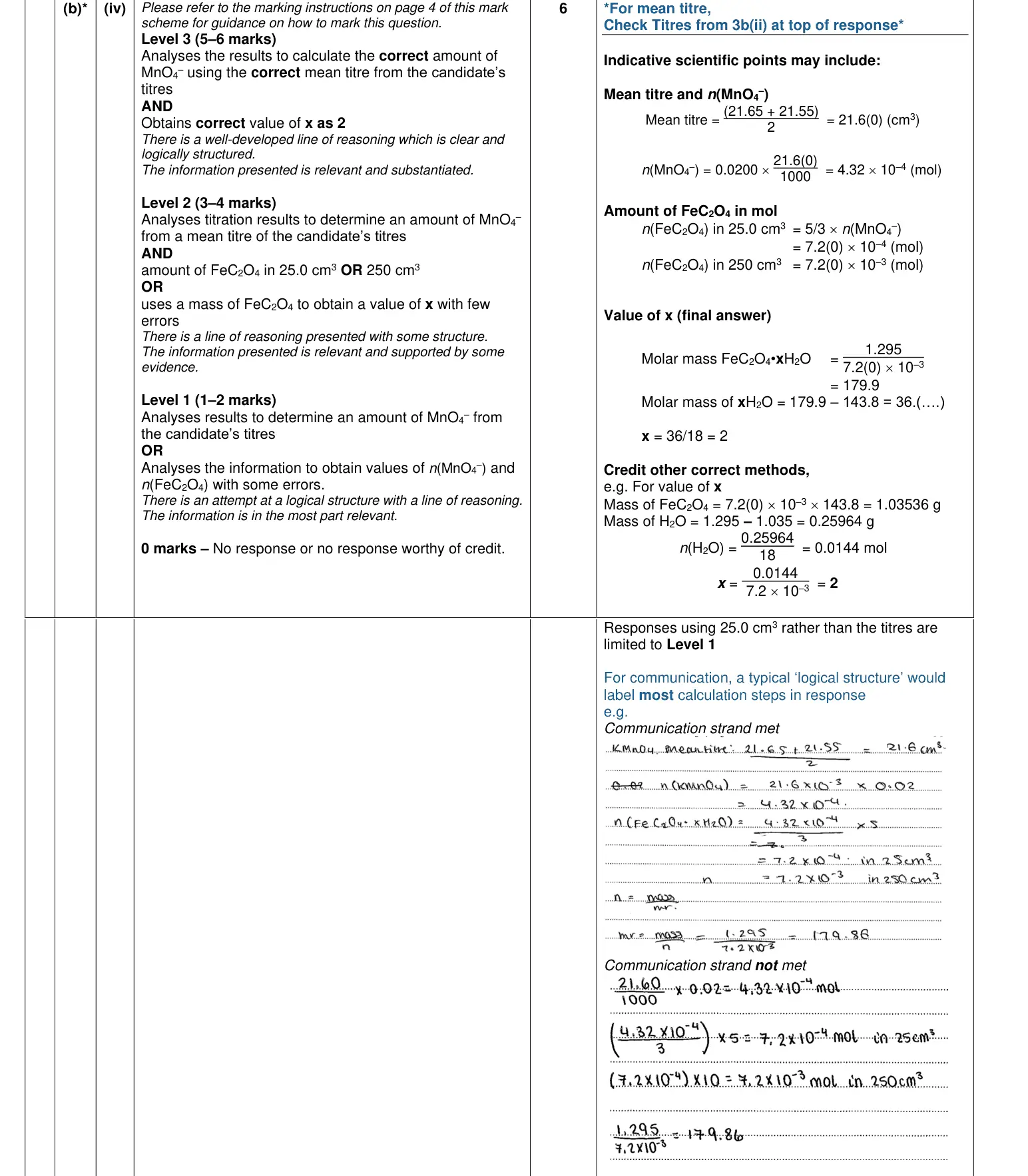
3(b)(iv) Redox titrations and electrode potentials, Amount of substance (moles) 6Level of response
4(a)(i) Acids, bases, pH and buffers 2Short answer
4(a)(ii) Bonding, structure and shapes of molecules 3Structure / isomer
4(a)(iii) Redox and oxidation numbers 1Short answer
4(b)(i) Formulae and equations, Redox and oxidation numbers 1Equation writing
4(b)(ii) Redox and oxidation numbers, Formulae and equations 3Equation writing
4(c)(i) Formulae and equations 1Equation writing
4(c)(ii) Atomic structure and isotopes 2Calculation
4(c)(iii) Aromatic compounds: benzene and phenol 1Short answer
4(c)(iv) Aromatic compounds: benzene and phenol, Bonding, structure and shapes of molecules 2Short answer
5(a)(i) Chromatography and tests for functional groups 1Calculation
5(a)(ii) Haloalkanes 1Equation writing
5(a)(iii) Haloalkanes, Chromatography and tests for functional groups 3Short answer
5(b)(i) Transition elements 2Data interpretation
5(b)(ii) Chromatography and tests for functional groups, Organic basics: naming, formulae and isomerism 6Level of response

The questions

1(a)1(b)1(c)1(d)2(a)(i)2(a)(ii)2(a)(iii)2(b)(i)2(b)(ii)2(c)(i)2(c)(ii)2(c)(iii)3(a)(i)3(a)(ii)3(b)(i)3(b)(ii)3(b)(iii)3(b)(iv)4(a)(i)4(a)(ii)4(a)(iii)4(b)(i)4(b)(ii)4(c)(i)4(c)(ii)4(c)(iii)4(c)(iv)5(a)(i)5(a)(ii)5(a)(iii)5(b)(i)5(b)(ii)
June 2024 · Paper 3 · Q1(a) 2 marks Calculation Medium acids bases and buffers
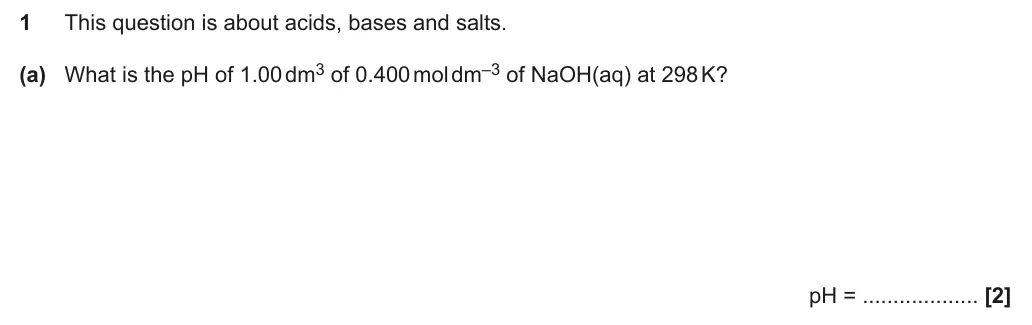
1 This question is about acids, bases and salts.
(a) What is the pH of 1.00 dm3 of 0.400 mol dm–3 of NaOH(aq) at 298 K?
pH = ................... [2]
June 2024 · Paper 3 · Q1(b) 1 mark Calculation Medium acids bases and buffersamount of substance
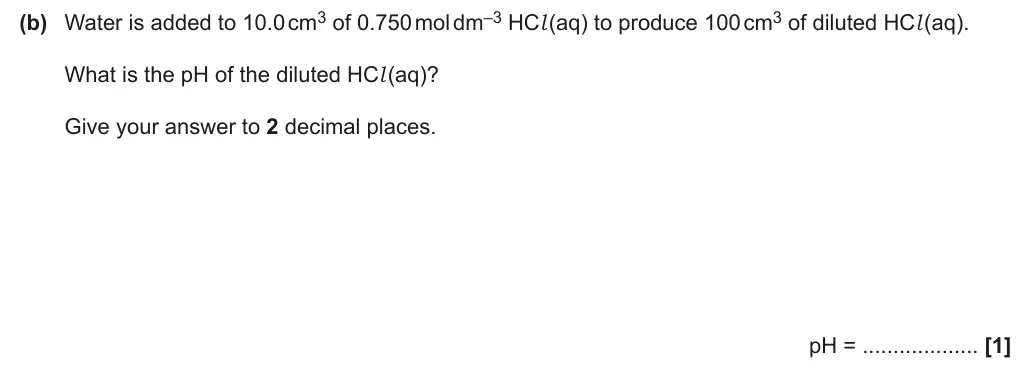
(b) Water is added to 10.0 cm3 of 0.750 mol dm–3 HCl (aq) to produce 100 cm3 of diluted HCl (aq).
What is the pH of the diluted HCl (aq)?
Give your answer to 2 decimal places.
pH = ................... [1]
June 2024 · Paper 3 · Q1(c) 2 marks Calculation Medium acids bases and buffers
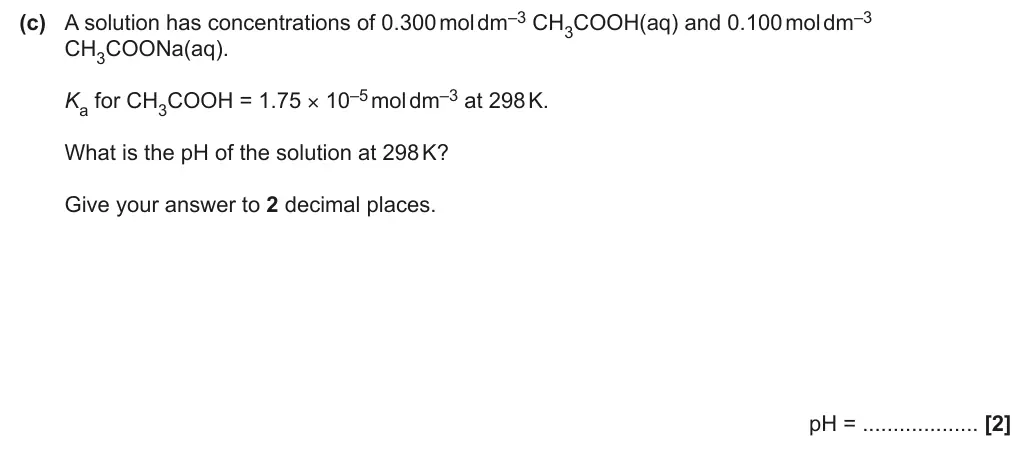
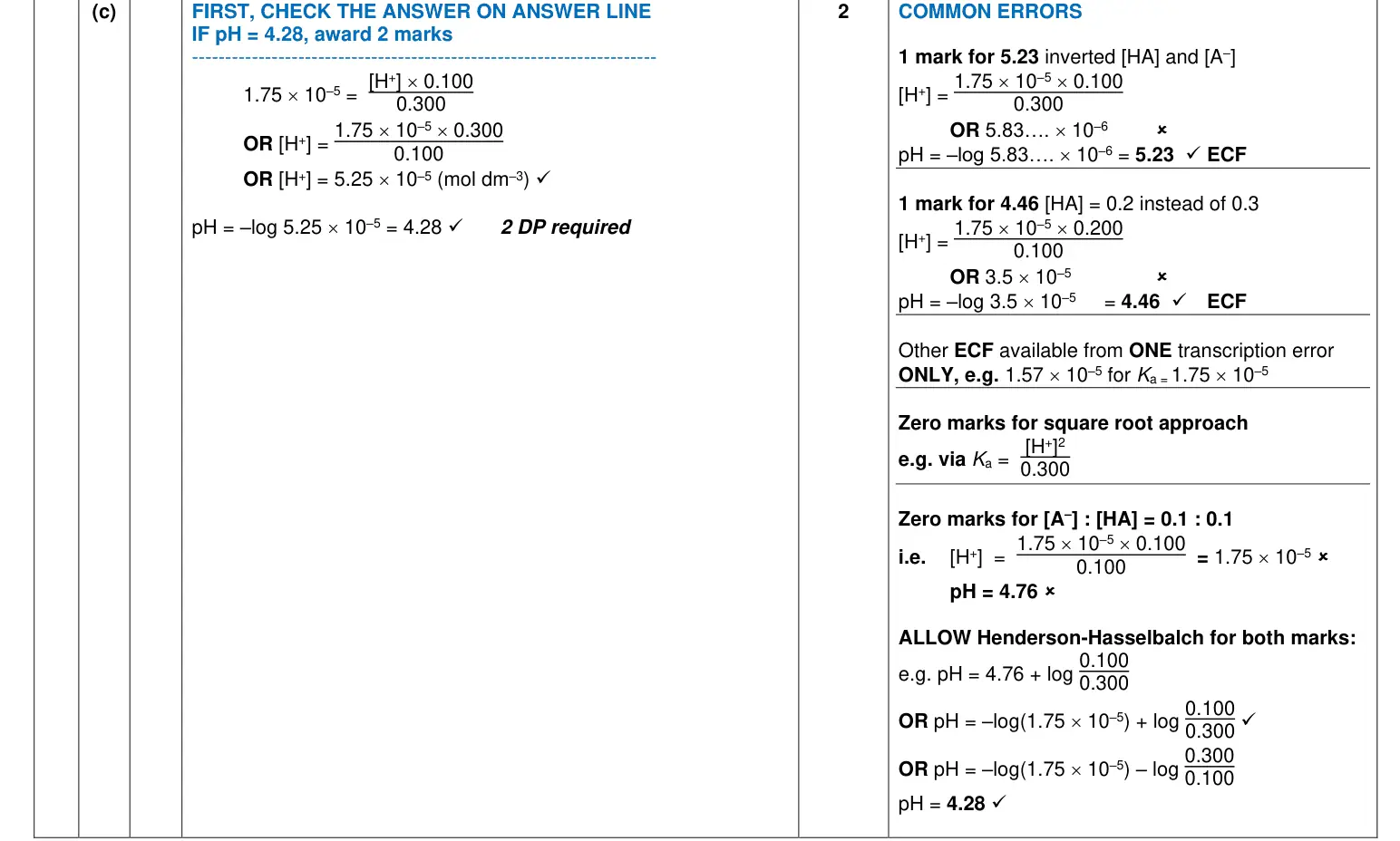
(c) A solution has concentrations of 0.300 mol dm–3 CH3COOH(aq) and 0.100 mol dm–3
CH3COONa(aq).
Ka for CH3COOH = 1.75 × 10⁻⁵ mol dm–3 at 298 K.
What is the pH of the solution at 298 K?
Give your answer to 2 decimal places.
pH = ................... [2]
June 2024 · Paper 3 · Q1(d) 5 marks Extended response Medium acids and titrationspractical techniquesamount of substance
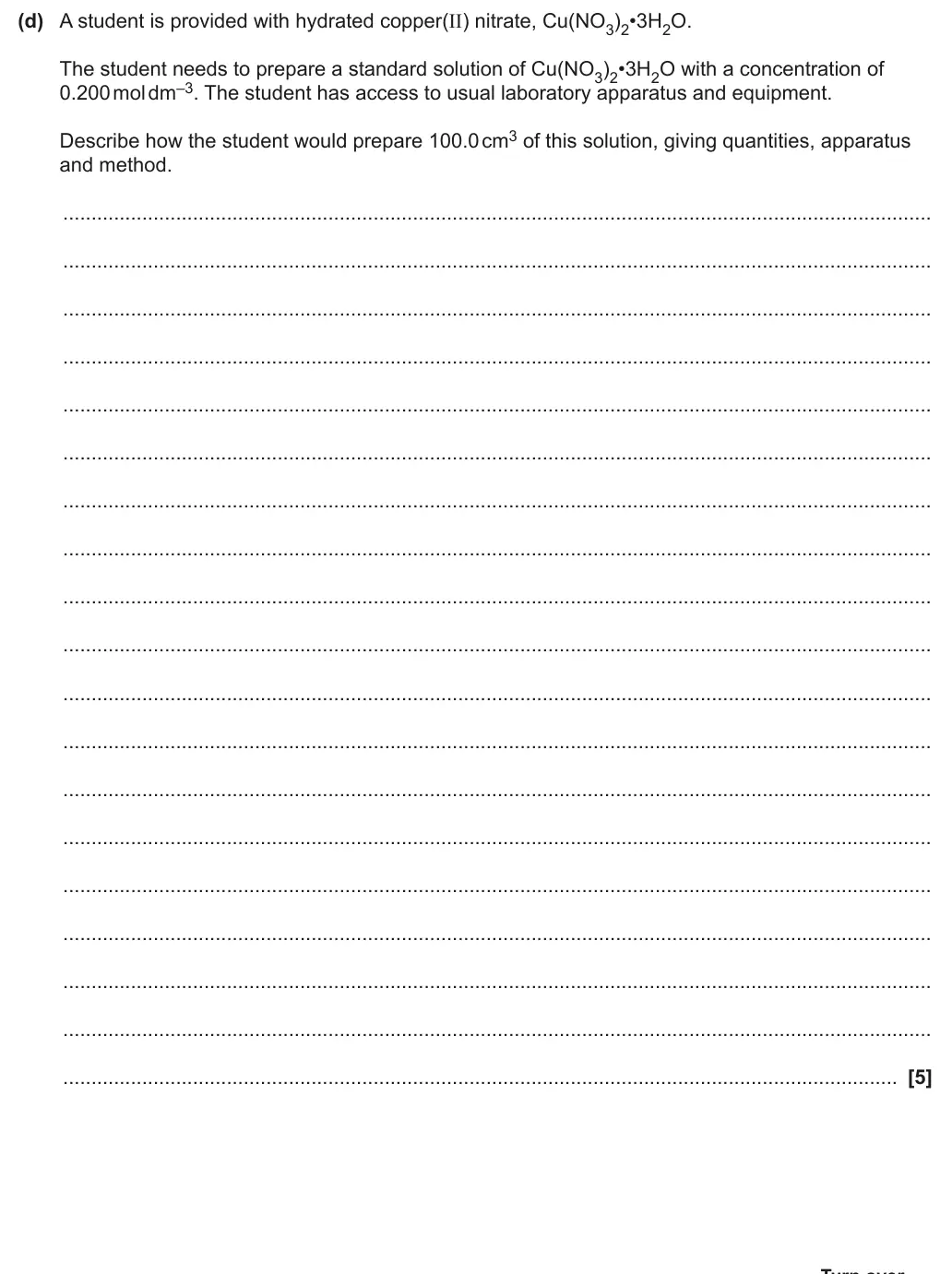
(d) A student is provided with hydrated copper(II) nitrate, Cu(NO3)2•3H2O.
The student needs to prepare a standard solution of Cu(NO3)2•3H2O with a concentration of
0.200 mol dm–3. The student has access to usual laboratory apparatus and equipment.
Describe how the student would prepare 100.0 cm3 of this solution, giving quantities, apparatus
and method.
..........................................................................................................................................................
..........................................................................................................................................................
..........................................................................................................................................................
..........................................................................................................................................................
..........................................................................................................................................................
..........................................................................................................................................................
..........................................................................................................................................................
..........................................................................................................................................................
..........................................................................................................................................................
..........................................................................................................................................................
..........................................................................................................................................................
..........................................................................................................................................................
..........................................................................................................................................................
..........................................................................................................................................................
..........................................................................................................................................................
..........................................................................................................................................................
..........................................................................................................................................................
..........................................................................................................................................................
.................................................................................................................................................... [5]
June 2024 · Paper 3 · Q2(a)(i) 1 mark Short answer Medium enthalpy changes
2 This question is about different areas of chemistry.
(a) Hydrogen gas is manufactured by the chemical industry from the reversible reaction of methane
and steam, shown below.
CH4(g) + H2O(g) 3H2(g) + CO(g)    ΔH = +195 kJ mol–1
Average bond enthalpies are shown in the table.
Bond H–H O–H C≡O
Average bond enthalpy
+436 +464 +1077
/ kJ mol–1
(i) Why do all average bond enthalpies have a positive value?
..........................................................................................................................................................
..................................................................................................................................................... [1]
June 2024 · Paper 3 · Q2(a)(ii) 3 marks Calculation Hard enthalpy changes
Earlier part of question 2 that this part usesEarlier part of June 2024 Paper 3 question 2
(ii) Determine the C–H bond enthalpy, in kJ mol–1, using the information above.
C–H bond enthalpy =  ........................................... kJ mol–1 [3]
June 2024 · Paper 3 · Q2(a)(iii) 2 marks Calculation Medium amount of substanceenthalpy changes
Earlier part of question 2 that this part usesEarlier part of June 2024 Paper 3 question 2
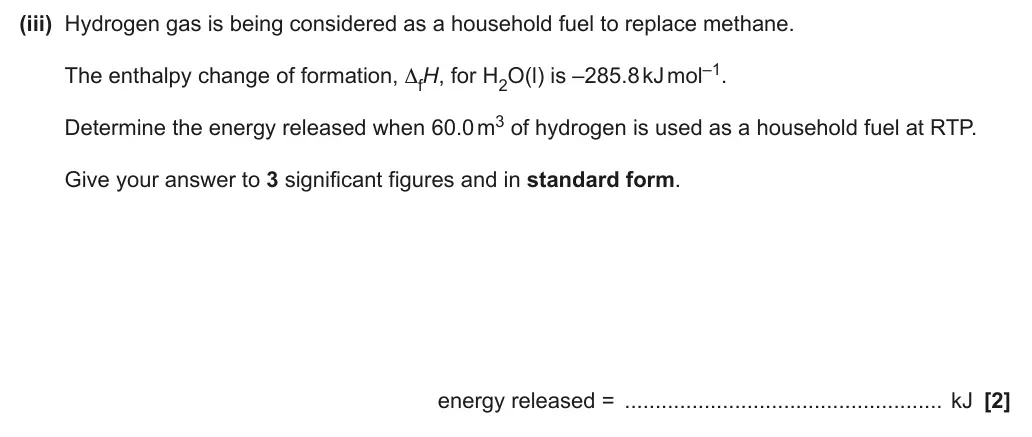
(iii) Hydrogen gas is being considered as a household fuel to replace methane.
The enthalpy change of formation, ΔfH, for H2O(l) is –285.8 kJ mol–1.
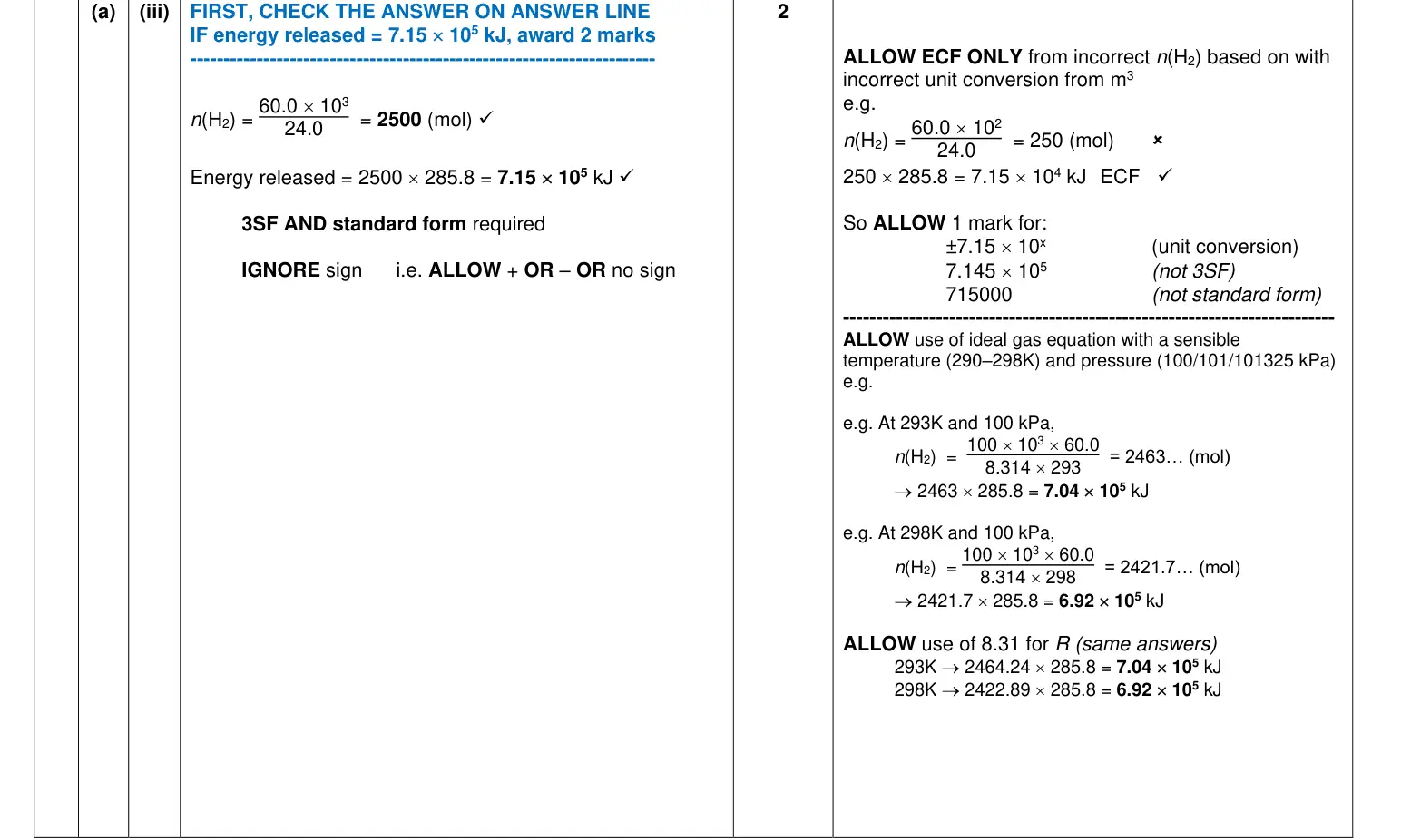
Determine the energy released when 60.0 m3 of hydrogen is used as a household fuel at RTP.
Give your answer to 3 significant figures and in standard form.
energy released =  .................................................... kJ [2]
June 2024 · Paper 3 · Q2(b)(i) 1 mark Equation writing Easy halogens
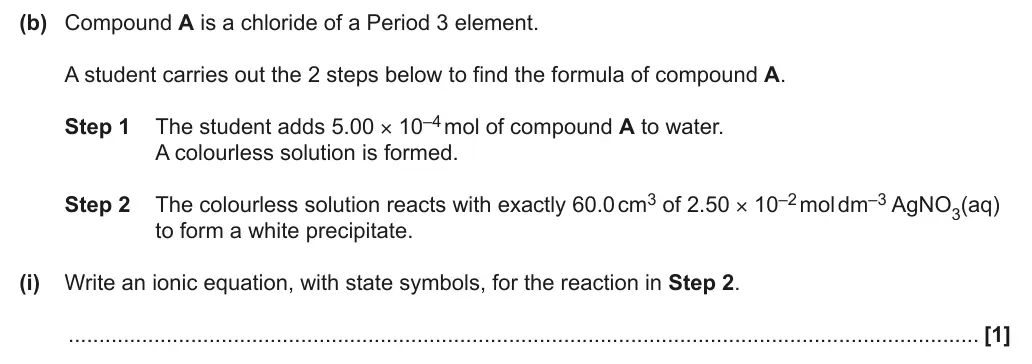
(b) Compound A is a chloride of a Period 3 element.
A student carries out the 2 steps below to find the formula of compound A.
Step 1 The student adds 5.00 × 10⁻⁴ mol of compound A to water.
A colourless solution is formed.
Step 2 The colourless solution reacts with exactly 60.0 cm3 of 2.50 × 10⁻² mol dm–3 AgNO3(aq)
to form a white precipitate.
(i) Write an ionic equation, with state symbols, for the reaction in Step 2.
..................................................................................................................................................... [1]
June 2024 · Paper 3 · Q2(b)(ii) 3 marks Calculation Medium amount of substanceformulae and equations
Earlier part of question 2 that this part usesEarlier part of June 2024 Paper 3 question 2
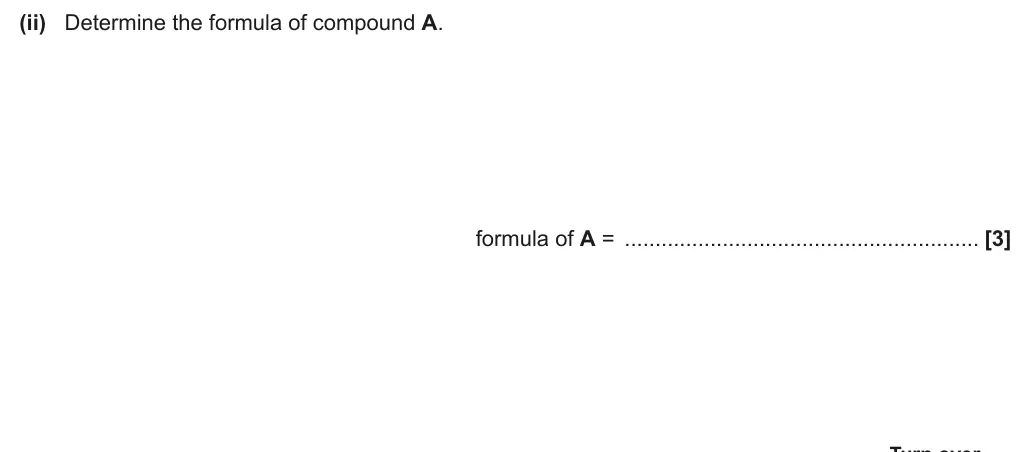
(ii) Determine the formula of compound A.
formula of A =  .......................................................... [3]
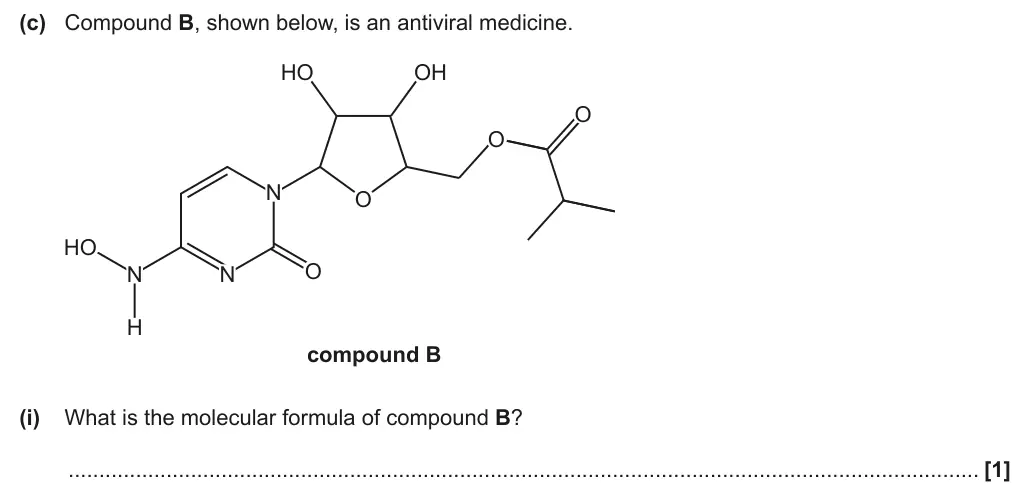
June 2024 · Paper 3 · Q2(c)(i) 1 mark Short answer Easy organic basicsamount of substance
(c) Compound B, shown below, is an antiviral medicine.
HO OH
O
O
N O
HO
N N O
H
compound B
(i) What is the molecular formula of compound B?
..................................................................................................................................................... [1]
June 2024 · Paper 3 · Q2(c)(ii) 1 mark Short answer Easy amino acids amides and chirality
Earlier part of question 2 that this part usesEarlier part of June 2024 Paper 3 question 2
(ii) How many chiral carbon atoms are there in one molecule of compound B?
..................................................................................................................................................... [1]
June 2024 · Paper 3 · Q2(c)(iii) 2 marks Calculation Medium atomic structure and isotopes
Earlier part of question 2 that this part usesEarlier part of June 2024 Paper 3 question 2
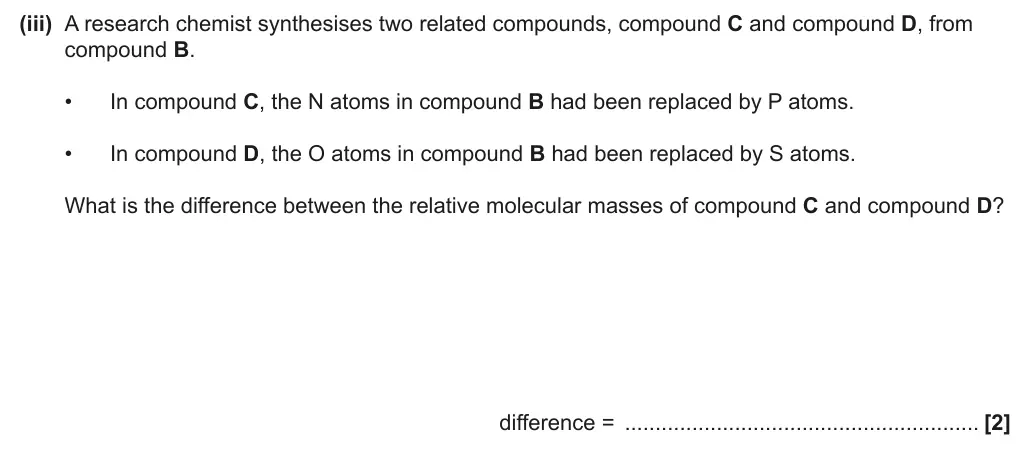
(iii) A research chemist synthesises two related compounds, compound C and compound D, from
compound B.
• In compound C, the N atoms in compound B had been replaced by P atoms.
• In compound D, the O atoms in compound B had been replaced by S atoms.
What is the difference between the relative molecular masses of compound C and compound D?
difference =  .......................................................... [2]
June 2024 · Paper 3 · Q3(a)(i) 2 marks Short answer Medium transition elements
3 This question is about compounds and ions of iron(II) and iron(III) that contain ethanedioate ions,
C2O4 2–.
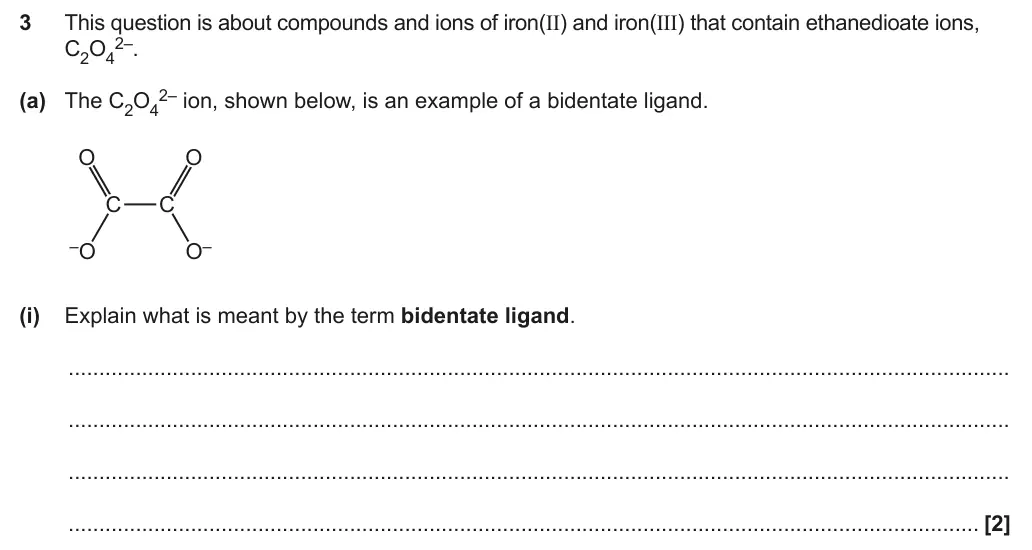
(a) The C2O4 2– ion, shown below, is an example of a bidentate ligand.
O O
C C
–O O–
(i) Explain what is meant by the term bidentate ligand.
..........................................................................................................................................................
..........................................................................................................................................................
..........................................................................................................................................................
..................................................................................................................................................... [2]
June 2024 · Paper 3 · Q3(a)(ii) 3 marks Structure / isomer Medium transition elements
Earlier part of question 3 that this part usesEarlier part of June 2024 Paper 3 question 3
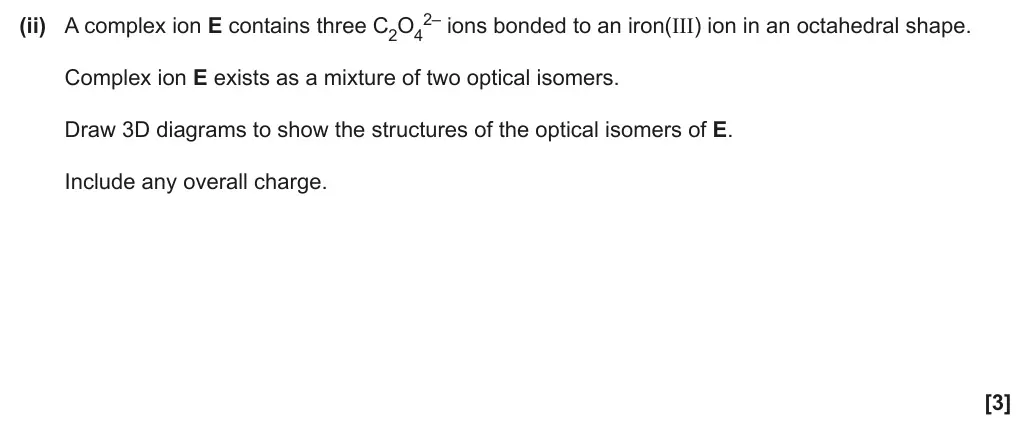
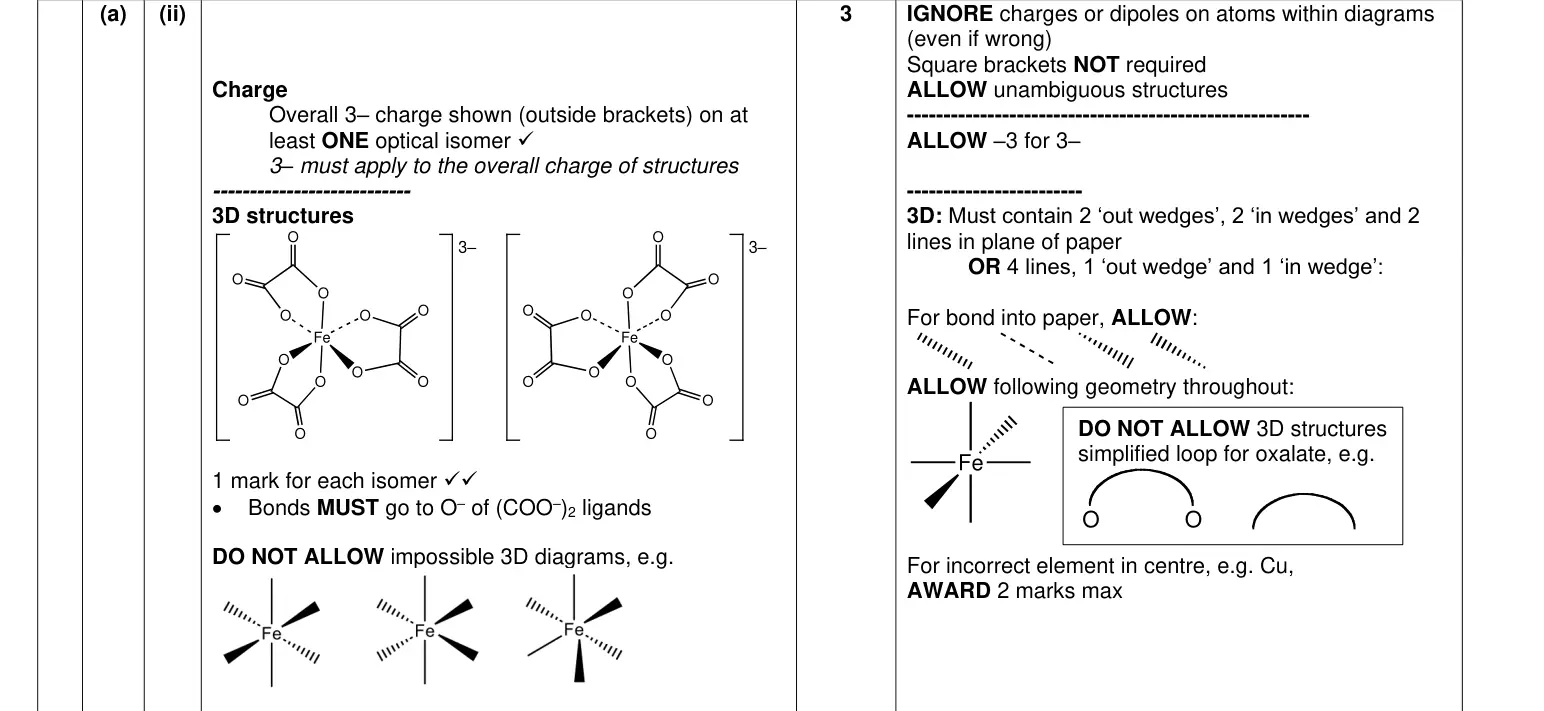
(ii) A complex ion E contains three C2O4 2– ions bonded to an iron(III) ion in an octahedral shape.
Complex ion E exists as a mixture of two optical isomers.
Draw 3D diagrams to show the structures of the optical isomers of E.
Include any overall charge.
[3]
June 2024 · Paper 3 · Q3(b)(i) 2 marks Equation writing Medium redox and electrode potentials
(b) A student plans an investigation to find the number of waters of crystallisation, x, in a sample of

hydrated iron(II) ethanedioate, FeC2O4•xH2O.
The student decides to carry out a redox titration between solutions of iron(II) ethanedioate and
potassium manganate(VII) in acidic conditions.
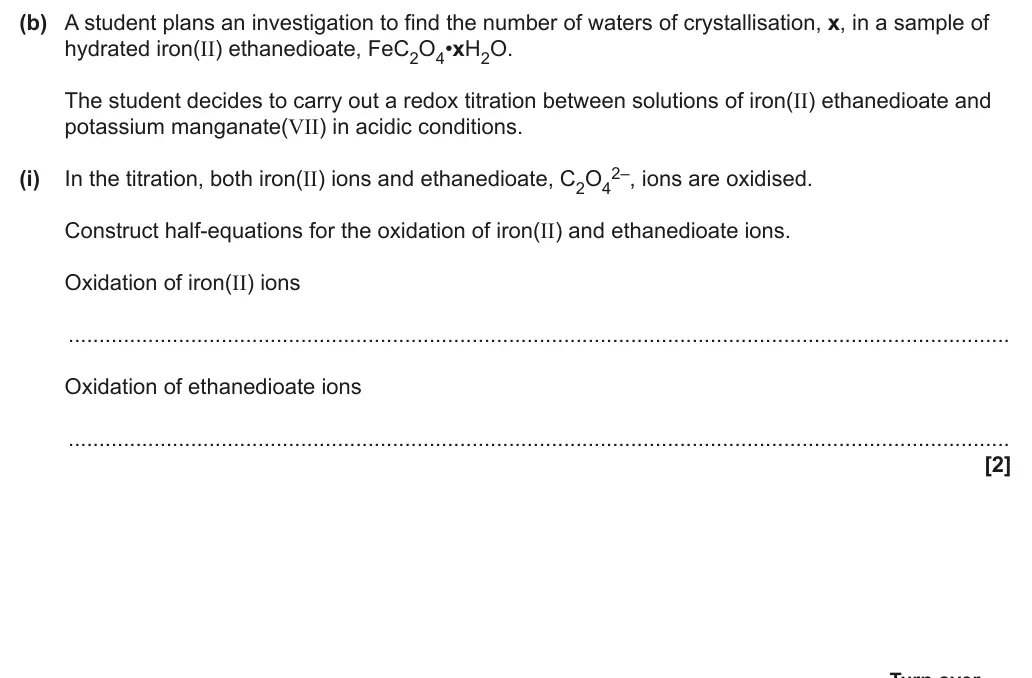
(i) In the titration, both iron(II) ions and ethanedioate, C2O4 2–, ions are oxidised.
Construct half-equations for the oxidation of iron(II) and ethanedioate ions.
Oxidation of iron(II) ions
..........................................................................................................................................................
Oxidation of ethanedioate ions
..........................................................................................................................................................
[2]
June 2024 · Paper 3 · Q3(b)(ii) 3 marks Complete table/diagram Medium redox and electrode potentialspractical skillspractical techniques
Earlier part of question 3 that this part usesEarlier part of June 2024 Paper 3 question 3
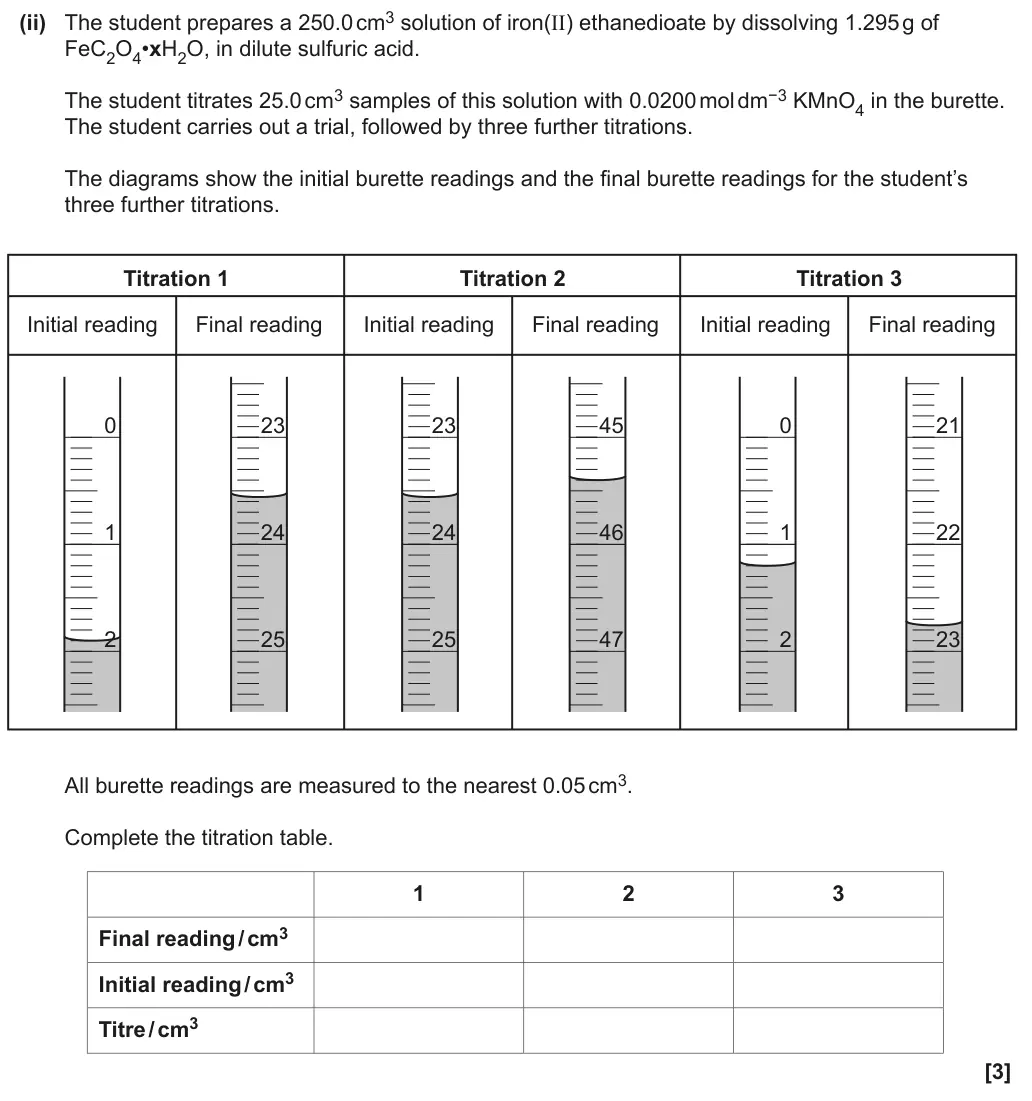
(ii) The student prepares a 250.0 cm3 solution of iron(II) ethanedioate by dissolving 1.295 g of
FeC2O4•xH2O, in dilute sulfuric acid.
The student titrates 25.0 cm3 samples of this solution with 0.0200 mol dm−3 KMnO4 in the burette.
The student carries out a trial, followed by three further titrations.
The diagrams show the initial burette readings and the final burette readings for the student’s
three further titrations.
Titration 1 Titration 2 Titration 3
Initial reading Final reading Initial reading Final reading Initial reading Final reading
0 23 23 45 0 21
1 24 24 46 1 22
2 25 25 47 2 23
All burette readings are measured to the nearest 0.05 cm3.
Complete the titration table.
1 2 3
Final reading / cm3
Initial reading / cm3
Titre / cm3
[3]
June 2024 · Paper 3 · Q3(b)(iii) 1 mark Calculation Medium practical skills
Earlier part of question 3 that this part usesEarlier part of June 2024 Paper 3 question 3
(iii) The uncertainty in each burette reading is ±0.05 cm3.
Calculate the percentage uncertainty for the titre in Titration 1.
percentage uncertainty =  .................................................... % [1]
June 2024 · Paper 3 · Q3(b)(iv) 6 marks 6-mark level of response Medium redox and electrode potentialsamount of substance
Earlier parts of question 3 that this part usesEarlier part of June 2024 Paper 3 question 3Earlier part of June 2024 Paper 3 question 3
(iv)* In the titration, 5 mol of iron(II) ethanedioate reacts with 3 mol of manganate(VII) ions.
Analyse the student’s results to find the number of waters of crystallisation, x, in the hydrated
iron(II) ethanedioate, FeC2O4•xH2O. [6]
..........................................................................................................................................................
..........................................................................................................................................................
..........................................................................................................................................................
..........................................................................................................................................................
..........................................................................................................................................................
..........................................................................................................................................................
..........................................................................................................................................................
..........................................................................................................................................................
..........................................................................................................................................................
..........................................................................................................................................................
..........................................................................................................................................................
..........................................................................................................................................................
..........................................................................................................................................................
..........................................................................................................................................................
..........................................................................................................................................................
Extra answer space if required.
..........................................................................................................................................................
..........................................................................................................................................................
..........................................................................................................................................................
..........................................................................................................................................................
..........................................................................................................................................................
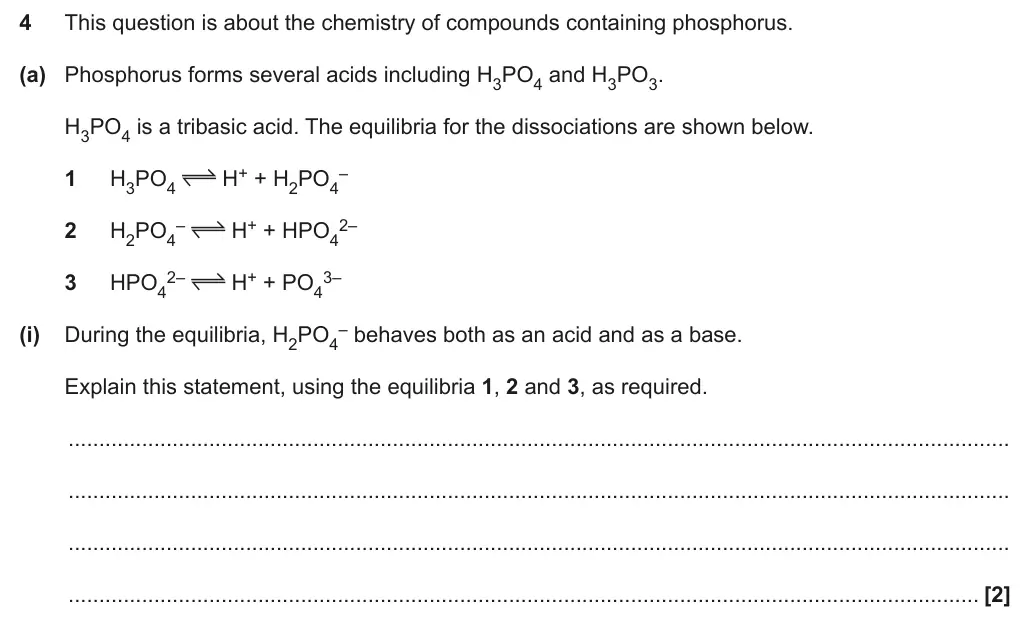
June 2024 · Paper 3 · Q4(a)(i) 2 marks Short answer Medium acids bases and buffers
4 This question is about the chemistry of compounds containing phosphorus.
(a) Phosphorus forms several acids including H3PO4 and H3PO3.
H3PO4 is a tribasic acid. The equilibria for the dissociations are shown below.
1 H3PO4 H+ + H2PO4 –
2 H2PO4 – H+ + HPO4 2–
3 HPO4 2– H+ + PO4 3–
(i) During the equilibria, H2PO4 – behaves both as an acid and as a base.
Explain this statement, using the equilibria 1, 2 and 3, as required.
..........................................................................................................................................................
..........................................................................................................................................................
..........................................................................................................................................................
..................................................................................................................................................... [2]
June 2024 · Paper 3 · Q4(a)(ii) 3 marks Structure / isomer Hard bonding and structure
Earlier part of question 4 that this part usesEarlier part of June 2024 Paper 3 question 4
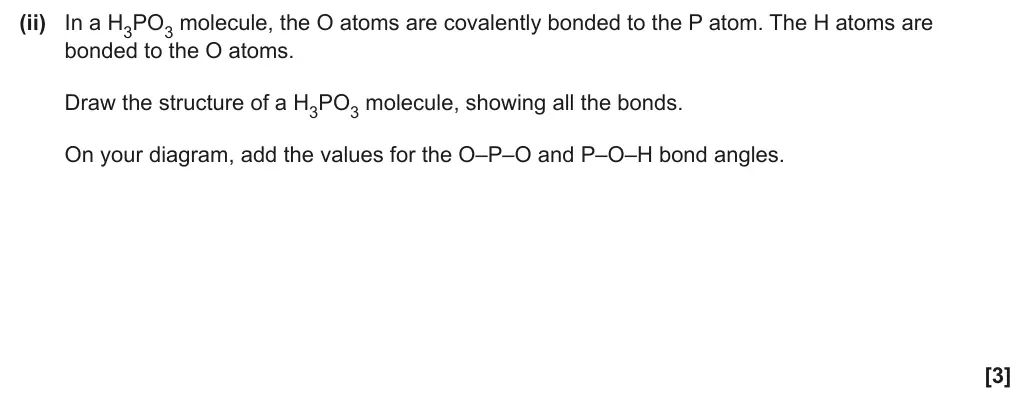
(ii) In a H3PO3 molecule, the O atoms are covalently bonded to the P atom. The H atoms are
bonded to the O atoms.
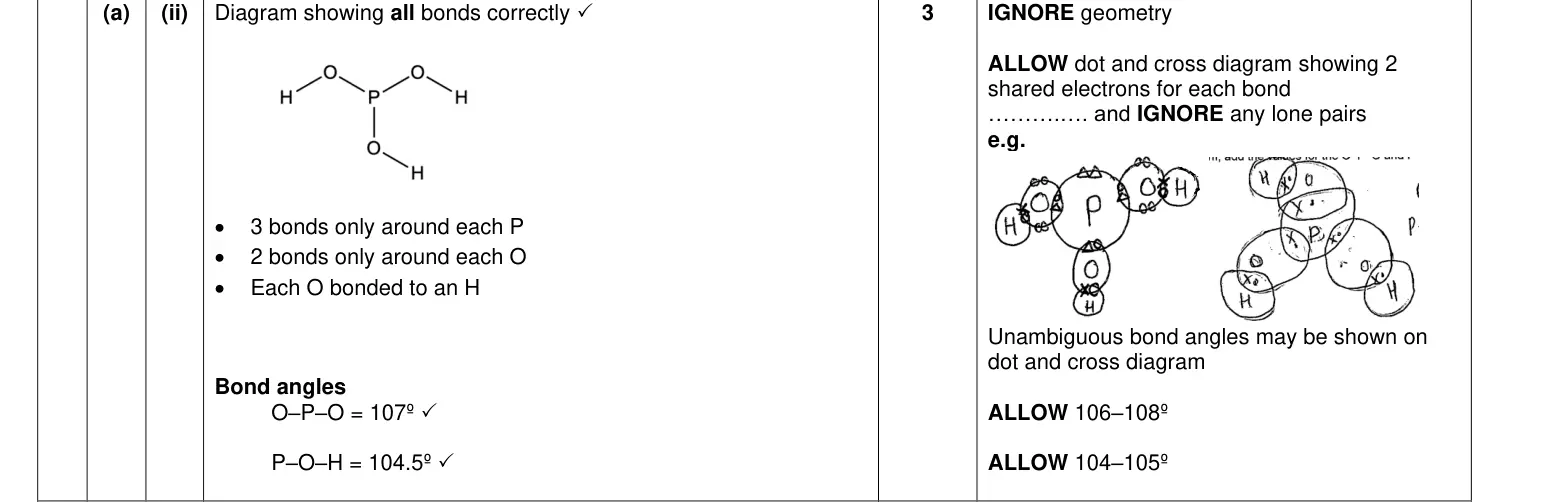
Draw the structure of a H3PO3 molecule, showing all the bonds.
On your diagram, add the values for the O–P–O and P–O–H bond angles.
[3]
June 2024 · Paper 3 · Q4(a)(iii) 1 mark Short answer Medium redox
Earlier part of question 4 that this part usesEarlier part of June 2024 Paper 3 question 4
(iii) The systematic name of H3PO4 is phosphoric(V) acid.
What is the systematic name of H3PO3?
..................................................................................................................................................... [1]
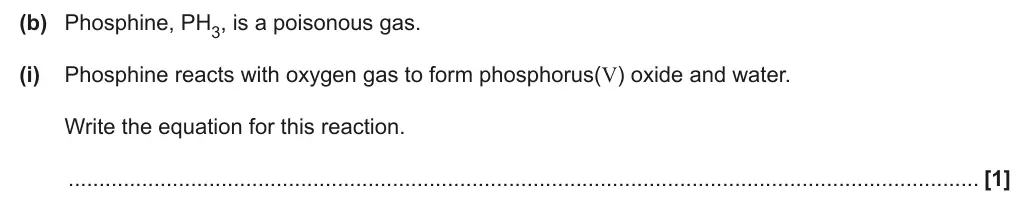
June 2024 · Paper 3 · Q4(b)(i) 1 mark Equation writing Medium formulae and equationsredox
(b) Phosphine, PH3, is a poisonous gas.
(i) Phosphine reacts with oxygen gas to form phosphorus(V) oxide and water.
Write the equation for this reaction.
..................................................................................................................................................... [1]
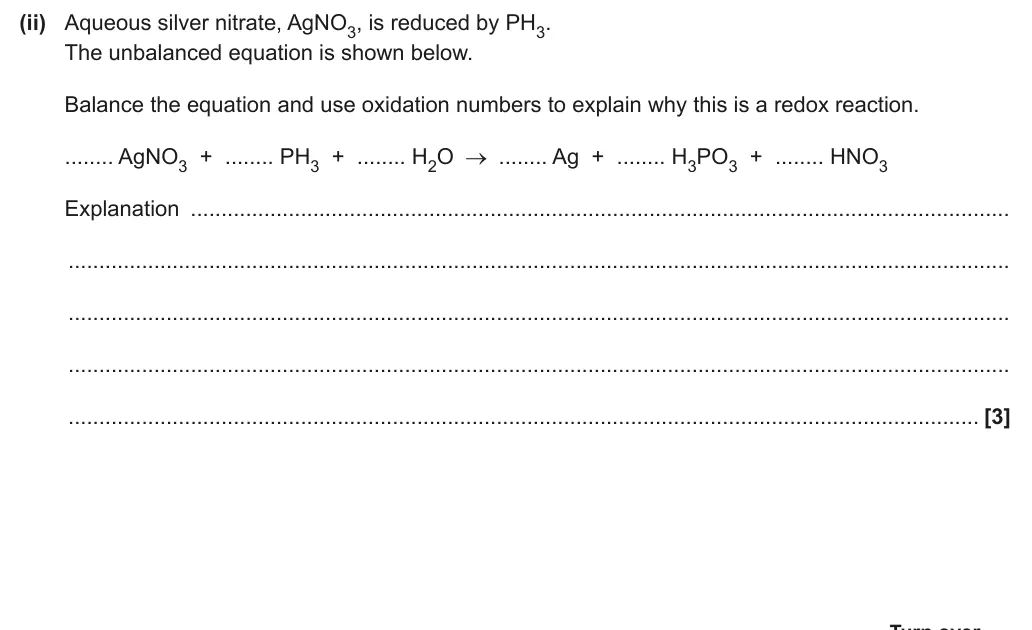
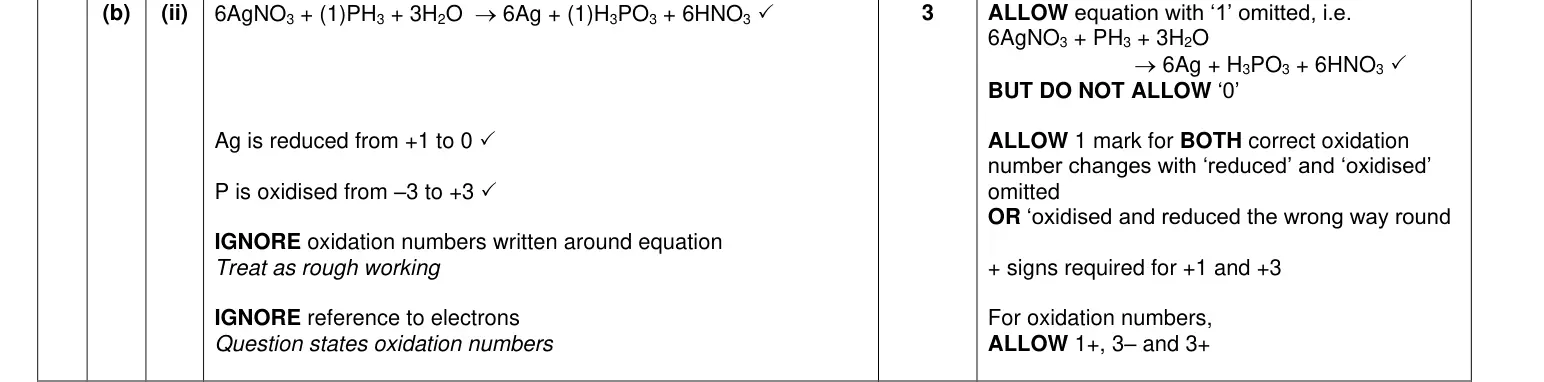
June 2024 · Paper 3 · Q4(b)(ii) 3 marks Equation writing Hard redoxformulae and equations
Earlier part of question 4 that this part usesEarlier part of June 2024 Paper 3 question 4
(ii) Aqueous silver nitrate, AgNO3, is reduced by PH3.
The unbalanced equation is shown below.
Balance the equation and use oxidation numbers to explain why this is a redox reaction.
........ AgNO3  +  ........ PH3  +  ........ H2O ........ Ag  +  ........ H3PO3  +  ........ HNO3
Explanation  ......................................................................................................................................
..........................................................................................................................................................
..........................................................................................................................................................
..........................................................................................................................................................
..................................................................................................................................................... [3]
June 2024 · Paper 3 · Q4(c)(i) 1 mark Equation writing Easy formulae and equations
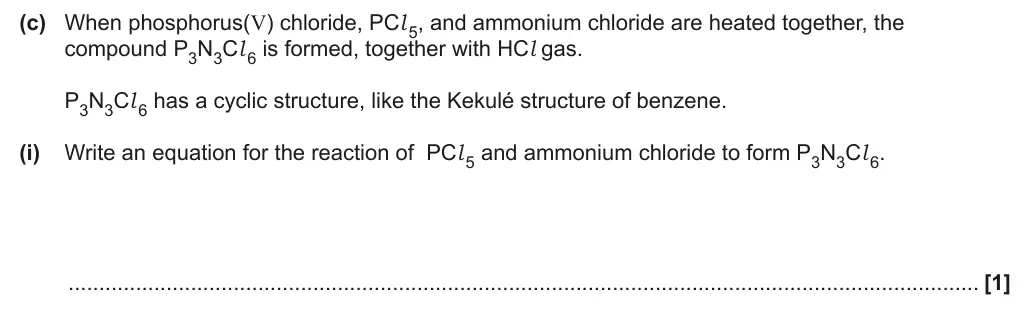
(c) When phosphorus(V) chloride, PCl 5, and ammonium chloride are heated together, the
compound P3N3Cl 6 is formed, together with HCl gas.
P3N3Cl 6 has a cyclic structure, like the Kekulé structure of benzene.
(i) Write an equation for the reaction of  PCl 5 and ammonium chloride to form P3N3Cl 6.
..................................................................................................................................................... [1]
June 2024 · Paper 3 · Q4(c)(ii) 2 marks Calculation Medium atomic structure and isotopes
Earlier part of question 4 that this part usesEarlier part of June 2024 Paper 3 question 4
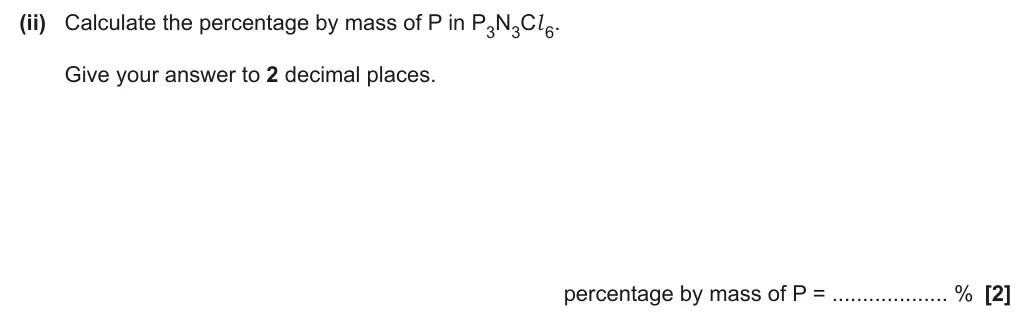
(ii) Calculate the percentage by mass of P in P3N3Cl 6.
Give your answer to 2 decimal places.
percentage by mass of P = ................... % [2]
June 2024 · Paper 3 · Q4(c)(iii) 1 mark Short answer Medium aromatic compounds
Earlier part of question 4 that this part usesEarlier part of June 2024 Paper 3 question 4
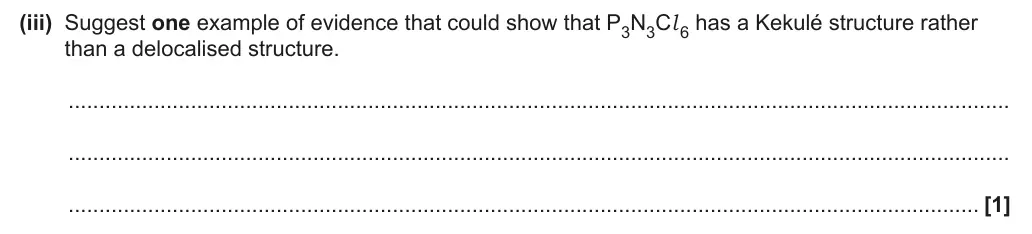
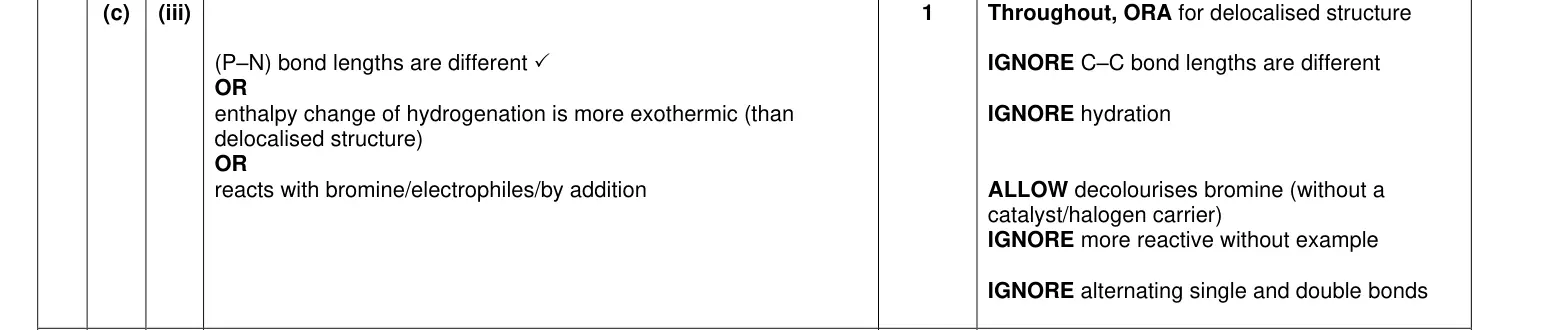
(iii) Suggest one example of evidence that could show that P3N3Cl 6 has a Kekulé structure rather
than a delocalised structure.
..........................................................................................................................................................
..........................................................................................................................................................
..................................................................................................................................................... [1]
June 2024 · Paper 3 · Q4(c)(iv) 2 marks Short answer Hard aromatic compoundsbonding and structure
Earlier part of question 4 that this part usesEarlier part of June 2024 Paper 3 question 4
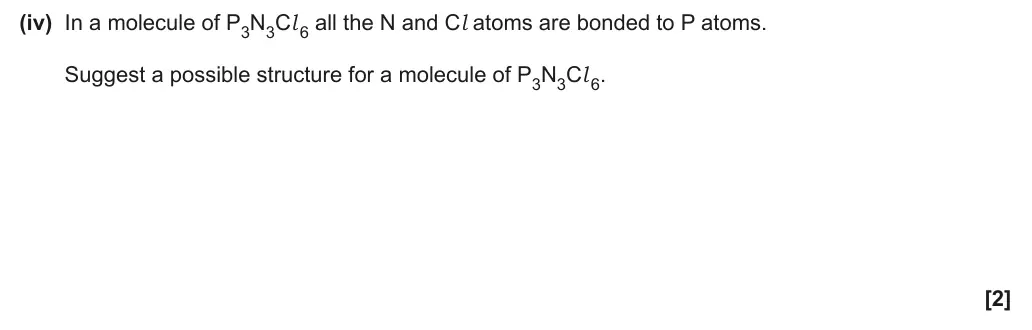
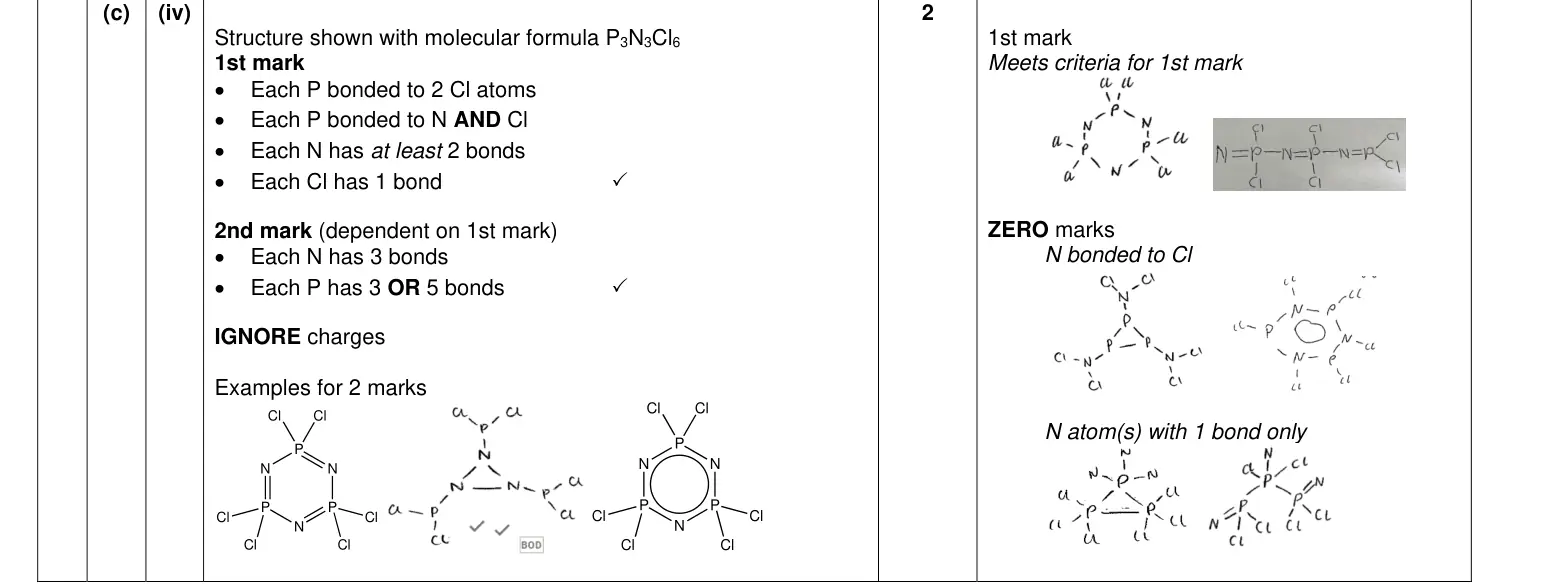
(iv) In a molecule of P3N3Cl 6 all the N and Cl atoms are bonded to P atoms.
Suggest a possible structure for a molecule of P3N3Cl 6.
[2]
June 2024 · Paper 3 · Q5(a)(i) 1 mark Calculation Easy chromatography and functional group tests
5 This question is about the analysis of organic compounds.
(a) A student investigates the alkaline hydrolysis of 1-bromopropane as outlined below.
Step 1 The student adds 1-bromopropane to an excess of aqueous potassium hydroxide,
KOH(aq), in a pear-shaped flask.
Step 2 A TLC chromatogram is run using propan-1-ol and the reaction mixture.
Step 3 The reaction mixture is refluxed.
A TLC chromatogram of the reaction mixture is run every 10 minutes.
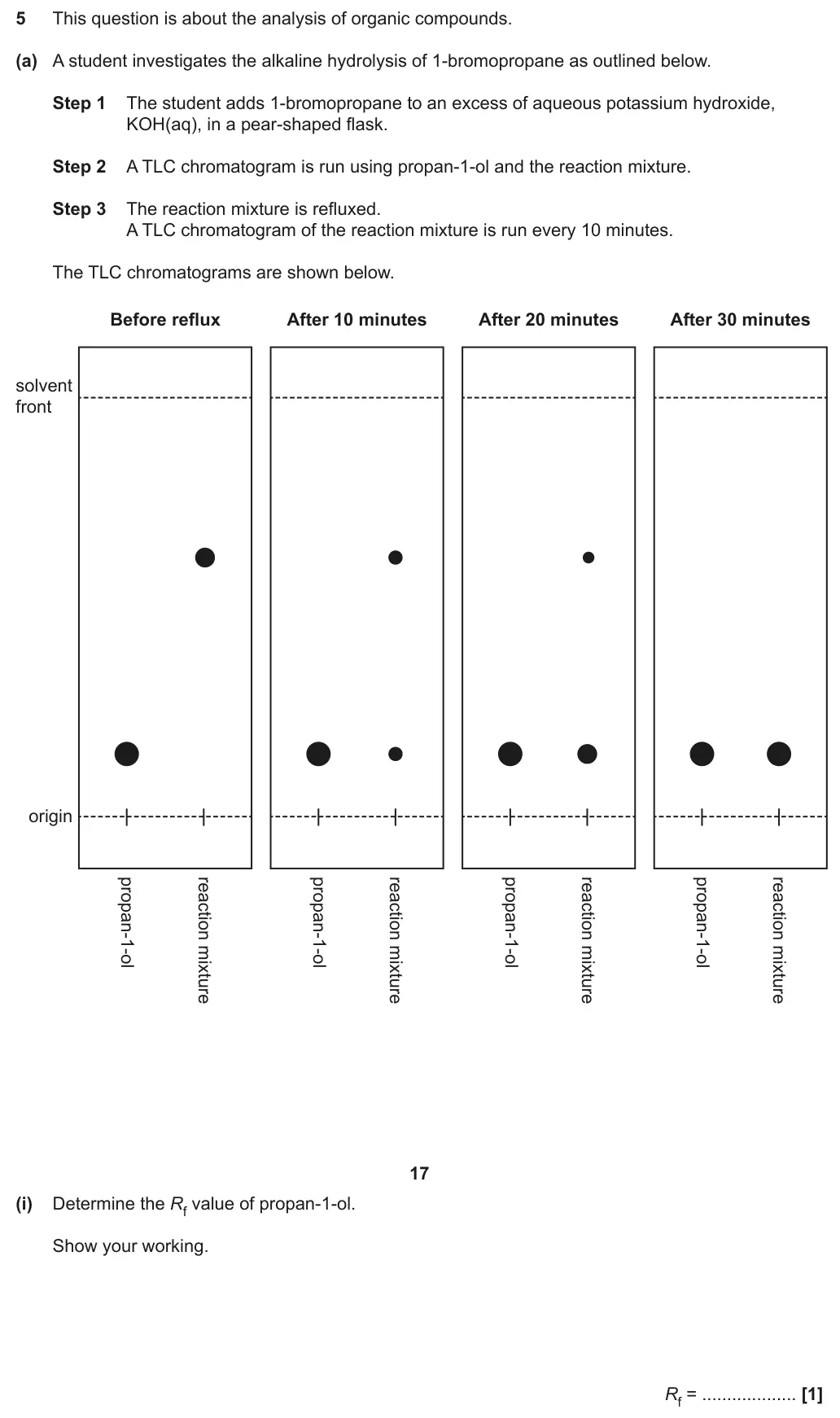
The TLC chromatograms are shown below.
Before reflux After 10 minutes After 20 minutes After 30 minutes
solvent
front
origin
propan-1-ol reaction mixture propan-1-ol reaction mixture propan-1-ol reaction mixture propan-1-ol reaction mixture
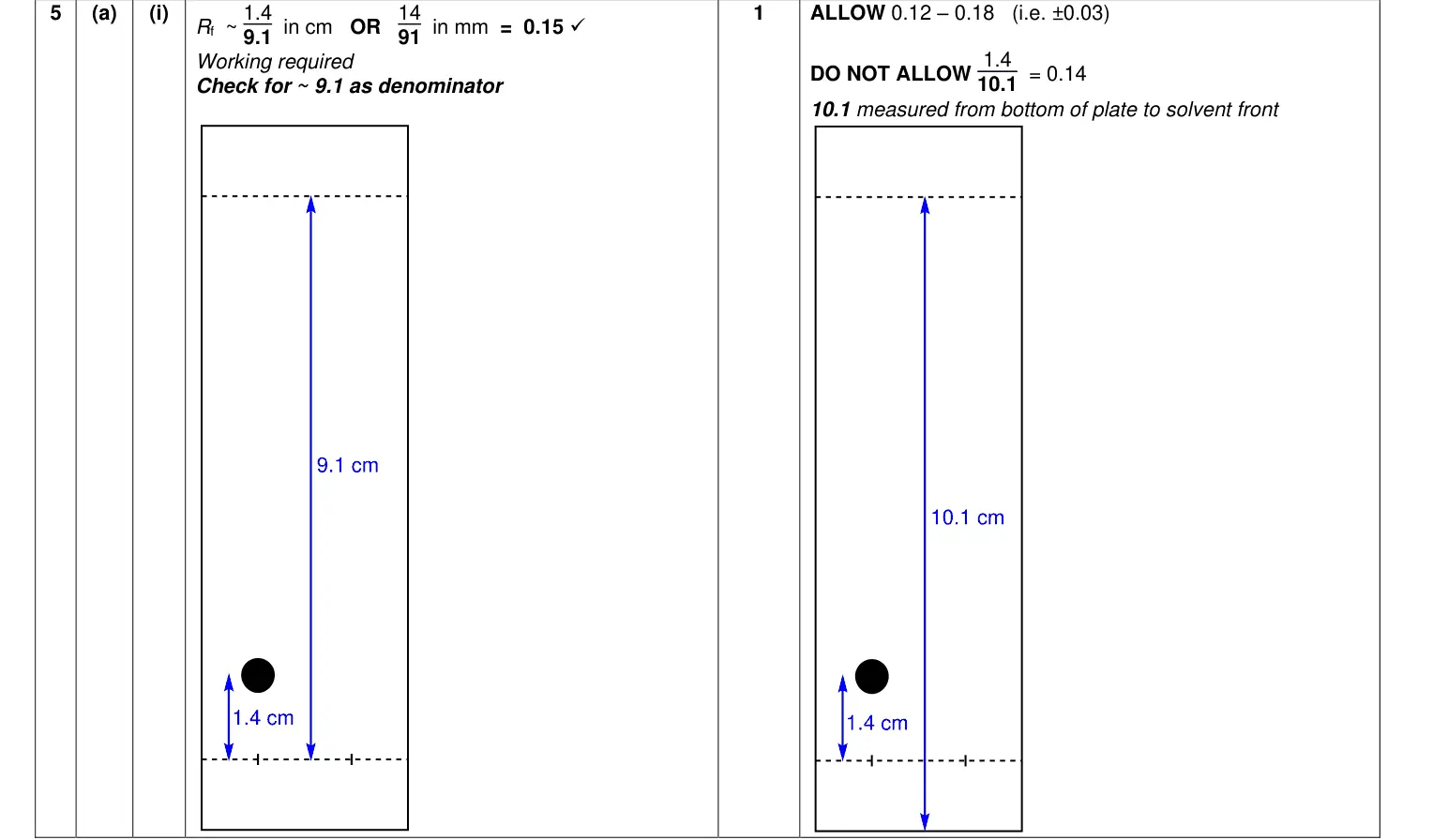
(i) Determine the Rf value of propan-1-ol.
Show your working.
Rf = ................... [1]
June 2024 · Paper 3 · Q5(a)(ii) 1 mark Equation writing Easy haloalkanes
Earlier part of question 5 that this part usesEarlier part of June 2024 Paper 3 question 5
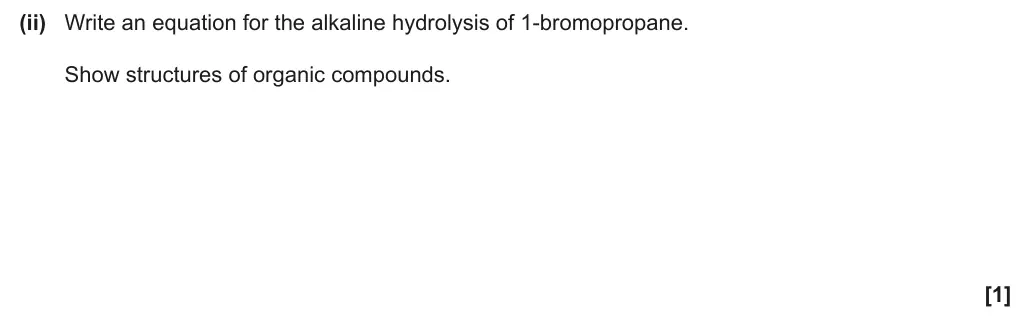
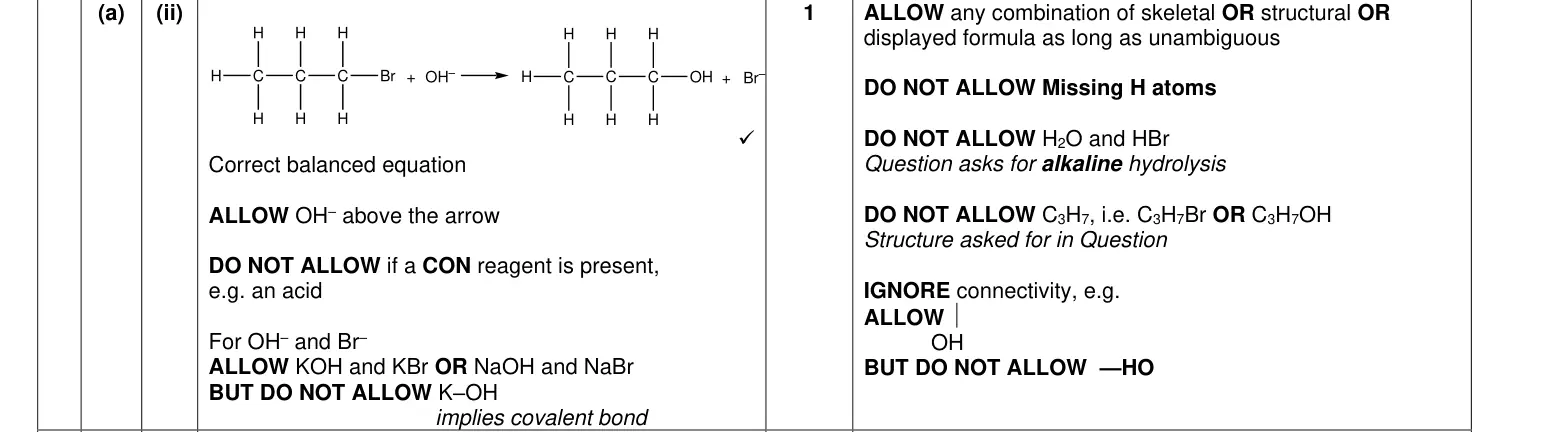
(ii) Write an equation for the alkaline hydrolysis of 1-bromopropane.
Show structures of organic compounds.
[1]
June 2024 · Paper 3 · Q5(a)(iii) 3 marks Short answer Easy haloalkaneschromatography and functional group tests
Earlier part of question 5 that this part usesEarlier part of June 2024 Paper 3 question 5
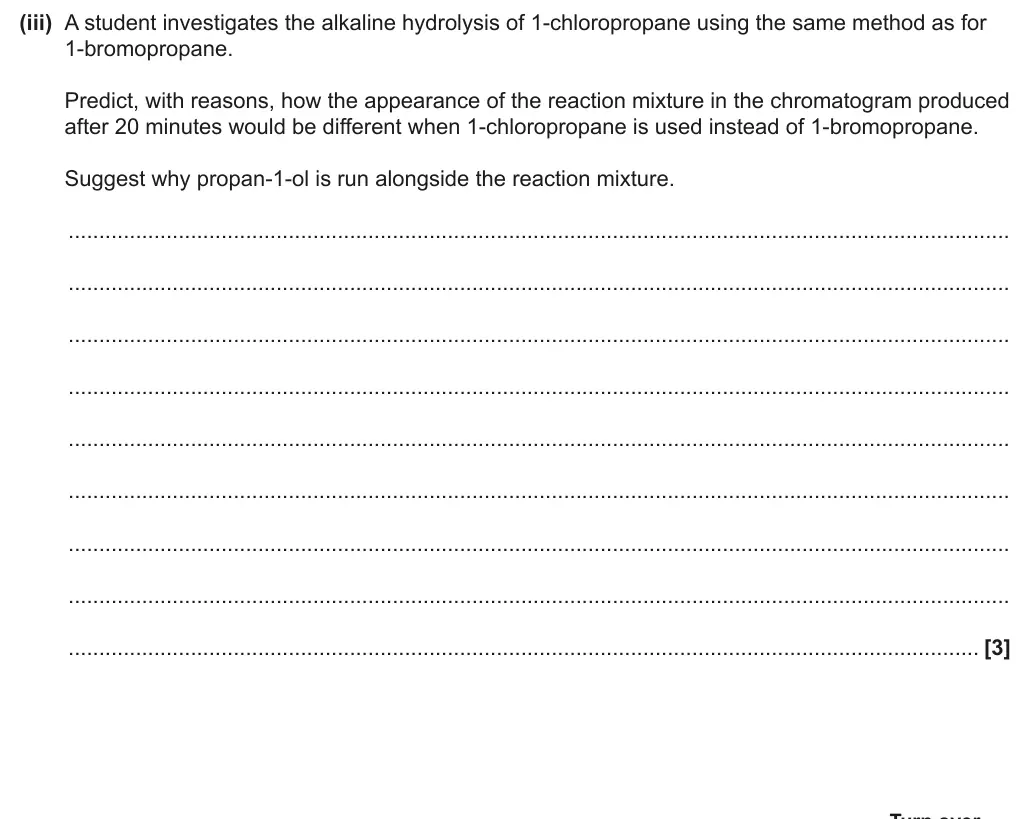
(iii) A student investigates the alkaline hydrolysis of 1-chloropropane using the same method as for
1-bromopropane.
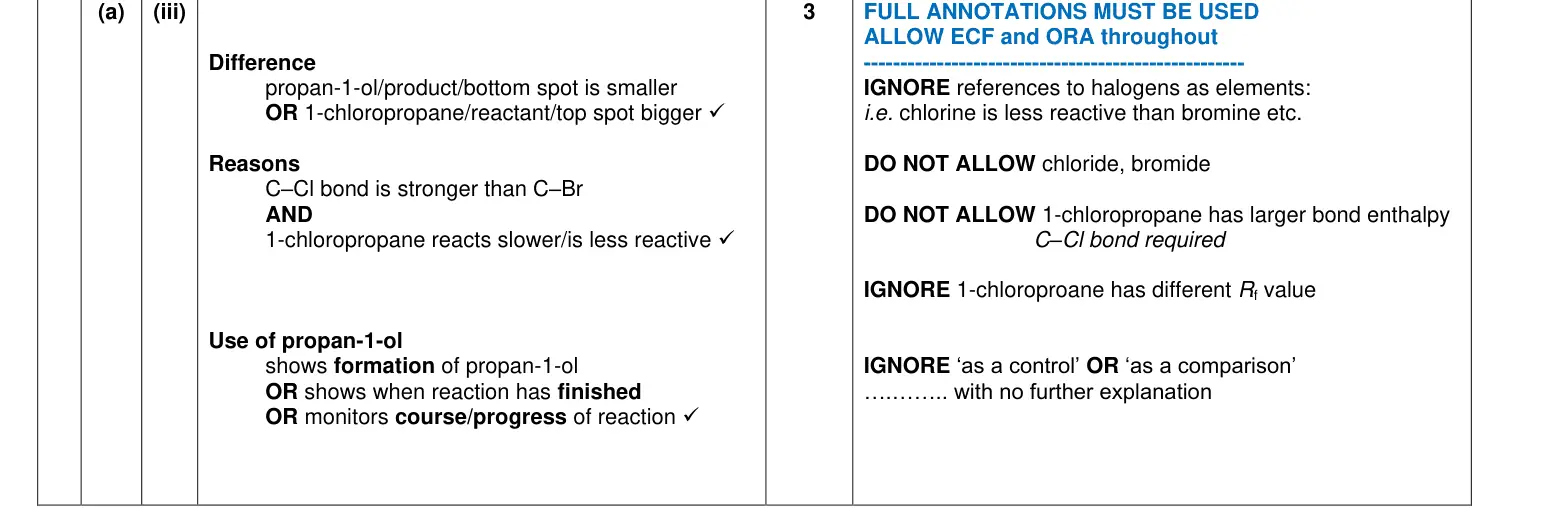
Predict, with reasons, how the appearance of the reaction mixture in the chromatogram produced
after 20 minutes would be different when 1-chloropropane is used instead of 1-bromopropane.
Suggest why propan-1-ol is run alongside the reaction mixture.
..........................................................................................................................................................
..........................................................................................................................................................
..........................................................................................................................................................
..........................................................................................................................................................
..........................................................................................................................................................
..........................................................................................................................................................
..........................................................................................................................................................
..........................................................................................................................................................
..................................................................................................................................................... [3]
June 2024 · Paper 3 · Q5(b)(i) 2 marks Data interpretation Medium transition elements
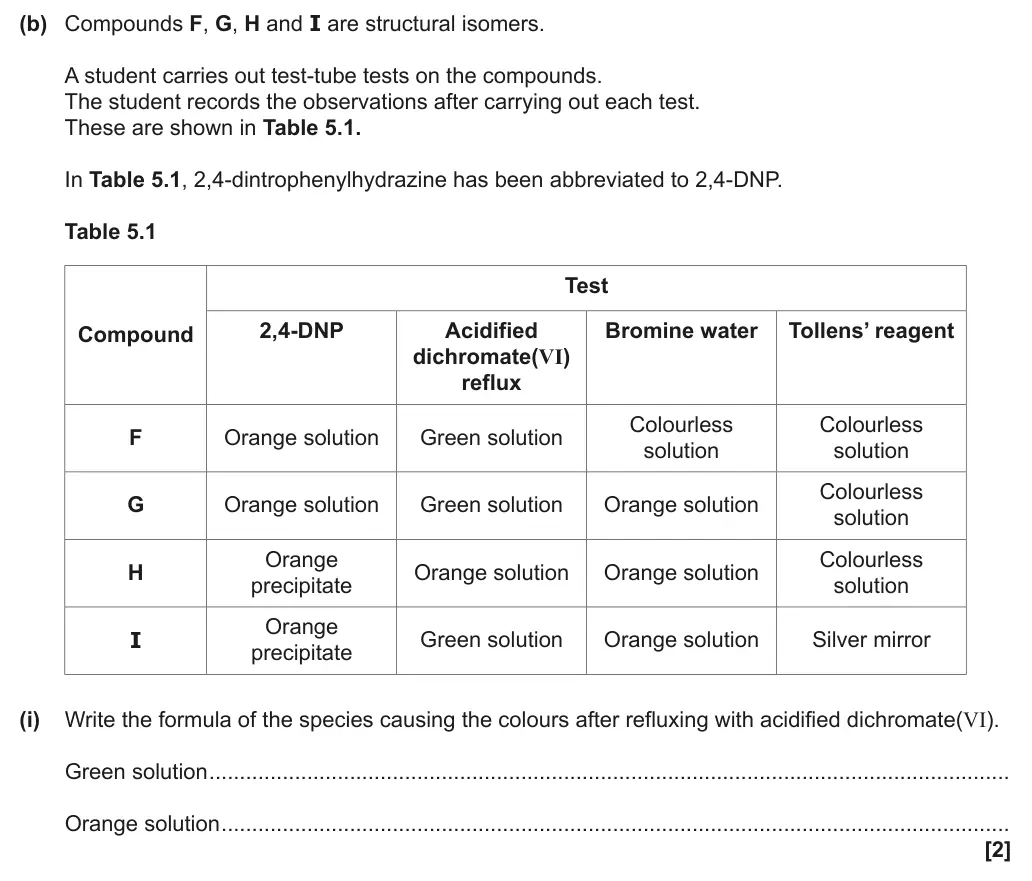
(b) Compounds F, G, H and I are structural isomers.
A student carries out test-tube tests on the compounds.
The student records the observations after carrying out each test.
These are shown in Table 5.1.
In Table 5.1, 2,4-dintrophenylhydrazine has been abbreviated to 2,4-DNP.
Table 5.1
Test
Compound 2,4-DNP Acidified Bromine water Tollens’ reagent
dichromate(VI)
reflux
Colourless Colourless
F Orange solution Green solution
solution solution
Colourless
G Orange solution Green solution Orange solution
solution
Orange Colourless
H Orange solution Orange solution
precipitate solution
Orange
I Green solution Orange solution Silver mirror
precipitate
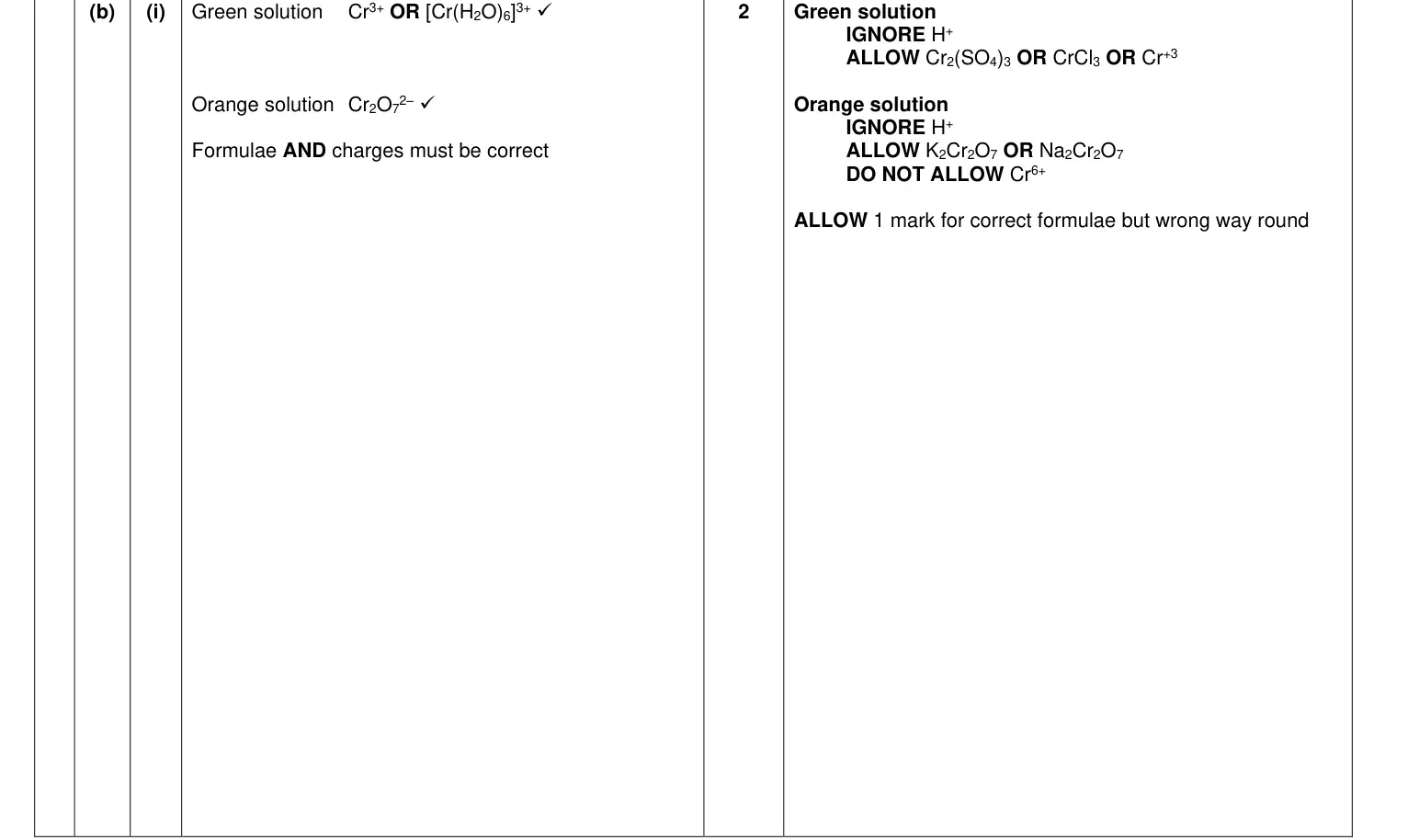
(i) Write the formula of the species causing the colours after refluxing with acidified dichromate(VI).
Green solution ...................................................................................................................................
Orange solution .................................................................................................................................
[2]
June 2024 · Paper 3 · Q5(b)(ii) 6 marks 6-mark level of response Easy chromatography and functional group testsorganic basics
Earlier part of question 5 that this part usesEarlier part of June 2024 Paper 3 question 5
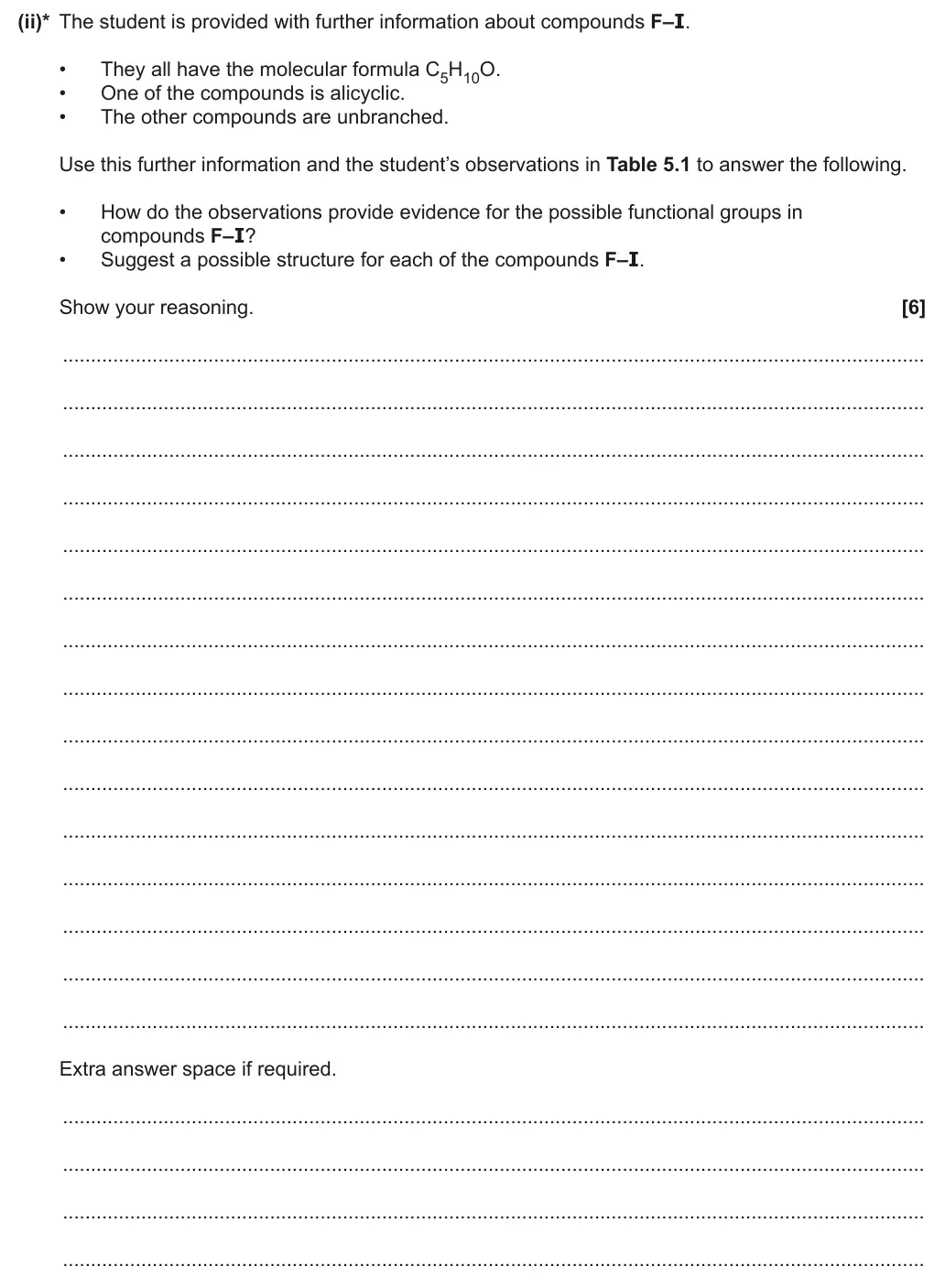
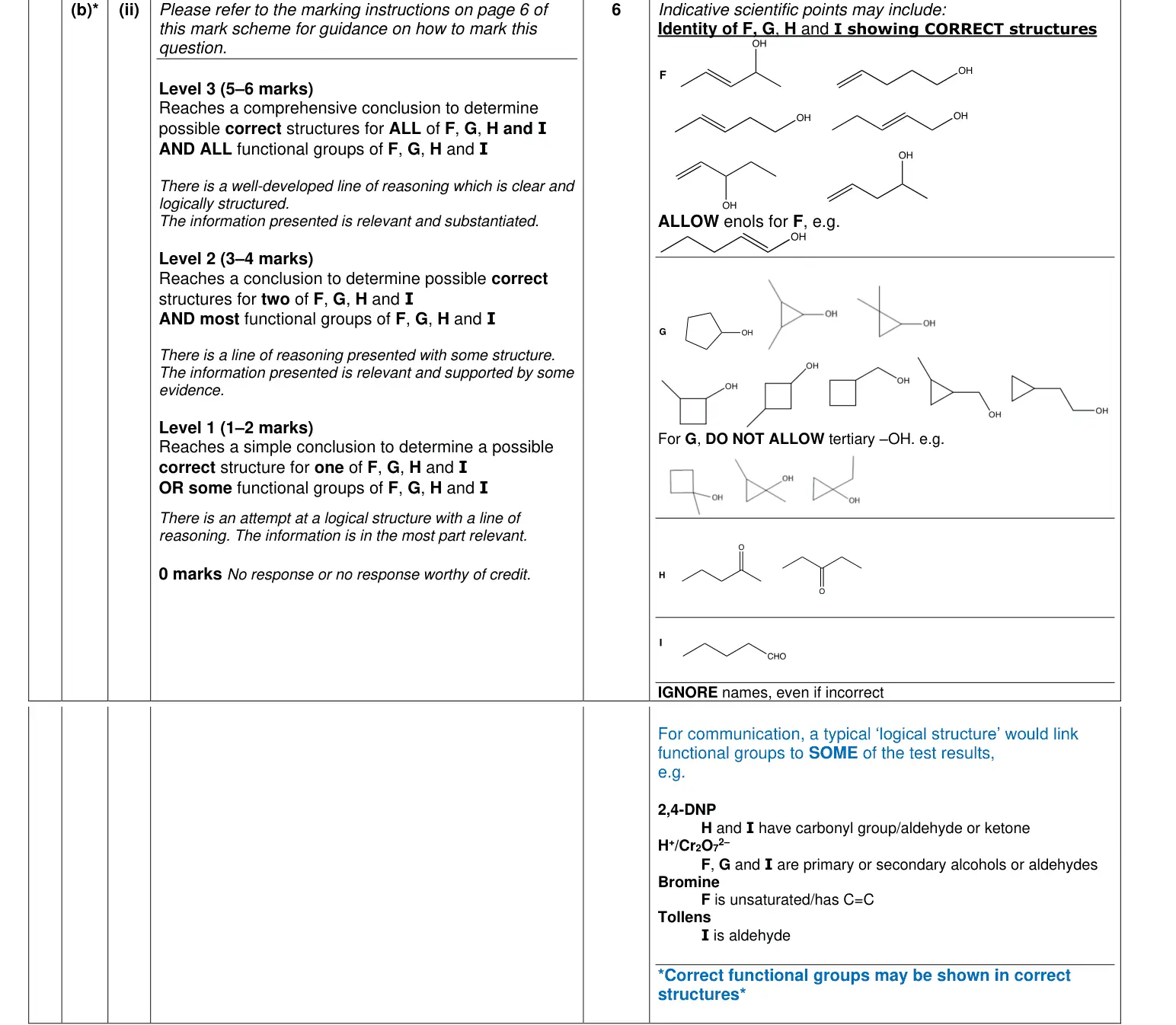
(ii)* The student is provided with further information about compounds F–I.
• They all have the molecular formula C5H10O.
• One of the compounds is alicyclic.
• The other compounds are unbranched.
Use this further information and the student’s observations in Table 5.1 to answer the following.
• How do the observations provide evidence for the possible functional groups in
compounds F–I?
• Suggest a possible structure for each of the compounds F–I.
Show your reasoning. [6]
..........................................................................................................................................................
..........................................................................................................................................................
..........................................................................................................................................................
..........................................................................................................................................................
..........................................................................................................................................................
..........................................................................................................................................................
..........................................................................................................................................................
..........................................................................................................................................................
..........................................................................................................................................................
..........................................................................................................................................................
..........................................................................................................................................................
..........................................................................................................................................................
..........................................................................................................................................................
..........................................................................................................................................................
..........................................................................................................................................................
Extra answer space if required.
..........................................................................................................................................................
..........................................................................................................................................................
..........................................................................................................................................................
..........................................................................................................................................................

Work with an OCR chemistry tutor

Want a paper marked and gone through with you? Message us.

Prefer email? Send an enquiry

If you are under 18, please include a parent's contact details. Enquiries go to enquiries@chemistryaleveltutor.com and are deleted once handled. All tutoring is online.