June 2023: AS Paper 2, Depth in chemistry

70 marks · 29 question parts · Paper, mark scheme and report on OCR's site · Have OCR's Data Sheet beside you

Question by question

QTopicMarksAOType
1(a)(i) Atomic structure and isotopes 2AO1, 2Calculation
1(a)(ii) Electron structure and orbitals 1AO1Short answer
1(a)(iii) Atomic structure and isotopes 1AO2Complete table/diagram
1(b)(i) Redox and oxidation numbers 1AO2Short answer
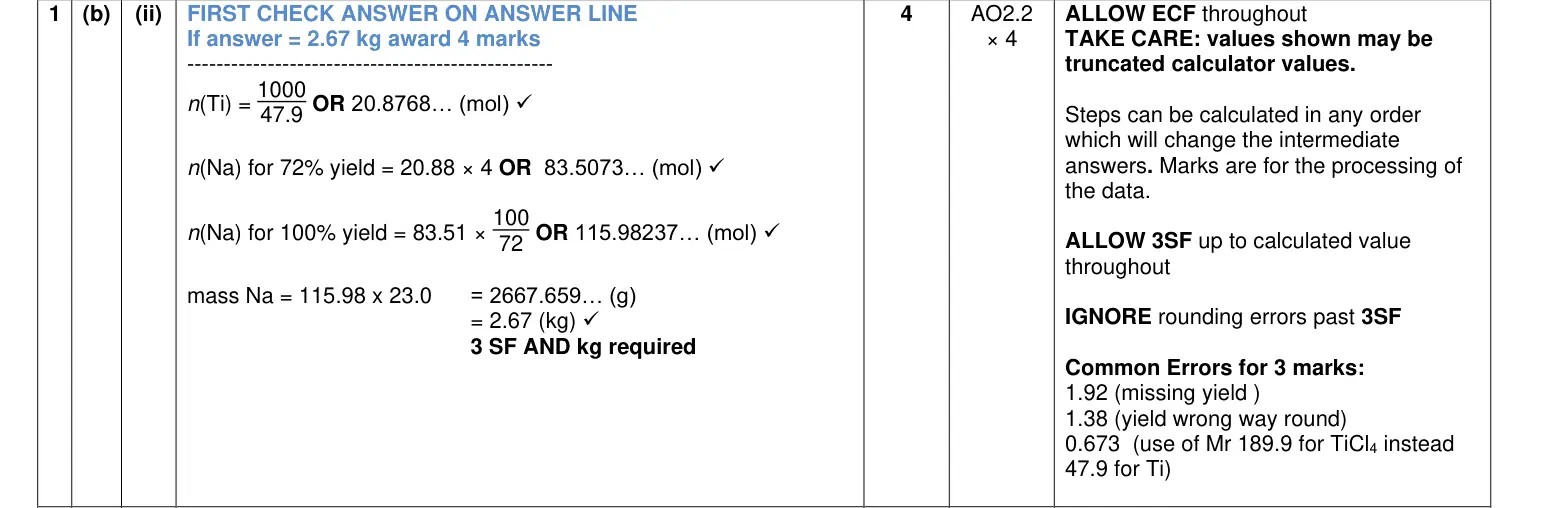
1(b)(ii) Amount of substance (moles) 4AO2Calculation
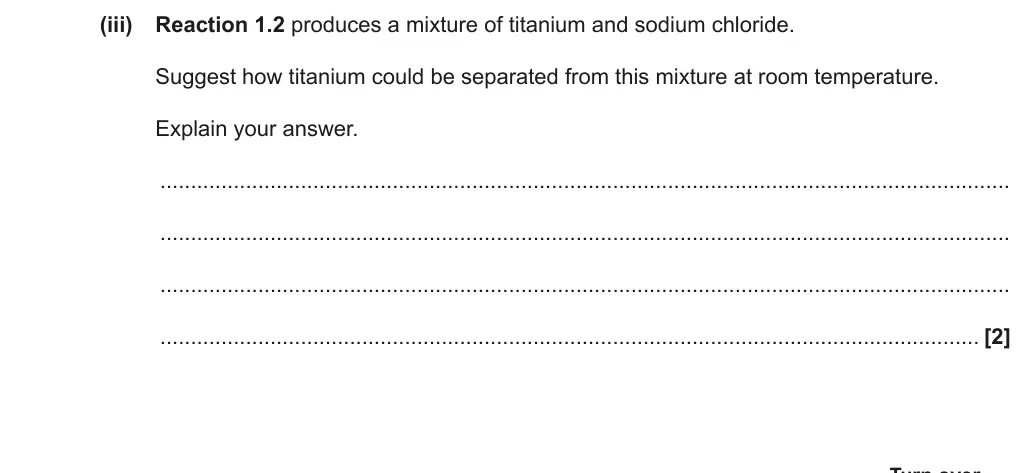
1(b)(iii) Bonding, structure and shapes of molecules, Practical skills: planning, analysis and evaluation 2AO3Short answer
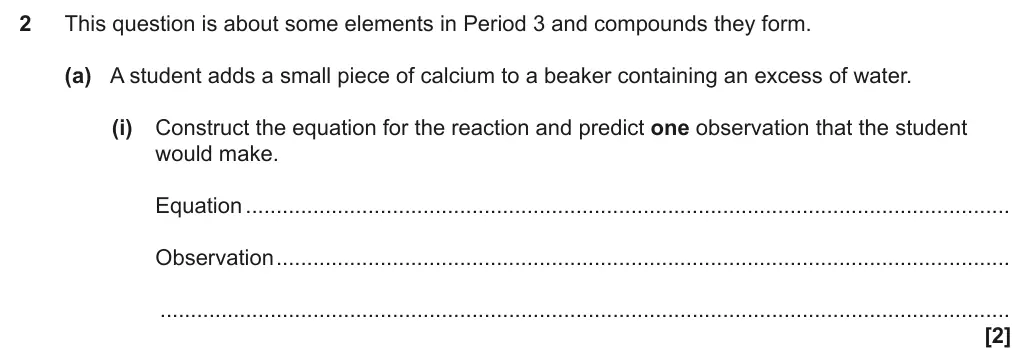
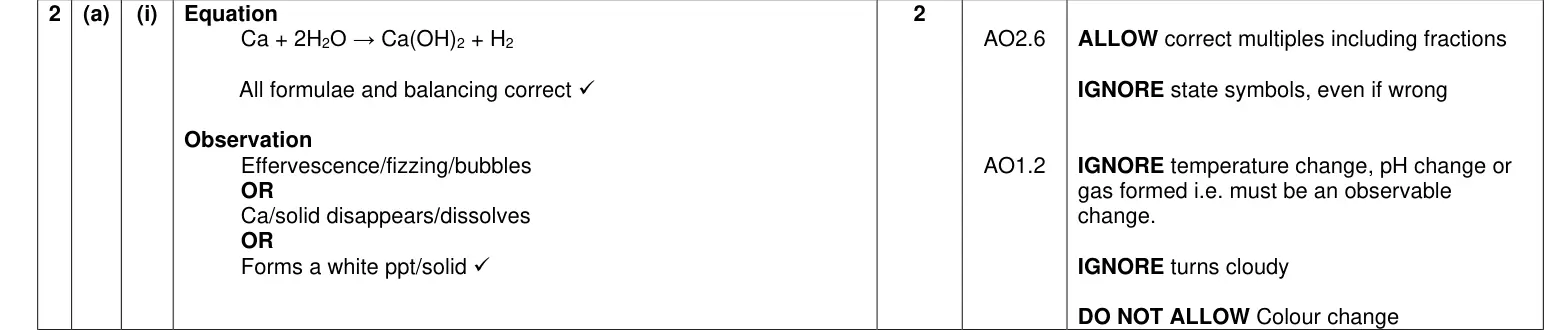
2(a)(i) Group 2, Formulae and equations 2AO1, 2Equation writing
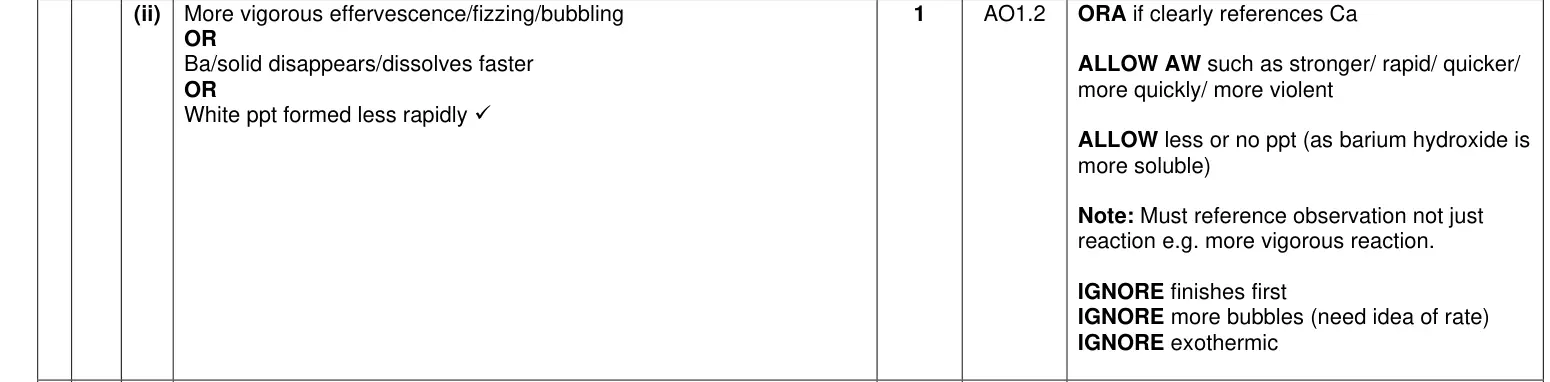
2(a)(ii) Group 2 1AO1Short answer
2(b)(i) Formulae and equations, Qualitative analysis: tests for ions 2AO2Equation writing
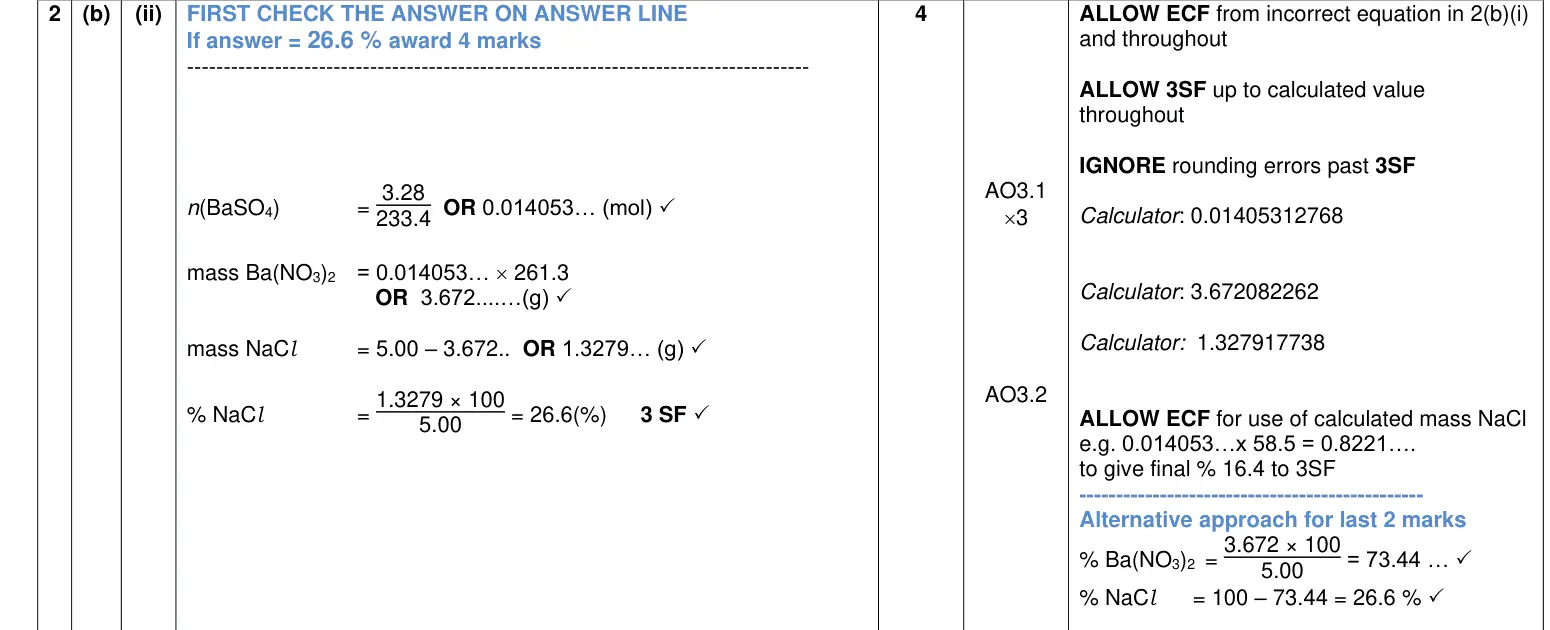
2(b)(ii) Amount of substance (moles), Practical skills: planning, analysis and evaluation 4AO3Calculation
2(b)(iii) The halogens, Practical skills: planning, analysis and evaluation 2AO3Short answer
2(c)(i) Bonding, structure and shapes of molecules, Periodicity and ionisation energy 4AO1, 2Complete table/diagram
2(c)(ii) Bonding, structure and shapes of molecules, Periodicity and ionisation energy 4AO1, 2, 3Short answer
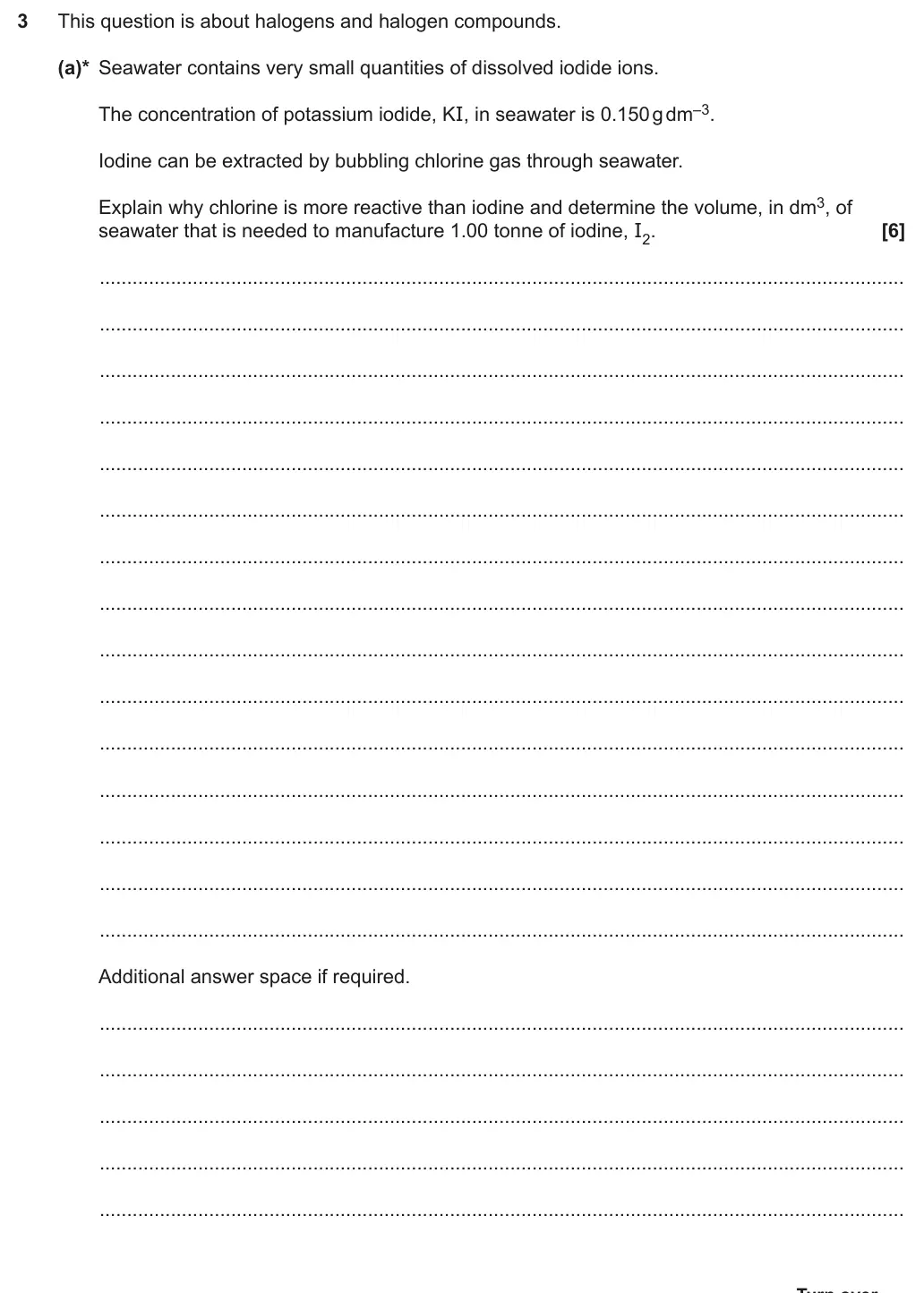
3(a) The halogens, Amount of substance (moles) 6AO1, 2Level of response
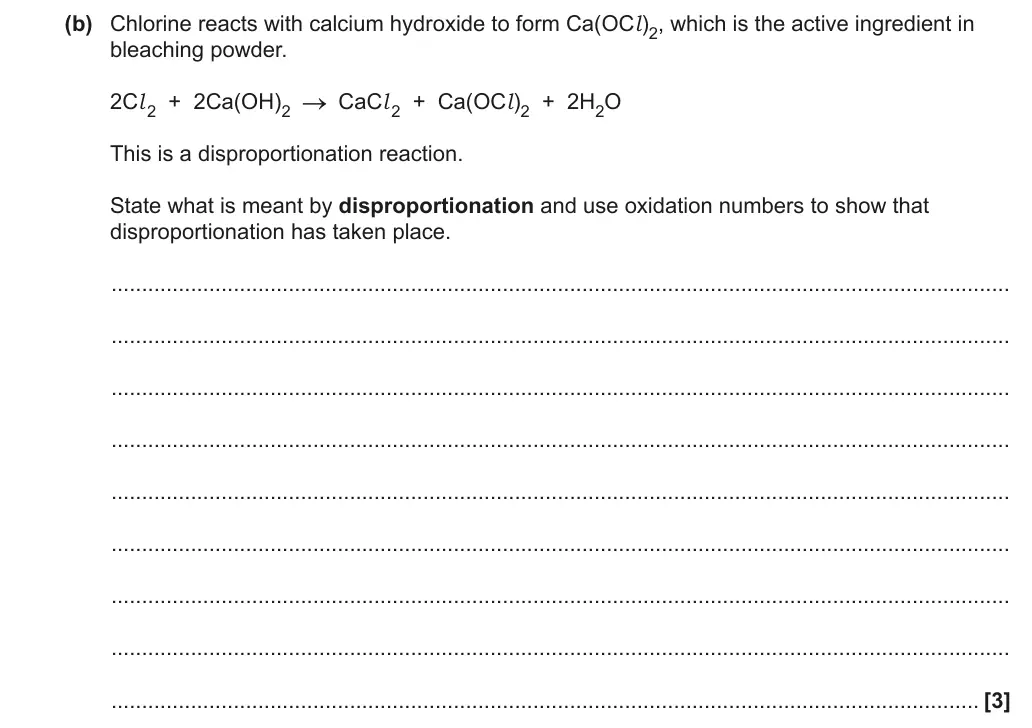
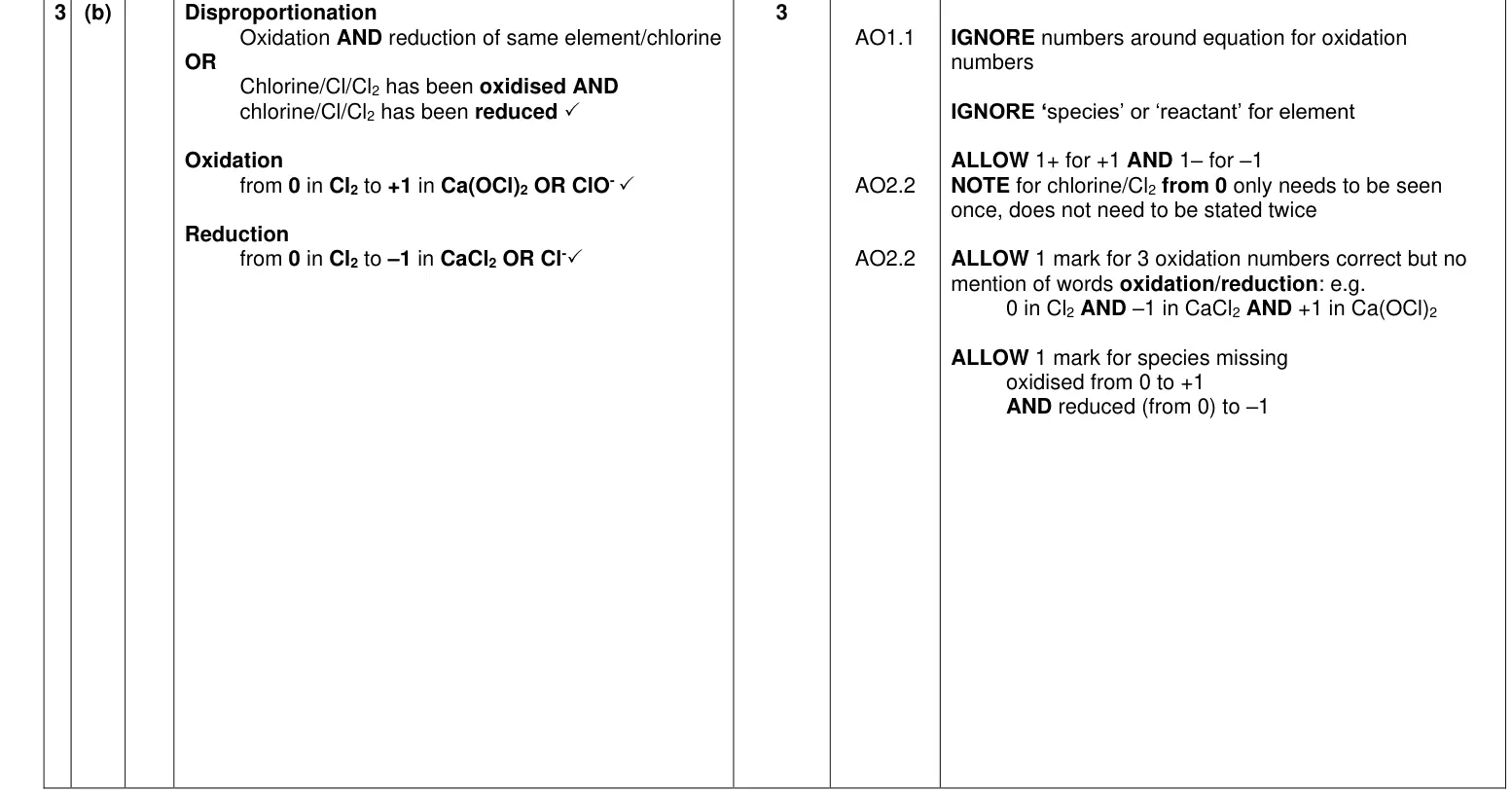
3(b) The halogens, Redox and oxidation numbers 3AO1, 2Data interpretation
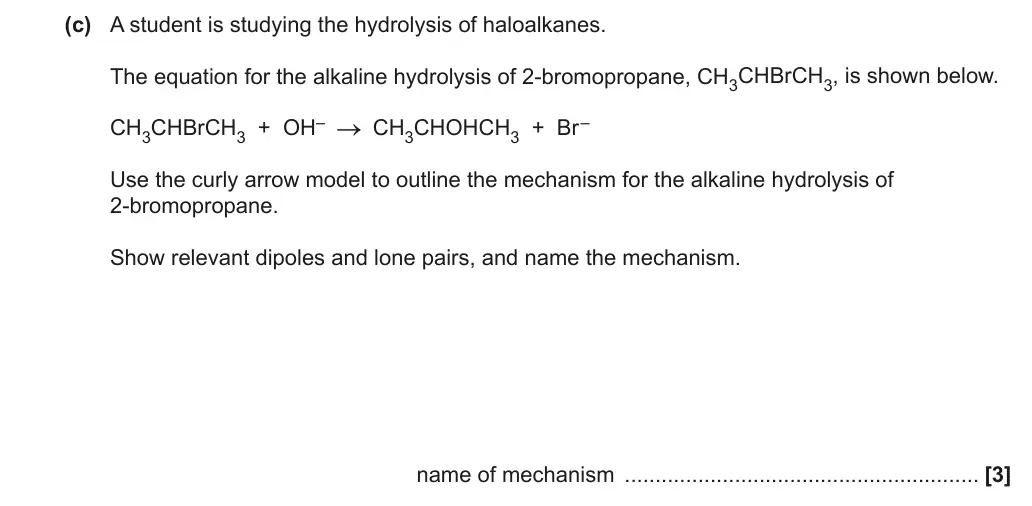
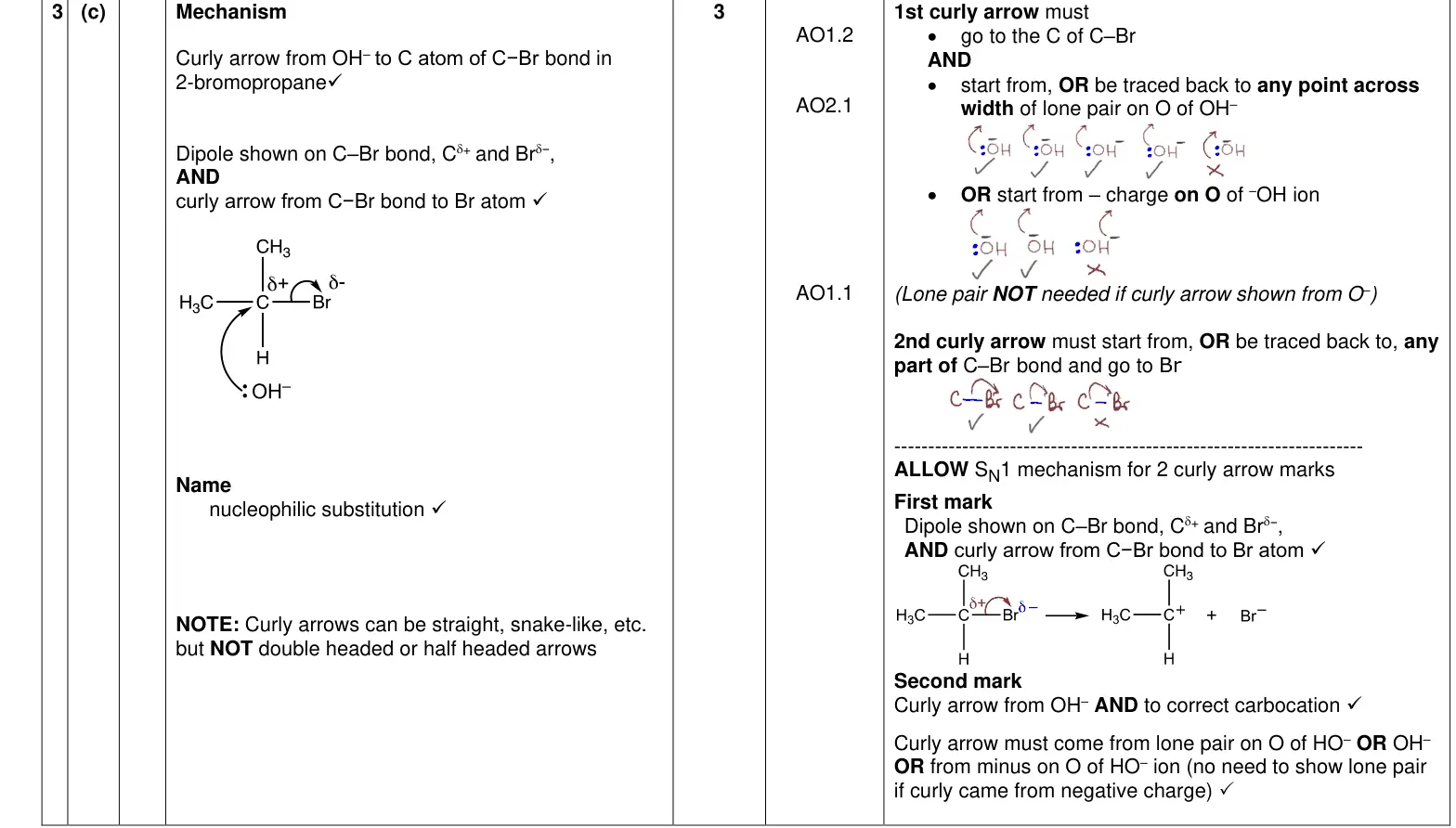
3(c) Haloalkanes, Organic basics: naming, formulae and isomerism 3AO1, 2Mechanism
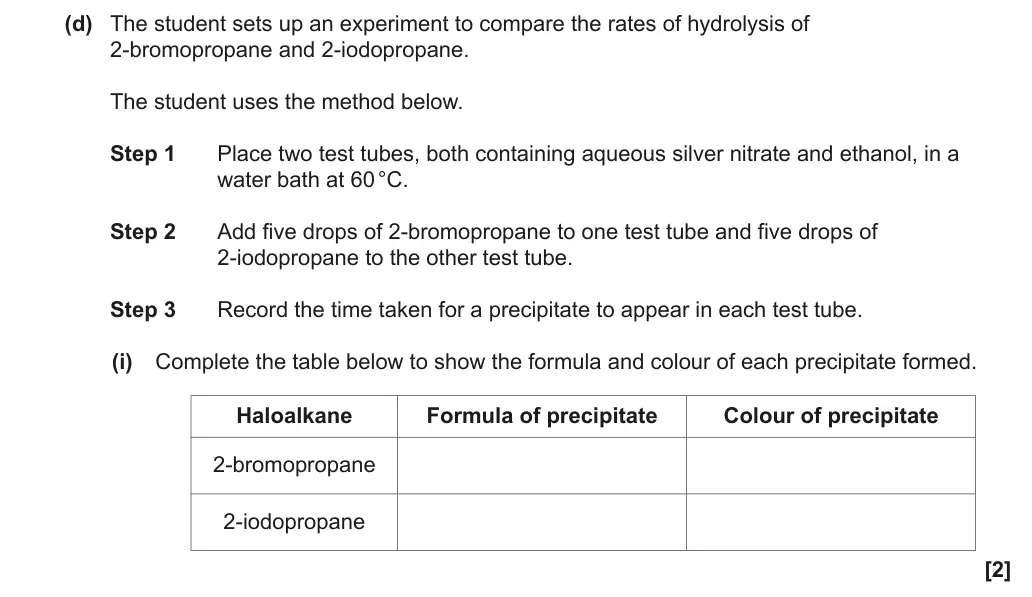
3(d)(i) Haloalkanes, The halogens 2AO1Complete table/diagram
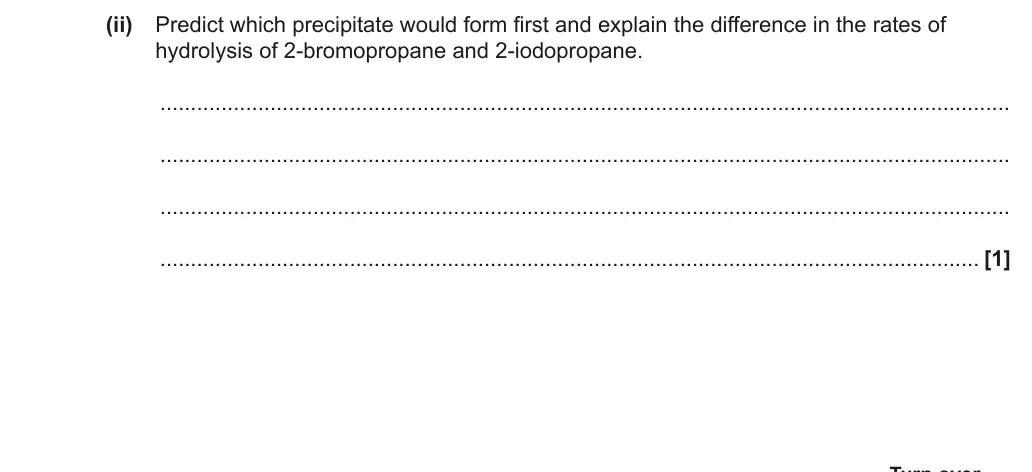
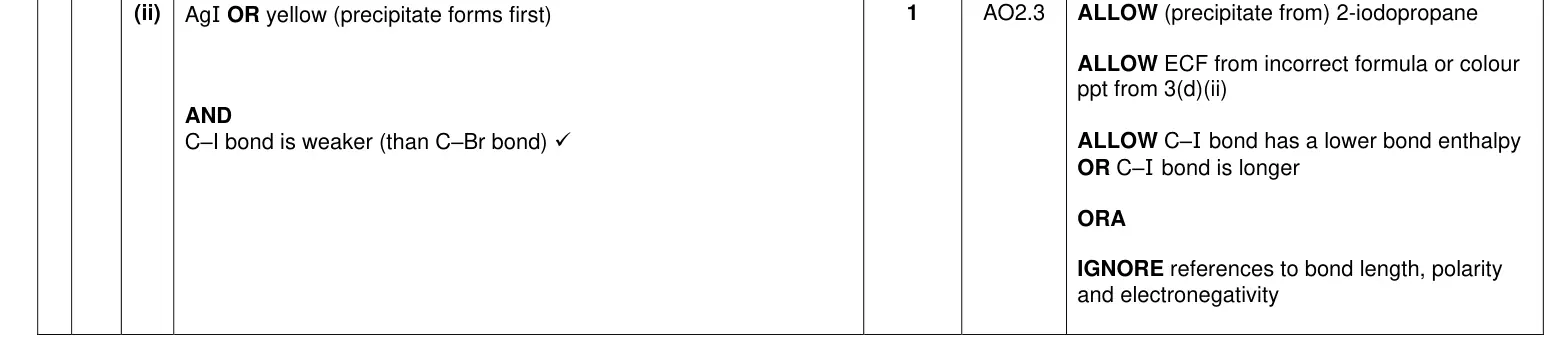
3(d)(ii) Haloalkanes 1AO2Short answer
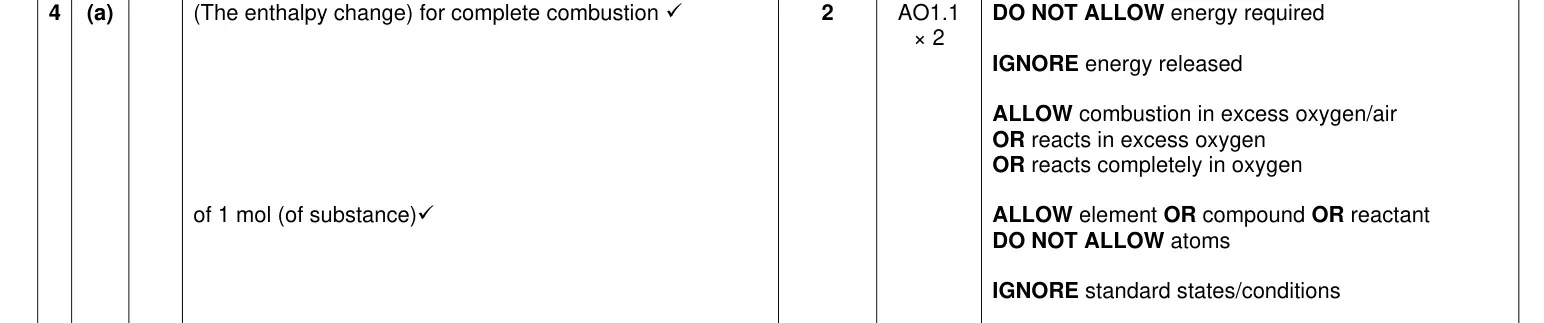
4(a) Enthalpy changes and Hess’ law 2AO1Short answer
4(b)(i) Practical skills: planning, analysis and evaluation 1AO2Calculation
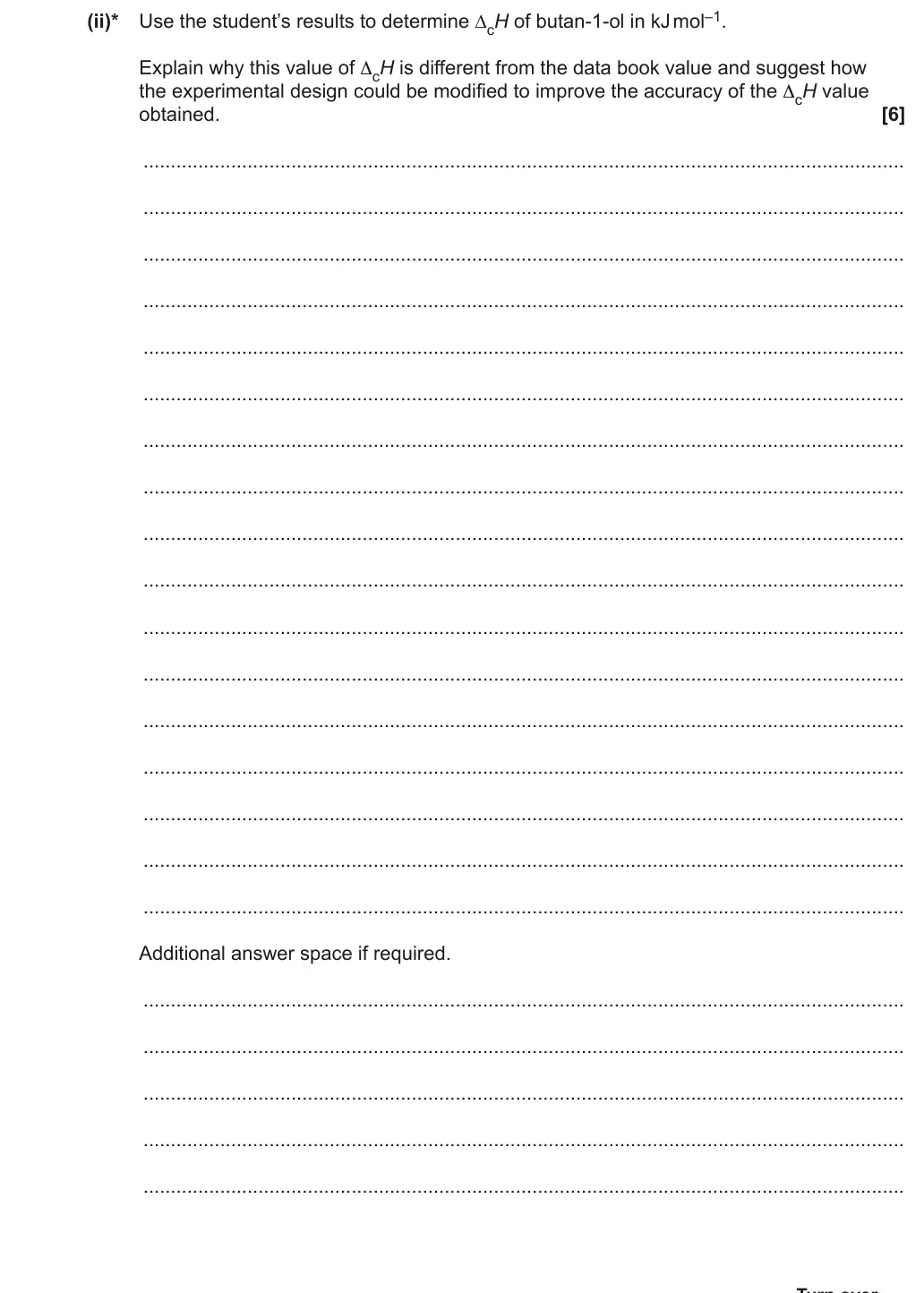
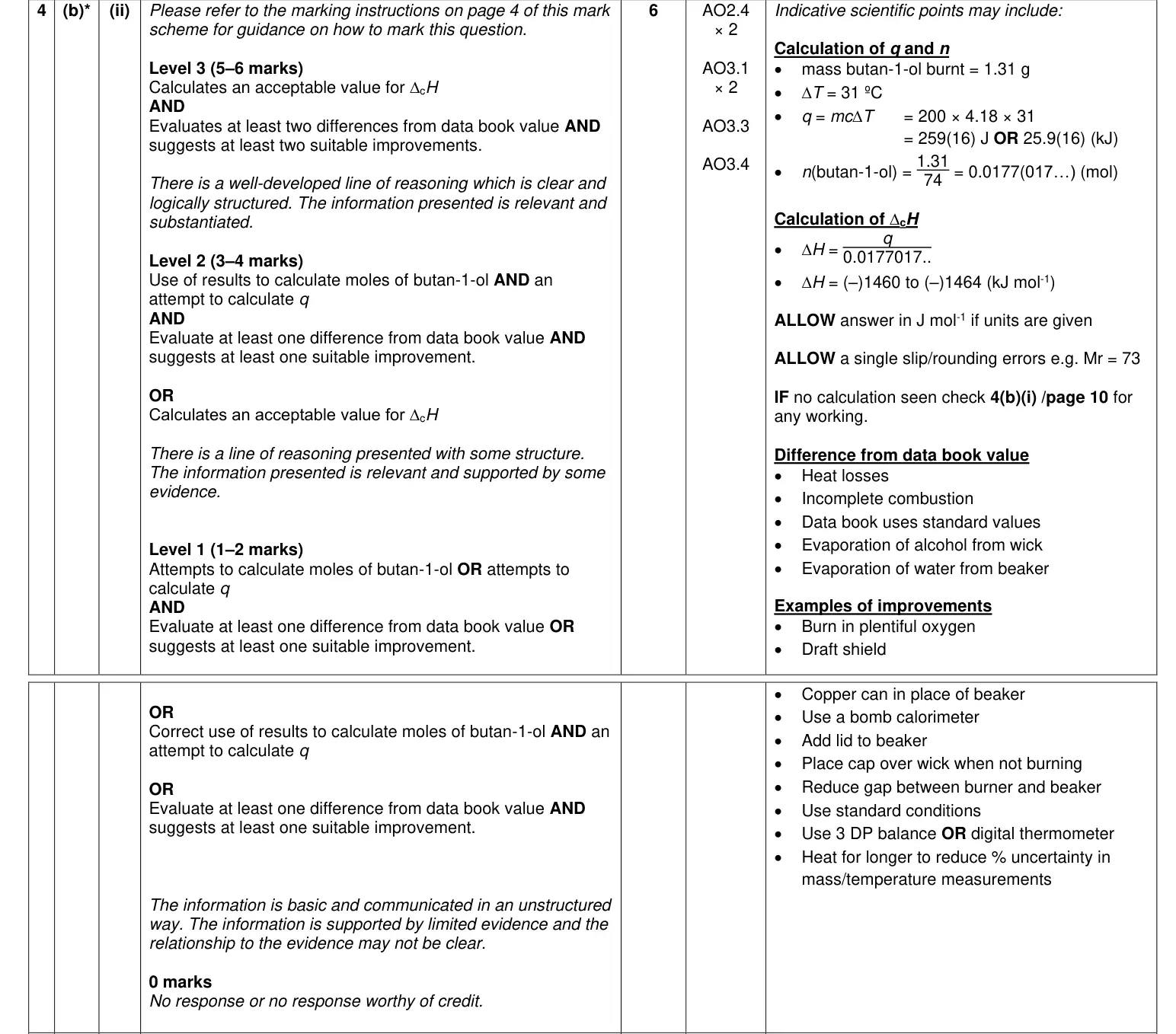
4(b)(ii) Enthalpy changes and Hess’ law, Practical skills: planning, analysis and evaluation 6AO2, 3Level of response
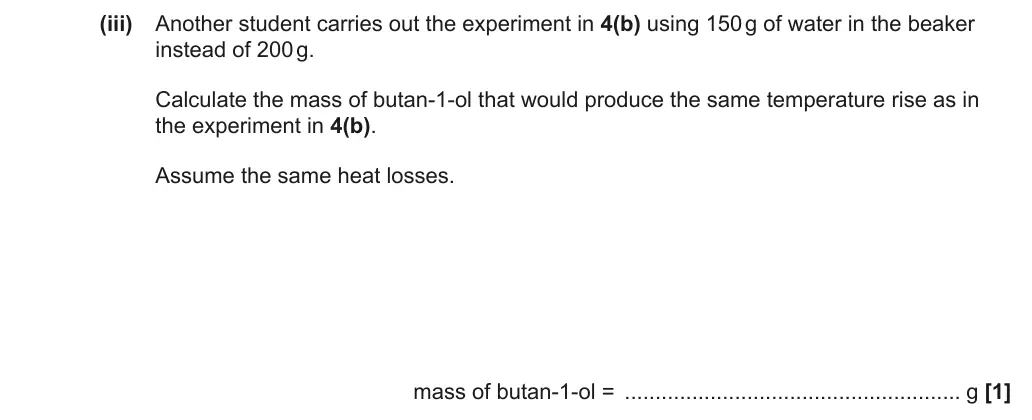
4(b)(iii) Enthalpy changes and Hess’ law 1AO3Calculation
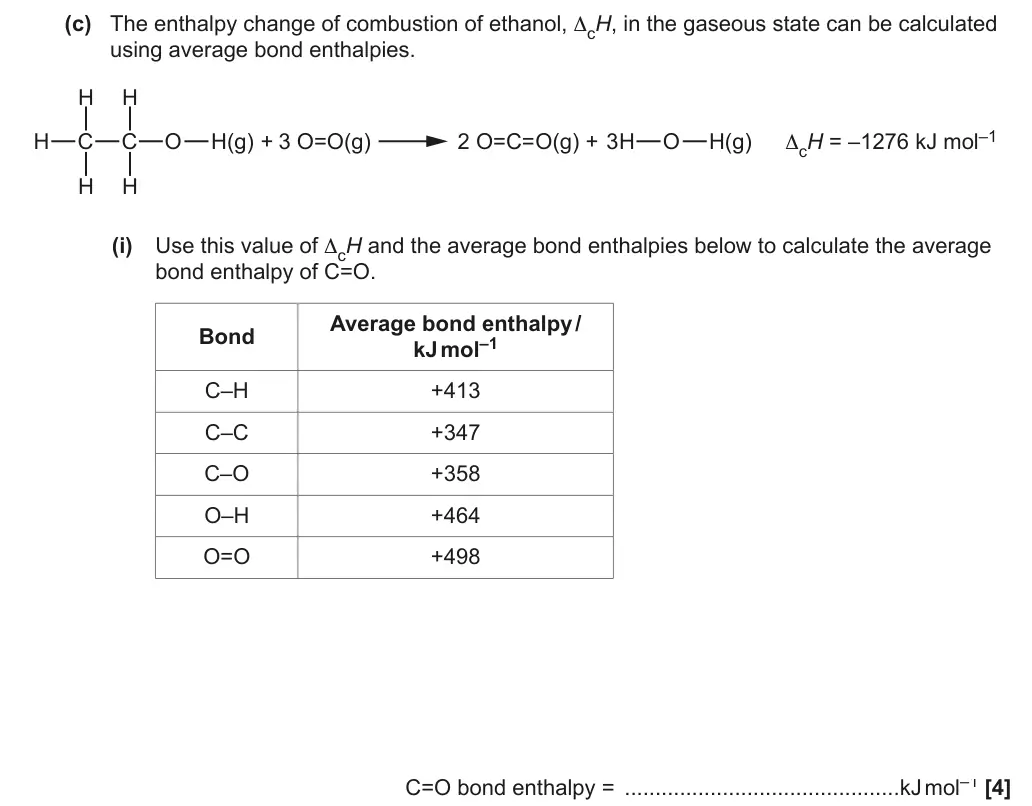
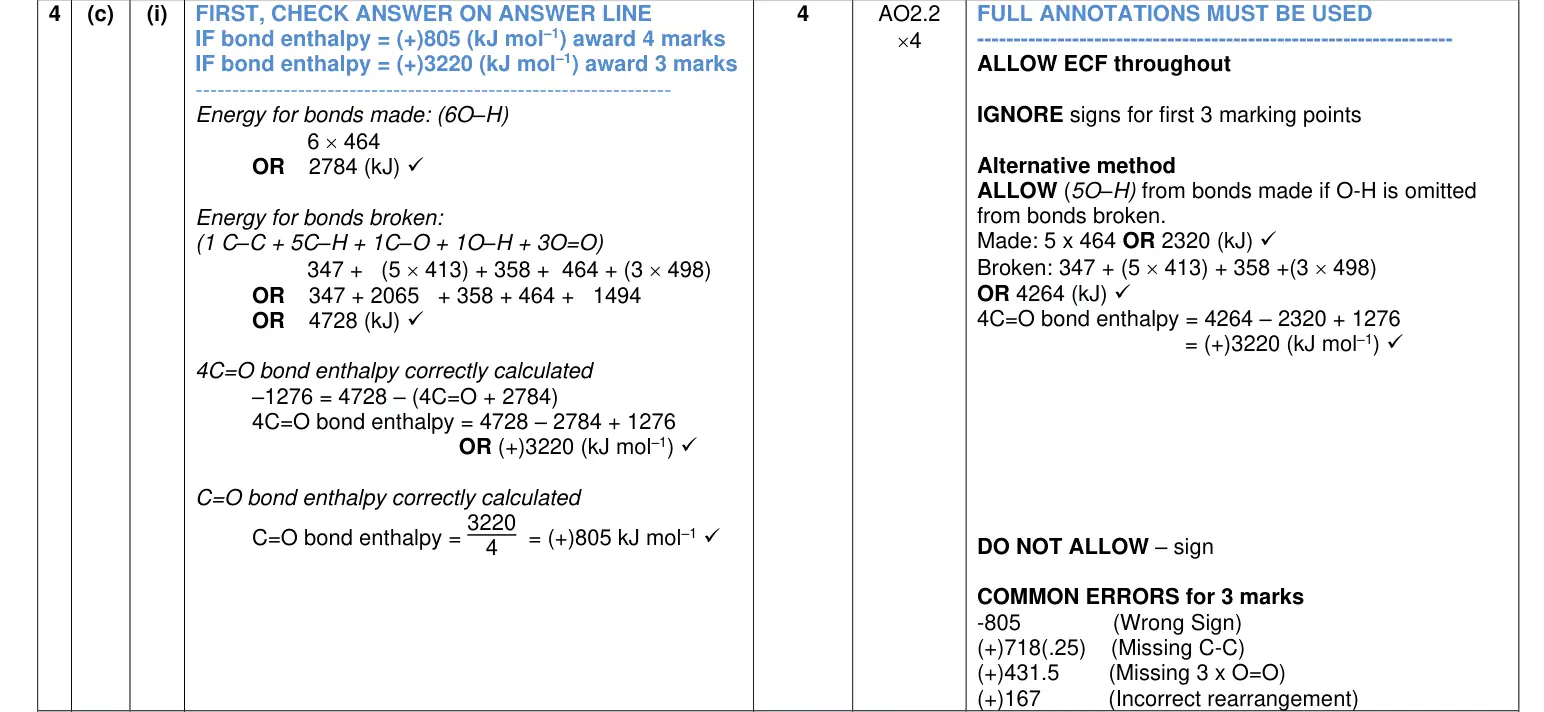
4(c)(i) Enthalpy changes and Hess’ law 4AO2Calculation
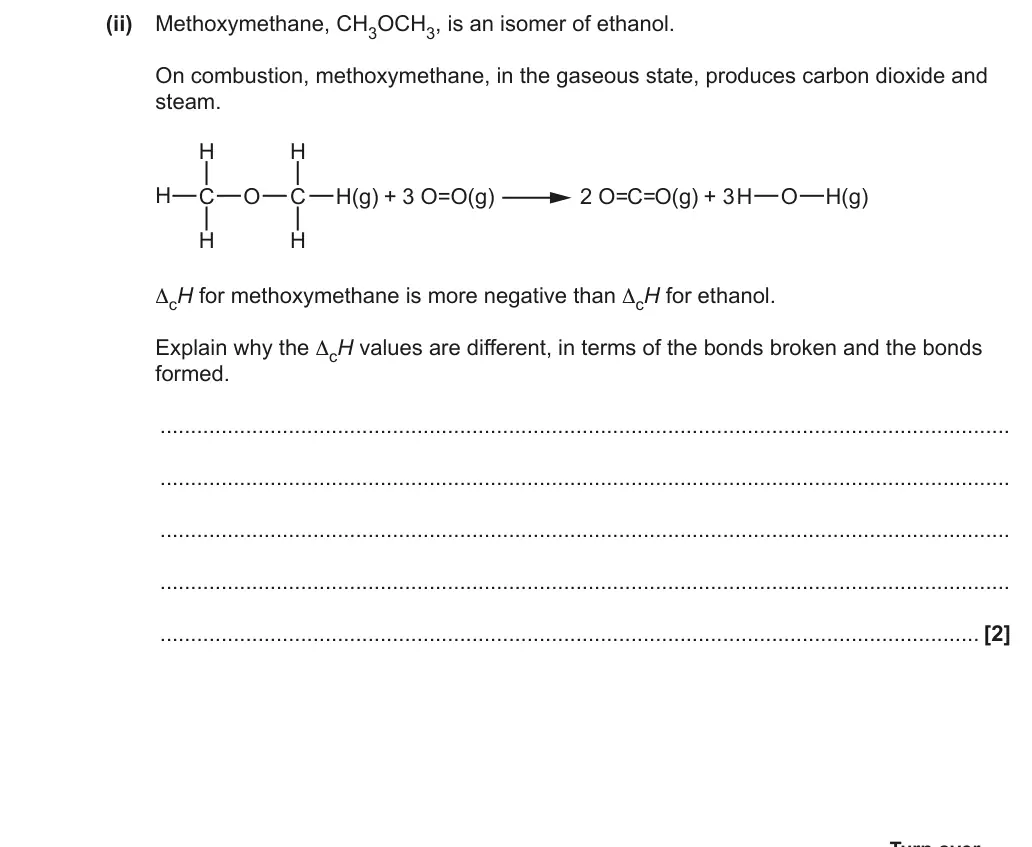
4(c)(ii) Enthalpy changes and Hess’ law 2AO3Short answer
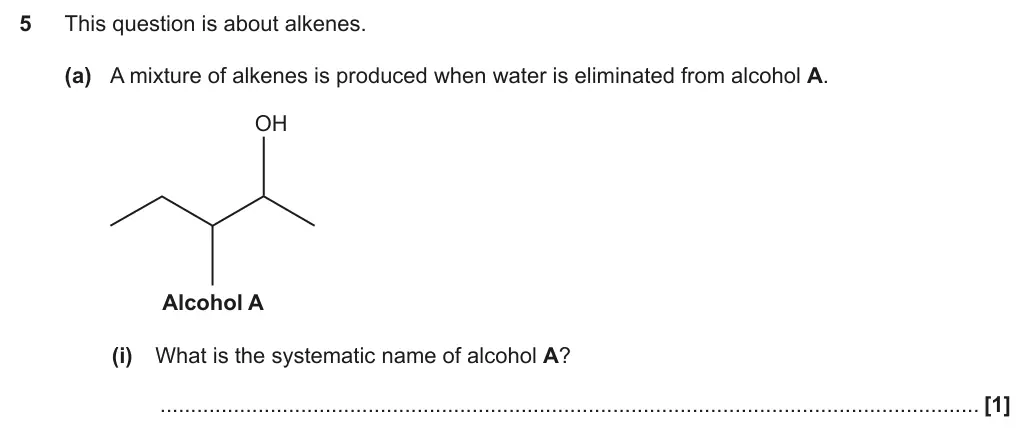
5(a)(i) Organic basics: naming, formulae and isomerism 1AO2Short answer
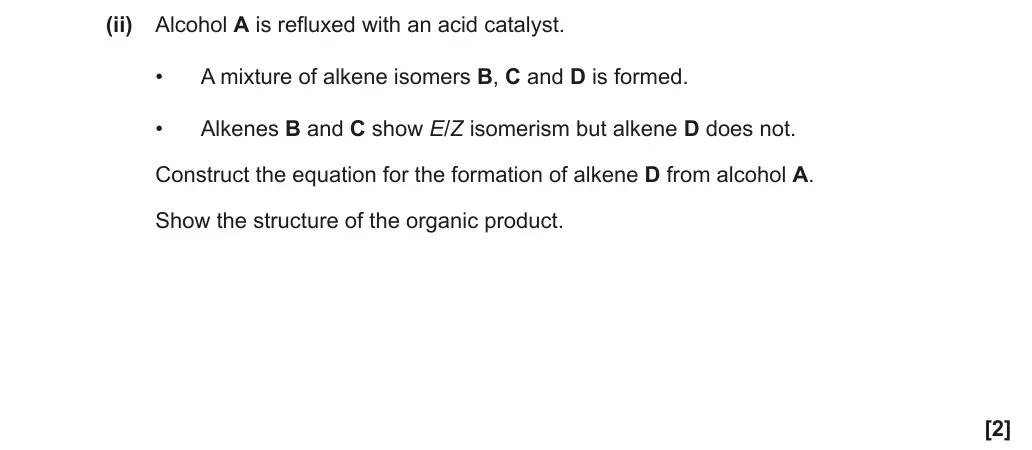
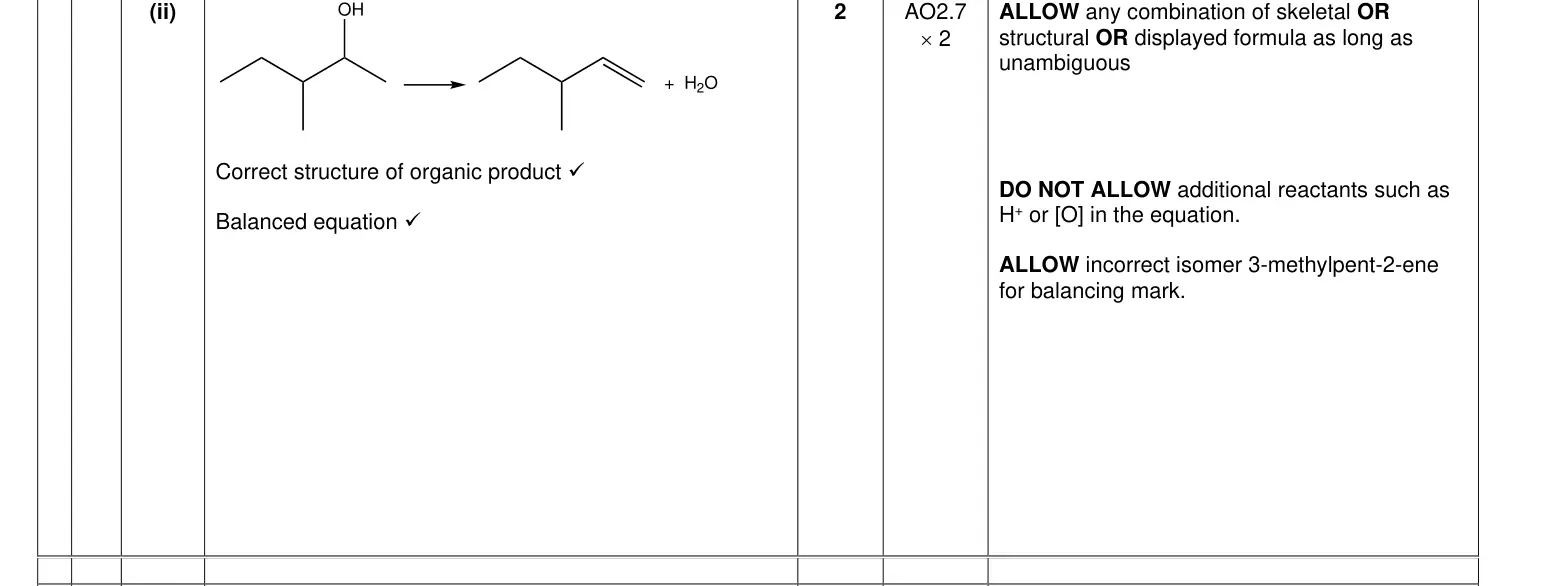
5(a)(ii) Alcohols, Organic basics: naming, formulae and isomerism, Alkenes 2AO2Equation writing
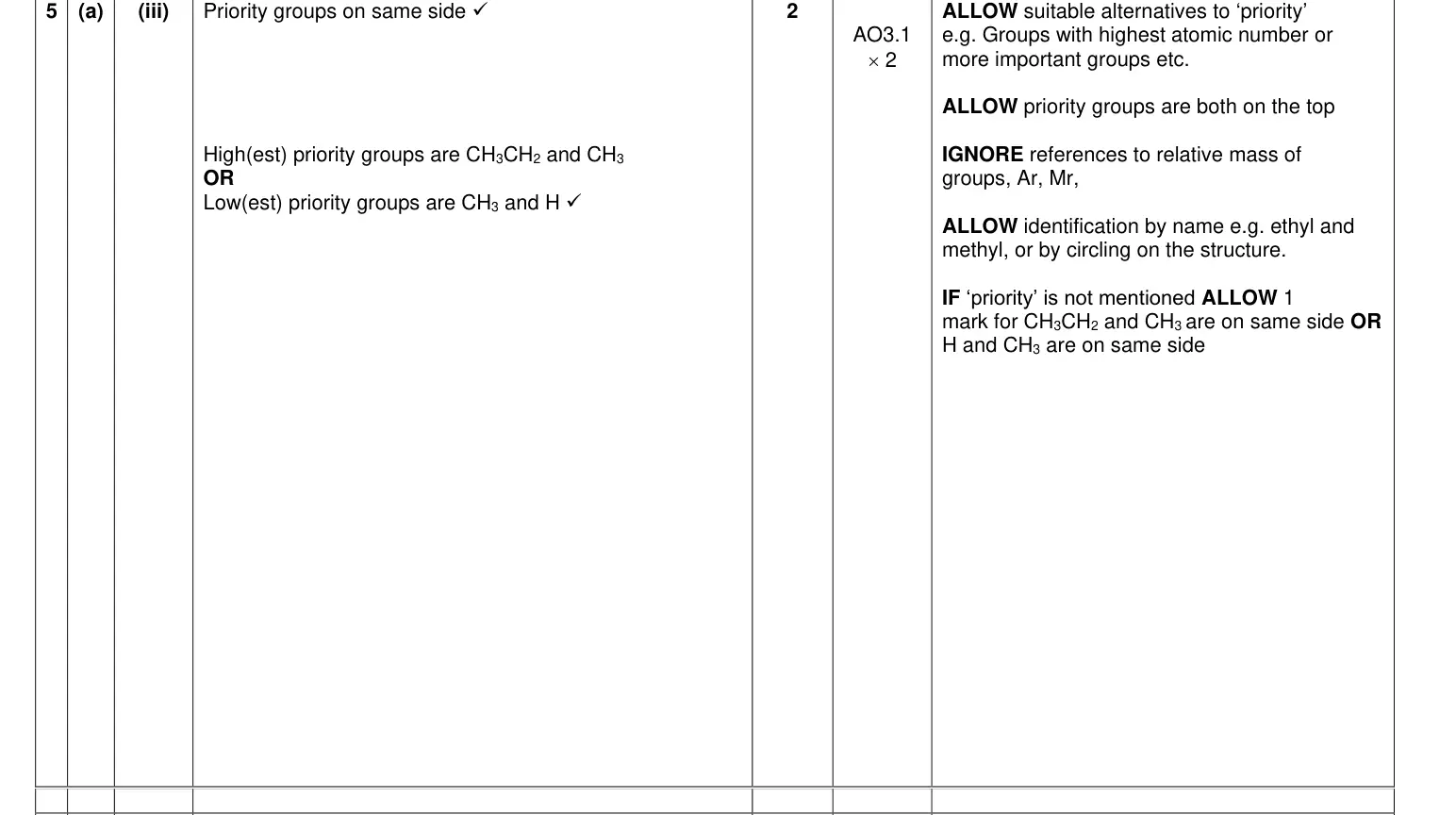
5(a)(iii) Alkenes 2AO3Data interpretation
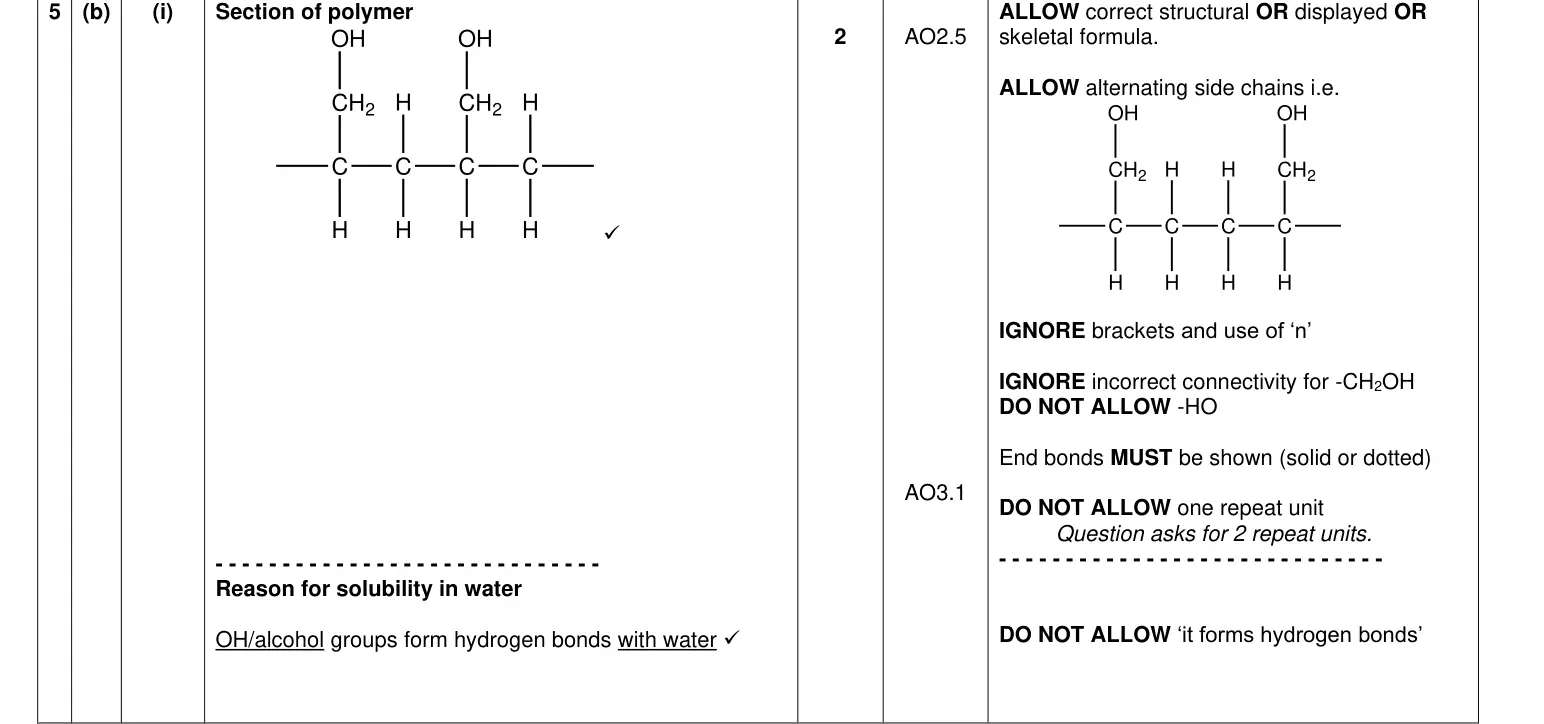
5(b)(i) Alkenes, Bonding, structure and shapes of molecules, Alcohols 2AO2, 3Drawing / labelling
5(b)(ii) Alkenes 2AO1Short answer

The questions

1(a)(i)1(a)(ii)1(a)(iii)1(b)(i)1(b)(ii)1(b)(iii)2(a)(i)2(a)(ii)2(b)(i)2(b)(ii)2(b)(iii)2(c)(i)2(c)(ii)3(a)3(b)3(c)3(d)(i)3(d)(ii)4(a)4(b)(i)4(b)(ii)4(b)(iii)4(c)(i)4(c)(ii)5(a)(i)5(a)(ii)5(a)(iii)5(b)(i)5(b)(ii)
June 2023 · AS Paper 2 · Q1(a)(i) 2 marks AO1, 2 Calculation Easy atomic structure and isotopes
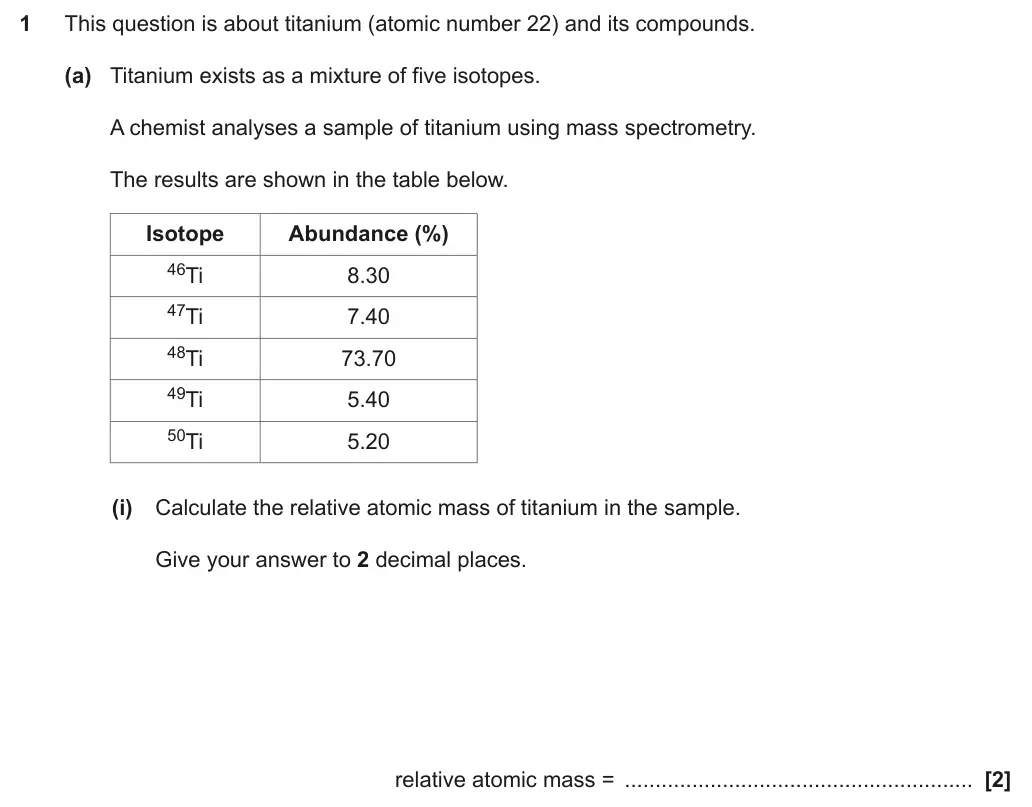
1 This question is about titanium (atomic number 22) and its compounds.
(a) Titanium exists as a mixture of five isotopes.
A chemist analyses a sample of titanium using mass spectrometry.
The results are shown in the table below.
Isotope Abundance (%)
46Ti 8.30
47Ti 7.40
48Ti 73.70
49Ti 5.40
50Ti 5.20
(i) Calculate the relative atomic mass of titanium in the sample.
Give your answer to 2 decimal places.
relative atomic mass =  ......................................................... [2]
June 2023 · AS Paper 2 · Q1(a)(ii) 1 mark AO1 Short answer Medium electron structure
(ii) Complete the electron configuration of a titanium atom.
1s2  ................................................................................................................................ [1]
June 2023 · AS Paper 2 · Q1(a)(iii) 1 mark AO2 Complete table/diagram Easy atomic structure and isotopes
Earlier part of question 1 that this part usesEarlier part of June 2023 Paper 2 question 1
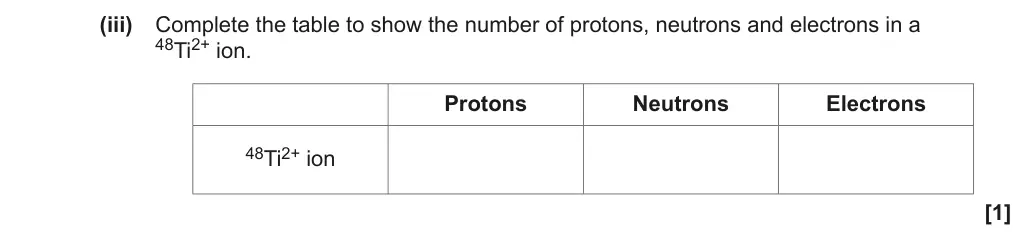
(iii) Complete the table to show the number of protons, neutrons and electrons in a
48Ti2+ ion.
Protons Neutrons Electrons
48Ti2+ ion
[1]
June 2023 · AS Paper 2 · Q1(b)(i) 1 mark AO2 Short answer Hard redox
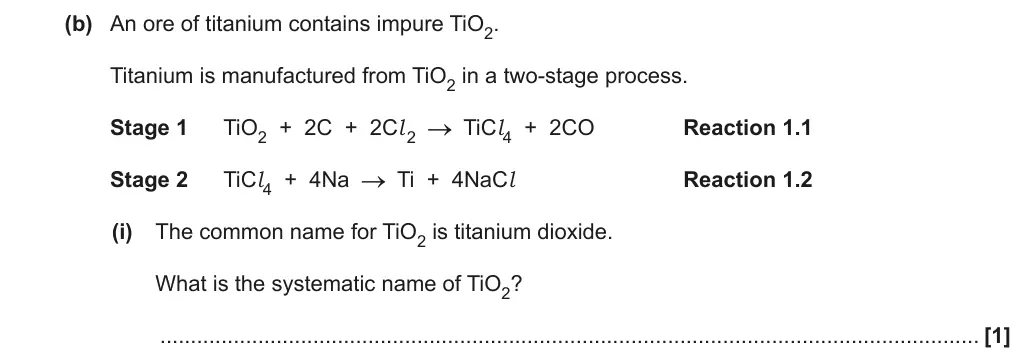
(b) An ore of titanium contains impure TiO2.
Titanium is manufactured from TiO2 in a two-stage process.
Stage 1 TiO2  +  2C  +  2Cl 2 TiCl4  +  2CO Reaction 1.1
Stage 2 TiCl4  +  4Na Ti  +  4NaCl Reaction 1.2
(i) The common name for TiO2 is titanium dioxide.
What is the systematic name of TiO2?
...................................................................................................................................... [1]
June 2023 · AS Paper 2 · Q1(b)(ii) 4 marks AO2 Calculation Hard amount of substance
Earlier part of question 1 that this part usesEarlier part of June 2023 Paper 2 question 1
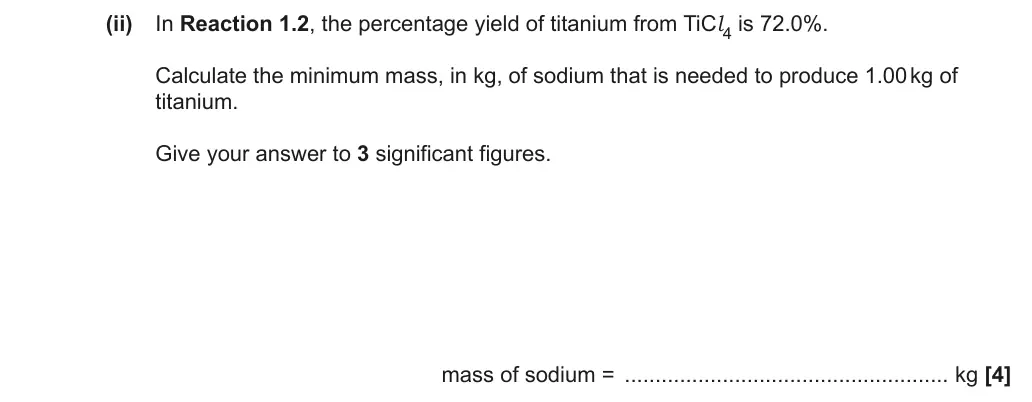
(ii) In Reaction 1.2, the percentage yield of titanium from TiCl4 is 72.0%.
Calculate the minimum mass, in kg, of sodium that is needed to produce 1.00 kg of
titanium.
Give your answer to 3 significant figures.
mass of sodium =  ..................................................... kg [4]
June 2023 · AS Paper 2 · Q1(b)(iii) 2 marks AO3 Short answer Medium bonding and structurepractical skills
Earlier part of question 1 that this part usesEarlier part of June 2023 Paper 2 question 1
(iii) Reaction 1.2 produces a mixture of titanium and sodium chloride.
Suggest how titanium could be separated from this mixture at room temperature.
Explain your answer.
...........................................................................................................................................
...........................................................................................................................................
...........................................................................................................................................
...................................................................................................................................... [2]
June 2023 · AS Paper 2 · Q2(a)(i) 2 marks AO1, 2 Equation writing Medium group 2formulae and equations
2 This question is about some elements in Period 3 and compounds they form.
(a) A student adds a small piece of calcium to a beaker containing an excess of water.
(i) Construct the equation for the reaction and predict one observation that the student
would make.
Equation .............................................................................................................................
Observation ........................................................................................................................
...........................................................................................................................................
[2]
June 2023 · AS Paper 2 · Q2(a)(ii) 1 mark AO1 Short answer Medium group 2
Earlier part of question 2 that this part usesEarlier part of June 2023 Paper 2 question 2
(ii) Suggest one difference that the student would observe in the reaction of barium with
water compared to the reaction of calcium with water.
...........................................................................................................................................
...................................................................................................................................... [1]
June 2023 · AS Paper 2 · Q2(b)(i) 2 marks AO2 Equation writing Hard formulae and equationsqualitative analysis
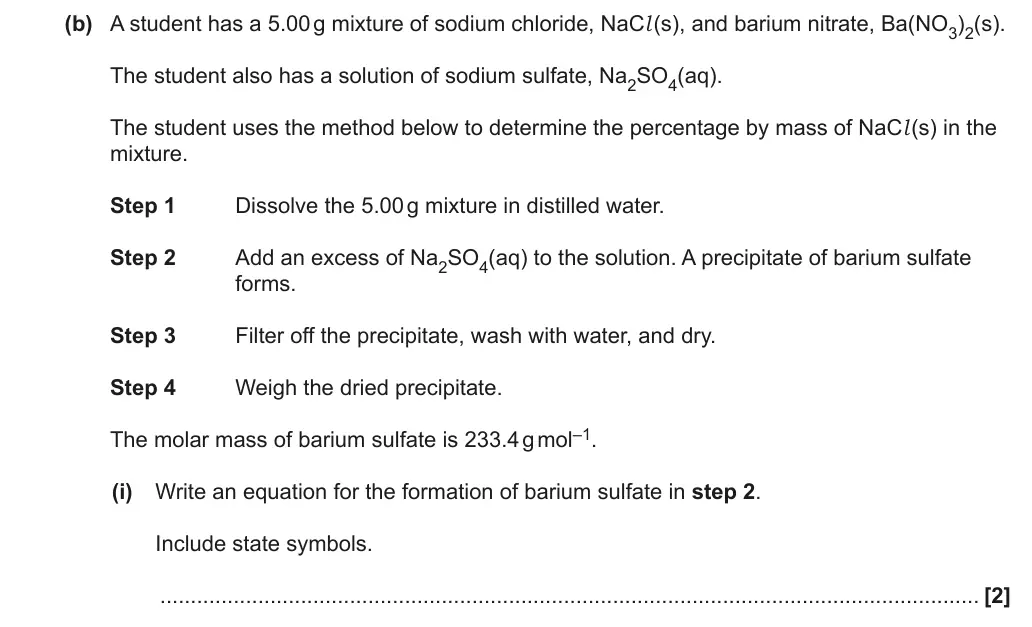
(b) A student has a 5.00 g mixture of sodium chloride, NaCl (s), and barium nitrate, Ba(NO3)2(s).
The student also has a solution of sodium sulfate, Na2SO4(aq).
The student uses the method below to determine the percentage by mass of NaCl (s) in the
mixture.
Step 1 Dissolve the 5.00 g mixture in distilled water.
Step 2 Add an excess of Na2SO4(aq) to the solution. A precipitate of barium sulfate
forms.
Step 3 Filter off the precipitate, wash with water, and dry.
Step 4 Weigh the dried precipitate.
The molar mass of barium sulfate is 233.4 g mol–1.
(i) Write an equation for the formation of barium sulfate in step 2.
Include state symbols.
...................................................................................................................................... [2]
June 2023 · AS Paper 2 · Q2(b)(ii) 4 marks AO3 Calculation Hard amount of substancepractical skills
Earlier part of question 2 that this part usesEarlier part of June 2023 Paper 2 question 2
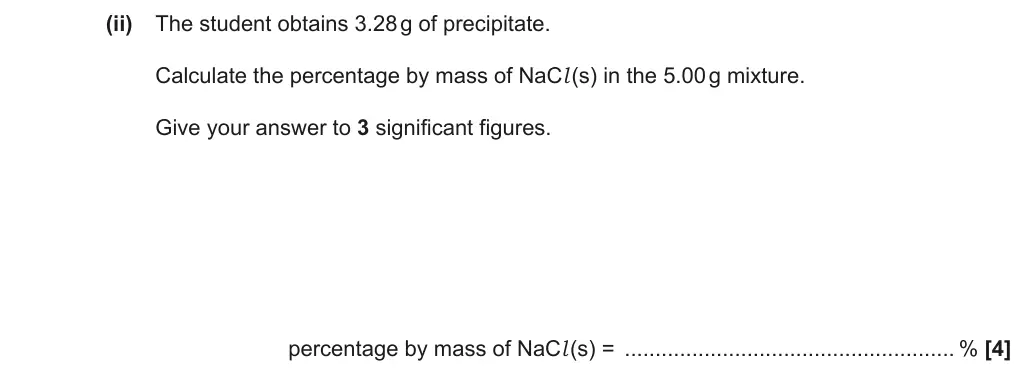
(ii) The student obtains 3.28 g of precipitate.
Calculate the percentage by mass of NaCl (s) in the 5.00 g mixture.
Give your answer to 3 significant figures.
percentage by mass of NaCl (s) =  ...................................................... % [4]
June 2023 · AS Paper 2 · Q2(b)(iii) 2 marks AO3 Short answer Medium halogenspractical skills
Earlier parts of question 2 that this part usesEarlier part of June 2023 Paper 2 question 2Earlier part of June 2023 Paper 2 question 2
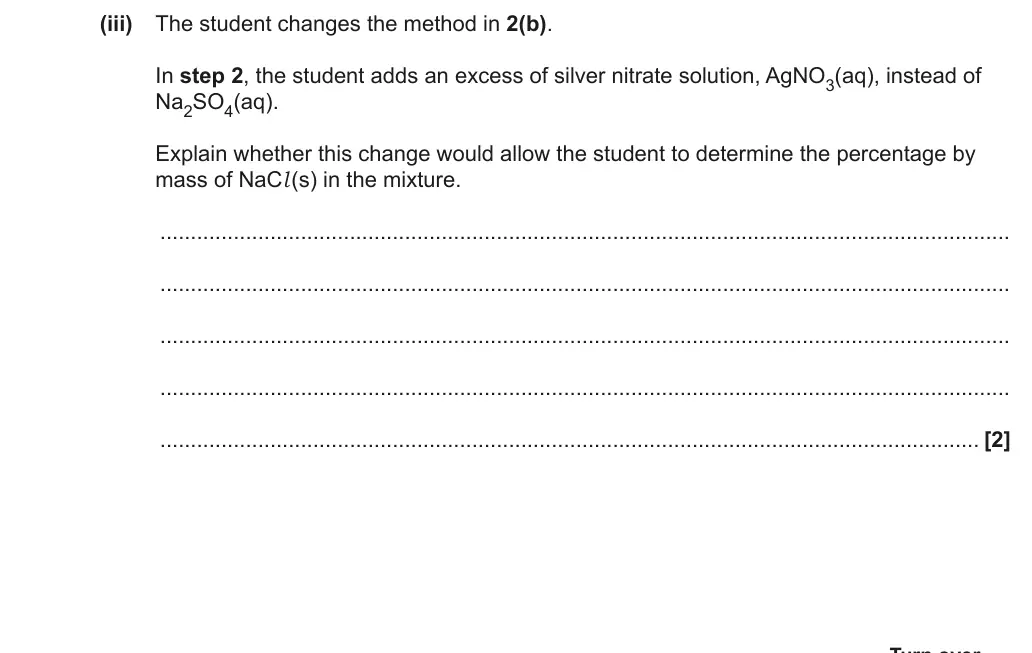
(iii) The student changes the method in 2(b).
In step 2, the student adds an excess of silver nitrate solution, AgNO3(aq), instead of
Na2SO4(aq).
Explain whether this change would allow the student to determine the percentage by
mass of NaCl (s) in the mixture.
...........................................................................................................................................
...........................................................................................................................................
...........................................................................................................................................
...........................................................................................................................................
...................................................................................................................................... [2]
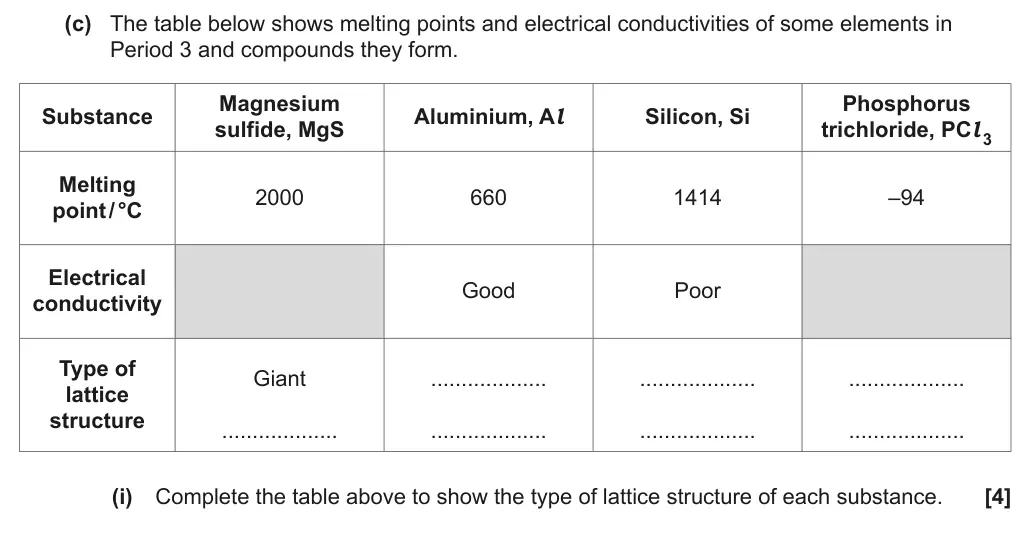
June 2023 · AS Paper 2 · Q2(c)(i) 4 marks AO1, 2 Complete table/diagram Medium bonding and structureperiodicity
(c) The table below shows melting points and electrical conductivities of some elements in
Period 3 and compounds they form.
Magnesium Phosphorus
Substance Aluminium, Al Silicon, Si
sulfide, MgS trichloride, PCl 3
Melting
2000 660 1414 –94
point / °C
Electrical
Good Poor
conductivity
Type of
Giant ................... ................... ...................
lattice
structure
................... ................... ................... ...................
(i) Complete the table above to show the type of lattice structure of each substance. [4]
June 2023 · AS Paper 2 · Q2(c)(ii) 4 marks AO1, 2, 3 Short answer Medium bonding and structureperiodicity
Earlier part of question 2 that this part usesEarlier part of June 2023 Paper 2 question 2
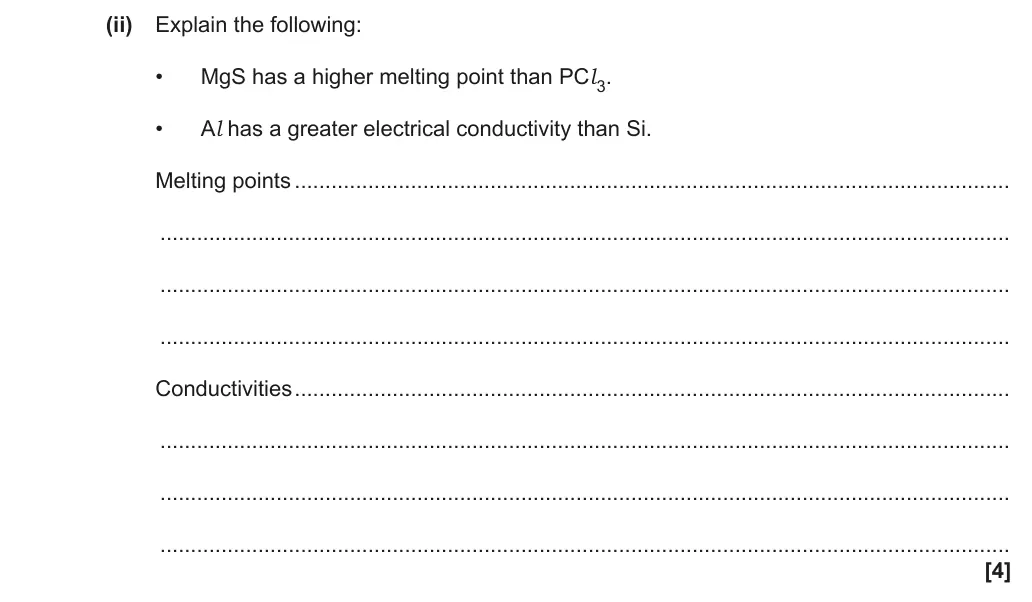
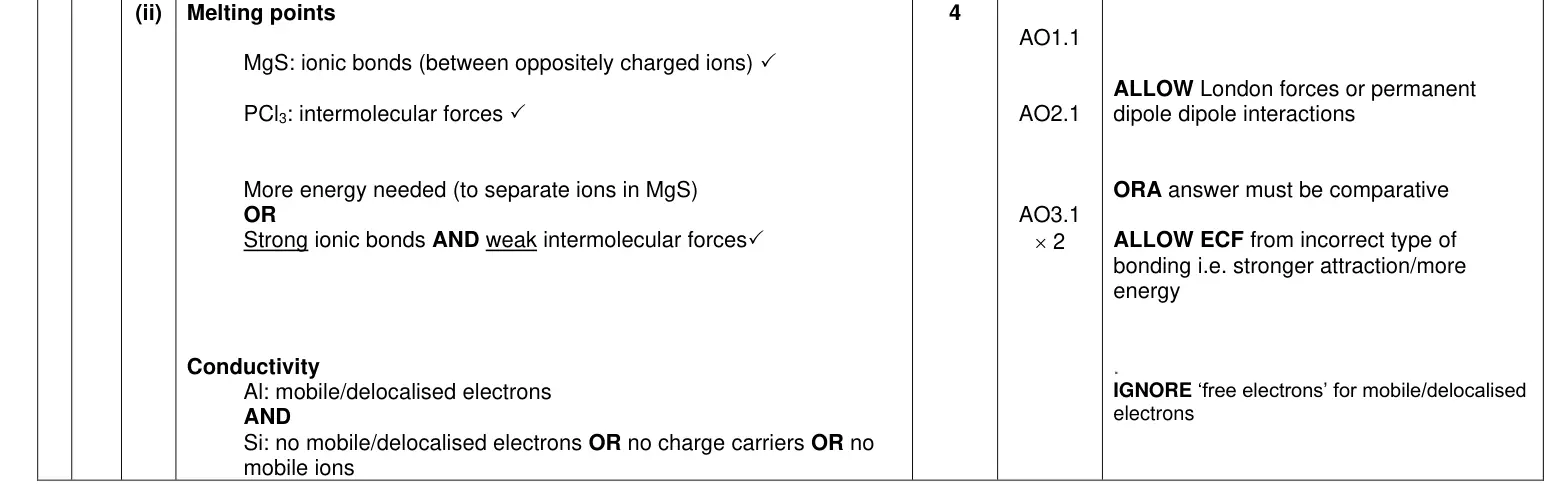
(ii) Explain the following:
• MgS has a higher melting point than PCl 3.
• Al has a greater electrical conductivity than Si.
Melting points .....................................................................................................................
...........................................................................................................................................
...........................................................................................................................................
...........................................................................................................................................
Conductivities .....................................................................................................................
...........................................................................................................................................
...........................................................................................................................................
...........................................................................................................................................
[4]
June 2023 · AS Paper 2 · Q3(a) 6 marks AO1, 2 6-mark level of response Hard halogensamount of substance
3 This question is about halogens and halogen compounds.
(a)* Seawater contains very small quantities of dissolved iodide ions.
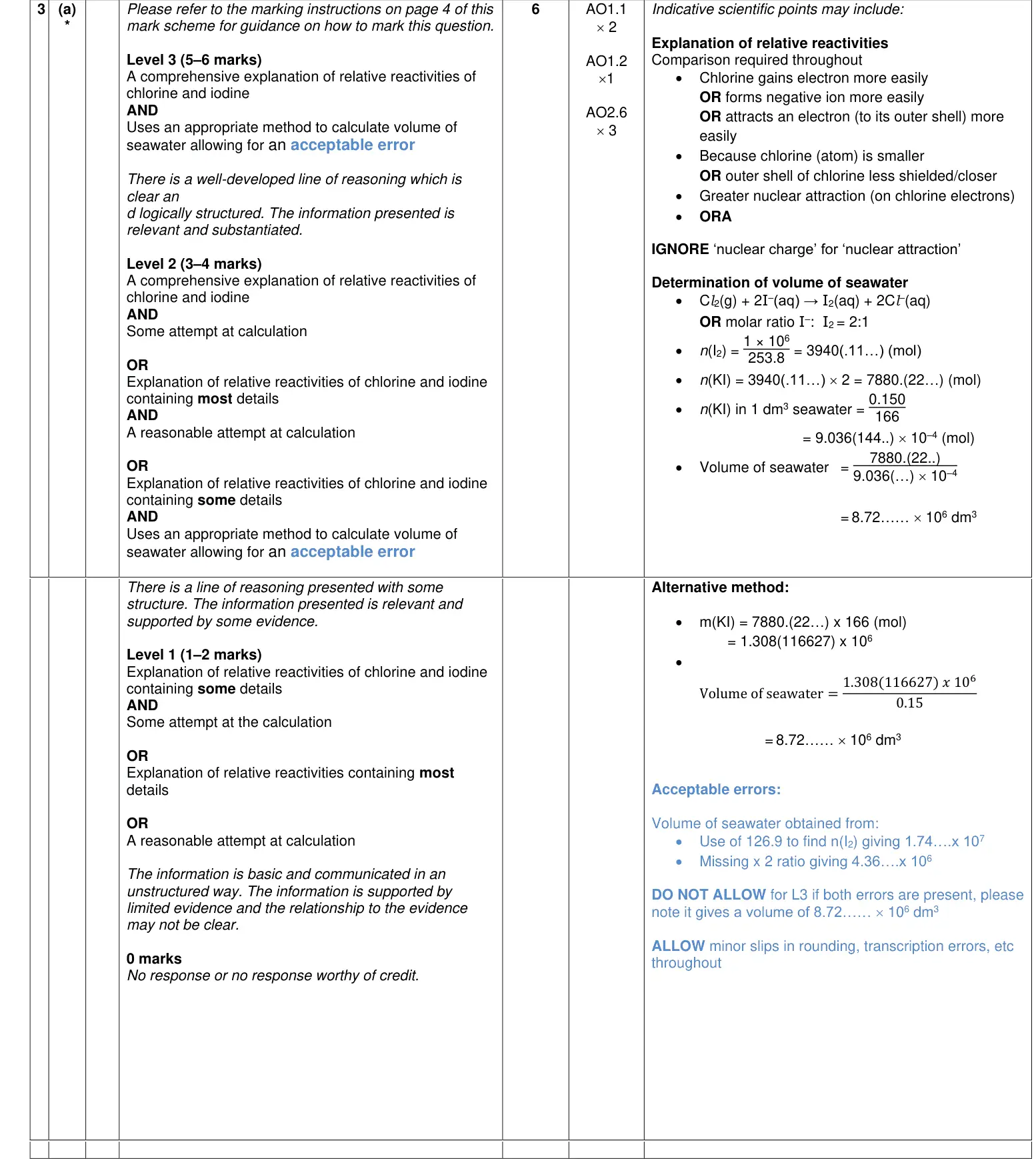
The concentration of potassium iodide, KI, in seawater is 0.150 g dm–3.
Iodine can be extracted by bubbling chlorine gas through seawater.
Explain why chlorine is more reactive than iodine and determine the volume, in dm3, of
seawater that is needed to manufacture 1.00 tonne of iodine, I2. [6]
...................................................................................................................................................
...................................................................................................................................................
...................................................................................................................................................
...................................................................................................................................................
...................................................................................................................................................
...................................................................................................................................................
...................................................................................................................................................
...................................................................................................................................................
...................................................................................................................................................
...................................................................................................................................................
...................................................................................................................................................
...................................................................................................................................................
...................................................................................................................................................
...................................................................................................................................................
...................................................................................................................................................
Additional answer space if required.
...................................................................................................................................................
...................................................................................................................................................
...................................................................................................................................................
...................................................................................................................................................
...................................................................................................................................................
June 2023 · AS Paper 2 · Q3(b) 3 marks AO1, 2 Data interpretation Hard halogensredox
(b) Chlorine reacts with calcium hydroxide to form Ca(OCl )2, which is the active ingredient in
bleaching powder.
2Cl 2  +  2Ca(OH)2 CaCl 2  +  Ca(OCl )2  +  2H2O
This is a disproportionation reaction.
State what is meant by disproportionation and use oxidation numbers to show that
disproportionation has taken place.
...................................................................................................................................................
...................................................................................................................................................
...................................................................................................................................................
...................................................................................................................................................
...................................................................................................................................................
...................................................................................................................................................
...................................................................................................................................................
...................................................................................................................................................
.............................................................................................................................................. [3]
June 2023 · AS Paper 2 · Q3(c) 3 marks AO1, 2 Mechanism Medium haloalkanesorganic basics
(c) A student is studying the hydrolysis of haloalkanes.
The equation for the alkaline hydrolysis of 2-bromopropane, CH3CHBrCH3, is shown below.
CH3CHBrCH3  +  OH– CH3CHOHCH3  +  Br –
Use the curly arrow model to outline the mechanism for the alkaline hydrolysis of
2-bromopropane.
Show relevant dipoles and lone pairs, and name the mechanism.
name of mechanism  .......................................................... [3]
June 2023 · AS Paper 2 · Q3(d)(i) 2 marks AO1 Complete table/diagram Easy haloalkaneshalogens
Earlier part of question 3 that this part usesEarlier part of June 2023 Paper 2 question 3
(d) The student sets up an experiment to compare the rates of hydrolysis of
2-bromopropane and 2-iodopropane.
The student uses the method below.
Step 1 Place two test tubes, both containing aqueous silver nitrate and ethanol, in a
water bath at 60 °C.
Step 2 Add five drops of 2-bromopropane to one test tube and five drops of
2-iodopropane to the other test tube.
Step 3 Record the time taken for a precipitate to appear in each test tube.
(i) Complete the table below to show the formula and colour of each precipitate formed.
Haloalkane Formula of precipitate Colour of precipitate
2-bromopropane
2-iodopropane
[2]
June 2023 · AS Paper 2 · Q3(d)(ii) 1 mark AO2 Short answer Medium haloalkanes
Earlier parts of question 3 that this part usesEarlier part of June 2023 Paper 2 question 3Earlier part of June 2023 Paper 2 question 3
(ii) Predict which precipitate would form first and explain the difference in the rates of
hydrolysis of 2-bromopropane and 2-iodopropane.
...........................................................................................................................................
...........................................................................................................................................
...........................................................................................................................................
...................................................................................................................................... [1]
June 2023 · AS Paper 2 · Q4(a) 2 marks AO1 Short answer Medium enthalpy changes
4 This question is about the enthalpy change of combustion of alcohols.
(a) Explain the term enthalpy change of combustion.
...................................................................................................................................................
...................................................................................................................................................
...................................................................................................................................................
.............................................................................................................................................. [2]
June 2023 · AS Paper 2 · Q4(b)(i) 1 mark AO2 Calculation Medium practical skills
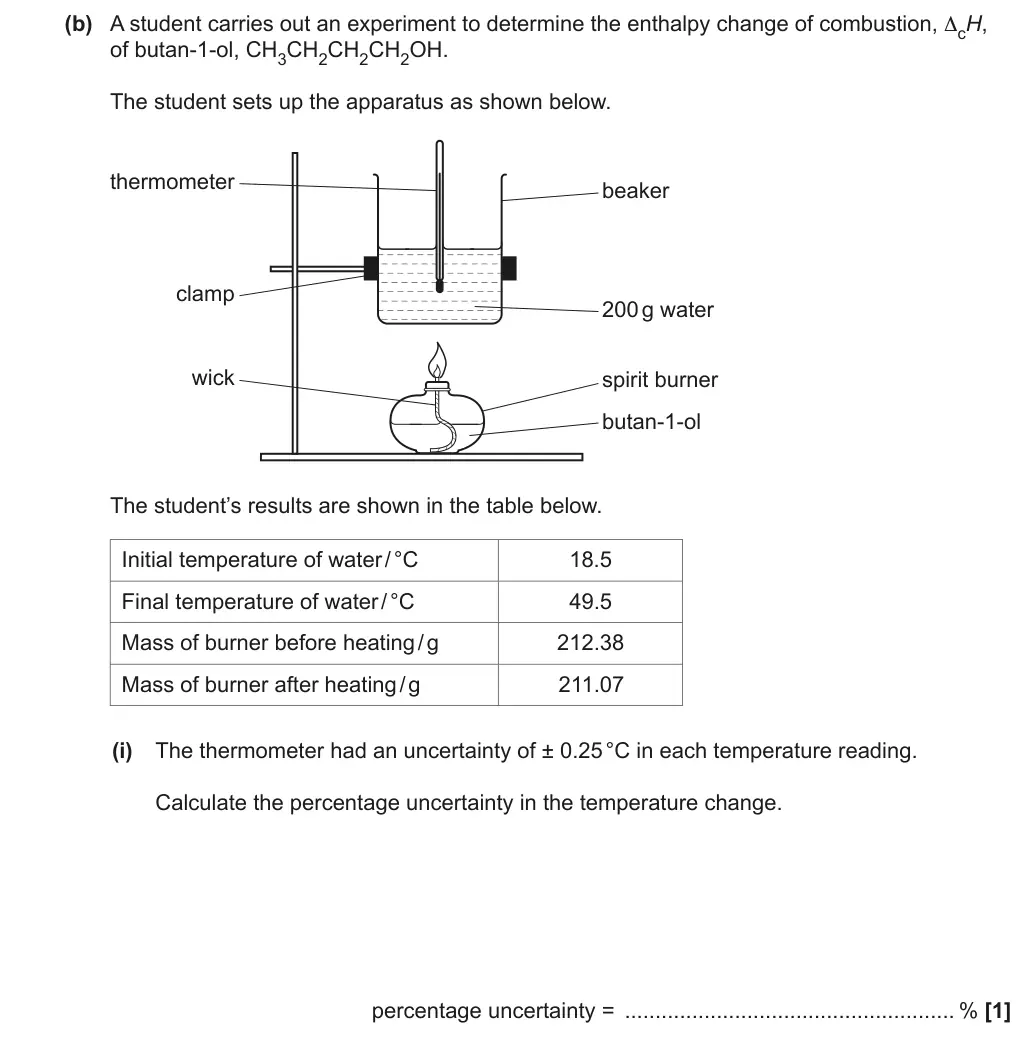
(b) A student carries out an experiment to determine the enthalpy change of combustion, ΔcH,
of butan-1-ol, CH3CH2CH2CH2OH.
The student sets up the apparatus as shown below.
thermometer
beaker
clamp
200 g water
wick spirit burner
butan-1-ol
The student’s results are shown in the table below.
Initial temperature of water / °C 18.5
Final temperature of water / °C 49.5
Mass of burner before heating / g 212.38
Mass of burner after heating / g 211.07
(i) The thermometer had an uncertainty of ± 0.25 °C in each temperature reading.
Calculate the percentage uncertainty in the temperature change.
percentage uncertainty =  ...................................................... % [1]
June 2023 · AS Paper 2 · Q4(b)(ii) 6 marks AO2, 3 6-mark level of response Medium enthalpy changespractical skills
Earlier part of question 4 that this part usesEarlier part of June 2023 Paper 2 question 4
(ii)* Use the student’s results to determine ∆cH of butan-1-ol in kJ mol–1.
Explain why this value of ΔcH is different from the data book value and suggest how
the experimental design could be modified to improve the accuracy of the ΔcH value
obtained. [6]
...........................................................................................................................................
...........................................................................................................................................
...........................................................................................................................................
...........................................................................................................................................
...........................................................................................................................................
...........................................................................................................................................
...........................................................................................................................................
...........................................................................................................................................
...........................................................................................................................................
...........................................................................................................................................
...........................................................................................................................................
...........................................................................................................................................
...........................................................................................................................................
...........................................................................................................................................
...........................................................................................................................................
...........................................................................................................................................
...........................................................................................................................................
Additional answer space if required.
...........................................................................................................................................
...........................................................................................................................................
...........................................................................................................................................
...........................................................................................................................................
...........................................................................................................................................
June 2023 · AS Paper 2 · Q4(b)(iii) 1 mark AO3 Calculation Medium enthalpy changes
Earlier parts of question 4 that this part usesEarlier part of June 2023 Paper 2 question 4Earlier part of June 2023 Paper 2 question 4
(iii) Another student carries out the experiment in 4(b) using 150 g of water in the beaker
instead of 200 g.
Calculate the mass of butan-1-ol that would produce the same temperature rise as in
the experiment in 4(b).
Assume the same heat losses.
mass of butan-1-ol =  ....................................................... g [1]
June 2023 · AS Paper 2 · Q4(c)(i) 4 marks AO2 Calculation Hard enthalpy changes
(c) The enthalpy change of combustion of ethanol, ΔcH, in the gaseous state can be calculated
using average bond enthalpies.
H H
H C C O H(g)  + 3 O=O(g) 2 O=C= O(g) + 3 H O H(g) ΔcH = –1276 kJ mol–1
H H
(i) Use this value of ΔcH and the average bond enthalpies below to calculate the average
bond enthalpy of C=O.
Average bond enthalpy /
Bond
kJ mol–1
C–H +413
C–C +347
C–O +358
O–H +464
O=O +498
C=O bond enthalpy =  .............................................kJ mol–1 [4]
June 2023 · AS Paper 2 · Q4(c)(ii) 2 marks AO3 Short answer Hard enthalpy changes
Earlier part of question 4 that this part usesEarlier part of June 2023 Paper 2 question 4
(ii) Methoxymethane, CH3OCH3, is an isomer of ethanol.
On combustion, methoxymethane, in the gaseous state, produces carbon dioxide and
steam.
H H
H C O C H(g)  + 3 O=O(g) 2 O= C=O(g) + 3 H O H(g)
H H
ΔcH for methoxymethane is more negative than ΔcH for ethanol.
Explain why the ΔcH values are different, in terms of the bonds broken and the bonds
formed.
...........................................................................................................................................
...........................................................................................................................................
...........................................................................................................................................
...........................................................................................................................................
...................................................................................................................................... [2]
June 2023 · AS Paper 2 · Q5(a)(i) 1 mark AO2 Short answer Medium organic basics
5 This question is about alkenes.
(a) A mixture of alkenes is produced when water is eliminated from alcohol A.
OH
Alcohol A
(i) What is the systematic name of alcohol A?
...................................................................................................................................... [1]
June 2023 · AS Paper 2 · Q5(a)(ii) 2 marks AO2 Equation writing Medium alcoholsorganic basicsalkenes
Earlier part of question 5 that this part usesEarlier part of June 2023 Paper 2 question 5
(ii) Alcohol A is refluxed with an acid catalyst.
• A mixture of alkene isomers B, C and D is formed.
• Alkenes B and C show E/Z isomerism but alkene D does not.
Construct the equation for the formation of alkene D from alcohol A.
Show the structure of the organic product.
[2]
June 2023 · AS Paper 2 · Q5(a)(iii) 2 marks AO3 Data interpretation Hard alkenes
Earlier parts of question 5 that this part usesEarlier part of June 2023 Paper 2 question 5Earlier part of June 2023 Paper 2 question 5
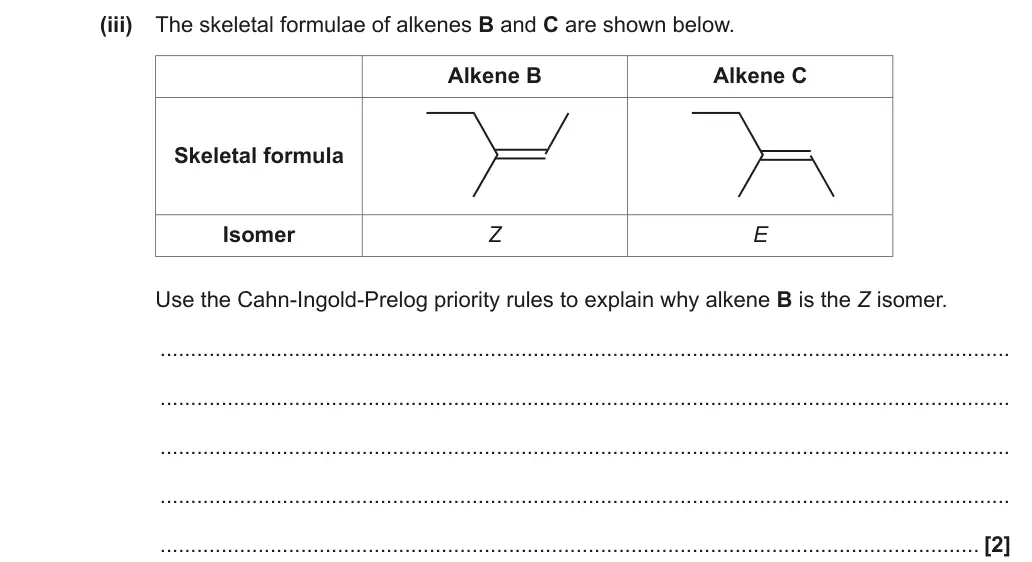
(iii) The skeletal formulae of alkenes B and C are shown below.
Alkene B Alkene C
Skeletal formula
Isomer Z E
Use the Cahn-Ingold-Prelog priority rules to explain why alkene B is the Z isomer.
...........................................................................................................................................
...........................................................................................................................................
...........................................................................................................................................
...........................................................................................................................................
...................................................................................................................................... [2]
June 2023 · AS Paper 2 · Q5(b)(i) 2 marks AO2, 3 Drawing / labelling Medium alkenesbonding and structurealcohols
(b) A chemistry company is developing water-soluble polymers.
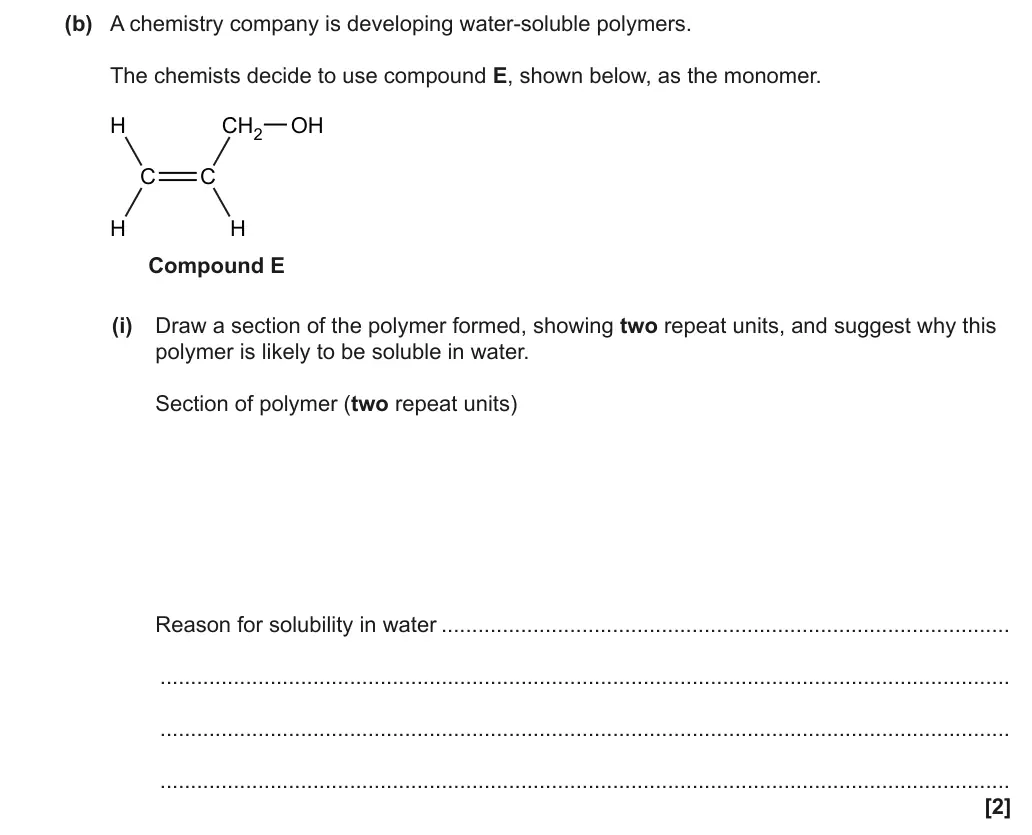
The chemists decide to use compound E, shown below, as the monomer.
H CH2 OH
C C
H H
Compound E
(i) Draw a section of the polymer formed, showing two repeat units, and suggest why this
polymer is likely to be soluble in water.
Section of polymer (two repeat units)
Reason for solubility in water .............................................................................................
...........................................................................................................................................
...........................................................................................................................................
...........................................................................................................................................
[2]
June 2023 · AS Paper 2 · Q5(b)(ii) 2 marks AO1 Short answer Hard alkenes
Earlier part of question 5 that this part usesEarlier part of June 2023 Paper 2 question 5
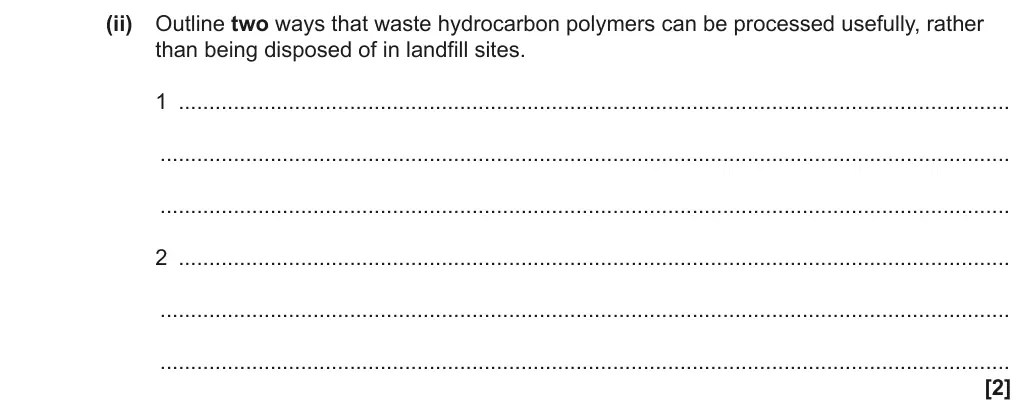
(ii) Outline two ways that waste hydrocarbon polymers can be processed usefully, rather
than being disposed of in landfill sites.
1  ........................................................................................................................................
...........................................................................................................................................
...........................................................................................................................................
2  ........................................................................................................................................
...........................................................................................................................................
...........................................................................................................................................
[2]

Work with an OCR chemistry tutor

Want a paper marked and gone through with you? Message us.

Prefer email? Send an enquiry

If you are under 18, please include a parent's contact details. Enquiries go to enquiries@chemistryaleveltutor.com and are deleted once handled. All tutoring is online.