Answer
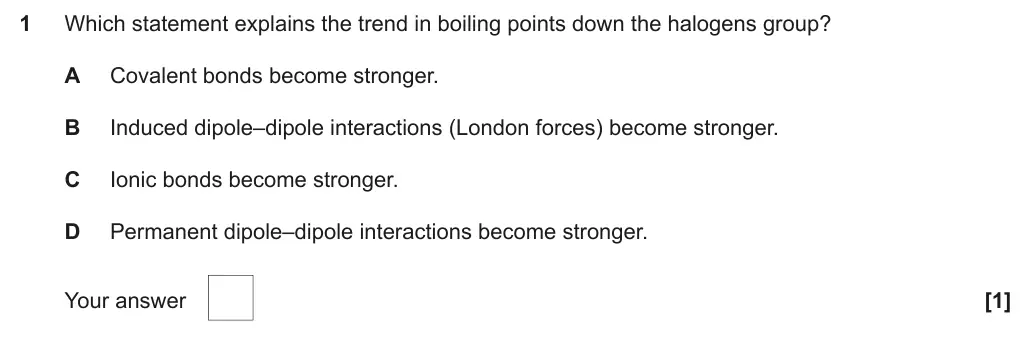
B
Mark scheme

Examiner's comment
Almost all candidates selected the correct response of B. The main distractor proved to be D, the other type of dipole–dipole interaction.
70 marks · 44 question parts · Paper, mark scheme and report on OCR's site · Have OCR's Data Sheet beside you
B
Almost all candidates selected the correct response of B. The main distractor proved to be D, the other type of dipole–dipole interaction.
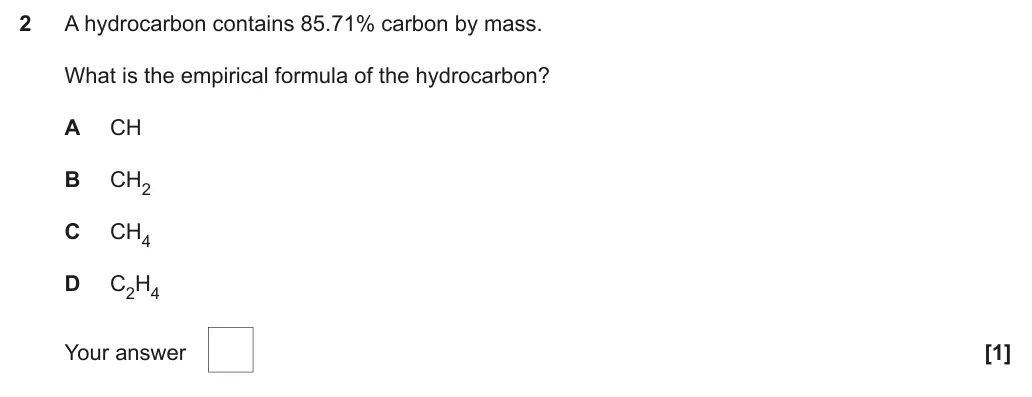
B
Most candidates are well drilled in the calculation of an empirical formula from percentage compositions and most selected the correct response of B. Option D proved to the main distractor, presumably due to confusion between the terms empirical and molecular formula.
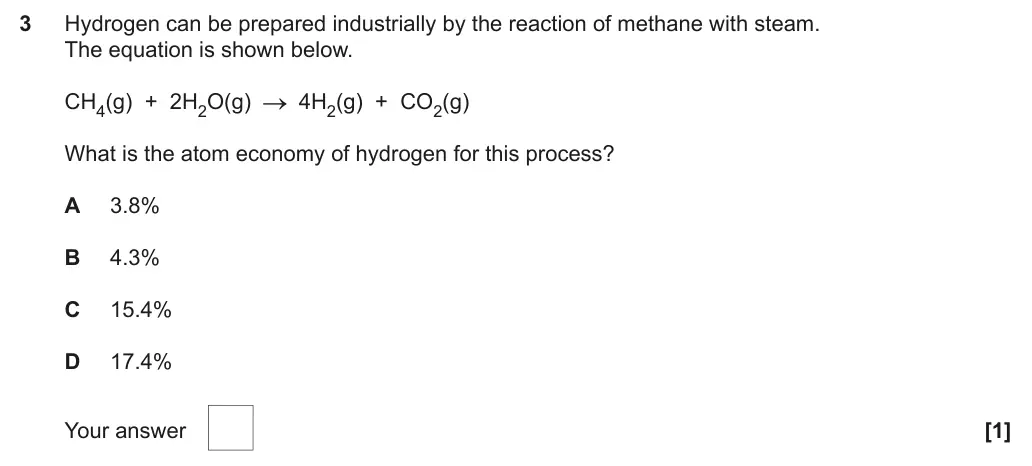
C
Most candidates selected the correct response of C but some chose D, the result of dividing 8 (for 4H2) by 44 (for CO2) instead of dividing by their sum (8 + 44 = 52). Overall, candidates showed a good understanding of the term ‘atom economy’.
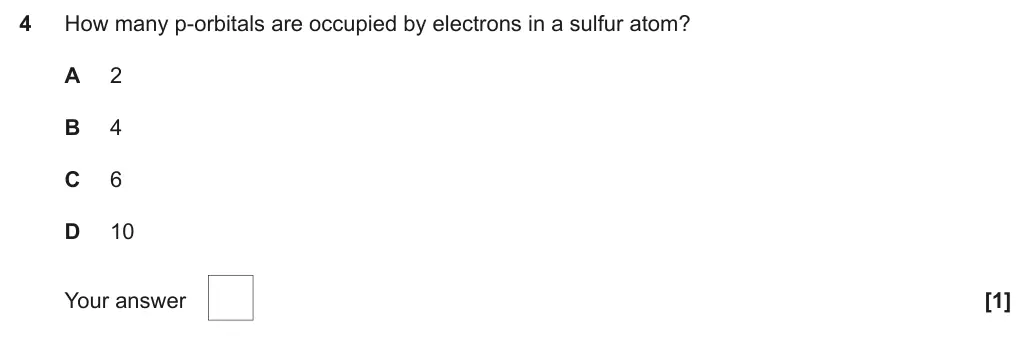
C
Candidates found this question more difficult than Questions 1–3. The question discriminated well. Most candidates showed the electron configuration in their working. A and D were the main distractors. Rather than the number of p-orbitals occupied, option A (2) is the number of p sub-shells (2p and 3p) and D (10) is the total number of p electrons (6 + 4). The errors may be the result of candidates not understanding the meaning of orbital and sub-shell or perhaps not reading the question closely enough. Underlining ‘p-orbitals’ may have helped candidates.
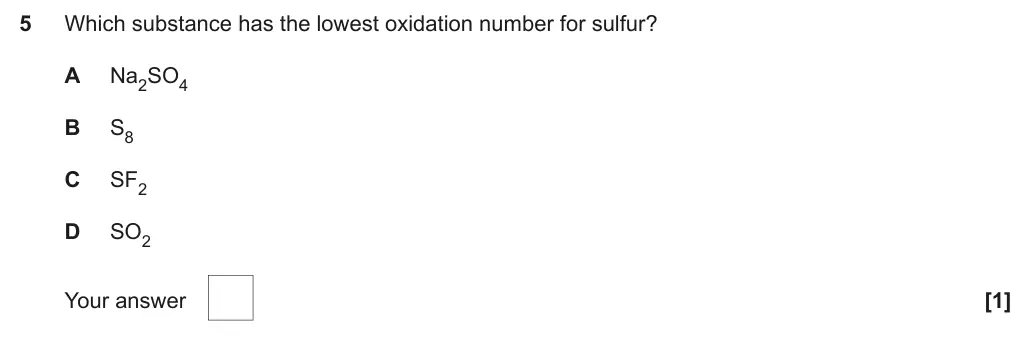
B
Most candidates corrected selected option B. Many candidates wrote their oxidation numbers by each response with most identifying the oxidation number of S in S8 as being 0. The main distractors were A and C. Annotations showed that many assignments of oxidation number had the wrong sign. For example, assigning S as –2 for S (SF2) would result in C being chosen. This suggests that some candidates have an insufficient understanding of the rules for assigning oxidation numbers.
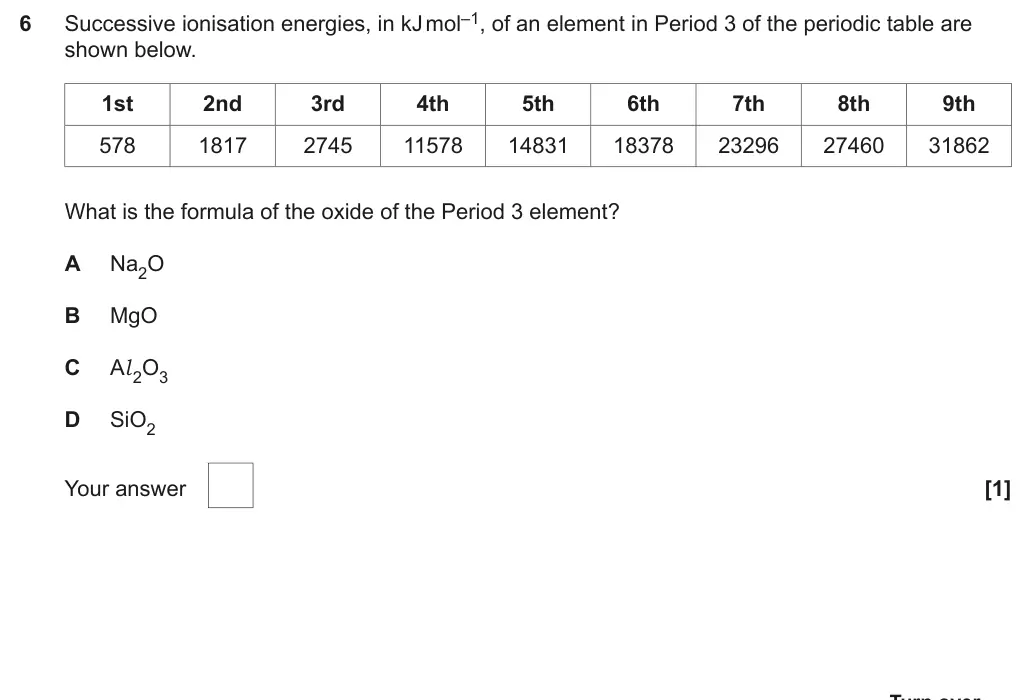
C
Most candidate chose the correct response of C. From the annotations on the scripts, most candidates identified the largest jump between the 3rd and 4th ionisation energies. Option D proved to be the main distractor. Having identified the correct large jump, a significant number of candidates chose the group at the end of the jump (Group 4) rather than the group at the start of the jump (Group 3). This suggests a misconception.
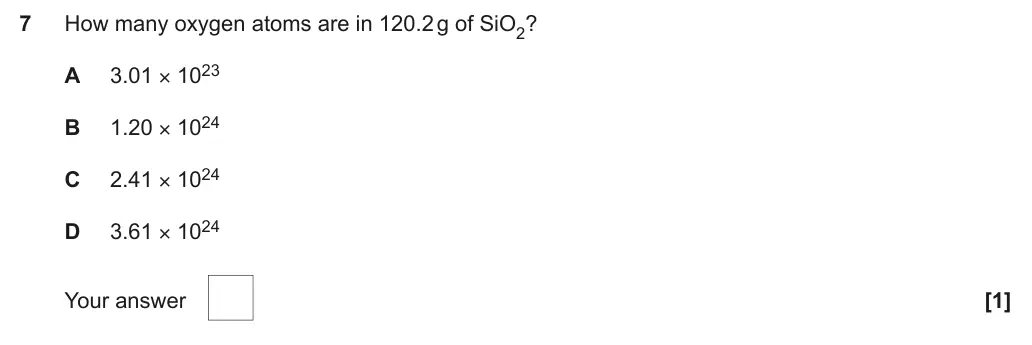
C
Candidates found this question more demanding than Questions 1–6 with only about half the candidates correctly choosing option C. Most candidates showed working on their scripts with B being the common distractor, the result of working out the moles of SiO2 as 120.2/60.1 = 2, and then multiplying the Avogadro Constant by 2, rather than first doubling 2 to take into account the two O atoms in SiO2.
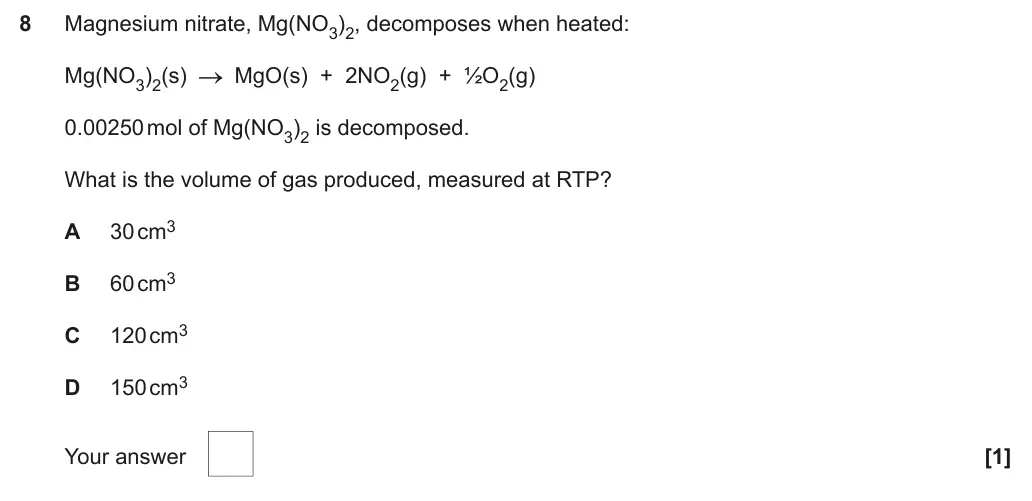
D
Candidates found this question demanding. It showed very good discrimination between abilities with most able candidates choosing the correct option D. Option C was chosen by many, the result of working out the moles of NO2(g) without adding the moles of O2. Care is needed when reading the question which asked for ‘volume of gas’, rather than ‘volume of NO2(g). Despite the question stating the volume has been measured at RTP, some candidates chose to use the Ideal Gas Equation instead of the simplified molar volume of 24 dm3 mol–1 at RTP. This approach could still lead to success but would have wasted significant time.
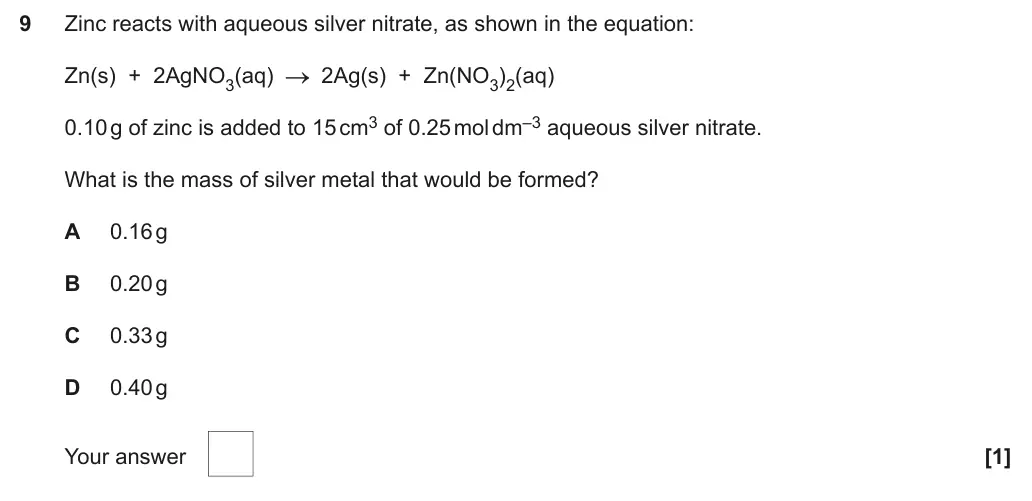
C
Candidates found this question very difficult with less than half successfully choosing option C. Many candidates chose option D, as shown in Exemplar 1. This candidate’s working is clear and would have been correct had AgNO3 have been the limiting factor. Calculating the moles of Zn shows that this is the limiting factor, producing 0.33 g of Ag for option C.
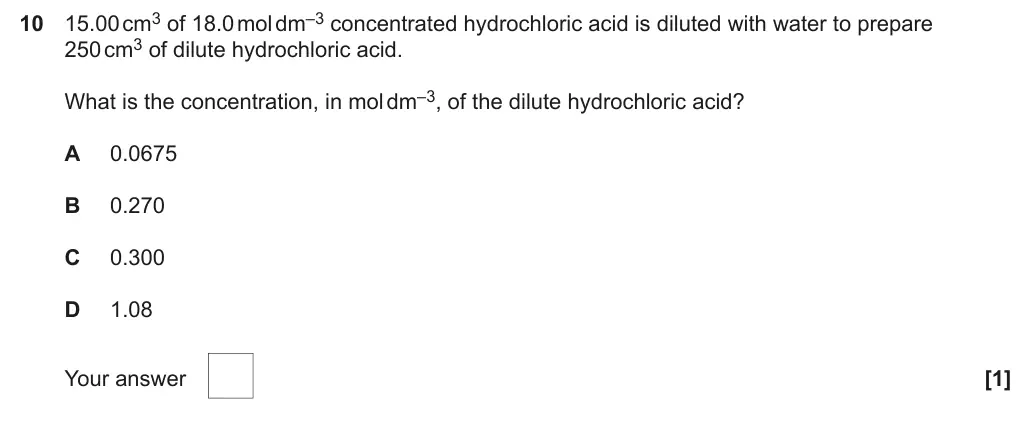
D
Most higher attaining candidates chose the correct option of D. From candidate annotations, most calculated the moles of HCl as 0.27 mol. This directly gave the common distractor of B, the result of not taking into account the volume of 250 cm3. Successful candidates multiplied 0.27 by 4 (or divided by 0.250) to get the correct response of 1.08 mol dm–3 (D).
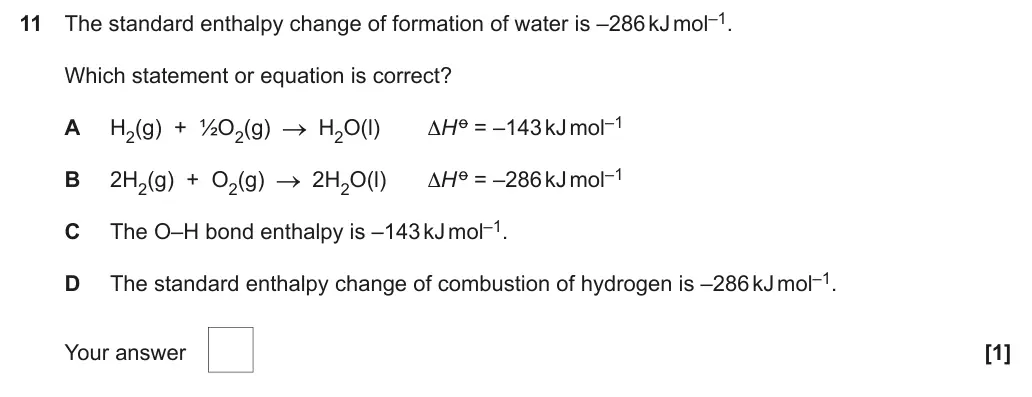
D
This question proved to be very difficult with only the highest attaining candidates obtaining the correct response of D. Options A and C were the main distractors but there didn’t seem to be any clear pattern. The many candidates could not identify the correct response suggests that candidates have difficulty in understanding the real meaning of these enthalpy terms.
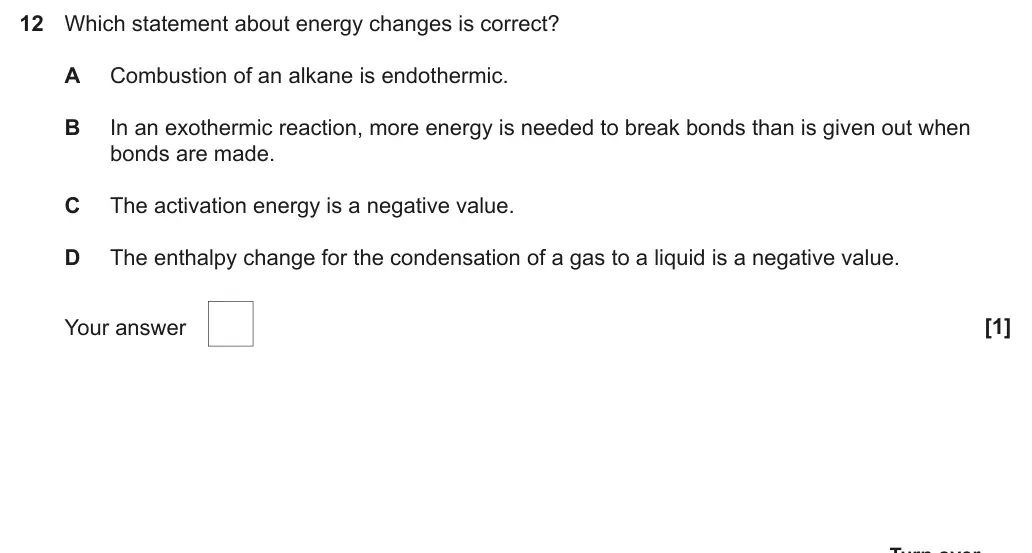
D
The theme of problems with enthalpy terms continued with Question 12, with only about half of the candidates choosing the correct option D.
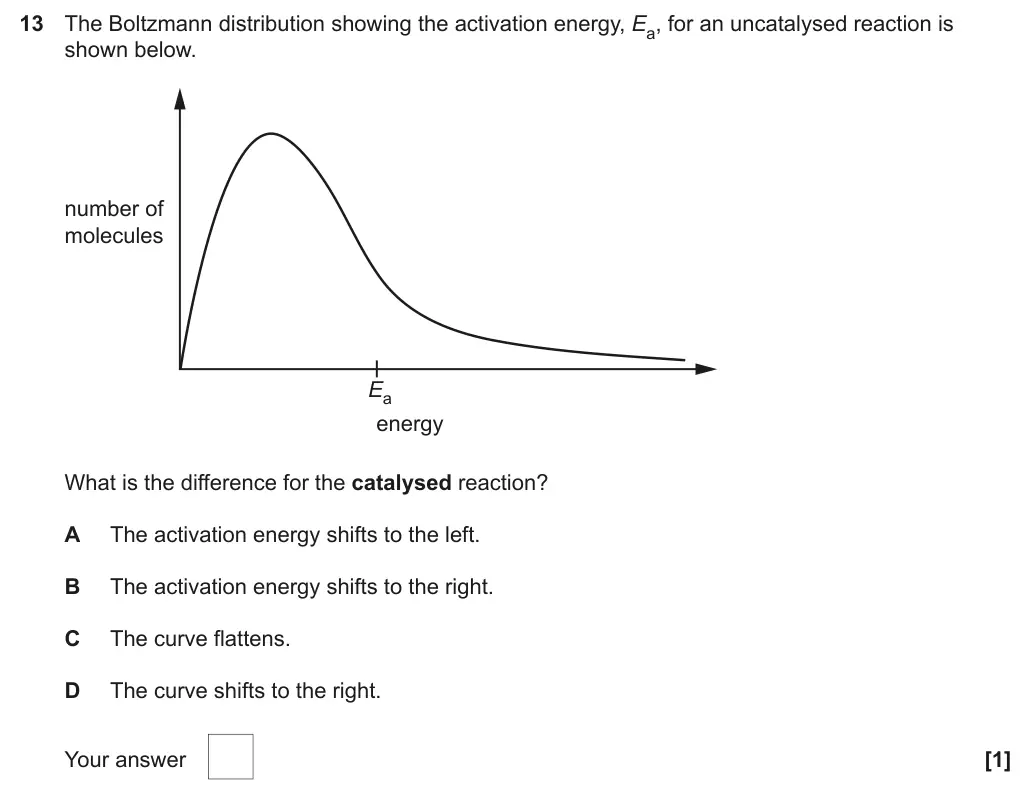
A
The behaviour of the Boltzmann distribution under different conditions is well known with most candidates making the correct choice of A.
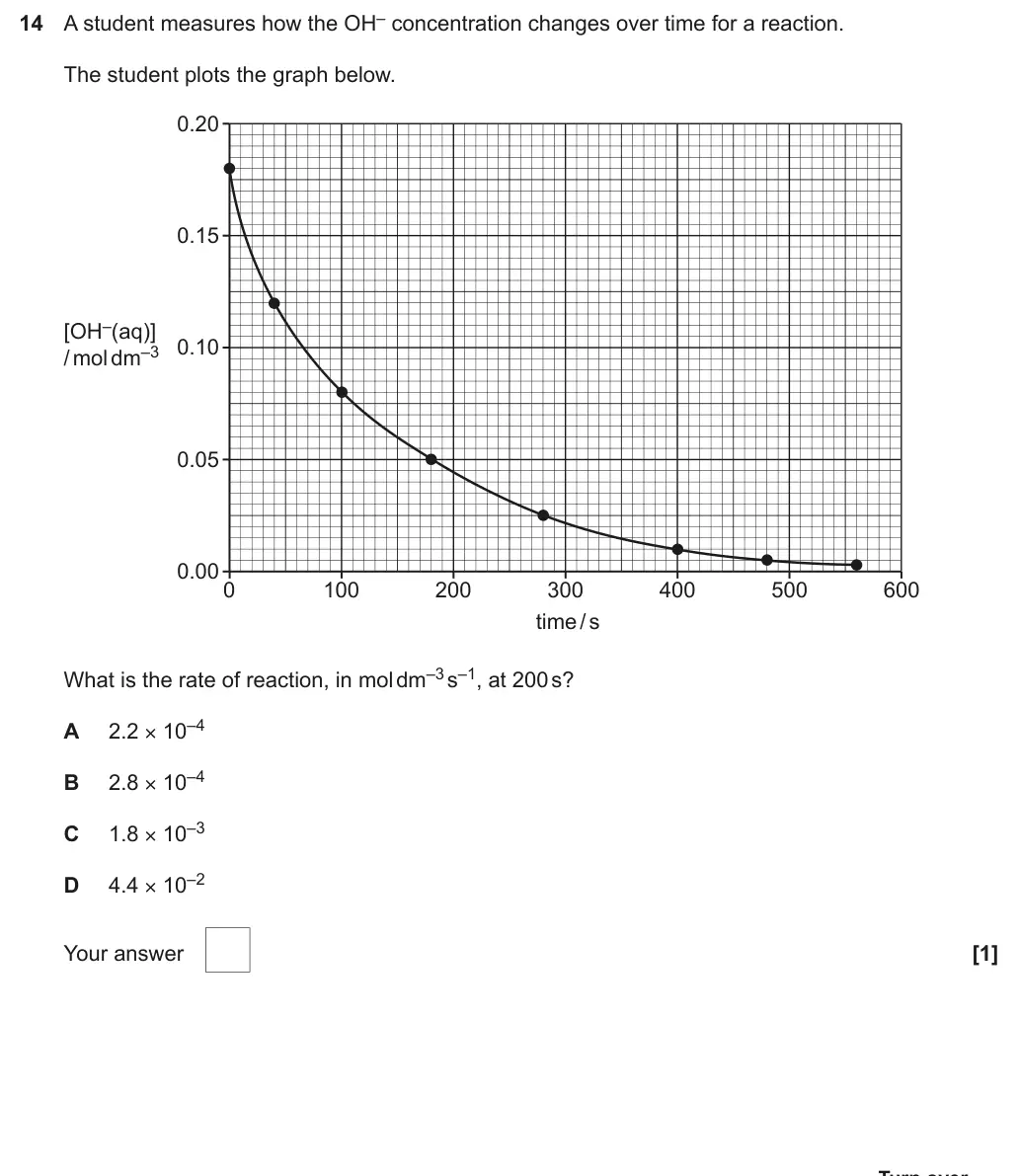
B
This question discriminated well, rewarding those candidates with a good understanding of the link between concentration, time and rate. Many candidates drew a tangent to the curve at 200 s, measuring its gradient to get the correct choice of B. Common errors focused on reading of the concentration at 200 s. This was then either matched to option D directly or divided by 200 to give option A.
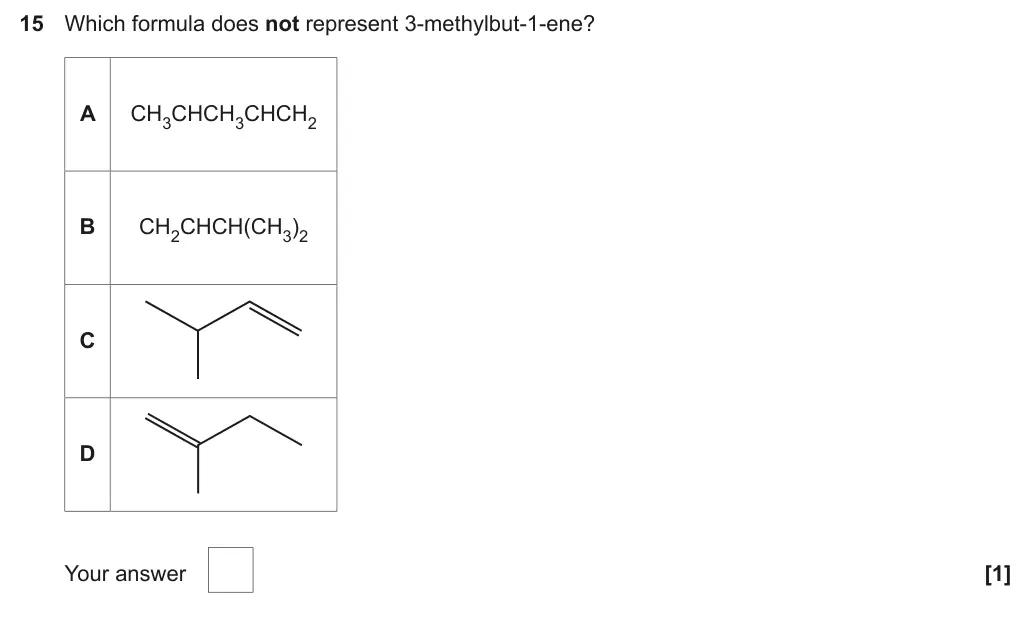
D
Most candidates showed a good understanding of organic nomenclature to obtain the correct option of D. Candidates who drew out the structures for options A and B were able to easily eliminate them. Those trying to interpret the A and B options without drawing out the structures were often less successful.
C
As with Question 15, the strategy of drawing out structures was more likely to lead to success with the correct option of C. Despite this, less than half of candidates obtained the correct response with many missing one of the isomers and opting for option B.
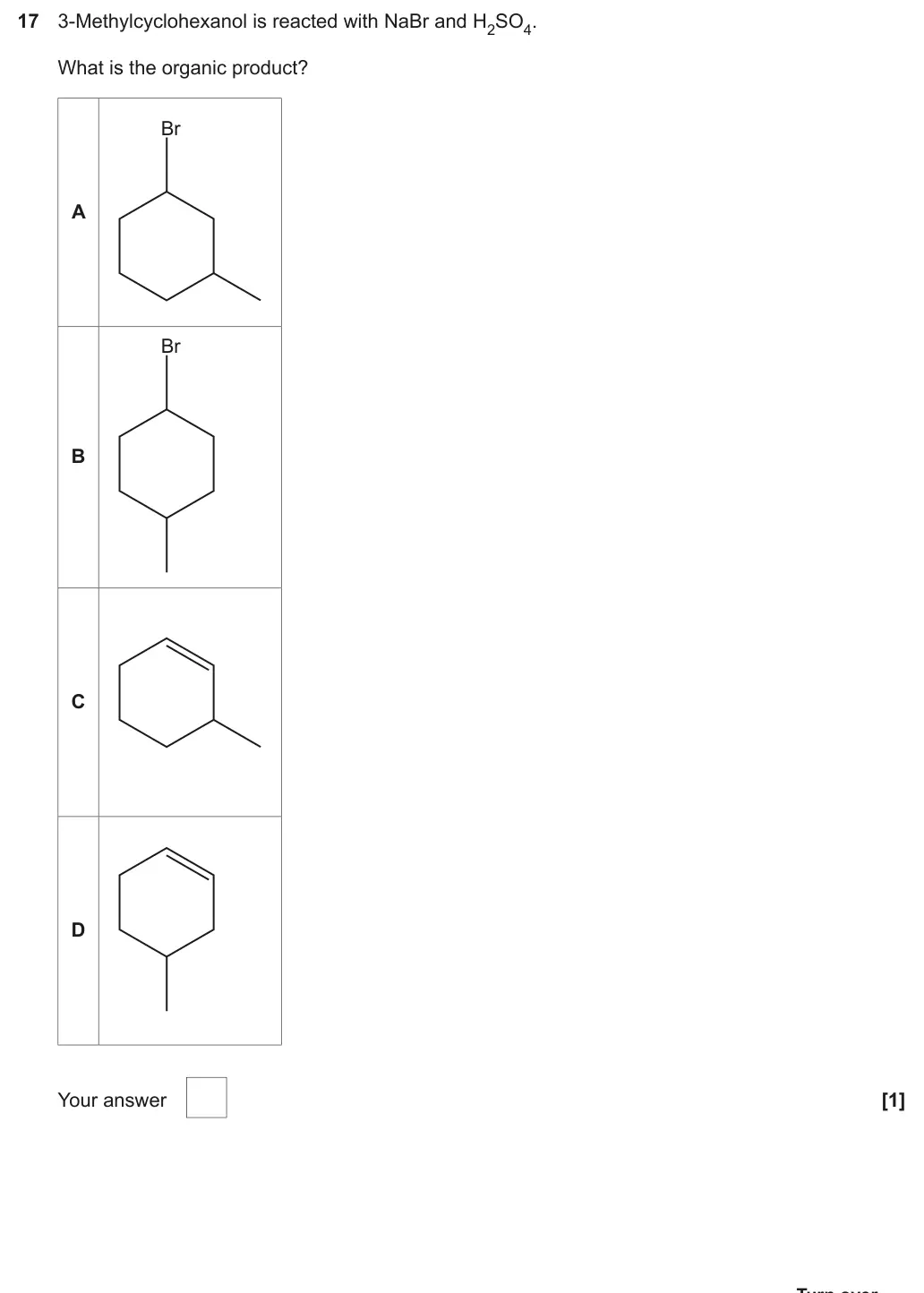
A
Candidates had more success with this question with most obtaining the correct option, A.
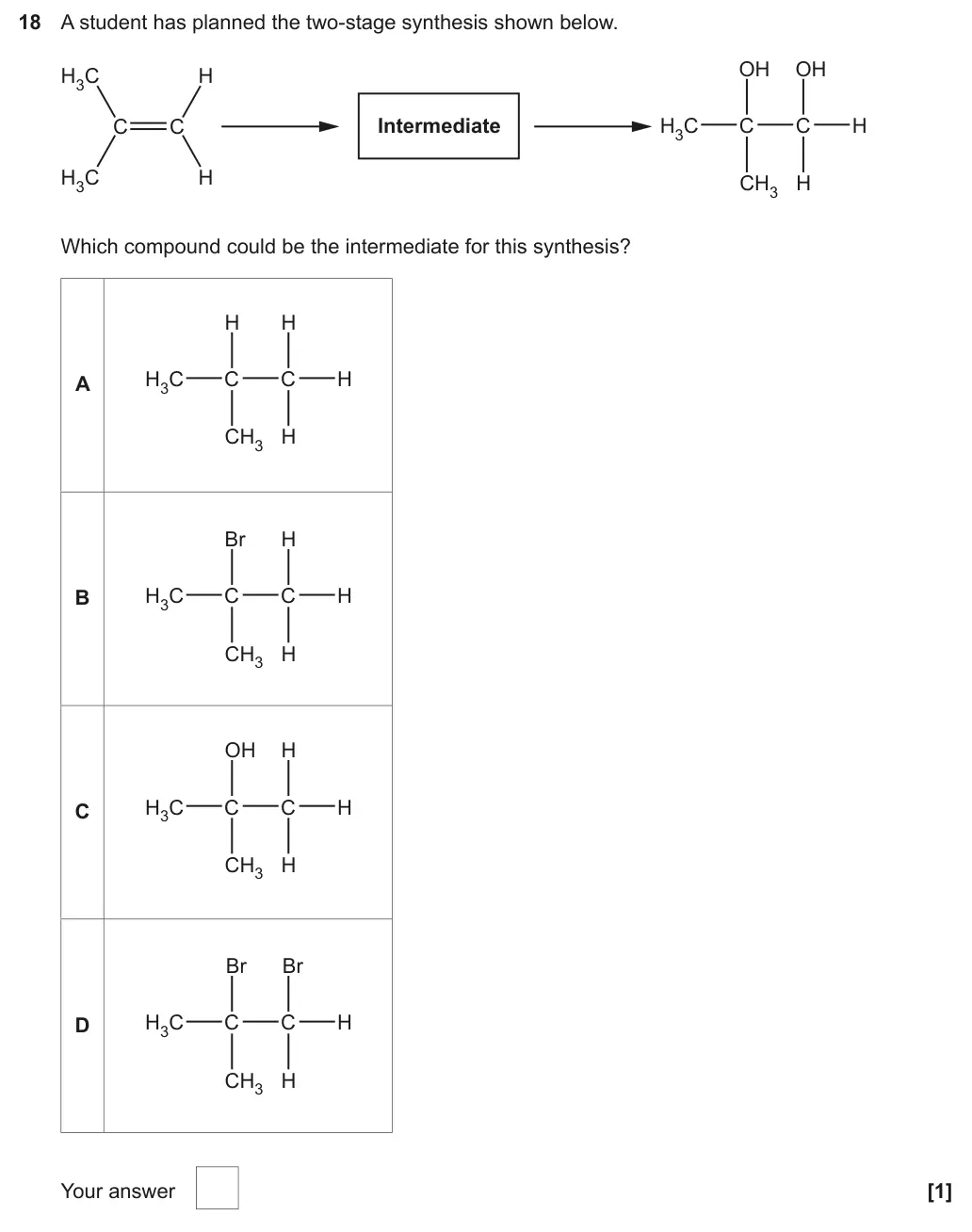
D
Candidates find it difficult to identify an intermediate within a synthesis and less than half selected the correct option, D.
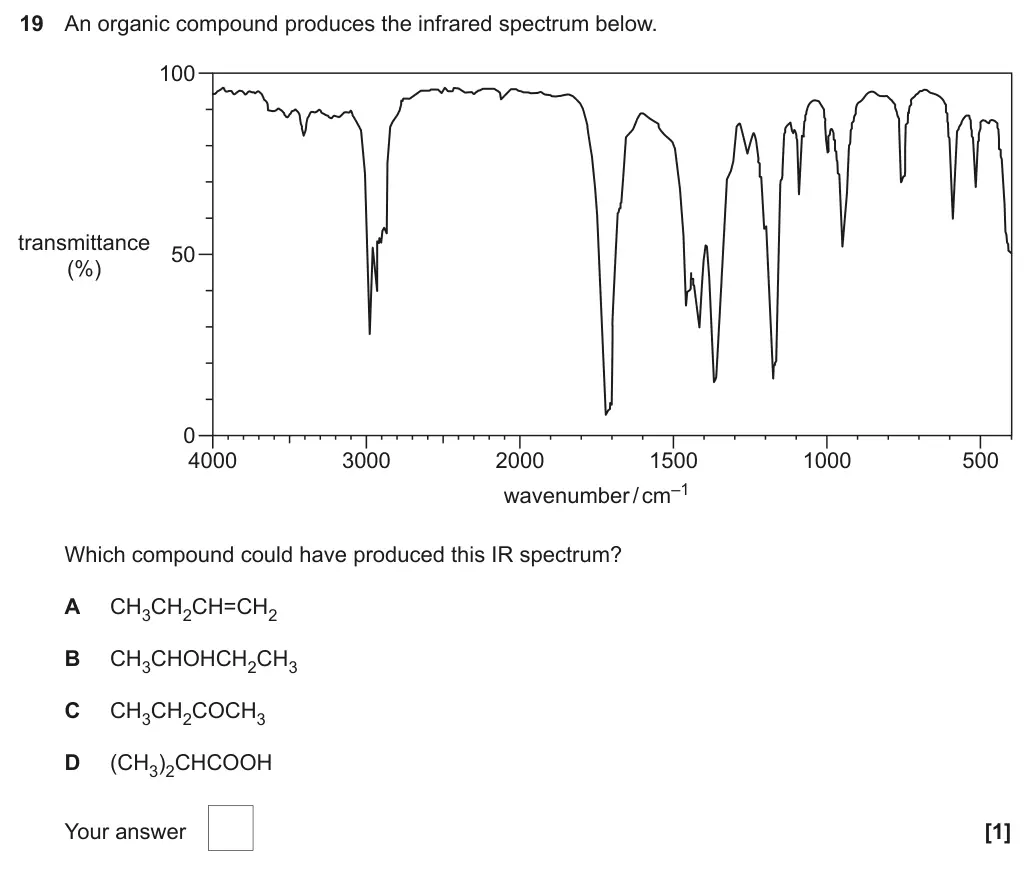
C
Less than half the candidates interpreted which compound could have produced the IR spectrum. Many wrote the functional groups present alongside each option and all four options were seen in the responses. It was expected that the presence of a C=O absorption at 1700 cm–1 would have led to A and B to be eliminated. Some thought that the peak at 3000 cm–1 was for the carboxylic acid O–H which diverted some away from the correct option, C.
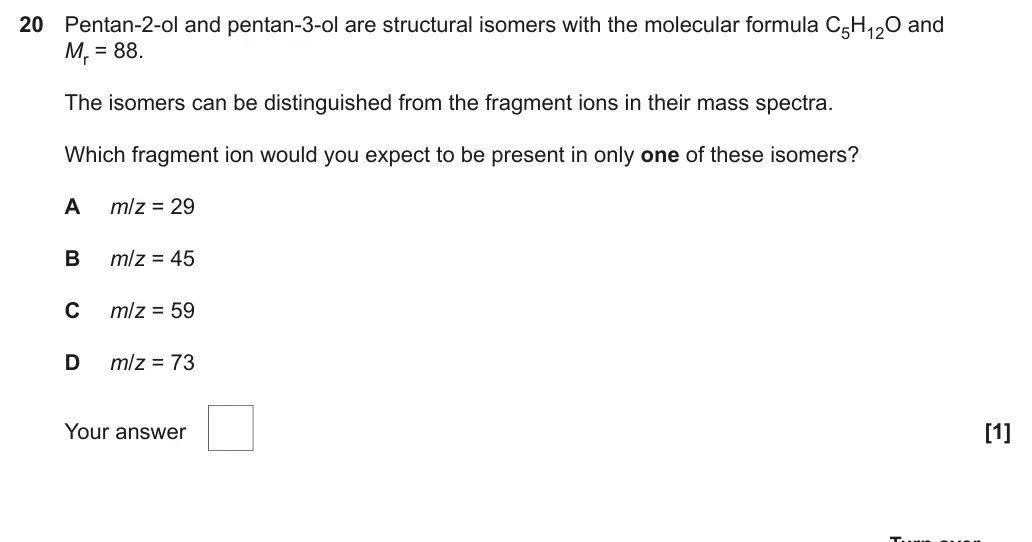
B
Candidates found this question a little easier and, as with previous organic questions, the best route to success was to draw out the structures of the organic isomers. For mass spectrum fragmentation, this ensures that the molecules can visually be split up into possible fragments. So well over half the candidates correctly identified the possible fragments and the correct option, B. Section B overview Section B includes short answer question styles (structured questions, problem solving, calculations, practical) and extended response questions. This section of the paper is worth 50 marks.
Most candidates correctly described a covalent bond as a shared pair of electrons. Where this mark was dropped, it was usually because of the omission of ‘pair’ or ‘shared’, e.g. ‘shared electrons’.
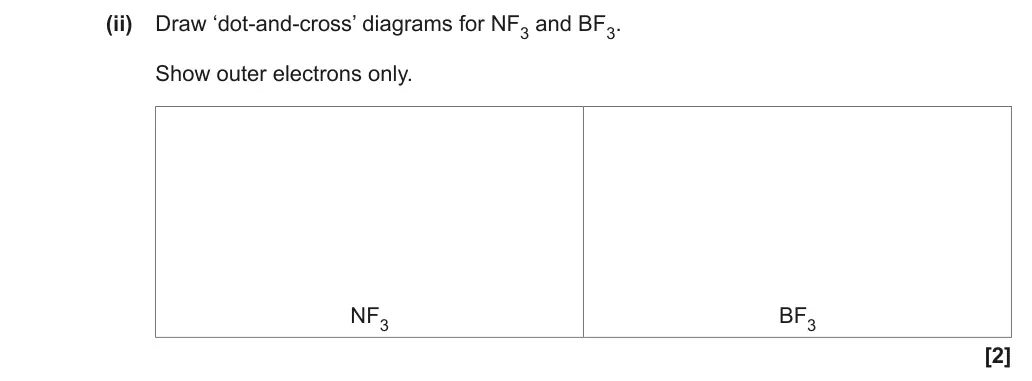
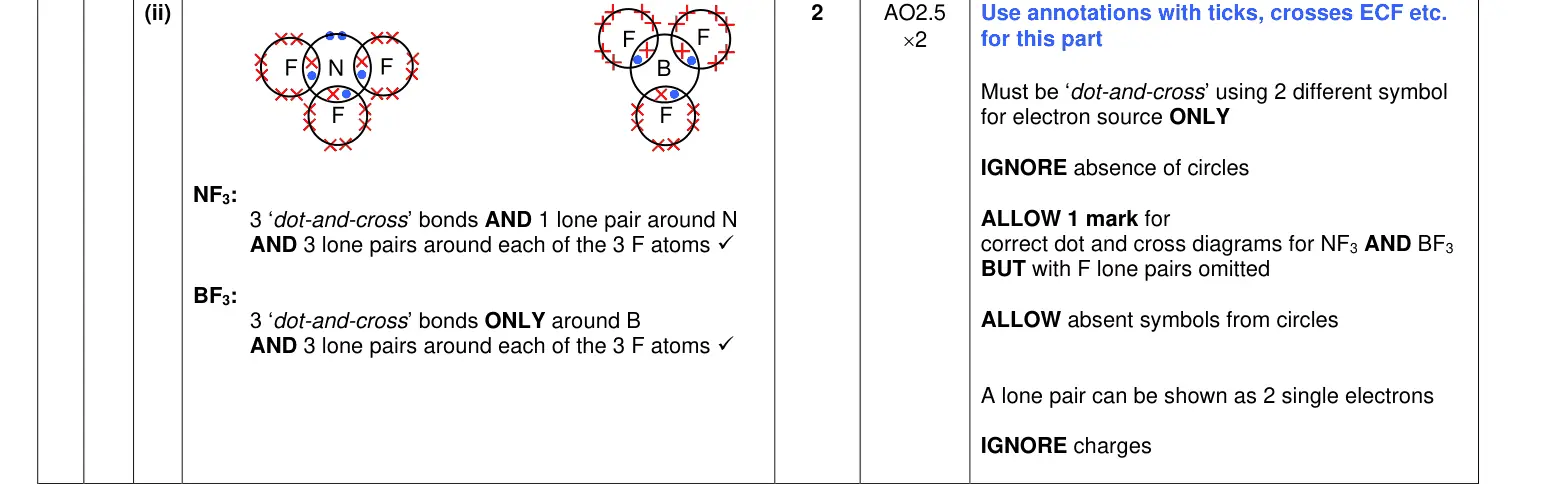
The ‘dot-and-cross’ diagrams were usually correct. Errors were commonly the result of missing a lone pair of electrons from one or more fluorine atoms. BF3 was the more challenging diagram suggesting that some candidates were unfamiliar with molecules with less than an octet in their outer shell. Some candidates used two electrons from one of the fluorine atoms to show a double bond around the central B atom to complete the octet.
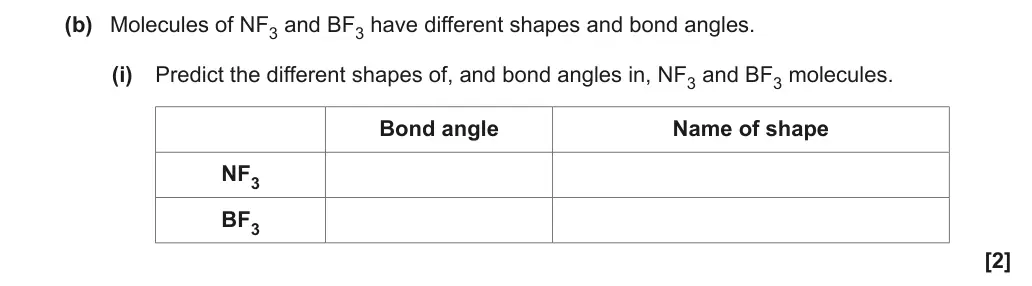
This bond angles and shapes rewarded the well-prepared candidates, with many being given both available marks. The commonest error was NH3 shown with a tetrahedral shape and a bond angle of 109.5º. This part discriminated very well.
Skills: M4.1 Use angles and shapes in regular 2-D and 3-D structures
Most students had the right idea here, but some lacked the detail for the marks. Some discussed repulsion in general terms, without referring the number of electron pairs. This question discriminated very well.
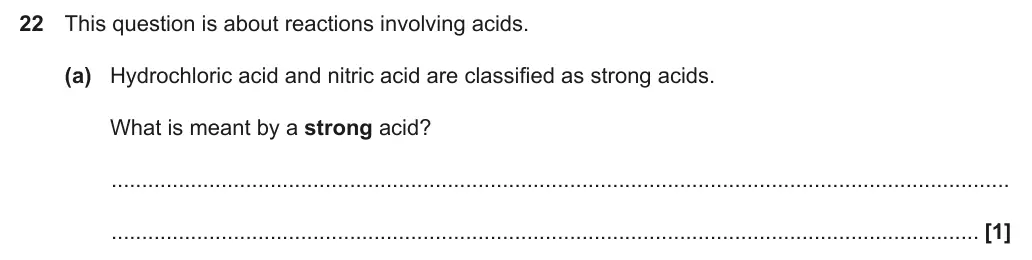
Most candidates knew that a strong acid completely dissociates. Only the lower-attaining candidates responded in terms of a low pH.

This question required candidates to recognise the reaction as being ‘acid–base’ and to interpret a formula from a name containing a Roman numeral. Candidates identifying the formula of copper(II) oxide as CuO were normally able to complete the equation. A reasonably large number identified the copper compounds as CuO2 and CuCl. Overall, most candidates produced a correct equation.
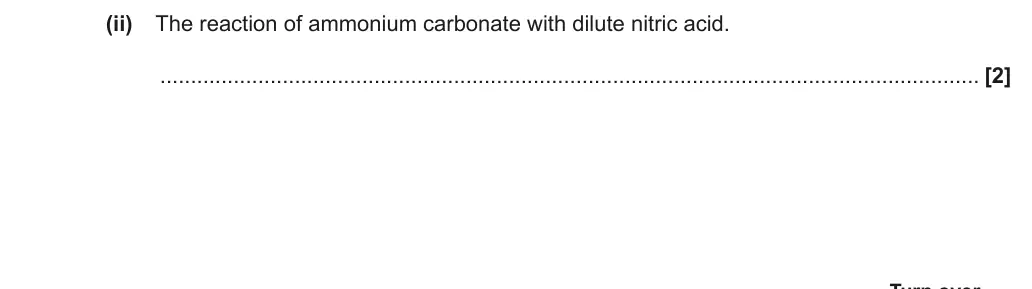
This item was much more demanding than the equation in 22(b)(i) and was often answered incorrectly. Most were unable to work out the formula of the two ammonium compounds, with NH3 often shown instead of NH4. A mark was available for 4 of the 5 formulae being correct but comparatively few were able to construct the correct balanced equation. Candidates are expected to know the formula and charge of ammonium and carbonate ions and the common acids (sulfuric, hydrochloric and nitric) and these are clearly listed in the specification.
Skills: M0.2 Use ratios, fractions and percentages
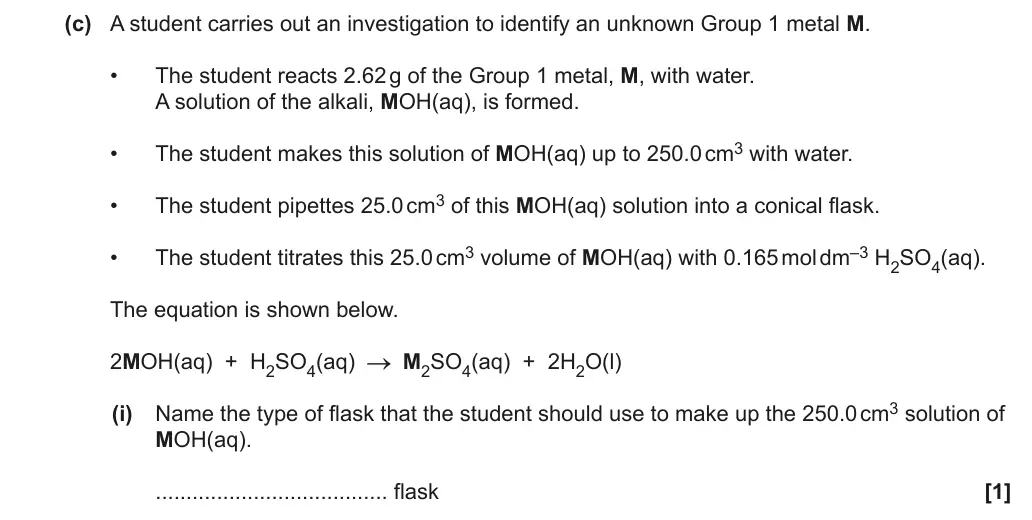
Most candidates recognised that a volumetric flask is used to accurately prepare volumes of solutions. A common error was a conical flask, perhaps by not reading the information clearly and giving the name of the flask used in the titration itself.
Skills: PAG2 Acid–base titration
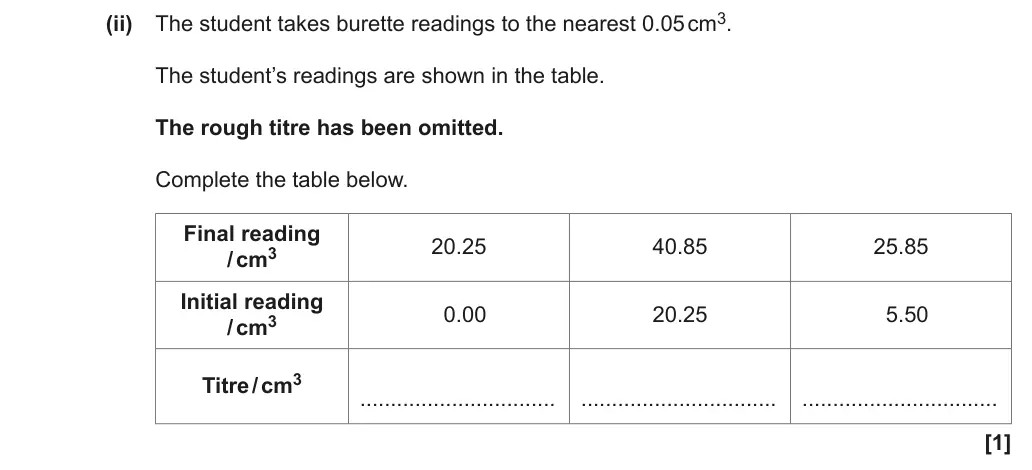
Most candidates were able to work out these simple subtractions. Candidates were told that the titration readings were read to the nearest 0.05 cm3, requiring titres to be shown to two decimal places, which includes a ‘0’. The middle titre is therefore 20.60 cm3 and not 20.6 cm3, which continues to be the commonest error seen.
Skills: PAG2 Acid–base titration
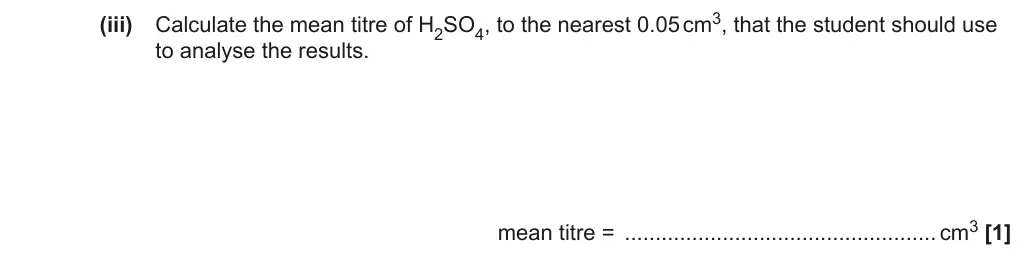
Candidates are expected to use only concordant titres when working out the mean titre and the middle titre of 20.60 cm3 should be rejected. Most candidates did this to produce 20.30 cm3 as their mean titre. Predictably, the commonest error was to use all three titres to produce the incorrect mean of 20.40 cm3.
Skills: M1.2 Find arithmetic means; PAG2 Acid–base titration
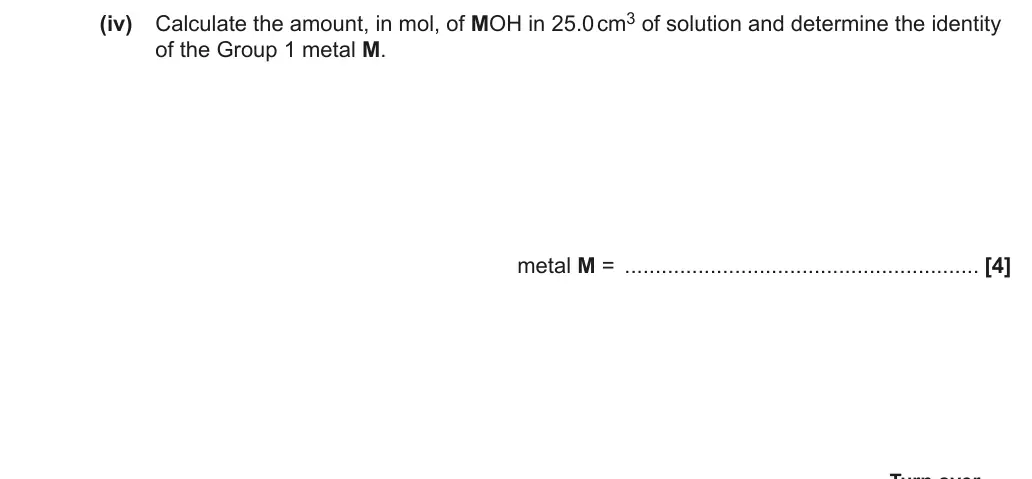
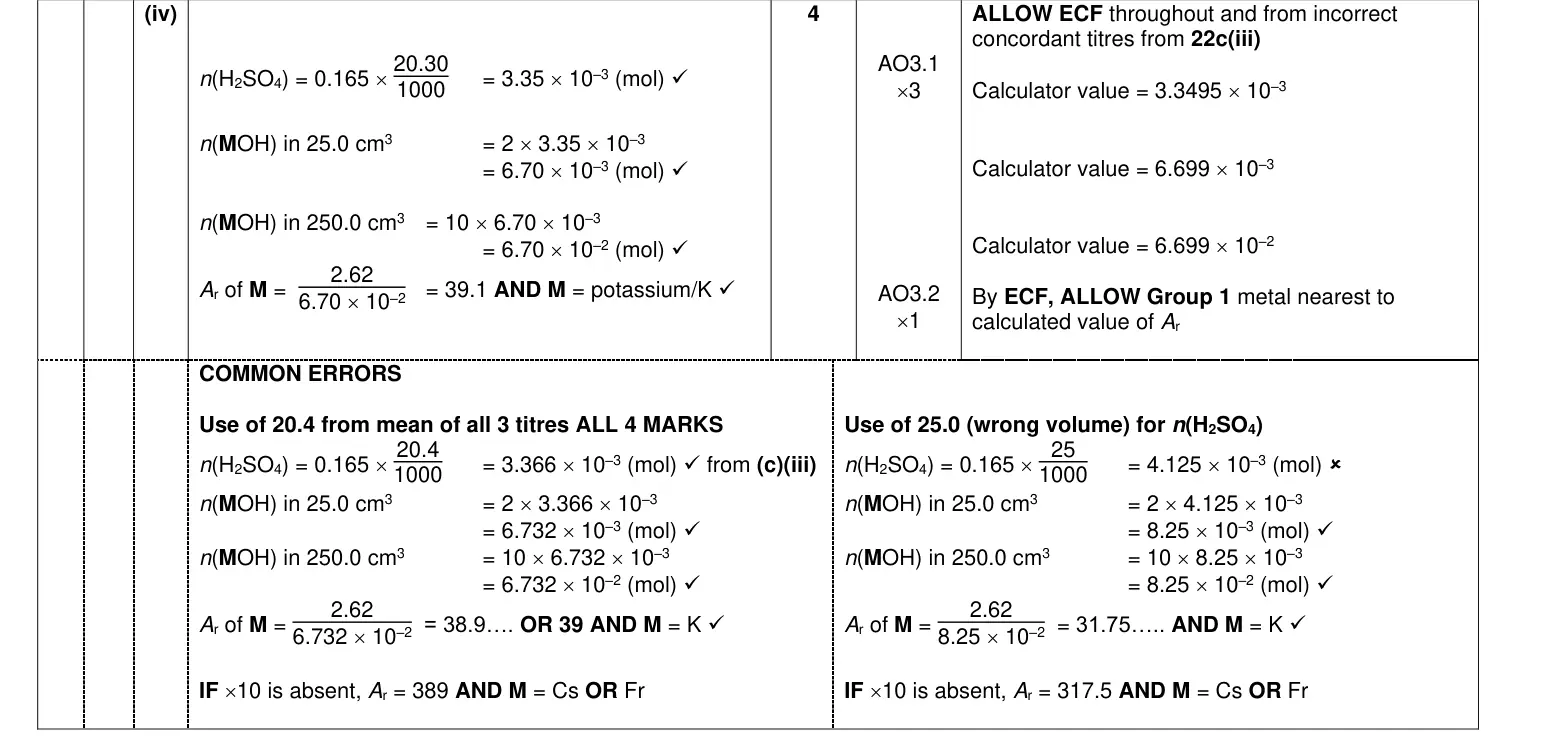
Many candidates followed a well drilled method to identify the unknown metal M as potassium: • Moles of H2SO4 in the mean titre • Moles of KOH in 25 cm3 • Scaling 10 for moles of KOH in 250 cm3 • Molar mass of the metal as 39.11 and identified as K. A number of candidates omitted the scaling stage to obtain a molar mass of 391.1. By ECF, the ‘correct’ identity would be caesium or francium. Some candidates then ‘fiddled’ their response, dividing by 10 to ‘identify’ the metal as K. This incorrect approach was not credited. A common error, illustrated in Exemplar 2, was for candidates to calculate 39.11 but to think that this was the mass of MOH and not M. They then subtracted 17 (for OH) from 39.11 to obtain a response of 22.11 and identified M as sodium instead of potassium. This error probably stems from candidates either not reading the question closely enough or confusion about the mole concept.
Skills: M0.2 Use ratios, fractions and percentages; M2.3 Substitute numerical values into algebraic equations using appropriate units for physical quantities; PAG2 Acid–base titration
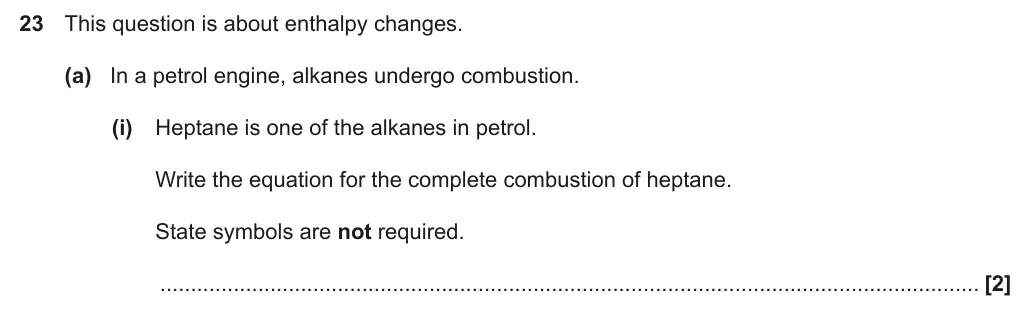
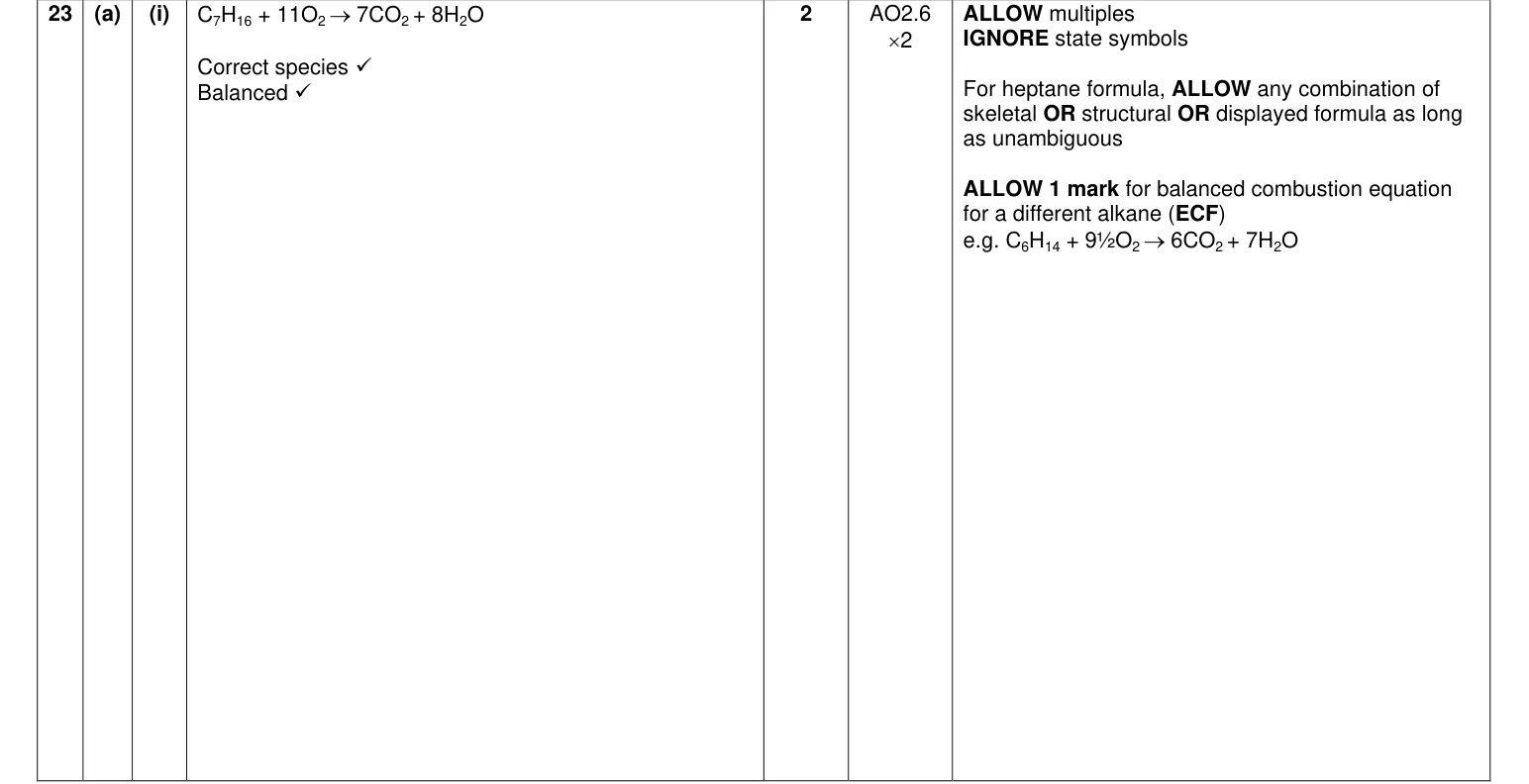
Most candidates were able to construct a balanced equation for the combustion of heptane. Most were aware that CO2 and H2O would be the products although some generated CO, C6H12 or unusual compounds such as C7H14O. The hardest part was the formula of heptane itself with use of hexane instead being a common error; candidates who made this error were given 1 mark, provided that their equation was balanced.
Skills: M0.2 Use ratios, fractions and percentages
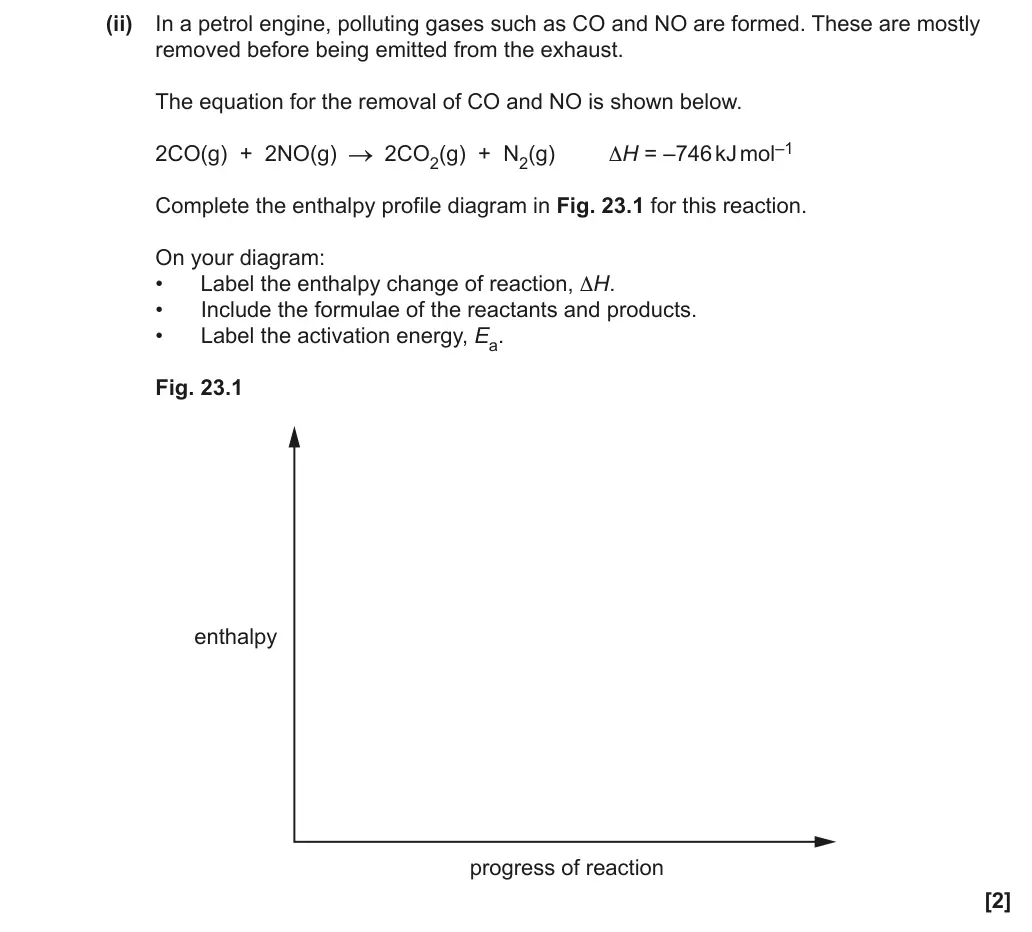
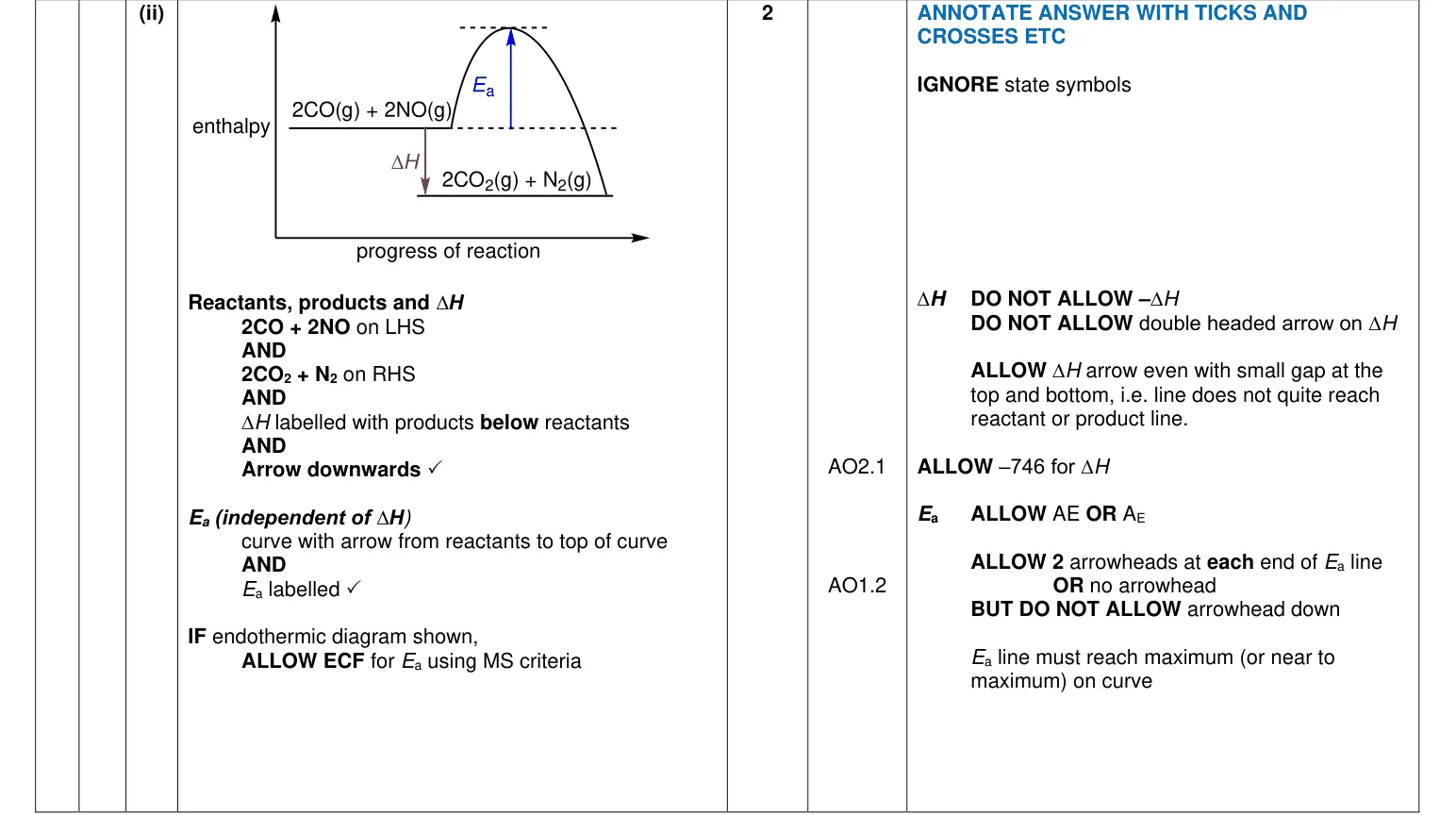
Most candidates obtained 1 or 2 of the available marks, the commonest errors being use of a double- headed arrow for ∆H or a –∆H label. Some candidates showed endothermic profiles and these could create issues with positioning of the ∆H and Ea arrows. Generally, positioning of ∆H and Ea arrows was imprecise and candidates are advised to start and finish the positions of their arrows accurately. The mark scheme did allow for some leeway but positioning of arrows could generally be improved.
Skills: M3.1 Translate information between graphical, numerical and algebraic forms
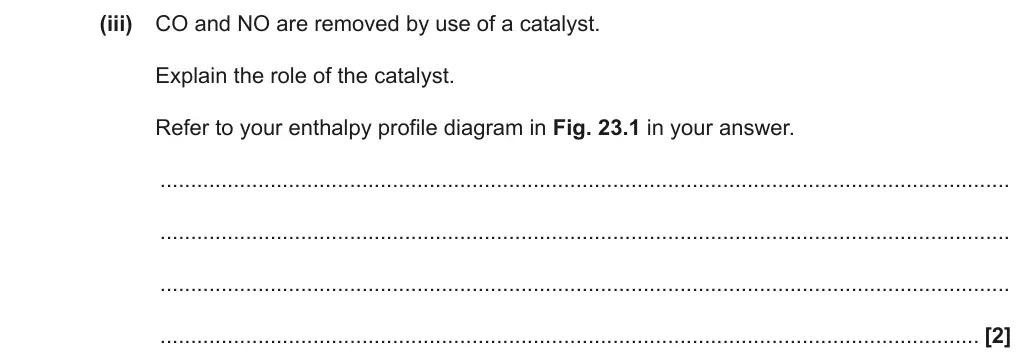
Almost all candidates knew that a catalyst lowered activation energy and most were aware that an alternative pathway was made possible by a catalyst.
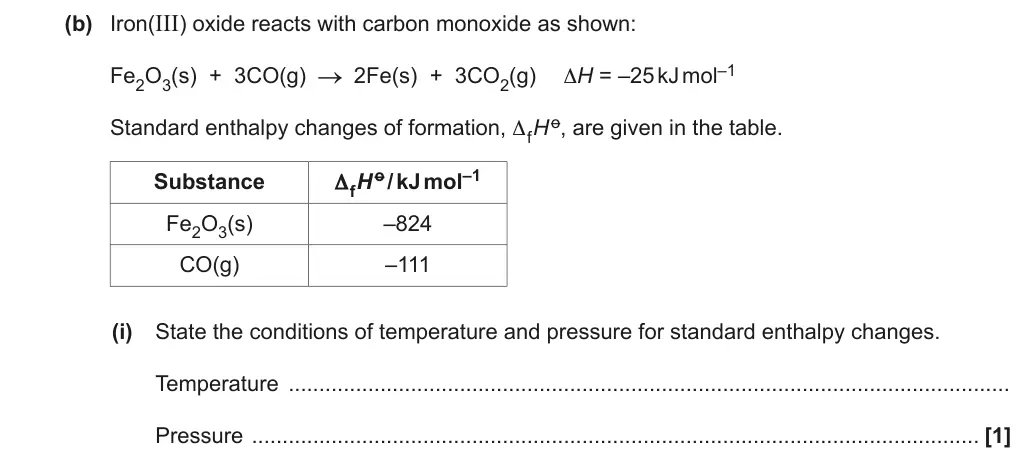
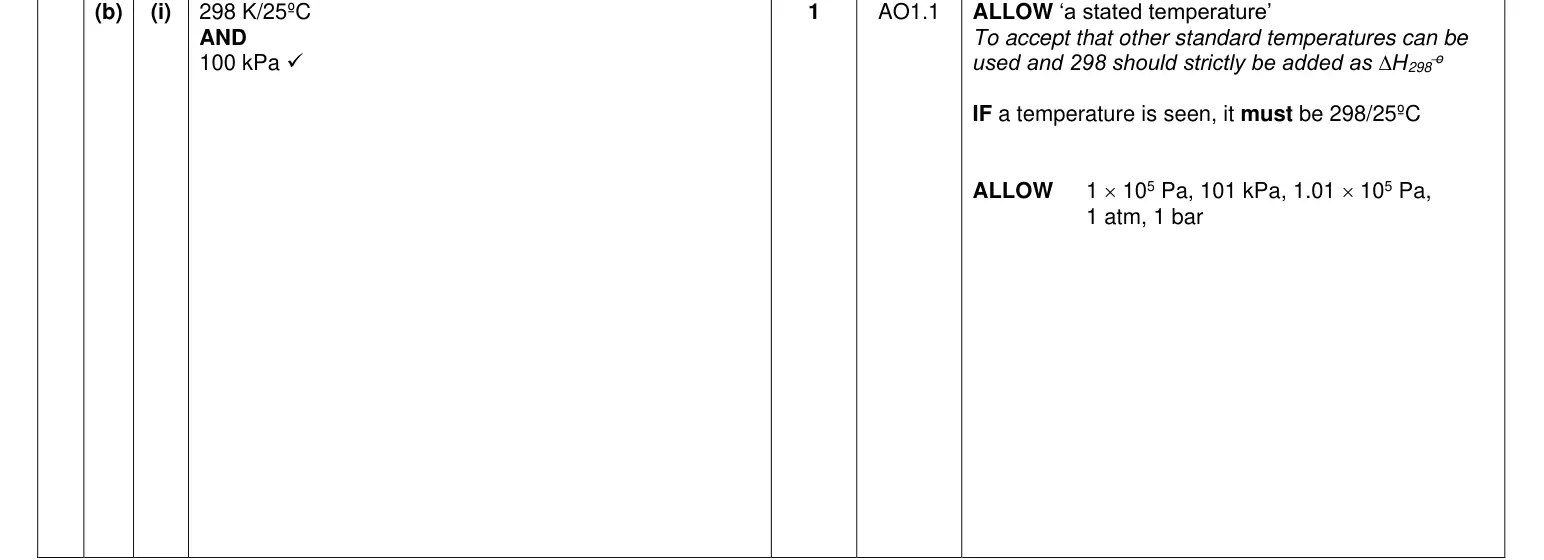
Only just over a half of candidates obtained this mark with one of the conditions being incorrect, usually as 273 K or 100 Pa. It is important that candidates learn these standard conditions.
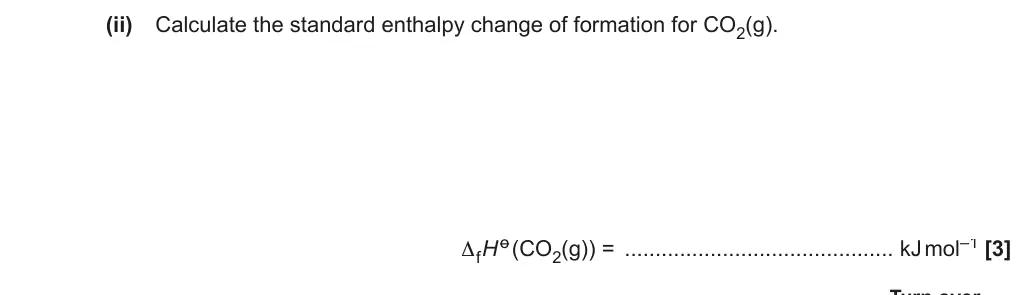
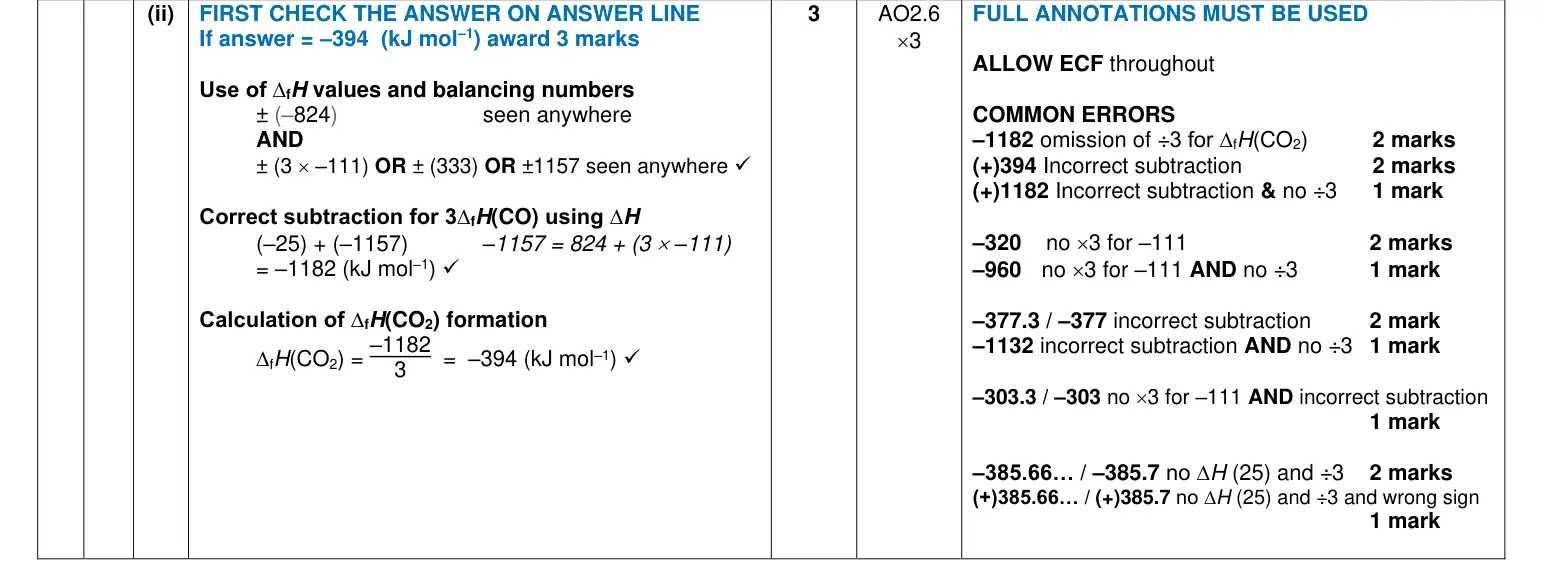
This question discriminated extremely well with many obtaining the correct enthalpy change of –394 kJ mol–1 for 3 marks. There were 3 stages to the calculating: • Use of –824 and 3 –111 to obtain –1157 • Correct incorporation of –25 to obtain –1182 • Division by 3 for 1 mole of CO2 to obtain –394 kJ mol–1 Weak candidates usually gained the first marking point but did not get any further. Incorrect signs were common as was not dividing by 3 for the final marking point. The mark scheme allowed ECF to be applied, provided that there was some correct method in the response. Unfortunately, many responses were very difficult to follow, often shown as numbers almost placed at random in the answer space. This makes it very difficult to identify any logic and to apply ECF. Exemplar 3 serves as a model, clear response, showing what is possible.
Skills: M2.2 Change the subject of an equation; M2.3 Substitute numerical values into algebraic equations using appropriate units for physical quantities; M2.4 Solve algebraic equations
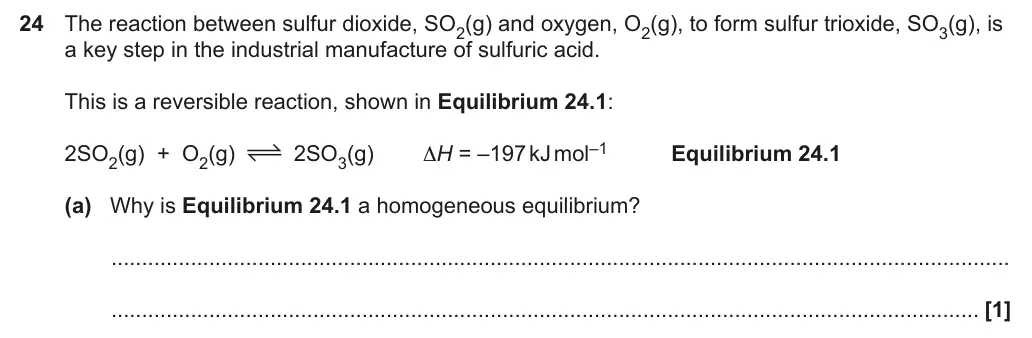
Only about half the candidates obtained this mark suggesting that this term had not been recalled by many. A common error stated that the catalyst and reactants were in the same state. Responses from lower-attaining candidates sometimes had the appearance of guesses.
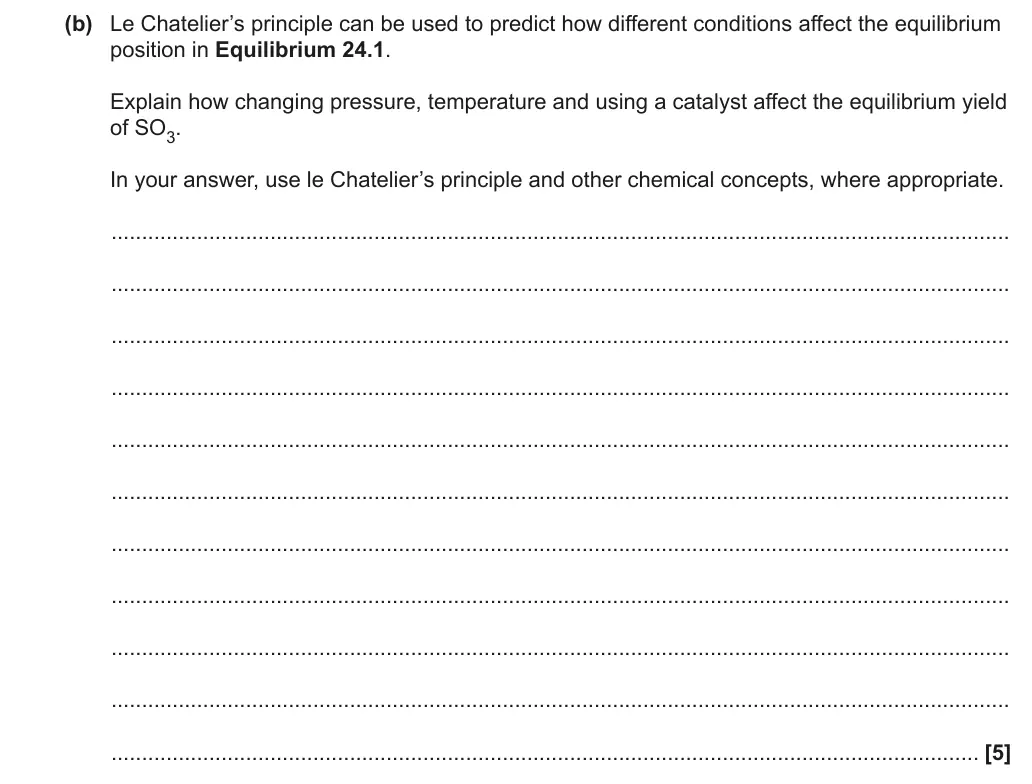
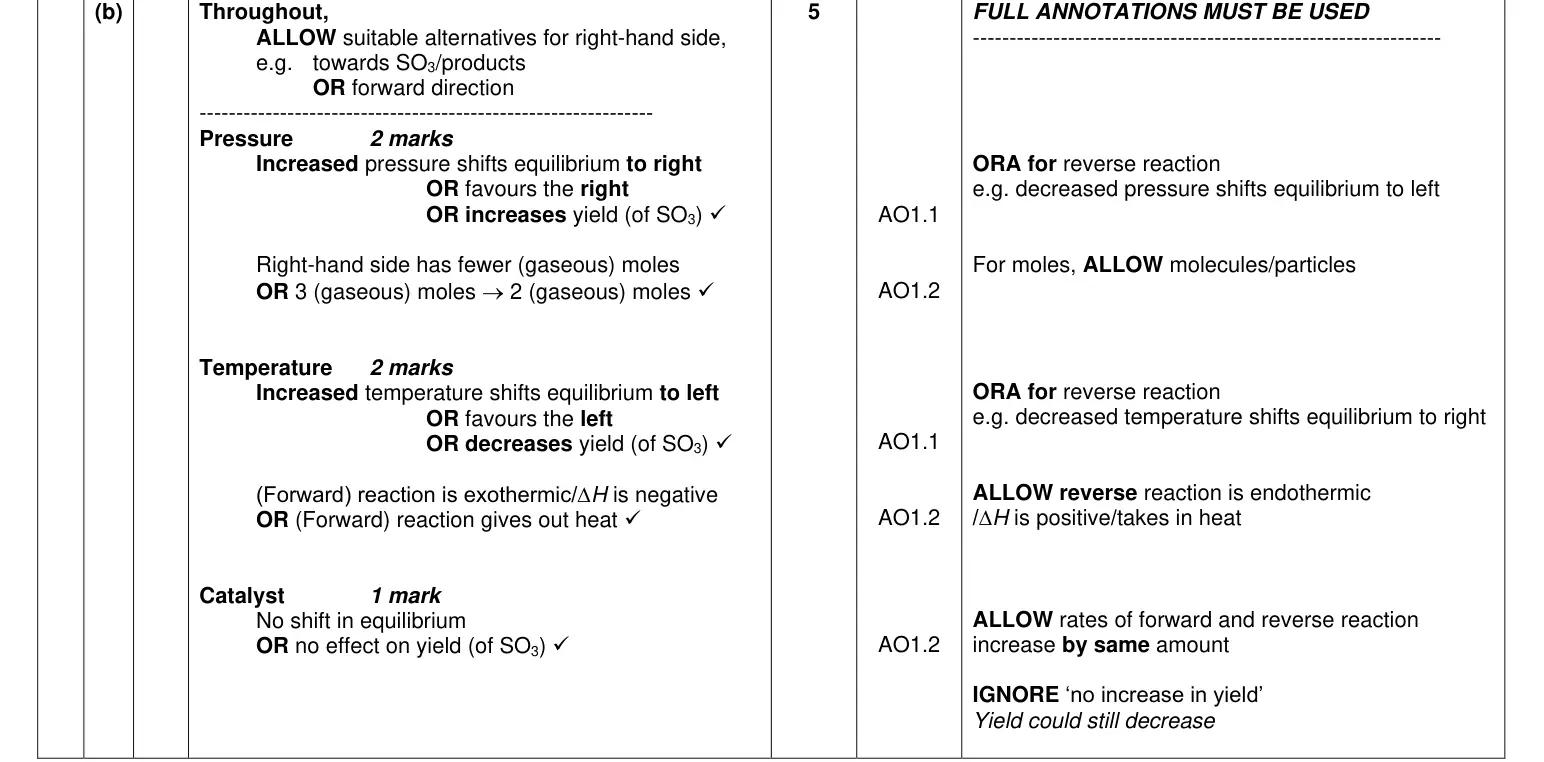
This long-answer question was approached very well and there were some excellent and concise answers. Only the less successful responses did not identify the main trends. Marks were often lost for responses in general terms, rather than related to the scenario in the question. For example, some candidates stated that the equilibrium would shift in the direction with fewer moles, without stating what that direction was for this equilibrium. Some candidates contradicted themselves due to a lack of fully understanding how Le Chatelier’s Principle should be applied. It was also common to see lengthy responses in which candidates discussed the effect of rate and compromise (not asked for in this question) and then confused equilibrium yield with overall yield.
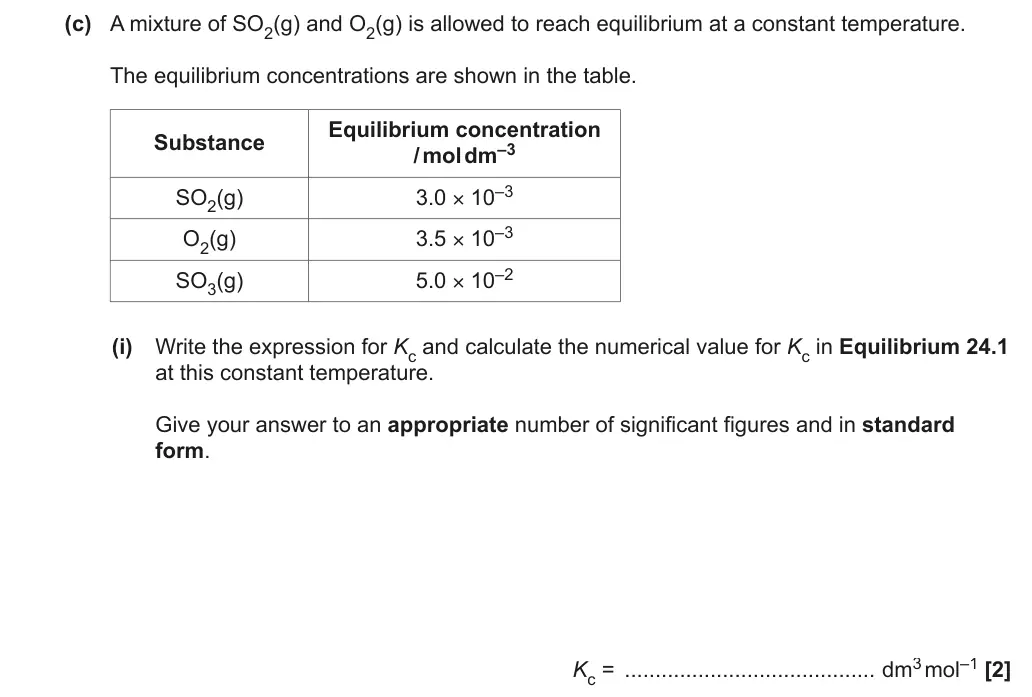
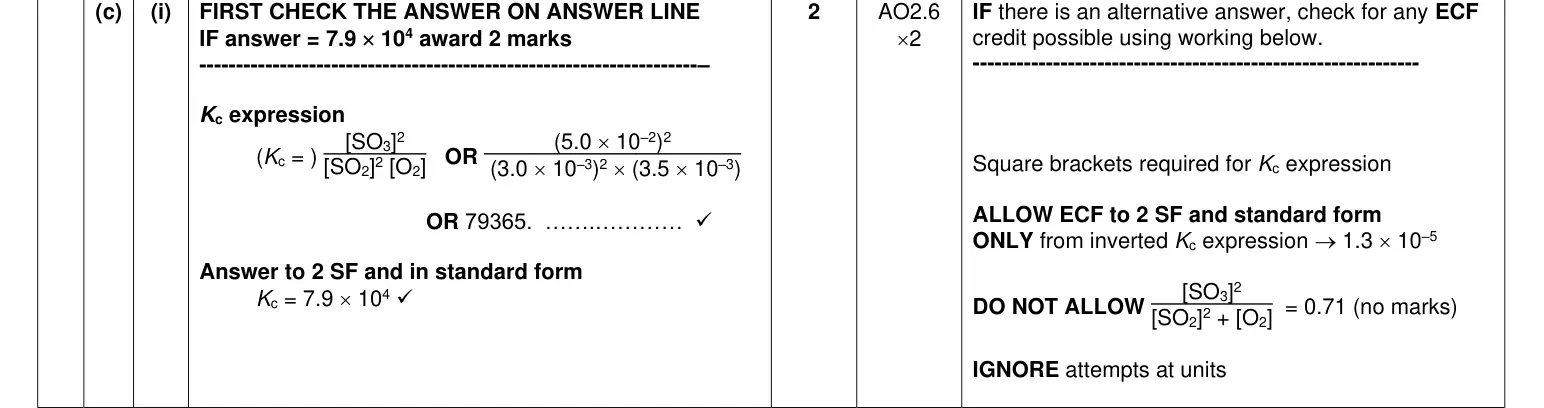
The Kc expression was written well by many inverted the expression or added rather than multiplying the values. Indices were usually included. Many candidates gave responses to more than 2 significant figures (2SF) and some did not give the response in standard form. Candidates should be made aware that the term in the question of ‘most appropriate’ means that the final response should be shown to the least number of significant figures in the supplied data. In this scenario, all values were provided to 2SF and so the final response should also be expressed to 2SF.
Skills: M0.1 Recognise and use expressions in decimal and ordinary form; M1.1 Use an appropriate number of significant figures; M2.3 Substitute numerical values into algebraic equations using appropriate units for physical quantities
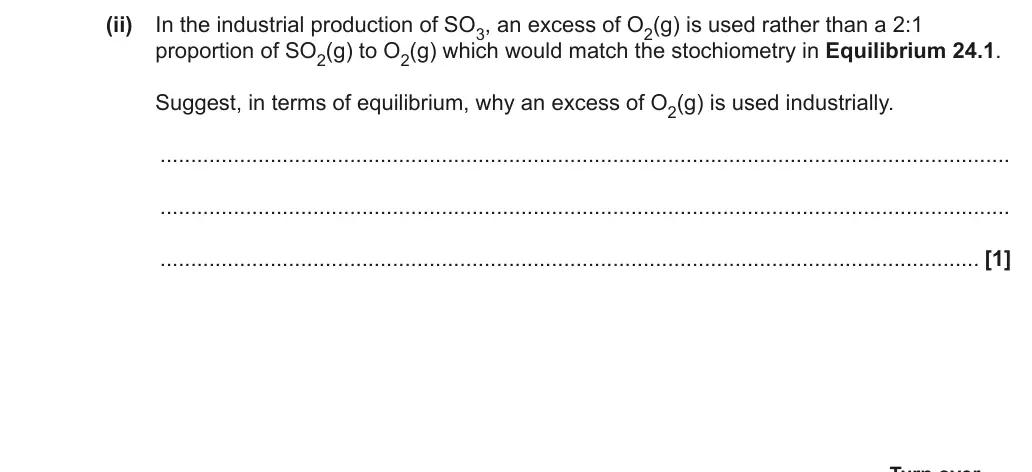
Few candidates successfully answered this difficult application question. Some candidates considered ensuring complete combustion, or not wasting reactants, or various environmental reasons. The question did supply a hint: ‘in terms of equilibrium’ but this was ignored by most candidates. The idea of equilibrium shift to the right was essential.
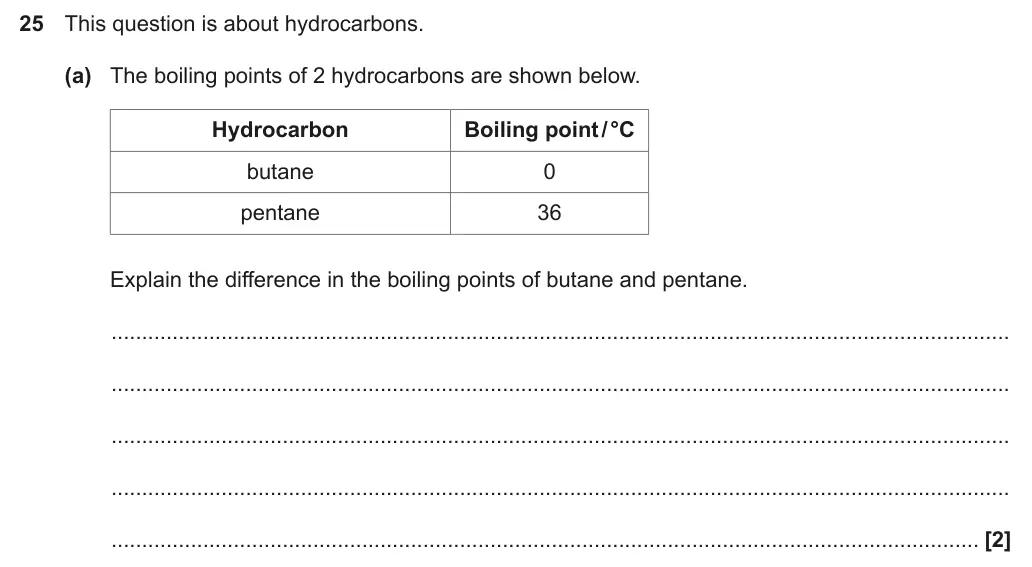
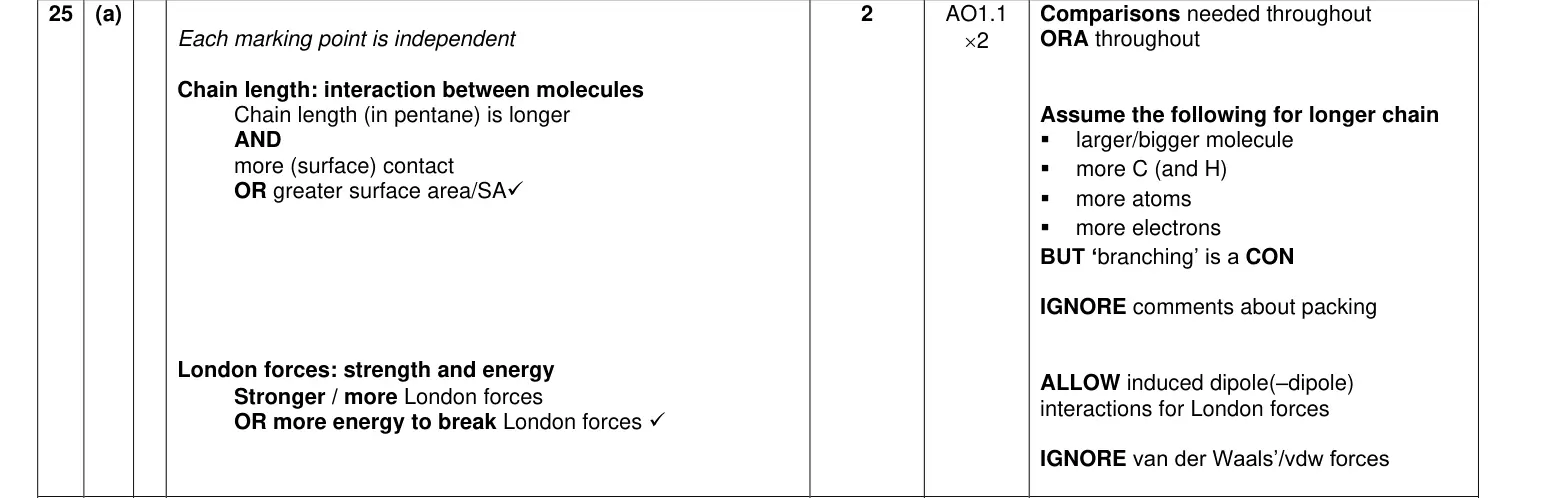
Most candidates were given 1 or 2 marks, with some omitting the idea of surface area or surface contact. Most candidates identified London forces or induced dipole interactions as the relevant intermolecular force. A few candidates gave a general comment in terms of ‘intermolecular’ forces without specifying the type of intermolecular forces. There has been a general improvement in candidate responses to this type of question with fewer candidates than in previous exams suggesting the breaking of hydrogen bonds or covalent bonds.
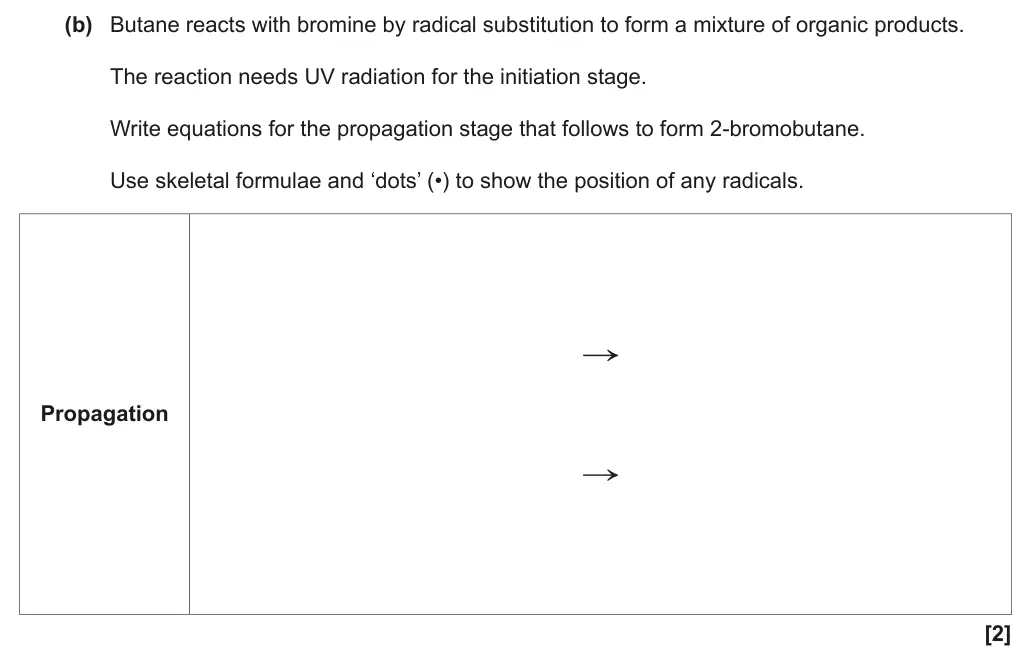
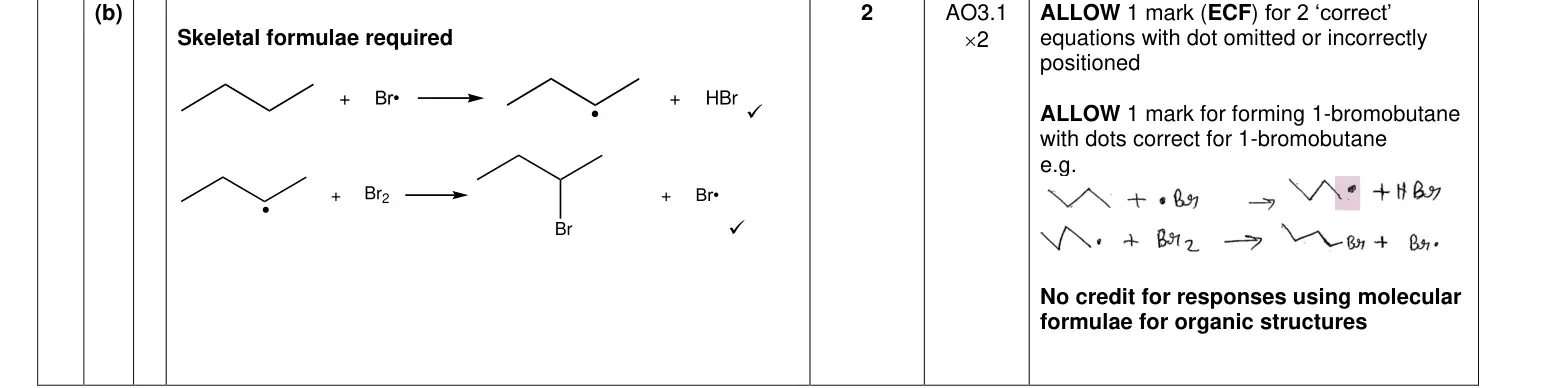
This question discriminated very well at the top end of the ability range, but many ignored the instruction to use skeletal formula and obtained no marks as a result. Of those that did use skeletal formula, many placed the dot on the wrong carbon atom or produced 1- brombutane, rather than 2-bromobutane, stated in the question. A mark was still available by ECF for misplaced or absent dots or formation of 1-brombutane with dots. This question was aimed to be demanding and so it proved to be.
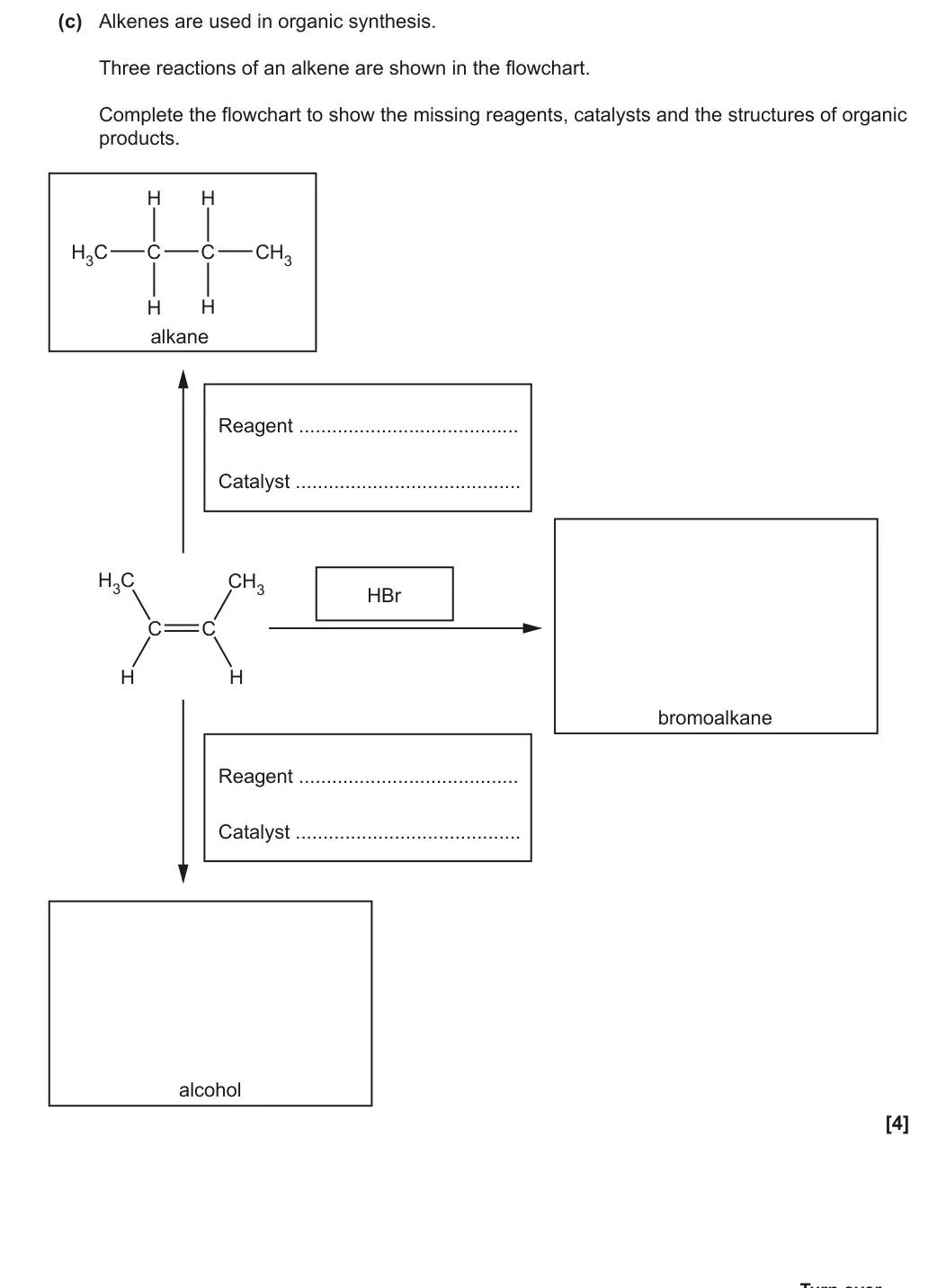
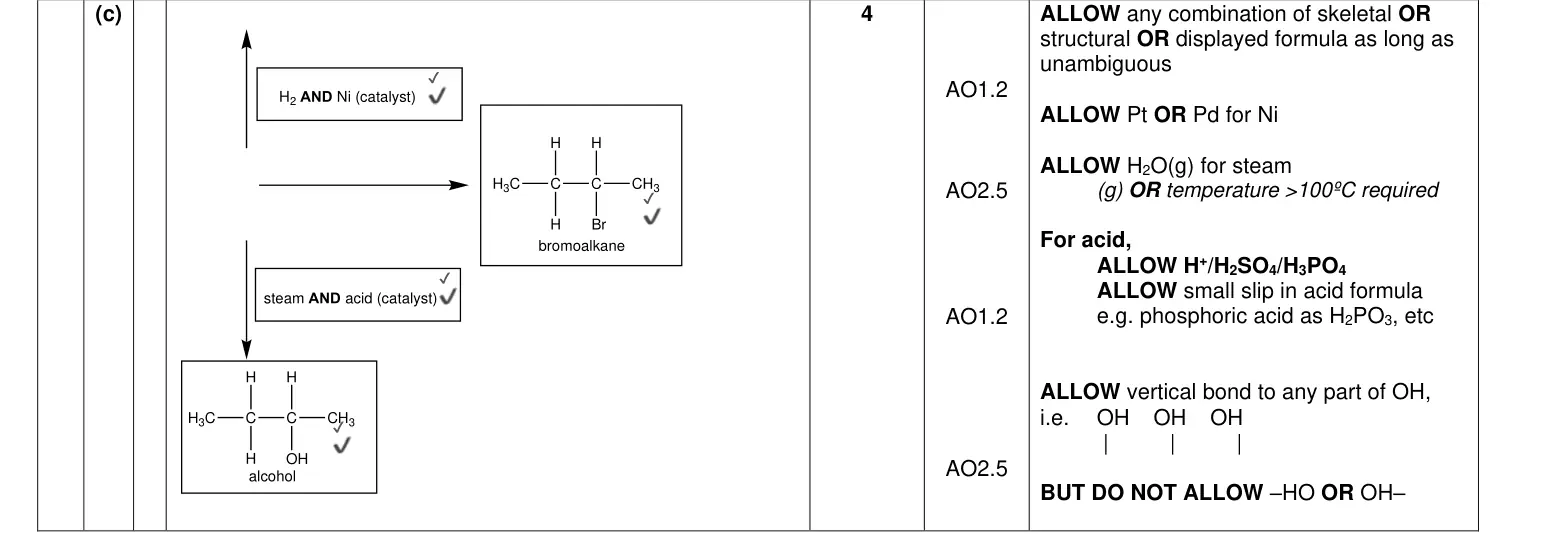
Most candidates drew correct structures for the bromoalkane and alcohol molecules, although some added Br and/or OH groups on the terminal carbon atoms. Some added two Br or OH groups. The reagents and catalysts caused the main problems, with a wide variety of incorrect responses. For the hydrogenation step, nickel was often omitted and H2SO4 or K2Cr2O7 were common incorrect reagents. For the hydration step, water/H2O was often seen as the reagent rather than steam or H2O(g). It was also common to see water stated as the reagent, without a (g) state symbol to infer that it is steam. Overall, this question discriminated very well with most candidates gaining at least 2 of the available 4 marks.
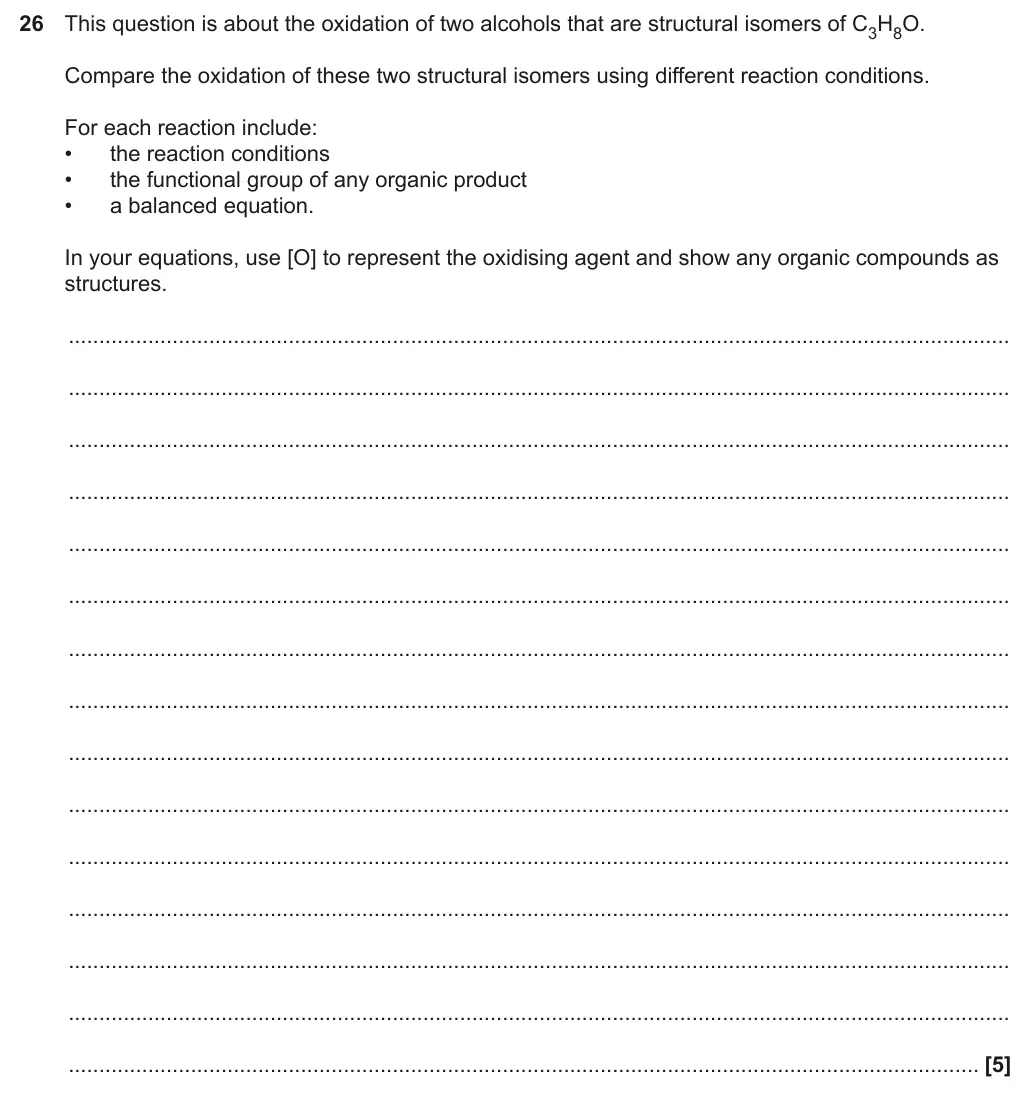
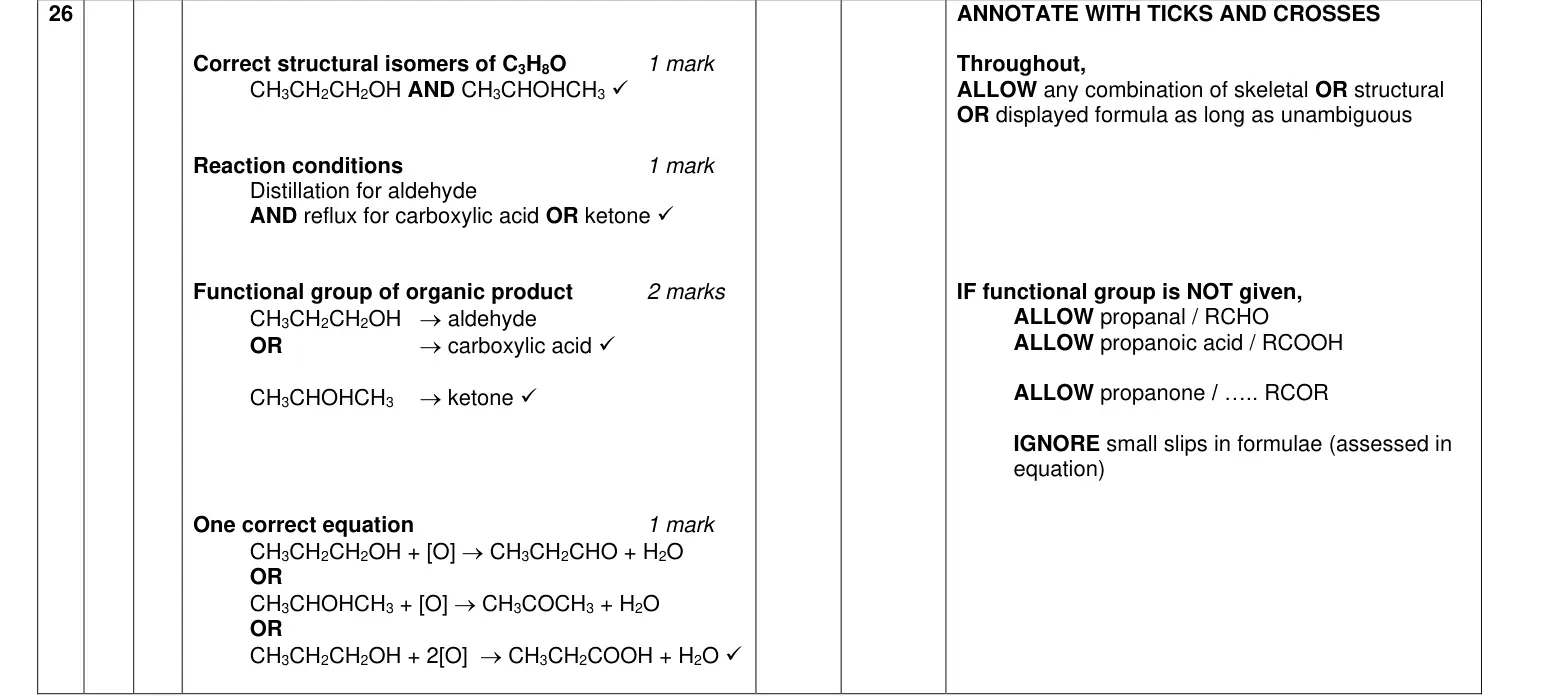
There were some excellent responses to this question which discriminated extremely well. Unfortunately, there were a significant number of incorrect responses and some less successful candidates had clearly struggled to recall and apply this important material. The identification of the isomers was usually correct, as was the identification of the oxidation products from the primary and secondary alcohols, and the conditions required to produce the organic products. The equation proved to be the hardest requirement with the H2O by-product often being omitted or H2 shown instead. A general point applies to organic structures. Some candidates did not show the structures of the isomers and attempted this question using the molecular formula of C3H8O supplied in the question for both alcohol isomers and no structural formulae. It was then impossible to know which isomer was being reacted and this could cost the candidate a significant number of marks. It is essential in organic chemistry to use unambiguous formulae which can be any combination of skeletal, structural or displayed. Unless a question specifies that a molecular formula is required, candidates should assume that an unambiguous formula is required.
Skills: PAG5 Synthesis of an organic liquid; PAG7 Qualitative analysis of organic functional groups
Want a paper marked and gone through with you? Message us.