Answer
B
Mark scheme

Examiner's comment
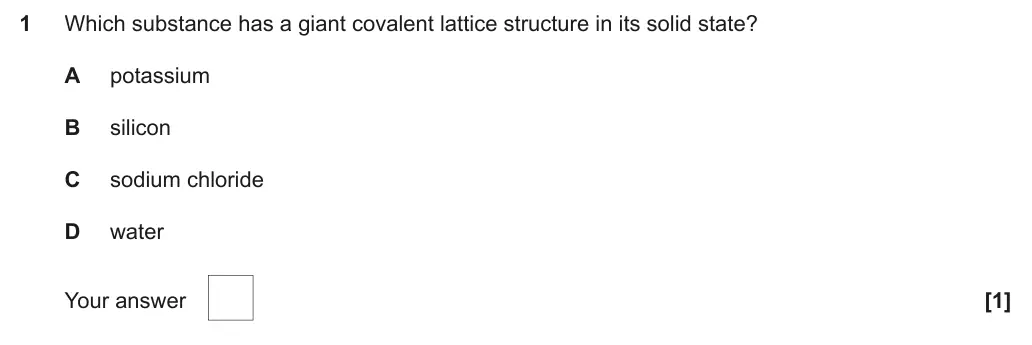
Most candidates selected B (silicon) as the correct response. A and C featured more than D as the incorrect choice but there seemed to be no pattern.
70 marks · 39 question parts · Paper, mark scheme and report on OCR's site · Have OCR's Data Sheet beside you
B
Most candidates selected B (silicon) as the correct response. A and C featured more than D as the incorrect choice but there seemed to be no pattern.
A
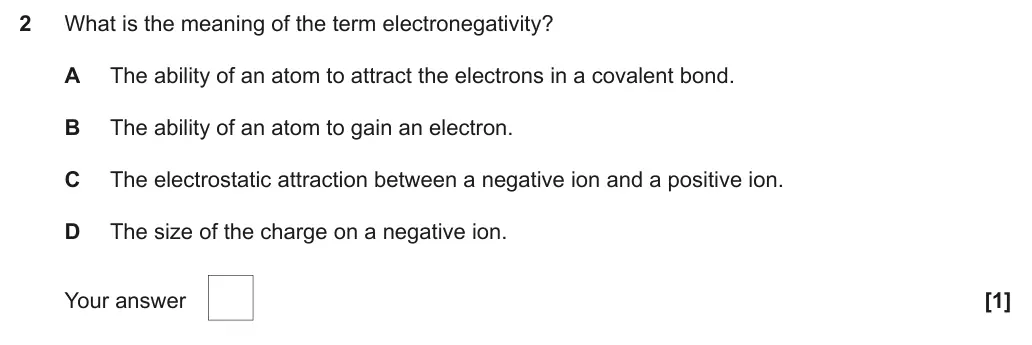
Most candidates knew the concept of electronegativity well and selected A as the correct response.
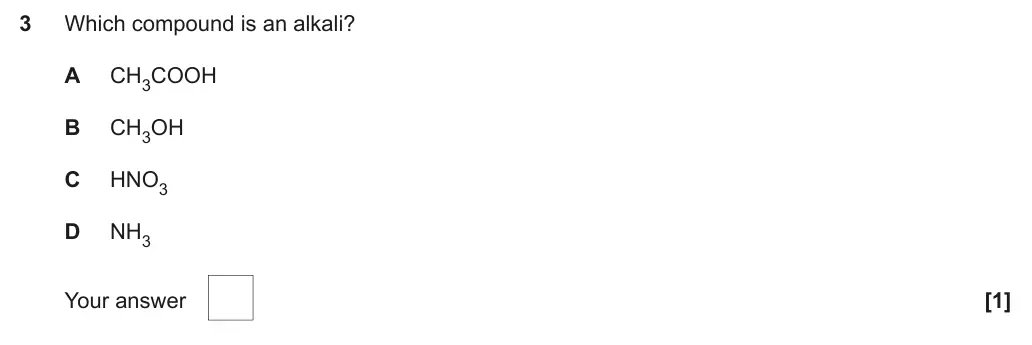
D
Candidates were less successful with this question than Questions 1 and 2, and it appeared as if many candidates did not recognise that ammonia was an alkali. Most candidates rejected A but a significant number selected C, suggesting that they did not recognise HNO3 as an acid or confused HNO3 with NH3.
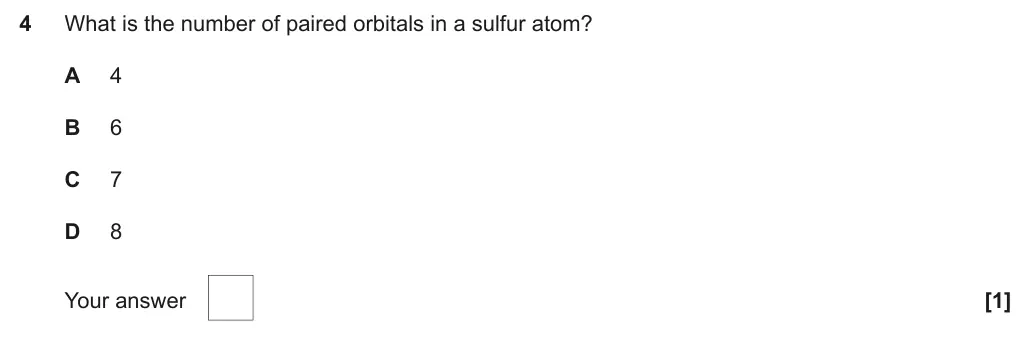
C
This question was answered reasonably well. From the annotations on scripts many candidates wrote out the electron configuration of a sulfur atom. The successful candidates used electrons in a box notation so that they could visually see, and count, the paired orbitals. This is an excellent strategy to use in any similar questions.
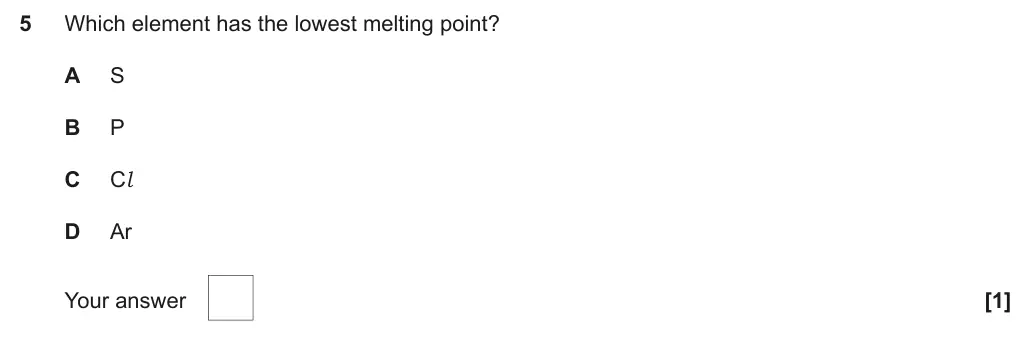
D
Candidates found this question difficult. Although argon looked to be the obvious choice, many candidates selected phosphorus (B) or chlorine (C). Candidate annotations alongside the question included atomic number and electron configurations suggesting that many find it difficult to link trends in melting point to the correct chemical concepts.
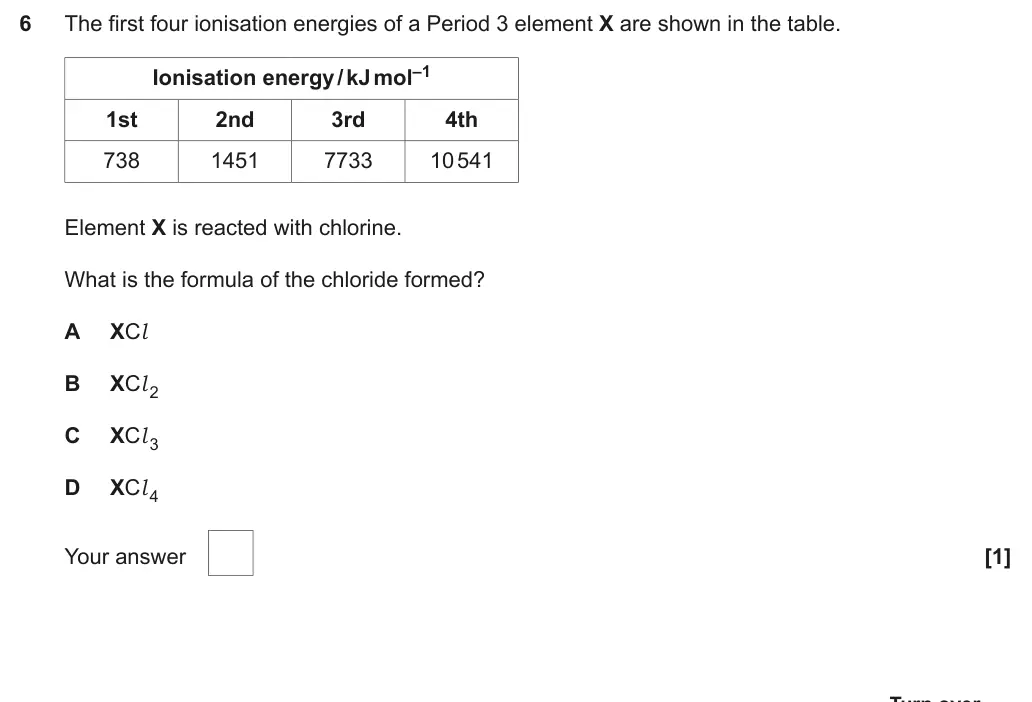
B
Although two steps were required to solve this problem, most candidates answered this question correctly. Candidate annotations showed that many identified element X as being in Group 2 and even as magnesium. The correct formula of XCl2 (B) then usually followed.
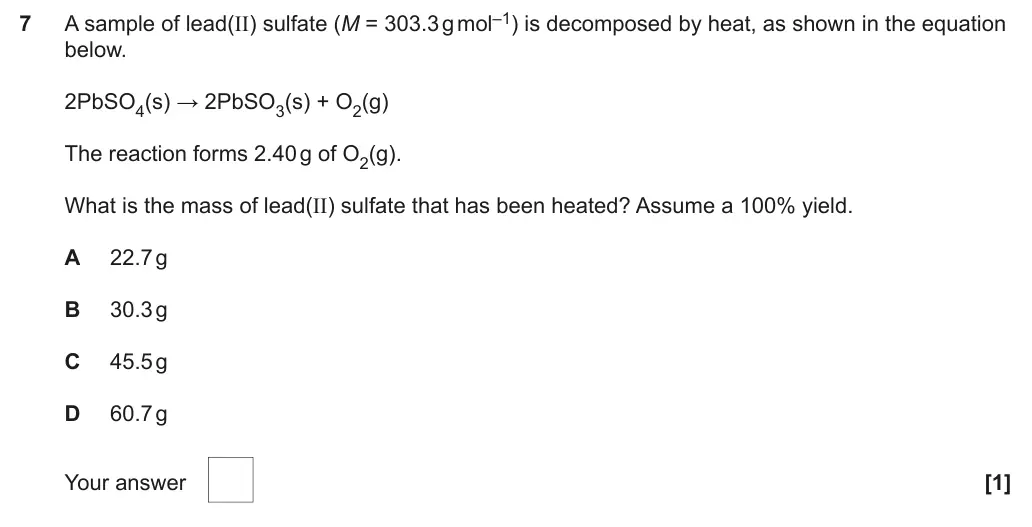
C
Candidates often appear to find quantitative questions such as this one easier than questions involving interpretation of textual information. Most candidates selected the correct response and most scripts contained working including molar proportions alongside the question. This is an excellent strategy.
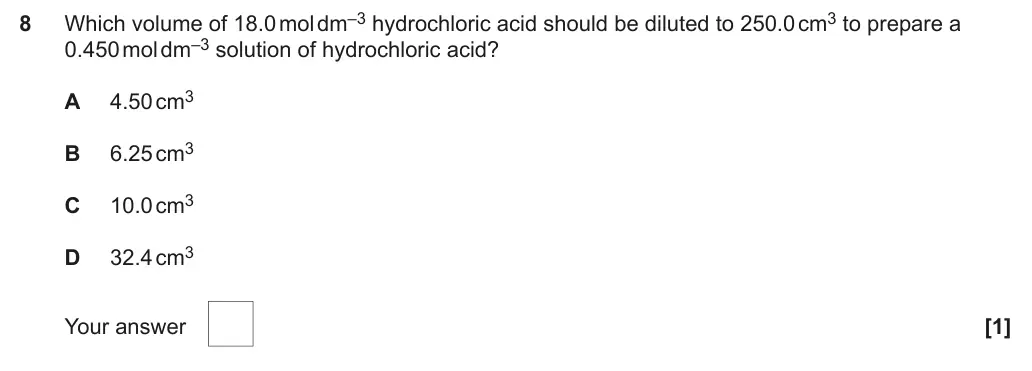
B
Candidates found this calculation more difficult than Question 7. From the annotations, most showed working using the relationship between moles, concentration and volume. Options A (18 250/1000) and C (18 250/1000 ÷ 0.450) were the main distractors.
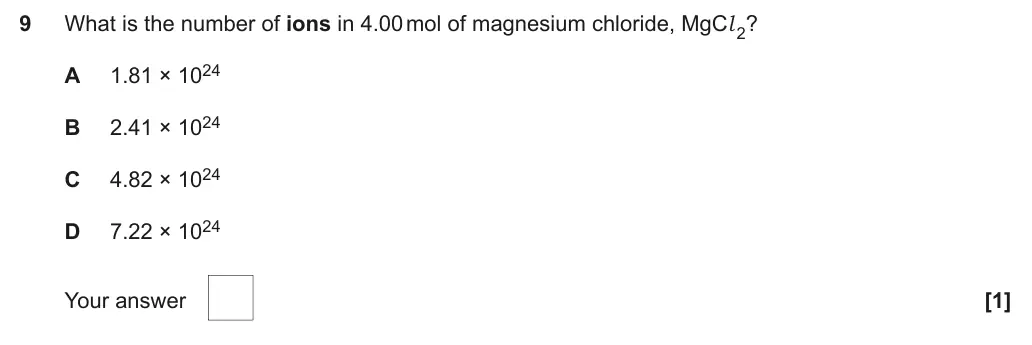
D
Candidates found this question very difficult. B was the main distractor, obtained by multiplying the number of moles (4) by the Avogadro constant. Only the highest-attaining candidates realised that the question asked for the number of ions and multiplied the answer to B by 3 to obtain option D. The lesson here is to consider carefully any bold text in the question (ions).
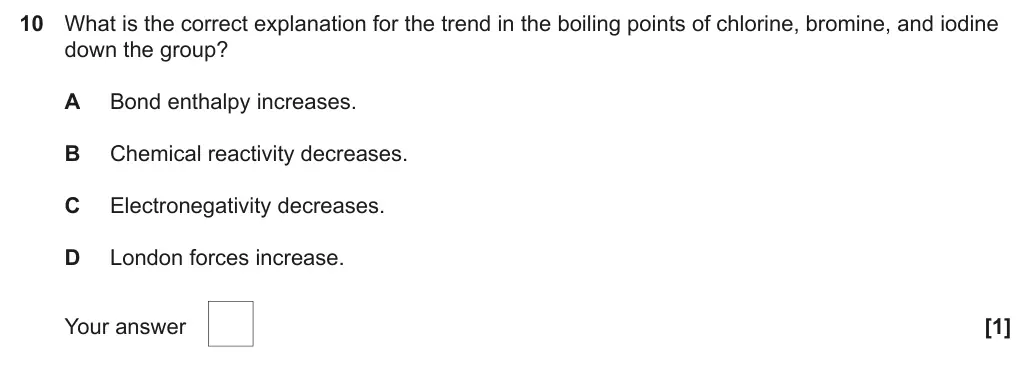
D
This question was direct recall of specification content and most candidates selected D as the correct answer.
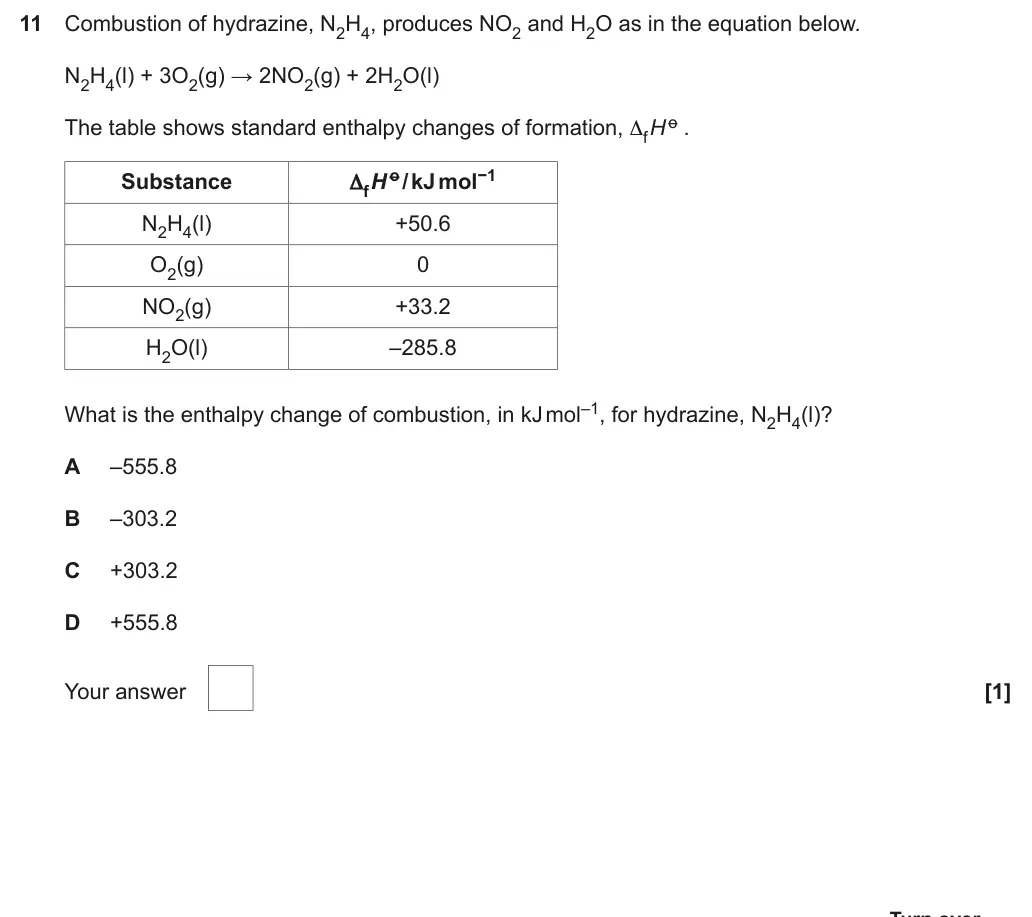
A
Candidates answered this question reasonably well with most choosing either the correct option A, or the incorrect D (the same numerical value but with the wrong sign). Energy cycles and Hess’ law seemed to be well known with most candidates drawing their cycle by the question. Candidates should take care with the direction of the arrows as these travel in different directions for formation and combustion problems. The incorrect option D was the result of arrows in the wrong direction.
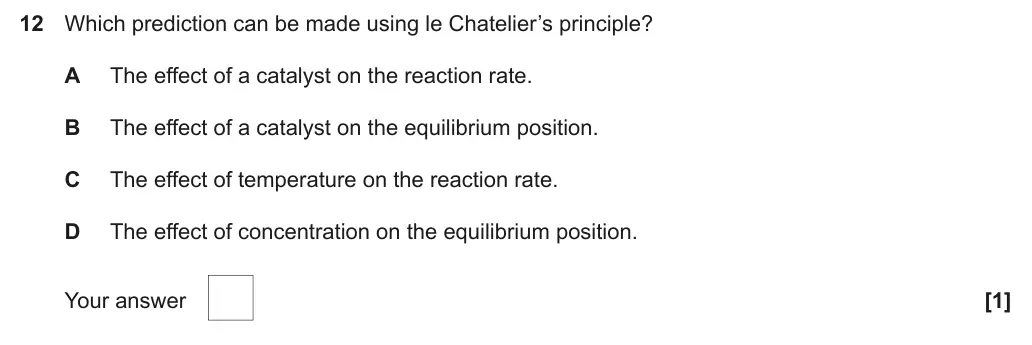
D
Candidates produced a variety of responses with just over half choosing the correct option D. Option C was the main distractor.
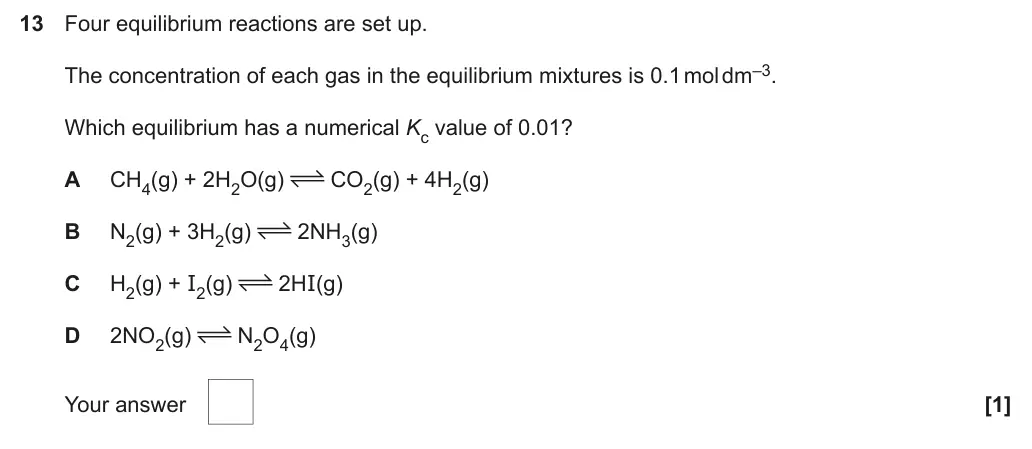
A
This question discriminated very well. Evidence from annotations showed that the successful candidates substituted the 0.1 mol dm–3 concentration into the Kc expression for each equilibrium and calculated Kc by calculator. This method should guarantee the correct answer.
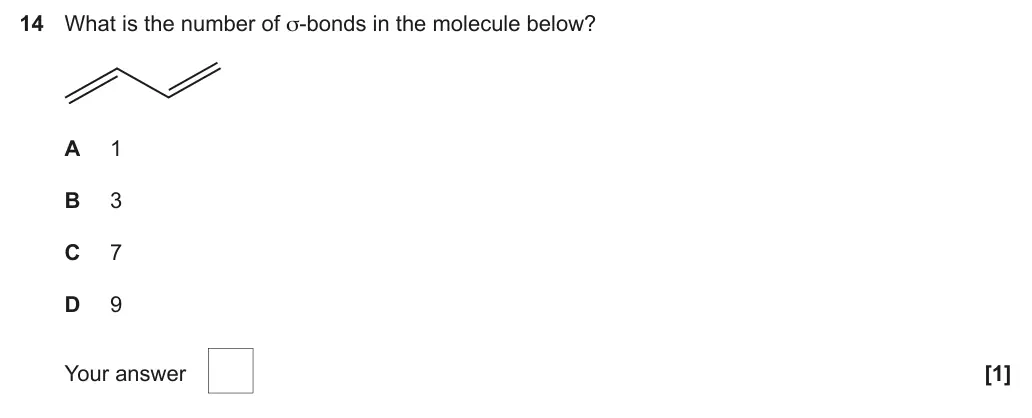
D
Candidates found this question difficult with very many choosing option B rather than the correct option D. Candidates are advised to draw out all bonds displayed when tackling such as question as the answer of B (3) results from considering just the three bonds shown in the skeletal formula and omitting the other 6 C–H bonds.
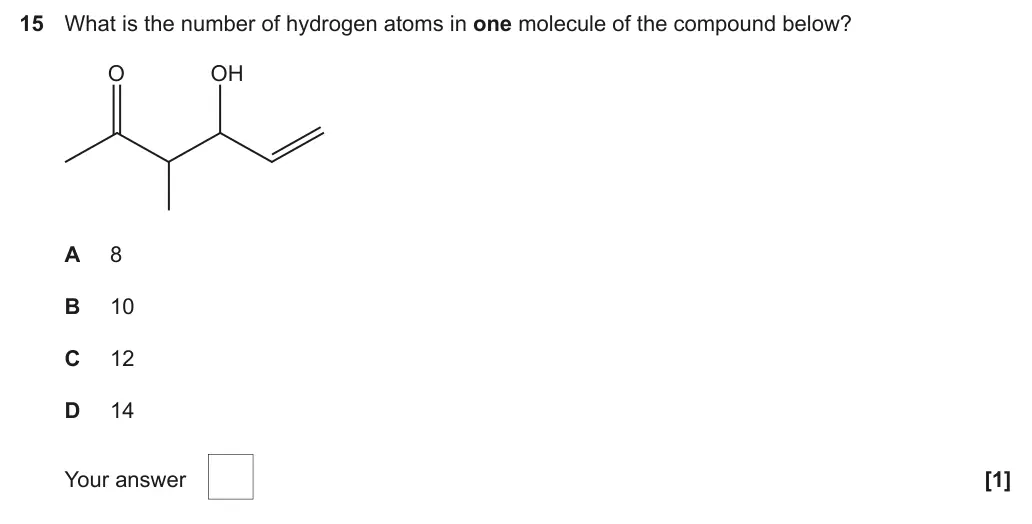
C
Most candidates selected the correct response. Where an error had been made, it was usually option B, the result of ignoring the two tertiary H atoms.
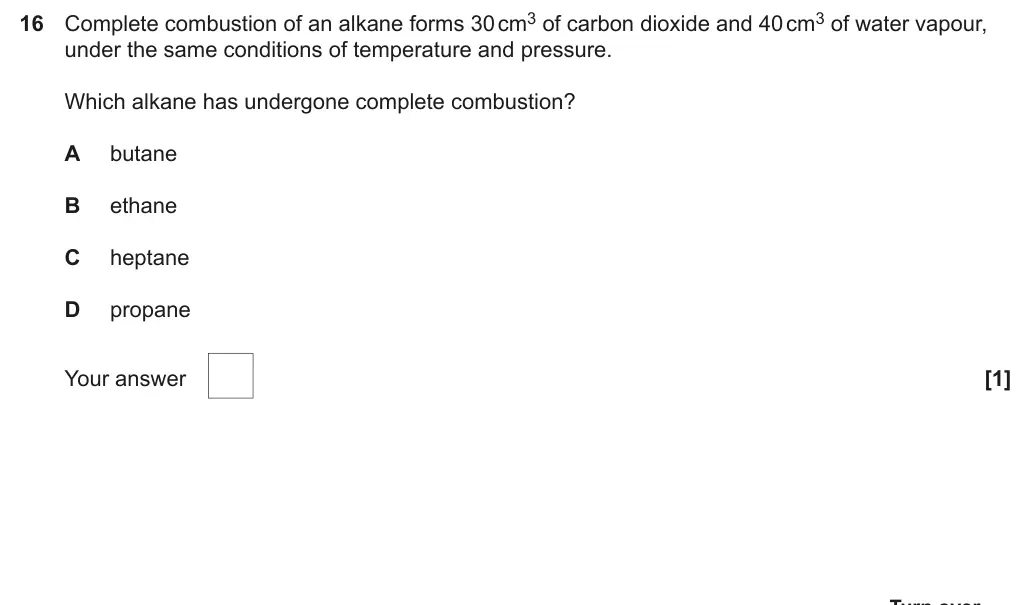
D
This question discriminated extremely well with most candidates choosing the correct option. Most candidates showed some working. The key to success was to identify the balanced equation that produced CO2 and H2O in a 3 : 4 molar ratio.
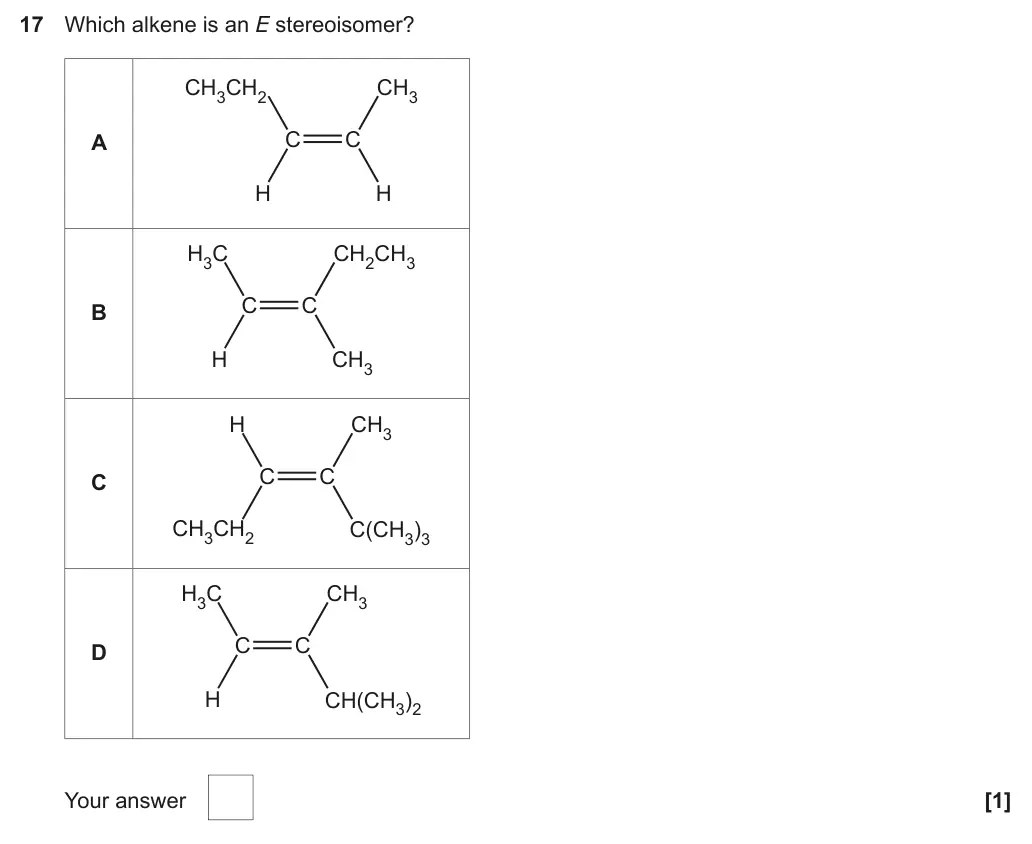
D
This was a difficult question, requiring candidates to use CIP rules along carbon chains. Higher-attaining candidates rose to the challenge but a variety of responses were seen, suggesting that many candidates guessed.
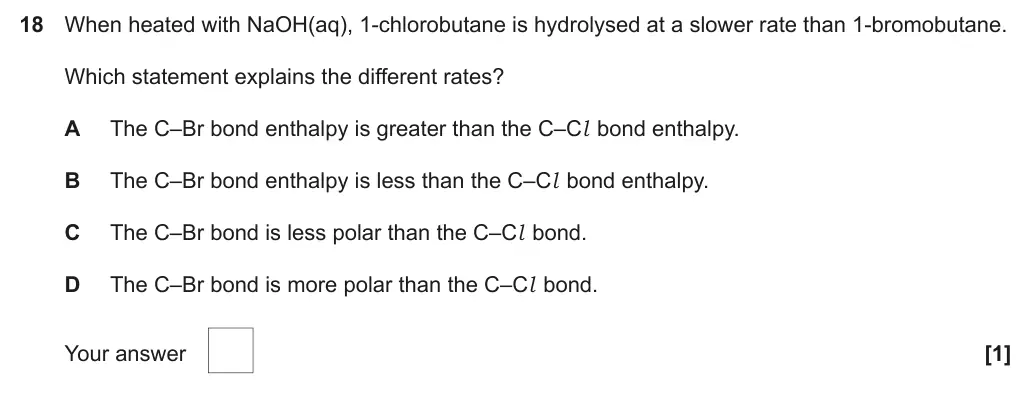
B
Most candidates selected the correct option, B. The main distractors were A (confusing which C–X bond is stronger) and C (confusing which effect of bond strength and polarity is dominant for this reaction).
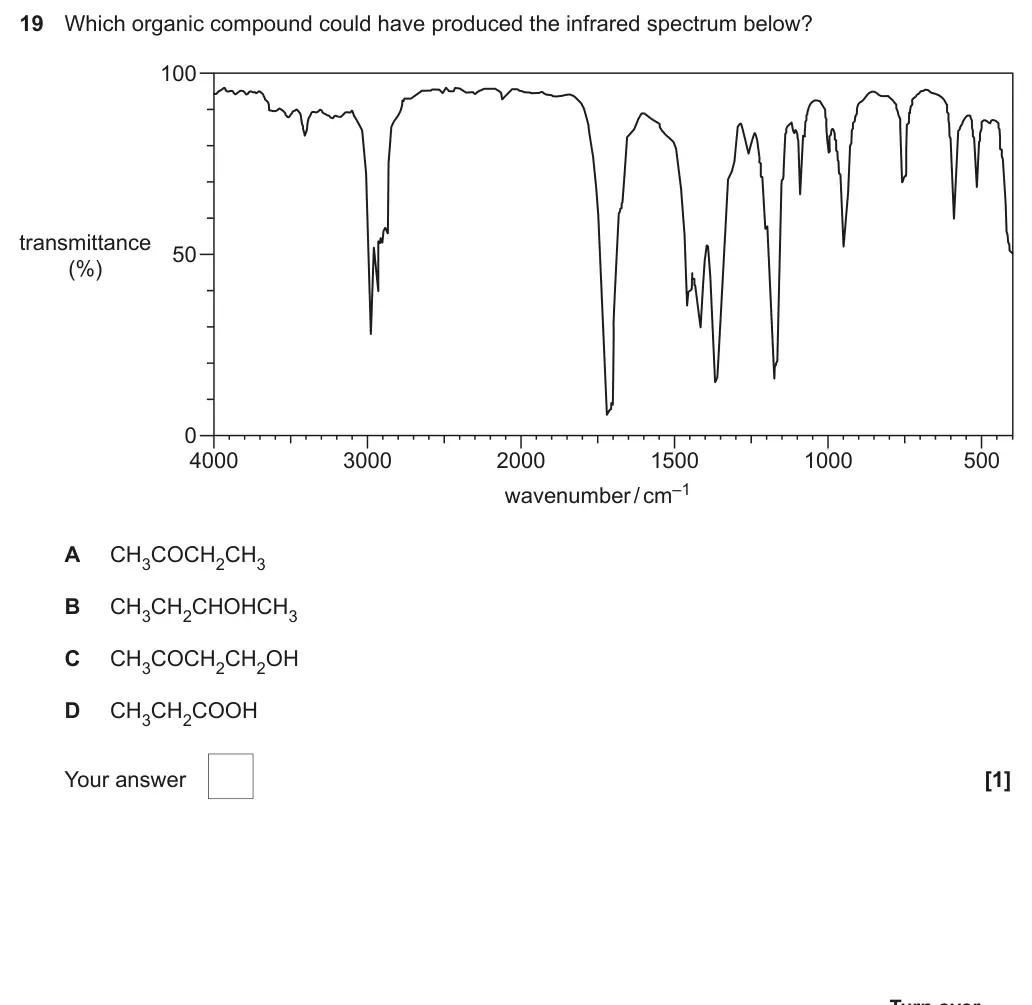
A
Candidates found this question hard with many selecting C or D instead of the correct option, B. Candidates appeared to have assigned the C–H absorption at 3000 cm–1 to an O–H group (from an alcohol or carboxylic acid). Candidates should appreciate that this C–H absorption will be present in any organic compound possessing a C–H group (that is, nearly all organic compounds).
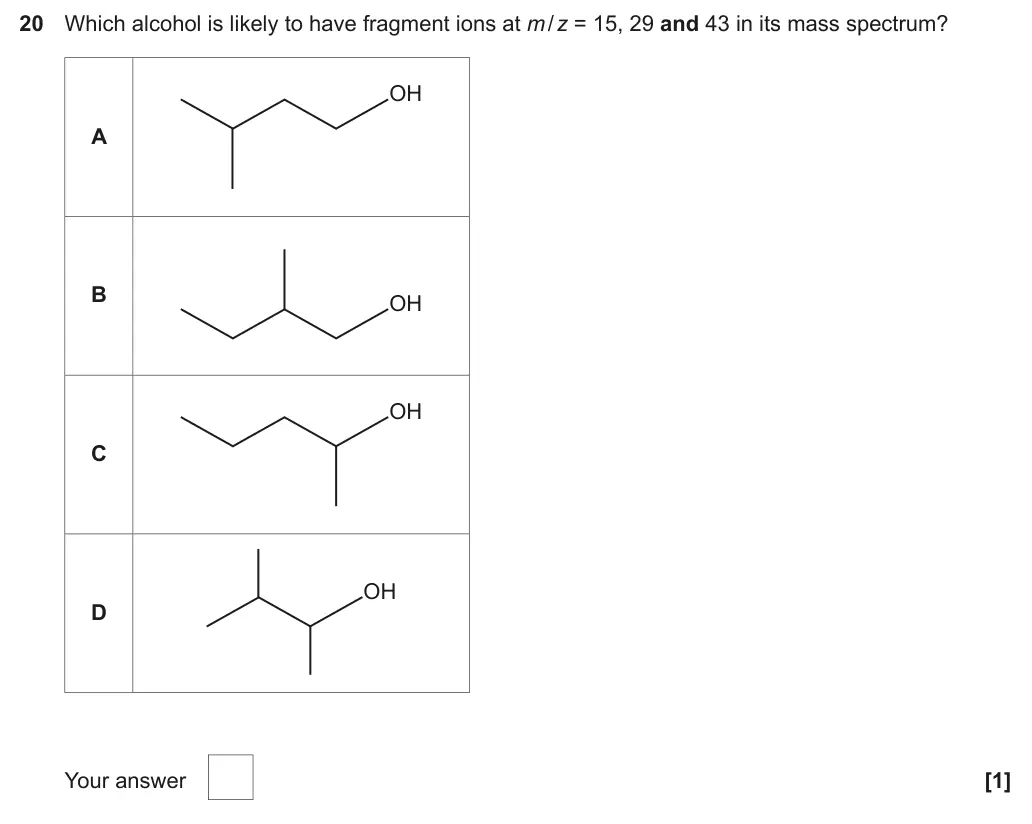
C
Compared to Question 19, candidates had more success with this question. Most drew out all the bonds in each structure, a good approach that should allow the candidate to identify the compound that would produce the three peaks. Section B overview Section B includes short answer question styles (structured questions, problem solving, calculations, practical) and extended response questions. This section of the paper is worth 50 marks.
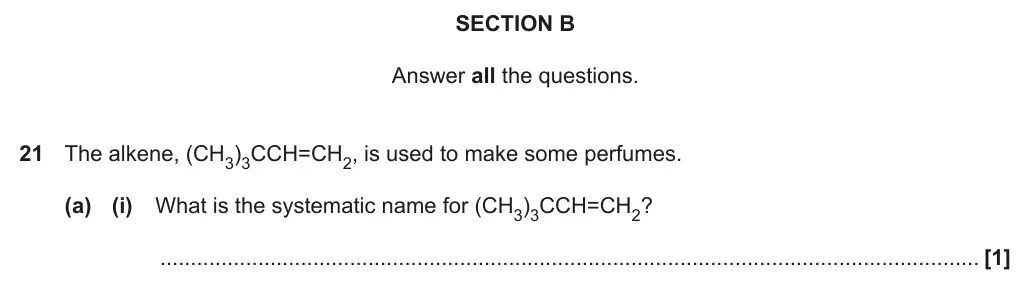
Candidates had difficulty in naming this compound correctly as 3,3-dimethylbut-1-ene. Many counted an incorrect number of carbons in the chain, numbered substituents from the wrong end (e.g. 1,1,1-) or used insufficient numbering (e.g. 3-dimethyl). Hex-1-ene was a common incorrect answer, presumably as there are six carbon atoms and one C=C double bond in the alkene.
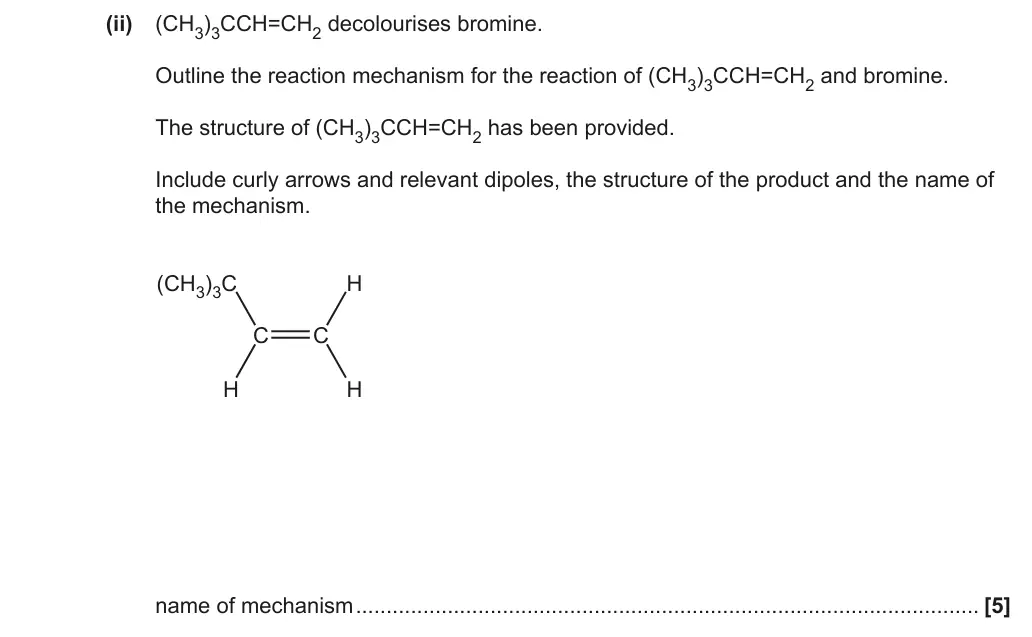
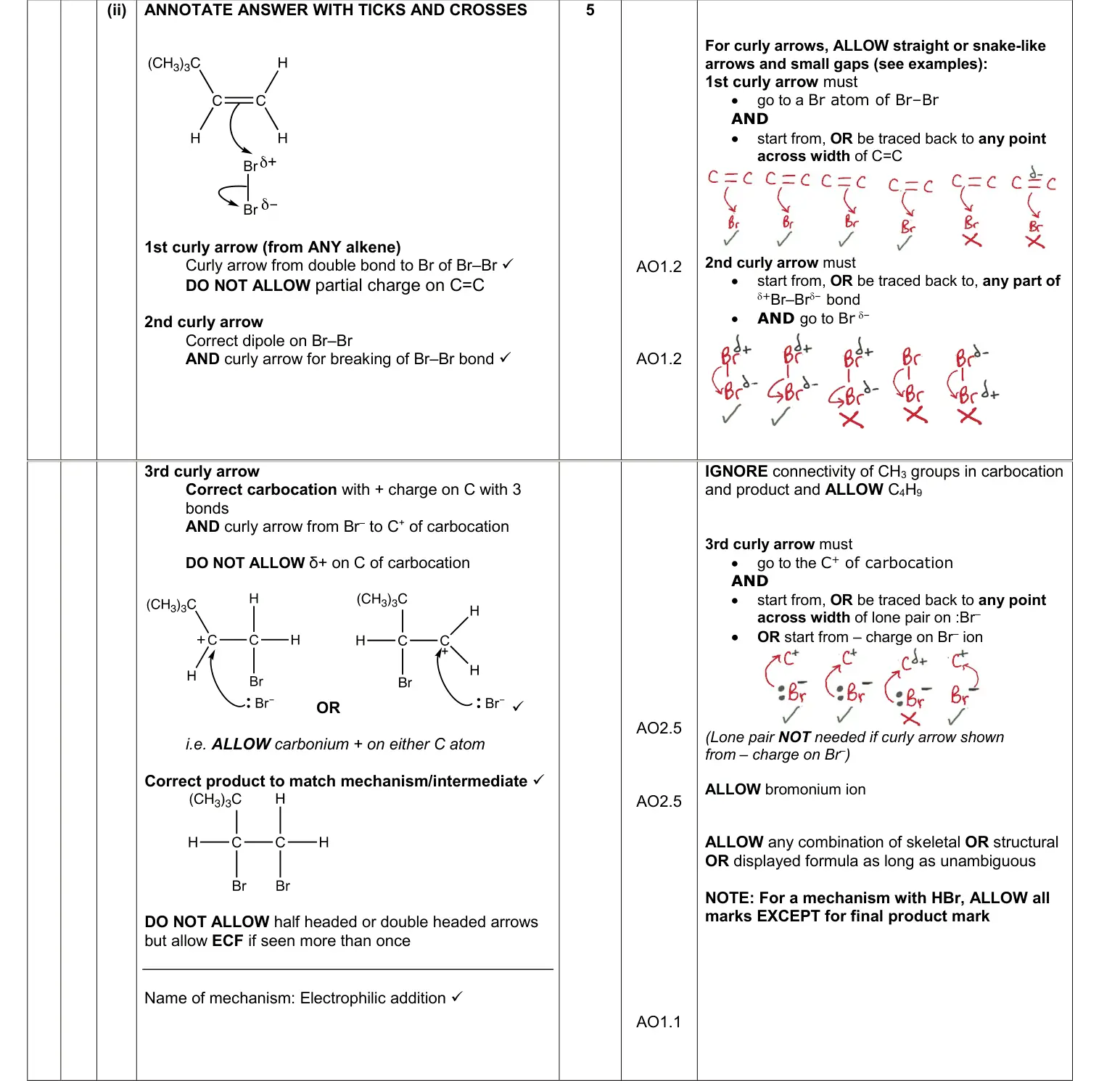
Many candidates answered the mechanism proficiently. However, many mistakes were seen with the direction of arrows, and confusing 𝛿+/ 𝛿– and +/– charges. In the intermediate carbocation, the C=C was often left intact and 𝛿– used on the bromide ion attacking the intermediate. Some less successful responses did not position curly arrows accurately. One common error was showing one or more C atoms missing from the (CH3)C groups. Candidates should take great care when drawing organic structures to make sure that all groups have been drawn accurately. This exemplar has been included to emphasise the importance of accurately placed curly arrows and use of charges. It was only possible to award this response 1 out of 5 marks. With a few improvements, this response could easily have been 5/5. The start of the first curly arrow has been placed accurately starting from the C=C double bond but the arrow should have finished at the Br𝛿+: 0 marks The Br–Br dipole is correct but there is no curly arrow showing it breaking: 0 marks The intermediate carbocation is correct but the curly arrow should have been shown from a lone pair on the Br– ion to the + charge of the carbocation: 0 marks The product is correct: 1 mark The reaction type is addition but the name of the mechanism is electrophilic addition: 0 marks nucleophilic substitution and radical substitution. This paper includes two of these in Questions 21 (a) (i) and 26 (a). It is essential that candidates learn these three mechanism types.
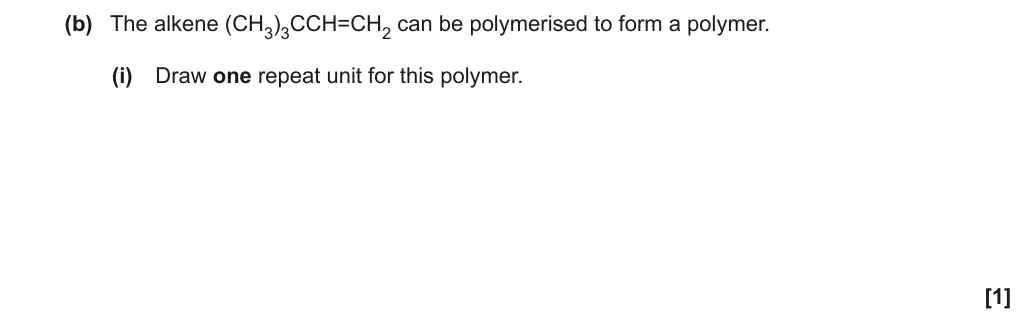
Most candidates drew out the correct repeat unit although some less successful responses showed the molecule instead of the polymer. Missing ‘side’ bonds were very few as were attempts to connect to the CH3 group leaving the C=C intact. Where candidates made an error, it was often from missing out a C or a 3 from the side chain.
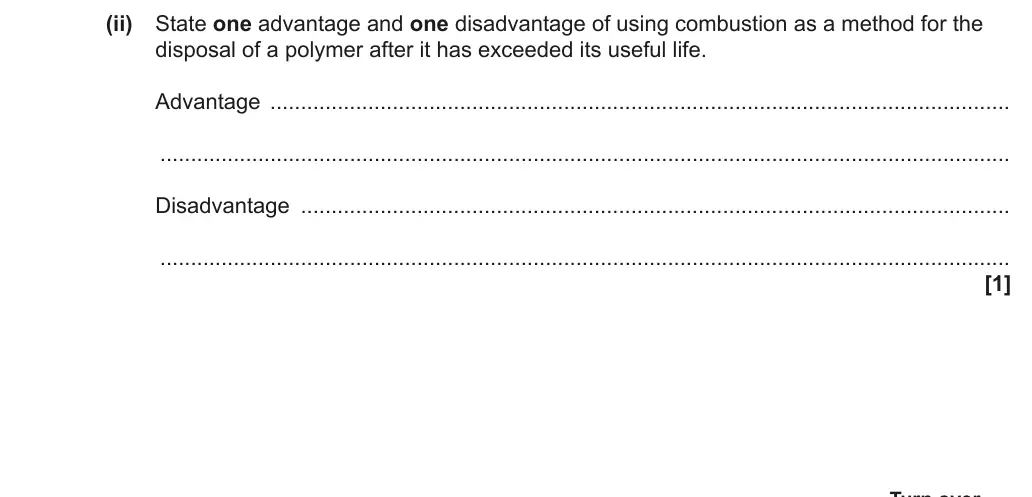
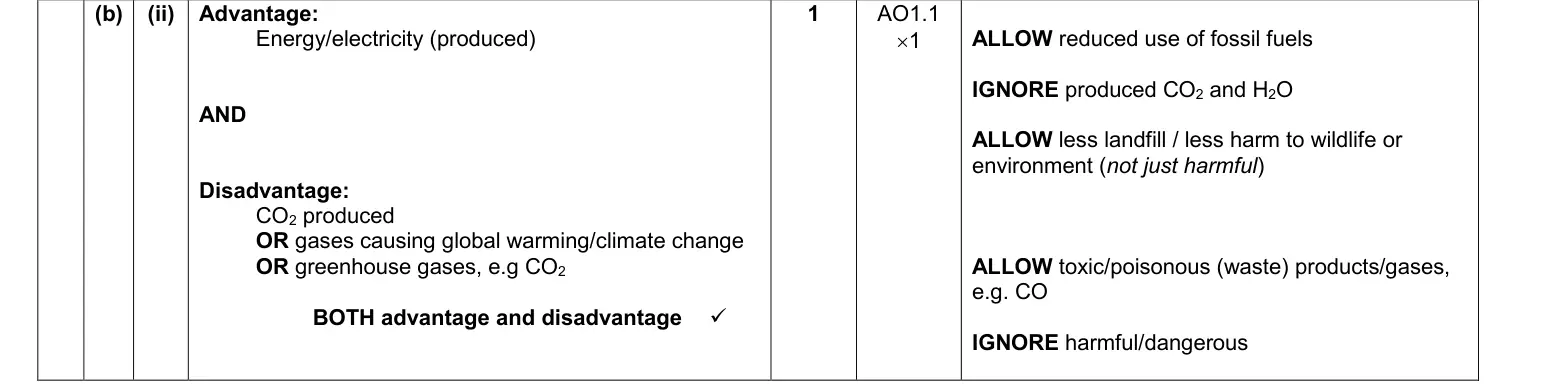
The responses to this question were highly variable. Many candidates correctly identified the disadvantage, usually in terms of CO2 release and global warming, but an advantage was less frequently seen. When it was seen it was almost universally about releasing energy. General hazard comments such as ‘harmless’; and ‘dangerous’ as too general and are never given marks at AS or A Level.
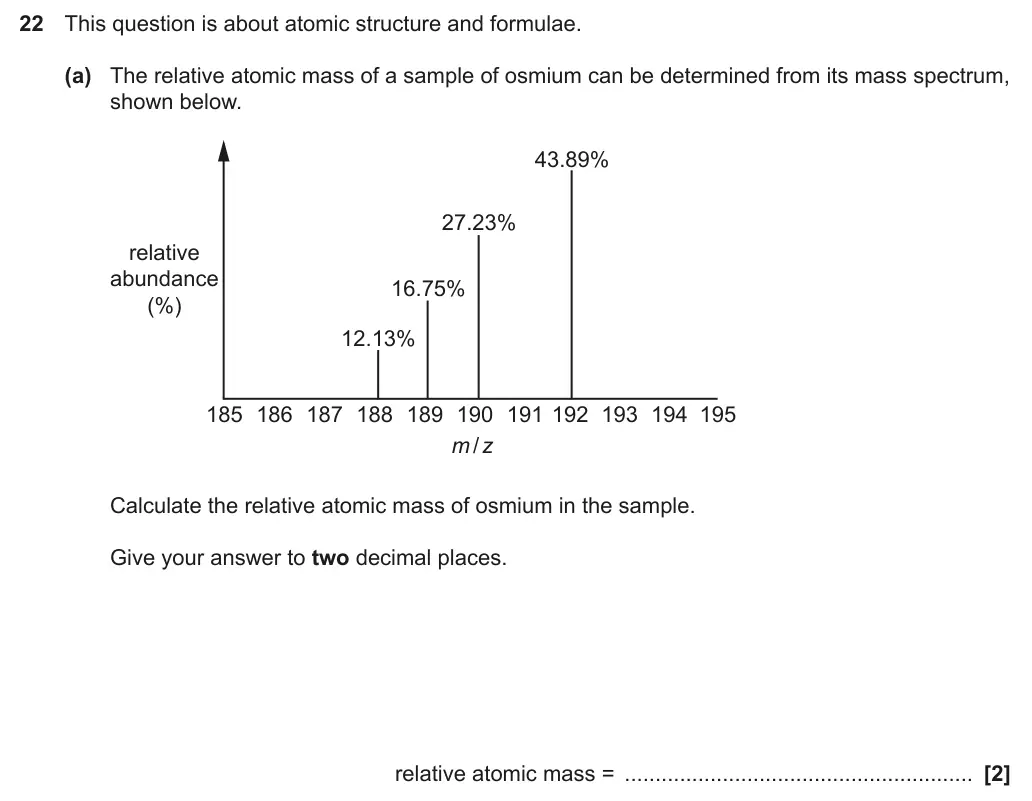
Candidates answered this question very successfully. Few candidates mis-wrote the numbers and even fewer gave answers to the incorrect number of decimal places. This type of question has featured on previous examinations and it was pleasing to see how well it was answered, even with more isotopes being included than in previous instances.
Skills: M0.2 Use ratios, fractions and percentages; M1.2 Find arithmetic means; M3.1 Translate information between graphical, numerical and algebraic forms
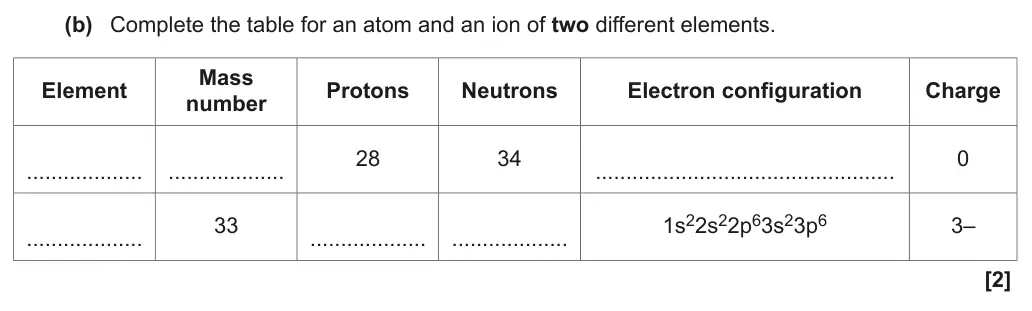
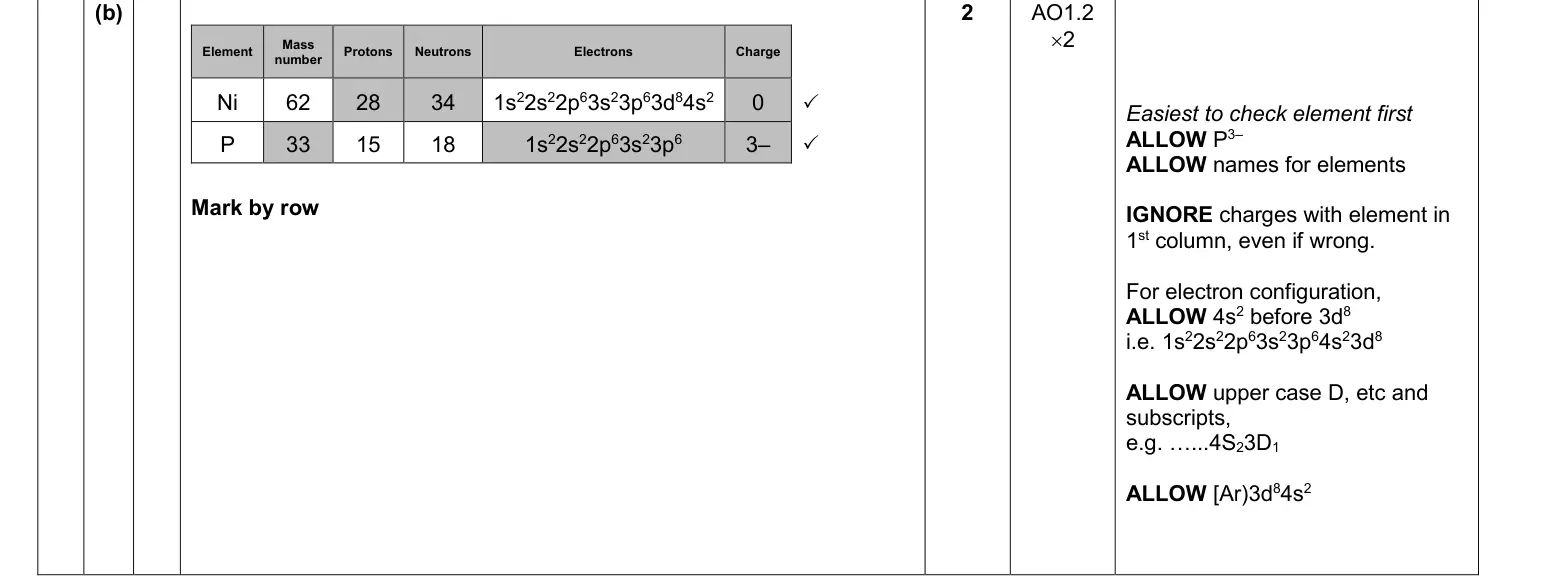
This question produced many mixed responses. Most candidates correctly identified nickel. However, its electron configuration was frequently shown as 3d10 instead of 3d8 and some less successful responses gave nickel’s relative atomic mass of 58.7 from the periodic table, instead of the mass number of the isotope provided. Many candidates selected the incorrect element for phosphorus, with argon being a key distractor from the extra 3 electrons in the P3– ion. The numbers of protons and neutrons were largely correct, although the wrong way round for many less successful responses.
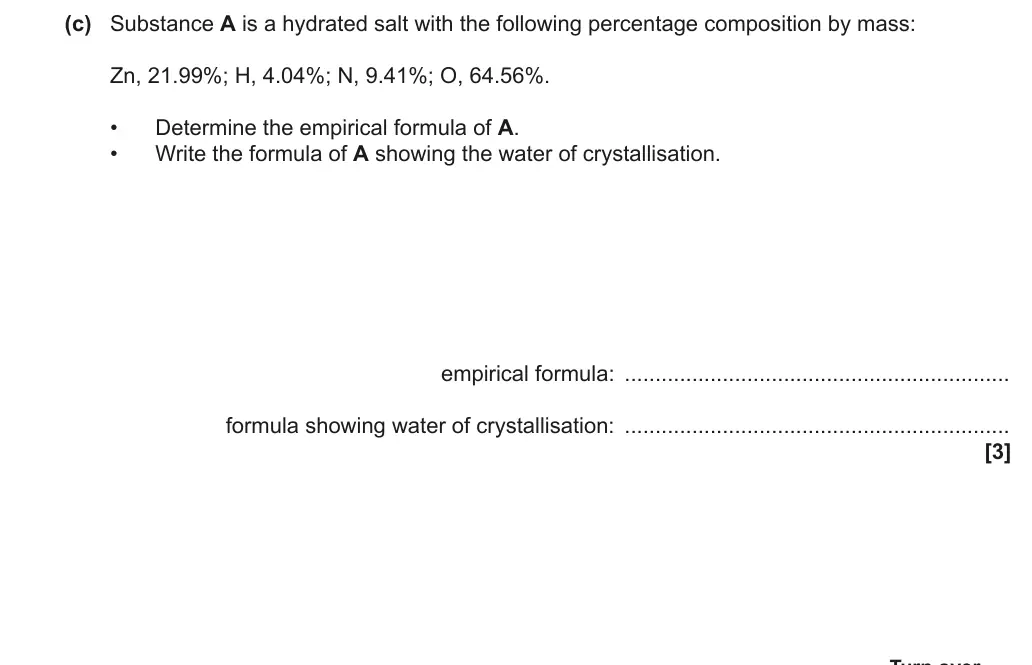
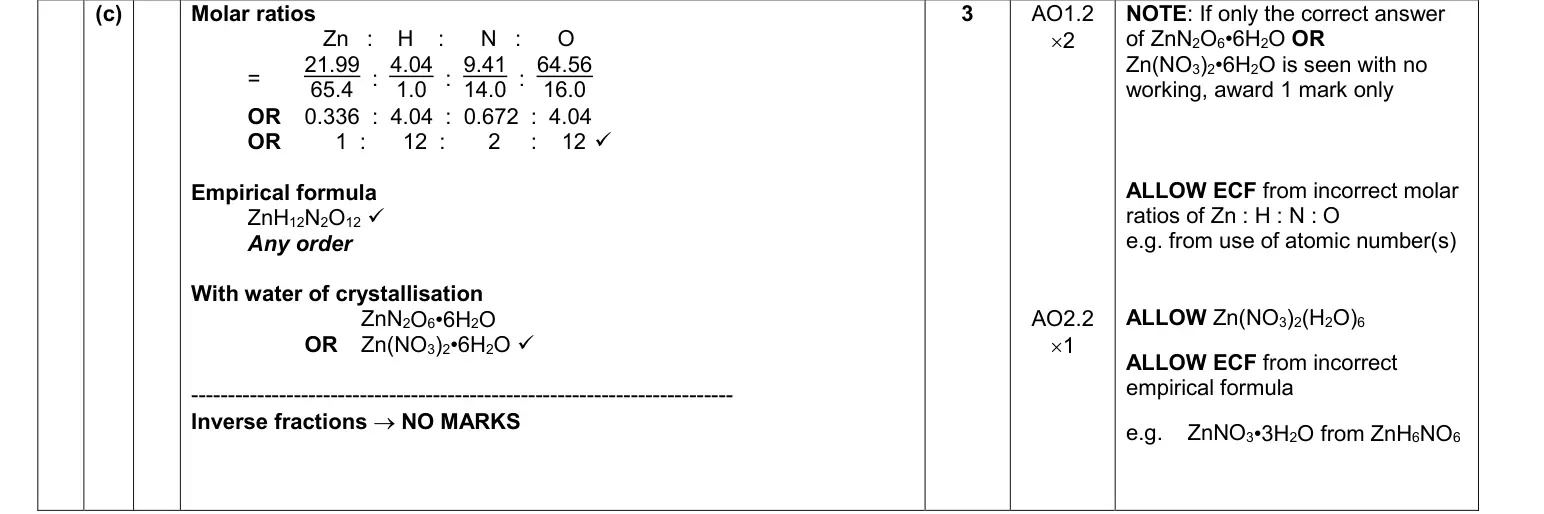
Candidates processed the empirical formula data well to obtain the correct molar ratio of the elements, with many being able to convert this ratio into an empirical formula. This type of problem is common in chemistry and candidates were clearly well-versed in the method of its solution. The most common error was H:11 rather than H:12. The third mark for water of crystallisation was far harder to obtain. Many candidates identified that 6H2O was present, but the O was often missing in a formula shown as ZnN2•6H2O, or ‘included’ with the water as ZnN2•6H2O2. Many candidates did not seem to know how to proceed here. The mark scheme allowed credit for both the preferred answer of Zn(NO3)2•6H2O and for ZnN2O6•6H2O, as both had extracted the waters of crystallisation from the rest of the empirical formula. A few candidates inverted the moles calculation, a strategy that could not be given marks.
Skills: M0.2 Use ratios, fractions and percentages
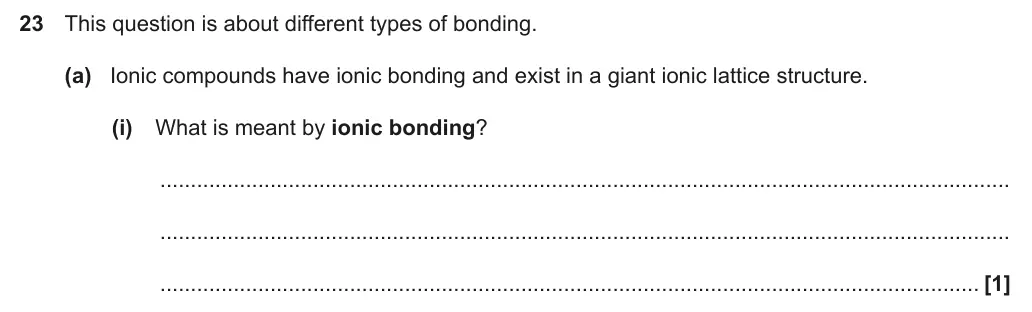
Candidates answered this question well. Where candidates had not been given marks, it was usually because they omitted the term ‘ions’ or did not state that an ionic bond is between metals and non- metals.
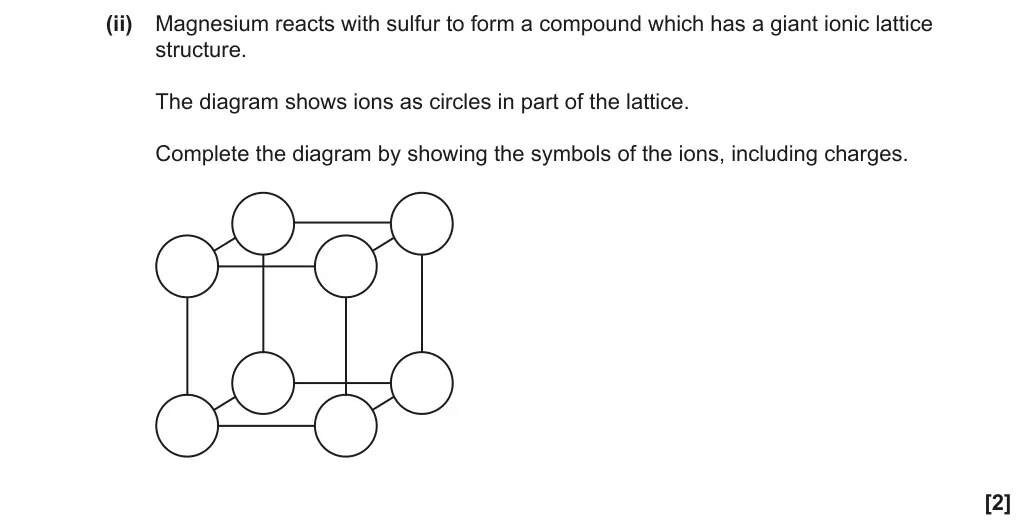
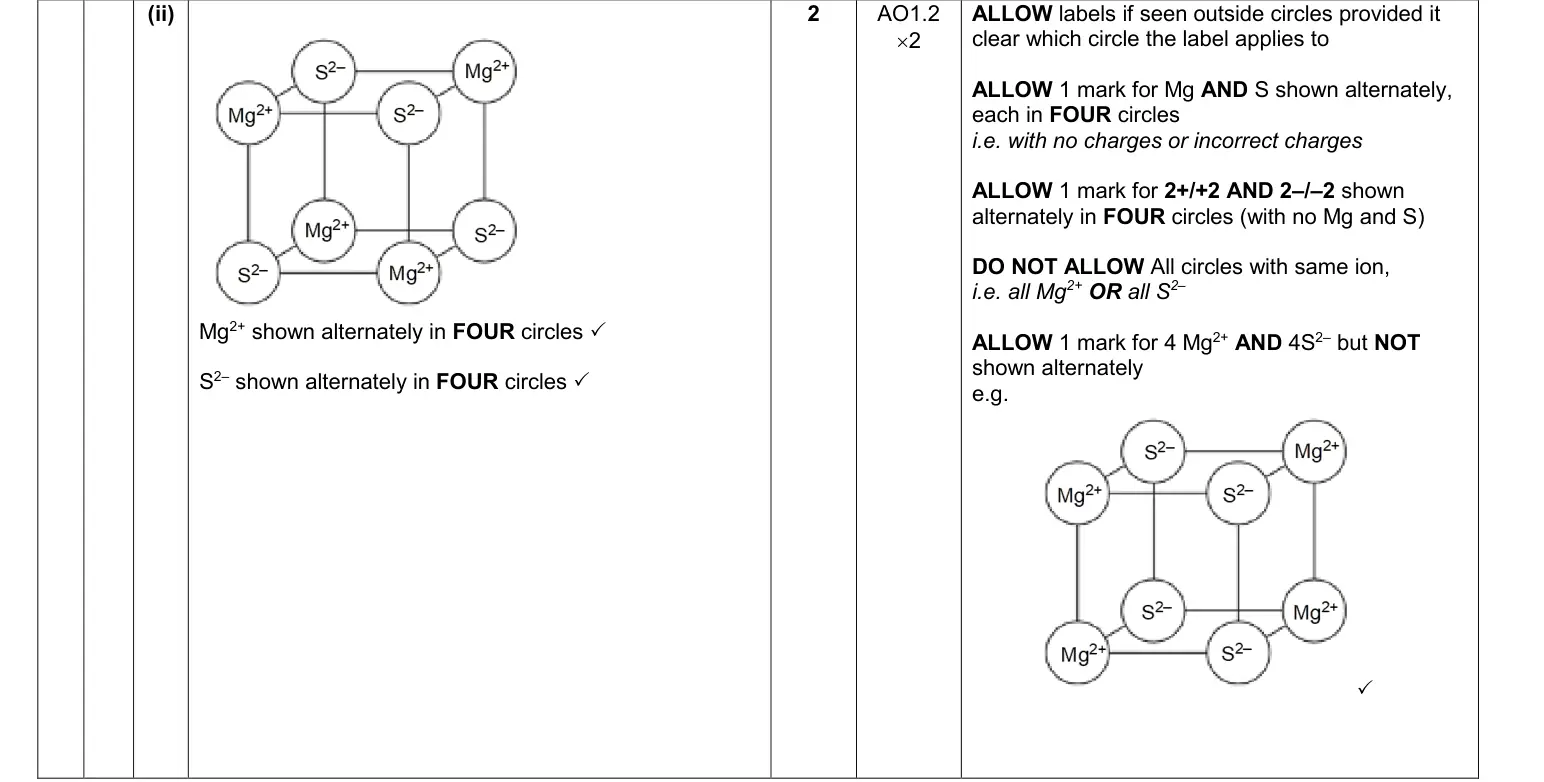
Most candidates correctly drew alternating Mg2+ and S2– labels in the circles. Some candidates made errors, however, including 2+ and 2– without Mg and S, incorrect or omitted charges, and placing the ions in layers rather than alternating.
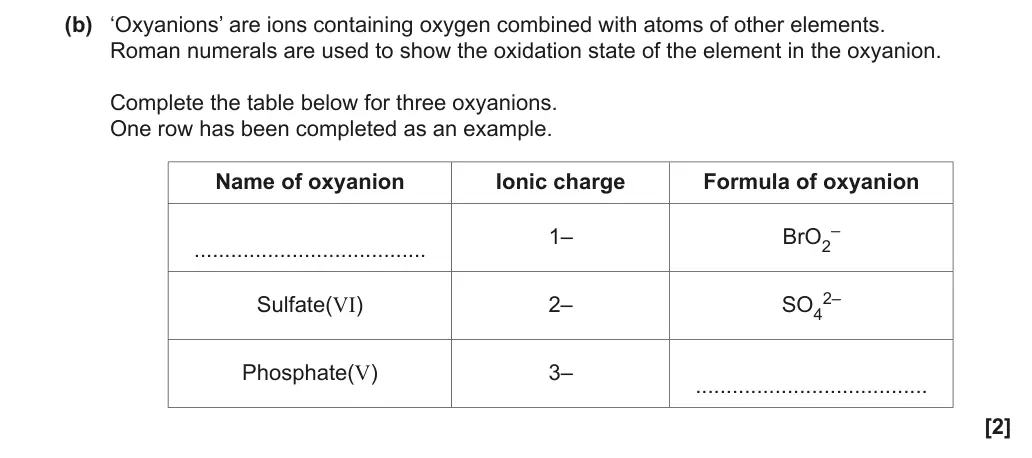
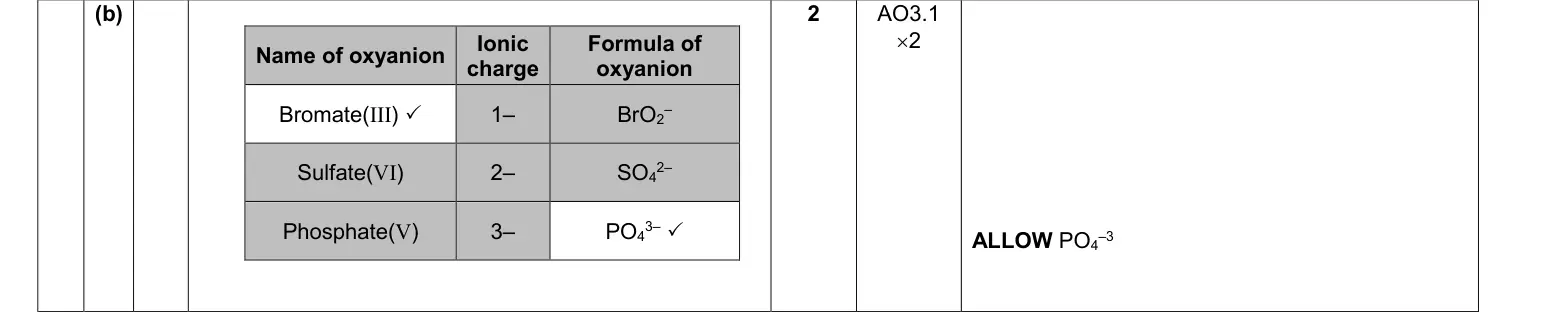
Although this question included important clues within the table, these were usually ignored by candidates and this item did not score as well as expected. The bromate(III) was poorly identified, with many candidates missing the oxidation state of the bromine. Many candidates wrote bromide, bromate without (III), bromide (III), bromate (VI) and other oxidation numbers. The phosphate ion was more familiar with many candidates identifying its formula as PO43–. A common error was the inclusion of the wrong number of oxygen atoms in the ion, such as PO5 with various charges.
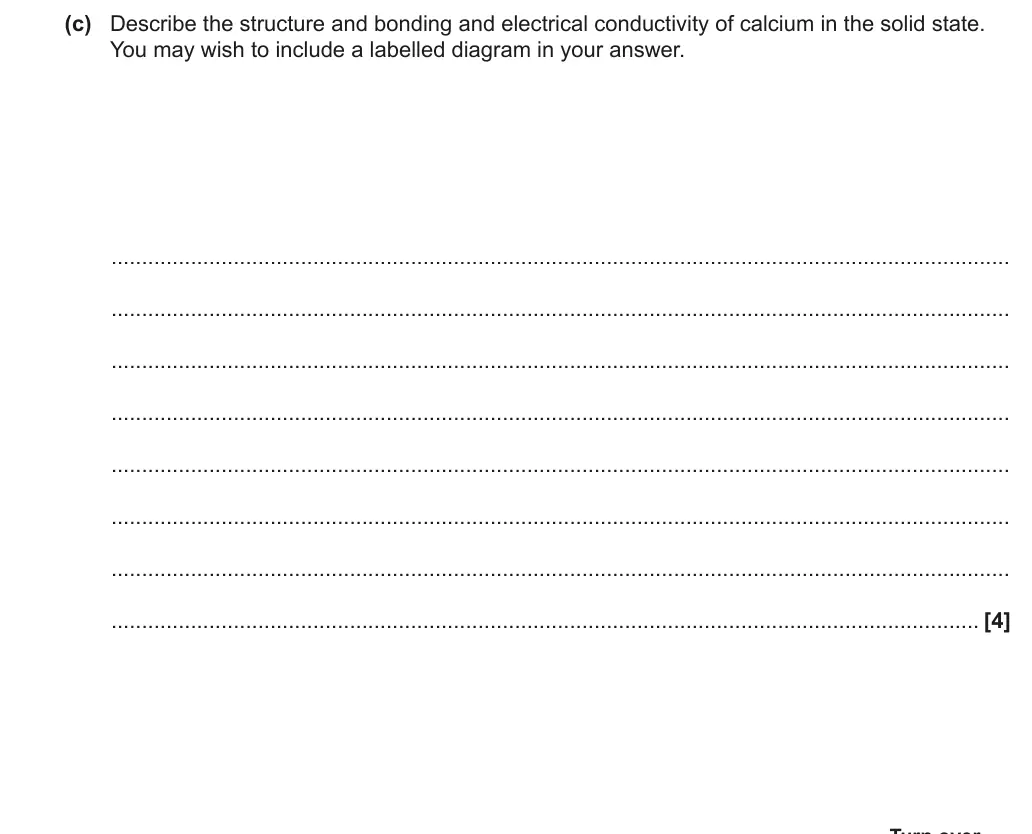
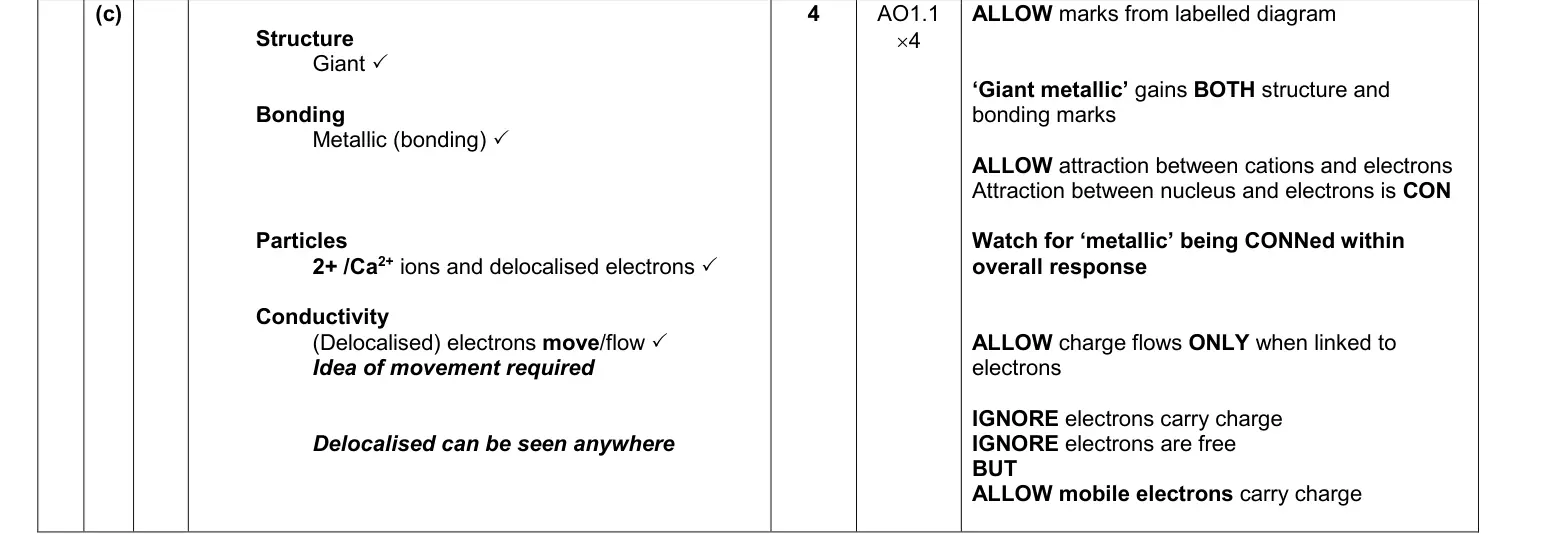
Many candidates answered this question well, with most identifying the model of metallic bonding as fixed positive ions and mobile delocalised electrons. The question did ask for bonding and structure and the giant feature of the structure was often omitted. Unfortunately, some candidates contradicted a correct metallic bonding statement by including descriptors of intermolecular forces, covalent bonding or attraction between electrons and the nucleus rather than with positive ions. Less successful responses demonstrated less understanding: some didn’t realise that Ca is a metal and conductivity explanations were often given as ions moving in the molten and not in the solid state, clear confusion with ionic bonding. Full marks were only given for showing the correct charges on the Ca2+ cations (+ was insufficient) and for explaining conductivity in terms of electron movement, rather than the common ‘the electrons carry charge’ and ‘the electrons are free’. Overall, this relatively simple question discriminated very well and demonstrated how well the candidates understood metal bonding and structure.
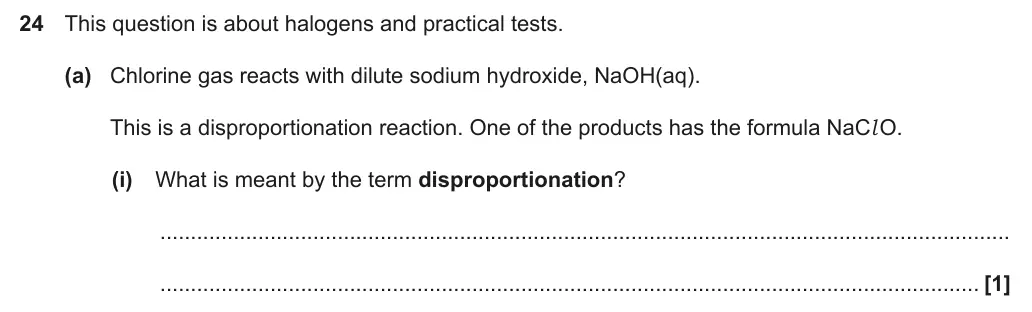
Candidates answered this question well and most were given the mark. Where candidates didn’t receive credit, it was mainly because they used the term ‘same atom’ instead of ‘same element’. Some less successful responses responded with completely incorrect chemistry and had clearly not learnt this specification content.
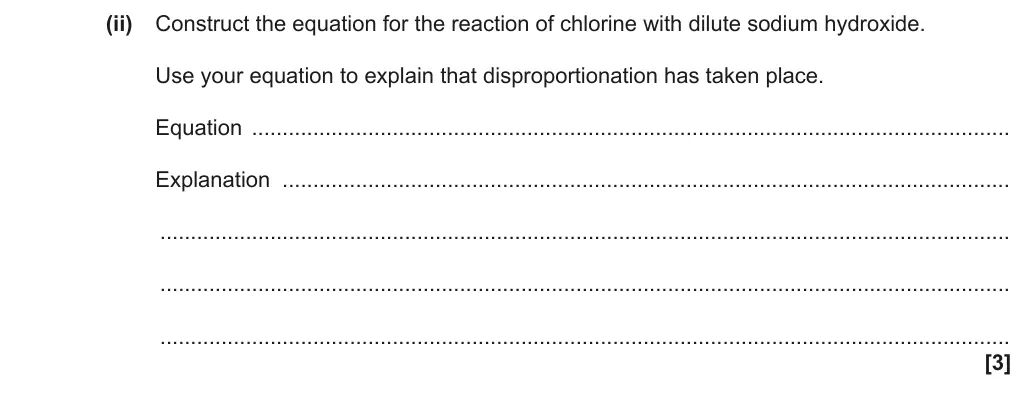
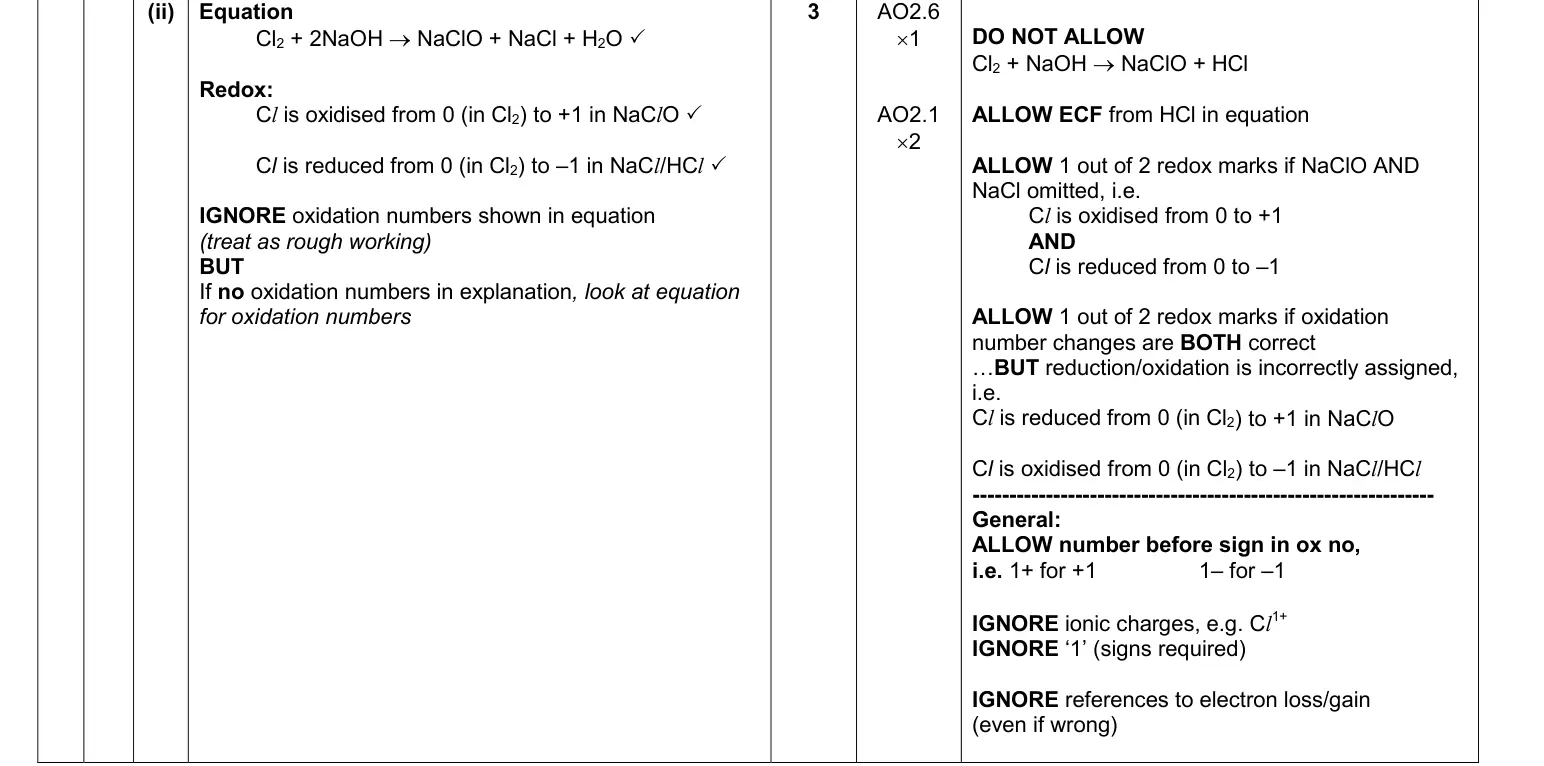
Candidates found the equation hard, despite this reaction being specification content and the inclusion in the earlier part of the stem of ‘NaClO’ as one product. The correct response required candidates to realise that NaCl would be a product and to balance the resulting equation. Some did not add the balancing ‘2’ before NaOH, and many selected HCl as the second product, a compound that would react further with NaOH to produce NaCl. The explanation worked the same whether NaCl or HCl had been identified as the second product. There were some excellent responses, providing the correct oxidation number changes, linking these to the species involved and identifying the changes as either oxidation or reduction. Two explanation marks were available with marks not being given for omission of one of the three features described above. This exemplar has been included to emphasise the points made above. It was only possible to award this response 1/3 marks. The equation shows the common error of the second chlorine-containing product being HCl and not NaCl: 0 marks The candidate has identified the oxidation number changes and has linked these to the correct species. The last statement in brackets is correct but the candidate has not communicated which oxidation number change is oxidation and which is reduction: 1/2 marks
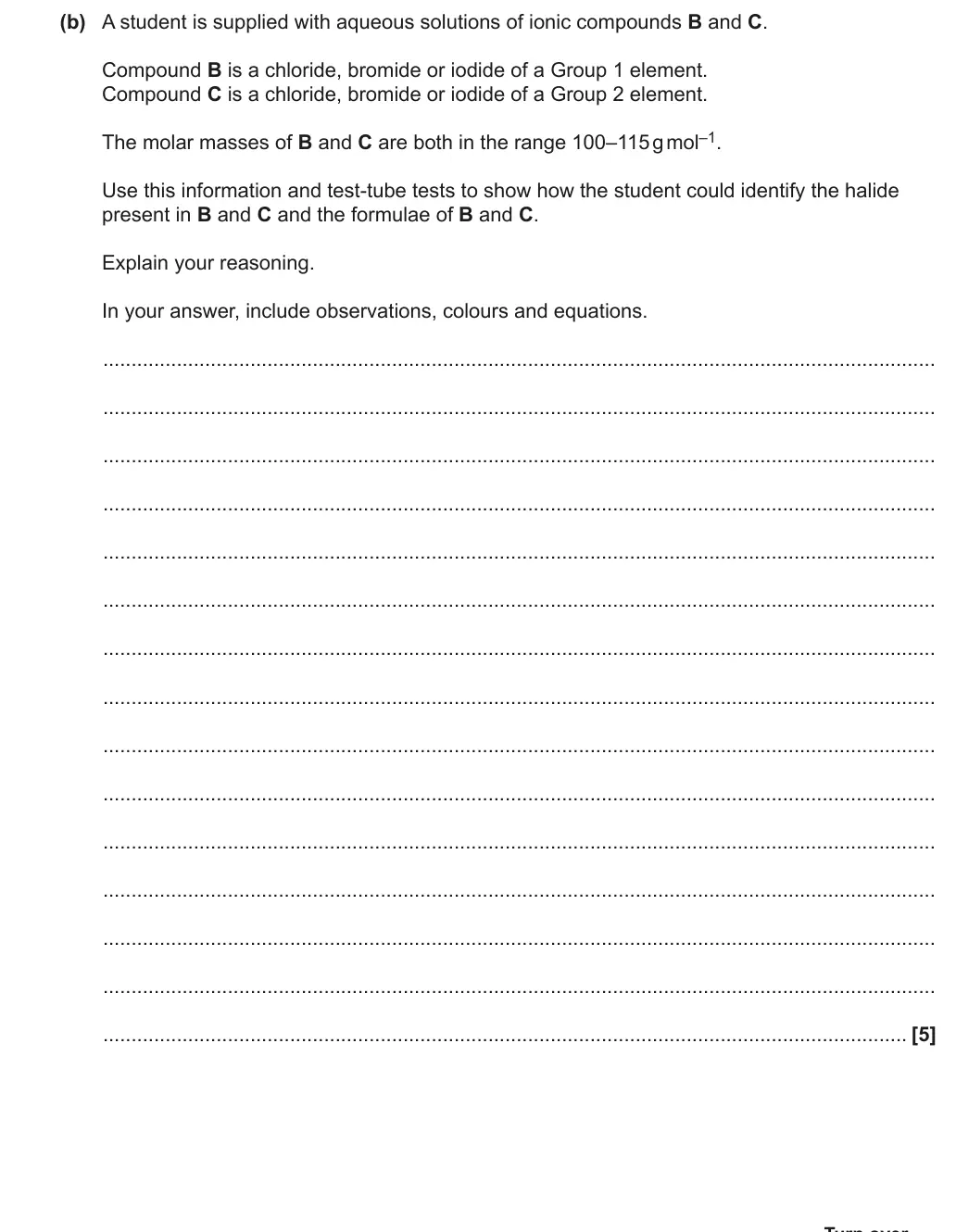
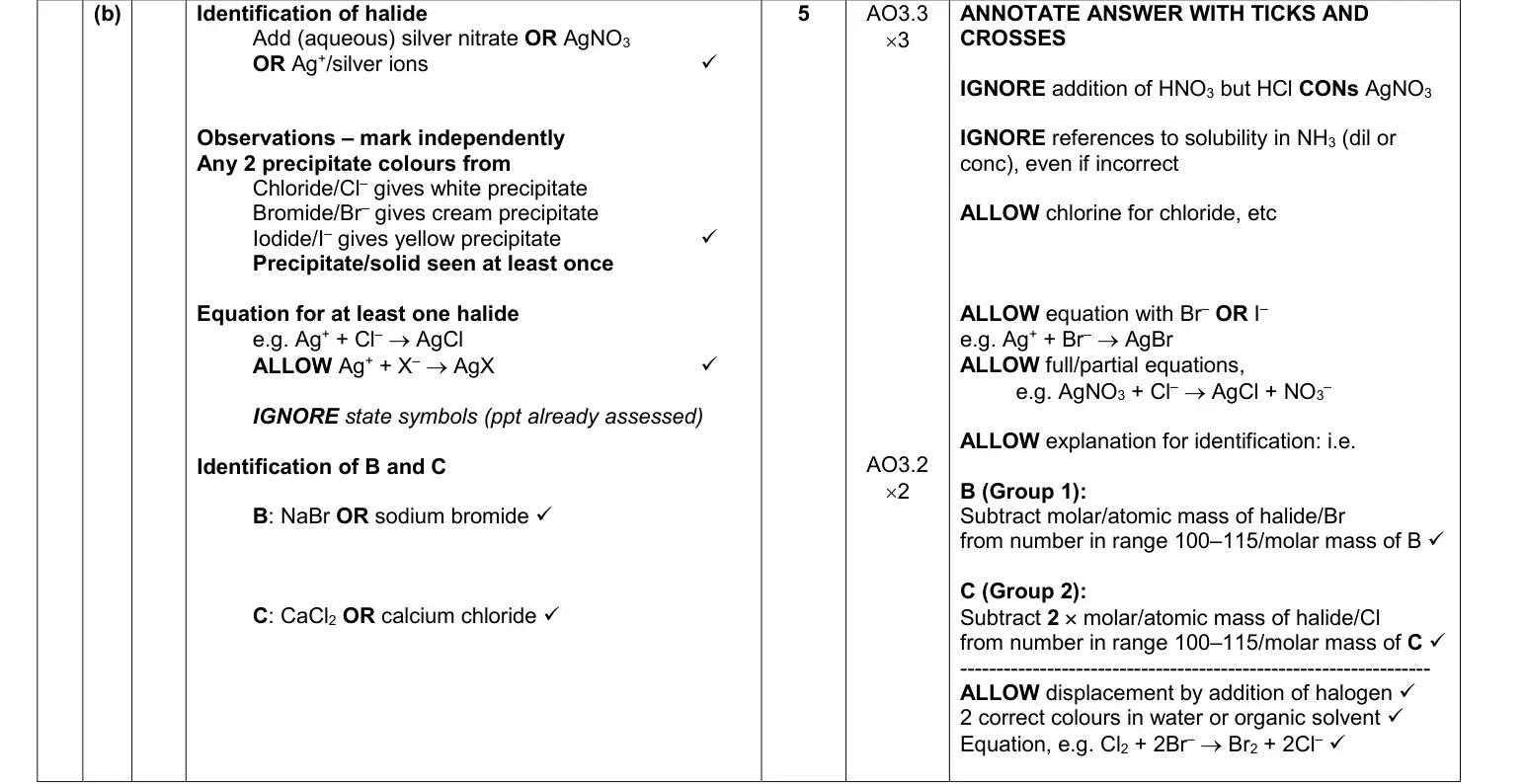
Candidates generally answered the first part of this question well. Most candidates were able to identify silver nitrate (or a halogen displacement method), to describe the expected observations, supported with mainly correct ionic equations. Candidates found it much harder to identify B and C as NaBr and CaCl2. They could do this in various ways by matching possible formula with the provided molar mass ranges. The mark scheme did allow marks to be given when candidates described the identification process, although this was often very muddled, so, only the most able few candidates fully identified the unknown B and C.
Skills: M0.2 Use ratios, fractions and percentages; PAG4 Qualitative analysis of ions
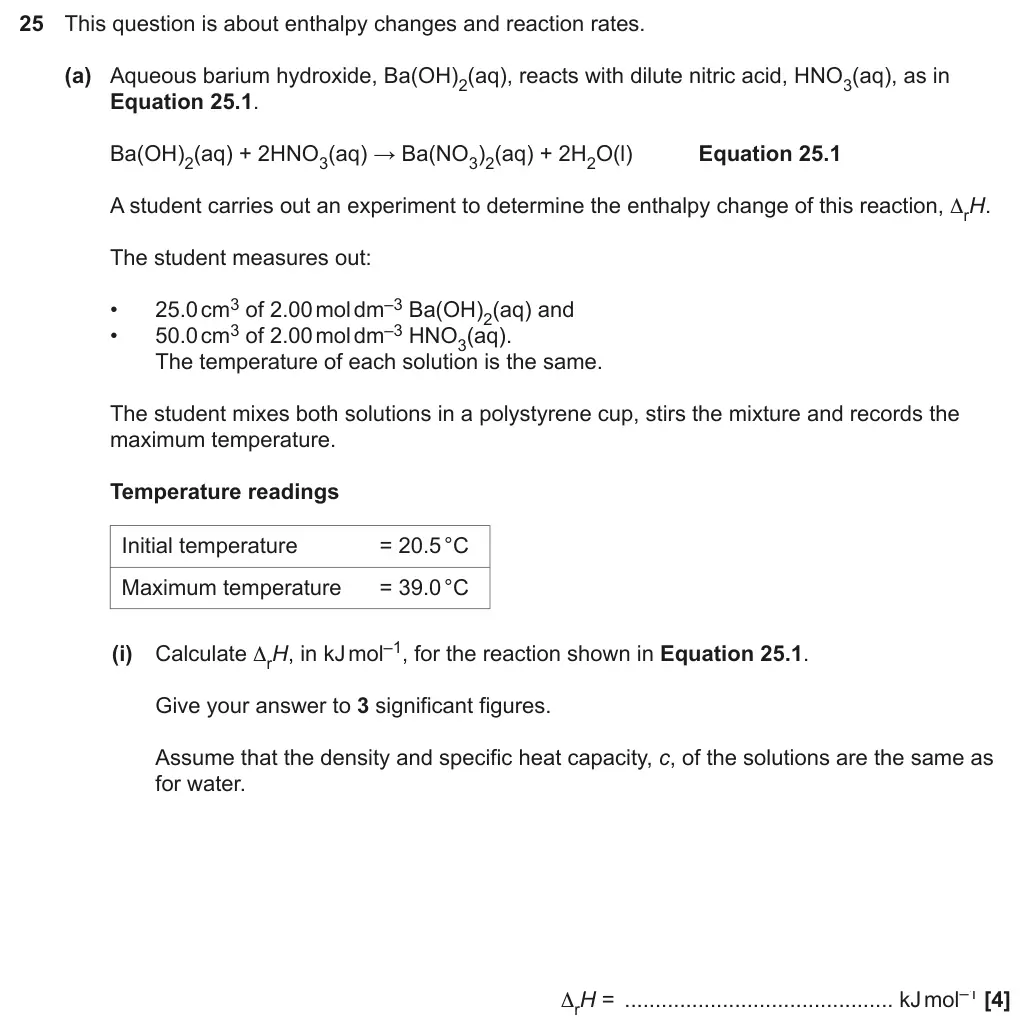
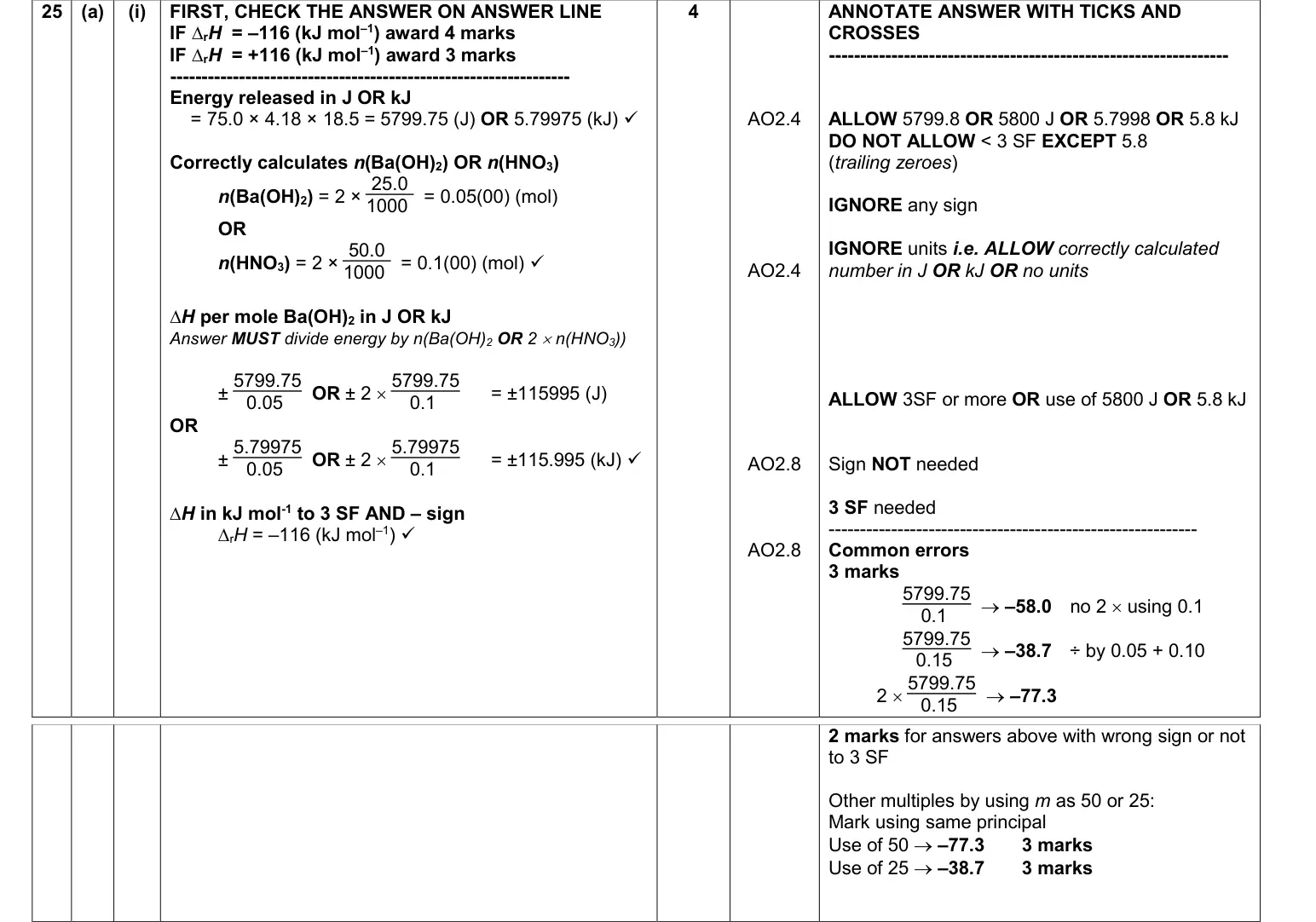
More successful candidates followed a well-rehearsed method for processing experimental enthalpy results to arrive at an enthalpy change. The result was usually the correct answer of –116 kJ mol–1. Most candidates combined the 2 volumes (25 cm3 and 50 cm3) to give 75 cm3 with m = 75 g and then calculated the correct energy change of 5799.75 J using mc∆T. Some candidates did not combine the volumes and used m = 25 g or 50 g instead. Most candidates worked out the amount in moles of Ba(OH)2 and HNO3. Unfortunately, these calculations were often scattered across the page with no indication of what the calculated values applied to. Some candidates incorrectly combined the moles (0.10 and 0.05) and divided this value (usually 0.15) into the energy change. The mark scheme accounted for these errors and allowed error carried forward marks to be allocated appropriately. Candidates are strongly advised to organise their calculation in a coherent way and to show what each calculated value applies to so that error carried forward can be applied for mistakes. misunderstanding the meaning of m in the equation q = mc∆T, used for finding the energy change q from experimental results. The information states that the density of the solutions is the same as for water, 1.00 g cm–3. Therefore, the mass m that changes temperature ∆T is 75.0 g and the energy change is 75.0 4.18 18.5 J. This candidate has correctly calculated the moles of one of the reactants, Ba(OH)2, as 0.0500 but has then calculated its mass as 75.0 4.18 18.5 J = 8.565 g and has used this in mc∆T. So the key message is that m in mc∆T is where the thermometer has been placed.
Skills: M0.0 Recognise and make use of appropriate units in calculations; M1.1 Use an appropriate number of significant figures; M2.3 Substitute numerical values into algebraic equations using appropriate units for physical quantities; PAG3 Enthalpy determination
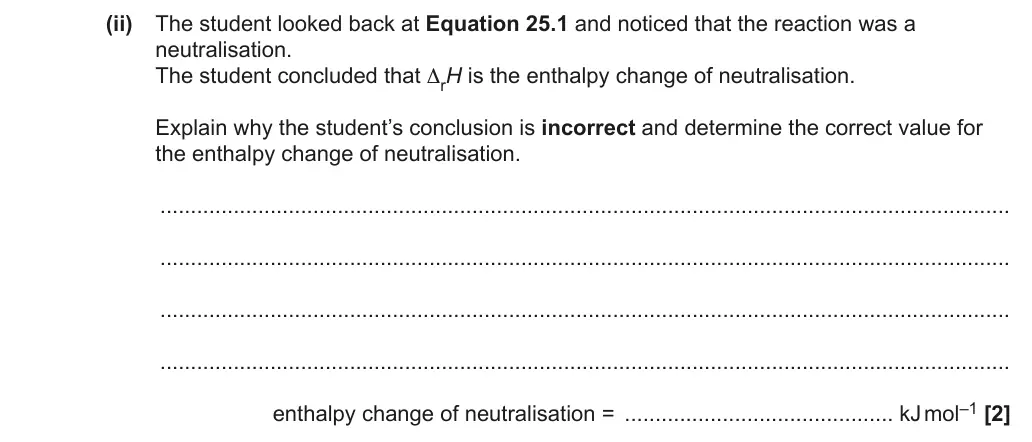
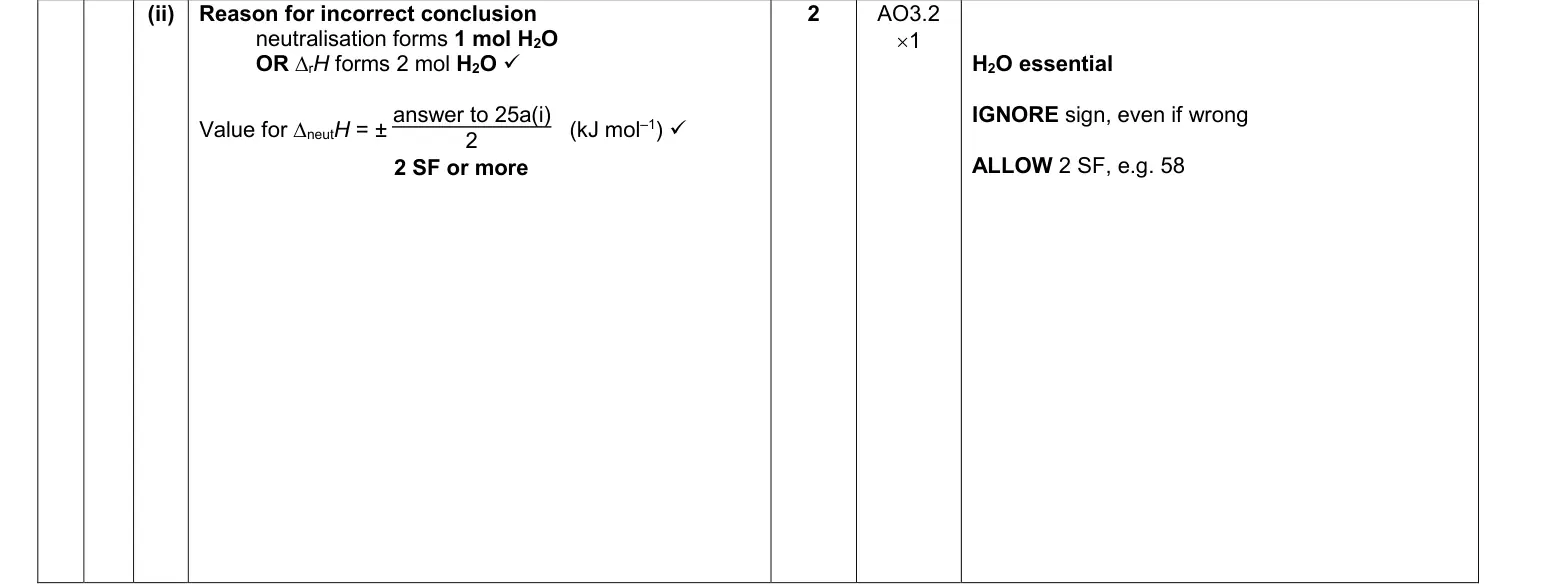
Many candidates correctly identified that neutralisation is the formation of 1 mole of water, whereas this equation forms 2 moles of water. Significantly fewer were then able to use their answer to the calculation in Question 25 (a) (i) to determine a value for the neutralisation enthalpy as half of that that value. This was a novel question, not used in previous examinations, and many candidates coped with the challenge admirably.
Skills: M0.2 Use ratios, fractions and percentages
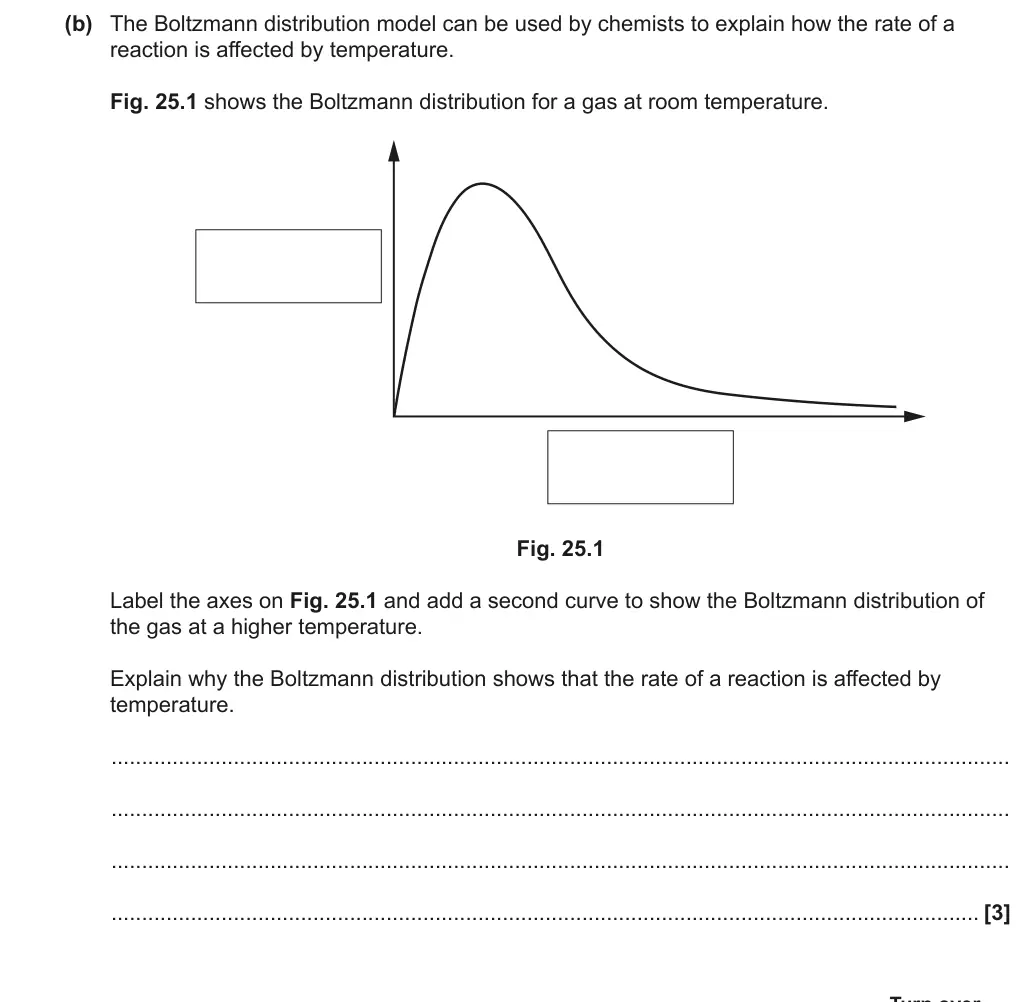
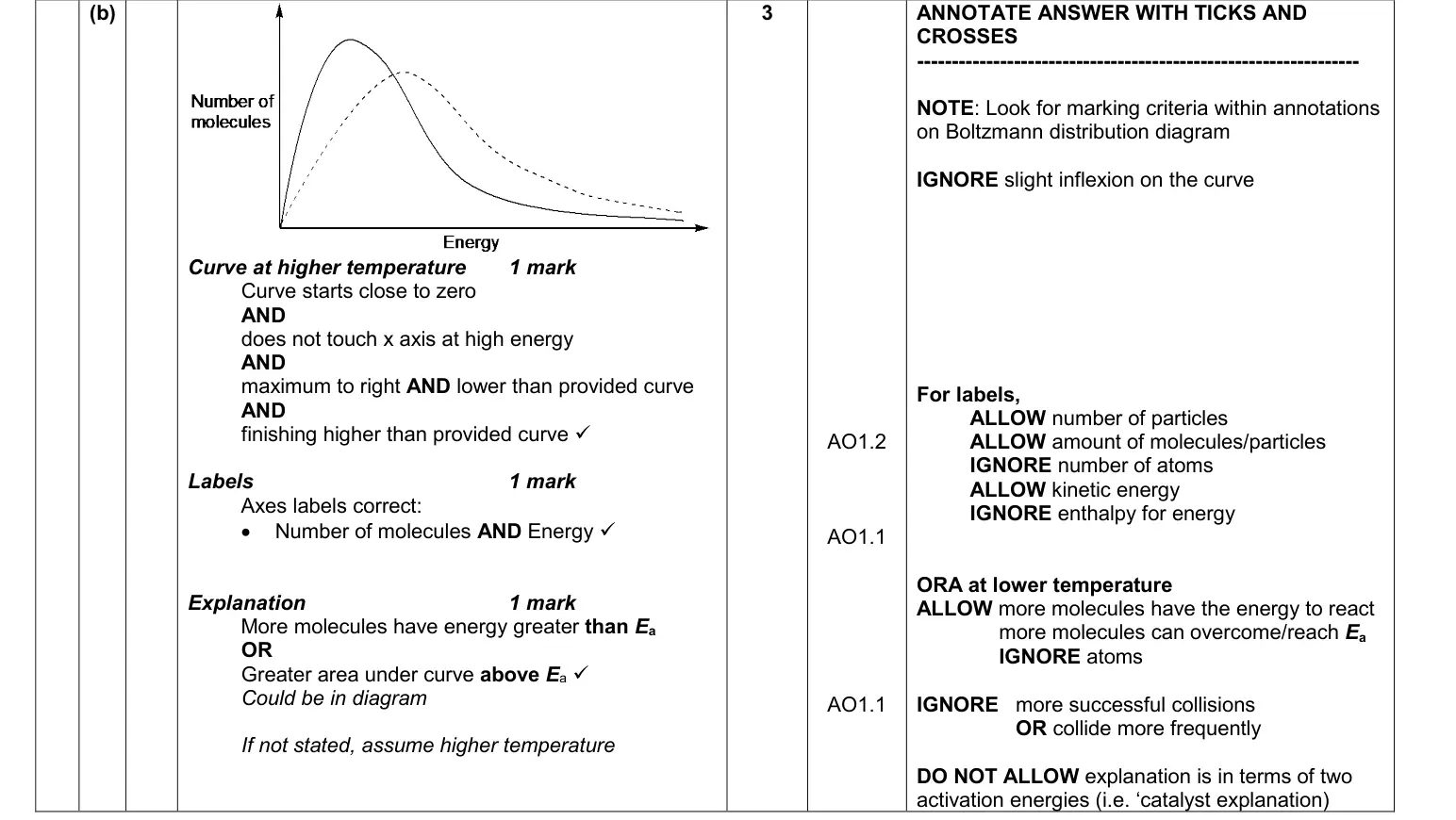
Most candidates answered this question well. Most graphs were drawn with care but some peaks were shown at the same height as the provided curve or meeting this curve at high energy. Some candidates labelled what should have been ‘energy’ on the x axis as ‘progress of reaction’, or used ‘atoms’ rather than molecules for the y axis label. Many candidates were able to explain that more molecules exceed the activation energy at a higher temperature.
Skills: M3.1 Translate information between graphical, numerical and algebraic forms
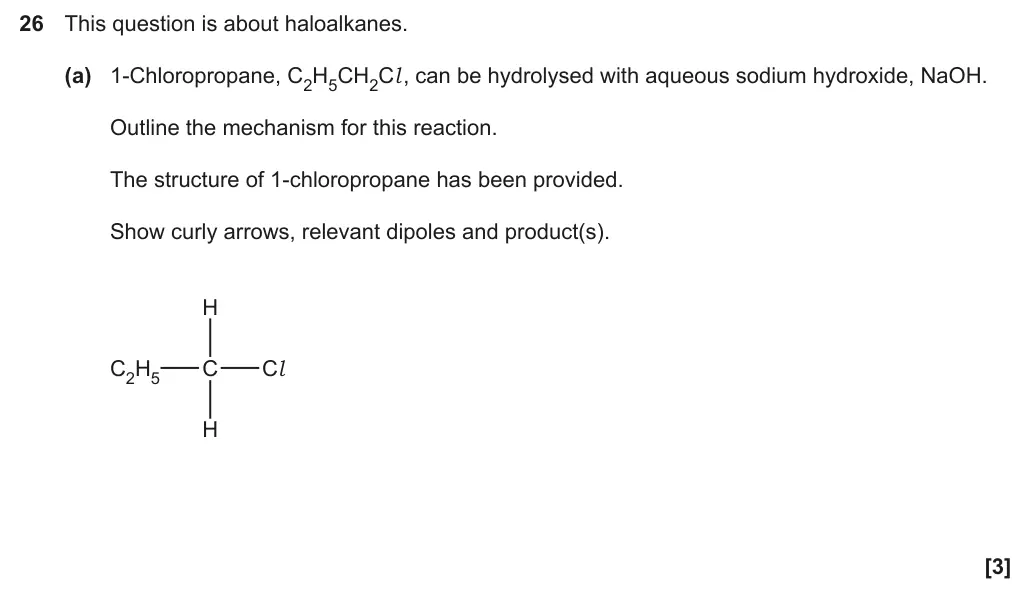
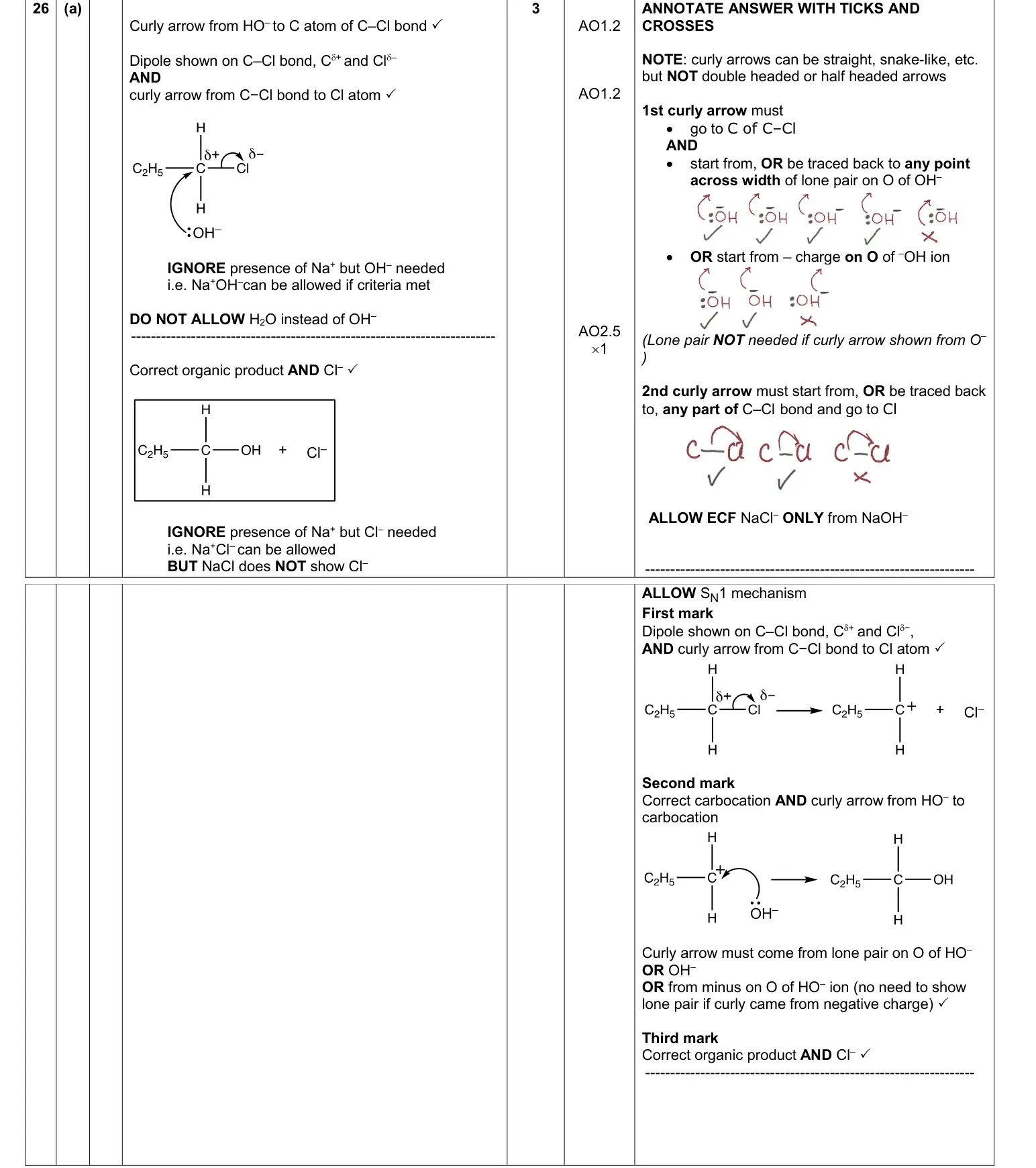
Although a simpler mechanism than electrophilic addition in Question 21 (a) (ii), candidate responses here were less successful. Many candidates weren’t able to identify the OH– ion attacking the carbon atom and the curly arrow often did not originate from an O lone pair or the negative charge. Candidates often omitted the dipole on the C–Cl bond or did not include a curly arrow. Candidates were expected to show both the resulting alcohol and Cl– as products. Many tried to incorporate Na into their organic structure. Organic mechanisms are a key concept in organic chemistry and it is essential for candidates to learn all the mechanisms in preparation for examinations. addition, nucleophilic substitution and radical substitution. This paper includes two of these in Questions 21 (a) (i) and 26 (a). It is essential that candidates learn these three mechanism types.
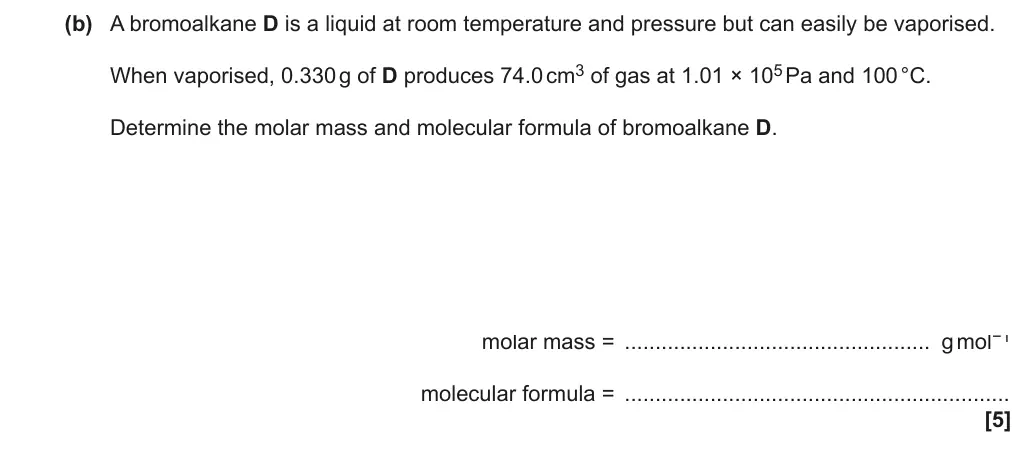
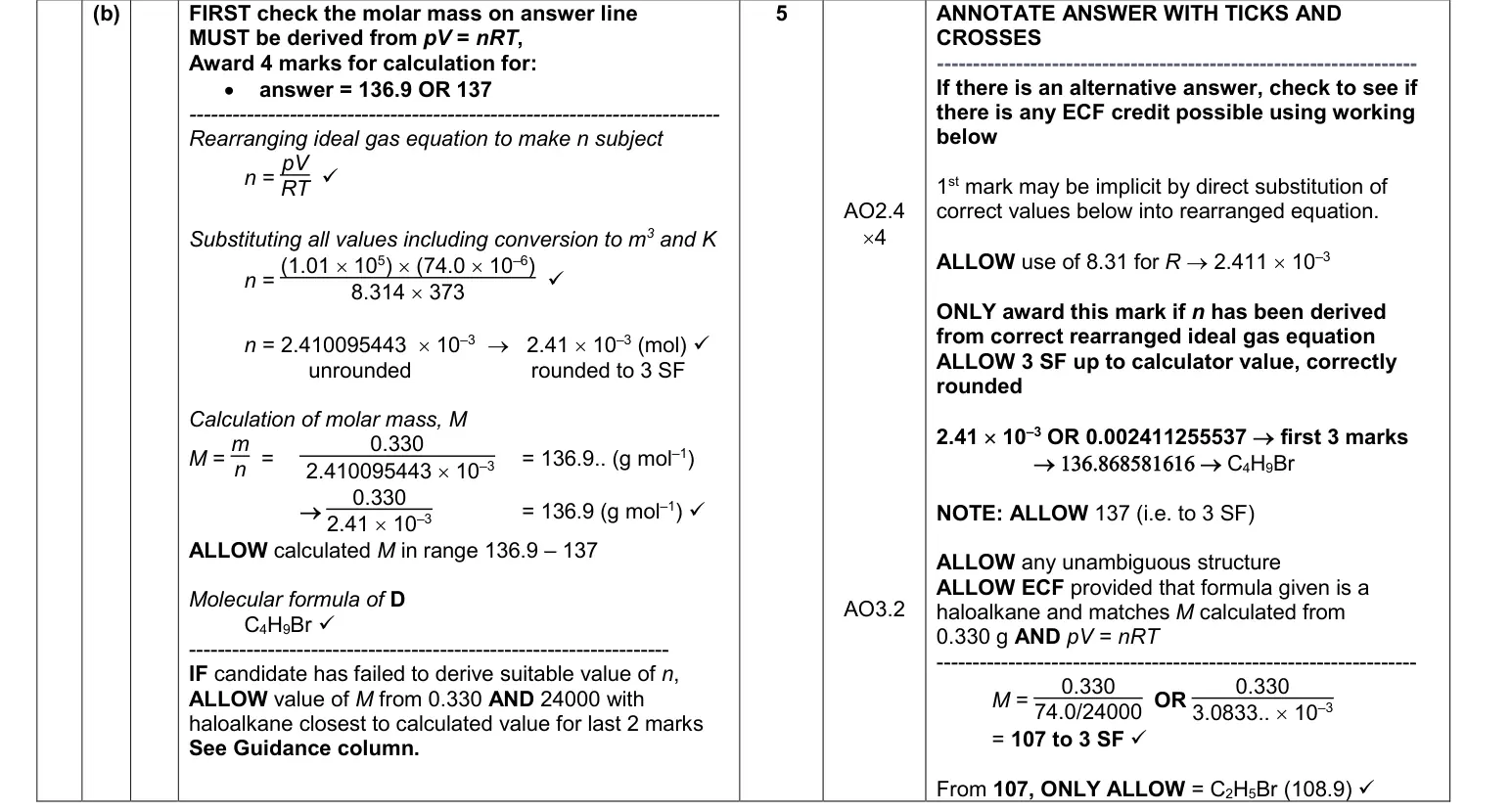
In contrast with the mechanism in Question 26 (a), this ideal gas calculation was answered well by most candidates. Most had obviously learnt the method for successfully processing this type of calculation. More candidates than in previous series were able to convert ºC into K and cm3 into m3 to obtain n = 0.00241 mol. Many candidates were then able to achieve the correct molar mass of 136.9 g mol–1 and molecular formula of C4H9Br. Candidates with incorrect unit conversions could still collect method marks by error carried forwards. The most common error was to use 10–3 instead of 10–6 for the cm3 conversion to m3, unfortunately this error led to a molar mass of 0.1369 from which a molecular formula is impossible. Notwithstanding the success of obtaining the correct answers, most calculations were unclearly presented, as in Question 25 (a) (i). If any of your students’ results are not as expected, you may wish to consider one of our post-results services. For full information about the options available visit the OCR website. We send a weekly roundup to tell you about important updates. You can also sign up for your subject specific updates. If you haven’t already, sign up here. Attend one of our popular CPD courses to hear directly from a senior assessor or drop in to a Q&A session. Most of our courses are delivered live via an online platform, so you can attend from any location. Please find details for all our courses on the relevant subject page on our website or visit OCR professional development. ExamBuilder is the question builder platform for a range of our GCSE, A Level, Cambridge Nationals and Cambridge Technicals qualifications. Find out more. ExamBuilder is free for all OCR centres with an Interchange account and gives you unlimited users per centre. We need an Interchange username to validate the identity of your centre's first user account for ExamBuilder. If you do not have an Interchange account please contact your centre administrator (usually the Exams Officer) to request a username, or nominate an existing Interchange user in your department. Review students' exam performance with our free online results analysis tool. It is available for all GCSEs, AS and A Levels and Cambridge Nationals. It allows you to: • review and run analysis reports on exam performance • analyse results at question and/or topic level • compare your centre with OCR national averages • identify trends across the centre • facilitate effective planning and delivery of courses • identify areas of the curriculum where students excel or struggle • help pinpoint strengths and weaknesses of students and teaching departments. Find out more. Post-results services Keep up-to-date OCR Professional Development Signed up for ExamBuilder?
Skills: M0.0 Recognise and make use of appropriate units in calculations; M1.1 Use an appropriate number of significant figures; M2.2 Change the subject of an equation; M2.3 Substitute numerical values into algebraic equations using appropriate units for physical quantities
Want a paper marked and gone through with you? Message us.