June 2019: AS Paper 2, Depth in chemistry

70 marks · 33 question parts · Paper, mark scheme and report on OCR's site · Have OCR's Data Sheet beside you

Question by question

QTopicMarksAOType
1(a)(i) Atomic structure and isotopes 2AO1Short answer
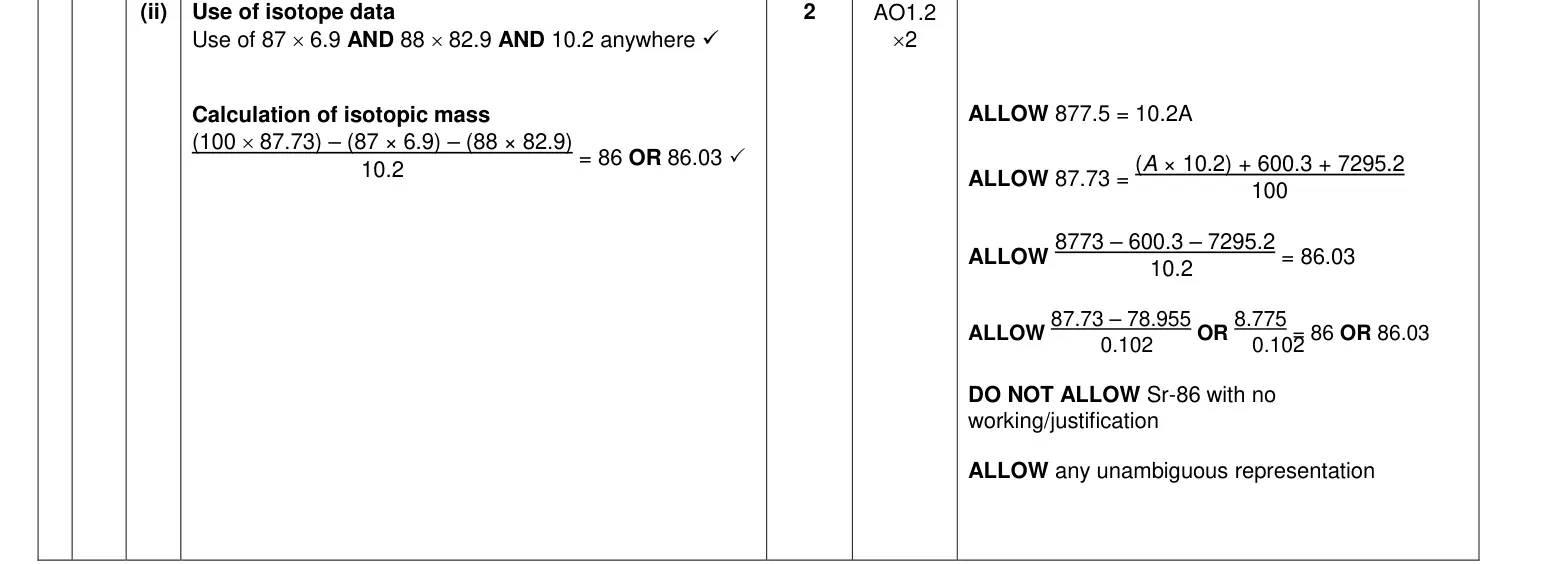
1(a)(ii) Atomic structure and isotopes 2AO1Calculation
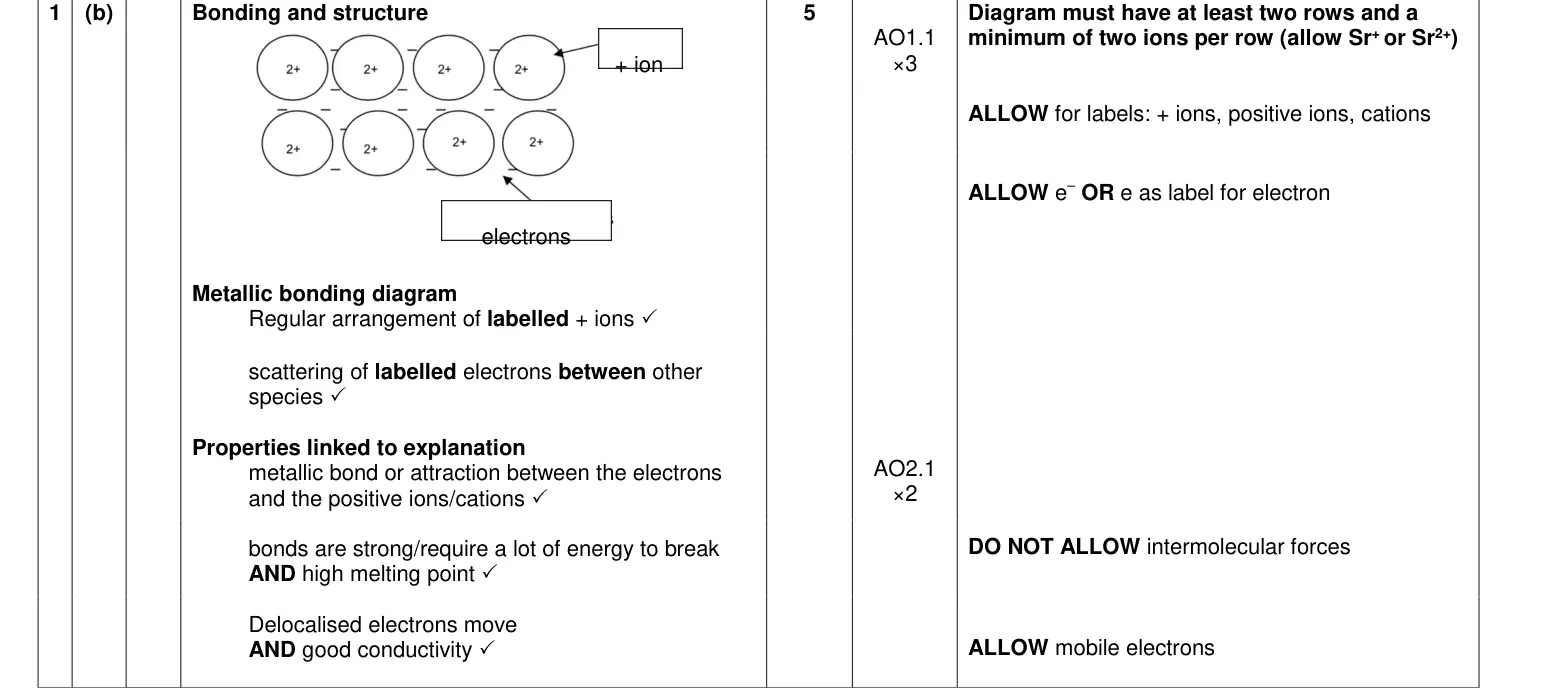
1(b) Periodicity and ionisation energy 5AO1, 2Drawing / labelling
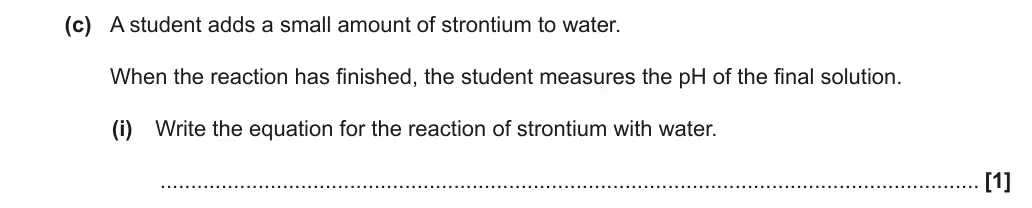
1(c)(i) Group 2 1AO2Equation writing
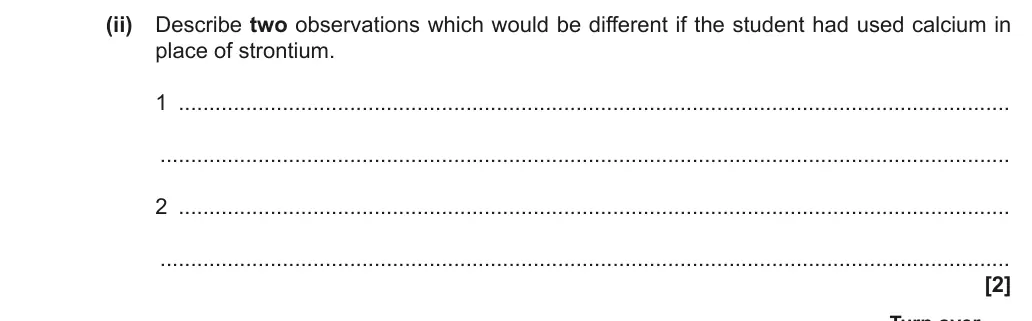
1(c)(ii) Group 2 2AO2Short answer
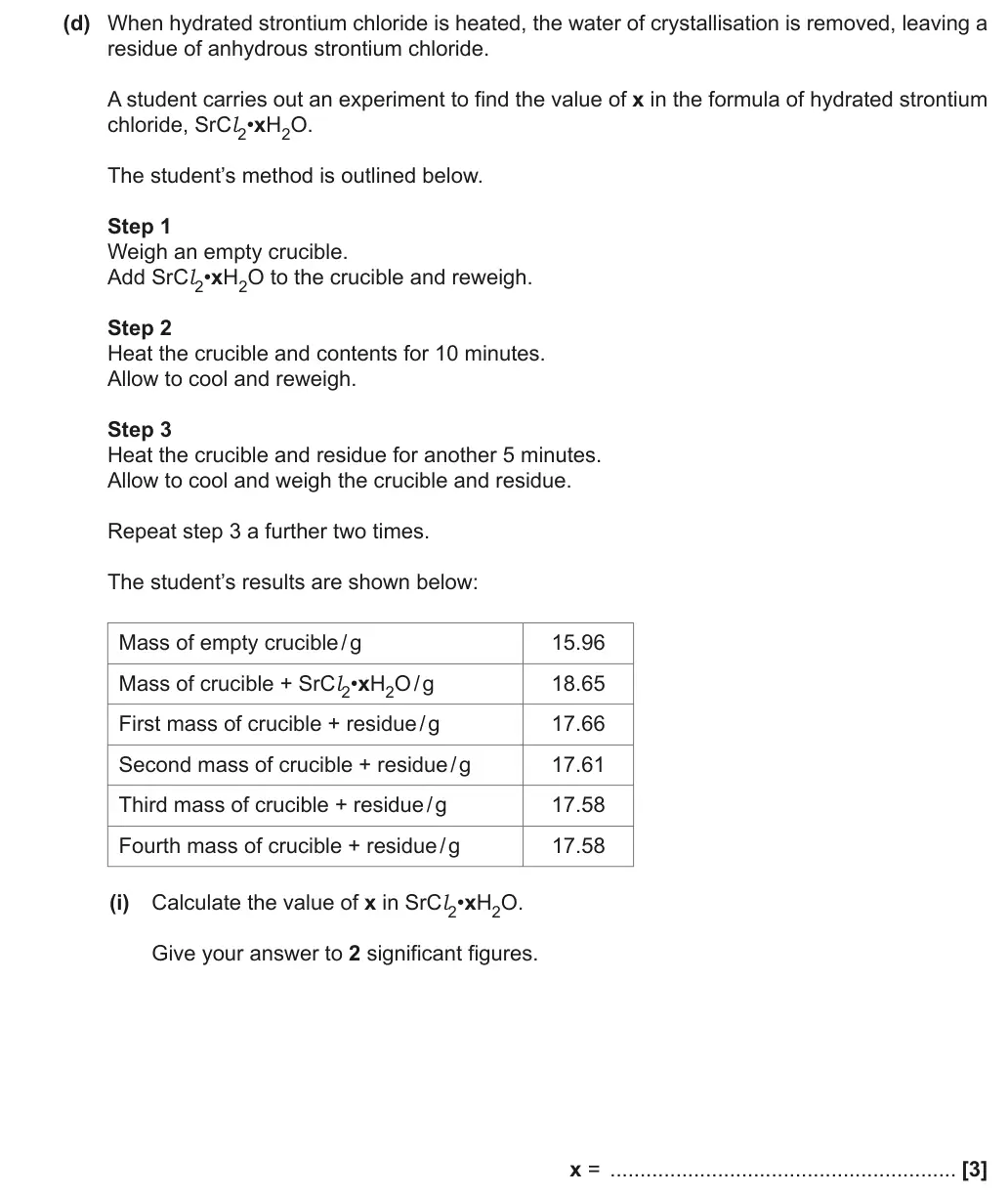
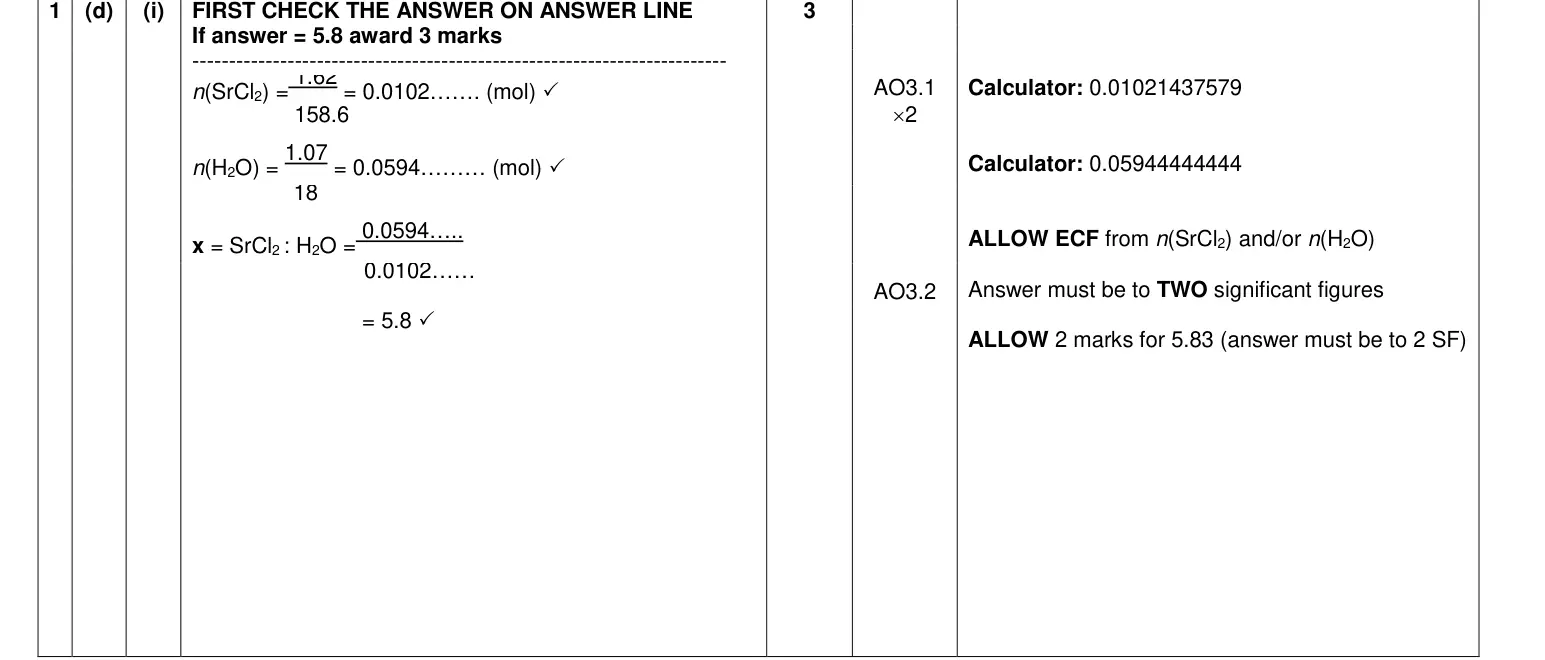
1(d)(i) Amount of substance (moles) 3AO3Calculation
1(d)(ii) Amount of substance (moles), Practical skills: planning, analysis and evaluation 1AO3Short answer
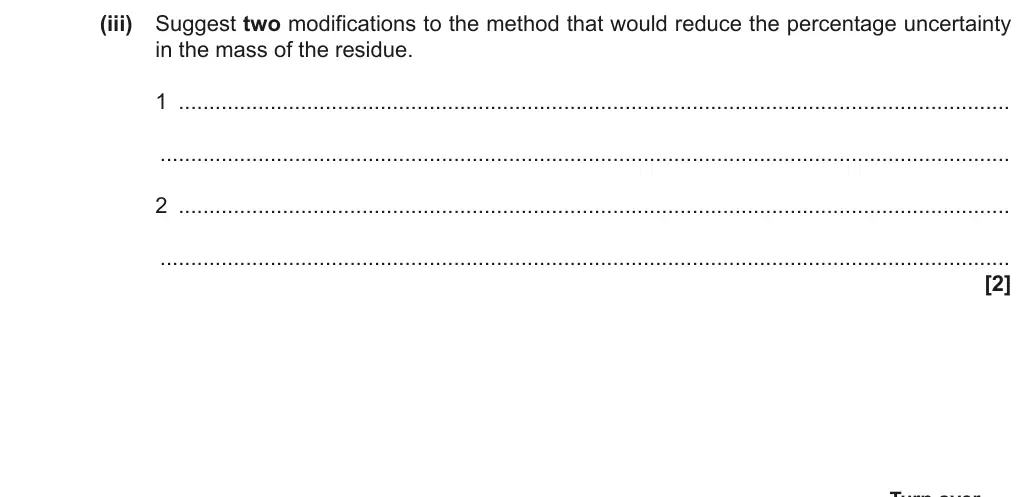
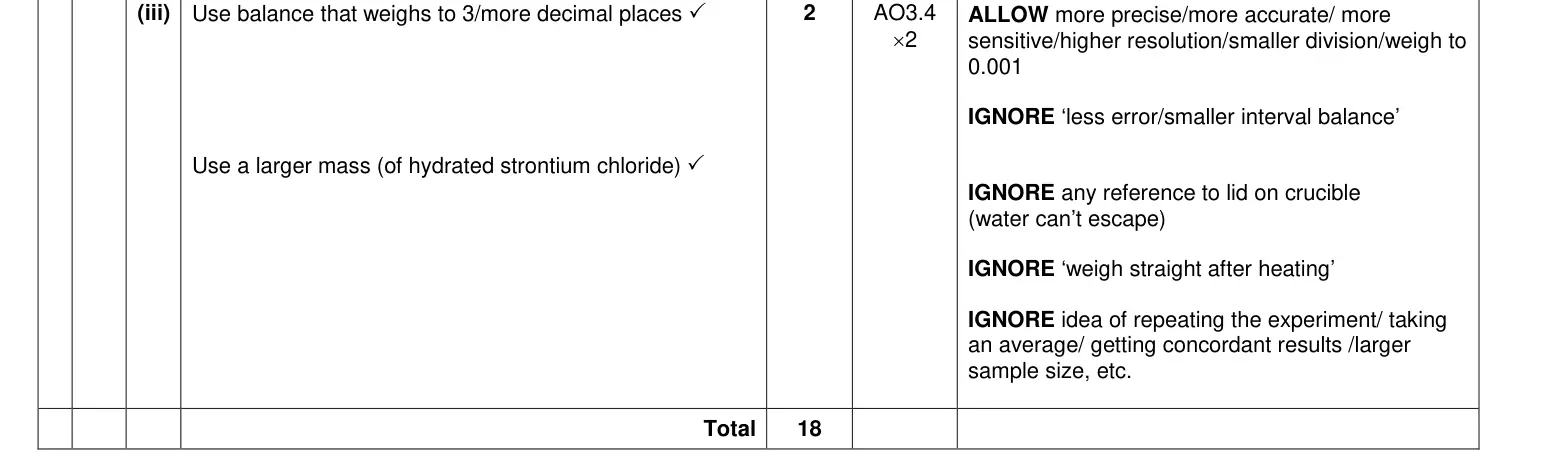
1(d)(iii) Practical skills: planning, analysis and evaluation 2AO3Short answer
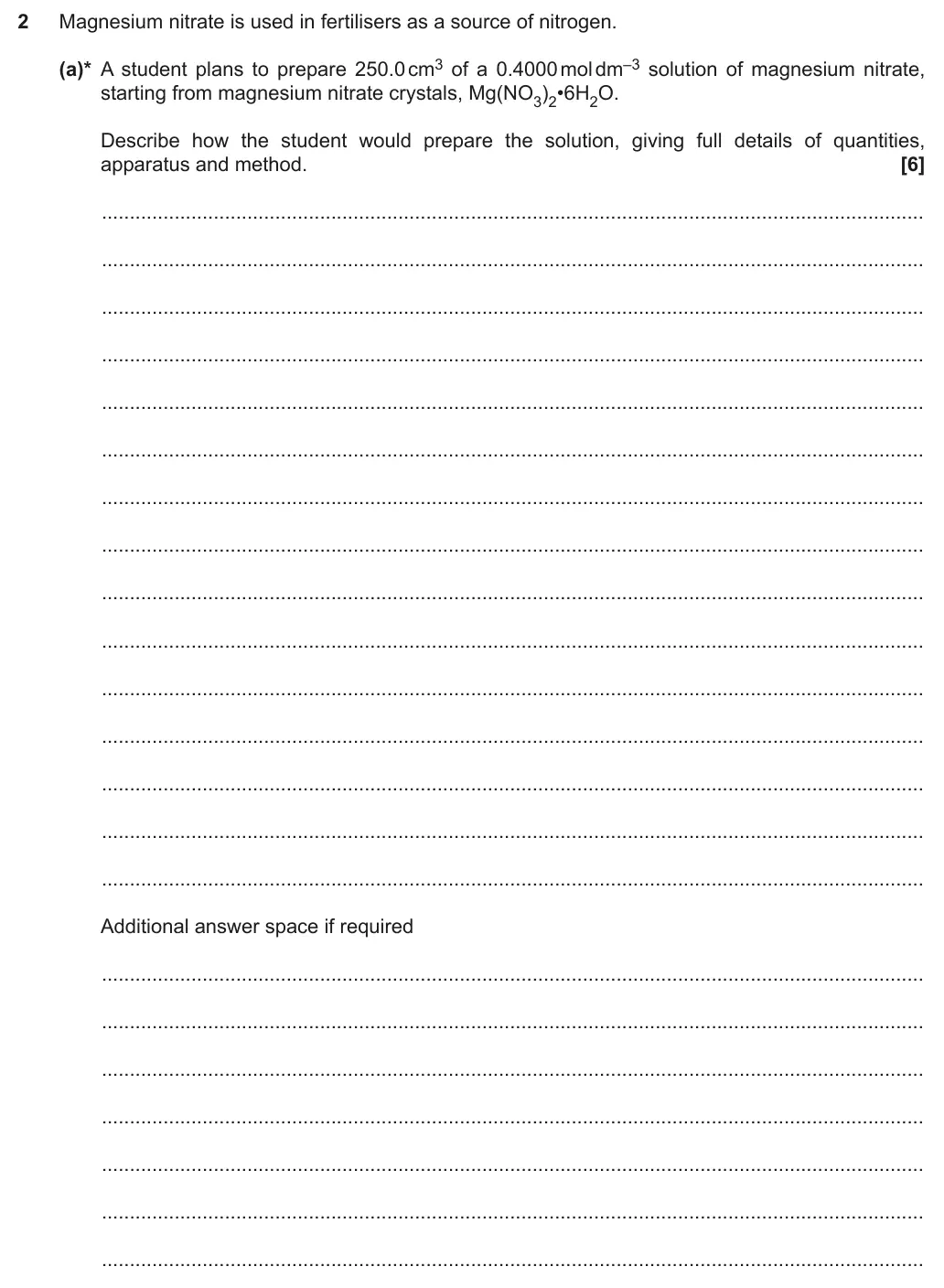
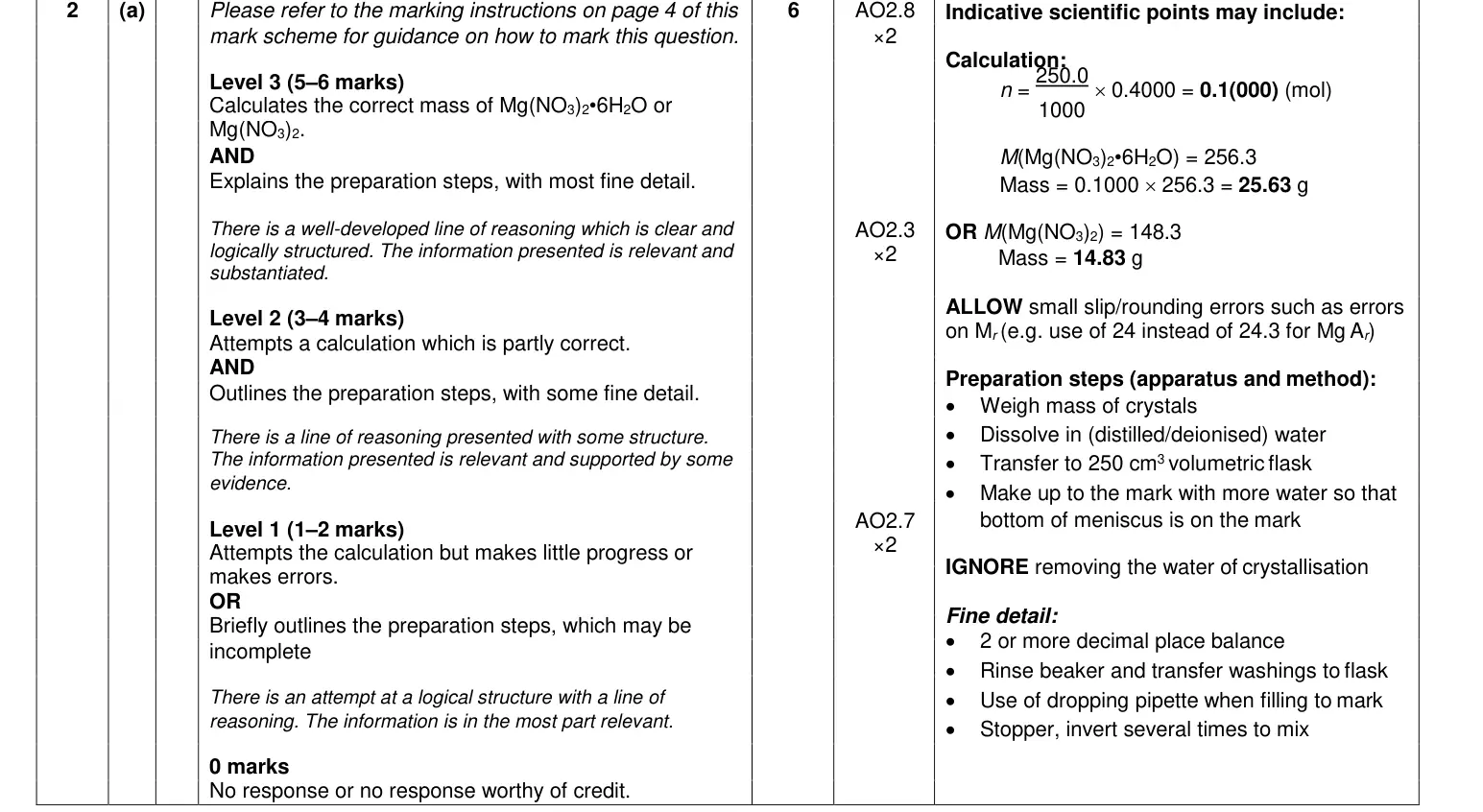
2(a) Acids, bases and titrations, Practical skills: planning, analysis and evaluation, Practical techniques and apparatus (PAGs), Amount of substance (moles) 6AO2Level of response
2(b) Amount of substance (moles) 3AO2Calculation
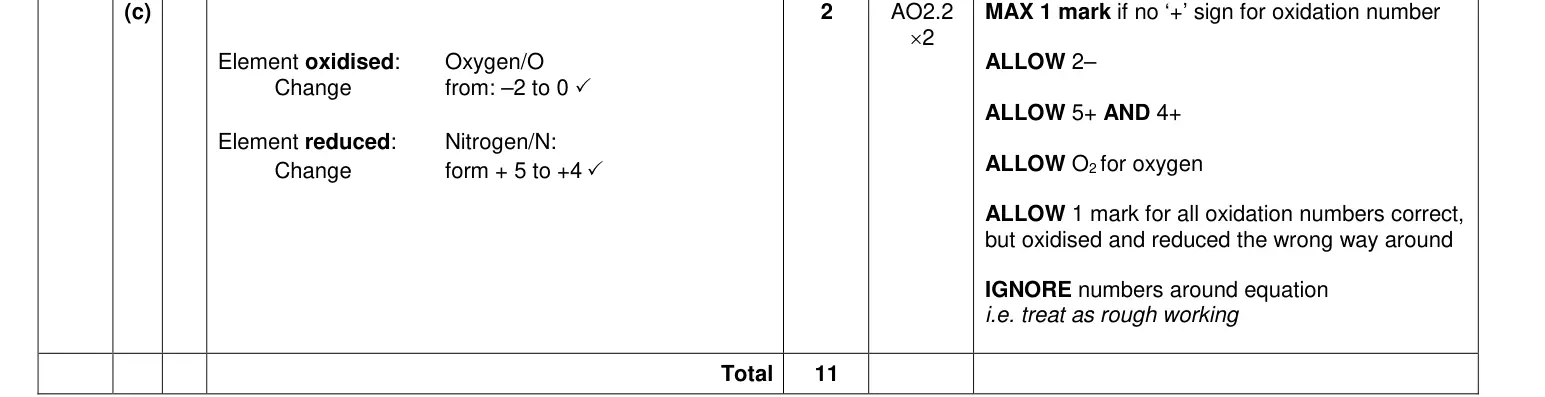
2(c) Redox and oxidation numbers 2AO2Short answer
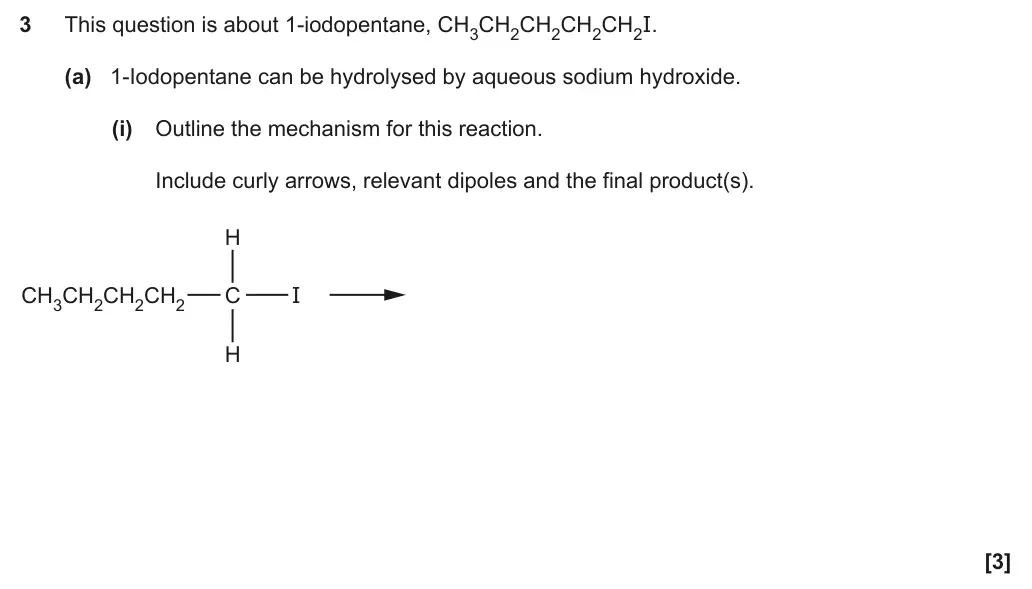
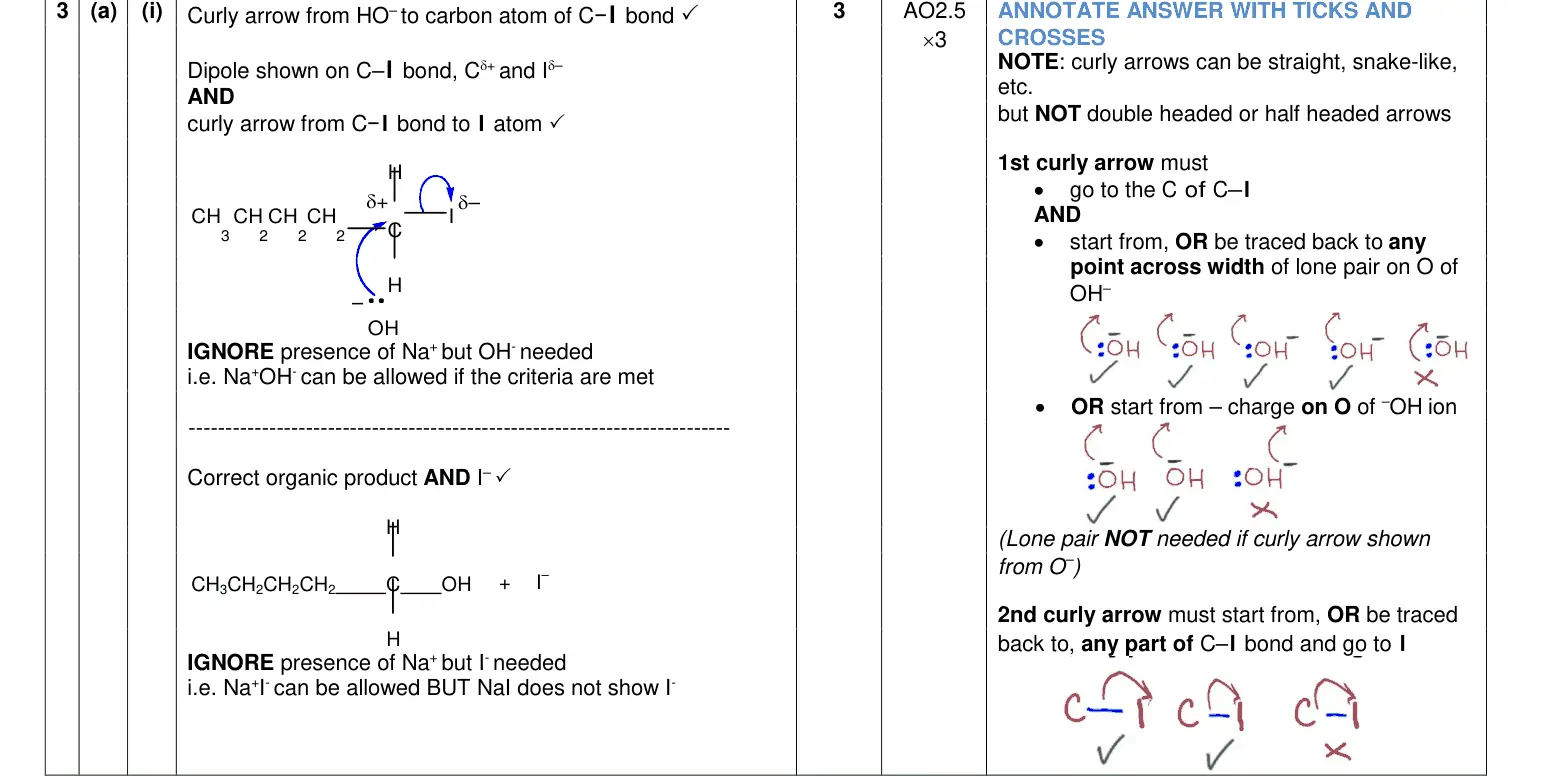
3(a)(i) Haloalkanes, Organic basics: naming, formulae and isomerism 3AO2Mechanism
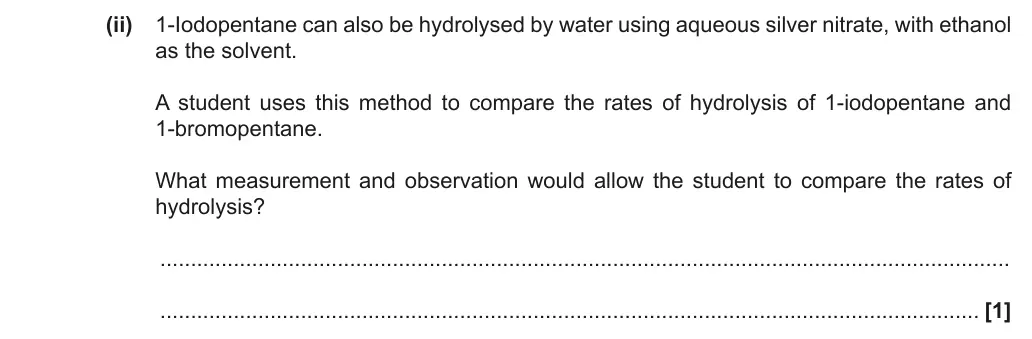
3(a)(ii) Haloalkanes 1AO3Short answer
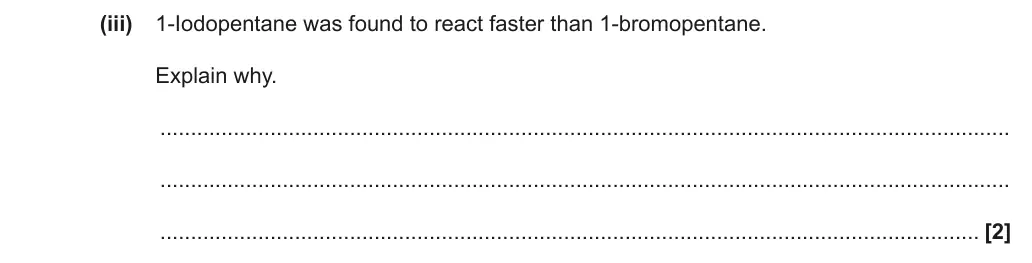
3(a)(iii) Haloalkanes 2AO3Short answer
3(b)(i) Infrared spectroscopy and mass spectrometry 1AO1Short answer
3(b)(ii) Infrared spectroscopy and mass spectrometry 2AO3Short answer
3(c)(i) Organic basics: naming, formulae and isomerism 1AO1Structure / isomer
3(c)(ii) Infrared spectroscopy and mass spectrometry 2AO3Short answer
4(a) Amount of substance (moles) 3AO2Calculation
4(b)(i) Practical skills: planning, analysis and evaluation, Reaction rates and the Boltzmann distribution 1AO2Graph plotting
4(b)(ii) Practical skills: planning, analysis and evaluation 1AO2Data interpretation
4(b)(iii) Practical skills: planning, analysis and evaluation, Reaction rates and the Boltzmann distribution 1AO3Drawing / labelling
4(c) Reaction rates and the Boltzmann distribution, Amount of substance (moles) 2AO2Data interpretation
4(d) Reaction rates and the Boltzmann distribution 2AO1Short answer
4(e)(i) Reaction rates and the Boltzmann distribution 2AO1Short answer
4(e)(ii) Reaction rates and the Boltzmann distribution 1AO2Short answer
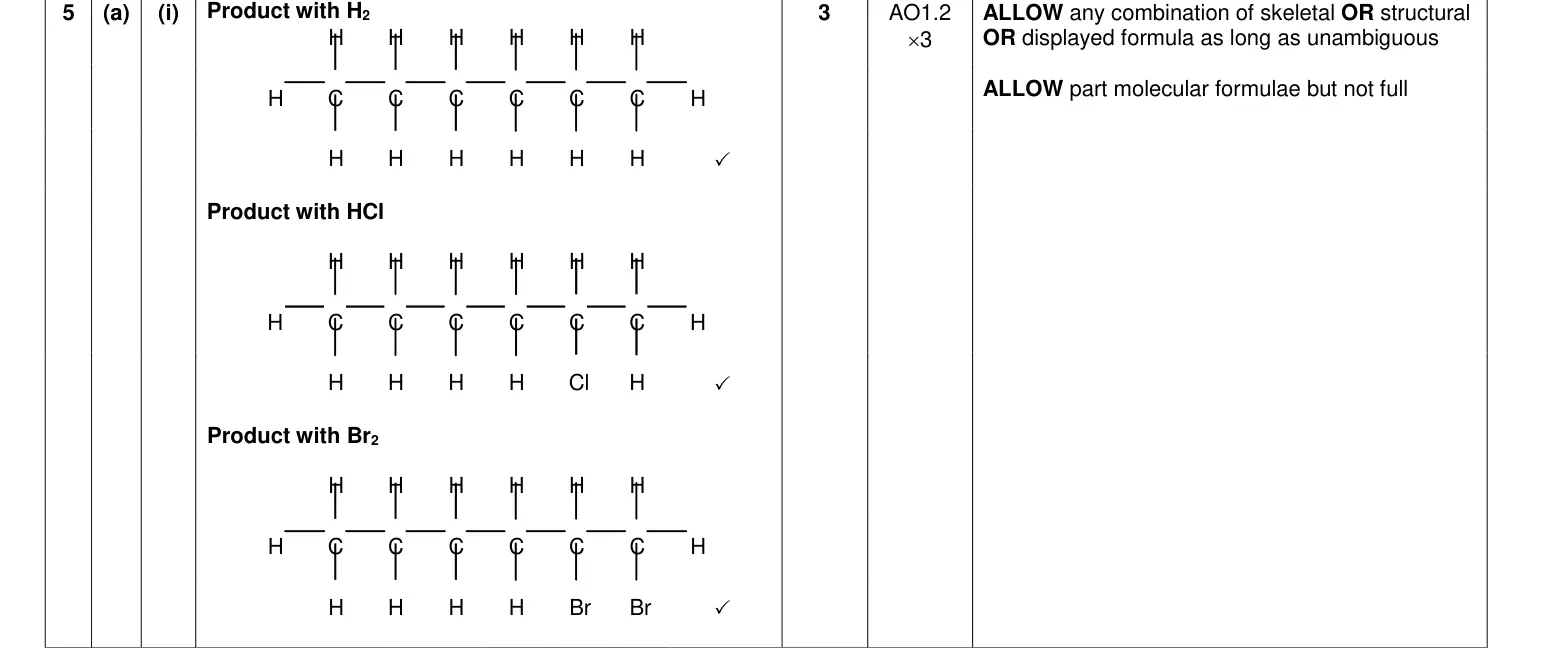
5(a)(i) Alkenes 3AO1Complete table/diagram
5(a)(ii) Alkenes 1AO1Short answer
5(a)(iii) Alkenes 1AO1Short answer
5(b)(i) Organic synthesis and practical techniques (Module 4), Practical techniques and apparatus (PAGs), Amount of substance (moles) 6AO2, 3Level of response
5(b)(ii) Alcohols, Organic basics: naming, formulae and isomerism 2AO3Short answer
5(c)(i) Alkenes 1AO2Drawing / labelling
5(c)(ii) Alkenes 2AO1Short answer

The questions

1(a)(i)1(a)(ii)1(b)1(c)(i)1(c)(ii)1(d)(i)1(d)(ii)1(d)(iii)2(a)2(b)2(c)3(a)(i)3(a)(ii)3(a)(iii)3(b)(i)3(b)(ii)3(c)(i)3(c)(ii)4(a)4(b)(i)4(b)(ii)4(b)(iii)4(c)4(d)4(e)(i)4(e)(ii)5(a)(i)5(a)(ii)5(a)(iii)5(b)(i)5(b)(ii)5(c)(i)5(c)(ii)
June 2019 · AS Paper 2 · Q1(a)(i) 2 marks AO1 Short answer Medium atomic structure and isotopes
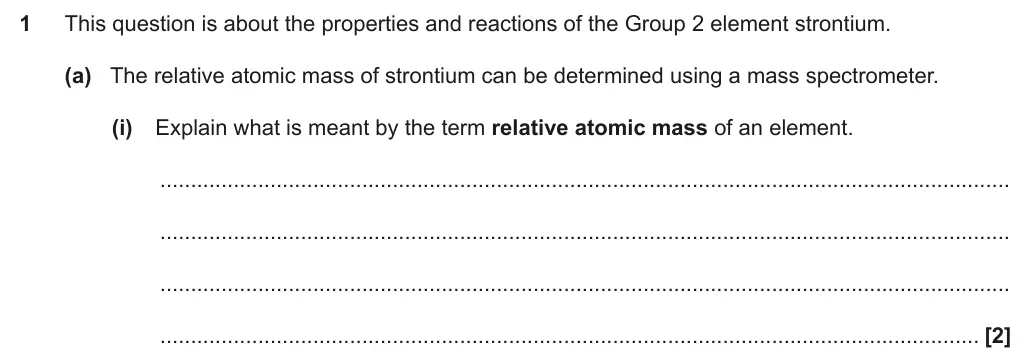
1 This question is about the properties and reactions of the Group 2 element strontium.
(a) The relative atomic mass of strontium can be determined using a mass spectrometer.
(i) Explain what is meant by the term relative atomic mass of an element.
...........................................................................................................................................
...........................................................................................................................................
...........................................................................................................................................
...................................................................................................................................... [2]
June 2019 · AS Paper 2 · Q1(a)(ii) 2 marks AO1 Calculation Easy atomic structure and isotopes
Earlier part of question 1 that this part usesEarlier part of June 2019 Paper 2 question 1
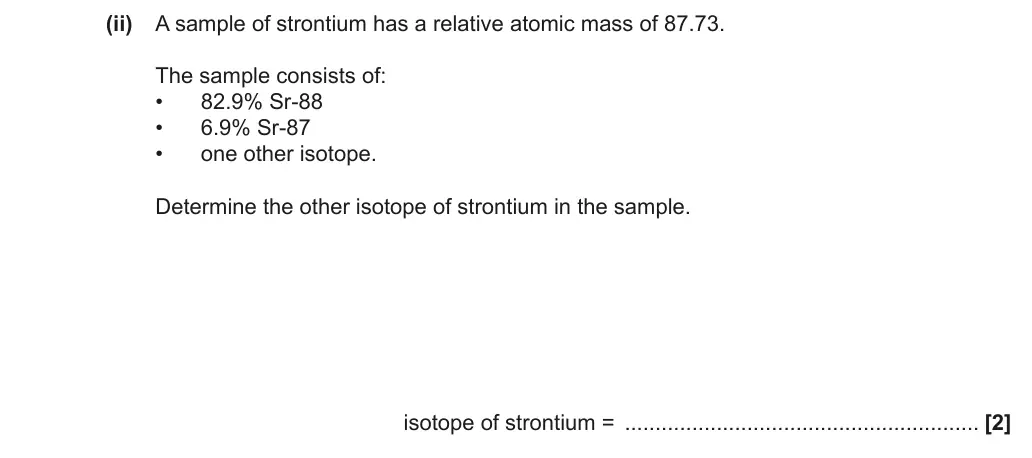
(ii) A sample of strontium has a relative atomic mass of 87.73.
The sample consists of:
• 82.9% Sr-88
• 6.9% Sr-87
• one other isotope.
Determine the other isotope of strontium in the sample.
isotope of strontium =  .......................................................... [2]
June 2019 · AS Paper 2 · Q1(b) 5 marks AO1, 2 Drawing / labelling Hard periodicity
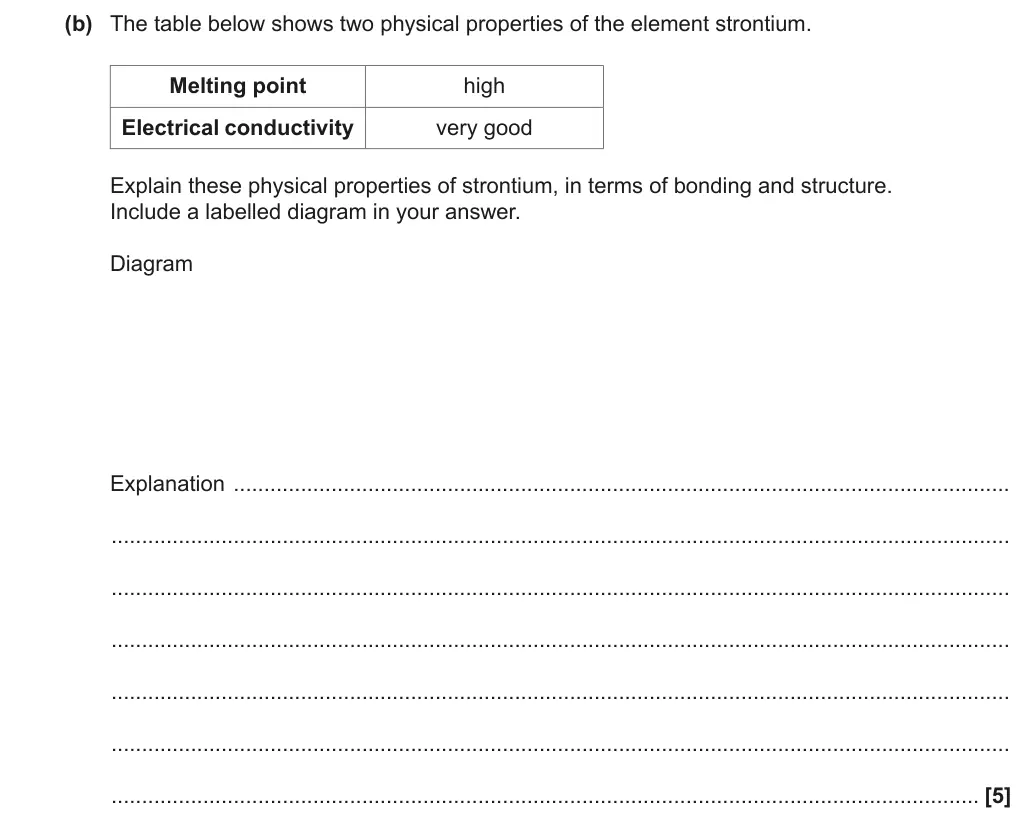
(b) The table below shows two physical properties of the element strontium.
Melting point high
Electrical conductivity very good
Explain these physical properties of strontium, in terms of bonding and structure.
Include a labelled diagram in your answer.
Diagram
Explanation  ...............................................................................................................................
...................................................................................................................................................
...................................................................................................................................................
...................................................................................................................................................
...................................................................................................................................................
...................................................................................................................................................
.............................................................................................................................................. [5]
June 2019 · AS Paper 2 · Q1(c)(i) 1 mark AO2 Equation writing Medium group 2
(c) A student adds a small amount of strontium to water.
When the reaction has finished, the student measures the pH of the final solution.
(i) Write the equation for the reaction of strontium with water.
...................................................................................................................................... [1]
June 2019 · AS Paper 2 · Q1(c)(ii) 2 marks AO2 Short answer Easy group 2
Earlier part of question 1 that this part usesEarlier part of June 2019 Paper 2 question 1
(ii) Describe two observations which would be different if the student had used calcium in
place of strontium.
1  ........................................................................................................................................
...........................................................................................................................................
2  ........................................................................................................................................
...........................................................................................................................................
[2]
June 2019 · AS Paper 2 · Q1(d)(i) 3 marks AO3 Calculation Medium amount of substance
(d) When hydrated strontium chloride is heated, the water of crystallisation is removed, leaving a
residue of anhydrous strontium chloride.
A student carries out an experiment to find the value of x in the formula of hydrated strontium
chloride, SrCl2•xH2O.
The student’s method is outlined below.
Step 1
Weigh an empty crucible.
Add SrCl2•xH2O to the crucible and reweigh.
Step 2
Heat the crucible and contents for 10 minutes.
Allow to cool and reweigh.
Step 3
Heat the crucible and residue for another 5 minutes.
Allow to cool and weigh the crucible and residue.
Repeat step 3 a further two times.
The student’s results are shown below:
Mass of empty crucible / g 15.96
Mass of crucible + SrCl2•xH2O / g 18.65
First mass of crucible + residue / g 17.66
Second mass of crucible + residue / g 17.61
Third mass of crucible + residue / g 17.58
Fourth mass of crucible + residue / g 17.58
(i) Calculate the value of x in SrCl2•xH2O.
Give your answer to 2 significant figures.
x =  .......................................................... [3]
June 2019 · AS Paper 2 · Q1(d)(ii) 1 mark AO3 Short answer Medium amount of substancepractical skills
Earlier part of question 1 that this part usesEarlier part of June 2019 Paper 2 question 1
(ii) Suggest why the student takes four readings of the mass of the crucible and residue.
...........................................................................................................................................
...................................................................................................................................... [1]
June 2019 · AS Paper 2 · Q1(d)(iii) 2 marks AO3 Short answer Medium practical skills
Earlier part of question 1 that this part usesEarlier part of June 2019 Paper 2 question 1
(iii) Suggest two modifications to the method that would reduce the percentage uncertainty
in the mass of the residue.
1  ........................................................................................................................................
...........................................................................................................................................
2  ........................................................................................................................................
...........................................................................................................................................
[2]
June 2019 · AS Paper 2 · Q2(a) 6 marks AO2 6-mark level of response Medium acids and titrationspractical skillspractical techniquesamount of substance
2 Magnesium nitrate is used in fertilisers as a source of nitrogen.
(a)* A student plans to prepare 250.0 cm3 of a 0.4000 mol dm–3 solution of magnesium nitrate,
starting from magnesium nitrate crystals, Mg(NO3)2•6H2O.
Describe how the student would prepare the solution, giving full details of quantities,
apparatus and method. [6]
...................................................................................................................................................
...................................................................................................................................................
...................................................................................................................................................
...................................................................................................................................................
...................................................................................................................................................
...................................................................................................................................................
...................................................................................................................................................
...................................................................................................................................................
...................................................................................................................................................
...................................................................................................................................................
...................................................................................................................................................
...................................................................................................................................................
...................................................................................................................................................
...................................................................................................................................................
...................................................................................................................................................
Additional answer space if required
...................................................................................................................................................
...................................................................................................................................................
...................................................................................................................................................
...................................................................................................................................................
...................................................................................................................................................
...................................................................................................................................................
...................................................................................................................................................
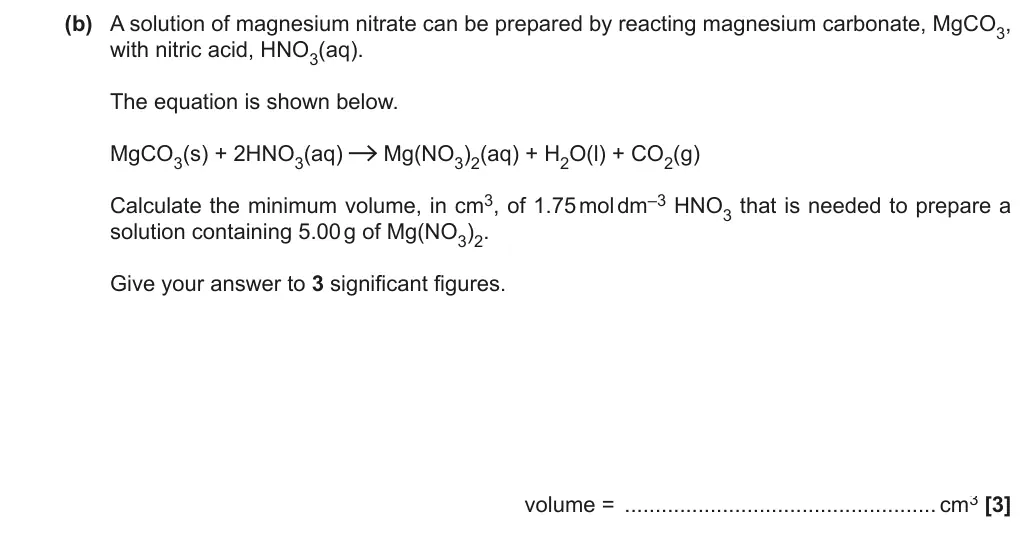
June 2019 · AS Paper 2 · Q2(b) 3 marks AO2 Calculation Easy amount of substance
(b) A solution of magnesium nitrate can be prepared by reacting magnesium carbonate, MgCO3,
with nitric acid, HNO3(aq).
The equation is shown below.
MgCO3(s) + 2HNO3(aq) Mg(NO3)2(aq) + H2O(l) + CO2(g)
Calculate the minimum volume, in cm3, of 1.75 mol dm–3 HNO3 that is needed to prepare a
solution containing 5.00 g of Mg(NO3)2.
Give your answer to 3 significant figures.
volume =  ................................................... cm3 [3]
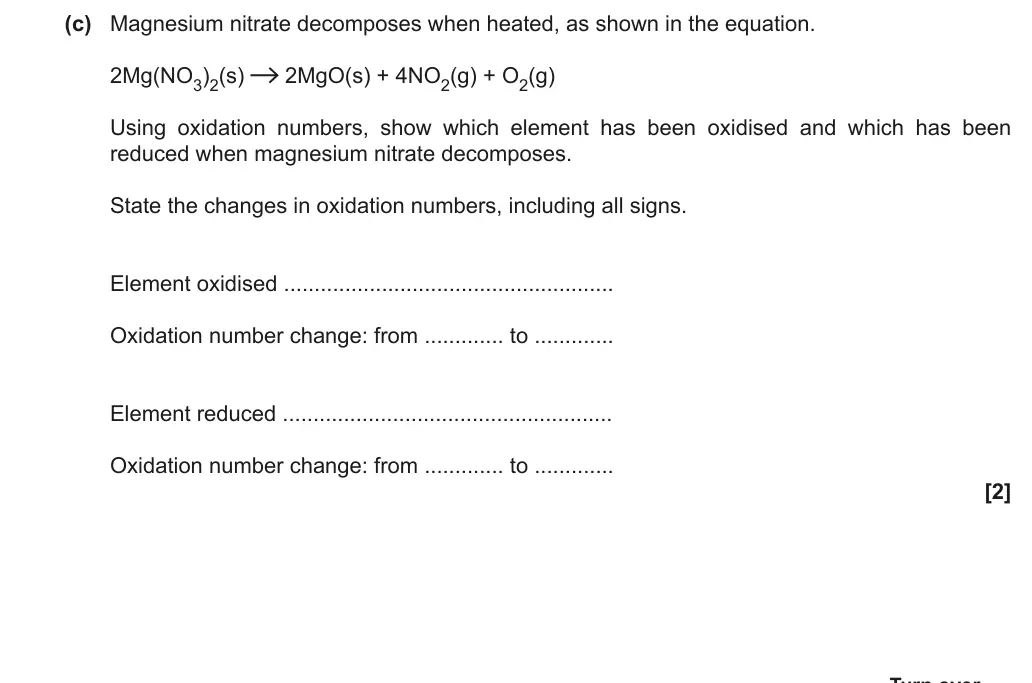
June 2019 · AS Paper 2 · Q2(c) 2 marks AO2 Short answer Medium redox
(c) Magnesium nitrate decomposes when heated, as shown in the equation.
2Mg(NO3)2(s) 2MgO(s) + 4NO2(g) + O2(g)
Using oxidation numbers, show which element has been oxidised and which has been
reduced when magnesium nitrate decomposes.
State the changes in oxidation numbers, including all signs.
Element oxidised ......................................................
Oxidation number change: from ............. to .............
Element reduced ......................................................
Oxidation number change: from ............. to .............
[2]
June 2019 · AS Paper 2 · Q3(a)(i) 3 marks AO2 Mechanism Medium haloalkanesorganic basics
3 This question is about 1-iodopentane, CH3CH2CH2CH2CH2I.
(a) 1-Iodopentane can be hydrolysed by aqueous sodium hydroxide.
(i) Outline the mechanism for this reaction.
Include curly arrows, relevant dipoles and the final product(s).
H
CH3CH2CH2CH2 C I
H
[3]
June 2019 · AS Paper 2 · Q3(a)(ii) 1 mark AO3 Short answer Medium haloalkanes
Earlier part of question 3 that this part usesEarlier part of June 2019 Paper 2 question 3
(ii) 1-Iodopentane can also be hydrolysed by water using aqueous silver nitrate, with ethanol
as the solvent.
A student uses this method to compare the rates of hydrolysis of 1-iodopentane and
1-bromopentane.
What measurement and observation would allow the student to compare the rates of
hydrolysis?
...........................................................................................................................................
...................................................................................................................................... [1]
June 2019 · AS Paper 2 · Q3(a)(iii) 2 marks AO3 Short answer Medium haloalkanes
Earlier parts of question 3 that this part usesEarlier part of June 2019 Paper 2 question 3Earlier part of June 2019 Paper 2 question 3
(iii) 1-Iodopentane was found to react faster than 1-bromopentane.
Explain why.
...........................................................................................................................................
...........................................................................................................................................
...................................................................................................................................... [2]
June 2019 · AS Paper 2 · Q3(b)(i) 1 mark AO1 Short answer Easy infrared and mass spectrometry
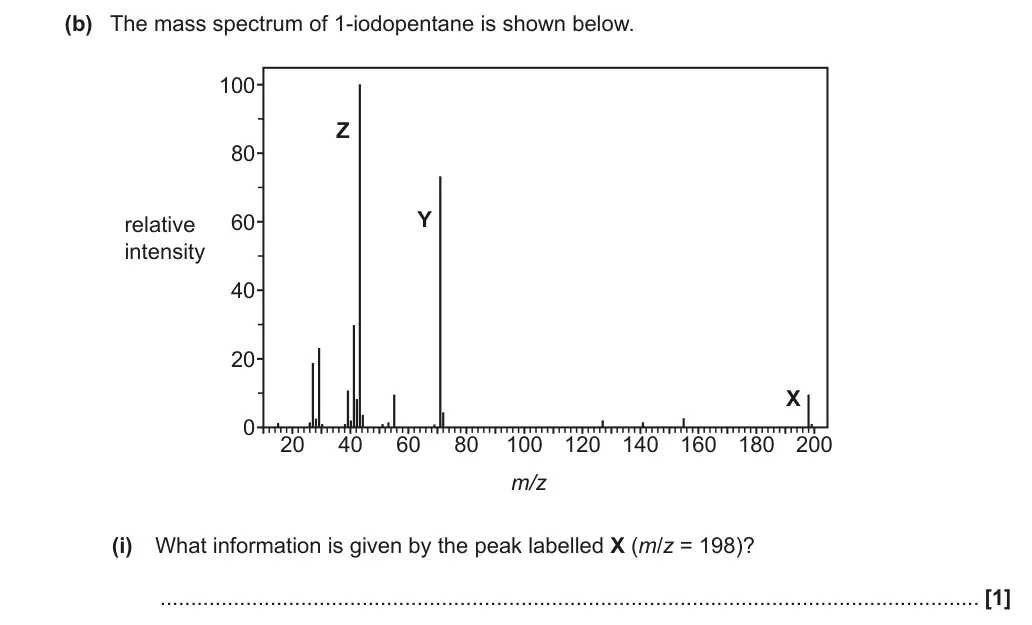
(b) The mass spectrum of 1-iodopentane is shown below.
100
Z
80
relative 60 Y
intensity
40
20
X
0
20 40 60 80 100 120 140 160 180 200
m/z
(i) What information is given by the peak labelled X (m/z = 198)?
...................................................................................................................................... [1]
June 2019 · AS Paper 2 · Q3(b)(ii) 2 marks AO3 Short answer Medium infrared and mass spectrometry
Earlier part of question 3 that this part usesEarlier part of June 2019 Paper 2 question 3
(ii) Write the structural formulae of the ions responsible for the peaks labelled Y and Z.
Y (m/z = 71)  .......................................................................................................................
Z (m/z = 43)  .................................................................................................................. [2]
June 2019 · AS Paper 2 · Q3(c)(i) 1 mark AO1 Structure / isomer Easy organic basics
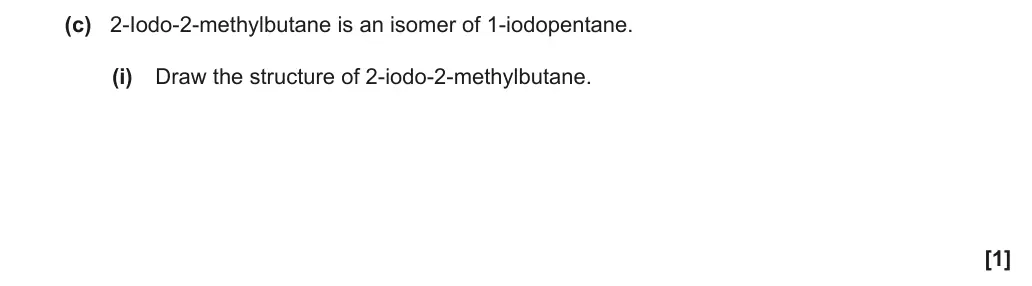
(c) 2-Iodo-2-methylbutane is an isomer of 1-iodopentane.
(i) Draw the structure of 2-iodo-2-methylbutane.
[1]
June 2019 · AS Paper 2 · Q3(c)(ii) 2 marks AO3 Short answer Hard infrared and mass spectrometry
Earlier parts of question 3 that this part usesEarlier part of June 2019 Paper 2 question 3Earlier part of June 2019 Paper 2 question 3Earlier part of June 2019 Paper 2 question 3
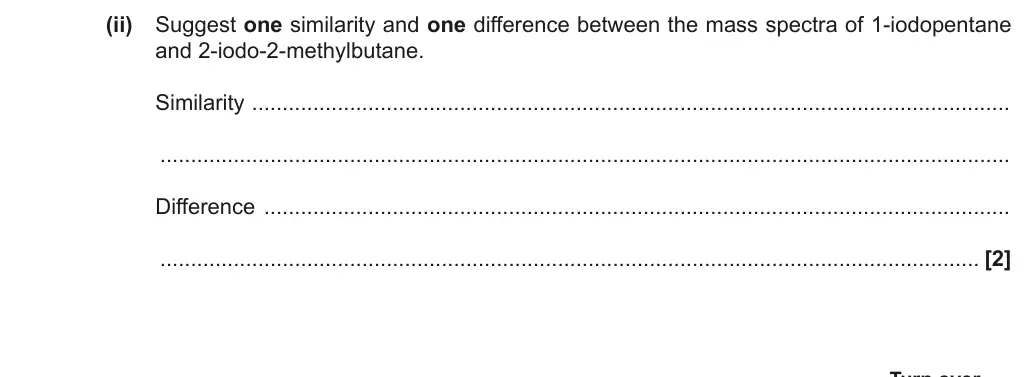
(ii) Suggest one similarity and one difference between the mass spectra of 1-iodopentane
and 2-iodo-2-methylbutane.
Similarity  ............................................................................................................................
...........................................................................................................................................
Difference  ..........................................................................................................................
...................................................................................................................................... [2]
June 2019 · AS Paper 2 · Q4(a) 3 marks AO2 Calculation Easy amount of substance
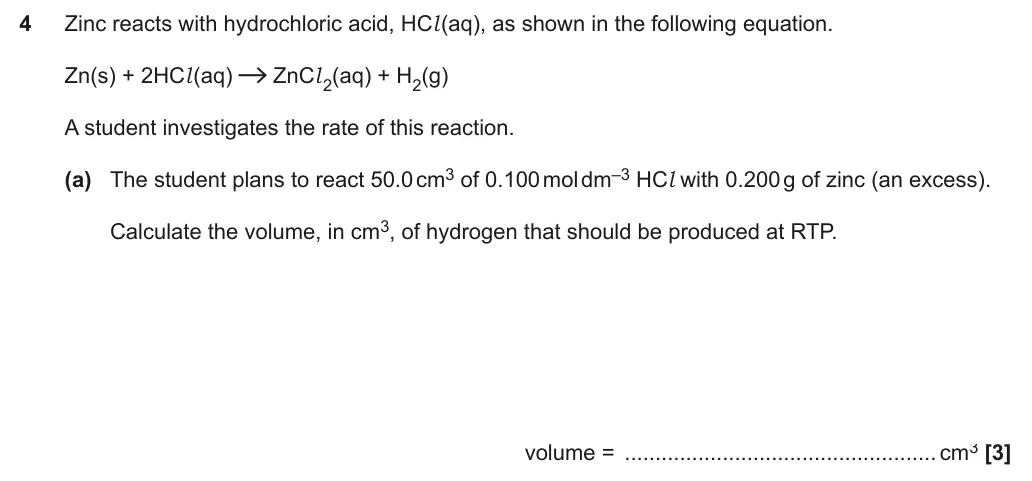
4 Zinc reacts with hydrochloric acid, HCl(aq), as shown in the following equation.
Zn(s) + 2HCl(aq) ZnCl2(aq) + H2(g)
A student investigates the rate of this reaction.
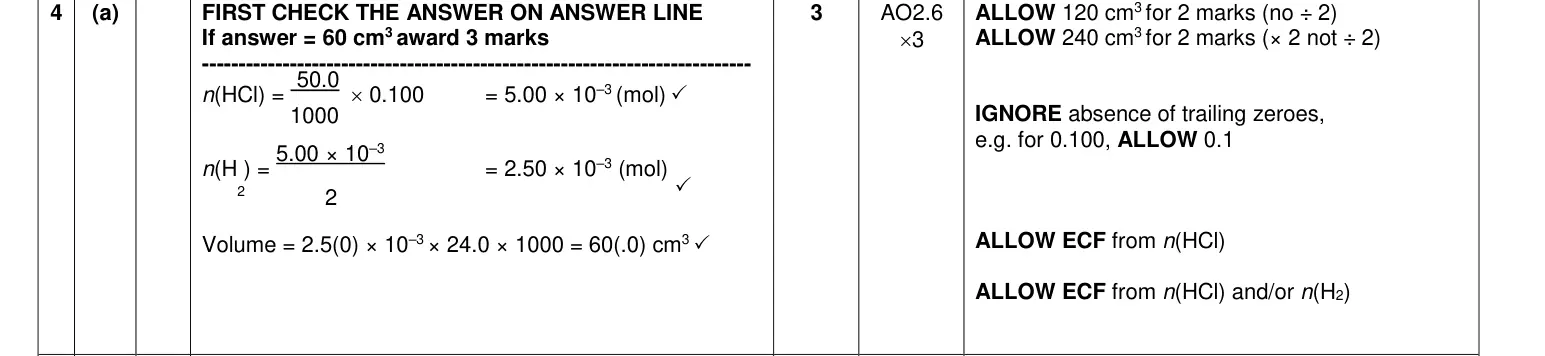
(a) The student plans to react 50.0 cm3 of 0.100 mol dm–3 HCl with 0.200 g of zinc (an excess).
Calculate the volume, in cm3, of hydrogen that should be produced at RTP.
volume =  ................................................... cm3 [3]
June 2019 · AS Paper 2 · Q4(b)(i) 1 mark AO2 Graph plotting Medium practical skillsreaction rates
Earlier parts of question 4 that this part usesEarlier part of June 2019 Paper 2 question 4Earlier part of June 2019 Paper 2 question 4
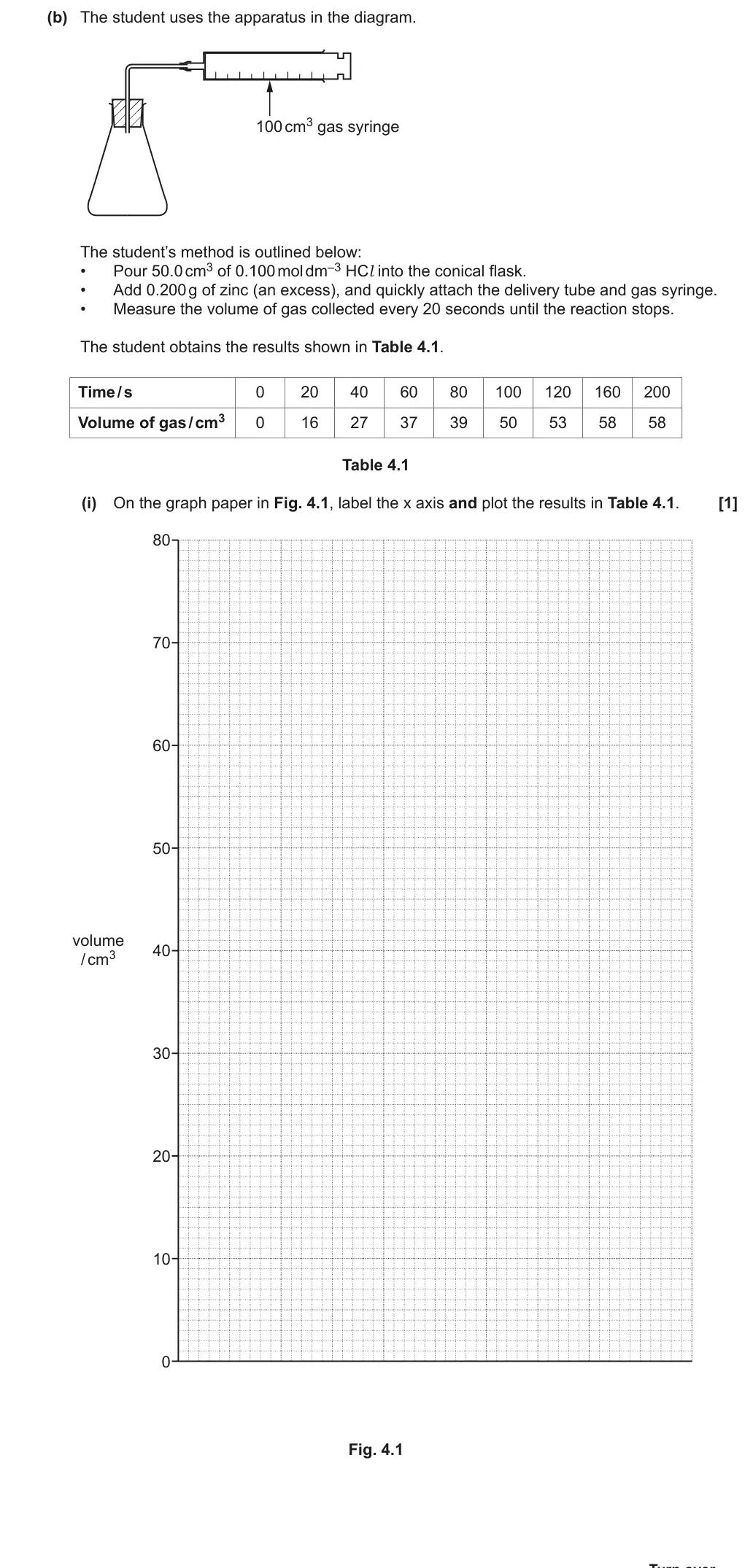
(b) The student uses the apparatus in the diagram.
100 cm3 gas syringe
The student’s method is outlined below:
• Pour 50.0 cm3 of 0.100 mol dm–3 HCl into the conical flask.
• Add 0.200 g of zinc (an excess), and quickly attach the delivery tube and gas syringe.
• Measure the volume of gas collected every 20 seconds until the reaction stops.
The student obtains the results shown in Table 4.1.
Time / s 0 20 40 60 80 100 120 160 200
Volume of gas / cm3 0 16 27 37 39 50 53 58 58
Table 4.1
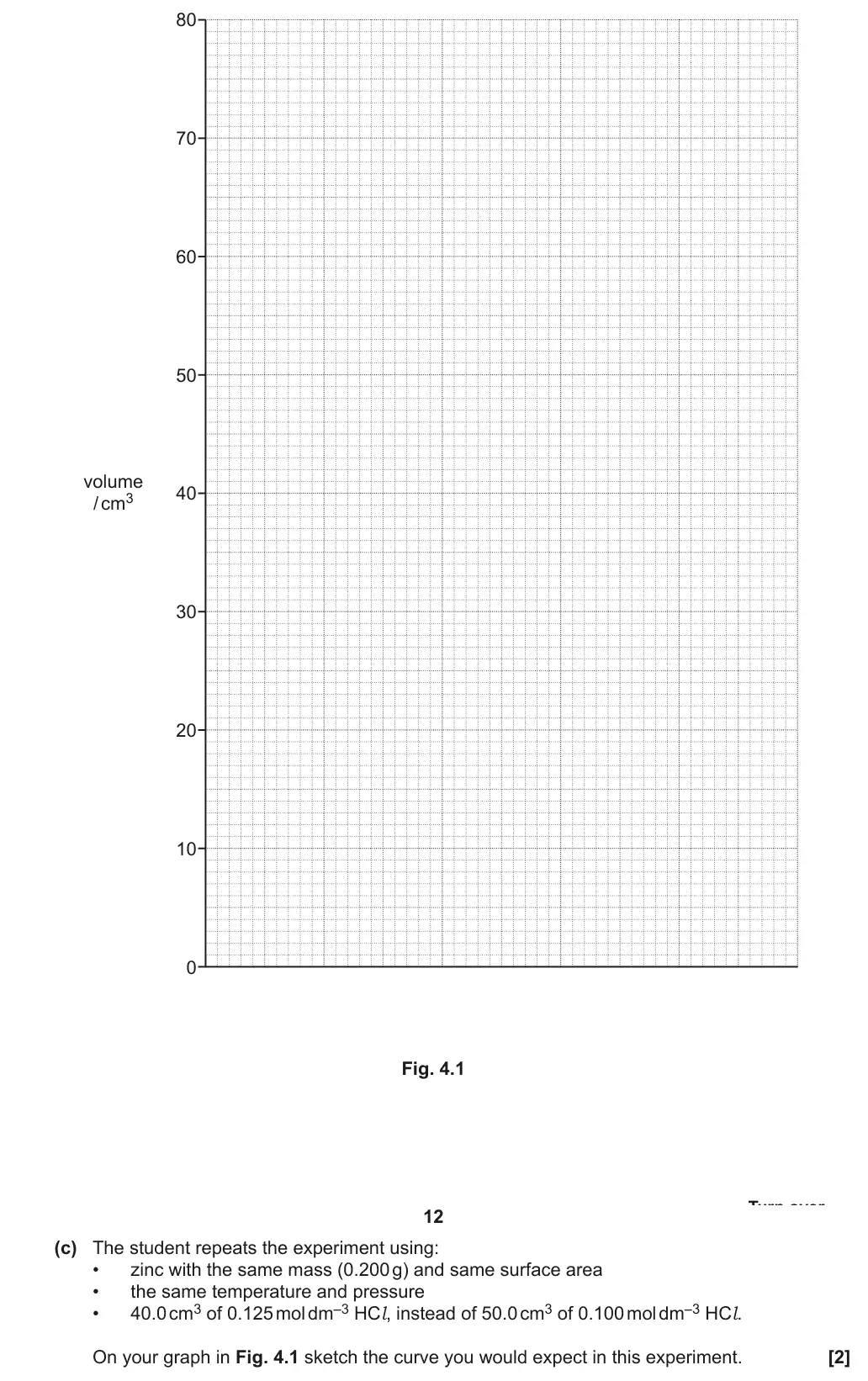
(i) On the graph paper in Fig. 4.1, label the x axis and plot the results in Table 4.1. [1]
June 2019 · AS Paper 2 · Q4(b)(ii) 1 mark AO2 Data interpretation Easy practical skills
Earlier parts of question 4 that this part usesEarlier part of June 2019 Paper 2 question 4Earlier part of June 2019 Paper 2 question 4
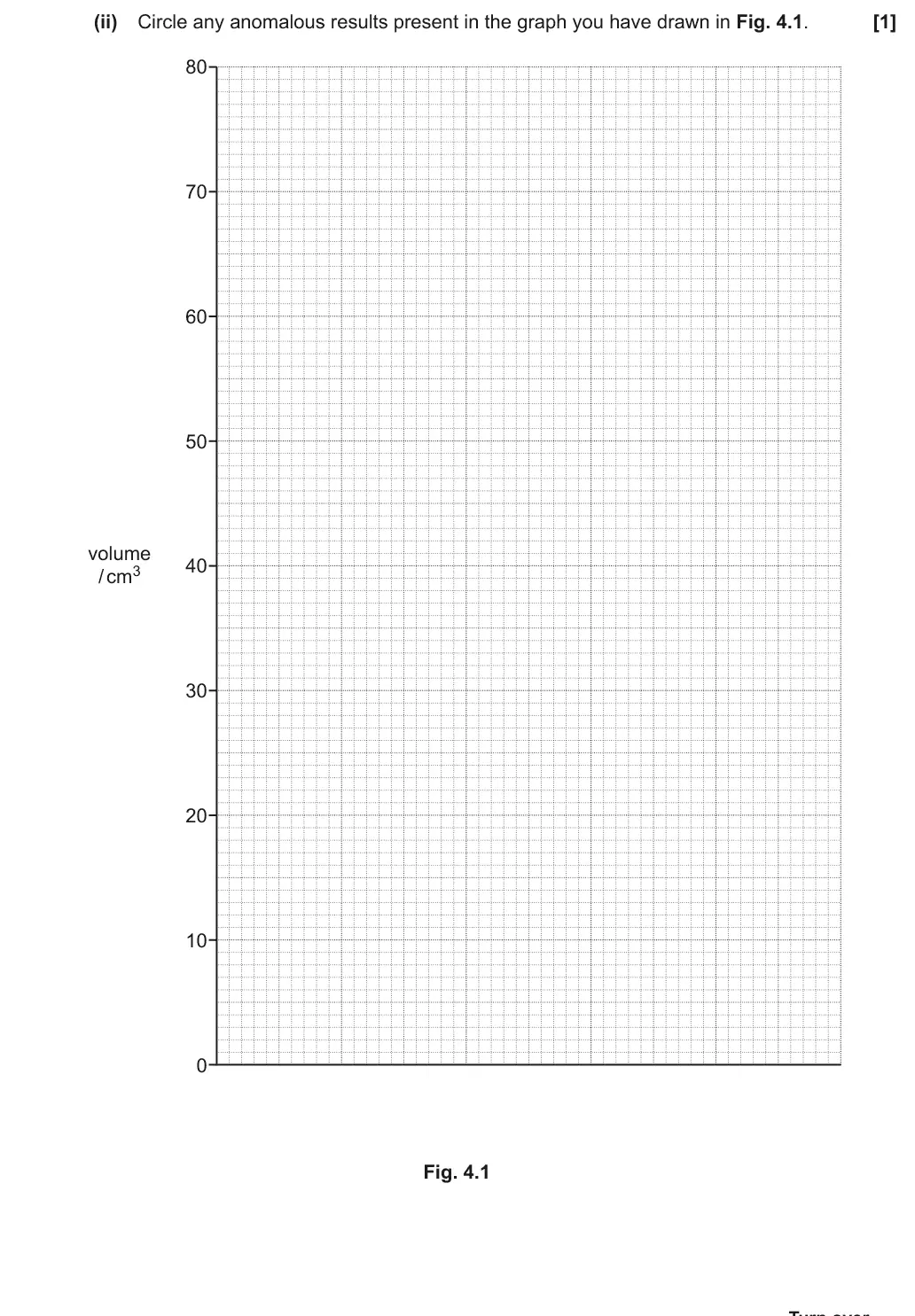
(ii) Circle any anomalous results present in the graph you have drawn in Fig. 4.1. [1]
June 2019 · AS Paper 2 · Q4(b)(iii) 1 mark AO3 Drawing / labelling Easy practical skillsreaction rates
Earlier parts of question 4 that this part usesEarlier part of June 2019 Paper 2 question 4Earlier part of June 2019 Paper 2 question 4
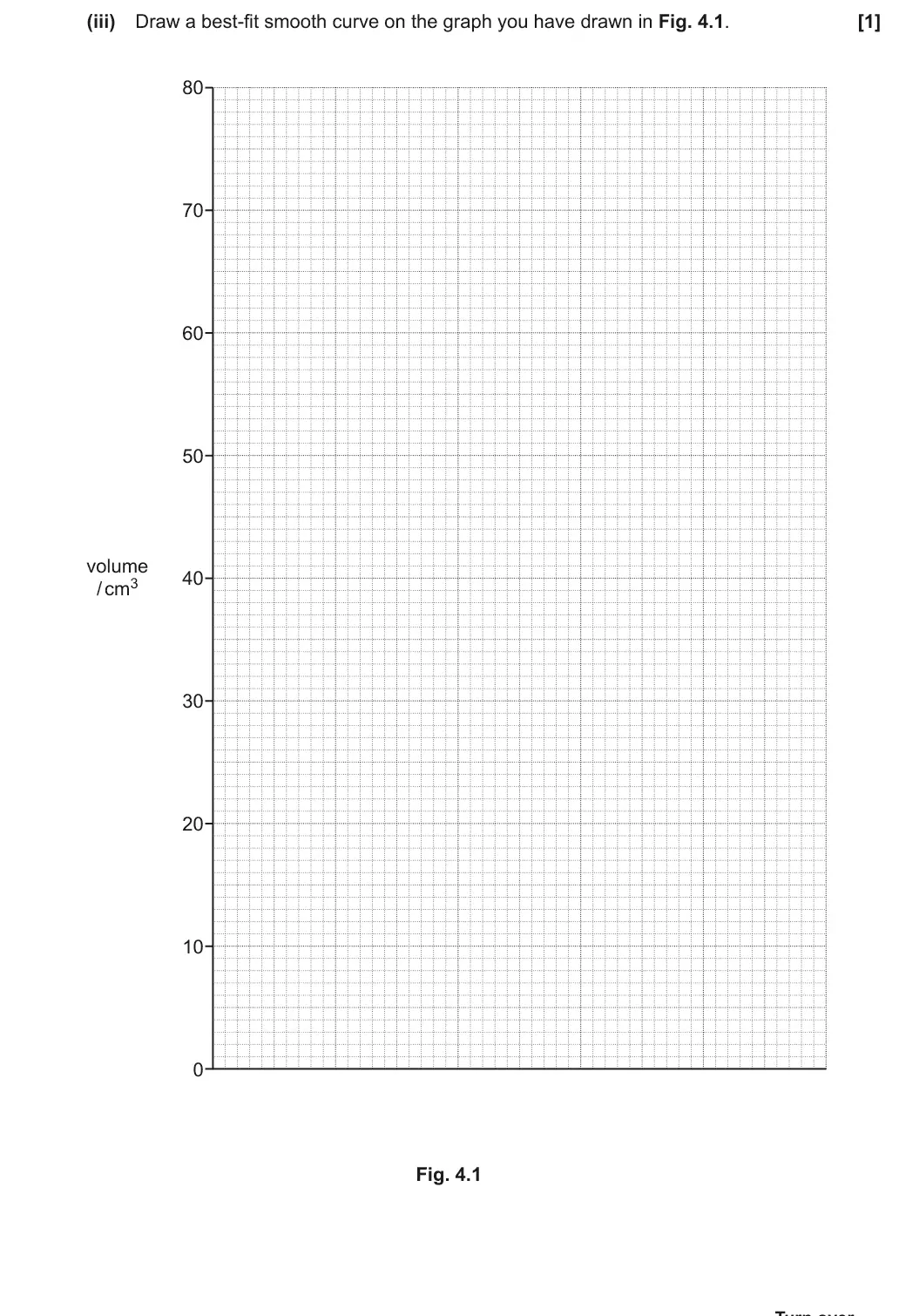
(iii) Draw a best-fit smooth curve on the graph you have drawn in Fig. 4.1. [1]
June 2019 · AS Paper 2 · Q4(c) 2 marks AO2 Data interpretation Medium reaction ratesamount of substance
Earlier parts of question 4 that this part usesEarlier part of June 2019 Paper 2 question 4Earlier part of June 2019 Paper 2 question 4
80
70
60
50
volume
40
/ cm3
30
20
10
0
Fig. 4.1
(c) The student repeats the experiment using:
• zinc with the same mass (0.200 g) and same surface area
• the same temperature and pressure
• 40.0 cm3 of 0.125 mol dm–3 HCl, instead of 50.0 cm3 of 0.100 mol dm–3 HCl.
On your graph in Fig. 4.1 sketch the curve you would expect in this experiment. [2]
June 2019 · AS Paper 2 · Q4(d) 2 marks AO1 Short answer Medium reaction rates
Earlier part of question 4 that this part usesEarlier part of June 2019 Paper 2 question 4
(d) The graph shows that rate of reaction decreases over time.
Explain why, in terms of collision theory.
...................................................................................................................................................
...................................................................................................................................................
...................................................................................................................................................
...................................................................................................................................................
.............................................................................................................................................. [2]
June 2019 · AS Paper 2 · Q4(e)(i) 2 marks AO1 Short answer Easy reaction rates
Earlier part of question 4 that this part usesEarlier part of June 2019 Paper 2 question 4
(e) (i) The rate of the reaction between zinc and hydrochloric acid can be increased using a
solution of copper(II) sulfate as a catalyst.
Explain how a catalyst increases the rate of reaction.
...........................................................................................................................................
...........................................................................................................................................
...........................................................................................................................................
...........................................................................................................................................
...................................................................................................................................... [2]
June 2019 · AS Paper 2 · Q4(e)(ii) 1 mark AO2 Short answer Hard reaction rates
Earlier part of question 4 that this part usesEarlier part of June 2019 Paper 2 question 4
(ii) Why is it difficult to classify the solution of copper(II) sulfate as a homogeneous or
heterogeneous catalyst in this reaction?
...........................................................................................................................................
...........................................................................................................................................
...................................................................................................................................... [1]
June 2019 · AS Paper 2 · Q5(a)(i) 3 marks AO1 Complete table/diagram Medium alkenes
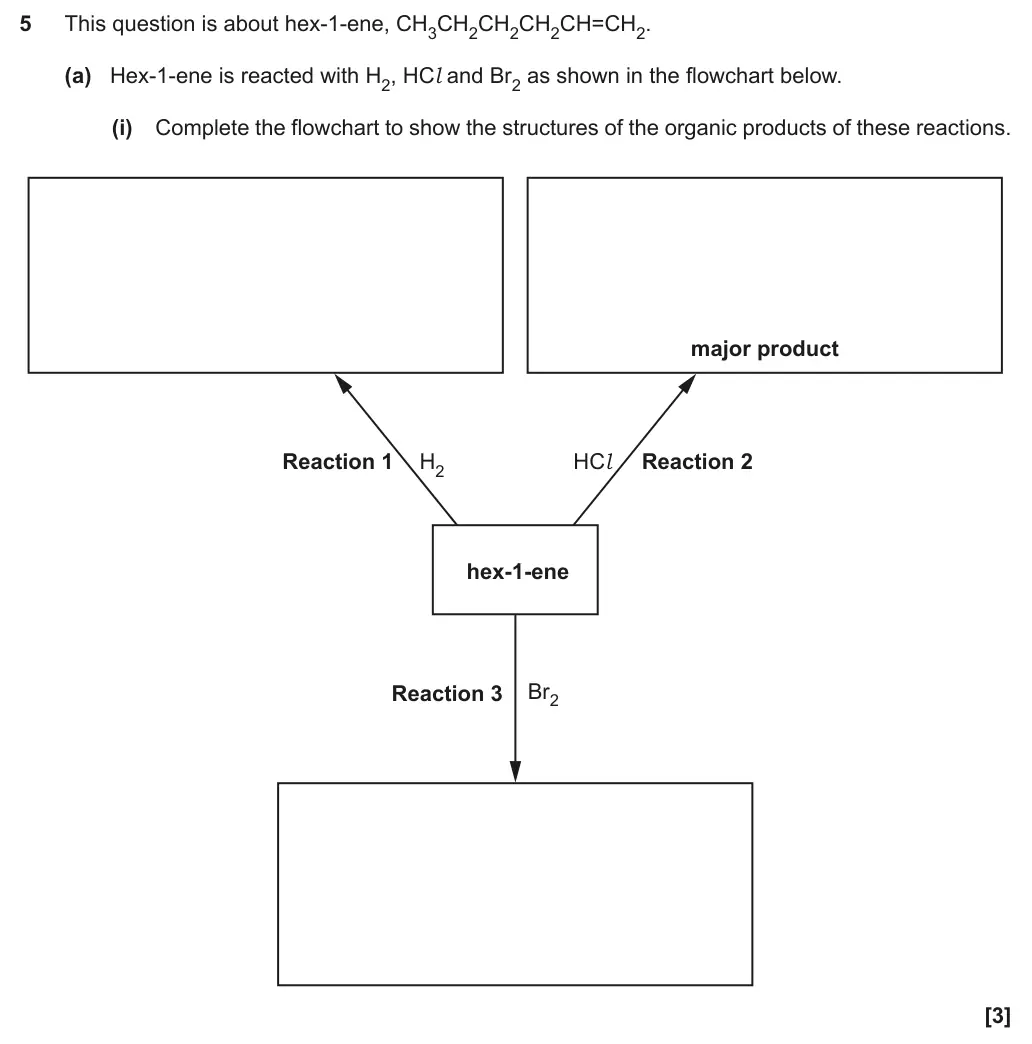
5 This question is about hex-1-ene, CH3CH2CH2CH2CH=CH2.
(a) Hex-1-ene is reacted with H2, HCl and Br2 as shown in the flowchart below.
(i) Complete the flowchart to show the structures of the organic products of these reactions.
major product
Reaction 1 H2 HCl Reaction 2
hex-1-ene
Reaction 3 Br2
[3]
June 2019 · AS Paper 2 · Q5(a)(ii) 1 mark AO1 Short answer Easy alkenes
Earlier part of question 5 that this part usesEarlier part of June 2019 Paper 2 question 5
(ii) State the catalyst needed in reaction 1.
...................................................................................................................................... [1]
June 2019 · AS Paper 2 · Q5(a)(iii) 1 mark AO1 Short answer Medium alkenes
Earlier part of question 5 that this part usesEarlier part of June 2019 Paper 2 question 5
(iii) What would you observe in reaction 3?
...........................................................................................................................................
...................................................................................................................................... [1]
June 2019 · AS Paper 2 · Q5(b)(i) 6 marks AO2, 3 6-mark level of response Hard organic synthesis aspractical techniquesamount of substance
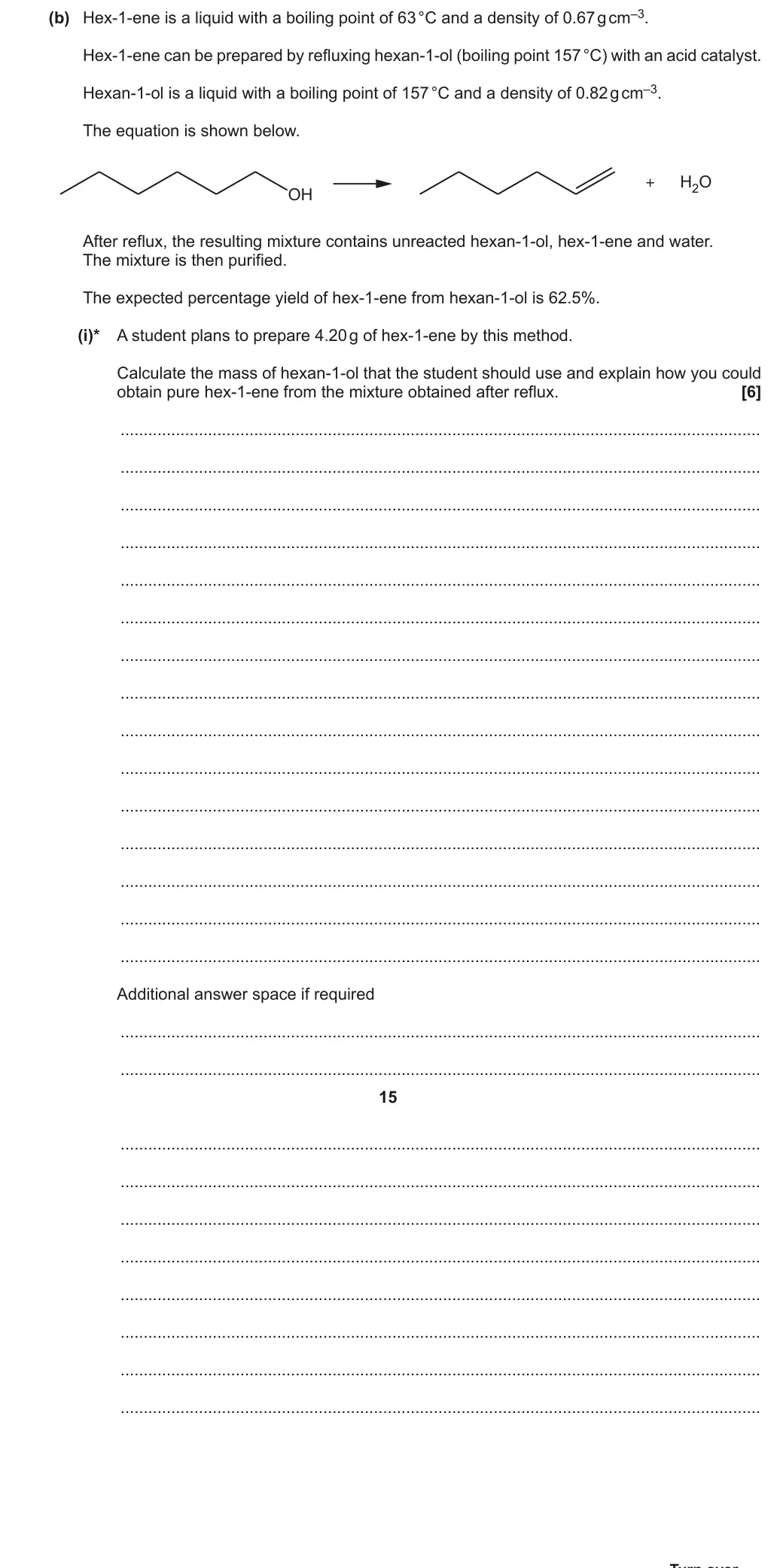
(b) Hex-1-ene is a liquid with a boiling point of 63 °C and a density of 0.67 g cm–3.
Hex-1-ene can be prepared by refluxing hexan-1-ol (boiling point 157 °C) with an acid catalyst.
Hexan-1-ol is a liquid with a boiling point of 157 °C and a density of 0.82 g cm–3.
The equation is shown below.
+ H2O
OH
After reflux, the resulting mixture contains unreacted hexan-1-ol, hex-1-ene and water.
The mixture is then purified.
The expected percentage yield of hex-1-ene from hexan-1-ol is 62.5%.
(i)* A student plans to prepare 4.20 g of hex-1-ene by this method.
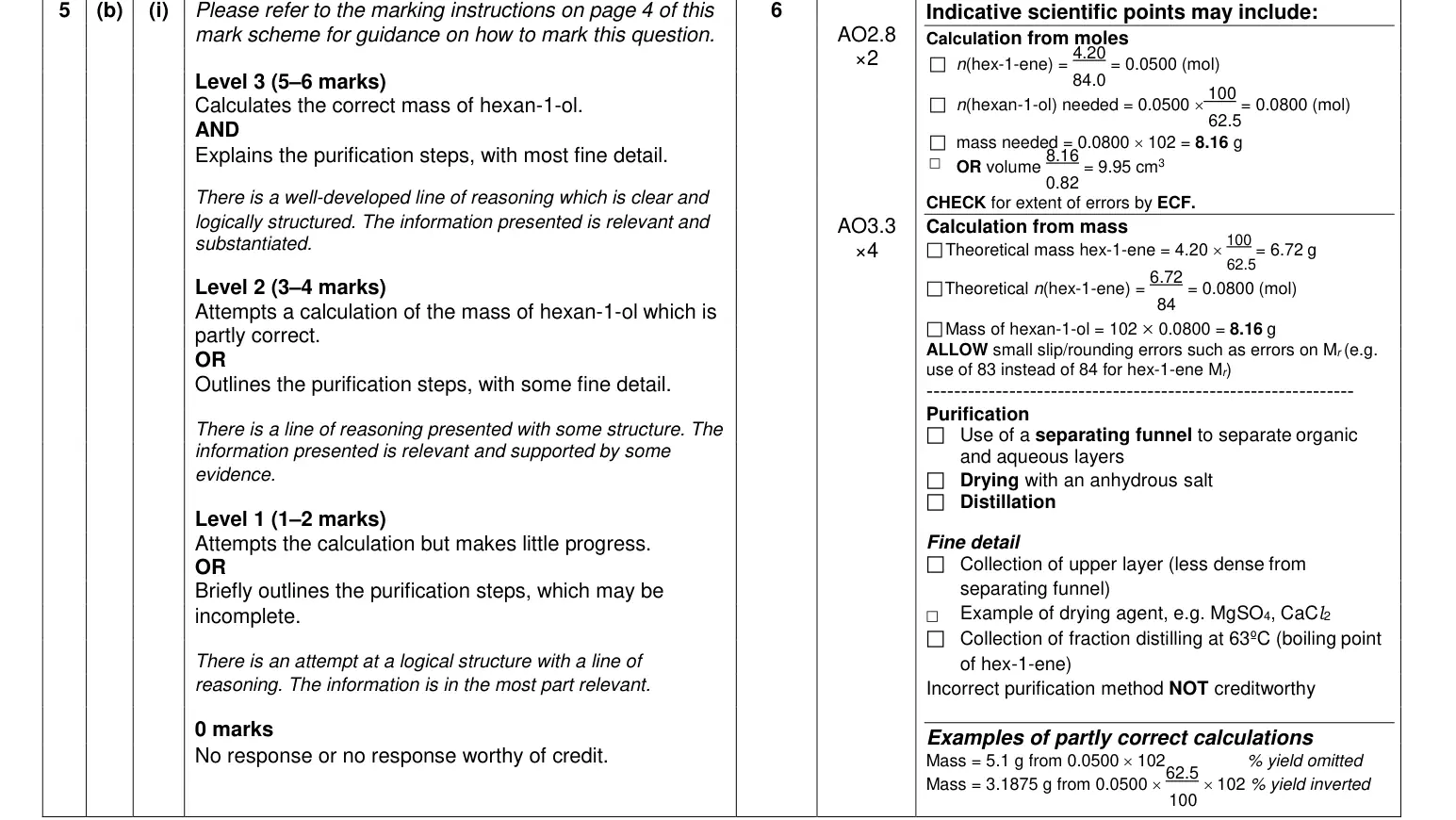
Calculate the mass of hexan-1-ol that the student should use and explain how you could
obtain pure hex-1-ene from the mixture obtained after reflux. [6]
...........................................................................................................................................
...........................................................................................................................................
...........................................................................................................................................
...........................................................................................................................................
...........................................................................................................................................
...........................................................................................................................................
...........................................................................................................................................
...........................................................................................................................................
...........................................................................................................................................
...........................................................................................................................................
...........................................................................................................................................
...........................................................................................................................................
...........................................................................................................................................
...........................................................................................................................................
...........................................................................................................................................
Additional answer space if required
...........................................................................................................................................
...........................................................................................................................................
...........................................................................................................................................
...........................................................................................................................................
...........................................................................................................................................
...........................................................................................................................................
...........................................................................................................................................
...........................................................................................................................................
...........................................................................................................................................
...........................................................................................................................................
June 2019 · AS Paper 2 · Q5(b)(ii) 2 marks AO3 Short answer Hard alcoholsorganic basics
Earlier part of question 5 that this part usesEarlier part of June 2019 Paper 2 question 5
(ii) Another student suggested that hex-1-ene could be prepared from hexan-2-ol by the
same method.
Would you expect the percentage yield of hex-1-ene to be greater than, less than or
about the same as when using hexan-1-ol?
Explain your answer.
...........................................................................................................................................
...........................................................................................................................................
...........................................................................................................................................
...................................................................................................................................... [2]
June 2019 · AS Paper 2 · Q5(c)(i) 1 mark AO2 Drawing / labelling Hard alkenes
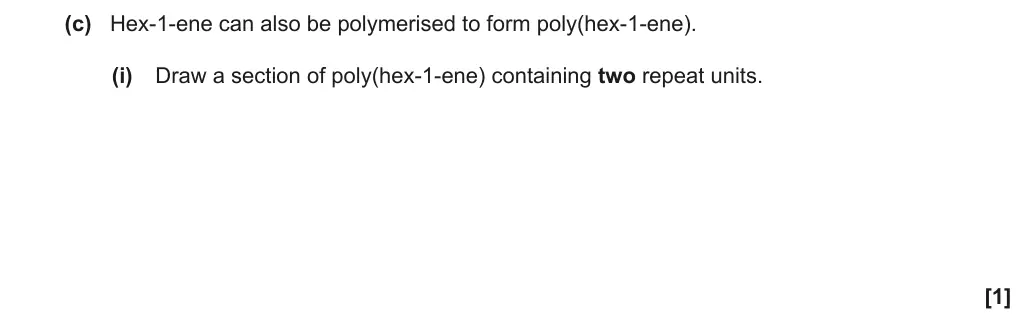
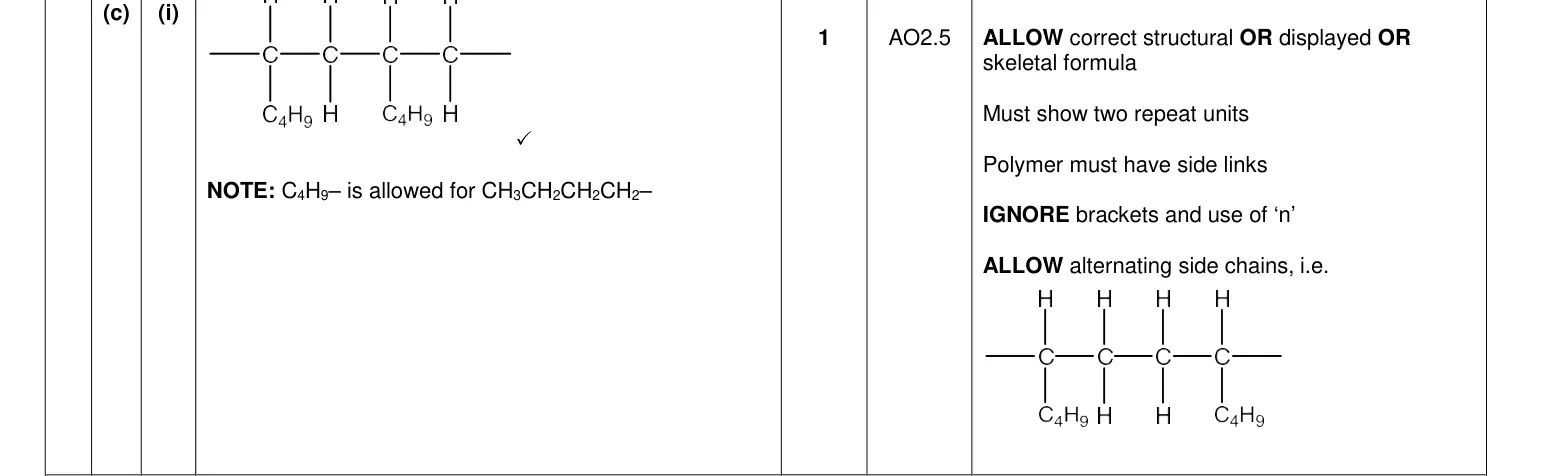
(c) Hex-1-ene can also be polymerised to form poly(hex-1-ene).
(i) Draw a section of poly(hex-1-ene) containing two repeat units.
[1]
June 2019 · AS Paper 2 · Q5(c)(ii) 2 marks AO1 Short answer Medium alkenes
Earlier part of question 5 that this part usesEarlier part of June 2019 Paper 2 question 5
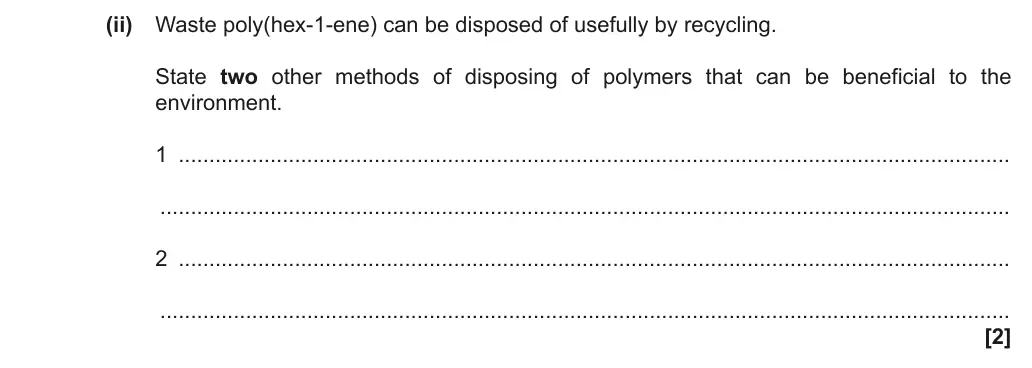
(ii) Waste poly(hex-1-ene) can be disposed of usefully by recycling.
State two other methods of disposing of polymers that can be beneficial to the
environment.
1  ........................................................................................................................................
...........................................................................................................................................
2  ........................................................................................................................................
...........................................................................................................................................
[2]

Work with an OCR chemistry tutor

Want a paper marked and gone through with you? Message us.

Prefer email? Send an enquiry

If you are under 18, please include a parent's contact details. Enquiries go to enquiries@chemistryaleveltutor.com and are deleted once handled. All tutoring is online.