Answer
A
Mark scheme

Notes from the mark scheme and report
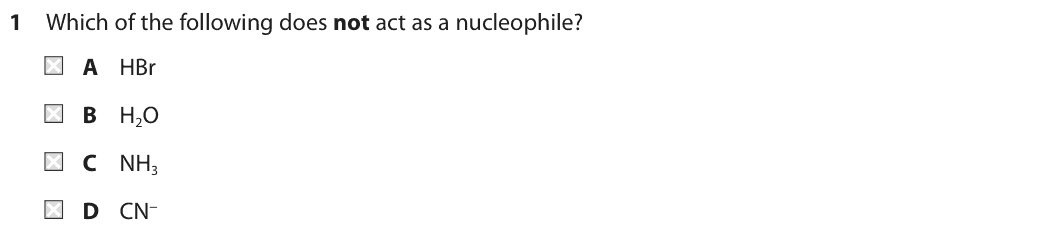
- Answer: A. HBr has no lone pair available to donate to an electron-deficient carbon
- it reacts as an electrophile. H2O, NH3 and CN– are all nucleophiles through their lone pairs
80 marks · 41 question parts · Paper, mark scheme and report on Edexcel's site · Have the Data Booklet beside you
A
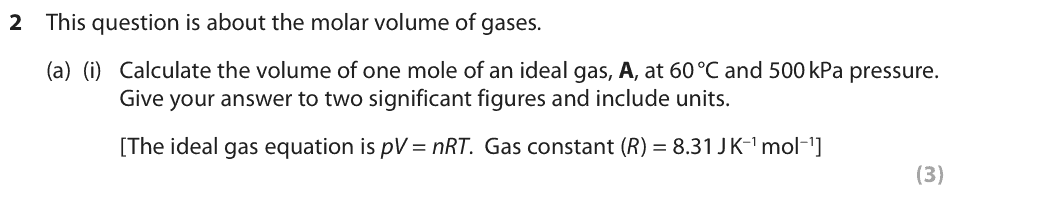
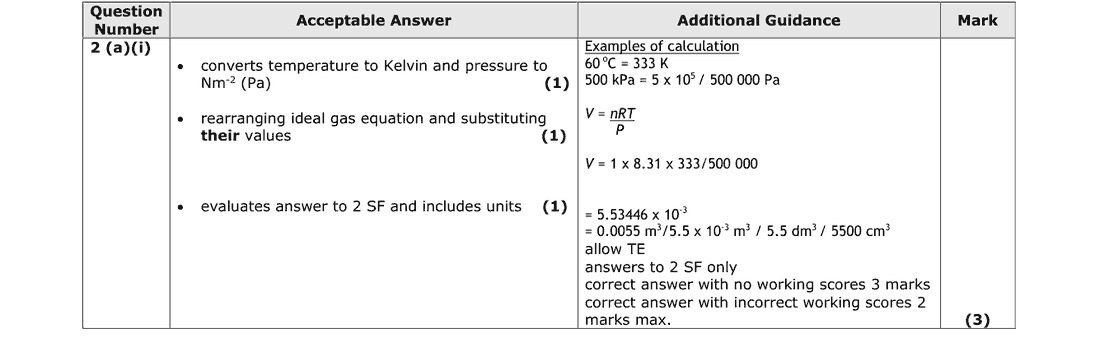
This was a relatively simple gas volume calculation, designed to give the students confidence with calculations at an early stage of the paper.
Skills: MS0.0 Recognise and make use of appropriate units in calculation; MS1.1 Use an appropriate number of significant figures; MS2.2 Change the subject of an equation; MS2.3 Substitute numerical values into algebraic equations using appropriate units for physical quantities
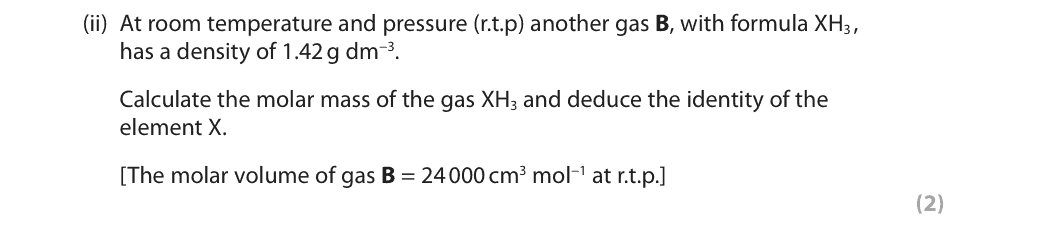
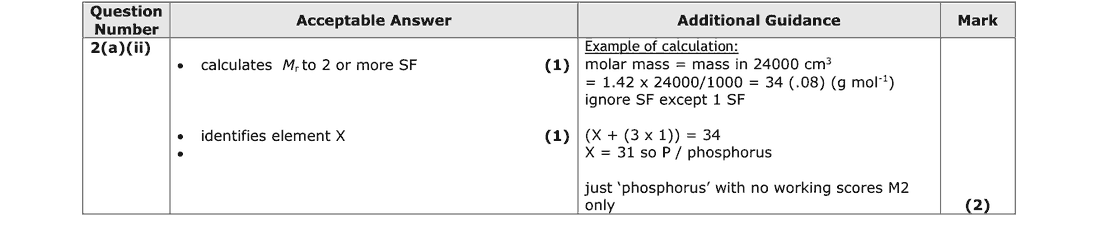
This was another relatively simple calculation which should have required minimal time for a confident student. Some students completed the more challenging section of the question; the determination of Mr, but then made no attempt to identify element X.
Skills: MS0.0 Recognise and make use of appropriate units in calculation; MS2.3 Substitute numerical values into algebraic equations using appropriate units for physical quantities
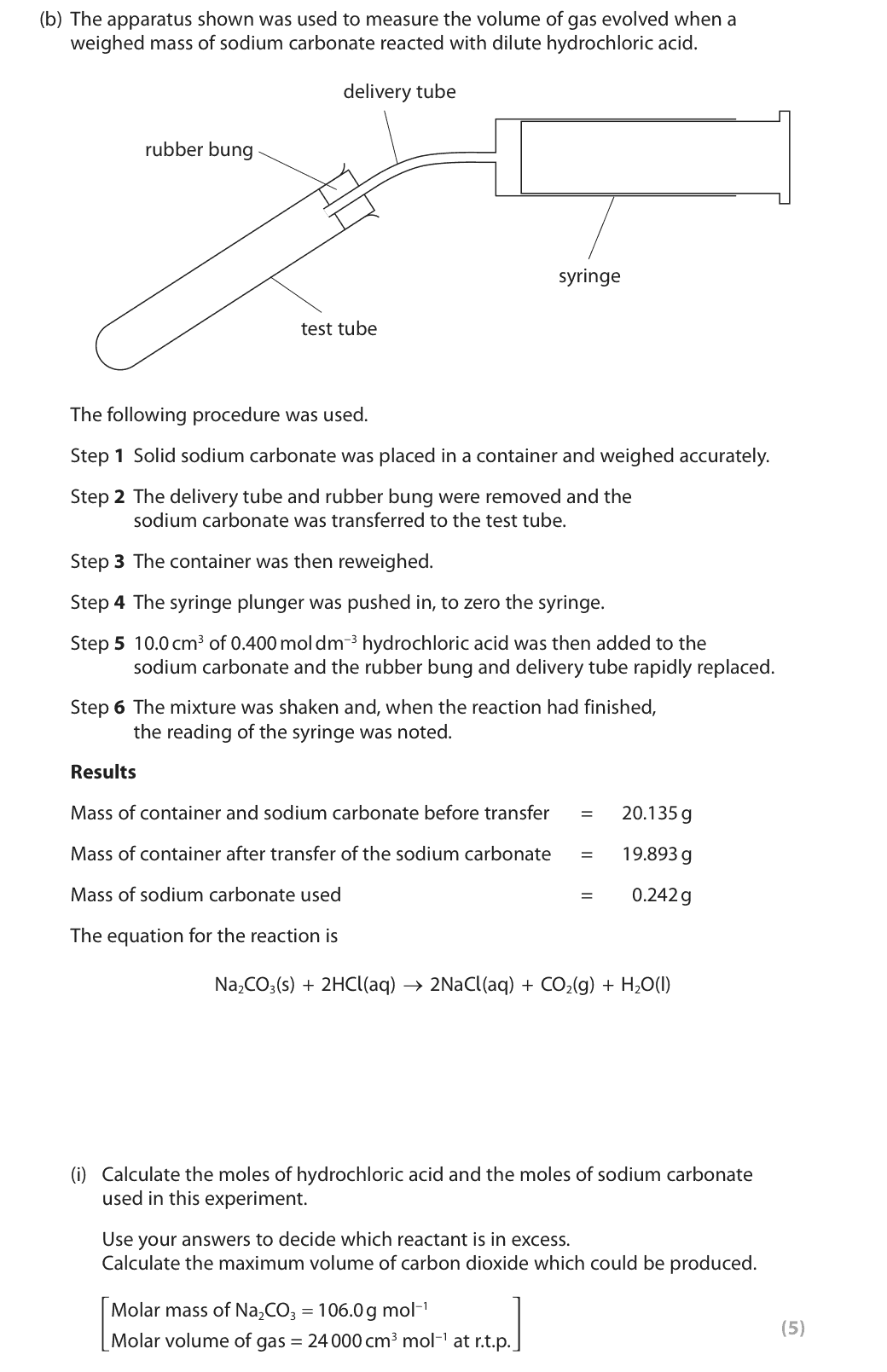
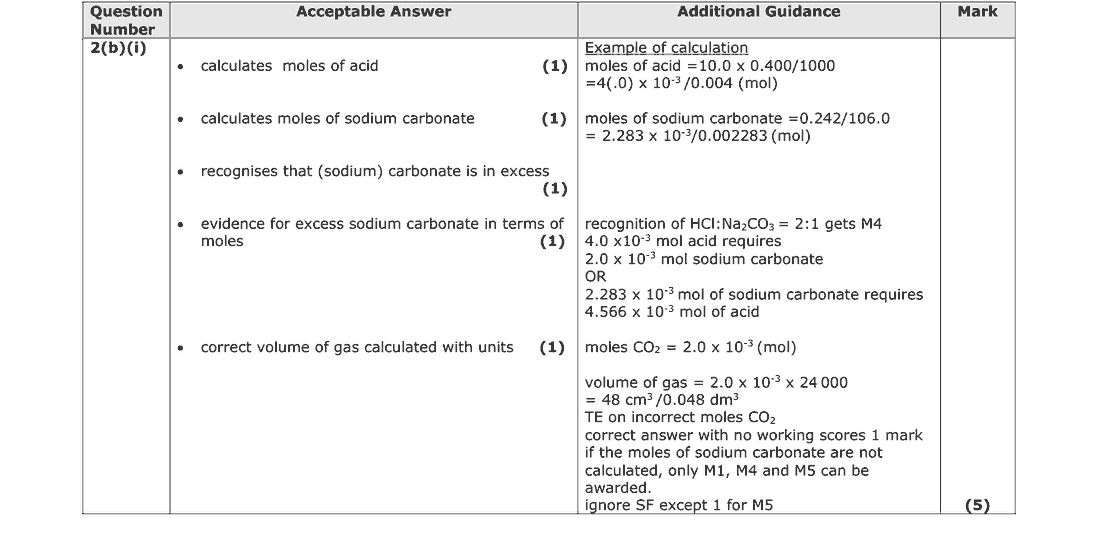
This question was very specific in its requirements. Students were instructed to calculate the moles of acid and sodium carbonate and use this information to decide which regent was in excess. A significant number of students did not calculate the moles of sodium carbonate. This created a problem for the student in deciding which reactant was in excess; it often followed that the evidence for the excess sodium carbonate was omitted. Units were expected for the final answer. Where units are not specified by the question, it is expected that units will be given in the answer. In this question, some gave an answer in cm3 (a familiar unit for many), but others in dm3 (a logical consequence of the calculation), both were acceptable.
Skills: MS0.1 Recognise and use expressions in decimal and ordinary form; MS0.2 Use ratios, fractions and percentages; MS2.3 Substitute numerical values into algebraic equations using appropriate units for physical quantities; CP1 Core practical 1: Measure the molar volume of a gas

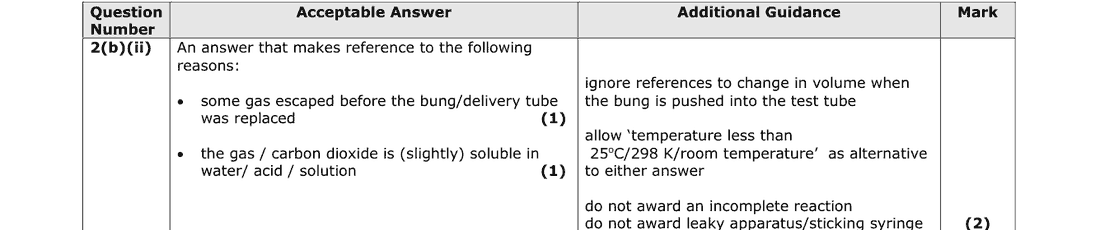
This question is based on practical work that the student is likely to have experienced. Even if the student has not carried out the practical, it should still be possible to answer the question from the procedure described in the question.
Skills: PT1 use appropriate apparatus to record a range of measurements (to include mass, time, volume of liquids and gases, temperature); CP1 Core practical 1: Measure the molar volume of a gas
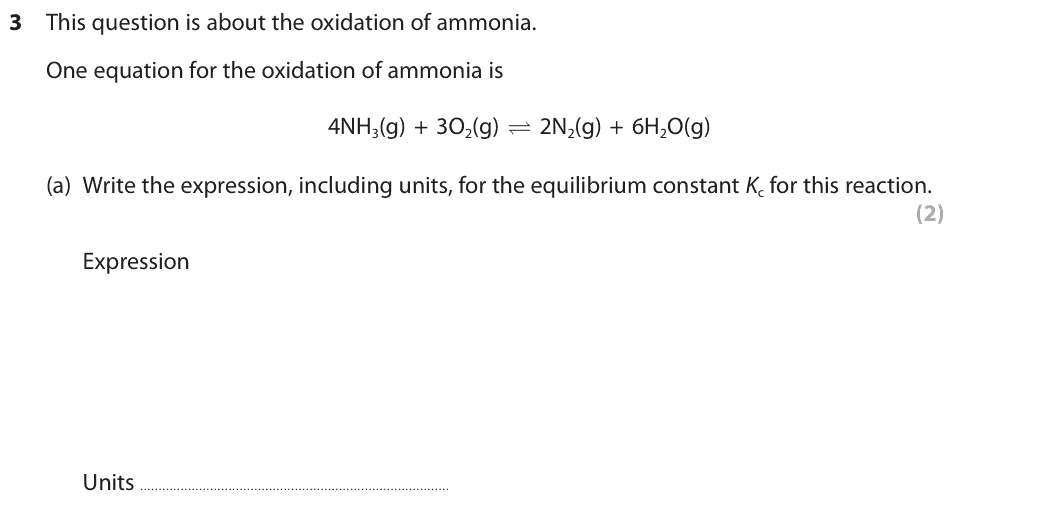
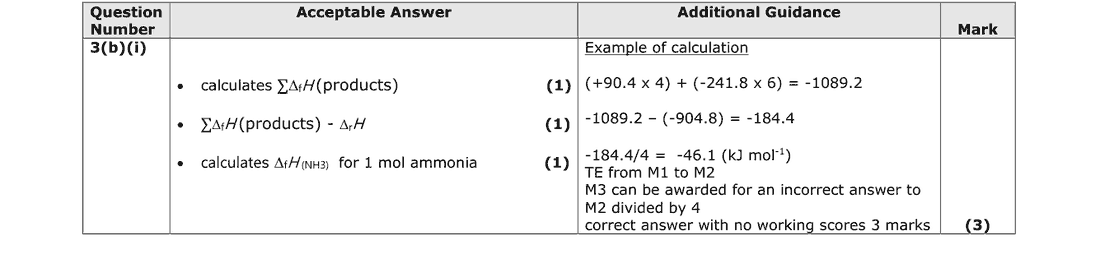
M1: Problems included inverted expressions and the use of a + sign instead of a product. M2: The units should be consistent with the expression as written. kJ mol-1 was a relatively common error for the units.
Skills: MS0.0 Recognise and make use of appropriate units in calculation
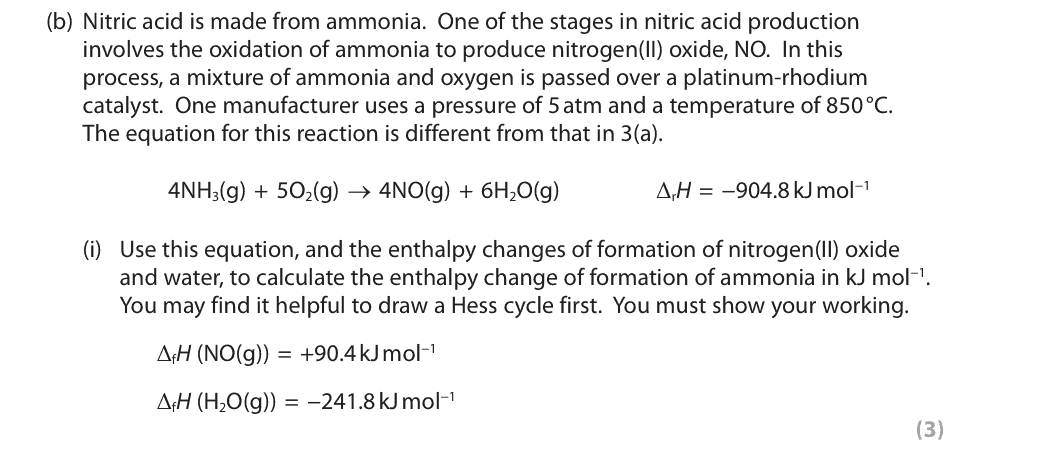
This style of question is often best answered using an energy triangle. This makes it easy for the examiner to follow and allows transferred errors to be recognised easily.
Skills: MS2.3 Substitute numerical values into algebraic equations using appropriate units for physical quantities; MS2.4 Solve algebraic equations

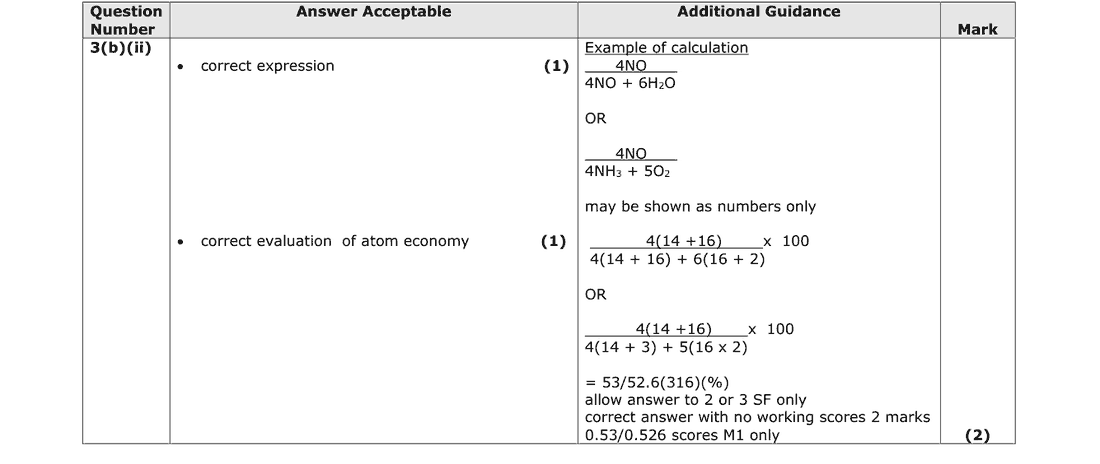
In general, students either knew how to answer this question, or they had little idea. Atom economy is expressed as a percentage. Some omitted the conversion to a percentage.
Skills: MS0.2 Use ratios, fractions and percentages; MS1.1 Use an appropriate number of significant figures
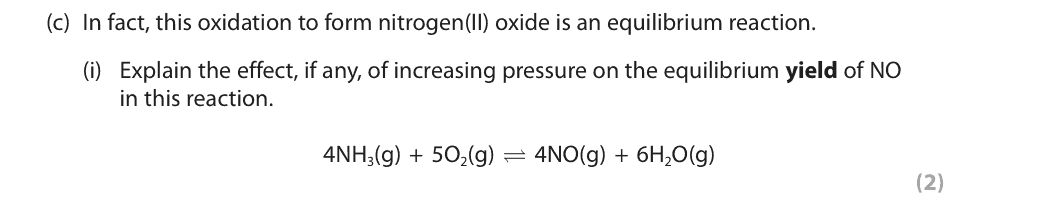


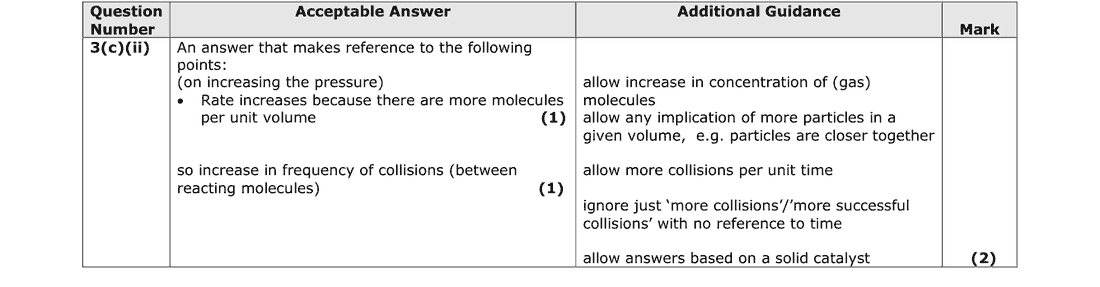
A heterogeneous catalyst is in a different state to the reactants. References to the products were ignored here. The rates of the forward and reverse reaction are increased to the same extent, but this qualification was not required in order to award M2.
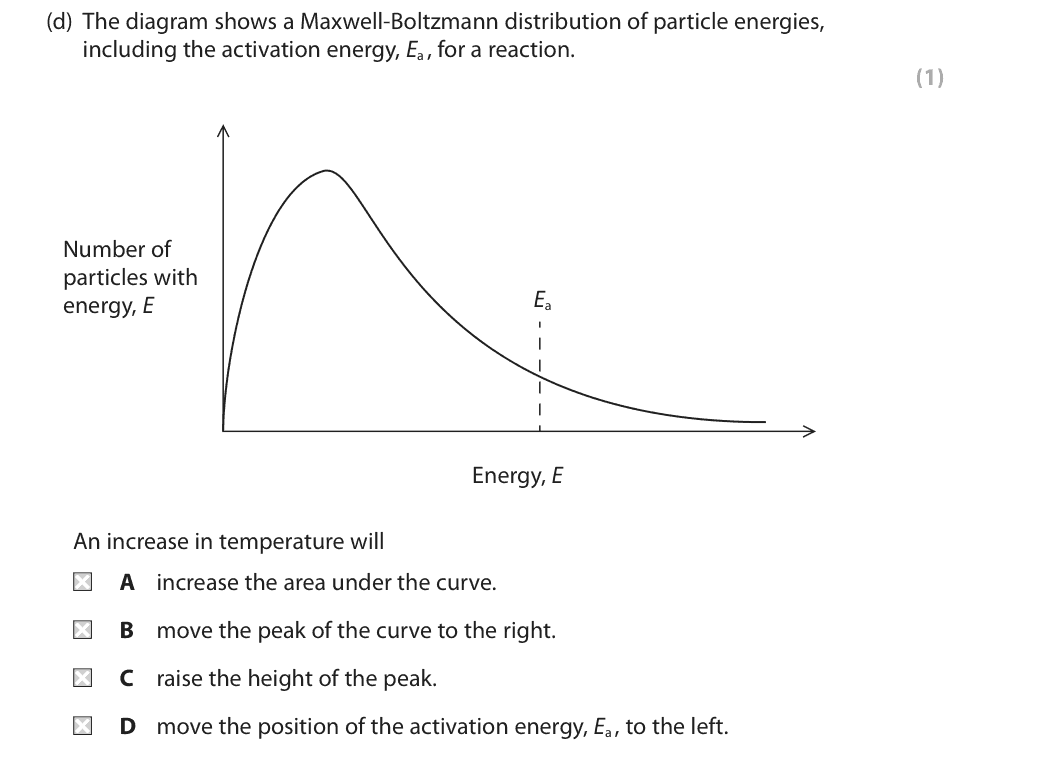
B
Skills: MS3.1 Translate information between graphical, numerical and algebraic forms
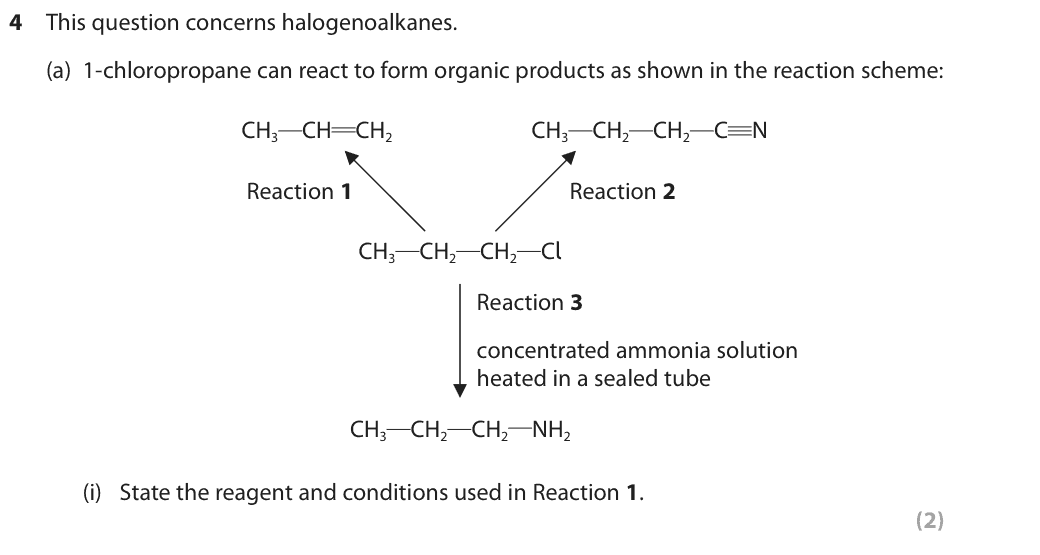
M1 was awarded for the correct reagent. M2 for the correct conditions (heating and ethanolic). M1 was dependent on M2 except for a 'near miss' with the reagent, e.g. use of just OH-.
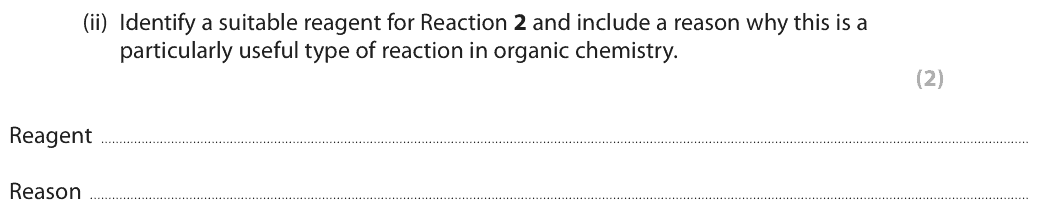
M1 was awarded for the correct reagent. Conditions, if given, were ignored. Just 'cyanide' or the formula of the cyanide ion were not sufficient.

The question carried the word 'heated' and 'sealed' in bold to emphasise the need to address both of these two matters. The mark allocation is also a good indication that two ideas will be required for a complete answer.

Additional inorganic products were ignored. The formula C3H7OH was not accepted because this would include the branched chain isomer.
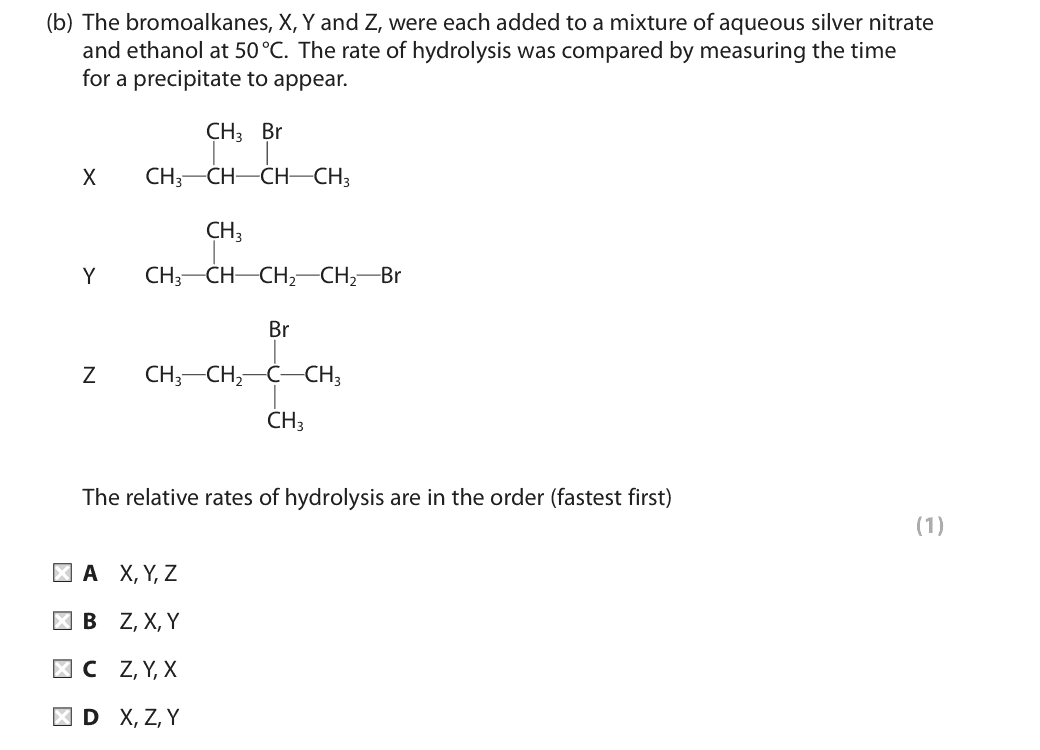
B
Skills: CP4 Core practical 4: Investigation of the rates of hydrolysis of some halogenoalkanes
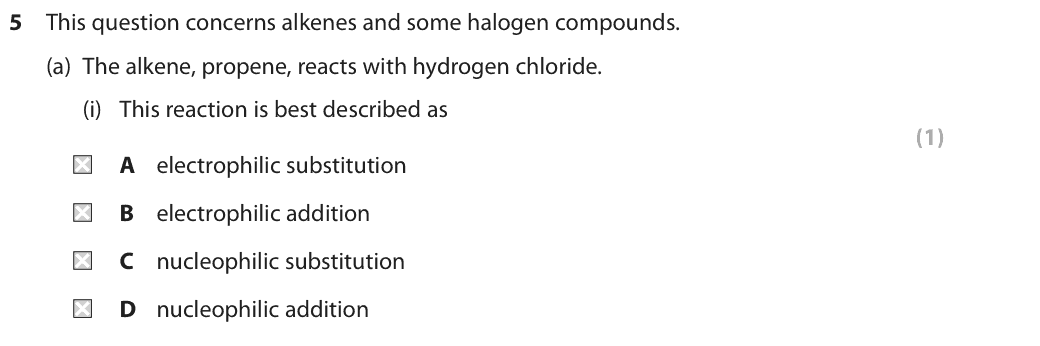
B
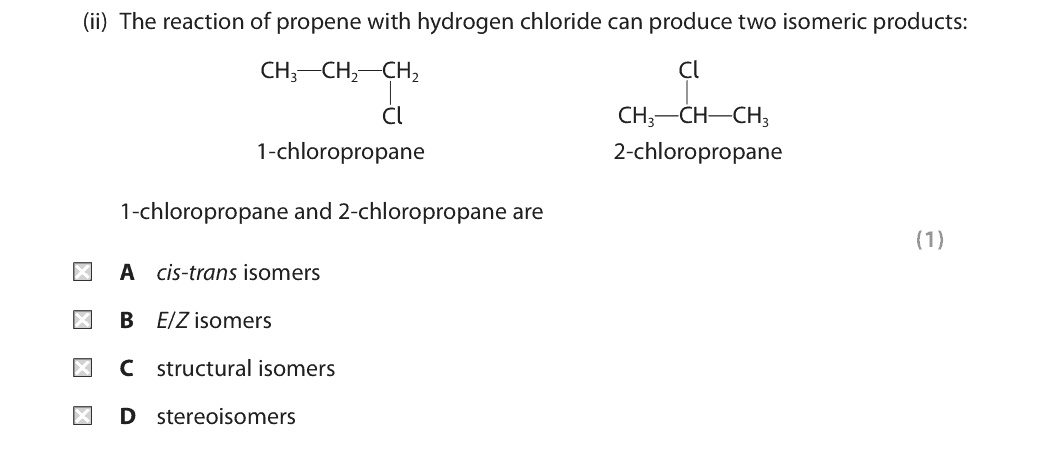
C

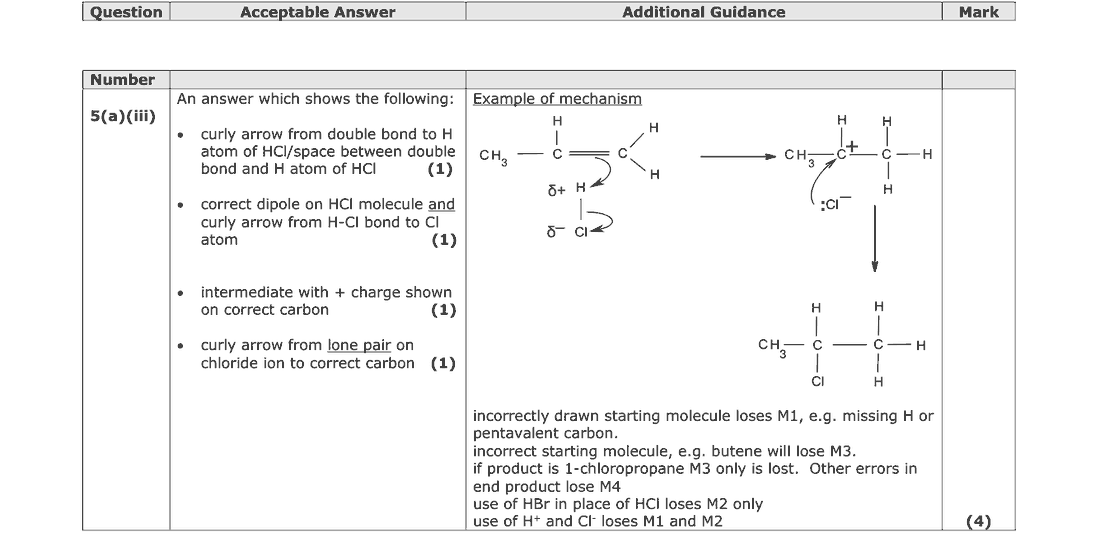
There were frequent casual errors in the response to this question. Missing H atoms and 5-bonded carbon atoms were all too frequent. Occasionally, HBr was used in place of HCl and, in some instances, the halogen changed part-way through the mechanism. The mechanism requested is for the production of 2-chloropropane. There is no credit for including the mechanism for 1-chloropropane as well.

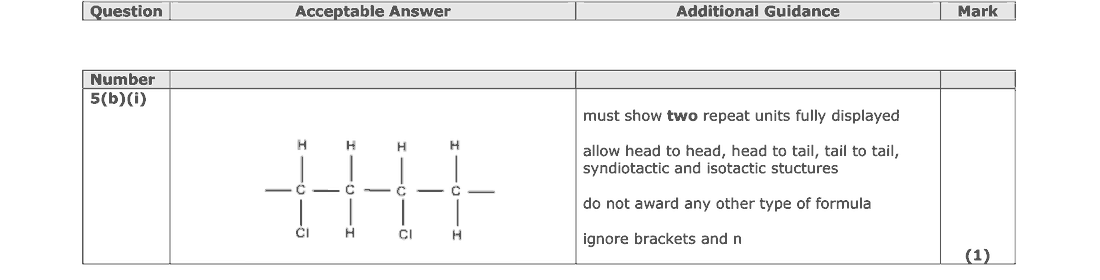
The diagram must show two repeat units and be fully displayed. The question asked for two repeat units. It is therefore important to show how the two units are connected, and how they would connect to more units.

The question was specifically related to PVC. It was not sufficient to give answers that related to the incineration of polymers in general. M2 was dependent on M1. Thus broad generalisations about acid rain or the effect on the ozone layer did not gain a mark unless connected to chlorinated products.

This question required students to recognise that chloroethane will be a carcinogenic gas at room temperature, and to suggest an appropriate precaution. Keeping below 260 K is not a reasonable suggestion because many of its reactions would be carried out at higher temperatures. The compound would still be carcinogenic as a liquid. A 'mask' on its own was an inadequate answer. Many simple face masks are designed to filter out solids; they allow gases to pass through freely.
Skills: PT11 safely and carefully handle solids and liquids, including corrosive, irritant, flammable and toxic substances
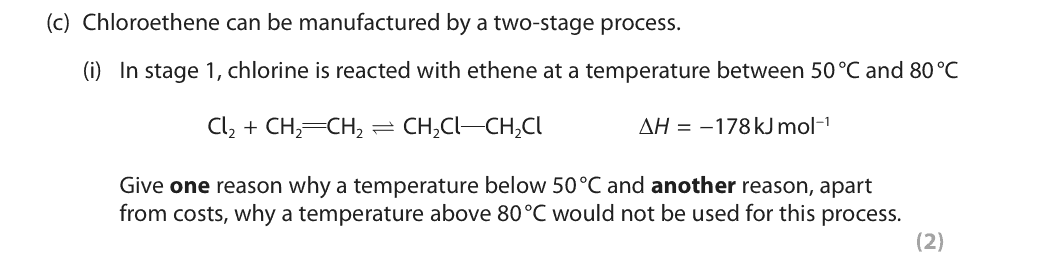
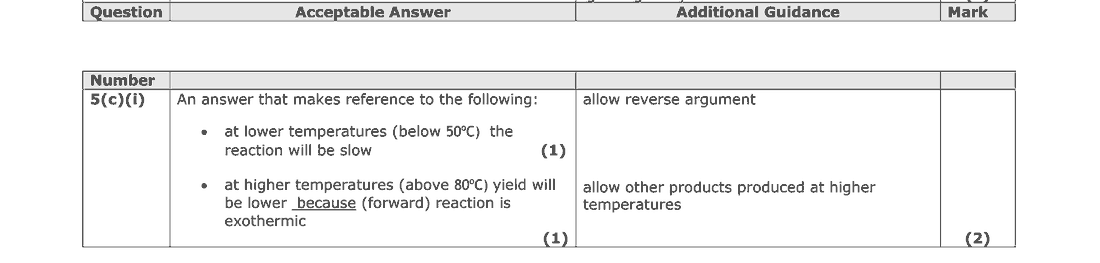
M1: This question required the candidate to discuss why a temperature below 50oC is not used. Simply, the rate of reaction will be (too) low. Discussions concerning the increased yield at lower temperatures would favour the use of low temperatures. M2: Temperatures above 80oC are not used because the yield would be lower for this exothermic reaction. The exothermic nature of the forward reaction is essential to the answer. Reverse arguments in terms of the endothermic nature of the reverse reaction were also accepted. Answers relating to the possibility of other products at higher temperatures were rarely seen.
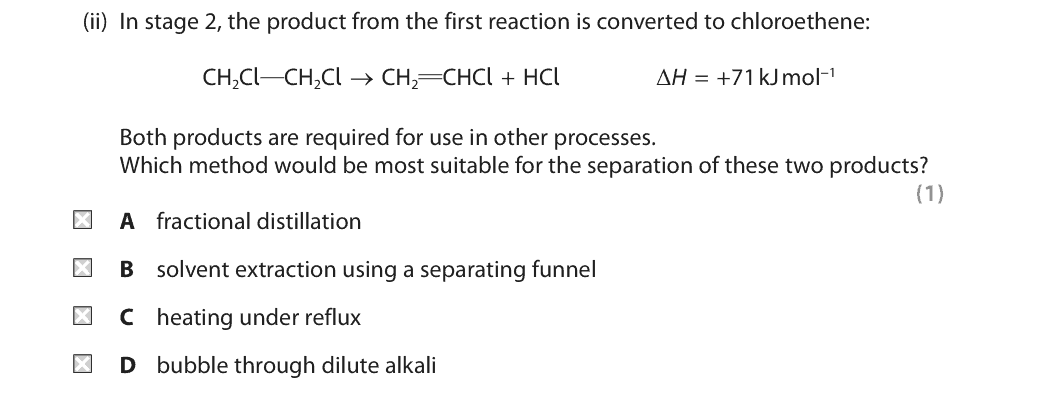
A
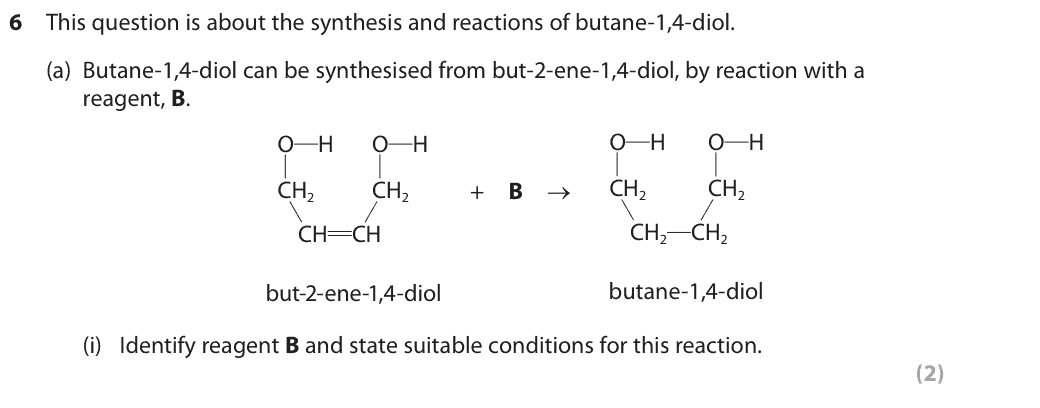
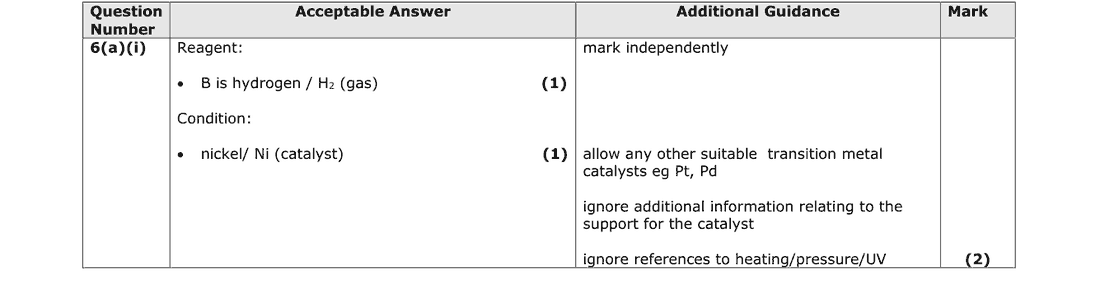
The two marks for this response were awarded independently. Simple inspection of the organic reactant and the product showed that hydrogen had been added, so M1 should have been easily obtainable.
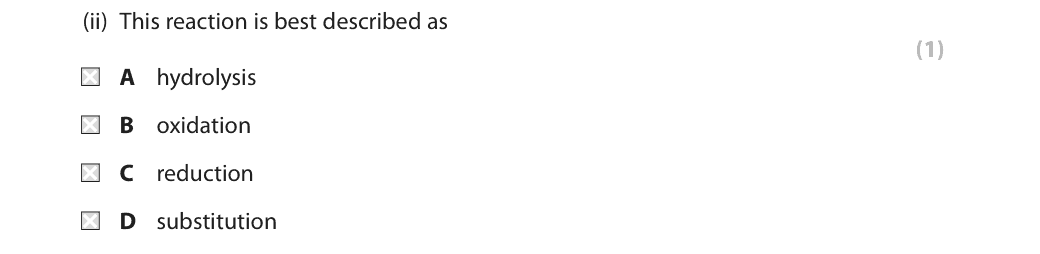
C

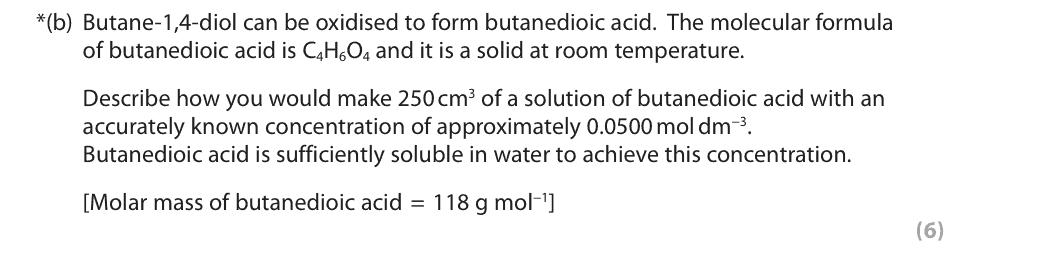
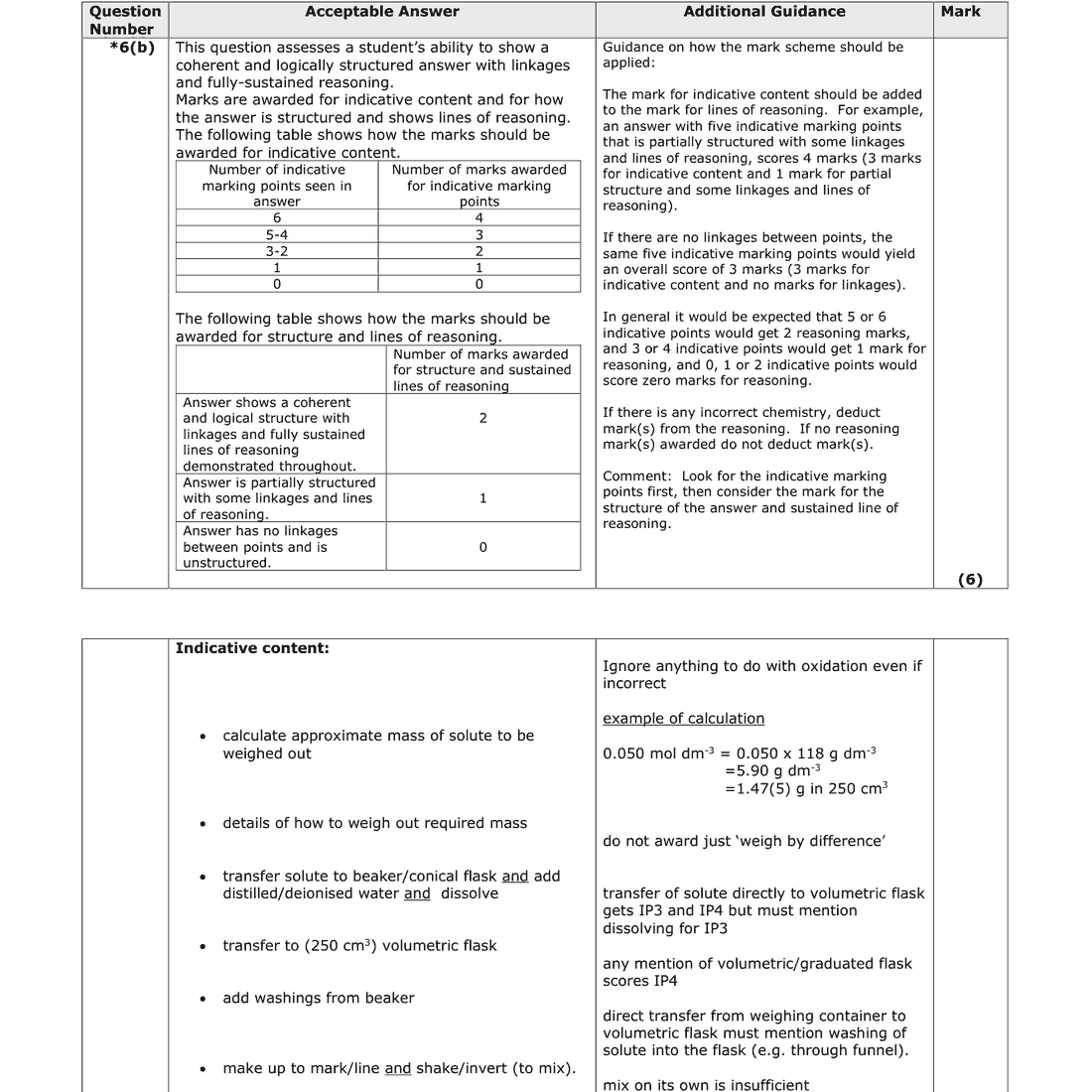
Skills: MS0.0 Recognise and make use of appropriate units in calculation; MS2.3 Substitute numerical values into algebraic equations using appropriate units for physical quantities; PT1 use appropriate apparatus to record a range of measurements (to include mass, time, volume of liquids and gases, temperature); PT5 use volumetric flask, including accurate technique for making up a standard solution; CP2 Core practical 2: Prepare a standard solution from a solid acid and use it to find the concentration of a solution of sodium hydroxide
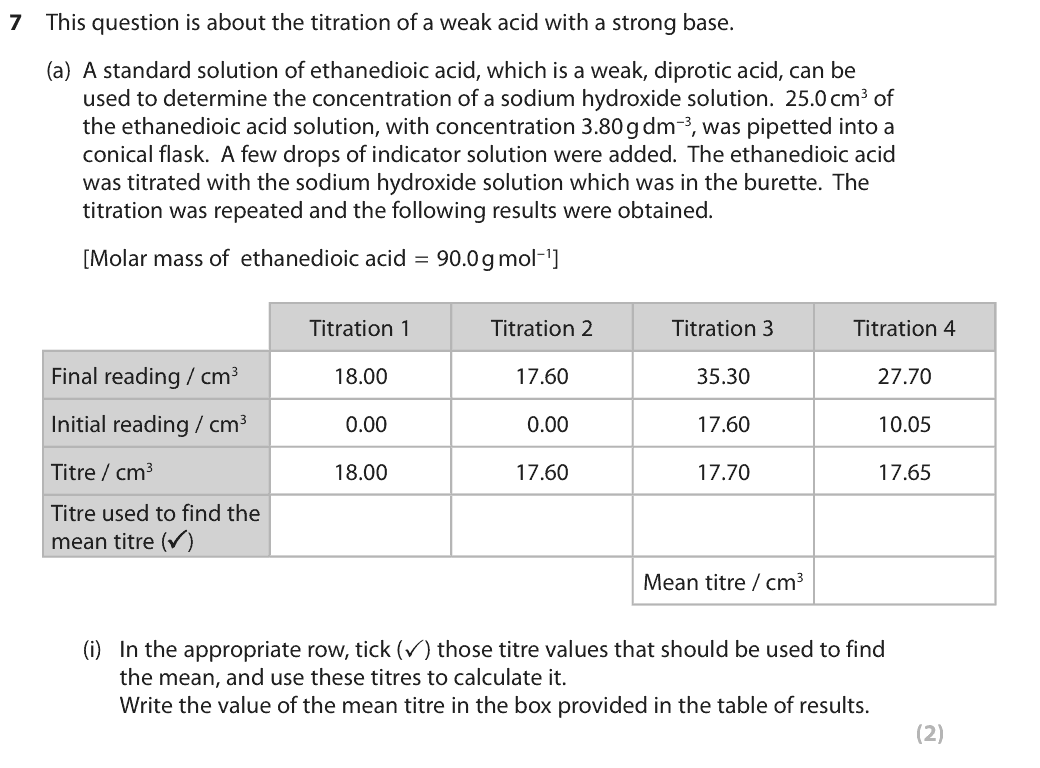
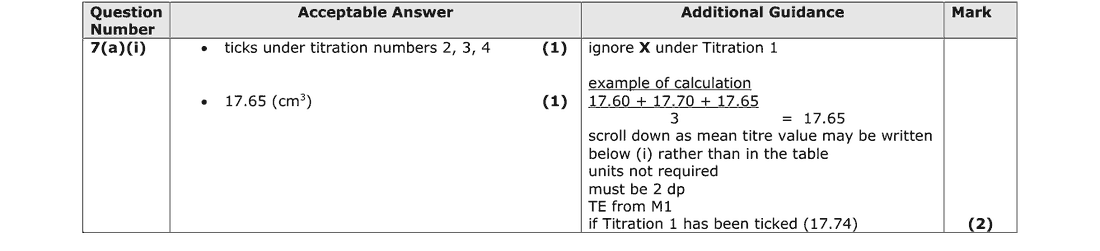
Skills: MS1.2 Find arithmetic means; PT4 use laboratory apparatus for a variety of experimental techniques, including: titration, using burette and pipette; distillation and heating under reflux, including setting up glassware using retort stand and clamps; qualitative tests for ions and organic functional groups; filtration, including use of fluted filter paper, or filtration under reduced pressure; CP2 Core practical 2: Prepare a standard solution from a solid acid and use it to find the concentration of a solution of sodium hydroxide
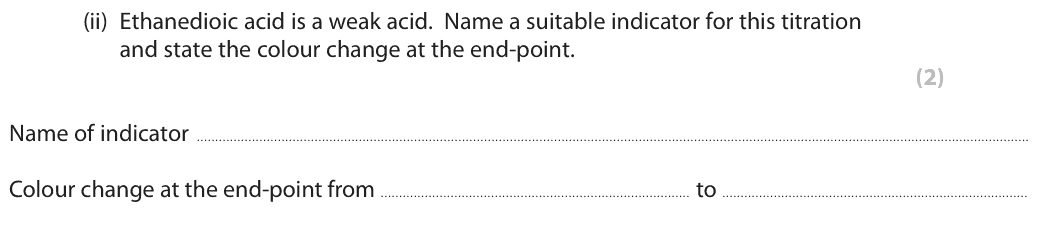
More advanced studies would demand a specific indicator for a weak acid/strong base titration. But at this stage, students have probably encountered only phenolphthalein and methyl orange. Any indicator was allowed but not universal indicator or litmus. Minor errors in spelling were allowed, (particularly for phenolphthalein).
Skills: PT6 use acid-base indicators in titrations of weak/strong acids with weak/strong alkalis; CP2 Core practical 2: Prepare a standard solution from a solid acid and use it to find the concentration of a solution of sodium hydroxide
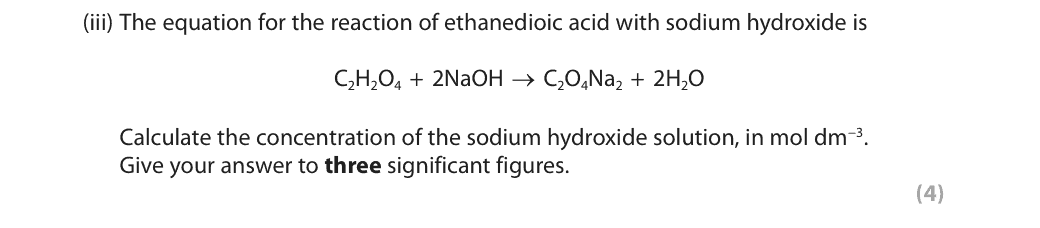
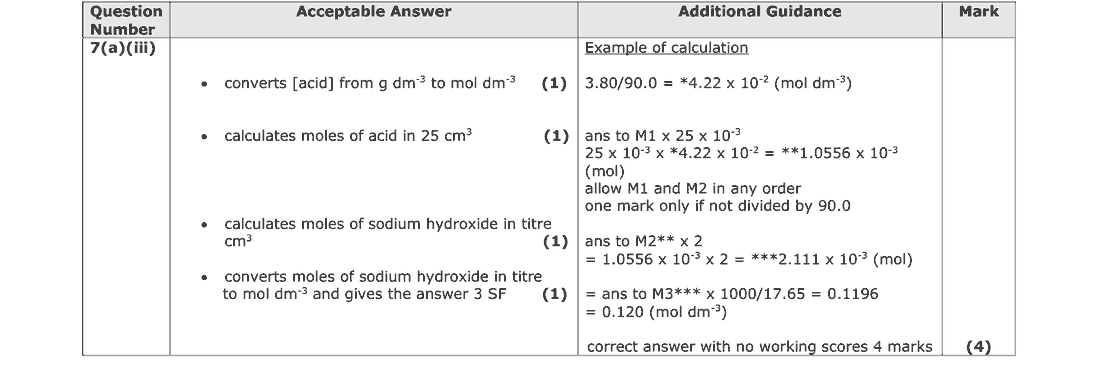
Skills: MS0.0 Recognise and make use of appropriate units in calculation; MS0.2 Use ratios, fractions and percentages; MS1.1 Use an appropriate number of significant figures; MS2.3 Substitute numerical values into algebraic equations using appropriate units for physical quantities; CP2 Core practical 2: Prepare a standard solution from a solid acid and use it to find the concentration of a solution of sodium hydroxide

Skills: MS0.2 Use ratios, fractions and percentages; MS1.3 Identify uncertainties in measurements and use simple techniques to determine uncertainty when data are; CP2 Core practical 2: Prepare a standard solution from a solid acid and use it to find the concentration of a solution of sodium hydroxide
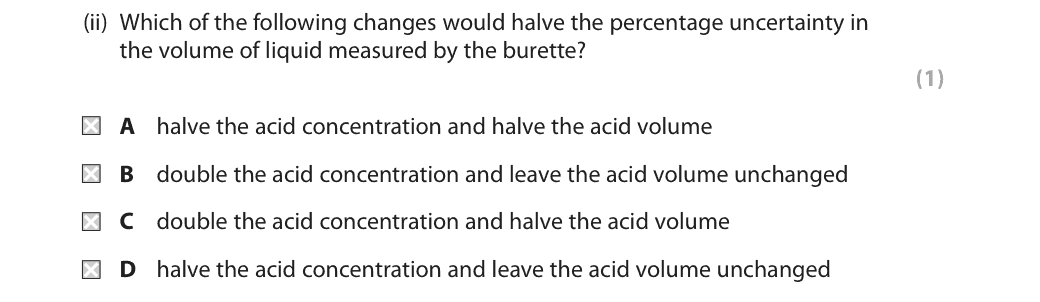
B
Skills: MS0.2 Use ratios, fractions and percentages; CP2 Core practical 2: Prepare a standard solution from a solid acid and use it to find the concentration of a solution of sodium hydroxide

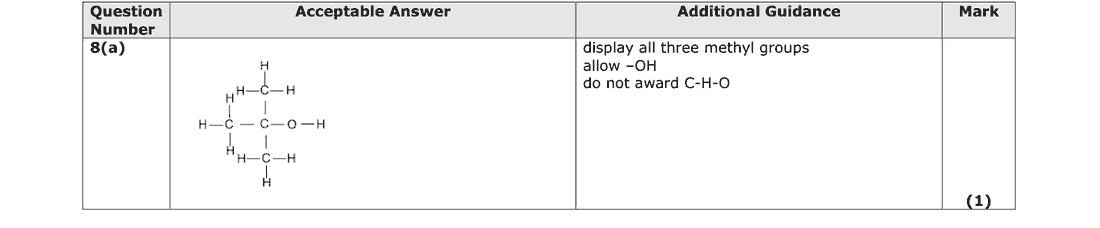
This question tested the ability to draw a fully displayed formula.
Skills: MS4.2 Visualise and represent 2D and 3D forms including two- dimensional representations of 3D objects
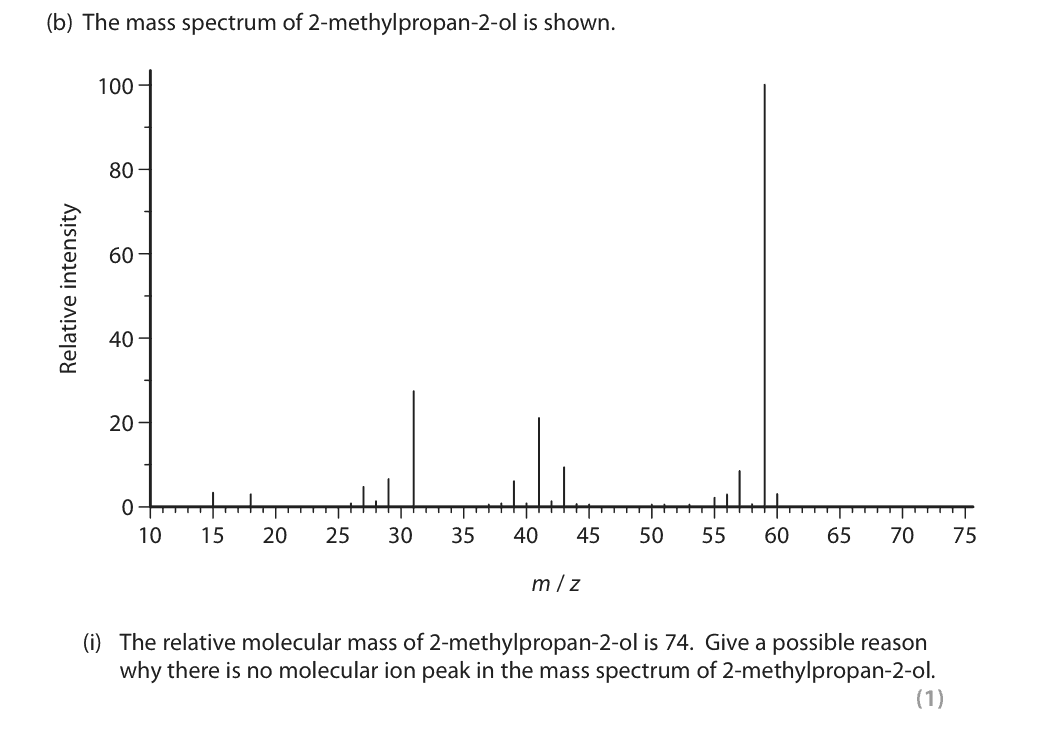
This question required application of the basic principles of fragmentation in a mass spectrometer, in an unfamiliar situation. Fragmentation of either the molecule or the molecular ion were acceptable answers.

The question did not specify which particular type of formula was required so any type was acceptable. The positive charge on the ion was an essential requirement. The majority of students presented their answers in a structural format, indicating that the correct answer had been deduced from fragmentation of the original molecule/ion.
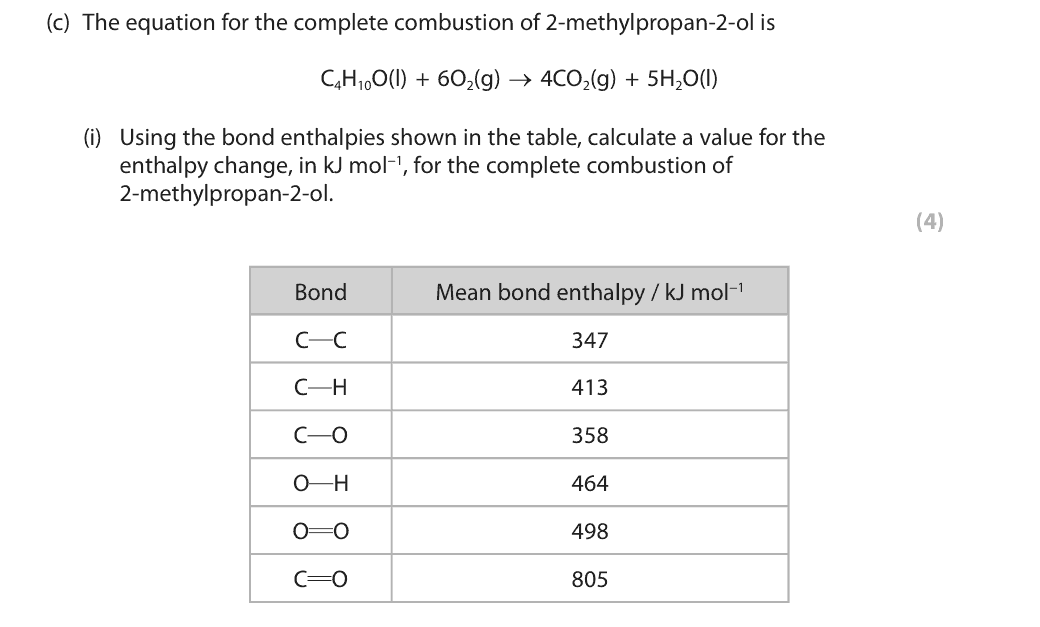
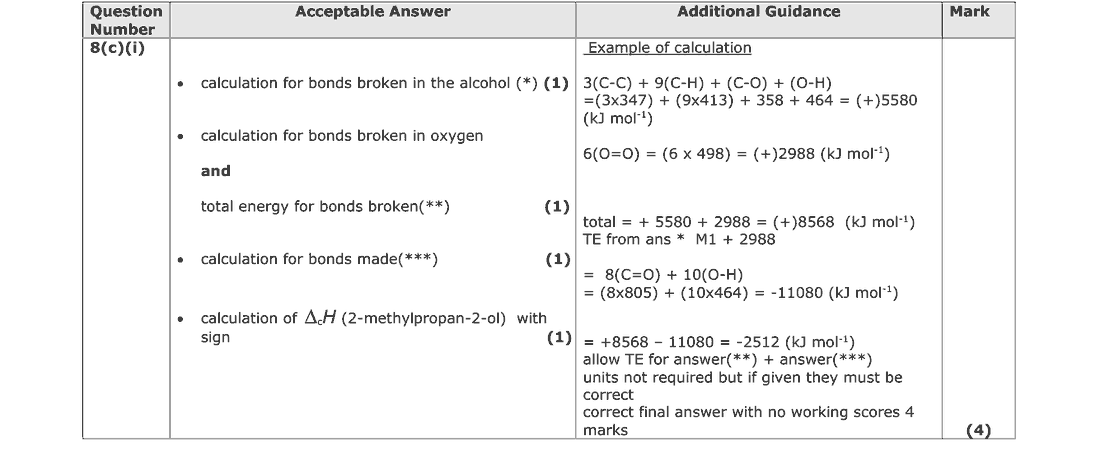
The responses to this question sometimes included a mass of figures followed by a final answer. It was often difficult to assign marks to transferred errors when the final answer was incorrect. Many answers indicated a mechanical application of the figures for bond formation and bond breaking, and showed little appreciation that bond breaking is an endothermic process while bond formation is exothermic. Common errors included the use of 4 C-C bonds and 10 C-H bonds. The bond enthalpies of the C-O and O-H bonds were also frequently omitted. Very few answers included an energy cycle. A well-drawn energy cycle or the use of Hess's Law equation would have helped to convince the reader that the energy changes were understood.
Skills: MS2.3 Substitute numerical values into algebraic equations using appropriate units for physical quantities; MS2.4 Solve algebraic equations

M1 and M2 were marked independently.

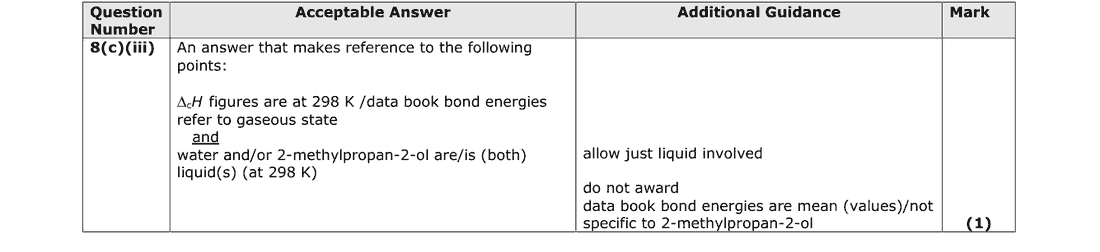
The discrepancy in this instance is explained by the difference in the states of water and 2-methylpropan-2-ol. Bond enthalpies refer to the gaseous state, whereas the equation shows water and 2-methylpropan-2-ol as liquids. There is a significant enthalpy change associated with changes of state, much larger than differences caused by the use of mean bond enthalpies.
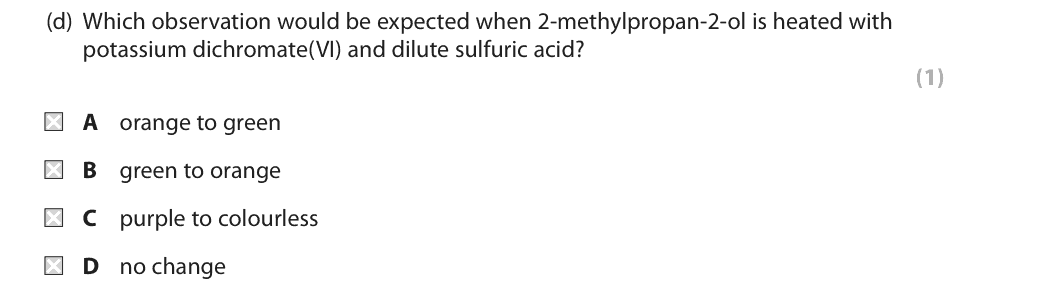
D
Want a paper marked and gone through with you? Message us.