
June 2024: AS Paper 1, Inorganic and physical chemistry

80 marks · 43 question parts · Paper, mark scheme and report on AQA's site · Have the Data Booklet beside you

Question by question

QTopicMarksAOType
01.1 Group 7(17), the halogens, Amount of substance 2AO3=2Short answer
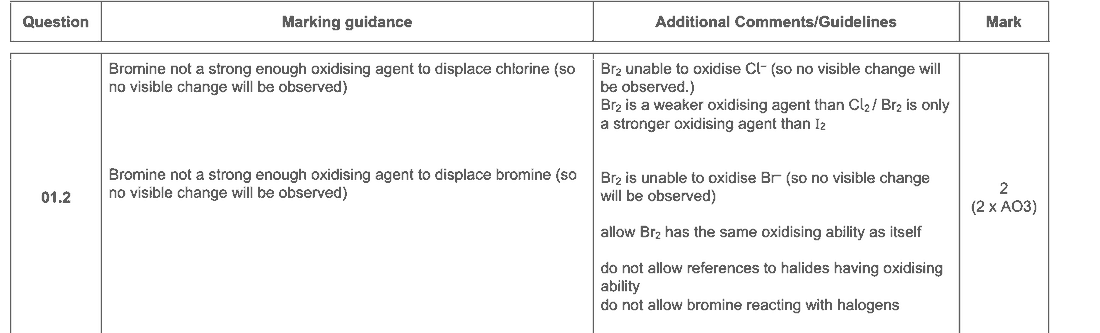
01.2 Group 7(17), the halogens 2AO3=2Explanation
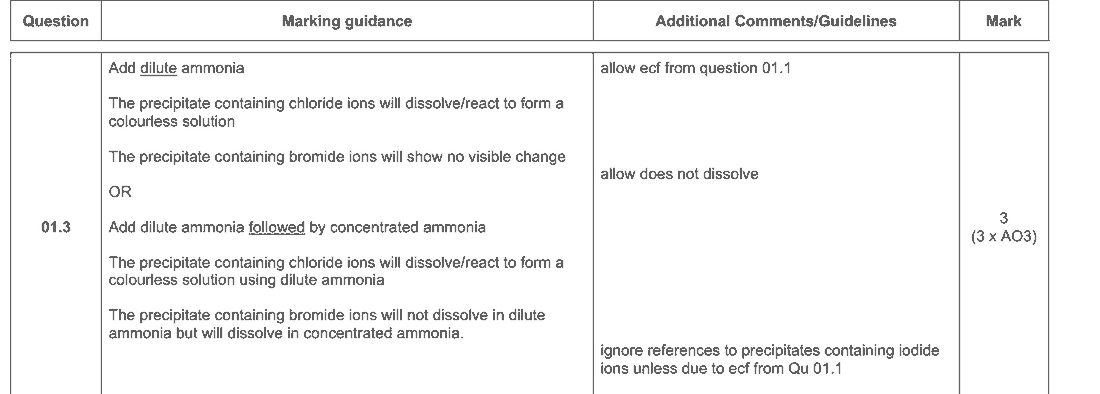
01.3 Group 7(17), the halogens 3AO3=3Practical and data analysis
02.1 Atomic structure 3AO2=3Explanation
02.2 Group 2, the alkaline earth metals 2AO1=2Short answer
02.3 Oxidation, reduction and redox equations 2AO2=2Explanation
03.1 Bonding 1AO1=1Short answer
03.2 Bonding 2AO2=2Explanation
03.3 Bonding 2AO2=2Explanation
03.4 Bonding 3AO1=3Explanation
03.5 Bonding 2AO2=2Diagram or structure
04 Group 7(17), the halogens, Group 2, the alkaline earth metals, Amount of substance 6AO2=2,AO3=4Level of response
05 Bonding 6AO1=6Explanation
06.1 Atomic structure 1AO1=1Short answer
06.2 Atomic structure 1AO1=1Equation writing
06.3 Atomic structure 3AO2=3Diagram or structure
06.4 Atomic structure 1AO1=1Short answer
07.1 Amount of substance 1AO1=1Calculation
07.2 Amount of substance 1AO2=1Calculation
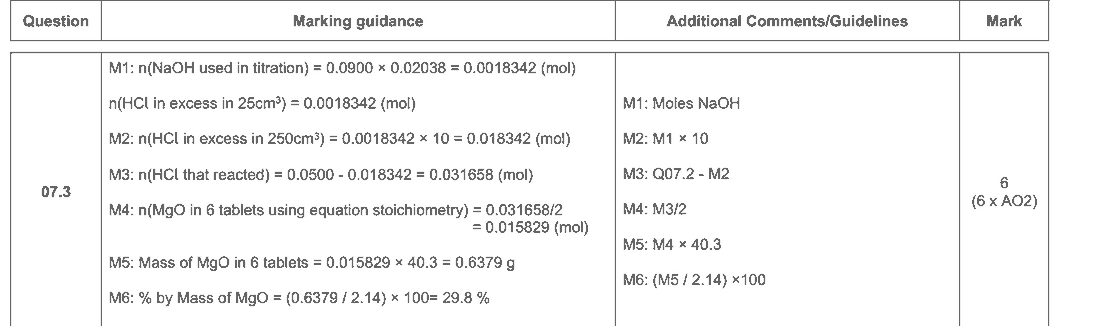
07.3 Amount of substance 6AO2=6Calculation
08.1 Energetics 2AO1=2Short answer
08.2 Energetics 2AO2=2Calculation
08.3 Energetics 1AO2=1Practical and data analysis
08.4 Energetics 6AO3=6Practical and data analysis
09.1 Oxidation, reduction and redox equations 1AO1=1Short answer
09.2 Oxidation, reduction and redox equations 1AO2=1Equation writing
09.3 Oxidation, reduction and redox equations 1AO2=1Equation writing
09.4 Oxidation, reduction and redox equations 1AO2=1Equation writing
10 Amount of substance 1AO2=1Multiple choice
11 Bonding 1AO1=1Multiple choice
12 Amount of substance 1AO2=1Multiple choice
13 Group 7(17), the halogens 1AO1=1Multiple choice
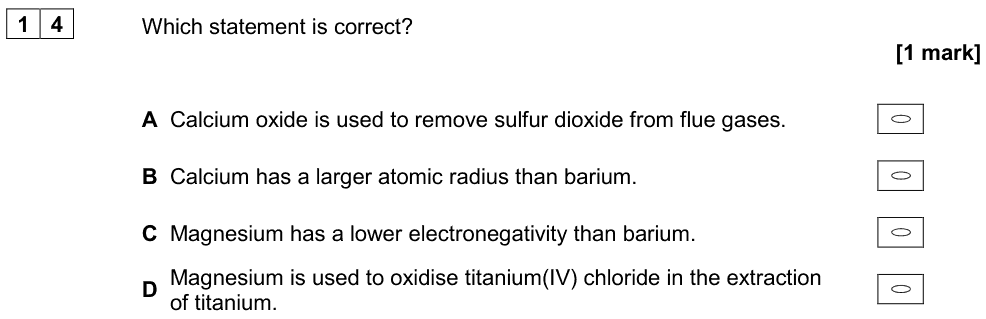
14 Group 2, the alkaline earth metals 1AO1=1Multiple choice
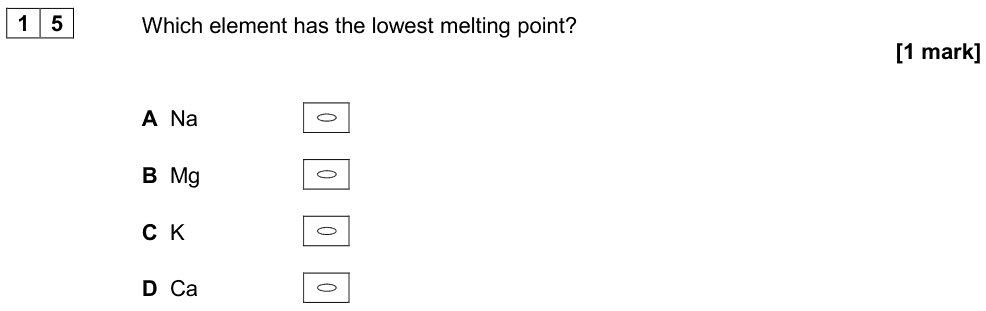
15 Bonding 1AO2=1Multiple choice
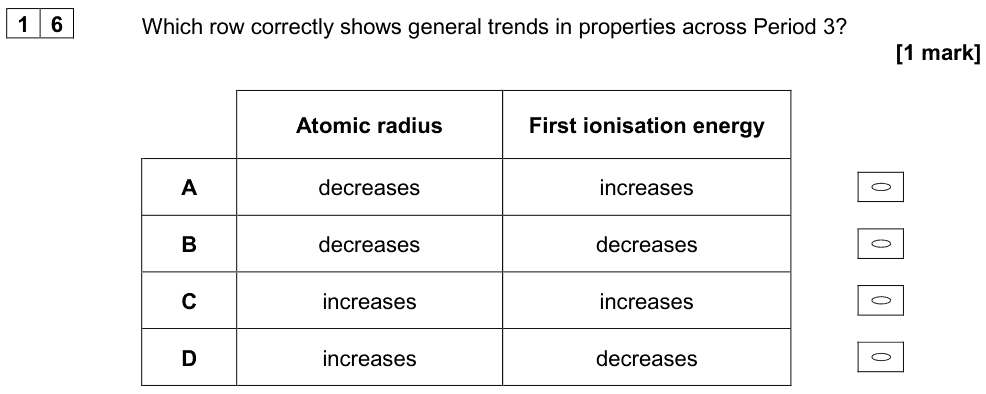
16 Periodicity 1AO1=1Multiple choice
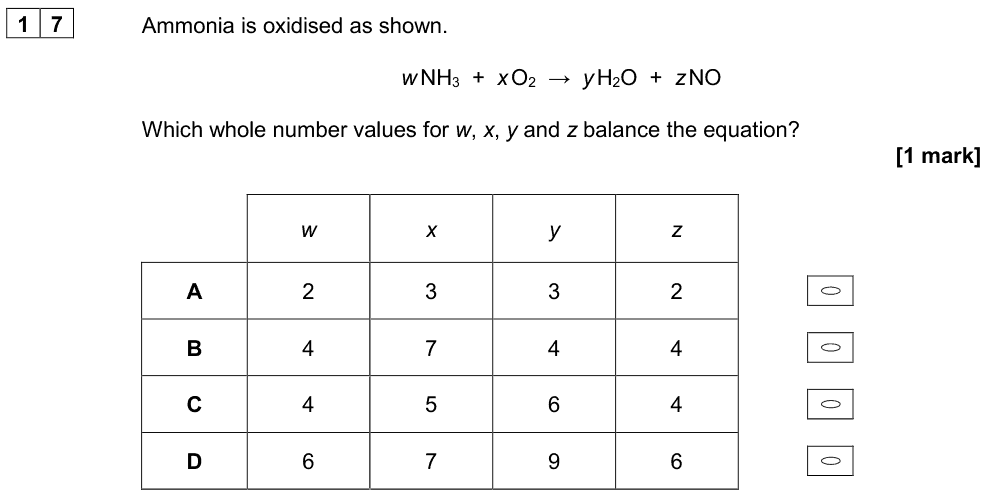
17 Amount of substance 1AO1=1Multiple choice
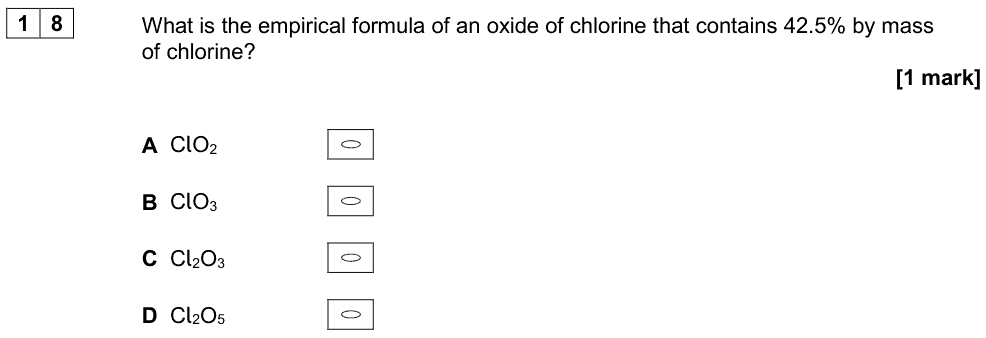
18 Amount of substance 1AO1=1Multiple choice
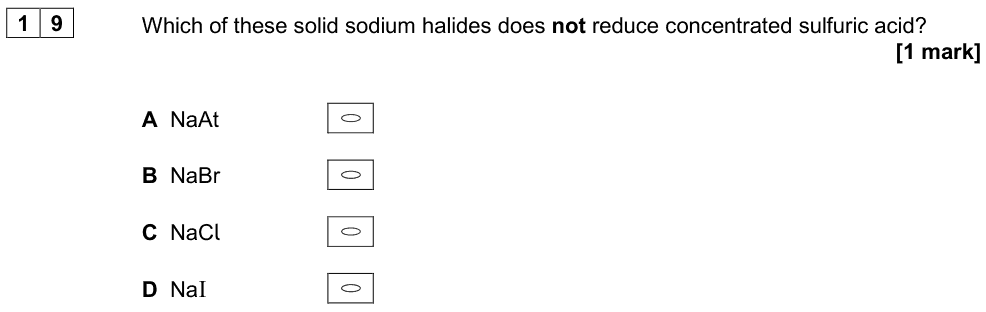
19 Group 7(17), the halogens 1AO3=1Multiple choice
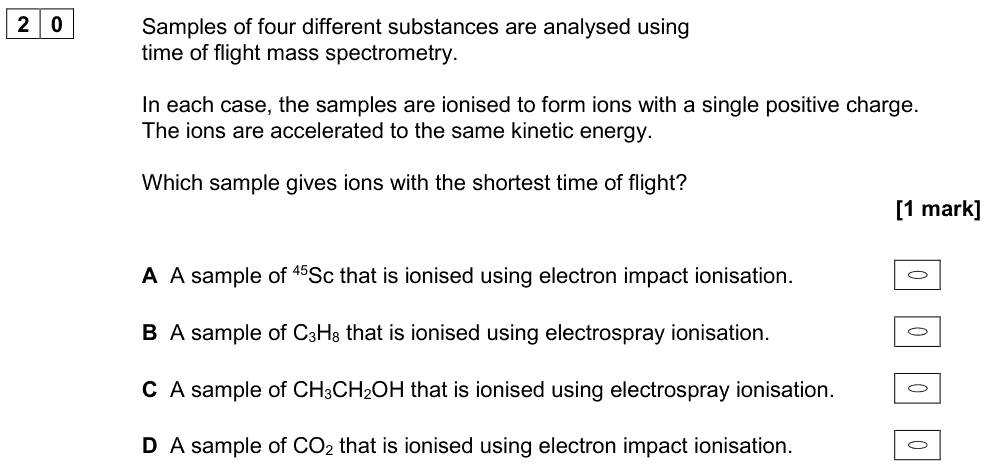
20 Atomic structure 1AO1=1Multiple choice
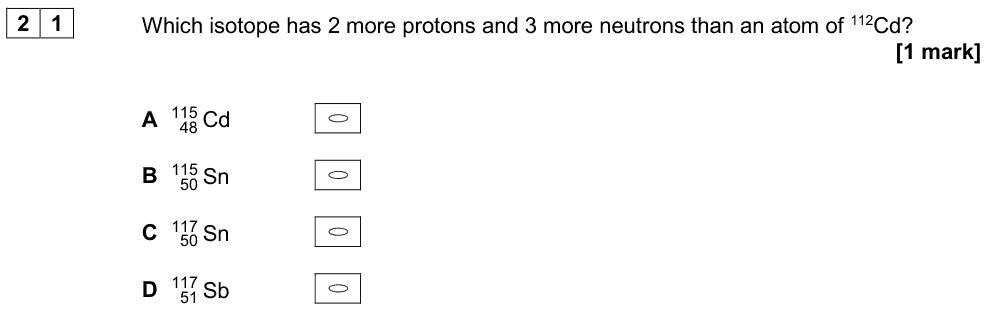
21 Atomic structure 1AO2=1Multiple choice
22 Atomic structure 1AO2=1Multiple choice
23 Amount of substance 1AO2=1Multiple choice
24 Atomic structure 1AO1=1Multiple choice

The questions

01.101.201.302.102.202.303.103.203.303.403.5040506.106.206.306.407.107.207.308.108.208.308.409.109.209.309.4101112131415161718192021222324
June 2024 · AS Paper 1 · Q01.1 2 marks AO3=2 Short answer Hard group 7 the halogensamount of substance
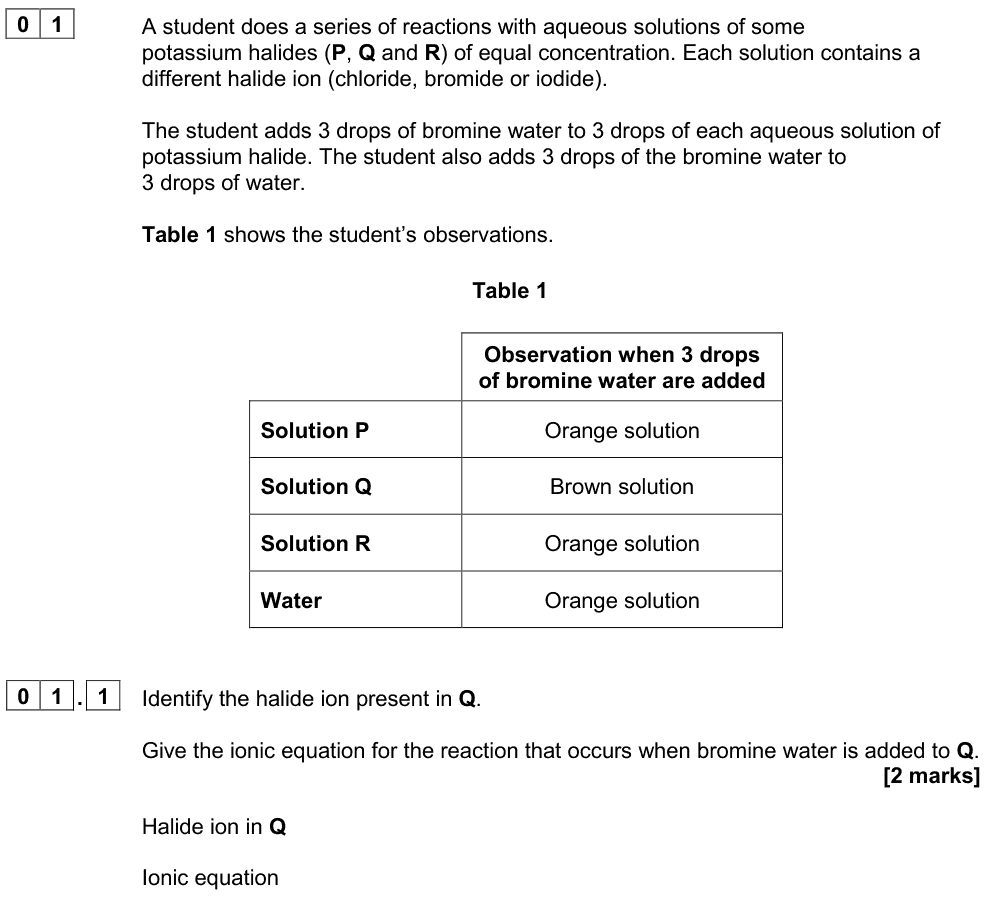
A student does a series of reactions with aqueous solutions of some
potassium halides (P, Q and R) of equal concentration. Each solution contains a
different halide ion (chloride, bromide or iodide).
The student adds 3 drops of bromine water to 3 drops of each aqueous solution of
potassium halide. The student also adds 3 drops of the bromine water to
3 drops of water.
Table 1 shows the student’s observations.
Table 1
Observation when 3 drops
of bromine water are added
Solution P
Orange solution
Solution Q
Brown solution
Solution R
Orange solution
Water
Orange solution
Identify the halide ion present in Q.
Give the ionic equation for the reaction that occurs when bromine water is added to Q.
[2 marks]
Halide ion in Q
Ionic equation
June 2024 · AS Paper 1 · Q01.2 2 marks AO3=2 Explanation group 7 the halogens
Earlier part of question 01 that this part usesEarlier part of June 2024 Paper 1 question 01
Explain, in terms of oxidising ability, why the observations from these reactions
do not allow the student to identify the halide ion present in P and the halide ion
present in R.
[2 marks]
June 2024 · AS Paper 1 · Q01.3 3 marks AO3=3 Practical and data analysis group 7 the halogens
Earlier part of question 01 that this part usesEarlier part of June 2024 Paper 1 question 01
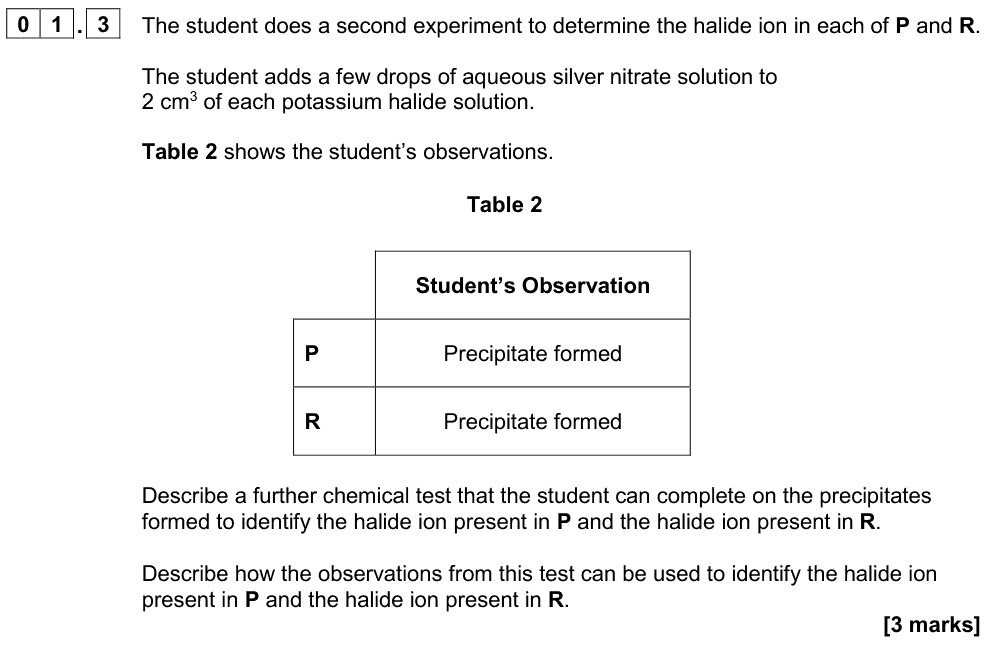
The student does a second experiment to determine the halide ion in each of P and R.
The student adds a few drops of aqueous silver nitrate solution to
2 cm3 of each potassium halide solution.
Table 2 shows the student’s observations.
Table 2
Student’s Observation
P
Precipitate formed
R
Precipitate formed
Describe a further chemical test that the student can complete on the precipitates
formed to identify the halide ion present in P and the halide ion present in R.
Describe how the observations from this test can be used to identify the halide ion
present in P and the halide ion present in R.
[3 marks]
June 2024 · AS Paper 1 · Q02.1 3 marks AO2=3 Explanation atomic structure
This question is about the elements in Group 2.
Explain why the third ionisation energy of beryllium is much higher than the
second ionisation energy of beryllium.
[3 marks]
June 2024 · AS Paper 1 · Q02.2 2 marks AO1=2 Short answer group 2
Earlier part of question 02 that this part usesEarlier part of June 2024 Paper 1 question 02
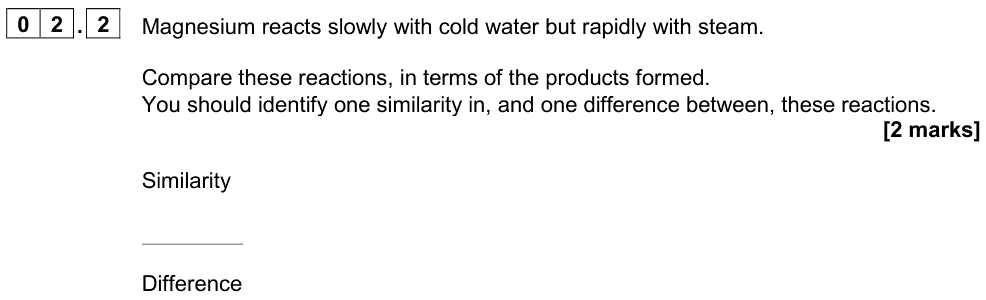
Magnesium reacts slowly with cold water but rapidly with steam.
Compare these reactions, in terms of the products formed.
You should identify one similarity in, and one difference between, these reactions.
[2 marks]
Similarity
Difference
June 2024 · AS Paper 1 · Q02.3 2 marks AO2=2 Explanation redox
Earlier part of question 02 that this part usesEarlier part of June 2024 Paper 1 question 02
The reaction of calcium with water is a redox reaction.
Explain, in terms of oxidation states, why this reaction involves both oxidation
and reduction.
[2 marks]
June 2024 · AS Paper 1 · Q03.1 1 mark AO1=1 Short answer bonding
This question is about structure and bonding.
Define electronegativity.
[1 mark]
June 2024 · AS Paper 1 · Q03.2 2 marks AO2=2 Explanation bonding
Earlier part of question 03 that this part usesEarlier part of June 2024 Paper 1 question 03
Explain why the C–Cl bond is polar.
[2 marks]
June 2024 · AS Paper 1 · Q03.3 2 marks AO2=2 Explanation bonding
Earlier part of question 03 that this part usesEarlier part of June 2024 Paper 1 question 03
Although the C–Cl bond is polar, CCl4 is a non-polar molecule.
Explain why.
[2 marks]
June 2024 · AS Paper 1 · Q03.4 3 marks AO1=3 Explanation bonding
Earlier part of question 03 that this part usesEarlier part of June 2024 Paper 1 question 03
There are van der Waals forces between non-polar molecules.
Explain what causes these forces.
[3 marks]
June 2024 · AS Paper 1 · Q03.5 2 marks AO2=2 Diagram or structure bonding
Earlier part of question 03 that this part usesEarlier part of June 2024 Paper 1 question 03
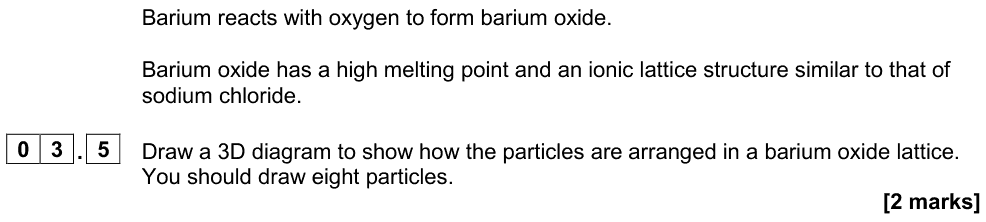
Barium reacts with oxygen to form barium oxide.
Barium oxide has a high melting point and an ionic lattice structure similar to that of
sodium chloride.
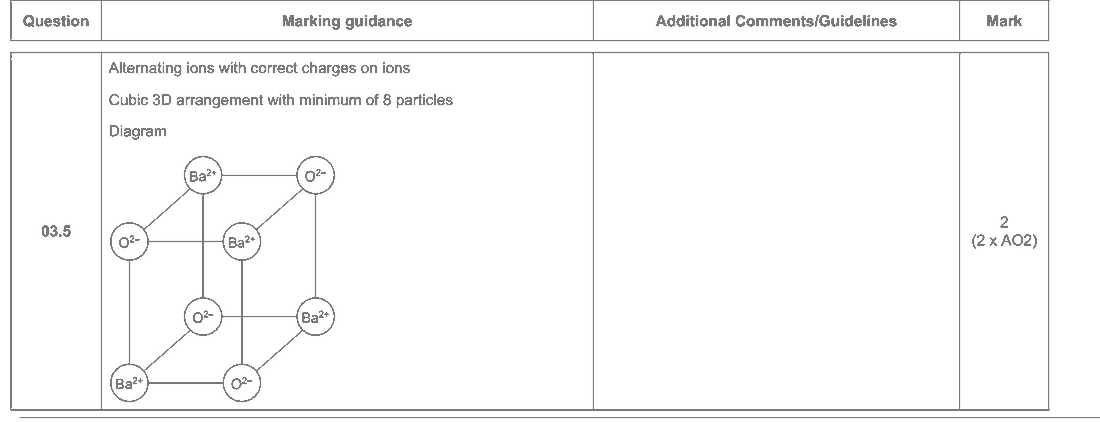
Draw a 3D diagram to show how the particles are arranged in a barium oxide lattice.
You should draw eight particles.
[2 marks]
June 2024 · AS Paper 1 · Q04 6 marks AO2=2, AO3=4 6-mark level of response group 7 the halogensgroup 2amount of substance
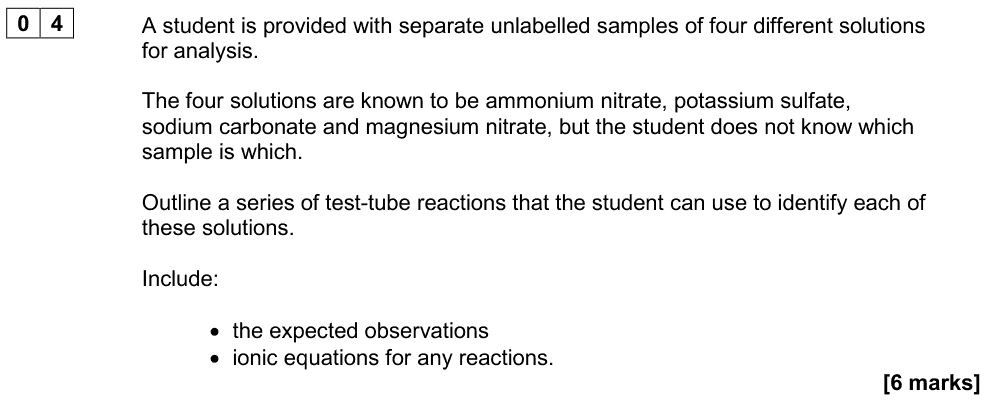
A student is provided with separate unlabelled samples of four different solutions
for analysis.
The four solutions are known to be ammonium nitrate, potassium sulfate,
sodium carbonate and magnesium nitrate, but the student does not know which
sample is which.
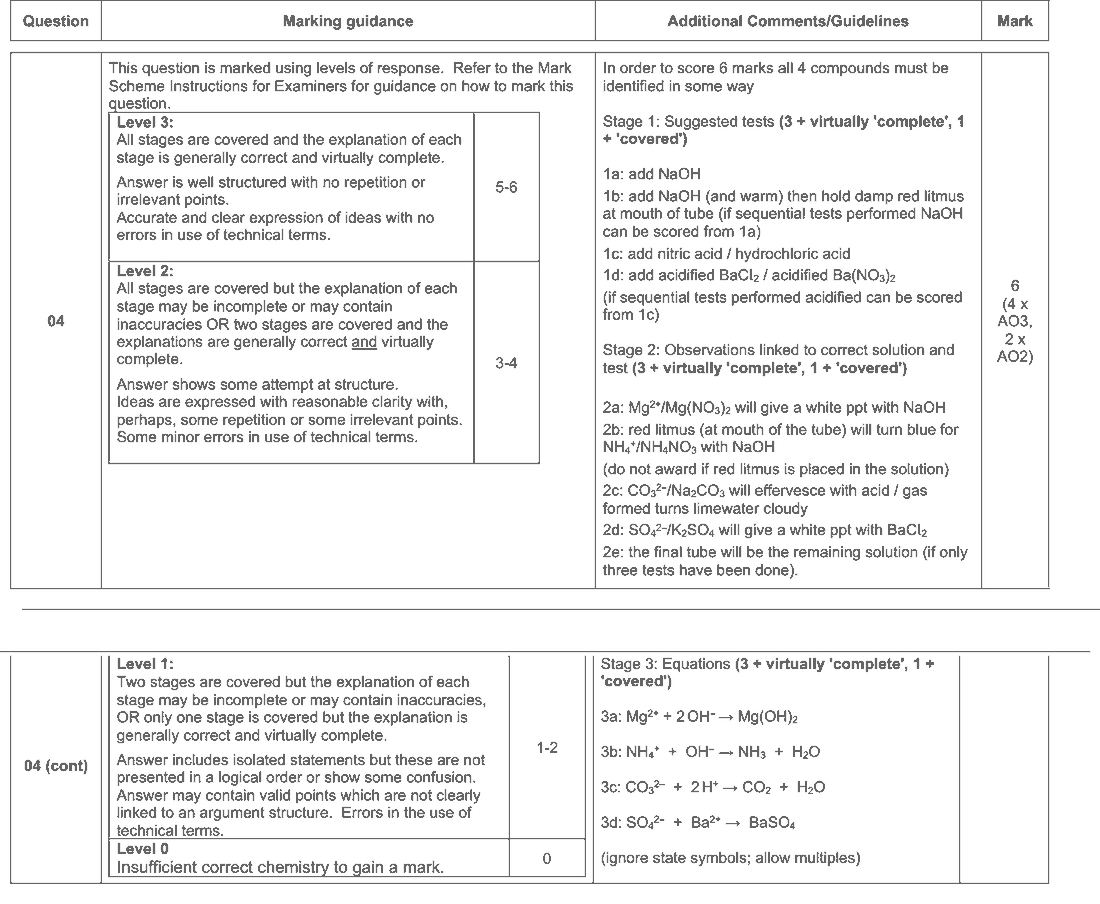
Outline a series of test-tube reactions that the student can use to identify each of
these solutions.
Include:
• the expected observations
• ionic equations for any reactions.
[6 marks]
June 2024 · AS Paper 1 · Q05 6 marks AO1=6 Explanation Hard bonding
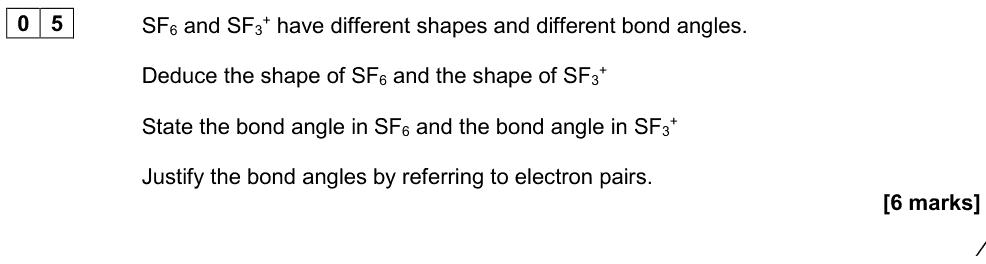
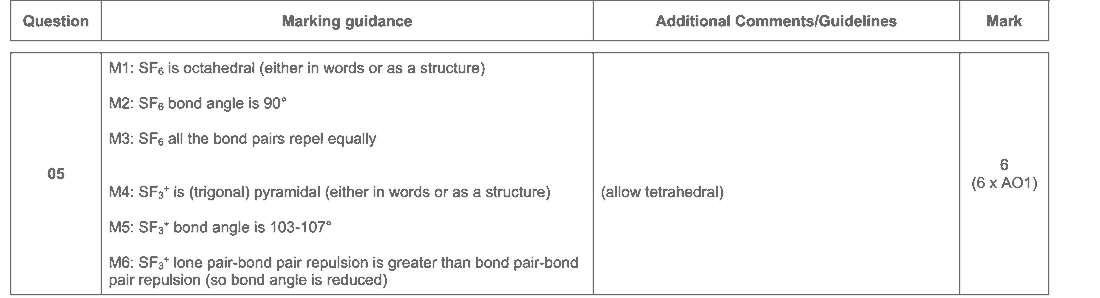
SF6 and SF3+ have different shapes and different bond angles.
Deduce the shape of SF6 and the shape of SF3+
State the bond angle in SF6 and the bond angle in SF3+
Justify the bond angles by referring to electron pairs.
[6 marks]
June 2024 · AS Paper 1 · Q06.1 1 mark AO1=1 Short answer atomic structure
This question is about atomic structure and mass spectrometry.
Give the full electron configuration for Br
[1 mark]
June 2024 · AS Paper 1 · Q06.2 1 mark AO1=1 Equation writing atomic structure
Earlier part of question 06 that this part usesEarlier part of June 2024 Paper 1 question 06
A sample of bromine (Br2) is analysed in a mass spectrometer.
The sample is ionised using electron impact ionisation.
Give an equation, including state symbols, for the process that occurs during the
ionisation of bromine.
[1 mark]
June 2024 · AS Paper 1 · Q06.3 3 marks AO2=3 Diagram or structure atomic structure
Earlier parts of question 06 that this part usesEarlier part of June 2024 Paper 1 question 06Earlier part of June 2024 Paper 1 question 06
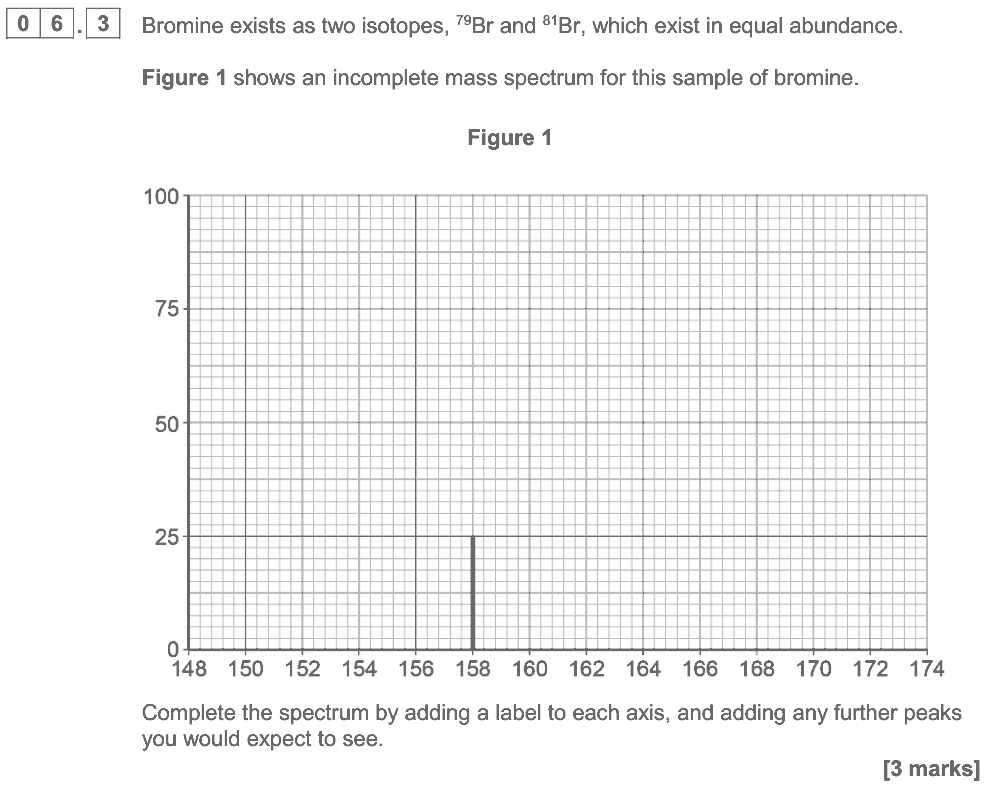
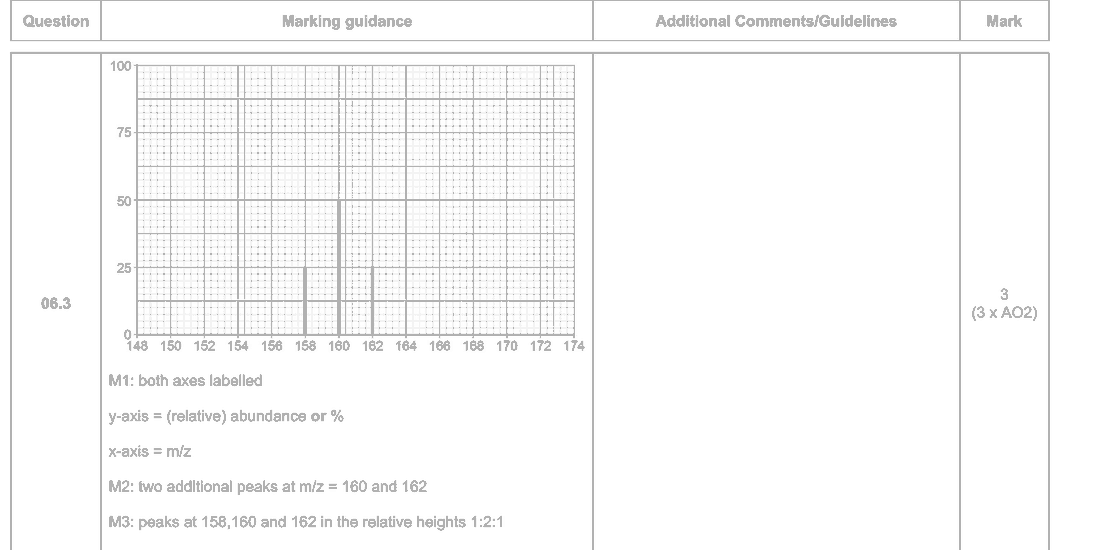
Bromine exists as two isotopes, 79Br and 81Br, which exist in equal abundance.
Figure 1 shows an incomplete mass spectrum for this sample of bromine.
Figure 1
Complete the spectrum by adding a label to each axis, and adding any further peaks
you would expect to see.
[3 marks]
June 2024 · AS Paper 1 · Q06.4 1 mark AO1=1 Short answer atomic structure
Earlier part of question 06 that this part usesEarlier part of June 2024 Paper 1 question 06
State how the detector enables the relative abundance of each ion to be determined.
[1 mark]
June 2024 · AS Paper 1 · Q07.1 1 mark AO1=1 Calculation Hard amount of substance
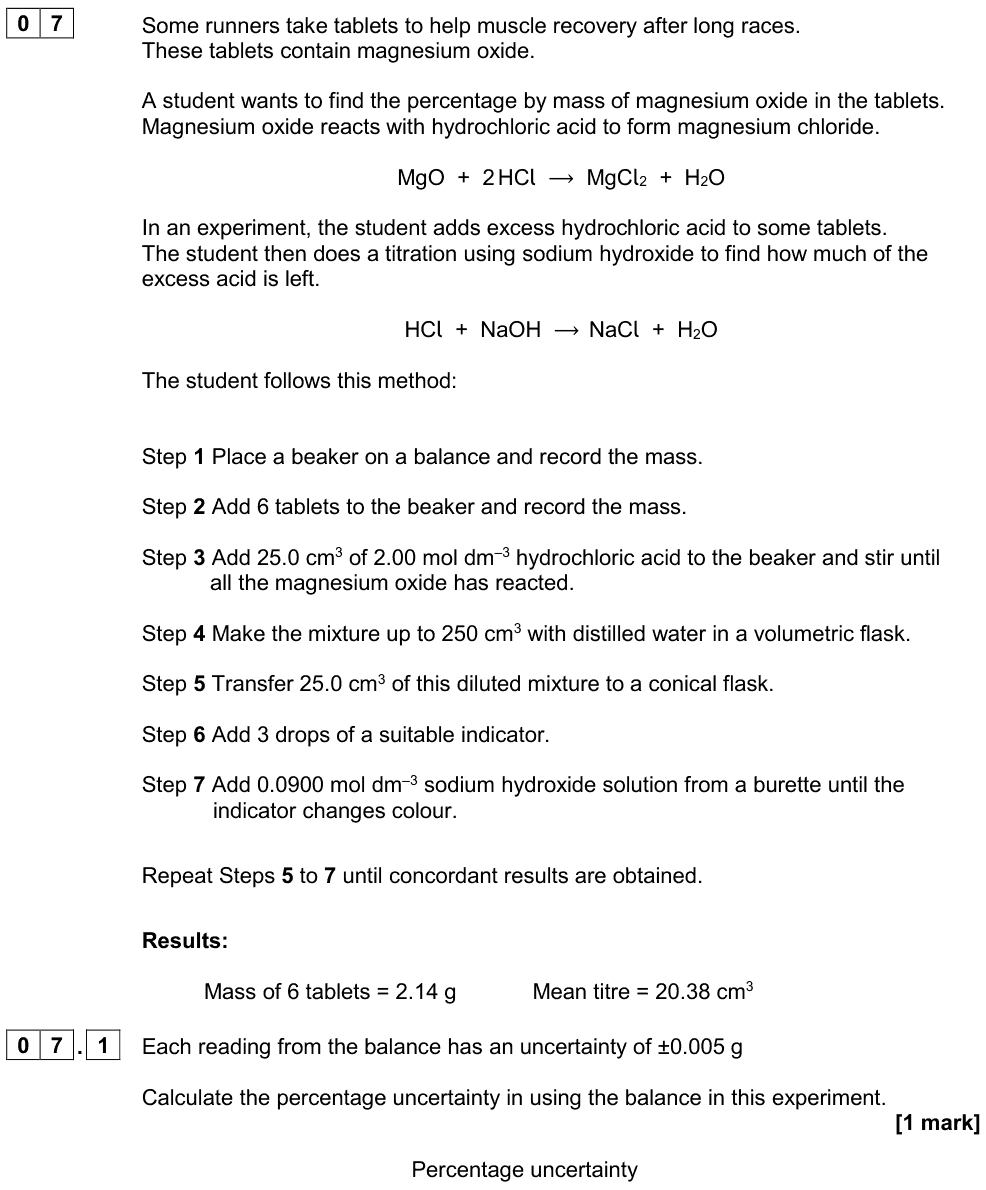
Some runners take tablets to help muscle recovery after long races.
These tablets contain magnesium oxide.
A student wants to find the percentage by mass of magnesium oxide in the tablets.
Magnesium oxide reacts with hydrochloric acid to form magnesium chloride.
MgO  +  2 HCl  ⟶  MgCl2  +  H2O
In an experiment, the student adds excess hydrochloric acid to some tablets.
The student then does a titration using sodium hydroxide to find how much of the
excess acid is left.
HCl  +  NaOH  ⟶  NaCl  +  H2O
The student follows this method:
Step 1 Place a beaker on a balance and record the mass.
Step 2 Add 6 tablets to the beaker and record the mass.
Step 3 Add 25.0 cm3 of 2.00 mol dm–3 hydrochloric acid to the beaker and stir until
all the magnesium oxide has reacted.
Step 4 Make the mixture up to 250 cm3 with distilled water in a volumetric flask.
Step 5 Transfer 25.0 cm3 of this diluted mixture to a conical flask.
Step 6 Add 3 drops of a suitable indicator.
Step 7 Add 0.0900 mol dm–3 sodium hydroxide solution from a burette until the
indicator changes colour.
Repeat Steps 5 to 7 until concordant results are obtained.
Results:
Mass of 6 tablets = 2.14 g
Mean titre = 20.38 cm3
Each reading from the balance has an uncertainty of ±0.005 g
Calculate the percentage uncertainty in using the balance in this experiment.
[1 mark]
Percentage uncertainty
June 2024 · AS Paper 1 · Q07.2 1 mark AO2=1 Calculation amount of substance
Earlier part of question 07 that this part usesEarlier part of June 2024 Paper 1 question 07
Calculate the amount, in moles, of hydrochloric acid that was added to the
tablets in Step 3.
Give your answer to an appropriate precision.
[1 mark]
Amount of hydrochloric acid
mol
June 2024 · AS Paper 1 · Q07.3 6 marks AO2=6 Calculation Hard amount of substance
Earlier part of question 07 that this part usesEarlier part of June 2024 Paper 1 question 07
Use your answer to Question 07.2 and the information given to calculate
the percentage by mass of magnesium oxide in the tablets.
[6 marks]
Percentage by mass of MgO
June 2024 · AS Paper 1 · Q08.1 2 marks AO1=2 Short answer Hard energetics
This question is about silver nitrate.
Define standard enthalpy of formation.
[2 marks]
June 2024 · AS Paper 1 · Q08.2 2 marks AO2=2 Calculation energetics
Earlier part of question 08 that this part usesEarlier part of June 2024 Paper 1 question 08
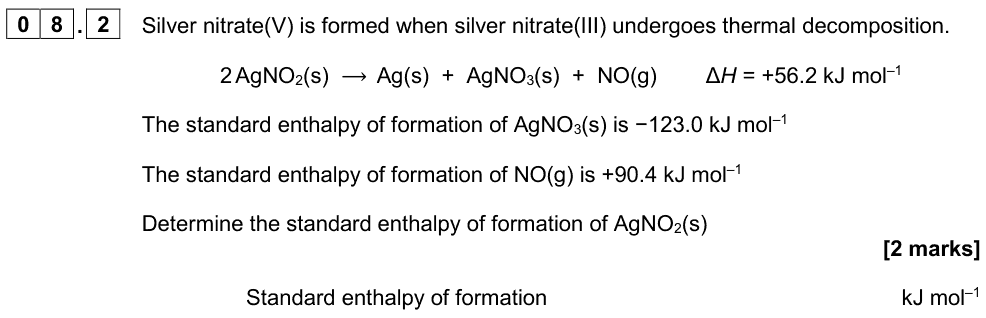
Silver nitrate(V) is formed when silver nitrate(III) undergoes thermal decomposition.
2 AgNO2(s)  ⟶  Ag(s)  +  AgNO3(s)  +  NO(g)        ΔH = +56.2 kJ mol–1
The standard enthalpy of formation of AgNO3(s) is −123.0 kJ mol–1
The standard enthalpy of formation of NO(g) is +90.4 kJ mol–1
Determine the standard enthalpy of formation of AgNO2(s)
[2 marks]
Standard enthalpy of formation
kJ mol–1
June 2024 · AS Paper 1 · Q08.3 1 mark AO2=1 Practical and data analysis energetics
Earlier part of question 08 that this part usesEarlier part of June 2024 Paper 1 question 08
Suggest why the enthalpy change for the thermal decomposition of
solid silver nitrate(III) is difficult to determine experimentally.
[1 mark]
June 2024 · AS Paper 1 · Q08.4 6 marks AO3=6 Practical and data analysis Hard energetics
Earlier part of question 08 that this part usesEarlier part of June 2024 Paper 1 question 08
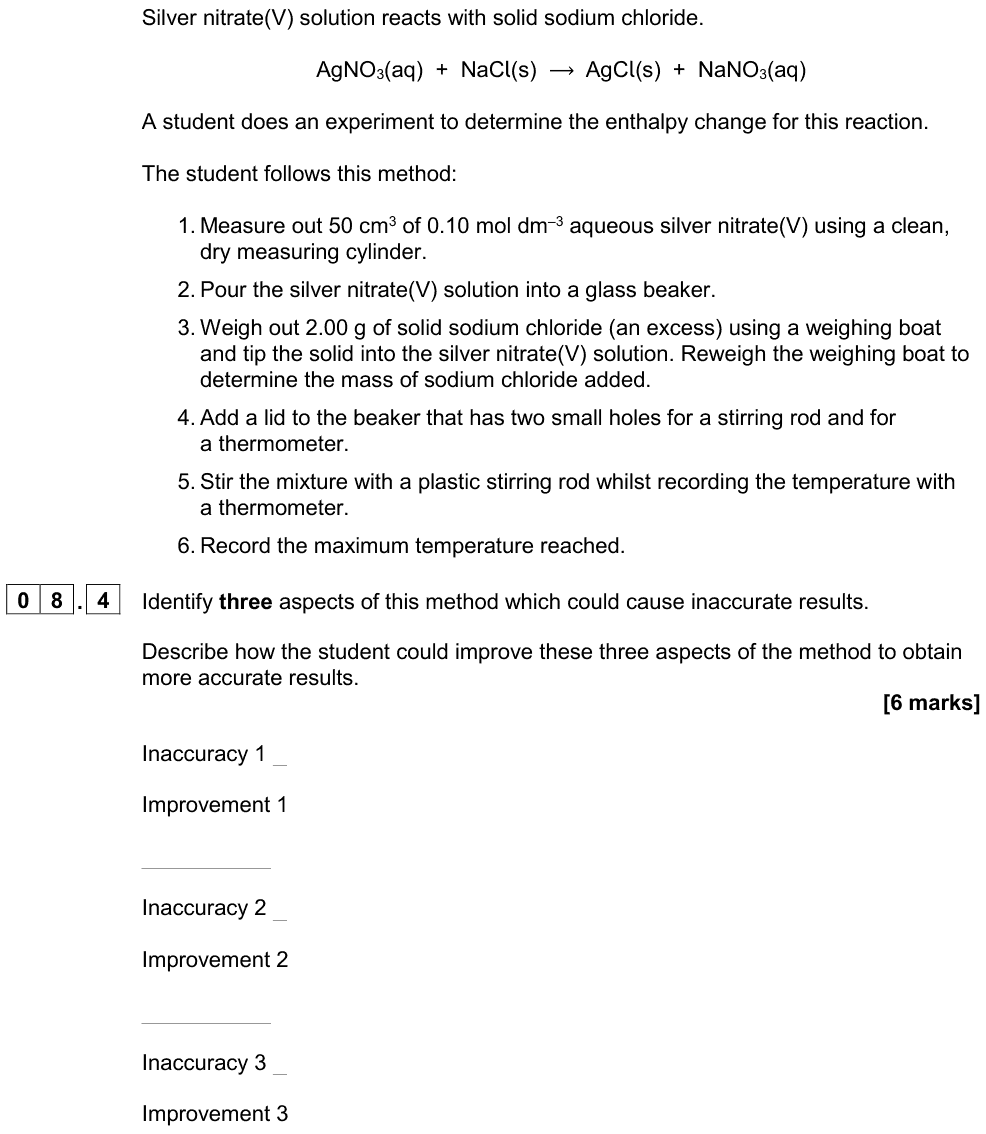
Silver nitrate(V) solution reacts with solid sodium chloride.
AgNO3(aq)  +  NaCl(s)  ⟶  AgCl(s)  +  NaNO3(aq)
A student does an experiment to determine the enthalpy change for this reaction.
The student follows this method:
1. Measure out 50 cm3 of 0.10 mol dm–3 aqueous silver nitrate(V) using a clean,

dry measuring cylinder.
2. Pour the silver nitrate(V) solution into a glass beaker.
3. Weigh out 2.00 g of solid sodium chloride (an excess) using a weighing boat
and tip the solid into the silver nitrate(V) solution. Reweigh the weighing boat to
determine the mass of sodium chloride added.
4. Add a lid to the beaker that has two small holes for a stirring rod and for
a thermometer.
5. Stir the mixture with a plastic stirring rod whilst recording the temperature with

a thermometer.
6. Record the maximum temperature reached.

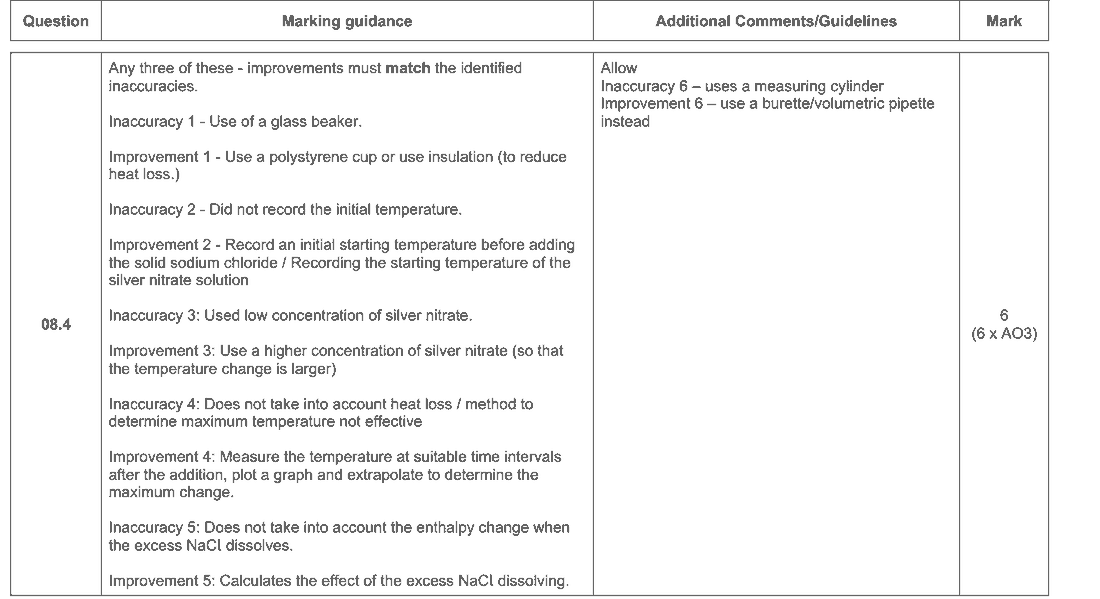
Identify three aspects of this method which could cause inaccurate results.
Describe how the student could improve these three aspects of the method to obtain
more accurate results.
[6 marks]
Inaccuracy 1
Improvement 1
Inaccuracy 2
Improvement 2
Inaccuracy 3
Improvement 3
June 2024 · AS Paper 1 · Q09.1 1 mark AO1=1 Short answer Easy redox
This question is about redox reactions.
State, in terms of electrons, the meaning of the term oxidising agent.
[1 mark]
June 2024 · AS Paper 1 · Q09.2 1 mark AO2=1 Equation writing redox
Earlier part of question 09 that this part usesEarlier part of June 2024 Paper 1 question 09
Give a half-equation to show the oxidation of copper to copper(II) ions.
[1 mark]
June 2024 · AS Paper 1 · Q09.3 1 mark AO2=1 Equation writing redox
Earlier part of question 09 that this part usesEarlier part of June 2024 Paper 1 question 09
Give a half-equation to show the reduction of NO3– ions in acidic solution to NO2
[1 mark]
June 2024 · AS Paper 1 · Q09.4 1 mark AO2=1 Equation writing redox
Earlier part of question 09 that this part usesEarlier part of June 2024 Paper 1 question 09
Use your answers to Question 09.2 and Question 09.3 to deduce an overall equation
for the reduction of NO3– ions by copper.
[1 mark]
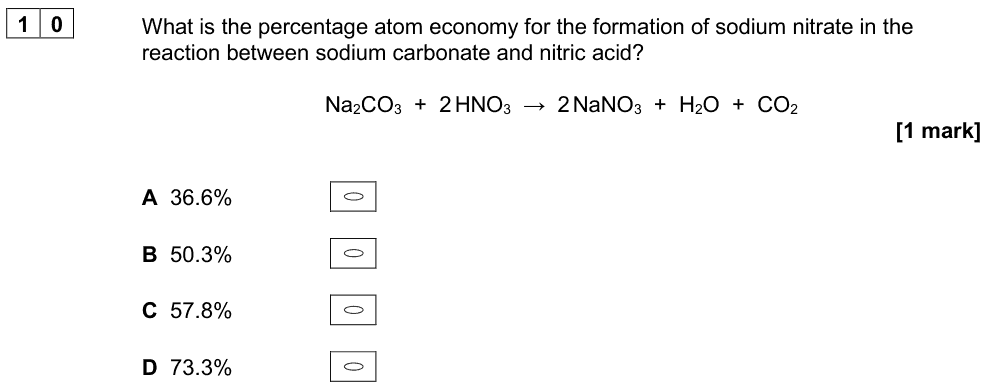
June 2024 · AS Paper 1 · Q10 1 mark AO2=1 Multiple choice Easy amount of substance
What is the percentage atom economy for the formation of sodium nitrate in the
reaction between sodium carbonate and nitric acid?
Na2CO3  +  2 HNO3  →  2 NaNO3  +  H2O  +  CO2
[1 mark]
A 36.6%
B 50.3%
C 57.8%
D 73.3%
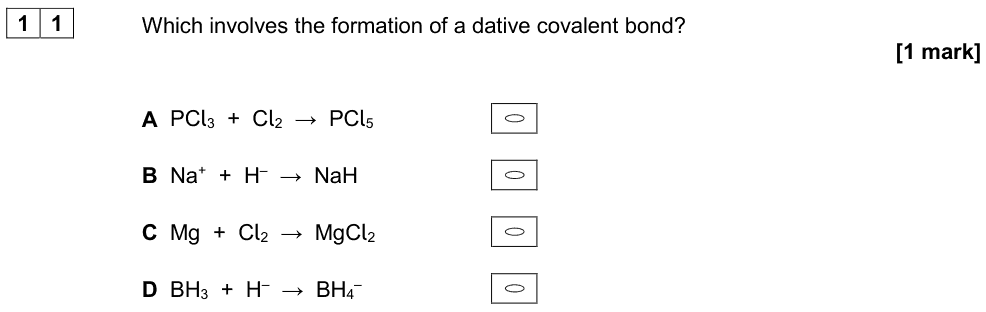
June 2024 · AS Paper 1 · Q11 1 mark AO1=1 Multiple choice bonding
Which involves the formation of a dative covalent bond?
[1 mark]
A PCl3  +  Cl2  →  PCl5
B Na+  +  H–  →  NaH
C Mg  +  Cl2  →  MgCl2
D BH3  +  H–  →  BH4–
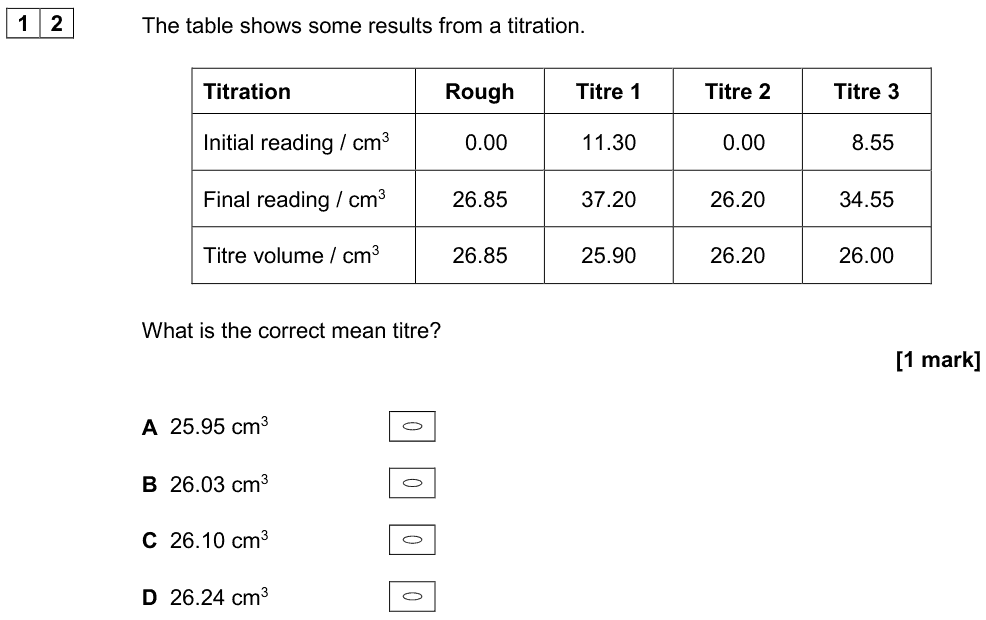
June 2024 · AS Paper 1 · Q12 1 mark AO2=1 Multiple choice Easy amount of substance
The table shows some results from a titration.
Titration
Rough
Titre 1
Titre 2
Titre 3
Initial reading / cm3
0.00
11.30
0.00
8.55
Final reading / cm3
26.85
37.20
26.20
34.55
Titre volume / cm3
26.85
25.90
26.20
26.00
What is the correct mean titre?
[1 mark]
A 25.95 cm3
B 26.03 cm3
C 26.10 cm3
D 26.24 cm3
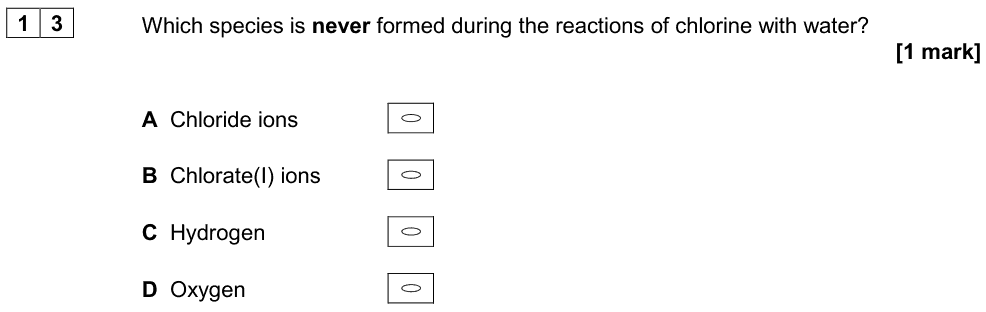
June 2024 · AS Paper 1 · Q13 1 mark AO1=1 Multiple choice group 7 the halogens
Which species is never formed during the reactions of chlorine with water?
[1 mark]
A Chloride ions
B Chlorate(I) ions
C Hydrogen
D Oxygen
June 2024 · AS Paper 1 · Q14 1 mark AO1=1 Multiple choice group 2
Which statement is correct?
[1 mark]
A Calcium oxide is used to remove sulfur dioxide from flue gases.
B Calcium has a larger atomic radius than barium.
C Magnesium has a lower electronegativity than barium.
D Magnesium is used to oxidise titanium(IV) chloride in the extraction
of titanium.
June 2024 · AS Paper 1 · Q15 1 mark AO2=1 Multiple choice bonding
Which element has the lowest melting point?
[1 mark]
A Na
B Mg
C K
D Ca
June 2024 · AS Paper 1 · Q16 1 mark AO1=1 Multiple choice Easy periodicity
Which row correctly shows general trends in properties across Period 3?
[1 mark]
Atomic radius
First ionisation energy
A
decreases
increases
B
decreases
decreases
C
increases
increases
D
increases
decreases
June 2024 · AS Paper 1 · Q17 1 mark AO1=1 Multiple choice Easy amount of substance
Ammonia is oxidised as shown.
w NH3  +  x O2  →  y H2O  +  z NO
Which whole number values for w, x, y and z balance the equation?
[1 mark]
w
x
y
z
A
2
3
3
2
B
4
7
4
4
C
4
5
6
4
D
6
7
9
6
June 2024 · AS Paper 1 · Q18 1 mark AO1=1 Multiple choice Easy amount of substance
What is the empirical formula of an oxide of chlorine that contains 42.5% by mass
of chlorine?
[1 mark]
A ClO2
B ClO3
C Cl2O3
D Cl2O5
June 2024 · AS Paper 1 · Q19 1 mark AO3=1 Multiple choice group 7 the halogens
Which of these solid sodium halides does not reduce concentrated sulfuric acid?
[1 mark]
A NaAt
B NaBr
C NaCl
D NaI
June 2024 · AS Paper 1 · Q20 1 mark AO1=1 Multiple choice Easy atomic structure
Samples of four different substances are analysed using
time of flight mass spectrometry.
In each case, the samples are ionised to form ions with a single positive charge.
The ions are accelerated to the same kinetic energy.
Which sample gives ions with the shortest time of flight?
[1 mark]
A A sample of 45Sc that is ionised using electron impact ionisation.
B A sample of C3H8 that is ionised using electrospray ionisation.
C A sample of CH3CH2OH that is ionised using electrospray ionisation.
D A sample of CO2 that is ionised using electron impact ionisation.
June 2024 · AS Paper 1 · Q21 1 mark AO2=1 Multiple choice Easy atomic structure
Which isotope has 2 more protons and 3 more neutrons than an atom of 112Cd?
[1 mark]
A
Cd
48
115
B
Sn
50
115
C
Sn
50
117
D
Sb
51
117
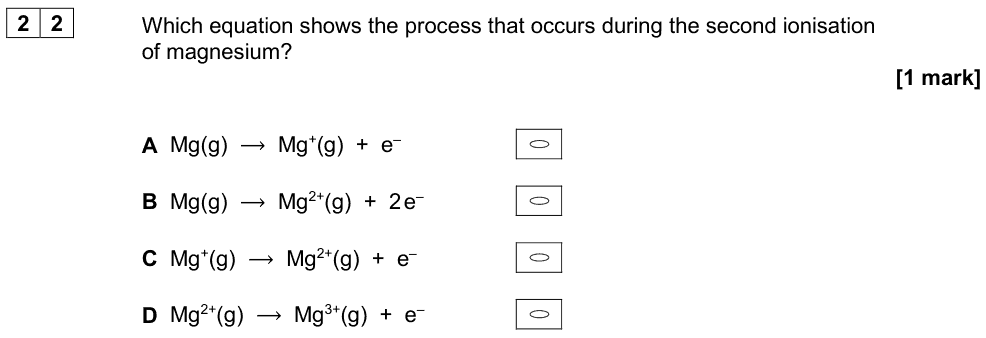
June 2024 · AS Paper 1 · Q22 1 mark AO2=1 Multiple choice Easy atomic structure
Which equation shows the process that occurs during the second ionisation
of magnesium?
[1 mark]
A Mg(g)  ⟶  Mg+(g)  +  e–
B Mg(g)  ⟶  Mg2+(g)  +  2 e–
C Mg+(g)  ⟶  Mg2+(g)  +  e–
D Mg2+(g)  ⟶  Mg3+(g)  +  e–
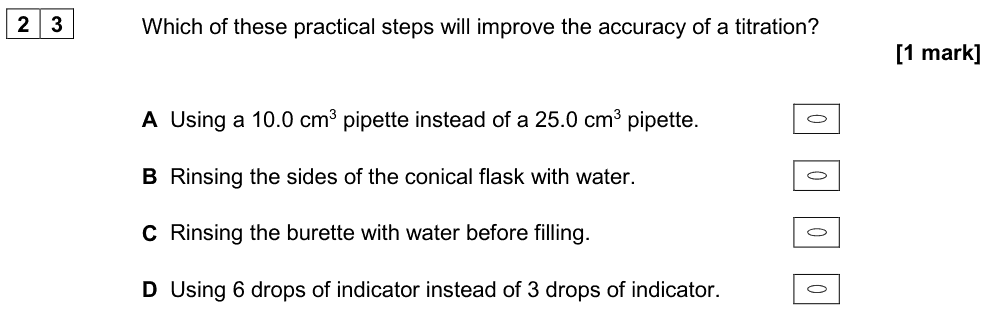
June 2024 · AS Paper 1 · Q23 1 mark AO2=1 Multiple choice Easy amount of substance
Which of these practical steps will improve the accuracy of a titration?
[1 mark]
A Using a 10.0 cm3 pipette instead of a 25.0 cm3 pipette.
B Rinsing the sides of the conical flask with water.
C Rinsing the burette with water before filling.
D Using 6 drops of indicator instead of 3 drops of indicator.
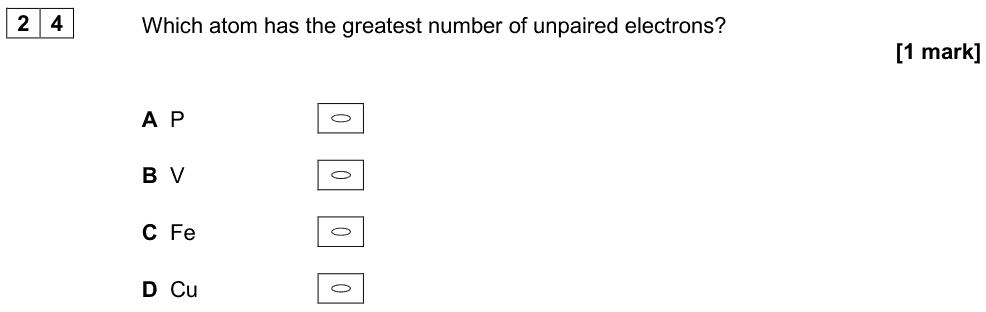
June 2024 · AS Paper 1 · Q24 1 mark AO1=1 Multiple choice atomic structure
Which atom has the greatest number of unpaired electrons?
[1 mark]
A P
B V
C Fe
D Cu

Work with an A-level chemistry tutor

Want a paper marked and gone through with you? Message us.

Prefer email? Send an enquiry

If you are under 18, please include a parent's contact details. Enquiries go to enquiries@chemistryaleveltutor.com and are deleted once handled. All tutoring is online.