June 2022: AS Paper 1, Inorganic and physical chemistry

80 marks · 42 question parts · Paper, mark scheme and report on AQA's site · Have the Data Booklet beside you

Question by question

QTopicMarksAOType
01.1 Group 2, the alkaline earth metals 2AO1=2Explanation
01.2 Atomic structure 1AO2=1Equation writing
01.3 Atomic structure 2AO2=2Explanation
02.1 Amount of substance 2AO1=2Practical and data analysis
02.2 Amount of substance 3AO2=3Calculation
02.3 Amount of substance 6AO1=3,AO3=3Level of response
02.4 Amount of substance 2AO1=2Practical and data analysis
02.5 Amount of substance 1AO1=1Calculation
03 Bonding 3AO1=3Diagram or structure
04.1 Bonding 3AO2=3Diagram or structure
04.2 Bonding 1AO1=1Short answer
04.3 Bonding 1AO2=1Short answer
04.4 Bonding 2AO2=2Explanation
04.5 Bonding 3AO2=3Explanation
05 Atomic structure, Amount of substance 5AO2=5Calculation
06.1 Oxidation, reduction and redox equations 1AO1=1Short answer
06.2 Oxidation, reduction and redox equations 2AO2=2Equation writing
06.3 Group 7(17), the halogens, Amount of substance 2AO1=2Equation writing
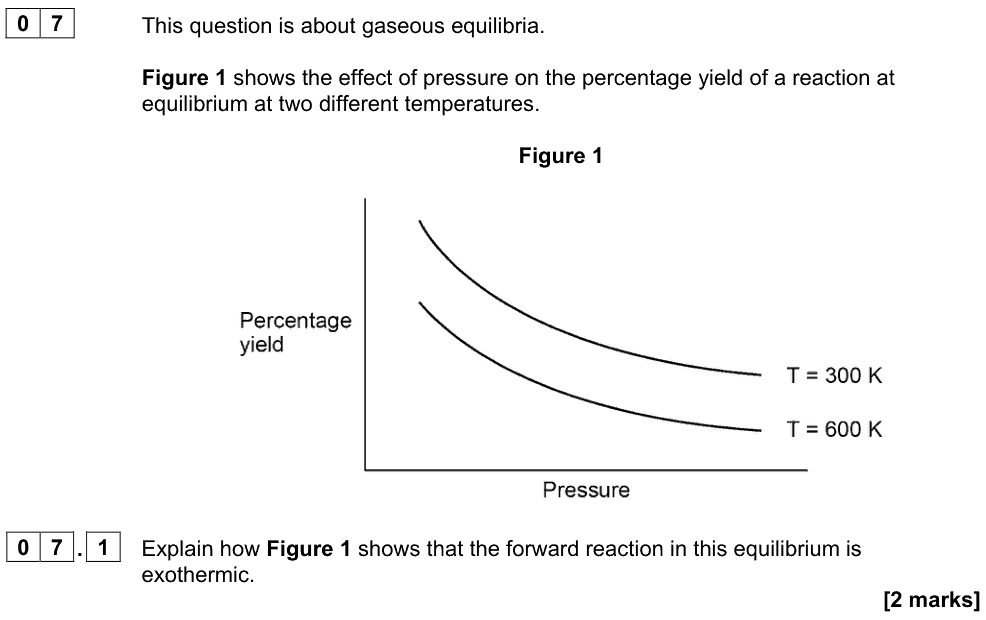
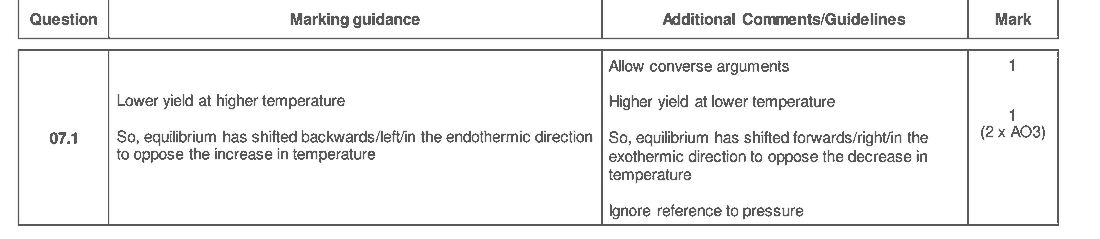
07.1 Chemical equilibria, Le Chatelier's principle and Kc 2AO3=2Explanation
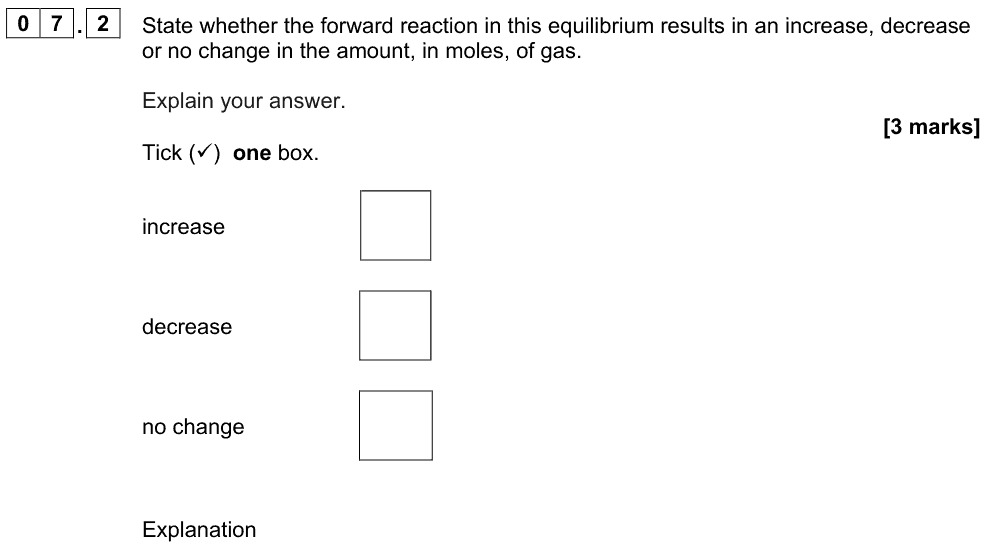
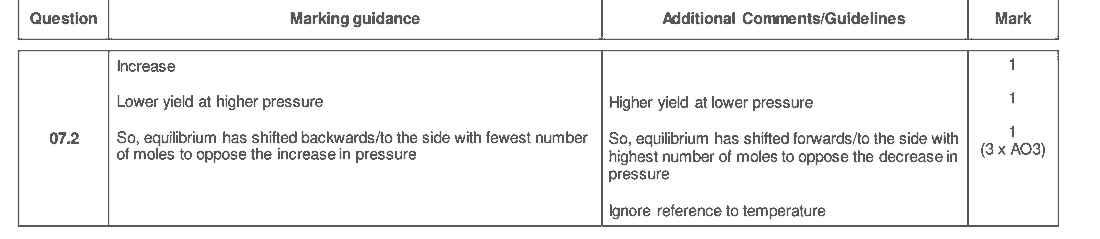
07.2 Chemical equilibria, Le Chatelier's principle and Kc 3AO3=3Explanation
07.3 Chemical equilibria, Le Chatelier's principle and Kc 1AO1=1Short answer
07.4 Chemical equilibria, Le Chatelier's principle and Kc 5AO2=5Calculation
07.5 Chemical equilibria, Le Chatelier's principle and Kc 2AO2=2Calculation
08.1 Group 7(17), the halogens 2AO1=1,AO3=1Practical and data analysis
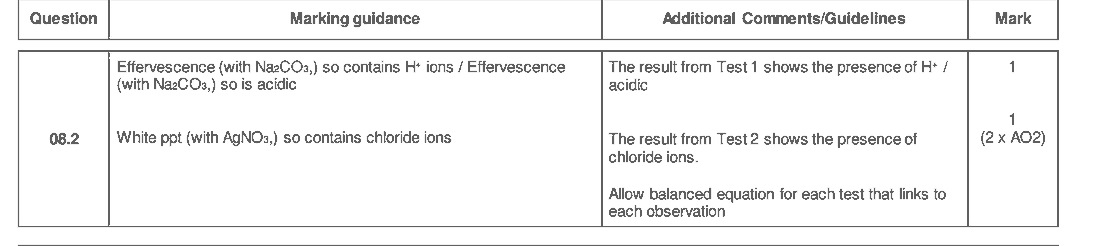
08.2 Group 7(17), the halogens 2AO2=2Practical and data analysis
08.3 Group 7(17), the halogens, Group 2, the alkaline earth metals 4AO3=4Practical and data analysis
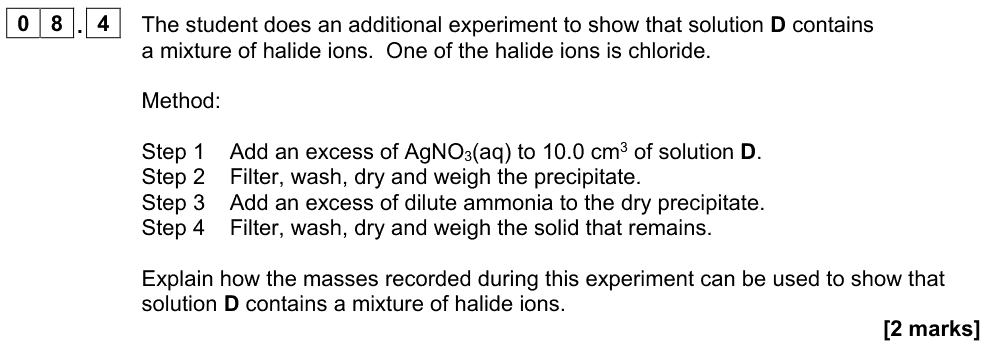
08.4 Group 7(17), the halogens 2AO3=2Practical and data analysis
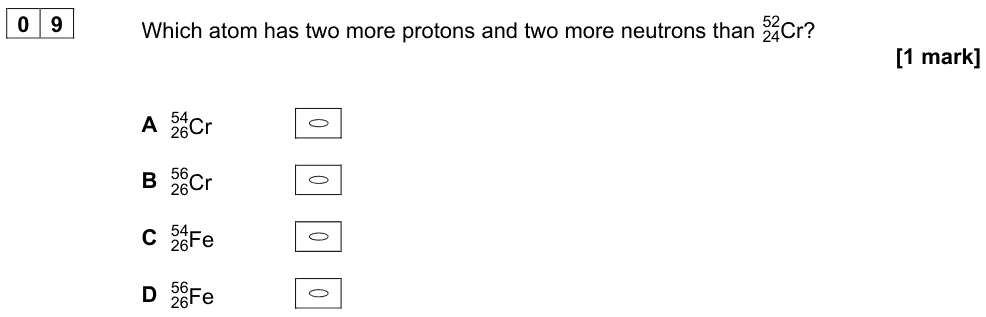
09 Atomic structure 1AO1=1Multiple choice
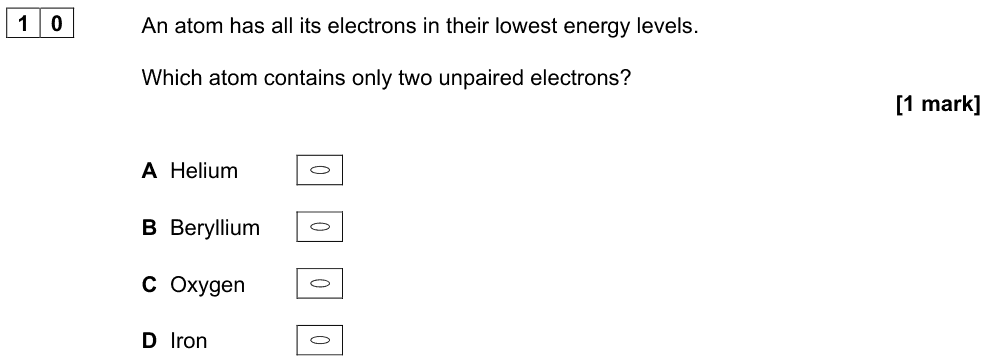
10 Atomic structure 1AO1=1Multiple choice
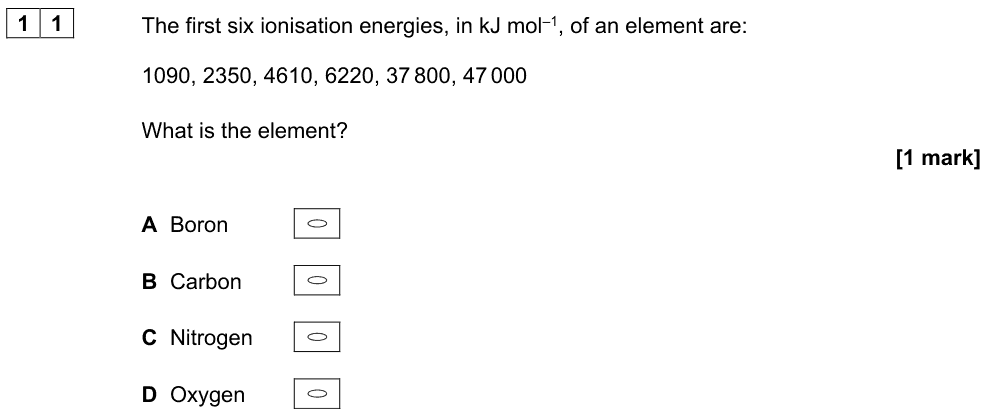
11 Atomic structure 1AO3=1Multiple choice
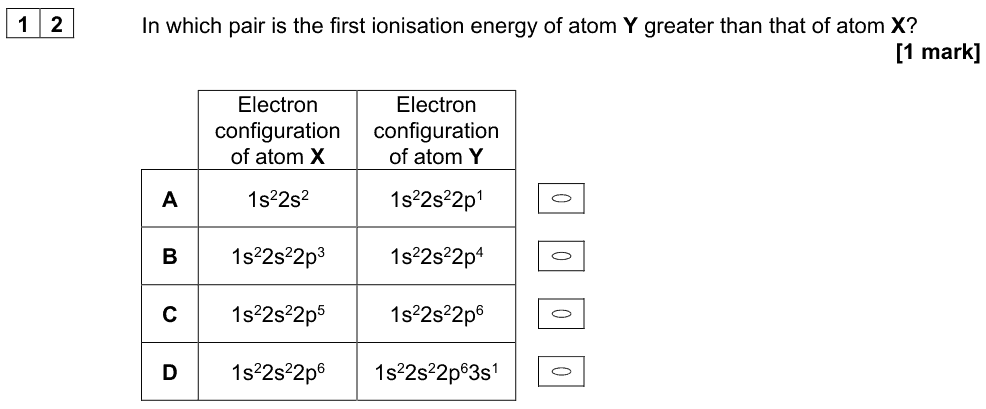
12 Atomic structure 1AO1=1Multiple choice
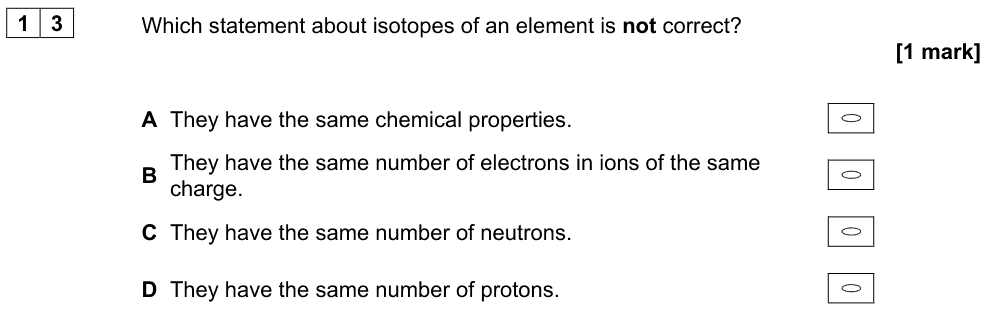
13 Atomic structure 1AO1=1Multiple choice
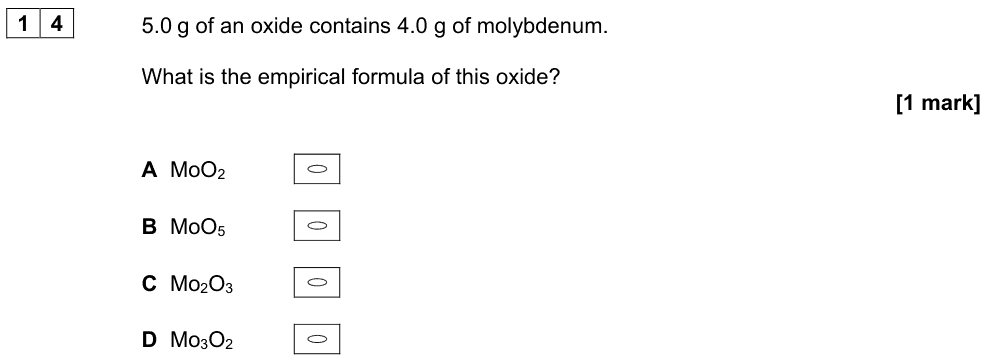
14 Amount of substance 1AO2=1Multiple choice
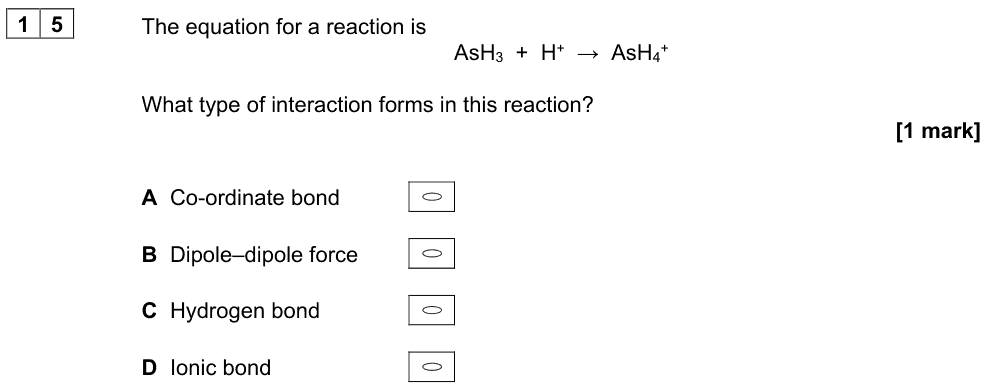
15 Bonding 1AO1=1Multiple choice
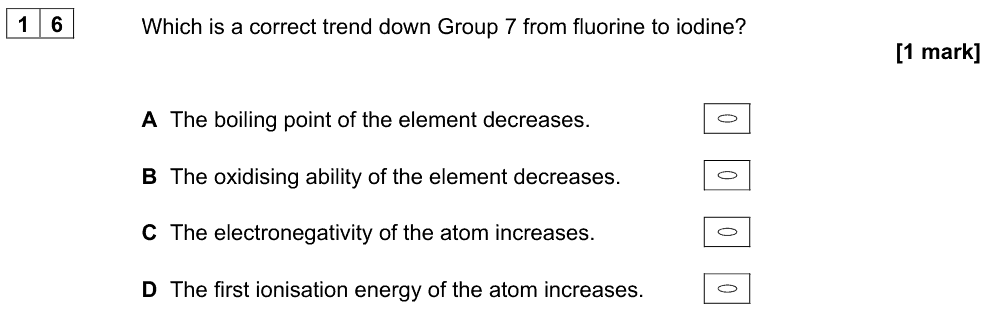
16 Group 7(17), the halogens 1AO1=1Multiple choice
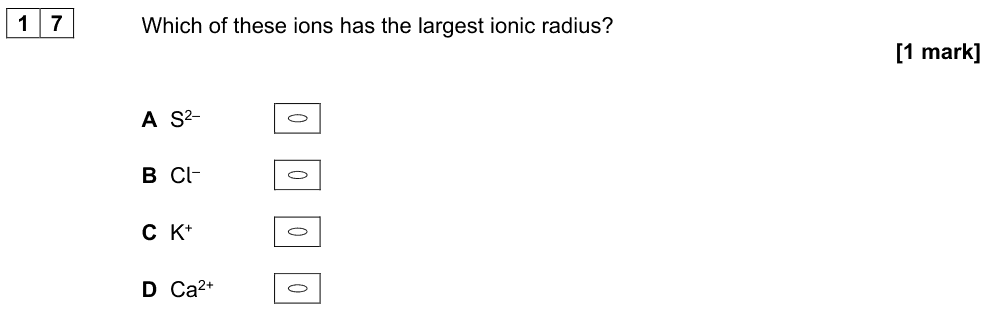
17 Atomic structure 1AO3=1Multiple choice
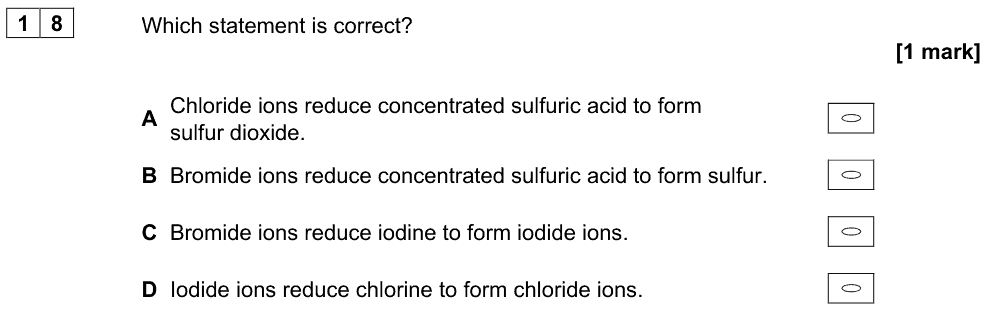
18 Group 7(17), the halogens 1AO1=1Multiple choice
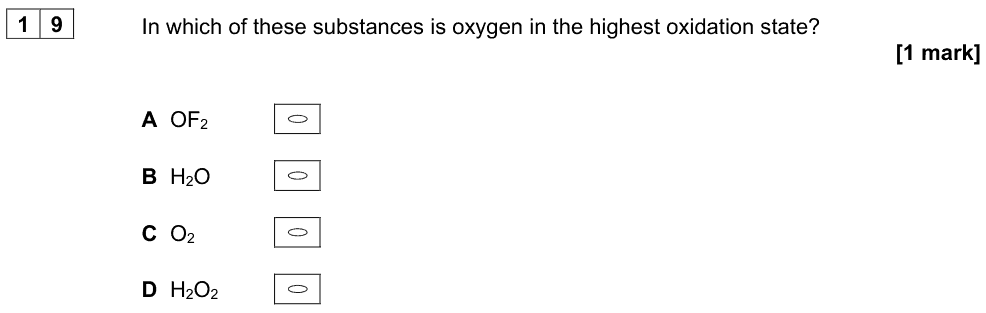
19 Oxidation, reduction and redox equations 1AO1=1Multiple choice
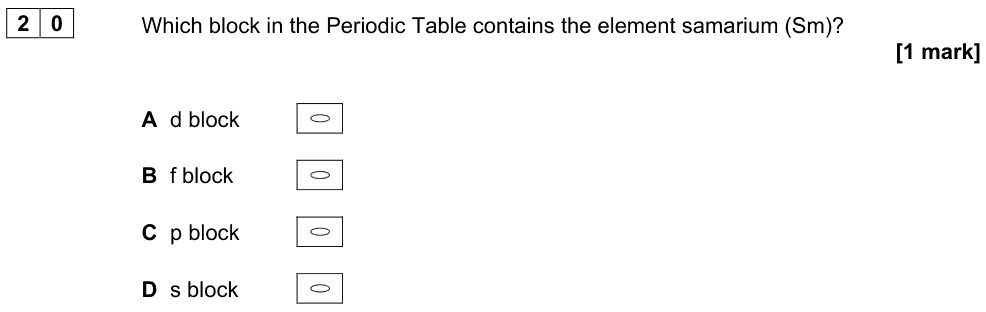
20 Periodicity 1AO1=1Multiple choice
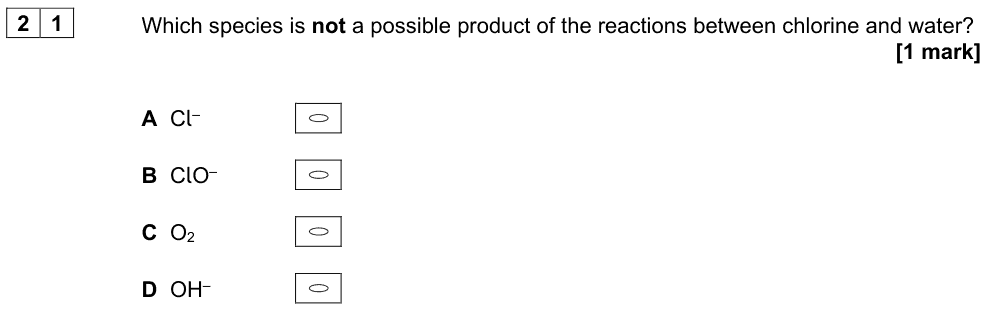
21 Group 7(17), the halogens 1AO1=1Multiple choice
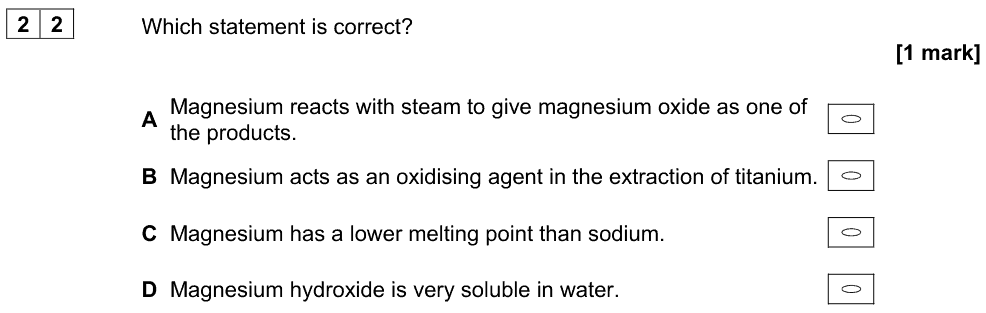
22 Group 2, the alkaline earth metals 1AO1=1Multiple choice
23 Bonding 1AO2=1Multiple choice

The questions

01.101.201.302.102.202.302.402.50304.104.204.304.404.50506.106.206.307.107.207.307.407.508.108.208.308.4091011121314151617181920212223
June 2022 · AS Paper 1 · Q01.1 2 marks AO1=2 Explanation group 2
This question is about ionisation energies of Group 2 elements.
Explain why the first ionisation energy of the Group 2 elements decreases down the
group.
[2 marks]
June 2022 · AS Paper 1 · Q01.2 1 mark AO2=1 Equation writing Easy atomic structure
Earlier part of question 01 that this part usesEarlier part of June 2022 Paper 1 question 01
Give an equation, including state symbols, to represent the process that occurs when
the third ionisation energy of magnesium is measured.
[1 mark]
June 2022 · AS Paper 1 · Q01.3 2 marks AO2=2 Explanation atomic structure
Earlier part of question 01 that this part usesEarlier part of June 2022 Paper 1 question 01
Explain why the third ionisation energy of magnesium is much higher than the
second ionisation energy of magnesium.
[2 marks]
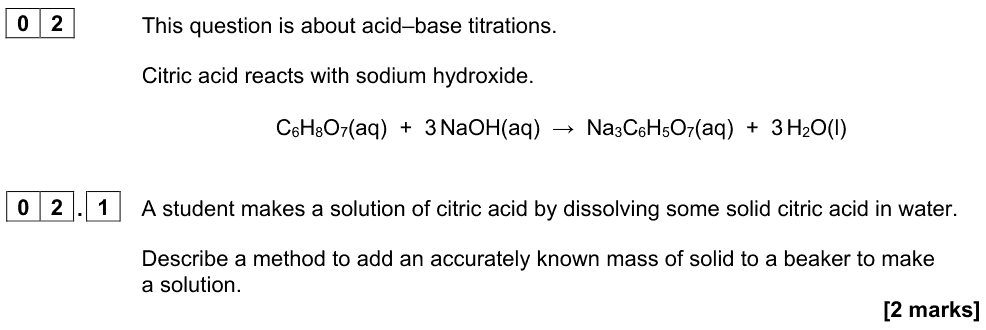
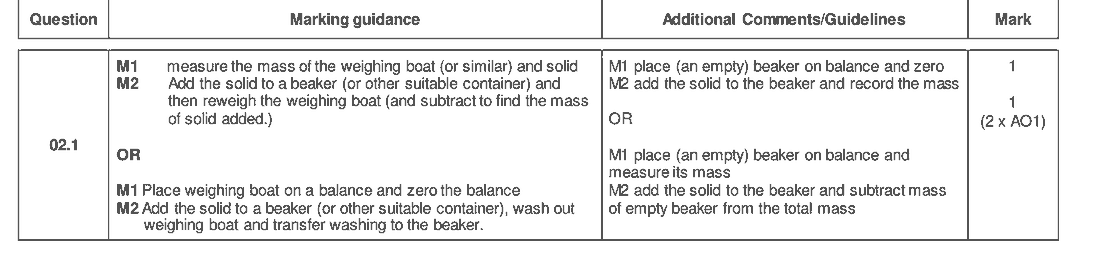
June 2022 · AS Paper 1 · Q02.1 2 marks AO1=2 Practical and data analysis amount of substance
This question is about acid–base titrations.
Citric acid reacts with sodium hydroxide.
C6H8O7(aq)  +  3 NaOH(aq)  →  Na3C6H5O7(aq)  +  3 H2O(l)
A student makes a solution of citric acid by dissolving some solid citric acid in water.
Describe a method to add an accurately known mass of solid to a beaker to make
a solution.
[2 marks]
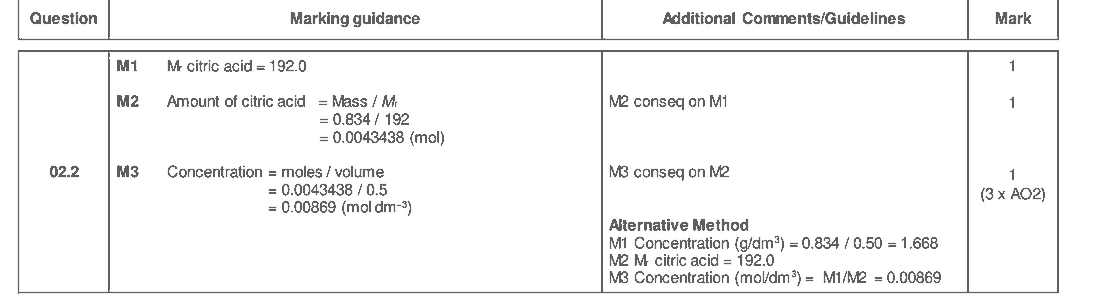
June 2022 · AS Paper 1 · Q02.2 3 marks AO2=3 Calculation amount of substance
Earlier part of question 02 that this part usesEarlier part of June 2022 Paper 1 question 02
The student dissolves 0.834 g of citric acid in water and makes the solution up to
500 cm3
Calculate the concentration, in mol dm–3, of citric acid in this solution.
[3 marks]
Concentration
mol dm–3
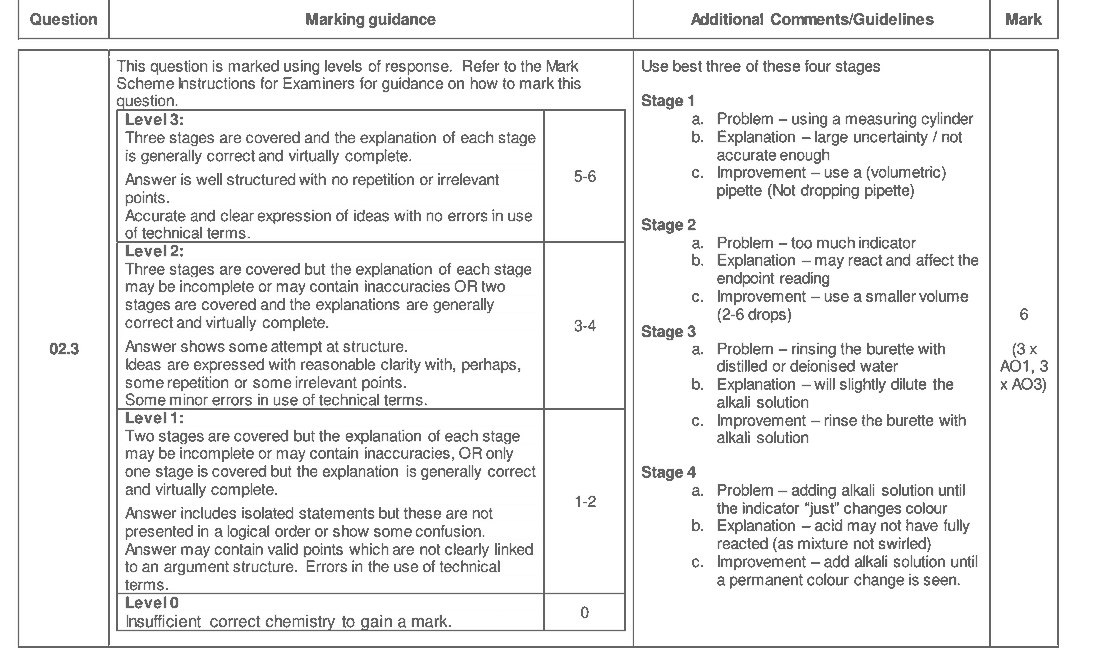
June 2022 · AS Paper 1 · Q02.3 6 marks AO1=3, AO3=3 6-mark level of response amount of substance
Earlier part of question 02 that this part usesEarlier part of June 2022 Paper 1 question 02
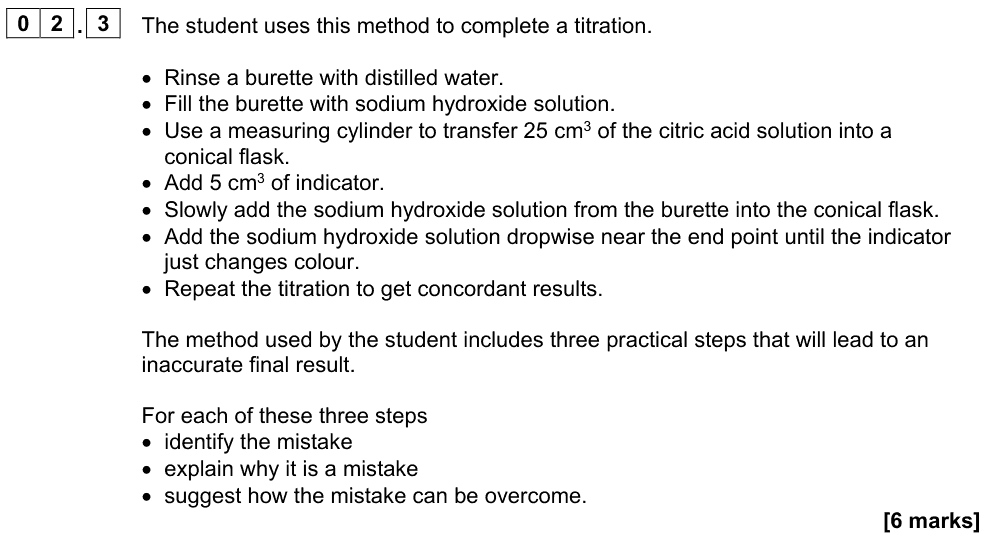
The student uses this method to complete a titration.
• Rinse a burette with distilled water.
• Fill the burette with sodium hydroxide solution.
• Use a measuring cylinder to transfer 25 cm3 of the citric acid solution into a
conical flask.
• Add 5 cm3 of indicator.
• Slowly add the sodium hydroxide solution from the burette into the conical flask.
• Add the sodium hydroxide solution dropwise near the end point until the indicator
just changes colour.
• Repeat the titration to get concordant results.
The method used by the student includes three practical steps that will lead to an
inaccurate final result.
For each of these three steps
• identify the mistake
• explain why it is a mistake
• suggest how the mistake can be overcome.
[6 marks]
June 2022 · AS Paper 1 · Q02.4 2 marks AO1=2 Practical and data analysis amount of substance
Earlier part of question 02 that this part usesEarlier part of June 2022 Paper 1 question 02
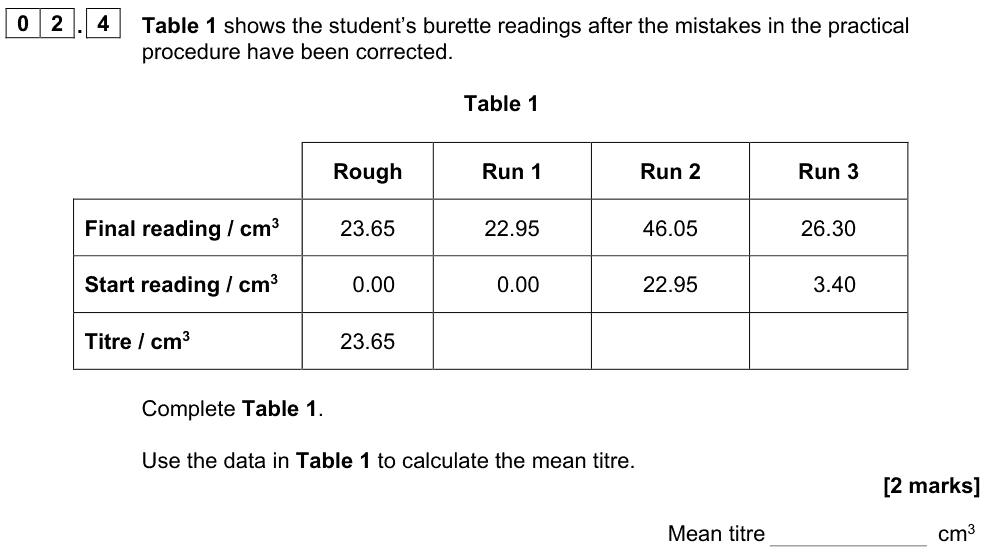
Table 1 shows the student’s burette readings after the mistakes in the practical
procedure have been corrected.
Table 1
Rough
Run 1
Run 2
Run 3
Final reading / cm3
23.65
22.95
46.05
26.30
Start reading / cm3
0.00
0.00
22.95
3.40
Titre / cm3
23.65
Complete Table 1.
Use the data in Table 1 to calculate the mean titre.
[2 marks]
Mean titre
cm3
June 2022 · AS Paper 1 · Q02.5 1 mark AO1=1 Calculation amount of substance
Earlier parts of question 02 that this part usesEarlier part of June 2022 Paper 1 question 02Earlier part of June 2022 Paper 1 question 02
The total uncertainty in the use of the burette is ±0.15 cm3
Calculate the percentage uncertainty in the use of the burette in Run 1.
[1 mark]
Percentage uncertainty
June 2022 · AS Paper 1 · Q03 3 marks AO1=3 Diagram or structure Hard bonding
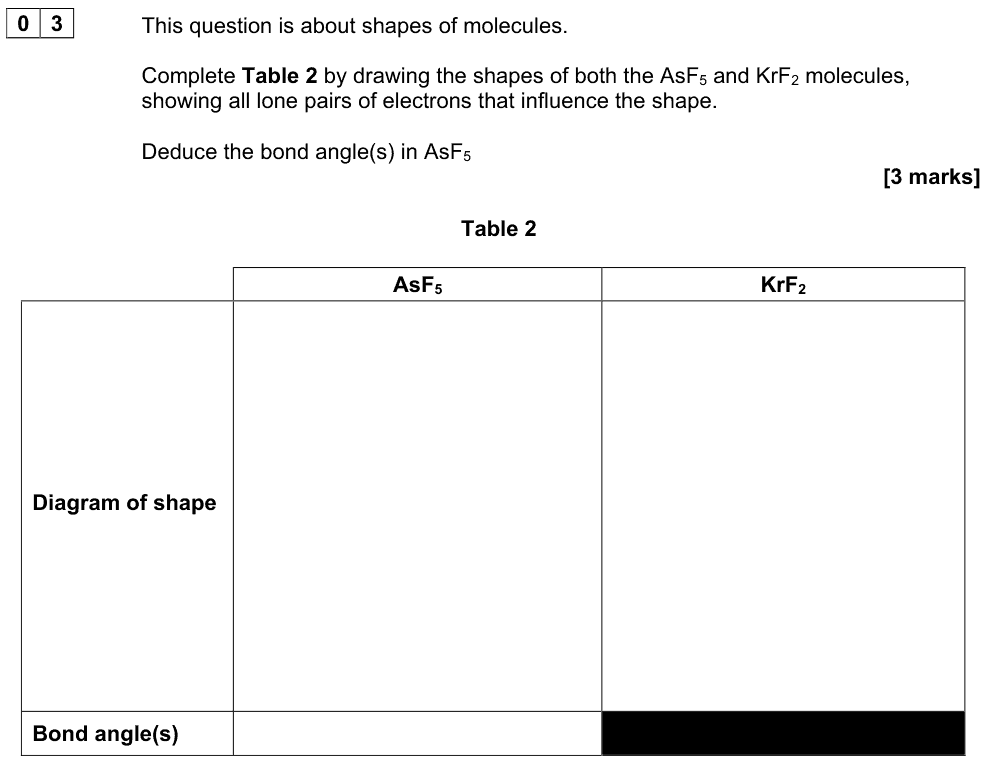
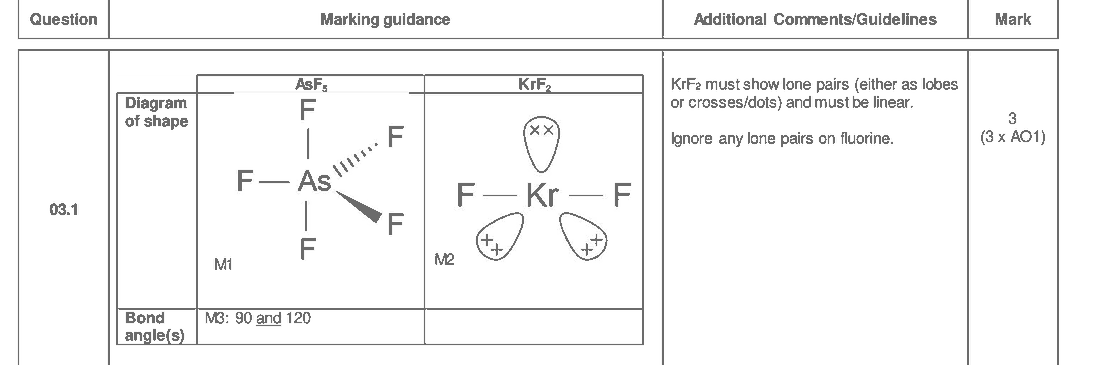
This question is about shapes of molecules.
Complete Table 2 by drawing the shapes of both the AsF5 and KrF2 molecules,
showing all lone pairs of electrons that influence the shape.
Deduce the bond angle(s) in AsF5
[3 marks]
Table 2
AsF5
KrF2
Diagram of shape
Bond angle(s)
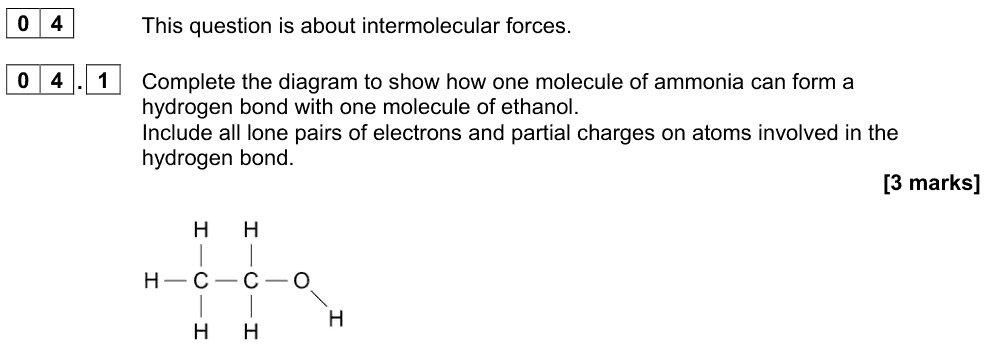
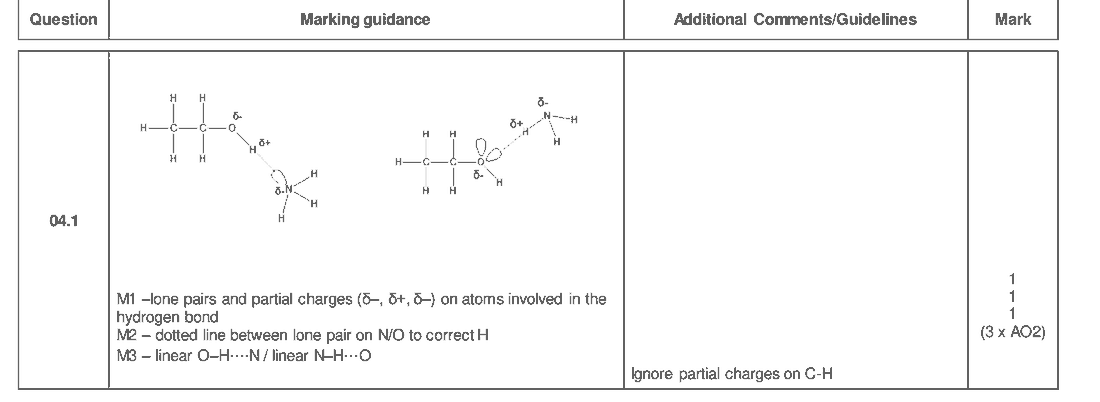
June 2022 · AS Paper 1 · Q04.1 3 marks AO2=3 Diagram or structure bonding
This question is about intermolecular forces.
Complete the diagram to show how one molecule of ammonia can form a
hydrogen bond with one molecule of ethanol.
Include all lone pairs of electrons and partial charges on atoms involved in the
hydrogen bond.
[3 marks]
June 2022 · AS Paper 1 · Q04.2 1 mark AO1=1 Short answer bonding
Earlier part of question 04 that this part usesEarlier part of June 2022 Paper 1 question 04
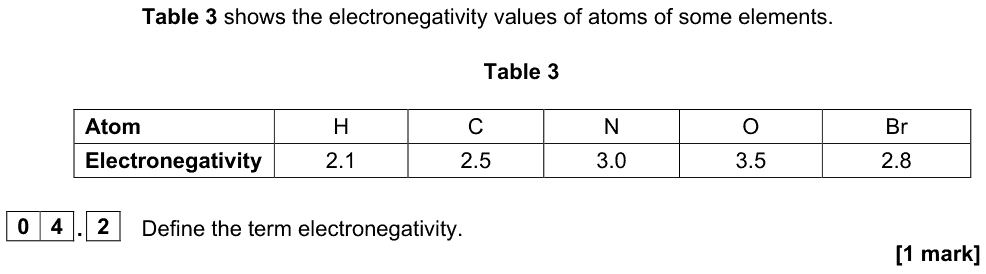
Table 3 shows the electronegativity values of atoms of some elements.
Table 3
Atom
H
C
N
O
Br
Electronegativity
2.1
2.5
3.0
3.5
2.8
Define the term electronegativity.
[1 mark]
June 2022 · AS Paper 1 · Q04.3 1 mark AO2=1 Short answer bonding
Earlier parts of question 04 that this part usesEarlier part of June 2022 Paper 1 question 04Earlier part of June 2022 Paper 1 question 04
Deduce the two atoms from Table 3 that will form the most polar bond.
[1 mark]
June 2022 · AS Paper 1 · Q04.4 2 marks AO2=2 Explanation bonding
Earlier part of question 04 that this part usesEarlier part of June 2022 Paper 1 question 04
The C–Br bond is polar.
Explain why CBr4 is not a polar molecule.
[2 marks]
June 2022 · AS Paper 1 · Q04.5 3 marks AO2=3 Explanation bonding
Earlier part of question 04 that this part usesEarlier part of June 2022 Paper 1 question 04
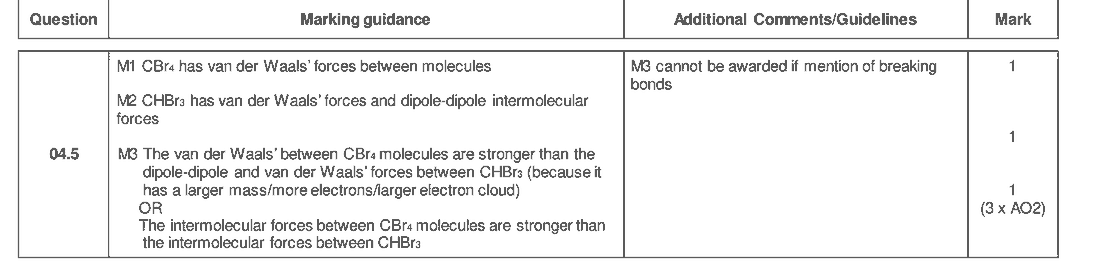
Suggest, in terms of the intermolecular forces for each compound, why CBr4 has a
higher boiling point than CHBr3
[3 marks]
June 2022 · AS Paper 1 · Q05 5 marks AO2=5 Calculation atomic structureamount of substance
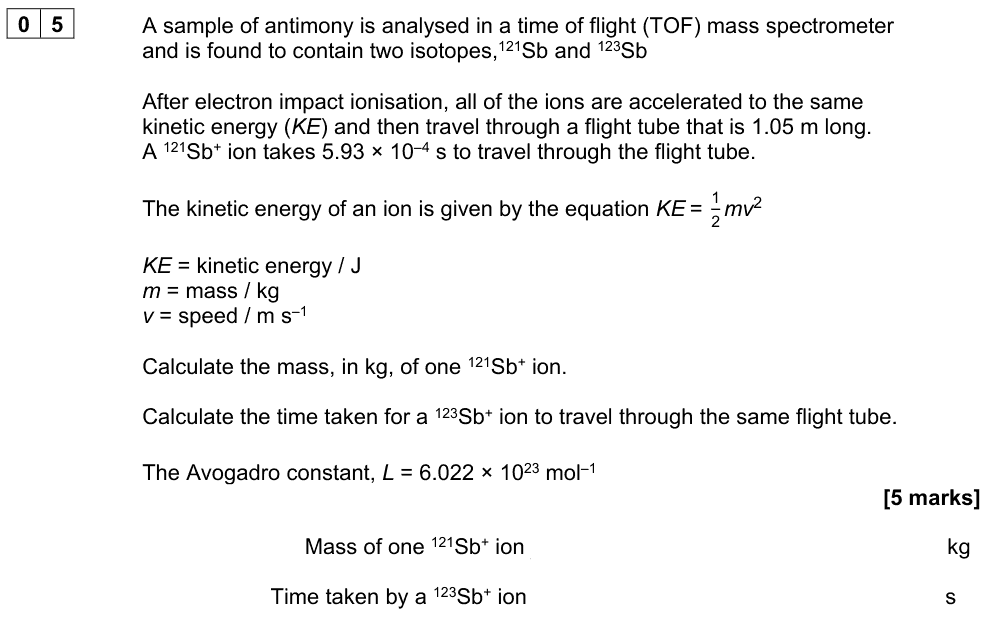
A sample of antimony is analysed in a time of flight (TOF) mass spectrometer
and is found to contain two isotopes,121Sb and 123Sb
After electron impact ionisation, all of the ions are accelerated to the same
kinetic energy (KE) and then travel through a flight tube that is 1.05 m long.
A 121Sb+ ion takes 5.93 × 10⁻⁴ s to travel through the flight tube.
The kinetic energy of an ion is given by the equation KE =
1
2 mv2
KE = kinetic energy / J
m = mass / kg
v = speed / m s–1
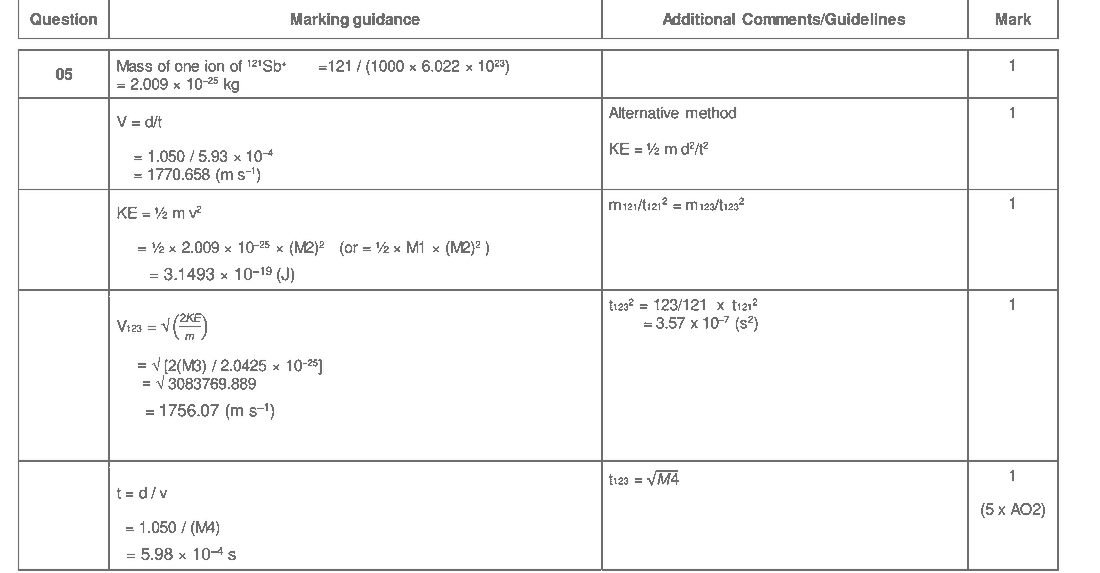
Calculate the mass, in kg, of one 121Sb+ ion.
Calculate the time taken for a 123Sb+ ion to travel through the same flight tube.
The Avogadro constant, L = 6.022 × 10²³ mol–1
[5 marks]
Mass of one 121Sb+ ion
kg
Time taken by a 123Sb+ ion
s
June 2022 · AS Paper 1 · Q06.1 1 mark AO1=1 Short answer redox
Iodide ions can be oxidised to iodine using oxidising agents such as
iodate(V) ions (IO3–) and concentrated sulfuric acid.
State, in terms of electrons, the meaning of the term oxidising agent.
[1 mark]
June 2022 · AS Paper 1 · Q06.2 2 marks AO2=2 Equation writing Hard redox
Earlier part of question 06 that this part usesEarlier part of June 2022 Paper 1 question 06
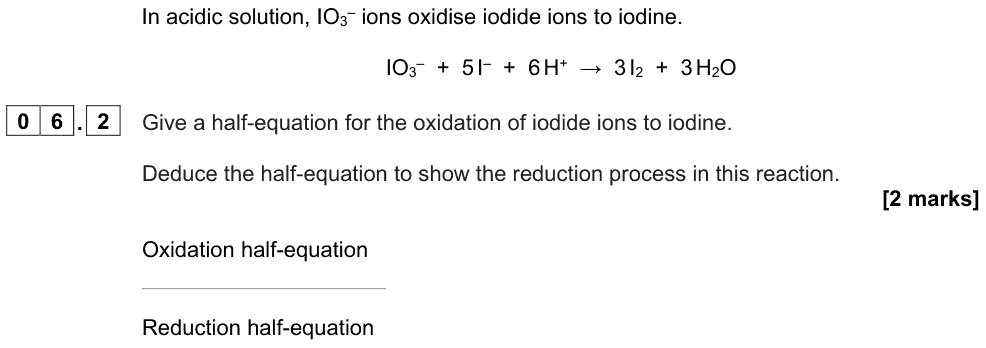
In acidic solution, IO3– ions oxidise iodide ions to iodine.
IO3–  +  5 I–  +  6 H+  →  3 I2  +  3 H2O
Give a half-equation for the oxidation of iodide ions to iodine.
Deduce the half-equation to show the reduction process in this reaction.
[2 marks]
Oxidation half-equation
Reduction half-equation
June 2022 · AS Paper 1 · Q06.3 2 marks AO1=2 Equation writing group 7 the halogensamount of substance
Earlier parts of question 06 that this part usesEarlier part of June 2022 Paper 1 question 06Earlier part of June 2022 Paper 1 question 06
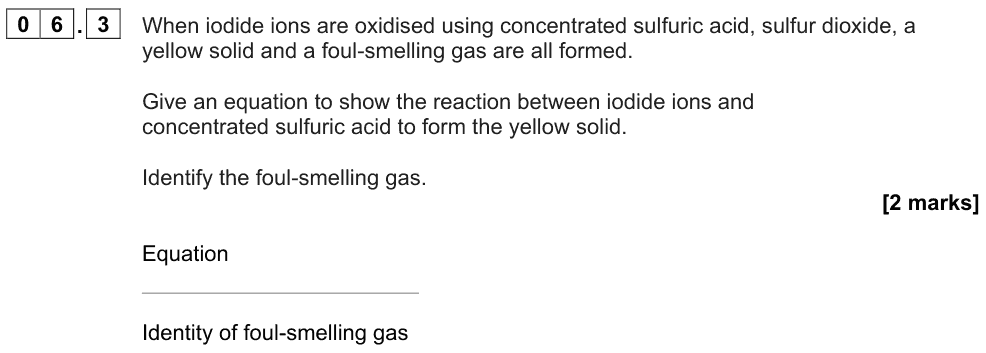
When iodide ions are oxidised using concentrated sulfuric acid, sulfur dioxide, a
yellow solid and a foul-smelling gas are all formed.
Give an equation to show the reaction between iodide ions and
concentrated sulfuric acid to form the yellow solid.
Identify the foul-smelling gas.
[2 marks]
Equation
Identity of foul-smelling gas
June 2022 · AS Paper 1 · Q07.1 2 marks AO3=2 Explanation chemical equilibria and kc
This question is about gaseous equilibria.
Figure 1 shows the effect of pressure on the percentage yield of a reaction at
equilibrium at two different temperatures.
Figure 1
Explain how Figure 1 shows that the forward reaction in this equilibrium is
exothermic.
[2 marks]
June 2022 · AS Paper 1 · Q07.2 3 marks AO3=3 Explanation chemical equilibria and kc
Earlier part of question 07 that this part usesEarlier part of June 2022 Paper 1 question 07
State whether the forward reaction in this equilibrium results in an increase, decrease
or no change in the amount, in moles, of gas.
Explain your answer.
[3 marks]
Tick ()  one box.
increase
decrease
no change
Explanation
June 2022 · AS Paper 1 · Q07.3 1 mark AO1=1 Short answer Hard chemical equilibria and kc
Earlier part of question 07 that this part usesEarlier part of June 2022 Paper 1 question 07
Explain why using a catalyst has no effect on the percentage yield.
[1 mark]
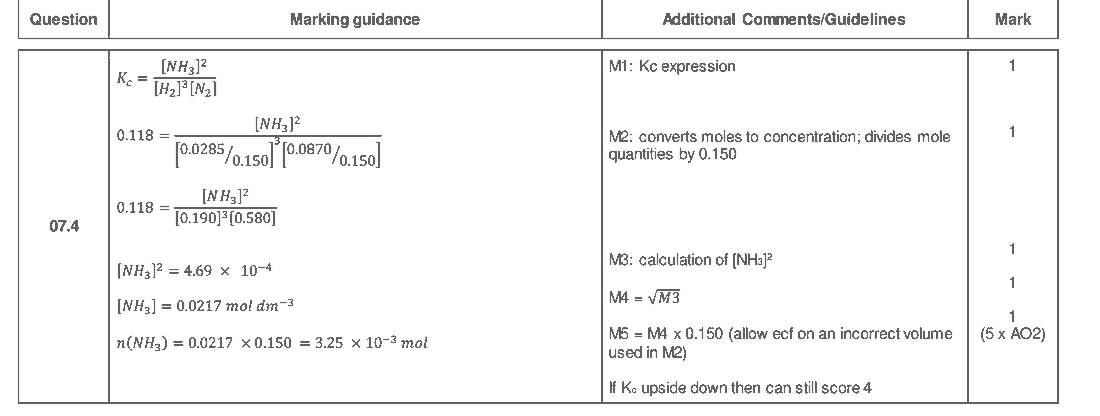
June 2022 · AS Paper 1 · Q07.4 5 marks AO2=5 Calculation chemical equilibria and kc
Earlier part of question 07 that this part usesEarlier part of June 2022 Paper 1 question 07
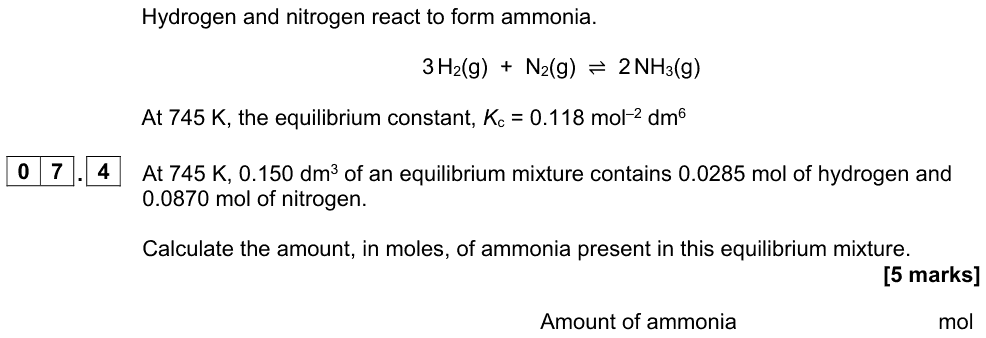
Hydrogen and nitrogen react to form ammonia.
3 H2(g)  +  N2(g)  ⇌  2 NH3(g)
At 745 K, the equilibrium constant, Kc = 0.118 mol–2 dm6
At 745 K, 0.150 dm3 of an equilibrium mixture contains 0.0285 mol of hydrogen and
0.0870 mol of nitrogen.
Calculate the amount, in moles, of ammonia present in this equilibrium mixture.
[5 marks]
Amount of ammonia
mol
June 2022 · AS Paper 1 · Q07.5 2 marks AO2=2 Calculation chemical equilibria and kc
Earlier parts of question 07 that this part usesEarlier part of June 2022 Paper 1 question 07Earlier part of June 2022 Paper 1 question 07
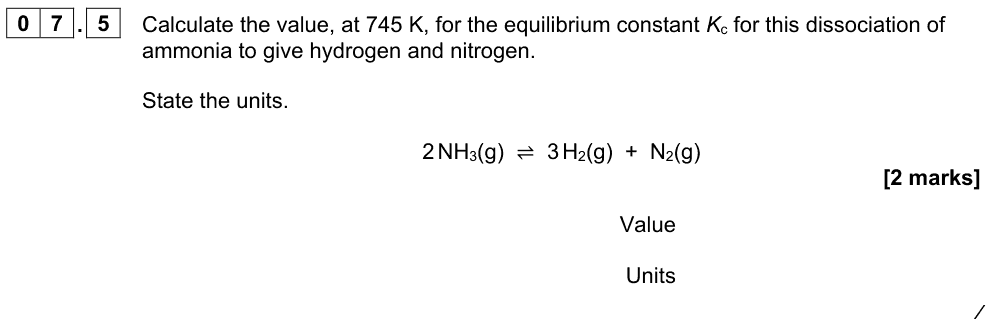
Calculate the value, at 745 K, for the equilibrium constant Kc for this dissociation of
ammonia to give hydrogen and nitrogen.
State the units.
2 NH3(g)  ⇌  3 H2(g)  +  N2(g)
[2 marks]
Value
Units
June 2022 · AS Paper 1 · Q08.1 2 marks AO1=1, AO3=1 Practical and data analysis group 7 the halogens
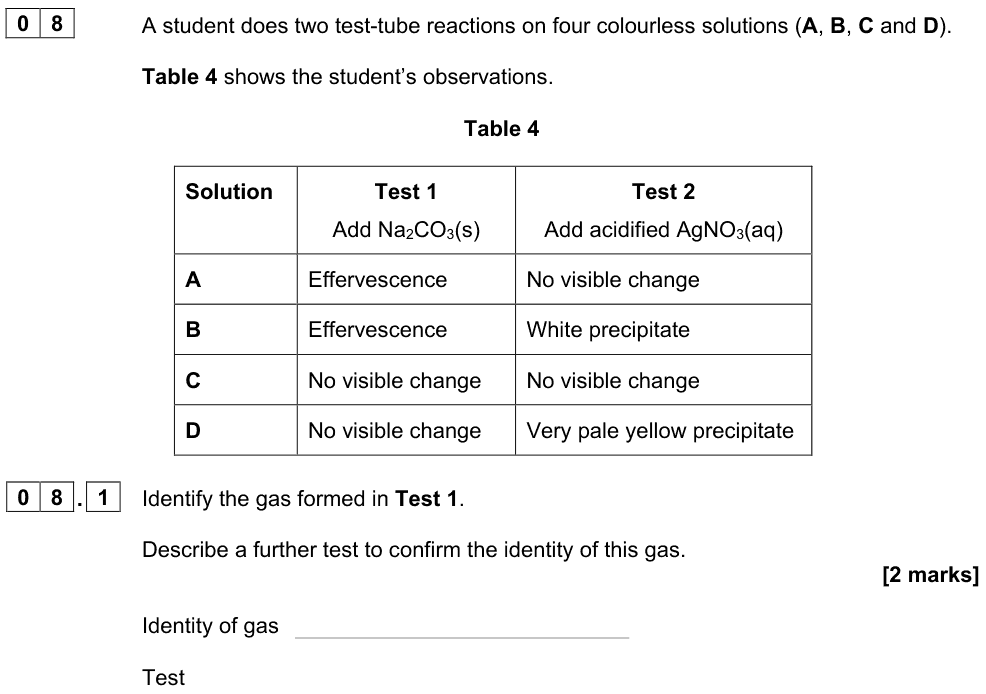
A student does two test-tube reactions on four colourless solutions (A, B, C and D).
Table 4 shows the student’s observations.
Table 4
Solution
Test 1
Add Na2CO3(s)
Test 2
Add acidified AgNO3(aq)
A
Effervescence
No visible change
B
Effervescence
White precipitate
C
No visible change
No visible change
D
No visible change
Very pale yellow precipitate
Identify the gas formed in Test 1.
Describe a further test to confirm the identity of this gas.
[2 marks]
Identity of gas
Test
June 2022 · AS Paper 1 · Q08.2 2 marks AO2=2 Practical and data analysis group 7 the halogens
Earlier part of question 08 that this part usesEarlier part of June 2022 Paper 1 question 08
Explain how the observations from Test 1 and Test 2 can be used to show that
solution B contains hydrochloric acid.
[2 marks]
June 2022 · AS Paper 1 · Q08.3 4 marks AO3=4 Practical and data analysis group 7 the halogensgroup 2
Earlier part of question 08 that this part usesEarlier part of June 2022 Paper 1 question 08
Describe a series of tests that the student can use to show that solution C contains
ammonium sulfate.
[4 marks]
June 2022 · AS Paper 1 · Q08.4 2 marks AO3=2 Practical and data analysis group 7 the halogens
Earlier part of question 08 that this part usesEarlier part of June 2022 Paper 1 question 08
The student does an additional experiment to show that solution D contains
a mixture of halide ions.  One of the halide ions is chloride.
Method:
Step 1    Add an excess of AgNO3(aq) to 10.0 cm3 of solution D.
Step 2    Filter, wash, dry and weigh the precipitate.
Step 3    Add an excess of dilute ammonia to the dry precipitate.
Step 4    Filter, wash, dry and weigh the solid that remains.
Explain how the masses recorded during this experiment can be used to show that
solution D contains a mixture of halide ions.
[2 marks]
June 2022 · AS Paper 1 · Q09 1 mark AO1=1 Multiple choice Easy atomic structure
Which atom has two more protons and two more neutrons than
Cr
24
52
?
[1 mark]
A
Cr
26
54
B
Cr
26
56
C
Fe
26
54
D
Fe
26
56
June 2022 · AS Paper 1 · Q10 1 mark AO1=1 Multiple choice atomic structure
An atom has all its electrons in their lowest energy levels.
Which atom contains only two unpaired electrons?
[1 mark]
A Helium
B Beryllium
C Oxygen
D Iron
June 2022 · AS Paper 1 · Q11 1 mark AO3=1 Multiple choice Easy atomic structure
The first six ionisation energies, in kJ mol–1, of an element are:
1090, 2350, 4610, 6220, 37 800, 47 000
What is the element?
[1 mark]
A Boron
B Carbon
C Nitrogen
D Oxygen
June 2022 · AS Paper 1 · Q12 1 mark AO1=1 Multiple choice atomic structure
In which pair is the first ionisation energy of atom Y greater than that of atom X?
[1 mark]
Electron
configuration
of atom X
Electron
configuration
of atom Y
A
1s22s2
1s22s22p1
B
1s22s22p3
1s22s22p4
C
1s22s22p5
1s22s22p6
D
1s22s22p6
1s22s22p63s1
June 2022 · AS Paper 1 · Q13 1 mark AO1=1 Multiple choice Easy atomic structure
Which statement about isotopes of an element is not correct?
[1 mark]
A They have the same chemical properties.
B They have the same number of electrons in ions of the same
charge.
C They have the same number of neutrons.
D They have the same number of protons.
June 2022 · AS Paper 1 · Q14 1 mark AO2=1 Multiple choice Easy amount of substance
5.0 g of an oxide contains 4.0 g of molybdenum.
What is the empirical formula of this oxide?
[1 mark]
A MoO2
B MoO5
C Mo2O3
D Mo3O2
June 2022 · AS Paper 1 · Q15 1 mark AO1=1 Multiple choice Easy bonding
The equation for a reaction is
AsH3  +  H+  →  AsH4+
What type of interaction forms in this reaction?
[1 mark]
A Co-ordinate bond
B Dipole–dipole force
C Hydrogen bond
D Ionic bond
June 2022 · AS Paper 1 · Q16 1 mark AO1=1 Multiple choice Easy group 7 the halogens
Which is a correct trend down Group 7 from fluorine to iodine?
[1 mark]
A The boiling point of the element decreases.
B The oxidising ability of the element decreases.
C The electronegativity of the atom increases.
D The first ionisation energy of the atom increases.
June 2022 · AS Paper 1 · Q17 1 mark AO3=1 Multiple choice atomic structure
Which of these ions has the largest ionic radius?
[1 mark]
A S2–
B Cl–
C K+
D Ca2+
June 2022 · AS Paper 1 · Q18 1 mark AO1=1 Multiple choice Hard group 7 the halogens
Which statement is correct?
[1 mark]
A Chloride ions reduce concentrated sulfuric acid to form
sulfur dioxide.
B Bromide ions reduce concentrated sulfuric acid to form sulfur.
C Bromide ions reduce iodine to form iodide ions.
D Iodide ions reduce chlorine to form chloride ions.
June 2022 · AS Paper 1 · Q19 1 mark AO1=1 Multiple choice redox
In which of these substances is oxygen in the highest oxidation state?
[1 mark]
A OF2
B H2O
C O2
D H2O2
June 2022 · AS Paper 1 · Q20 1 mark AO1=1 Multiple choice Easy periodicity
Which block in the Periodic Table contains the element samarium (Sm)?
[1 mark]
A d block
B f block
C p block
D s block
June 2022 · AS Paper 1 · Q21 1 mark AO1=1 Multiple choice Hard group 7 the halogens
Which species is not a possible product of the reactions between chlorine and water?
[1 mark]
A Cl–
B ClO–
C O2
D OH–
June 2022 · AS Paper 1 · Q22 1 mark AO1=1 Multiple choice group 2
Which statement is correct?
[1 mark]
A Magnesium reacts with steam to give magnesium oxide as one of
the products.
B Magnesium acts as an oxidising agent in the extraction of titanium.
C Magnesium has a lower melting point than sodium.
D Magnesium hydroxide is very soluble in water.
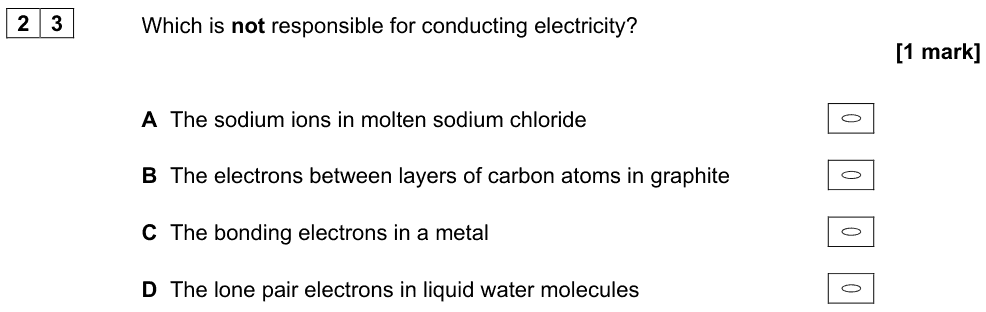
June 2022 · AS Paper 1 · Q23 1 mark AO2=1 Multiple choice bonding
Which is not responsible for conducting electricity?
[1 mark]
A The sodium ions in molten sodium chloride
B The electrons between layers of carbon atoms in graphite
C The bonding electrons in a metal
D The lone pair electrons in liquid water molecules

Work with an A-level chemistry tutor

Want a paper marked and gone through with you? Message us.

Prefer email? Send an enquiry

If you are under 18, please include a parent's contact details. Enquiries go to enquiries@chemistryaleveltutor.com and are deleted once handled. All tutoring is online.