October 2020: AS Paper 1, Core Inorganic and Physical Chemistry

80 marks · 39 question parts · Paper, mark scheme and report on Edexcel's site · An autumn series, sat in place of the cancelled summer exams · Have the Data Booklet beside you

Question by question

QTopicMarksAOType
1(a) Atomic structure and the Periodic Table 1Multiple choice
1(b)(i) Atomic structure and the Periodic Table 1Short answer
1(b)(ii) Atomic structure and the Periodic Table 1Short answer
2(a)(i) Atomic structure and the Periodic Table 1Multiple choice
2(a)(ii) Atomic structure and the Periodic Table 1Multiple choice
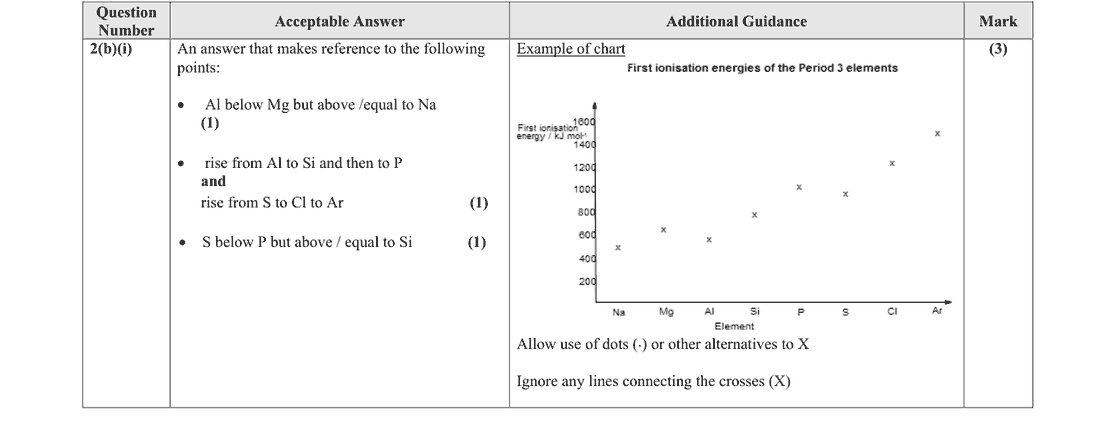
2(b)(i) Atomic structure and the Periodic Table 3Diagram or structure
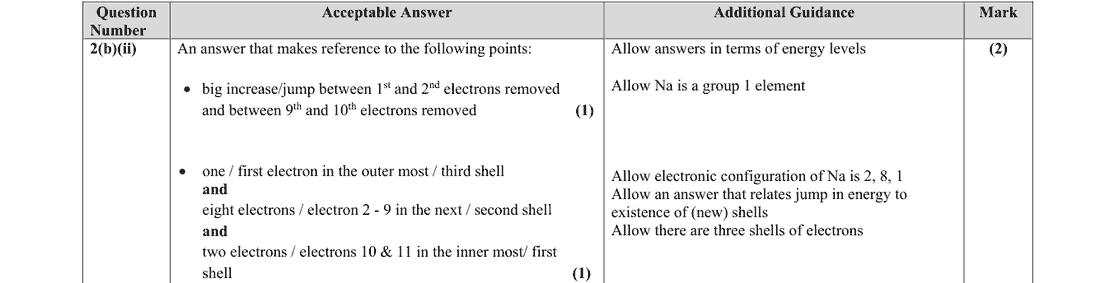
2(b)(ii) Atomic structure and the Periodic Table 2Short answer
3(a)(i) Bonding 2Short answer
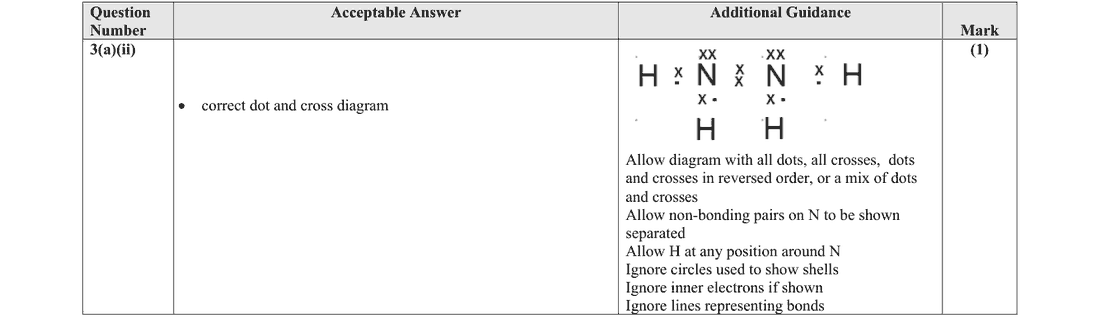
3(a)(ii) Bonding 1Diagram or structure
3(a)(iii) Bonding 1Short answer
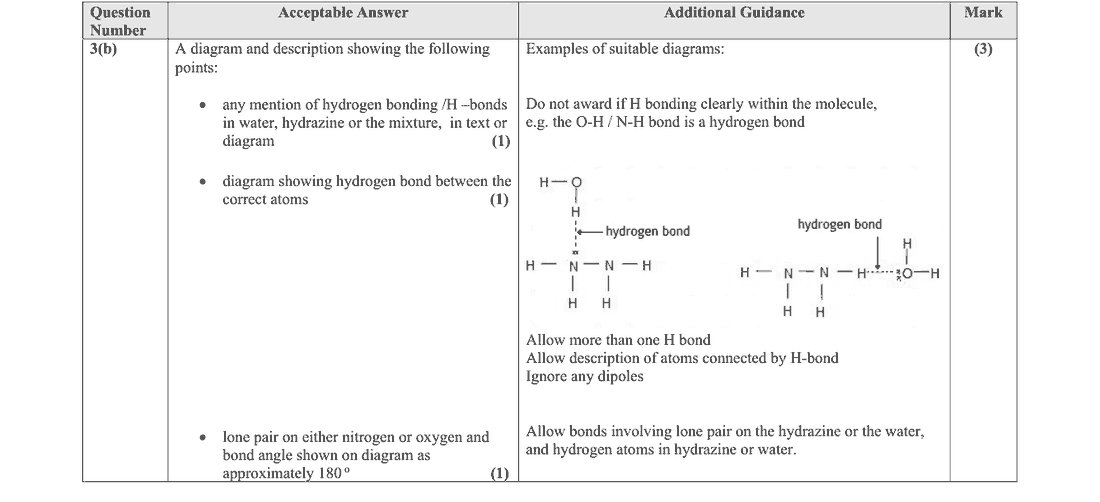
3(b) Bonding 3Diagram or structure
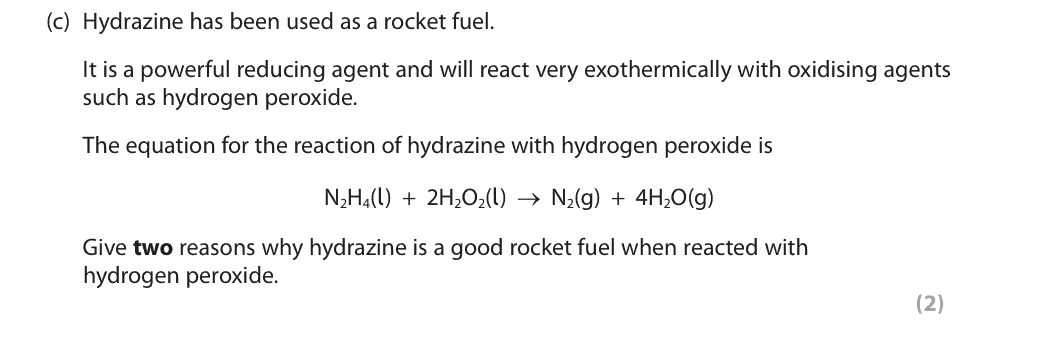
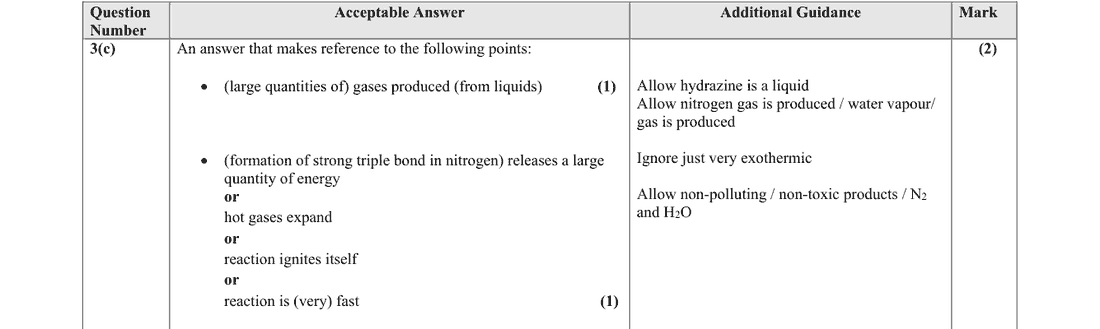
3(c) Formulae, equations and amounts of substance 2Short answer
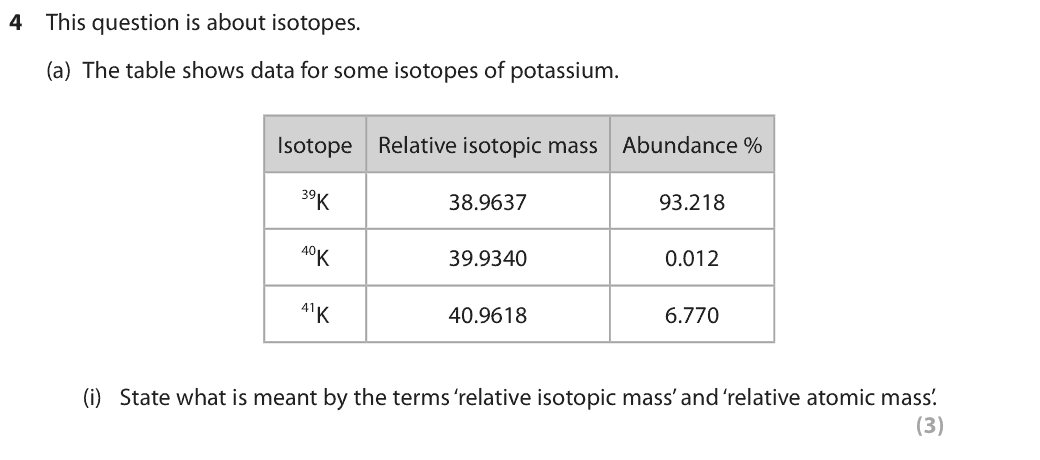
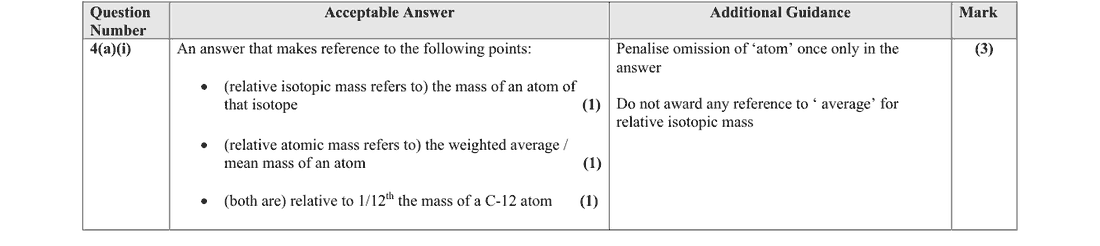
4(a)(i) Atomic structure and the Periodic Table 3Short answer
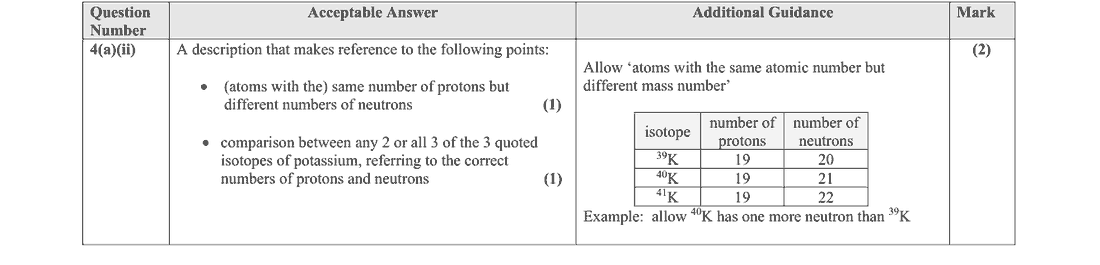
4(a)(ii) Atomic structure and the Periodic Table 2Short answer
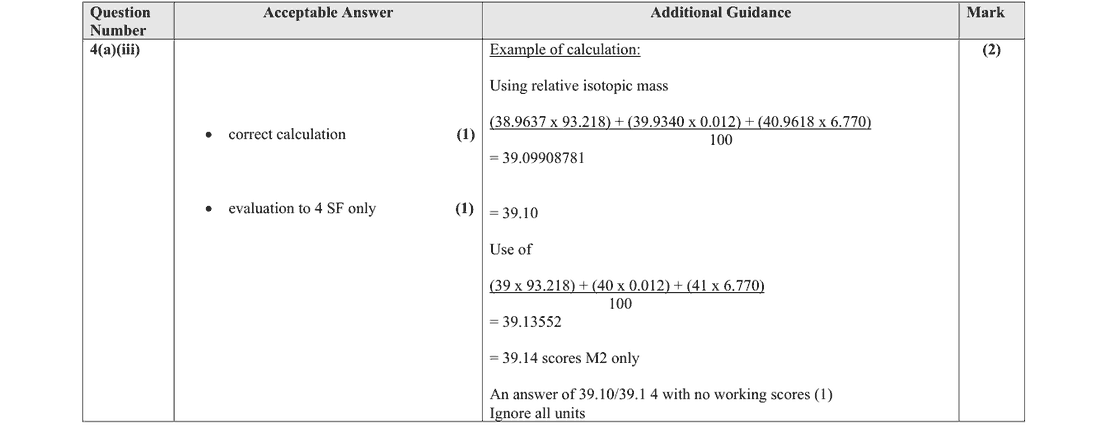
4(a)(iii) Atomic structure and the Periodic Table 2Calculation
4(b)(i) Atomic structure and the Periodic Table 1Short answer
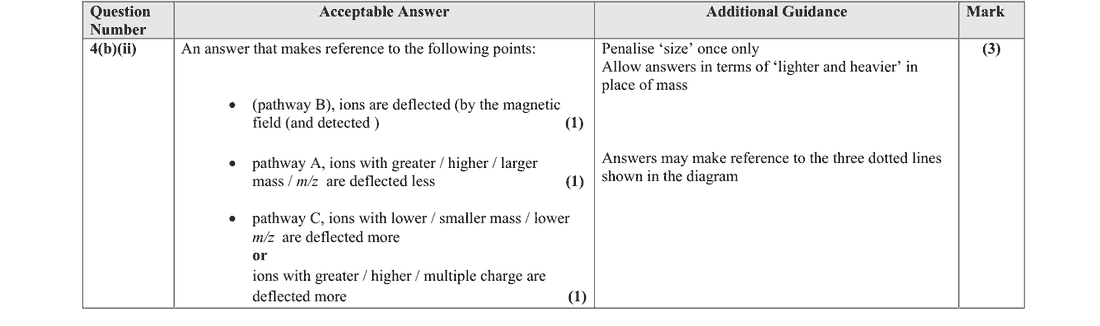
4(b)(ii) Atomic structure and the Periodic Table 3Explanation
4(b)(iii) Atomic structure and the Periodic Table 1Short answer
5(a)(i) The elements of Group 7 (halogens), Redox I 1Multiple choice
5(a)(ii) The elements of Group 7 (halogens) 1Multiple choice
5(b)(i) The elements of Group 7 (halogens) 1Multiple choice
5(b)(ii) The elements of Group 7 (halogens), Formulae, equations and amounts of substance 3Practical and data analysis
5(c)(i) The elements of Group 7 (halogens) 3Practical and data analysis
5(c)(ii) The elements of Group 7 (halogens) 2Practical and data analysis
5(d) The elements of Group 7 (halogens) 1Multiple choice
6(a) Atomic structure and the Periodic Table 1Multiple choice
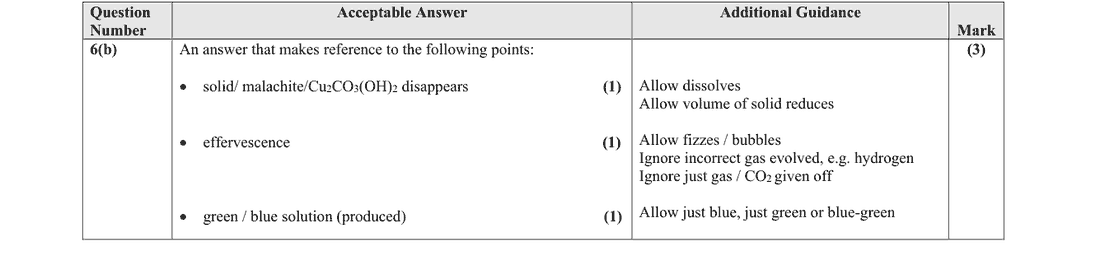
6(b) Formulae, equations and amounts of substance, Analysis of inorganic compounds 3Practical and data analysis
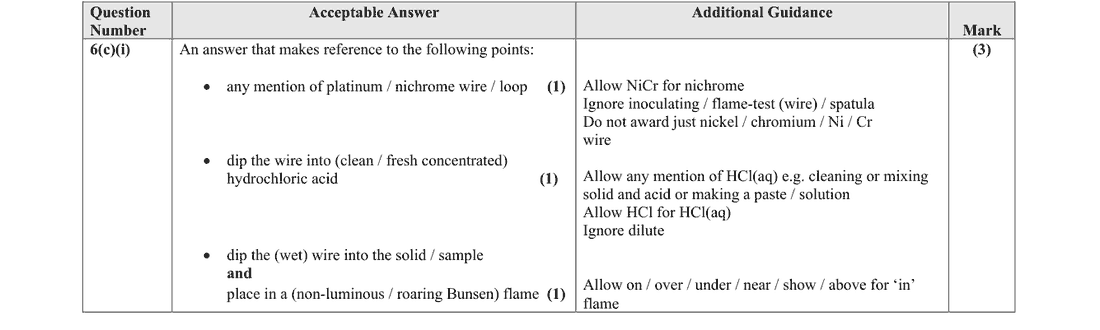
6(c)(i) The elements of Groups 1 and 2 3Practical and data analysis
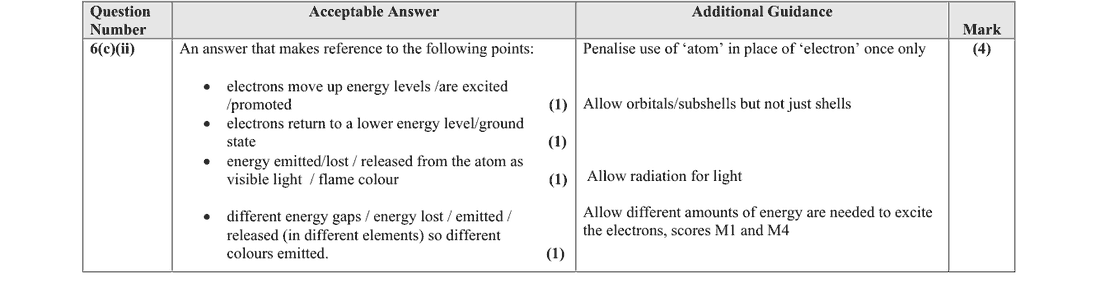
6(c)(ii) The elements of Groups 1 and 2 4Explanation
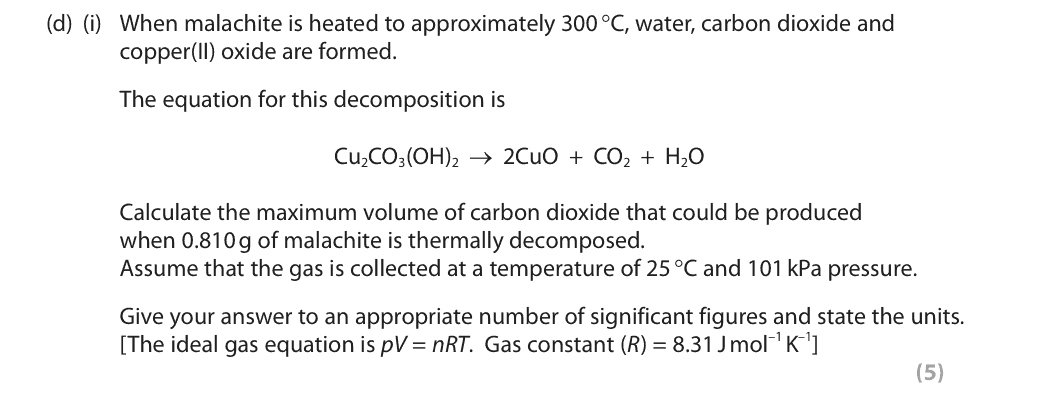
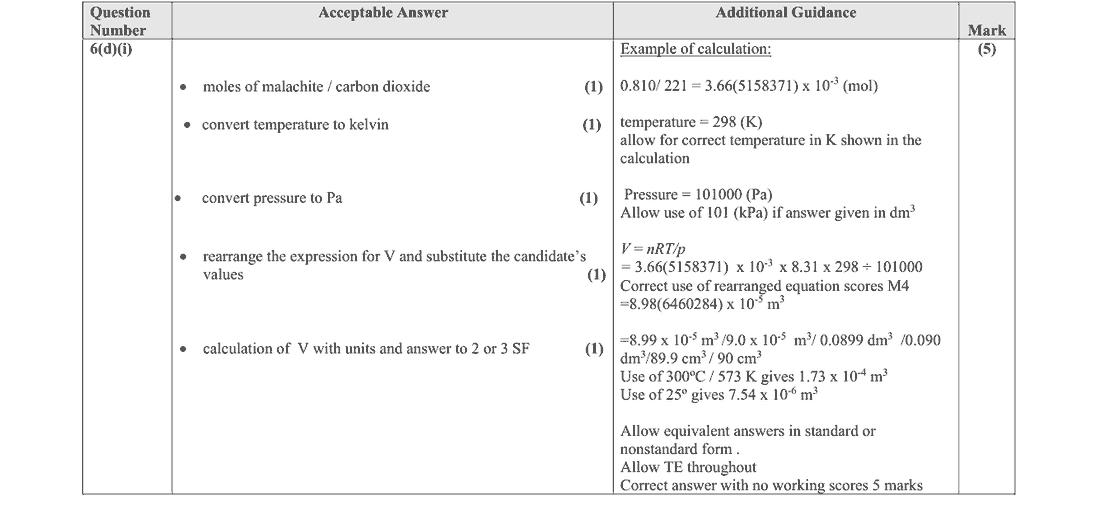
6(d)(i) Formulae, equations and amounts of substance 5Calculation
6(d)(ii) Formulae, equations and amounts of substance 1Calculation
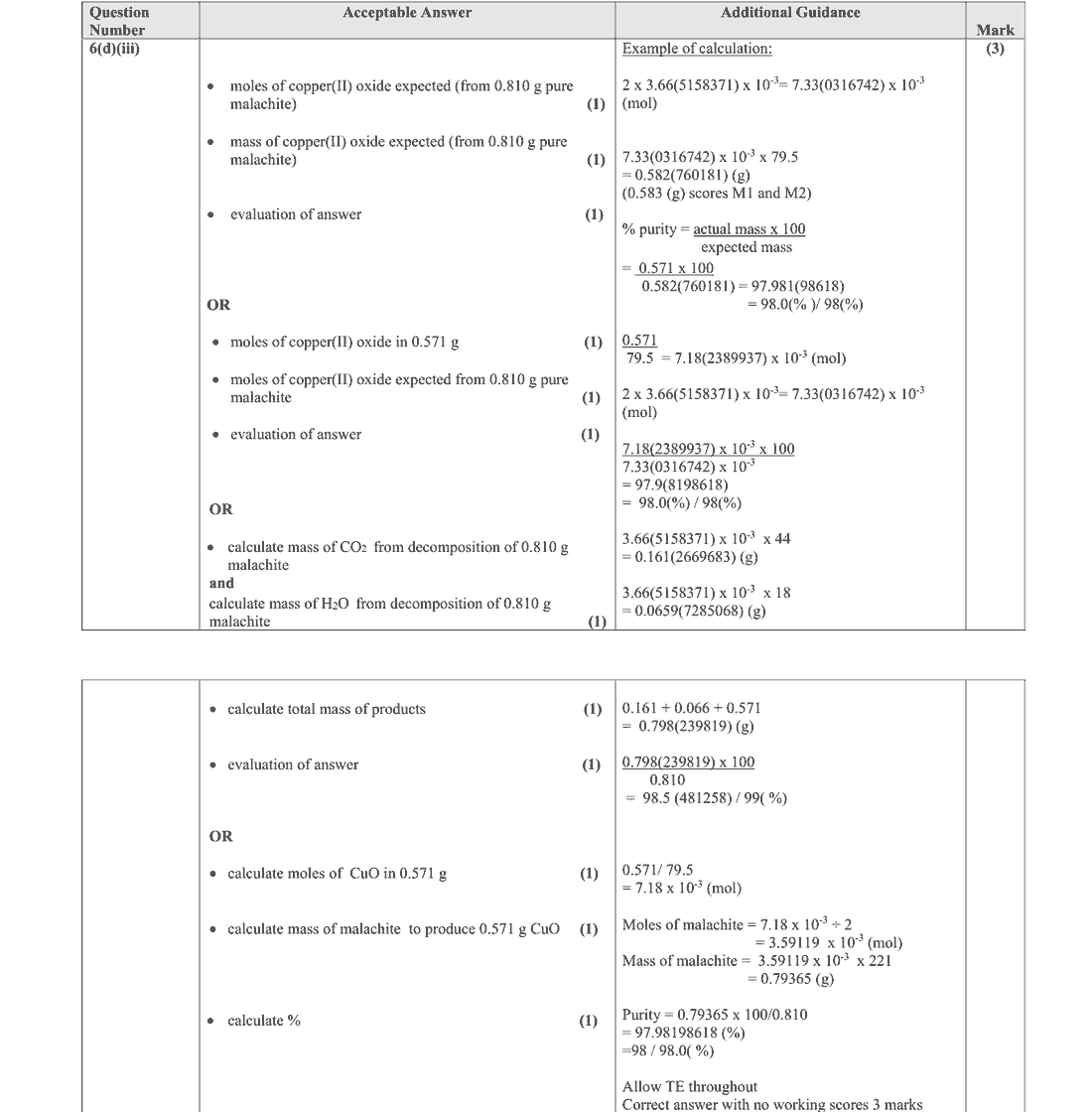
6(d)(iii) Formulae, equations and amounts of substance 3Calculation
7(a) Atomic structure and the Periodic Table 3Short answer
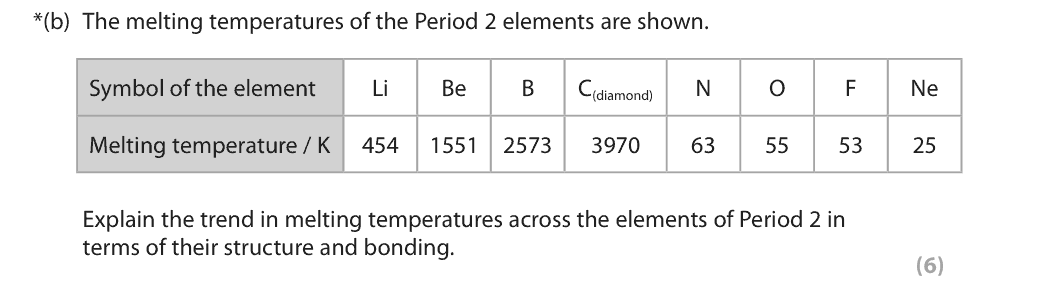
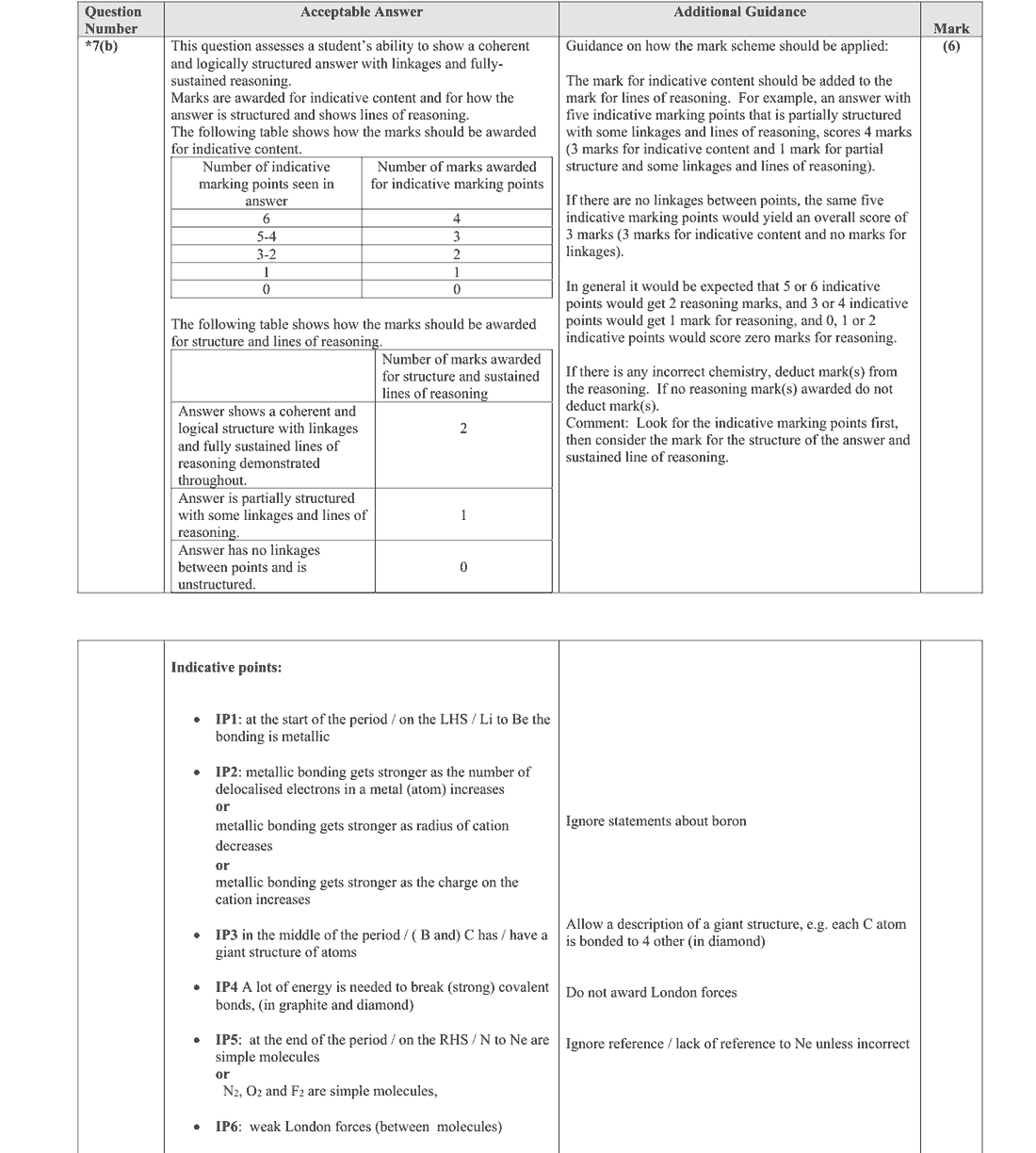
7(b) Atomic structure and the Periodic Table, Structure 6Extended response
8(a) The elements of Groups 1 and 2, Formulae, equations and amounts of substance 2Equation writing
8(b) The elements of Groups 1 and 2 3Explanation
8(c)(i) The elements of Groups 1 and 2, Formulae, equations and amounts of substance 1Equation writing
8(c)(ii) Bonding 1Short answer
8(c)(iii) The elements of Groups 1 and 2 1Short answer

The questions

1(a)1(b)(i)1(b)(ii)2(a)(i)2(a)(ii)2(b)(i)2(b)(ii)3(a)(i)3(a)(ii)3(a)(iii)3(b)3(c)4(a)(i)4(a)(ii)4(a)(iii)4(b)(i)4(b)(ii)4(b)(iii)5(a)(i)5(a)(ii)5(b)(i)5(b)(ii)5(c)(i)5(c)(ii)5(d)6(a)6(b)6(c)(i)6(c)(ii)6(d)(i)6(d)(ii)6(d)(iii)7(a)7(b)8(a)8(b)8(c)(i)8(c)(ii)8(c)(iii)
October 2020 · AS Paper 1 · Q1(a) 1 mark Multiple choice atomic structure and the periodic table
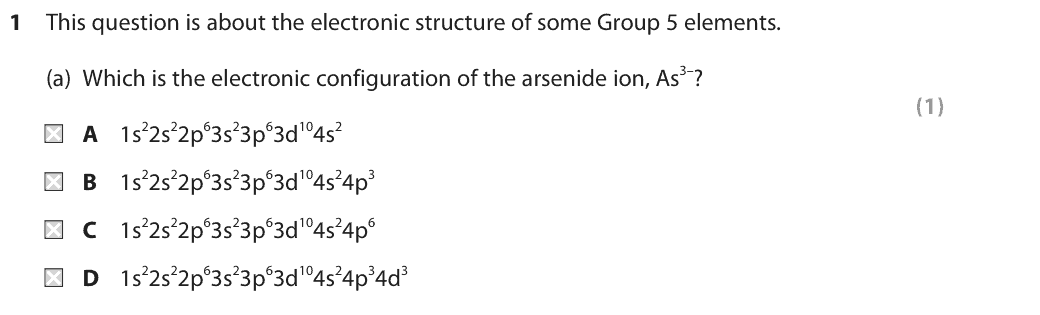
This question is about the electronic structure of some Group 5 elements.
Which is the electronic configuration of the arsenide ion, As3–?
A  1s22s22p63s23p63d104s2
B  1s22s22p63s23p63d104s24p3
C  1s22s22p63s23p63d104s24p6
D  1s22s22p63s23p63d104s24p34d3
October 2020 · AS Paper 1 · Q1(b)(i) 1 mark Short answer atomic structure and the periodic table
Earlier part of question 1 that this part usesEarlier part of October 2020 Paper 1 question 1
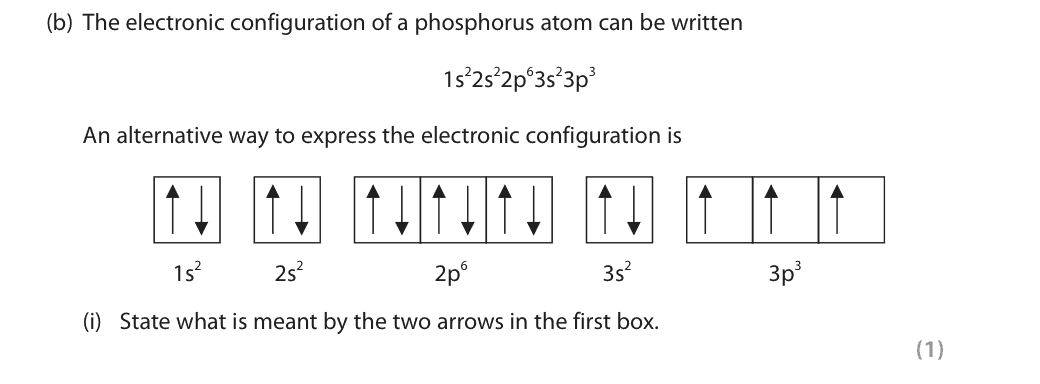
The electronic configuration of a phosphorus atom can be written
1s22s22p63s23p3
An alternative way to express the electronic configuration is
1s2
2s2
2p6
3s2
3p3
State what is meant by the two arrows in the first box.
October 2020 · AS Paper 1 · Q1(b)(ii) 1 mark Short answer atomic structure and the periodic table
Earlier parts of question 1 that this part usesEarlier part of October 2020 Paper 1 question 1Earlier part of October 2020 Paper 1 question 1
State why the arrows are all pointing in the same direction in the 3p boxes.
October 2020 · AS Paper 1 · Q2(a)(i) 1 mark Multiple choice atomic structure and the periodic table
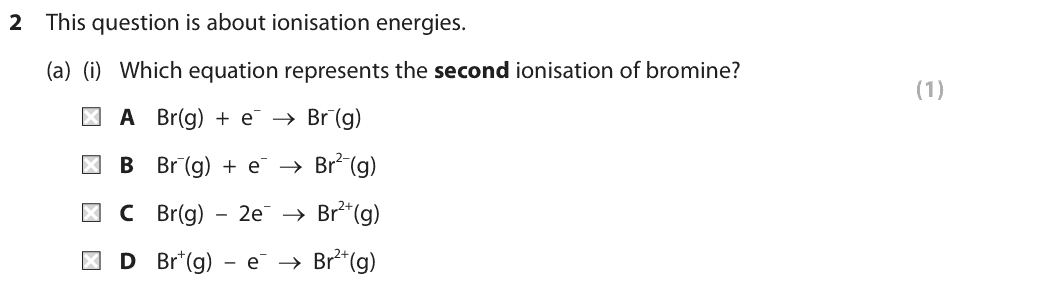
This question is about ionisation energies.
Which equation represents the second ionisation of bromine?
A  Br(g)  +  e–  →  Br–(g)
B  Br–(g)  +  e–  →  Br2–(g)
C  Br(g)  –  2e–  →  Br2+(g)
D  Br+(g)  –  e–  →  Br2+(g)
October 2020 · AS Paper 1 · Q2(a)(ii) 1 mark Multiple choice atomic structure and the periodic table
Earlier part of question 2 that this part usesEarlier part of October 2020 Paper 1 question 2
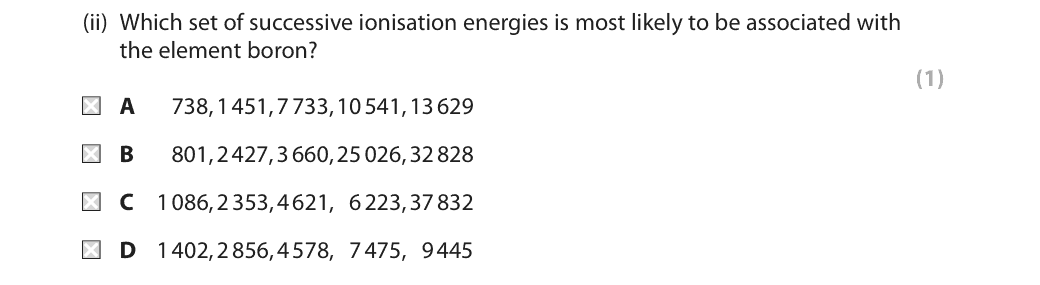
Which set of successive ionisation energies is most likely to be associated with
the element boron?
A     738, 1 451, 7 733, 10 541, 13 629
B     801, 2 427, 3 660, 25 026, 32 828
C  1 086, 2 353, 4 621,   6 223, 37 832
D  1 402, 2 856, 4 578,   7 475,   9 445
October 2020 · AS Paper 1 · Q2(b)(i) 3 marks Diagram or structure Hard atomic structure and the periodic table
Earlier part of question 2 that this part usesEarlier part of October 2020 Paper 1 question 2
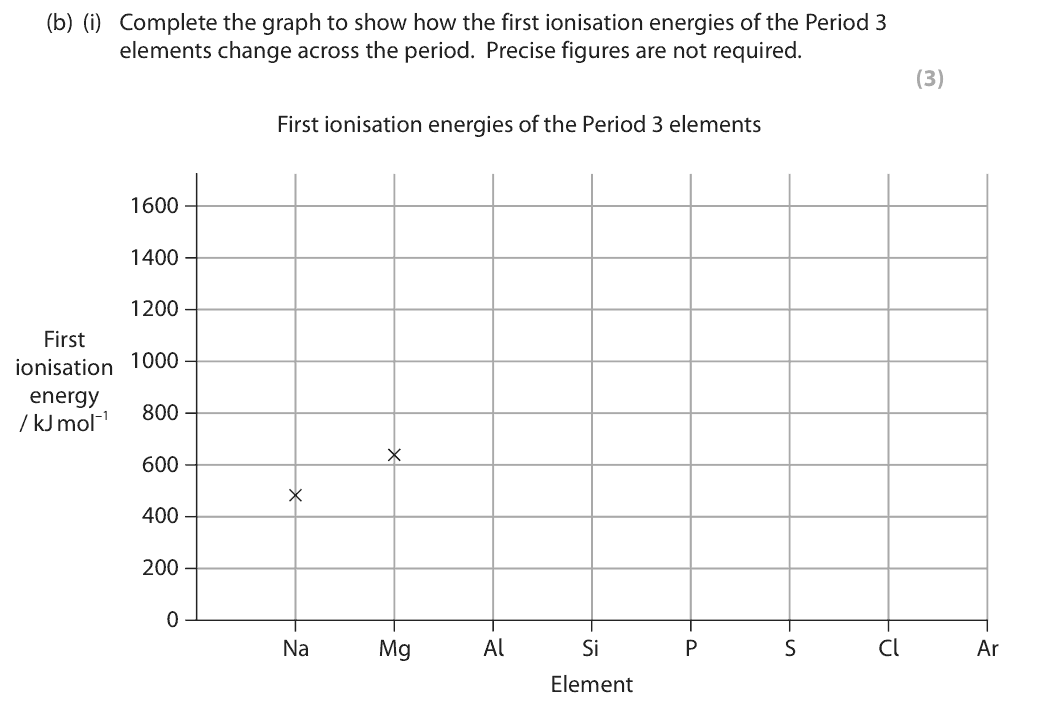
Complete the graph to show how the first ionisation energies of the Period 3
elements change across the period.  Precise figures are not required.
First ionisation energies of the Period 3 elements
1600
1400
1200
First
1000
ionisation
energy
800
/ kJ mol–1
600
400
200
0
Na
Mg
Al
Si
P
S
Cl
Ar
Element
October 2020 · AS Paper 1 · Q2(b)(ii) 2 marks Short answer atomic structure and the periodic table
Earlier parts of question 2 that this part usesEarlier part of October 2020 Paper 1 question 2Earlier part of October 2020 Paper 1 question 2
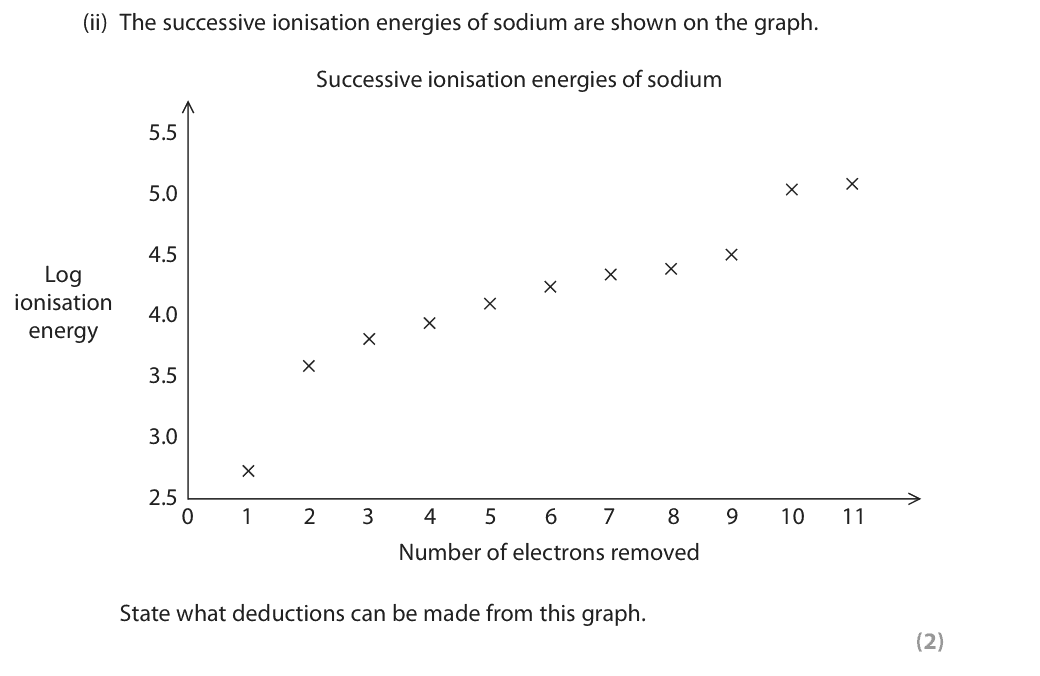
The successive ionisation energies of sodium are shown on the graph.
Successive ionisation energies of sodium
5.5
5.0
4.5
Log
ionisation
4.0
energy
3.5
3.0
2.5
0
1
2
3
4
5
6
7
8
9
10
11
Number of electrons removed
State what deductions can be made from this graph.
October 2020 · AS Paper 1 · Q3(a)(i) 2 marks Short answer bonding
Nitrogen forms several hydrides.  In addition to ammonia, NH3 , it forms hydrazine, N2H4 ,
in which the two nitrogen atoms are covalently bonded together.
Explain what is meant by a covalent bond.
October 2020 · AS Paper 1 · Q3(a)(ii) 1 mark Diagram or structure bonding
Earlier part of question 3 that this part usesEarlier part of October 2020 Paper 1 question 3
Draw a dot‑and‑cross diagram for hydrazine, showing the outer electrons only.
Use crosses (×) to represent the electrons from nitrogen and dots ( • ) to
represent the electrons from hydrogen.
October 2020 · AS Paper 1 · Q3(a)(iii) 1 mark Short answer bonding
Earlier part of question 3 that this part usesEarlier part of October 2020 Paper 1 question 3
Estimate the H
N
H bond angle in hydrazine.
Bond angle =
October 2020 · AS Paper 1 · Q3(b) 3 marks Diagram or structure bonding
Earlier part of question 3 that this part usesEarlier part of October 2020 Paper 1 question 3
Hydrazine is very soluble in water.
Explain, using a labelled diagram and naming the relevant intermolecular interactions,
why hydrazine is very soluble in water.
October 2020 · AS Paper 1 · Q3(c) 2 marks Short answer formulae equations and amounts of substance
Earlier part of question 3 that this part usesEarlier part of October 2020 Paper 1 question 3
Hydrazine has been used as a rocket fuel.
It is a powerful reducing agent and will react very exothermically with oxidising agents
such as hydrogen peroxide.
The equation for the reaction of hydrazine with hydrogen peroxide is
N2H4(l)  +  2H2O2(l)  →  N2(g)  +  4H2O(g)
Give two reasons why hydrazine is a good rocket fuel when reacted with
hydrogen peroxide.
October 2020 · AS Paper 1 · Q4(a)(i) 3 marks Short answer atomic structure and the periodic table
This question is about isotopes.
The table shows data for some isotopes of potassium.
Isotope
Relative isotopic mass
Abundance %
39K
38.9637
93.218
40K
39.9340
0.012
41K
40.9618
6.770
State what is meant by the terms ‘relative isotopic mass’ and ‘relative atomic mass’.
October 2020 · AS Paper 1 · Q4(a)(ii) 2 marks Short answer atomic structure and the periodic table
Earlier part of question 4 that this part usesEarlier part of October 2020 Paper 1 question 4
State what is meant by the term ‘isotopes’.  Illustrate your answer by referring to
the isotopes of potassium.
October 2020 · AS Paper 1 · Q4(a)(iii) 2 marks Calculation Easy atomic structure and the periodic table
Earlier parts of question 4 that this part usesEarlier part of October 2020 Paper 1 question 4Earlier part of October 2020 Paper 1 question 4
Use the data in the table to calculate the relative atomic mass of potassium.
Give your answer to 4 significant figures.
October 2020 · AS Paper 1 · Q4(b)(i) 1 mark Short answer atomic structure and the periodic table
Earlier part of question 4 that this part usesEarlier part of October 2020 Paper 1 question 4
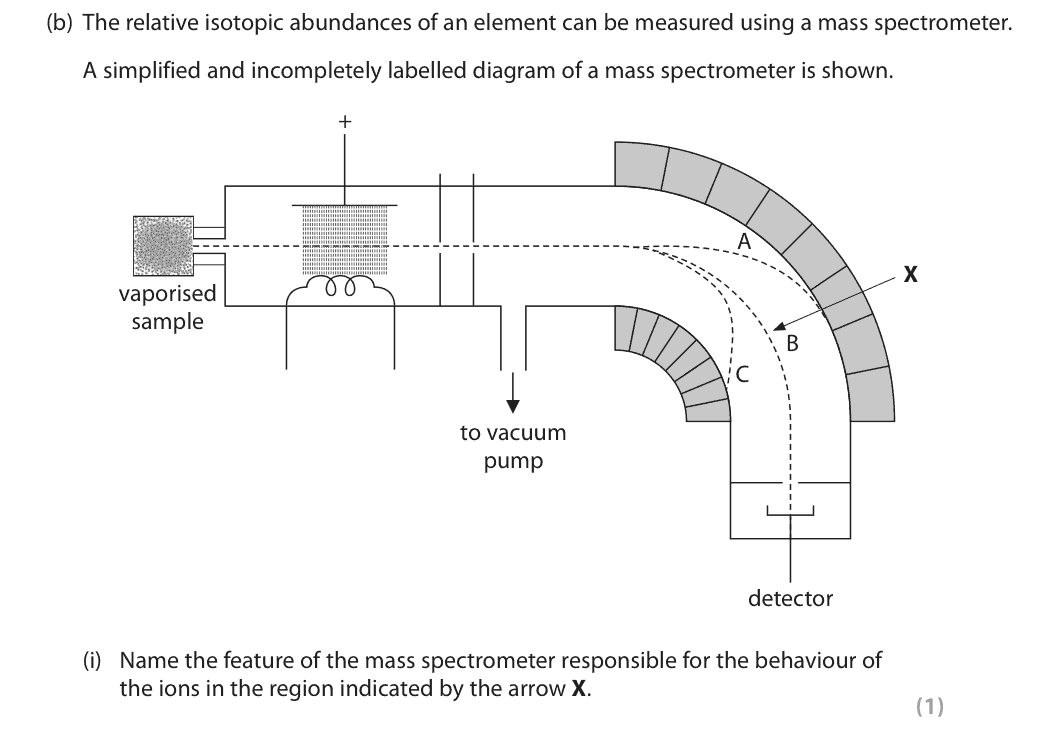
The relative isotopic abundances of an element can be measured using a mass spectrometer.
A simplified and incompletely labelled diagram of a mass spectrometer is shown.
+
A
X
vaporised
sample
B
C
to vacuum
pump
detector
Name the feature of the mass spectrometer responsible for the behaviour of
the ions in the region indicated by the arrow X.
October 2020 · AS Paper 1 · Q4(b)(ii) 3 marks Explanation Hard atomic structure and the periodic table
Earlier parts of question 4 that this part usesEarlier part of October 2020 Paper 1 question 4Earlier part of October 2020 Paper 1 question 4
Explain the three ion pathways, A, B and C, shown in the region indicated by
the arrow X.
October 2020 · AS Paper 1 · Q4(b)(iii) 1 mark Short answer Hard atomic structure and the periodic table
Earlier part of question 4 that this part usesEarlier part of October 2020 Paper 1 question 4
Give a reason why the mass spectrometer must be operated under vacuum.
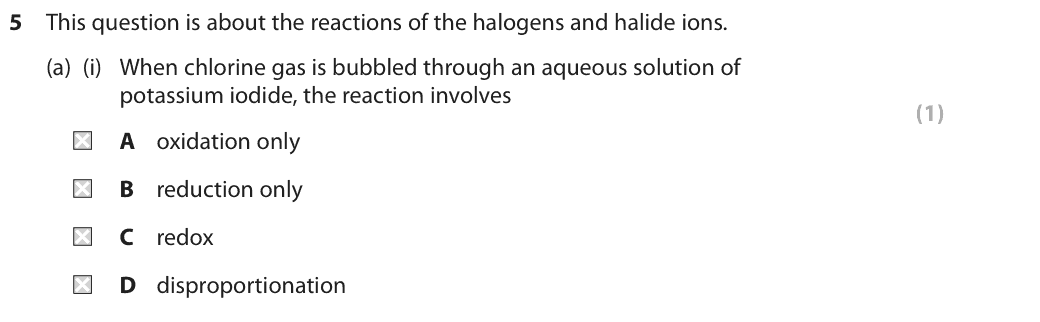
October 2020 · AS Paper 1 · Q5(a)(i) 1 mark Multiple choice group 7 the halogensredox i
This question is about the reactions of the halogens and halide ions.
When chlorine gas is bubbled through an aqueous solution of
potassium iodide, the reaction involves
A  oxidation only
B  reduction only
C  redox
D  disproportionation
October 2020 · AS Paper 1 · Q5(a)(ii) 1 mark Multiple choice group 7 the halogens
Earlier part of question 5 that this part usesEarlier part of October 2020 Paper 1 question 5
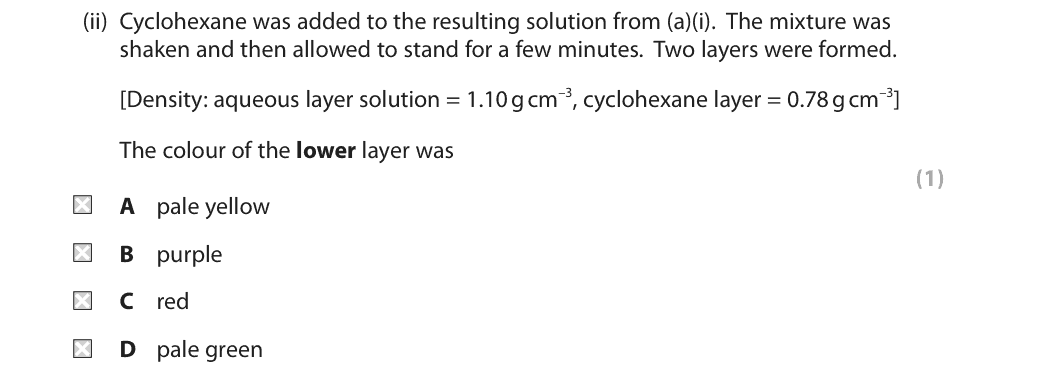
Cyclohexane was added to the resulting solution from (a)(i).  The mixture was
shaken and then allowed to stand for a few minutes.  Two layers were formed.
[Density: aqueous layer solution = 1.10 g cm–3, cyclohexane layer = 0.78 g cm–3]
The colour of the lower layer was
A  pale yellow
B  purple
C  red
D  pale green
October 2020 · AS Paper 1 · Q5(b)(i) 1 mark Multiple choice group 7 the halogens
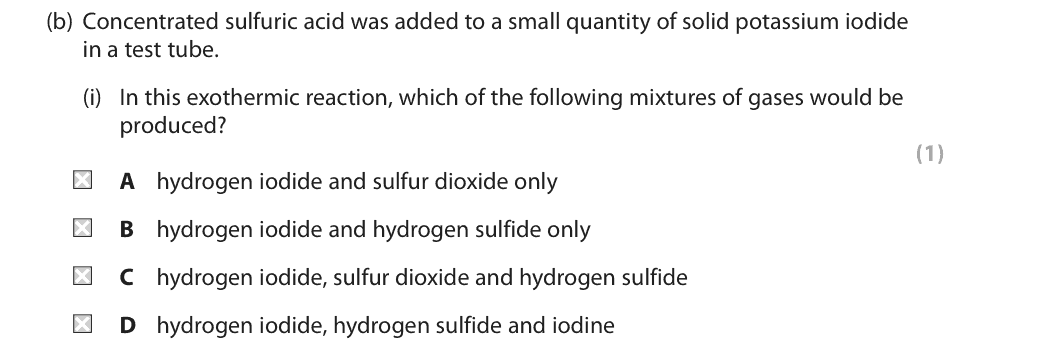
Concentrated sulfuric acid was added to a small quantity of solid potassium iodide
in a test tube.
In this exothermic reaction, which of the following mixtures of gases would be
produced?
A  hydrogen iodide and sulfur dioxide only
B  hydrogen iodide and hydrogen sulfide only
C  hydrogen iodide, sulfur dioxide and hydrogen sulfide
D  hydrogen iodide, hydrogen sulfide and iodine
October 2020 · AS Paper 1 · Q5(b)(ii) 3 marks Practical and data analysis group 7 the halogensformulae equations and amounts of substance
Earlier part of question 5 that this part usesEarlier part of October 2020 Paper 1 question 5
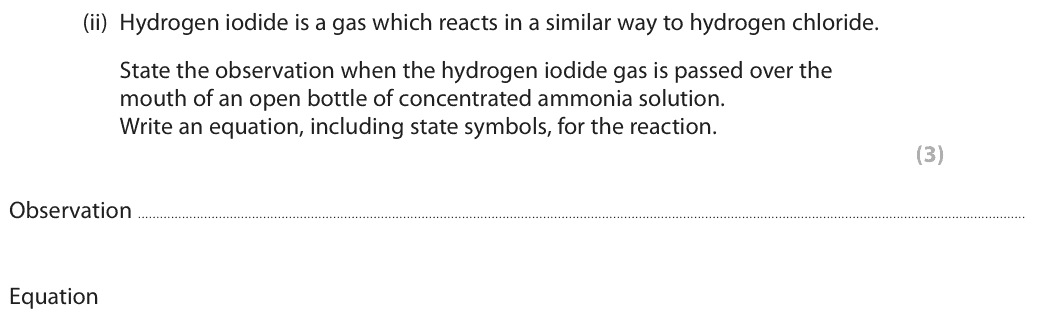
Hydrogen iodide is a gas which reacts in a similar way to hydrogen chloride.
State the observation when the hydrogen iodide gas is passed over the
mouth of an open bottle of concentrated ammonia solution.
Write an equation, including state symbols, for the reaction.
Observation 
Equation
October 2020 · AS Paper 1 · Q5(c)(i) 3 marks Practical and data analysis Hard group 7 the halogens
Earlier part of question 5 that this part usesEarlier part of October 2020 Paper 1 question 5
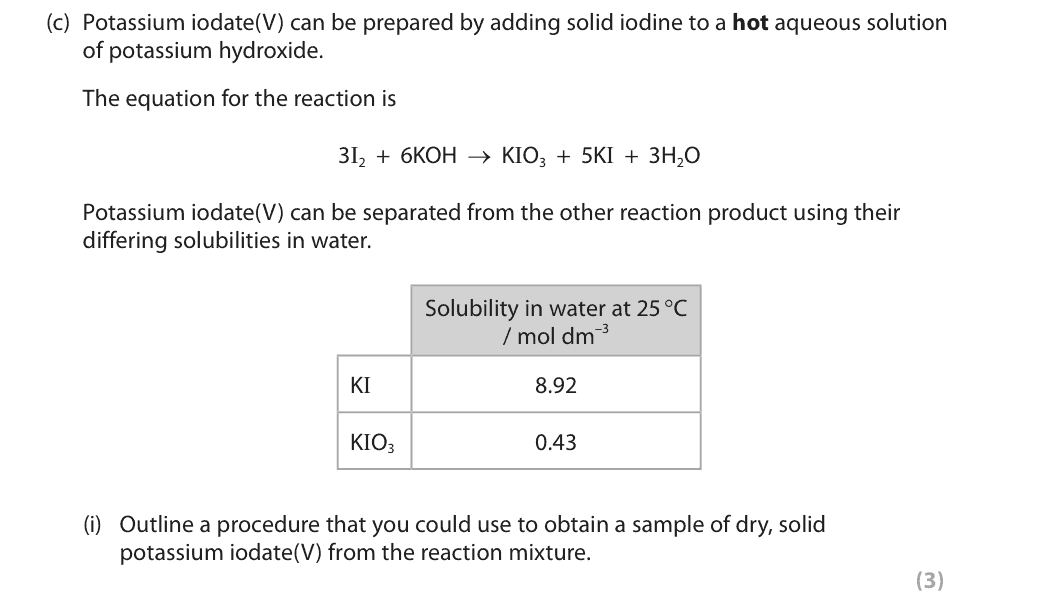
Potassium iodate(V) can be prepared by adding solid iodine to a hot aqueous solution
of potassium hydroxide.
The equation for the reaction is
3I2  +  6KOH  →  KIO3  +  5KI  +  3H2O
Potassium iodate(V) can be separated from the other reaction product using their
differing solubilities in water.
Solubility in water at 25 °C
/ mol dm–3
KI
8.92
KIO3
0.43
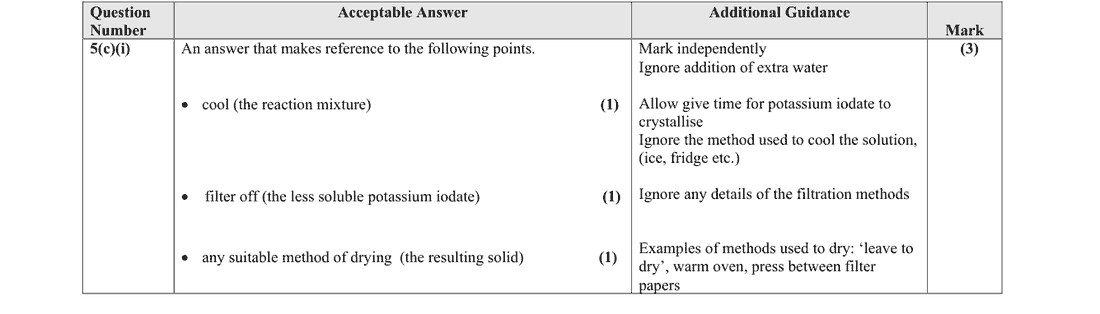
Outline a procedure that you could use to obtain a sample of dry, solid
potassium iodate(V) from the reaction mixture.
October 2020 · AS Paper 1 · Q5(c)(ii) 2 marks Practical and data analysis group 7 the halogens
Earlier part of question 5 that this part usesEarlier part of October 2020 Paper 1 question 5
Describe how you would show that iodide ions are present in an aqueous
solution of potassium iodide.
October 2020 · AS Paper 1 · Q5(d) 1 mark Multiple choice group 7 the halogens
Earlier part of question 5 that this part usesEarlier part of October 2020 Paper 1 question 5
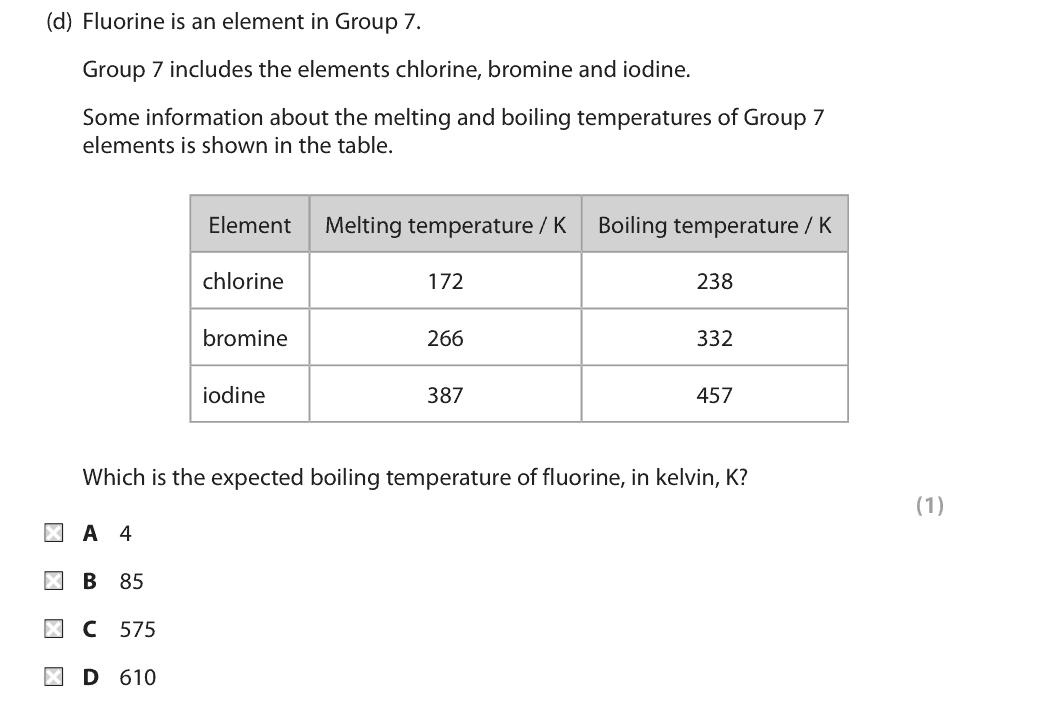
Fluorine is an element in Group 7.
Group 7 includes the elements chlorine, bromine and iodine.
Some information about the melting and boiling temperatures of Group 7
elements is shown in the table.
Element
Melting temperature / K
Boiling temperature / K
chlorine
172
238
bromine
266
332
iodine
387
457
Which is the expected boiling temperature of fluorine, in kelvin, K?
A  4
B  85
C  575
D  610
October 2020 · AS Paper 1 · Q6(a) 1 mark Multiple choice atomic structure and the periodic table
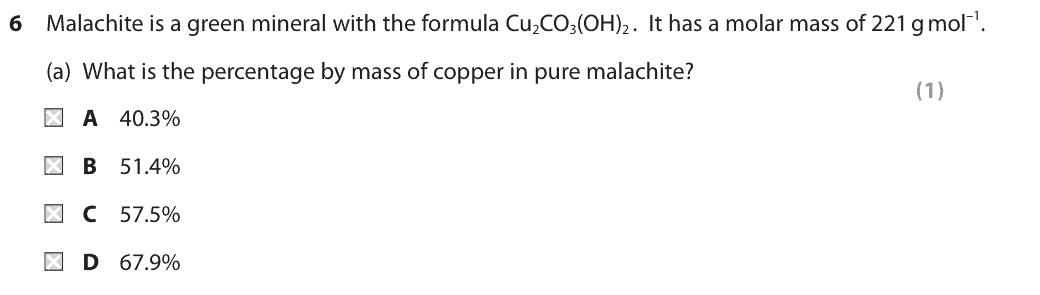
Malachite is a green mineral with the formula Cu2CO3(OH)2 .  It has a molar mass of 221 g mol–1.
What is the percentage by mass of copper in pure malachite?
A  40.3%
B  51.4%
C  57.5%
D  67.9%
October 2020 · AS Paper 1 · Q6(b) 3 marks Practical and data analysis formulae equations and amounts of substanceanalysis of inorganic compounds
Earlier part of question 6 that this part usesEarlier part of October 2020 Paper 1 question 6
Describe what you would expect to see when an excess of dilute hydrochloric acid
is added to a sample of pure solid malachite.
October 2020 · AS Paper 1 · Q6(c)(i) 3 marks Practical and data analysis Easy groups 1 and 2
Earlier part of question 6 that this part usesEarlier part of October 2020 Paper 1 question 6
Describe how you would carry out a flame test on a sample of powdered malachite.
October 2020 · AS Paper 1 · Q6(c)(ii) 4 marks Explanation groups 1 and 2
Earlier parts of question 6 that this part usesEarlier part of October 2020 Paper 1 question 6Earlier part of October 2020 Paper 1 question 6
When the atoms of some elements are heated, they produce a characteristic
flame colour.  For example, the copper in malachite gives a blue-green colour.
Explain how atoms of different elements can produce different characteristic
flame colours when heated.
October 2020 · AS Paper 1 · Q6(d)(i) 5 marks Calculation formulae equations and amounts of substance
Earlier part of question 6 that this part usesEarlier part of October 2020 Paper 1 question 6
When malachite is heated to approximately 300 °C, water, carbon dioxide and
copper(II) oxide are formed.
The equation for this decomposition is
Cu2CO3(OH)2  →  2CuO  +  CO2  +  H2O
Calculate the maximum volume of carbon dioxide that could be produced
when 0.810 g of malachite is thermally decomposed.
Assume that the gas is collected at a temperature of 25 °C and 101 kPa pressure.
Give your answer to an appropriate number of significant figures and state the units.
[The ideal gas equation is pV = nRT.  Gas constant (R) = 8.31 J mol–1 K–1]
October 2020 · AS Paper 1 · Q6(d)(ii) 1 mark Calculation formulae equations and amounts of substance
Earlier parts of question 6 that this part usesEarlier part of October 2020 Paper 1 question 6Earlier part of October 2020 Paper 1 question 6
The gas was collected in a gas syringe with a stated accuracy of ± 0.5 cm3.
Calculate the percentage uncertainty in the volume of gas collected.
October 2020 · AS Paper 1 · Q6(d)(iii) 3 marks Calculation formulae equations and amounts of substance
Earlier parts of question 6 that this part usesEarlier part of October 2020 Paper 1 question 6Earlier part of October 2020 Paper 1 question 6Earlier part of October 2020 Paper 1 question 6
Malachite ore is a mixture of malachite and rock.  A 0.810 g sample of malachite ore
was thermally decomposed, producing 0.571 g of copper(II) oxide.
Calculate the percentage purity of this malachite ore sample.
Give your answer to an appropriate number of significant figures.

October 2020 · AS Paper 1 · Q7(a) 3 marks Short answer Hard atomic structure and the periodic table
Give the meaning of the term ‘periodicity’.
Illustrate your answer by referring to the atomic radii of the Period 2 and Period 3 elements.
Specific values of atomic radii are not required.
October 2020 · AS Paper 1 · Q7(b) 6 marks 6-mark extended response atomic structure and the periodic tablestructure
Earlier part of question 7 that this part usesEarlier part of October 2020 Paper 1 question 7
The melting temperatures of the Period 2 elements are shown.
Symbol of the element
Li
Be
B
C(diamond)
N
O
F
Ne
Melting temperature / K
454
1551
2573
3970
63
55
53
25
Explain the trend in melting temperatures across the elements of Period 2 in
terms of their structure and bonding.
October 2020 · AS Paper 1 · Q8(a) 2 marks Equation writing Hard groups 1 and 2formulae equations and amounts of substance
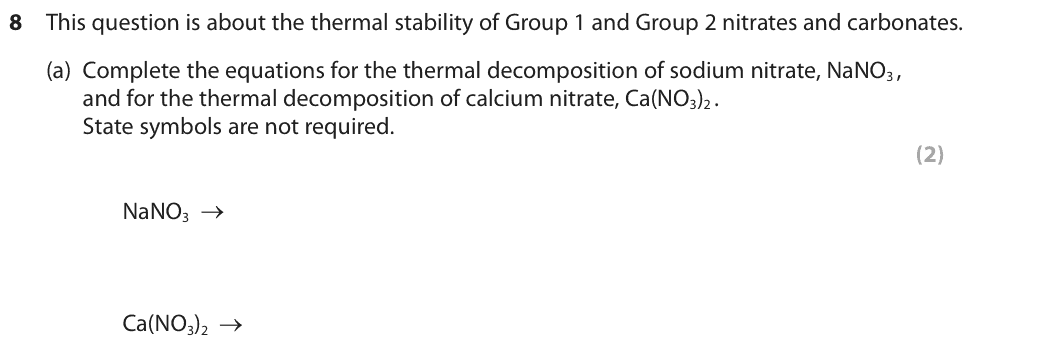
This question is about the thermal stability of Group 1 and Group 2 nitrates and carbonates.
Complete the equations for the thermal decomposition of sodium nitrate, NaNO3 ,
and for the thermal decomposition of calcium nitrate, Ca(NO3)2 .
State symbols are not required.
NaNO3  →
Ca(NO3)2  →
October 2020 · AS Paper 1 · Q8(b) 3 marks Explanation Hard groups 1 and 2
Earlier part of question 8 that this part usesEarlier part of October 2020 Paper 1 question 8
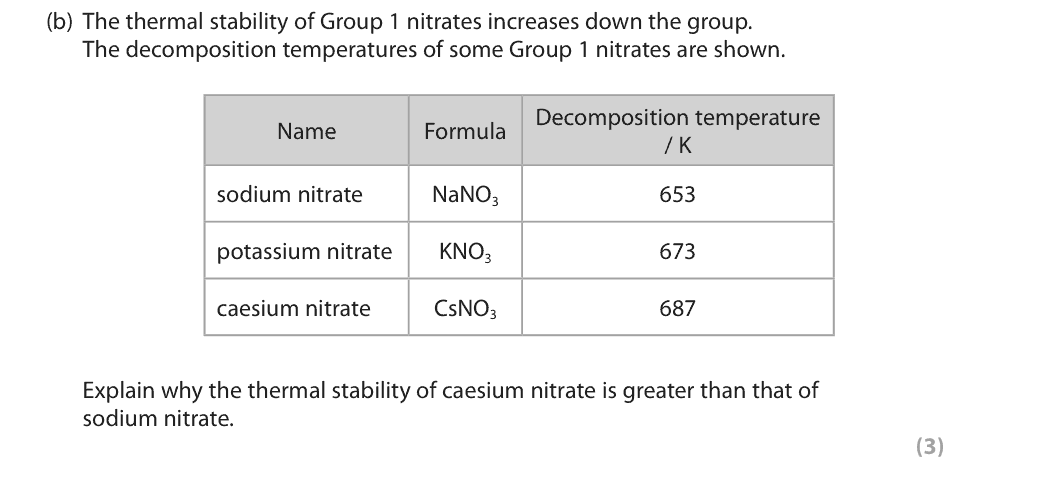
The thermal stability of Group 1 nitrates increases down the group.
The decomposition temperatures of some Group 1 nitrates are shown.
Decomposition temperature
Name
Formula
/ K
sodium nitrate
NaNO3
653
potassium nitrate
KNO3
673
caesium nitrate
CsNO3
687
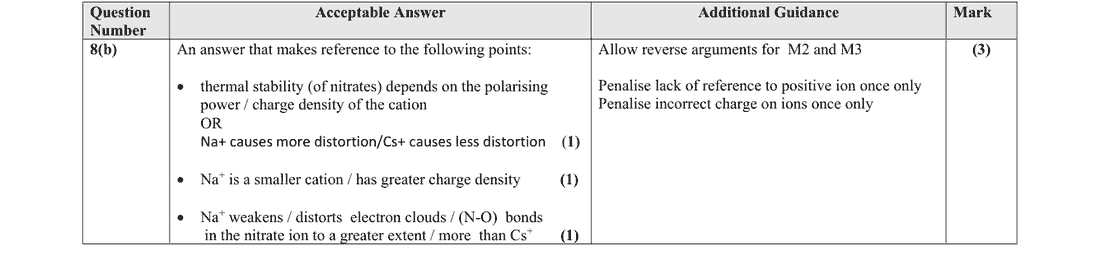
Explain why the thermal stability of caesium nitrate is greater than that of
sodium nitrate.
October 2020 · AS Paper 1 · Q8(c)(i) 1 mark Equation writing groups 1 and 2formulae equations and amounts of substance
Earlier part of question 8 that this part usesEarlier part of October 2020 Paper 1 question 8
Calcium carbonate is thermally decomposed during the manufacture of cement.
Write an equation, including state symbols, for the thermal decomposition of
calcium carbonate.
October 2020 · AS Paper 1 · Q8(c)(ii) 1 mark Short answer bonding
Earlier parts of question 8 that this part usesEarlier part of October 2020 Paper 1 question 8Earlier part of October 2020 Paper 1 question 8
Name all the types of bond present in calcium carbonate.
October 2020 · AS Paper 1 · Q8(c)(iii) 1 mark Short answer Hard groups 1 and 2
Earlier parts of question 8 that this part usesEarlier part of October 2020 Paper 1 question 8Earlier part of October 2020 Paper 1 question 8
Give a reason, in terms of the bonding, why a high decomposition
temperature is required.

Work with an A-level chemistry tutor

Want a paper marked and gone through with you? Message us.

Prefer email? Send an enquiry

If you are under 18, please include a parent's contact details. Enquiries go to enquiries@chemistryaleveltutor.com and are deleted once handled. All tutoring is online.