June 2024: AS Paper 1, Core Inorganic and Physical Chemistry

80 marks · 38 question parts · Paper, mark scheme and report on Edexcel's site · Have the Data Booklet beside you

Question by question

QTopicMarksAOType
1 Atomic structure and the Periodic Table 1Multiple choice
2 Atomic structure and the Periodic Table 1Multiple choice
3 Atomic structure and the Periodic Table 1Multiple choice
4(a)(i) The elements of Group 7 (halogens) 3Practical and data analysis
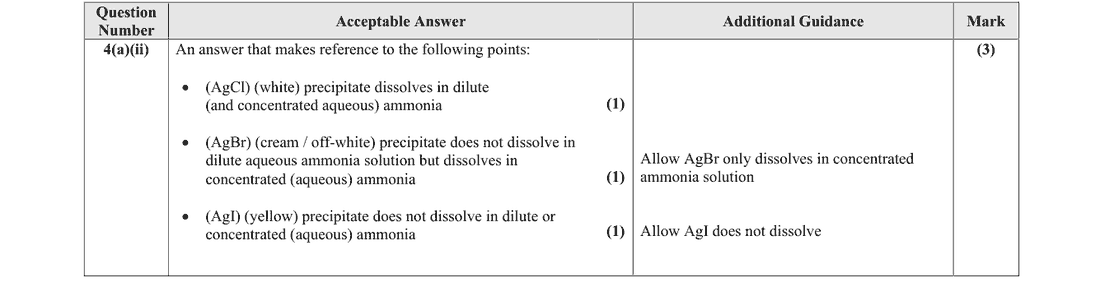
4(a)(ii) The elements of Group 7 (halogens) 3Practical and data analysis
4(b)(i) The elements of Group 7 (halogens) 1Practical and data analysis
4(b)(ii) Analysis of inorganic compounds 1Practical and data analysis
4(b)(iii) Analysis of inorganic compounds, Formulae, equations and amounts of substance 2Equation writing
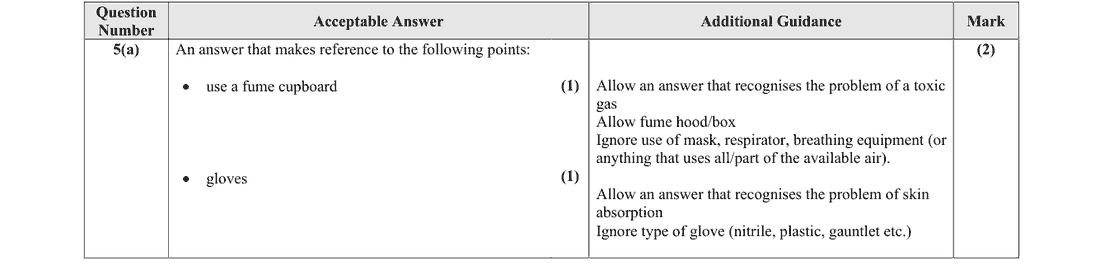
5(a) Formulae, equations and amounts of substance 2Practical and data analysis
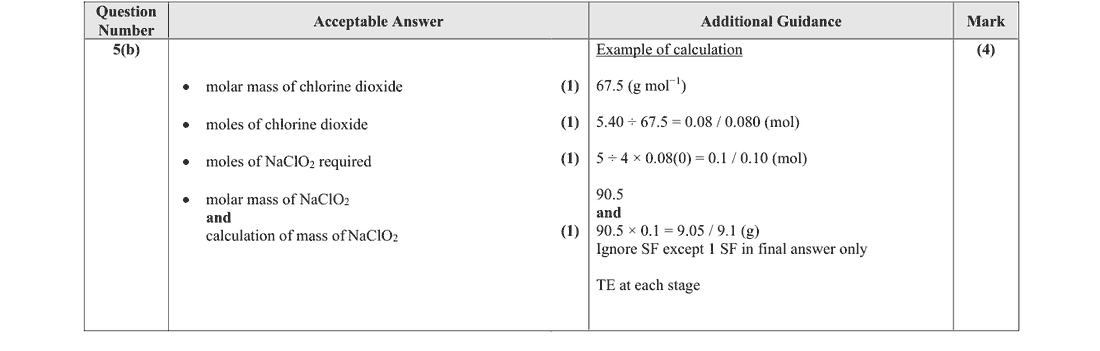
5(b) Formulae, equations and amounts of substance 4Calculation
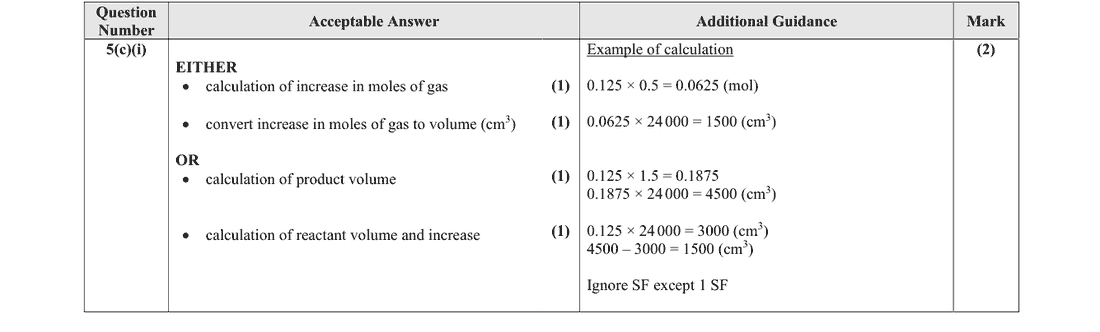
5(c)(i) Formulae, equations and amounts of substance 2Calculation
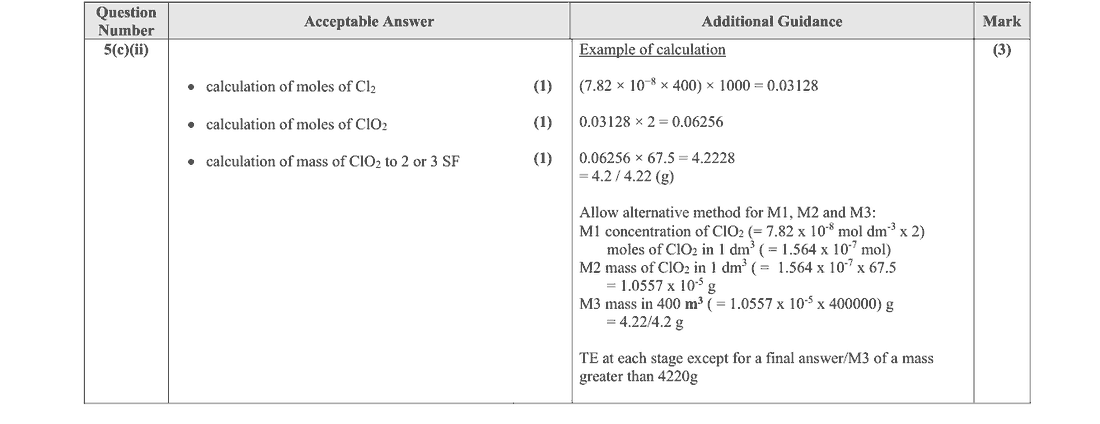
5(c)(ii) Formulae, equations and amounts of substance 3Calculation
5(d) Bonding 1Multiple choice
5(e)(i) Bonding 2Diagram or structure
5(e)(ii) Bonding 3Explanation
5(f) Redox I 1Multiple choice
6(a)(i) Formulae, equations and amounts of substance 3Calculation
6(a)(ii) Formulae, equations and amounts of substance 1Calculation
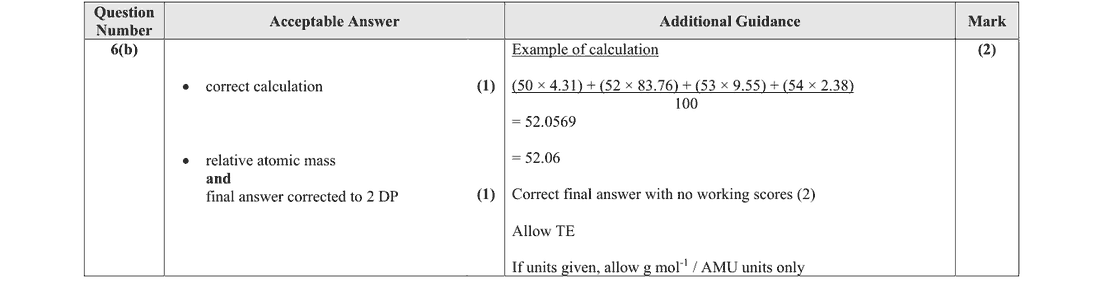
6(b) Atomic structure and the Periodic Table 2Calculation
6(c) Atomic structure and the Periodic Table 1Multiple choice
6(d) Atomic structure and the Periodic Table 1Short answer
7(a) The elements of Group 7 (halogens), Redox I 6Extended response
7(b)(i) The elements of Groups 1 and 2 1Practical and data analysis
7(b)(ii) The elements of Groups 1 and 2 1Practical and data analysis
7(c)(i) The elements of Groups 1 and 2 2Diagram or structure
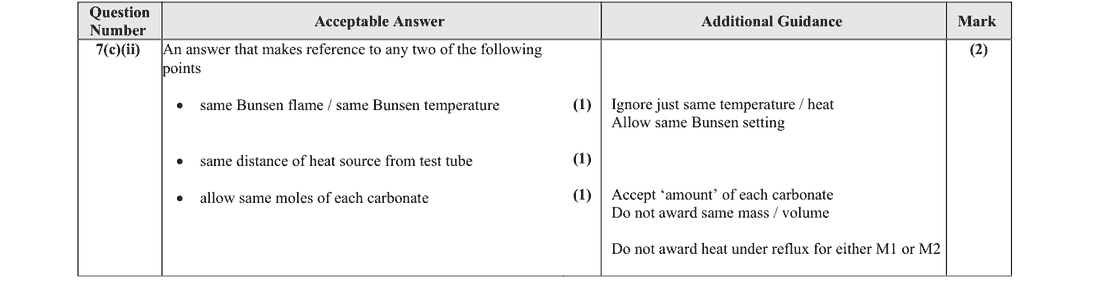
7(c)(ii) The elements of Groups 1 and 2 2Practical and data analysis
7(c)(iii) The elements of Groups 1 and 2 1Practical and data analysis
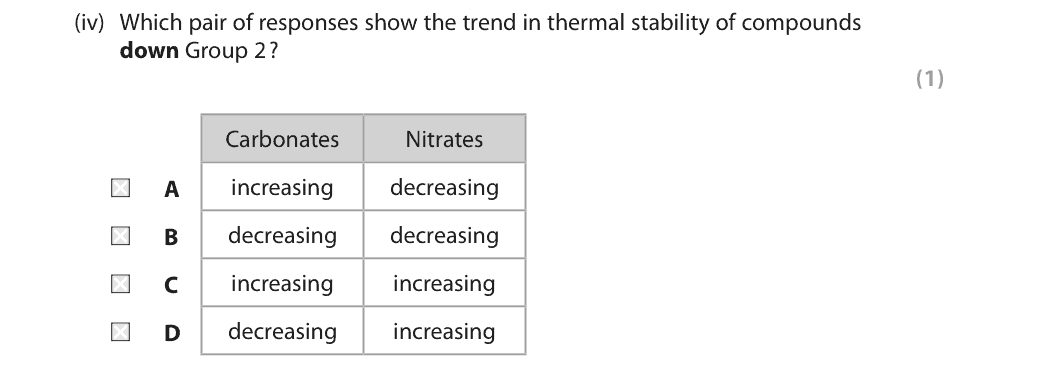
7(c)(iv) The elements of Groups 1 and 2 1Multiple choice
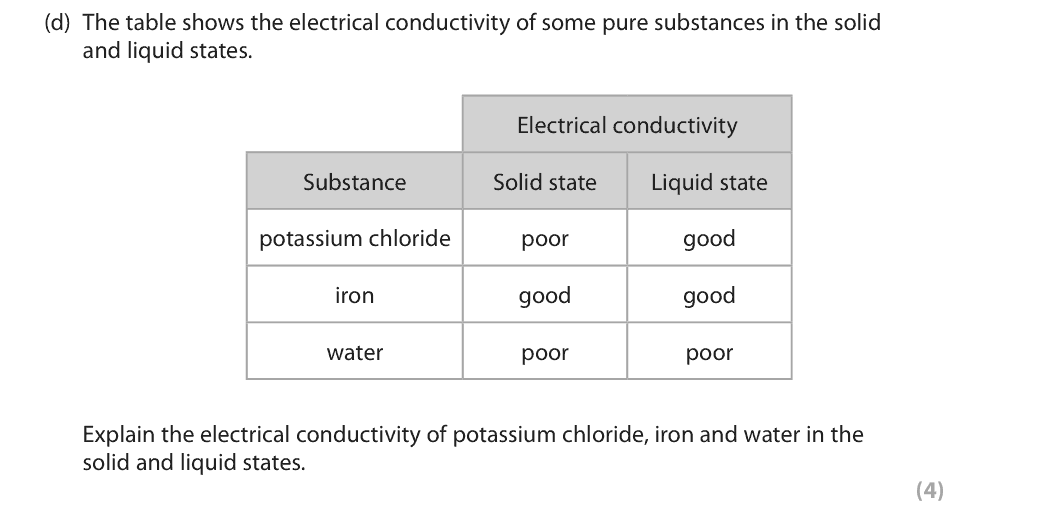
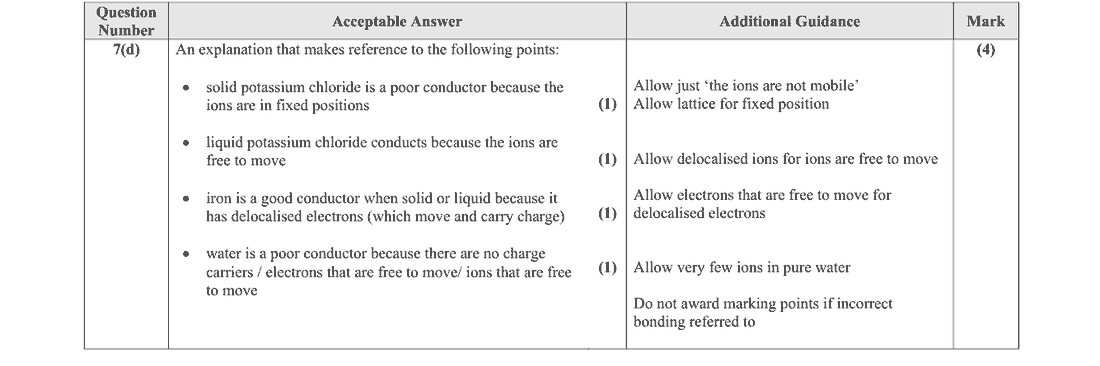
7(d) Structure 4Explanation
8(a)(i) Bonding 4Diagram or structure
8(a)(ii) Bonding 3Diagram or structure
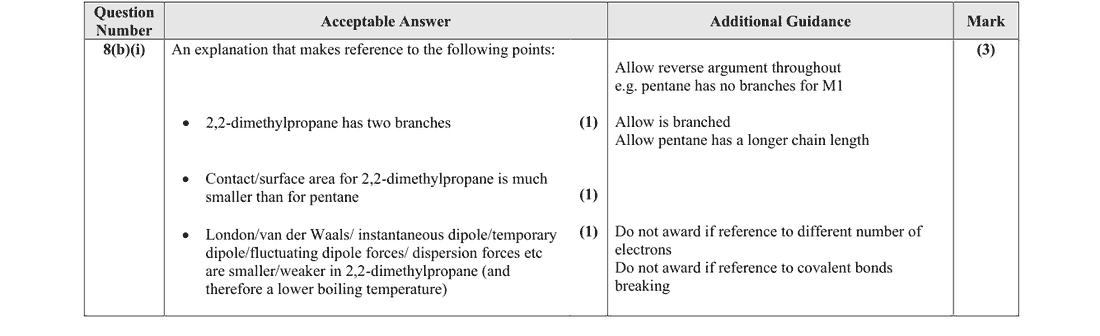
8(b)(i) Bonding 3Explanation
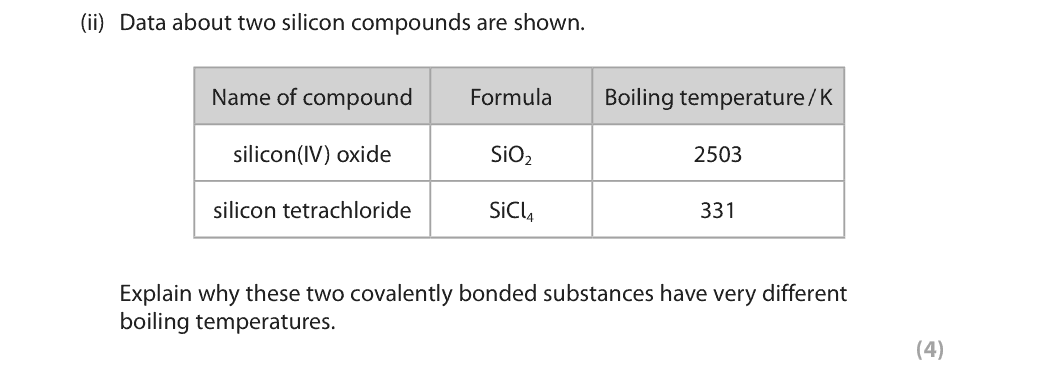
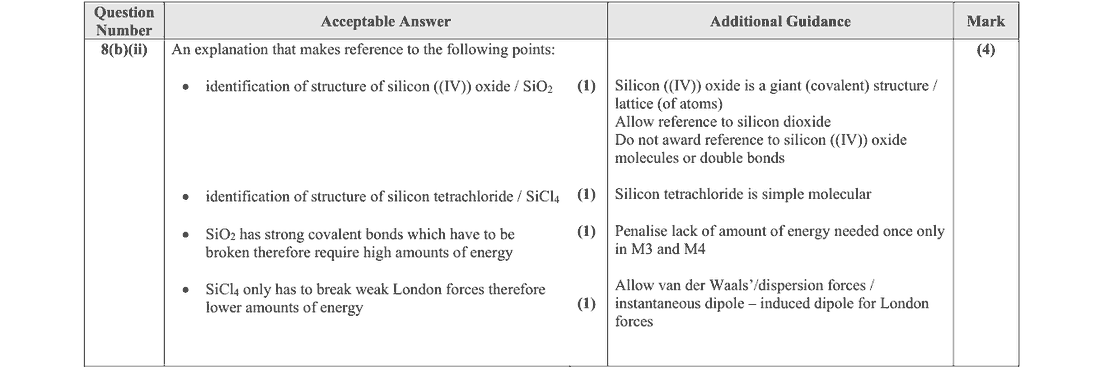
8(b)(ii) Structure 4Explanation
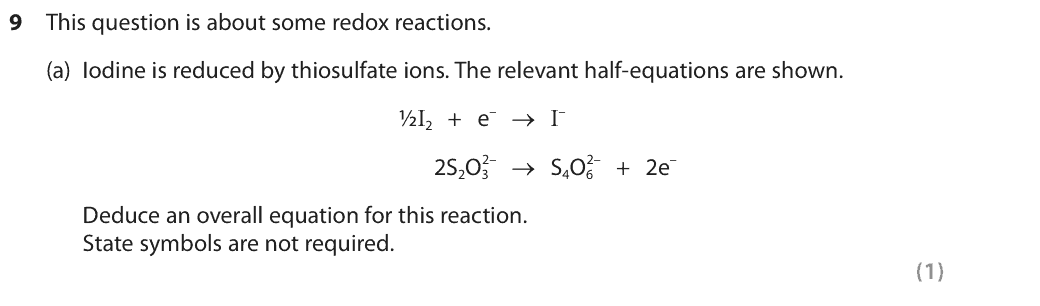
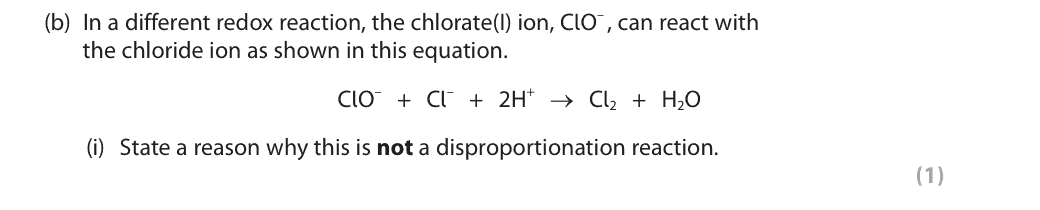
9(a) Redox I 1Equation writing
9(b)(i) Redox I 1Short answer
9(b)(ii) Redox I 1Short answer
9(b)(iii) Redox I 1Multiple choice
9(c) Formulae, equations and amounts of substance 5Calculation

The questions

1234(a)(i)4(a)(ii)4(b)(i)4(b)(ii)4(b)(iii)5(a)5(b)5(c)(i)5(c)(ii)5(d)5(e)(i)5(e)(ii)5(f)6(a)(i)6(a)(ii)6(b)6(c)6(d)7(a)7(b)(i)7(b)(ii)7(c)(i)7(c)(ii)7(c)(iii)7(c)(iv)7(d)8(a)(i)8(a)(ii)8(b)(i)8(b)(ii)9(a)9(b)(i)9(b)(ii)9(b)(iii)9(c)
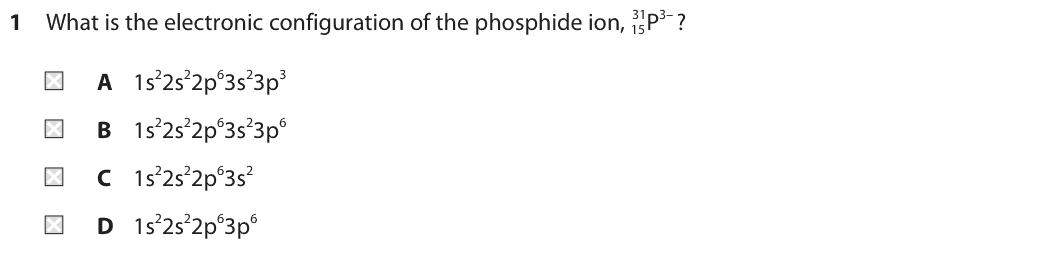
June 2024 · AS Paper 1 · Q1 1 mark Multiple choice atomic structure and the periodic table
What is the electronic configuration of the phosphide ion, 15
31P3– ?
A  1s22s22p63s23p3
B  1s22s22p63s23p6
C  1s22s22p63s2
D  1s22s22p63p6
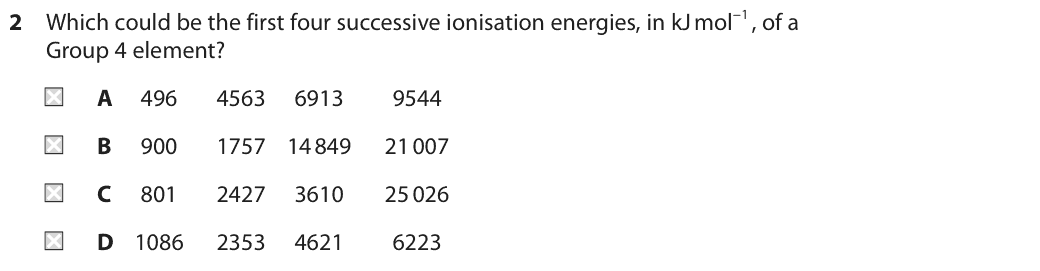
June 2024 · AS Paper 1 · Q2 1 mark Multiple choice atomic structure and the periodic table
Which could be the first four successive ionisation energies, in kJ mol−1 , of a
Group 4 element?
A
496
4563
6913
9544
B
900
1757  14 849
21 007
C
801
2427
3610
25 026
D  1086
2353
4621
6223
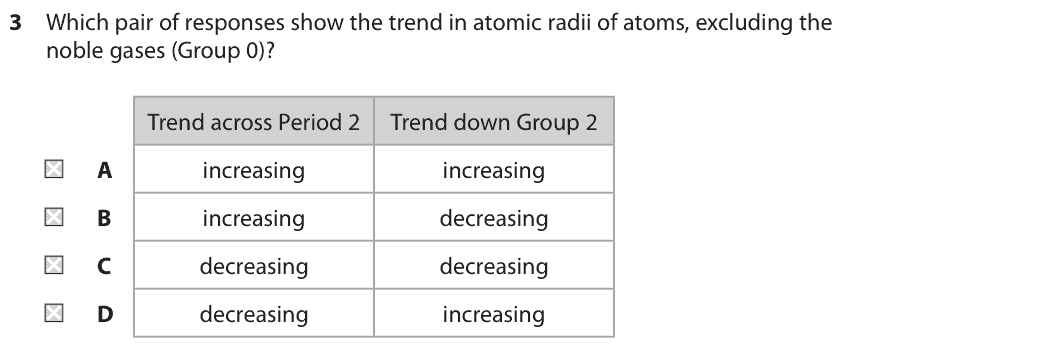
June 2024 · AS Paper 1 · Q3 1 mark Multiple choice atomic structure and the periodic table
Which pair of responses show the trend in atomic radii of atoms, excluding the
noble gases (Group 0)?
Trend across Period 2
Trend down Group 2
A
increasing
increasing
B
increasing
decreasing
C
decreasing
decreasing
D
decreasing
increasing
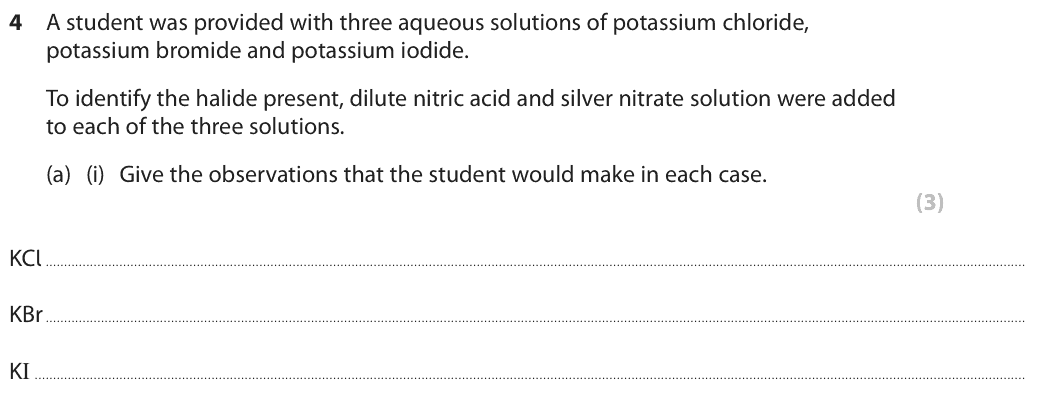
June 2024 · AS Paper 1 · Q4(a)(i) 3 marks Practical and data analysis group 7 the halogens
A student was provided with three aqueous solutions of potassium chloride,
potassium bromide and potassium iodide.
To identify the halide present, dilute nitric acid and silver nitrate solution were added
to each of the three solutions.
Give the observations that the student would make in each case.
KCl . 
KBr
KI
June 2024 · AS Paper 1 · Q4(a)(ii) 3 marks Practical and data analysis group 7 the halogens
Earlier part of question 4 that this part usesEarlier part of June 2024 Paper 1 question 4
Describe how the student could confirm the halide ions present in the
products of (a)(i) by adding ammonia solutions.
June 2024 · AS Paper 1 · Q4(b)(i) 1 mark Practical and data analysis group 7 the halogens
Earlier part of question 4 that this part usesEarlier part of June 2024 Paper 1 question 4
Nitric acid removes other ions that would interfere with the halide test,
for example carbonate ions.
State the observation when silver nitrate is added to a solution of
carbonate ions in the absence of nitric acid.
June 2024 · AS Paper 1 · Q4(b)(ii) 1 mark Practical and data analysis analysis of inorganic compounds
Earlier parts of question 4 that this part usesEarlier part of June 2024 Paper 1 question 4Earlier part of June 2024 Paper 1 question 4
State the observation when nitric acid is added to a solution of
carbonate ions.
June 2024 · AS Paper 1 · Q4(b)(iii) 2 marks Equation writing Hard analysis of inorganic compoundsformulae equations and amounts of substance
Earlier parts of question 4 that this part usesEarlier part of June 2024 Paper 1 question 4Earlier part of June 2024 Paper 1 question 4
Write the ionic equation for the reaction of nitric acid with carbonate ions.
Include state symbols.
June 2024 · AS Paper 1 · Q5(a) 2 marks Practical and data analysis formulae equations and amounts of substance
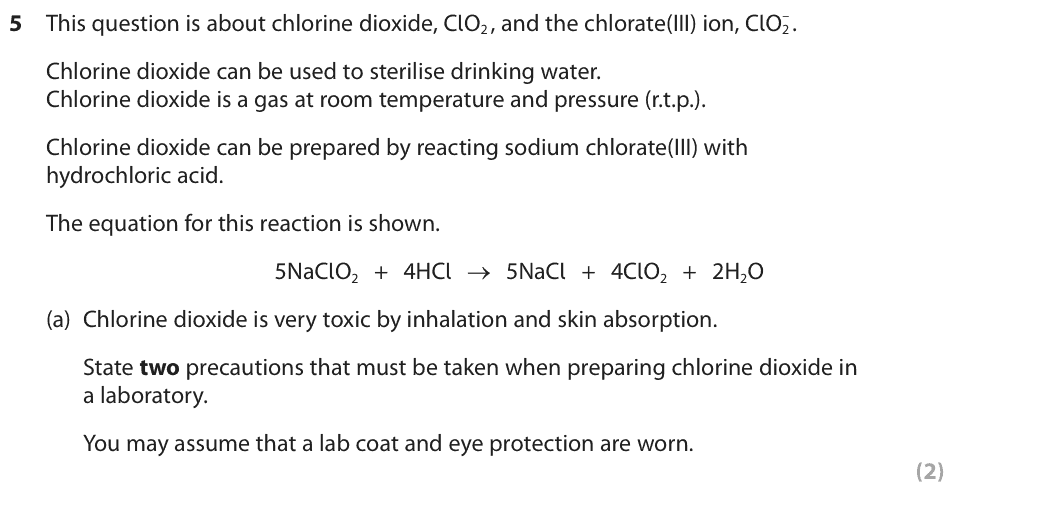
This question is about chlorine dioxide, ClO2 , and the chlorate(III) ion, ClO2
– .
Chlorine dioxide can be used to sterilise drinking water.
Chlorine dioxide is a gas at room temperature and pressure (r.t.p.).
Chlorine dioxide can be prepared by reacting sodium chlorate(III) with
hydrochloric acid.
The equation for this reaction is shown.
5NaClO2   +   4HCl   →   5NaCl   +   4ClO2   +   2H2O
Chlorine dioxide is very toxic by inhalation and skin absorption.
State two precautions that must be taken when preparing chlorine dioxide in
a laboratory.
You may assume that a lab coat and eye protection are worn.
June 2024 · AS Paper 1 · Q5(b) 4 marks Calculation formulae equations and amounts of substance
Earlier part of question 5 that this part usesEarlier part of June 2024 Paper 1 question 5
Calculate the mass of sodium chlorate(III) needed to make
5.40 g of chlorine dioxide.
[Ar values: H = 1.00      O = 16.0      Na = 23.0      Cl = 35.5]
June 2024 · AS Paper 1 · Q5(c)(i) 2 marks Calculation Hard formulae equations and amounts of substance
Earlier part of question 5 that this part usesEarlier part of June 2024 Paper 1 question 5
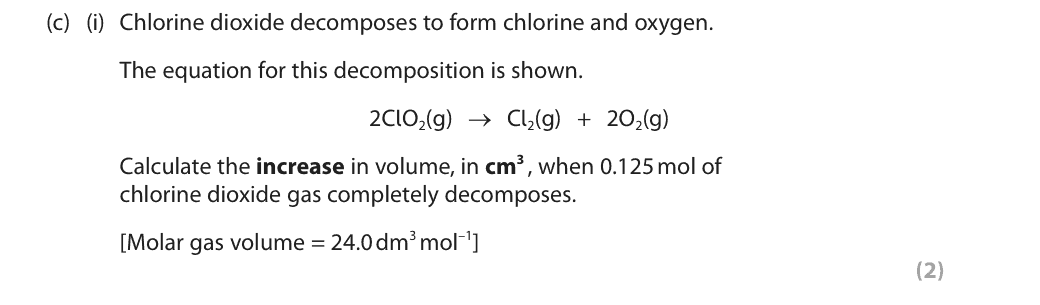
Chlorine dioxide decomposes to form chlorine and oxygen.
The equation for this decomposition is shown.
2ClO2(g)   →   Cl2(g)   +   2O2(g)
Calculate the increase in volume, in cm3 , when 0.125 mol of
chlorine dioxide gas completely decomposes.
[Molar gas volume = 24.0 dm3 mol–1]
June 2024 · AS Paper 1 · Q5(c)(ii) 3 marks Calculation formulae equations and amounts of substance
Earlier parts of question 5 that this part usesEarlier part of June 2024 Paper 1 question 5Earlier part of June 2024 Paper 1 question 5
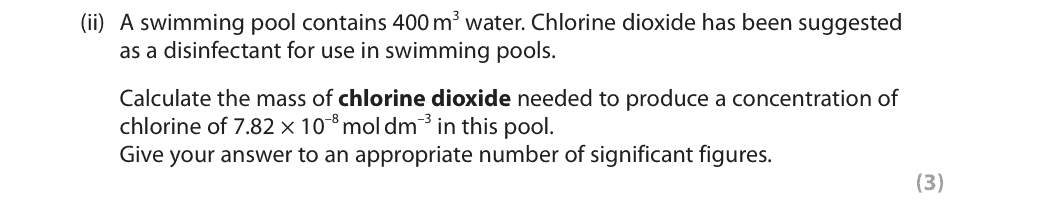
A swimming pool contains 400 m3 water. Chlorine dioxide has been suggested
as a disinfectant for use in swimming pools.
Calculate the mass of chlorine dioxide needed to produce a concentration of
chlorine of 7.82 × 10⁻⁸ mol dm–3 in this pool.
Give your answer to an appropriate number of significant figures.
June 2024 · AS Paper 1 · Q5(d) 1 mark Multiple choice bonding
Earlier part of question 5 that this part usesEarlier part of June 2024 Paper 1 question 5
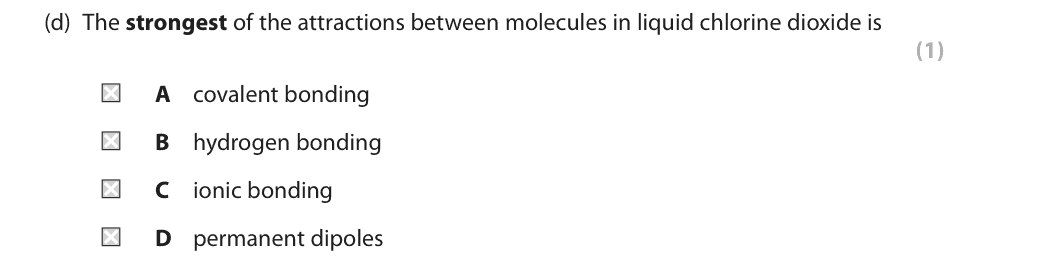
The strongest of the attractions between molecules in liquid chlorine dioxide is
A  covalent bonding
B  hydrogen bonding
C  ionic bonding
D  permanent dipoles
June 2024 · AS Paper 1 · Q5(e)(i) 2 marks Diagram or structure bonding
Earlier part of question 5 that this part usesEarlier part of June 2024 Paper 1 question 5
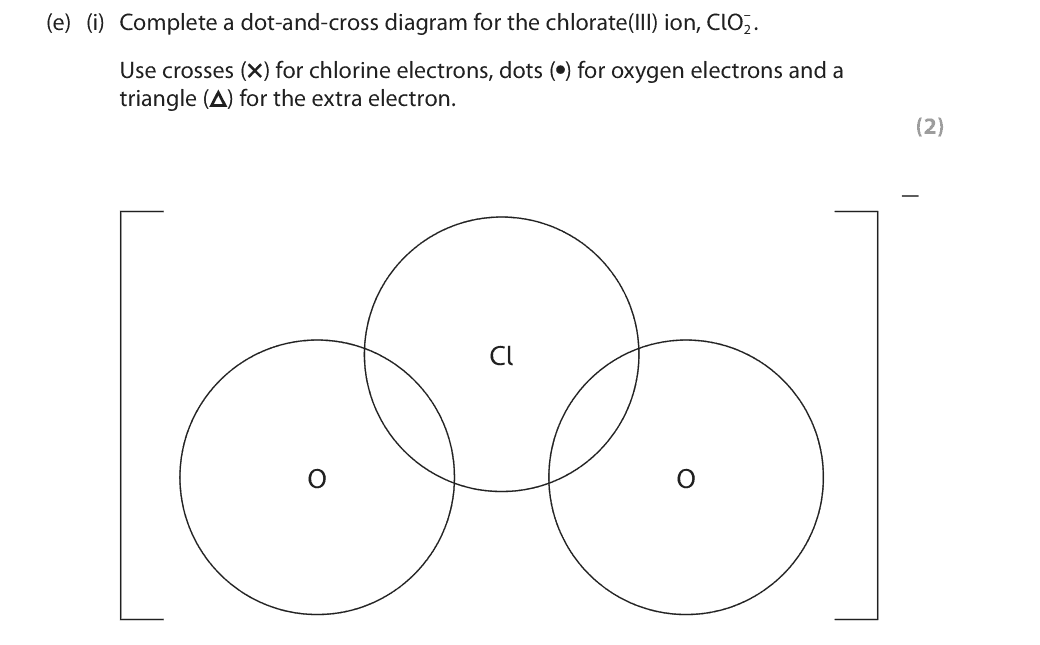
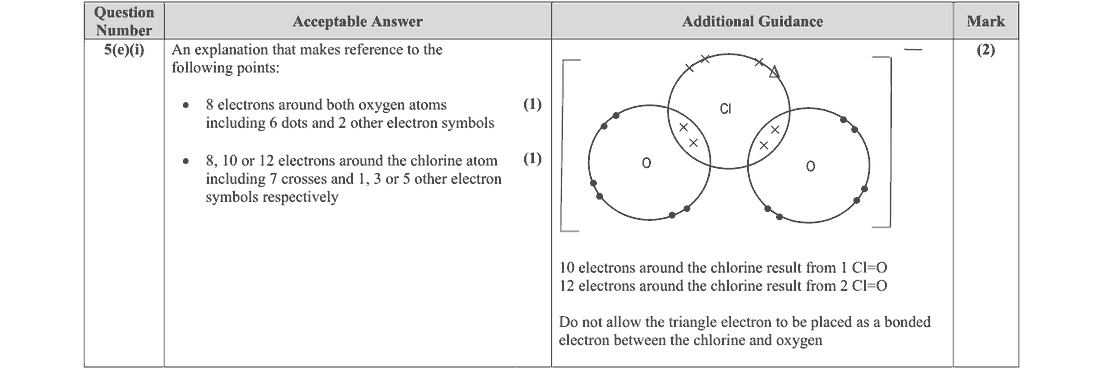
Complete a dot‑and‑cross diagram for the chlorate(III) ion, ClO2
– .
Use crosses (×) for chlorine electrons, dots (•) for oxygen electrons and a
triangle () for the extra electron.
Cl
O
O
June 2024 · AS Paper 1 · Q5(e)(ii) 3 marks Explanation bonding
Earlier parts of question 5 that this part usesEarlier part of June 2024 Paper 1 question 5Earlier part of June 2024 Paper 1 question 5
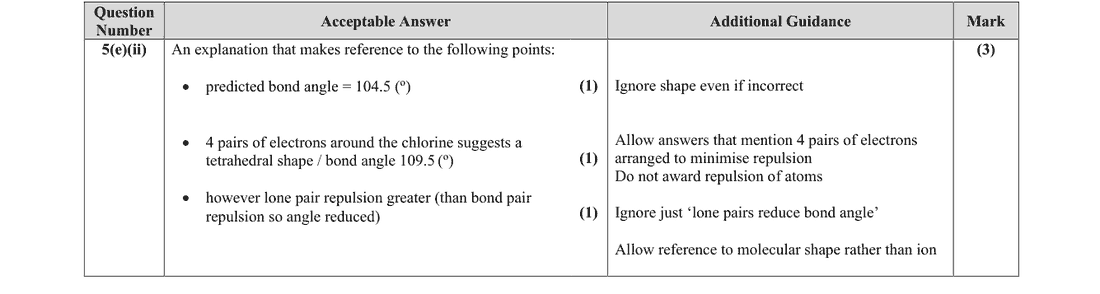
Predict the bond angle in this ion. Justify your answer.
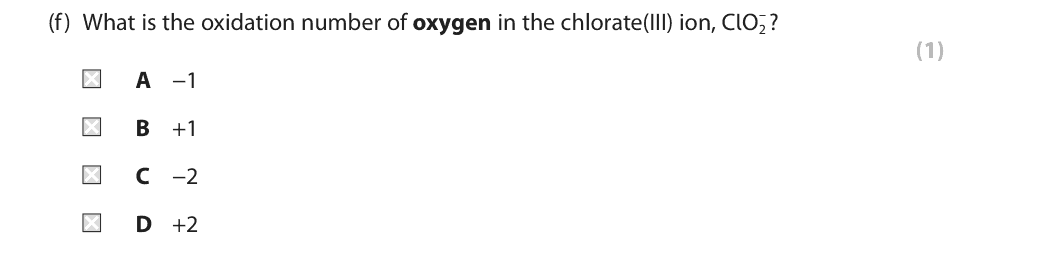
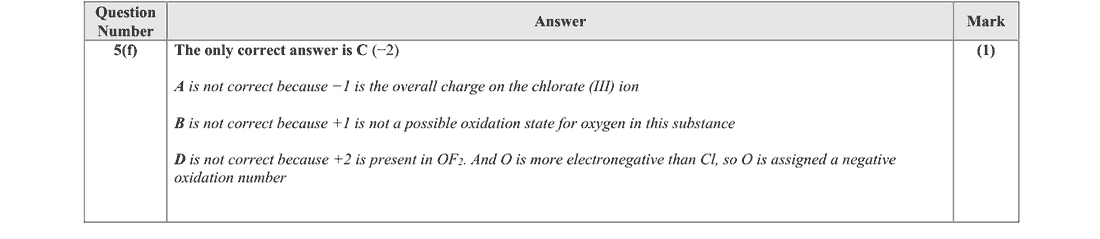
June 2024 · AS Paper 1 · Q5(f) 1 mark Multiple choice redox i
Earlier part of question 5 that this part usesEarlier part of June 2024 Paper 1 question 5
What is the oxidation number of oxygen in the chlorate(III) ion, ClO2
– ?
A  −1
B  +1
C  −2
D  +2
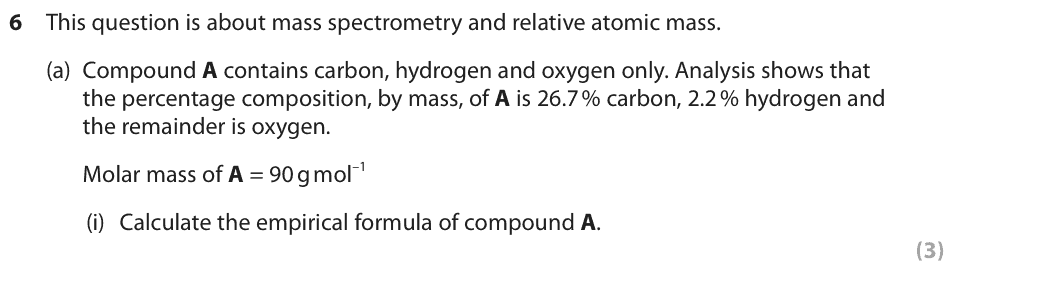
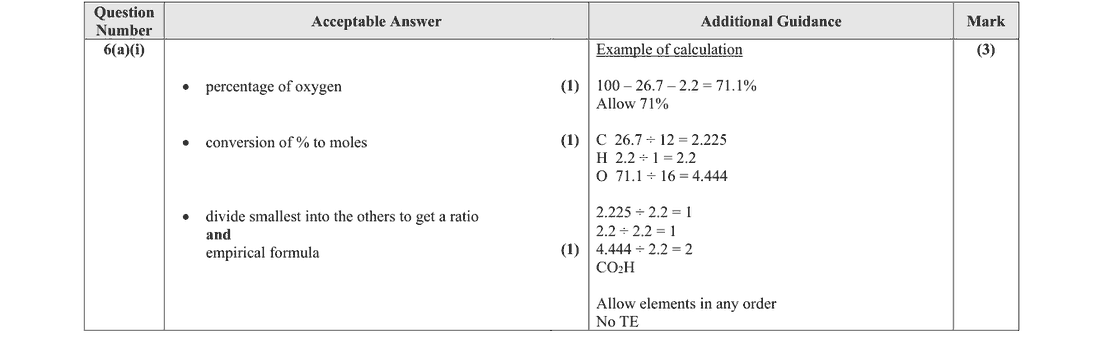
June 2024 · AS Paper 1 · Q6(a)(i) 3 marks Calculation formulae equations and amounts of substance
This question is about mass spectrometry and relative atomic mass.
Compound A contains carbon, hydrogen and oxygen only. Analysis shows that
the percentage composition, by mass, of A is 26.7 % carbon, 2.2 % hydrogen and
the remainder is oxygen.
Molar mass of A = 90 g mol–1
Calculate the empirical formula of compound A.
June 2024 · AS Paper 1 · Q6(a)(ii) 1 mark Calculation formulae equations and amounts of substance
Earlier part of question 6 that this part usesEarlier part of June 2024 Paper 1 question 6
Calculate the molecular formula of compound A.
June 2024 · AS Paper 1 · Q6(b) 2 marks Calculation Easy atomic structure and the periodic table
Earlier part of question 6 that this part usesEarlier part of June 2024 Paper 1 question 6
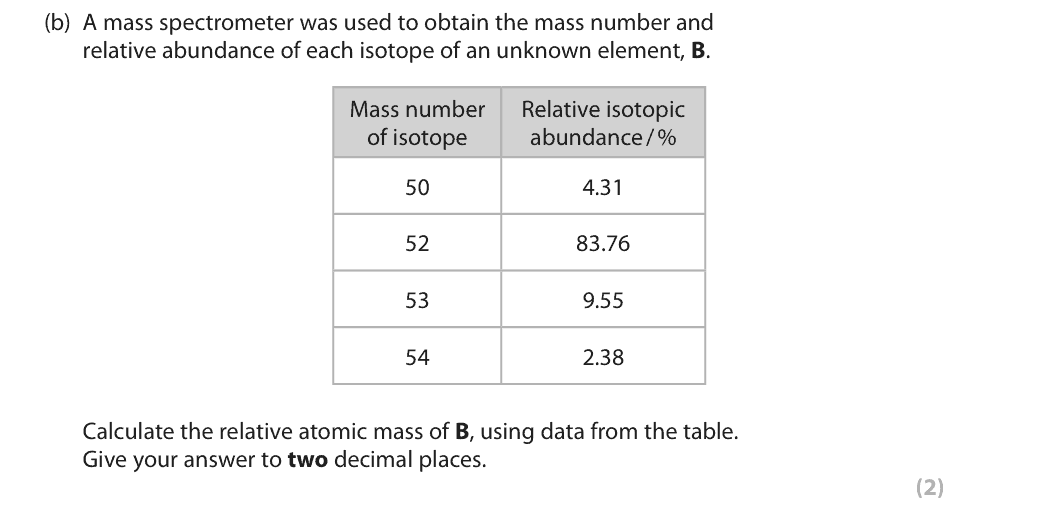
A mass spectrometer was used to obtain the mass number and
relative abundance of each isotope of an unknown element, B.
Mass number
Relative isotopic
of isotope
abundance / %
50
4.31
52
83.76
53
9.55
54
2.38
Calculate the relative atomic mass of B, using data from the table.
Give your answer to two decimal places.
June 2024 · AS Paper 1 · Q6(c) 1 mark Multiple choice atomic structure and the periodic table
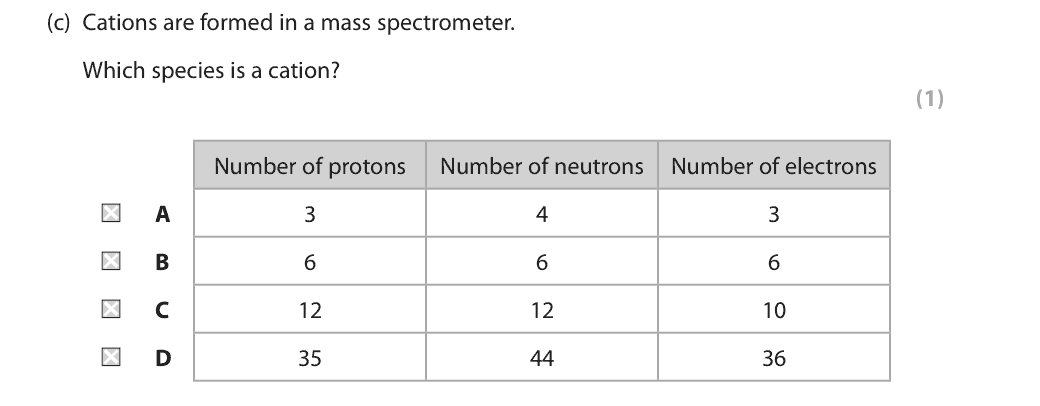
Cations are formed in a mass spectrometer.
Which species is a cation?
Number of protons
Number of neutrons
Number of electrons
A
3
4
3
B
6
6
6
C
12
12
10
D
35
44
36
June 2024 · AS Paper 1 · Q6(d) 1 mark Short answer atomic structure and the periodic table
Earlier part of question 6 that this part usesEarlier part of June 2024 Paper 1 question 6
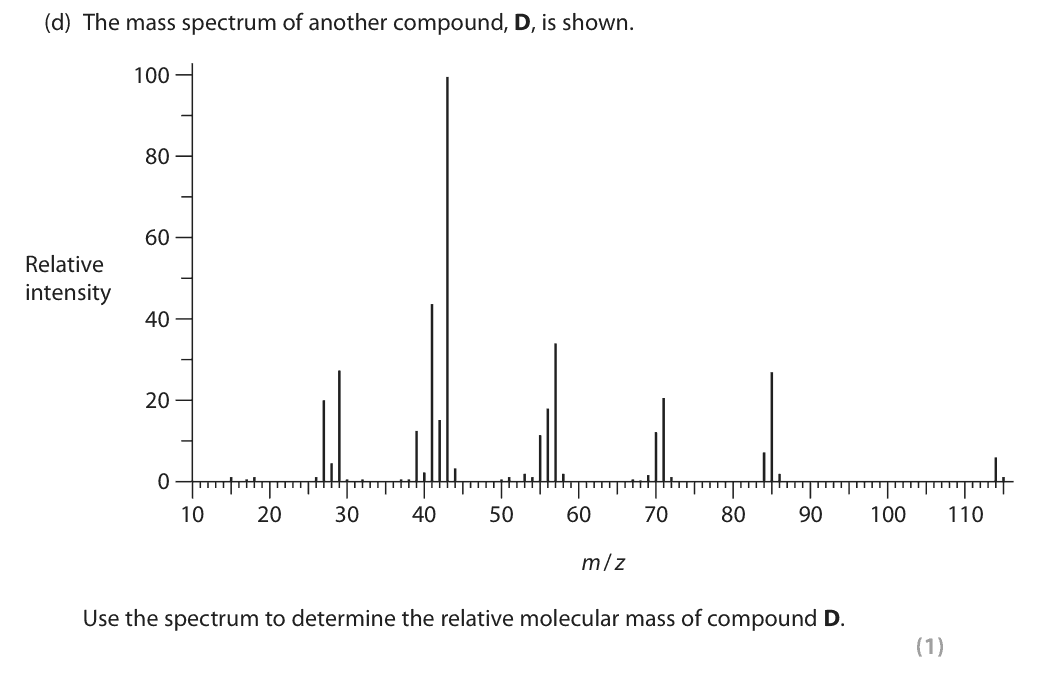
The mass spectrum of another compound, D, is shown.
100
80
60
Relative
intensity
40
20
0
10
20
30
40
50
60
70
80
90
100
110
m / z
Use the spectrum to determine the relative molecular mass of compound D.
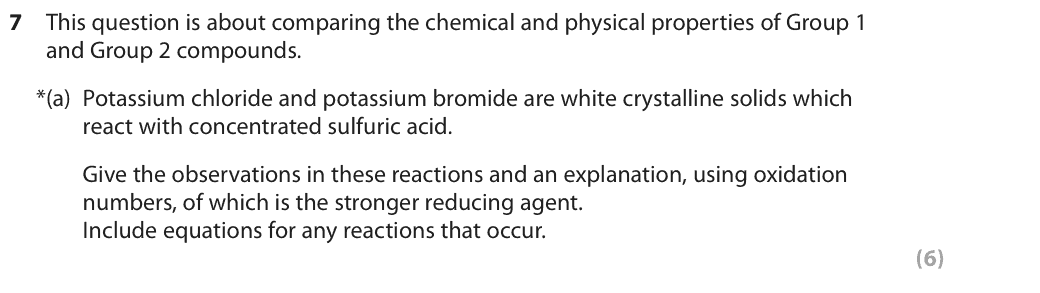
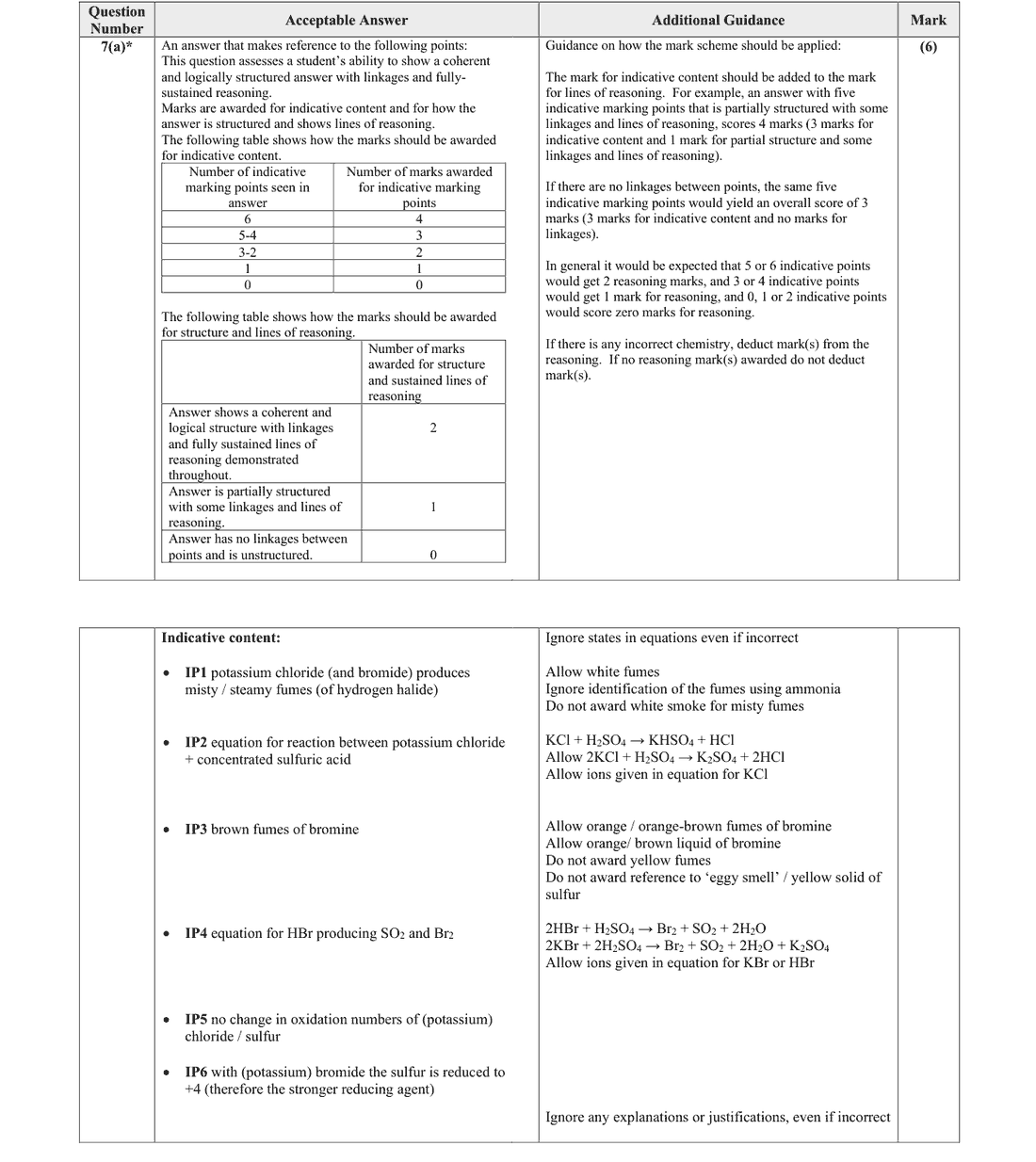
June 2024 · AS Paper 1 · Q7(a) 6 marks 6-mark extended response group 7 the halogensredox i
This question is about comparing the chemical and physical properties of Group 1
and Group 2 compounds.
Potassium chloride and potassium bromide are white crystalline solids which
react with concentrated sulfuric acid.
Give the observations in these reactions and an explanation, using oxidation
numbers, of which is the stronger reducing agent.
Include equations for any reactions that occur.
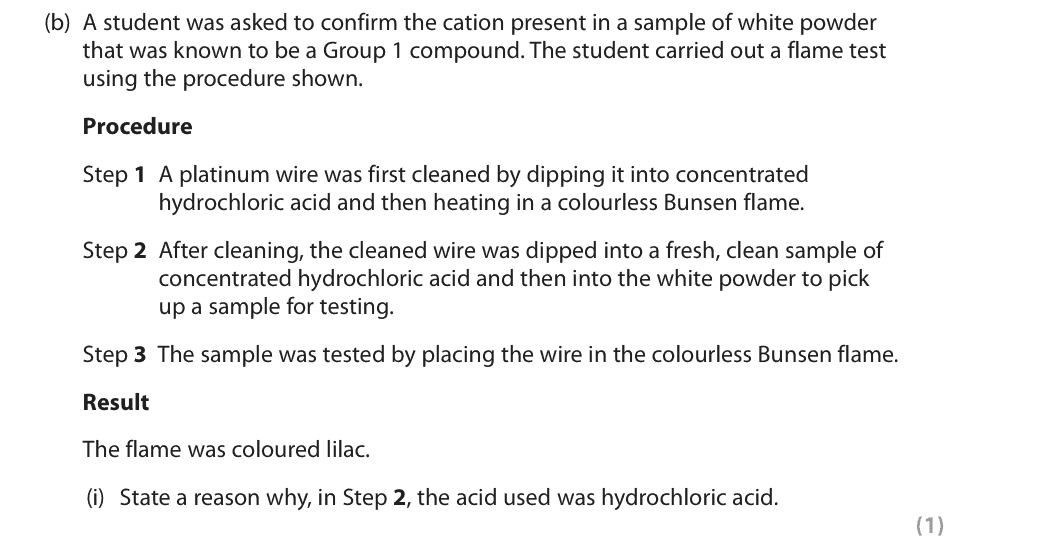
June 2024 · AS Paper 1 · Q7(b)(i) 1 mark Practical and data analysis Hard groups 1 and 2
Earlier part of question 7 that this part usesEarlier part of June 2024 Paper 1 question 7
A student was asked to confirm the cation present in a sample of white powder
that was known to be a Group 1 compound. The student carried out a flame test
using the procedure shown.
Procedure
Step 1  A platinum wire was first cleaned by dipping it into concentrated
hydrochloric acid and then heating in a colourless Bunsen flame.
Step 2  After cleaning, the cleaned wire was dipped into a fresh, clean sample of
concentrated hydrochloric acid and then into the white powder to pick
up a sample for testing.
Step 3  The sample was tested by placing the wire in the colourless Bunsen flame.
Result
The flame was coloured lilac.
State a reason why, in Step 2, the acid used was hydrochloric acid.
June 2024 · AS Paper 1 · Q7(b)(ii) 1 mark Practical and data analysis Easy groups 1 and 2
Earlier parts of question 7 that this part usesEarlier part of June 2024 Paper 1 question 7Earlier part of June 2024 Paper 1 question 7
Identify the cation present in this sample of white powder.
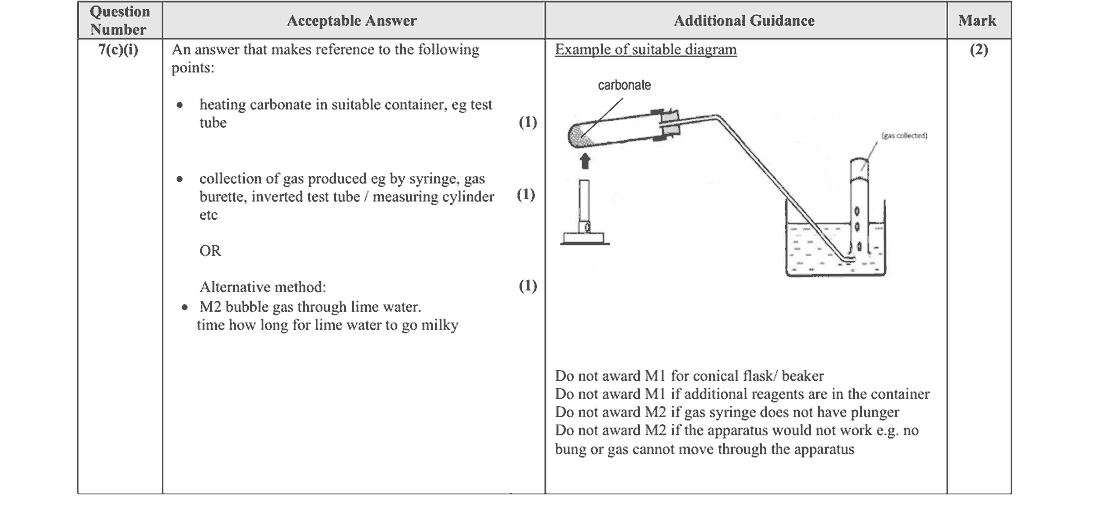
June 2024 · AS Paper 1 · Q7(c)(i) 2 marks Diagram or structure Hard groups 1 and 2
Earlier part of question 7 that this part usesEarlier part of June 2024 Paper 1 question 7
The thermal stability of compounds in Group 2 is investigated.
Draw a labelled diagram of apparatus that would enable you to compare the
thermal stability of Group 2 carbonates.
June 2024 · AS Paper 1 · Q7(c)(ii) 2 marks Practical and data analysis Hard groups 1 and 2
Earlier parts of question 7 that this part usesEarlier part of June 2024 Paper 1 question 7Earlier part of June 2024 Paper 1 question 7
State the conditions that must be used with the apparatus shown in your
diagram to ensure that the test is fair.
June 2024 · AS Paper 1 · Q7(c)(iii) 1 mark Practical and data analysis groups 1 and 2
Earlier parts of question 7 that this part usesEarlier part of June 2024 Paper 1 question 7Earlier part of June 2024 Paper 1 question 7Earlier part of June 2024 Paper 1 question 7
State what data could be obtained in this experiment to compare
thermal stability.
June 2024 · AS Paper 1 · Q7(c)(iv) 1 mark Multiple choice groups 1 and 2
Earlier parts of question 7 that this part usesEarlier part of June 2024 Paper 1 question 7Earlier part of June 2024 Paper 1 question 7
Which pair of responses show the trend in thermal stability of compounds
down Group 2 ?
Carbonates
Nitrates
A
increasing
decreasing
B
decreasing
decreasing
C
increasing
increasing
D
decreasing
increasing
June 2024 · AS Paper 1 · Q7(d) 4 marks Explanation structure
Earlier part of question 7 that this part usesEarlier part of June 2024 Paper 1 question 7
The table shows the electrical conductivity of some pure substances in the solid
and liquid states.
Electrical conductivity
Substance
Solid state
Liquid state
potassium chloride
poor
good
iron
good
good
water
poor
poor
Explain the electrical conductivity of potassium chloride, iron and water in the
solid and liquid states.
June 2024 · AS Paper 1 · Q8(a)(i) 4 marks Diagram or structure Hard bonding
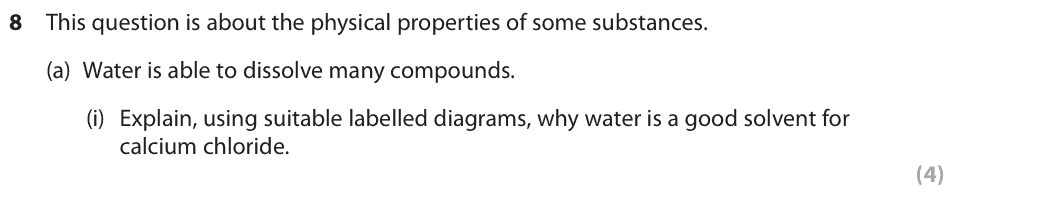
This question is about the physical properties of some substances.
Water is able to dissolve many compounds.
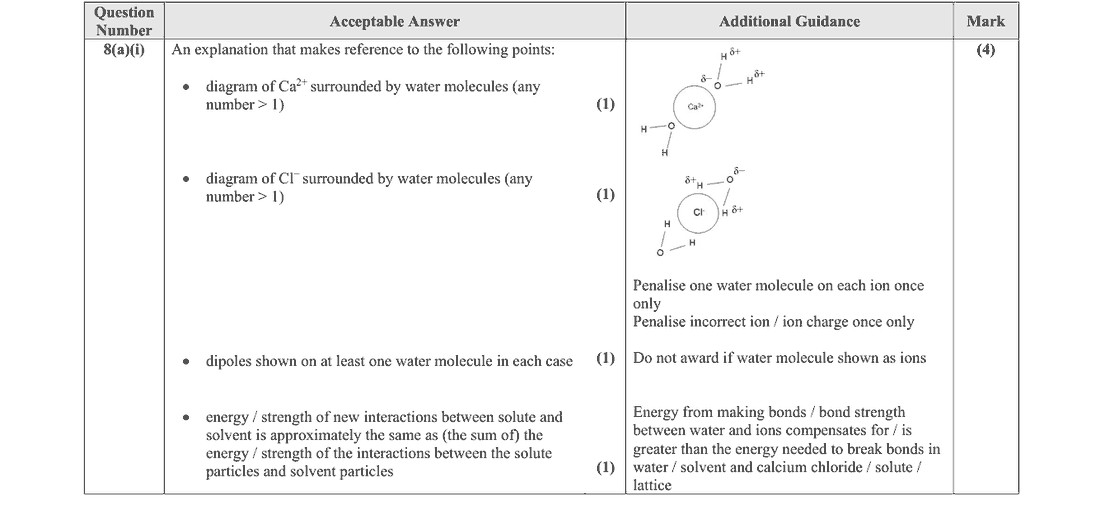
Explain, using suitable labelled diagrams, why water is a good solvent for
calcium chloride.
June 2024 · AS Paper 1 · Q8(a)(ii) 3 marks Diagram or structure bonding
Earlier part of question 8 that this part usesEarlier part of June 2024 Paper 1 question 8
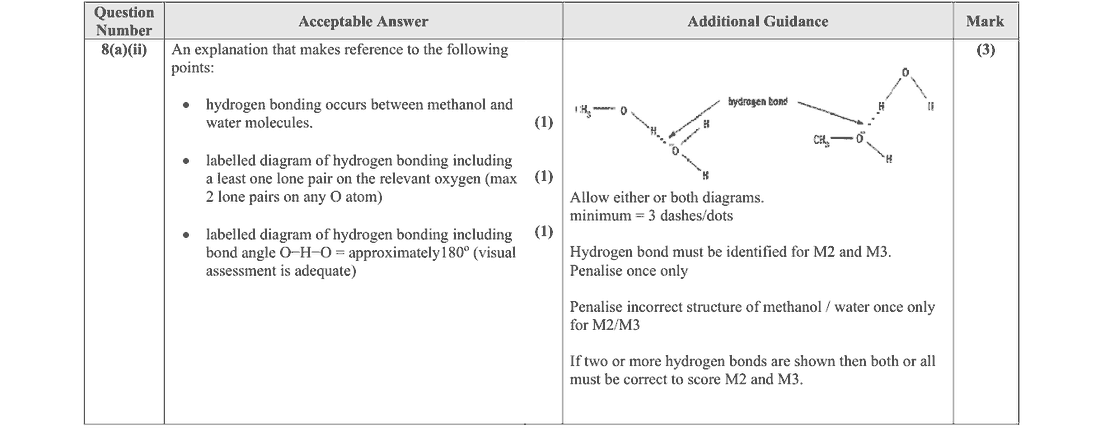
Explain why methanol dissolves in water.
Include a suitable labelled diagram.
June 2024 · AS Paper 1 · Q8(b)(i) 3 marks Explanation bonding
Earlier part of question 8 that this part usesEarlier part of June 2024 Paper 1 question 8
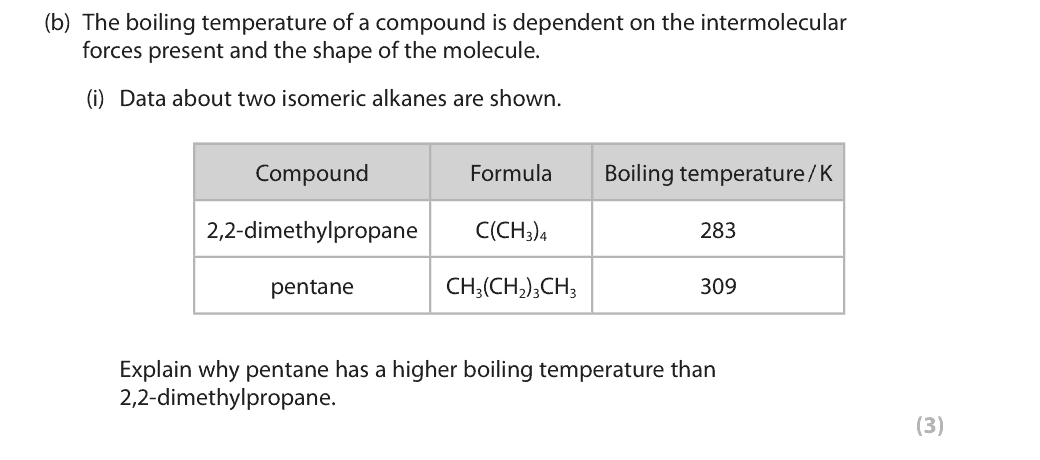
The boiling temperature of a compound is dependent on the intermolecular
forces present and the shape of the molecule.
Data about two isomeric alkanes are shown.
Compound
Formula
Boiling temperature / K
2,2‑dimethylpropane
C(CH3)4
283
pentane
CH3(CH2)3CH3
309
Explain why pentane has a higher boiling temperature than
2,2‑dimethylpropane.
June 2024 · AS Paper 1 · Q8(b)(ii) 4 marks Explanation structure
Earlier parts of question 8 that this part usesEarlier part of June 2024 Paper 1 question 8Earlier part of June 2024 Paper 1 question 8
Data about two silicon compounds are shown.
Name of compound
Formula
Boiling temperature / K
silicon(IV) oxide
SiO2
2503
silicon tetrachloride
SiCl4
331
Explain why these two covalently bonded substances have very different
boiling temperatures.
June 2024 · AS Paper 1 · Q9(a) 1 mark Equation writing redox i
This question is about some redox reactions.
Iodine is reduced by thiosulfate ions. The relevant half‑equations are shown.
½I2   +   e–   →   I–
2S2O3
2–   →   S4O6
2–   +   2e–
Deduce an overall equation for this reaction.
State symbols are not required.
June 2024 · AS Paper 1 · Q9(b)(i) 1 mark Short answer Hard redox i
Earlier part of question 9 that this part usesEarlier part of June 2024 Paper 1 question 9
In a different redox reaction, the chlorate(I) ion, ClO– , can react with
the chloride ion as shown in this equation.
ClO–   +   Cl–   +   2H+   →   Cl2   +   H2O
State a reason why this is not a disproportionation reaction.
June 2024 · AS Paper 1 · Q9(b)(ii) 1 mark Short answer redox i
Earlier parts of question 9 that this part usesEarlier part of June 2024 Paper 1 question 9Earlier part of June 2024 Paper 1 question 9
Identify the reducing agent in this reaction.
June 2024 · AS Paper 1 · Q9(b)(iii) 1 mark Multiple choice redox i
Earlier parts of question 9 that this part usesEarlier part of June 2024 Paper 1 question 9Earlier part of June 2024 Paper 1 question 9
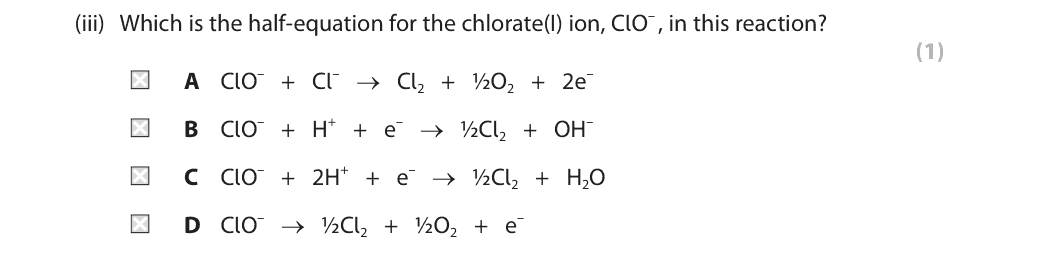
Which is the half‑equation for the chlorate(I) ion, ClO– , in this reaction?
A  ClO–   +   Cl–   →   Cl2   +   ½O2   +   2e–
B  ClO–   +   H+   +   e–   →   ½Cl2   +   OH–
C  ClO–   +   2H+   +   e–   →   ½Cl2   +   H2O
D  ClO–   →   ½Cl2   +   ½O2   +   e–
June 2024 · AS Paper 1 · Q9(c) 5 marks Calculation formulae equations and amounts of substance
Earlier part of question 9 that this part usesEarlier part of June 2024 Paper 1 question 9
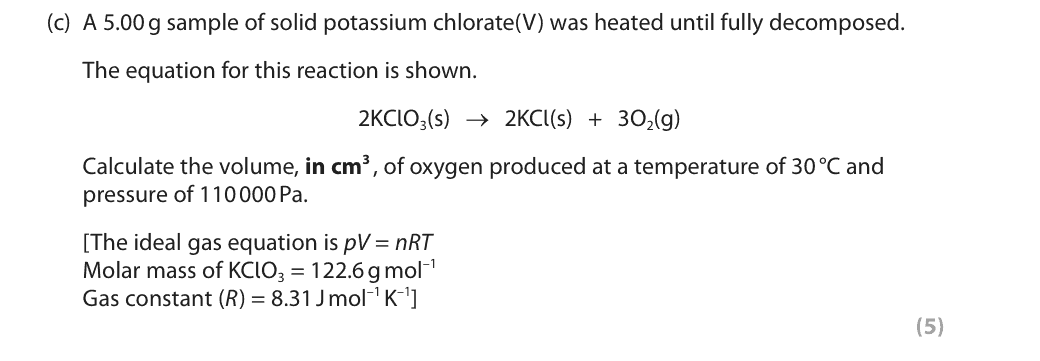
A 5.00 g sample of solid potassium chlorate(V) was heated until fully decomposed.
The equation for this reaction is shown.
2KClO3(s)   →   2KCl(s)   +   3O2(g)
Calculate the volume, in cm3 , of oxygen produced at a temperature of 30 °C and
pressure of 110 000 Pa.
[The ideal gas equation is pV = nRT
Molar mass of KClO3 = 122.6 g mol–1
Gas constant (R) = 8.31 J mol–1 K–1]

Work with an A-level chemistry tutor

Want a paper marked and gone through with you? Message us.

Prefer email? Send an enquiry

If you are under 18, please include a parent's contact details. Enquiries go to enquiries@chemistryaleveltutor.com and are deleted once handled. All tutoring is online.