June 2023: AS Paper 1, Core Inorganic and Physical Chemistry

80 marks · 41 question parts · Paper, mark scheme and report on Edexcel's site · Have the Data Booklet beside you

Question by question

QTopicMarksAOType
1(a) Atomic structure and the Periodic Table 1Multiple choice
1(b)(i) Atomic structure and the Periodic Table 1Short answer
1(b)(ii) Atomic structure and the Periodic Table 1Short answer
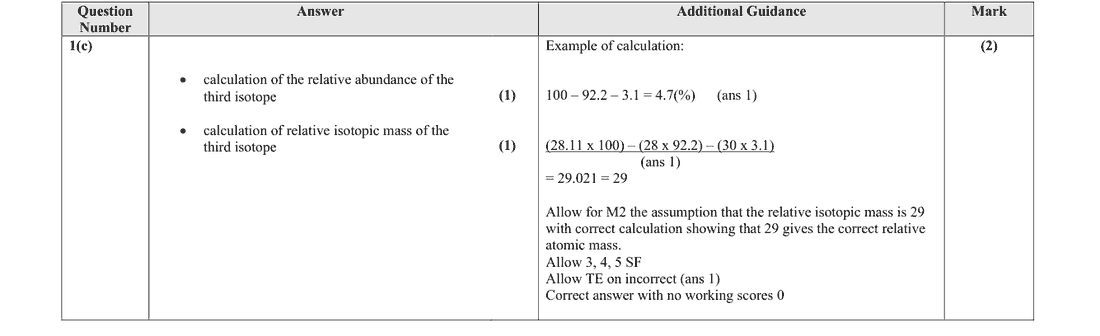
1(c) Atomic structure and the Periodic Table 2Calculation
1(d) Atomic structure and the Periodic Table 1Short answer
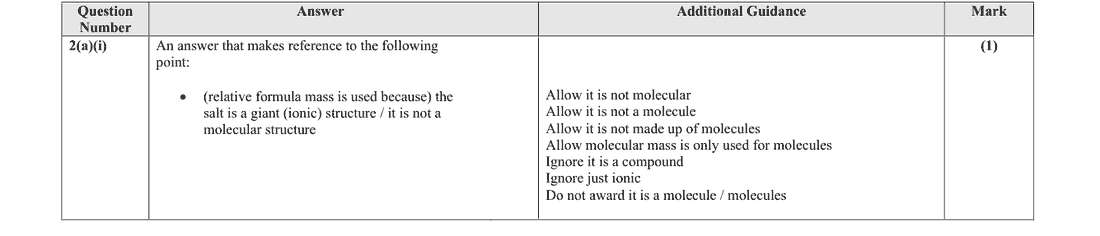
2(a)(i) Atomic structure and the Periodic Table 1Short answer
2(a)(ii) Atomic structure and the Periodic Table 1Short answer
2(a)(iii) Atomic structure and the Periodic Table 1Multiple choice
2(a)(iv) Formulae, equations and amounts of substance 1Calculation
2(b) The elements of Groups 1 and 2 4Practical and data analysis
2(c)(i) Analysis of inorganic compounds 1Multiple choice
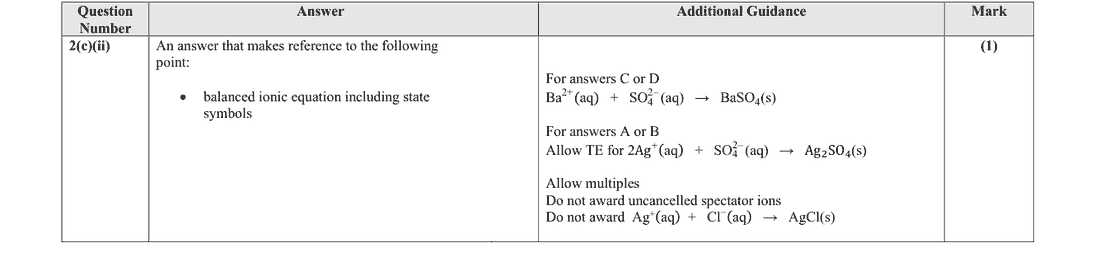
2(c)(ii) Analysis of inorganic compounds, Formulae, equations and amounts of substance 1Equation writing
3(a)(i) Redox I 1Multiple choice
3(a)(ii) The elements of Group 7 (halogens), Atomic structure and the Periodic Table 1Multiple choice
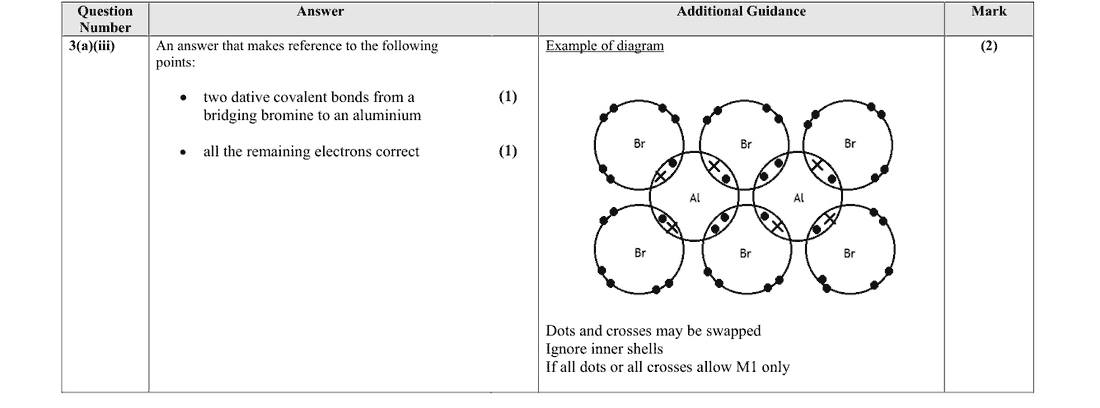
3(a)(iii) Bonding 2Diagram or structure
3(a)(iv) Redox I 1Short answer
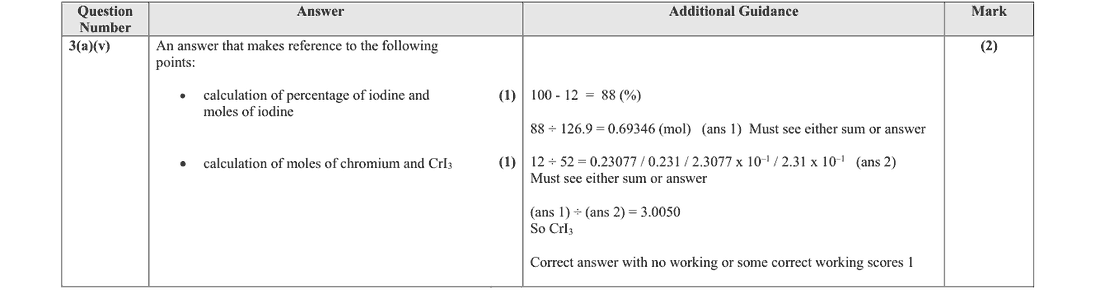
3(a)(v) Formulae, equations and amounts of substance 2Calculation
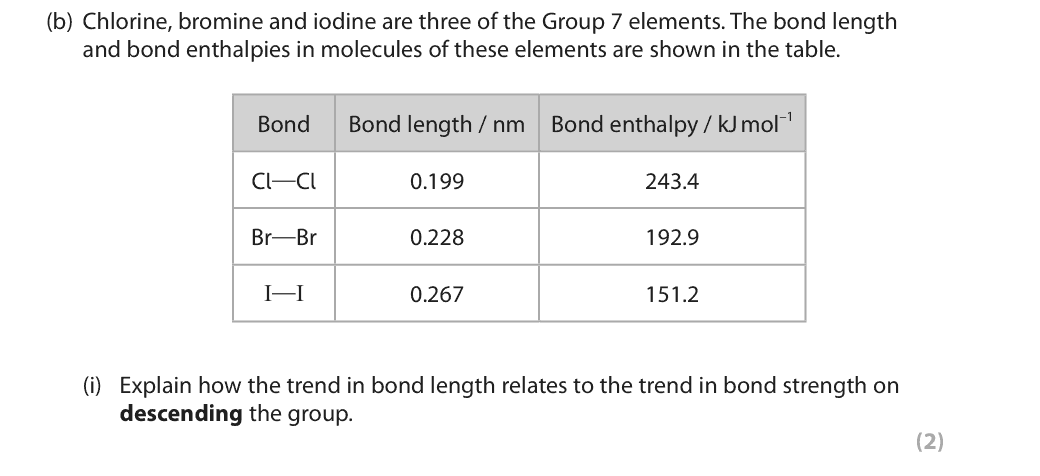
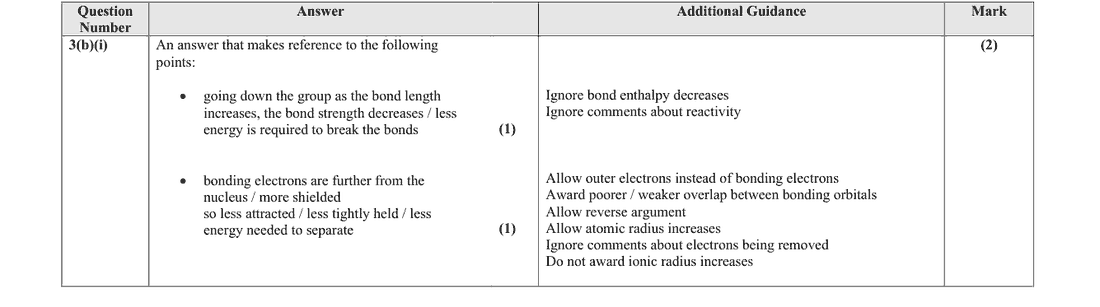
3(b)(i) Bonding 2Explanation
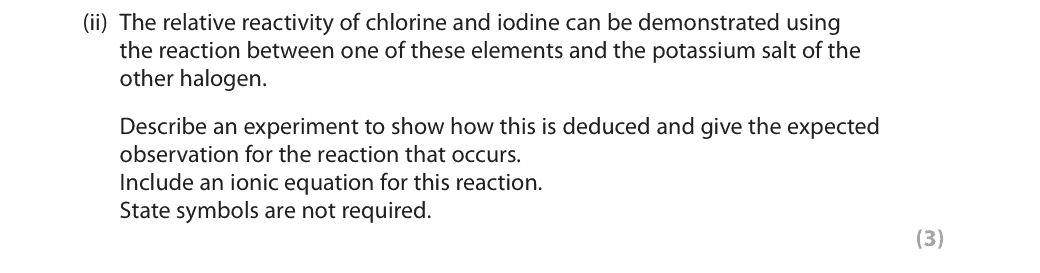
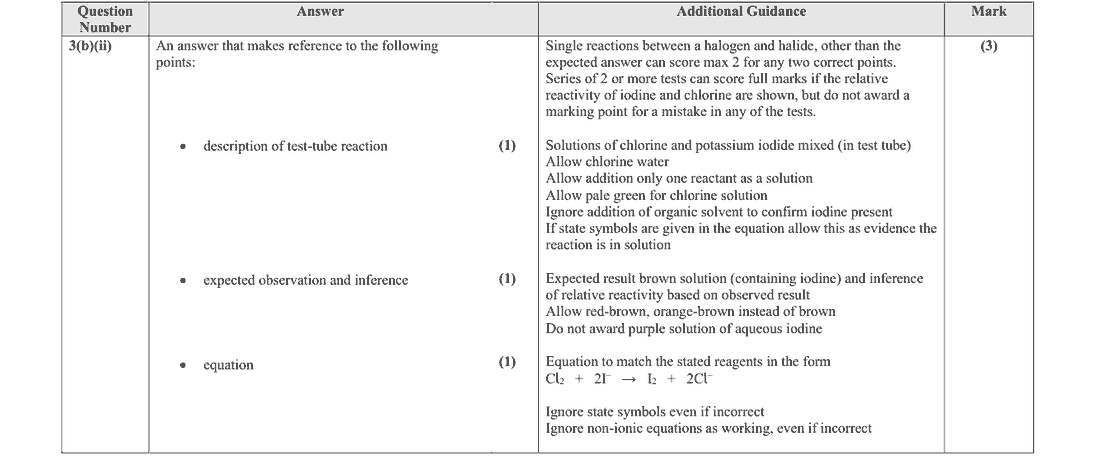
3(b)(ii) The elements of Group 7 (halogens) 3Practical and data analysis
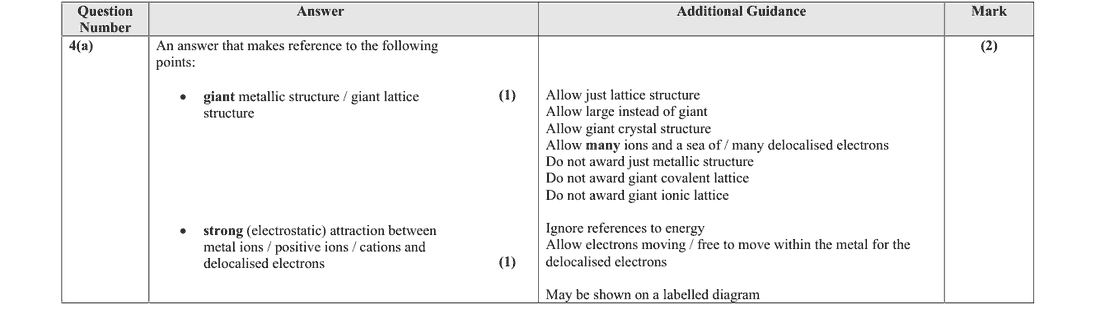
4(a) Bonding, Structure 2Explanation
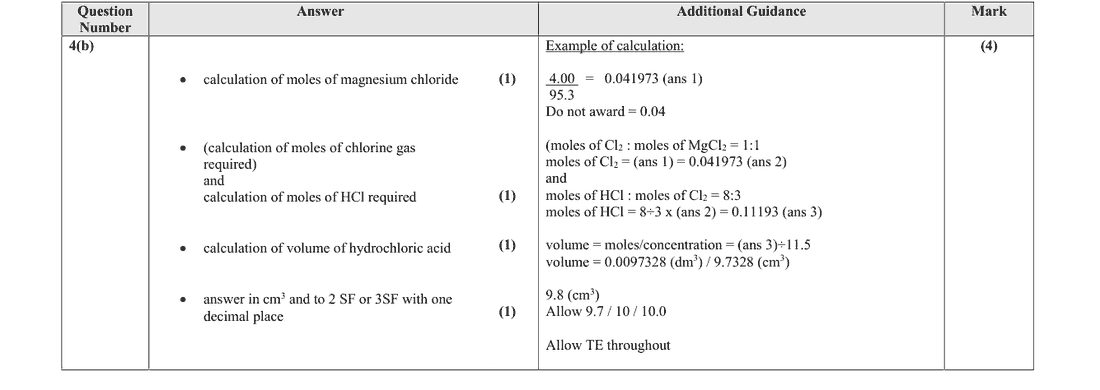
4(b) Formulae, equations and amounts of substance 4Calculation
4(c) Formulae, equations and amounts of substance 1Multiple choice
5(a) Bonding 1Short answer
5(b) The elements of Group 7 (halogens) 3Explanation
5(c) Bonding 2Short answer
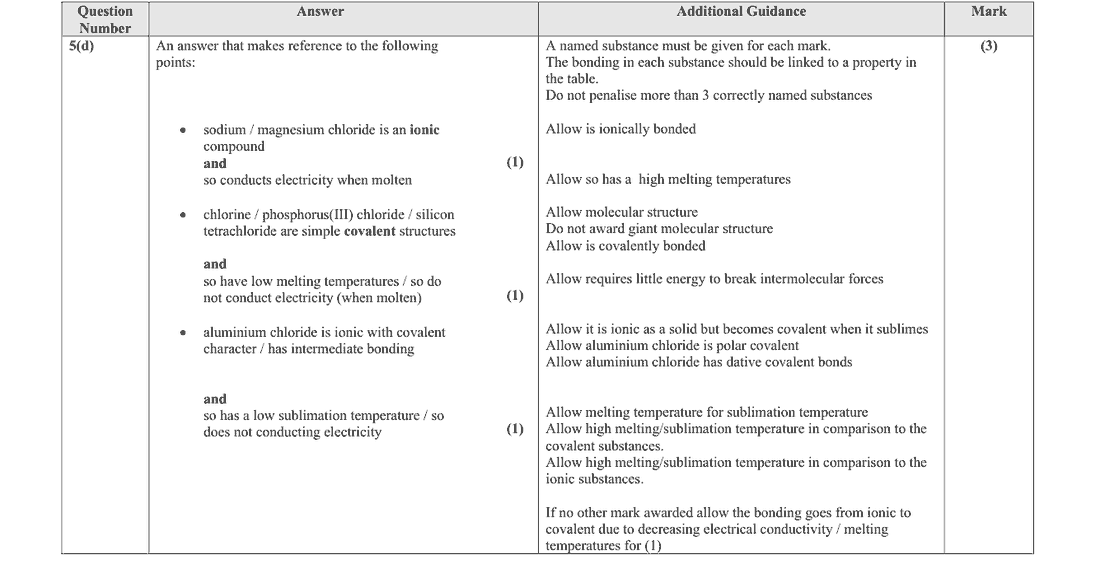
5(d) Structure, Bonding 3Explanation
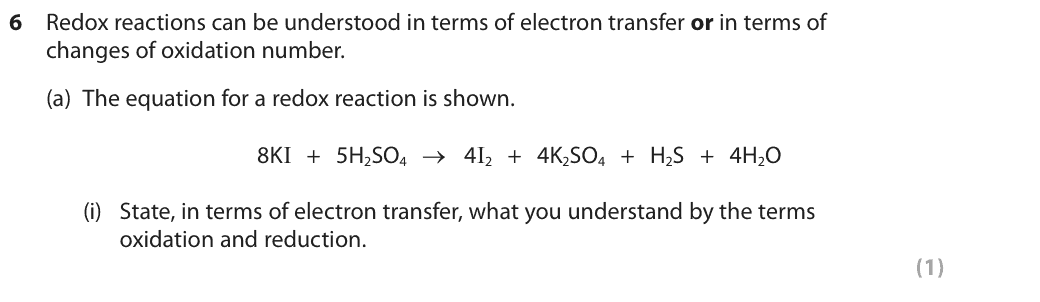
6(a)(i) Redox I 1Short answer
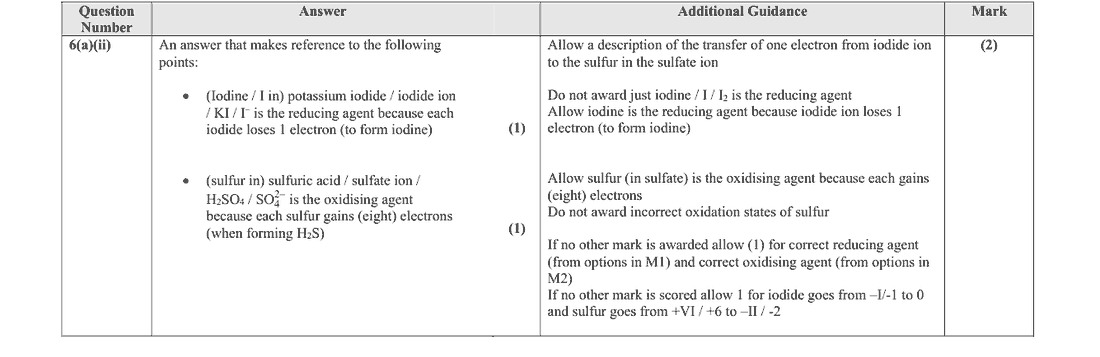
6(a)(ii) Redox I 2Explanation
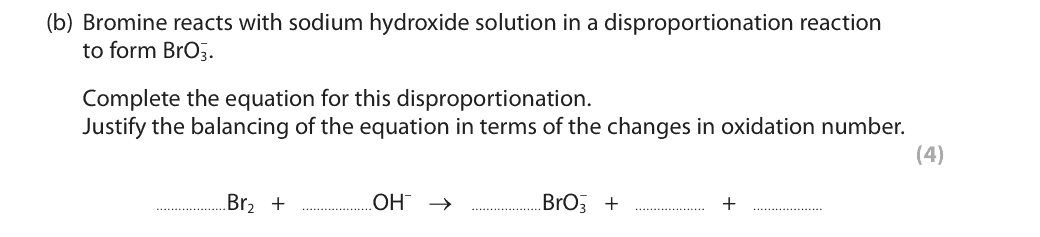
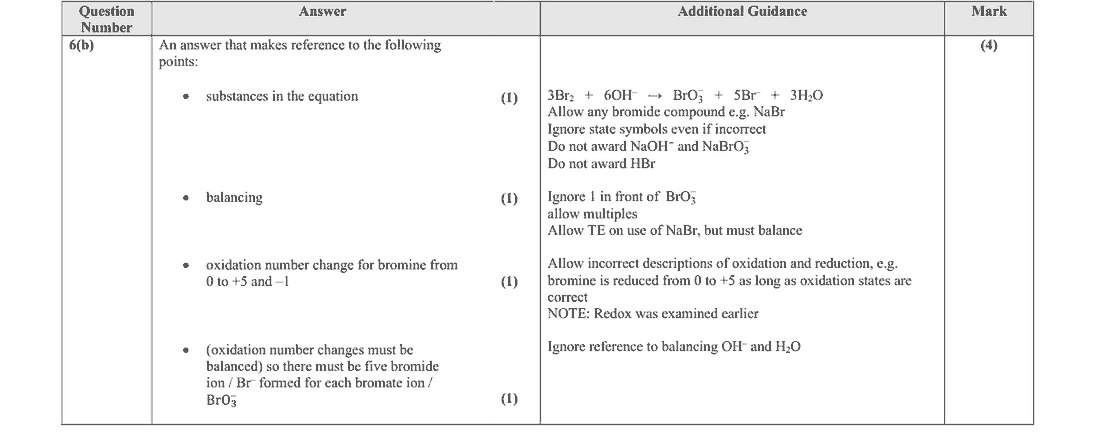
6(b) The elements of Group 7 (halogens), Redox I 4Equation writing
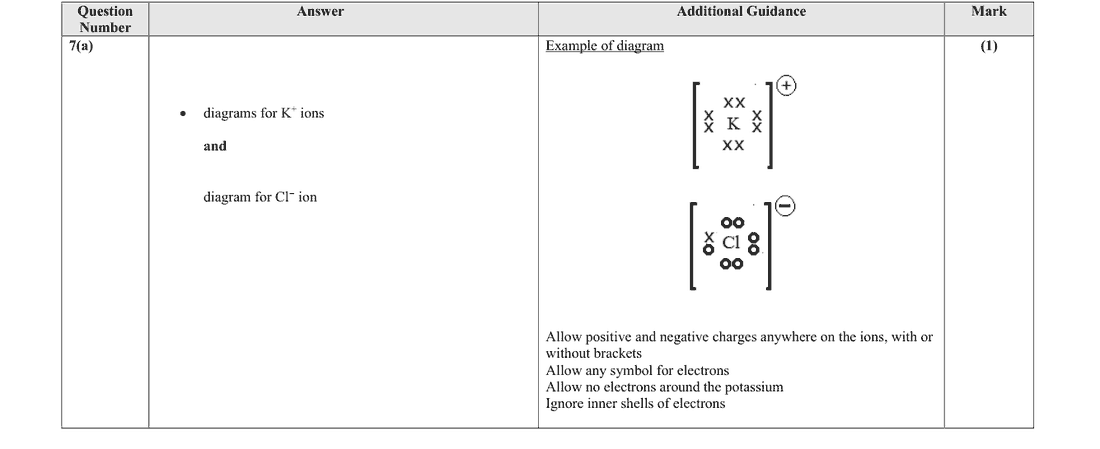
7(a) Bonding 1Diagram or structure
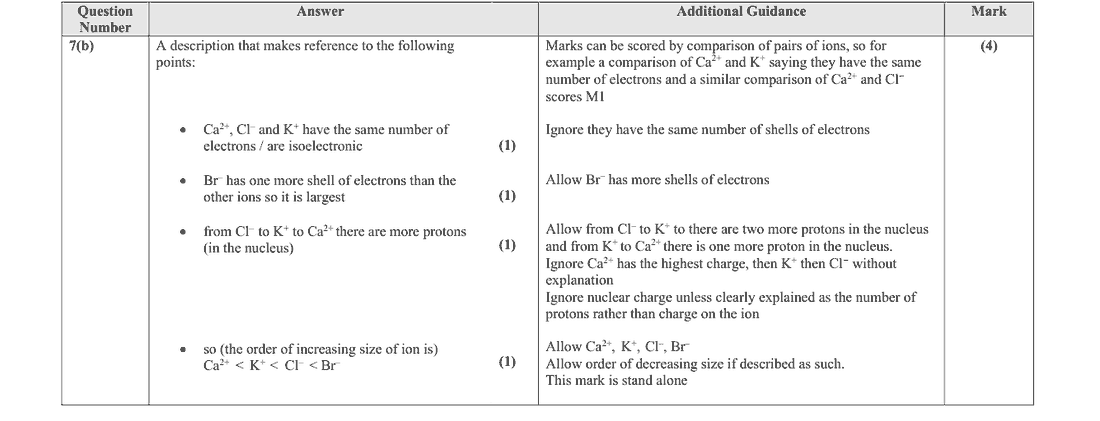
7(b) Bonding 4Explanation
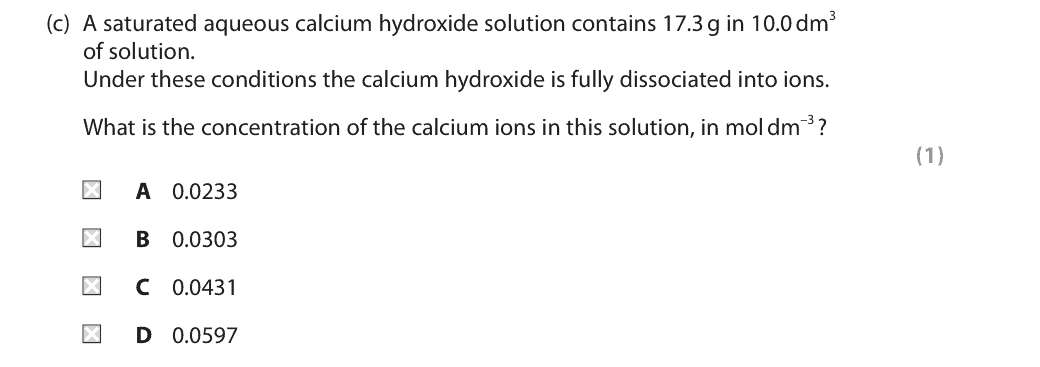
7(c) Formulae, equations and amounts of substance 1Multiple choice
8(a)(i) Formulae, equations and amounts of substance, Kinetics I 2Practical and data analysis
8(a)(ii) Formulae, equations and amounts of substance 2Practical and data analysis
8(b) Formulae, equations and amounts of substance 2Practical and data analysis
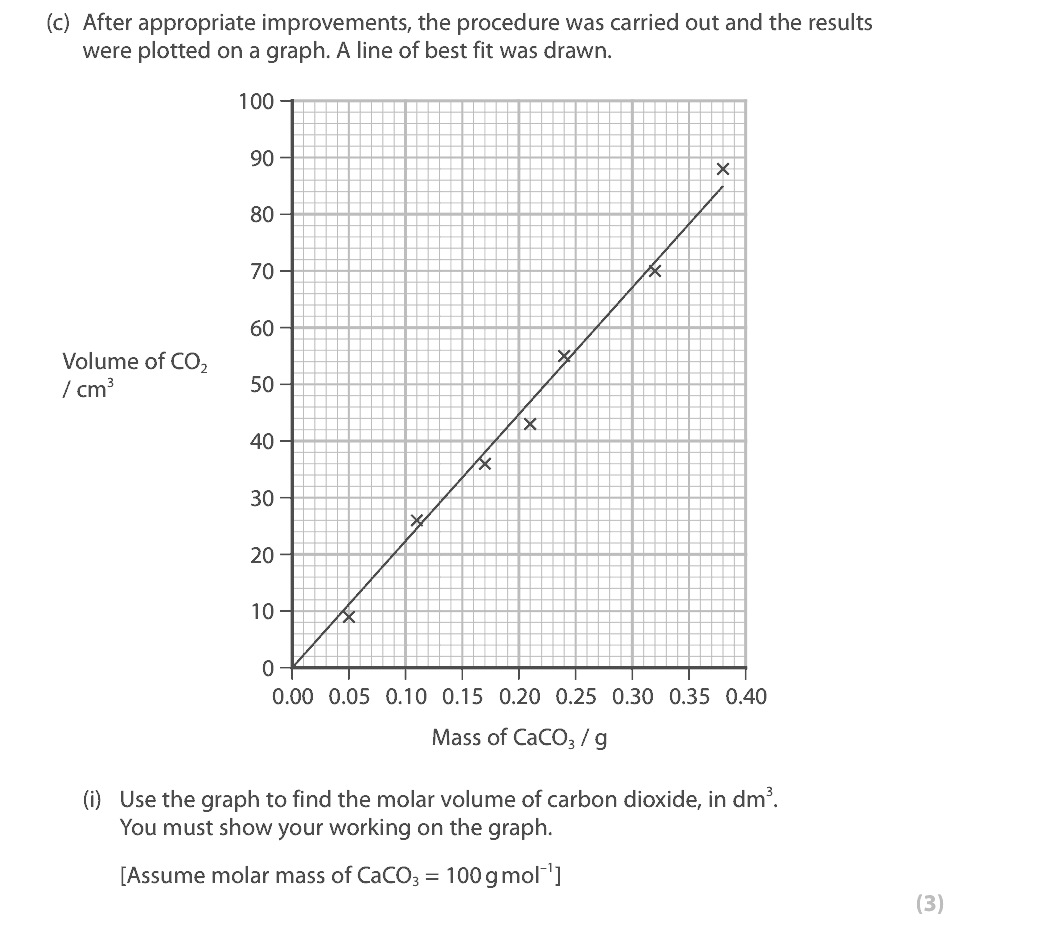
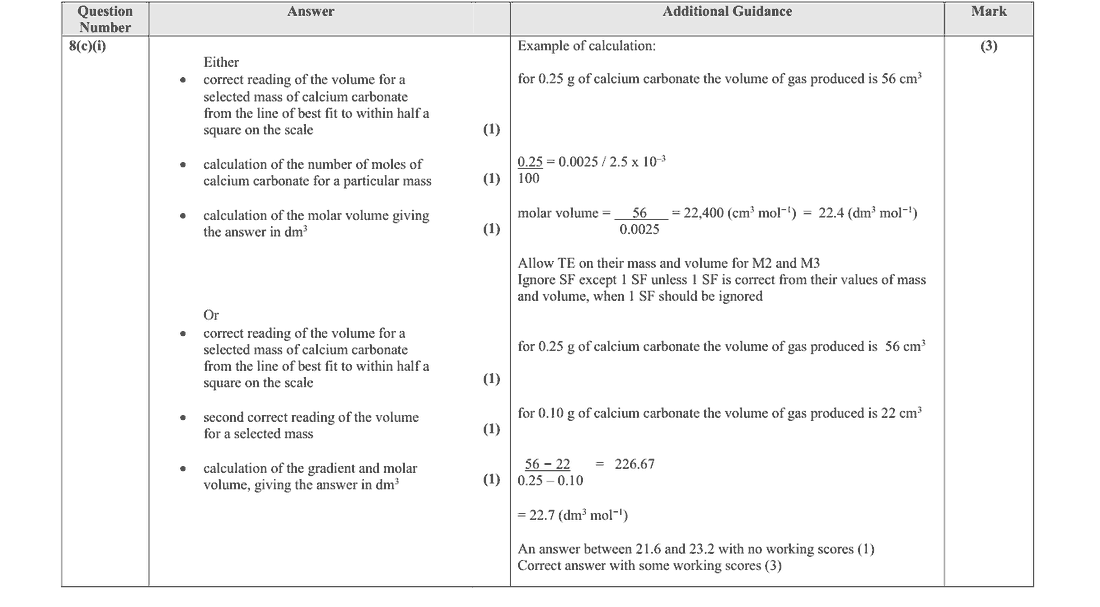
8(c)(i) Formulae, equations and amounts of substance 3Calculation
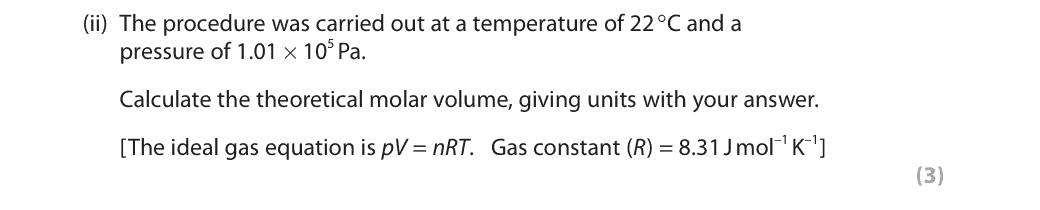
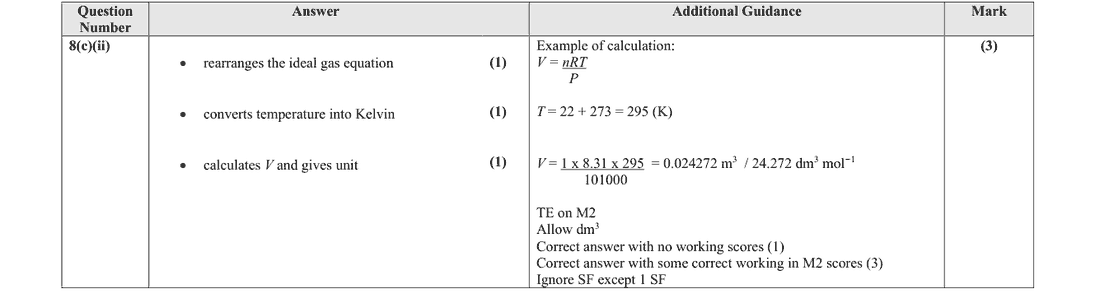
8(c)(ii) Formulae, equations and amounts of substance 3Calculation
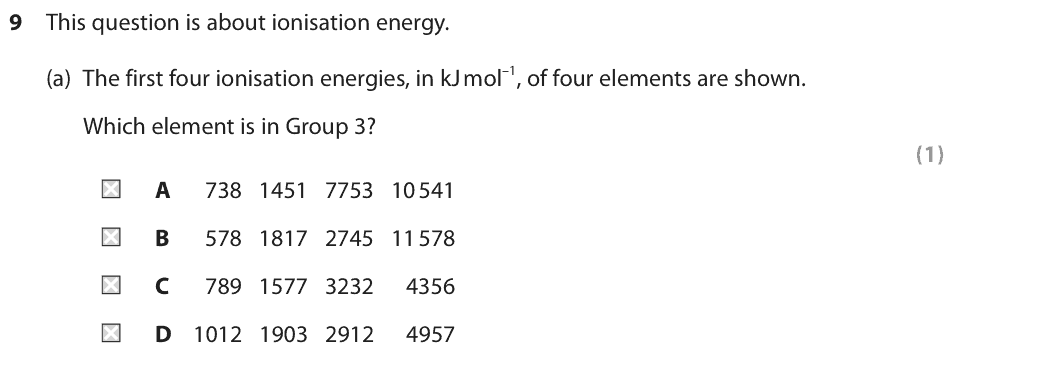
9(a) Atomic structure and the Periodic Table 1Multiple choice
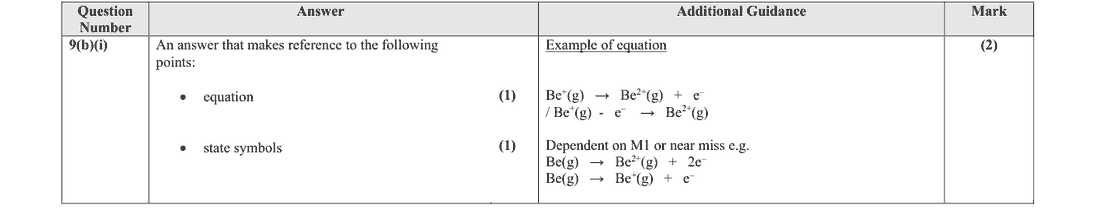
9(b)(i) Atomic structure and the Periodic Table 2Equation writing
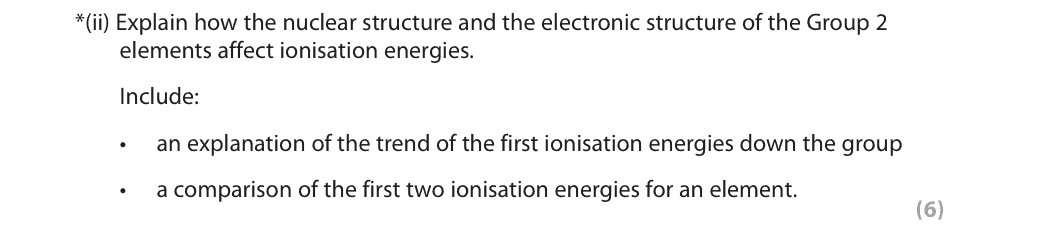
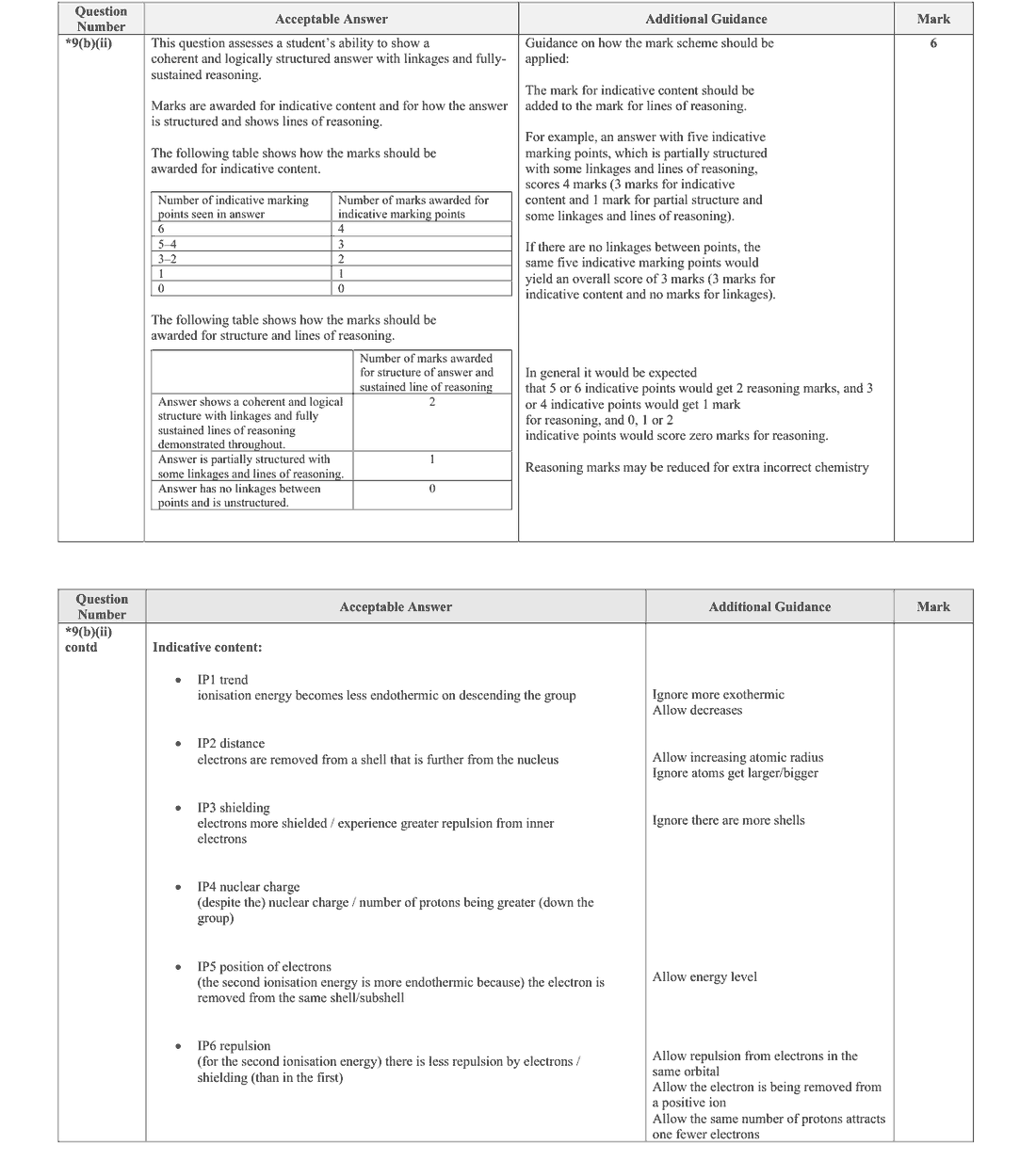
9(b)(ii) The elements of Groups 1 and 2, Atomic structure and the Periodic Table 6Extended response
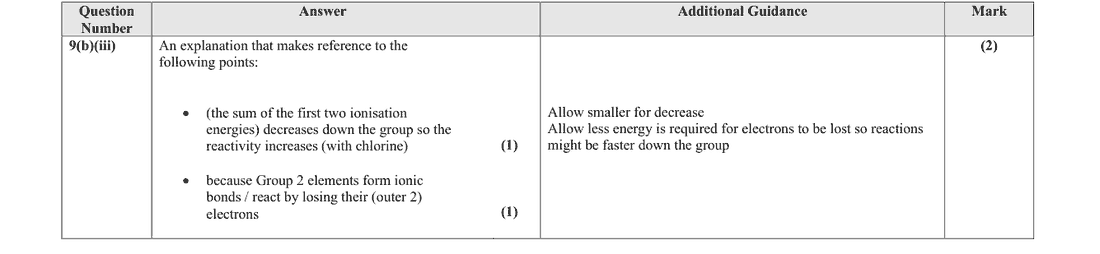
9(b)(iii) The elements of Groups 1 and 2 2Explanation

The questions

1(a)1(b)(i)1(b)(ii)1(c)1(d)2(a)(i)2(a)(ii)2(a)(iii)2(a)(iv)2(b)2(c)(i)2(c)(ii)3(a)(i)3(a)(ii)3(a)(iii)3(a)(iv)3(a)(v)3(b)(i)3(b)(ii)4(a)4(b)4(c)5(a)5(b)5(c)5(d)6(a)(i)6(a)(ii)6(b)7(a)7(b)7(c)8(a)(i)8(a)(ii)8(b)8(c)(i)8(c)(ii)9(a)9(b)(i)9(b)(ii)9(b)(iii)
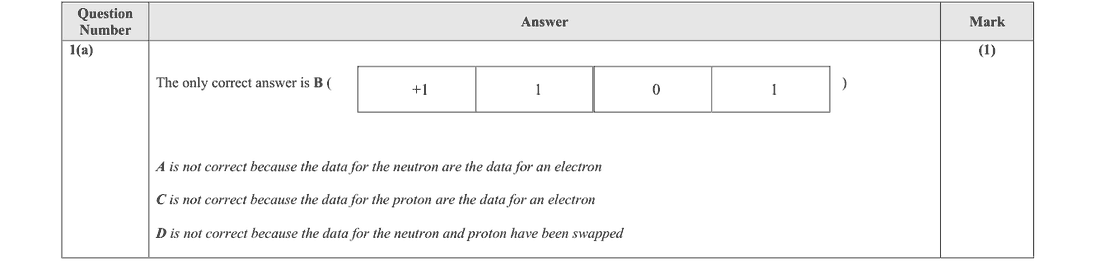
June 2023 · AS Paper 1 · Q1(a) 1 mark Multiple choice atomic structure and the periodic table
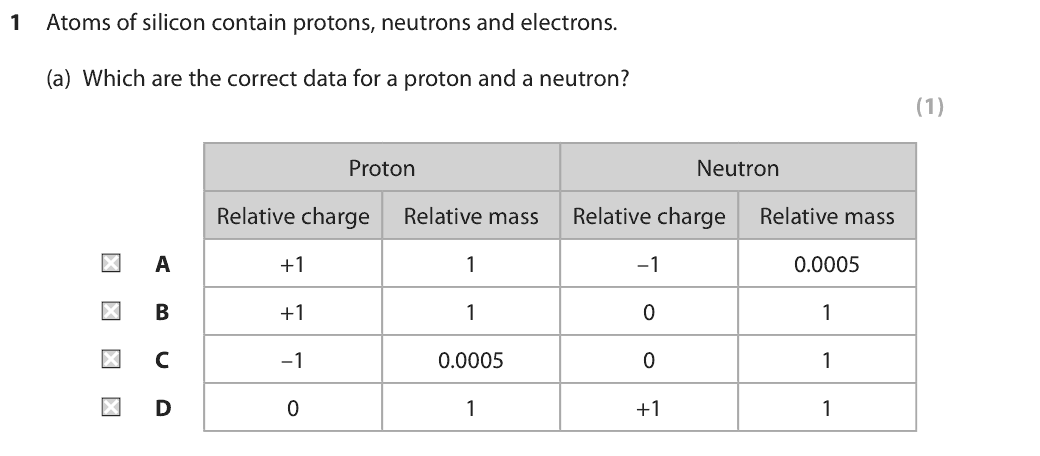
Atoms of silicon contain protons, neutrons and electrons.
Which are the correct data for a proton and a neutron?
Proton
Neutron
Relative charge
Relative mass
Relative charge
Relative mass
A
+1
1
–1
0.0005
B
+1
1
0
1
C
–1
0.0005
0
1
D
0
1
+1
1
June 2023 · AS Paper 1 · Q1(b)(i) 1 mark Short answer atomic structure and the periodic table
State the shape of the 2s orbital of a silicon atom.
June 2023 · AS Paper 1 · Q1(b)(ii) 1 mark Short answer atomic structure and the periodic table
Earlier part of question 1 that this part usesEarlier part of June 2023 Paper 1 question 1
State the difference between the two subatomic particles in the 2s orbital.
June 2023 · AS Paper 1 · Q1(c) 2 marks Calculation atomic structure and the periodic table
Earlier part of question 1 that this part usesEarlier part of June 2023 Paper 1 question 1
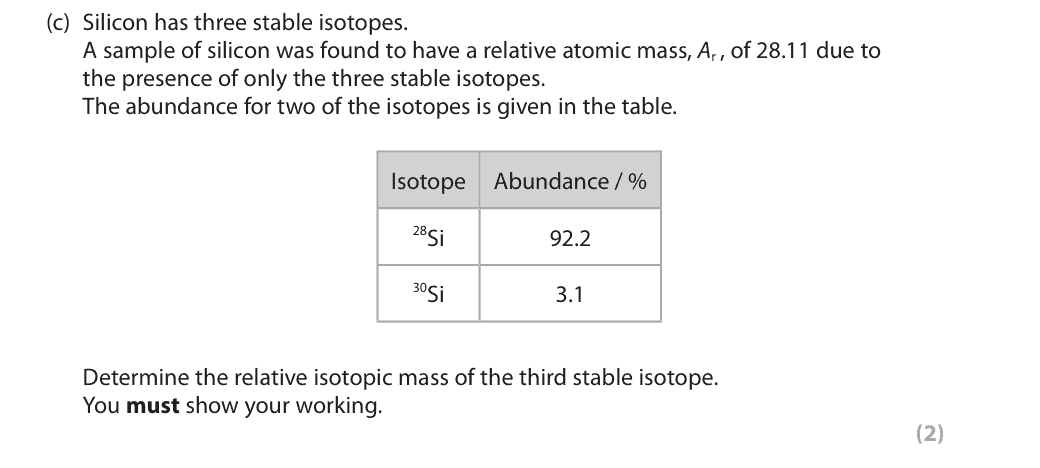
Silicon has three stable isotopes.
A sample of silicon was found to have a relative atomic mass, Ar , of 28.11 due to
the presence of only the three stable isotopes.
The abundance for two of the isotopes is given in the table.
Isotope
Abundance / %
28Si
92.2
30Si
3.1
Determine the relative isotopic mass of the third stable isotope.
You must show your working.
June 2023 · AS Paper 1 · Q1(d) 1 mark Short answer atomic structure and the periodic table
Earlier part of question 1 that this part usesEarlier part of June 2023 Paper 1 question 1
Give the symbol, including the mass number and atomic number, for an atom of
element X that has four fewer protons and three fewer neutrons than an atom
of 14
28Si.
June 2023 · AS Paper 1 · Q2(a)(i) 1 mark Short answer atomic structure and the periodic table
This question is about the double salt K2Mg(SO4)2.6H2O.
A double salt is a salt containing more than one cation or more than one anion.
Give the reason why the term relative formula mass is used, rather than
relative molecular mass, when discussing K2Mg(SO4)2.6H2O.
June 2023 · AS Paper 1 · Q2(a)(ii) 1 mark Short answer atomic structure and the periodic table
Earlier part of question 2 that this part usesEarlier part of June 2023 Paper 1 question 2
Give the reason why relative formula mass has no mathematical units.
June 2023 · AS Paper 1 · Q2(a)(iii) 1 mark Multiple choice atomic structure and the periodic table
Earlier part of question 2 that this part usesEarlier part of June 2023 Paper 1 question 2
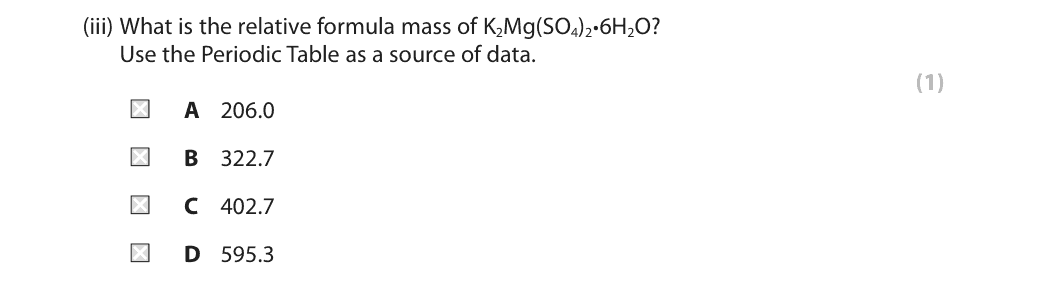
What is the relative formula mass of K2Mg(SO4)2.6H2O?
Use the Periodic Table as a source of data.
A  206.0
B  322.7
C  402.7
D  595.3
June 2023 · AS Paper 1 · Q2(a)(iv) 1 mark Calculation formulae equations and amounts of substance
Earlier part of question 2 that this part usesEarlier part of June 2023 Paper 1 question 2
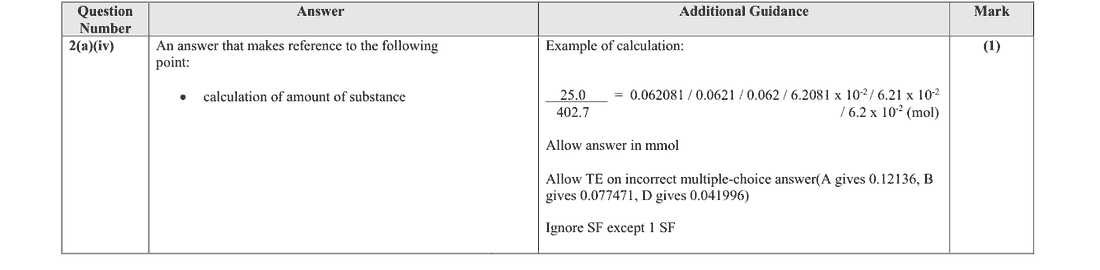
Calculate the amount of substance, in mol, in 25.0 g of K2Mg(SO4)2.6H2O.
June 2023 · AS Paper 1 · Q2(b) 4 marks Practical and data analysis groups 1 and 2
Earlier part of question 2 that this part usesEarlier part of June 2023 Paper 1 question 2
Cations may be identified using a flame test on a solid or by the addition of
aqueous sodium hydroxide to an aqueous solution containing the cation.
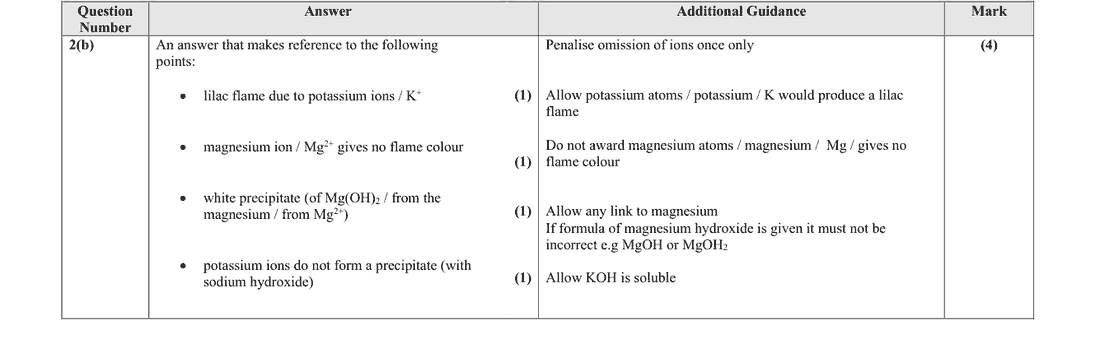
Describe the expected results of performing these tests on K2Mg(SO4)2.6H2O.
Include the observation for each cation in each test.
June 2023 · AS Paper 1 · Q2(c)(i) 1 mark Multiple choice analysis of inorganic compounds
Earlier part of question 2 that this part usesEarlier part of June 2023 Paper 1 question 2
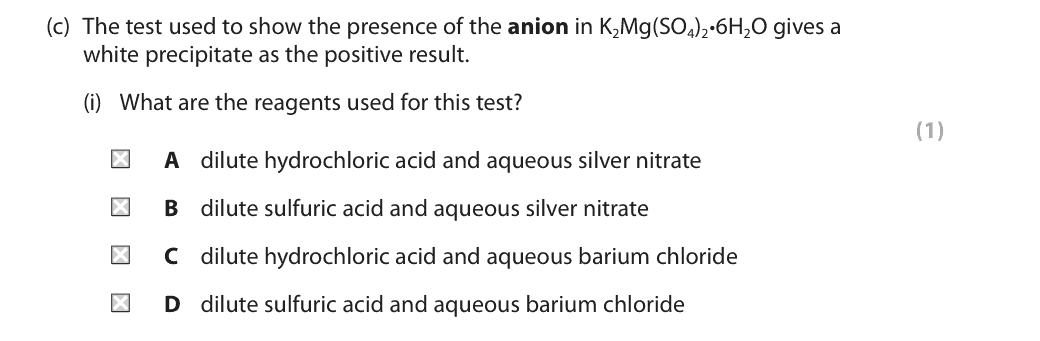
The test used to show the presence of the anion in K2Mg(SO4)2.6H2O gives a
white precipitate as the positive result.
What are the reagents used for this test?
A  dilute hydrochloric acid and aqueous silver nitrate
B  dilute sulfuric acid and aqueous silver nitrate
C  dilute hydrochloric acid and aqueous barium chloride
D  dilute sulfuric acid and aqueous barium chloride
June 2023 · AS Paper 1 · Q2(c)(ii) 1 mark Equation writing Hard analysis of inorganic compoundsformulae equations and amounts of substance
Earlier parts of question 2 that this part usesEarlier part of June 2023 Paper 1 question 2Earlier part of June 2023 Paper 1 question 2
Write an ionic equation, including state symbols, for the formation of the
white precipitate in the test for the anion in the double salt.
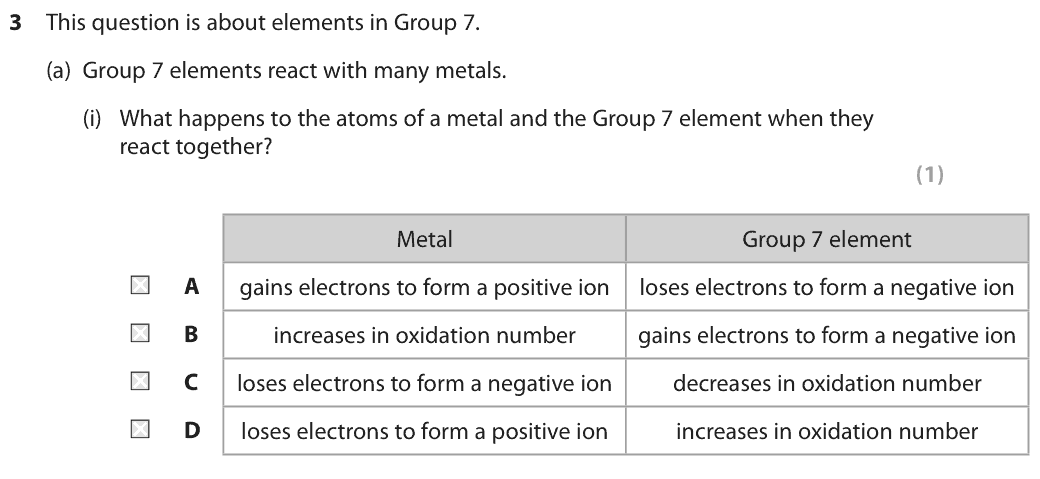
June 2023 · AS Paper 1 · Q3(a)(i) 1 mark Multiple choice redox i
This question is about elements in Group 7.
Group 7 elements react with many metals.
What happens to the atoms of a metal and the Group 7 element when they
react together?
Metal
Group 7 element
A
gains electrons to form a positive ion
loses electrons to form a negative ion
B
increases in oxidation number
gains electrons to form a negative ion
C
loses electrons to form a negative ion
decreases in oxidation number
D
loses electrons to form a positive ion
increases in oxidation number
June 2023 · AS Paper 1 · Q3(a)(ii) 1 mark Multiple choice group 7 the halogensatomic structure and the periodic table
Earlier part of question 3 that this part usesEarlier part of June 2023 Paper 1 question 3
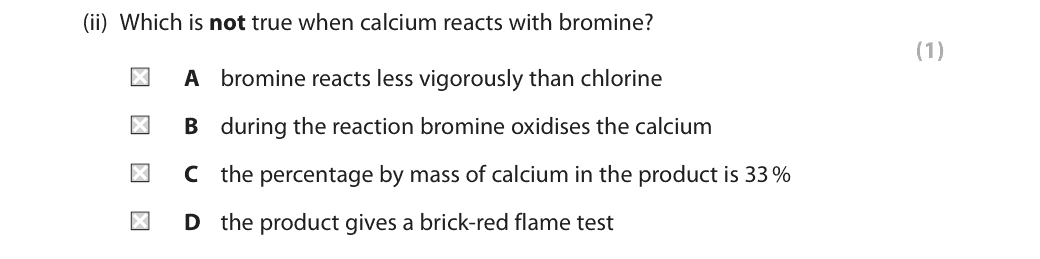
Which is not true when calcium reacts with bromine?
A  bromine reacts less vigorously than chlorine
B  during the reaction bromine oxidises the calcium
C  the percentage by mass of calcium in the product is 33 %
D  the product gives a brick‑red flame test
June 2023 · AS Paper 1 · Q3(a)(iii) 2 marks Diagram or structure bonding
Earlier part of question 3 that this part usesEarlier part of June 2023 Paper 1 question 3
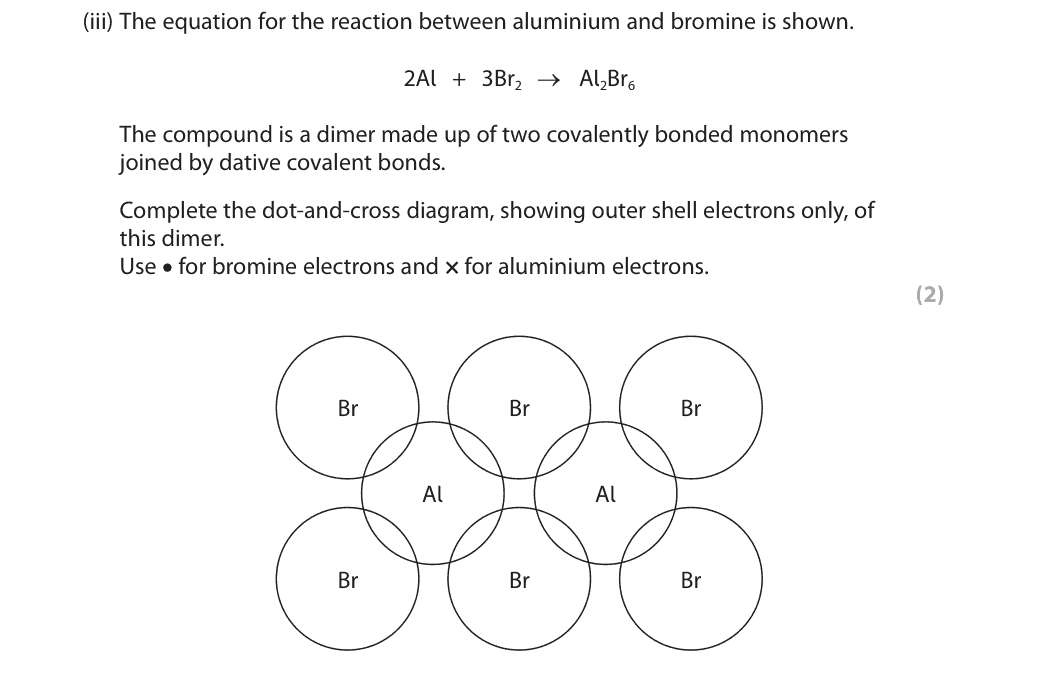
The equation for the reaction between aluminium and bromine is shown.
2Al   +   3Br2   →   Al2Br6
The compound is a dimer made up of two covalently bonded monomers
joined by dative covalent bonds.
Complete the dot‑and‑cross diagram, showing outer shell electrons only, of
this dimer.
Use • for bromine electrons and × for aluminium electrons.
Br
Br
Br
Al
Al
Br
Br
Br
June 2023 · AS Paper 1 · Q3(a)(iv) 1 mark Short answer redox i
Earlier part of question 3 that this part usesEarlier part of June 2023 Paper 1 question 3
Platinum metal reacts with fluorine to give a compound of platinum with an
oxidation number of +6.
Give the formula of this compound of platinum.
June 2023 · AS Paper 1 · Q3(a)(v) 2 marks Calculation formulae equations and amounts of substance
Earlier part of question 3 that this part usesEarlier part of June 2023 Paper 1 question 3
Chromium reacts with iodine.
The only product contains 12.0 % chromium by mass.
Calculate the empirical formula of the chromium iodide formed.
You must show your working.
June 2023 · AS Paper 1 · Q3(b)(i) 2 marks Explanation bonding
Earlier part of question 3 that this part usesEarlier part of June 2023 Paper 1 question 3
Chlorine, bromine and iodine are three of the Group 7 elements. The bond length
and bond enthalpies in molecules of these elements are shown in the table.
Bond
Bond length / nm
Bond enthalpy / kJ mol–1
Cl
Cl
0.199
243.4
Br
Br
0.228
192.9
I
I
0.267
151.2
Explain how the trend in bond length relates to the trend in bond strength on
descending the group.
June 2023 · AS Paper 1 · Q3(b)(ii) 3 marks Practical and data analysis Hard group 7 the halogens
Earlier part of question 3 that this part usesEarlier part of June 2023 Paper 1 question 3
The relative reactivity of chlorine and iodine can be demonstrated using
the reaction between one of these elements and the potassium salt of the
other halogen.
Describe an experiment to show how this is deduced and give the expected
observation for the reaction that occurs.
Include an ionic equation for this reaction.
State symbols are not required.
June 2023 · AS Paper 1 · Q4(a) 2 marks Explanation bondingstructure
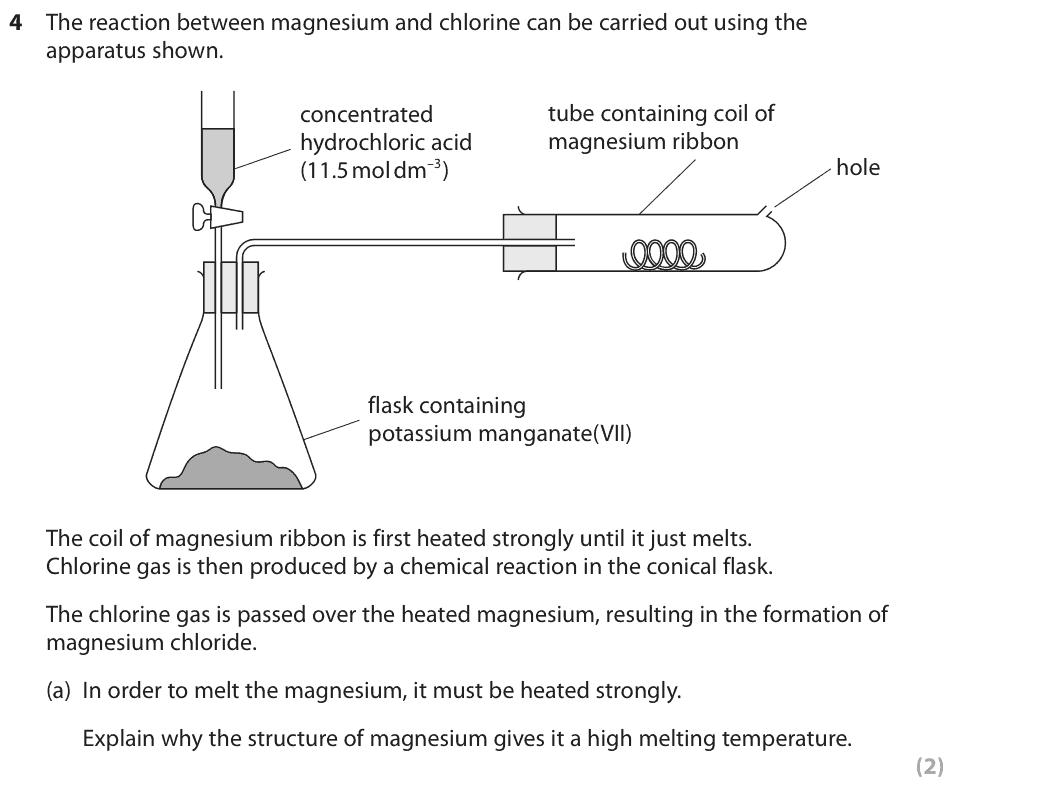
The reaction between magnesium and chlorine can be carried out using the
apparatus shown.
concentrated
tube containing coil of
hydrochloric acid
magnesium ribbon
hole
(11.5 mol dm–3)
flask containing
potassium manganate(VII)
The coil of magnesium ribbon is first heated strongly until it just melts.
Chlorine gas is then produced by a chemical reaction in the conical flask.
The chlorine gas is passed over the heated magnesium, resulting in the formation of
magnesium chloride.
In order to melt the magnesium, it must be heated strongly.
Explain why the structure of magnesium gives it a high melting temperature.
June 2023 · AS Paper 1 · Q4(b) 4 marks Calculation formulae equations and amounts of substance
Earlier part of question 4 that this part usesEarlier part of June 2023 Paper 1 question 4
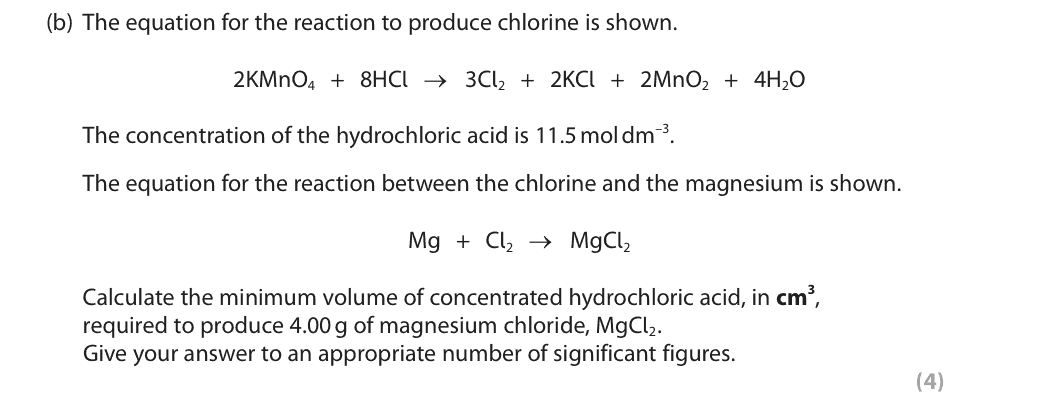
The equation for the reaction to produce chlorine is shown.
2KMnO4   +   8HCl   →   3Cl2   +   2KCl   +   2MnO2   +   4H2O
The concentration of the hydrochloric acid is 11.5 mol dm–3.
The equation for the reaction between the chlorine and the magnesium is shown.
Mg   +   Cl2   →   MgCl2
Calculate the minimum volume of concentrated hydrochloric acid, in cm3,
required to produce 4.00 g of magnesium chloride, MgCl2.
Give your answer to an appropriate number of significant figures.
June 2023 · AS Paper 1 · Q4(c) 1 mark Multiple choice formulae equations and amounts of substance
Earlier part of question 4 that this part usesEarlier part of June 2023 Paper 1 question 4
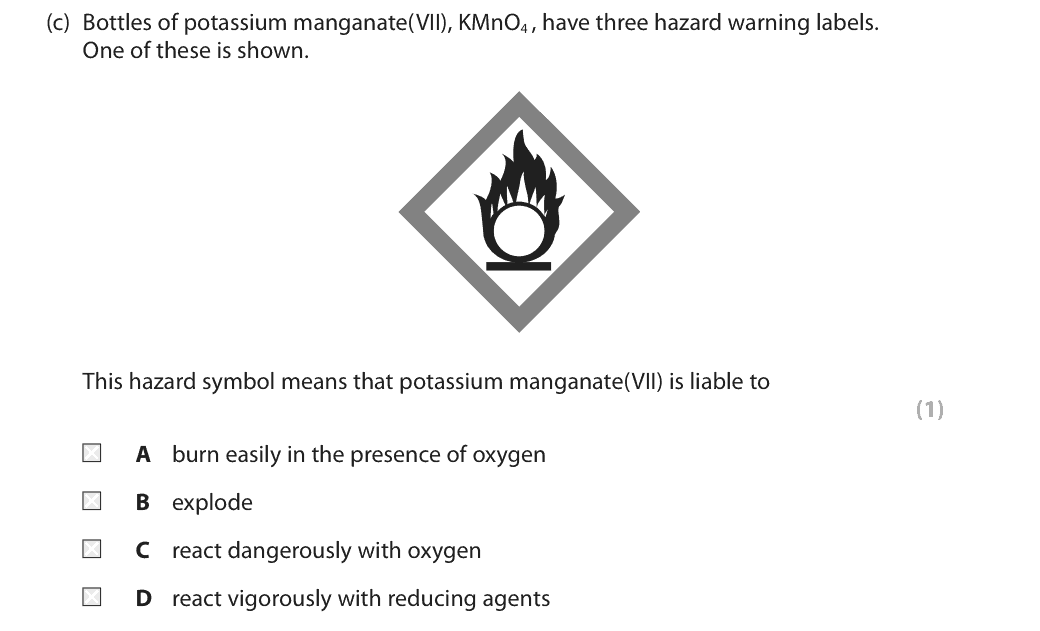
Bottles of potassium manganate(VII), KMnO4 , have three hazard warning labels.
One of these is shown.
This hazard symbol means that potassium manganate(VII) is liable to
A  burn easily in the presence of oxygen
B  explode
C  react dangerously with oxygen
D  react vigorously with reducing agents
June 2023 · AS Paper 1 · Q5(a) 1 mark Short answer bonding
The question is about electronegativity and its influence on bonding.
State what is meant by the term electronegativity.
June 2023 · AS Paper 1 · Q5(b) 3 marks Explanation group 7 the halogens
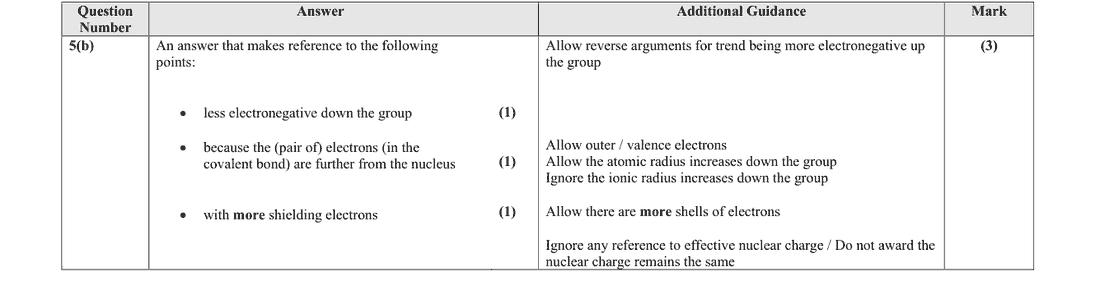
Explain the trend in electronegativity for the Group 7 elements.
June 2023 · AS Paper 1 · Q5(c) 2 marks Short answer Hard bonding
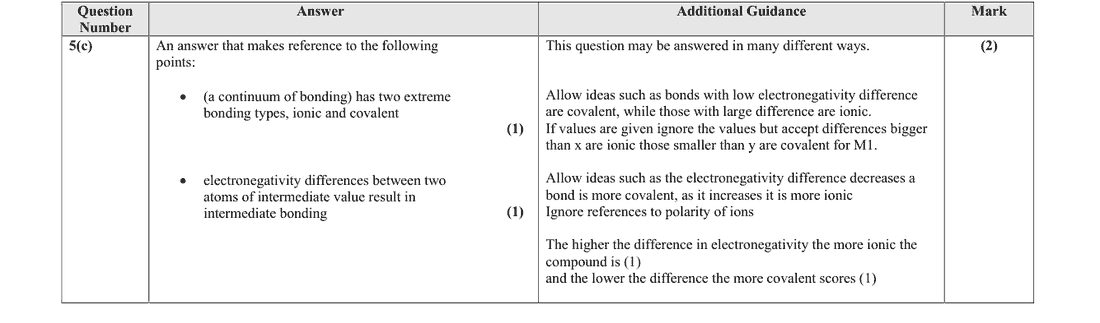
Describe what you understand by the term ‘continuum of bonding type’ in
relation to electronegativities.
June 2023 · AS Paper 1 · Q5(d) 3 marks Explanation Hard structurebonding
Earlier part of question 5 that this part usesEarlier part of June 2023 Paper 1 question 5
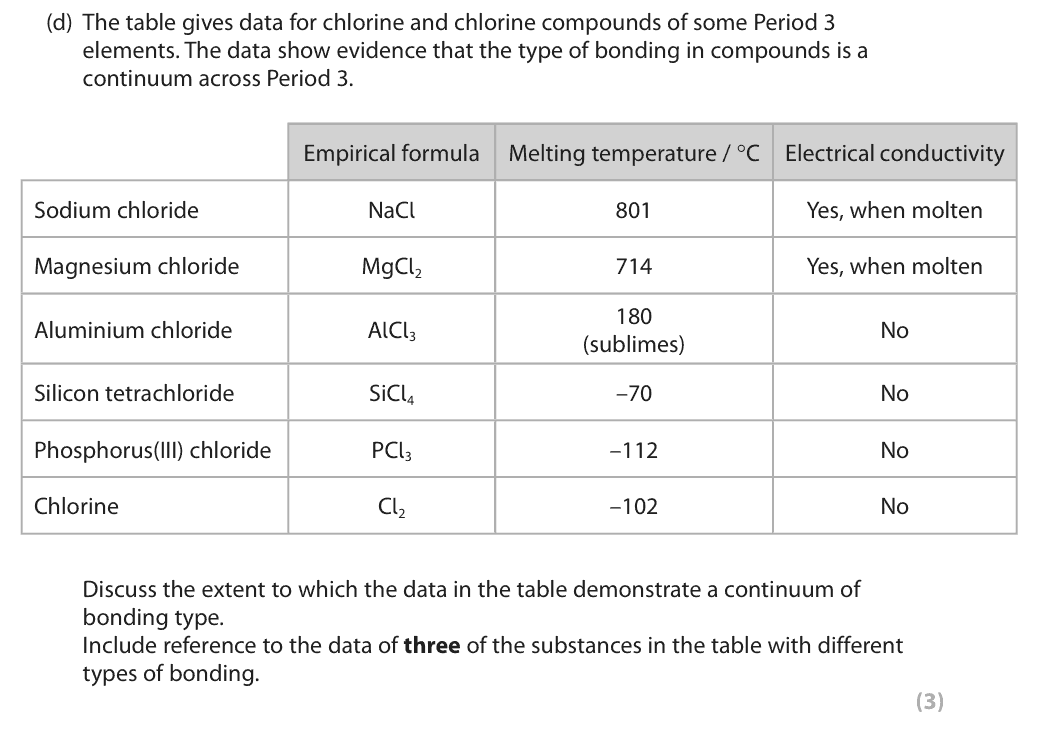
The table gives data for chlorine and chlorine compounds of some Period 3
elements. The data show evidence that the type of bonding in compounds is a
continuum across Period 3.
Empirical formula
Melting temperature / °C
Electrical conductivity
Sodium chloride
NaCl
801
Yes, when molten
Magnesium chloride
MgCl2
714
Yes, when molten
180
Aluminium chloride
AlCl3
No
(sublimes)
Silicon tetrachloride
SiCl4
–70
No
Phosphorus(III) chloride
PCl3
–112
No
Chlorine
Cl2
–102
No
Discuss the extent to which the data in the table demonstrate a continuum of
bonding type.
Include reference to the data of three of the substances in the table with different
types of bonding.
June 2023 · AS Paper 1 · Q6(a)(i) 1 mark Short answer Easy redox i
Redox reactions can be understood in terms of electron transfer or in terms of
changes of oxidation number.
The equation for a redox reaction is shown.
8KI   +   5H2SO4   →   4I2   +   4K2SO4   +   H2S   +   4H2O
State, in terms of electron transfer, what you understand by the terms
oxidation and reduction.
June 2023 · AS Paper 1 · Q6(a)(ii) 2 marks Explanation redox i
Earlier part of question 6 that this part usesEarlier part of June 2023 Paper 1 question 6
Explain, in terms of electron transfer, which of the species is the oxidising
agent and which is the reducing agent.
June 2023 · AS Paper 1 · Q6(b) 4 marks Equation writing Hard group 7 the halogensredox i
Earlier part of question 6 that this part usesEarlier part of June 2023 Paper 1 question 6
Bromine reacts with sodium hydroxide solution in a disproportionation reaction
–.
to form BrO3
Complete the equation for this disproportionation.
Justify the balancing of the equation in terms of the changes in oxidation number.
Br2   +   OH–   →   BrO3
–   +      +
June 2023 · AS Paper 1 · Q7(a) 1 mark Diagram or structure bonding
This question is about ions.
Draw a dot‑and‑cross diagram of the ionic compound potassium chloride.
Show outer shell electrons only.
June 2023 · AS Paper 1 · Q7(b) 4 marks Explanation bonding
Deduce the order of increasing size of the ions:
Br–, Ca2+, Cl–, K+
Justify your answer.
June 2023 · AS Paper 1 · Q7(c) 1 mark Multiple choice formulae equations and amounts of substance
Earlier part of question 7 that this part usesEarlier part of June 2023 Paper 1 question 7
A saturated aqueous calcium hydroxide solution contains 17.3 g in 10.0 dm3
of solution.
Under these conditions the calcium hydroxide is fully dissociated into ions.
What is the concentration of the calcium ions in this solution, in mol dm–3 ?
A  0.0233
B  0.0303
C  0.0431
D  0.0597
June 2023 · AS Paper 1 · Q8(a)(i) 2 marks Practical and data analysis formulae equations and amounts of substancekinetics i
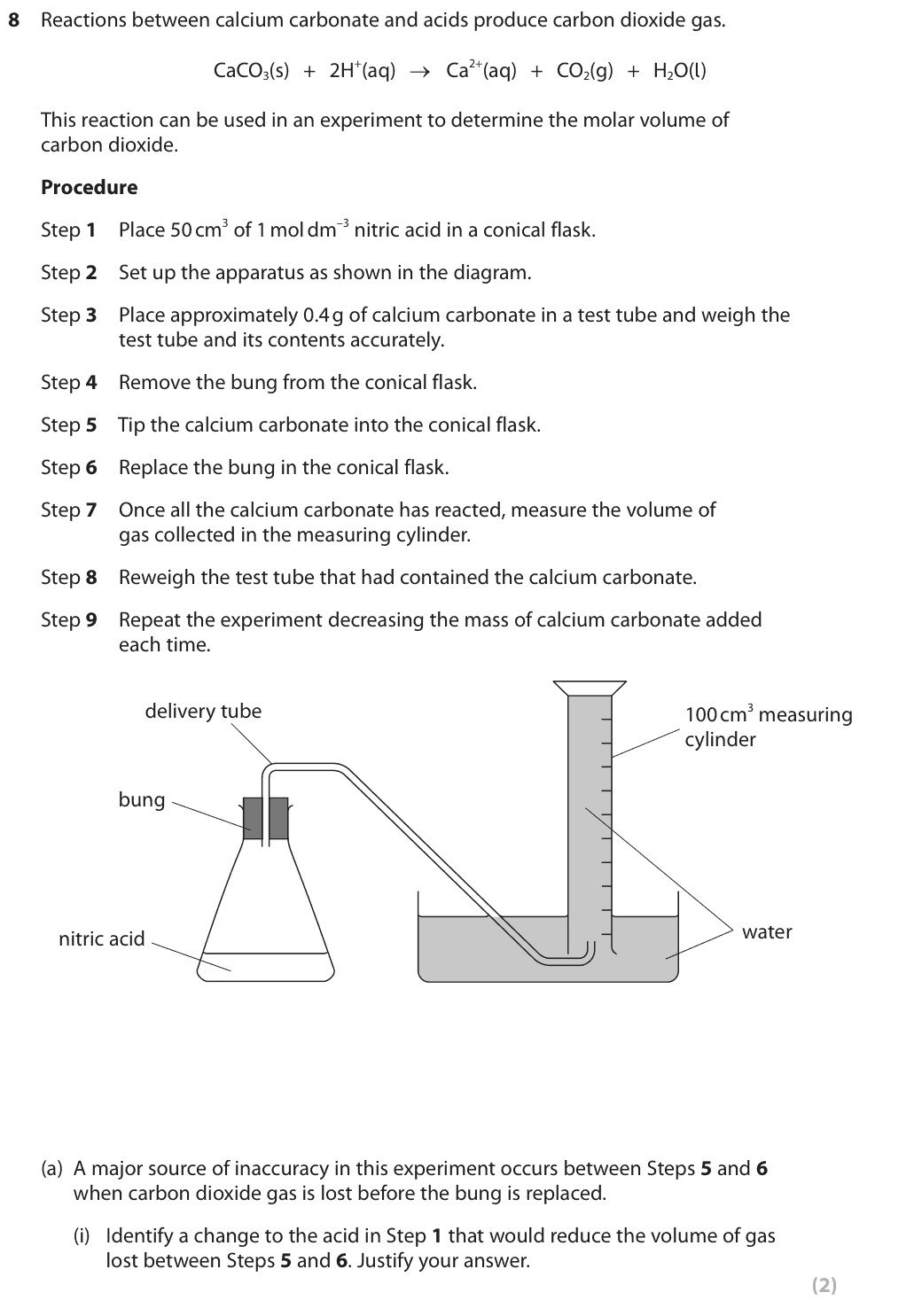
Reactions between calcium carbonate and acids produce carbon dioxide gas.
CaCO3(s)   +   2H+(aq)   →   Ca2+(aq)   +   CO2(g)   +   H2O(l)
This reaction can be used in an experiment to determine the molar volume of
carbon dioxide.
Procedure
Step 1    Place 50 cm3 of 1 mol dm–3 nitric acid in a conical flask.
Step 2    Set up the apparatus as shown in the diagram.
Step 3    Place approximately 0.4 g of calcium carbonate in a test tube and weigh the
test tube and its contents accurately.
Step 4    Remove the bung from the conical flask.
Step 5    Tip the calcium carbonate into the conical flask.
Step 6    Replace the bung in the conical flask.
Step 7    Once all the calcium carbonate has reacted, measure the volume of
gas collected in the measuring cylinder.
Step 8    Reweigh the test tube that had contained the calcium carbonate.
Step 9    Repeat the experiment decreasing the mass of calcium carbonate added
each time.
delivery tube
100 cm3 measuring
cylinder
bung
water
nitric acid
A major source of inaccuracy in this experiment occurs between Steps 5 and 6
when carbon dioxide gas is lost before the bung is replaced.
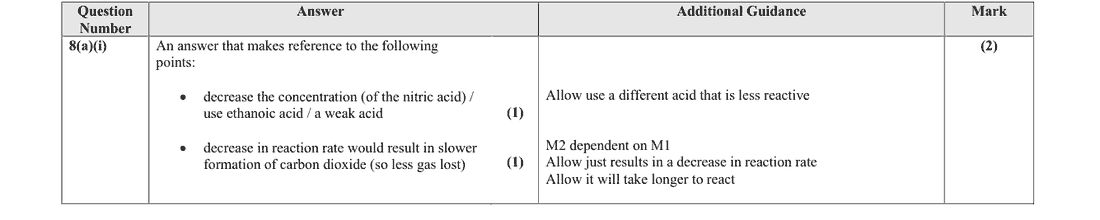
Identify a change to the acid in Step 1 that would reduce the volume of gas
lost between Steps 5 and 6. Justify your answer.
June 2023 · AS Paper 1 · Q8(a)(ii) 2 marks Practical and data analysis formulae equations and amounts of substance
Earlier part of question 8 that this part usesEarlier part of June 2023 Paper 1 question 8
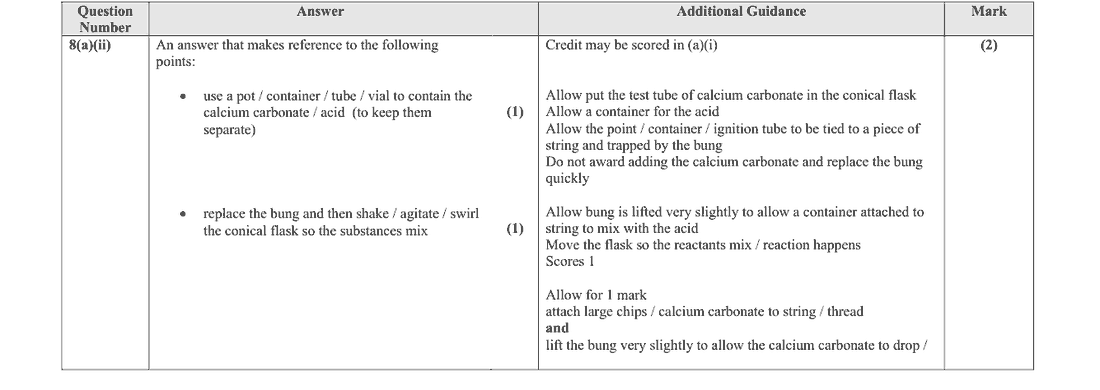
Identify a change to the procedure in Steps 5 and 6 that would prevent loss
of gas.
June 2023 · AS Paper 1 · Q8(b) 2 marks Practical and data analysis formulae equations and amounts of substance
Earlier part of question 8 that this part usesEarlier part of June 2023 Paper 1 question 8
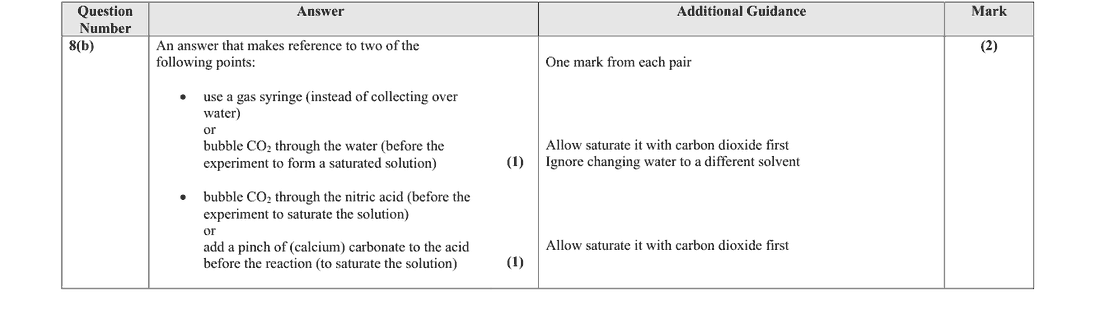
A second source of inaccuracy results from the significant solubility in water of
carbon dioxide.
Give two improvements which together prevent this problem.
June 2023 · AS Paper 1 · Q8(c)(i) 3 marks Calculation formulae equations and amounts of substance
Earlier part of question 8 that this part usesEarlier part of June 2023 Paper 1 question 8
After appropriate improvements, the procedure was carried out and the results
were plotted on a graph. A line of best fit was drawn.
100
90
80
70
60
Volume of CO2
50
/ cm3
40
30
20
10
0
0.00
0.05
0.10
0.15
0.20
0.25
0.30
0.35
0.40
Mass of CaCO3 / g
Use the graph to find the molar volume of carbon dioxide, in dm3.
You must show your working on the graph.
[Assume molar mass of CaCO3 = 100 g mol–1]
June 2023 · AS Paper 1 · Q8(c)(ii) 3 marks Calculation formulae equations and amounts of substance
Earlier parts of question 8 that this part usesEarlier part of June 2023 Paper 1 question 8Earlier part of June 2023 Paper 1 question 8
The procedure was carried out at a temperature of 22 °C and a
pressure of 1.01 × 105 Pa.
Calculate the theoretical molar volume, giving units with your answer.
[The ideal gas equation is pV = nRT.   Gas constant (R) = 8.31 J mol–1 K–1]
June 2023 · AS Paper 1 · Q9(a) 1 mark Multiple choice atomic structure and the periodic table
This question is about ionisation energy.
The first four ionisation energies, in kJ mol–1, of four elements are shown.
Which element is in Group 3?
A    738   1451   7753   10 541
B    578   1817   2745   11 578
C    789   1577   3232      4356
D  1012   1903   2912      4957
June 2023 · AS Paper 1 · Q9(b)(i) 2 marks Equation writing atomic structure and the periodic table
The second ionisation energy of beryllium is more endothermic than the
first ionisation energy.
Write an equation for the second ionisation of beryllium.
Include state symbols.
June 2023 · AS Paper 1 · Q9(b)(ii) 6 marks 6-mark extended response groups 1 and 2atomic structure and the periodic table
Earlier part of question 9 that this part usesEarlier part of June 2023 Paper 1 question 9
Explain how the nuclear structure and the electronic structure of the Group 2
elements affect ionisation energies.
Include:
•
an explanation of the trend of the first ionisation energies down the group
•
a comparison of the first two ionisation energies for an element.
June 2023 · AS Paper 1 · Q9(b)(iii) 2 marks Explanation groups 1 and 2
Earlier part of question 9 that this part usesEarlier part of June 2023 Paper 1 question 9
The value of the sum of the first and second ionisation energies changes on
descending Group 2.
Explain how this changing value might contribute to the relative reactivity of
the elements with chlorine.

Work with an A-level chemistry tutor

Want a paper marked and gone through with you? Message us.
Prefer email? Send an enquiry
If you are under 18, please include a parent's contact details. Enquiries go to enquiries@chemistryaleveltutor.com and are deleted once handled. All tutoring is online.