June 2022: AS Paper 1, Core Inorganic and Physical Chemistry

80 marks · 38 question parts · Paper, mark scheme and report on Edexcel's site · Have the Data Booklet beside you

Question by question

QTopicMarksAOType
1 Atomic structure and the Periodic Table 1Multiple choice
2 Atomic structure and the Periodic Table 1Multiple choice
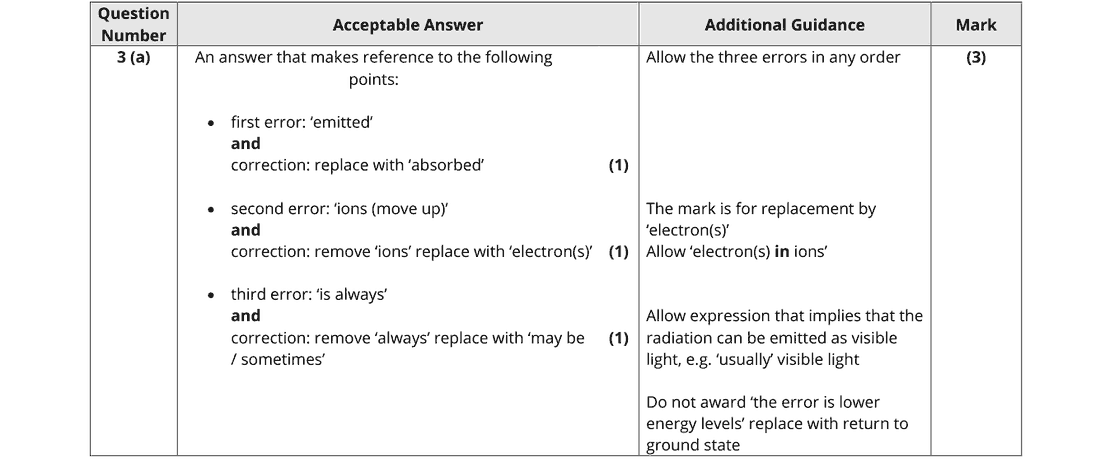
3(a) The elements of Groups 1 and 2 3Short answer
3(b) The elements of Groups 1 and 2 1Multiple choice
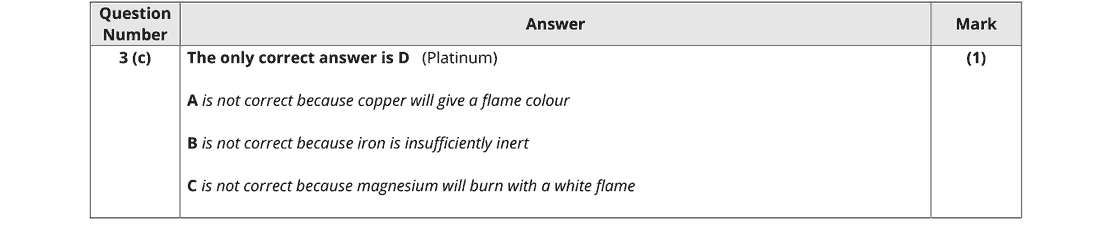
3(c) The elements of Groups 1 and 2 1Multiple choice
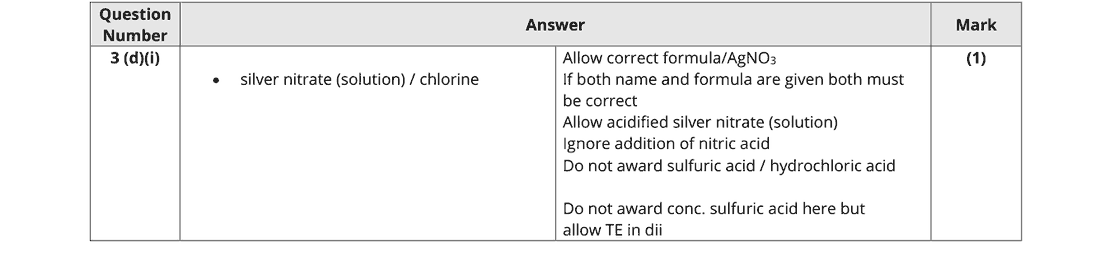
3(d)(i) The elements of Group 7 (halogens) 1Short answer
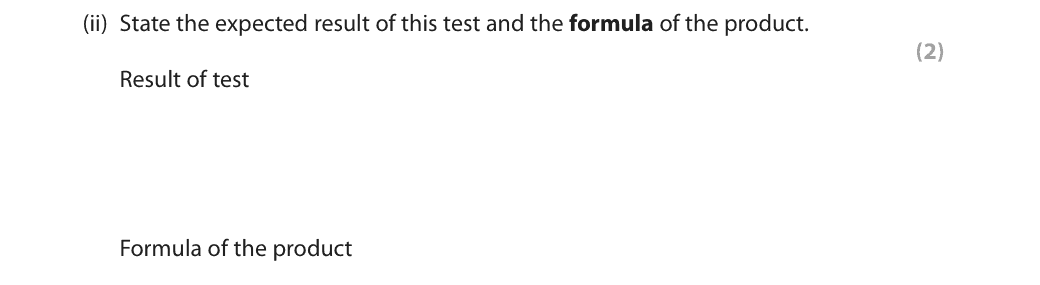
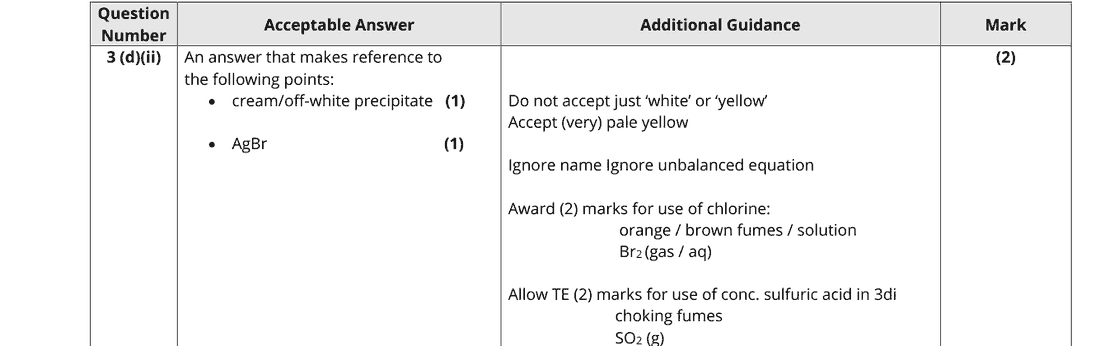
3(d)(ii) The elements of Group 7 (halogens) 2Practical and data analysis
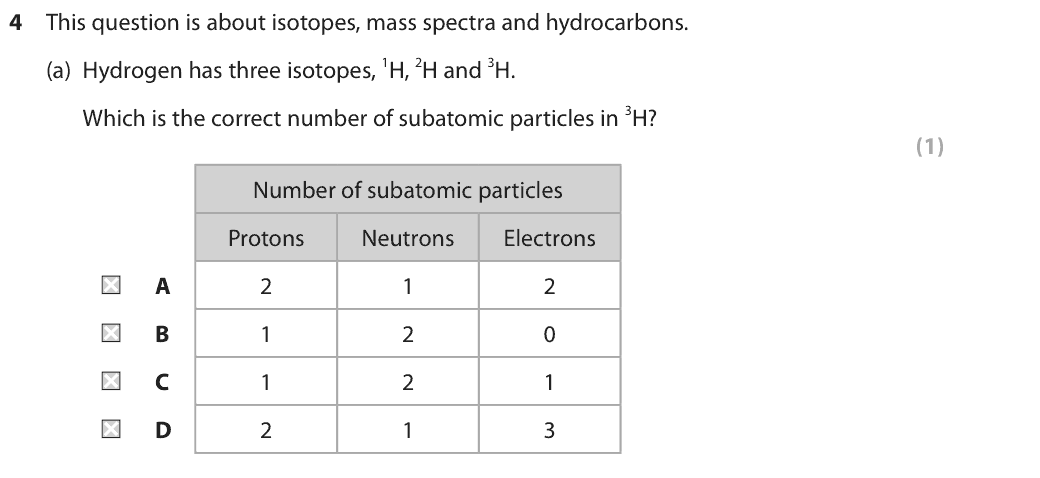
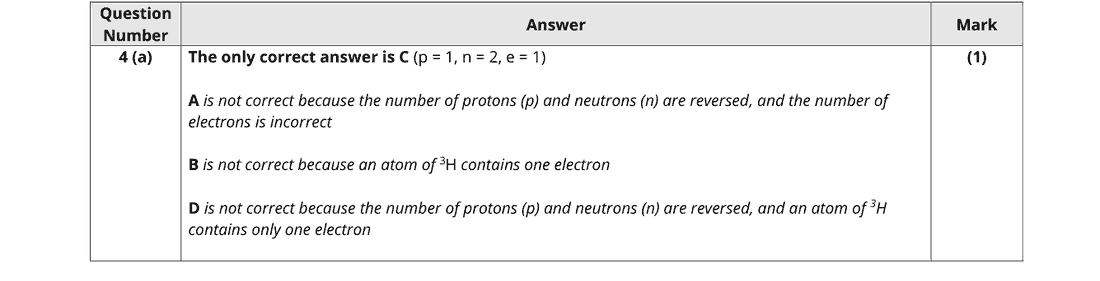
4(a) Atomic structure and the Periodic Table 1Multiple choice
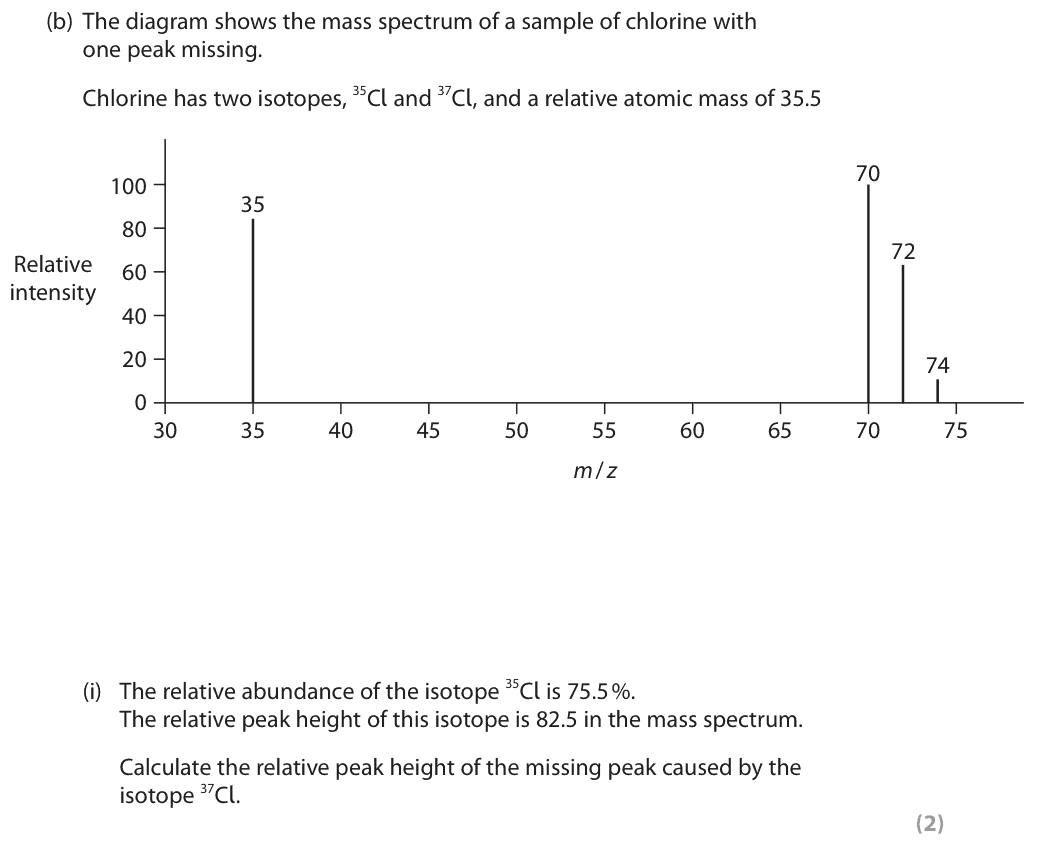
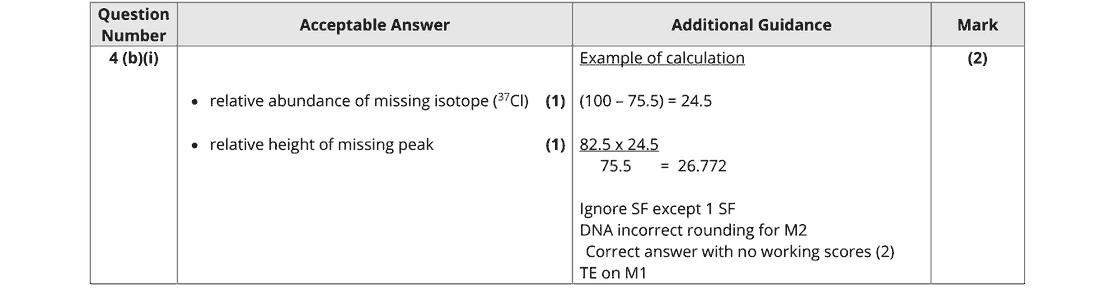
4(b)(i) Atomic structure and the Periodic Table 2Calculation
4(b)(ii) Atomic structure and the Periodic Table 1Short answer
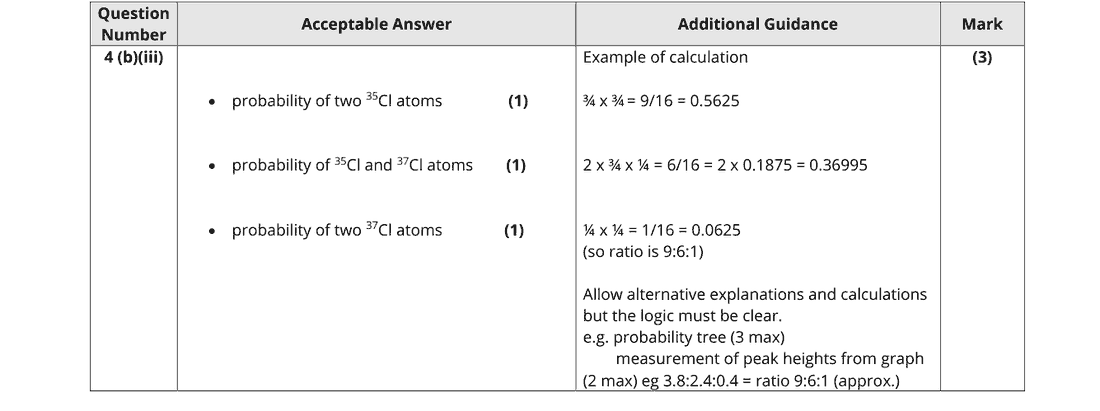
4(b)(iii) Atomic structure and the Periodic Table 3Calculation
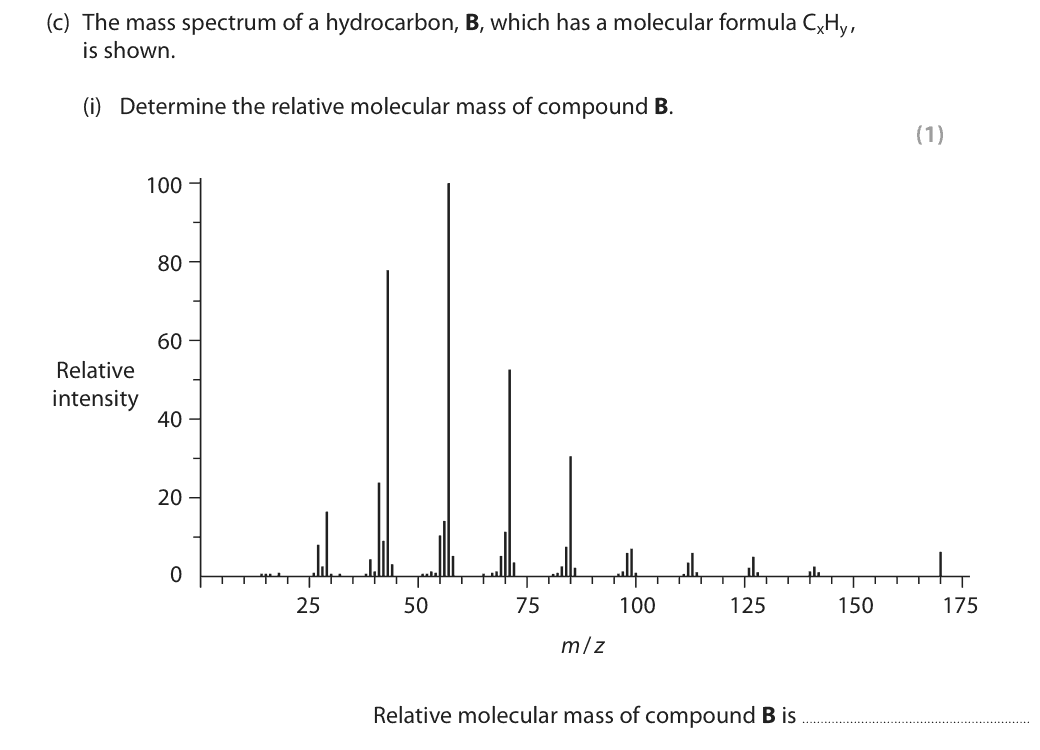
4(c)(i) Atomic structure and the Periodic Table 1Short answer
4(c)(ii) Atomic structure and the Periodic Table, Formulae, equations and amounts of substance 1Short answer
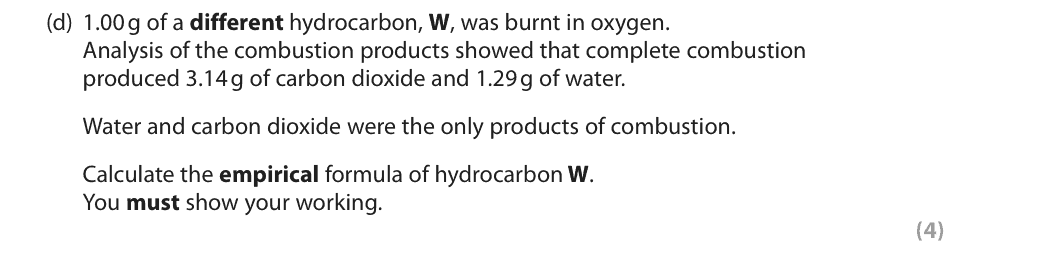
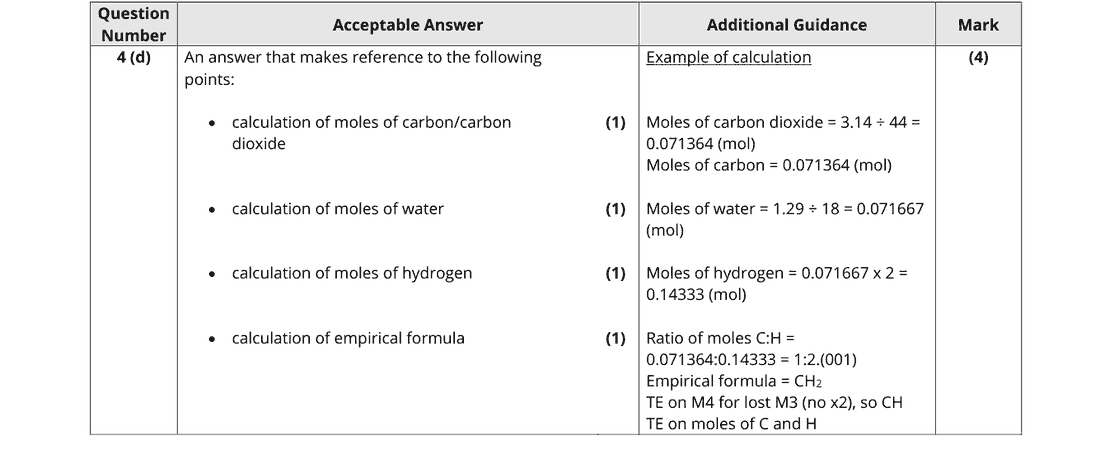
4(d) Formulae, equations and amounts of substance 4Calculation
5(a) Bonding 1Short answer
5(b) Bonding 1Multiple choice
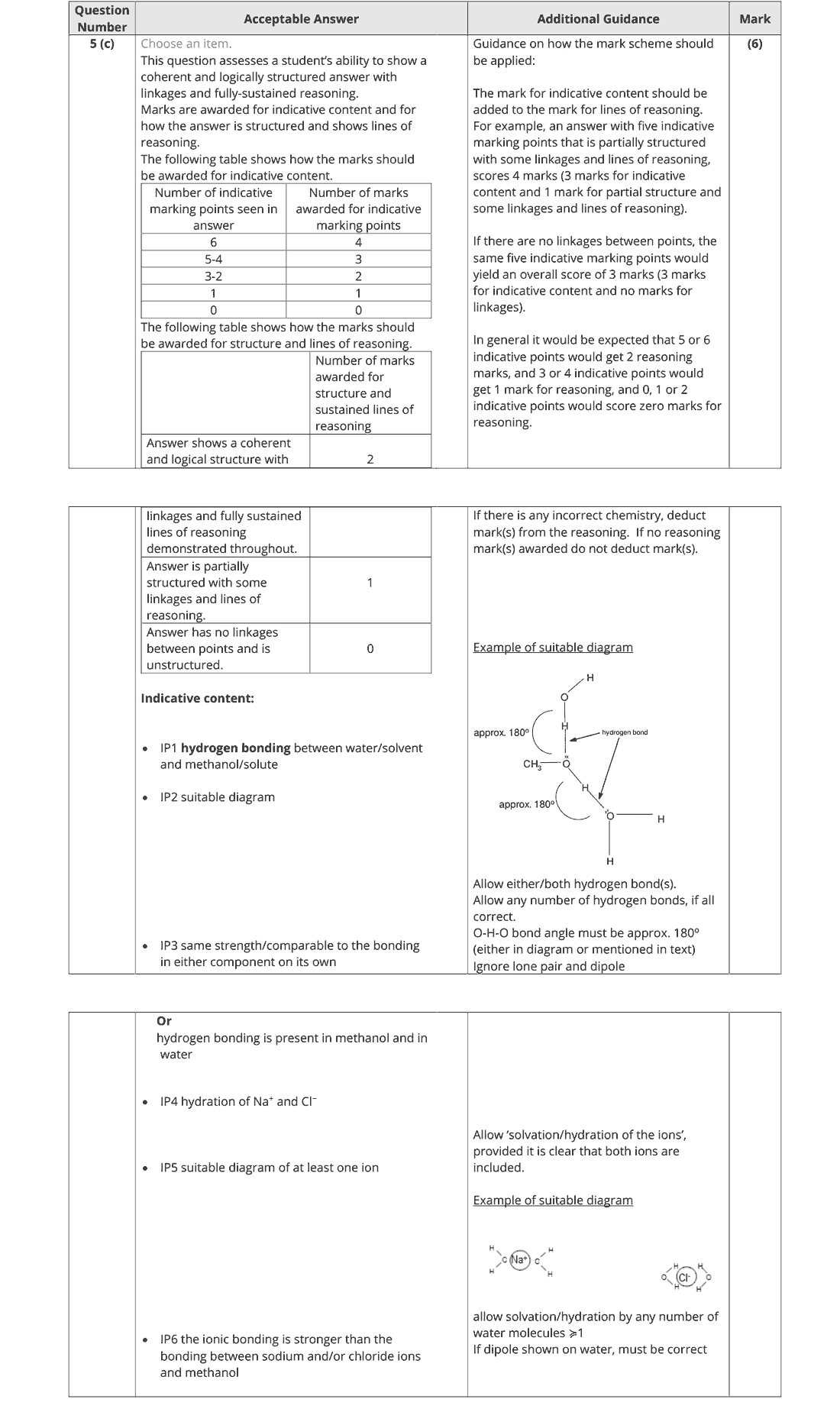
5(c) Bonding 6Extended response
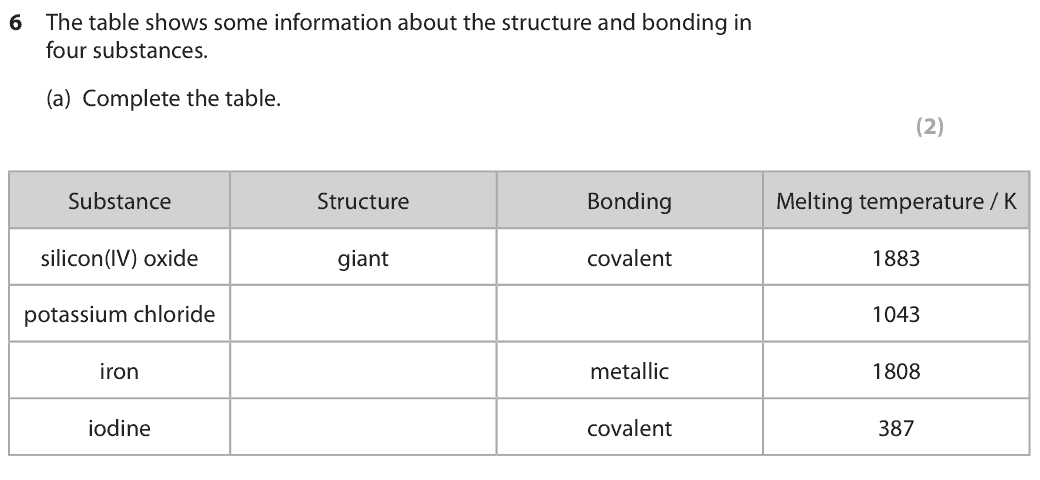
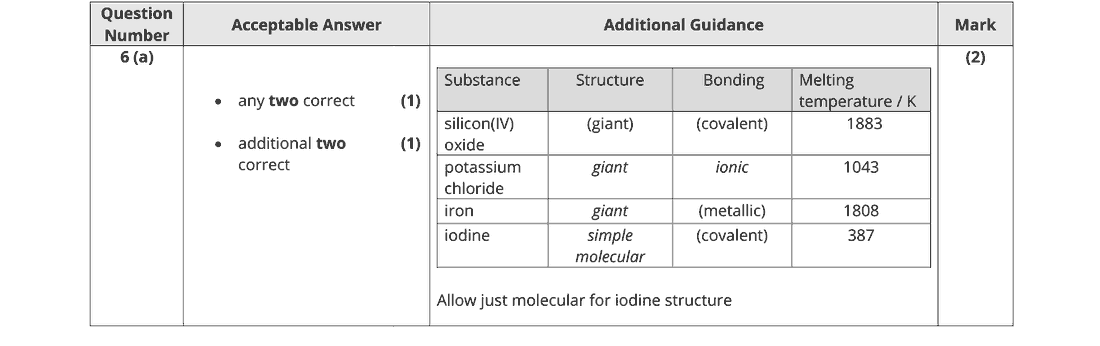
6(a) Structure 2Short answer
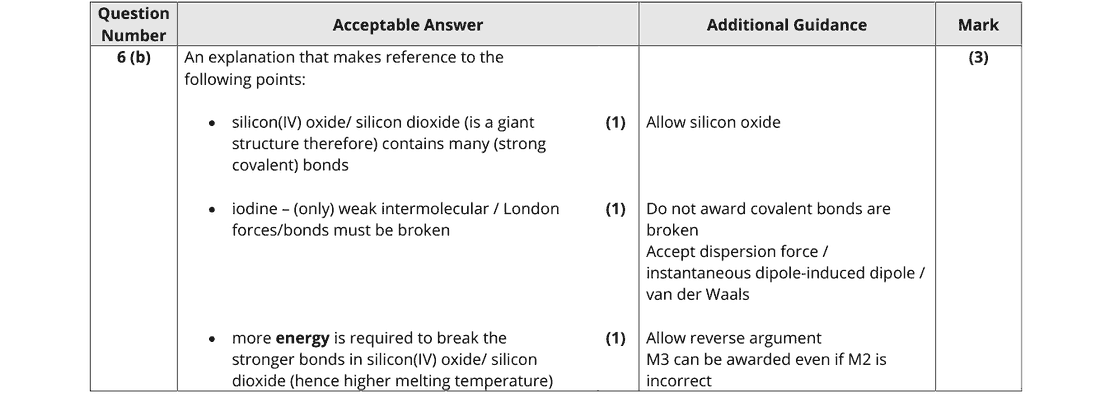
6(b) Structure 3Explanation
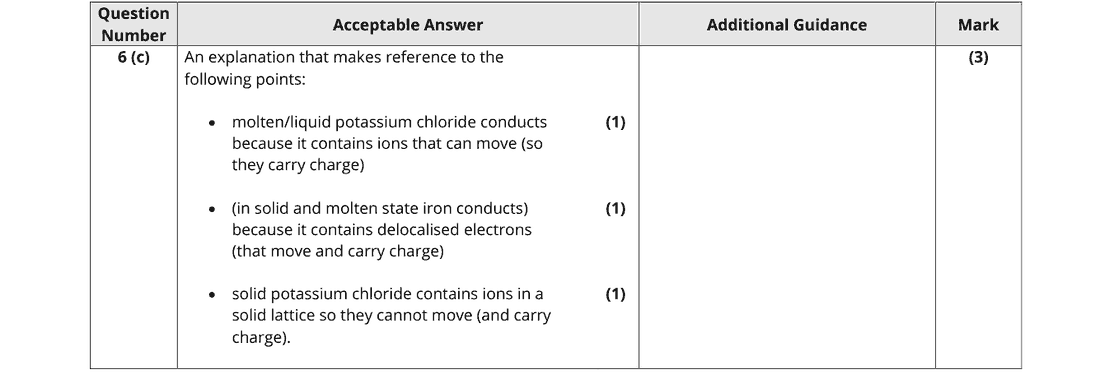
6(c) Structure 3Explanation
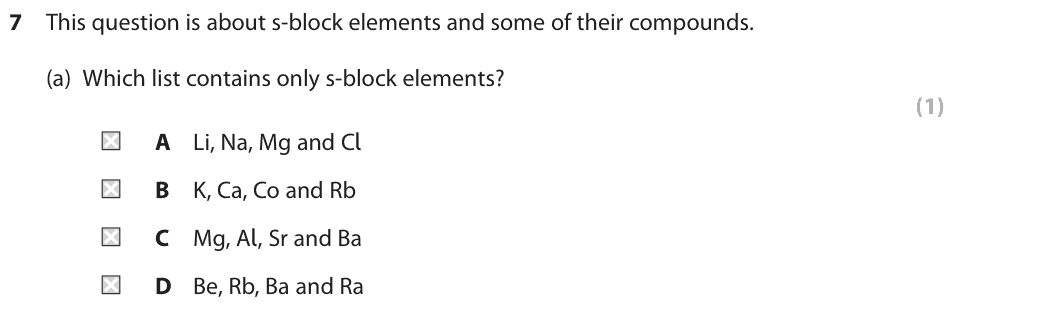
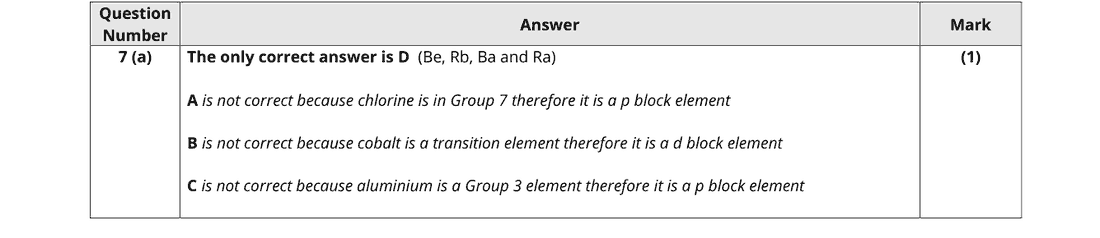
7(a) Atomic structure and the Periodic Table 1Multiple choice
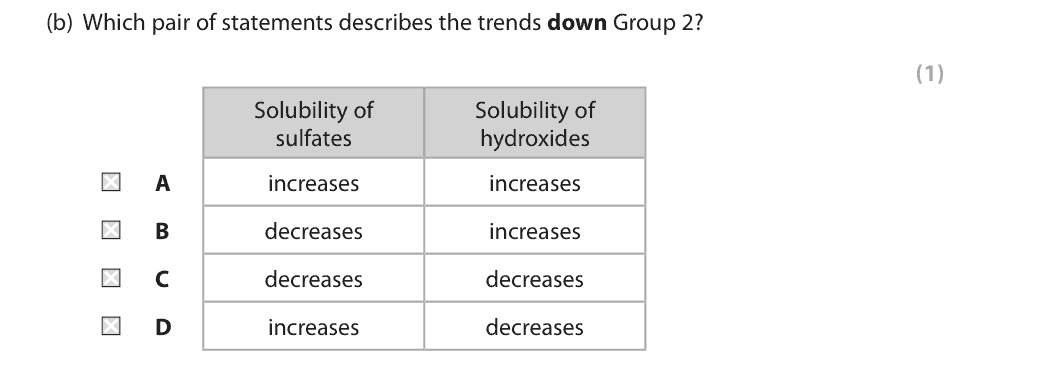
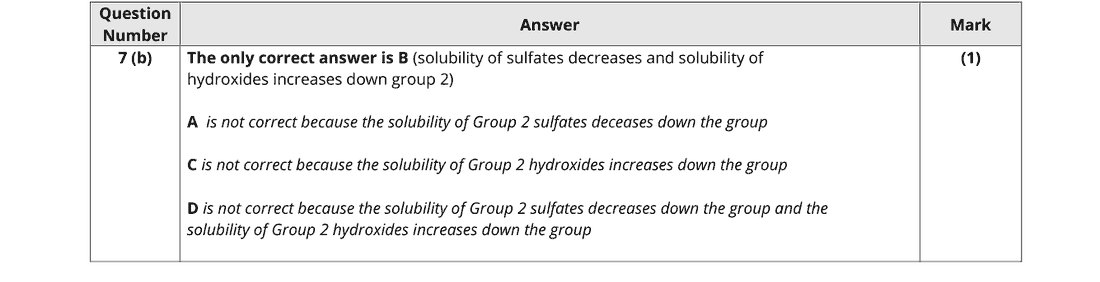
7(b) The elements of Groups 1 and 2 1Multiple choice
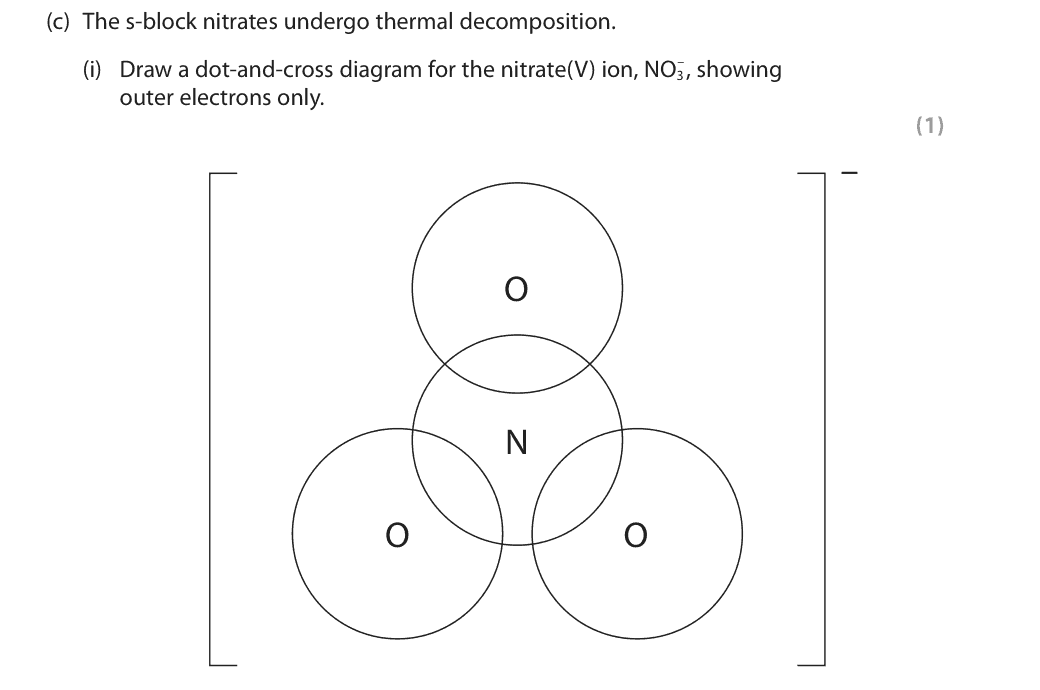
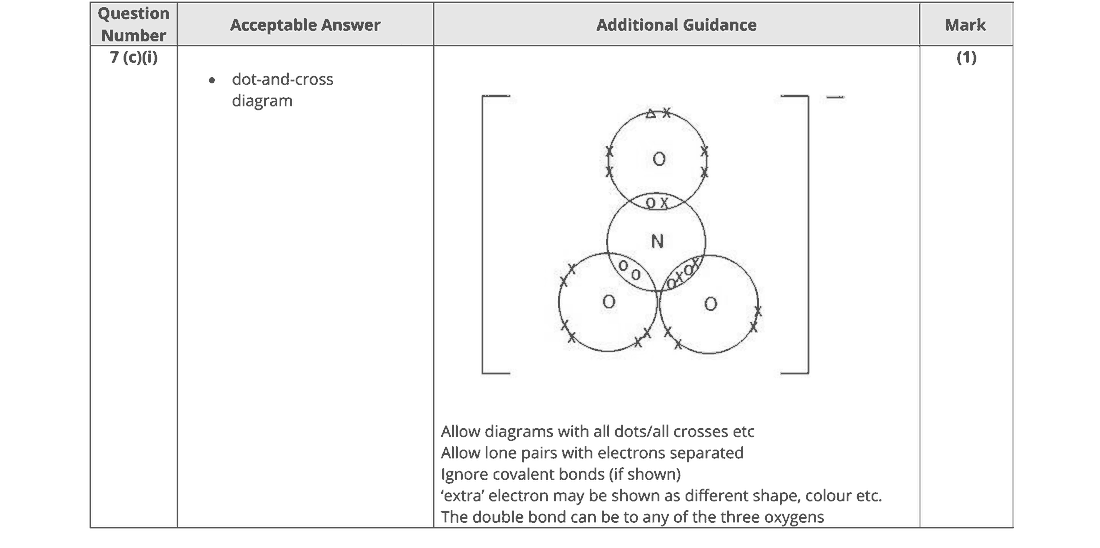
7(c)(i) Bonding 1Diagram or structure
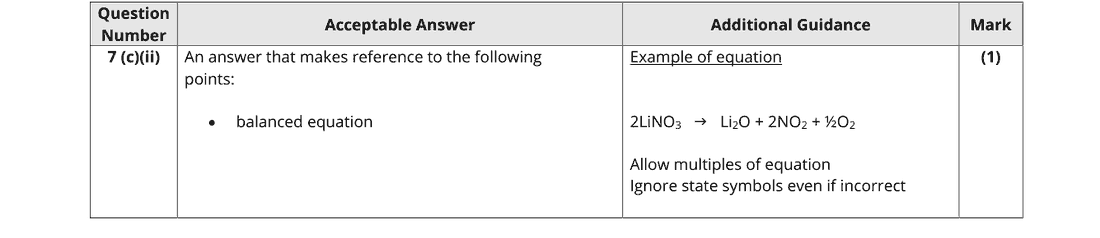
7(c)(ii) The elements of Groups 1 and 2 1Equation writing
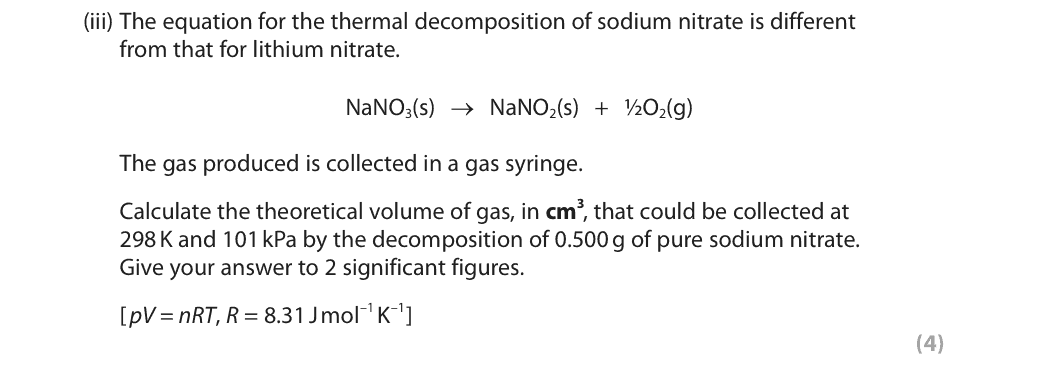
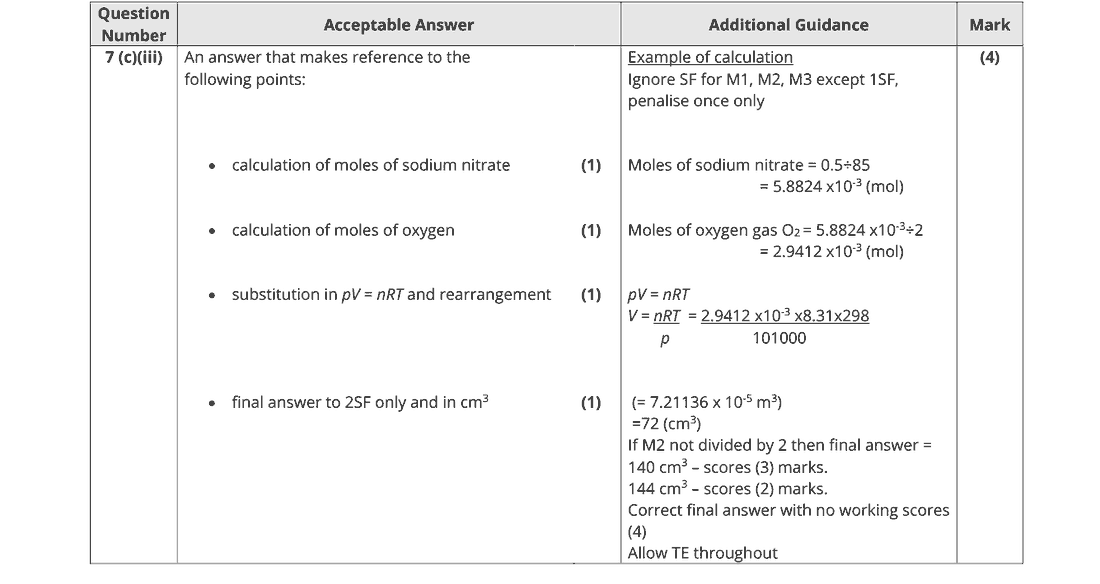
7(c)(iii) Formulae, equations and amounts of substance 4Calculation
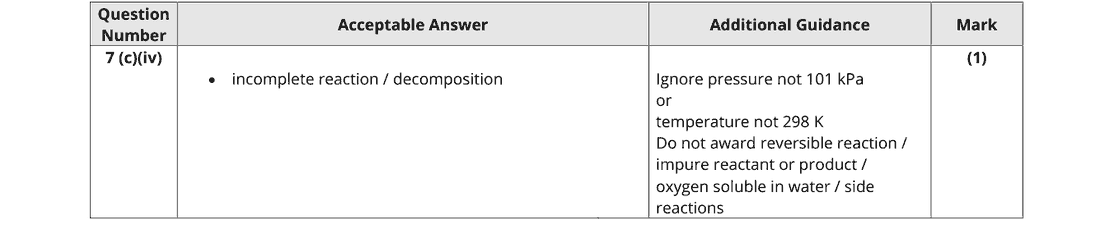
7(c)(iv) Formulae, equations and amounts of substance 1Practical and data analysis
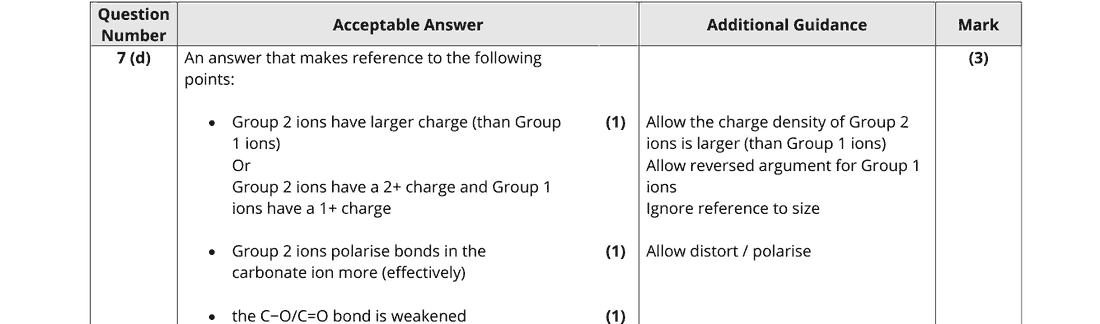
7(d) The elements of Groups 1 and 2 3Explanation
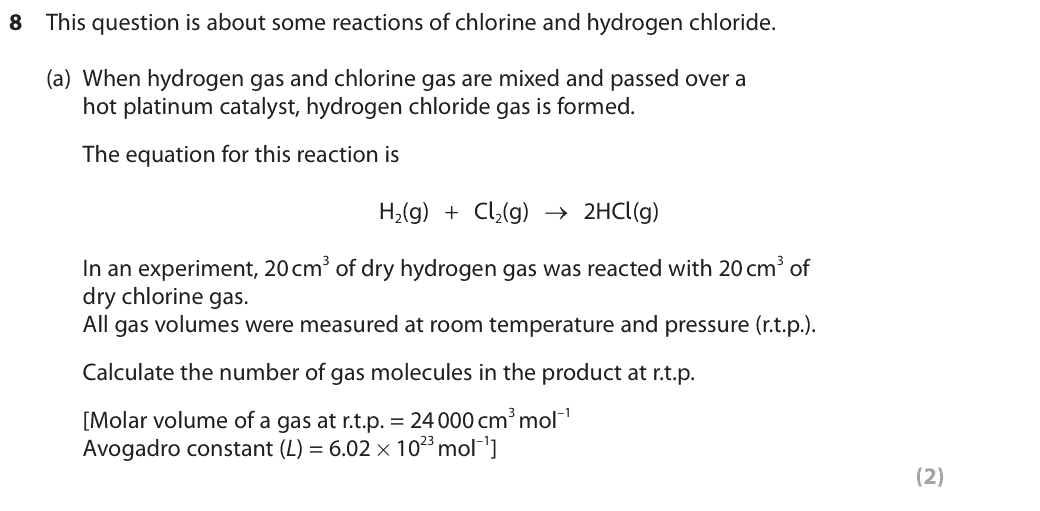
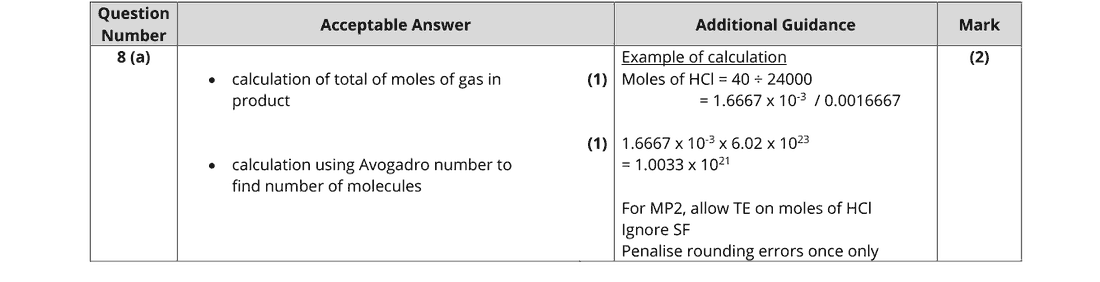
8(a) Formulae, equations and amounts of substance 2Calculation
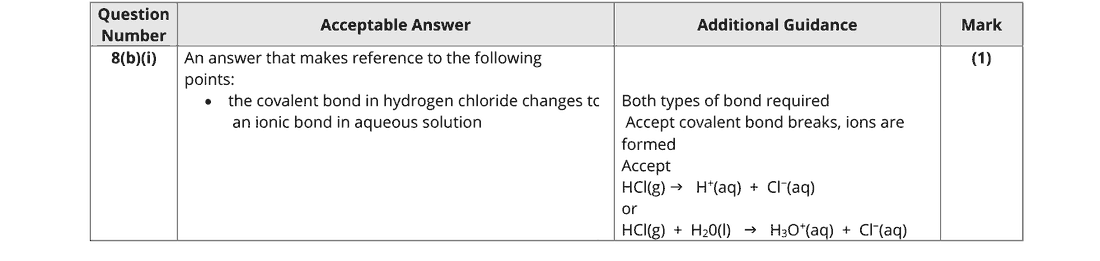
8(b)(i) The elements of Group 7 (halogens) 1Short answer
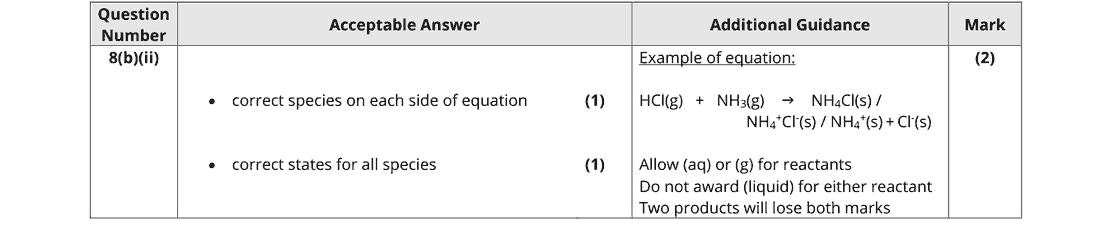
8(b)(ii) The elements of Group 7 (halogens) 2Equation writing
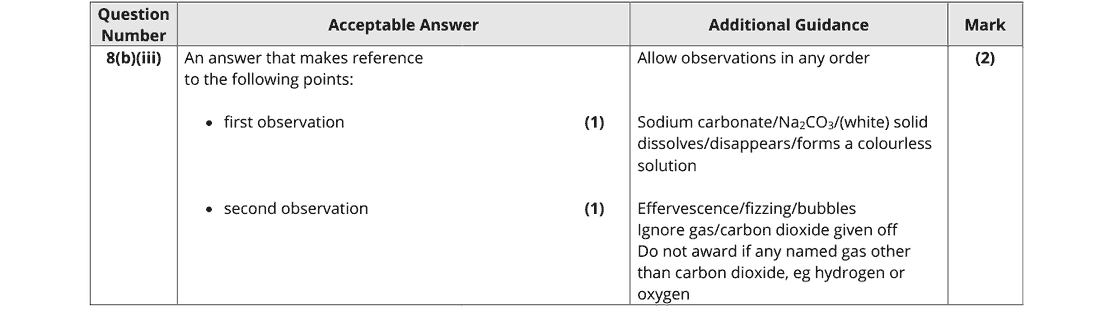
8(b)(iii) Formulae, equations and amounts of substance, Analysis of inorganic compounds 2Practical and data analysis
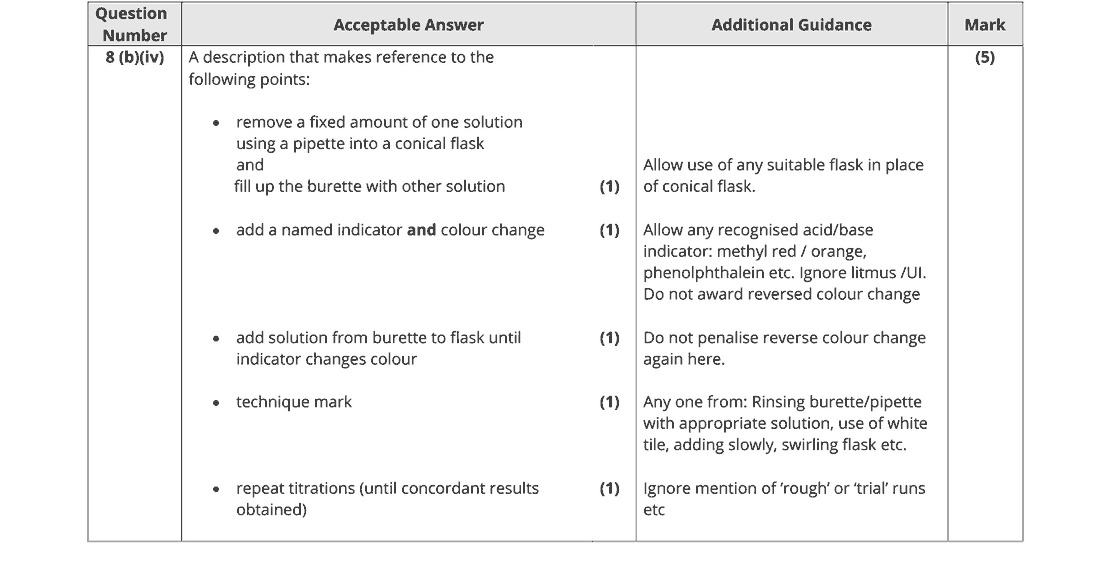
8(b)(iv) Formulae, equations and amounts of substance 5Practical and data analysis
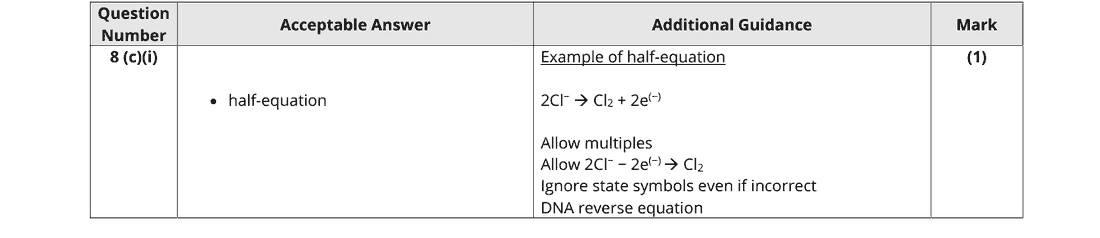
8(c)(i) Redox I 1Equation writing
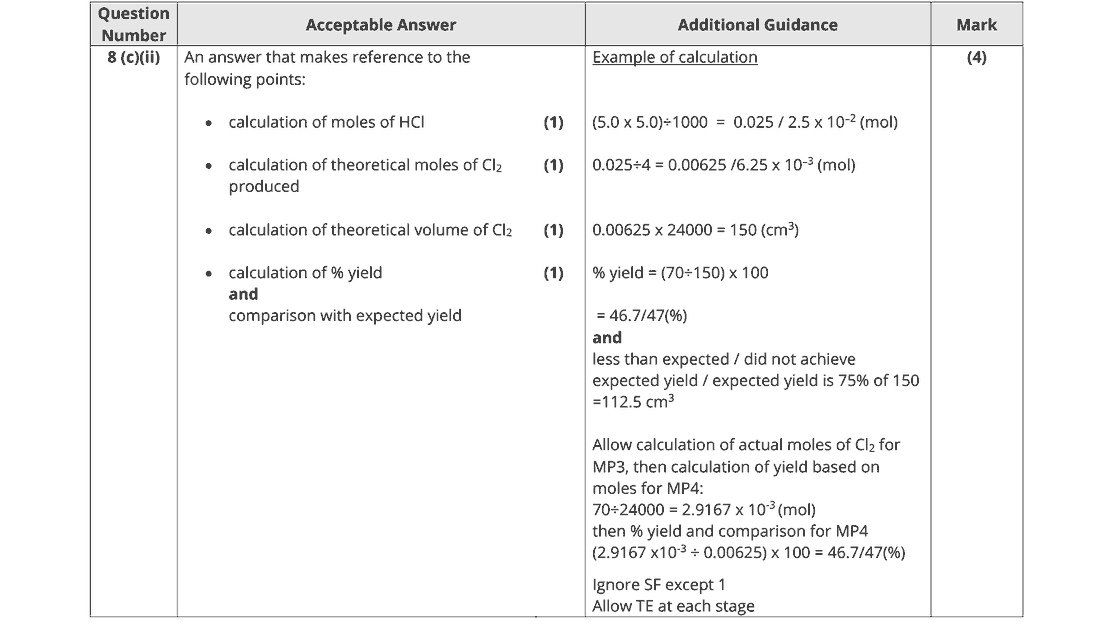
8(c)(ii) Formulae, equations and amounts of substance 4Calculation
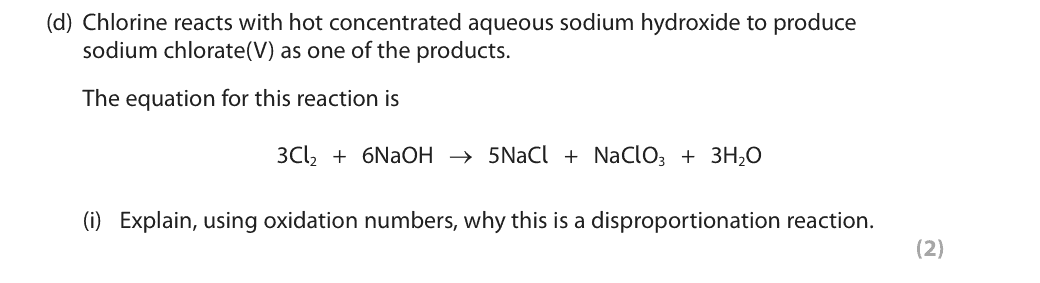
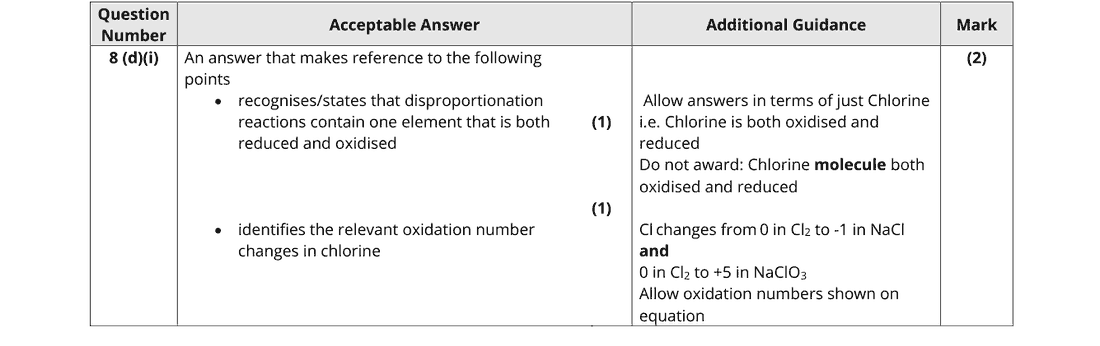
8(d)(i) Redox I 2Explanation
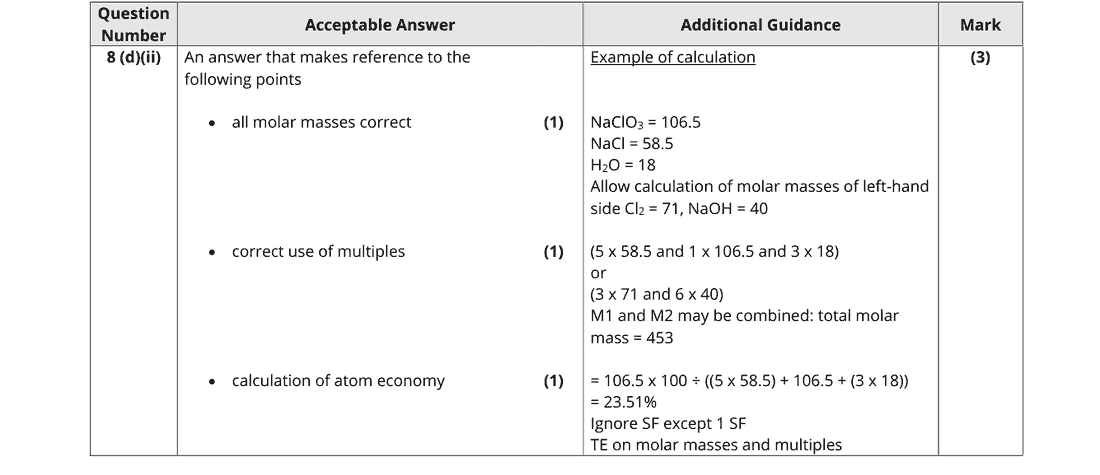
8(d)(ii) Formulae, equations and amounts of substance 3Calculation
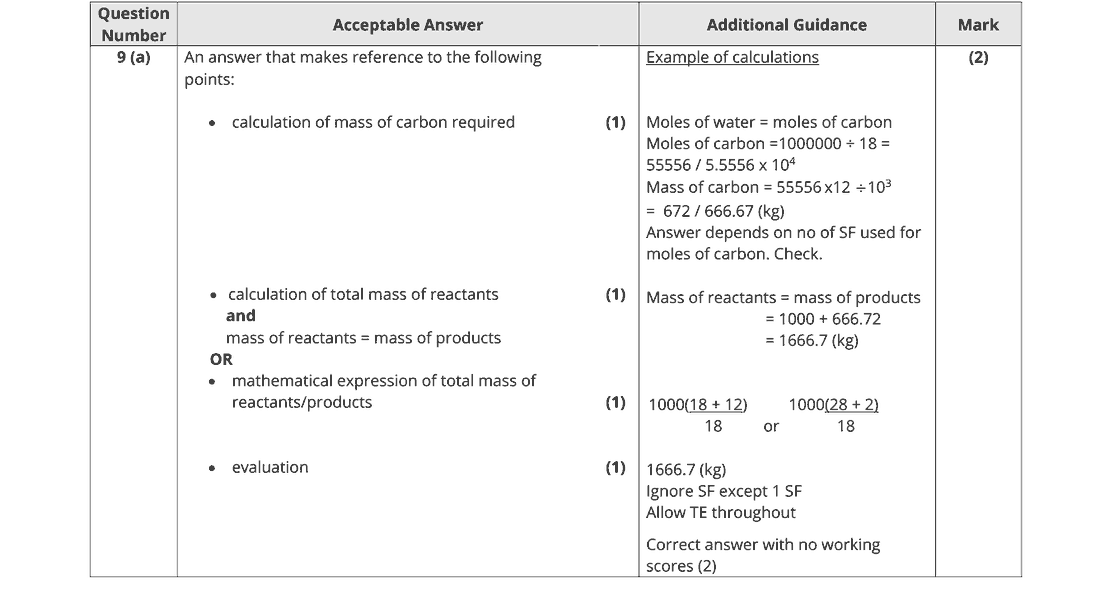
9(a) Formulae, equations and amounts of substance 2Calculation
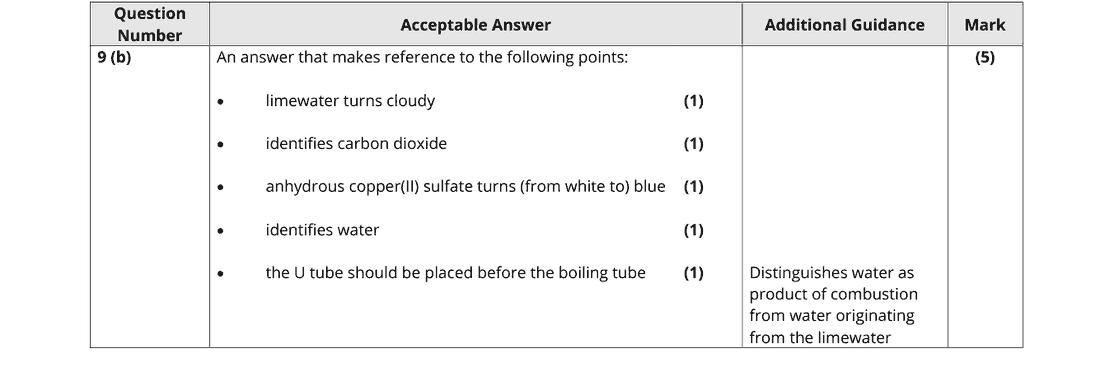
9(b) Formulae, equations and amounts of substance 5Practical and data analysis

The questions

123(a)3(b)3(c)3(d)(i)3(d)(ii)4(a)4(b)(i)4(b)(ii)4(b)(iii)4(c)(i)4(c)(ii)4(d)5(a)5(b)5(c)6(a)6(b)6(c)7(a)7(b)7(c)(i)7(c)(ii)7(c)(iii)7(c)(iv)7(d)8(a)8(b)(i)8(b)(ii)8(b)(iii)8(b)(iv)8(c)(i)8(c)(ii)8(d)(i)8(d)(ii)9(a)9(b)
June 2022 · AS Paper 1 · Q1 1 mark Multiple choice atomic structure and the periodic table
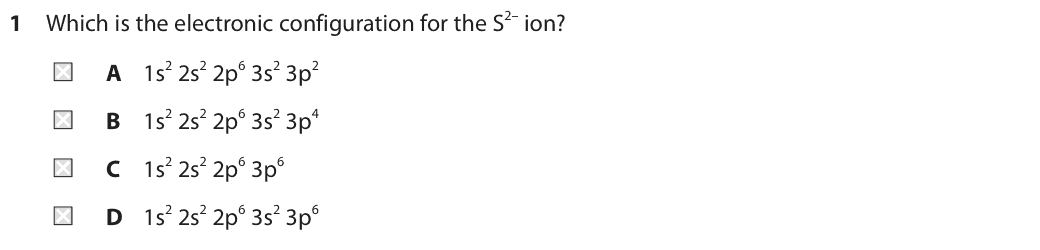
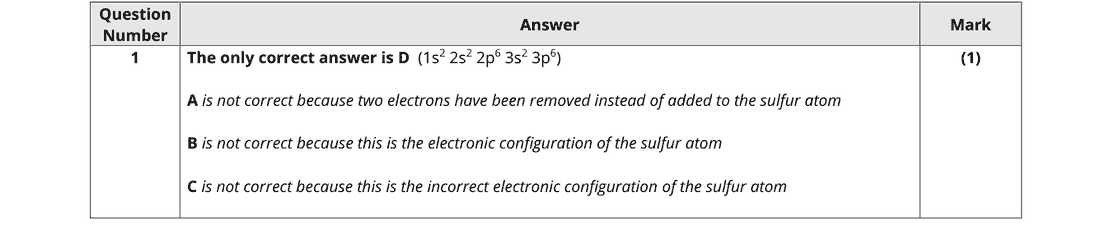
Which is the electronic configuration for the S2– ion?
A  1s2 2s2 2p6 3s2 3p2
B  1s2 2s2 2p6 3s2 3p4
C  1s2 2s2 2p6 3p6
D  1s2 2s2 2p6 3s2 3p6
June 2022 · AS Paper 1 · Q2 1 mark Multiple choice atomic structure and the periodic table
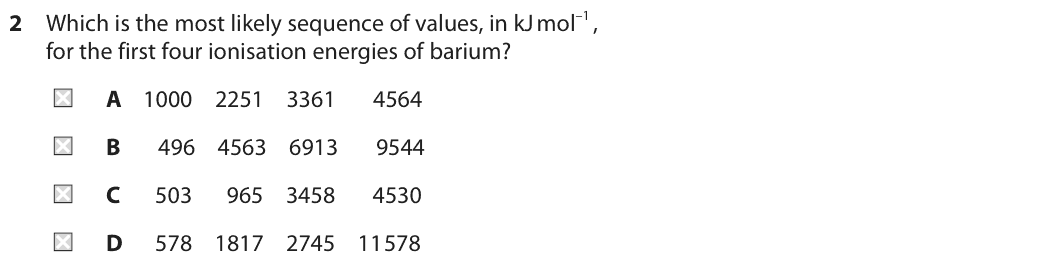
Which is the most likely sequence of values, in kJ mol–1 ,
for the first four ionisation energies of barium?
A  1000    2251    3361       4564
B     496    4563    6913       9544
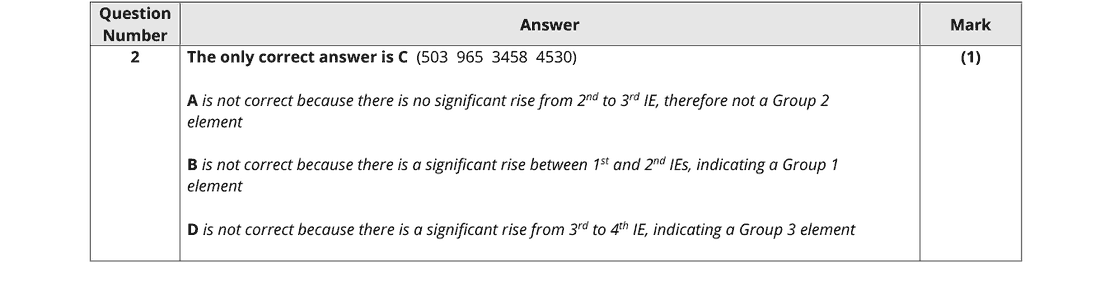
C    503      965    3458       4530
D    578    1817    2745    11 578
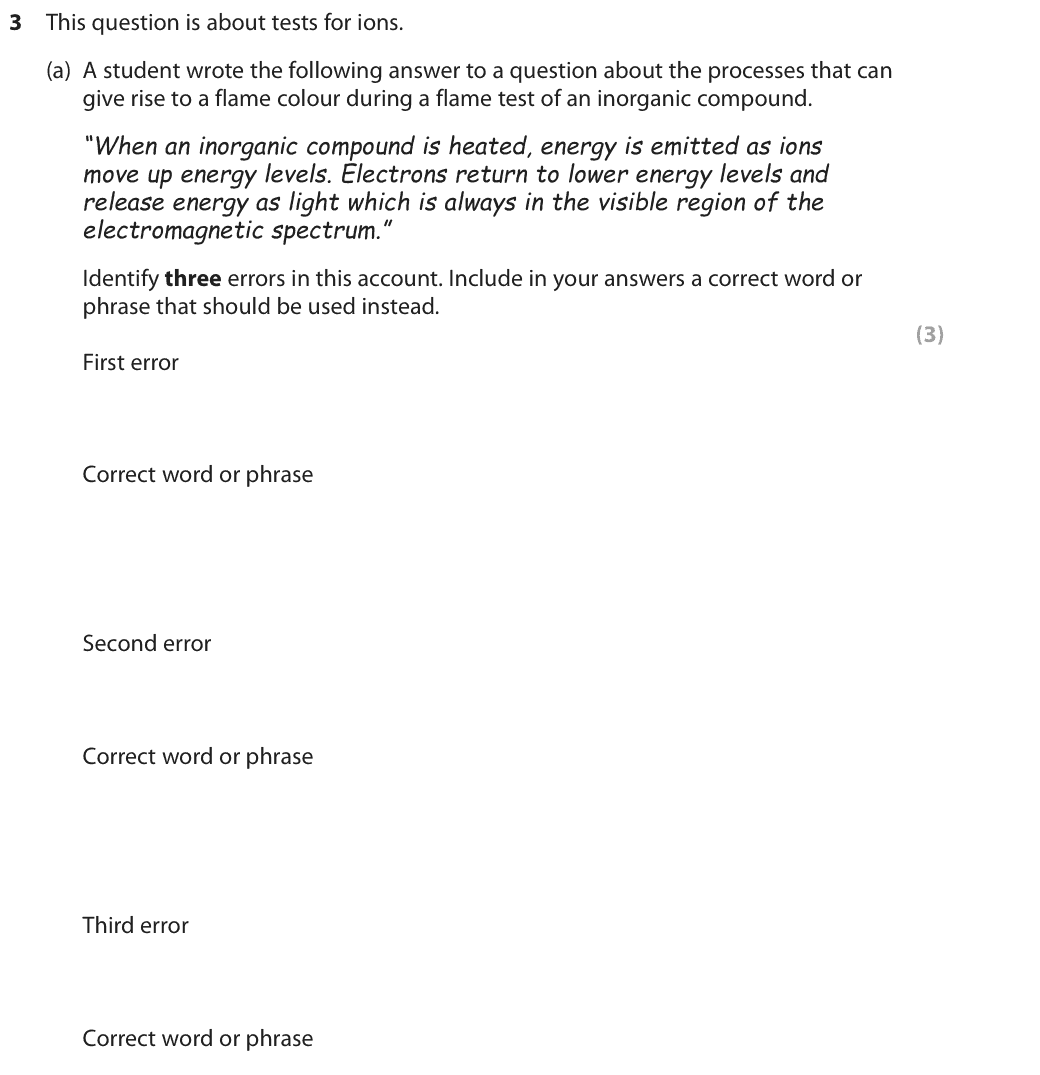
June 2022 · AS Paper 1 · Q3(a) 3 marks Short answer groups 1 and 2
This question is about tests for ions.
A student wrote the following answer to a question about the processes that can
give rise to a flame colour during a flame test of an inorganic compound.
“When an inorganic compound is heated, energy is emitted as ions
move up energy levels. Electrons return to lower energy levels and
release energy as light which is always in the visible region of the
electromagnetic spectrum.”
Identify three errors in this account. Include in your answers a correct word or
phrase that should be used instead.
First error
Correct word or phrase
Second error
Correct word or phrase
Third error
Correct word or phrase
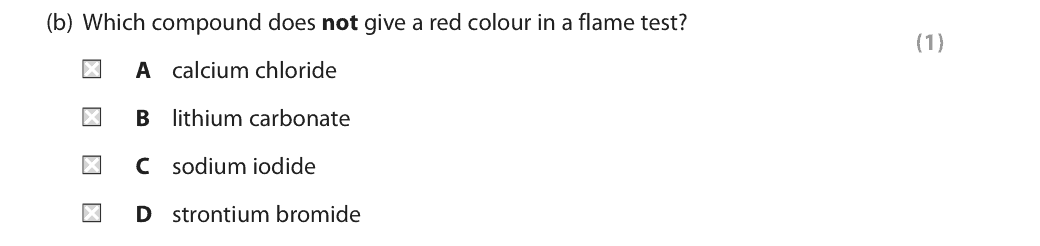
June 2022 · AS Paper 1 · Q3(b) 1 mark Multiple choice groups 1 and 2
Which compound does not give a red colour in a flame test?
A  calcium chloride
B  lithium carbonate
C  sodium iodide
D  strontium bromide
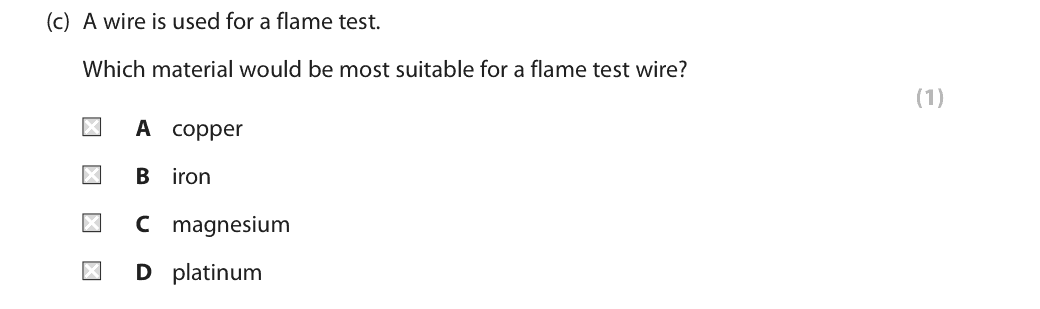
June 2022 · AS Paper 1 · Q3(c) 1 mark Multiple choice groups 1 and 2
A wire is used for a flame test.
Which material would be most suitable for a flame test wire?
A  copper
B  iron
C  magnesium
D  platinum
June 2022 · AS Paper 1 · Q3(d)(i) 1 mark Short answer group 7 the halogens
An aqueous solution is suspected to be potassium bromide and is tested for the
presence of the anion.
Write the name of the reagent used to test for the anion.
June 2022 · AS Paper 1 · Q3(d)(ii) 2 marks Practical and data analysis group 7 the halogens
Earlier parts of question 3 that this part usesEarlier part of June 2022 Paper 1 question 3Earlier part of June 2022 Paper 1 question 3
State the expected result of this test and the formula of the product.
Result of test
Formula of the product
June 2022 · AS Paper 1 · Q4(a) 1 mark Multiple choice atomic structure and the periodic table
This question is about isotopes, mass spectra and hydrocarbons.
Hydrogen has three isotopes, 1H, 2H and 3H.
Which is the correct number of subatomic particles in 3H?
Number of subatomic particles
Protons
Neutrons
Electrons
A
2
1
2
B
1
2
0
C
1
2
1
D
2
1
3
June 2022 · AS Paper 1 · Q4(b)(i) 2 marks Calculation atomic structure and the periodic table
Earlier part of question 4 that this part usesEarlier part of June 2022 Paper 1 question 4
The diagram shows the mass spectrum of a sample of chlorine with
one peak missing.
Chlorine has two isotopes, 35Cl and 37Cl, and a relative atomic mass of 35.5
70
100
35
80
72
Relative
60
intensity
40
20
74
0
30
35
40
45
50
55
60
65
70
75
m / z
The relative abundance of the isotope 35Cl is 75.5 %.
The relative peak height of this isotope is 82.5 in the mass spectrum.
Calculate the relative peak height of the missing peak caused by the
isotope 37Cl.
June 2022 · AS Paper 1 · Q4(b)(ii) 1 mark Short answer atomic structure and the periodic table
Earlier parts of question 4 that this part usesEarlier part of June 2022 Paper 1 question 4Earlier part of June 2022 Paper 1 question 4
Give a reason for the presence of the three peaks at 70, 72 and 74.
June 2022 · AS Paper 1 · Q4(b)(iii) 3 marks Calculation atomic structure and the periodic table
Earlier parts of question 4 that this part usesEarlier part of June 2022 Paper 1 question 4Earlier part of June 2022 Paper 1 question 4
Explain, using calculations, why there is an approximate ratio of 9 : 6 : 1 for the
peak heights corresponding to the m / z values of 70, 72 and 74.
June 2022 · AS Paper 1 · Q4(c)(i) 1 mark Short answer atomic structure and the periodic table
Earlier part of question 4 that this part usesEarlier part of June 2022 Paper 1 question 4
The mass spectrum of a hydrocarbon, B, which has a molecular formula CxHy ,
is shown.
Determine the relative molecular mass of compound B.
100
80
60
Relative
intensity
40
20
0
25
50
75
100
125
150
175
m / z
Relative molecular mass of compound B is
June 2022 · AS Paper 1 · Q4(c)(ii) 1 mark Short answer atomic structure and the periodic tableformulae equations and amounts of substance
Earlier parts of question 4 that this part usesEarlier part of June 2022 Paper 1 question 4Earlier part of June 2022 Paper 1 question 4
Deduce the molecular formula of hydrocarbon B.
June 2022 · AS Paper 1 · Q4(d) 4 marks Calculation formulae equations and amounts of substance
1.00 g of a different hydrocarbon, W, was burnt in oxygen.
Analysis of the combustion products showed that complete combustion
produced 3.14 g of carbon dioxide and 1.29 g of water.
Water and carbon dioxide were the only products of combustion.
Calculate the empirical formula of hydrocarbon W.
You must show your working.
June 2022 · AS Paper 1 · Q5(a) 1 mark Short answer bonding
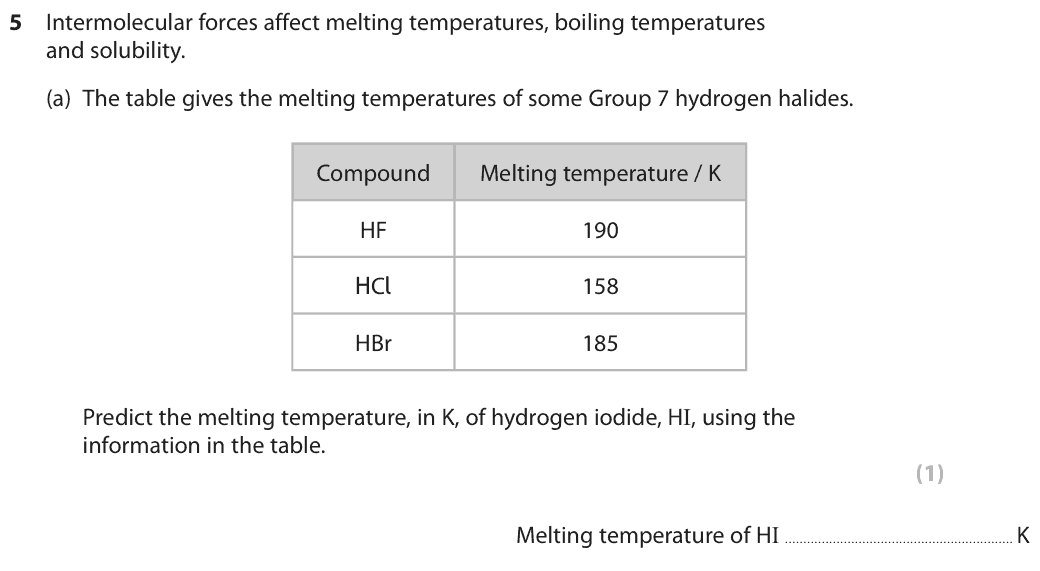
Intermolecular forces affect melting temperatures, boiling temperatures
and solubility.
The table gives the melting temperatures of some Group 7 hydrogen halides.
Compound
Melting temperature / K
HF
190
HCl
158
HBr
185
Predict the melting temperature, in K, of hydrogen iodide, HI, using the
information in the table.
Melting temperature of HI  K
June 2022 · AS Paper 1 · Q5(b) 1 mark Multiple choice bonding
Earlier part of question 5 that this part usesEarlier part of June 2022 Paper 1 question 5
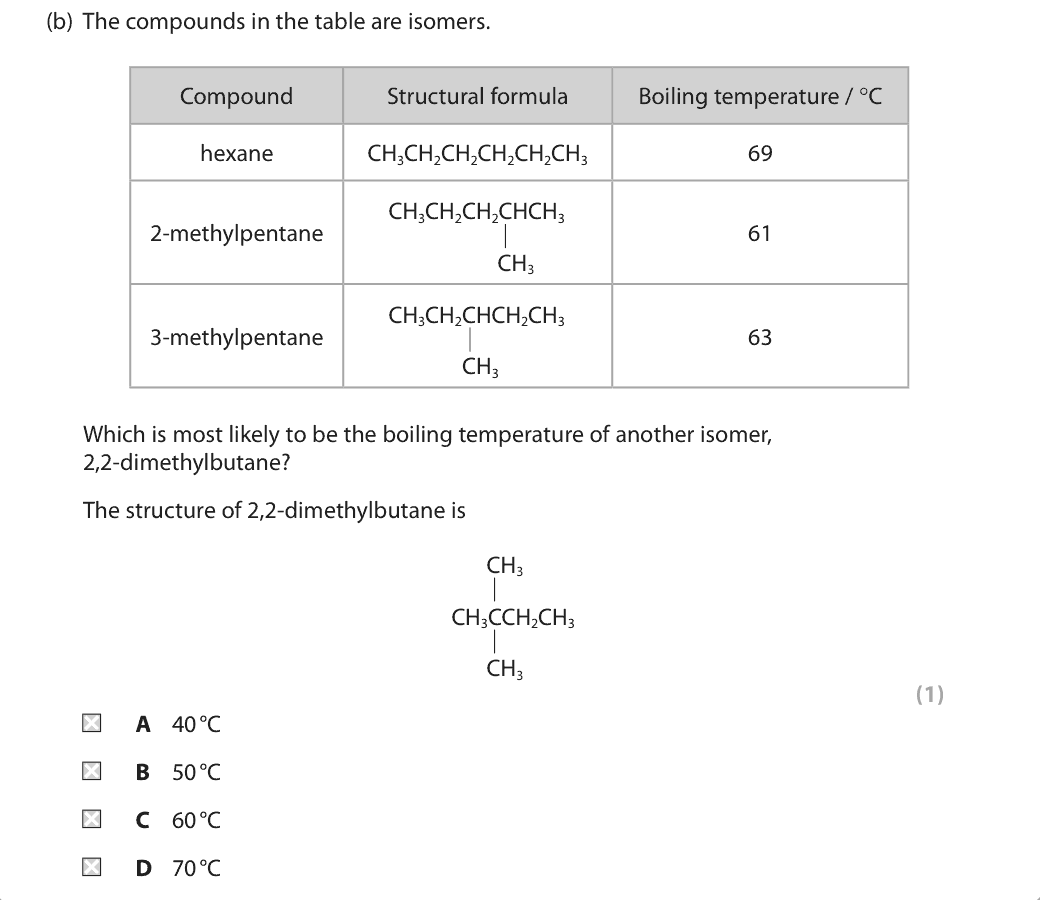
The compounds in the table are isomers.
Compound
Structural formula
Boiling temperature / °C
hexane
CH3CH2CH2CH2CH2CH3
69
CH3CH2CH2CHCH3
2‑methylpentane
61
CH3
CH3CH2CHCH2CH3
3‑methylpentane
63
CH3
Which is most likely to be the boiling temperature of another isomer,
2,2‑dimethylbutane?
The structure of 2,2‑dimethylbutane is
CH3
CH3CCH2CH3
CH3
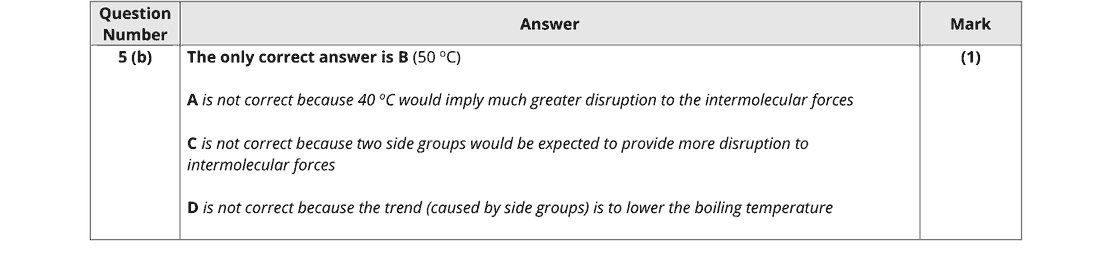
A  40 °C
B  50 °C
C  60 °C
D  70 °C
June 2022 · AS Paper 1 · Q5(c) 6 marks 6-mark extended response bonding
Earlier part of question 5 that this part usesEarlier part of June 2022 Paper 1 question 5
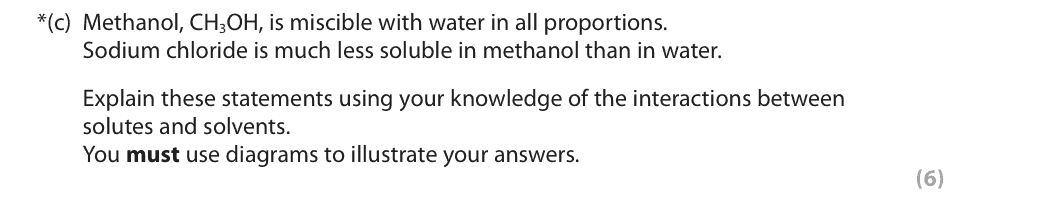
Methanol, CH3OH, is miscible with water in all proportions.
Sodium chloride is much less soluble in methanol than in water.
Explain these statements using your knowledge of the interactions between
solutes and solvents.
You must use diagrams to illustrate your answers.
June 2022 · AS Paper 1 · Q6(a) 2 marks Short answer Hard structure
The table shows some information about the structure and bonding in
four substances.
Complete the table.
Substance
Structure
Bonding
Melting temperature / K
silicon(IV) oxide
giant
covalent
1883
potassium chloride
1043
iron
metallic
1808
iodine
covalent
387
June 2022 · AS Paper 1 · Q6(b) 3 marks Explanation structure
Earlier part of question 6 that this part usesEarlier part of June 2022 Paper 1 question 6
Explain why the melting temperature of silicon(IV) oxide is much higher than that
of iodine, even though the bonding in both is covalent.
June 2022 · AS Paper 1 · Q6(c) 3 marks Explanation structure
Earlier part of question 6 that this part usesEarlier part of June 2022 Paper 1 question 6
Iron and potassium chloride both conduct electricity when molten. However, only
iron conducts electricity when solid.
Explain these observations.

June 2022 · AS Paper 1 · Q7(a) 1 mark Multiple choice atomic structure and the periodic table
This question is about s‑block elements and some of their compounds.
Which list contains only s‑block elements?
A  Li, Na, Mg and Cl
B  K, Ca, Co and Rb
C  Mg, Al, Sr and Ba
D  Be, Rb, Ba and Ra
June 2022 · AS Paper 1 · Q7(b) 1 mark Multiple choice groups 1 and 2
Earlier part of question 7 that this part usesEarlier part of June 2022 Paper 1 question 7
Which pair of statements describes the trends down Group 2?
Solubility of
Solubility of
sulfates
hydroxides
A
increases
increases
B
decreases
increases
C
decreases
decreases
D
increases
decreases
June 2022 · AS Paper 1 · Q7(c)(i) 1 mark Diagram or structure Hard bonding
Earlier part of question 7 that this part usesEarlier part of June 2022 Paper 1 question 7
The s-block nitrates undergo thermal decomposition.
Draw a dot‑and‑cross diagram for the nitrate(V) ion, NO3
–, showing
outer electrons only.
–
O
N
O
O
June 2022 · AS Paper 1 · Q7(c)(ii) 1 mark Equation writing groups 1 and 2
Earlier part of question 7 that this part usesEarlier part of June 2022 Paper 1 question 7
Write an equation for the thermal decomposition of lithium nitrate.
State symbols are not required.
June 2022 · AS Paper 1 · Q7(c)(iii) 4 marks Calculation formulae equations and amounts of substance
Earlier parts of question 7 that this part usesEarlier part of June 2022 Paper 1 question 7Earlier part of June 2022 Paper 1 question 7Earlier part of June 2022 Paper 1 question 7
The equation for the thermal decomposition of sodium nitrate is different
from that for lithium nitrate.
NaNO3(s)   →   NaNO2(s)   +   ½O2(g)
The gas produced is collected in a gas syringe.
Calculate the theoretical volume of gas, in cm3, that could be collected at
298 K and 101 kPa by the decomposition of 0.500 g of pure sodium nitrate.
Give your answer to 2 significant figures.
[pV = nRT, R = 8.31 J mol–1 K–1]
June 2022 · AS Paper 1 · Q7(c)(iv) 1 mark Practical and data analysis formulae equations and amounts of substance
Earlier parts of question 7 that this part usesEarlier part of June 2022 Paper 1 question 7Earlier part of June 2022 Paper 1 question 7
State one reason why the experimental gas volume may differ from the
calculated theoretical volume.
Assume that no gas escapes and measurements have been made accurately.
June 2022 · AS Paper 1 · Q7(d) 3 marks Explanation groups 1 and 2
A textbook states, ‘The thermal stability of Group 1 carbonates is generally higher
than the thermal stability of Group 2 carbonates in the same period’.
Explain why Group 1 carbonates are more thermally stable than
Group 2 carbonates.
June 2022 · AS Paper 1 · Q8(a) 2 marks Calculation formulae equations and amounts of substance
This question is about some reactions of chlorine and hydrogen chloride.
When hydrogen gas and chlorine gas are mixed and passed over a
hot platinum catalyst, hydrogen chloride gas is formed.
The equation for this reaction is
H2(g)   +   Cl2(g)   →   2HCl(g)
In an experiment, 20 cm3 of dry hydrogen gas was reacted with 20 cm3 of
dry chlorine gas.
All gas volumes were measured at room temperature and pressure (r.t.p.).
Calculate the number of gas molecules in the product at r.t.p.
[Molar volume of a gas at r.t.p. = 24 000 cm3 mol–1
Avogadro constant (L) = 6.02 × 1023 mol–1]
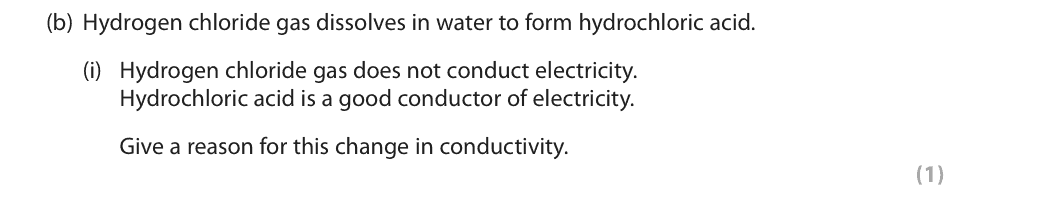
June 2022 · AS Paper 1 · Q8(b)(i) 1 mark Short answer Hard group 7 the halogens
Hydrogen chloride gas dissolves in water to form hydrochloric acid.
Hydrogen chloride gas does not conduct electricity.
Hydrochloric acid is a good conductor of electricity.
Give a reason for this change in conductivity.
June 2022 · AS Paper 1 · Q8(b)(ii) 2 marks Equation writing group 7 the halogens
Earlier part of question 8 that this part usesEarlier part of June 2022 Paper 1 question 8
When concentrated hydrochloric acid on a glass rod is held above a
concentrated ammonia solution, a white smoke is observed.
Write an equation, including state symbols, for the reaction that produces the
white smoke.
June 2022 · AS Paper 1 · Q8(b)(iii) 2 marks Practical and data analysis formulae equations and amounts of substanceanalysis of inorganic compounds
Earlier part of question 8 that this part usesEarlier part of June 2022 Paper 1 question 8
Hydrochloric acid is added to a test tube containing a sample of
solid sodium carbonate.
Give two observations.
June 2022 · AS Paper 1 · Q8(b)(iv) 5 marks Practical and data analysis formulae equations and amounts of substance
Earlier part of question 8 that this part usesEarlier part of June 2022 Paper 1 question 8
Describe an experiment to enable you to accurately determine the
concentration of an approximately 1 mol dm–3 solution of hydrochloric acid,
using a solution of sodium hydroxide of concentration 1.00 mol dm–3.
Details of the calculation are not required.
June 2022 · AS Paper 1 · Q8(c)(i) 1 mark Equation writing redox i
Earlier part of question 8 that this part usesEarlier part of June 2022 Paper 1 question 8
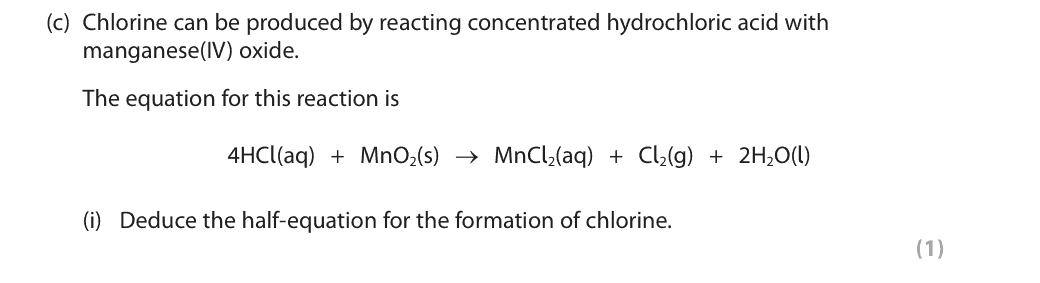
Chlorine can be produced by reacting concentrated hydrochloric acid with
manganese(IV) oxide.
The equation for this reaction is
4HCl(aq)   +   MnO2(s)   →   MnCl2(aq)   +   Cl2(g)   +   2H2O(l)
Deduce the half‑equation for the formation of chlorine.
June 2022 · AS Paper 1 · Q8(c)(ii) 4 marks Calculation formulae equations and amounts of substance
Earlier parts of question 8 that this part usesEarlier part of June 2022 Paper 1 question 8Earlier part of June 2022 Paper 1 question 8
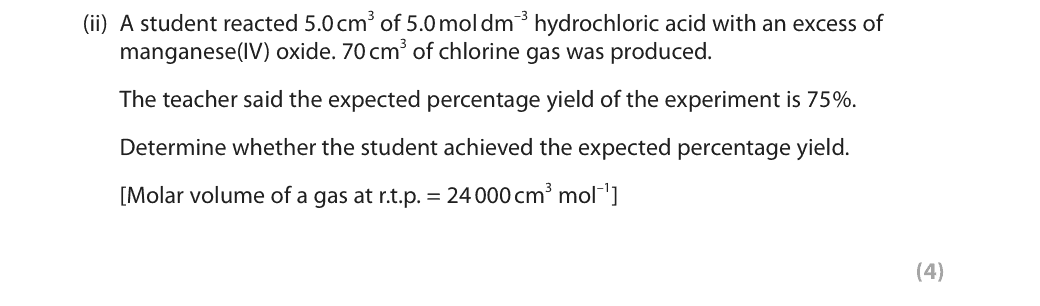
A student reacted 5.0 cm3 of 5.0 mol dm–3 hydrochloric acid with an excess of
manganese(IV) oxide. 70 cm3 of chlorine gas was produced.
The teacher said the expected percentage yield of the experiment is 75 %.
Determine whether the student achieved the expected percentage yield.
[Molar volume of a gas at r.t.p. = 24 000 cm3 mol–1]
June 2022 · AS Paper 1 · Q8(d)(i) 2 marks Explanation redox i
Earlier part of question 8 that this part usesEarlier part of June 2022 Paper 1 question 8
Chlorine reacts with hot concentrated aqueous sodium hydroxide to produce
sodium chlorate(V) as one of the products.
The equation for this reaction is
3Cl2   +   6NaOH   →   5NaCl   +   NaClO3   +   3H2O
Explain, using oxidation numbers, why this is a disproportionation reaction.
June 2022 · AS Paper 1 · Q8(d)(ii) 3 marks Calculation formulae equations and amounts of substance
Earlier parts of question 8 that this part usesEarlier part of June 2022 Paper 1 question 8Earlier part of June 2022 Paper 1 question 8
Calculate the atom economy, by mass, of sodium chlorate(V) in this reaction.
June 2022 · AS Paper 1 · Q9(a) 2 marks Calculation formulae equations and amounts of substance
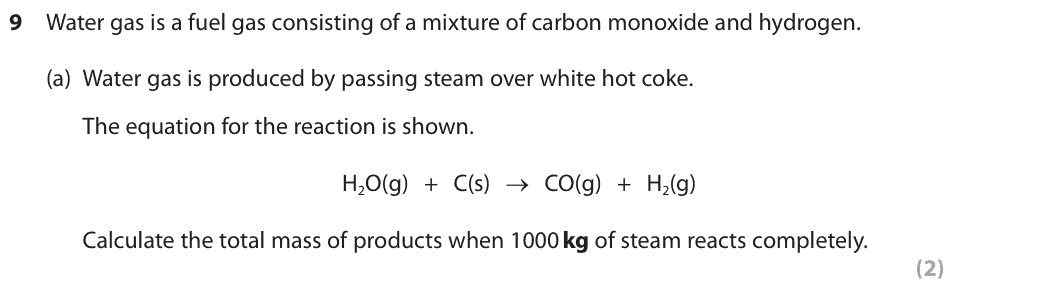
Water gas is a fuel gas consisting of a mixture of carbon monoxide and hydrogen.
Water gas is produced by passing steam over white hot coke.
The equation for the reaction is shown.
H2O(g)   +   C(s)   →   CO(g)   +   H2(g)
Calculate the total mass of products when 1000 kg of steam reacts completely.
June 2022 · AS Paper 1 · Q9(b) 5 marks Practical and data analysis Hard formulae equations and amounts of substance
Earlier part of question 9 that this part usesEarlier part of June 2022 Paper 1 question 9
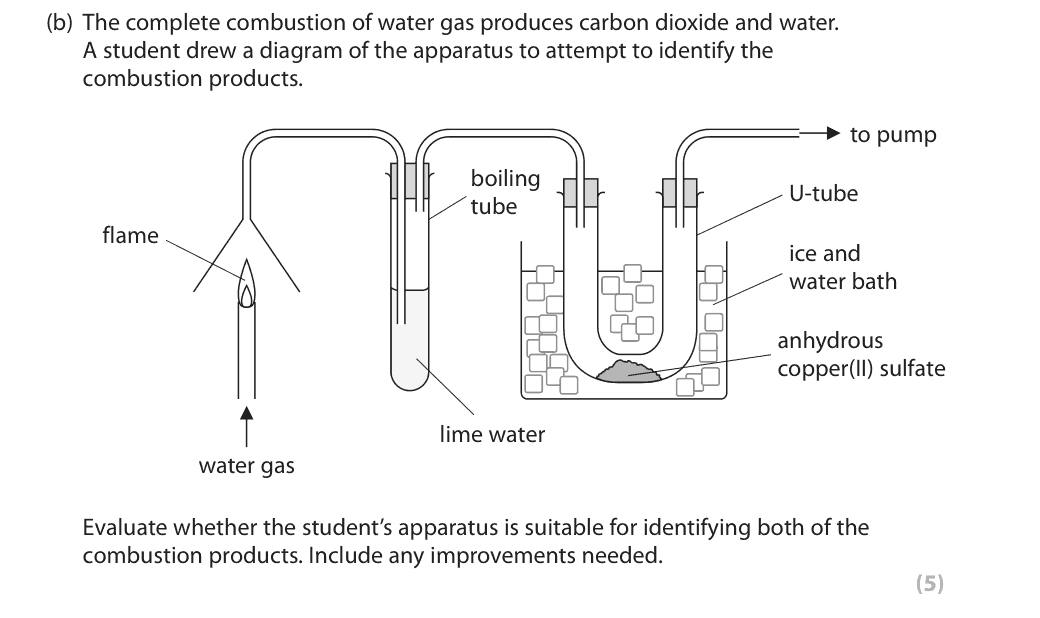
The complete combustion of water gas produces carbon dioxide and water.
A student drew a diagram of the apparatus to attempt to identify the
combustion products.
to pump
boiling
U-tube
tube
flame
ice and
water bath
anhydrous
copper(II) sulfate
lime water
water gas
Evaluate whether the student’s apparatus is suitable for identifying both of the
combustion products. Include any improvements needed.

Work with an A-level chemistry tutor

Want a paper marked and gone through with you? Message us.

Prefer email? Send an enquiry

If you are under 18, please include a parent's contact details. Enquiries go to enquiries@chemistryaleveltutor.com and are deleted once handled. All tutoring is online.