June 2017: AS Paper 1, Core Inorganic and Physical Chemistry

80 marks · 41 question parts · Paper, mark scheme and report on Edexcel's site · Have the Data Booklet beside you

Question by question

QTopicMarksAOType
1(a)(i) The elements of Groups 1 and 2 2Practical and data analysis
1(a)(ii) The elements of Groups 1 and 2 1Multiple choice
1(a)(iii) The elements of Groups 1 and 2 1Multiple choice
1(b) The elements of Groups 1 and 2, Analysis of inorganic compounds 2Short answer
2(a)(i) Bonding 1Multiple choice
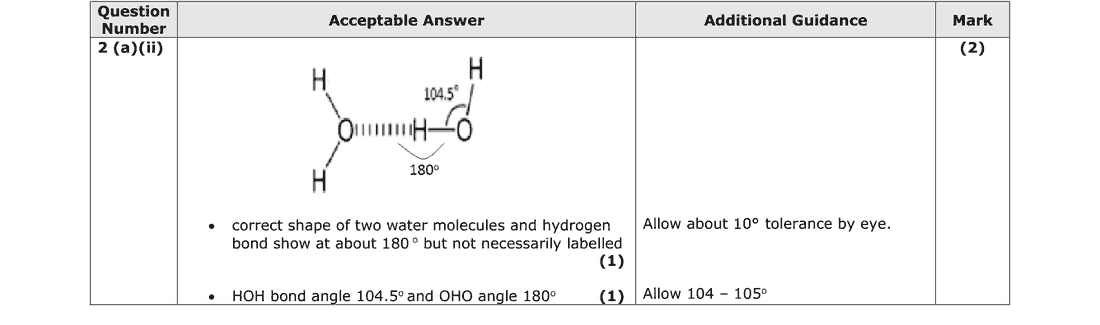
2(a)(ii) Bonding 2Diagram or structure
2(a)(iii) Bonding 2Explanation
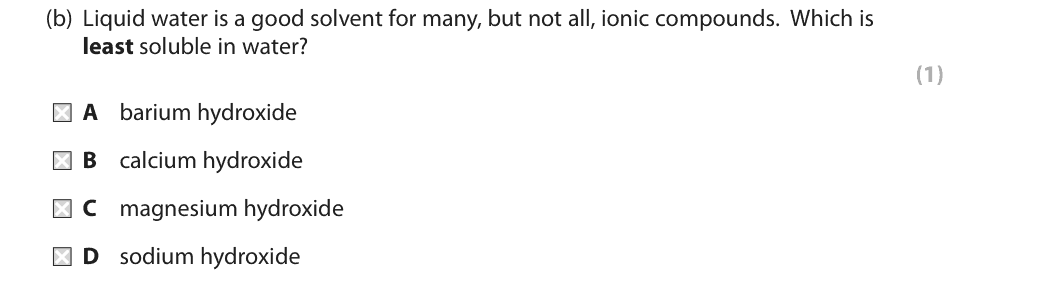
2(b) The elements of Groups 1 and 2 1Multiple choice
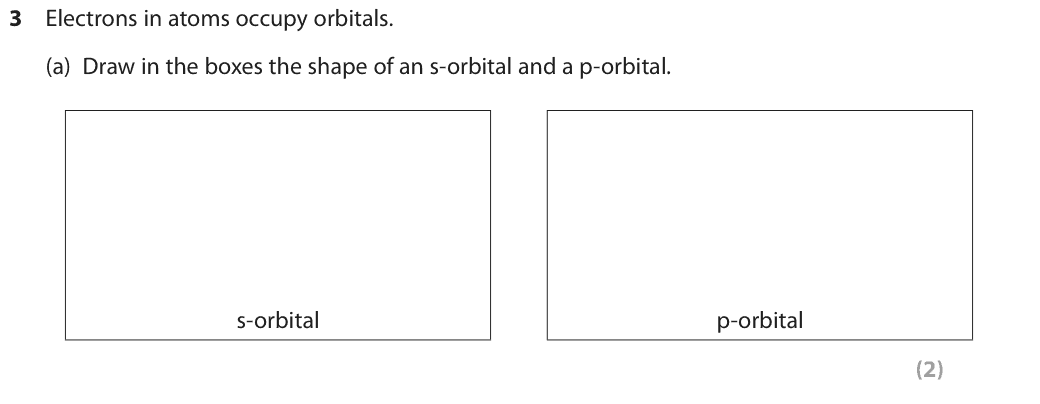
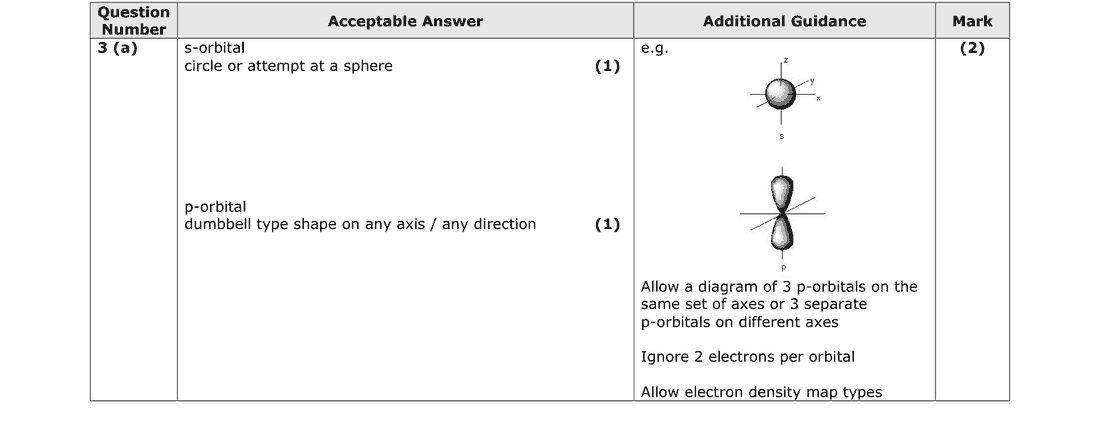
3(a) Atomic structure and the Periodic Table 2Diagram or structure
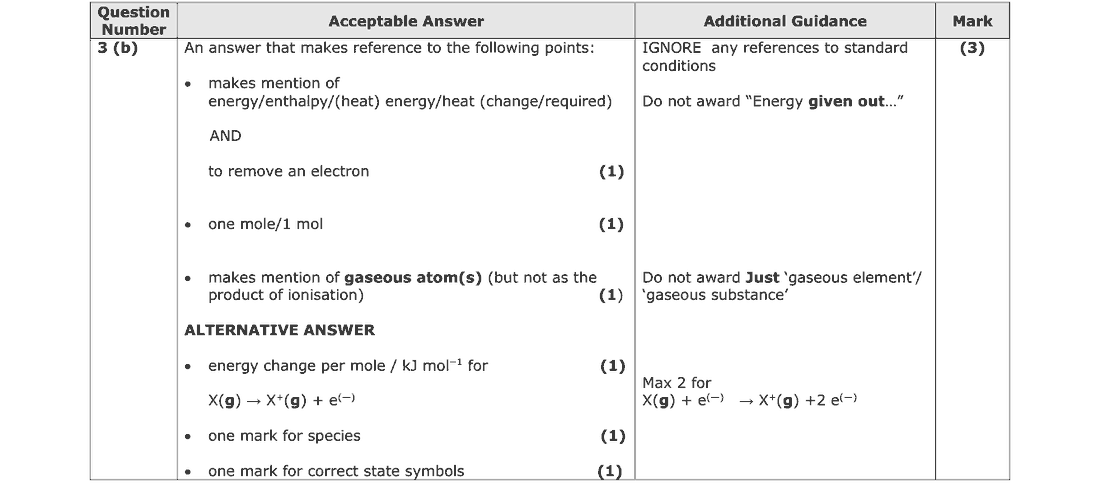
3(b) Atomic structure and the Periodic Table 3Short answer
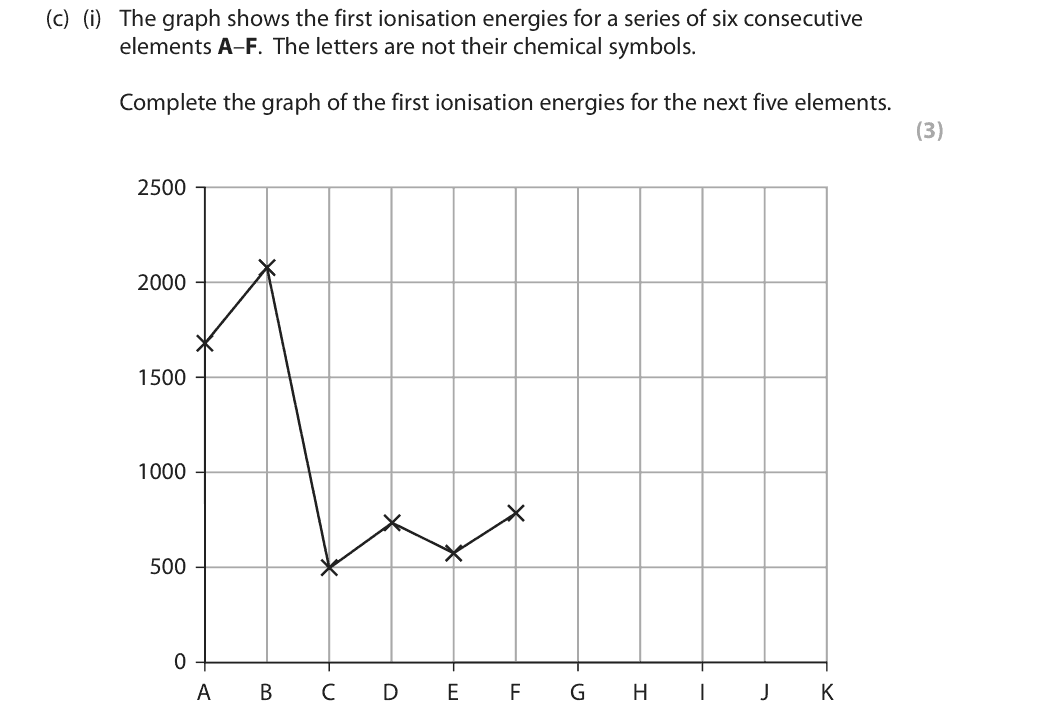
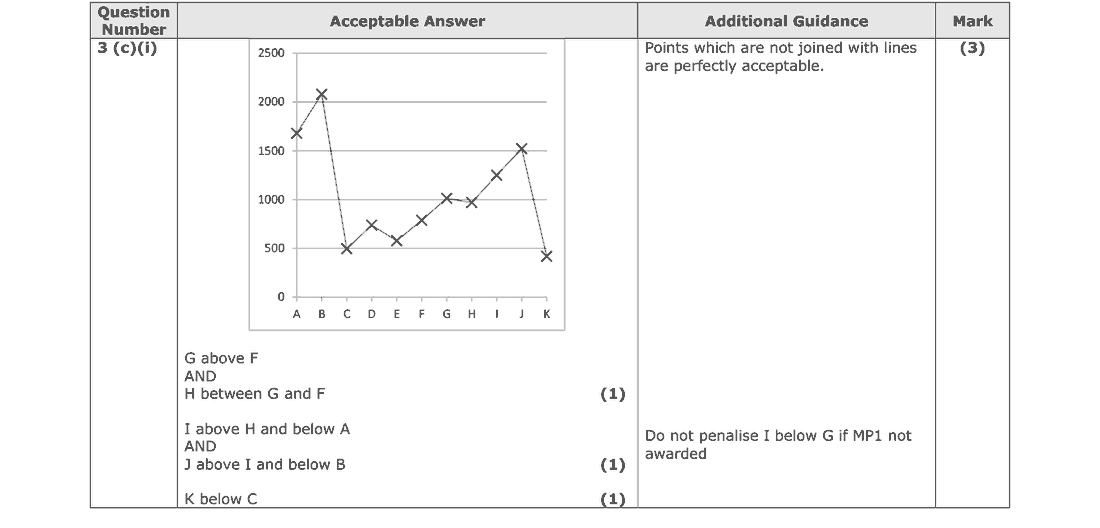
3(c)(i) Atomic structure and the Periodic Table 3Diagram or structure
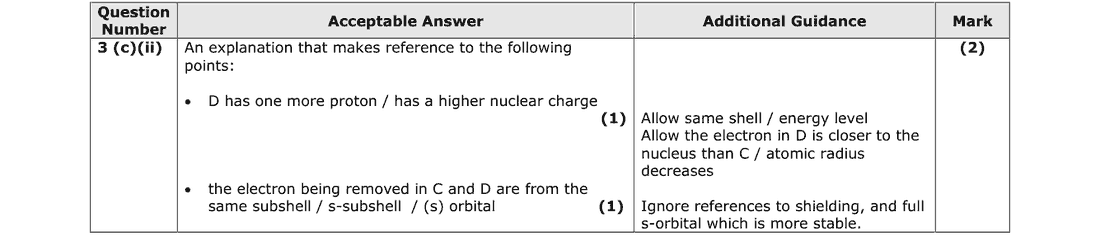
3(c)(ii) Atomic structure and the Periodic Table 2Explanation
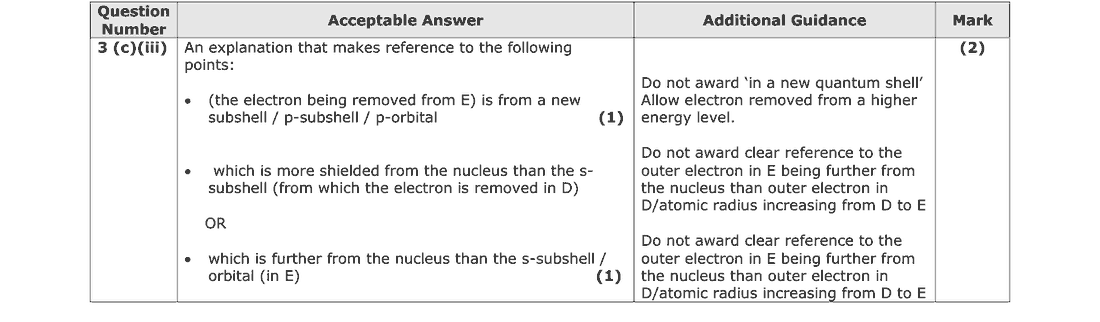
3(c)(iii) Atomic structure and the Periodic Table 2Explanation
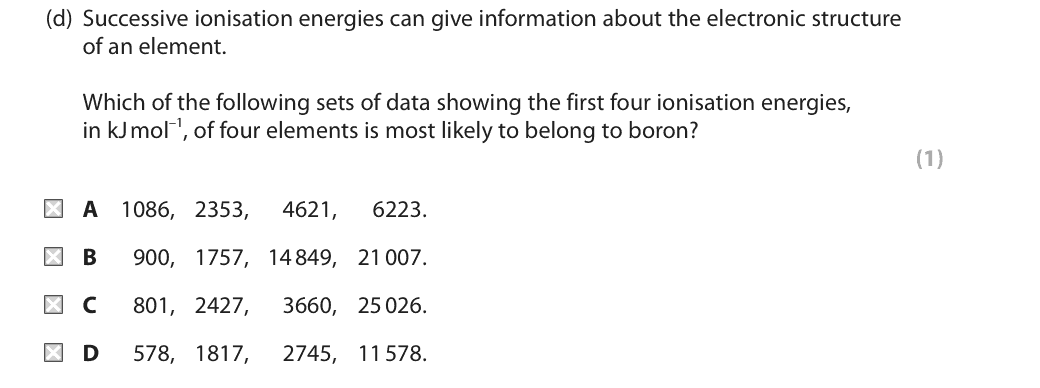
3(d) Atomic structure and the Periodic Table 1Multiple choice
4(a)(i) Redox I 1Equation writing
4(a)(ii) Redox I, The elements of Group 7 (halogens) 1Equation writing
4(a)(iii) Redox I, The elements of Group 7 (halogens) 1Equation writing
4(a)(iv) Redox I 2Explanation
4(b) The elements of Group 7 (halogens), Redox I 2Short answer
4(c)(i) The elements of Group 7 (halogens), Redox I 1Equation writing
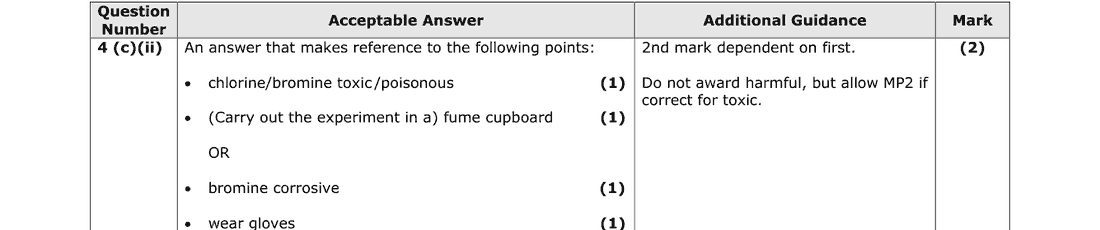
4(c)(ii) Formulae, equations and amounts of substance 2Practical and data analysis


5(a)(i) Atomic structure and the Periodic Table 1Short answer
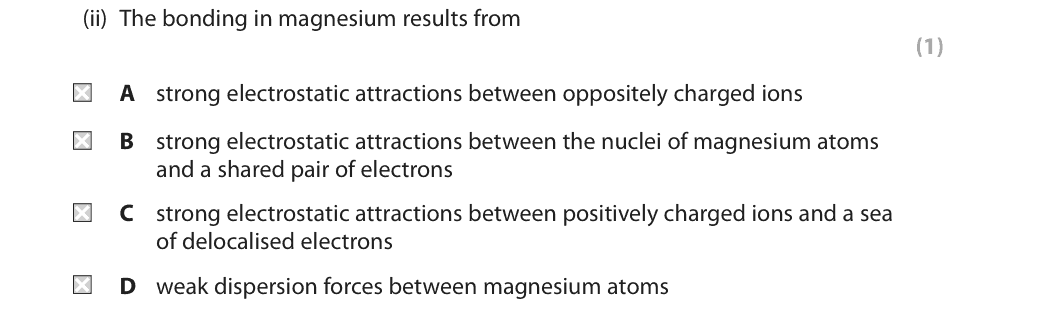
5(a)(ii) Bonding 1Multiple choice
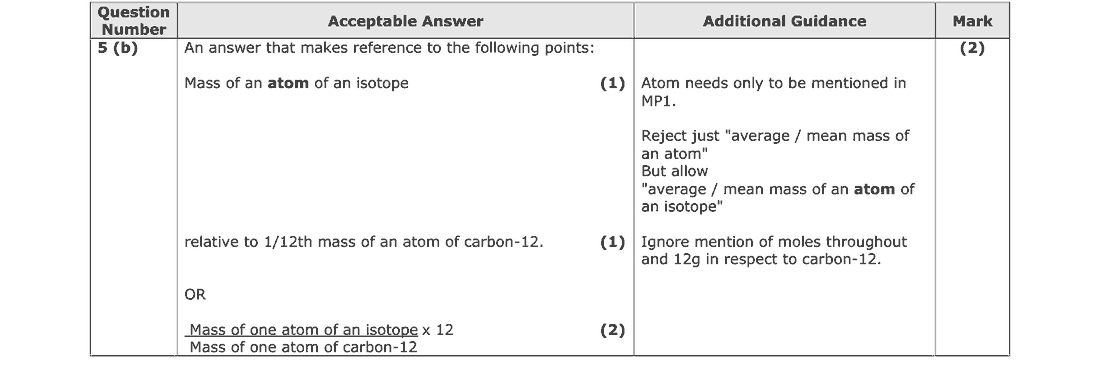
5(b) Atomic structure and the Periodic Table 2Short answer
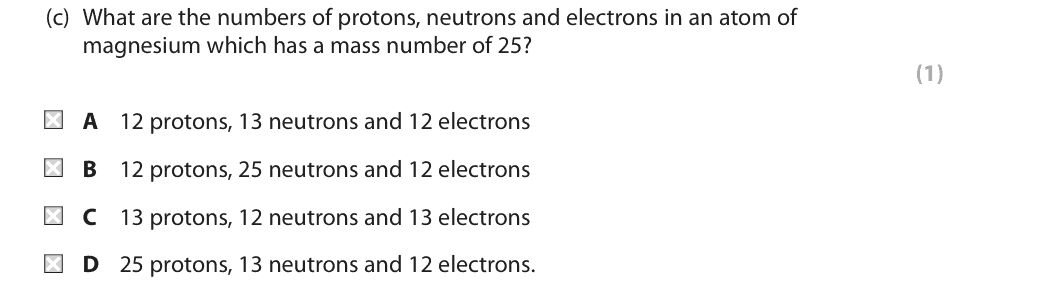
5(c) Atomic structure and the Periodic Table 1Multiple choice
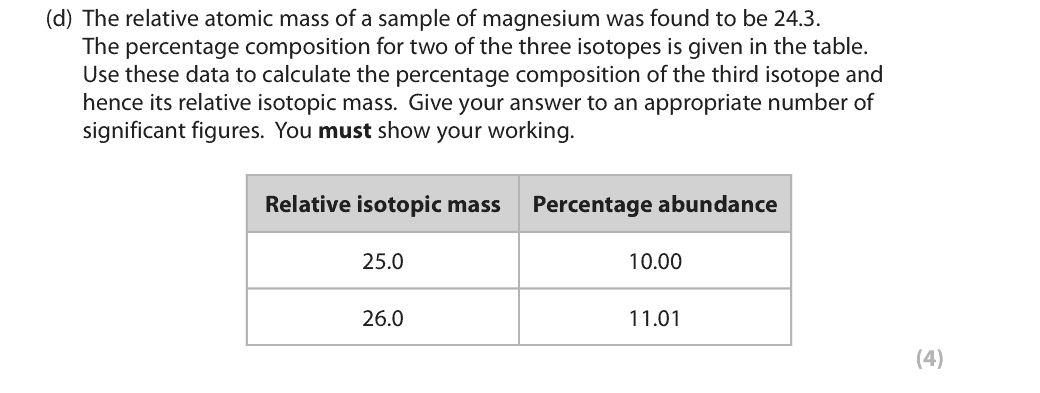
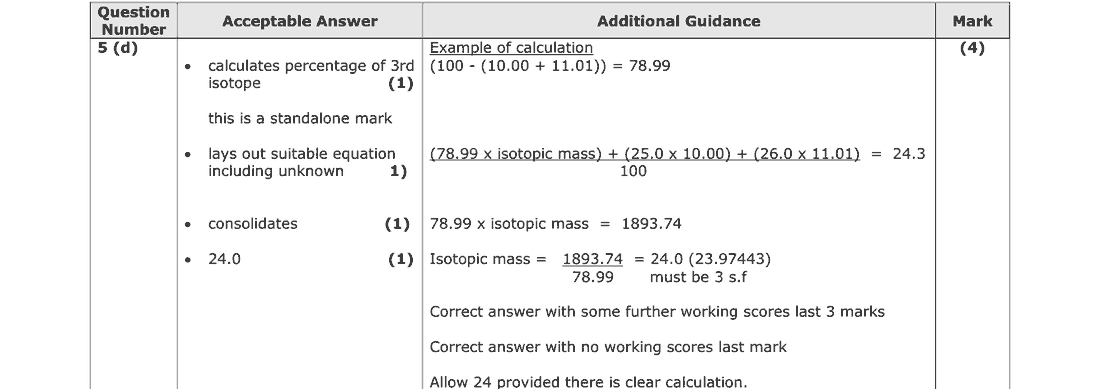
5(d) Atomic structure and the Periodic Table 4Calculation
6(a)(i) Formulae, equations and amounts of substance 1Equation writing
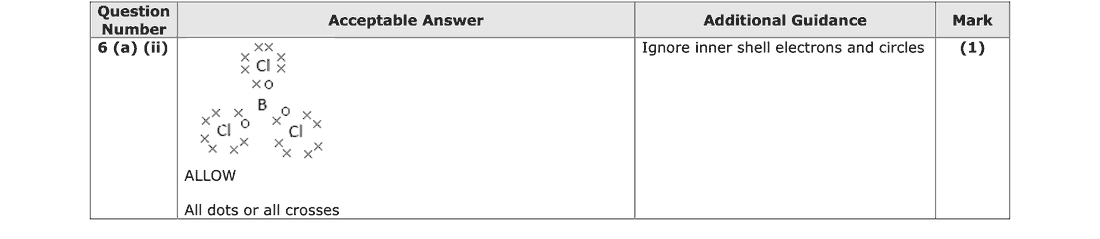
6(a)(ii) Bonding 1Diagram or structure
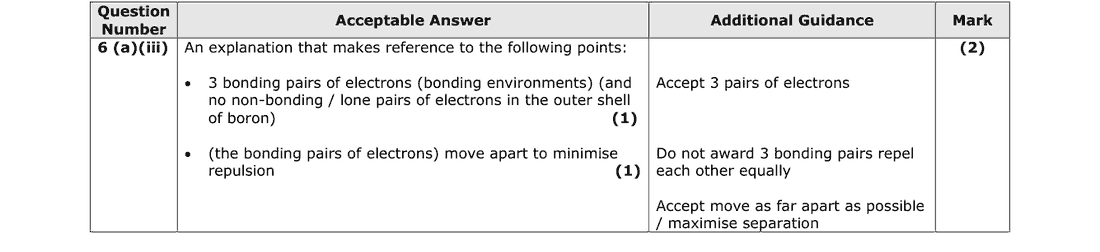
6(a)(iii) Bonding 2Explanation
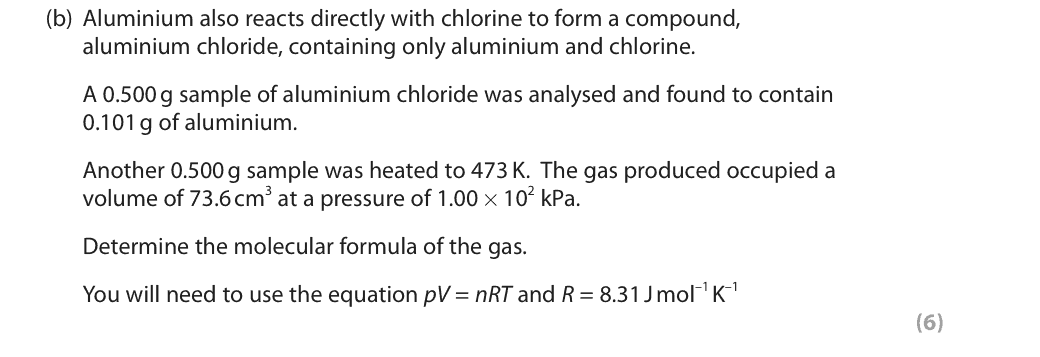
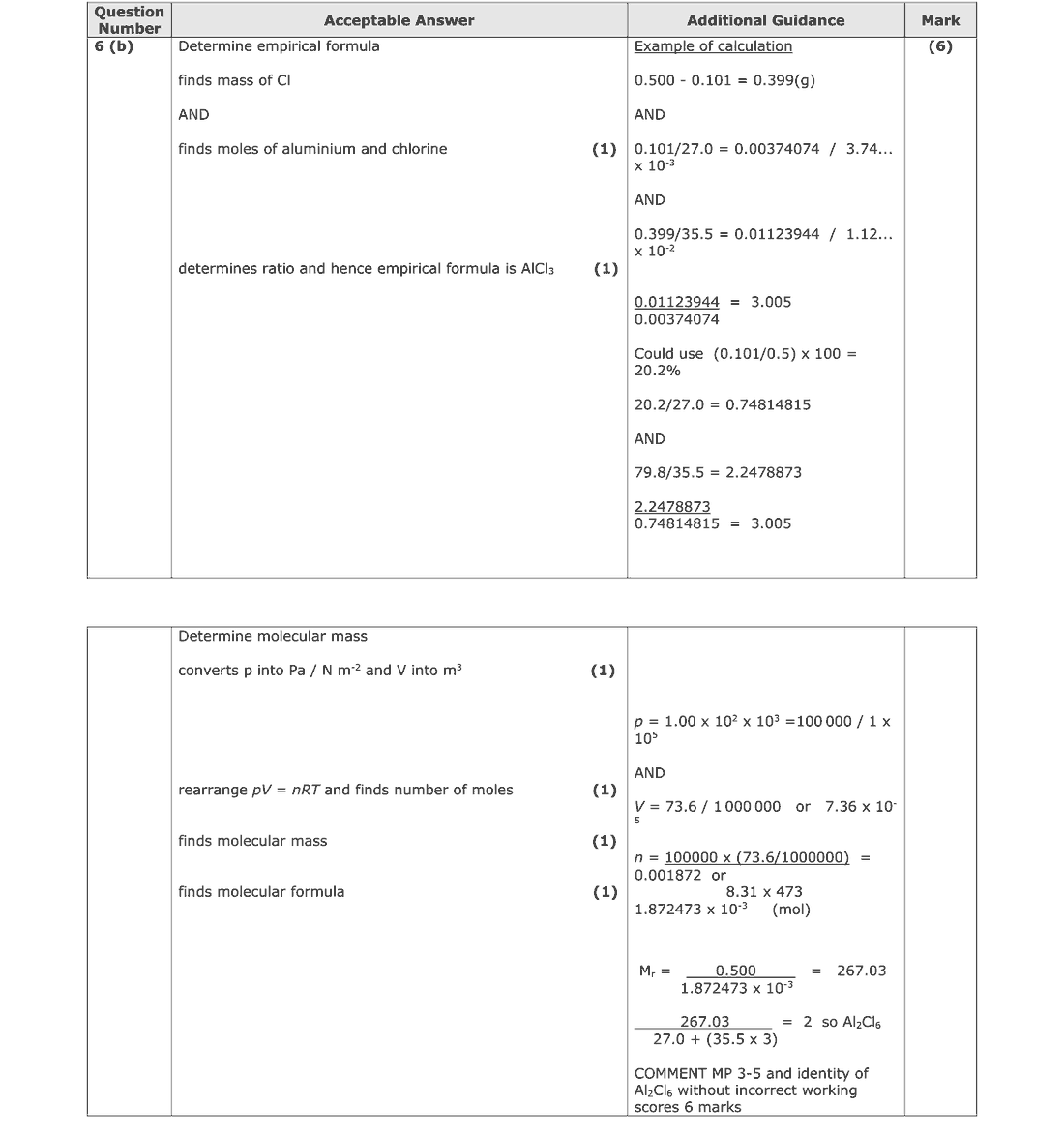
6(b) Formulae, equations and amounts of substance 6Calculation
6(c) Bonding, Structure 6Extended response
7(a) Formulae, equations and amounts of substance 5Calculation
7(b) Formulae, equations and amounts of substance 1Multiple choice
7(c) Formulae, equations and amounts of substance 3Practical and data analysis
8(a)(i) Formulae, equations and amounts of substance 2Equation writing
8(a)(ii) Formulae, equations and amounts of substance, Atomic structure and the Periodic Table 1Calculation
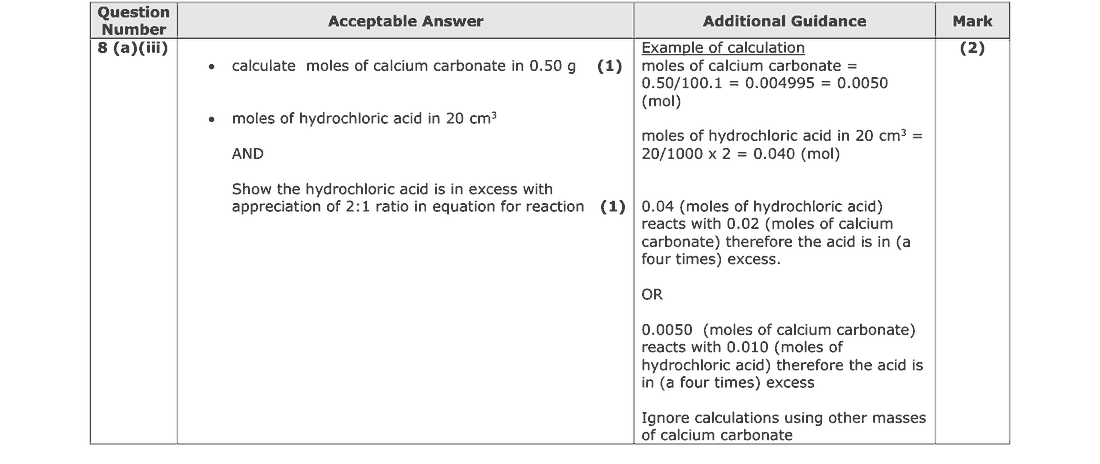
8(a)(iii) Formulae, equations and amounts of substance 2Calculation
8(b)(i) Formulae, equations and amounts of substance 2Diagram or structure
8(b)(ii) Formulae, equations and amounts of substance 1Short answer
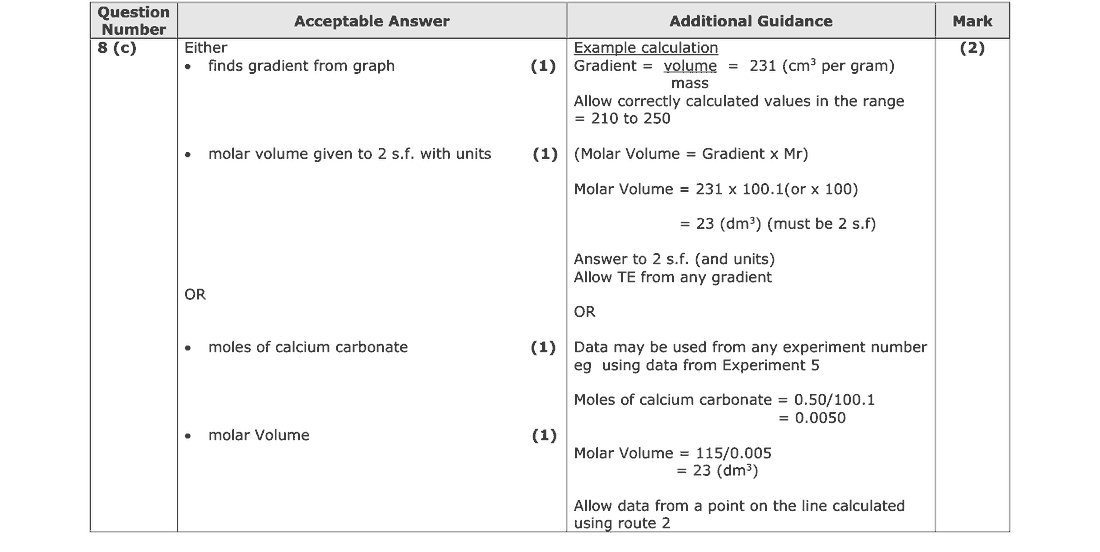
8(c) Formulae, equations and amounts of substance 2Calculation
8(d) Formulae, equations and amounts of substance 1Practical and data analysis

The questions

1(a)(i)1(a)(ii)1(a)(iii)1(b)2(a)(i)2(a)(ii)2(a)(iii)2(b)3(a)3(b)3(c)(i)3(c)(ii)3(c)(iii)3(d)4(a)(i)4(a)(ii)4(a)(iii)4(a)(iv)4(b)4(c)(i)4(c)(ii)5(a)(i)5(a)(ii)5(b)5(c)5(d)6(a)(i)6(a)(ii)6(a)(iii)6(b)6(c)7(a)7(b)7(c)8(a)(i)8(a)(ii)8(a)(iii)8(b)(i)8(b)(ii)8(c)8(d)
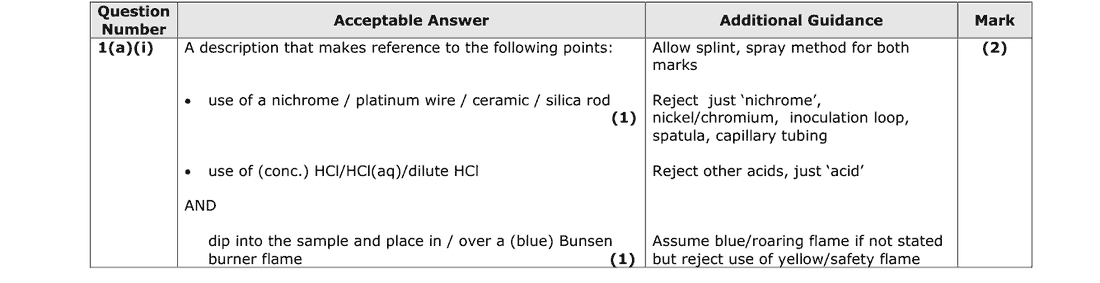
June 2017 · AS Paper 1 · Q1(a)(i) 2 marks Practical and data analysis groups 1 and 2
The presence of some ions in compounds can be identified using a Bunsen burner flame.
Some metal ions give characteristic colours in a flame test.
Describe how to carry out a flame test on an unknown solid.
June 2017 · AS Paper 1 · Q1(a)(ii) 1 mark Multiple choice groups 1 and 2
Earlier part of question 1 that this part usesEarlier part of June 2017 Paper 1 question 1
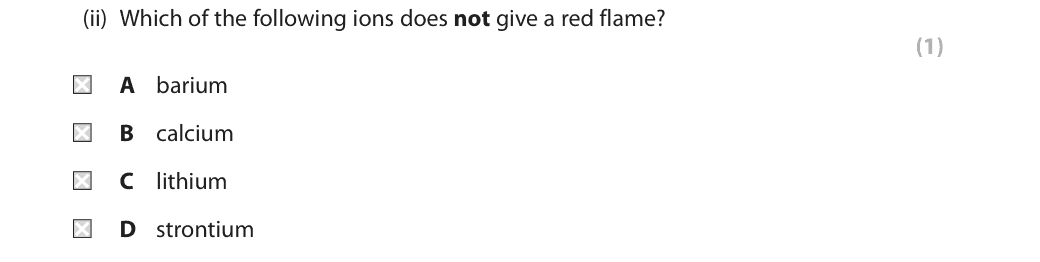
Which of the following ions does not give a red flame?
A barium
B calcium
C lithium
D strontium
June 2017 · AS Paper 1 · Q1(a)(iii) 1 mark Multiple choice groups 1 and 2
Earlier part of question 1 that this part usesEarlier part of June 2017 Paper 1 question 1
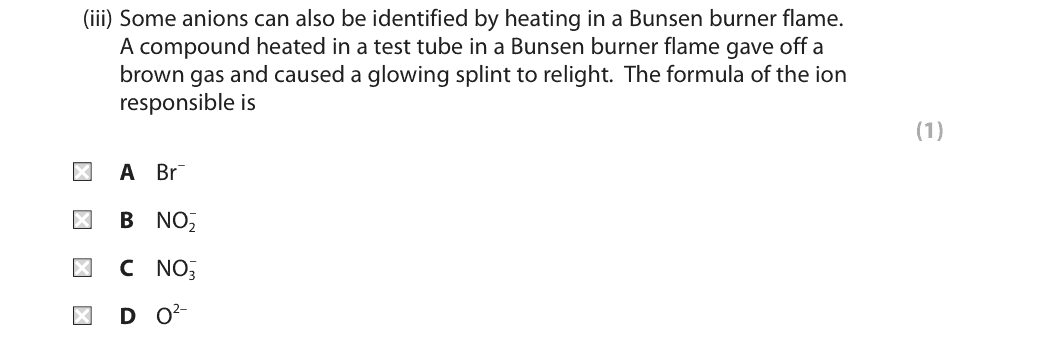
Some anions can also be identified by heating in a Bunsen burner flame.
A compound heated in a test tube in a Bunsen burner flame gave off a
brown gas and caused a glowing splint to relight.  The formula of the ion
responsible is
A Br–
B NO2
–
C NO3
–
D O2–
June 2017 · AS Paper 1 · Q1(b) 2 marks Short answer groups 1 and 2analysis of inorganic compounds
Earlier part of question 1 that this part usesEarlier part of June 2017 Paper 1 question 1
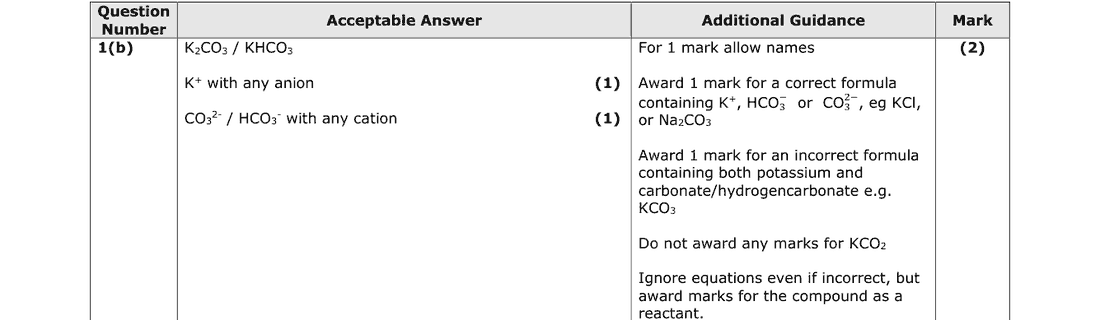
A flame test on a white powder gave a lilac flame colour.  Dilute hydrochloric acid
was added to a second sample of the same powder in a boiling tube and the gas
produced bubbled into limewater.  The limewater turned cloudy.
Give a possible formula for the white powder.
June 2017 · AS Paper 1 · Q2(a)(i) 1 mark Multiple choice bonding
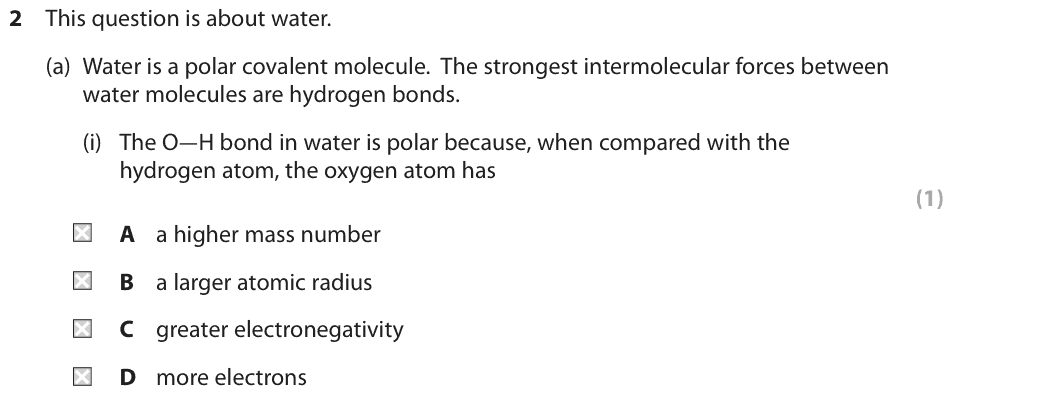
This question is about water.
Water is a polar covalent molecule.  The strongest intermolecular forces between
water molecules are hydrogen bonds.
The O–H bond in water is polar because, when compared with the
hydrogen atom, the oxygen atom has
A a higher mass number
B a larger atomic radius
C greater electronegativity
D more electrons
June 2017 · AS Paper 1 · Q2(a)(ii) 2 marks Diagram or structure bonding
Earlier part of question 2 that this part usesEarlier part of June 2017 Paper 1 question 2
Draw a diagram of a hydrogen bond between two water molecules in ice.
Show the value of the H–O–H angle within a molecule and the value of the
O–H–O angle between the two molecules.
June 2017 · AS Paper 1 · Q2(a)(iii) 2 marks Explanation bonding
Earlier part of question 2 that this part usesEarlier part of June 2017 Paper 1 question 2
Explain why hydrogen bonding causes ice to be less dense than liquid water.
June 2017 · AS Paper 1 · Q2(b) 1 mark Multiple choice groups 1 and 2
Liquid water is a good solvent for many, but not all, ionic compounds.  Which is
least soluble in water?
A barium hydroxide
B calcium hydroxide
C magnesium hydroxide
D sodium hydroxide
June 2017 · AS Paper 1 · Q3(a) 2 marks Diagram or structure Easy atomic structure and the periodic table
Electrons in atoms occupy orbitals.
Draw in the boxes the shape of an s-orbital and a p-orbital.
s-orbital
p-orbital
June 2017 · AS Paper 1 · Q3(b) 3 marks Short answer atomic structure and the periodic table
State what is meant by the term first ionisation energy.
June 2017 · AS Paper 1 · Q3(c)(i) 3 marks Diagram or structure atomic structure and the periodic table
Earlier part of question 3 that this part usesEarlier part of June 2017 Paper 1 question 3
The graph shows the first ionisation energies for a series of six consecutive
elements A–F.  The letters are not their chemical symbols.
Complete the graph of the first ionisation energies for the next five elements.
2500
2000
1500
1000
500
0
A
B
C
D
E
F
G
H
I
J
K
June 2017 · AS Paper 1 · Q3(c)(ii) 2 marks Explanation atomic structure and the periodic table
Earlier parts of question 3 that this part usesEarlier part of June 2017 Paper 1 question 3Earlier part of June 2017 Paper 1 question 3
Explain why the value of the first ionisation energy for D is greater than for C.
June 2017 · AS Paper 1 · Q3(c)(iii) 2 marks Explanation atomic structure and the periodic table
Earlier parts of question 3 that this part usesEarlier part of June 2017 Paper 1 question 3Earlier part of June 2017 Paper 1 question 3
Explain why the value of the first ionisation energy of E is less than for D.
June 2017 · AS Paper 1 · Q3(d) 1 mark Multiple choice atomic structure and the periodic table
Earlier part of question 3 that this part usesEarlier part of June 2017 Paper 1 question 3
Successive ionisation energies can give information about the electronic structure
of an element.
Which of the following sets of data showing the first four ionisation energies,
in kJ mol–1, of four elements is most likely to belong to boron?
A 1086, 2353,
4621,
6223.
B
900, 1757, 14 849, 21 007.
C
801, 2427,
3660, 25 026.
D
578, 1817,
2745, 11 578.
June 2017 · AS Paper 1 · Q4(a)(i) 1 mark Equation writing redox i
This question is about redox chemistry.
Write an ionic half-equation for the reduction of chlorine molecules to
chloride ions.
State symbols are not required.
June 2017 · AS Paper 1 · Q4(a)(ii) 1 mark Equation writing Hard redox igroup 7 the halogens
Earlier part of question 4 that this part usesEarlier part of June 2017 Paper 1 question 4
Write an ionic half-equation for the oxidation of chlorine molecules to
chlorate(I) ions in the presence of cold, aqueous hydroxide ions.
State symbols are not required.
June 2017 · AS Paper 1 · Q4(a)(iii) 1 mark Equation writing redox igroup 7 the halogens
Earlier part of question 4 that this part usesEarlier part of June 2017 Paper 1 question 4
Combine the two equations in (a)(i) and (ii) to give the ionic equation for the
reaction of chlorine molecules with cold, aqueous hydroxide ions.
June 2017 · AS Paper 1 · Q4(a)(iv) 2 marks Explanation redox i
Earlier parts of question 4 that this part usesEarlier part of June 2017 Paper 1 question 4Earlier part of June 2017 Paper 1 question 4Earlier part of June 2017 Paper 1 question 4
Use your answer to (a)(iii) to explain why the reaction is described as a
disproportionation reaction.
June 2017 · AS Paper 1 · Q4(b) 2 marks Short answer Easy group 7 the halogensredox i
A different ion containing chlorine is formed if the solution of aqueous hydroxide ions
is hot.
Give the formula of the chlorine-containing ion and the oxidation number of
chlorine in this ion.
June 2017 · AS Paper 1 · Q4(c)(i) 1 mark Equation writing Hard group 7 the halogensredox i
Bromine can be extracted from seawater containing bromide ions
using chlorine.
Write the ionic equation for this reaction.  State symbols are not required.
June 2017 · AS Paper 1 · Q4(c)(ii) 2 marks Practical and data analysis Easy formulae equations and amounts of substance
Earlier part of question 4 that this part usesEarlier part of June 2017 Paper 1 question 4
Identify one hazard associated with carrying out this reaction in a school
laboratory and a safety precaution other than wearing a laboratory coat and
eye protection.
June 2017 · AS Paper 1 · Q5(a)(i) 1 mark Short answer Easy atomic structure and the periodic table
This question is about magnesium.
Complete the electronic structure of a magnesium atom.
1s2
June 2017 · AS Paper 1 · Q5(a)(ii) 1 mark Multiple choice bonding
Earlier part of question 5 that this part usesEarlier part of June 2017 Paper 1 question 5
The bonding in magnesium results from
A strong electrostatic attractions between oppositely charged ions
B strong electrostatic attractions between the nuclei of magnesium atoms
and a shared pair of electrons
C strong electrostatic attractions between positively charged ions and a sea
of delocalised electrons
D weak dispersion forces between magnesium atoms
June 2017 · AS Paper 1 · Q5(b) 2 marks Short answer atomic structure and the periodic table
Magnesium exists as three stable isotopes.  One isotope has a relative
isotopic mass of 25.0.
State what is meant by the term relative isotopic mass.
June 2017 · AS Paper 1 · Q5(c) 1 mark Multiple choice atomic structure and the periodic table
What are the numbers of protons, neutrons and electrons in an atom of
magnesium which has a mass number of 25?
A 12 protons, 13 neutrons and 12 electrons
B 12 protons, 25 neutrons and 12 electrons
C 13 protons, 12 neutrons and 13 electrons
D 25 protons, 13 neutrons and 12 electrons.
June 2017 · AS Paper 1 · Q5(d) 4 marks Calculation Easy atomic structure and the periodic table
Earlier part of question 5 that this part usesEarlier part of June 2017 Paper 1 question 5
The relative atomic mass of a sample of magnesium was found to be 24.3.
The percentage composition for two of the three isotopes is given in the table.
Use these data to calculate the percentage composition of the third isotope and
hence its relative isotopic mass.  Give your answer to an appropriate number of
significant figures.  You must show your working.
Relative isotopic mass
Percentage abundance
25.0
10.00
26.0
11.01
June 2017 · AS Paper 1 · Q6(a)(i) 1 mark Equation writing formulae equations and amounts of substance
Boron and aluminium are in the same group of the Periodic Table.  Both form
compounds with chlorine and with fluorine.
Boron reacts directly with chlorine to produce a covalently bonded compound, BCl3.
Write the equation for this reaction.  State symbols are not required.
June 2017 · AS Paper 1 · Q6(a)(ii) 1 mark Diagram or structure bonding
Earlier part of question 6 that this part usesEarlier part of June 2017 Paper 1 question 6
Draw a dot-and-cross diagram for BCl3 showing only the outer shell electrons
of the atoms.
June 2017 · AS Paper 1 · Q6(a)(iii) 2 marks Explanation bonding
Earlier part of question 6 that this part usesEarlier part of June 2017 Paper 1 question 6
Use your diagram to explain why BCl3 has a trigonal planar shape with
bond angles of 120q.
June 2017 · AS Paper 1 · Q6(b) 6 marks Calculation formulae equations and amounts of substance
Earlier part of question 6 that this part usesEarlier part of June 2017 Paper 1 question 6
Aluminium also reacts directly with chlorine to form a compound,
aluminium chloride, containing only aluminium and chlorine.
A 0.500 g sample of aluminium chloride was analysed and found to contain
0.101 g of aluminium.
Another 0.500 g sample was heated to 473 K.  The gas produced occupied a
volume of 73.6 cm3 at a pressure of 1.00 × 10² kPa.
Determine the molecular formula of the gas.
You will need to use the equation pV = nRT and R = 8.31 J mol–1 K–1
June 2017 · AS Paper 1 · Q6(c) 6 marks 6-mark extended response bondingstructure
Earlier part of question 6 that this part usesEarlier part of June 2017 Paper 1 question 6
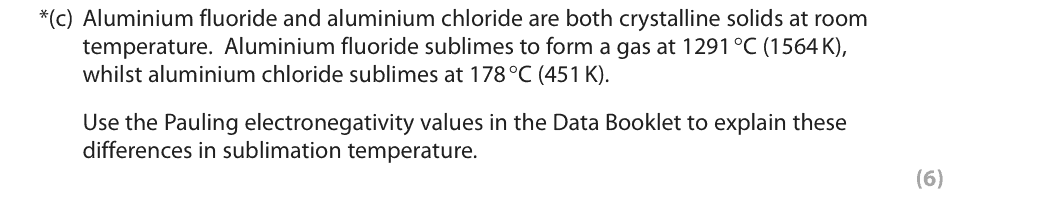
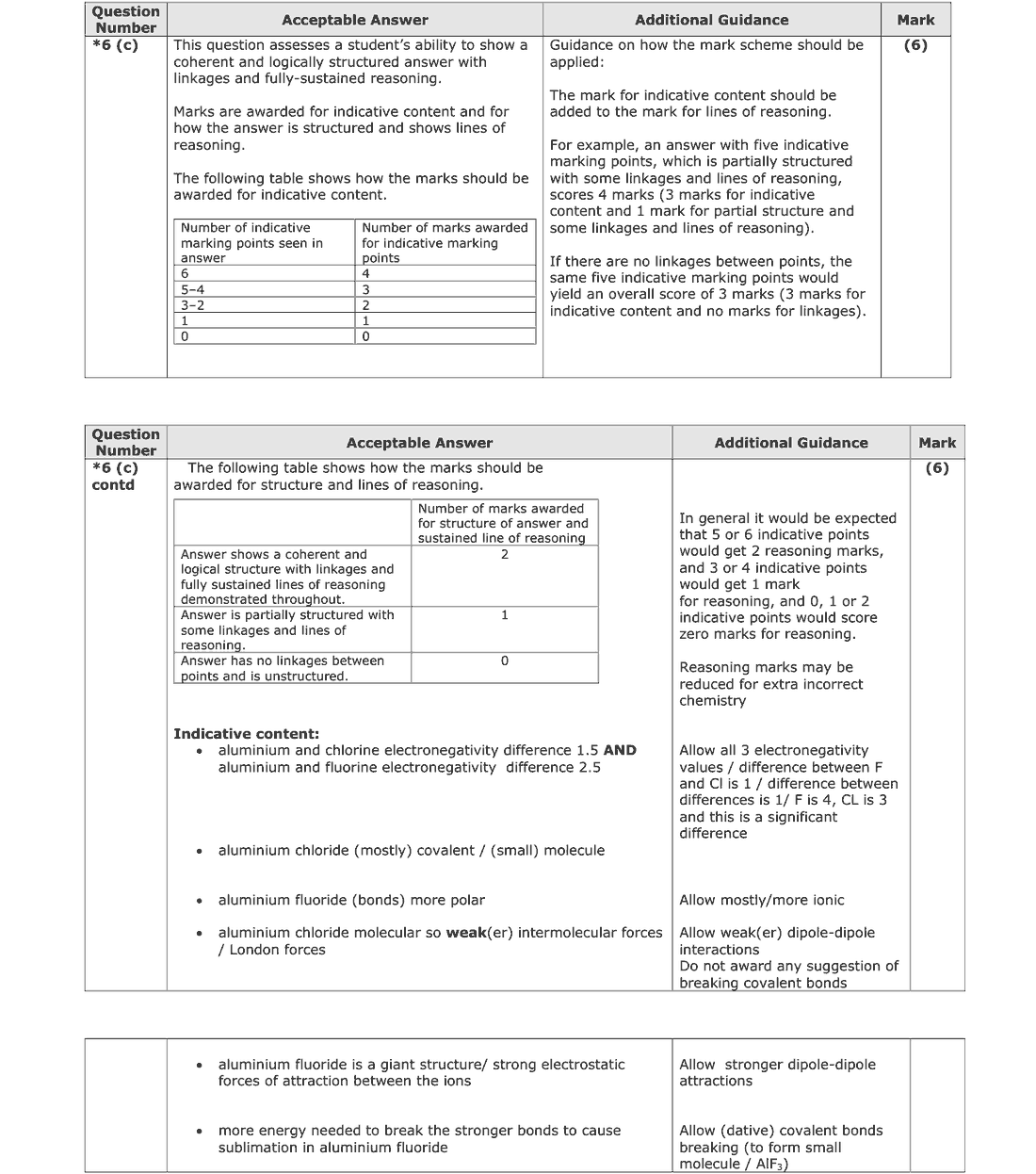
Aluminium fluoride and aluminium chloride are both crystalline solids at room
temperature.  Aluminium fluoride sublimes to form a gas at 1291qC (1564 K),
whilst aluminium chloride sublimes at 178qC (451 K).
Use the Pauling electronegativity values in the Data Booklet to explain these
differences in sublimation temperature.
June 2017 · AS Paper 1 · Q7(a) 5 marks Calculation formulae equations and amounts of substance
Hydrochloric acid is prepared by dissolving hydrogen chloride gas in water.  It is
difficult to dissolve a known amount of hydrogen chloride, so the exact concentration
of such solutions is uncertain.  A solution of hydrochloric acid of concentration
between 0.095 mol dm–3 and 0.105 mol dm–3 was prepared.
Before a class attempted a practical using this solution, a technician standardised the
hydrochloric acid with sodium carbonate solution.  The technician dissolved 1.30 g of
anhydrous sodium carbonate in water and made up the solution to 100 cm3.
The equation for the reaction which occurs is shown.
Na2CO3 + 2HCl o 2NaCl + H2O + CO2
A 10.0 cm3 portion of the sodium carbonate solution was transferred to a conical flask.
Three drops of methyl orange indicator were added and the solution titrated with
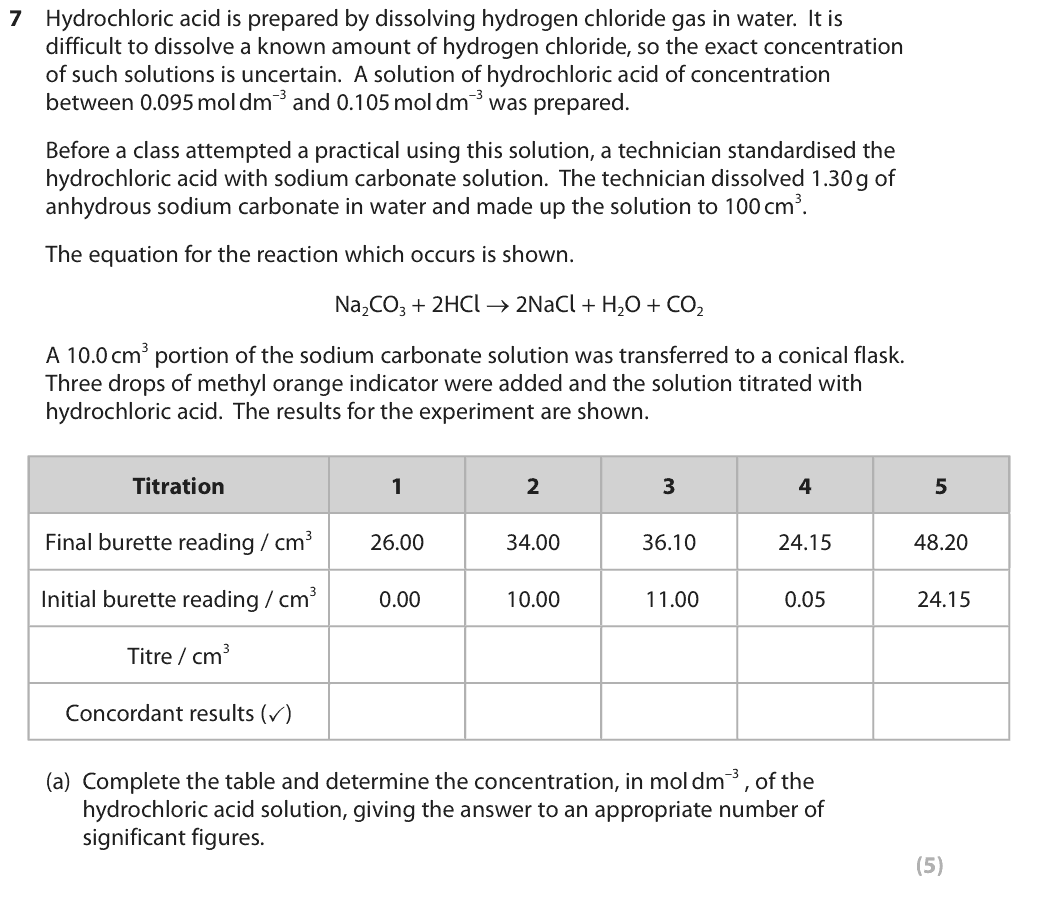
hydrochloric acid.  The results for the experiment are shown.
Titration
1
2
3
4
5
Final burette reading / cm3
26.00
34.00
36.10
24.15
48.20
Initial burette reading / cm3
0.00
10.00
11.00
0.05
24.15
Titre / cm3
Concordant results (3)
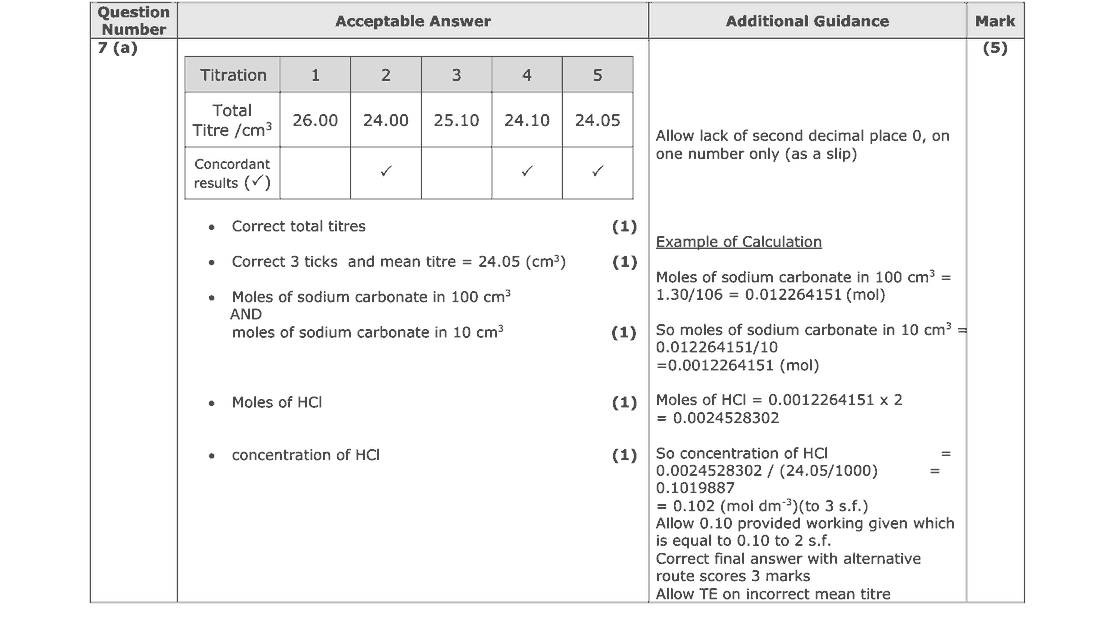
Complete the table and determine the concentration, in mol dm–3 , of the
hydrochloric acid solution, giving the answer to an appropriate number of
significant figures.
June 2017 · AS Paper 1 · Q7(b) 1 mark Multiple choice formulae equations and amounts of substance
Earlier part of question 7 that this part usesEarlier part of June 2017 Paper 1 question 7
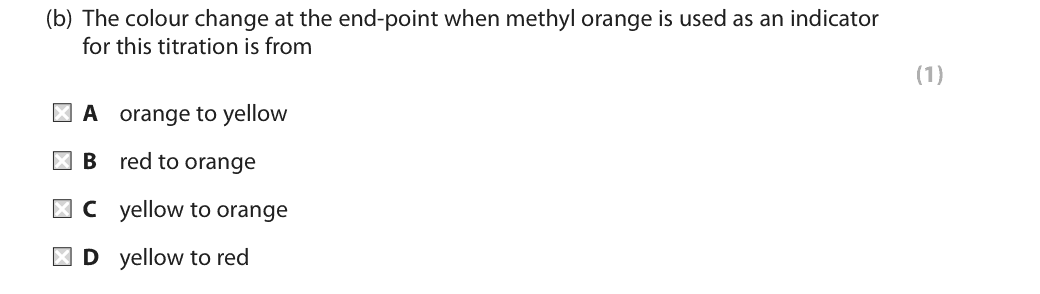
The colour change at the end-point when methyl orange is used as an indicator
for this titration is from
A orange to yellow
B red to orange
C yellow to orange
D yellow to red
June 2017 · AS Paper 1 · Q7(c) 3 marks Practical and data analysis formulae equations and amounts of substance
Earlier part of question 7 that this part usesEarlier part of June 2017 Paper 1 question 7
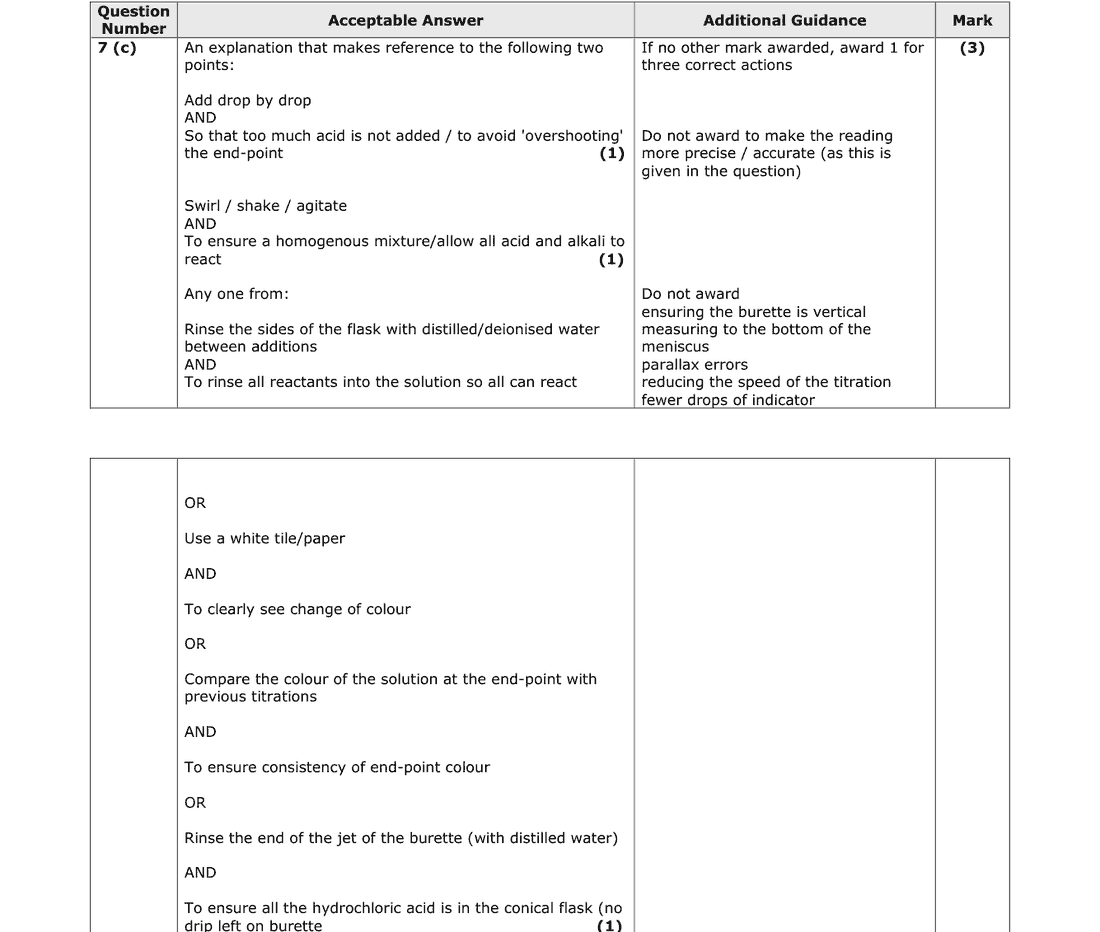
Explain three actions the technician might take in the procedure, just before
the end-point of the titration, to ensure that the volume of acid added at the
end-point is accurate.
June 2017 · AS Paper 1 · Q8(a)(i) 2 marks Equation writing formulae equations and amounts of substance
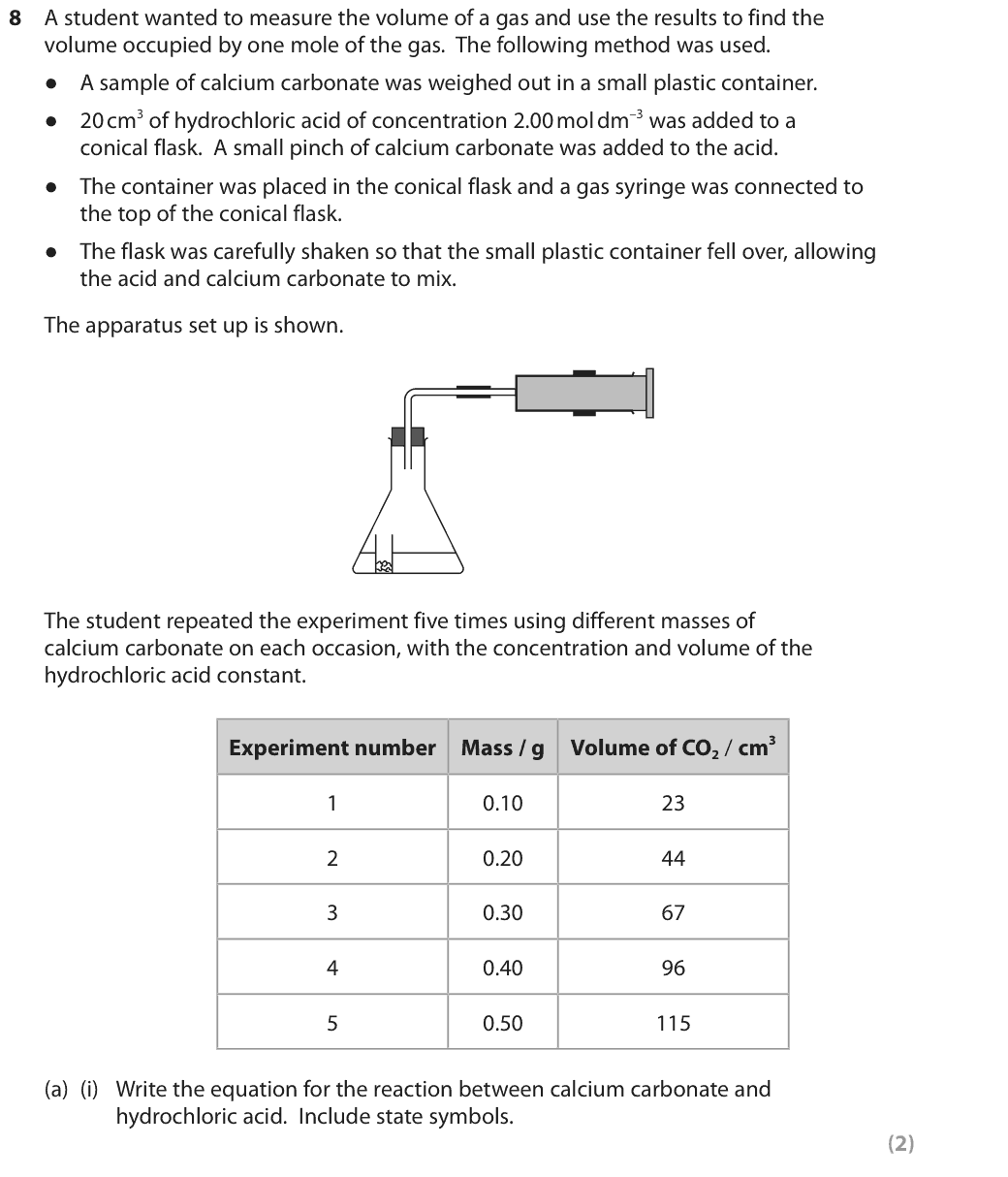
A student wanted to measure the volume of a gas and use the results to find the
volume occupied by one mole of the gas.  The following method was used.
Ɣ A sample of calcium carbonate was weighed out in a small plastic container.
Ɣ 20 cm3 of hydrochloric acid of concentration 2.00 mol dm–3 was added to a
conical flask.  A small pinch of calcium carbonate was added to the acid.
Ɣ The container was placed in the conical flask and a gas syringe was connected to
the top of the conical flask.
Ɣ The flask was carefully shaken so that the small plastic container fell over, allowing
the acid and calcium carbonate to mix.
The apparatus set up is shown.
The student repeated the experiment five times using different masses of
calcium carbonate on each occasion, with the concentration and volume of the
hydrochloric acid constant.
Experiment number
Mass / g
Volume of CO2 / cm3
1
0.10
23
2
0.20
44
3
0.30
67
4
0.40
96
5
0.50
115
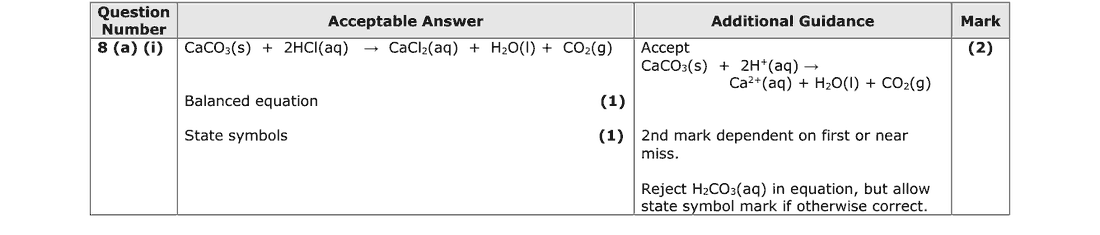
Write the equation for the reaction between calcium carbonate and
hydrochloric acid.  Include state symbols.
June 2017 · AS Paper 1 · Q8(a)(ii) 1 mark Calculation formulae equations and amounts of substanceatomic structure and the periodic table
Earlier part of question 8 that this part usesEarlier part of June 2017 Paper 1 question 8
Calculate the molar mass of calcium carbonate.
 g mol–1
June 2017 · AS Paper 1 · Q8(a)(iii) 2 marks Calculation formulae equations and amounts of substance
Earlier part of question 8 that this part usesEarlier part of June 2017 Paper 1 question 8
Show that, in each experiment, the hydrochloric acid is in excess.
June 2017 · AS Paper 1 · Q8(b)(i) 2 marks Diagram or structure formulae equations and amounts of substance
Earlier part of question 8 that this part usesEarlier part of June 2017 Paper 1 question 8
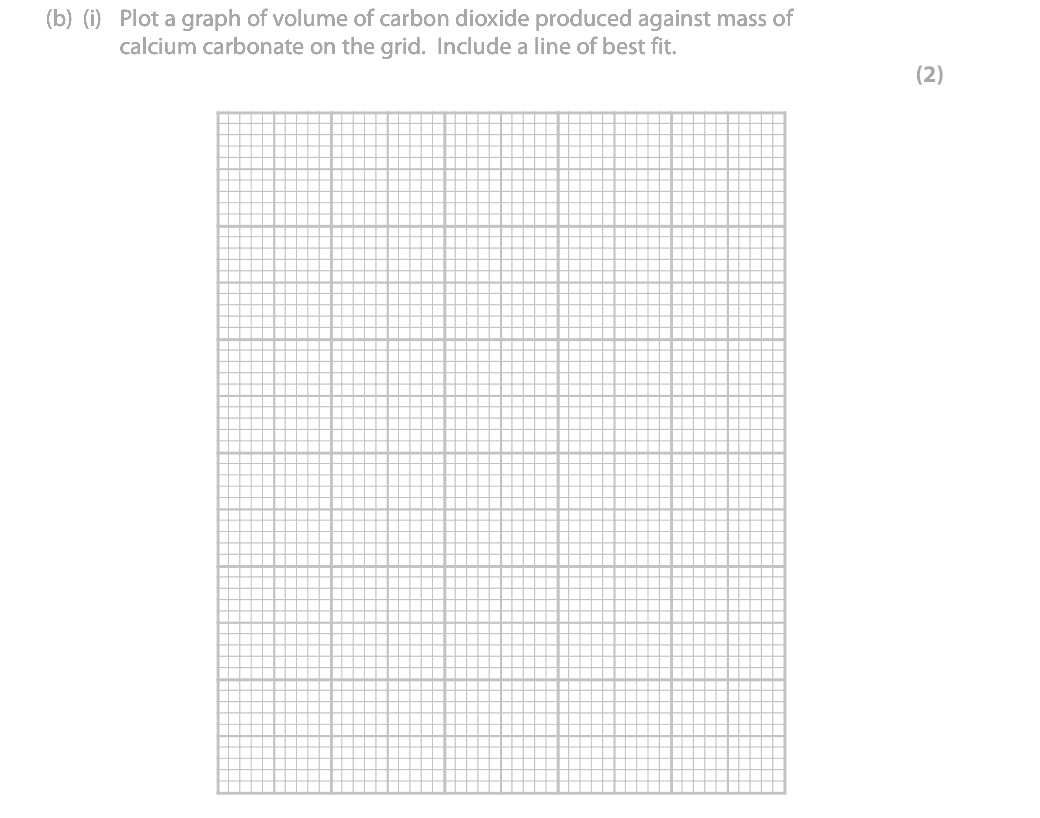
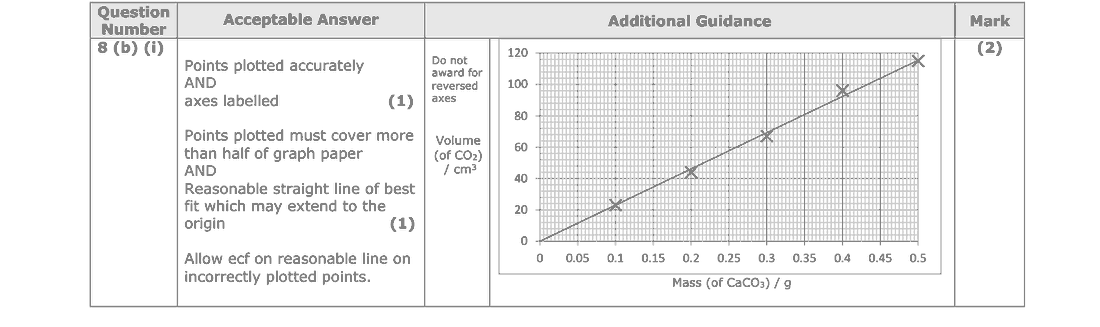
Plot a graph of volume of carbon dioxide produced against mass of
calcium carbonate on the grid.  Include a line of best fit.
June 2017 · AS Paper 1 · Q8(b)(ii) 1 mark Short answer formulae equations and amounts of substance
Earlier parts of question 8 that this part usesEarlier part of June 2017 Paper 1 question 8Earlier part of June 2017 Paper 1 question 8
State how your graph supports the idea that the volume of gas produced
depends directly on the mass of calcium carbonate added.
June 2017 · AS Paper 1 · Q8(c) 2 marks Calculation formulae equations and amounts of substance
Earlier part of question 8 that this part usesEarlier part of June 2017 Paper 1 question 8
Calculate the volume, under these conditions, of one mole of carbon dioxide gas
from these data.  Give your answer in dm3 to two significant figures.
June 2017 · AS Paper 1 · Q8(d) 1 mark Practical and data analysis Hard formulae equations and amounts of substance
Earlier part of question 8 that this part usesEarlier part of June 2017 Paper 1 question 8
Give a reason why the student added a small pinch of calcium carbonate to
the acid before starting the reaction.

Work with an A-level chemistry tutor

Want a paper marked and gone through with you? Message us.

Prefer email? Send an enquiry

If you are under 18, please include a parent's contact details. Enquiries go to enquiries@chemistryaleveltutor.com and are deleted once handled. All tutoring is online.