June 2016: AS Paper 1, Core Inorganic and Physical Chemistry

80 marks · 38 question parts · Paper, mark scheme and report on Edexcel's site · Have the Data Booklet beside you

Question by question

QTopicMarksAOType
1(a)(i) The elements of Group 7 (halogens) 1Short answer
1(a)(ii) The elements of Group 7 (halogens) 1Short answer
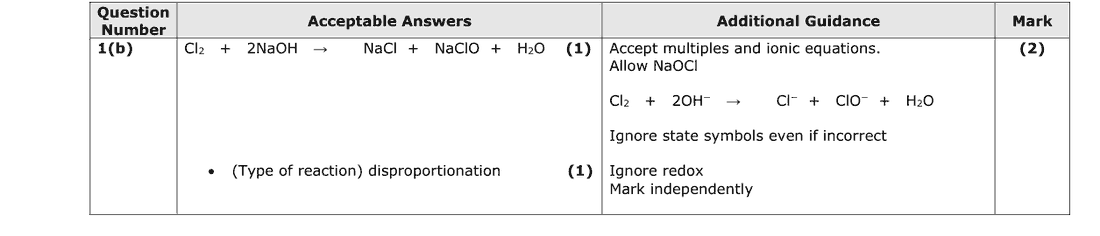
1(b) The elements of Group 7 (halogens) 2Equation writing
1(c) The elements of Group 7 (halogens) 1Multiple choice
1(d) Bonding 3Explanation
1(e) Formulae, equations and amounts of substance 1Multiple choice
2(a) Atomic structure and the Periodic Table 2Short answer
2(b) Atomic structure and the Periodic Table 1Multiple choice
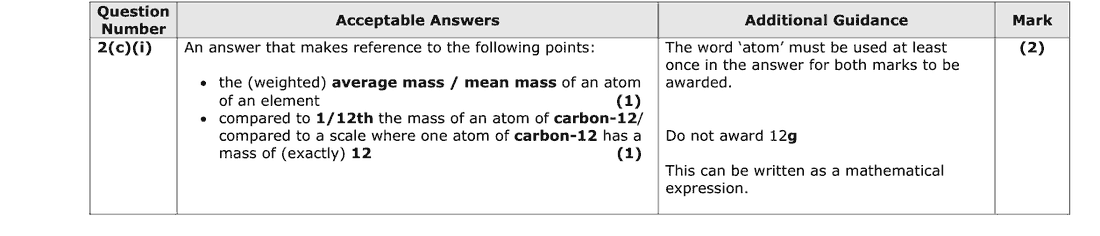
2(c)(i) Atomic structure and the Periodic Table 2Short answer
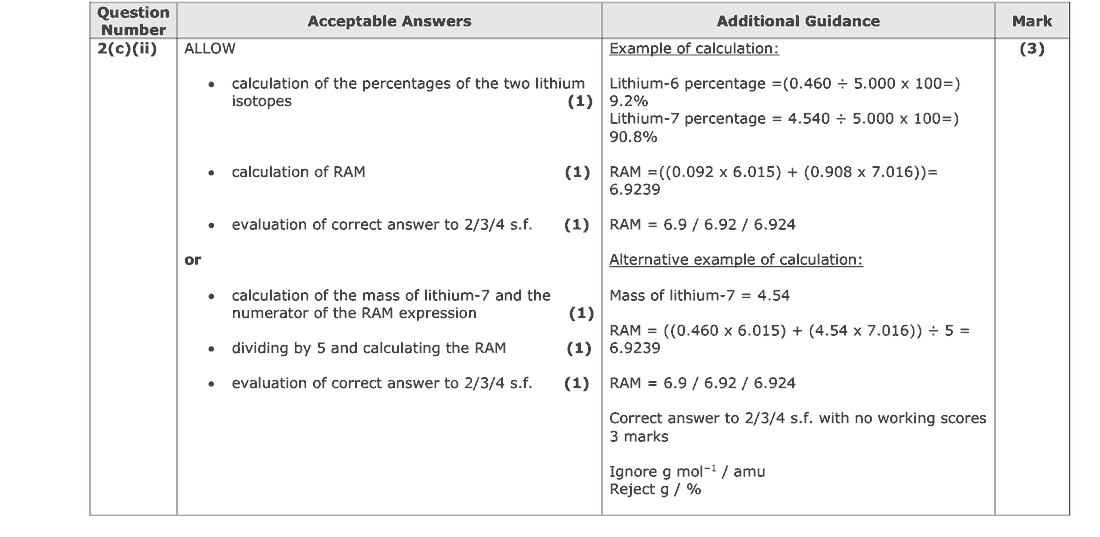
2(c)(ii) Atomic structure and the Periodic Table 3Calculation
2(d) Atomic structure and the Periodic Table 2Explanation
3(a)(i) Formulae, equations and amounts of substance 1Calculation
3(a)(ii) Formulae, equations and amounts of substance 1Calculation
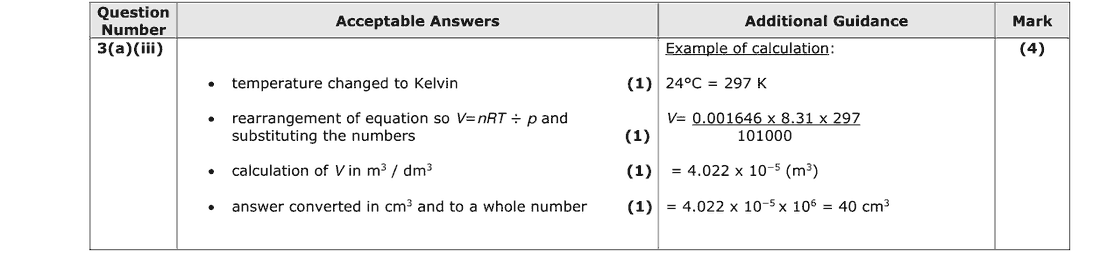
3(a)(iii) Formulae, equations and amounts of substance 4Calculation
3(b) Formulae, equations and amounts of substance 1Practical and data analysis
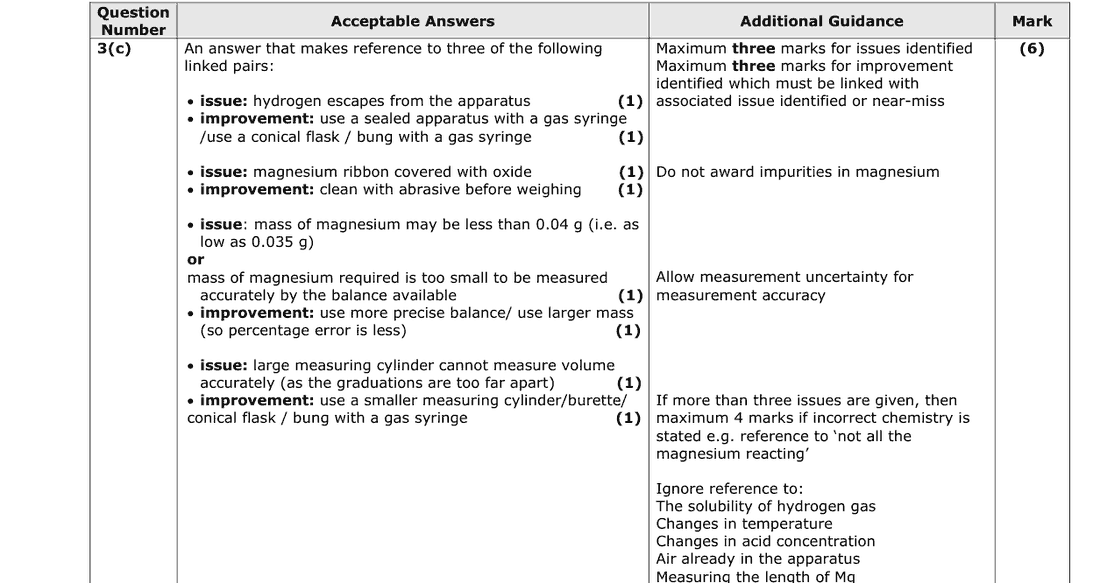
3(c) Formulae, equations and amounts of substance 6Practical and data analysis
4(a) The elements of Groups 1 and 2 1Multiple choice
4(b) The elements of Groups 1 and 2 1Multiple choice
4(c) Analysis of inorganic compounds 1Multiple choice
4(d) The elements of Group 7 (halogens) 2Practical and data analysis
4(e) Analysis of inorganic compounds, Formulae, equations and amounts of substance 2Equation writing
5(a) Formulae, equations and amounts of substance 1Calculation
5(b) Formulae, equations and amounts of substance 5Calculation
5(c) Bonding 3Diagram or structure
5(d) Formulae, equations and amounts of substance 1Calculation
6(a) Bonding 2Explanation
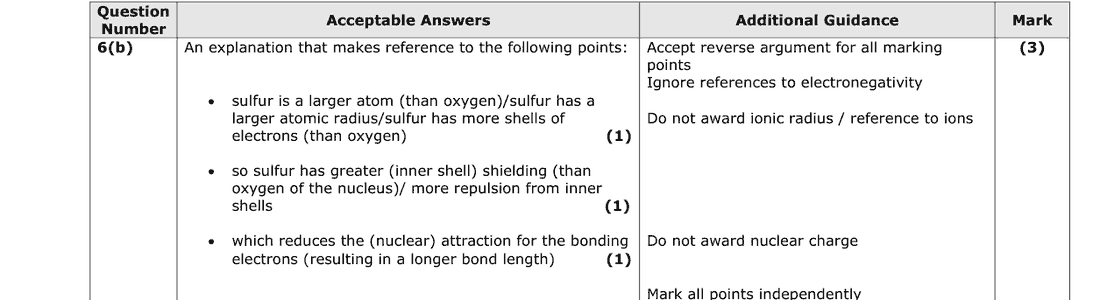
6(b) Bonding 3Explanation
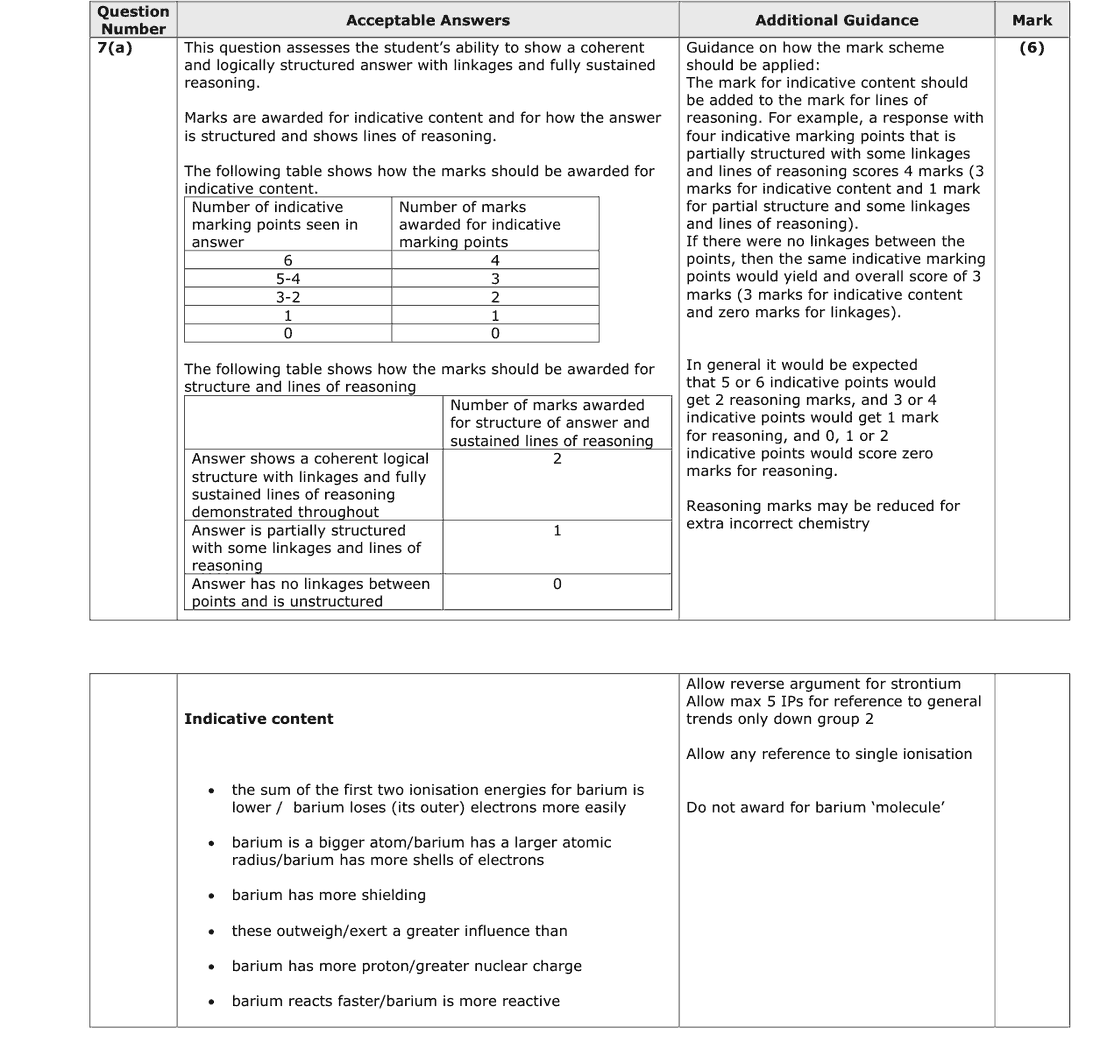
7(a) The elements of Groups 1 and 2 6Extended response
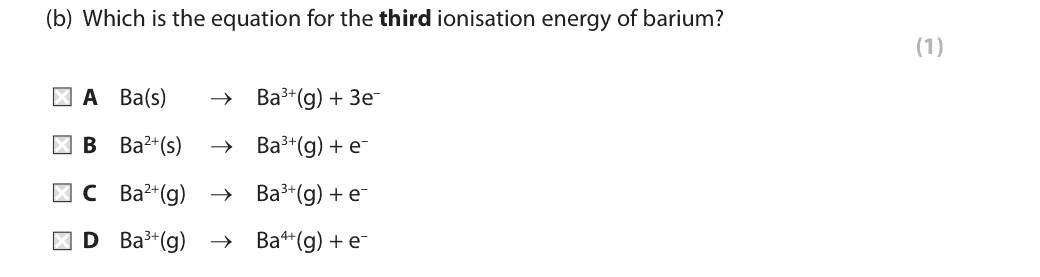
7(b) Atomic structure and the Periodic Table 1Multiple choice
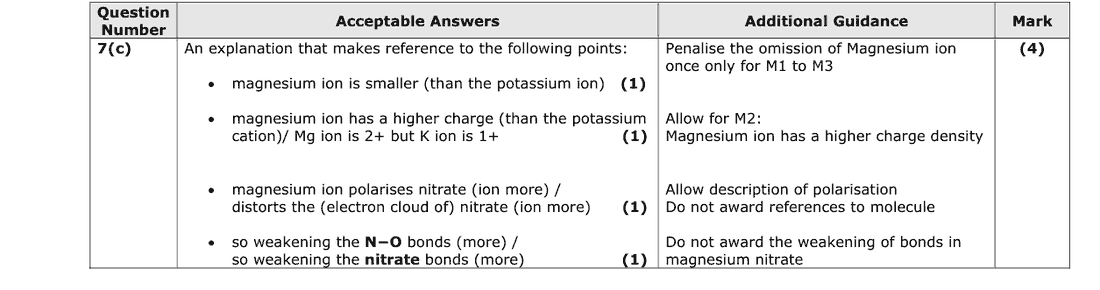
7(c) The elements of Groups 1 and 2 4Explanation
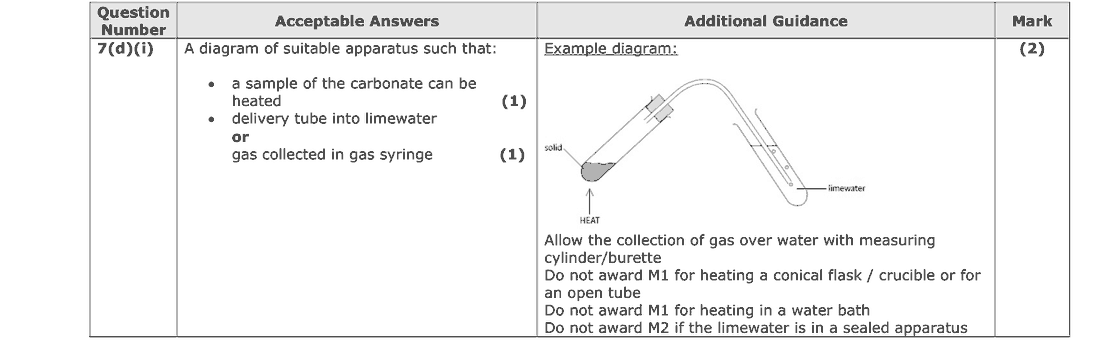
7(d)(i) The elements of Groups 1 and 2 2Diagram or structure
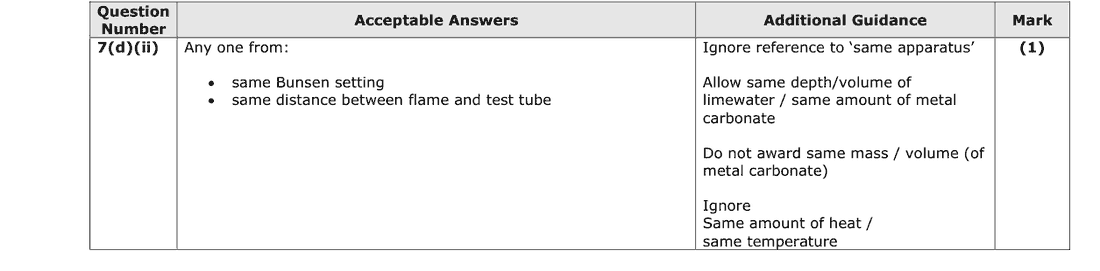
7(d)(ii) The elements of Groups 1 and 2 1Practical and data analysis
7(d)(iii) The elements of Groups 1 and 2 1Practical and data analysis
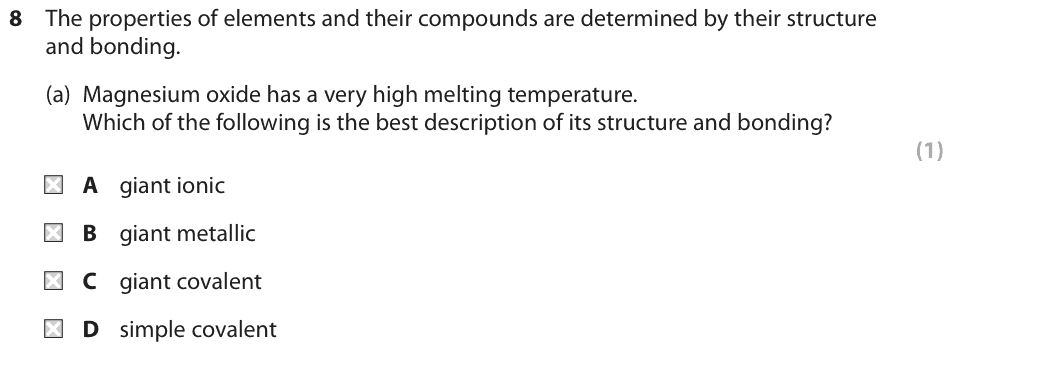
8(a) Structure 1Multiple choice
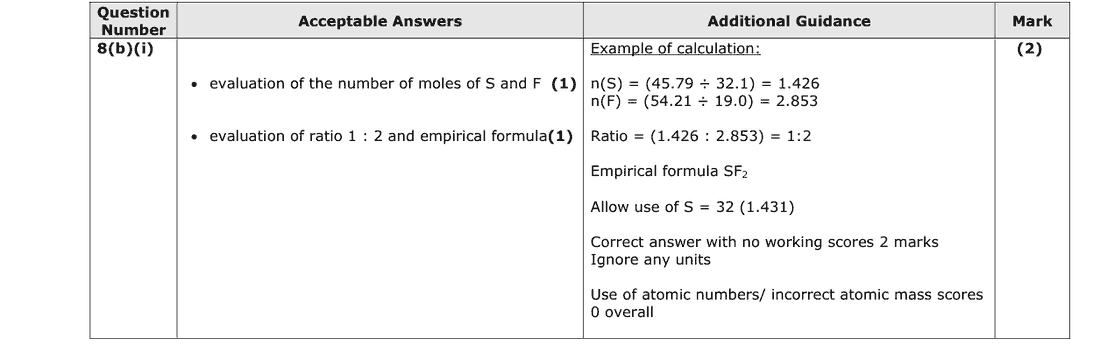
8(b)(i) Formulae, equations and amounts of substance 2Calculation
8(b)(ii) Formulae, equations and amounts of substance 1Equation writing
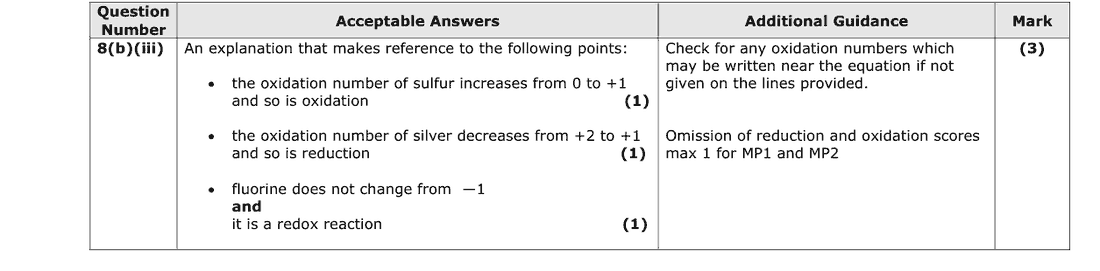
8(b)(iii) Redox I 3Explanation
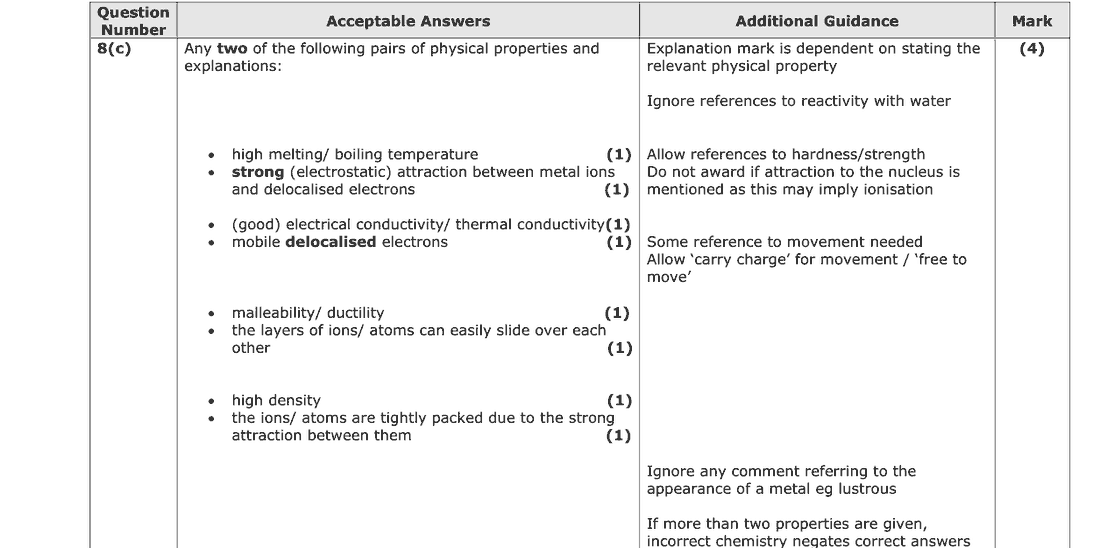
8(c) Structure, Bonding 4Explanation

The questions

1(a)(i)1(a)(ii)1(b)1(c)1(d)1(e)2(a)2(b)2(c)(i)2(c)(ii)2(d)3(a)(i)3(a)(ii)3(a)(iii)3(b)3(c)4(a)4(b)4(c)4(d)4(e)5(a)5(b)5(c)5(d)6(a)6(b)7(a)7(b)7(c)7(d)(i)7(d)(ii)7(d)(iii)8(a)8(b)(i)8(b)(ii)8(b)(iii)8(c)
June 2016 · AS Paper 1 · Q1(a)(i) 1 mark Short answer group 7 the halogens
This question is about Group 7 elements and their compounds.
Give the physical states of chlorine and iodine at room temperature and
pressure.
June 2016 · AS Paper 1 · Q1(a)(ii) 1 mark Short answer group 7 the halogens
Earlier part of question 1 that this part usesEarlier part of June 2016 Paper 1 question 1
Predict the physical state of astatine under these conditions.  Justify your
answer.
June 2016 · AS Paper 1 · Q1(b) 2 marks Equation writing group 7 the halogens
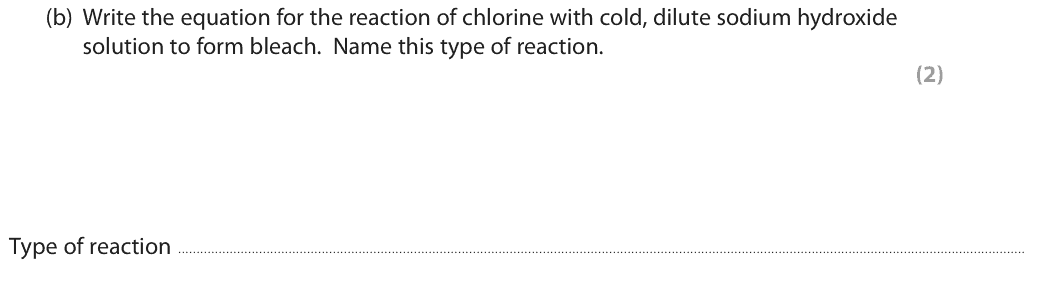
Write the equation for the reaction of chlorine with cold, dilute sodium hydroxide
solution to form bleach.  Name this type of reaction.
Type of reaction
June 2016 · AS Paper 1 · Q1(c) 1 mark Multiple choice group 7 the halogens
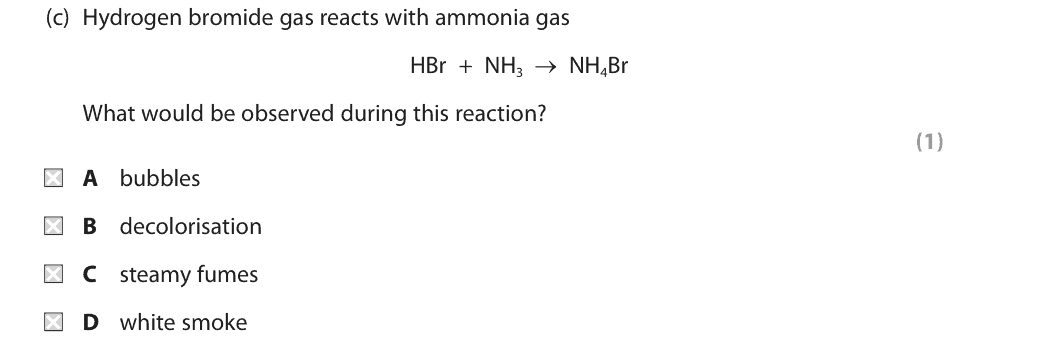
Hydrogen bromide gas reacts with ammonia gas
HBr + NH3 r NH4Br
What would be observed during this reaction?
A bubbles
B decolorisation
C steamy fumes
D white smoke
June 2016 · AS Paper 1 · Q1(d) 3 marks Explanation bonding
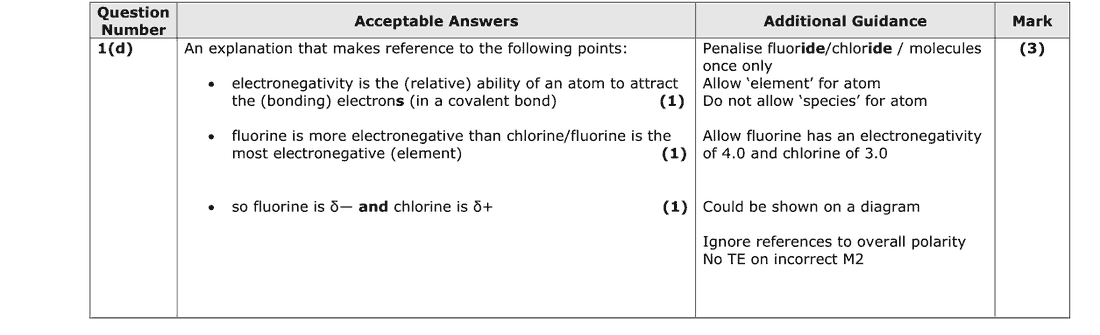
State what is meant by the term electronegativity and hence explain the polarity,
if any, of the bonds in chlorine trifluoride, ClF3.
June 2016 · AS Paper 1 · Q1(e) 1 mark Multiple choice formulae equations and amounts of substance
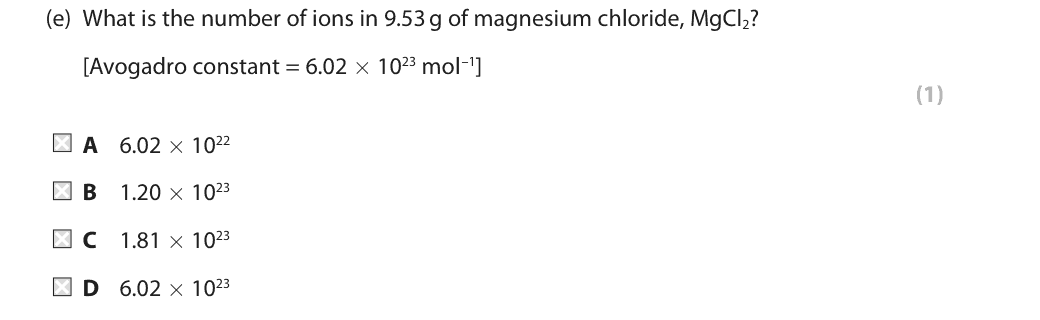
What is the number of ions in 9.53 g of magnesium chloride, MgCl2?
[Avogadro constant = 6.02 × 10²³ mol–1]
A 6.02 × 10²²
B 1.20 × 10²³
C 1.81 × 10²³
D 6.02 × 10²³
June 2016 · AS Paper 1 · Q2(a) 2 marks Short answer Easy atomic structure and the periodic table
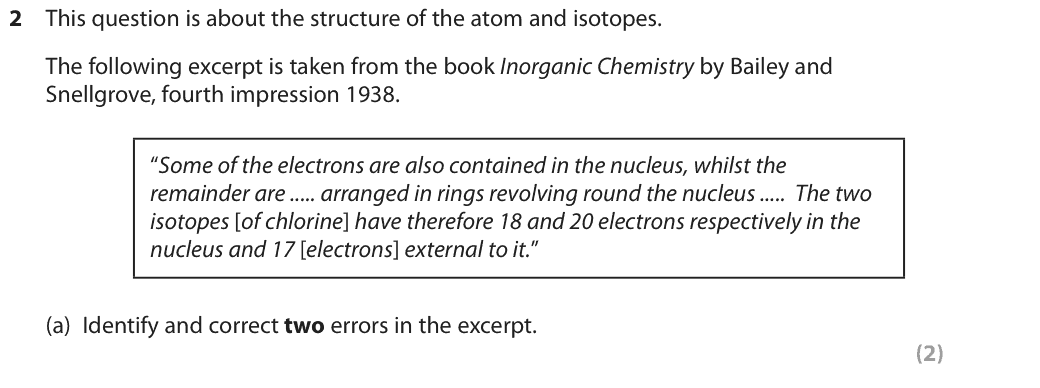
This question is about the structure of the atom and isotopes.
The following excerpt is taken from the book Inorganic Chemistry by Bailey and
Snellgrove, fourth impression 1938.
“Some of the electrons are also contained in the nucleus, whilst the
remainder are ..... arranged in rings revolving round the nucleus .....  The two
isotopes [of chlorine] have therefore 18 and 20 electrons respectively in the
nucleus and 17 [electrons] external to it.”
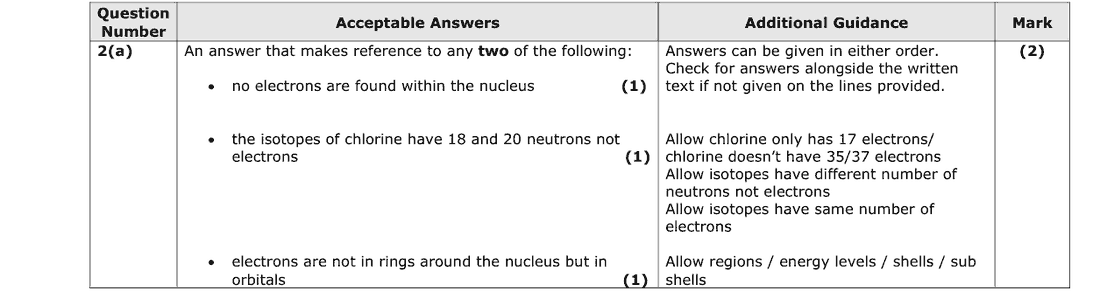
Identify and correct two errors in the excerpt.
June 2016 · AS Paper 1 · Q2(b) 1 mark Multiple choice atomic structure and the periodic table
Earlier part of question 2 that this part usesEarlier part of June 2016 Paper 1 question 2
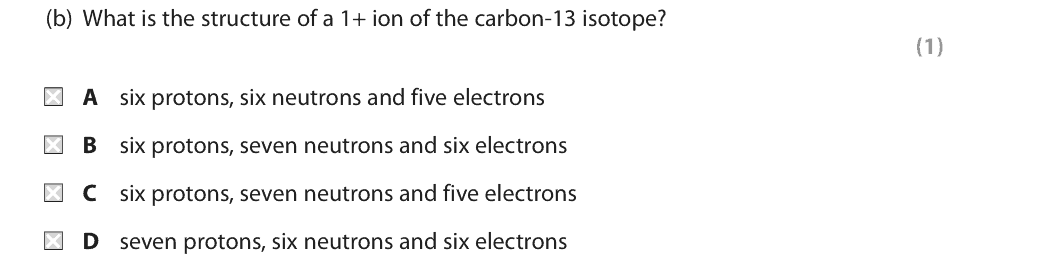
What is the structure of a 1+ ion of the carbon-13 isotope?
A six protons, six neutrons and five electrons
B six protons, seven neutrons and six electrons
C six protons, seven neutrons and five electrons
D seven protons, six neutrons and six electrons
June 2016 · AS Paper 1 · Q2(c)(i) 2 marks Short answer Easy atomic structure and the periodic table
Earlier part of question 2 that this part usesEarlier part of June 2016 Paper 1 question 2
State what is meant by the term relative atomic mass.
June 2016 · AS Paper 1 · Q2(c)(ii) 3 marks Calculation atomic structure and the periodic table
Earlier parts of question 2 that this part usesEarlier part of June 2016 Paper 1 question 2Earlier part of June 2016 Paper 1 question 2
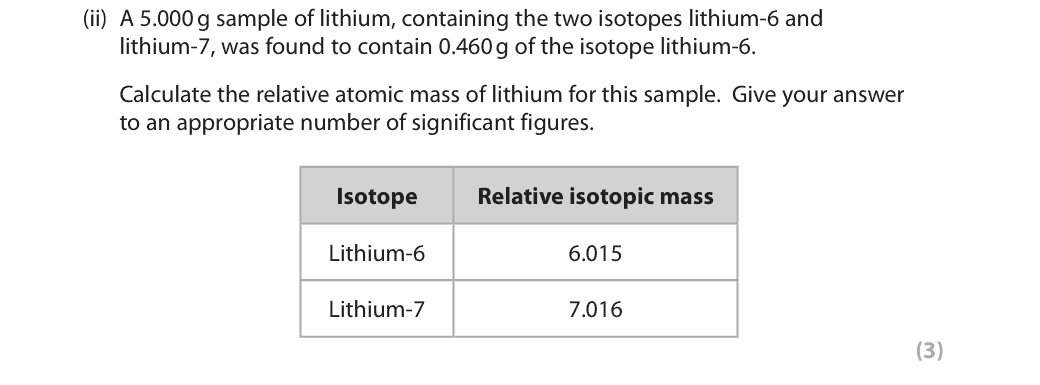
A 5.000 g sample of lithium, containing the two isotopes lithium-6 and
lithium-7, was found to contain 0.460 g of the isotope lithium-6.
Calculate the relative atomic mass of lithium for this sample.  Give your answer
to an appropriate number of significant figures.
Isotope
Relative isotopic mass
Lithium-6
6.015
Lithium-7
7.016
June 2016 · AS Paper 1 · Q2(d) 2 marks Explanation Hard atomic structure and the periodic table
Earlier part of question 2 that this part usesEarlier part of June 2016 Paper 1 question 2
A mass spectrometer was used to analyse a sample of bromine, Br2, with only the
79Br and 81Br isotopes present.
Explain why a very small peak occurs at m/z = 80.
June 2016 · AS Paper 1 · Q3(a)(i) 1 mark Calculation Easy formulae equations and amounts of substance
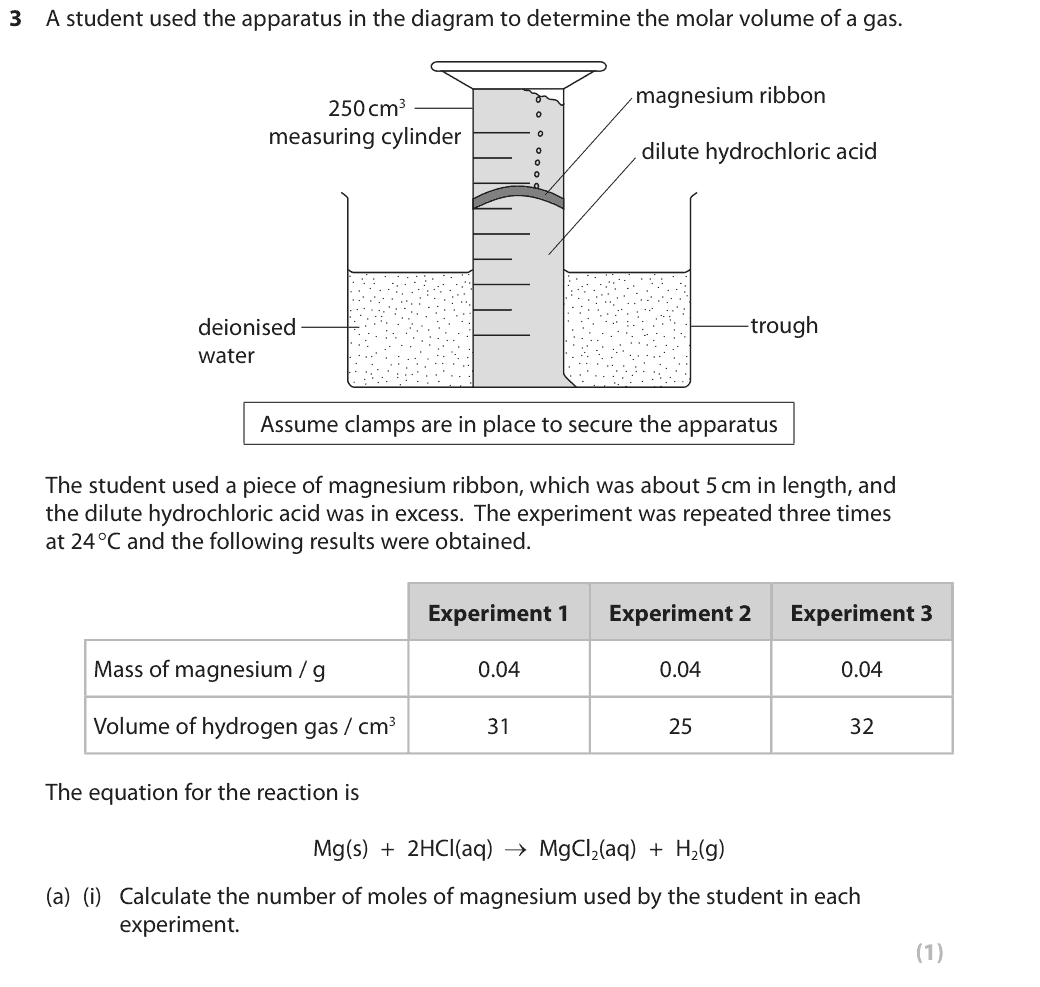
A student used the apparatus in the diagram to determine the molar volume of a gas.
magnesium ribbon
250 cm3
measuring cylinder
dilute hydrochloric acid
deionised
trough
water
Assume clamps are in place to secure the apparatus
The student used a piece of magnesium ribbon, which was about 5 cm in length, and
the dilute hydrochloric acid was in excess.  The experiment was repeated three times
at 24°C and the following results were obtained.
Experiment 1
Experiment 2
Experiment 3
Mass of magnesium / g
0.04
0.04
0.04
Volume of hydrogen gas / cm3
31
25
32
The equation for the reaction is
Mg(s) + 2HCl(aq) r MgCl2(aq) + H2(g)
Calculate the number of moles of magnesium used by the student in each
experiment.
June 2016 · AS Paper 1 · Q3(a)(ii) 1 mark Calculation Easy formulae equations and amounts of substance
Earlier part of question 3 that this part usesEarlier part of June 2016 Paper 1 question 3
Use your answer from part (a)(i) to deduce the number of moles of hydrogen
gas that should be produced.
June 2016 · AS Paper 1 · Q3(a)(iii) 4 marks Calculation formulae equations and amounts of substance
Earlier part of question 3 that this part usesEarlier part of June 2016 Paper 1 question 3
Calculate, using the Ideal Gas Equation, the volume of hydrogen gas, in cm3,
that should be produced in each of these experiments.
[pV = nRT    R = 8.31 J mol–1 K–1    p = 101 000 Pa]
June 2016 · AS Paper 1 · Q3(b) 1 mark Practical and data analysis formulae equations and amounts of substance
Earlier part of question 3 that this part usesEarlier part of June 2016 Paper 1 question 3
Give a reason why the student repeated the experiment three times.
June 2016 · AS Paper 1 · Q3(c) 6 marks Practical and data analysis formulae equations and amounts of substance
Earlier parts of question 3 that this part usesEarlier part of June 2016 Paper 1 question 3Earlier part of June 2016 Paper 1 question 3
Give three reasons for the difference between your calculated value in (a)(iii) and
the actual volumes of hydrogen gas obtained by the student.
For each reason, identify a change to either the apparatus or the chemicals that
could be made by the student to improve the result.
June 2016 · AS Paper 1 · Q4(a) 1 mark Multiple choice groups 1 and 2
The labels on four colourless solutions had fallen off in storage.  It was known that the
solutions were:
hydrochloric acid
magnesium sulfate
potassium chloride
sodium carbonate
In order to identify each solution, a number of tests were carried out.
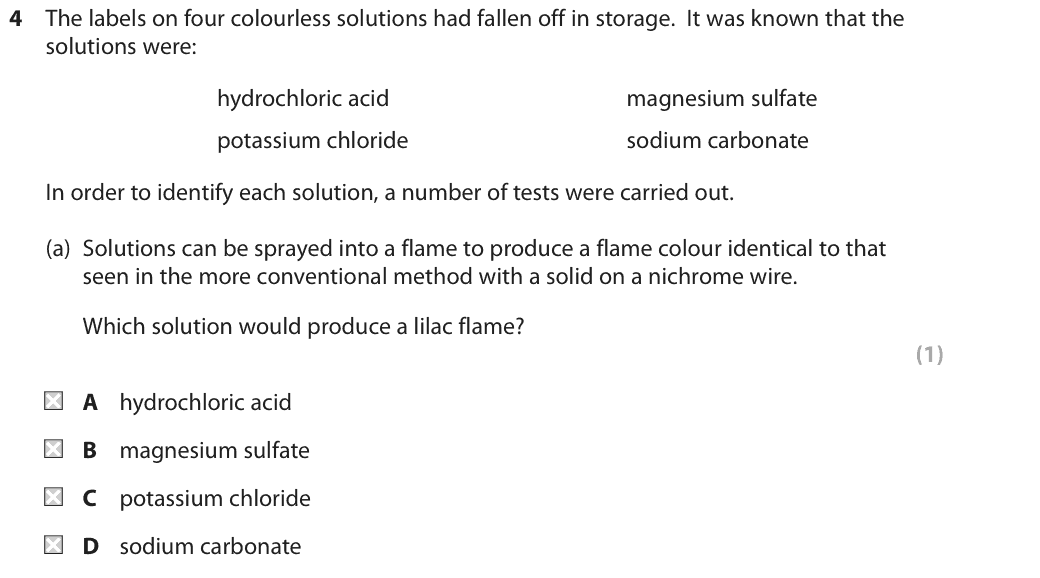
Solutions can be sprayed into a flame to produce a flame colour identical to that
seen in the more conventional method with a solid on a nichrome wire.
Which solution would produce a lilac flame?
A hydrochloric acid
B magnesium sulfate
C potassium chloride
D sodium carbonate
June 2016 · AS Paper 1 · Q4(b) 1 mark Multiple choice groups 1 and 2
Earlier part of question 4 that this part usesEarlier part of June 2016 Paper 1 question 4
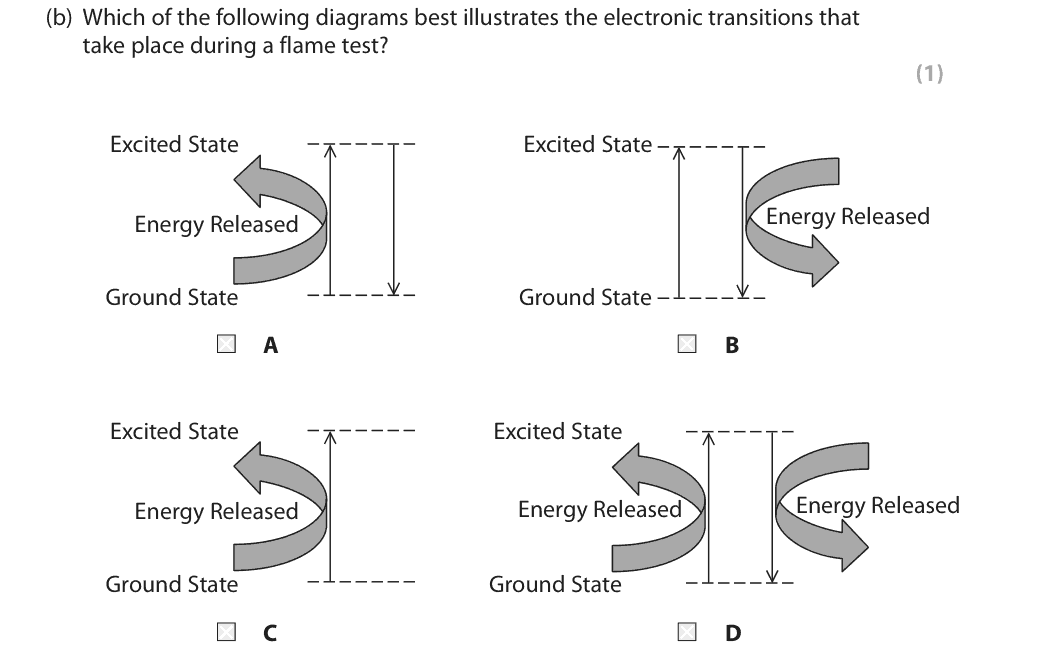
Which of the following diagrams best illustrates the electronic transitions that
take place during a flame test?
Excited State
Excited State
Energy Released
Energy Released
Ground State
Ground State
A
B
Excited State
Excited State
Energy Released
Energy Released
Energy Released
Ground State
Ground State
C
D
June 2016 · AS Paper 1 · Q4(c) 1 mark Multiple choice analysis of inorganic compounds
Earlier part of question 4 that this part usesEarlier part of June 2016 Paper 1 question 4
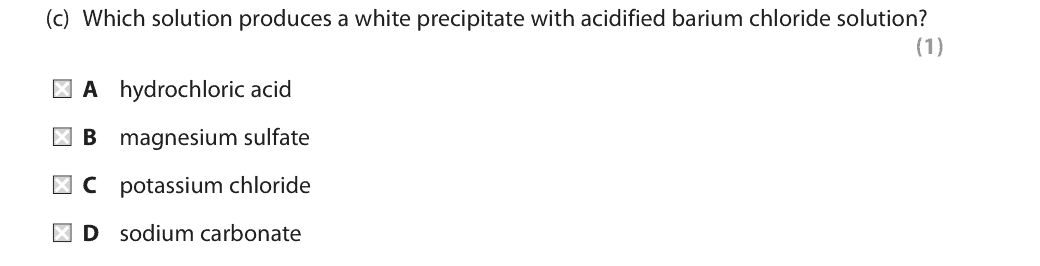
Which solution produces a white precipitate with acidified barium chloride solution?
A hydrochloric acid
B magnesium sulfate
C potassium chloride
D sodium carbonate
June 2016 · AS Paper 1 · Q4(d) 2 marks Practical and data analysis group 7 the halogens
Earlier part of question 4 that this part usesEarlier part of June 2016 Paper 1 question 4
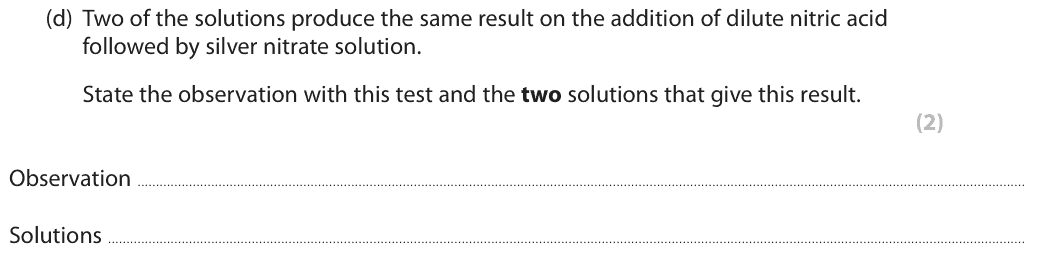
Two of the solutions produce the same result on the addition of dilute nitric acid
followed by silver nitrate solution.
State the observation with this test and the two solutions that give this result.
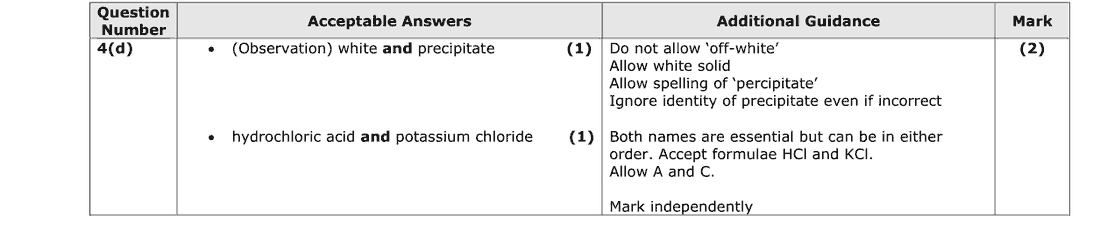
Observation  
Solutions
June 2016 · AS Paper 1 · Q4(e) 2 marks Equation writing analysis of inorganic compoundsformulae equations and amounts of substance
Earlier part of question 4 that this part usesEarlier part of June 2016 Paper 1 question 4
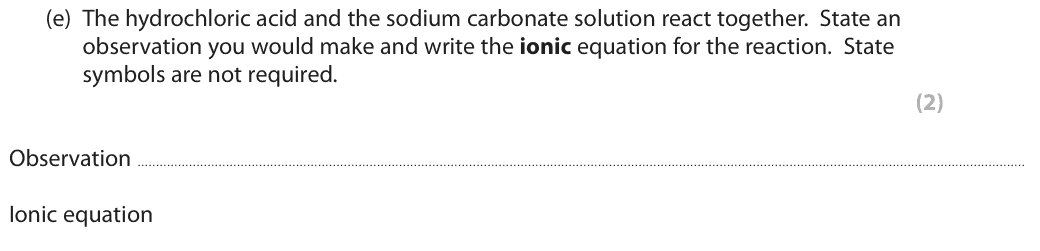
The hydrochloric acid and the sodium carbonate solution react together.  State an
observation you would make and write the ionic equation for the reaction.  State
symbols are not required.
Observation  
Ionic equation
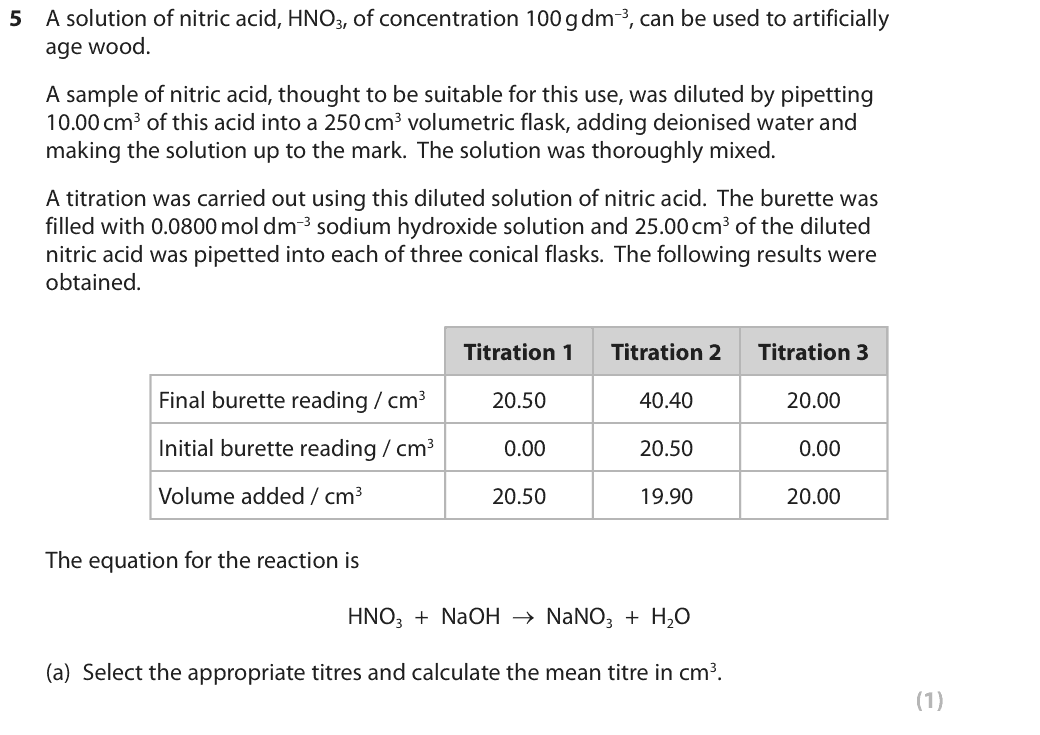
June 2016 · AS Paper 1 · Q5(a) 1 mark Calculation formulae equations and amounts of substance
A solution of nitric acid, HNO3, of concentration 100 g dm–3, can be used to artificially
age wood.
A sample of nitric acid, thought to be suitable for this use, was diluted by pipetting
10.00 cm3 of this acid into a 250 cm3 volumetric flask, adding deionised water and
making the solution up to the mark.  The solution was thoroughly mixed.
A titration was carried out using this diluted solution of nitric acid.  The burette was
filled with 0.0800 mol dm–3 sodium hydroxide solution and 25.00 cm3 of the diluted
nitric acid was pipetted into each of three conical flasks.  The following results were
obtained.
Titration 1
Titration 2
Titration 3
Final burette reading / cm3
20.50
40.40
20.00
Initial burette reading / cm3
0.00
20.50
0.00
Volume added / cm3
20.50
19.90
20.00
The equation for the reaction is
HNO3 + NaOH r NaNO3 + H2O
Select the appropriate titres and calculate the mean titre in cm3.
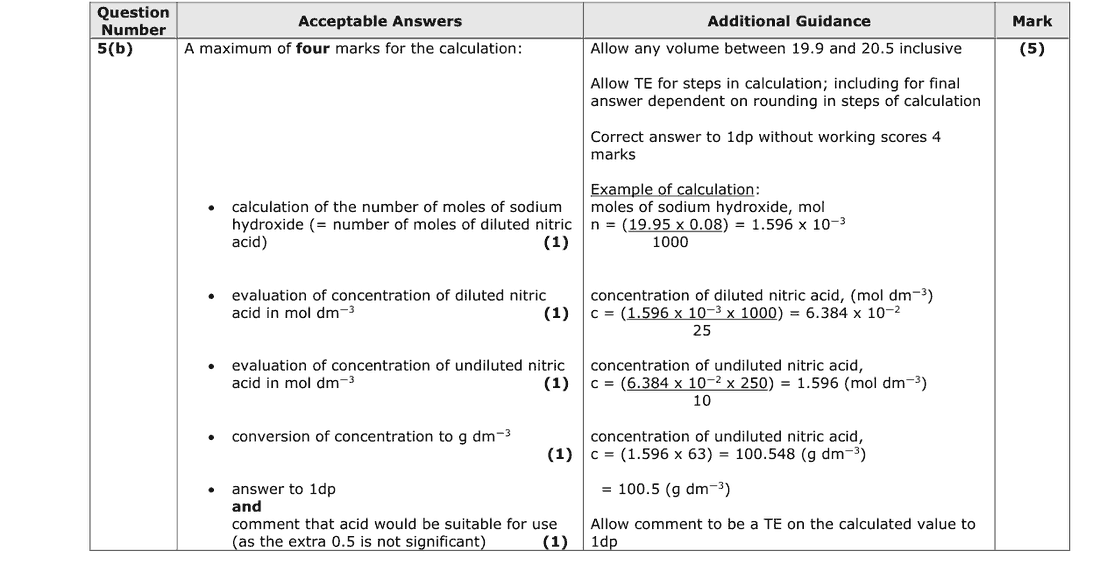
June 2016 · AS Paper 1 · Q5(b) 5 marks Calculation formulae equations and amounts of substance
Earlier part of question 5 that this part usesEarlier part of June 2016 Paper 1 question 5
Calculate the concentration of the undiluted nitric acid in g dm–3.  Give your
answer to one decimal place.
Deduce whether this nitric acid is suitable for use in artificially ageing wood.
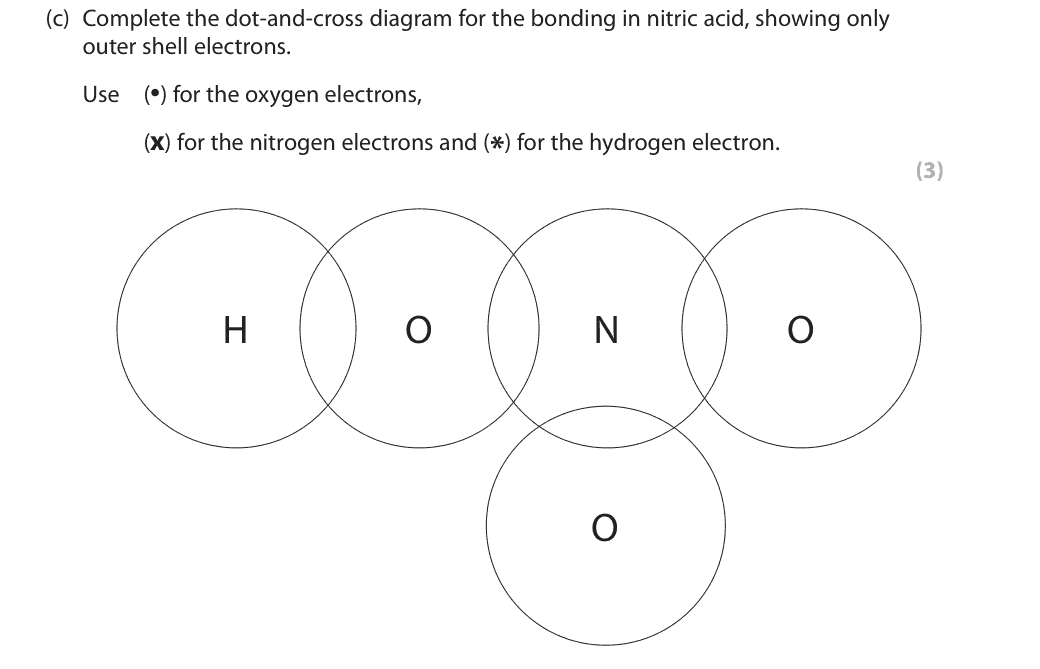
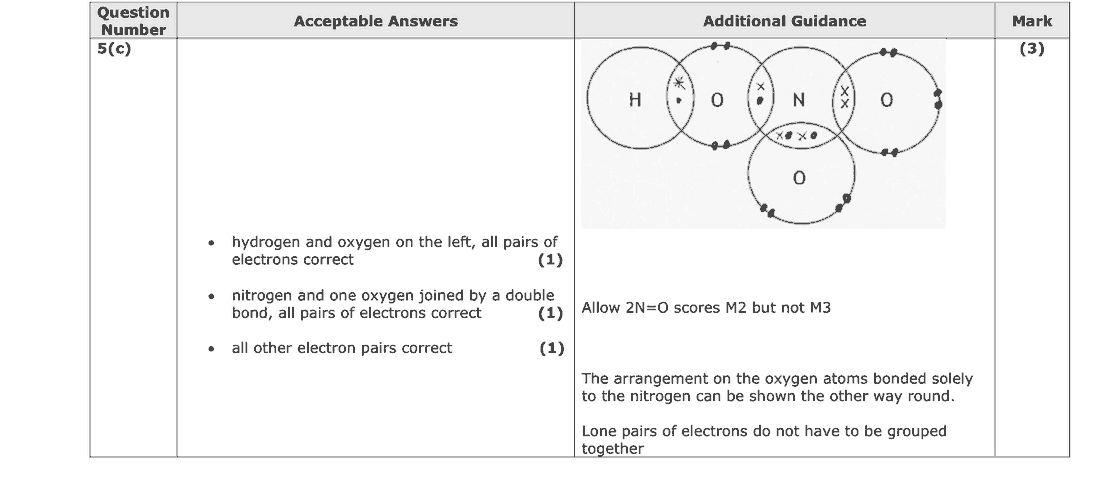
June 2016 · AS Paper 1 · Q5(c) 3 marks Diagram or structure bonding
Earlier part of question 5 that this part usesEarlier part of June 2016 Paper 1 question 5
Complete the dot-and-cross diagram for the bonding in nitric acid, showing only
outer shell electrons.
Use  (•) for the oxygen electrons,
(x) for the nitrogen electrons and (*) for the hydrogen electron.
H
O
N
O
O
June 2016 · AS Paper 1 · Q5(d) 1 mark Calculation formulae equations and amounts of substance
Earlier part of question 5 that this part usesEarlier part of June 2016 Paper 1 question 5
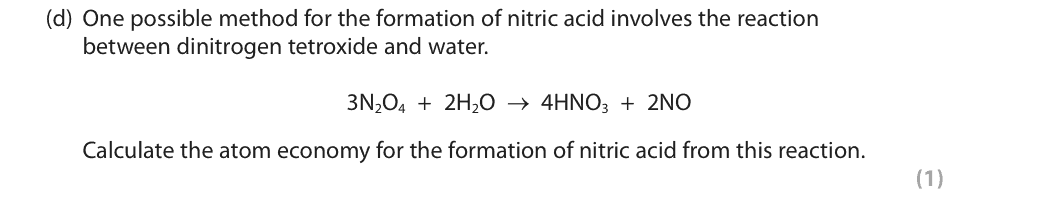
One possible method for the formation of nitric acid involves the reaction
between dinitrogen tetroxide and water.
3N2O4 + 2H2O r 4HNO3 + 2NO
Calculate the atom economy for the formation of nitric acid from this reaction.
June 2016 · AS Paper 1 · Q6(a) 2 marks Explanation bonding
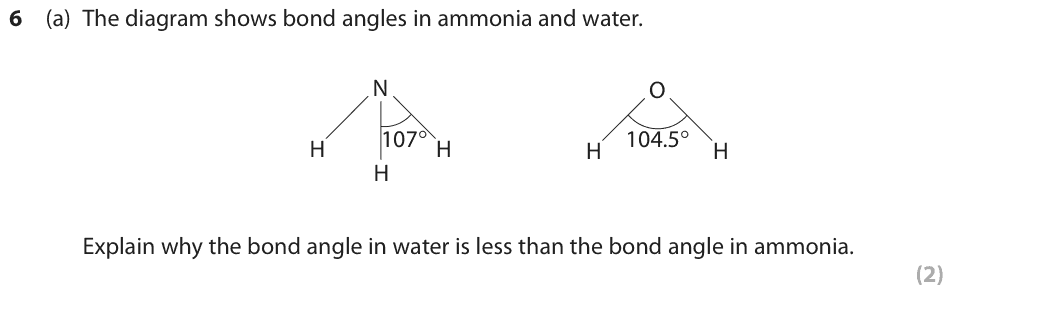
The diagram shows bond angles in ammonia and water.
N
O
107°
104.5°
H
H
H
H
H
Explain why the bond angle in water is less than the bond angle in ammonia.
June 2016 · AS Paper 1 · Q6(b) 3 marks Explanation Hard bonding
Earlier part of question 6 that this part usesEarlier part of June 2016 Paper 1 question 6
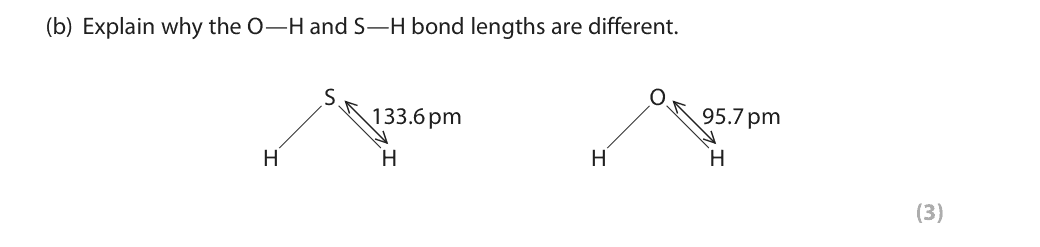
Explain why the O–H and S–H bond lengths are different.
S
O
133.6 pm
95.7 pm
H
H
H
H
June 2016 · AS Paper 1 · Q7(a) 6 marks 6-mark extended response groups 1 and 2
A student suggested that the difference in the rates of reaction of strontium and
barium with water is due to the difference in the sum of their first and second
ionisation energies.  Discuss this suggestion.
June 2016 · AS Paper 1 · Q7(b) 1 mark Multiple choice atomic structure and the periodic table
Which is the equation for the third ionisation energy of barium?
A Ba(s)
r  Ba3+(g) + 3e–
B Ba2+(s)  r  Ba3+(g) + e–
C Ba2+(g)  r  Ba3+(g) + e–
D Ba3+(g)  r  Ba4+(g) + e–
June 2016 · AS Paper 1 · Q7(c) 4 marks Explanation groups 1 and 2
Explain why magnesium nitrate, Mg(NO3)2 decomposes more readily on heating
than potassium nitrate, KNO3.
June 2016 · AS Paper 1 · Q7(d)(i) 2 marks Diagram or structure groups 1 and 2
Some metal carbonates also undergo thermal decomposition.
Draw a diagram of the apparatus that could be used to compare the
ease of thermal decomposition of lithium carbonate, Li2CO3, and
magnesium carbonate, MgCO3.
June 2016 · AS Paper 1 · Q7(d)(ii) 1 mark Practical and data analysis Hard groups 1 and 2
Earlier part of question 7 that this part usesEarlier part of June 2016 Paper 1 question 7
State one way in which you would ensure a fair test.
June 2016 · AS Paper 1 · Q7(d)(iii) 1 mark Practical and data analysis groups 1 and 2
Earlier parts of question 7 that this part usesEarlier part of June 2016 Paper 1 question 7Earlier part of June 2016 Paper 1 question 7
State how data obtained in this experiment could be used to make a
comparison.
June 2016 · AS Paper 1 · Q8(a) 1 mark Multiple choice structure
The properties of elements and their compounds are determined by their structure
and bonding.
Magnesium oxide has a very high melting temperature.
Which of the following is the best description of its structure and bonding?
A giant ionic
B giant metallic
C giant covalent
D simple covalent
June 2016 · AS Paper 1 · Q8(b)(i) 2 marks Calculation formulae equations and amounts of substance
Earlier part of question 8 that this part usesEarlier part of June 2016 Paper 1 question 8
Sulfur reacts with fluorine to form a number of different compounds.
One compound contains 45.79% sulfur and 54.21% fluorine by mass.
Calculate the empirical formula of this compound.
June 2016 · AS Paper 1 · Q8(b)(ii) 1 mark Equation writing formulae equations and amounts of substance
Earlier parts of question 8 that this part usesEarlier part of June 2016 Paper 1 question 8Earlier part of June 2016 Paper 1 question 8
In a dry container, a fluoride of silver reacts with sulfur to produce
disulfur difluoride.  Complete the equation for this reaction.
State symbols are not required.
S8 + AgF2 r S2F2 + AgF
June 2016 · AS Paper 1 · Q8(b)(iii) 3 marks Explanation redox i
Earlier parts of question 8 that this part usesEarlier part of June 2016 Paper 1 question 8Earlier part of June 2016 Paper 1 question 8
Explain, by using the oxidation numbers of all the atoms, whether or not this
is a redox reaction.
June 2016 · AS Paper 1 · Q8(c) 4 marks Explanation Easy structurebonding
Earlier part of question 8 that this part usesEarlier part of June 2016 Paper 1 question 8
Element X has the typical appearance of a metal.
Predict two other distinct physical properties that element X would exhibit if it is
a metal.  Explain your choices in terms of structure and bonding.

Work with an A-level chemistry tutor

Want a paper marked and gone through with you? Message us.

Prefer email? Send an enquiry

If you are under 18, please include a parent's contact details. Enquiries go to enquiries@chemistryaleveltutor.com and are deleted once handled. All tutoring is online.