November 2021: AS Paper 1, Core Inorganic and Physical Chemistry

80 marks · 39 question parts · Paper, mark scheme and report on Edexcel's site · An autumn series, sat in place of the cancelled summer exams · Have the Data Booklet beside you

Question by question

QTopicMarksAOType
1(a) Atomic structure and the Periodic Table 2Short answer
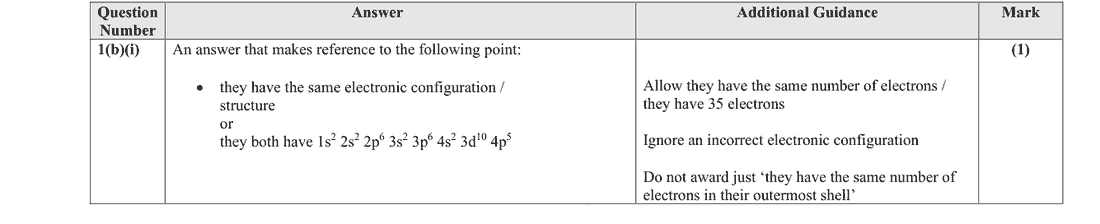
1(b)(i) Atomic structure and the Periodic Table 1Short answer
1(b)(ii) Atomic structure and the Periodic Table 2Short answer

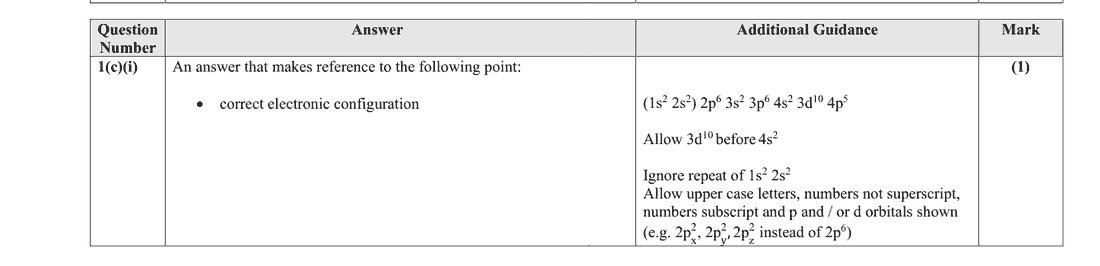
1(c)(i) Atomic structure and the Periodic Table 1Short answer
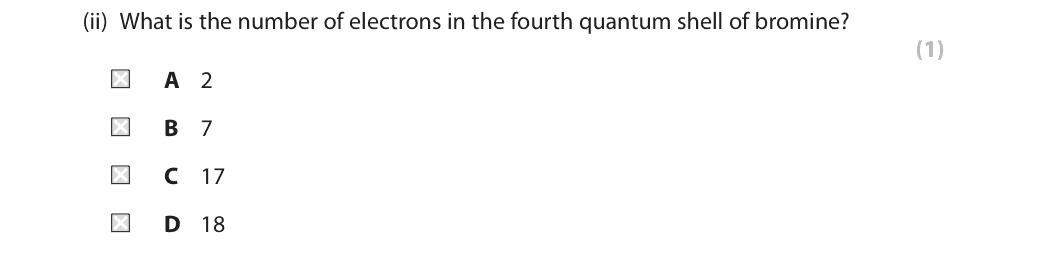
1(c)(ii) Atomic structure and the Periodic Table 1Multiple choice
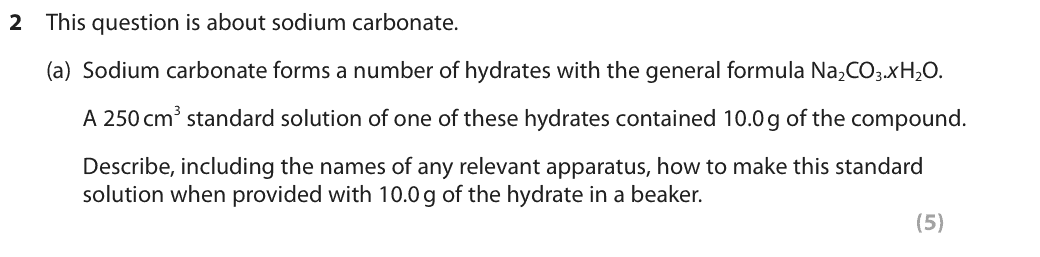
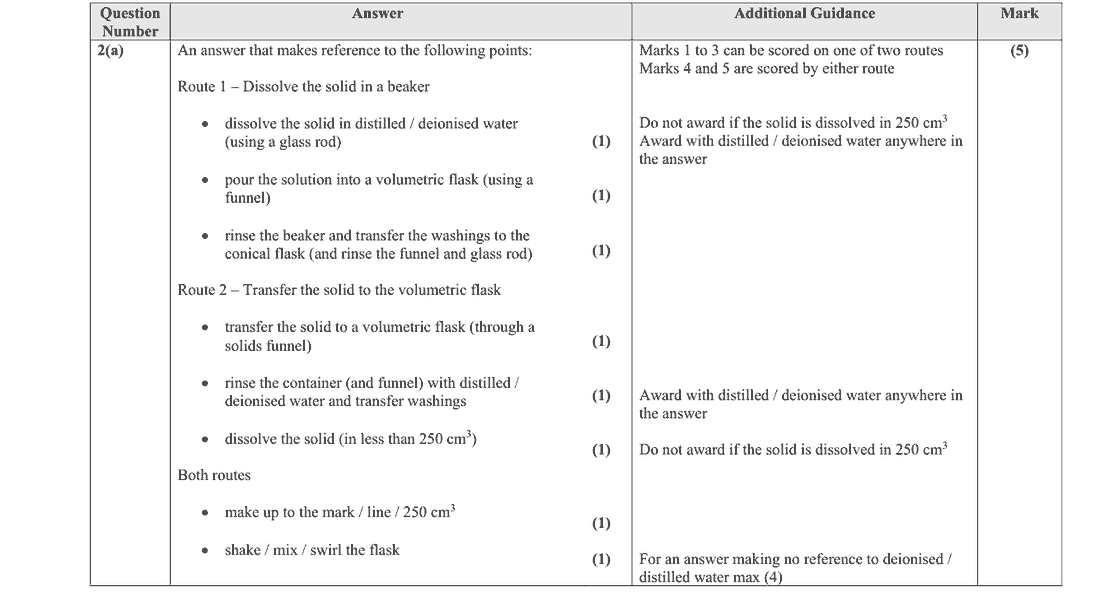
2(a) Formulae, equations and amounts of substance 5Practical and data analysis
2(b)(i) Formulae, equations and amounts of substance 1Multiple choice
2(b)(ii) Formulae, equations and amounts of substance 1Practical and data analysis
2(b)(iii) Formulae, equations and amounts of substance 1Calculation
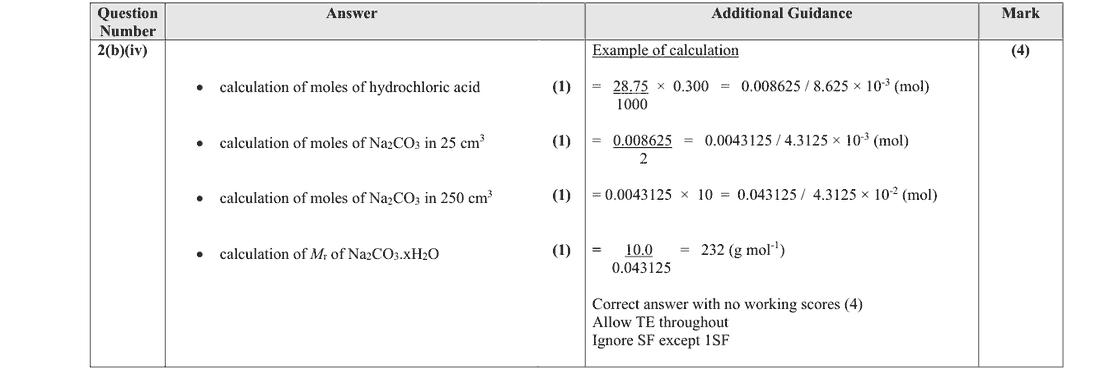
2(b)(iv) Formulae, equations and amounts of substance 4Calculation
2(c)(i) Atomic structure and the Periodic Table 1Calculation
2(c)(ii) Atomic structure and the Periodic Table, Formulae, equations and amounts of substance 1Calculation
2(d) Formulae, equations and amounts of substance 3Calculation
3(a)(i) Formulae, equations and amounts of substance 1Equation writing
3(a)(ii) Bonding 3Diagram or structure
3(a)(iii) Bonding 1Multiple choice
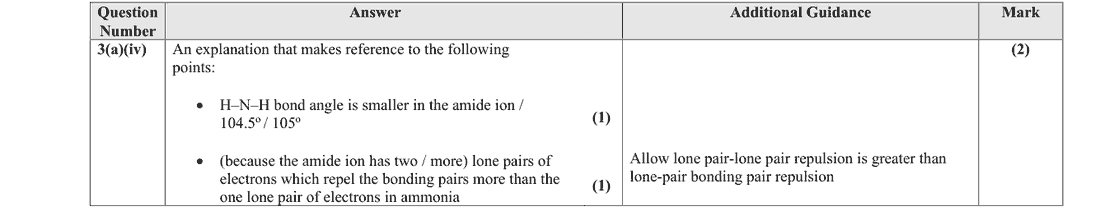
3(a)(iv) Bonding 2Explanation
3(b) Formulae, equations and amounts of substance 1Short answer
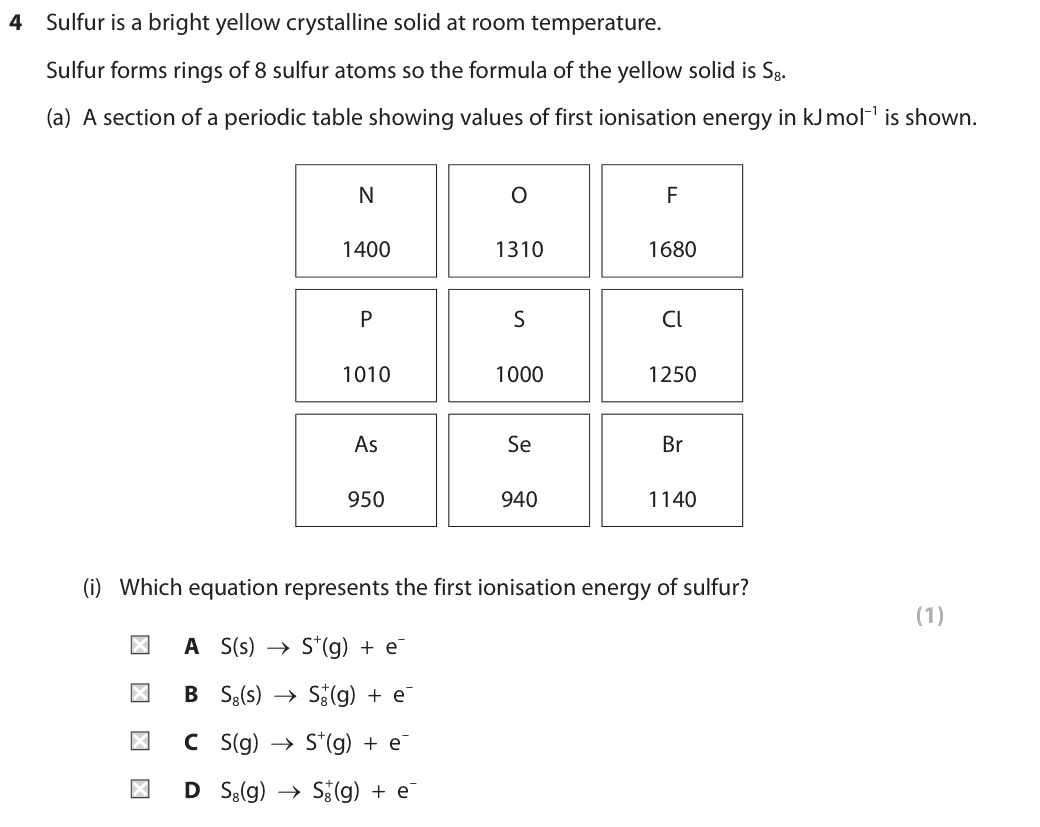
4(a)(i) Atomic structure and the Periodic Table 1Multiple choice
4(a)(ii) Atomic structure and the Periodic Table 3Explanation
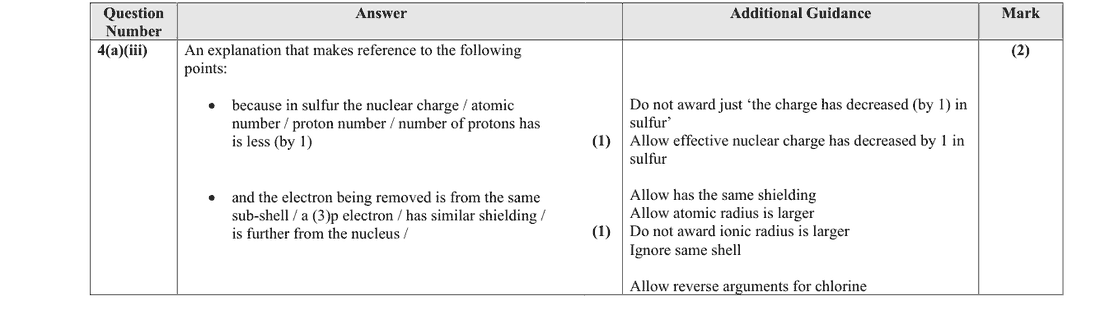
4(a)(iii) Atomic structure and the Periodic Table 2Explanation
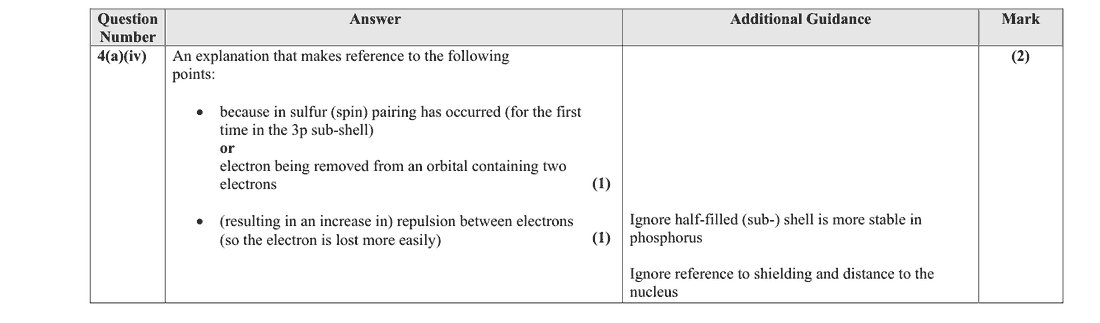
4(a)(iv) Atomic structure and the Periodic Table 2Explanation
4(b) Formulae, equations and amounts of substance 5Calculation
4(c)(i) Bonding 2Diagram or structure
4(c)(ii) Bonding 1Short answer
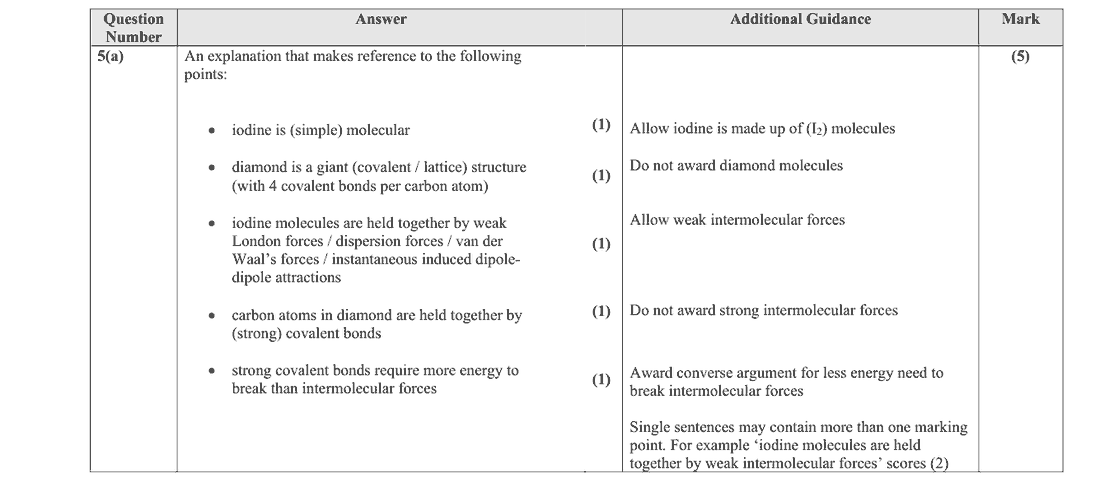
5(a) Structure 5Explanation
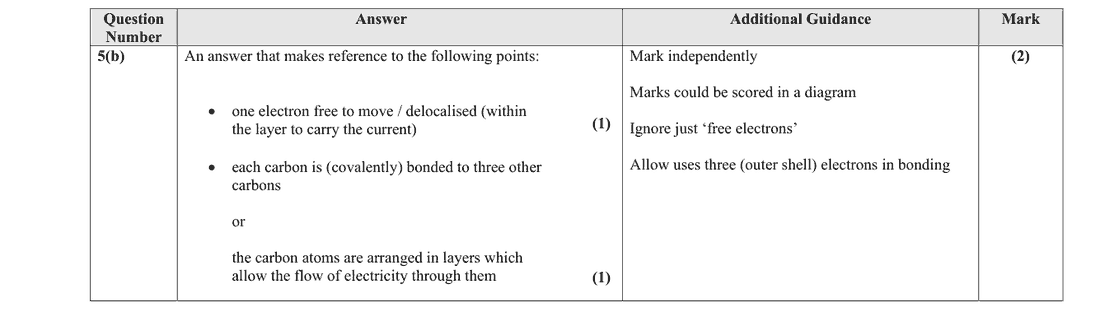
5(b) Structure 2Short answer
6(a)(i) Redox I 1Short answer
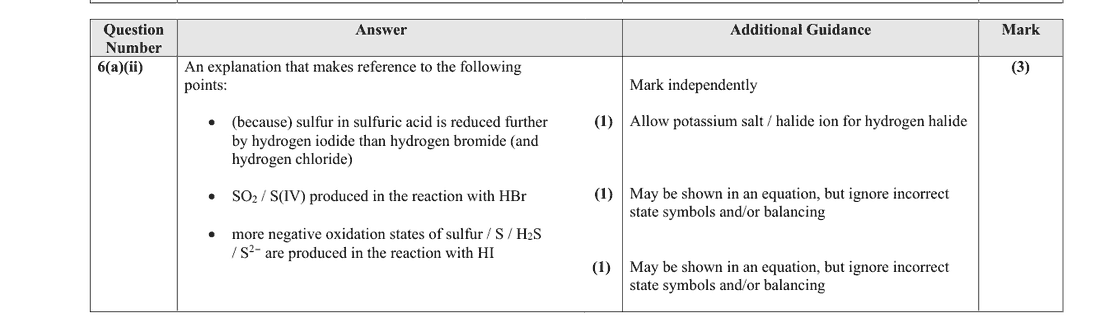
6(a)(ii) The elements of Group 7 (halogens) 3Explanation
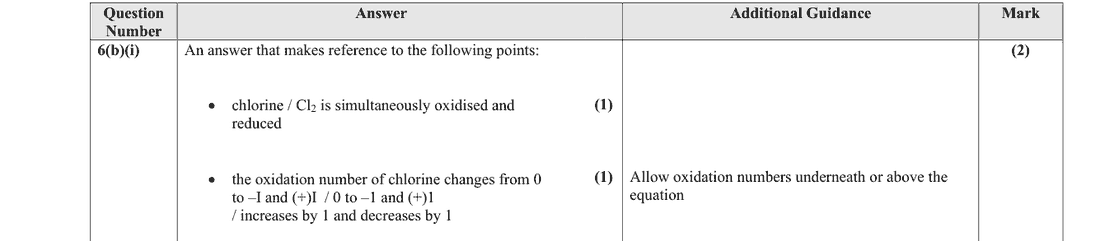
6(b)(i) Redox I, The elements of Group 7 (halogens) 2Explanation
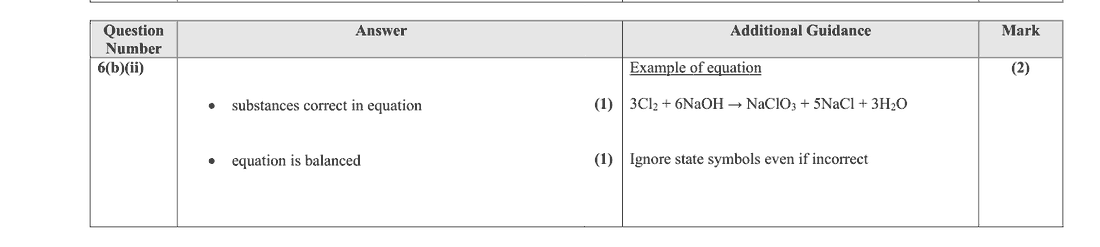
6(b)(ii) The elements of Group 7 (halogens), Formulae, equations and amounts of substance 2Equation writing
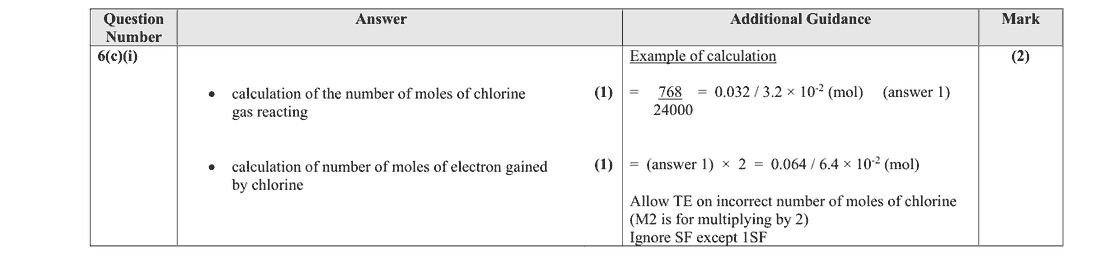
6(c)(i) Formulae, equations and amounts of substance 2Calculation
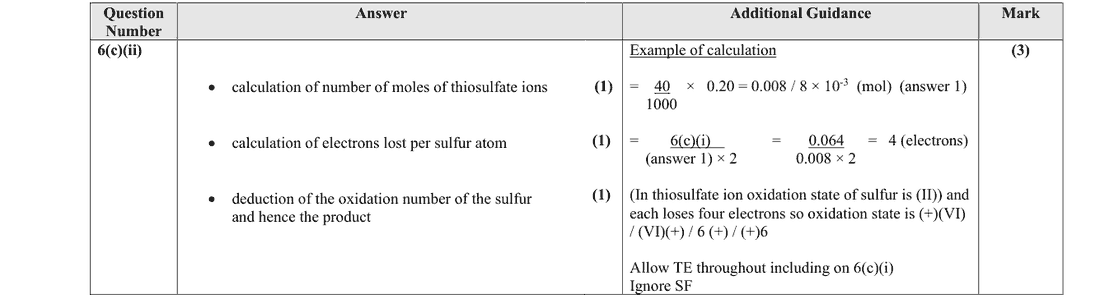
6(c)(ii) Redox I, Formulae, equations and amounts of substance 3Calculation
7(a) Bonding 2Short answer
7(b) Atomic structure and the Periodic Table 1Multiple choice
7(c)(i) The elements of Groups 1 and 2 1Multiple choice
7(c)(ii) The elements of Groups 1 and 2 1Multiple choice
7(c)(iii) The elements of Groups 1 and 2 1Multiple choice
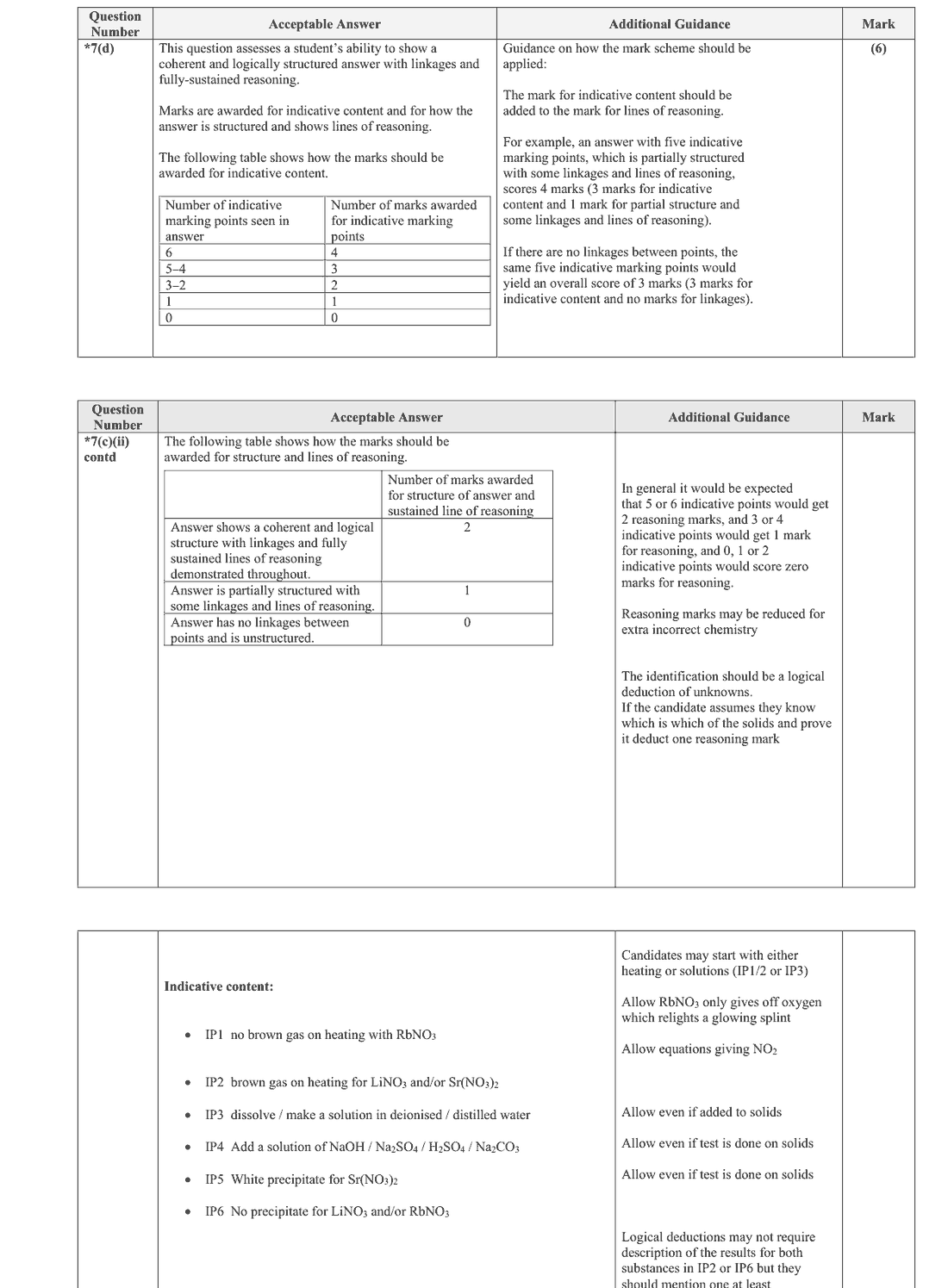
7(d) The elements of Groups 1 and 2 6Extended response

The questions

1(a)1(b)(i)1(b)(ii)1(c)(i)1(c)(ii)2(a)2(b)(i)2(b)(ii)2(b)(iii)2(b)(iv)2(c)(i)2(c)(ii)2(d)3(a)(i)3(a)(ii)3(a)(iii)3(a)(iv)3(b)4(a)(i)4(a)(ii)4(a)(iii)4(a)(iv)4(b)4(c)(i)4(c)(ii)5(a)5(b)6(a)(i)6(a)(ii)6(b)(i)6(b)(ii)6(c)(i)6(c)(ii)7(a)7(b)7(c)(i)7(c)(ii)7(c)(iii)7(d)
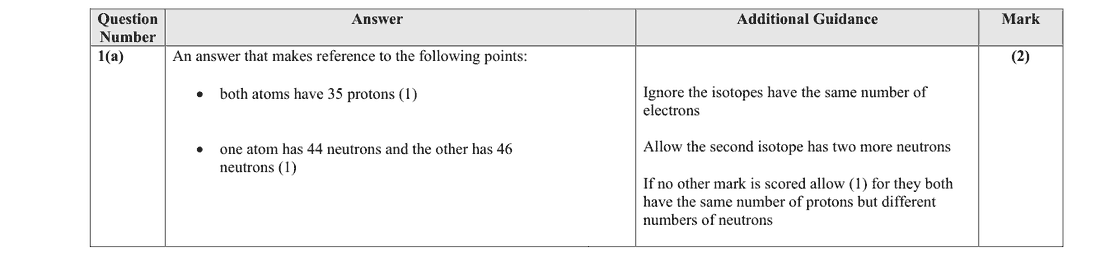
November 2021 · AS Paper 1 · Q1(a) 2 marks Short answer Easy atomic structure and the periodic table
Bromine exists as two stable isotopes. The two isotopes are represented by the
symbols 35
79Br and 35
81Br.
Give one similarity and one difference between these two isotopes by referring to
the number of particles in the nuclei of the two isotopes.
November 2021 · AS Paper 1 · Q1(b)(i) 1 mark Short answer atomic structure and the periodic table
Earlier part of question 1 that this part usesEarlier part of November 2021 Paper 1 question 1
The relative abundance of the two isotopes in a sample cannot be found in a
chemical test.
Give the reason why, despite the difference in atomic structure, the isotopes
have the same chemical reactions.
November 2021 · AS Paper 1 · Q1(b)(ii) 2 marks Short answer atomic structure and the periodic table
Earlier parts of question 1 that this part usesEarlier part of November 2021 Paper 1 question 1Earlier part of November 2021 Paper 1 question 1
State how the relative abundance of the two isotopes can be found.
November 2021 · AS Paper 1 · Q1(c)(i) 1 mark Short answer Easy atomic structure and the periodic table
Earlier part of question 1 that this part usesEarlier part of November 2021 Paper 1 question 1
Complete the electronic configuration of a bromine atom.
1s2 2s2
November 2021 · AS Paper 1 · Q1(c)(ii) 1 mark Multiple choice atomic structure and the periodic table
Earlier parts of question 1 that this part usesEarlier part of November 2021 Paper 1 question 1Earlier part of November 2021 Paper 1 question 1
What is the number of electrons in the fourth quantum shell of bromine?
A  2
B  7
C  17
D  18
November 2021 · AS Paper 1 · Q2(a) 5 marks Practical and data analysis Hard formulae equations and amounts of substance
This question is about sodium carbonate.
Sodium carbonate forms a number of hydrates with the general formula Na2CO3.xH2O.
A 250 cm3 standard solution of one of these hydrates contained 10.0 g of the compound.
Describe, including the names of any relevant apparatus, how to make this standard
solution when provided with 10.0 g of the hydrate in a beaker.
November 2021 · AS Paper 1 · Q2(b)(i) 1 mark Multiple choice formulae equations and amounts of substance
Earlier part of question 2 that this part usesEarlier part of November 2021 Paper 1 question 2
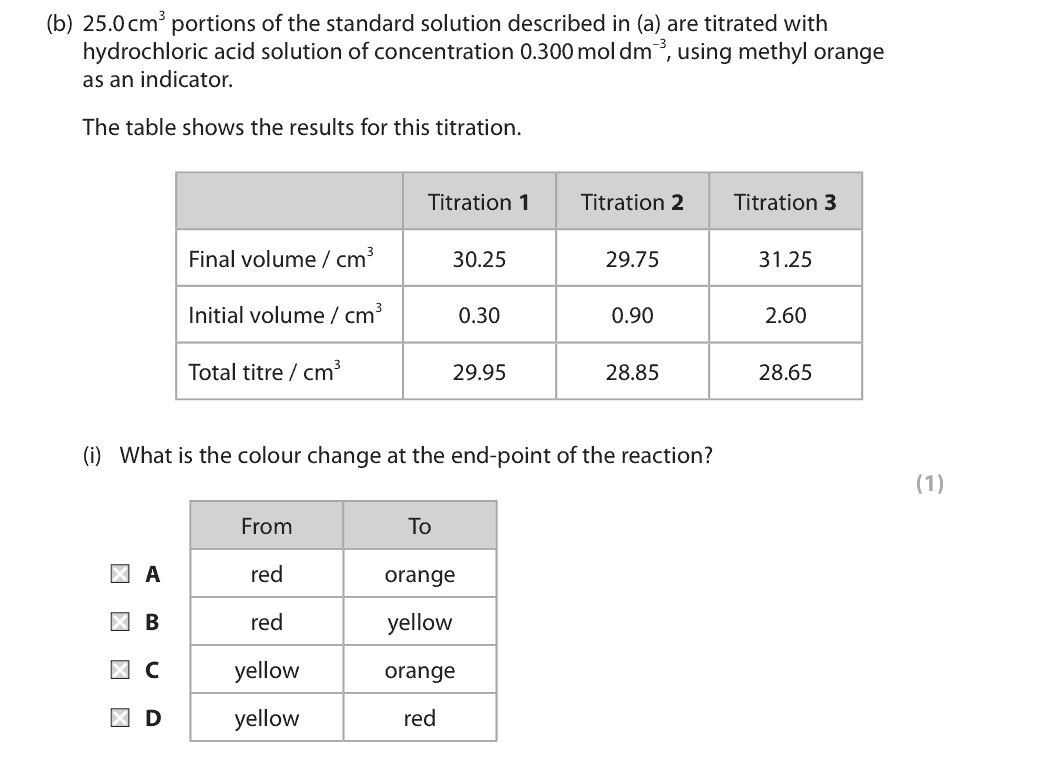
25.0 cm3 portions of the standard solution described in (a) are titrated with
hydrochloric acid solution of concentration 0.300 mol dm–3, using methyl orange
as an indicator.
The table shows the results for this titration.
Titration 1
Titration 2
Titration 3
Final volume / cm3
30.25
29.75
31.25
Initial volume / cm3
0.30
0.90
2.60
Total titre / cm3
29.95
28.85
28.65
What is the colour change at the end-point of the reaction?
From
To
A
red
orange
B
red
yellow
C
yellow
orange
D
yellow
red
November 2021 · AS Paper 1 · Q2(b)(ii) 1 mark Practical and data analysis formulae equations and amounts of substance
Earlier parts of question 2 that this part usesEarlier part of November 2021 Paper 1 question 2Earlier part of November 2021 Paper 1 question 2
State why the value for the total titre in Titration 1 should not be used to
calculate the mean titre.
November 2021 · AS Paper 1 · Q2(b)(iii) 1 mark Calculation formulae equations and amounts of substance
Earlier parts of question 2 that this part usesEarlier part of November 2021 Paper 1 question 2Earlier part of November 2021 Paper 1 question 2
Calculate the mean titre.
November 2021 · AS Paper 1 · Q2(b)(iv) 4 marks Calculation formulae equations and amounts of substance
Earlier parts of question 2 that this part usesEarlier part of November 2021 Paper 1 question 2Earlier part of November 2021 Paper 1 question 2
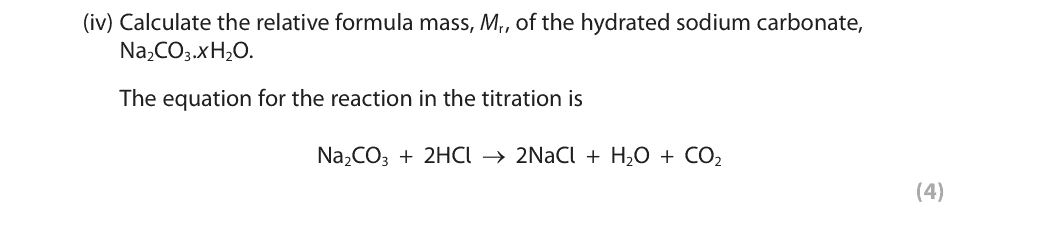
Calculate the relative formula mass, Mr , of the hydrated sodium carbonate,
Na2CO3.xH2O.
The equation for the reaction in the titration is
Na2CO3  +  2HCl  →  2NaCl  +  H2O  +  CO2
November 2021 · AS Paper 1 · Q2(c)(i) 1 mark Calculation atomic structure and the periodic table
In an experiment, the Mr of a different hydrated sodium carbonate was found to
be 286 g mol–1.
Calculate the relative formula mass of anhydrous sodium carbonate, Na2CO3 .
November 2021 · AS Paper 1 · Q2(c)(ii) 1 mark Calculation atomic structure and the periodic tableformulae equations and amounts of substance
Earlier parts of question 2 that this part usesEarlier part of November 2021 Paper 1 question 2Earlier part of November 2021 Paper 1 question 2
Calculate the number of molecules of water of crystallisation, x, for this
hydrated sodium carbonate, Na2CO3.xH2O.
November 2021 · AS Paper 1 · Q2(d) 3 marks Calculation formulae equations and amounts of substance
Earlier part of question 2 that this part usesEarlier part of November 2021 Paper 1 question 2
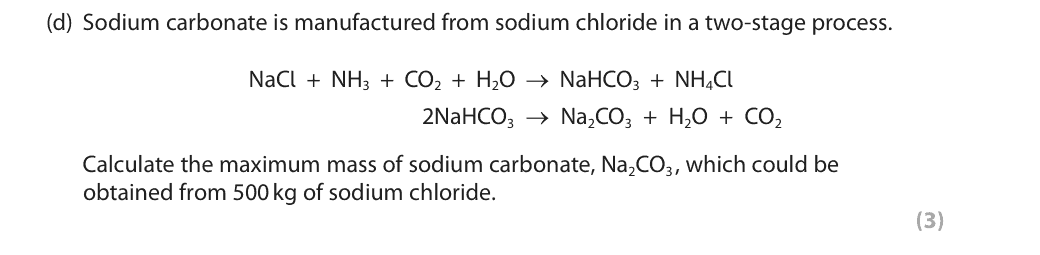
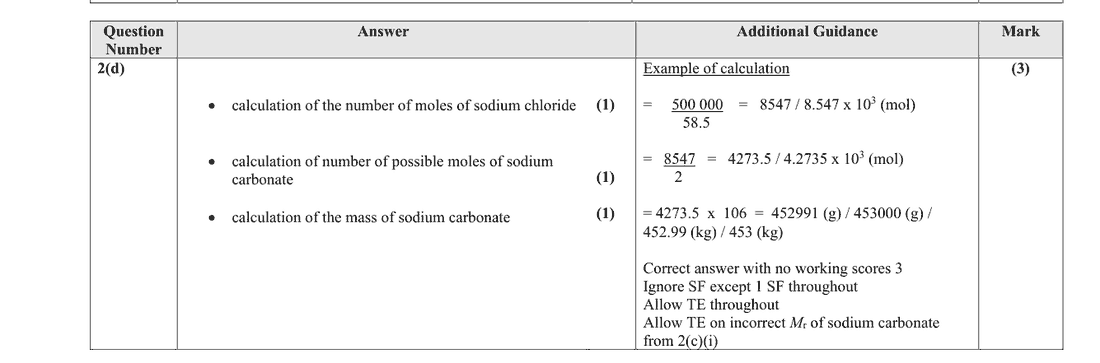
Sodium carbonate is manufactured from sodium chloride in a two-stage process.
NaCl  +  NH3  +  CO2  +  H2O  →  NaHCO3  +  NH4Cl
2NaHCO3  →  Na2CO3  +  H2O  +  CO2
Calculate the maximum mass of sodium carbonate, Na2CO3 , which could be
obtained from 500 kg of sodium chloride.
November 2021 · AS Paper 1 · Q3(a)(i) 1 mark Equation writing formulae equations and amounts of substance
Ammonia reacts with sodium to form sodium amide, NaNH2 , and hydrogen.
Write the equation for this reaction.
State symbols are not required.
November 2021 · AS Paper 1 · Q3(a)(ii) 3 marks Diagram or structure bonding
Earlier part of question 3 that this part usesEarlier part of November 2021 Paper 1 question 3
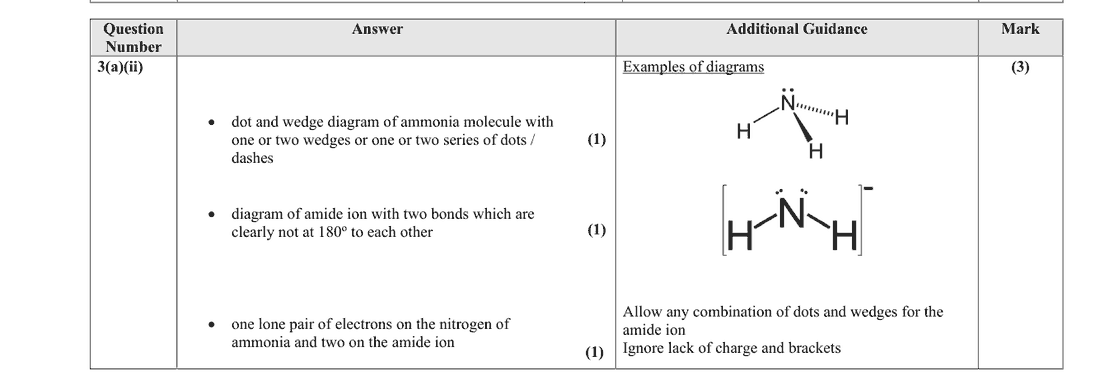
Draw diagrams showing the 3-dimensional shape of an ammonia molecule
and of an amide ion, NH2
–.
Include any lone pairs of electrons in each species.
ammonia molecule
amide ion
November 2021 · AS Paper 1 · Q3(a)(iii) 1 mark Multiple choice bonding
Earlier part of question 3 that this part usesEarlier part of November 2021 Paper 1 question 3
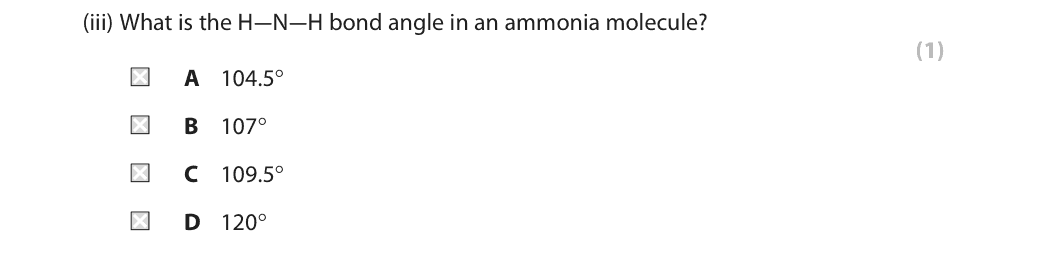
What is the H–N–H bond angle in an ammonia molecule?
A  104.5°
B  107°
C  109.5°
D  120°
November 2021 · AS Paper 1 · Q3(a)(iv) 2 marks Explanation bonding
Earlier part of question 3 that this part usesEarlier part of November 2021 Paper 1 question 3
Explain the difference between the H–N–H bond angle in ammonia and in
the amide ion.
November 2021 · AS Paper 1 · Q3(b) 1 mark Short answer Hard formulae equations and amounts of substance
Give a possible reason why samples of sodium amide are stored in oil.
November 2021 · AS Paper 1 · Q4(a)(i) 1 mark Multiple choice atomic structure and the periodic table
Sulfur is a bright yellow crystalline solid at room temperature.
Sulfur forms rings of 8 sulfur atoms so the formula of the yellow solid is S8.
A section of a periodic table showing values of first ionisation energy in kJ mol–1 is shown.
N
O
F
1400
1310
1680
P
S
Cl
1010
1000
1250
As
Se
Br
950
940
1140
Which equation represents the first ionisation energy of sulfur?
A  S(s)  →  S+(g)  +  e–
B  S8(s)  →  S8
+(g)  +  e–
C  S(g)  →  S+(g)  +  e–
D  S8(g)  →  S8
+(g)  +  e–
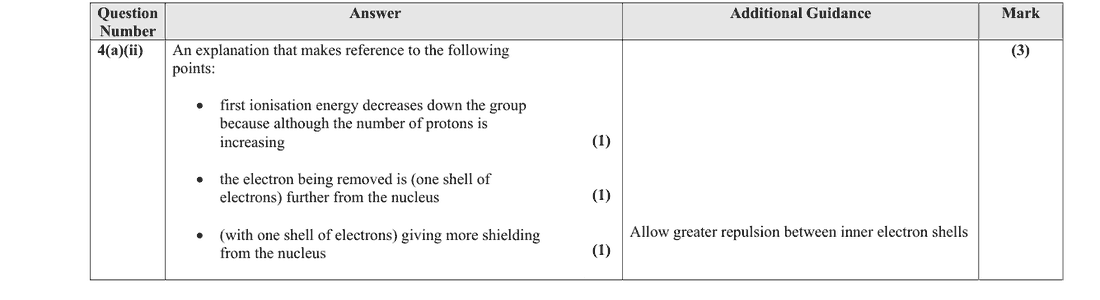
November 2021 · AS Paper 1 · Q4(a)(ii) 3 marks Explanation atomic structure and the periodic table
Earlier part of question 4 that this part usesEarlier part of November 2021 Paper 1 question 4
Explain the trend in the values of the first ionisation energies for the group
containing sulfur.
November 2021 · AS Paper 1 · Q4(a)(iii) 2 marks Explanation atomic structure and the periodic table
Earlier part of question 4 that this part usesEarlier part of November 2021 Paper 1 question 4
Explain why the first ionisation energy of sulfur is lower than that of chlorine.
November 2021 · AS Paper 1 · Q4(a)(iv) 2 marks Explanation atomic structure and the periodic table
Earlier part of question 4 that this part usesEarlier part of November 2021 Paper 1 question 4
Explain why the first ionisation energy of sulfur is lower than that of phosphorus.
November 2021 · AS Paper 1 · Q4(b) 5 marks Calculation Hard formulae equations and amounts of substance
Earlier part of question 4 that this part usesEarlier part of November 2021 Paper 1 question 4
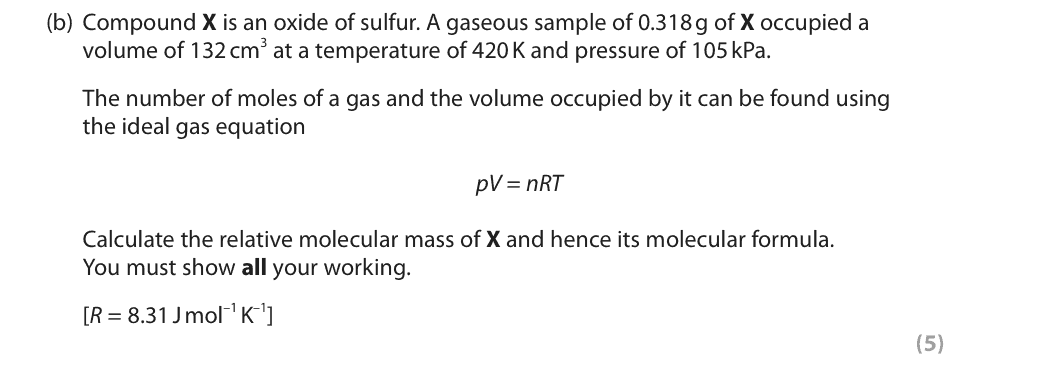
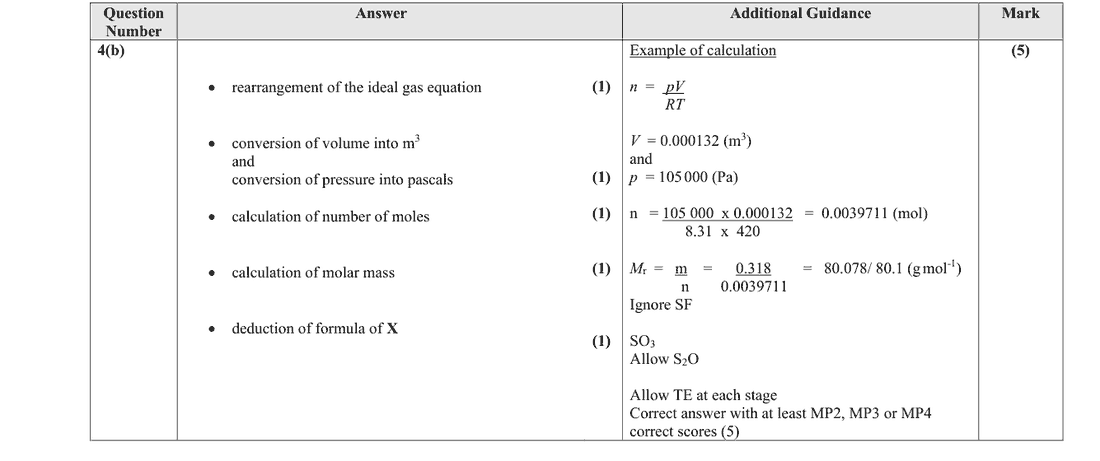
Compound X is an oxide of sulfur. A gaseous sample of 0.318 g of X occupied a
volume of 132 cm3 at a temperature of 420 K and pressure of 105 kPa.
The number of moles of a gas and the volume occupied by it can be found using
the ideal gas equation
pV = nRT
Calculate the relative molecular mass of X and hence its molecular formula.
You must show all your working.
[R = 8.31 J mol–1 K–1]
November 2021 · AS Paper 1 · Q4(c)(i) 2 marks Diagram or structure bonding
Earlier part of question 4 that this part usesEarlier part of November 2021 Paper 1 question 4
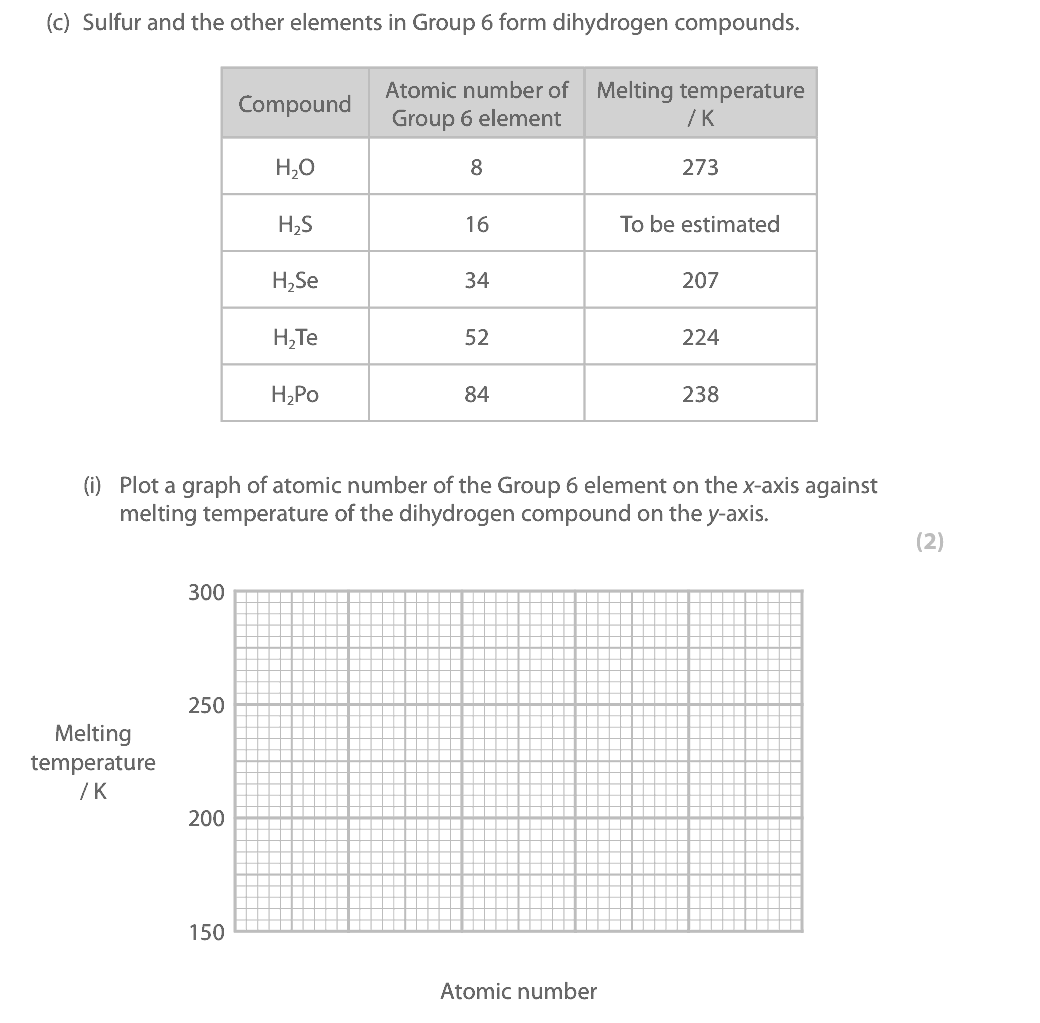
Sulfur and the other elements in Group 6 form dihydrogen compounds.
Atomic number of
Melting temperature
Compound
Group 6 element
/ K
H2O
8
273
H2S
16
To be estimated
H2Se
34
207
H2Te
52
224
H2Po
84
238
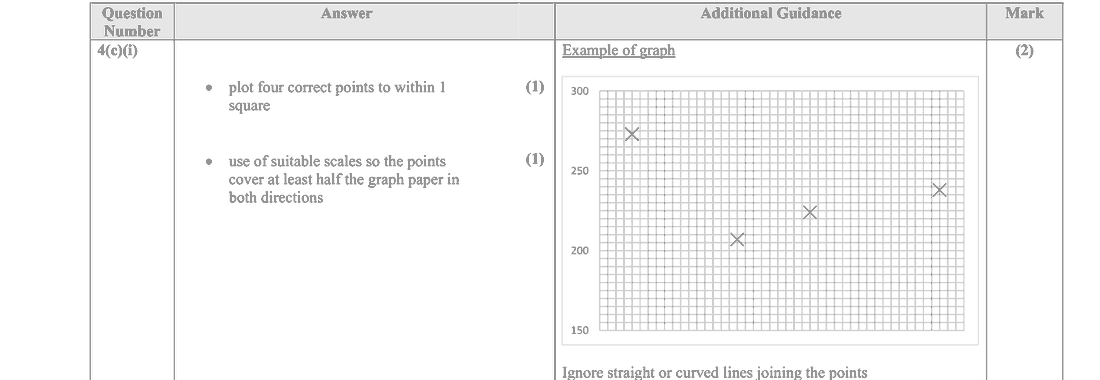
Plot a graph of atomic number of the Group 6 element on the x-axis against
melting temperature of the dihydrogen compound on the y-axis.
300
250
Melting
temperature
/ K
200
150
Atomic number
November 2021 · AS Paper 1 · Q4(c)(ii) 1 mark Short answer bonding
Earlier parts of question 4 that this part usesEarlier part of November 2021 Paper 1 question 4Earlier part of November 2021 Paper 1 question 4
Give an estimate of the melting temperature of H2S.
November 2021 · AS Paper 1 · Q5(a) 5 marks Explanation structure
This question is about crystalline solids.
Iodine and diamond are crystalline solids at room temperature.
Explain why diamond has a much higher melting temperature than iodine.
November 2021 · AS Paper 1 · Q5(b) 2 marks Short answer structure
Graphite is also a crystalline solid at room temperature.
Unlike diamond, graphite conducts electricity.
Describe the key feature of the bonding of the carbon atoms in graphite that
results in it being an electrical conductor.
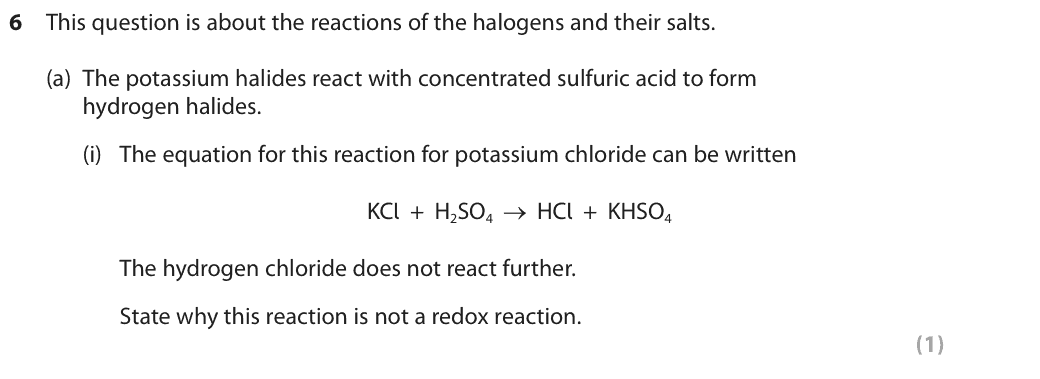
November 2021 · AS Paper 1 · Q6(a)(i) 1 mark Short answer redox i
This question is about the reactions of the halogens and their salts.
The potassium halides react with concentrated sulfuric acid to form
hydrogen halides.
The equation for this reaction for potassium chloride can be written
KCl  +  H2SO4  →  HCl  +  KHSO4
The hydrogen chloride does not react further.
State why this reaction is not a redox reaction.
November 2021 · AS Paper 1 · Q6(a)(ii) 3 marks Explanation group 7 the halogens
Earlier part of question 6 that this part usesEarlier part of November 2021 Paper 1 question 6
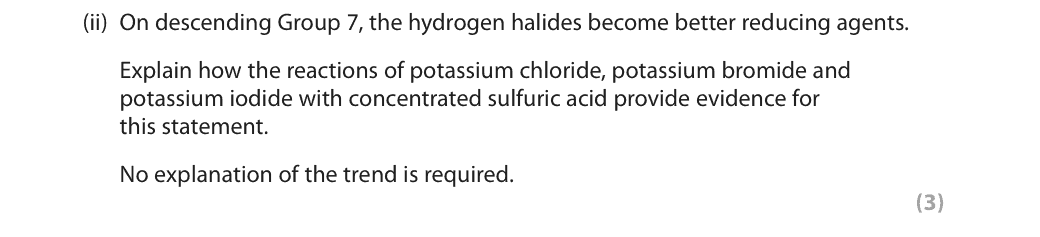
On descending Group 7, the hydrogen halides become better reducing agents.
Explain how the reactions of potassium chloride, potassium bromide and
potassium iodide with concentrated sulfuric acid provide evidence for
this statement.
No explanation of the trend is required.
November 2021 · AS Paper 1 · Q6(b)(i) 2 marks Explanation redox igroup 7 the halogens
Earlier part of question 6 that this part usesEarlier part of November 2021 Paper 1 question 6
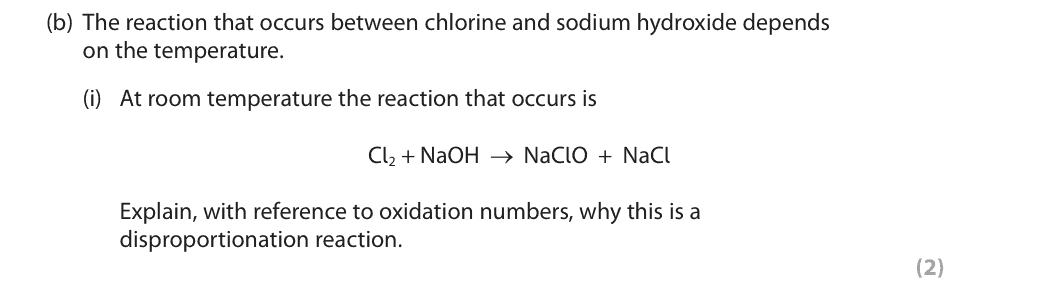
The reaction that occurs between chlorine and sodium hydroxide depends
on the temperature.
At room temperature the reaction that occurs is
Cl2 + NaOH  →  NaClO  +  NaCl
Explain, with reference to oxidation numbers, why this is a
disproportionation reaction.
November 2021 · AS Paper 1 · Q6(b)(ii) 2 marks Equation writing group 7 the halogensformulae equations and amounts of substance
Earlier part of question 6 that this part usesEarlier part of November 2021 Paper 1 question 6
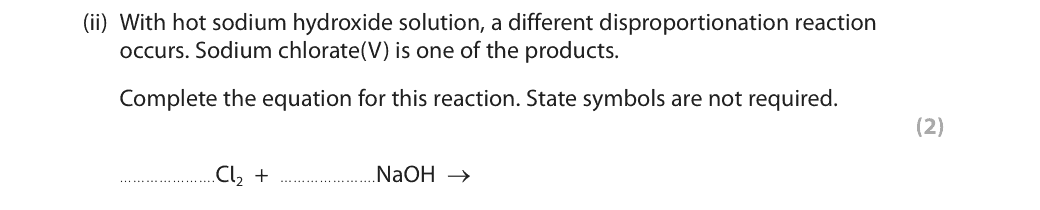
With hot sodium hydroxide solution, a different disproportionation reaction
occurs. Sodium chlorate(V) is one of the products.
Complete the equation for this reaction. State symbols are not required.
………………….Cl2  +  ………………….NaOH  →
November 2021 · AS Paper 1 · Q6(c)(i) 2 marks Calculation Hard formulae equations and amounts of substance
Earlier part of question 6 that this part usesEarlier part of November 2021 Paper 1 question 6
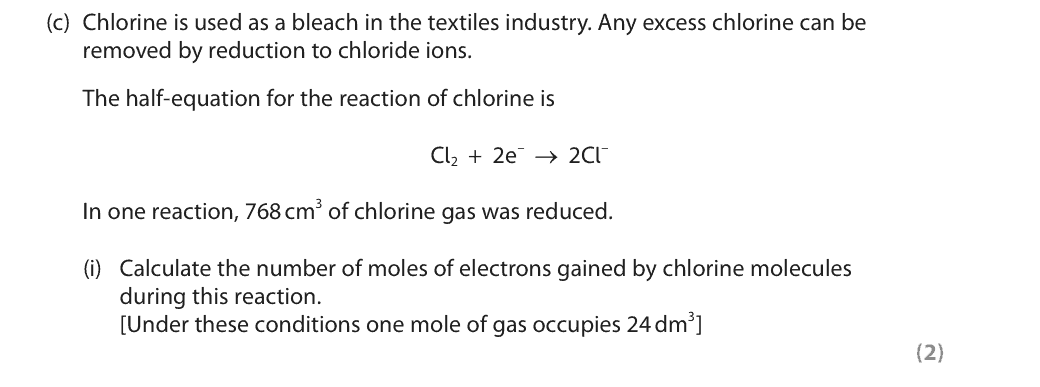
Chlorine is used as a bleach in the textiles industry. Any excess chlorine can be
removed by reduction to chloride ions.
The half-equation for the reaction of chlorine is
Cl2  +  2e–  →  2Cl–
In one reaction, 768 cm3 of chlorine gas was reduced.
Calculate the number of moles of electrons gained by chlorine molecules
during this reaction.
[Under these conditions one mole of gas occupies 24 dm3]
November 2021 · AS Paper 1 · Q6(c)(ii) 3 marks Calculation Hard redox iformulae equations and amounts of substance
Earlier parts of question 6 that this part usesEarlier part of November 2021 Paper 1 question 6Earlier part of November 2021 Paper 1 question 6
The reducing agent was a solution containing thiosulfate ions, S2O3
2–.
The chlorine reacted with 40 cm3 of a 0.20 mol dm–3 solution of these ions.
Deduce the number of moles of electrons lost by each atom of sulfur in the
thiosulfate ion, and hence the final oxidation state of the sulfur in the product.
November 2021 · AS Paper 1 · Q7(a) 2 marks Short answer bonding
The nitrates of lithium, rubidium and strontium are all white solids. The compounds
are held together by ionic bonds.
State the meaning of the term ‘ionic bond’.
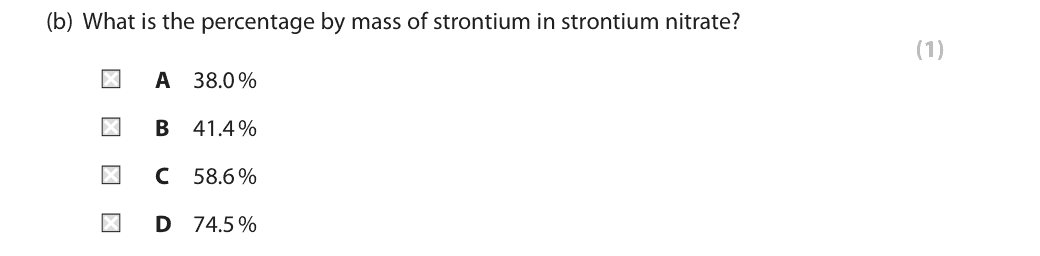
November 2021 · AS Paper 1 · Q7(b) 1 mark Multiple choice atomic structure and the periodic table
Earlier part of question 7 that this part usesEarlier part of November 2021 Paper 1 question 7
What is the percentage by mass of strontium in strontium nitrate?
A  38.0 %
B  41.4 %
C  58.6 %
D  74.5 %
November 2021 · AS Paper 1 · Q7(c)(i) 1 mark Multiple choice groups 1 and 2
Earlier part of question 7 that this part usesEarlier part of November 2021 Paper 1 question 7
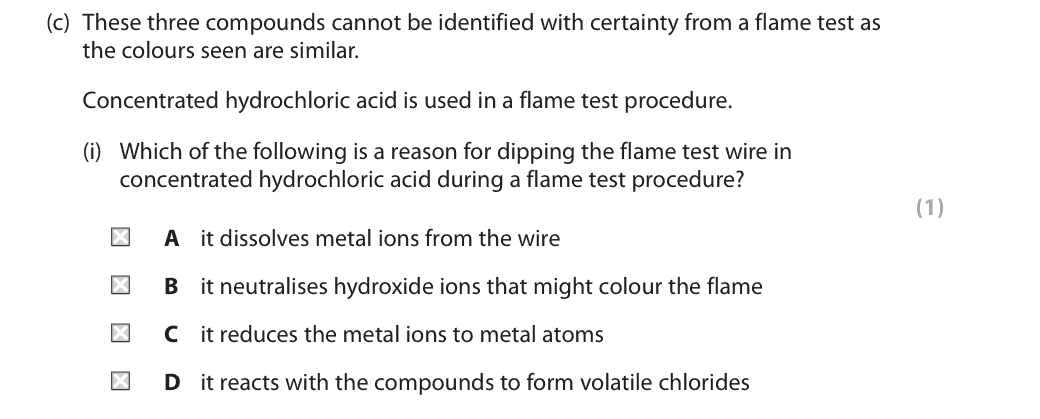
These three compounds cannot be identified with certainty from a flame test as
the colours seen are similar.
Concentrated hydrochloric acid is used in a flame test procedure.
Which of the following is a reason for dipping the flame test wire in
concentrated hydrochloric acid during a flame test procedure?
A  it dissolves metal ions from the wire
B  it neutralises hydroxide ions that might colour the flame
C  it reduces the metal ions to metal atoms
D  it reacts with the compounds to form volatile chlorides
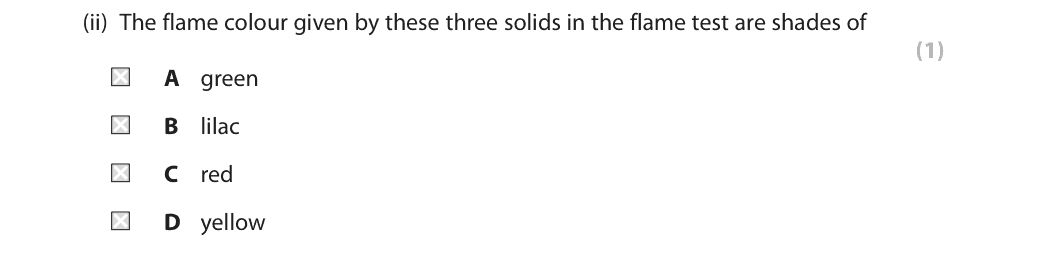
November 2021 · AS Paper 1 · Q7(c)(ii) 1 mark Multiple choice groups 1 and 2
Earlier parts of question 7 that this part usesEarlier part of November 2021 Paper 1 question 7Earlier part of November 2021 Paper 1 question 7
The flame colour given by these three solids in the flame test are shades of
A  green
B  lilac
C  red
D  yellow
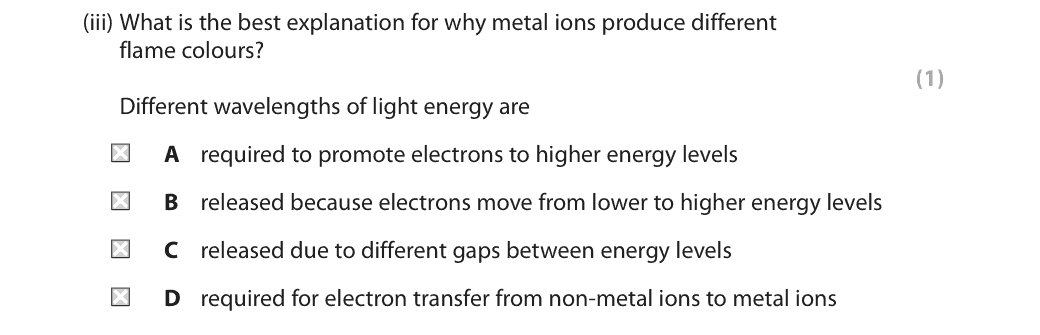
November 2021 · AS Paper 1 · Q7(c)(iii) 1 mark Multiple choice groups 1 and 2
Earlier parts of question 7 that this part usesEarlier part of November 2021 Paper 1 question 7Earlier part of November 2021 Paper 1 question 7
What is the best explanation for why metal ions produce different
flame colours?
Different wavelengths of light energy are
A  required to promote electrons to higher energy levels
B  released because electrons move from lower to higher energy levels
C  released due to different gaps between energy levels
D  required for electron transfer from non-metal ions to metal ions
November 2021 · AS Paper 1 · Q7(d) 6 marks 6-mark extended response Hard groups 1 and 2
Earlier part of question 7 that this part usesEarlier part of November 2021 Paper 1 question 7
Devise a procedure to identify the nitrates of lithium, rubidium and strontium using the
effect of heat on the three solids and any precipitation reactions of the compounds.
Practical details are not required, but you should give the observations expected in
each case.

Work with an A-level chemistry tutor

Want a paper marked and gone through with you? Message us.

Prefer email? Send an enquiry

If you are under 18, please include a parent's contact details. Enquiries go to enquiries@chemistryaleveltutor.com and are deleted once handled. All tutoring is online.