June 2025: AS Paper 1, Core Inorganic and Physical Chemistry

80 marks · 40 question parts · Paper, mark scheme and report on Edexcel's site · Have the Data Booklet beside you

Question by question

QTopicMarksAOType
1(a) Bonding 1Multiple choice
1(b) Bonding 2Diagram or structure
1(c) Bonding 3Explanation
1(d) Bonding, Structure 2Explanation
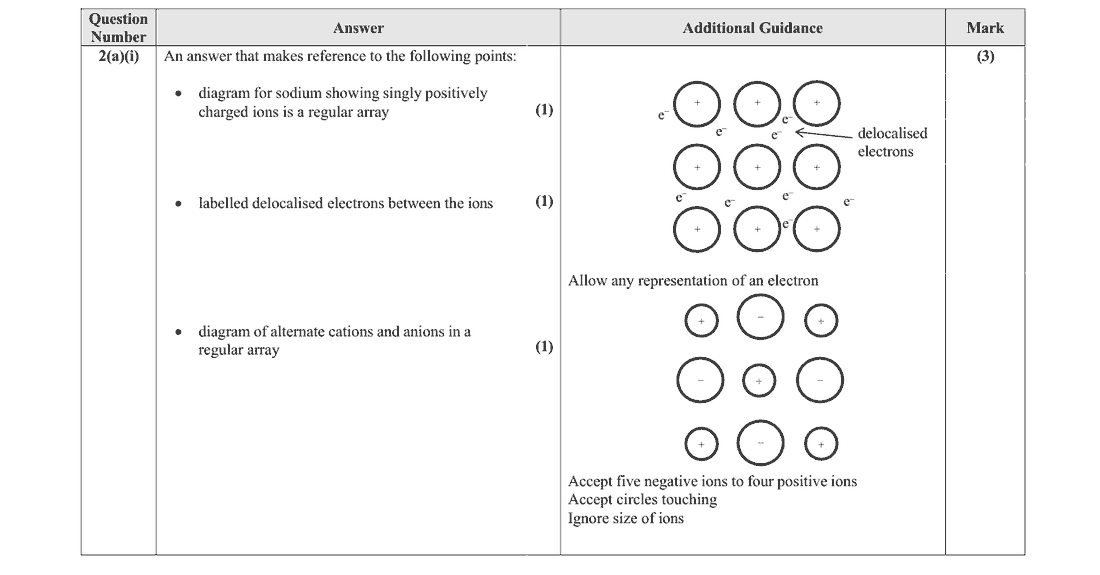
2(a)(i) Structure, Bonding 3Diagram or structure
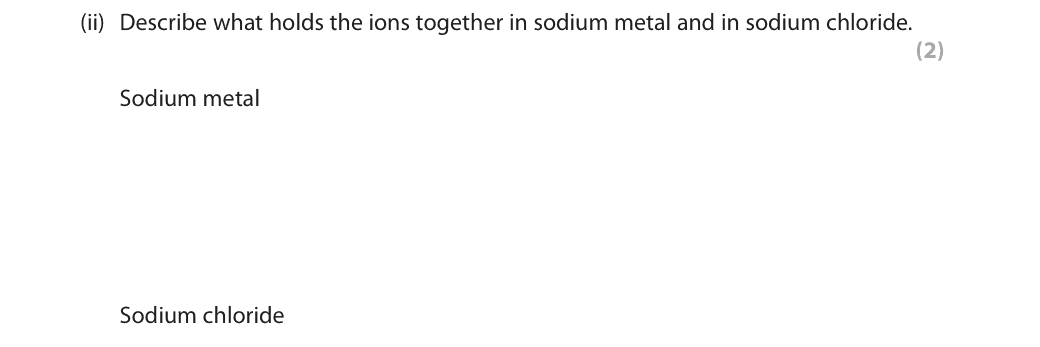
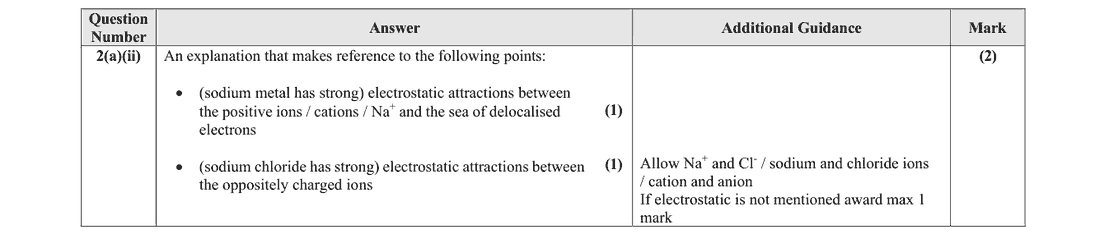
2(a)(ii) Bonding 2Short answer
2(a)(iii) Structure 1Short answer
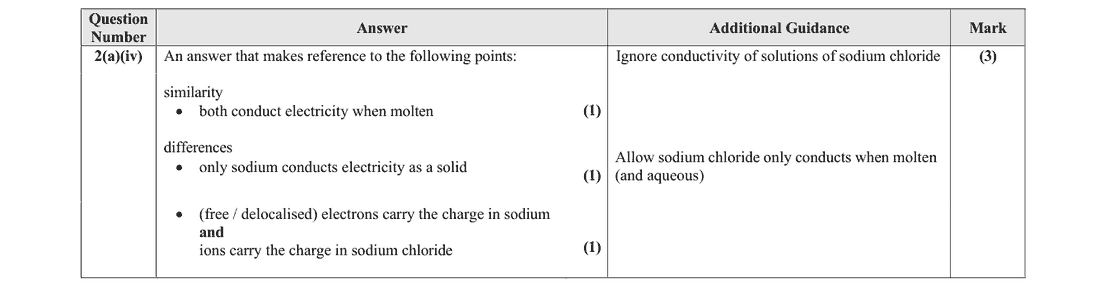
2(a)(iv) Structure, Bonding 3Explanation
2(b)(i) Formulae, equations and amounts of substance 1Equation writing
2(b)(ii) Formulae, equations and amounts of substance 1Equation writing
2(b)(iii) Bonding 2Short answer
2(b)(iv) Bonding 1Multiple choice
3(a) Bonding 1Multiple choice
3(b) Bonding 1Multiple choice
4(a)(i) Formulae, equations and amounts of substance 2Practical and data analysis
4(a)(ii) Formulae, equations and amounts of substance 2Equation writing
4(a)(iii) Formulae, equations and amounts of substance 1Equation writing
4(b)(i) The elements of Groups 1 and 2 1Practical and data analysis
4(b)(ii) The elements of Groups 1 and 2 2Explanation
4(b)(iii) Formulae, equations and amounts of substance 1Multiple choice
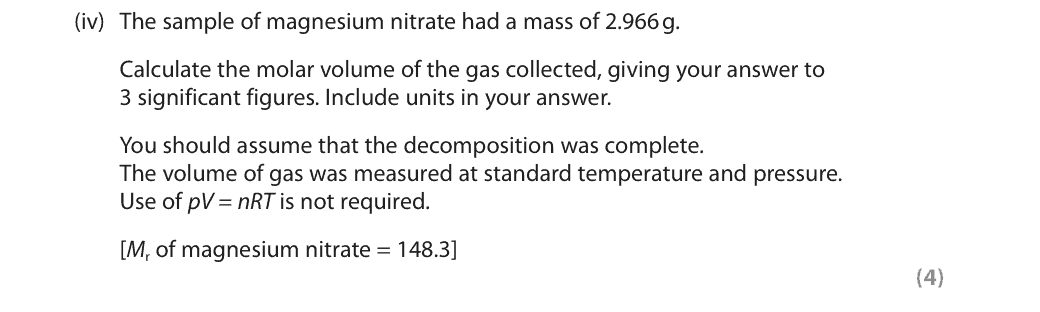
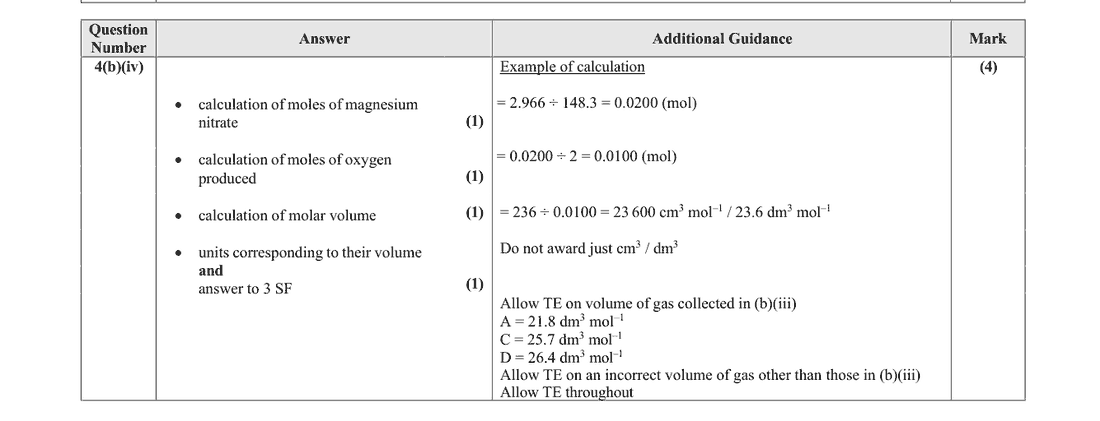
4(b)(iv) Formulae, equations and amounts of substance 4Calculation
4(b)(v) Formulae, equations and amounts of substance 2Explanation
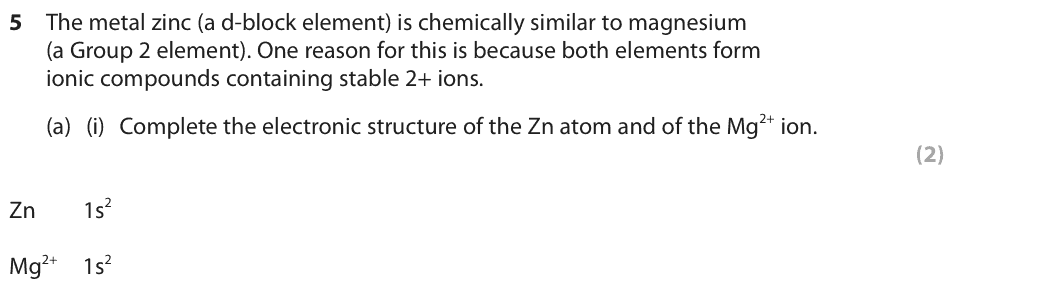
5(a)(i) Atomic structure and the Periodic Table 2Short answer
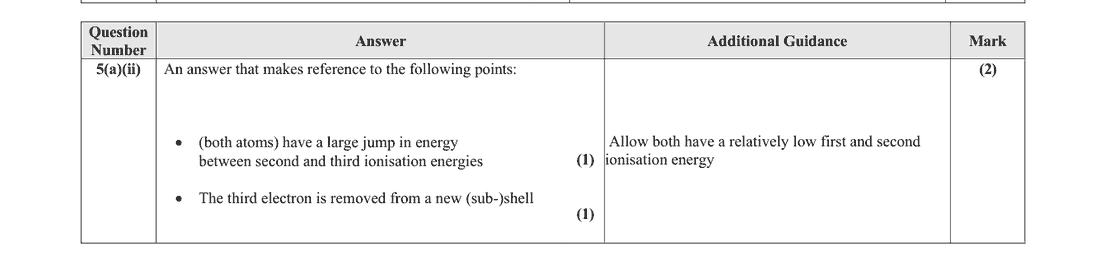
5(a)(ii) Atomic structure and the Periodic Table 2Explanation
5(b)(i) Atomic structure and the Periodic Table 1Short answer
5(b)(ii) Atomic structure and the Periodic Table 1Short answer
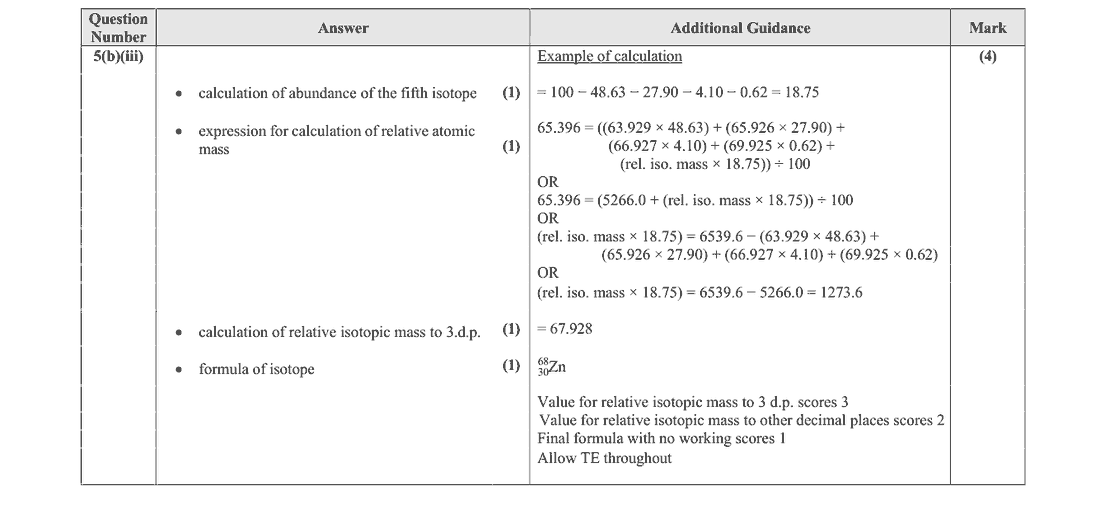
5(b)(iii) Atomic structure and the Periodic Table 4Calculation
5(b)(iv) Formulae, equations and amounts of substance 1Calculation
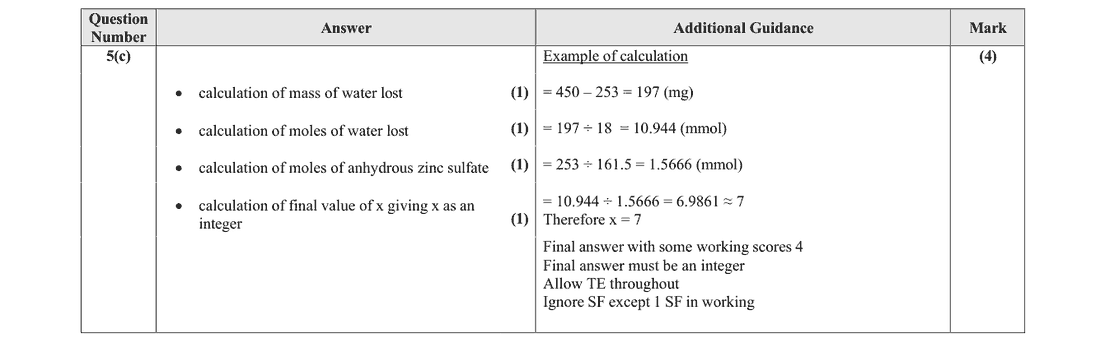
5(c) Formulae, equations and amounts of substance 4Calculation
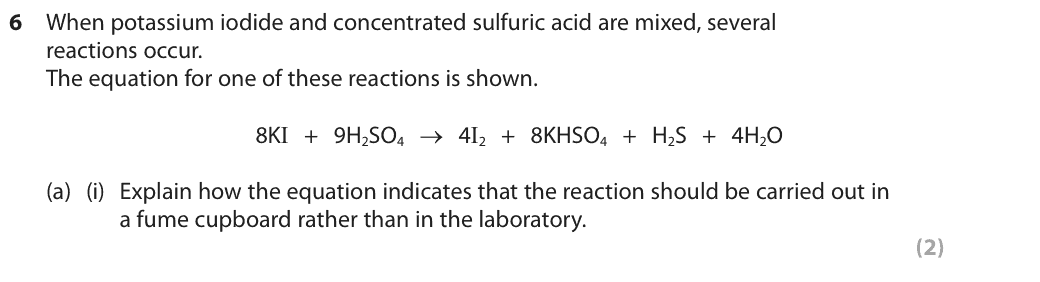
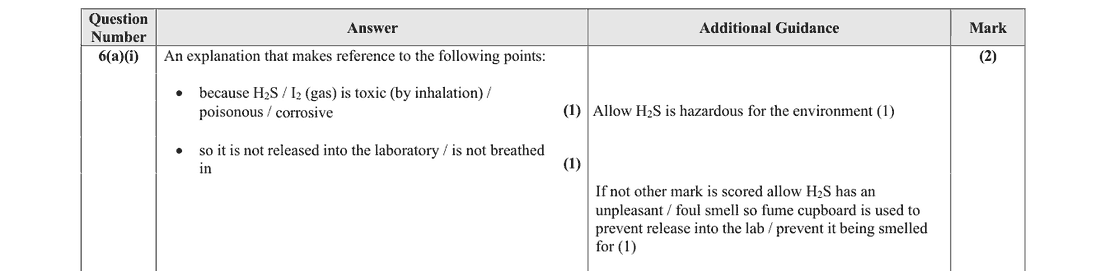
6(a)(i) Formulae, equations and amounts of substance 2Practical and data analysis
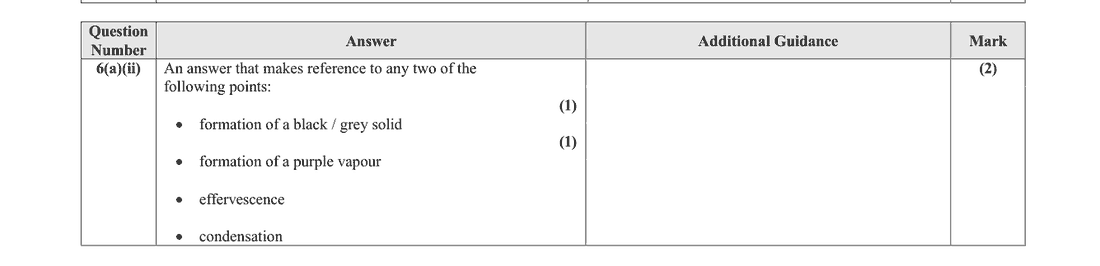
6(a)(ii) The elements of Group 7 (halogens) 2Practical and data analysis
6(b) Redox I 1Multiple choice
6(c) Redox I 2Equation writing
6(d)(i) The elements of Group 7 (halogens) 1Short answer
6(d)(ii) The elements of Group 7 (halogens) 2Explanation
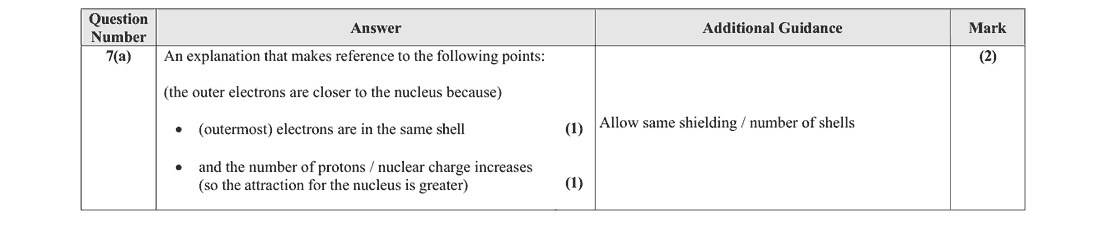
7(a) Atomic structure and the Periodic Table 2Explanation
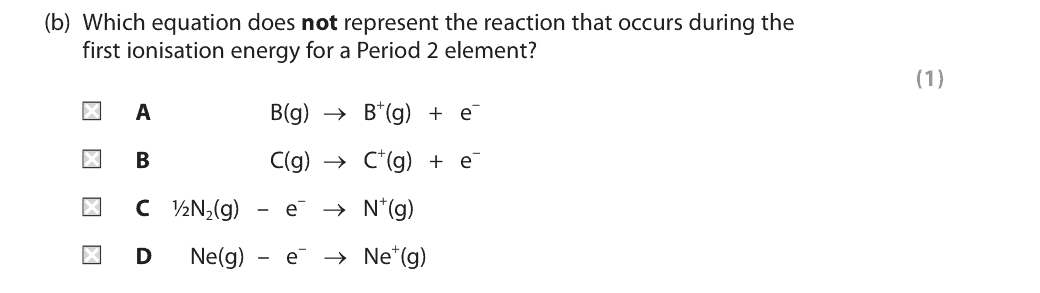
7(b) Atomic structure and the Periodic Table 1Multiple choice
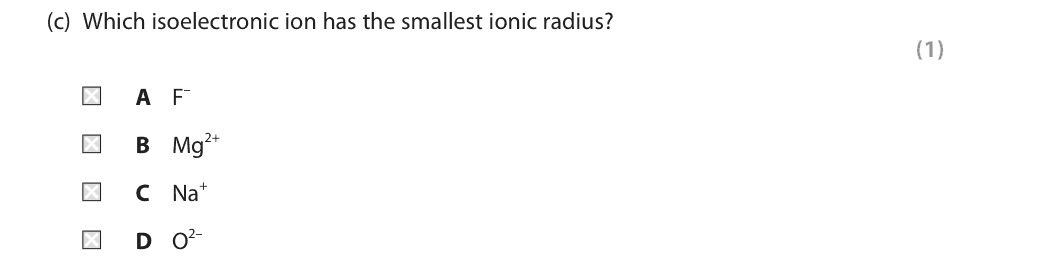
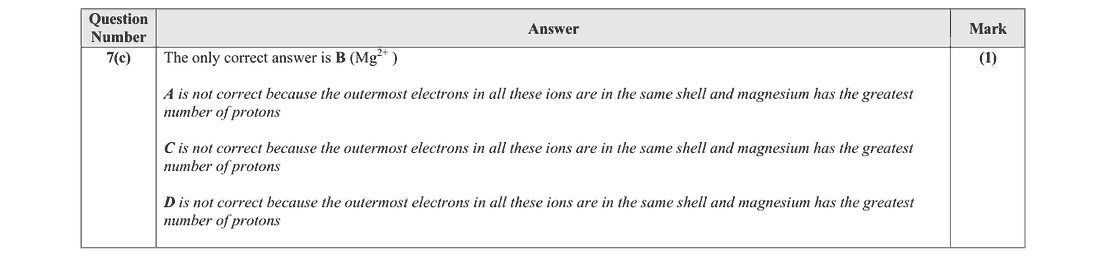
7(c) Bonding 1Multiple choice
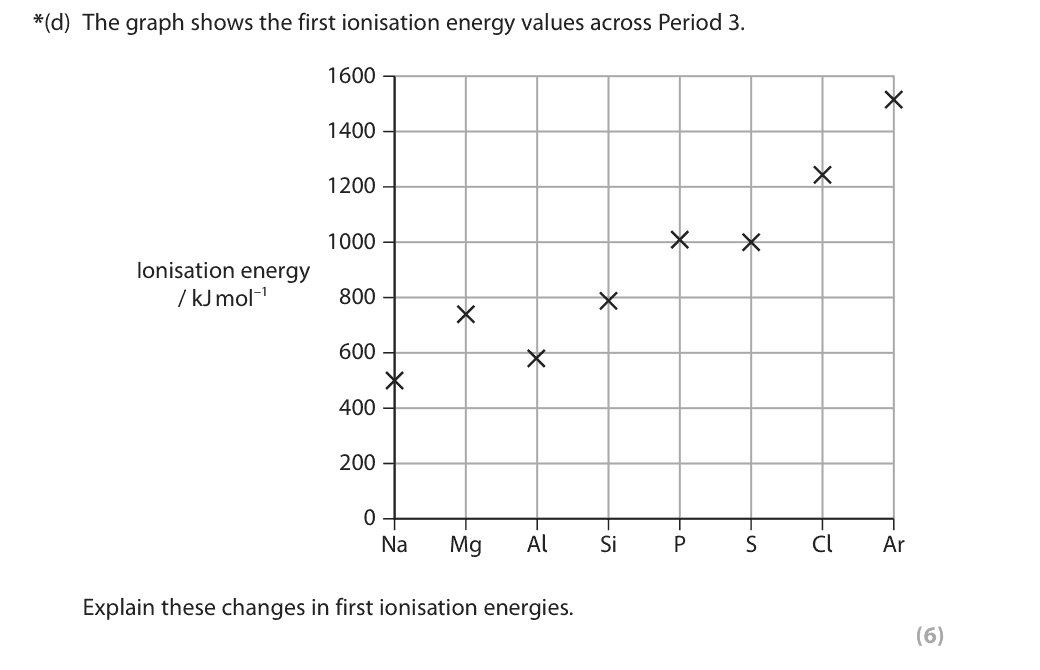
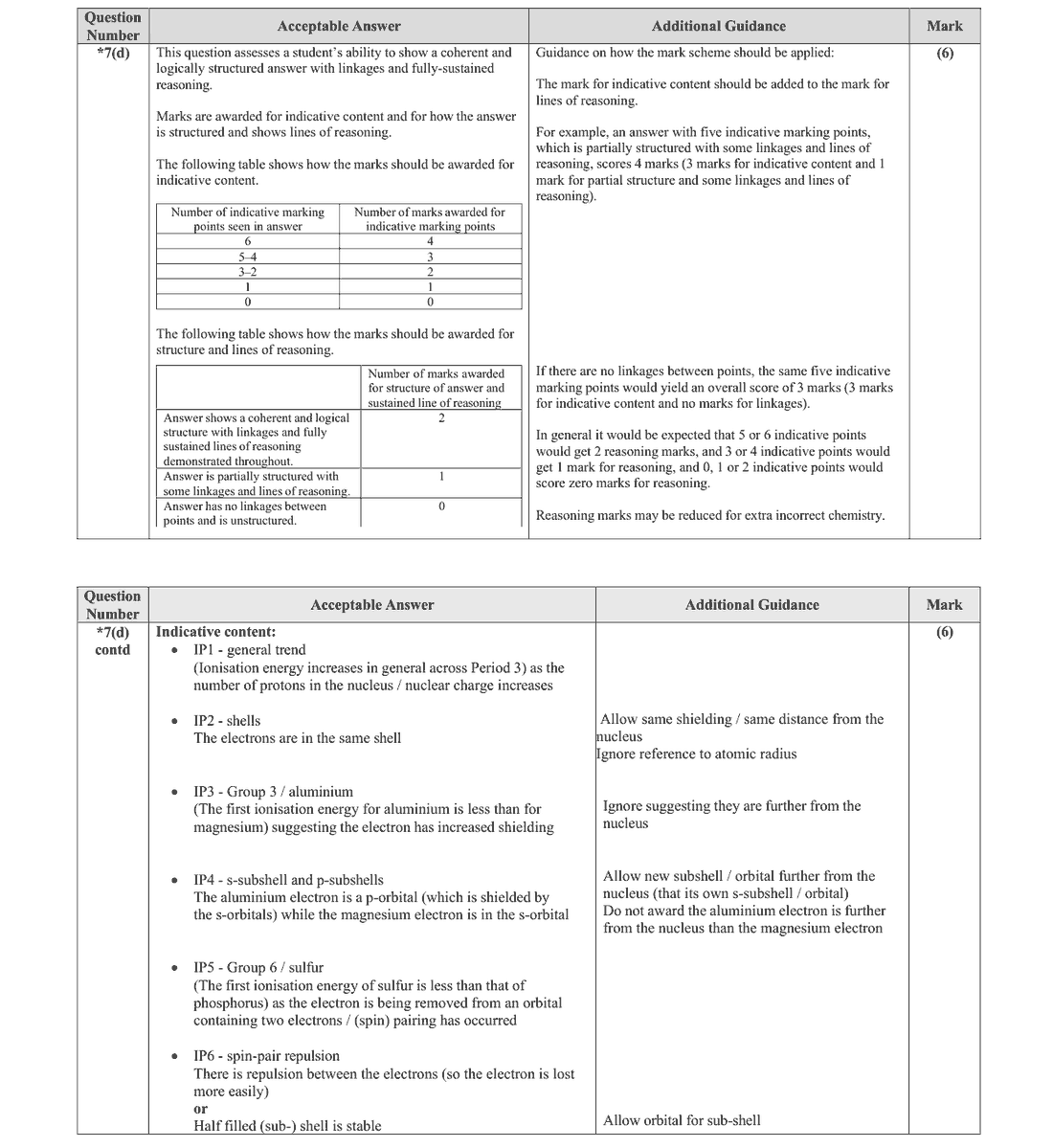
7(d) Atomic structure and the Periodic Table 6Extended response
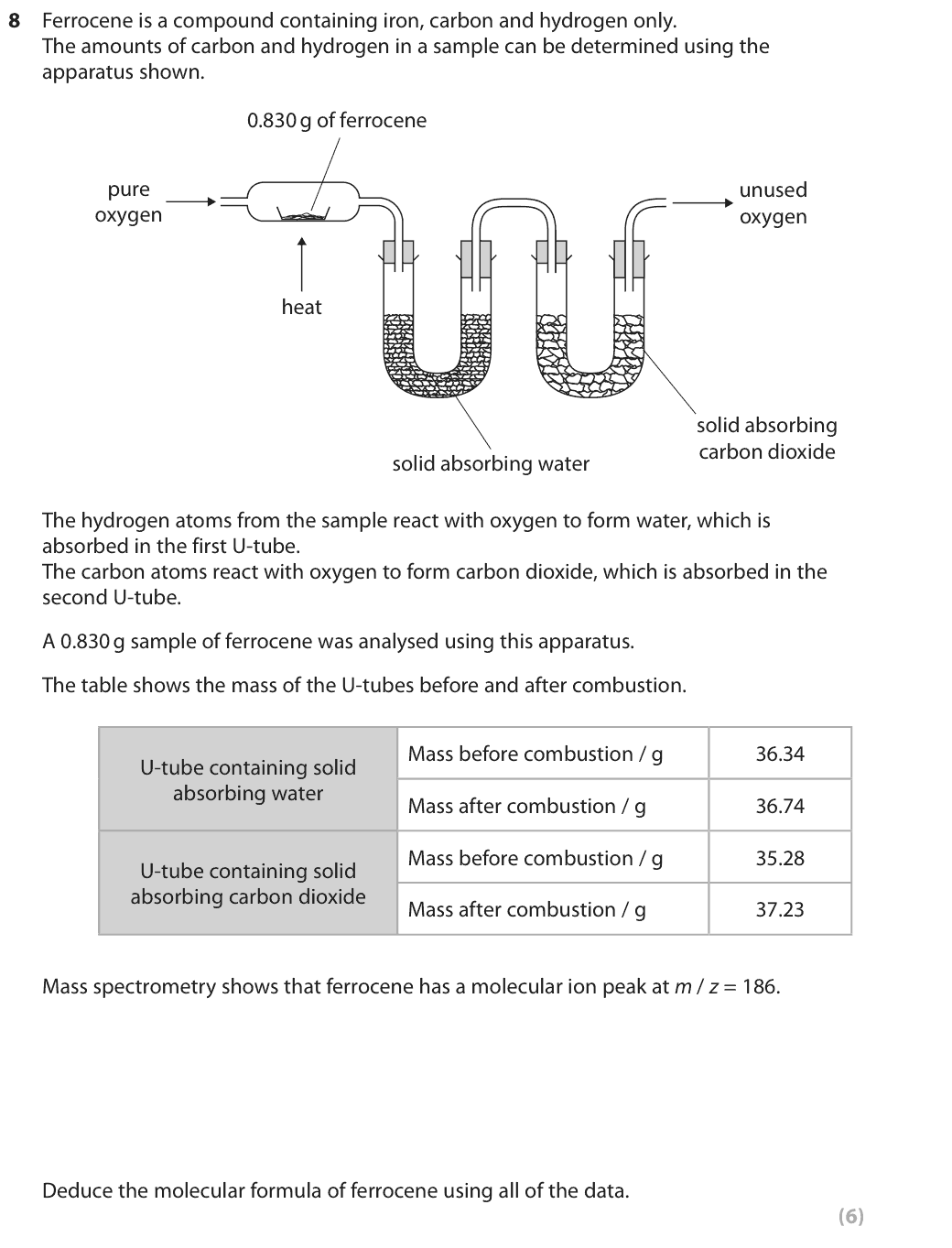
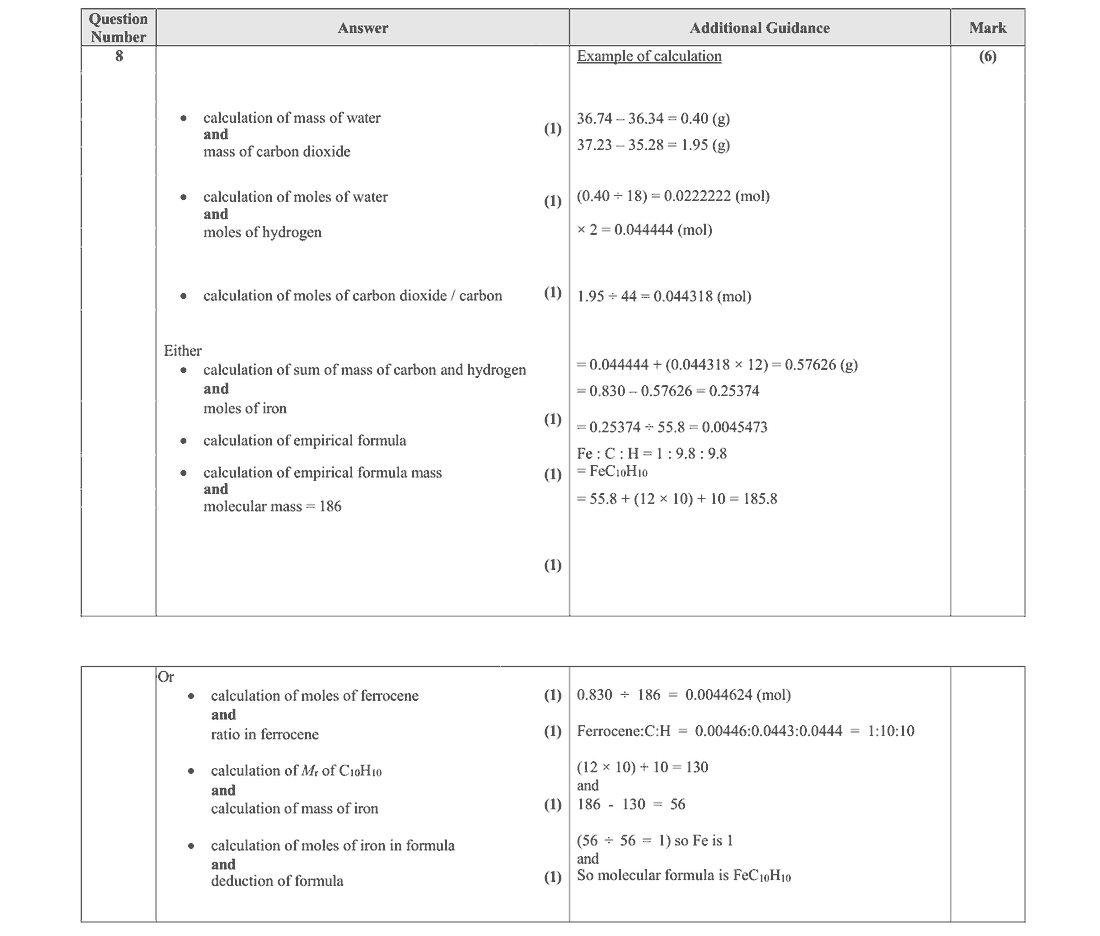
8 Formulae, equations and amounts of substance 6Calculation

The questions

1(a)1(b)1(c)1(d)2(a)(i)2(a)(ii)2(a)(iii)2(a)(iv)2(b)(i)2(b)(ii)2(b)(iii)2(b)(iv)3(a)3(b)4(a)(i)4(a)(ii)4(a)(iii)4(b)(i)4(b)(ii)4(b)(iii)4(b)(iv)4(b)(v)5(a)(i)5(a)(ii)5(b)(i)5(b)(ii)5(b)(iii)5(b)(iv)5(c)6(a)(i)6(a)(ii)6(b)6(c)6(d)(i)6(d)(ii)7(a)7(b)7(c)7(d)8
June 2025 · AS Paper 1 · Q1(a) 1 mark Multiple choice bonding
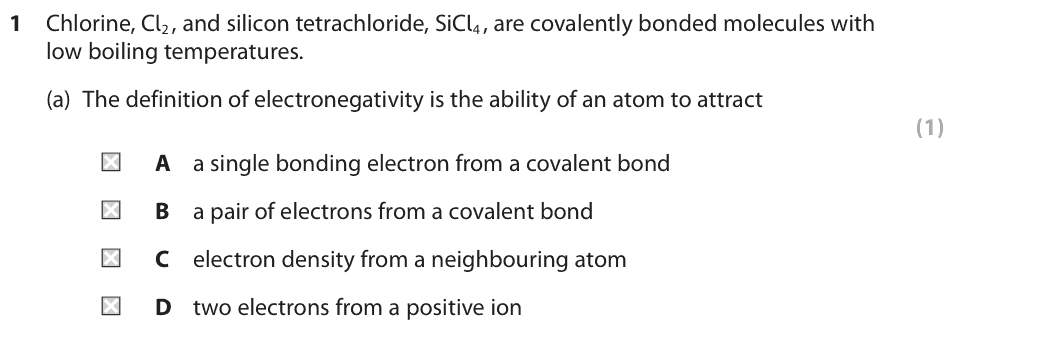
Chlorine, Cl2 , and silicon tetrachloride, SiCl4 , are covalently bonded molecules with
low boiling temperatures.
The definition of electronegativity is the ability of an atom to attract
A  a single bonding electron from a covalent bond
B  a pair of electrons from a covalent bond
C  electron density from a neighbouring atom
D  two electrons from a positive ion
June 2025 · AS Paper 1 · Q1(b) 2 marks Diagram or structure bonding
Earlier part of question 1 that this part usesEarlier part of June 2025 Paper 1 question 1
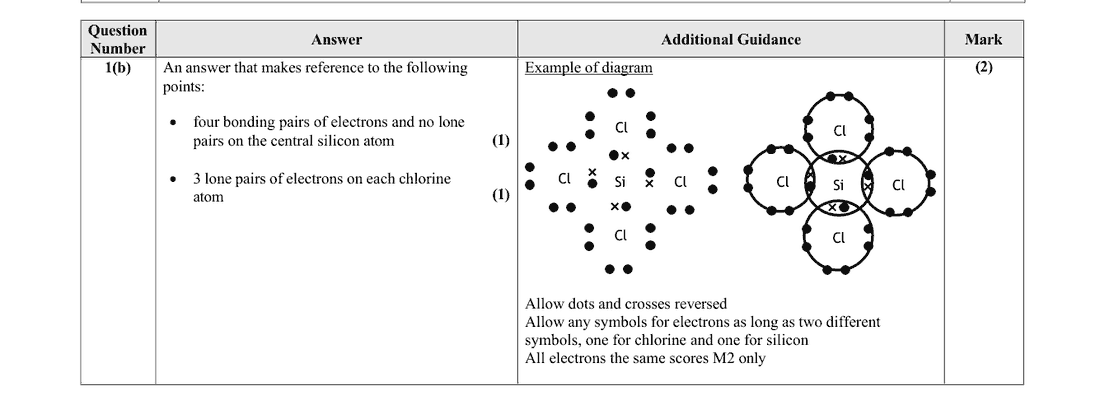
Draw a dot-and-cross diagram of silicon tetrachloride, showing outer shells of
electrons only.
Use crosses (×) for silicon electrons and dots (• ) for chlorine electrons.
June 2025 · AS Paper 1 · Q1(c) 3 marks Explanation bonding
Earlier part of question 1 that this part usesEarlier part of June 2025 Paper 1 question 1
Explain, using electronegativity values, why both chlorine and
silicon tetrachloride are non-polar molecules.
June 2025 · AS Paper 1 · Q1(d) 2 marks Explanation bondingstructure
Earlier part of question 1 that this part usesEarlier part of June 2025 Paper 1 question 1
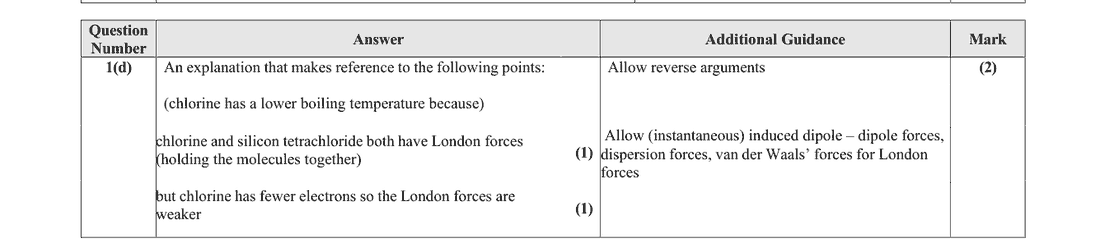
Explain why the boiling temperature of chlorine (−34 °C) is lower than that of
silicon tetrachloride (57 °C).
June 2025 · AS Paper 1 · Q2(a)(i) 3 marks Diagram or structure structurebonding
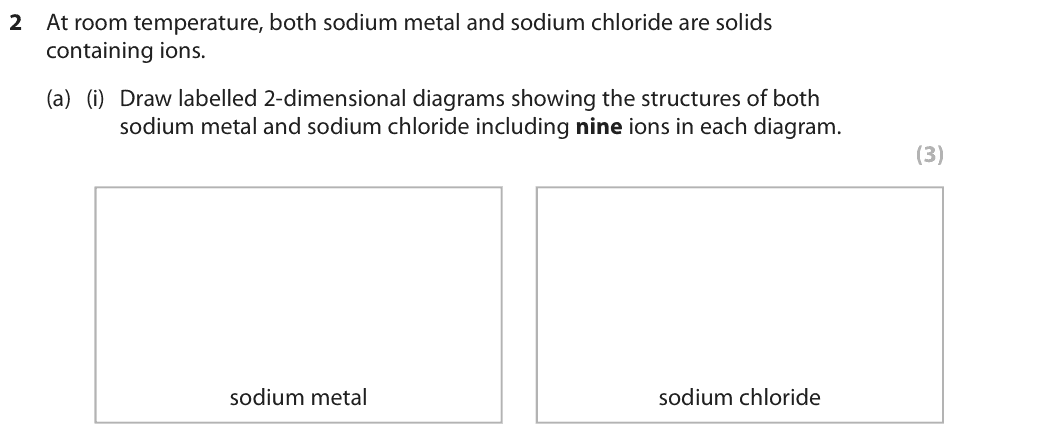
At room temperature, both sodium metal and sodium chloride are solids
containing ions.
Draw labelled 2-dimensional diagrams showing the structures of both
sodium metal and sodium chloride including nine ions in each diagram.
sodium metal
sodium chloride
June 2025 · AS Paper 1 · Q2(a)(ii) 2 marks Short answer bonding
Earlier part of question 2 that this part usesEarlier part of June 2025 Paper 1 question 2
Describe what holds the ions together in sodium metal and in sodium chloride.
Sodium metal
Sodium chloride
June 2025 · AS Paper 1 · Q2(a)(iii) 1 mark Short answer structure
Earlier part of question 2 that this part usesEarlier part of June 2025 Paper 1 question 2
The melting temperature of sodium chloride is much higher than that of
sodium metal.
State what this information shows about the bonding in these
two substances.
June 2025 · AS Paper 1 · Q2(a)(iv) 3 marks Explanation structurebonding
Earlier part of question 2 that this part usesEarlier part of June 2025 Paper 1 question 2
Compare and contrast the electrical conductivity of sodium metal with that of
sodium chloride, including how the charge is carried.
June 2025 · AS Paper 1 · Q2(b)(i) 1 mark Equation writing formulae equations and amounts of substance
Earlier part of question 2 that this part usesEarlier part of June 2025 Paper 1 question 2
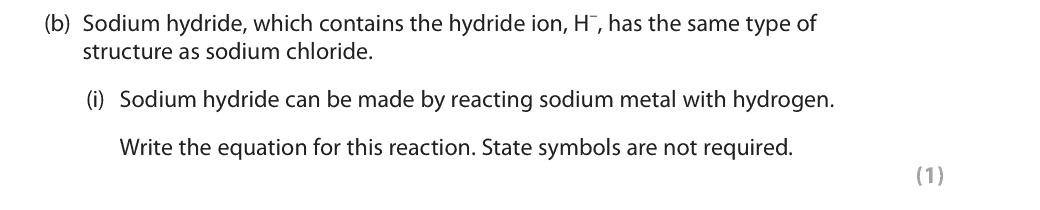
Sodium hydride, which contains the hydride ion, H−, has the same type of
structure as sodium chloride.
Sodium hydride can be made by reacting sodium metal with hydrogen.
Write the equation for this reaction. State symbols are not required.
June 2025 · AS Paper 1 · Q2(b)(ii) 1 mark Equation writing formulae equations and amounts of substance
Earlier parts of question 2 that this part usesEarlier part of June 2025 Paper 1 question 2Earlier part of June 2025 Paper 1 question 2
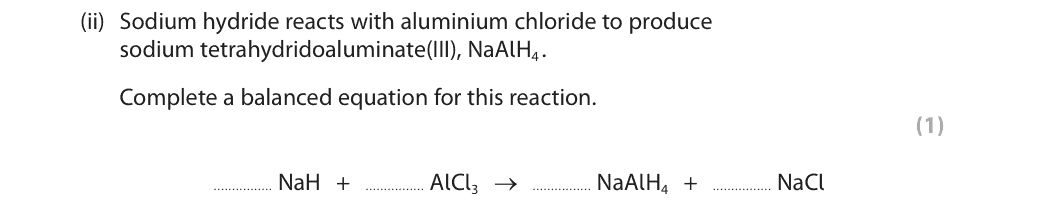
Sodium hydride reacts with aluminium chloride to produce
sodium tetrahydridoaluminate(III), NaAlH4 .
Complete a balanced equation for this reaction.
 NaH   +    AlCl3   →    NaAlH4   +    NaCl
June 2025 · AS Paper 1 · Q2(b)(iii) 2 marks Short answer bonding
Earlier parts of question 2 that this part usesEarlier part of June 2025 Paper 1 question 2Earlier part of June 2025 Paper 1 question 2
H → Al represents one of the bonds in AlH 4
– .
State the name of this type of bond and how the bond forms in this ion.
June 2025 · AS Paper 1 · Q2(b)(iv) 1 mark Multiple choice bonding
Earlier parts of question 2 that this part usesEarlier part of June 2025 Paper 1 question 2Earlier part of June 2025 Paper 1 question 2
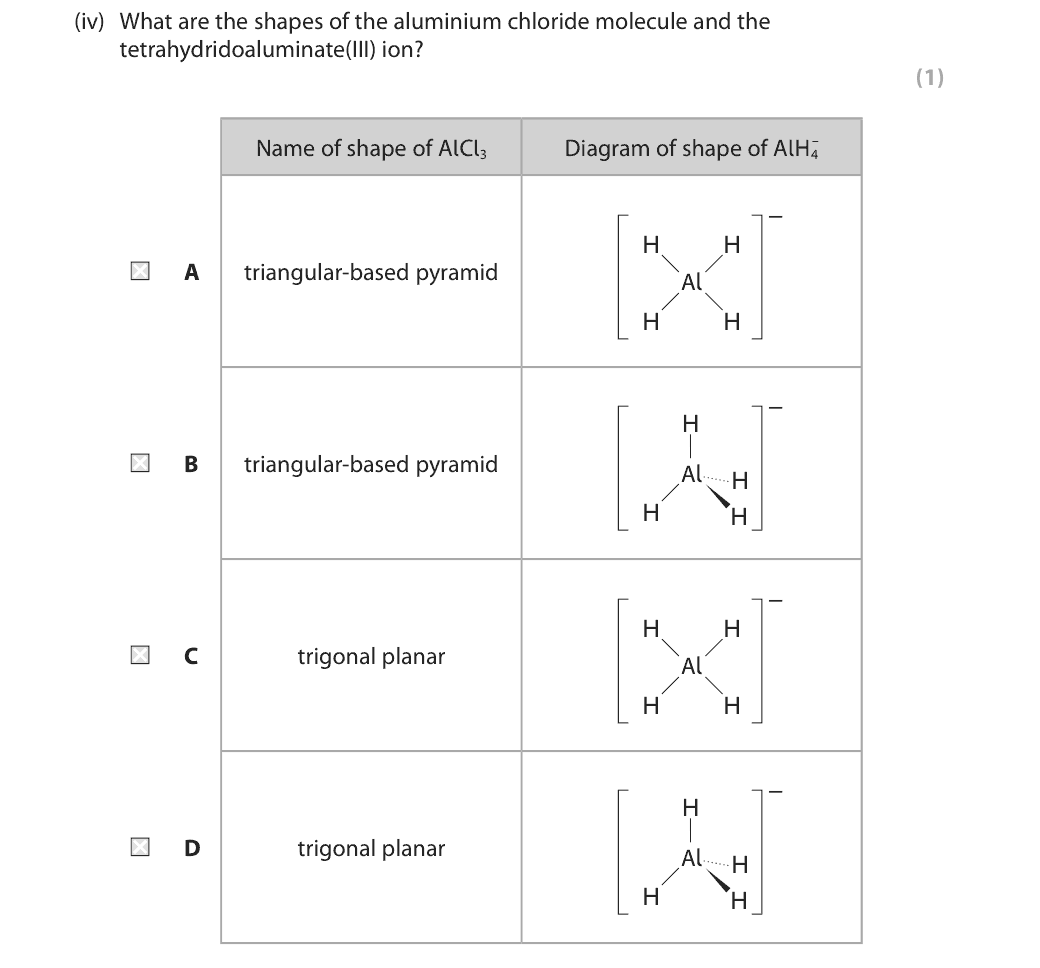
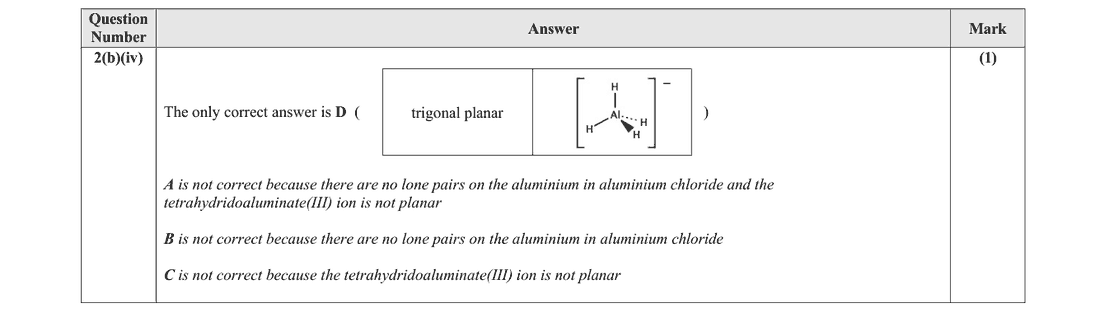
What are the shapes of the aluminium chloride molecule and the
tetrahydridoaluminate(III) ion?
Name of shape of AlCl3
Diagram of shape of AlH 4
–
–
H
H
A
triangular-based pyramid
Al
H
H
–
H
B
triangular-based pyramid
Al
H
H
H
–
H
H
C
trigonal planar
Al
H
H
–
H
D
trigonal planar
Al
H
H
H
June 2025 · AS Paper 1 · Q3(a) 1 mark Multiple choice bonding
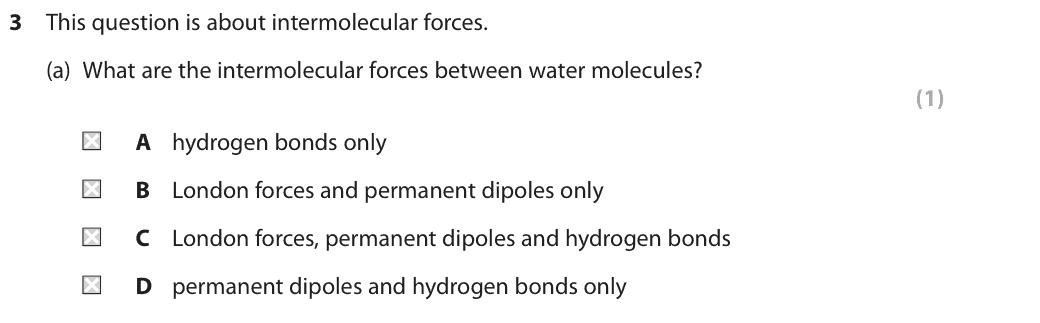
This question is about intermolecular forces.
What are the intermolecular forces between water molecules?
A  hydrogen bonds only
B  London forces and permanent dipoles only
C  London forces, permanent dipoles and hydrogen bonds
D  permanent dipoles and hydrogen bonds only
June 2025 · AS Paper 1 · Q3(b) 1 mark Multiple choice bonding
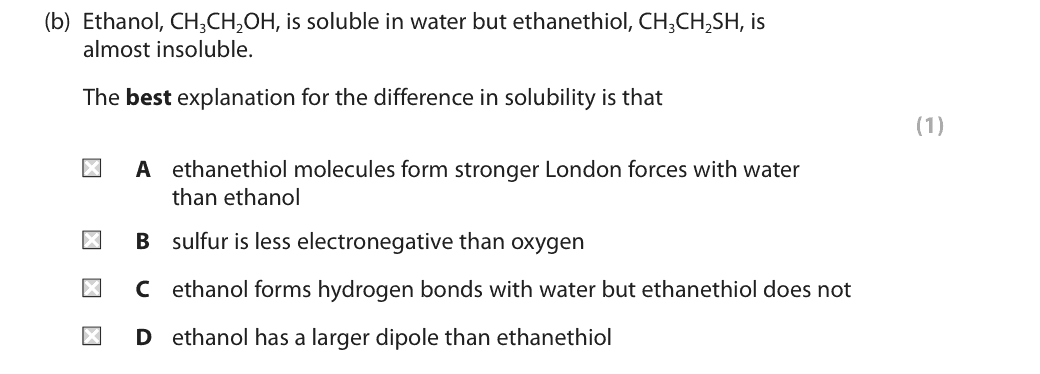
Ethanol, CH3CH2OH, is soluble in water but ethanethiol, CH3CH2SH, is
almost insoluble.
The best explanation for the difference in solubility is that
A  ethanethiol molecules form stronger London forces with water
than ethanol
B  sulfur is less electronegative than oxygen
C  ethanol forms hydrogen bonds with water but ethanethiol does not
D  ethanol has a larger dipole than ethanethiol
June 2025 · AS Paper 1 · Q4(a)(i) 2 marks Practical and data analysis Hard formulae equations and amounts of substance
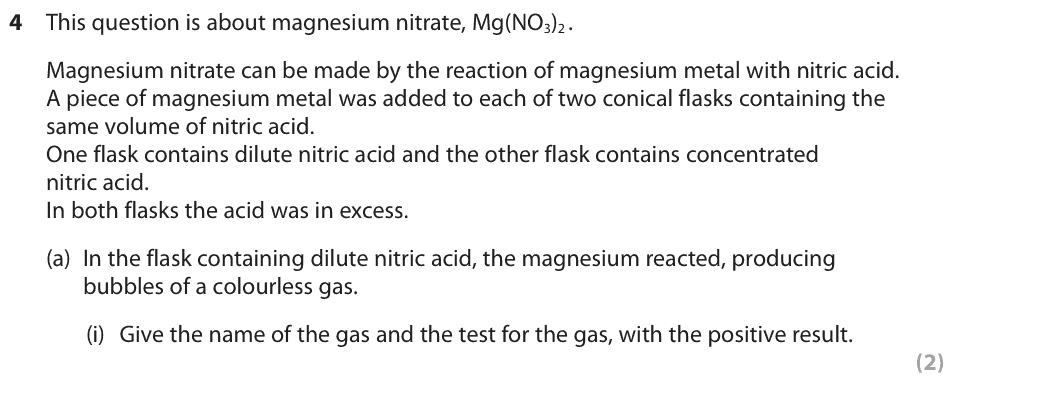
This question is about magnesium nitrate, Mg(NO3)2 .
Magnesium nitrate can be made by the reaction of magnesium metal with nitric acid.
A piece of magnesium metal was added to each of two conical flasks containing the
same volume of nitric acid.
One flask contains dilute nitric acid and the other flask contains concentrated
nitric acid.
In both flasks the acid was in excess.
In the flask containing dilute nitric acid, the magnesium reacted, producing
bubbles of a colourless gas.
Give the name of the gas and the test for the gas, with the positive result.
June 2025 · AS Paper 1 · Q4(a)(ii) 2 marks Equation writing formulae equations and amounts of substance
Earlier part of question 4 that this part usesEarlier part of June 2025 Paper 1 question 4
Write an equation for the reaction that occurs with magnesium and
dilute nitric acid.
Include state symbols.
June 2025 · AS Paper 1 · Q4(a)(iii) 1 mark Equation writing Hard formulae equations and amounts of substance
Earlier part of question 4 that this part usesEarlier part of June 2025 Paper 1 question 4
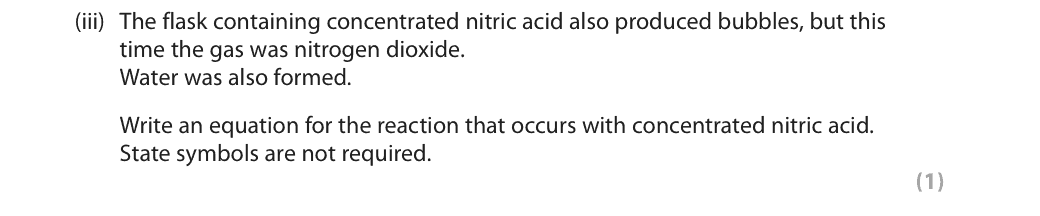
The flask containing concentrated nitric acid also produced bubbles, but this
time the gas was nitrogen dioxide.
Water was also formed.
Write an equation for the reaction that occurs with concentrated nitric acid.
State symbols are not required.
June 2025 · AS Paper 1 · Q4(b)(i) 1 mark Practical and data analysis groups 1 and 2
Earlier part of question 4 that this part usesEarlier part of June 2025 Paper 1 question 4
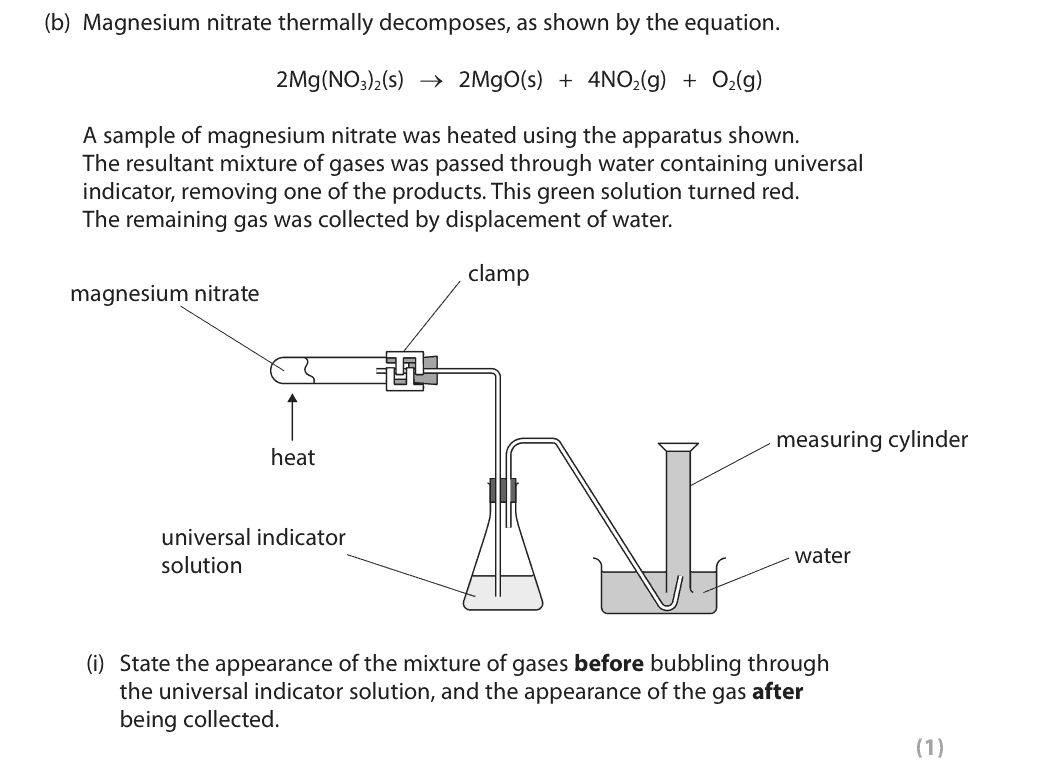
Magnesium nitrate thermally decomposes, as shown by the equation.
2Mg(NO3)2(s)   →   2MgO(s)   +   4NO2(g)   +   O2(g)
A sample of magnesium nitrate was heated using the apparatus shown.
The resultant mixture of gases was passed through water containing universal
indicator, removing one of the products. This green solution turned red.
The remaining gas was collected by displacement of water.
clamp
magnesium nitrate
measuring cylinder
heat
universal indicator
water
solution
State the appearance of the mixture of gases before bubbling through
the universal indicator solution, and the appearance of the gas after
being collected.
June 2025 · AS Paper 1 · Q4(b)(ii) 2 marks Explanation Hard groups 1 and 2
Earlier parts of question 4 that this part usesEarlier part of June 2025 Paper 1 question 4Earlier part of June 2025 Paper 1 question 4
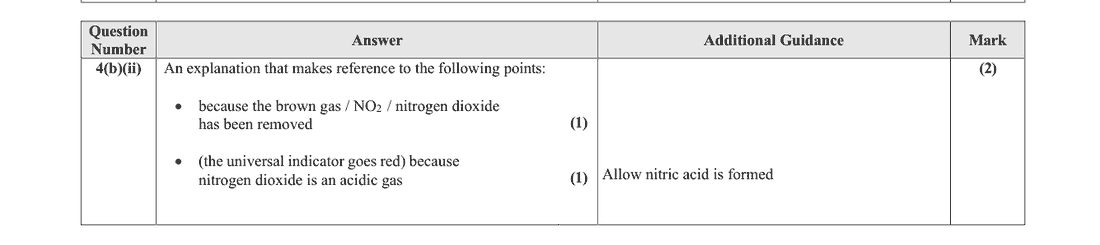
Explain the change in appearance of the mixture of gases, and of the universal
indicator solution.
June 2025 · AS Paper 1 · Q4(b)(iii) 1 mark Multiple choice formulae equations and amounts of substance
Earlier parts of question 4 that this part usesEarlier part of June 2025 Paper 1 question 4Earlier part of June 2025 Paper 1 question 4
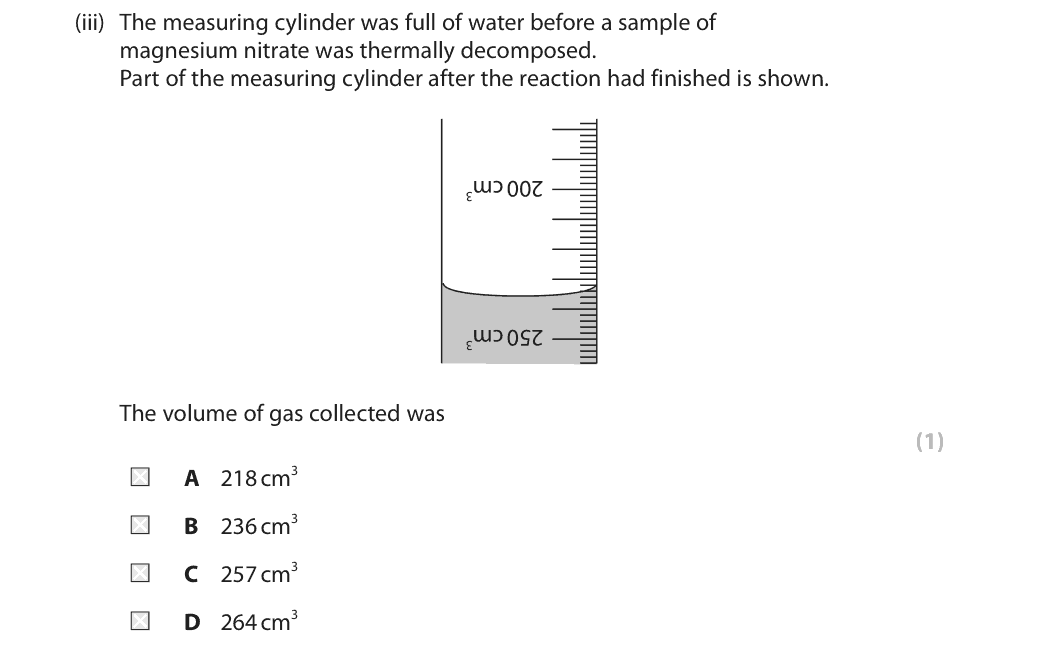
The measuring cylinder was full of water before a sample of
magnesium nitrate was thermally decomposed.
Part of the measuring cylinder after the reaction had finished is shown.
The volume of gas collected was
A  218 cm3
B  236 cm3
C  257 cm3
D  264 cm3
June 2025 · AS Paper 1 · Q4(b)(iv) 4 marks Calculation formulae equations and amounts of substance
Earlier parts of question 4 that this part usesEarlier part of June 2025 Paper 1 question 4Earlier part of June 2025 Paper 1 question 4Earlier part of June 2025 Paper 1 question 4Earlier part of June 2025 Paper 1 question 4
The sample of magnesium nitrate had a mass of 2.966 g.
Calculate the molar volume of the gas collected, giving your answer to
3 significant figures. Include units in your answer.
You should assume that the decomposition was complete.
The volume of gas was measured at standard temperature and pressure.
Use of pV = nRT is not required.
[Mr of magnesium nitrate = 148.3]
June 2025 · AS Paper 1 · Q4(b)(v) 2 marks Explanation Hard formulae equations and amounts of substance
Earlier parts of question 4 that this part usesEarlier part of June 2025 Paper 1 question 4Earlier part of June 2025 Paper 1 question 4
Explain why three significant figures is appropriate for the answer in
this calculation.
June 2025 · AS Paper 1 · Q5(a)(i) 2 marks Short answer Easy atomic structure and the periodic table
The metal zinc (a d-block element) is chemically similar to magnesium
(a Group 2 element). One reason for this is because both elements form
ionic compounds containing stable 2+ ions.

Complete the electronic structure of the Zn atom and of the Mg2+ ion.
Zn
1s2
Mg2+
1s2
June 2025 · AS Paper 1 · Q5(a)(ii) 2 marks Explanation Hard atomic structure and the periodic table
Earlier part of question 5 that this part usesEarlier part of June 2025 Paper 1 question 5
Explain, in terms of ionisation energies, why zinc and magnesium both form
stable 2+ ions.

June 2025 · AS Paper 1 · Q5(b)(i) 1 mark Short answer Easy atomic structure and the periodic table
Earlier part of question 5 that this part usesEarlier part of June 2025 Paper 1 question 5
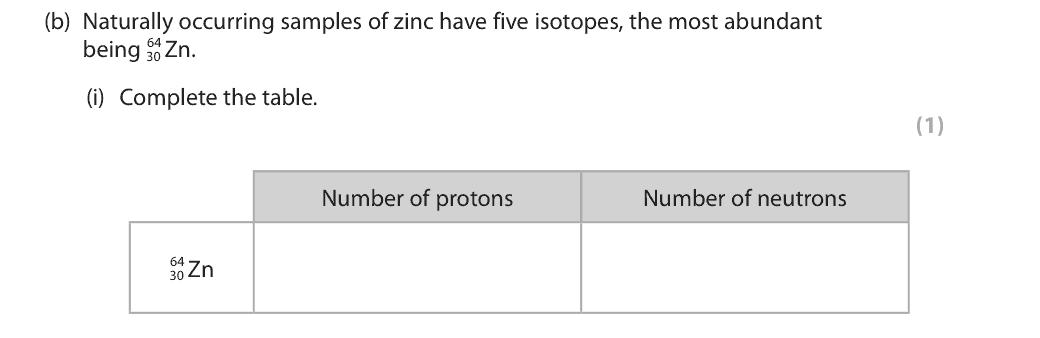
Naturally occurring samples of zinc have five isotopes, the most abundant
being 30
64 Zn.
Complete the table.
Number of protons
Number of neutrons
64 Zn
30
64 Zn = 63.929.
June 2025 · AS Paper 1 · Q5(b)(ii) 1 mark Short answer Hard atomic structure and the periodic table
Earlier parts of question 5 that this part usesEarlier part of June 2025 Paper 1 question 5Earlier part of June 2025 Paper 1 question 5
The relative isotopic mass of 30
Give the reason why the relative isotopic mass is not exactly 64.
June 2025 · AS Paper 1 · Q5(b)(iii) 4 marks Calculation atomic structure and the periodic table
Earlier parts of question 5 that this part usesEarlier part of June 2025 Paper 1 question 5Earlier part of June 2025 Paper 1 question 5Earlier part of June 2025 Paper 1 question 5
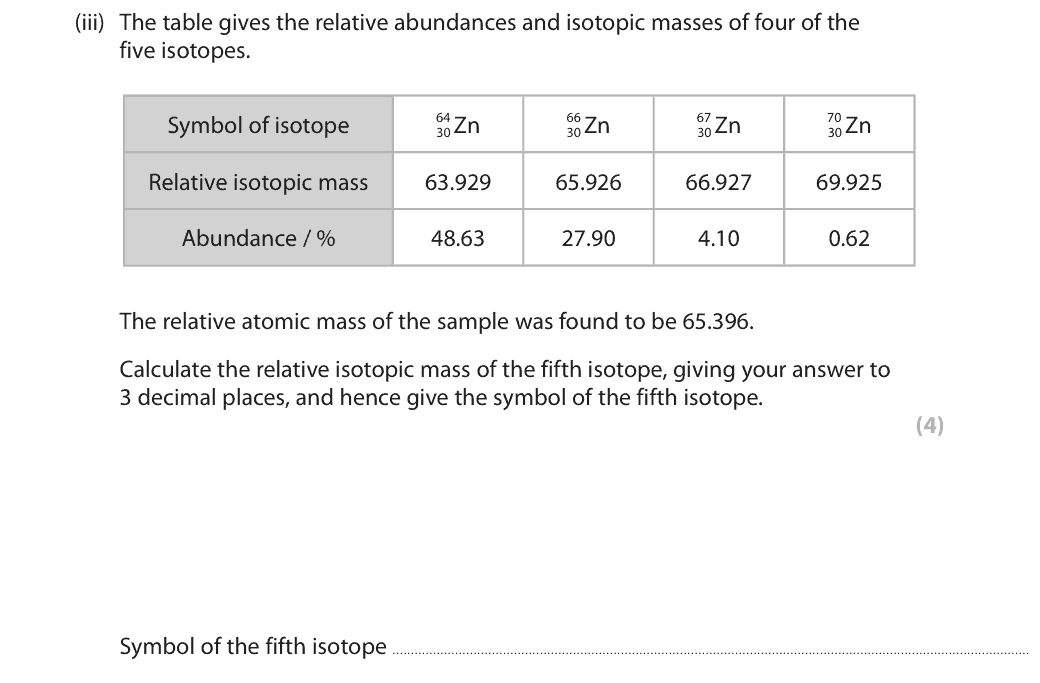
The table gives the relative abundances and isotopic masses of four of the
five isotopes.
Symbol of isotope
64
30 Zn
66
30 Zn
67
30 Zn
70
30 Zn
Relative isotopic mass
63.929
65.926
66.927
69.925
Abundance / %
48.63
27.90
4.10
0.62
The relative atomic mass of the sample was found to be 65.396.
Calculate the relative isotopic mass of the fifth isotope, giving your answer to
3 decimal places, and hence give the symbol of the fifth isotope.
Symbol of the fifth isotope
June 2025 · AS Paper 1 · Q5(b)(iv) 1 mark Calculation Hard formulae equations and amounts of substance
Earlier parts of question 5 that this part usesEarlier part of June 2025 Paper 1 question 5Earlier part of June 2025 Paper 1 question 5Earlier part of June 2025 Paper 1 question 5Earlier part of June 2025 Paper 1 question 5
The mass of an atom of  64
30 Zn = 1.06157 × 10⁻²² g.
Calculate the value of the Avogadro constant using the mass of this atom and
the relative isotopic mass, giving your answer to an appropriate number of
significant figures. You must show your working.
June 2025 · AS Paper 1 · Q5(c) 4 marks Calculation formulae equations and amounts of substance
Earlier part of question 5 that this part usesEarlier part of June 2025 Paper 1 question 5
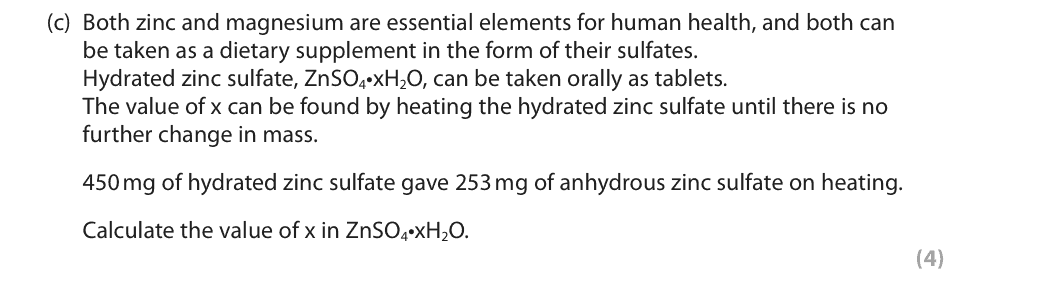
Both zinc and magnesium are essential elements for human health, and both can
be taken as a dietary supplement in the form of their sulfates.
Hydrated zinc sulfate, ZnSO4•xH2O, can be taken orally as tablets.
The value of x can be found by heating the hydrated zinc sulfate until there is no
further change in mass.
450 mg of hydrated zinc sulfate gave 253 mg of anhydrous zinc sulfate on heating.
Calculate the value of x in ZnSO4•xH2O.
June 2025 · AS Paper 1 · Q6(a)(i) 2 marks Practical and data analysis formulae equations and amounts of substance
When potassium iodide and concentrated sulfuric acid are mixed, several
reactions occur.
The equation for one of these reactions is shown.
8KI   +   9H2SO4   →   4I2   +   8KHSO4   +   H2S   +   4H2O
Explain how the equation indicates that the reaction should be carried out in
a fume cupboard rather than in the laboratory.
June 2025 · AS Paper 1 · Q6(a)(ii) 2 marks Practical and data analysis group 7 the halogens
Earlier part of question 6 that this part usesEarlier part of June 2025 Paper 1 question 6
Give two observations that would be made when the reaction shown by the
equation is carried out in a fume cupboard.
June 2025 · AS Paper 1 · Q6(b) 1 mark Multiple choice redox i
Earlier part of question 6 that this part usesEarlier part of June 2025 Paper 1 question 6
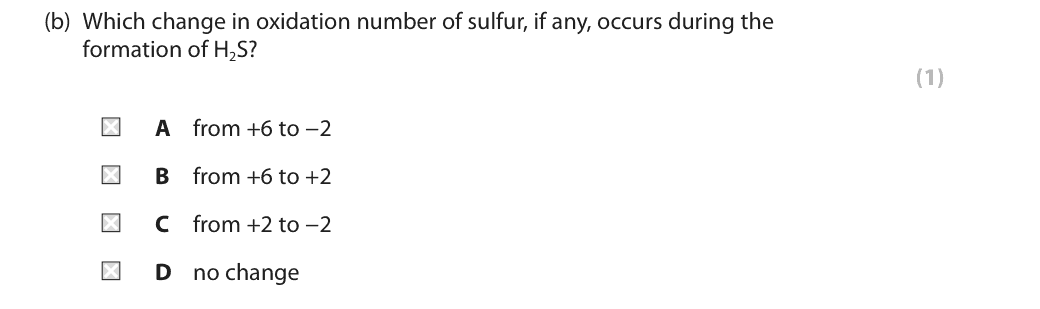
Which change in oxidation number of sulfur, if any, occurs during the
formation of H2S?
A  from +6 to −2
B  from +6 to +2
C  from +2 to −2
D  no change
June 2025 · AS Paper 1 · Q6(c) 2 marks Equation writing Hard redox i
Earlier part of question 6 that this part usesEarlier part of June 2025 Paper 1 question 6
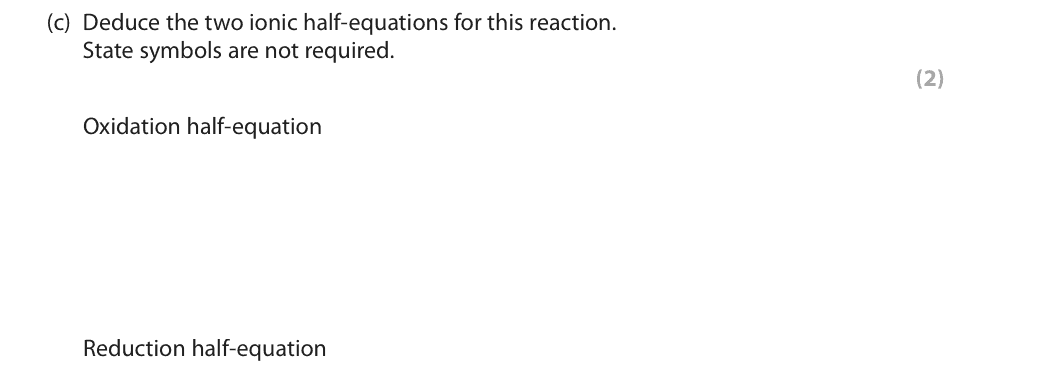
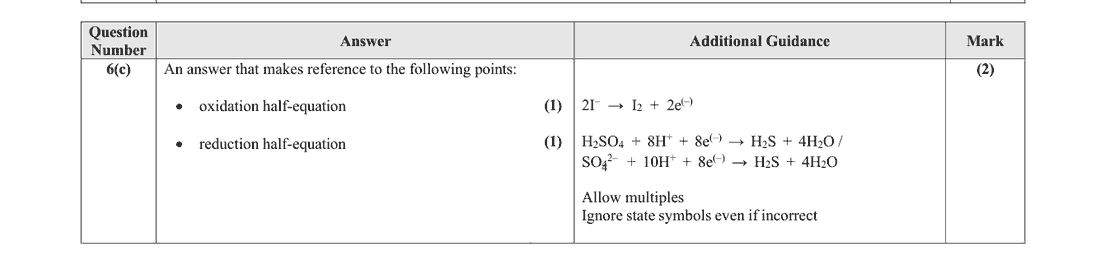
Deduce the two ionic half-equations for this reaction.
State symbols are not required.
Oxidation half-equation
Reduction half-equation
June 2025 · AS Paper 1 · Q6(d)(i) 1 mark Short answer group 7 the halogens
Earlier part of question 6 that this part usesEarlier part of June 2025 Paper 1 question 6
When potassium chloride and concentrated sulfuric acid are mixed, misty fumes
are observed from the only reaction that occurs.
Identify, by name or formula, the misty fumes.
June 2025 · AS Paper 1 · Q6(d)(ii) 2 marks Explanation Hard group 7 the halogens
Earlier parts of question 6 that this part usesEarlier part of June 2025 Paper 1 question 6Earlier part of June 2025 Paper 1 question 6
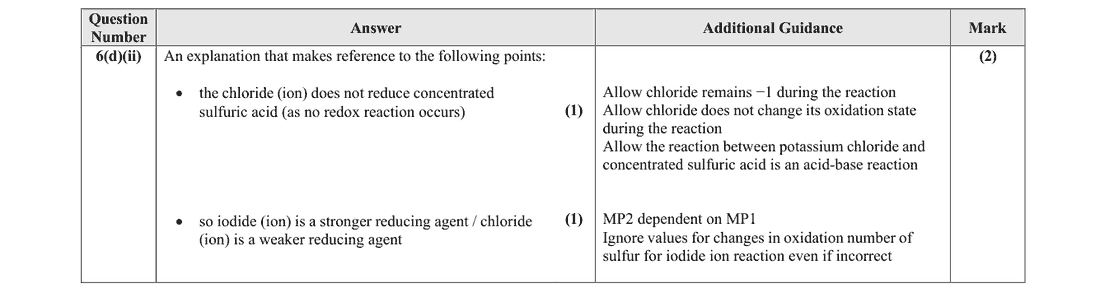
Explain what this observation indicates about the relative strength of the
chloride ion and the iodide ion as reducing agents.
June 2025 · AS Paper 1 · Q7(a) 2 marks Explanation atomic structure and the periodic table
This question is about periodic properties of elements.
Explain why the atomic radius decreases across Period 3 from sodium to chlorine.
June 2025 · AS Paper 1 · Q7(b) 1 mark Multiple choice atomic structure and the periodic table
Which equation does not represent the reaction that occurs during the
first ionisation energy for a Period 2 element?
A
B(g)  →   B+(g)   +   e−
B
C(g)  →   C+(g)  +   e−
C  ½N2(g)   –   e−   →   N+(g)
D  . Ne(g)  –   e−   →   Ne+(g)
June 2025 · AS Paper 1 · Q7(c) 1 mark Multiple choice bonding
Which isoelectronic ion has the smallest ionic radius?
A  F–
B  Mg2+
C  Na+
D  O2–
June 2025 · AS Paper 1 · Q7(d) 6 marks 6-mark extended response atomic structure and the periodic table
Earlier part of question 7 that this part usesEarlier part of June 2025 Paper 1 question 7
The graph shows the first ionisation energy values across Period 3.
1600
1400
1200
1000
Ionisation energy
/ kJ mol–1
800
600
400
200
0
Na
Mg
Al
Si
P
S
Cl
Ar
Explain these changes in first ionisation energies.
June 2025 · AS Paper 1 · Q8 6 marks Calculation formulae equations and amounts of substance
Ferrocene is a compound containing iron, carbon and hydrogen only.
The amounts of carbon and hydrogen in a sample can be determined using the
apparatus shown.
0.830 g of ferrocene
pure
unused
oxygen
oxygen
heat
solid absorbing
carbon dioxide
solid absorbing water
The hydrogen atoms from the sample react with oxygen to form water, which is
absorbed in the first U-tube.
The carbon atoms react with oxygen to form carbon dioxide, which is absorbed in the
second U-tube.
A 0.830 g sample of ferrocene was analysed using this apparatus.
The table shows the mass of the U-tubes before and after combustion.
Mass before combustion / g
36.34
U-tube containing solid
absorbing water
Mass after combustion / g
36.74
Mass before combustion / g
35.28
U-tube containing solid
absorbing carbon dioxide
Mass after combustion / g
37.23
Mass spectrometry shows that ferrocene has a molecular ion peak at m / z = 186.
Deduce the molecular formula of ferrocene using all of the data.

Work with an A-level chemistry tutor

Want a paper marked and gone through with you? Message us.

Prefer email? Send an enquiry

If you are under 18, please include a parent's contact details. Enquiries go to enquiries@chemistryaleveltutor.com and are deleted once handled. All tutoring is online.